HAL Id: hal-01337724
https://hal.inria.fr/hal-01337724
Submitted on 27 Jun 2016
HAL
is a multi-disciplinary open access
archive for the deposit and dissemination of
sci-entific research documents, whether they are
pub-lished or not. The documents may come from
teaching and research institutions in France or
L’archive ouverte pluridisciplinaire
HAL
, est
destinée au dépôt et à la diffusion de documents
scientifiques de niveau recherche, publiés ou non,
émanant des établissements d’enseignement et de
recherche français ou étrangers, des laboratoires
Computation by interaction for space-bounded
functional programming
Ugo Dal Lago, Ulrich Schöpp
To cite this version:
Ugo Dal Lago, Ulrich Schöpp. Computation by interaction for space-bounded functional programming.
Information and Computation, Elsevier, 2016, 248, �10.1016/j.ic.2015.04.006�. �hal-01337724�
Computation by Interaction for Space-Bounded Functional Programming
Ugo Dal Lagoa, Ulrich Sch¨oppbaUniversit`a di Bologna, Italy and INRIA, France bLudwig-Maximilians-Universit¨at M¨unchen, Germany
Abstract
We consider the problem of supporting sublinear space programming in a functional programming language. Writing programs with sublinear space usage often requires one to use special implementation techniques for otherwise easy tasks, e.g. one cannot compose functions directly for lack of space for the intermediate result, but must instead compute and recompute small parts of the intermediate resulton demand. In this paper, we study how the implementation of such techniques can be supported by functional programming languages.
Our approach is based on modelling computation by interaction using the Int construction of Joyal, Street & Verity. We derive functional programming constructs from the structure obtained by applying the Int construction to a term model of a given functional language. The thus derived core functional languageintmlis formulated by means of a
type system inspired by Baillot & Terui’s Dual Light Affine Logic. It can be understood as a programming language
simplification of Stratified Bounded Affine Logic. We show that it captures the classesflogspaceandnflogspaceof the
functions computable in deterministic logarithmic space and in non-deterministic logarithmic space, respectively. We illustrate the expressiveness ofintmlby showing how typical graph algorithms, such a test for acyclicity in undirected
graphs, can be represented in it.
1. Introduction
A central goal in programming language theory is to design programming languages that allow a programmer to express efficient algorithms in a convenient way. The programmer should be able to focus on algorithmic issues as much
as possible and the programming language should give him or her the means to delegate inessential implementation details to the machine.
In this paper we study how a programming language can support the implementation of algorithms with sublinear space usage. Sublinear space algorithms are characterised by having less memory than they would need to store their input. They are useful for computing with large data that may not fit into memory. Examples of concrete application scenarios are streaming algorithms [35], web crawling,gpucomputing, and statistical data mining.
We focus in particular on algorithms with logarithmic space usage. A common intuition of such algorithms is that they access externally stored large data using only a fixed number of pointers. A typical example is that of large graphs, where the pointers are references to graph nodes. To encode a pointer to a node of a graph withnnodes, one needs spaceO(logn). Logarithmic space graph algorithms are therefore often thought of as algorithms that work with only a constant number of pointers to graph nodes. Another typical example of large data are long strings. In this case the pointers are character positions.
While logarithmic space algorithms can only store a fixed number of pointers, they can produce large output that does not fit into memory. They do so by producing the output bit by bit. A program that outputs a graph would output the graph nodes one after the other, followed by a stream of the pairs of nodes that are connected by an edge. The program may not have enough memory to store the whole output all at once, but it can produce it bit by bit.
When writing programs with logarithmic space usage, one must often use special techniques for tasks that would normally be simple. Consider for example the composition of two programs. In order to remain in logarithmic space, one cannot run the two algorithms one after the other, as there may not be enough space to store the intermediate result. Instead, one needs to implement composition without storing the intermediate value at all. To compose two programs, one begins by running the second program and executes it until it tries to read a bit from the output of the first program. Only then does one start the first program to compute the requested bit, so that the execution of the second program can
be continued. Running the first program may produce more output than just the required bit, but this output is simply discarded. In this way, the two programs work as coroutines and the output of the first program is only computed on demand, one bit at a time.
Implementing such on-demand recomputation is tedious and error-prone. We believe that programming language support should be very useful for the implementation of algorithms that rely on on-demand recomputation of intermedi-ate values. Instead of implementing composition with on-demand recomputation by hand, the programmer should be able to write function composition in the usual way and have a compiler generate a program that does not store the whole intermediate value.
In this paper we ask: How can the implementation of functions with logarithmic space usage be supported in a programming language? We follow the approach of viewing logarithmic space computation as computation with a fixed number of pointers. Algorithms that use a fixed number of pointer values are not hard to capture by first-order programming languages. Suppose we use a typeintof unsigned integers to represent pointers. Then computation with a fixed number of pointers simply becomes computation with a fixed number ofint-values. In imperative programming, this may be captured by a while-language [26]; in functional programming it may be captured by programs that are restricted to first-order data and tail recursion [27].
But how should we represent large data like externally stored graphs or large intermediate results that should only be recomputed in small parts on demand? First, we need some way to use the pointers to actually access some large data. If we work with a large graph, for example, and pointers are justint-values, then we need some way of finding out whether or not there is an edge between the nodes reference by two pointers. It would be easy to extend a programming language with primitive operations for this purpose if we only had a single fixed large input graph. But we would like to treat large data much like first-class values that can be passed around and transformed in the program. Therefore, we must explain how to access large data and how to construct it, not just for a the input and output, but also for intermediate results computed by the program itself.
In this paper we propose to model large data as interactive entities. The idea is to formalise the intuition that large data is never computed all at once, but that pieces of data are requested when they are needed. For example, a large graph may be represented by an entity that takes pairs of pointers to nodes as requests and that answers with true or false depending on whether or not there is an edge in the graph. Large strings can be represented similarly as entities that take requests for character positions and that answer with the character at that position.
Such interactive entities may be presented to the programmer as functions that map requests to answers. A large string can be represented by its length together with a function of typeint→charthat returns the character at the given position (if it is smaller than the length). Graphs can be represented by the number of nodes together with a functionint×int→boolthat tells whether there is an edge between two nodes. Such functional representations of data are suitable for on-demand recomputation. In practical implementations of functional programming languages, the values of typeint→charare not stored by the whole graph of the function. Rather, they are given by code that can compute a character for any given integer when required.
In a higher-order functional programming language, such functional representations of data can be used as first-class values. To represent strings, we may use the typeString:=int×(int→char) of pairs of the word length and a function mapping positions to characters. A predicate on strings then becomes a higher-order function of type String→bool. To work with strings, one may define basic operations directly, e.g.consc:String→Stringfor prepending a characterc:
consc = λx.lethn,wi=xinhn+1, λi.ifi=0thencelsew(i−1)i .
Having defined a suitable set of such operations, one does not need to know the encoding details of the string type anymore and can use it as if it were a normal data type with operations. It is then not visible that strings may be too large to fit into memory.
In this paper we show that this higher-order functional programming approach can be used for implementing algorithms with logarithmic space usage. We argue that the higher-order approach captures typical algorithms with logarithmic space in a natural way. Suppose we have a programpof typeString → String; a simple example would beλx.consc(consd x). Suppose we have a large externally stored string that we want to use as an input for this program. We can construct a valuehn,wiof typeString, wherenis the length of the string andwis a function that when invoked with argumentihas the effect of looking up thei-th character of the externally stored string (perhaps by
sending a network request to a database or similar). Now we can applyptohn,wiand obtain a term of typeString. We use it to compute the characters of the result string one by one by applying the returned function to 0, 1, 2, etc. Each time we ask for a character, the program will request from the input word the characters that it needs to compute the requested character. This corresponds well to the on-demand recomputation that one finds in algorithms with logarithmic space usage. But of course we have to be careful if we want to remain within logarithmic space. With higher-order functions the restriction to tail recursion no longer guarantees that programs only store a constant number of pointers during evaluation. Indeed, with acps-translation any recursive program can be brought into a tail recursive
form.
In this paper we show that higher-order functions are nevertheless suitable for the implementation of functions with logarithmic space usage in a functional language. We show how to combine computation with a fixed number of pointers with higher-order functions in a functional programming language. We explain how one can extend a simple first-order language for programming with a fixed number of pointers with higher-order functions in such a way that programs are still guaranteed to use no more than a fixed number of pointers. The higher-order extensions will in fact be fully definitional in the sense that any higher-order program will be translated to a first-order program. Since our first-order programs cannot use more than a finite number of pointers, this property will then be true for higher-order programs as well.
In this paper we work this out in the form of a minimal functional programming language,intml, for programming
with logarithmic space. Theintmltype system is conceptually simple, and, with the type inference procedure of [11],
which is outlined in Section 2.3.1, it is also relatively easy to use. Nevertheless, we argue that the type system is strong enough to allow logarithmic space algorithms to be written in a natural way.
1.1. Organising Interactive Computation
The heart of the definition of intmlis the construction of higher-order functions in a first-order language that
computes with a fixed number of pointers only. This construction is an instance of the Int-construction [28], see Section 5.7. We begin with a simple first-order language that captures computation with a fixed number of pointers. We then study how this language can implement interactive processes, such as the logarithmic space algorithms that access their input by requesting it piece by piece. This model of interactive computation can interpret higher-order functions, which is whatintmlmakes available directly to the programmer. The point is that the whole construction is such that in
the end all computation will happen in the first-order language. Even with higher-order functions, programs use no more than a fixed number of pointers and thus remain within logarithmic space.
For an informal explanation of the construction, the details of the first-order base language for computing with a fixed number of pointers are not very important. Assume given a first-order programming language with types type int, 1 (a unit type),A+AandA×Athat captures a suitable form of computation with a fixed number of pointers.
Assume that it has the usual terms for these types and also a loop construct for possibly nonterminating iteration. A first-order program of typeA→Bis a program that takes a value of the first-order typeAas input and that returns a value of the first-order type outputB. Our first-order programs do not have state and always return the same answer for the same input. For now, the reader may think of programs of typeA→Bsimply as partial functions from the values of typeAto the values of typeB. More details can be found in Section 2.1, but they should not be needed for now.
The construction of higher-order functions is based on a systematic analysis of on-demand interactive computation. The interface of an interactive entityXcan be represented by a pair of first-order types (X−,X+), whereX−is the type of all the requests that may be sent to the entity andX+is the type of all possible answers. For a representation of long strings, one may chooseString−to be a type that can encode the questions “What is the length of the string?” and “What is thei-th character?”. The typeString+would be chosen to encode the possible corresponding answers. An implementation of the interfaceXis a first-order program that mapsX−toX+and thus explains how to answer requests.
In computation with logarithmic space one often finds the situation that one has access to one interactive entity X=(X−,X+) representing the input and one wants to implement another interactive entityY=(Y−,Y+) representing the output. This can be done without higher-order types by a first-order program of type f: X++Y−→X−+Y+. It explains how to answer requests to interfaceY, given that one can answer requests to interfaceX. To answer a request inY−, we applyf to it. If the result is inY+, then this is our answer. If it is inX−, then we can answer that request with an element ofX+and then apply f to this answer. We repeat this until we get an answer inY+(i.e. possibly forever).
Let us think of the first-order program function f as a message-passing node with two input wires and two output wires as drawn below:
f X+
Y+ X−
Y−
When an input value arrives on an input wire then f is applied to it and the resulting output value (if any) is passed along the corresponding output wire.
We will draw the two edges for X− and X+ as a single edge in which messages may travel both ways (and likewise forY). Thus we obtain the node depicted below, whose edges are bidirectional in the sense that an edge with labelX=(X−,X+) allows any message fromX+to be passed in the forward direction and any message fromX−to be passed in the backwards direction:
f X Y
Message passing nodes can be connected to form message-passing circuits. The compositiong◦ f:X →Zof f: X→Yandg:Y→Zas shown on the left below is obtained simply by connecting the two nodes. The underlying first-order program of typeX++Z−→Z++X−is most easily described in terms of message passing:
f X Y g Z f X+ Y+ X− Y− g Z+ Z−
An input inX+is given to f and one inZ−tog. If eitherf orggive an output inX−orZ+then this is the output of g◦ f. If, however, f (resp.g) outputs a message onY+(resp.Y−), this message is given as an input tog(resp. f). This may lead to a looping computation andg◦ f may be partial even whengandf are both total.
This simple model of interactive computation can be used to support higher-order functions.
Thunks. As base type, one may take the interfaces of the form [A] :=(1,A) for any typeA. The single value of type 1
signals an explicit request for a value of typeA, which may be provided as an answer. Thus, one may think of [A] as a type of thunks that are evaluated on demand.
Pairs. The interfaceX⊗Y :=(X−+Y−,X++Y+) corresponds to a pair type. It may be used to represent entities that provide both an implementation ofXand one ofY. The intention is that a query inX−is answered with an answer inX+, and likewise forY. In conjunction with pairs, the empty interfaceI:=(∅,∅) is sometimes useful, asX⊗IandX can be considered as the same interface.
A message-passing node f of typeX⊗Y →Zcan be understood as a message passing node with two inputs; we depict it as shown below. It corresponds to a program of type (X++Y+)+Z−→(X−+Y−)+Z+. It is indicated on the right below, which type of messages should be passed in which direction along which wire.
f Z Y X X+ X− f Y+ Y− Z− Z +
With this understanding, we can construct more complicated message passing circuits. For instance, given h:X→V⊗U,g:V⊗W →Iandk:Y⊗Z→W, we can construct the following circuit.
h Z X Y U k g V X Z U Y W
Figure 2: A circuit and its schematic notation
In this circuit, an element ofU−may be passed tohagainst the direction of the output wire. With this input, the nodeh may then perhaps decide to pass an element ofV+along the wire togor to return an element ofX−to the environment. It may also go into an infinite loop, in which case the whole computation will be blocked. Also, message passing inside the circuit may go on indefinitely in an infinite loop.
When only the interface of a circuit, but not its detailed implementation, is important, then we will only show a schematic notation of the circuit, as shown on the right in Fig. 2.
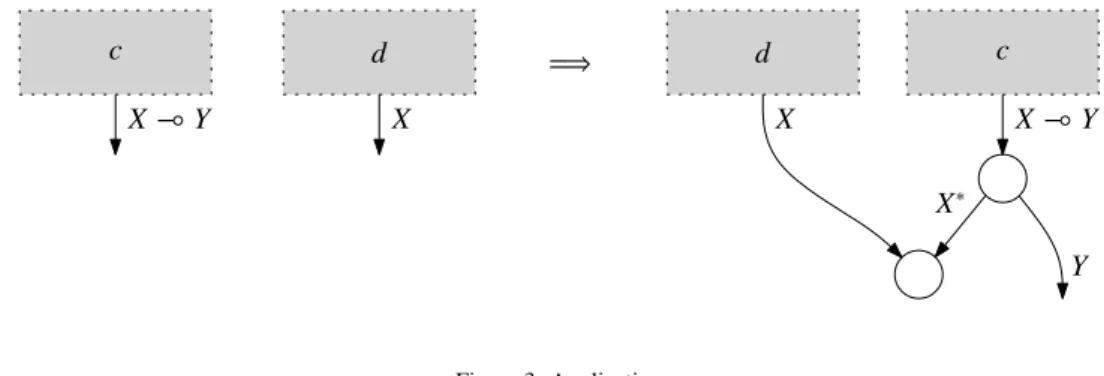
Functions. Importantly, it is possible to model higher-order functions as interactive entities. We can define an interface X (Yfor functions fromXtoY by letting (X (Y)−:=X++Y−and (X(Y)+:=X−+Y+. To understand this,
suppose we have an implementation of this interfaceX(Yand implementation of interfaceX, as shown on the left in
the figure below. Then we can connect them to obtain an implementation of interfaceYas shown on the right below. In this figure,X∗denotes the interface obtained by exchanging question and answer types, i.e. (X−,X+)∗:=(X+,X−). The two unlabelled nodes are forwarding nodes. For each message arriving at either of these nodes, there is exactly one possible choice of outgoing wire of the same type, and the message is just sent along this wire. For example, the node of type (X(Y)→X∗⊗Y must be implemented by a program mapping (X(Y)++(X∗⊗Y)−=(X−+Y+)+(X++Y−) to (X(Y)−+(X∗⊗Y)+=(X++Y−)+(X−+Y+) and there is just one canonical program of this type.
X(Y X X X(Y
Y X∗
c d =⇒ d c
Figure 3: Application
One may think ofX(Yas a way of formalising program parameterisation. A circuit implementing this interface
has the property that when it is linked to a circuit implementing interfaceXas shown above, then the resulting circuit implements interfaceY. In this sense,X(Y can be thought of as a type of functions fromXtoY.
Another way of thinking about the interfaceX(Y =(X++Y−,X−+Y+) is in terms of interactive semantics, such as game semantics [2, 24] or the Geometry of Interaction [18]. If one wants to know the result of the function, one sends it a query fromY−for the result. The function may directly answer this request with an answer fromY+. Or, it may respond with a request inX−for its argument. The environment can answer this request by passing the answer inX+as a new ‘question’ to the function.
Subexponentials. A final important construction in our simple model of interactive computation is that of subexponen-tials. The message-passing nodes that make up circuits are all stateless, being just programs of the stateless first-order language that we started with. They cannot remember any information from one request to the next.
This is a severe restriction on the expressiveness of functions. Suppose, for example, thatStringis an interface that allows us to access long strings by requesting the characters one by one. Predicates on such strings may be given the typeString([bool], whereboolis a type of booleans with valuestrueandfalse. Suppose we want to implement such a predicate. Then we cannot store any information between one request to the string and the next. This means that we cannot even decide whether or not the first and the second character of the string are the same. We need to request both characters and there is no way to remember the first character while we request the second one.
Subexponentials are a way of storing first-order data across a request to some entity. For any interfaceXand any first-order typeA, we define the subexponentialA·Xby (A×X−,A×X+). A requestha,mi ∈A×X−is intended to mean ‘Please answer the requestmand remind me ofawhen you give the answer’. An answer toha,mihas the form
ha,pi, wherepanswersm. The invariant of subexponentials is thatais always returned unchanged. Because of this invariant, subexponentials can be used for data storage. The interfaceA·Xin effect allows us to put any element ofA
to the side, make a request toXand retrieve the element ofAwhen an answer arrives. This is much like local variables are preserved across function calls in machine code by using a call stack.
The above example of checking whether the first two characters of a string are the same, can be defined with type ((1+char)·String)([bool]. The subexponential 1+charis chosen so that we do not store anything when making the first request to the string (hence the 1) and that we store the first returned character across the second request (hence thechar).
One situation that will often arise is that we have a function of typeA·X (Ythat we would like to apply to
an argument of typeX. Above we have only explained the application ofX(YtoX. What we need is to turn an
implementation of interfaceXinto one of interfaceA·Xin such a way that values of typeAin the first component are always returned unchanged. On the level of circuits this is easy to do. We can change the circuit forXso that each wire of typeZbecomes a wire of typeA·Z. The nodes pass on the value of typeAunchanged and otherwise behave as before.
1.2. Overview
In this paper we develop the functional programming languageintml. It is constructed from a simple first-order
programming language as abase language. Intmlis obtained by adding to this base language a new class of types and
terms that allows us to construct message passing circuits whose nodes are implemented in the base language. We call this theinteractive language. The new types represent interfaces of wires in message-passing circuits, as outlined above. Inintmlwe use types of the form [A],X⊗YandA·X(Y. The terms of the interactive language, which are
much like in a standard functional programming language, represent the circuits themselves.
By constructingintmlin this way we obtain a language that allows the programmer to work both in the base and
in the interactive language. This reflects our experience with writing programs with logarithmic space usage. The interactive language allows the programmer to work with large data. The base language can be used work with small data and to manipulate pointers directly. It seems to be useful to keep such a distinction, as restrictions that need to be imposed on the manipulation of large data in order to remain in logarithmic space are not necessary for small values. We introduceintmlin Section 2. The following Sections 3 and 4 contain programming examples and explain how
logarithmic space graph algorithms can be represented inintml. In Section 5 we show in detail how higher-order
functions inintmlare translated to message-passing circuits and thus reduced to first-order programs. In Section 6 we
use this reduction to prove soundness and completeness ofintmlfor the functions computable in logarithmic space.
This paper develops and expands the material first presented atesop 2010 [10]. It takes into account further
developments fromaplas2010 [11] andaplas2011 [43]. We discuss related work in Section 7.
1.3. Contribution
The main contribution of this paper is to identify a higher-order functional language and a translation to circuits that can be evaluated using logarithmic space. The idea of translating programs to circuits by means of interpretation in an interactive model is not new. In the literature one can find a number of higher-order functional languages, such as [32, 23], that are translated to circuits using this approach. However, without further restrictions one cannot prove that circuits evaluate in sublinear space. Even in languages without recursion, e.g. [23], one may encounter messages of exponential size during circuit evaluation. What is new in this paper is that we show how to refine language and model in order to obtain an expressive language for sublinear space programming. The main issue is the control
of exponentials, which are responsible for size increases in message passing. In order to obtain space bounds, the exponentials must therefore be restricted. The difficulty is to do so without the programming language becoming too
weak. In this paper we argue thatintmlwith its subexponentials represents a good solution to this problem.
Subexponentials makeintmlan expressive higher-order language. For example, we show that it can type the
Kierstead terms, which cannot be typed in similar linear type systems, such as [14]. Moreover, the proof offlogspace
-completeness in this paper is completely straightforward. In earlier work, such as [36, 42], the -completeness proofs were more involved. The expressiveness of intmlis further illustrated by the programming examples, such as in
Section 4. Subexponentials not only give us control over space usage, they also afford an efficient treatment of
controlled duplication. For example, Ghica and Smith [15] treat copying in the language by actual duplication of terms. Here we show how to allow copying by sharing without the need to duplicate parts of the program. Finally, the languageintmlpresented in this paper is the first higher-order language with logarithmic space bounds that allows one
to use (and define!) higher-order combinators such as for tail recursion and call with current continuation.
Compared to [10], this paper includes full proofs of all main results presented there. Moreover, the characterisation of logarithmic space from [10] has been generalised to nondeterminism. The presence not only of higher-order functions but also the ability to define combinators, such as for call/cc or for block-scoped mutable variables like in
Idealised Algol, is the main novelty of the language we present here. Finally, the relation with Joyal, Street & Verity’s Int construction is analysed in more detail and precision. As such, this paper is not just a revised and extended version of previous work, but presents new contributions.
2. IntML
In this section we introduceintmland its type system.
2.1. Base Language
We begin by fixing the details of the base language. We emphasise that this language was chosen mainly for simplicity and that richer languages can be chosen without affecting the construction ofintml. The types of the base
language are generated by the grammar A ::= α int 0 1 A+A A×A .
They are built from type variables, a type of integers and product and coproduct types. We use lowercase Greek letters
α,β,γto range over type variables. The typeintcontains the unsigned integers of some fixed bit-widthk. We define the interactive language without any assumptions on the choice ofk. It shall be possible to evaluate any single program with respect to different choices ofk. Indeed, we shall useintas a type of pointers to access large data, which means that we must choosekdepending on the size of the data. In particular, we representlogspace-algorithms by programs
that are evaluated with respect to different bit-width, depending on the size of the input; see Section 2.1.1.
The terms of the base language are parameterised by a signature ofconstantsC. For any two typesAandB, a signature specifies a setC(A,B) of constants that take an argument of typeAand that have typeB. We assume that any signature contains constants for arithmetic operations{add,sub,mul} ⊆ C(int×int,int) and for (in)equality tests on integers{eq,lt} ⊆ C(int×int,1+1).
The terms of the base language are given by the grammar f,g,h ::= x c(f) ∗ n hf,gi fst(f) snd(f) inl(f) inr(f)
case f of inl(x)⇒g|inr(y)⇒h
letx= f loopg ,
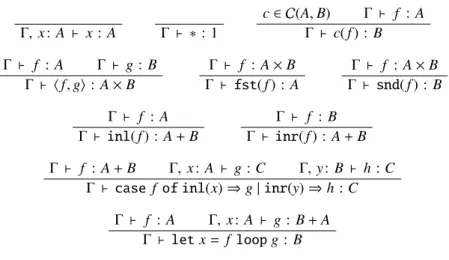
in whichxandyrange over variables,cranges over constants andnranges over integer values. The base language is typed in a standard way. The typing judgementΓ ` f : Astates that term f has typeAin contextΓ. A contextΓ
is simply a finite mapping from variables to base types. The typing rules are given in Fig. 4. There are no linearity restrictions and the following weakening and contraction rules are admissible.
Γ ` f : B Γ, x: A ` f :B
Γ, x: A,y:A ` f : B
Γ, x: A ` x: A Γ ` ∗: 1 c∈ C(A,B) Γ ` f : A Γ ` c(f) : B Γ ` f :A Γ ` g: B Γ ` hf,gi: A×B Γ ` f : A×B Γ ` fst(f) :A Γ ` f : A×B Γ ` snd(f) :B Γ ` f :A Γ ` inl(f) :A+B Γ ` f : B Γ ` inr(f) : A+B Γ ` f : A+B Γ, x: A ` g :C Γ,y: B ` h:C
Γ ` case f of inl(x)⇒g|inr(y)⇒h:C
Γ ` f :A Γ, x:A ` g: B+A Γ ` letx= f loopg :B
Figure 4: Base Language Typing Rules
We explain the base language terms by defining its (unsurprising) operational semantics. It is given by a small-step reduction relation that is parameterised by a natural numberkthat represents the bit-width of all integer values. The set ofvaluesfor bit-widthkis defined by the following grammar
v,w ::= x ∗ n hv,wi inl(v) inr(w) ,
in whichnis an integer that can be represented usingkbits.
The loop constructletx = f loopgis a simple way of capturing iteration in the language. Its operational semantics is defined by the rewrite rule
letx=vloopg →k caseg[v/x]of inl(y)⇒y
|inr(z)⇒(letx=zloopg) .
The special case (letx= f loop inl(g)) evaluates the loop body exactly once. We write (letx= f ing) as an abbreviation for it. We shall also write 2 for 1+1 and use it as a type of booleans. We writetrueforinl(∗),false forinr(∗) and (if f thengelseh) for (case f of inl(x)⇒g|inr(y)⇒h), wherexandyare fresh variables.
The rewrite rules for products and coproducts are standard:
fst(hv,wi) →k v snd(hv,wi) →k w
case(inl(v))of inl(x)⇒ f |inr(y)⇒g →k f[v/x]
case(inr(v))of inl(x)⇒ f |inr(y)⇒g →k g[v/y]
The operational semantics of constants depends on the signatureC. We assume that rewrite rules are specified as part of the signature. The reduction rules for the arithmetic constants are:
add(hv,wi) →k min(v+w,2k−1) eq(hv,vi) →k inl(∗)
sub(hv,wi) →k max(0,v−w) eq(hv,wi) →k inr(∗) ifv,w mul(hv,wi) →k min(v∗w,2k−1) lt(hv,wi) →k inl(∗) ifv<w
lt(hv,wi) →k inr(∗) ifv≥w
For integer constants we letn→k2k−1 for any integer constantnthat exceeds 2k−1. Other integer constants are
follows: E,F,G ::= [·] c(v1, . . . ,vn,E,f1, . . . ,fm) hE,gi hv,Ei fst(E) snd(E) inl(E) inr(E)
caseEof inl(x)⇒g|inr(y)⇒h
letx=Eloopg
A term f is said toreducetogin one step, written f 7→k gif and only if there are an evaluation contextEand two
termsh,psuch thath→k p, f =E[h] andg=E[p]. We write7→∗kfor the reflexive transitive closure of7→k, as usual. Example 1. The following term f can be seen to compute the factorial function. For example, we have f[4/x]7→∗
k24,
provided thatkis large enough that that all numbers can be represented usingkbits. letz=hx,1iloop(letx=fst(z)in
letr=snd(z)in letx0=sub(hx,1i)in
case eq(hx0,0i)of inl(∗)⇒inl(r)
|inr(∗)⇒inr(hx0,mul(hr,xi)i))
Definition 1. Two termsΓ ` f : AandΓ ` g :Aareextensionally equal, if, for any substitutionσthat assigns to
each variablex:BinΓa closed value of typeB, and any closed valuevof typeA, and anyk, we have f[σ]7→∗
kvif and
only ifg[σ]7→∗
kv.
We shall consider a typeAto be smaller than a typeBwhen any closed value of typeAcan be encoded into a closed value of typeB, and encoding and decoding terms can be written in the base language. Formally, this is defined by means of section-retraction pairs.
Definition 2. Asection-retraction pair between typesA and Bin contextΓis a pair of terms s andrsuch that
Γ, x: A ` s: BandΓ,y: B ` r: Aare derivable and such thatΓ, x: A ` r[s/y] :Aand Γ, x: A ` x:A are extensionally equal.
Definition 3. TypeAis aretractofB, writtenA/B, if there exists a section-retraction pair betweenAandBin the empty context.
2.1.1. On Space Usage
Let us briefly discuss the space usage of base term reduction. In the rest of this paper we shall use values of type intto represent pointers into some given input, e.g. as pointers to graph nodes. We will vary the bit-width of base language integers with the size of the input, so that the integer type can represent such pointers. Given an input of sizen, we will choose the bit-width to bedlogne, so thatintcan count at least up ton. This is much like in finite model theory, where logics with counting have a universe as big as the size of the input [25].
With respect to space usage, it is therefore important to understand how much space is needed for term reduction as a function of the bit-width of theinttype. Suppose the bit-width ofintisk. Consider a termx:int ` f :Aand a numbernthat can be represented withkbits. How much space does one need to reduce f[n/x]7→∗
kv, i.e. to compute a
valuev? It is not hard to see that even in a naive implementation of the reduction relation7→kby term rewriting the reduction needs not more thanO(k) space (see Lemma 22). The terms that can appear during reduction all have abstract syntax trees of constant depth, the constant depending only on the term f. They can therefore contain only a constant number ofintvalues, each of which can be encoded usingO(k) bits. One can thus think of base term reduction as computing with a finite number of pointers.
2.2. Interactive Language
The base language is the basis of the definition of intml. To complete the definition, we now introduce the
interactive part of the language. This part adds higher-order functions to the base language. The interactive language can be understood as a way of constructing message-passing circuits, as outlined in the Introduction, in which each
message-passing node is implemented by a base language term. Nevertheless, the interactive language takes the form of a typedλ-calculus that can be described without reference to circuits and that allows one to write programs following a handier functional paradigm.
Interactive types are defined by the grammar X,Y ::= [A]
X⊗Y
A·X(Y ,
in whichAranges over base language types.
The type [A] represents computations that return a value of base typeAif they terminate. One can think of [A] much like a monadic type.
The typeX⊗Yis a type of pairs. We use⊗instead of×to avoid confusion with the product types in the base language.
The typeA·X(Yis a type of functions fromXtoY. It has an annotationA, a base language type, which we call
asubexponential annotation. This annotation is important for space bound control. It can be understood as a stack shape annotation: Whenever the function makes a call to its argument, it puts a value of base typeAon the stack. This value remains there until the call returns. The caller then retrieves the value from the stack for use in the rest of the computation. We write shortX(Yfor the type 1·X(Y. These are functions that do not need to reserve any stack
space when making a call.
We believe that subexponential annotations are best considered as static space usage annotations that are inferred and tracked by a compiler. For a programmer it is usually sufficient to think of the function typeA·X(Y simply as
X→Y. Indeed, subexponential annotations do not appear explicitly in terms.
The terms of the interactive language are defined by the following grammar, in which f ranges over base language terms. s,t ::= x hs,ti lethx,yi=sint λx.t s t [f] let[x]=sint
case f of inl(x)⇒ s|inr(y)⇒t copysasx,yint hack(x.f)
Although the meaning of the various constructs will be clear only when typing rules and reductions are introduced, we can already introduce a classification of the interactive operators:
• First, there areλ-abstraction and application (λx.tands t, respectively), as well as standard terms for linear pairs
(ht,siandlethx,yi=sint).
• Base language terms can appear in interactive terms. First, the term [f] denotes the computation that on request evaluates f to a value. The execution of a computation can be forced using thelet-termlet[x]=sint. The result of base-language computations can influence interactive terms. Thecaseconstruct
casevof inl(x)⇒s|inr(y)⇒t ,
behaves as eithers[w/x] ort[w/y], depending on whethervisinl(w) orinr(w). There is a third, more intricate, way of making use of the base language in the interactive language, namely the operatorhack(x.f), on which we comment at the end of this section and in Section 3.
• The interactive calculus does not allow interactive variables to be used more than once. Controlled duplication is nevertheless possible by means of the termcopytasx,yins. This term captures a form of explicit sharing. There will be only one copy oftand any requests fromsto eitherxorywill be handled by the same copy oft. It would be possible to formulate the type system without explicitcopyterms, such thatcopyis inserted implicitly when a variable is used more than once. While this may indeed be preferable for practical programming, we use explicit terms here for conceptual clarity.
The type system for the interactive language derives typing judgements of the form
Γ|x1:A1·X1, . . . ,xn:An·Xn ` t:Y . (1)
In this judgementΓis a base language context. The sequencex1:A1·X1, . . . ,xn:An·Xnis aninteractive context. It is a
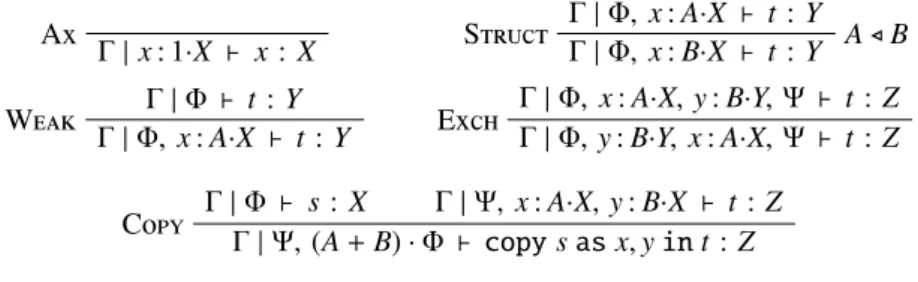
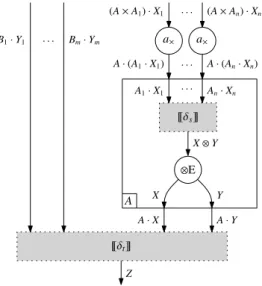
Ax Γ|x: 1·X ` x: X Γ|Φ, x:A·X ` t :Y Struct Γ|Φ, x:B·X ` t :Y A/B Γ|Φ ` t:Y Weak Γ|Φ, x:A·X ` t :Y Γ|Φ, x:A·X,y:B·Y,Ψ ` t:Z Exch Γ|Φ,y:B·Y, x:A·X,Ψ ` t:Z Γ|Φ ` s:X Γ|Ψ, x:A·X,y:B·X ` t :Z Copy Γ|Ψ,(A+B)·Φ ` copysasx,yint:Z
Figure 5: Interactive Typing: Structural Rules
The base language typeAiis a subexponential annotation that allows the type system to control the space usage of
programs. An interactive context may contain at most one declaration for any variable. In the above typing judgement the variablesx1, . . . ,xnmust be therefore be pairwise distinct.
To explain the subexponential annotations, we need to refer to message passing circuits that we have outlined in the Introduction and that will be defined in detail in Section 5. For each interactive typeX, we define two base language typesX−andX+as follows. The informal meaning of these definitions are outlined in the Introduction.
[A]− = 1 [A]+ = A
(X⊗Y)− = X−+Y− (X⊗Y)+ = X++Y+ (A·X(Y)− = A×X++Y− (A·X(Y)+ = A×X−+Y+
The motivation of the interactive type system is that the termtin the typing judgement (1) will be translated to a message passing circuitJtKwith the following interface.
~t
. . .
(Y−,Y+) (A1×X−
1,A1×X1+) (An×X−n,An×Xn+)
Each of the message-passing nodes in this circuit is implemented by a base language term, which may make use of the variables fromΓ. If the interactive termtis closed, then the circuit has no incoming wires and a single outgoing wire.
On the wire going out of the circuit we can send requests of base typeY−and expect answers of base typeY+. To compute the answer, the circuit may need to query any of thexi. It does so by sending a requestha,mi:Ai×Xi−
along thei-th input wire of the circuit. The circuit expects the answer to be of the formha,pi: Ai×Xi+, i.e. it expects
the samea back with the answer. Since circuits are stateless and cannot store any information, this is useful for remembering the valueaacross a call toXi.
We next introduce the typing rules. In them we writeΦ,Ψfor the concatenation of two interactive contextsΦ
andΨ. Note that this is an interactive context only if no variable is declared in bothΦandΨ. We writeA·Φfor the
context obtained by replacing each declarationx:B·XinΦwithx: (A×B)·X. The structural rules in Fig. 5 allow one to
manipulate the contextΦ, which is treatedmultiplicativelyin the logical rules. Rule Axallows one to type a variablex
if the contextΦconsists of the sole declarationx: 1·X. The subexponential annotation 1 means that no additional space
is needed when requests are sent tox. Weakand Exchare standard rules for weakening and context reordering. With
rule Structit is always possible to increase the subexponential annotations on a variable: in the premise of Struct,t
relies on the guarantee that any value of typeAthat it sends together with a request of typeX−toxwill be returned unchanged. IfA/B, then replacingAbyBstrengthens this guarantee. Any value of typeAcan be encoded into one of
typeB, be sent along with the request, and be decoded when it is returned. There may be many ways to encode values of typeAinto typeB. It does not matter which one we choose. All that matters forintmlis that by encoding and then
decoding we get back the value we started from. The definition ofA/Bby a retraction is just enough to guarantee this property. Instead of the general semantic definition ofA/Bby retractions, one may also use syntactic approximations. We refer to [11] for an exploration of possible choices.
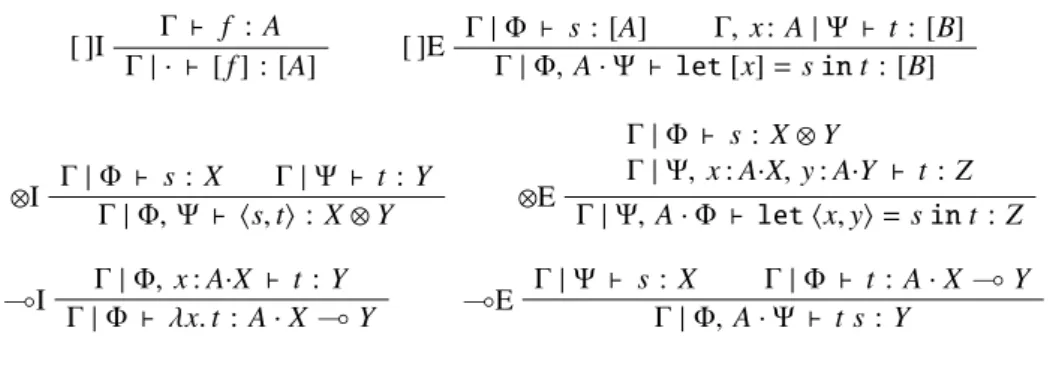
Γ ` f :A [ ]I Γ| · ` [f] : [A] Γ|Φ ` s: [A] Γ, x: A|Ψ ` t : [B] [ ]E Γ|Φ,A·Ψ ` let[x]=sint: [B] Γ|Φ ` s: X Γ|Ψ ` t :Y ⊗I Γ|Φ,Ψ ` hs,ti: X⊗Y Γ|Φ ` s:X⊗Y Γ|Ψ,x:A·X,y:A·Y ` t :Z ⊗E Γ|Ψ,A·Φ ` lethx,yi=sint :Z Γ|Φ, x:A·X ` t :Y (I Γ|Φ ` λx.t :A·X(Y (E Γ|Ψ ` sΓ: X|Φ,A·ΓΨ|Φ` t s` t::YA·X(Y
Figure 6: Interactive Typing: Introductions and Eliminations
Γ ` v: A+B Γ, x: A|Φ ` s:X Γ,y: B|Φ ` t: X
+Ec vis a value
Γ|Φ ` casevof inl(x)⇒s|inr(y)⇒t :X
Figure 7: Interactive Typing: Cross-Eliminations
The structural rules are set up so that no variable in an interactive contextΦmay be used more than once. However,
the calculus does support explicit duplication. A specific term construct serves this purpose, and can be typed by rule Copy. The reader may want to refer to Fig. 12 to get an idea of how the circuits forsandtare connected.
The introduction and elimination rules for the three type formers [−],⊗and(appear in Fig. 6. These rules are
fairly standard for a linearλ-calculus. Only perhaps rules [ ]I and [ ]E for embedding base language computations and for forcing their execution are of note. In rule [ ]E the term (let[x]=sint) allows one to force the computations and bind its value to a variablexin the base language context oft. The value of the thunk thus becomes available int and, as base language contexts are treated additively, this value may be used many times int.
Fig. 7 gives the rules for eliminating base language terms over interactive terms. With our simple base language, we only need a single rule+Ec, which allows one to define interactive terms by case distinction over a base language
term. In this rulevis restricted to be a value and it will typically be a variable. The typical use of thecase-term is of the formlet[x]=sin casexof inl(y)⇒t|inr(z)⇒u. With the exception of Section 6.2, all results in this paper remain true verbatim also if one allows arbitrary base terms forvin rule+Ec.
Theintmltype system is completed by rule Hackin Fig. 8. Rule Hackis the only rule that requires a detailed
understanding of the translation of interactive terms to message passing circuits. This rule allows one to define an interactive term of typeXby giving explicitly a base language term f that implements a message passing node with a single outgoing wire of typeXand no other wires. Therefore, rule Hackcan only be explained properly once the
compilation to circuits that are implemented in the base language has been explained in detail. For now, the reader should consider rule Hacklike a method for inlining C code in an ML program, whose understanding requires a
detailed knowledge of the runtime system.
The other terms can however be understood without any reference to circuits. Below we define an operational semantics for the interactive terms which specifies their meaning. The translation of interactive terms to circuits will then be a space-efficient implementation of this specification.
Γ, x: X− ` f :X+
Hack Γ| · ` hack(x.f) :X
2.3. Typing Examples
We give a first simple example to explain the features of theintmltype system. The term λf. λy.let[x]=yin f [x] [x] : α·(β·[α](γ·[α]([δ])([α]([δ]
defines a function that evaluates a thunky, binds the returned value to variablexand then invokes a function f. When f asks for either of its arguments, the valuexis returned as answer.
In the type,α,β,γandδare type variables that can be instantiated with arbitrary types. Thatβandγare type variables means that no restriction is imposed on the subexponentials in the functions that may be given as argument for f. That the type of the argument f appears underα·(. . .) tells us that a value of typeαis sent along with any request to the function f, and this value is expected to be returned unchanged. In this case, this is the value of the variablex, which has typeα.
The typing judgement of the term is derivable as follows.
Ax − |y: 1·[α] ` y: [α] x:α| f: 1·(β·[α] Π (γ·[α]([δ]) ` f [x] [x] : [δ] [ ]E − |y: 1·[α],f: (α×1)·(β·[α](γ·[α]([δ]) ` let[x]=yin f [x] [x] : [δ] Exch − | f: (α×1)·(β·[α] (γ·[α]([δ]),y: 1·[α] ` let[x]=yin f [x] [x] : [δ] (I − | f: (α×1)·(β·[α] (γ·[α]([δ]) ` λy.let[x]=yinf [x] [x] : [α]([δ] Struct − | f:α·(β·[α] (γ·[α]([δ]) ` λy.let[x]=yin f [x] [x] : [α]([δ] (I − | − ` λf. λy.let[x]=yinf [x] [x] :α·(β·[α] (γ·[α]([δ])([α]([δ]
The sub-derivationΠis shown below. In it we abbreviate (β·[α](γ·[α]([δ]) byT.
Ax x:α| f: 1·T ` f : (β·[α]
(γ·[α]([δ]) [ ]I x: αx:| − `α ` [x] : [x: α α]
(E x:α| f: 1·T ` f [x] :γ·[α]
([δ] [ ]I x:αx:| − `α ` [x] : [x:α α]
(E x:α| f: 1·T ` f [x] [x] : [δ]
Note that the similar termλf. λy.f y yis not well-typed inintml, as the interactive variableyis used twice. However,
the following term can be typed for anyXandY; a typing derivation is constructed below.
λf. λy.copyyasy1,y2inf y1y2 : (β·X(γ·X(Y)((β+γ)·X(Y
This term passes the same thunkyto both arguments off. If f forces both its arguments one after the other, theny will be computed twice. This is in contrast to the above termlet[x]=yin f [x] [x], which first forces the thunky, binds its return value toxand then passes to f the thunks that immediately returnx. In this case the computation inyis executed only once.
2.3.1. Finding Subexponential Annotations Let us use the typing judgement
λf. λy.copyyasy1,y2inf y1y2 : (β·X(γ·X(Y)((β+γ)·X(Y
as an example to explain how subexponential annotations can be found.
The idea is to first use Hindley-Milner type inference to construct a skeleton of the typing derivation without subexponentials. If we leave out all subexponential annotations and useX→Y in place ofA·X(Y, then we obtain
the following skeleton of a derivation for the above term:
− | f: X→X→Y ` f :X→X→Y − |y1:X ` y1 :X − | f: X→X→Y,y1: X ` f y1 :X→Y − |y2:X ` y2 :X − | f:X→X→Y,y1:X,y2: X ` f y1y2 :Y − | f:X→X→Y,y:X ` copyyasy1,y2in f y1y2 :Y − | f:X→X→Y ` λy.copyyasy1,y2in f y1y2 : X→Y − | − ` λf. λy.copyyasy1,y2inf y1y2: (X→X→Y)→X→Y
This is not a properintmltyping derivation. To turn it into one we need to add subexponential annotations. To do so,
add fresh type variables for all missing subexponential annotations. In order to obtain a correct typing derivation, we will need to insert rule Structin a number of places. Without loss of generality, we can assume that Structis being
applied after every rule to each variable in the interactive context. Let us denote these applications of Structby double
lines. We obtain the following annotated skeleton of the derivation.
− | f:α1·(β1·X(β2·X(Y) ` f :β1·X(β2·X(Y − |y1:α2·X ` y1 : X − | f:α3·(β1·X(β2·X(Y),y1:α4·X ` f y1 :β2·X(Y − |y2:α5·X ` y2 : X − | f:α6·(β1·X(β2·X(Y),y1:α7·X,y2:α8·X ` f y1y2 :Y − | f:α9·(β1·X(β2·X(Y),y:α10·X ` copyyasy1,y2in f y1y2 :Y − | f:α11·(β1·X(β2·X(Y) ` λy.copyyasy1,y2in f y1y2 :α10·X(Y − | − ` λf. λy.copyyasy1,y2in f y1y2 :α11·(β1·X(β2·X(Y)(α10·X(Y
Now we simply gather the constraints on the type variablesαiandβiin the side conditions of all the rules in the
derivation and we solve them. The side constraints in the above skeleton are:
• 1/ α1, 1/ α2and 1/ α5from the application of Structafter the axiom rules.
• α1/ α3and (β1×α2)/ α4from the application rule with conclusion f y1. The conclusion of the application rule has context f:α1·(β1·X(β2·X(Y),y1: (β1×α)·Xand applying Structto each of the two variables gives
the two constraints.
• α3/ α6,α4/ α7and (β2×α5)/ α8from the application rule with conclusion f y1y2.
• α6/ α9and (α7+α8)/ α10from the copying rule.
• α9/ α11from the abstraction rule.
Notice that all constraints have the formA/ α, whereαis a type variable that does not appear inA. A number
of such constraintsA1/ α,. . . ,An/ αcan be solved simply by settingα:=A1+· · ·+An. It is not hard to see that
Ai/(A1+· · ·+An) holds fori=1, . . . ,n. This simple observation can be used to solve the constraints one by one.
First we gather all the constraints withα1as an upper bound and solve forα1, then we continue withα2and so on. Using this simple idea, we can find the following solution to the constraints completely mechanically:
α1:=1 α2:=1 α3 :=1 α4:=β1×1 α5:=1 α6 :=1
α7:=β1×1 α8:=β2×1 α9 :=1 α10:=(β1×1)+(β2×1) α11:=1
The definition of/further allows us to apply simplifications, such as usingβ1instead ofβ1×1. We obtain a typing derivation with the claimed type.
2.4. Type Inference
We note that the subexponential annotations in the above examples and all the examples in the rest of this paper were found by the type inference procedure outlined in the example above. It is described in more detail in [11].
We have found that in practice when writing programs one usually does not have to be aware of particular subexponentials in the type. In the above example on copying values, for instance, it is useful to ignore subexponential annotations on functions at first and think of the type as ([α]→[α]→[δ])→[α]→[δ]. Keeping the restrictions on variable duplication and the ways of introducing and eliminating [ ]-types, it is straightforward to come up with the termλf. λy.let[x]=yin f [x] [x]. The precise typeα·(β·[α](γ·[α]([δ])([α]([δ] with subexponential annotations can then be computed using type inference.
We note that with the general definition of/, type inference is a hard problem. The simple and fast type inference procedure described above is incomplete. It may fail to find a type even when one exists. Moreover, even if it finds a typing derivation, it may not find the best one. Often, there will be many solutions for subexponential constraints. The
(λx.s)t→ks[t/x]
lethx,yi=hs,tiinu→ku[s/x][t/y]
case inl(v)of inl(x)⇒s|inr(y)⇒t→ks[v/x] ifvis a value case inr(v)of inl(x)⇒s|inr(y)⇒t→kt[v/y] ifvis a value
let[x]=[v]int→kt[v/x] ifvis a value
copysasx,yinu→ku[s/x][s/y]
[f]→k[g] if f 7→kg
Figure 9: Interactive Language: Closed Reduction Semantics
choice of the solution will affect the space usage of compiled programs. If we use rule Structwith side conditionA/B, then in the final implementation the typeBwill be used to encode values of typeA. Thus, the smaller we chooseB, the less space will be used in the final program. This should illustrate why with the general definition of/, one should expect the inference of the best type to be hard.
In [11] we study the hardness of type inference. We consider a number of possible syntactic approximations of/
and study the computational hardness of type inference with such choices. 2.5. Operational Semantics
While the interactive language will be implemented using message passing circuits, we specify its meaning using a standard reduction-based operational semantics. We emphasise that the following operational semantics is a method of specification only.
The operational semantics of the interactive language is formulated as a set of rewrite rules that are applicable in any evaluation context derivable from the following grammar:
E,F ::= [·] hE,ti ht,Ei lethx,yi=Eint E t t E let[x]=Eint copyEasx,yint
The evaluation contexts do not uniquely specify an evaluation order. Since we implement reduction only in the base language, it is not necessary to do so. We will show soundness for any choice of evaluation order.
The rewrite rules are given in Fig. 9, wheresandtare assumed to beclosedterms, i.e. terms not containing any free occurrence of any variable. Note that thecase-terms is restricted to case distinction on values by the type system. A termt reducestos, writtent7→ks, if there areu,qsuch thatu→kq,t=E[u] ands=E[q]. As in the base language,
the parameterkrepresents the bit-width of integers. In Section 5.6, we show that the translation of interactive terms to message passing circuits is sound with respect to reduction:t7→k simplies that the circuits fortandshave the same message passing behaviour (even if they are not the same).
This completes the definition of the interactive language ofintml. The reader may wonder if in addition to the
various ways of embedding base language terms into interactive terms, it is also possible to embed interactive terms into base terms. It is indeed possible to add to the base language a term (let[x]=tinf) that evaluates a closed interactive thunktand uses the result in a base language term f. In fact, such a term is already admissible, see Corollary 16 in Section 5.6, which is why we have not included it in the definition.
2.6. On Large Data and Space Usage
Base language programs can be understood as programs that store a constant number of pointers. If the bit-width of integers isk, then any base language program evaluates in spaceO(k). The same is true for the interactive language. We will show that the interactive part of the language can be compiled to the base language. Even though the interactive language allows higher-order functions, it can nevertheless be evaluated in spaceO(k). Thus,intmlcan be seen as a
Let us outline with a simple concrete example how we use higher-order functions inintmlto implement sublinear
space algorithms. We consider programs that work on long bit vectors, i.e. long sequences of 0s and 1s. The base language type 2=1+1 can be seen as a type of bits, whereinl(∗) stands for 0 andinr(∗) stands for 1. Bit vectors of lengthncan be represented as a base type value of type 2× · · · ×2 (nfactors), but this representation would not be space efficient. A value of this type has sizeO(n), i.e. it will need linear space.
A higher-order representation of bit vectors is more space-efficient. If we choose the bit-width of the base language
to be logn, then thepositionsin the bit vector can be represented by values of typeint. Bit vectors of lengthncan then be represented by functions of type
A·[int]([2] .
(There may be more thannbits, but we can just ignore superfluous elements.)
First, we explain how large bit vectors can be given as input tointmlprograms. Suppose we have a program of type
A·(1·[int]([2])([2] that represents a predicate on bit vectors. We make no restriction on the subexponential and allow any typeA(we cannot use a type variable as the program may require a type of a particular form, such as 1+B).
Suppose that we have a concrete large vector (e.g. stored in some database) of lengthnthat we would like to pass to the program. The program will translate to a circuit with one outgoing wire with interface (X−,X+).
X = A · ( 1 · [int] ( [2] ) ( [2]
X− = A × ( 1 × 1 + 2 ) + 1
X+ = A × ( 1 × int + 1 ) + 2
To evaluate the program with the bit vector as input, we fix the bit-length of integers to bedlogneand then use the circuit to evaluate the result of the program. The values of typeX−are the messages that we can send to the circuit, the values of typeX+are the possible responses. A typical dialogue with this circuit will be as follows: we send inr(∗): X−(‘What is the value of the predicate?’) to the circuit. A typical answer will beinl(ha,inr(∗)i): X+(‘I would like to know a bit of the input vector. Also, please remind me ofawhen you answer.’). We may answer by sendinginl(ha,inl(h∗,∗i)i): X−(‘Which bit would you like to know? Also, here is theayou asked me to return.’). The reply will beinl(ha,inl(h∗,ni)i): X+(‘I would like to know thei-th bit.’). We may then look up thei-th bitx of the large vector and return it by sendinginl(ha,inr(x)i):X−(‘The requested bit isx.’). This may continue for a while until we receive the final answerinr(p):X+(‘The value of the predicate isp.’). Notice that inX−andX+the summands for requests and answers line up with the interactive type inX. For instance,inr(∗):X−andinr(a): X+ both pertain the type [2].
If large data appears as the output of programs, then it can be requested in a similar way. Suppose we have a closed
intmlterm of typeB·[int]([2], again without restriction on the typeB. The term will be translated to a circuit with
a single outgoing wire with interface (Y−,Y+), in whichY−andY+are base language types: Y = B · [int] ( [2]
Y− = B × int + 1
Y+ = B × 1 + 2
To compute the bit vector we again interact with the circuit. We begin by sending it the messageinr(∗):Y−(‘I would like to know the value of the thunk of type [2] that the function returns.’). The circuit would then typically reply with inl(b,∗):Y+(‘I need to know the argument of the function, i.e. the value of the thunk of type [int]. When you answer this request, please also remind me of valueb.’). Suppose we want to know the character in positioni:int. We then send the messageinl(b,i):Y−(‘The argument thunk has valuei. And you asked me to remind you of valueb.’). To this, the circuit will typically replyinr(p):Y+(‘The thunk returned by the function has valuep.’). The whole bit vector represented by the term of typeA·[int]([2] can now be reconstructed by repeatedly querying the circuit.
Notice that the messages that we send to and receive from the circuits are all base language values of sizeO(k), wherekis the bit-width of integers. Theintmltype system guarantees that the same is true for the messages exchanged
internally in the circuit. The space needed for messages is thus logarithmic in the length of the bit vectors that are represented, which is 2k. It is this basic observation that leads to logarithmic space bounds.
Direct interaction with circuits is needed only to supply the input value and to read offthe output value. Intermediate
be implemented as an interactive program
λx. λy. λz.copyzasz1,z2in let[u1]=x z1in let[u2]=y z2in[xor(u1,u2)] of type
(α·[int]([2])(2·(β·[int]([2])((α+2×β)·[int]([2] .
In it,xordenotes a base language termx: 2,y: 2 ` xor(x,y) : 2 that computes the exclusive or of individual bits,
i.e. that satisfiesxor(x,y)[a/x,b/y]7→∗
ka⊕bfor all (encodings of) bitsaandb. We omit the standard definition by
case distinction. A typing derivation be found in Fig. 17 on page 51. The program for the exclusive or of bit vectors manipulates bit vectors of length 2k. Its circuit, however, works by passing only messages of sizeO(k). There are other
ways of writing the exclusive or function. In the above program the thunkzwill typically be evaluated twice. It is also possible to evaluate it only once up front and keep its value in memory:
λx. λy. λz.let[v]=zin let[u1]=x[v]in let[u2]=y[v]in[xor(u1,u2)].
The type reflects the changed memory behaviour:
int·(α·[int]([2])((int×2)·(β·[int]([2])([int]([2].
A typing derivation be found in Fig. 17 on page 51.
3. Direct Definition of Combinators
The interactive language is a simple linearλ-calculus with restricted copying. As such it is quite weak. However, with rule Hacka programmer can define interactive terms directly by giving an implementation of the message passing
nodes that implement them. The main intended use of this is to allow the programmer to enrich the interactive language by implementing useful combinators of higher-order type that can then be used as if they were built-in constants. In this section we give examples of how to implement a few useful combinators.
3.1. Iteration
The most important example of such a combinator is an iterator
loop: α·(γ·[α]([α+β])([α]([β]
that informally satisfies (loop s t) = [v] if (s t) = [inr(v)] and (loop s t) = loop s[v] if (s t) = [inl(v)]. We implement this combinator directly byloop:=hack(x.l) for a suitable base language termlof typex: X− ` l :X+, where:
X = α · ( γ · [α] ( [α+β] ) ( ( [α] ( [β] )
X− = α × ( γ × 1 + (α+β) ) + ( α + 1 )
X+ = α × ( γ × α + 1 ) + ( 1 + β )
The termhack(x.l) defines a single message passing node with an outgoing wire labelledX. It can therefore receive messages of typeX−and may reply with messages of typeX+.
The termx: X− ` l:X+implements the message passing node. It works by case distinction onxand gives the following result in the five possible cases:
l[inr(inr(∗))/x]7→∗
kinr(inl(∗)) (2)
l[inr(inl(a))/x]7→∗
kinl(ha,inr(∗)i) (3)
l[inl(ha,inr(inr(b))i)/x]7→∗
kinr(inr(b)) (4)
l[inl(ha,inr(inl(a0))i)/x]7→∗kinl(ha0,inr(∗)i) (5)
l[inl(ha,inl(hg,∗i)i)/x]7→∗
kinl(ha,inl(hg,ai)i) (6)
The termlimplements the following strategy: (2) says that a request for the value ofloops tresults in the value oftbeing requested. When an answer fromtarrives, we put it in a memory cell (corresponding toα· −in the type) and asksfor its return value (3). Wheneversasks for its argument, we supply the value from the memory cell (6). Ifsreturns valueinr(b), then we are done and givebas output (4). Ifsreturns valueinl(a0), then we overwrite the memory cell content witha0and restart the step functionsby asking for its result (5).
In Section 5 we will make precise the circuit implementation ofintmland in Section 5.6 we show that is correctly
implements the operational semantics. With the techniques of Section 5.6, one can show:
Proposition 2. The following reduction is sound (in the sense of Theorem 13) in the interactive language.
loops t →k let[x]=tin let[y]=s[x]in caseyof inl(z)⇒loops[z]
|inr(z)⇒[z]
The proof goes by spelling out the circuit implementing the right-hand side of the reduction. The direct implementation ofloopabove is an explicit description of this strategy.
We give a typical example for a use ofloop. AssumeAis a base language type that we can iterate over in the following sense: there are terms ` firstA :Aand x: A ` nextA(x) :Aandx: A ` islastA(x) : 2, such thatfirstAis
the first element ofAand, by repeatedly evaluatingnextA, we get all values ofA. The termislastAindicates whether
we have arrived at the last element, in which case its value isinl(∗). Otherwise the value is alwaysinr(∗). For any variable-free typeAsuch terms are easily defined.
With these assumptions, we define a combinatorfoldAwith the property thatfoldAs tcomputess xn(. . .(s x1(s x0t))),
wherex0=firstAandxi+1=nextA(xi) andxnis the last element in the enumeration ofA.
foldA : (A×β×A×β)·([A]([β]([β])([β]([β]
foldA= λf. λy.loop(λp.let[hx,yi]=pin
let[y0]= f [x] [y]in let[b]=islastA(x)in
casebof inl(true)⇒[return(y0)]
|inr(false)⇒[continue(hnextA(x),y0i)]
) (let[y0]=yin[hfirstA,y0i])
In this program we writelet[hx,yi]=pintas syntactic sugar for the more verboselet[p0]=pint[fst(p0)/x,snd(p0)/y]. We use the suggestive abbreviationsreturn:=inrandcontinue:=inl.
3.2. Call with Current Continuation
A second useful combinator is a version ofcallcc. It can be given the following type for any interactive typeX: callcc: γ·([α](X)([α]
([α]
Its definition is againcallcc:=hack(x.c), wherecis a base language term of typex: Y− ` c:Y+:
Y = 1 · γ · ( [α] ( X ) ( [α]
( [α]
Y− = 1 × γ × ( α + X− ) + α + 1
Y+ = 1 × γ × ( 1 + X+ ) + 1 + α
We implementcby a nested case distinction, so that we have the following reductions:
c[inr(∗)/x]7→∗kinl(h∗,inr(∗)i) (7)
c[inl(h∗,inr(a)i)/x]7→∗
kinr(a) (8)
c[inl(h∗,inl(g,inr(v))i)/x]7→∗
kinl(h∗,inl(hg,inl(∗)i)i) (9)
c[inl(h∗,inl(g,inl(a))i)/x]7→∗