35
Contents
• Injuries from moving and handling people: Prevalence and costs • The benefits of moving and handling programmes
• Preventing injuries to carers and clients • Injury prevention in New Zealand
• Preventing injuries in New Zealand workplaces • References and resources.
Why moving and handling programmes
are needed
2.1 Injuries from moving and handling people:
Prevalence and costs
Moving and handling people can potentially be a serious hazard. Many countries, including New Zealand, have high injury rates among healthcare staff compared with other occupational groups. Healthcare workers have one of the highest rates of musculoskeletal disorders among all occupational groups.1
• Healthcare workers lead all other occupations for the risk of back injuries requiring hospitalisation in women
• Hospitals, nursing and residential care facilities lead all industries for workplace injury and illness
• Carers and health assistants have the highest risk of injuries, as their jobs require frequent client transferring and repositioning
• Musculoskeletal injuries make up the largest proportion of total injuries. Carers performing high rates of
client moving and handling each day are much more likely to report back pain. The daily number of client moving and handling tasks is a key measure for assessing the risk of back pain.
Carers are at risk of musculoskeletal injury when their work involves moving and handling clients. Repositioning clients in bed and transferring clients from bed to stretcher are the most physically demanding tasks performed by carers. Even though repositioning clients can appear to be a straightforward or mundane activity, it can lead to injuries to staff (see Box 2.1 for examples). Carers who do the most client moving and handling tasks each day are more likely to experience lower back pain. The use of appropriate equipment greatly
reduces musculoskeletal strain and the risk of injury among staff. 1. Thomas et al, 2009.
box 2.1
Examples of reasons given for staff injuries resulting from moving clients (quotes from ACC claim forms)
• Lifted patient [and developed] acute cervical neck pain and radiation to shoulder
• Transferring patient who fell back, got pulled forward and hurt back
• Transferring patient at work, injured lower back
• Working at a rest home, helping an elderly lady up, pulled back muscle
• Lifting patient, patient slipped, pulled right shoulder
• While putting a resident to bed, she rolled onto my hand
• While lifting and transferring patients noticed increased pain in low back.
Source: ACC claims data, June 2010 (for people away from work for 30 days or longer)
37
Other factors, besides the physical workload, contribute to injuries and lead to staff taking sick leave. These include:
• Irregular and long shifts
• Lacking adequate sleep and being less alert while moving and handling clients • Staff who feel they have little control over their work and an unsupportive
work environment are more likely to report back problems.2
Moving and handling injury costs in New Zealand
In New Zealand, the estimated annual social and economic cost of workplace
injuries is $1.347 billion, and these injuries account for around 14% of all injury costs in New Zealand.3 Workplace injuries are one of the six priority areas for injury prevention in the New Zealand Injury Prevention Strategy (NZIPS).
Accident Compensation Corporation (ACC) claim data for back injuries provide an indication of some of the costs of injuries in healthcare facilities in New Zealand. Claims such as these result in direct costs to healthcare providers.
• There were 4,800 new workplace claims for back injuries for the 12‑month period July 2009 – June 2010
• ACC paid $126.4 million in claim payments in that 12‑month period for new and ongoing back claims
• Of the 4,800 new claims, 301 claims were in the health sector, with new claim costs of $6.5 million over 12 months.4
Within the health sector, ACC data showed a 28% increase in injury claim costs for the New Zealand residential care (or retirement village) sector in a five‑year period (2004‑2008). In 2009, the entitlement claim cost (for injuries that caused the employees to be away from work for more than a week) was $6 million per annum for the residential care sector. By comparison, the hospital sector experienced an 11% increase in injury costs in the same five‑year period, with entitlement claims being around $8 million per annum.5
Figure 2.1 shows the costs of work‑related entitlement claims recorded by ACC for employees in health services (hospitals and aged‑care residential services) in the five‑year period to June 2010. These claims, which cost ACC around $8 million per year, were for discomfort, pain and injury (DPI), including soft tissue pain and injuries to the head, neck, upper and lower back, arms and legs.
An analysis of long‑term claims (claims paid for 60 days or more) from residential care employees (2007‑2009) showed that long‑term claims accounted for 38% of all claims and 84% of the cost of claims. Among these claims, 63% were for injuries to the lower 2. Thomas et al, 2009
3. New Zealand Government, 2010 4. Source: ACC claims data, June 2010 5. Ludcke & Kahler, 2009.
back or shoulders, and 26% were for upper or lower limb injuries. Fifty percent of the injuries occurred during client moving and handling, 16% during equipment moving and handling, 4% while using equipment during client moving and handling, and 17% from falls occurring at the same level (mostly slips on wet surfaces and trip falls).4 Among healthcare staff, falls are the second most common type of injury after injuries occurring when moving and handling clients. Falls among healthcare staff occur both while attending to clients and during other aspects of their work (see Box 2.2).
Box 2.2
Examples of fall injuries among healthcare staff
• Helping a patient, tripped and fell backwards on outstretched hand, injured left wrist • Showering resident, slipped and injured left knee
• Fell while putting shoes on resident, toppled and pulled abdominal muscles • Tripped over equipment landing heavily
• Walking on kitchen floor and slipped onto knee
• Serving lunch to residents, tripped over person’s handbag on floor beside their chair. Source: ACC claims data, June 2010
Injuries to healthcare staff and their associated costs are substantial in New Zealand. Industry initiatives to reduce injuries need to include both hospitals and residential care services, and especially injury‑reduction strategies for employees in aged‑care residential services and retirement villages.
figure 2.1 Acc work‑releated entitlement claims in the health services sector (source: Acc data, july 2011)
$ millions 0 2 4 6 8 10 12 2005/2006 2006/2007 2007/2008 2008/2009 2009/2010
Hospitals (except psychiatric hospitals) Aged care residential services Total health services
Estimating the cost of workplace injuries to employers and staff
The most commonly reported costs for workplace injuries, including moving and handling injuries, are the claim costs incurred by ACC. However, these are only one part of the overall cost. Expenses to employers and injured individuals and their families are also significant and need to be included in cost estimates.
39
For employers, the costs of injuries to staff include not only additional salary expenses for replacement staff (part of which may be met by ACC under entitlement claims) but also other costs. These additional costs include:
• Providing induction training for new staff (and temporary replacement staff) • Paying overtime to other staff to cover for injured staff
• Costs related to increased staff turnover
• Cost of injury investigation, recording details of the injury and notifying ACC, and absenteeism and sick leave days (which are not covered by ACC)
• Difficulties for employees returning to work following injuries.
Taking staff turnover as an example, the estimated average cost of replacing a registered nurse in the United States, including productivity losses, is 1.3 times the annual salary of a nurse.6 A New Zealand study reported that four out of ten staff nurses in hospital general wards move jobs each year, costing hospitals on average around $25,000 to replace each nurse7 (a figure that does not include the loss of productivity). These costs will vary depending on the education, experience and tenure of the nurse who leaves, whether or not there is a nurse shortage, and other organisational and environmental factors.
Replacement costs may include the costs of: • Advertising and recruitment
• Vacancies (e.g. paying for agency nurses, overtime, closed beds and hospital diversions)
• Hiring (e.g. paperwork, background checks and moving and travel expenses) • Orientation and training for new staff
• Decreased productivity (the difference between full productivity and productivity during the induction and learning period)
• Termination for long‑term staff who leave
• Potential client errors, compromised quality of care
• Poor work environment and culture, dissatisfaction and distrust • Loss of organisational knowledge
• Additional turnover.8
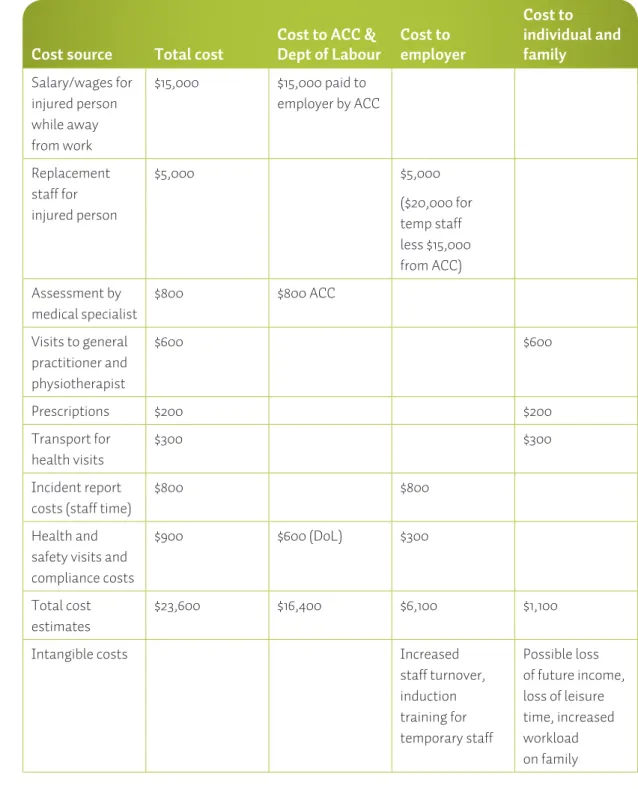
The costs to individuals who are injured and their families can be substantial. They will often include medical and specialist fees not covered by ACC, transport costs and prescription costs. They will also include costs that are more difficult to estimate, such as increased stress and workload for other family members, loss of leisure time and activities, and potential loss of future income. Table 2.1 shows a hypothetical example of the cost of an injured healthcare employee being away from work for 6. Jones, 2005.
7. North et al, 2006. 8. Jones, 2007.
three months. Examples of similar cost estimates for injured employees in other occupations are described in the 2002 report published by the Department of Labour:
Aftermath: The Social and Economic Consequences of Workplace Injury and Illness
(Adams et al, 2002).
table 2.1 Example of costs for an injured employee away from work for three months
Cost source Total cost Cost to ACC & Dept of Labour Cost to employer
Cost to individual and family Salary/wages for injured person while away from work $15,000 $15,000 paid to employer by ACC Replacement staff for injured person $5,000 $5,000 ($20,000 for temp staff less $15,000 from ACC) Assessment by medical specialist $800 $800 ACC Visits to general practitioner and physiotherapist $600 $600 Prescriptions $200 $200 Transport for health visits $300 $300 Incident report costs (staff time)
$800 $800
Health and safety visits and compliance costs
$900 $600 (DoL) $300
Total cost estimates
$23,600 $16,400 $6,100 $1,100
Intangible costs Increased
staff turnover, induction training for temporary staff Possible loss of future income, loss of leisure time, increased workload on family
41
2.2 The benefits of moving and handling programmes
Moving and handling programmes significantly reduce the rates of injury resulting from client moving and handling, as well as the
associated costs. Programmes that are successful in reducing injuries to healthcare staff need multiple components, such as support from management, an appropriate policy, training, risk assessments, equipment, facility design, auditing and reviews. There are also
financial savings through lower costs from injuries, and reduced staff absenteeism and turnover.
An outlay on the right training and equipment can save money through reduced injuries to staff and clients. For example, incorporating ceiling hoists into the design of new facilities or during renovations is a cost‑effective option. The payback time (the time when the savings from reduced injury costs exceeds the costs of installing ceiling hoists) from the installation of ceiling hoists has been reported as being around three years9 – when the ceiling hoists were installed so that they could be used effectively for moving and handling. Section 12 has examples of how payback costs can be calculated.
9. See Chhokar et al, 2005; Miller et al, 2006.
Box 2.3
Benefits of including ceiling lifts in intervention strategies
The rapid economic gains and reduction in the frequency and cost of patient handling injuries make a strong case for ceiling lift programmes as part of an intervention strategy. Incorporating ceiling lifts into the design of new facilities or during renovations is most cost effective. The most effective interventions include the installation of ceiling lifts and training staff how to use them. Source: Chhokar et al, 2005
2.3 Preventing injuries to carers and clients
Injury prevention research and programmes play a vital role in reducing injuries and their associated costs. In New Zealand several government agencies, including ACC, have ongoing injury prevention programmes. Research on the causes of injuries, and the most effective ways of preventing injuries, is essential to avoid an ongoing escalation in the costs of injuries, both to state agencies such as ACC and to individuals and their families.
There are significant reductions in injuries, back problems and absenteeism rates among healthcare staff following the introduction of lifting and transfer equipment such as hoists (mobile and ceiling hoists). Following the installation of ceiling hoists, there are significant reductions in three to five years in the risk of injury, and sustained decreases in days lost, workers’ compensation claims and other direct costs associated with client moving and handling injuries.10
Training staff in people moving and handling techniques alone is ineffective in
reducing injuries. Only a moving and handling programme with multiple components is effective in reducing back problems and other injuries among healthcare staff. Core programme components typically include:
• A policy on moving and handling clients
• A training programme for staff in moving and handling people
• Risk assessment protocols, documentation and an incident reporting system • The provision of moving and handling equipment
• Facilities that are designed or modified for moving and handling people.11 Installing ceiling hoists is one of the most cost‑effective intervention strategies, even after taking into account the initial costs. Incorporating ceiling hoists into the design of new facilities and during renovations reduces injury rates to staff and clients, and provides for future proofing of facilities.
The costs of providing equipment, improving the design of buildings for moving and handling people and providing staff training are generally recovered after three years.12
10. Thomas et al, 2009.
11. Components identified in the literature review by Thomas et al, 2009. 12. See, for example, an Australian study by Bird, 2009.
43
2.4 Injury prevention in New Zealand
There are several national injury prevention initiatives in New Zealand. These initiatives provide a context for preventing injuries to carers involved in moving and handling people. Figure 2.2 shows the main injury prevention strategies.
Figure 2.2 Injury prevention initiatives in New Zealand
NZIPS (Ministry of Health)
National Falls Prevention Strategy
(ACC) Workplace injury prevention strategies (ACC) DPI Programme (ACC)
Moving and Handling People: The New Zealand Guidelines
(ACC)
Health and safety in all locations, including workplaces, transport and leisure activities
Preventing falls in multiple locations
All workplaces in New Zealand. Aims to raise awareness and coordinate prevention
strategies to improve workplace health and safety
Strategy, action plans and resources for preventing musculoskeletal injuries
in workplaces
Guidelines for healthcare services, residential care services and other occupations involving moving and
handling people applies applies applies applies applies
Moving and Handling People: The New Zealand Guidelines is designed as a resource for preventing moving and handling injuries in workplaces and other locations. The prevention of manual handling injuries is an integral part of three national strategies: workplace injury prevention, falls prevention and the NZIPS. These strategies are described below.
New Zealand Injury Prevention Strategy
The NZIPS was established in 2003. It provides a framework for the injury prevention activities of government agencies, local government, non‑government organisations, communities and individuals. The strategy is intended to focus national injury
prevention efforts and resources by providing a clear direction to agencies,
organisations and communities that have either a direct involvement or contributory role to play in injury prevention in New Zealand. The six national priority areas in the strategy are motor vehicle traffic crashes, suicide and deliberate self‑harm, falls,
workplace injuries (including occupational diseases), assault, and drowning and near‑drowning. The six areas account for at least 80% of injury deaths and serious injuries in New Zealand.13
National Falls Prevention Strategy
Falls are the leading cause of hospitalisation as the result of injury, and one of the top three causes of injury‑related deaths in New Zealand. Between 1993 and 2002, more than 160,000 people were hospitalised for fall‑related injuries, accounting for 43% of all unintentional injury‑related hospital admissions.14 Complementing the
National Falls Prevention Strategy, preventing slips, trips and falls in workplaces is one of the priority areas in the Workplace Health and Safety Strategy for New Zealand to 2015. Facilitating safe client moving and handling can reduce falls for both clients and staff.
Workforce injury prevention programmes
Two government agencies have ongoing workplace injury prevention programmes. In 2005, the Department of Labour initiated the Workplace Health and Safety Strategy for New Zealand to 2015, which aims to enhance New Zealand’s workplace health and safety performance and reduce workplace injuries. The ACC WorkSafe Cycle provides a guide on how to set up and support the comprehensive systems and procedures required for effective workplace health and safety, to reduce injury and illness in the workplace. A major injury prevention programme promoted by ACC within workplaces is Preventing and Managing Discomfort, Pain and Injury (the DPI Programme).
DPI Programme
The DPI Programme is ACC’s approach to the prevention and management of workplace musculoskeletal conditions. This multifaceted approach encourages workplaces to focus on both the prevention and management of these problems.15 The DPI Programme amalgamates three separate injury‑related programmes for the workplace:
1. Occupational overuse syndrome (OOS) prevention programme 2. Acute low back pain programme
3. Serious (specific) back injuries prevention programme, which included the early patient handling guidelines.
DPI can be prevented or managed if the pain and its contributory factors are
addressed in the early stages. Where feasible, workers should be able to stay at work, providing changes are made to address factors contributing to their conditions. The 13. New Zealand Government, 2003.
14. ACC, 2005.
45
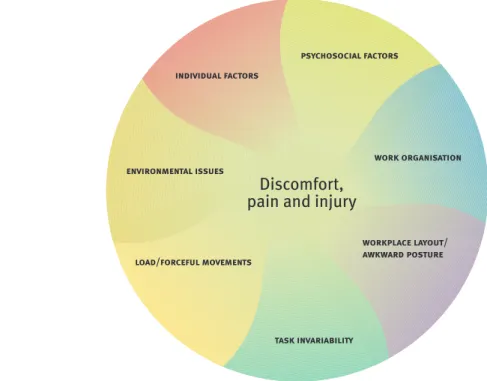
seven groups of factors that combine to contribute to DPI are shown in Figure 2.3 and described below.
figure 2.3: the dpi framework
Individual factors – things a person can and can’t change about the way they are,
such as their strength, physical fitness, skills and training.
Psychosocial factors – the way a person interacts with their social environment and
the influences on their behaviour, including the development of a culture of safety.
Workplace layout/awkward postures – the way the workplace is set up and the
working positions workers adopt, including the facility design and space available.
Work organisation – how work is arranged, delegated and carried out. For moving
and handling people this includes policies, management support and training.
Task invariability – how much a task changes over time.
Load/forceful movements – what a person handles and the forces they have to apply
to use them, including the use of specific client handling techniques and equipment.
Environmental issues – where the work takes place and the conditions in which a
person works, including workplace size, resources and staff skill levels.
Manual handling
Manual handling is a priority area in the Workplace Health and Safety Strategy for New Zealand to 2015 (Department of Labour, 2005) and is a significant hazard for the healthcare workforce. Broadly, manual handling work requires a person to lift, lower, push, pull, carry or otherwise handle an object. Examples include lifting boxes, packing in a supermarket, undertaking cleaning tasks, operating machinery, using
hand tools and moving and handling people. Poor manual handling practices can lead to musculoskeletal injuries, including sprains and strains and overuse disorders. The Department of Labour is responsible for the ongoing development of the strategy and action plans related to workplace health and safety. It also coordinates the promotion and evaluation of the strategy, monitors implementation, produces accountability reports, and collects and disseminates information through the strategy’s website (www.whss.govt.nz).
47
2.5 Preventing injuries in New Zealand workplaces
A key principle in the prevention of injuries is that primary prevention with multiple strategies works best (Box 2.3). It is better to allocate resources to prevent injuries rather than only provide treatment for injuries once they have occurred. Primary prevention involves tackling the causes of injuries that are most amenable to change. One view is that there are three general strategies for isolating, eliminating or minimising the likelihood of injuries (sometimes referred to as the three Es):
• Education – persuading
people to alter their
behaviour, for example through training
• Engineering – designing the work environment and providing equipment for
moving and handling people
• Enforcement – requiring changes that reduce injuries by law or administrative
rules, such as organisational policies and programmes.
Who should be responsible for making the changes that can reduce workplace injuries? There are four key groups of change agents:
• State or government agencies that identify the broad strategies needed and
the specific health and safety requirements, and help provide resources for organisations and individuals
• Organisations, such as companies and employers where healthcare,
residential care, disability care and other staff work
• Professional associations and unions (e.g. the New Zealand Nurses
Organisation, The New Zealand Public Services Association and the Service and Food Workers Union)
• Individuals in workplaces, such as managers and employees, for whom the
initiatives are intended to reduce the risk of injuries.
Each of these four groups has key roles in creating a culture of safety in New Zealand workplaces (see Section 11 Workplace culture). A culture of safety is one that fosters and promotes a working climate where safety is valued by every person working in an organisation. Such a culture ensures that responsibility for safety is an integral part of every manager’s and employee’s job.
Box 2.3
Key points in the New Zealand Injury Prevention Strategy
Current evidence suggests that injury prevention will work best when it: • Addresses the multiple factors that
contribute to injury
• Encourages environmental and behavioural change
• Engages the people who are most at risk • Involves action across sectors (e.g. health,
police, education)
• Is sustained and reinforced over time. Source: New Zealand Government, 2003, p. 9
The purpose of fostering a safety culture in an organisation is to guide how employees behave in the workplace. Safety culture involves a focus both on the attitudes and behaviour of employees and on their work activities. Workplace behaviour is shaped by what behaviours are acceptable and rewarded by management and colleagues. Creating a safety culture requires an assessment of rewards systems to ensure they encourage safe behaviours by both managers and employees. One way of thinking about safety culture is adding an emphasis on working safely to the existing cultural patterns in a workplace, rather than creating a separate layer of workplace patterns. An essential part of sustaining injury reductions for the long term is to set up
monitoring systems that allow assessments of ongoing effectiveness and ensure that the prevention strategies used are cost effective. This requires setting up incident reporting systems where injuries and events that could have led to an injury (‘near misses’) are routinely recorded and reviewed. This is more effective when incidents are reported anonymously. Active reviews of incidents, followed by appropriate actions, should operate in all organisations to ensure continuing improvement in health and safety systems.
A key feature of the development of a safety culture in New Zealand has been the growth of workplace health and safety initiatives, such as the appointment of occupational health and safety managers (see Box 2.4). Many workplaces now have designated managers or coordinators for health and safety. Large organisations often have health and safety sections
with several people, each of whom has responsibility for a specific aspect of health and safety. For example, many District Health Boards in New Zealand have occupational health and safety managers responsible for staff and client safety. Some units have designated people responsible for ensuring the safe moving and handling of clients. In some cases businesses use external health and safety consultants to provide advice on the most effective ways to set up and improve their health and safety systems.
Box 2.4
Development of occupational health and safety positions in New Zealand
• Occupational health and safety managers monitor workplace hazards and risks and advise workers and managers on how to minimise or eliminate or reduce hazards • In 2006 there were 1035 health and safety
positions in New Zealand
• In June 2009 there were 590 private occupational health and safety businesses. Most of these were in Auckland, Canterbury and Wellington. Source: www.careers.govt.nz
49
References and resources
ACC. (2005). Preventing Injury from Falls: The national strategy 2005‑2015. Wellington: ACC.
ACC. (2010). Preventing and Managing Discomfort, Pain and Injury to Healthcare Workers. Wellington ACC. www.accdpi.org.nz.
Adams, M., Burton, J., Butcher, F., Graham, S., McLeod, A., & Rajan, R. (2002).
Aftermath: The Social and Economic Consequences of Workplace Injury and Illness. Wellington: Department of Labour, New Zealand. Retrieved 10 August 2010 from www.dol.govt.nz.
Bird, P. (2009). Reducing manual handling workers compensation claims in a public health facility. Journal of Occupational Health and Safety: Australia and New Zealand, 25(6), 451‑459.
Chhokar, R., Engst, C., Miller, A., Robinson, D., Tate, R. B., & Yassi, A. (2005). The three‑year economic benefits of a ceiling lift intervention aimed to reduce healthcare worker injuries. Applied Ergonomics, 36(2), 223‑239.
Department of Labour. (2005). Workplace Health and Safety Strategy for New Zealand to 2015. Wellington: Department of Labour.
Department of Labour and ACC. (2001). Code of Practice for Manual Handling. Wellington: Department of Labour.
Jones, C. B. (2005). The costs of nursing turnover, part 2: Application of the Nursing Turnover Cost Calculation Methodology. Journal of Nursing Administration, 35(1), 41‑49.
Jones, C. B. (2007). The costs and benefits of nurse turnover: A business case for nurse retention. Online Journal of Issues in Nursing, 12(3), 1‑11.
Ludcke, J., & Kahler, R. (2009). Taxonomy of Injuries in Residential Care. Brisbane: The InterSafe Group Pty Ltd (research on ACC New Zealand claim data).
Miller, A., Engst, C., Tate, R. B., & Yassi, A. (2006). Evaluation of the effectiveness of portable ceiling lifts in a new long‑term care facility. Applied Ergonomics, 37(3), 377‑385.
New Zealand Government. (2003). New Zealand Injury Prevention Strategy. Wellington:Accident Compensation Corporation (ACC).Retrieved from www.nzips.govt.nz.
New Zealand Government. (2010). New Zealand Injury Prevention Strategy: Five‑year Evaluation – Final Report May 2010.
Wellington:Accident Compensation Corporation (ACC). Retrieved from www.nzips.govt.nz.
North, N., Hughes, F., Finlayson, M., Rasmussen, E., Ashton, T., Campbell, T.,
Tomkins, S. (2006). The Rates and Costs of Nursing Turnover and Impact on Nurse and Patient Outcomes in Public Hospital Medical and Surgical Units: Report of a national study 2004‑2006. Auckland: School of Nursing, University of Auckland.
Thomas, D. R., Thomas, Y‑L., Borner, H., Etherington, M., McMahon, A., Polaczuk, C., & Wallaart, J. (2009). Patient Handling Guidelines: Literature review. Wellington: ACC.