An investigation into
border security checks
February 2012
John Vine CBE QPM
An investigation into
border security checks
By
John Vine CBE QPM
Independent Chief Inspector of the UK Border Agency
Presented to Parliament
Pursuant to Section 50 (2)
of the UK Borders Act 2007
© Crown copyright 2012
You may re-use this information (excluding logos) free of charge in any format or medium, under the terms of the Open Government Licence. To view this licence, visit www.nationalarchives.gov.uk/doc/
open-government-licence/
or e-mail: [email protected]
Where we have identified any third party copyright information you will need to obtain permission from the copyright holders concerned.
Any enquiries regarding this publication should be sent to us at: Home Office, Group Finance Unit, 6th Floor Fry Building, 2 Marsham Street, London SW1P 4DF
This publication is also available for download at www.official-documents.gov.uk
ISBN: 9780108511363
Printed in the UK by The Stationery Office Limited on behalf of the Controller of Her Majesty’s Stationery Office
ID P002479043 02/12
CONTENTS
O
VERALLF
INDINGSA
NDC
ONCLUSIONS4
R
ECOMMENDATIONS8
E
XECUTIVES
UMMARY9
C
HAPTER1:
T
HEI
NVESTIGATION15
C
HAPTER2:
H
OMEO
FFICEW
ARNINGSI
NDEX21
C
HAPTER3:
S
ECUREID
34
C
HAPTER4:
L
EVEL2
P
ILOT50
C
HAPTER5:
R
ELAXATION OFC
HECKS:
O
THERM
EASURES73
C
HAPTER6:
T
HES
ITUATIONP
OST4
N
OVEMBER2011
78
A
PPENDIX1:
K
EYT
ERMS80
4
OVERALL FINDINGS AND CONCLUSIONS
FROM JOHN VINE CBE QPM
INDEPENDENT CHIEF INSPECTOR OF THE
UK BORDER AGENCY
On 5 November 2011, I was commissioned by the Home Secretary to investigate and report on the level of checks operated at ports of entry to the UK. This followed the disclosure that some checks may have been suspended without the approval of Ministers and the subsequent suspension of the former Head of Border Force from the UK Border Agency. My investigation has sought to establish which checks were in operation, whether any of these were suspended and, if so, on whose authority, and if there has been a potential risk to border security caused by any relaxation of checks. It has also assessed management oversight, the accuracy of record keeping and whether improvements have taken place since November to ensure compliance with border security checks.
To ensure the thoroughness of the investigation, I attended 17 airports and seaports covering 22 terminals across the UK examining the records at each and conducting my own observations of staff carrying out border security checks. I also contacted a further 16 smaller ports. I assessed policy submissions, operational instructions, minutes of meetings and email correspondence from within the Agency and between the Agency and the Home Office, including Ministers and their offices. I interviewed the Home Secretary, the Immigration Minister, the Permanent Secretary at the Home Office, the current and former Chief Executives of the Agency, the former Head of Border Force, senior operational managers and front-line staff. I also met representatives of the British Airports Authority and trade unions. I received excellent co-operation throughout the investigation and I am grateful to all who gave up their time to be interviewed.
There is an urgent need to establish a new framework of border security checks. This should unambiguously specify the checks that must be carried out at all times and those where there is discretion to suspend checks based on risk or health and safety. There must be a shared understanding of any such discretion by Ministers, senior managers and front-line staff across all ports so any suspensions of checks are applied consistently and only when necessary. There must be greater clarity on the levels of authorisation required to suspend checks and when decisions require the explicit agreement of Ministers. Language and terminology must be precise in all policy proposals, responses from Ministers and operational guidance to prevent any misunderstanding by front-line staff.
Records must be kept which accurately set out the number of times checks are suspended and the reasons why. Ministers should be told of the suspension of checks so they are aware of what is happening at the border. If 100% checking at all times is the model that Ministers and the Agency decide upon, it requires a detailed
5 analysis of staff deployment at the border, how technology is used and how passenger queuing times can be managed without compromising security.
Overall, I found poor communication, poor managerial oversight and a lack of clarity about roles and responsibilities. There was no single framework setting out all potential border security checks, which of these could be suspended, in what circumstances and the level of authority required at Agency or Ministerial level to do so. There is a fundamental question of how free the Agency should be to decide its own operational priorities. These are important issues that need to be considered in order to define and agree the boundaries between the Home Office and the Agency. There had been no attempt to incorporate the verification of fingerprints using Secure ID within the existing Home Office Warnings Index (WI) Policy. The purpose of the Secure ID check is to identify any passengers trying to enter the UK using a false identity and considerable public money had been spent on its introduction. Despite this, its implementation was hampered by the absence of an operating policy and associated guidance for staff. This led to different assumptions being made about whether, and, if so, in what circumstances, the check could be suspended. When it was introduced, there was no evidence to indicate whether decisions on its use or suspension should be made by the Agency or by Ministers. This lack of clarity continued until May 2011, when the Home Secretary stated that she did not want Secure ID to be suspended as part of a move to risk-based border checks. At that point there was no evidence that the Agency informed Ministers that Secure ID had been suspended in the past or secured approval for any subsequent suspensions. Communications between the Agency and Ministers and between senior managers and operational staff was poor. There was a lack of clarity in the language used with consequent ambiguity when decisions were converted to operational practice. This was compounded by instructions to staff that did not always accurately reflect what Ministers had agreed. The number of suspensions, the precise reasons they occur, the level of authorisation necessary and the specific impact on both border security and on passenger clearance times must be absolutely clear.
The number of occasions when WI and Secure ID checks were suspended and risk-based measures invoked was affected by a number of factors including the volume of passengers arriving, the level of risk presented by them, the numbers of staff deployed and the infrastructure of ports affected. This was most apparent at Heathrow and Calais and resulted in more frequent suspension of checks at these ports. Any framework of border security checks must take account of these factors and there needs to be a clear understanding of how these policies will operate in practice.
Importantly, there was no clear understanding of when „health and safety‟ was a ground for suspension, resulting in different assumptions as to the number of times checks might be suspended. While there was a consistent understanding that suspensions may be necessary for health and safety reasons, these occurred more frequently than the Agency‟s senior management and Ministers had assumed. In addition, there was no consistent understanding at senior management and
6 Ministerial level of when and why the length of passenger queues might constitute a health and safety issue.
Records showing the number of times border security checks were suspended and the reasons for these were maintained at all ports. However, the level of detail recorded differed, and there were significant discrepancies between the records maintained at individual ports and records maintained centrally by the Agency. Record-keeping showing the suspension of Secure ID checks was particularly poor. There was limited staff understanding at ports as to why accurate and detailed records needed to be maintained and how and whether the information would be used by the Agency to maintain management oversight, develop policy or change operational practice.
Despite regular visits by senior managers, there were insufficient enquiries undertaken to find out precisely what was happening at ports. No process was put in place to analyse the number of occasions and reasons why checks were suspended. There is nothing I have discovered which could not have been identified and addressed by senior managers exercising proper oversight.
I was particularly concerned to find one example of a local initiative operating at Heathrow under which border controls were relaxed and which had not undergone any scrutiny by more senior managers or Ministers. I found this to be potentially unlawful and it reinforces the need to clarify what local managers can and cannot authorise.
The risk to the border when checks were suspended needs to be kept in perspective. I found that the WI check which indicates whether a passenger has previously committed a terrorist, criminal or immigration offence or is of interest to law enforcement agencies was generally carried out consistently. This check occurred even where other measures were relaxed and provided assurance that those who had previously come to the attention of the authorities would be identified and, where appropriate, refused entry. However, I believe that the number of occasions when this check was suspended – over 350 and notably at the juxtaposed controls - was too high. Although these were generally for health and safety reasons, the volume indicates an urgent need to assess how the particular health and safety issues at those locations can be addressed. Furthermore, it was unacceptable that the WI check had not been carried out for British and EEA nationals on a limited number of Eurostar services. This amounted to a considerable number of passengers over a period of four years.
On the basis of what I have seen since 4 November 2011, it is apparent to me that the Agency does now have a much firmer grip in respect of border security checks than was previously the case. A significant test will be whether this can be maintained during periods of greater passenger volume and for the Olympic and Paralympic Games.
7 Security of the border is paramount. Overall, I found significant room for improvement in this important area of work. Based on the evidence provided in this report, there is much to do in order to provide the assurance that the public and Parliament expect.
John Vine CBE QPM
Independent Chief Inspector of the UK Border Agency 7 February 2012
8
R
ECOMMENDATIONS
1. The extent of the UK Border Agency‟s operational autonomy from the Home Office
needs to be explicit, with a clear delineation of roles and responsibilities.
2. A new framework of border security checks, authorised by Ministers, should be produced and implemented urgently. This needs to take account of the different operational environments at ports, the benefits to border security of conducting the checks and the implications for border security of any reduction in checks.
3. Ministers should decide the minimum standard of border security checks to be applied at UK ports before allowing entry to the UK.
4. Ministerial decisions, policy proposals and operational instructions must be communicated effectively with specific and careful use of language.
5. The level of authorisation required for any suspension of or reduction in border security checks must be explicitly set out and authorised by Ministers.
6. Suspension of border security checks should only take place when absolutely necessary. Records showing the frequency of these, the reasons for them and the level of authorisation obtained should be reported to Ministers and senior managers on a quarterly or more frequent basis.
7. To ensure suspension of border security checks is kept to an absolute minimum, a clear understanding of what constitutes health and safety grounds for suspension should be agreed.
8. An operating policy for fingerprint verification of all visa nationals (Secure ID) needs to be produced as a matter of urgency. It must take into account its importance relative to other checks contained within any new framework of border security checks.
9. Record-keeping at ports should be overhauled ensuring that staff know what to record, and why, whilst keeping bureaucracy to a minimum. Management should ask for and review records of border security checks to inform development of policy.
10. A rigorous management assurance process needs to be put in place so that Ministers and the UK Border Agency can be assured that policy is being translated into practice on the ground.
11. The UK Border Agency must ensure that any local initiative regarding suspension of border security checks does not contradict any new framework of border security checks and is lawful and properly authorised.
12. Service standards for passenger queuing times and staffing levels at ports should be reviewed to ensure they are compatible with any new framework of border security checks.
9
E
XECUTIVE
S
UMMARY
1. This investigation examined the level of border security checks operated at ports of entry to the UK with a particular focus on the Home Office Warnings Index (WI), Secure ID and the risk-based measures that formed part of the Level 2 pilot. A brief explanation of these checks follow:
WI – used to ascertain whether passengers are of interest to the UK Border Agency, the police or other government departments;
Secure ID – checks passengers‟ fingerprints at the immigration controls and verifies them against those previously provided during the visa application process;
Level 2 pilot – a risk-based approach to border checks where it was no longer routine to:
- open the biometric chip within European Economic Area (EEA) passports; and
- perform WI checks of EEA children where they were travelling in obvious family units or school groups.
Warnings Index
2. In 2007, the Agency introduced a policy which set out the requirement to check all passengers against the WI. There was a clear and consistent understanding amongst staff of the importance of and need to carry out these checks on all passengers, except where doing so was likely to result in the health and safety of passengers being put at risk. There was no indication whether Ministers needed to be consulted on, or agree to, any changes to this policy.
3. We found that WI checks took place at the majority of ports. However, the
Agency‟s records show these checks had been suspended on 354 occasions, with the majority of these being at juxtaposed controls. We noted that these suspensions were primarily on health and safety grounds. We believe that the frequency of these suspensions was too high and is likely to have been higher than either the Agency or Ministers anticipated when the policy was introduced.
4. We found that WI checks were not applied as a matter of course in three other scenarios beyond those envisaged by the policy. A decision was taken to suspend WI checks on EEA school groups, under the age of 16, travelling to the UK by coach through juxtaposed controls. This had been approved by Ministers. A decision was taken to extend this to other seaports and Eurostar services, which Ministers had been informed of. In February 2011, the age restriction for this arrangement was removed for coaches travelling from Calais and Coquelles for a specific weekend.
10 However, we did not find written evidence that this had received Ministerial authorisation.
5. A decision was taken to suspend checks on the children of returning British families for the February half-term weekend, at Calais and Coquelles, which had been approved by the former Head of Border Force. This measure was then applied for the Easter weekend and had been approved by the Acting Chief Executive. There is evidence that this latter authorisation was raised informally with the Immigration Minister and Home Secretary at the time, but neither had any recollection of this and there is no written record of the discussions.
6. Of considerable concern is that WI checks had not been carried out on EEA nationals travelling to the UK on Eurostar services from Disneyland Paris and other French resorts since 2007. Although the Agency assessed these passengers to have been low risk this measure is likely to have resulted in approximately 500,000 EEA nationals not being checked against the WI. We did not find evidence that these suspensions had been authorised by Ministers.
7. The Agency‟s records relating to the suspension of the WI were poor. We found that records relating to some suspensions had not been kept, whilst other records did not capture important information, such as whether the emergency services had been consulted before checks were suspended.
8. There was a lack of effective management oversight of the frequency with which checks had been suspended, the reasons for this and which ports were suspending checks. Had this been in place it would have enabled the Agency to develop a plan to reduce the number of suspensions of this important border security check.
Secure ID
9. This investigation established that Secure ID was suspended a total of 482 times between June 2010 and November 2011. We noted that 463 of these suspensions occurred at Heathrow. These suspensions ranged from a matter of minutes to several hours and were applied regularly, primarily at Terminals 3 and 4. Where a start and end time was provided, we identified that the majority of these suspensions were between one and four hours.
10. We found there was no policy document or operational instruction in relation to Secure ID. There was a general perception amongst senior Agency officials and Ministers that Secure ID was a mandatory check. It was evident from the evidence we examined that the Border Force senior management team saw Secure ID as a mandatory check from July 2010 onwards, although it was recognised that there might be exceptional circumstances when it would be appropriate for it to be suspended. The absence of a policy and clear Ministerial direction at this time means that it is not possible to say with any certainty whether any suspension of Secure ID was authorised or not.
11 11. This position changed when the Immigration Minister and Security Minister gave their approval for Secure ID to become part of a risk-based approach to border checks on 27 January and 14 February 2011 respectively. Although we note that the Immigration Minister states that his approval was provisional, we believe it was reasonable for the Agency to interpret the written response and the Minister‟s letter
to the Transport Minister as approval to implement the proposals during Easter 2011. This resulted in the Agency working towards implementing these changes until, on 13 April 2011, the Home Secretary indicated that she did not approve the risk-based proposal, pending further work.
12. After 13 April 2011, we found that while two of the risk-based measures were viewed by Ministers as viable, pending further work by the Agency to support its approach, the inclusion of risk-based Secure ID was not. At a meeting on 19 May 2011, the Home Secretary specifically excluded the implementation of risk-based Secure ID. This was reinforced on 22 July 2011, when the Level 2 pilot was approved.
13. Despite Ministers‟ views that suspension of Secure ID should be excluded from
the risk-based measures, we found that such suspensions continued at Heathrow (106 Secure ID suspensions took place between 19 May and 1 November 2011); this exceeded Ministerial authority. At this point the Agency should have informed Ministers that suspension of Secure ID was taking place regularly, primarily at Heathrow.
14. The former Head of Border Force told us that he allowed the suspension of Secure ID as the separate WI policy already permitted suspension of checks on health and safety grounds. However, we noted that this policy did not apply to visa nationals and no provision existed to extend the policy, whether the approach was practical or not.
15. We found the suspension of Secure ID was unauthorised from 19 May 2011 onwards. We also found that four days after the Home Secretary approved the Level 2 Pilot on 22 July, senior Border Force officials were discussing ways in which the suspension of Secure ID could apply in extreme circumstances that might arise at Heathrow, such as overcrowding in the immigration arrival hall leading to flights being unable to disembark passengers or unload baggage. Email correspondence suggested that this might happen up to 12 times per week at Terminals 3 and 4. In
our view and given the Home Secretary‟s clear position on this matter, if the Agency
believed there was an operational need to suspend Secure ID in emergencies, then specific Ministerial approval should have been obtained at that point.
16. Suspension of Secure ID potentially exposed the border to greater risk. However, we note that this risk would have been mitigated to some extent because passengers continued to be checked against the WI and, other than the specific instances approved by Ministers, travel documents were examined and biometric chips in travel documents were opened in most cases.
17. However, the more checks that are carried out, the greater the assurance that can be provided to the public and Parliament that only those entitled to enter the UK
12 are doing so. The suspension of fingerprint checks did not occur in individual cases as a result of a risk-based assessment by an Immigration Officer. It occurred primarily at the busiest times of day at the largest airport in the UK. This is unacceptable. There needs to be absolute clarity on whether, in any circumstances, it is appropriate to suspend fingerprint verification. That decision needs to assess the level of risk and needs to take account of the very different passenger volumes and infrastructure at ports across the UK and at the juxtaposed controls. Once the decision is made and communicated, it needs to be applied rigorously and consistently.
18. The Agency had failed to put in place any effective management oversight in relation to Secure ID suspensions. It had not undertaken any formal risk analysis to determine whether the suspension of Secure ID exposed the border to an increased risk, neither had it evaluated the extent to which Secure ID acted as a deterrent against people committing immigration offences.
19. The accuracy and consistency of record keeping in relation to the suspension of Secure ID was particularly poor. Management controls were weak, in that no guidance or suspension templates were provided to help staff record information in a systematic and consistent manner. As a consequence of this, records were incomplete and contained gaps in information. In addition, reasons for suspension were not always recorded and were not always properly authorised.
20. We found no management reporting system in place to support the upward reporting of Secure ID suspensions. We also found an absence of any assurance systems to provide confidence to more senior Agency officials and/or Ministers that suspensions were appropriate and necessary.
Level 2 pilot
21. The Level 2 pilot was authorised by the Home Secretary on 22 July 2011 and ran from 29 July to 4 November 2011. In relation to the ports we inspected as part of this investigation, records show that Level 2 measures were operated a total of 2,081 times.
22. We found that the language used in both the “Summer pressures” submission to Ministers and the response provided, was not clear and as a result was open to misinterpretation. Given the importance of decisions to suspend border security checks, it is imperative that the language used is absolutely clear and unambiguous. For example, the written response from the Home Secretary‟s office said that “the
change in checks should not be a routine measure but only used when the queues get beyond a reasonable length.” As the key terms were not clearly defined, we found this had been interpreted and operated in different ways at different ports.
23. There was a further lack of clarity in the Agency‟s Interim Operational Instruction as it failed to define what was meant by “further measures.” We found
that there was no explicit reference in the submission to Ministers about the
possibility of introducing “further measures” either on health and safety or other grounds.
13 24. The Interim Operational Instruction also failed to accurately reflect what had been approved in the submission in relation to the issue of endorsing travel documents and questioning visa holders. This led to further confusion and different interpretations of what should be done in this regard. An example of this was at Heathrow, where managers discouraged staff from asking questions of visa nationals.
25. We established that there was confusion amongst staff, particularly at Heathrow and Gatwick South about whether the Level 2 pilot included the suspension of Secure ID. We believe this was caused in part by similar terminology used during the contingency plans for the industrial action on 30 June 2011.
26. In considering the accuracy and consistency of record keeping, we generally found that ports captured the information that was required. However, we identified discrepancies between local and central records.
27. We found that the weekly update reports submitted to the Chief Executive and Ministers did not contain information about key immigration activities, such as the number of IS81s1 issued and refusals of leave to enter. This was despite the fact that
such activities were included in the Agency‟s own performance measures for the
pilot. In addition we found results related to commodity seizures were not directly linked to the application of Level 2 measures. We found that the systems put in place by the Agency to evaluate the effectiveness of the Level 2 pilot were inadequate. The difficulty in separating out results that could be directly attributable to the Level 2 pilot made reporting to Ministers less reliable.
28. In terms of border security, it is not possible to quantify the extent of the risk that these measures presented to the border. Clearly the more occasions such checks are not carried out, the less assurance can be provided. In relation to EEA nationals, we found there was no evidence that WI checks were suspended at the same time as the Level 2 pilot was in operation, so the risk was mitigated to some extent. However, of more concern was the confusion over whether Secure ID formed part of the pilot and whether visa nationals should be questioned. The benefits and risks of this latter approach had not been articulated clearly or implemented consistently. Failing to exercise appropriate discretion regarding the questioning of visa nationals does, in our view, expose the border to greater risk.
Relaxation of Checks: Other Measures
29. During our investigation, we found three other measures in operation which relaxed border checks. The first of these measures was „Operation Savant‟, an Agency initiative to manage student numbers at peak periods of demand allowing resources to be focussed on those considered the highest risk.
30. While we recognise the arrival of large numbers of students at particular times of the year presents challenges to particular ports, we consider that this approach was potentially unlawful.
14 31. The Agency did not maintain records to set out whether any students were allowed into the UK without an entry clearance under this initiative. Consequently, we cannot say whether any student was admitted to the country unlawfully during Operation Savant and any potential risks to security cannot be quantified. We note, however, that Immigration Officers were instructed to admit passengers without an entry clearance only where they appeared to meet all other requirements for admission as a student.
32. Secondly, we found that between January and June 2011 (inclusive), prior to the introduction of the Level 2 pilot, the biometric chip reading facility had been deactivated on 14, 812 occasions at a number of ports. The Agency was unable to explain definitively why these deactivations occurred. It therefore needs to take action to identify the reasons for this and take steps to ensure that checks take place in accordance with policy.
33. The third measure involved a failure to open the biometric chip in e-passports for EEA (other than French) and British nationals at Portsmouth, from August 2010. We consider this was unacceptable and not in accordance with the policy.
34. While it is difficult to quantify the level of risk posed to the border by these two measures, we note that this risk would have been mitigated to some extent because passengers continued to be checked against the WI and their travel documents were examined.
35. On the basis of the evidence provided to this investigation, it is apparent that the Agency does now have a much stronger grip in respect of border security checks than was previously the case. However, there remains a question about whether this approach can continue during periods of greater passenger volume, including during the Olympic and Paralympic Games in the summer of 2012.
15
C
HAPTER
1.
THE INVESTIGATION
Role and remit of the Independent Chief Inspector
1.1 The role of the Independent Chief Inspector of the UK Border Agency (“the Chief Inspector”) was established by the UK Borders Act 20072 to examine the
efficiency and effectiveness of the UK Border Agency in dealing with asylum, immigration and nationality functions. The statutory remit of the Chief Inspector was
extended to include customs functions and the work of the Agency‟s contractors by the Borders, Citizenship and Immigration Act 2009.3
Background to this investigation
1.2 The Chief Inspector‟s published Inspection Plan for 2011-12 set out his intention to inspect a number of Border Force ports within the South East region in 2011-12, making assessments about performance using his inspection criteria. Subsequently two locations were selected for full inspection: Gatwick North Terminal and Heathrow Terminal 3.
1.3 The Heathrow inspection took place between 26 September and 19 October 2011. For Heathrow, the terms of reference particularly focussed on “the primary
arrival control and the secondary detection area of Terminal 3”.
1.4 During the onsite phase of the Heathrow Terminal 3 inspection, the Chief Inspector and his inspection team discovered a number of inconsistencies in the way border security checks were being operated.
1.5 The Chief Inspector verified these findings with his inspection team following the on-site phase of the inspection, to ensure that the evidence collected was properly analysed and quality assured to support the conclusions made. Believing that these issues raised concerns about the effectiveness of border security checks at Heathrow Terminal 3, he brought them to the attention of the Chief Executive of the UK Border Agency at a planned meeting on 2 November 2011.
Terms of Reference
1.6 Pursuant to section 50 of the 2007 Act, the Home Secretary requested that the Chief Inspector investigate and report to her on those matters set out in the Terms of Reference laid before Parliament on 7 November 2011.
1.7 The terms of reference set by the Home Secretary for this investigation are set out in Figure 1.
2 2007 c.30, section 48
16
Figure 1: Independent Investigation – Terms of Reference
1 To investigate and report the level of checks operated by the UK Border Agency at ports in light of the operational requirements approved by Ministers and report any potential risks to border security created by any unauthorised relaxation.
2 Establish the effectiveness of management oversight in the UK Border Agency including the guidance given to staff on the checks to be undertaken, the levels of authorisation required for any relaxation of checks, whether any unauthorised
relaxation of checks occurred and, if so, the reasons why they occurred and whether any assessment of the risk was made and communicated.
3 To investigate and report on the accuracy and consistency of record-keeping at ports in that period and make recommendations on the management information and assurance systems that are required in the UK Border Agency, both locally and nationally, to ensure compliance with all required border security checks.
4 To review and report on any work put in place in UKBA since 4 November 2011 to improve security at the border including arrangements to ensure compliance with all required border security checks.
5 To make any further recommendations on whether operational changes are required to ensure that checks are being operated within the framework approved by
Ministers.
Methodology
1.8 When this investigation into border security checks commenced on 8 November 2011, we (the Chief Inspector and his inspection team) immediately contacted the Agency and requested that the following evidence was securely retained by a responsible senior manager at each port:
all records relating to the suspension of the Secure ID fingerprint scanning for
visa nationals;
all records relating to the dates and times when the Level 2 pilot was in operation;
and
the risk assessments made by ports which supported the implementation of Level
2 and/or the suspension of Secure ID fingerprint scanning.
1.9 On 10 November 2011, we contacted the Agency and requested detailed evidence, including:
all correspondence4 between the Agency and the Home Secretary, the
Immigration Minister or their Private Offices relating to the preparatory work that was undertaken on the pilot, prior to final approval being given by the Home Secretary;
all subsequent correspondence between the Agency and the Home Secretary,
the Immigration Minister or their Private Offices relating to the pilot;
4 Correspondence refers to every record relating to the Level 2 pilot – submissions, all types of documents, emails, meeting
17
the minutes of Agency Board meetings throughout 2011 to date and the notes of
any meetings between Agency Board members in which border security checks were discussed;
the Agency documentation that set out the terms under which the final agreed
Level 2 pilot would operate, including the aims and objectives of the pilot, the parameters under which the Agency would operate it, the management assurance process, the reporting protocols and the declared benefits/disadvantages of the pilot; and
the evaluation report submitted by the Agency to the Home Secretary which
resulted in her agreeing to extend the pilot on 19 September 2011 (to include the supporting documentation provided by the Agency which informed the evaluation paper submitted in September 2011).
1.10 Supplementary requests for documentary evidence were made to the Agency, up to and including 25 January 2012 when we requested more detailed information about the Level 2 pilot, Secure ID, WI suspensions and other types of border check suspensions. We also received a number of additional documents, including documents from the former Head of Border Force.
Port locations inspected
1.11 The Agency informed us that 28 ports had been involved in the Level 2 pilot5. To determine which of these ports we should visit as part of this investigation, we took a number of factors into account, including:
inspecting the remaining terminals at Heathrow (Terminals 1, 4 and 5) to compare
and contrast with our findings at Terminal 3;
assessing passenger volumes, coupled with the need to cover major regional
ports, including juxtaposed ports in Northern France; and
visiting ports located across the UK, including Scotland, Northern Ireland, Wales
and England.
1.12 We selected 17 port locations to inspect, covering 22 terminals. Figure 2 records details of the UK Border Agency ports we visited in the course of this investigation.
5 Aberdeen, Belfast, Birmingham, Bournemouth, Bristol Airport, Calais, Cardiff, Coquelles, East Midlands, Edinburgh, Exeter,
Gatwick, Glasgow, Harwich, Heathrow, Leeds Bradford, Liverpool, London City, Luton, Manchester Airport, Newcastle, Newhaven, Norwich, Plymouth, Poole, Portsmouth, Prestwick and Stansted.
18
Figure 2: List of UK Border Agency ports visited
Port location Passenger volumes
2010* Date inspected - 2011 Heathrow Terminal 1 29,519,000 11 – 14 November Heathrow Terminal 3 Heathrow Terminal 4 Heathrow Terminal 5 Gatwick North 13,253,000 25 -26 November Gatwick South Stansted 7,851,000 17 – 18 November Manchester Terminal 1 7,720,000 9 – 10 December Manchester Terminal 2 **Calais 5,153,5006 13 December **Coquelles 4,739,0007 14 December Luton 3,634,000 17 November Birmingham 3,377,000 5 – 6 December Bristol 2,144,000 28 November Edinburgh 1,848,000 23 November Newcastle 1,499,000 5 – 6 December Glasgow 1,465,000 22 November Portsmouth 1,097,000 1 December
Belfast International 840,000 22 – 23 November
Cardiff 516,000 28 – 29 November
**Plymouth 456,000 29 November
**Newhaven 128,000 25 November
Total 85,239,500
Note: * These figures are rounded to the nearest thousand and exclude arrivals from the Common Travel Area.
**Indicates Secure ID was not in force at these ports.
1.13 The onsite phase of the investigation took place between 11 November and 16 December 2011. A variety of shifts were covered, including weekends, to ensure we saw a wide range of staff, in addition to conducting observation of the Primary
6 Figures sourced from published Department of Transport statistics which show Dover – Calais route had 10,307,000
passengers in 2010 – this covers passenger journeys both ways so spilt equally to arrive at figure shown.
7 Passenger figures sourced from Eurotunnel and are based on an estimate of the average number of people in each car,
19 Control Point (also known as immigration control or the immigration arrivals hall). At each port location we arranged sessions where staff could speak to us privately. We interviewed (individually or as part of focus groups) 349 Border Force staff across the ports that we inspected as part of this investigation. Figure 3 provides a breakdown by grade.
Figure 3: UK Border Agency staff interviewed at ports8
Grade Number
Immigration Officer 235
Chief Immigration Officer 70
Her Majesty‟s Inspectors 31
Assistant Director / Grade 7 12
Deputy Director / Grade 6 1
Total 349
1.14 We examined local records at each port relating to the management of the Level 2 pilot, Secure ID (where it was in place) and any relaxation of passport scanning against the Home Office Warnings Index (WI). This included obtaining email correspondence, management reports and any form of record keeping relating to these issues.
1.15 We conducted telephone interviews with a range of staff at two additional ports (Harwich and Leeds Bradford) where the Agency indicated that the Level 2 pilot was in operation. We also contacted one further port (Poole) and asked for a questionnaire to be completed in relation to the Level 2 pilot.
Ports not operating Level 2
1.16 We contacted a further 14 ports not involved in the Level 2 pilot, in order to determine whether:
the information provided by the Agency in relation to those ports participating in
the pilot scheme was accurate; and
any other measures had been undertaken at these ports concerning the
relaxation of border security checks in relation to either Secure ID or the WI. 1.17 Figure 4 provides details of these ports.
8 We interviewed staff at equivalent grades who were former Customs staff. The more senior grades (Assistant Director and
20
Figure 4: Ports not involved in the Level 2 pilot
Brussels Humberside Southampton Cambridge Newquay Southampton Docks Doncaster Robin Hood North Shields Southend
Holyhead Paris Teesside Hull Ramsgate
Interviews
1.18 We conducted a number of interviews with senior management grades within the Agency (Grade 7 to Chief Executive) in order to ascertain the effectiveness of policy, planning and management oversight in relation to border security checks. We also interviewed the Home Secretary, the Immigration Minister, the Permanent Secretary, the former Chief Executive of the Agency and the former Head of Border Force to ensure our investigation was able to collect evidence to enable us to report effectively against the terms of reference for this investigation.
1.19 The Chief Inspector also met representatives of the British Airports Authority, the Public and Commercial Services Union and the Immigration Service Union.
21
C
HAPTER
2. H
OME
O
FFICE
W
ARNINGS
I
NDEX
F
INDINGS
Background to the Home Office Warnings Index
2.1 The UK Border Agency checks the details of arriving passengers using an
electronic system called the „Home Office Warnings Index‟ (WI). This system was
introduced in 1995, when it replaced a paper-based system. This is the single most important electronic check carried out by the Agency on passengers arriving in the UK. It is used to ascertain whether passengers are of interest to the Agency, the police or other government departments. For example, it will show if the passenger is wanted by the police or has previously been removed from the UK by the Agency. Prior to June 2007, the Agency checked all non-EEA nationals against this system, but only checked a proportion of British and EEA nationals.
2.2 In June 2007, as part of the then Government‟s strategy for immigration, asylum and counter terrorism, the Agency implemented a policy to check 100% of passengers arriving in the UK against the WI. To support its approach, the Agency issued the Home Office WI Checking Policy and operational instructions in June 2007.
2.3 This policy was owned by the Strategic Director of UK Border Control who
became the Head of the Agency‟s Border Force. It required Immigration Officers to:
“physically examine a passenger‟s travel document; and conduct a check of the passenger‟s details against the WI”.
2.4 Under the policy, Immigration Officers must handle and examine the travel document of every passenger and wherever possible check these against the WI on, or in advance of, arrival. It also requires Immigration Officers to verify the biometric details of all passengers presenting e-passports (i.e. opening the photograph from the biometric chip in the e-passport).
2.5 The WI checking policy made provision for circumstances in which it would not always be possible to carry out 100% checks of EEA nationals. It described circumstances where the additional time taken by these checks, combined with port infrastructure, had the potential to create health and safety issues at times of high passenger volumes. An extract from the WI Operational Instructions notes that:
“In the event that application of the WI policy leads to severe congestion of the port or control accommodation with the consequence that, in the opinion of the port authority, the emergency services or the Assistant Director / Duty HMI, the safety and / or security of the port is likely to be compromised to the extent that the health and safety of passengers is put at risk, it will be necessary to take [the following] immediate preventative / immediate action.”9
22 2.6 The operational instructions stated that the first step was to liaise with the port authority and/or emergency services to manage the flow of passengers into immigration control. If this did not resolve the issue, a „risk-based‟ approach to
checking travel documents should be taken, but only where the “port authority or
emergency services consider that the health and safety risk to passengers cannot be adequately mitigated by other means”.
2.7 The risk-based approach to checks differentiated between passengers from the EEA and Switzerland, and those who were not. It required that Immigration Officers must continue to handle and physically examine the passports or travel documents presented by all passengers, and that the details of:
all non-EEA nationals must be checked against the WI;
EEA / Swiss nationals who had arrived on a service (e.g. a specific flight) that had
been assessed as being of a medium, high or very high risk must be checked against the WI; and
EEA / Swiss nationals who had arrived on a service that had been assessed as
being of a low or very low risk should be assessed against the WI in line with a
„risk validation process‟10.
2.8 The WI policy stated that suspension of 100% checks could only be authorised
by an officer of the rank of Her Majesty‟s Inspector (also known as Inspector) or above, or where this was not possible, a Chief Immigration Officer “who had been
properly briefed”.
2.9 In June 2007, the former Head of Border Force wrote a submission to the then Immigration Minister. The submission informed the Minister of changes that had been introduced by the Agency to maximise the benefits of WI checks and described circumstances when 100% checks would not be possible. The submission went on to say that it (the policy) “sets out a framework for monitoring occasions when the policy has to be suspended for health and safety reasons...” This was copied to, amongst others, the then Home Secretary.
2.10 While we note that Ministers were informed of this policy, it was not clear whether there was the expectation that they should approve the policy or receive regular updates about its implementation.
Suspension of the 100% checks
2.11 We asked the Agency for details of the number of occasions on which 100% checks had been suspended. It provided us with data that had been collated
centrally by the Agency‟s headquarters11 in response to the issues that led to this investigation. The Agency‟s headquarters obtained this information by asking individual ports for information on the suspension of checks. The data showed that between 1 July 2007 and 27 October 2011, 100% checking had been suspended on a total of 430 occasions. Figure 5 provides a breakdown of these suspensions.
10UK Border Agency‟s „Border Control: Home Office Risk Assessment and Action Plan‟, published in June 2007, stated that “In
broad terms, this is based on a combination of factors such as local intelligence, passenger behaviour and information within travel documents such as travel history.”
23
Figure 5: Warning Index suspensions
Reason for suspension Number of occasions
Health and safety 270
Technical12 68
Other 92
Total 430
Note: This information was provided by the UK Border Agency
2.12 However, we found that seven of the entries had been recorded twice. Six of
these duplicates were recorded under „Health and Safety‟, whilst a further one had been recorded under „Technical‟. It also appeared that in 69 instances, separate records had been created in different categories, for what appeared to be the same incident, as can be seen from the example below:
On 30 May 2011, the records show that checks had been suspended at Calais for
six hours because of “Significant levels of traffic [and a] moderate number of
Immigration Officers on desks”. This had been recorded as a health and safety suspension. However, a separate record shows that checks had been suspended
at the same time but recorded this as „Other – Non Policy or Unconfirmed‟.
2.13 We removed these duplicate and multiple entries which showed that between 1 July 2007 and 27 October 2011 the Agency suspended 100% checking against the WI on 354 occasions. It was not possible to determine with any certainty the number of occasions on which checking had been suspended for each of the three categories. A breakdown of where this occurred most frequently can be seen in Figure 6.
Figure 6: Suspension of 100% checks by port
Port Number of occasions
Calais 89
Paris Gare du Nord 68
Portsmouth 46
Coquelles 45
Other ports combined 10613
Total 354
2.14 For example, the data shows that on 3 July 2008, 100% checks had been suspended at Paris Gare du Nord for two hours and 15 minutes because “staff
12„Technical‟ refers to situations where the WI was unavailable because of an equipment or software failure.
13 This data provided recorded that three ports (Avignon, Bourg St Maurice and Marne La Villee) had suspended 100% checks
on one occasion. However, these suspensions had existed for over four years, this is discussed in more detail in Paragraph 2.14.
24
shortages created pressures on control” - this was recorded as an „Other‟ reason.
An example of a „Technical‟ reason is that recorded for Portsmouth on 9 September 2011, when 100% checks were suspended because there had been a technical fault. As a result the details of 1,020 EEA nationals were not checked against WI.
2.15 The Agency‟s records indicate that 100% checking was suspended on 66 occasions for technical reasons (after two duplicates were removed). Any suspension of the WI poses a potential risk to border security. At the time the policy was decided, there was no indication of the frequency with which the Agency and Ministers had anticipated health and safety suspensions taking place. This number of suspensions appears high given the importance of this check.
Suspension of 100% checks at Calais
2.16 The port of Calais is one of the ports from which the Agency operates what are
known as „juxtaposed controls‟. This means that the Agency carries out immigration checks on passengers before they travel to the UK. There are no further immigration checks on passengers when they arrive in the UK. The data provided showed that Calais was the port at which 100% checking had been suspended most frequently and as a result, we inspected the port in order to ascertain the reasons for these suspensions.14
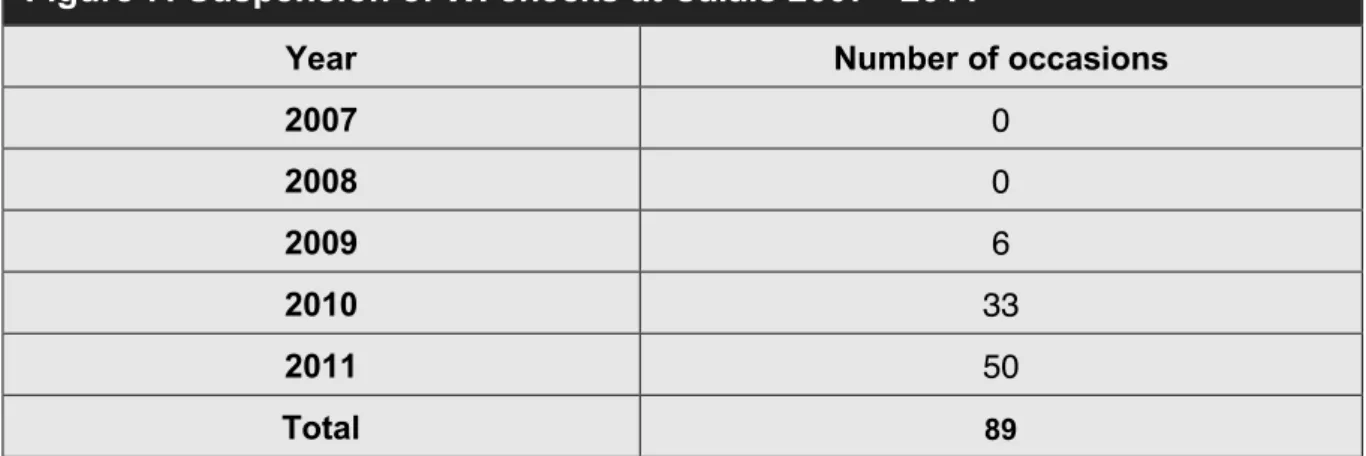
2.17 As we have set out in Figure 6, 100% checking was recorded as having been suspended at Calais on 89 occasions between 1 July 2007 and 27 October 2011. Figure 7 shows the number of suspensions from 2007 to 2011.
Figure 7: Suspension of WI checks at Calais 2007 - 2011
Year Number of occasions
2007 0 2008 0 2009 6 2010 33 2011 50 Total 89
2.18 Although the figure for 2011 only covered nine months to the end of September, this represented a 51% increase over the previous year. The Agency should assess whether this increase can be attributed to changes in port infrastructure, increases in passenger numbers, a reduction in staff or a combination of all three.
14 We also inspected the port of Coquelles, due to its close proximity to Calais, as the data suggested that a further 46 suspensions had occurred at that port.
25 2.19 The shortest period for which 100% checks were suspended was 10 minutes, with the longest being six hours and 30 minutes. From the quality of data we have available, we can approximate that the average suspension period is one hour 40 minutes.
2.20 Staff working at the port told us that at busy periods, vehicles travelling to the UK through the port regularly backed up onto the busy A16 motorway, which was nearby. They said that at peak times, even when all of the booths from which Immigration Officers carried out checks were open, the volume of traffic was such that congestion invariably occurred. Managers informed us that when this happened, it had the potential to represent a risk to the health and safety of passengers. They cited examples where passengers were queuing on the motorway and would leave their vehicle in order to use the toilet facilities at the side of the motorway. We were told by managers that when such congestion occurred, the French authorities, including the Police au Frontieres (PAF), the local Chamber of Commerce and/or the port operators would, on occasions, raise their concern with local Agency managers. 2.21 Managers informed us that it was in this context that they had authorised the suspension of 100% checks on health and safety grounds, in order to prevent and/or mitigate the health and safety risks associated with such congestion. Indeed having reviewed the data provided to us by the Agency, we noted that such factors were frequently referred to as the reason for suspending 100% checking. For example, on 15 July 2011, 100% checks were suspended for one hour and 20 minutes and the
reason for this was recorded as “Coaches blocking roundabout”, whilst on 16 July 2011, the reason recorded was “Coaches tailed back to motorway.”
2.22 Managers and staff informed us that where 100% checking was suspended, passengers who were not EEA or Swiss nationals15 continued to be checked against
the WI, whilst a visual check of the passport or identity document of EEA and Swiss nationals continued to be undertaken. We were told that Immigration Officers continued to have the discretion to conduct checks against the WI if they felt that it was appropriate to do so in relation to EEA and Swiss nationals, in keeping with the WI policy.
2.23 Staff explanations for suspension were reasonable. However, we cannot confirm whether the Agency had exhausted all alternative options before suspending on health and safety grounds.
Data quality where 100% checks were suspended at Calais
2.24 Having compared the local records for the suspension of 100% checks with the data provided by the Agency‟s headquarters, we found a considerable degree of variation between these two pieces of information.
2.25 The data provided by the Agency‟s headquarters stated that 100% checks had been suspended on 50 occasions in 2011. However, local records indicated that
26 100% checks had been suspended on 64 occasions. In addition, we found two further suspensions at Calais that were not recorded by the Agency‟s headquarters. This in turn casts further doubt on the accuracy of the data provided.
2.26 We found significant discrepancies between records kept locally and centrally with only 6 of the 50 suspensions matching in terms of their duration. For example, on 2 July 2011 Calais recorded a suspension lasting four hours 30 minutes, whilst records provided by the Agency‟s headquarters indicated that only one suspension occurred on that day, which lasted 25 minutes.
The suspension of 100% checks under the WI policy at other ports
2.27 Although a significant number of suspensions under the WI policy occurred at four ports - Calais, Coquelles, Paris and Portsmouth - the data provided by the Agency showed that checks had been suspended by other ports on 106 occasions between 1 July 2007 and 27 October 2011. Given our findings on the accuracy of record keeping for suspensions at Calais, we examined records for suspensions at two further ports - Birmingham and Luton.
2.28 Local records showed that in 2011, 100% checks had been suspended seven times at Birmingham and four times at Luton. This matched the data provided by the
Agency‟s headquarters. We also found, unlike records from Calais, that the timings of these suspensions were the same in both sets of records.
2.29 Discrepancies between local and central records illustrate the need for a clear definition of what constitutes a health and safety risk. For example, of the seven suspensions at Birmingham, local records gave the reasons for two as “Passenger
numbers leading to excessive queues with health and safety concerns with passengers on stairs.” The reasons for the remaining five were “Excessive queues”.
However when this appeared on the central records collated by the Agency‟s
headquarters they all read “Excessive queues leading to health and safety
concerns”. Whilst we accept that queues may result in health and safety concerns, this does not necessarily follow.
The suspension of 100% checks in other situations
2.30 In addition to suspensions of 100% checks on grounds of health and safety, we identified other situations where checks against the WI had not taken place; these related to:
EEA school groups travelling by coach;
British families travelling by car to the UK through juxtaposed controls; and Specific Eurostar trains travelling to the UK.
EEA school groups
2.31 On 23 June 2008, the former Head of Border Force informed the then Immigration Minister that he intended “to apply a targeted approach to Warnings
27 went on to state that this would allow Immigration Officers at the juxtaposed controls to suspend WI checks for children under 16 travelling on coaches carrying school groups, except where travel commenced beyond the EEA , or the group:
comprised of a number of nationalities;
had been actively involved in survival skills / personal training; or included minors over 16 but under 18 years of age.
2.32 The former Head of Border Force stated that under this suspension, Immigration Officers would continue to handle and verify passports/identity documents of all passengers, including children and that in addition, any accompanying adults would also be checked against the WI. The former Head of Border Force advised that following the introduction of 100% checks of coach passengers at both Calais and Coquelles, all passengers had to leave coaches and pass through an immigration control. This caused delays, particularly at weekends and during peak holiday periods.
2.33 The submission to the Minister pointed out that these groups had been assessed as low risk and this measure would reduce congestion, particularly at busy times. It advised that the proposals had been shared with the Office for Security and Counter Terrorism16 and “other data owners” and that there was general consensus
that the proposal was sensible and may be effective.
2.34 On 9 July 2008, the then Immigration Minister‟s Private Office emailed to say
that he “is happy for us to exercise the derogation‟” Therefore it is clear that this suspension had been seen and authorised by Ministers.
2.35 On 23 October 2008, the former Head of Border Force provided an update to the new Immigration Minister on the measure and to inform him of his intention to extend it to other seaports. This update advised the Minister that this measure had been successful in the first four months of operation at the juxtaposed controls and that the former Head of Border Force was satisfied that the revised procedures were not compromising security at the border. As such, he advised that extending the measure to other seaports would not increase the risk to the UK. He stated “We
have talked this through with the Office for Security and Counter Terrorism in the light of my current proposal and they are content.”
2.36 This submission did not seek Ministerial approval, rather it asked that the Minister “note” the “success” of this measure at Calais and Coquelles, along with the former Head of Border Force‟s intention to extend the suspension to other ports. Although the previous suspension had been authorised by the Immigration Minister, it is not clear why Ministerial authorisation was not specifically requested, or provided on this occasion. We noted, however, that there was no guidance setting out whether extensions required Ministerial authorisation.
2.37 Records showed that between 1 January 2011 and 31 October 2011 this measure was applied to 4,213 coaches at Calais, while at Coquelles it had been applied to 3,501 coaches between 19 January 2011 and 13 December 2011.
28 2.38 However, we found that staff were confused about which passengers travelling by coach could be exempt from WI checking under this measure. This was supported by a review of locally held records, which showed examples of WI checks being waived for passengers who were not in this particular category, including elderly passengers, those with special needs, brownie and scout groups and sports teams.
2.39 This went beyond what Ministers had authorised and we found no evidence of any written instruction allowing the practice to occur.
2.40 On 17 February 2011, the Agency‟s Regional Director for Border Force South
and Europe wrote to the former Head of Border Force. She proposed that between 26 and 27 February 2011 (inclusive), authority be given to suspend checks against the WI for EEA school groups travelling from the ports of Calais and Coquelles and the UK, irrespective of the age of the students, if the only alternative was suspension on the grounds of health and safety.
2.41 The Regional Director advised that the February half-term period was one of the busiest weekends of the year for both Eurotunnel and the port of Calais, with people returning from ski holidays and that 26-27 February was the busiest weekend of that year for coach traffic. She advised that 575 coaches were due to sail out of the port of Calais on 26 February carrying a total of 20,000 passengers, most of whom were expected to arrive at the port between 3am and 10am. A further 250 coaches were also expected to travel through the port on 27 February. She went on to say that in 2010 the queues (to clear immigration) were 1.5 miles long, which meant that a suspension on health and safety grounds “will almost certainly be
required”.
2.42 On 23 February 2011, the former Head of Border Force agreed the proposal. It was agreed with the following provisos:
that this level of checking was in place only for returning UK school parties; all supervisory teaching staff would be checked against WI;
all members of the school group would be visually checked against their travel
documents; and
a senior responsible teacher would be required to agree and sign a disclaimer
that the numbers and membership of the party was correct and there had been no additions or changes to the group.
2.43 Although this change was intended to only apply for one weekend, we did not see any evidence to suggest that it was seen or approved by Ministers.
2.44 We also found that on 12 May 2009, the former Head of Border Force wrote to the then Immigration Minister, stating that he intended to extend the suspension of checks for EEA children under the age of 16 to Eurostar service from Paris. He stated that this would be trialled for one month and continued if successful. The trial commenced on 19 May 2009 and on 30 June 2009 the then Director of Border
Force‟s European Operations wrote to the Immigration Minister asking that he note his intention to continue with this measure. Although it is clear from these
29 submissions that the Minister was aware of the intention to suspend checks, we did not see any evidence that it was either approved by Ministers or whether it was necessary for Ministers to approve it.
Returning British families
2.45 Following a visit by the former Head of Border Force to the ports of Calais and Coquelles on 24 and 25 February 2011, staff were informed by email17 that the
former Head of Border Force had authorised a further amendment to the WI policy at those ports. For returning British families travelling in cars, who were considered to be the lowest risk group, children would no longer be checked against the WI, but would have a visual check of their face against the travel document.
2.46 We found that the former Head of Border Force also authorised the same approach for the weekend of Easter, the royal wedding bank holiday, the end of May bank holiday and the weekend that followed it, which was the end of the UK schools‟
half-term break. During interview, the former Head of Border Force told us that he had observed “the waste of time involved in checking returning British families
against a criminality and terror watch list” and that “it was an alternative to
suspending WI checks [more widely].”
2.47 He stated that he had raised this with the Acting Chief Executive, who agreed to it, having spoken to the Home Secretary in the margins of a meeting and that she had agreed. We interviewed the former Acting Chief Executive who stated that he had in fact raised this issue with the Immigration Minister, advising him of the likelihood that over the Easter weekend at Calais, checks on British children and family groups would be “simple visual passport checks”. He continued, adding he had also raised this issue verbally with the Home Secretary, in the margins of another meeting, in which he briefly described to her that this approach would adopted over Easter at Calais. He stated that there was no written briefing or submission in relation to this matter and there was no record of the discussion.
2.48 During our interviews with the Home Secretary and Immigration Minister, they both stated that they were unaware of this WI suspension.
2.49 We did not find any written correspondence between the former Head of Border Force, the Acting Chief Executive or Ministers to show whether this measure had been approved by Ministers. While we recognise that this was potentially the lowest risk group, Ministers have to decide whether this sort of policy change needs their approval in writing or whether it can be delegated to the Agency.
Eurostar trains
2.50 The Agency‟s operational instructions18 stated that juxtaposed immigration controls (also referred to as “static controls”) were in place at a number of ports, set out below:
17 Dated 25 February 2011
30 Boulougne; Brussels; Calais; Coquelles; Dunkerque; Lille; and Paris.
2.51 The Agency‟s policy of checking 100% of passengers applied at these ports.
However, for Eurostar trains travelling to the UK from stations that did not have juxtaposed controls, the Agency decided that whilst all non–EEA nationals would be checked against the WI, EEA nationals would not be checked as a matter of course, though Immigration Officers would be able to conduct checks on EEA nationals fitting a “targeted profile”.
2.52 This arrangement was in place for trains travelling from Avignon (a summer seasonal service), Bourg St Maurice (a ski train operating at weekend during the winter) and Marne La Vallee (Disneyland Paris). [REDACTED].
2.53 Passengers travelling on trains from Avignon and Bourg St Maurice were able to leave the train at Ashford or London St Pancras, whilst those travelling from Marne La Vallee could disembark at Ashford, Ebbsfleet or London St Pancras.
2.54 As the Agency did not check passengers against the WI when they arrived at these ports, it meant that EEA nationals travelling from Avignon, Bourg St Maurice or Marne Le Vallee services were not routinely checked against the WI.
2.55 This was common practice and data provided by the Agency showed that each of these three ports had recorded decisions to suspend 100% checks after 1 July 2007. For each of the three ports, the following is recorded:
“Permanent arrangements for on board controls. WI control of non EEA nationals only.”
2.56 The number of passengers travelling on these services formed a small percentage of the 4,681,667 passengers who travelled to the UK by Eurostar between January and December 2010. A submission written by the Regional Director of Border Force South and Europe (dated 4 November 2011) stated that passenger numbers on the service from Marne La Vallee ranged between 600 – 750 per train. This service operated five times a week, rising to seven services during the school holidays.
2.57 The service from Avignon operated for ten weeks over the summer, with one train each week, whilst there was one service per week over the winter from Bourg St Maurice. To place this in context, an Agency manager that we interviewed estimated that there were approximately 105 Eurostar services each week travelling from Paris to the UK.
2.58 We were told that the suspension of checks of EEA nationals continued until January 2011 for passengers travelling from both Avignon and Bourg St Maurice.