5
INTRODUCTION
Changes in the technology context that affect IT organizations
Technology itself plays a key part in the way IT is organized and how IT organizations are developing themselves from being purely technology-oriented towards service-oriented organizations. When the personal computer was introduced in the 20th century, the need arose for end-user support and, therefore, for service desks and a multi-tiered support organization. Nowadays front-offices tend to be set-up to support customers, but back-offices are mostly organized in stovepipes with all their own technology expertise. Employees working in these back-offices are responsible for running their part of the back-end
infrastructure, but they also participate in projects and resolve incidents that are related to their own stovepipe. There are some key changes in technology that have affected IT organizations in recent years.
Convergence of technology
Network management, server management and management of the telephony infrastructure were, for decades, different disciplines that had very clear boundaries. However, as a result of the convergence of technology these boundaries have become blurred. Telephony is provisioned via the same infrastructure as office automation and uses the same network infrastructure. Network components look the same as server components and use the same operating system.
Standardization and bandwidth
The number of different operating systems and databases used by organizations has reduced over the last decade or so. This has been caused by cost-cutting operations and led to a few dominant platforms in the market. The abundance of network bandwidth has made it possible to centralize the IT infrastructure in a limited number of data centers and, therefore, standardization of the IT infrastructure was a necessary precondition for successful management of this infrastructure. Through this development, the IT organizations evolved from small local IT organizations with their own specific skills to larger IT organizations that require a more professional structure.
Management tooling
Nearly every component in the IT infrastructure can now be managed remotely. Traditionally every stovepipe had its own system management tools but developments in recent years
Improving the IT organization using the
team model (MOF)
M
ost improvements to IT service delivery using the ITIL framework take several years before an acceptable level of maturity, reliability and availability is achieved. Marcel Burghoorn, Paul Leenards and Hans Vriends describe how you can bring about IT service delivery improvement within a year by using the MOF Team Model as guidance. A key success factor here is a well structured IT organization.mean that all parts of the infrastructure can be coupled to the same console. This has had a significant effect on how monitoring and control activities are organized in back-offices, often because the management tools offer the opportunity to monitor end-to-end services. Developments in the Dutch market
Most of the case study implementations used in this article were undertaken in the Netherlands. We shall now look at the context of IT usage in the Netherlands. In the Dutch market outsourcing is a growing business. All multinationals with headquarters in the Netherlands have either outsourced their IT or are planning to do so in the next few years. Most of the large companies are busy with centralization and consolidation of their IT infrastructure. By doing this, economies of scale are realized, mostly at the national level. There is an increasing need for compliancy. The most important reasons for this are: • new legislation from both the Dutch government and the EU
• international relations forcing Dutch companies to comply to US legislation • emerging ISO-standards like ISO20000.
Because of the long history in the use of ITIL® as a process framework, the maturity of IT processes in the Dutch market is relatively high. The number of certified ITIL service managers is also high. Most companies already have basic IT processes like incident and change management implemented.
What is the MOF Team Model
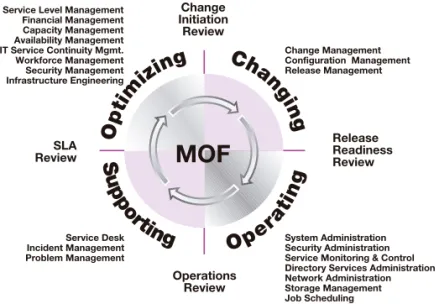
The Microsoft Operations Framework is created by Microsoft. It is based on ITIL best practice, combined with Microsoft’s own experience from application development and project management as described in the Microsoft Solutions Framework (MSF), plus the best practices of the day-to-day operations their own IT group performed. The best practices from ITIL were mostly adopted in the MOF Process Model. In this model the ITIL processes are structured in four quadrants as is shown in figure 1.
Figure 1 The MOF Process Model
O
p
ti
m
iz
ing
S
u
p
p
o
rtin
g
Cha
n
g
in
g
MOF
Op
er
a
ti
n
g
Release Readiness Review Operations Review SLA Review Change Initiation Review Service Desk Incident Management Problem Management System Administration Security Administration Service Monitoring & Control Directory Services Administration Network Administration Storage Management Job Scheduling Change Management Configuration Management Release Management Service Level ManagementFinancial Management Capacity Management Availability Management IT Service Continuity Mgmt. Workforce Management Security Management Infrastructure Engineering
5
The main principle of the team model is to separate conflicting tasks and responsibilities. Byseparating, for example, reactive ad-hoc tasks from proactive repetitive tasks, it will ensure that the latter tasks will get done. This separation of tasks is accomplished by creating virtual teams and adding resources to these teams. This is done so that staff are not assigned to more than one team at any one time.
There are seven teams in the MOF Team Model:
Team Tasks and responsibilities Quality Goal
Release Tracks changes and lessons learned in a corporate knowledge base.
Tracks inventory and changes in a configuration management database (CMDB).
Acts as liaison between the change development team and the operations groups; it encompasses the ITIL disciplines of configuration management and software control and distribution.
Controlled release and change management, and accurate inventory tracking of all IT services and systems
Infrastructure Defines physical environment standards. Manages physical assets.
Maintains the IT infrastructure and oversees IT architecture evolution.
Coordinates building and office moves, expansions and acquisitions, and physical environment changes such as wiring, lab space, and user connectivity.
Efficient management of physical environments and infrastructure tools
Support Provides technical support for internal and external customers, resolving incidents and problems using highly automated tools and knowledge based systems. Provides production support for line-of-business (LOB) applications.
Gives feedback to the development and design team.
Quality customer support and a service culture
Operations Ensures that daily, routine tasks are performed reliably within specific technology areas and production systems (messaging, system administration, etc.).
Performs scheduled and repeatable processes such as data backup, archiving and storage, output management, system monitoring and event log management, and file and print server management.
Predictable, repeatable, and automated day-to-day system management
Partner Defines and manages partnerships in a mutually beneficial and cost-effective manner.
Includes both the internal manager responsible for the relationships with external parties, and those parties themselves.
Protected corporate assets, controlled authorization to systems and information, and proactive planning for emergency response
Security Ensures data confidentiality, data integrity, and data availability.
Influences business policies, such as defining exit procedures to follow when an employee leaves the company.
Efficient and cost-effective, mutually beneficial relationships with service and supply partners
How we use the team model
If the objective is to make an IT-department more effective (better services, more agility) and efficient (better processes, lower cost) it is very important to look at the organization first. The most important reason for this is that, frequently, organizational changes cannot be done overnight, but they do take time. In our experience a lot of inefficiencies in an IT department are caused by the way IT is organized. Employees have to spread their attention over a number of roles and therefore tend to prioritize their time on what is important for the organization.
Division of responsibilities
We use the team model to make a clear division in responsibilities. The seven teams that the team model uses are in line with requirements from both ISO standards and compliancy legislation. The division is necessary to give the teams focus on their own objectives, as mentioned in section “What is the MOF Team Model”. Many IT departments tend to be organized along the lines of technology. At the employee level the consequence of this is that most of the IT employees have different roles in the IT department that cause conflicts. If employees have to choose between resolving incidents (support team) and pro-active server management (operations team) most of them tend to choose the first. The pressure to do reactive tasks first is difficult to resist for most employees. Therefore it is better to avoid these kinds of choices by organizing differently. Some of the divisions of responsibilities are also enforced by compliance legislation, for example a division between employees undertaking internal audits in line with security policies (security team) and those employees that are involved in day-to-day security management (operations team).
For efficient delivery of IT projects the division between support and operations on the one hand, and project oriented work (release team) on the other is also essential. This is important for ensuring that service levels are met by carrying out efficient IT management and also that projects are delivered on time. As work for the agreed IT services is planned first, the risk of losing stability in an IT environment because important business projects require a lot of resources, is avoided. On the other hand, work on a project is planned better and therefore more predictable because the appropriate employee resources are guaranteed for the duration of the project.
Accountability
At the end of the 20th century most IT departments were organized on the basis of technology. When they became more process oriented, a lot of IT departments chose to become matrix organizations, where line managers were typically accountable for the different platforms and the employees working on those platforms, and the process managers were only accountable for the processes. These departments were directed from two different perspectives. A major benefit of this development was that most (especially) back-office employees became aware of the fact that customer orientation was important.
Team Tasks and responsibilities Quality Goal
Service Ensures that all of the IT services being provided to customers are aligned with the customers’ need for them. Maintains a working relationship with customers, understanding their need for IT services, and managing the introduction of new services, service improvements, and (eventually) service reductions and retirements.
Delivery of a portfolio of business-aligned IT services
5
The downside to these matrix organizations was that is was very difficult to make managersaccountable because they did not have complete authority over all of the means they needed to accomplish their objectives.
The team model is useful to avoid these types of conflict by making the manager of the support team not only accountable for the employees but also for the processes that logically belong to the team cluster.
A central concept of the model is that the manager of the support team becomes
accountable for the helpdesk, the incident management process, the problem management and the registration of all CI’s that are in the offices. The manager in the operation team becomes accountable for all processes in the operating quadrant and the registration of all the CI’s that are “behind the wall”. Technical processes of the optimizing quadrant (service continuity, capacity management and availability management) become part of the infrastructure team. The manager release is responsible for the release management process. The manager security becomes responsible for security management (setting the policies) but not for security administration (working according to the policies). Ultimately the manager service becomes responsible for the service level management process.
The only exception in practice is that the manager of the release team is not made responsible for the change management process. The interest this manager has in bringing changes quickly through to production is simply too great.
Quality goals
The third aspect of the team model is the definition of quality goals. By using the team model, the number of different goals that employees have to live up to is limited. This is important because most employees tend to realize objectives that are easily feasible. The consequence is that difficult objectives are avoided. The team model illustrates to employees that achieving an important team objective is only feasible through cooperation with their colleagues.
In implementations it is important to align the quality goals of the team model with the overall mission and vision of the IT department. This integrates the team model objectives within the overall strategy of the IT department. In practice the team model objectives prove to be generic enough to fit in with every kind of business strategy.
Knowledge sharing
Knowing and trusting each other are very important aspects for working in a successful team. For this reason it is essential that the support and the operations team are brought together into a limited number of physical locations. If rooms are equipped for meetings then the quality of this work increases and the knowledge transfer from more experienced employees to juniors quickens.
In a traditional three-tier support model, employees have the tendency to complain about the quality of the tier beneath them. So the second tier support complain about the helpdesk and the third tier support complains about the lack of knowledge of the second tier.
BENEFITS OF THE APPROACH
General benefitsThere are a number of general benefits that have been realized in our implementations in the past. These benefits occurred in all of the projects and are related to both the approach and the chosen organizational model:
• There is a clear distinction between ad hoc urgent activities (support) and repetitive day-to-day tasks (operations). Before the implementation, the non-urgent operating tasks were not executed, there was never time or attention. The supporting tasks, such as incidents and service requests, would take up most of the time and energy of the IT staff. And if there was some time available, then there would be a project requiring some resources. By separating the operational tasks from the support tasks, and by consistently reserving resources, the model helps to ensure that the operational tasks were carried out. Because the operational tasks, such as monitoring and maintenance, were undertaken this meant that possible incidents were prevented from happening. Thus after some time there was less need to maintain a large support staff and these resources could be freed for projects.
• The tension between the organizational hierarchy and process responsibilities is resolved by making the team leaders responsible for their own processes. In many ITIL process framework implementations the organizational hierarchy remains intact and a second process hierarchy is put in place (matrix organization). The effect is that, in many cases, the process managers or owners do not have a mandate to assign resources, or to escalate if this is needed. By implementing the MOF team model, the organizational hierarchy is changed so that it aligns line management with process management responsibilities. The result is that the team manager is responsible for his staff and for the quality goals of the team.
• There is organizational control through a reporting structure based on both performance and maturity of the processes. This structure provides guidance on the constant improvement of the processes' performance and maturity in line with the business forecast and expectations. Because the approach is more focused on the outcomes of the ITIL/MOF processes than on the inputs of the processes, a reporting structure is needed early in the implementation to be able to react to the outcomes. This reporting structure, or management system, is created as an overarching structure over all the individual processes. With this reporting structure, processes do not have to be implemented perfectly (100%) before results will be visible. Because of the reports on outcome (the results of the processes) it generates the input for the teams to discuss possible improvements.
Benefits realized in cases
In this section several case study examples are used which were previously described in the Dutch version of ”IT Service Management global best practices”. These are cases were the MOF team model was used to create a new IT organization, as in the example of Deloitte, or to improve an existing IT organization, as in the case of the Dutch Railways and Bouwfonds. There is a short description of the background to each case study before the realized benefits are described.
Deloitte
In 2003 the new datacenter of Deloitte Netherlands was built to enable a more centralized IT infrastructure and support system for the more than 30 local offices. The new datacenter would also enable a portal solution for the customers of Deloitte to outsource some of their administration. Our project entails the creation of a managed infrastructure through the use of architecture standards as well as the implementation of the new IT service organization based on MOF.
5
The following results were achieved during the implementation of MOF in the Deloitte ICTServices organization:
• Due to centralization and efficiency in operations, the number of employees decreased from 200 to 150, which was the target in the ICT Services business plan.
• Due to the centralization, the number of infrastructure and office automation servers decreased from 400 to 250.
• There was a controlled implementation of changes in relation to the production
environment, achieved by means of using the Release Readiness Review in combination with a separated preproduction environment.
• Clearly documented procedures and tasks, leading to consistent execution of daily operations and ensuring that the teams do not become dependent on individual employees.
• Smooth cooperation with the service desk on monitoring events that could potentially become breaches in the quality of service.
• Ability to plan, schedule, and automate all activities, thereby optimizing the use of systems and resources.
• In May of 2004, Deloitte ICT Services earned its ISO 9001-2000 certification. In December of 2003, Deloitte ICT Services earned its BS7799 certification.
• The maturity in processes grew on average from SPICE (Software Process Improvement and Capability dEtermination) level 1 to SPICE level 3 in the MOF Operating Quadrant and Changing Quadrant in nine months. In the Supporting Quadrant, the maturity grew on average from SPICE level 2 to SPICE level 3 in five months.
• Deloitte Portal Services was introduced on schedule in December of 2003, nine months after the start of the project. The objective of Deloitte Portal Services was to acquire 1,450 new customers in 2004. At the end of May of 2004, the number of new customers was already 500 percent above the target for the entire year.
Bouwfonds
At Bouwfonds, a financial services organization in the Netherlands, the IT department was going through changes after the merger of two IT departments: IT operations and IT staff (projects, IT policies and IT strategy). The new team for Infrastructure Services needed to transform from a reactive to a proactive attitude. Bouwfonds decided to use the MOF guidance around operations management as the basis for this transformation.
The MOF implementation project made a significant contribution to improving the overall service levels for the customer. Figure 2 shows the number of client-related incidents as well as those for server or back office-related incidents. Most of the 800 to 1000 client-related incidents per month were service requests, ranging from password resets to requests for new laptops. The server-related incidents had an effect on multiple users at the same time and made applications unavailable to them.
During the MOF implementation project, which took three months to complete, the number of server related incidents started to decrease significantly. Based on these numbers there is a correlation between the implementation of MOF and a decrease in the number of incidents (in this case with about 100 per month: equating to 54%) at the server side of the ICT infrastructure.
The number of people working on support activities has decreased in the year following the MOF project. The number of people working on releases has also decreased, even though the total number of changes has stayed more or less the same (the number of supported workspaces decreased due to an organizational change within the company). Only the number of people in operations has increased from around one FTE to about five FTE. This
means that with a slightly decreased number of staff (from 18 to 16,5 FTE) the same amount of changes and service requests can be handled.
Dutch Railways
The situation at the Dutch Railways (Nederlandse Spoorwegen - NS) differed from the previous two cases in the sense that most of the management of the IT infrastructure is outsourced to multiple suppliers. In this situation the upgrade of the Operating System (OS) of the workstations and the back-office was needed. With this upgrade the service management organization, specifically the demand organization at the NS, needed to be improved and transformed. ITIL and MOF were used in combination to help guide the transformation of the IT organization.
In the case of the Dutch Railways, the benefits of using the MOF team model didn’t lead to an improved performance of the IT services. With the IT services outsourced to external providers, the performance improvement was not in scope. However, it resulted in a better understanding of IT governance and on how to manage the external suppliers. In some sense using the team model helped the IT staff to get a better grip on what is needed and who is responsible. In combination with the NS-specific model on outsourcing (based on service layers), the MOF team model provided guidance on helping to decide what the responsibilities were of the central IT organization in comparison to those of the external service providers.
OUTLINE OF THE IMPLEMENTATION APPROACH
In this section the approach to the implementation is presented in the form of a generic case study. This approach is based on our experiences at several organizations in implementing the MOF Team Model.
Figure 2 Absolute number of reported incidents
Number of recorded incidents MOF project Time Server/backoffice related incidents Client related incidents and service requests
5
Program structure
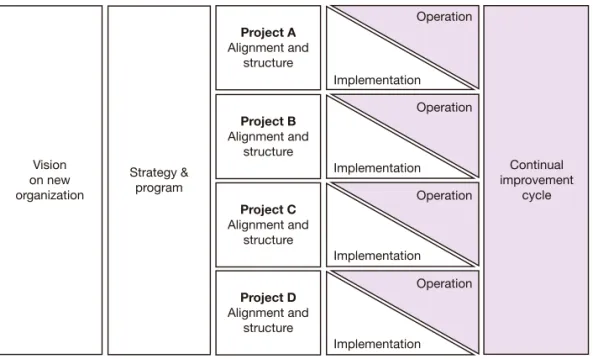
The overall structure used to implement MOF is based on the principle that the process improvements will follow on from the changes made in the IT organization. As discussed in the section “How we use the team model” most IT departments are not well organized. In order to reach the improvement goals, a vision of the new organization firstly needs to be established and communicated. This is done in the form of a organizational blueprint using the MOF team model for guidance. The first steps to create this blueprint are taken in a number of workshops that look at business IT alignment and design considerations. Based on the progress made in these first steps, a program can start containing a number of parallel projects intended to implement the process clusters or MOF teams. This is illustrated in figure 2.
The projects are all based on the same principles:
• A short design phase to align the current activities with the best practices theory. In workshops with the involved staff, the process principles and quality goals of the teams are shared and approved. This phase should take about two to four weeks.
• An implementation phase of about three months where the MOF consultant takes the lead. Working with the assigned process manager, the phase is shaped around the reported outcomes of the processes. Therefore this phase is as much about reporting, planning and control as it is on creating the right work instructions and procedures. • At the end of the implementation phase the MOF consultant hands over the responsibility
for the process to the process manager. This is done when the process manager feels comfortable with being in control and is recognized as such by their manager. The consultant shifts to a coaching role and the organization now assumes control.
• The operation phase ends with the process managers presenting their plans to manage, control and improve their processes. These process improvement plans are the basis for the continuous improvement phase or production phase, signaling the end of the program.
Figure 3 The program structure
Vision on new organization Strategy & program Project A Alignment and structure Project B Alignment and structure Project C Alignment and structure Project D Alignment and structure Operation Operation Operation Operation Implementation Implementation Implementation Implementation Continual improvement cycle
Generic case: starting with the team model, creation of a blueprint
Senior management and team leaders organize a kick-off meeting for the implementation of the MOF Team Model for the IT department. Before this kick-off meeting, a workshop with representatives of the business is organized to present the business vision and strategy and what is needed from IT: the business-alignment workshop. During this workshop, a group of managers, team leaders, and senior specialists are enlisted to participate in the project and to become the process owners and managers in the new organizational structure. Team leaders responsible for operations participate in this workshop and explain their current way of working: many tasks are performed, but there is a lack of process structure and knowledge sharing.
At the kick-off, the CIO explains the need for changes in the organization by showing that strong division of responsibilities produces better results in management of the infrastructure. The CIO gives examples that illustrate the relationship between issues addressed during the business alignment workshop and issues caused by the current organizational structure. The presentation has three components:
• team model theory
• the company’s vision and strategy objectives, and the project team’s perception of the changes needed in the organization
• design considerations and guidelines to be used as the basis for the organizational blueprint
The purpose of the presentation is to create a shared vision with senior management to use in establishing the guidelines for the project. In order to make the implementation of the organizational blueprint a success, it is important to achieve a clear understanding of these guidelines because they will be used to explain the organizational change to the employees. The presentation ends with a slide in which the team model is mapped to the current organization. Following this presentation a discussion on the design considerations of the new organization takes place.
Design of the blueprint
On the basis of the design considerations, an organizational blueprint is produced during several interactive sessions with the senior management of the IT department. Because the blueprint is built one step at a time, it results in a shared vision. After the blueprint is presented, the IT department decides to merge all release- and project-oriented departments into a single department named Release. This department is designated to be responsible for innovations, proof of concepts, and projects. The design of the support and operations
groups is created with the managers of these groups and senior management. The
Infrastructure or Architecture group starts as a very small team around the lead architect. The more staff-oriented groups (security or quality and partner) are decreased in size and integrated. A new group, the Services group is created with the service level manager and the change manager as its core. Figure 6 shows an example of the organizational blueprint. In the end, the blueprint design process includes the following:
• a presentation explaining the reasoning behind the blueprint, and its relationship to both the company vision and the targets of the IT department
• an organizational outline written in a hierarchical structure that includes numbers and names of employees
• all roles in the hierarchy, with descriptions of their tasks and responsibilities based on the content of the team model
5
Blueprint implementationThe employees of the IT department are informed of the project’s goals and implications during three sets of meetings that are held for all employees. The first meetings are awareness sessions that explain the reasoning behind MOF and its relationship to the company’s vision and goals. Secondly, every employee attends one of the MOF training sessions. In this one-day training, the focus is on the importance of working with processes derived from MOF. Thirdly, in a meeting of the entire IT department, the overall layout of the new organization is presented. Team managers have additional planning workshops covering the essence of the team model and its consequences in terms of the planning and teamwork for which they are responsible. These workshops produce good results; the team managers begin to understand each other’s problems and discover immediate solutions.
Some of the process managers (either team managers or coordinators) are appointed to their roles prior to the organization-wide meeting for pragmatic reasons: They become familiar with their new roles in advance and they are extremely motivated to deliver good results in the process-design phase of the project.
The role descriptions are also integrated into the company-wide HR (Human Resource) model. By integrating the roles, the results become institutionalized throughout the entire organization.
Generic case: process cluster or team implementation
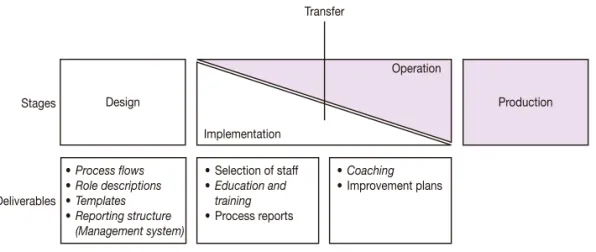
As described above, the process cluster or team implementation project consists of four phases: design, implementation, operation and production. In figure 4 these four stages are shown, together with the deliverables involved.
Design phase
During the design phase, a MOF consultant works closely with the process managers and designated process owners. In this phase the consultant has responsibility for designing the MOF processes and aligning them with the organization. It is also the consultant’s responsibility to ensure that process managers and process owners learn on a theoretical basis how each of their processes should work.
As part of their contribution to the design phase, the process managers demonstrate or explain their current best practices, which are then aligned with and integrated into the MOF processes.
Figure 4 The four stages of the process cluster implementation project
(The deliverables in italic are the responsibility of the MOF consultant or project manager. The other products are all the responsibility of the team leader or process manager.)
• Process flows • Role descriptions • Templates • Reporting structure (Management system) • Selection of staff • Education and training • Process reports • Coaching • Improvement plans Design Production Operation Transfer Implementation Stages Deliverables
To ensure that all responsible parties agree with the design, the consultant organizes a formal handoff to the next phase. In a session with all parties involved, the process managers present their designs and considerations and explain the way they intend to plan the implementation. This session ensures that the process managers take responsibility for the processes they are going to manage.
Implementation phase
During the implementation phase, real-life situations in the existing organization are evaluated as examples for improvement. This approach means that instead of templates and procedures being produced in the original design, they are created based on real needs in the daily operation of the IT department. In order to find these examples and to give management a higher level of control, a weekly operating report is introduced.
These weekly reports, in combination with monthly operations review meetings, show the people involved where progress can be made and how to apply the process model. They also show the subsequent improvement of service levels and management control. The effect of this approach is that the IT organization starts to be more proactive and assertive.
Employees with new roles are asked to participate in the project and to record their daily procedures. In order to ensure that all roles are clear and that all employees are trained in their new way of working, the IT department organizes information sessions and workshops delivered by the process managers and the MOF consultant.
It is the responsibility of the MOF consultant to coach the process managers in their new positions and roles. When focusing on the operating quadrant, therefore, the MOF consultant has to coach a group of process managers, not only in their process roles but also in their line management roles. This method of implementation creates an environment in which the employees take ownership of the new ways of working.
The implementation occurs in two directions:
• bottom-up, based on the technology (products), working out the details of the frequent tasks related to the specific products – for example, Microsoft Windows Server™ 2003 • top-down, in line with the design strategy; through the structure of the ITIL or MOF
processes, creating the details for required policies and procedures
During the implementation, both directions came together, resulting in a set of policies and procedures sufficient for running a smooth operation.
When the project starts, employees are not used to planning their activities; this needs to be addressed. In order to ensure that all activities are planned and synchronized with other processes, planning workshops are implemented for all employees: support staff (ad-hoc activities), release staff (planned activities), and operations staff (repetitive activities). These workshops convince process managers to consider the workload of the entire organization when planning their group’s activities and roles, with the ultimate goal of service quality. Consolidation of the results
To ensure that the organization can be agile in following its business demands, the MOF project continues to implement a constant quality improvement process, controlled within the organization and audited against criteria of, for instance, ISO20000, ISO 9001 and ISO27001. Because ISO and MOF build on the concept of constant quality improvement, a single quality system for the IT department is created.
Within this quality system is a strong division of responsibilities based on the MOF Team Model. The ISO audits are successful, indicating that the division of responsibilities is appropriate.
5
MEASURING PROGRESS
During the implementation and production phases of the implementation program, progress is measured based on the desired outcome of the IT service delivery. The desired outcome is derived from the business requirement and is specified in the business alignment workshop. Measuring the actual outcome is difficult, since the contribution of IT to business results is often indirect. Also, it is very much about business perception of the IT performance. It is easier to measure the outputs or performance of the IT department and relate these to the business results.
Output measurement
The contribution of a process to the overall performance of the IT organization can be presented in Key Performance Indicators (KPIs). In the design workshop of the process these KPIs are identified and the goal or norm of the KPI is set in relation to the business requirements and desired outcomes. The number of KPI’s should be limited to about three and no more than five. The norm of the KPI should be set above the current level and within reach after a couple of months. For instance the maximum time to resolve an incident should be lower than the current maximum (based on monthly reporting) and it should attempt to find ways to control and lower the resolution time for the support group. Also, the KPIs should be measurable and it should take little (but some) effort to report on them. Using the KPIs the process managers have to create a monthly report on the status. This report should show the actual KPI in relation to the past results. It should address the reasons for the performance and should come up with possible improvements where necessary. This report will be discussed with the MOF consultant in the implementation and operation phases to improve measurement and reports. The report should be shared with all other process managers, higher management and staff.
The reports are discussed in the review meetings that should be put into place. MOF describes several review meetings that are either production-based (continual) or release-based (projects). There are two pre-described production-release-based reviews: the operations reviews and the service level reviews. The operations review takes place on a monthly basis. In this review the performance reports produced by the operational process managers are discussed and possible improvements are indentified. The outcome of the operations review is used as input for the service level review. In this review the customer, i.e. the business, will discuss their perception of the performance with the IT organization. Both reviews will lead to possible improvements, in performance as well as in measurements.
Maturity measurement
Traditionally the progress of an ITIL implementation is measured in terms of maturity. The problem with this type of measurement is that the maturity scale (levels 1 to 5) doesn’t help in showing progress during the implementation project. To report every month that the maturity is still at level two does not help to show that the implementation is moving forward. These kinds of levels are not discriminating enough. In MOF implementation projects a different type of reporting on maturity was used. In the implementation, when the IT department was growing in maturity, the project was controlled by process maturity in order to bring the entire organization to a consistent level of operations, with measures taken of the areas for improvement. This reporting was based on a checklist of maturity components and how many of these components were in place and actually used by the organization. Instead of only showing the level of maturity, the reports showed how much was accomplished on any level and gave a percentage of the maximum maturity that could be reached. This made it possible to report on the maturity components of a higher maturity level: for instance, quantitative management is a level four requirement, but many components (measuring
and reporting) were already used early on in the implementation. This reporting also made it possible to show progress on a monthly basis, which is very important in terms of psychology.
HOW THE ORGANIZATION DIFFERS FROM A TRADITIONAL
ORGANIZATION
This section summarizes the differences between a traditional IT department and a MOF team model-based IT department. It addresses the three main differences between those two types of organization.
Planning of resources
In all implementations strict guidelines are used for the planning of work for employees. By creating a strong division between reactive work (support team), proactive work (operating team) and planned work (release team) the availability of employees on a daily basis can be better guaranteed than in a normal setting.
When it comes to the planning of employees, the support and operating activities are planned first. The number of employees required for support activities is based on historical data. The number of FTEs needed is a key factor in ensuring that all roles in the support team are fulfilled on a consistent basis.
The operating team numbers are planned based on the amount of pro-active tasks that have to be performed. Following on from this, the number of employees who are available for projects and changes is calculated. This method helps IT departments to plan more effectively for their employees and prevents the department from turning down work (particularly of a proactive type) because employees are busy doing other things.
Figure 5 Normal outline of an IT organization
Management
Staff (like HR and finance) Staff (like architecture and service management Servicedesk Desktop management Infrastructure management Project management Application management Application development Application maintenance Network management Server management Database administration
5
Clear accountabilities
Because IT management in itself is complex, it is very important to make roles and responsibilities clear. Figures 5 and 6 show the differences in hierarchy between a normal IT organization and one based on the MOF team model. The main difference is that most organizations as shown in figure 5 are structured in a way that reflects technology. By using the MOF team model, processes become the basis for organizing the IT department. As discussed earlier in section “How we use the team model”, most of the processes are performed in only one team. This makes the accountability clearer because in most of the classic IT departments the processes run through all parts of the department.
Managers of a MOF team cluster are accountable for all the employees and processes in their own team.
From product focus to customer focus
The quality goals in the team model help IT departments to become more customer focused. In a classic IT department, IT management primarily focuses on the platform (we make sure our Unix platform is available) and much less so on end-to-end services. In the MOF team model the focus is on all customer services (support team) or on the availability of all components that provision services to customers.
CONCLUSIONS AND RECOMMENDATIONS
The implementation of an organizational structure is the most important activity in an overall MOF, or even an ITIL, implementation. The MOF team model is necessary for separating roles and for creating checks and balances in the organization. The most important effect of using the MOF team model from a managerial perspective is that the IT department becomes more transparent. The demands on the competences of IT managers are higher because their accountability is more visible to the rest of the department. In practice it is difficult for a manager to manage people, process, technology and performance all together. It is advisable, therefore, to train the manager in their new role.
Figure 6 Basic outline of an organization based on MOF team model
Management
Services Security or
Quality
The main feedback from MOF implementations is that organizations tend to be less hectic and more under control. Employees appreciate the fact that they don’t have to do everything but can focus on the kind of work they like (proactive operations, reactive support, or planned projects).
The following concepts and processes proved to be of value during this project and will be used in future, similar projects:
• Base the design upon the vision of the organization. Agreements and decisions made during this design phase are useful for settling differences of opinion later.
• Move ahead with the implementation as soon as possible and maintain constant communication during the steps that you take in the process.
• Demonstrate what the value of an organizational change is in terms of the business case. • Plan some preparation time (study and questioning) for the new process owners and
managers.
• Make sure you create an official handoff process from the design phase to the implementation phase.
• Do not leave all the design work to the external consultant. It’s important that the process owners and managers be involved in the design process.
• Avoid allocating too long a period for the design phase. Don’t spend a lot of time thinking of all the ”nice to haves” for the project. It is important to get started on the implementation. You will be able to make adjustments as the project progresses.
Marcel Burghoorn (The Netherlands) is Practice Manager Microsoft Premier Support Services. Marcel is driving operational improvement and efficiency for Microsoft customers through Premier Services. As a senior consultant he was responsible for the positioning and rollout of implementations of service management solutions in EMEA.
Paul Leenards (The Netherlands) is a Senior Business Consultant for Getronics
PinkRoccade, Business Unit Consulting. He has over 10 years of experience in improving IT organizations using ITIL and MOF. Paul is a Master in IT Management.
Hans Vriends (The Netherlands) is a Managing Consultant for Getronics PinkRoccade, Business Unit Consulting. He leads the consulting practices for Service and Performance Management and Architecture and is member of the itSMF NL Research Board.
REFERENCES
• Boes, Klaas, Paul Leenards (2007). Meer doen met minder mensen – Het scheiden van werkzaamheden in operations- en supportteams. IT Service Management, best practices deel 2. Zaltbommel (NL): Van Haren Publishing.
• Burghoorn, Marcel, Paul Leenards (2005). Het MOF Operating Quadrant bij Deloitte Cybercenter: implementaties en resultaten. IT Service Management, best practices deel 2. Zaltbommel (NL): Van Haren Publishing.
• Eijk, P. van, Hans Vriends, Joris Geertman (2005). Deloitte Cybercenter Ontwerpkeuzes – een case study in rationalisatie en consolidatie. IT Service Management, best practices deel 2. Zaltbommel (NL): Van Haren Publishing.
• Ploeg, Pieter van der, Paul Leenards (2006). Het MOF Operating Quadrant in de praktijk. IT Service Management, best practices deel 3. Zaltbommel (NL): Van Haren Publishing.