Online Research Commons @ ATU
Online Research Commons @ ATU
Theses and Dissertations from 2019 Student Research and Publications
Spring 5-9-2019
Implementation of Standards-Based Grading at the Middle School
Implementation of Standards-Based Grading at the Middle School
Level
Level
Amy Louise Manley
Follow this and additional works at: https://orc.library.atu.edu/etds_2019
Part of the Educational Assessment, Evaluation, and Research Commons, Elementary and Middle and Secondary Education Administration Commons, and the Junior High, Intermediate, Middle School
Education and Teaching Commons
Recommended Citation Recommended Citation
Manley, Amy Louise, "Implementation of Standards-Based Grading at the Middle School Level" (2019). Theses and Dissertations from 2019. 20.
https://orc.library.atu.edu/etds_2019/20
This Dissertation is brought to you for free and open access by the Student Research and Publications at Online Research Commons @ ATU. It has been accepted for inclusion in Theses and Dissertations from 2019 by an authorized administrator of Online Research Commons @ ATU. For more information, please contact [email protected].
IMPLEMENTATION OF STANDARDS-BASED GRADING AT THE MIDDLE SCHOOL LEVEL
A Dissertation Submitted to the Graduate College Arkansas Tech University
in partial fulfillment of requirements for the degree of
DOCTOR OF EDUCATION in School Leadership
in the Center for Leadership and Learning of the College of Education
May 2019
Amy Manley
Bachelor of Arts, Arkansas Tech University, 1994 Master of Education, Arkansas Tech University, 2002 Specialist in Education, Arkansas State University, 2014
This disse(ation, "An Investigation of a Standards-Based Grading Model lor Arkansas Middle Schools,"
by Amy Manley, is approved by:
Dissertation Co-Chair:
Professor and Interim Department l{ead Center for Leadership and Learning
Dissertation Co-Chair:
ど
貯
Christopher E. Trombly
Assistant Professor, Educatjonal Leadership and Policy Snrdies
Southsrn Connecticut State University
Dissertation Committee Member:
ProgSam Direclor:
Prot'essor and Interim Department Head
Cerler for Leadership and Learning
Graduate Collegc Dean:
Bounds
Center for Leadership and Leaming
Professor and Interim Dean
iii
iv Abstract
The grading practices in education are steeped in tradition. Although the inaccuracies of grading have been written about for over 100 years, schools have been slow to tackle grading reform. This research study is based on a case study which investigated the implementation of standards-based grading from traditional grading in one middle school. This case study was developed to answer one research question:
How was standards-based grading implemented in the middle school? The research obtained in this case study will be used with the researcher’s own school community as they transition to standards-based grading.
The case study involved semi-structured interviews of parents, teachers, and administrators along with public documents which included state mandated assessment scores and state school report cards. This study sought to extract the purpose, process, and outcomes to which the participating middle school transitioned from traditional grading to standards-based grading. The purpose for changing to standards-based grading was based on the low reading scores of graduating seniors. Over the last nine years, the process of transitioning to standards-based grading took place with several representations of the report card. The middle school’s current standards-based report card is a combination, or conversion chart of numeric levels, proficiency levels, and percentages. The outcomes for this middle school were varied based upon the individual students and their needs.
Numerous lessons were learned by the researcher during this study. It is important to build capacity with all of the stakeholders when addressing the purpose of any significant change. A deep, collective understanding of the purpose for changing to
v
standards-based grading are the foundation for a successful implementation. This type of process will vary as individual schools transition to standards-based grading, but schools must start with the end result and product clearly defined. The outcomes will be based on the building of a foundation with the purpose, as well as the level of detail and
accountability throughout the process. The transition from traditional grading to standards-based grading is a daunting task that takes years to complete, but with the support and hard work of all stakeholders, it can be beneficial to the learning of all students.
vi
Table of Contents
Page
CHAPTER ONE: INTRODUCTION ...1
Statement of the Problem ...3
Purpose of the Study ...4
Research Question ...5
Significance of the Study ...5
Definition of Terms...8
Limitations of the Study...9
Summary ...9
CHAPTER TWO: REVIEW OF THE LITERATURE ...10
History of Grading ...11
Types of Grading Systems ...14
Standards-Based Grading...17
Implications of Grading Reform ...20
Conclusion ...22
CHAPTER THREE: METHODOLOGY ...24
Qualitative Design ...24
Population and Sample ...25
Instrumentation/Data Collection ...26
Treatment of the Data ...28
Summary ...29
vii Descriptive Statistics ...30 Semi-Structured Interviews ...34 Purpose ...37 Process ...39 Outcomes ...42
CHAPTER FIVE: CONCLUSIONS ...52
Summary of Findings ...52
Interpretations of Findings ...57
Implications...61
Limitations ...68
Suggestions for Future Research ...69
Conclusions ...69
REFERENCES ...70
APPENDICES ...76
Appendix A: Email Script Used to Determine the Middle Schools in Arkansas that use Standards-Based Grading ...76
Appendix B: Semi-Structured Interview Questions for Administrator/Principal ..77
Appendix C: Semi-Structured Interview Questions for Teachers ...78
viii List of Tables
Page Table 1: Middle School Demographic Data ...31 Table 2: Middle School Standards-Based Grading Chart ...33 Table 3: Middle School Grading Chart ...54
ix List of Figures
Page
Figure 1: Keys to Educating Young Adolescents ...7
Figure 2: Bell Curve Grade Chart ...13
Figure 3: Middle School Demographics ...30
Figure 4: Two Year School ESSA Scores ...32
Figure 5: ELA Performance Levels ...32
1
Chapter One: Introduction
The date of December 10, 2015 may not mean anything to most people, but to educators it is the day President Barack Hussein Obama signed the Every Student Succeeds Act (ESSA) into law. ESSA is a reauthorization of the Elementary and Secondary Education Act (ESEA) which was signed into law by President
Lyndon Baines Johnson in 1965. ESEA was a civil rights law focused on providing grant funding to school districts serving income students as well as scholarships for low-income students. The Every Student Succeeds Act also centers on special education and improving the quality of elementary and secondary education (The U.S. Department of Education, 2016).
ESSA includes provisions that will help to ensure success for students and schools. The law:
• Advances equity by upholding critical protections for America's disadvantaged and high-need students.
• Requires—for the first time—that all students in America be taught to high academic standards that will prepare them to succeed in college and careers. • Ensures that vital information is provided to educators, families, students, and
communities through annual statewide assessments that measure students' progress toward those high standards.
• Helps to support and grow local innovations—including evidence-based and place-based interventions developed by local leaders and educators—consistent with our Investing in Innovation and Promise Neighborhoods
2
• Sustains and expands [the Obama] administration's historic investments in increasing access to high-quality preschool.
• Maintains an expectation that there will be accountability and action to effect positive change in our lowest-performing schools, where groups of students are not making progress, and where graduation rates are low over extended periods of time. (The U.S. Department of Education, 2016, para. 7)
The third bullet discussed above focuses the reader on the annual statewide assessments and the implications of those assessments. It speaks to the continuation of a local school’s assessment data being released to all stakeholders just as had occurred under the No Child Left Behind Act.
President George Walker Bush signed the No Child Left Behind Act (NCLB) into law on January 8, 2002. It called for an increased role of the federal government in holding schools responsible for the academic growth of their students, with a focus on certain subpopulations such as English-language learners, special education students, low-socio economic students, and minority students. The caveat was states did not have to comply with the new requirements; however, if the states chose not to comply, they risked losing federal Title I money (Klein, 2015).
Under NCLB, students were tested on reading and math annually in grades three through eight, and once in high school. These test results were then reported by whole schools and subpopulations. Each year, a school must have reached a goal of adequate yearly progress or AYP. NCLB required that all students reach proficiency by the 2013-2014 school year. Schools not meeting their AYP were subject to expanding sanctions that could include the state taking over the school (Klein, 2015).
3
In 2011, the scrutiny placed by NCLB on public schools and the individual staff members prompted President Obama to give waivers to states from the requirements of NCLB. Under this waiver, an individual state could set its own standards to prepare students for higher education or the workforce. Along with these standards, there had to be an assessment aligned to the standards. Another component was a teacher-evaluation system which included student progress on state standardized tests (Klein, 2015).
Although the Elementary and Secondary Education Act of 1965, the No Child Left Behind Act of 2002, and the Every Student Succeeds Act of 2015 all played a role in the evolution of school reform in America. The No Child Left Behind Act provision for reporting test results shifted our focus to data, which led to an investigation of student assessment scores on standardized tests and school accountability for these scores. Statement of the Problem
According to Guskey and Brookhart (2019), “Grades are the symbols assigned to individual pieces of student work or to composite measures of student performance created for report cards and other summative documents” (p. 1). Grades come in many forms: letters, numbers, figures, or descriptors. Current grading practices are based on long-held traditions rather than current evidence-based research. Opinions on grading, whether positive or negative, are mostly based on personal experiences from individuals’ own time in school. A simple search using the term “grading reform” will result in almost nine million hits, but, as with any topic, it is the researcher’s job to distinguish literature that is based on “…research evidence rather than personal experience” (Guskey & Brookhart, 2019 p. 2).
4
According to Guskey and Brookhart (2019), history showed grading to be one of the last facets of reform in education. Educational reform typically starts with a
clarification of standards and curriculum. Schools then move to the creation of
appropriate assessments as evidence of the level of learning. Next, schools take the data from the assessments and focus on the quality of instruction and how to effectively help students meet the established goals and standards. Only at this point do educators typically address grading practices and how to communicate the level of learning to students and parents. “We take grading on last and always with some reluctance, because changing grading policies and practices means challenging some of education’s longest-held traditions” (Guskey & Brookhart, 2019, p. 1).
Purpose of the Study
The purpose of this study is to investigate the particular experience of one middle school community and their transition to standards-based grading from traditional
grading. Results from this case study will be used to inform the decision-making process at the researcher’s own school, as it transitions from traditional grading to standards-based grading.
According to the perceptions of participating parents, teachers, and building administrators, this case study will explore the implementation of standards-based grading in one particular middle school in the state of Arkansas. The case study will include semi-structured interviews of parents, teachers, and building administrators as well as a review of public documents reporting the school’s demographics, standardized test scores, and Arkansas ESSA School Report Card rating.
5 Research Question
One research question guides this study of grading systems: How was standards-based grading implemented in the middle school?
The researcher gathered data through semi-structured interviews with parents, teachers, and building administrators. Other data available to the public were collected through the Arkansas Department of Education’s My School Info website. This website stores demographic data, required standardized test data, and ESSA School Report Card data.
Significance of the Study
This study is driven by the enigma of standards-based grading and its implications at the secondary level. More specifically, the purpose of this study is to investigate one particular middle school community and their experience in transitioning from traditional grading to standards-based grading. The researcher is currently a principal in a
traditional seventh - ninth grade junior high school. In two years, the school will be transitioning to a sixth - eighth grade middle school. As the researcher’s school moves from a junior high to a middle school, a study of middle level education is underway. The researcher’s intended transition to standards-based grading must be viewed through the lens of effective middle level educational practices.
The Association for Middle Level Education formally known as the National Middle School Association was formed in 1973. It is specifically dedicated to the education of middle level students between the ages of 10 and 15, which is the time in a child’s life that signifies “more rapid and profound personal changes...than any other time in their lives” (Association of Middle Level Education [AMLE], 2010, p. 5).
6
There are four essential attributes of successful middle school education: 1. Developmentally Responsive: Using the distinctive nature of young
adolescents as the foundation upon which all decisions about school organization, policies, curriculum, instruction, and assessment are made. 2. Challenging: Ensuring that every student learns and every member of the
learning community is held to high expectations.
3. Empowering: Providing all students with the knowledge and skills they need to take responsibility for their lives, to address life’s challenges, to function successfully at all levels of society, and to be creators of knowledge. 4. Equitable: Advocating for and ensuring every student’s right to learn and
providing appropriately challenging and relevant learning opportunities for every student. (AMLE, 2010, p. 13)
According to the AMLE (2010), these four essential attributes can be realized and best achieved through 16 characteristics. The 16 characteristics are listed in Figure 1.
7
Figure 1. Keys to Educating Young Adolescents. Visual of the Essential Attributes and Characteristics for Successful Middle Level Education (AMLE, 2010, p. 14).
While the AMLE (2012) dedicated a chapter to varied assessments, it does not recommend a specific grading system for middle level students. However, the chapter does illuminate the role students should play in assessment. “Hence it is important to invite students to work with their teachers to make critical decisions at all stages of the learning enterprise, especially goal setting, establishing evaluation criteria, demonstrating learning, self-evaluation, peer evaluation, and reporting” (Association for Middle Level Education [AMLE], 2012, p. 68).
The significance of this study will help the researcher make appropriate decisions in the transition from traditional grading to standards-based grading in their own
school. The data gathered during this study will be beneficial in making decisions that are developmentally responsive to middle level students in the context of grading reform.
8 Definition of Terms
The following terms are defined to provide clarity and understanding for the readers of this study:
Grade(s) or Grading: “The number or letter reported at the end of a period of time as a summary statement of student performance” (O'Connor, 2009, p. 2).
Traditional Grading: Grading that references student achievement by letter grade or percentage grade for each subject area (Guskey & Bailey, 2010).
Standards-Based Grading: “Grading that references student achievement to specific topics within each subject area” (Marzano, 2010, p. 527).
Middle Level Education: Education pertaining to young adolescents ages 10-15 (AMLE, 2010).
No Child Left Behind Act (NCLB): An act to close the achievement gap with accountability, flexibility, and choice, so that no child is left behind. NCLB put a special focus on ensuring that states and schools boost the performance of certain groups of students, such as English-language learners, students in special education, and poor and minority children, whose achievement, on average, trails their peers (Klein, 2015, para. 5).
Every School Succeeds Act (ESSA): “This bipartisan measure reauthorizes the 50-year-old Elementary and Secondary Education Act (ESEA), the nation’s national
education law and longstanding commitment to equal opportunity for all students” (The U.S. Department of Education, 2016, para. 1).
ESSA Report Card: The Arkansas Department of Education (ADE) publishes a Performance Report of the state’s schools. This online report provides information about
9
each school, district, and the state, including test performance, teacher qualification, retention, discipline and more. It is designed to help open the lines of communication between schools, parents and the local community (Arkansas Department of Education, 2019, para. 1).
Limitations of the Study
The researcher conducted a qualitative case study with a middle school which has transitioned from traditional grading to standards-based grading. This case study is limited by the mere fact it was a single case study interviewing parents, teachers, and building administrators from one school community. The implications and
recommendations can only be viewed from the lens of one particular middle school and their journey from traditional grading to standards-based grading. While the results of this case study are an important part of the researcher’s ultimate goal of transitioning from traditional grading to standards-based grading in her own school, more case studies pertaining to standards-based grading at middle level are needed to add to the literature on this subject.
Summary
This study represents a qualitative investigation of a middle school in Arkansas and its transition from traditional grading to standards-based grading. Chapter Two is a review of the relevant literature on grading and grading reform. Chapter Three discusses the methodology for the study, as well as information regarding the sample and the instruments used to gather data. Finally, Chapters Four and Five will detail the data analysis and the findings as a result of the study.
10
Chapter 2: Review of the Literature
The purpose of this literature review is to provide a comprehensive overview of grading practices in education. The first section of the literature review will establish the history of grading in education and the review will proceed with types of grading systems and current grading trends in K-12 education. The literature review will conclude with the implications associated with grading reform.
Over a century ago, Isador Finkelstein (1913) identified the major issue associated with grading:
When we consider the practically universal use in all educational institutions of a system of marks, whether numbers or letters, to indicate scholastic attainment of the pupils or students in the institutions, and when we remember how very great stress is laid by teachers and pupils alike upon these marks as real measures or indicators of attainment, we can but be astonished at the blind faith that has been felt in the reliability of the marking system. (p. 1)
Finkelstein (1913) wrote about marking systems in his master’s thesis at Cornell University. There were three theoretical questions addressed in his thesis: “1) Should marks indicate performance or ability or accomplishment? 2) What is the theoretical distribution of the qualities or traits that marks are to indicate? 3) What is the best method of translating the distribution into a scale of symbols?” (Finkelstein, 1913, p. 3).
Tierney (2015) wrote about the significance of grades to students. Grades drive students’ “…learning paths, scholarships, post-secondary opportunities, and career choices” (Isnawati & Saukah, 2017, p. 156). Hence, students’ grades should be directly
11
relevant to those students’ achievement. The priority for many stakeholders is about the letter grade, and not the student’s learning (Durm, 1993).
Inaccuracies in marking or grading practices were identified in early public education, yet efforts to reform grading systems have faced many obstacles steeped in tradition. A clear understanding of educator and stakeholder biases must be confronted and dispelled. The focus of current K-12 education is student centered and driven by research-based best practices, but grading systems and grading practices are difficult to alter. Educational leaders must be intimately familiar with current research in order to propose new policies and procedures in local schools that support student learning and growth (Guskey, 2011).
History of Grading
It is important to understand the history of grading systems in order to find the most effective grading system for middle level students. Scholars from Oxford and Cambridge brought their educational traditions to the United States between 1630 and 1641 (Kunnath, 2016). Mark Durm wrote about the history of grading as it relates to colleges. He reported that “…marking or grading, to differentiate students was first used at Yale. The scale was made up of descriptive adjectives and was included as a footnote to (Ezra) Stiles’ 1785 diary” (Durm, 1993, p. 2). Four categories were used for seniors at Yale in 1785: Optimi, second Optimi, Inferiores, and Perjores (Schinske & Tanner, 2014).
Yale records from 1813 make reference to a marking system based on a scale of 4, which is presumed to be the origin of the 4.0 grading system used today in higher education (Brookhart, 2009; Durm, 1993). In 1830, numerical grading systems were
12
found in different versions starting at Harvard, which used a scale of 20. In 1837, a group of Harvard professors used a scale of 100. The University of Michigan explored the pass/fail system in 1851 (Brookhart et al., 2016).
Other grading systems were used over several decades, but the 100 percent basis grading scale was started at Harvard in 1877. From 1877-1897, colleges used different forms of the 100 percent grading scale. In 1898, Mount Holyoke adopted the grading scale that “…became the cornerstone for college grading” (Durm, 1993, p. 3). The unreliability of teachers’ ability to use the 100 percent scale was pointed out by Starch and Elliott (1912, 1913). The researchers discovered ranges in 40 to 50 points in the same paper for English, history, and arithmetic.
Norm-referenced grading, which compares students to one another and uses class standing to assign grades, was advocated in the early 1900s (Brookhart et al., 2016). This type of grading was based on the normal distribution, or Gauss’s curve, and is also
known as the bell shape curve (Finkelstein, 1913). It was believed that conforming grades to the curve would increase grading consistency in the classrooms (Meyer, 1908). Meyer (1908) is credited with the practice of grading on the curve. In the bell shaped curve the distribution of grades would look like the following in Figure 2.
13
Figure 2. Bell Curve Grade Chart. Illustration of a bell curve (Calcu Nation, 2017).
The 100 percent grading system was the most common grading system in high schools from 1890-1910 (Brookhart, 2009). During the early 1900s, the inaccuracies of the percent grading system defined by many scholars brought on the adoption of the letter grading system in the 1920s (Brookhart, 2009; Starch & Elliott, 1913). During the 1930s, standards or absolute standards grading was adopted. During its inception, standards grading was the comparison of a student’s performance against a predetermined standard of performance. Standard-based grading, as it is known currently, is defined as a system of grading that references a student’s achievement based on specific performance
standards within a subject area (Brookhart, 2009; Marzano, 2010). While standards-based grading is relatively new, many secondary schools persist in preserving traditional grading practices (Grinberg, 2014). The most common grading system currently being used is percent grading which is used as a way to arrive at letter grades (Brookhart, 2009).
14 Types of Grading Systems
There are many types of grading systems in education. The United States does not have a nationally mandated grading system but some systems are prevalent. One example is criterion-referenced grading which is based on a fixed numeric scale. Under this grading system, faculty assign grades based on an individual student’s
performance. In criterion-referenced grading systems, all students could
theoretically pass an exam; conversely, every student could fail the exam (The Glossary of Educational Reform, 2014; United States Network for Education Information,
2008). Criterion-referenced tests are the most prevailing form of assessment used today in the United States. Some notable examples of criterion-referenced tests include:
Advanced Placement or AP exams, and the National Assessment of Educational Progress or NAEP (The Glossary of Educational Reform, 2014). These large-scale tests develop cut-off scores to determine passing scores.
The debate over using criterion-referenced tests alludes to some positive outcomes. The criterion-referenced tests apply the same standards to all students including the historically disadvantaged students of color, limited English, low-income, and physical or learning disabilities. These groups of students have suffered from “lower academic achievement,” and many proponents of criterion-referenced tests claim that raising academic expectations for these student groups “promotes greater equity” (The Glossary of Educational Reform, 2014, p. 3). Arguments against criterion-referenced tests include: inaccuracy if the standards are vague or flawed, and the highly subjective determination of cut-off scores (The Glossary of Educational Reform, 2014).
15
Another example of a grading system is norm-referenced grading which assigns a specific percentage or ratio of students in the class a grade. Norm-referenced tests compare a student’s performance against a “hypothetically average student” (The
Glossary of Education Reform, 2015, p. 1). Reporting of norm-referenced test results are in the form of percentages or percentile rankings. Notable norm-referenced tests include: Intelligence Quotient or IQ tests, the Iowa Test of Basic Skills, and the Stanford
Achievement Test or SAT (The Glossary of Education Reform, 2015). Norm-referenced tests are used to measure certain skills against a “norming group” or a “small subset of test takers” (The Glossary of Education Reform, 2015).
Norm referenced grading might look like: A (Excellent) = Top 10% of class
B (Good) = Next 20% of Class
C (Average, Fair) = Next 30% of Class D (Poor, Pass) = Next 20% of Class F (Failure) = Bottom 20% of Class.
(United States Network for Education Information, 2008, table 1)
The debate over norm-referenced tests centers on the ethics of this type of test, and whether or not individual students should be compared to other students. Another potential risk is the changing of the performance criteria for a given set of students. If all of the scores were lower than previous tests, the “passing or proficient” score would be lower. Proponents of norm-referenced tests suggest some positive attributes which include: high quality due to the testing experts who create them, ease of administration
16
and scoring, objectivity and decreased bias (The Glossary of Education Reform, 2015). Current types of grading include:
Percentage Grading - Using a percentage scale.
Letter Grading and Variations - Using a series of letters with or without plusses or minuses.
Norm-Referenced Grading - Comparing students to each other
Mastery Grading - Grading students as “masters” or “passers” and allowing for different amounts of time.
Pass/Fail - Using a scale of two levels.
Standards or Absolute Standards Grading - Comparing students to a pre-establish standard level of performance.
Narrative Grading-Writing comments about student’s achievement in addition to or instead of percentages or letter grades. (Brookhart, 2009, table 2-3)
Several studies considered whether norm- or criterion-referenced grading should be prevalent in education (Crooks 1933; Kirschenbaum, Napier, & Simon 1971). High schools were more inclined to use norm-referenced grades as a way to rank students for admission into college, whereas elementary schools have transitioned into what is called standards-based grading (Grinberg, 2014).
Some researchers tout that giving grades on a concept “diminish students’ interest” in the learning (Kohn, 2011, p. 1). Kohn (2011) also pointed out that those assigning grades will create a preference for students to pick the easiest task possible within the assignment. Thus, Kohn wrote about the elimination of grades if research can prove their detriment to student learning (Kohn, 2011).
17 Standards-Based Grading
Validity is the most fundamental principle related to meaningful grading and assessment (Allen, 2005; Kunnath, 2016). According to Allen (2005), validity is about the accuracy of assessment and grading procedures by a teacher. In order for grades to be accurate, they must give a true measure of a student’s academic achievement (Allen, 2005).
According to Marzano (2010), standards-based grading is a system of grading that references a student’s achievement based on specific performance standards within a subject area. Standards-based systems have been confused with standards-referenced systems, but the two are distinct. A standards-based system keeps a student at a certain level until he or she can demonstrate competence while in a standards-referenced system, a student is graded relative to the standard but he or she is not required to meet the performance standard before moving to the next level (Marzano, 2010). Viability can be found in both standards-based and standards-reference systems but they are opposed in philosophy (Marzano, 2010).
Standards-based grading allows students to be graded wholly on mastery of the performance standard and not on homework, attendance, participation, or
behavior (Shippy, Washer, & Perrin, 2013). Marzano recommended some best practices for standards-based grading; “…get rid of the omnibus grade, expand the assessment options available to students, and allow students to continually update their scores on previous measurement topics” (Marzano & Heflebower, 2011, p. 1). In order for students to continually update their scores, formative assessments must be in place. Black and William (1998) gave a clear definition of formative assessments: “Formative
18
assessment...is to be interpreted as all of those activities undertaken by teachers and/or by students which provide information to be used as feedback to modify the teaching and learning activities in which they engage” (p. 7-8). A more recent definition of formative assessment from the 2006 Council of Chief State School Officers (CCSSO)
reads: “Formative assessment is a process used by teachers and students during instruction that provides feedback to adjust ongoing teaching and learning to improve students’ achievement of intended instructional outcomes” (Marzano, 2010, p.
591). Black and William (1998) and Marzano (2010) both point out that “…formative assessment is a process as opposed to a specific type of assessment” (Marzano, 2010, p. 747). According to Marzano (2010), an assessment can be either formative or summative depending on how the information is used.
In determining whether an assessment is formative or summative, the following analogy is offered: “When a cook tastes the soup it is formative, when the guests tastes the soup it is summative” (Hattie, 2003, p. 4). In other words, it is not the actual
assessment that determines whether it is formative or summative. It is the timing of the assessment and how the information from the assessment is used which determines whether it is formative or summative.
The standards-based grading system is gaining momentum in the United States. According to Sullivan and Downey (2015), as of 2012, 36 states have policies “allowing students to earn credits based on outcomes that demonstrate academic proficiency instead of acquiring traditional Carnegie units” (p. 6). Standards-based grading emphasizes diverse instructional practices including: direct instruction, peer instruction, collaboration, and teachers as facilitators (Sullivan & Downey,
19
2015). According to Sullivan and Downey (2015), the ideal is “40% direct instruction, 40% peer instruction, and 20% individualized learning” (Sullivan & Downey, 2015, p. 6).
A benefit of standards-based grading is the ownership assumed by the students for their learning (VanHook, 2014). VanHook (2014) stated, “By understanding exactly what they need in order to master a subject’s knowledge and skills, students can work in collaboration with teachers and other students to accomplish their goals” (p. 1). Another benefit is the significance and definable meanings of grades and homework as they are tied directly to the standards (VanHook, 2014).
The implementation of standards-based grading has two essential requirements, “the establishment of the standards and a rubric system” (VanHook, 2014, p. 2). In establishing standards, they “…must be broad enough to allow for efficient
communication of student learning, yet specific enough to be useful” (VanHook, 2014, p. 2). Establishing a rubric system that specifies each level of proficiency should contain either numerical marks or word levels. Numerical marks 1,2,3,4 could correspond with beginning, developing/progressing, proficient, or exceptional/advanced (VanHook, 2014, p. 3). The system of standards-based grading has many merits but without proper
training and guidance “…on how to collect and interpret the assessment data...standards-based reporting can be highly inaccurate” (Marzano, 2010, p. 548).
The focus on standards can pose challenges in grading and reporting. Guskey and Jung (2006) considered four challenges to be the most prevalent with standards-based grading: “…clarifying the purpose, differentiating grading criteria, moving from letter grades to standards, and grading students with special needs” (p.1). It is important to
20
make intentions clear to all stakeholders, including parents and guardians, from the beginning of the process to move to standards-based grading, and to consider their input (Guskey & Jung, 2006). Teachers must establish clear indicators of product, process, and progress while reporting each separately by differentiating grades for homework, effort, and work habits to give a detailed report to parents (Guskey & Jung, 2006). When moving from letter grades to standards, it is important to emphasize how standards-based grading gives a more accurate picture of a student’s learning. Parents need to know that standards-based grading “…facilitates collaborative efforts on the part of parents and educators to help students improve their performance” (Guskey & Jung, 2006, p. 2). The last challenge addressed by Guskey and Jung (2006) concerns students with special needs. Some students with special needs will only need assessment
procedure adaptations; for example, a visually impaired student may need their tests read aloud (Guskey & Jung, 2006). Students whose more significant disabilities necessitate modified curricula will also require differentiated standards, according to their
individualized educational plans (IEP) (Guskey & Jung, 2006). Guskey and Jung (2006) pointed out that a special notation should be used in the reporting system to indicate when grades are based on such differentiated standards.
Implications of Grading Reform
There is a certain mystique which surrounds the grading process. Even though the teacher’s evaluation of student progress is frequently subjective, many still
confidently assert that they grade on an absolute scale. If this be true, then the truth comes in bewildering variety. Anyone who has examined transcripts from many schools
21
and colleges is aware of the fascinating variations in grading schemes (Cureton, 1971, p. 1).
The reliability of teachers’ grading practices has been questioned by many researchers (Cheng & Sun, 2015; Finkelstein, 1913). Research has shown grading is influenced by multiple factors, and “teachers’ grading practices vary by subject area and by level taught;” furthermore, teacher’s grading styles are influenced by their gender, subject, and perceptions of the subject matter (p. 215). According to Greene, Johnson, Kim, and Pope (2007), most teachers agreed grading a student’s effort is ethical;
however, effort is not considered equally for every student. Some teachers have admitted they would “not lower high-achieving students’ grades for a lack of effort, [but] would raise grades for lower-achieving students who seemed to make an effort,” according to Tierney (2015, p. 7)
There are a number of studies that report teachers use grading practices that involve non-achievement factors (Bowers 2011; Cheng & Sun, 2015; Guskey,
2011; Isnawati & Saukah, 2017). Non-achievement factors can take the form of effort, work habits, behavior, and school policy (Cheng & Sun 2015; Guskey,
2011; Isnawati & Saukah, 2017). Many teachers justify the use of non-achievement factors because of external pressure from parents and state accountability models (Cheng & Sun, 2015; Isnawati & Saukah, 2017). One major reason teachers do not base grades solely on achievement is the consideration of equity in education. Teachers tend to use homework and participation as assessment pieces to give more students a chance to score the highest grade possible (Kunnath, 2016).
22
Parents and guardians presume that their students’ grades are representative of achievement in a class (Brookhart, 1994). Research indicates, though, that, as grades are "…often inaccurate representations of student achievement, parents may be misinformed of their child's true performance in their classes” (Kunnath, 2016, p. 68). Another issue summarized by Kunnath (2016) is the relationship of American students with low scores on standardized tests and high scores on teacher assigned course grades. Such a
discrepancy leads many to question the subjective meaning and validity of course grades in the United States (Kunnath, 2016).
There are some researchers who have determined “…that grades are effective in performing multiple purposes” (Kunnath, 2016, p. 72). Bowers (2011) articulates this thought by stating, “Recently, this dualistic nature of grades has been explored as useful data as a multidimensional assessment that assesses both academic knowledge and non-academic behaviors” (p. 143). Bowers (2009) conducted a study and found that
approximately 25% of grading is academic and 75% of grading is social process. Bowers (2009) claimed that the social process “…portion of the grade is evidence of a success at school factor (SSF), which has a tight connection to academic knowledge” (Kunnath, 2016, p. 72).
Conclusion
A century’s worth of published literature on grading reform indicates a
recognition of inaccuracies in teacher’s grading practices. Traditional grading practices are so ingrained in our society that we often create new topics to grade including
individual school proficiency. There are no required grading practices in the United States, but most secondary schools are using the traditional grading system,
23
which translates into grade points for admission into post-secondary schools and universities. Due to this, secondary schools have not changed their grading systems or practices, unlike elementary schools who have adopted standards-based
grading (Grinberg, 2014).
Standards-based grading is a system of grading that references a student’s achievement based on specific performance standards within a subject area (Marzano, 2010). A standards-based system removes the non-achievement factors such as: effort, work habits, and behavior from grade reports (Cheng & Sun 2015; Guskey,
2011; Isnawati & Saukah, 2017). Non-achievement factors obscure a student’s true learning on a specific performance standard and give the parent and student an unrealistic picture of the student’s actual level of achievement.
24
Chapter 3: Methodology
This study was driven by the enigma of standards-based grading and the implications at the middle school level. Elementary level staff and parents have
embraced standards-based grading, but as the students move into middle and secondary levels “…parents and teachers become less willing to abandon letters and numbers as students prepare to apply for college” (Grinberg, 2014, p. 2). This investigation was a case study of a middle school in Arkansas and their practice of standards-based grade reporting. There was one driving research question for this study on standards-based grading: How was standards-based grading implemented in the middle school?
Qualitative Design
There are seven kinds of knowledge-generating contributions that come from qualitative research:
1. Illuminating meaning 2. Studying how things work
3. Capturing stories to understand people’s perspectives and experiences 4. Elucidating how systems function and their consequences for people’s lives 5. Understanding context: how and why it matters
6. Identifying unanticipated consequences
7. Making case comparisons to discover important patterns and themes across the cases. (Patton, 2015, p.12-13)
The case study of standards-based grade reporting attempted to uncover a part of all seven contributions listed above. Close consideration was made to the case study and the attempt to discover important patterns and themes. Experts maintain, “Schools are
25
complex social environments in which it is impossible to ‘control’ for the wide range of conditions that influence the delivery of services” (Lareau & Walters, 2010, para. 7). This study therefore focused on “What researchers can actually accomplish given the turbulent, complex, and often chaotic conditions for carrying out research in schools today” (Lareau & Walters, 2010, para. 7).
Population and Sample
Since there is no official list of schools in Arkansas that employ standards-based reporting, the first step was to survey all schools in this state and compile a list of such schools. An email was sent from the Arkansas Association of Educational
Administrators (AAEA) to all school leaders (See Appendix A). Once this list was generated, a middle school was chosen based on several different criteria. One criterion was the grade configuration of the school using standard-based reporting. The researcher is currently a principal at a traditional seventh - ninth grade junior high. The researcher’s school will be transitioning to a sixth - eighth middle school in two years. The goal was to find a school which had a sixth – eighth grade configuration to match the researcher’s anticipated new grade configuration, as this research will be used to guide the implementation of standards-based grading at the researcher’s school.
Another criterion for the school in the case study was the specific demographic data. Schools who serve ethnically diverse learners with a significant population of low socio-economic and special education students were given more consideration. The other criterion was determining the level of standards-based reporting used in the school. The standards-based grade reporting must be a school wide practice and not a singular practice in only a few classrooms.
26
Once the school was chosen based on the above criteria, the principal from the school scheduled interviews for the researcher. The researcher traveled to the middle school and completed all interviews in one day. The interviews were conducted and recorded in a small room located in the media center. All of the interviews were
completed in this location except for the administrator interviews, which were completed in each administrator’s office.
Instrumentation/Data Collection
Data were collected using a variety of methods for this study. There were semi-structured interviews with participants and reviews of public documents collected from the participating middle school. The semi-structured interview questions were developed after the researcher studied Merriam and Tisdell’s (2016) book, Qualitative Research, A Guide to Design and Implementation. The book is a comprehensive look at qualitative research from designing the study to analyzing and reporting results.
Merriam and Tisdell (2016) support that a majority of the data collected for qualitative research will emerge out of interviews. According to Patton (2015), such research aims to “…find out what is in and on someone else’s mind” (p.426).
As Patton explains:
We interview people to find out from them those things we cannot directly observe…We cannot observe feelings, thoughts, and intentions. We cannot observe behaviors that took place at some previous point in time. We cannot observe situations that preclude the presence of an observer. We cannot observe how people have organized the world and the meanings they attach to what goes on in the world. We have to ask people questions about those things. The purpose
27
to interviewing then is to allow us to enter into the other person’s perspective. (Patton, 2015, p. 426).
In semi-structured interviews “…either all of the questions are more flexibly worded or the interview is a mix of more and less structured questions” (Merriam & Tisdell, 2016, p. 109). Specific information was gathered during a structured part of the interview. The majority of the interview was “…guided by a list of questions or issues to be explored, and neither the exact wording nor the order of questions is determined ahead of time”(Merriam & Tisdell, 2016, p. 109).
In Merriam and Tisdell (2016), Patton suggested six types of questions:
1. Experience and Behavior Questions - This type of question gets at the things a person does or did, his or her behaviors, actions, and activities.
2. Opinion and Values Questions - Here the researcher is interested in a person’s beliefs or opinions, what he or she thinks about something.
3. Feeling Questions - These questions ‘tap the affective dimension of human life’.
4. Knowledge Questions - The questions elicit a participant’s actual factual knowledge about a situation.
5. Sensory Questions - These are similar to experience and behavior questions but try to elicit more specific data about what is or was seen, heard, touched, and so forth.
6. Background/Demographic Questions- All interviews contain questions that refer to the particular demographics (age, income, education, number of years on the job, and so on). (p. 196)
28 Treatment of the Data
In a qualitative study the analysis of data should be done simultaneously with the data collection (Merriam & Tisdell, 2016). “Without ongoing analysis, the data can be unfocused, repetitious, and overwhelming in the sheer volume of material that needs to be processed. Data that have been analyzed while being collected are both parsimonious and illuminating” (Merriam & Tisdell, 2016, p. 196).
“Ensuring validity and reliability in qualitative research involves conducting the investigation in an ethical manner” (Merriam & Tisdell, 2016, p. 237). Patton (2015) provided an “Ethical Checklist” identifying the following 12 items to be considered when engaging in qualitative research:
1. Explaining the purpose of the inquiry and methods to be used
2. Reciprocity (what’s in it for the interviewee and issues of compensation) 3. Promises
4. Risk assessment 5. Confidentiality 6. Informed consent
7. Data access and ownership 8. Interviewer mental health
9. Ethical advice (who will be your counselor on ethical matters) 10.Data collection boundaries
11.Ethical and methodological choices 12.Ethical versus legal
29
In summary, part of ensuring for the trustworthiness of a study-its credibility- is that the researcher himself or herself is trustworthy in carrying out the study in as ethical a manner as possible. (Merriam & Tisdell, 2016, p. 265)
Summary
The qualitative case study of standards-based grade reporting within a middle school in Arkansas was driven by the researcher’s intention to implement standards-based grading in their own school. Through semi-structured interviews and public documents collected from the participating middle school, the data collected was an attempt to answer the research question: How was standards-based grading implemented in the middle school?
30
Chapter Four: Results
The purpose of this case study was to determine how an individual middle school moved from traditional grading to standard-based grading successfully. Administrators, teachers, and parents of students at the middle school participated in the data collection process through semi-structured interviews. The results of this study are being used to guide the transition to standards-based grading in the researcher’s own school.
Descriptive Statistics
The middle school utilized in this case study serves grades sixth - eighth and has an enrollment of around 400 students. The race/ethnicity of the overall student body may be broken into four sub-groups: white, African American, Hispanic, and two or more races. Figure 3 represents the race/ethnicity breakdown for the middle school. Table 1 represents other demographic information, including percentages of students whose families earn low incomes, who are English learners, who receive special education services; the average district per pupil expenditure; the student to teacher ratio; average class size; and average years of teaching experience for the middle school faculty members.
Figure 3. Middle School Demographics. Middle School race and ethnicity demographics (My School Info, 2019).
41% 34% 24% 1%
Race/Ethnicity
White African American Hispanic31 Table 1
Middle School Demographic Data
Demographics Percentage
Low-Income 69.95%
English Learners 5.44%
Special Education 9.59%
District Per Pupil Expenditures $9,960.02
Student to Teacher Ratio 13:1
Average Class Size 17
Average Years Teaching Experience 12.55
Note. Middle school demographic data.
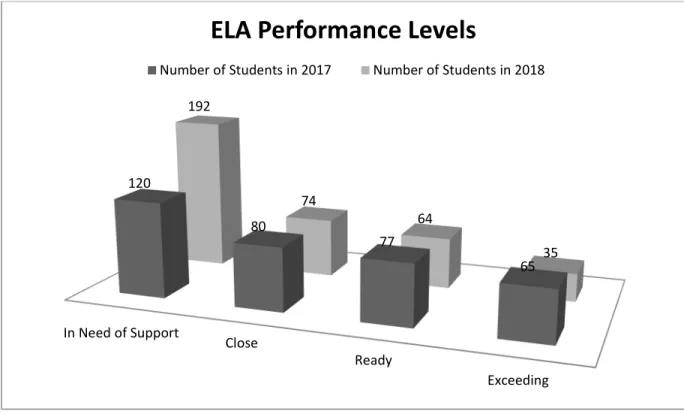
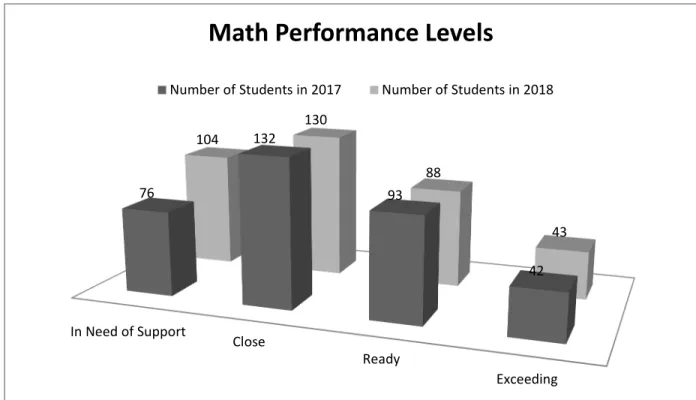
According to the Arkansas Department of Education, the middle school has an Every Student Succeeds Act (ESSA) public school rating score of 62.65, or “D” for 2018. Figure 4 represents two years of school ESSA index scores by subgroup. Figures 4 and 5 represent the number of students in the four performance levels – in need of support, close, ready, and exceeding – in English language acquisition (ELA), and math for the past two years on the ACT Aspire. Arkansas adopted as the ACT Aspire as its statewide annual assessment.
32 66.22 59.23 64.64 71.32 62.12 56.6 50.84 62.65 54.69 61.89 68.54 62.65 53.33 50.56
All Students African
American Hispanic White DisadvantagedEconomically LearnersEnglish Students withDisabilities
Two Year School ESSA Index Scores By Subgroup
2017 Index Score 2018 Index Score
Figure 4. Two Year School ESSA Scores. Arkansas ESSA School Report Card scores by subgroup (My School Info, 2019).
Figure 5. ELA Performance Levels. The number of students performing at various levels on the ACT Aspire (My School Info, 2019).
In Need of Support Close
Ready Exceeding 120 80 77 65 192 74 64 35
ELA Performance Levels
33
In Need of Support Close
Ready Exceeding 76 132 93 42 104 130 88 43
Math Performance Levels
Number of Students in 2017 Number of Students in 2018
Figure 6. Math Performance Levels. Number of students performing at various levels on the ACT Aspire (My School Info, 2019).
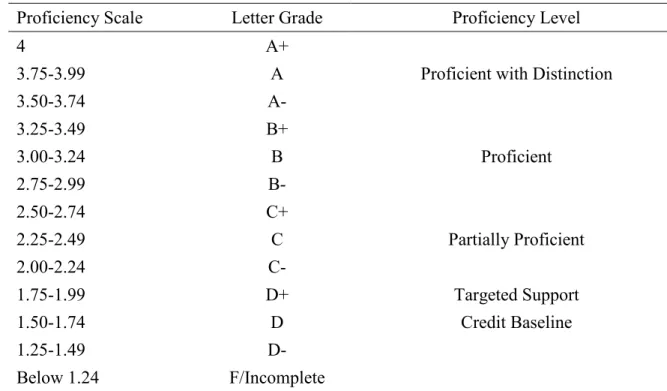
Table 2 is the current standard-based grading chart at the middle school. It is a conversion chart to letter grades from the proficiency scale.
Table 2
Middle School Standards-Based Grading Chart
Proficiency
Scale Letter Grade Proficiency Level
4 A+
3.75-3.99 A Proficient with Distinction
3.50-3.74 A-
3.25-3.49 B+
3.00-3.24 B Proficient
2.75-2.99 B-
34 Proficiency
Scale Letter Grade Proficiency Level
2.25-2.49 C Partially Proficient 2.00-2.24 C- 1.75-1.99 D+ Targeted Support 1.50-1.74 D Credit Baseline 1.25-1.49 D- Below 1.24 F/Incomplete
Note. Current middle school standards-based grading conversion chart.
Learners Must Obtain a 1.5 or above to receive credit for a class or move to the next learning level (grade level).
• The chart above will be used to convert an average of the scores on summative assessments to a letter grade.
• Teachers will continue to work with students to reach for the 3 and provide opportunities for all students to obtain a 4.
Semi-Structured Interviews
There were 12 participants in this case study. Four participants were parents, six participants were teachers, and two participants were administrators. All participants were interviewed face-to-face at the middle school on the same day. All parents and one administrator were interviewed before lunch. After lunch, all teachers were interviewed. The second administrator was interviewed at the end of the day. Each of these
individuals was asked a range of five-to-eight questions. The interview questions used to gather data included:
Parents (see Appendix D)
35
• How were you introduced to standard-based grading?* • Have there been any annual meetings?*
• How is your child responding with the change to standards-based grading? • Given the choice, which grading system would you choose, traditional or
standard-based and why?
• What is your child’s plan after high school? • Is there anything else you would like to add? *Follow up questions
Teachers (see Appendix C)
• Tell me about your experiences with standards-based grading.
• Tell me about the transition process from traditional to standards-based grading in your school.
• What professional development was provided with the change to standards-based grading?*
• What role did the teachers, administrators, and other stakeholders take in making this change?*
• Why was standards-based grading chosen to replace traditional grading practices?
• What could have been done differently in the process of changing from traditional to standards-based grading?
• How are your students responding with the change to standards-based grading?
36
• What instructional challenges have you experienced with standards-based grading?*
• How are your parents responding with the change to standards-based grading? • Given the choice, which grading system would you choose, traditional or
standards-based and why?
• Is there anything else you would like to add? *Follow up questions
Administrators (see Appendix B)
• Tell me about the transition process from traditional grading to standards-based grading in your school.
• What professional development was provided with the change to standards-based grading?*
• What role did the administrators, teachers, and other stakeholders take in making this change?*
• Why was standards-based grading chosen to replace traditional grading practices?
• How was the decision made to replace traditional grading practices with standards-based grading?*
• What could have been done differently in the process of changing from traditional grading to standards-based grading?
• How are your students responding with the change to standards-based grading?
37
• What instructional challenges have you experienced with standards-based grading?*
• How are your parents responding with the change to standards-based grading? • Given the choice, which grading system would you choose, traditional or
standards-based and why?
• Is there anything you would like to add? *Follow up questions
All of the interviews were recorded and transcribed. The transcriptions were then initially coded and analyzed by participant groups. After this initial coding, there was a second round of coding that included all transcripts. Three major themes were identified during this second analysis including purpose, process, and outcomes.
Purpose
The question: Why was standards-based grading chosen to replace traditional grading practices? was primarily asked to address the purpose behind the change from traditional to standard-based grading. This question was asked to the administrators and teachers. A follow-up question: How was the decision made to replace traditional grading with standards-based grading? was only asked to the administrators. According to one administrator, the transition from traditional to
standard-based learning started approximately nine years ago with a district and building leadership meeting. They were reading an article about Adams 50 school district in Colorado, which was practicing competency-based learning and standard-based grading. One of the administrators reportedly said, “We always talk but we never walk. So from there a committee was formed to go out and see the school.” The committee felt a “sense
38
of urgency” and a “moral purpose” to change their current practices due to the lack of industry in the community where the hospital and community are the two largest employers. The school had data to support the fact that graduating high school seniors were not able to read proficiently. According to one administrator,
You will ride through town and our graduates are sitting on their front porch during the day. They turn to selling drugs to support their families. We had to do something to change to meet their needs and provide other opportunities for them to be successful.
According to another administrator,
It had gotten to the point; I might get a hundred points figured into my grade just for participation points or things like that. And when you figure that in, that really did not tell you if the student understood the content. So now you know where they're at and if they understood the concept because nothing else plays into that.
A teacher noted,
That way the students that would normally get left behind and, oh, you don't get it, they get more pulled in so we're not leaving those kids out, if they don't get it at the beginning, they're just gone. And then it just adds up and builds up to where when we're in high school they're just lost and they usually end up dropping out because they're so far behind they don't know what to do.
Another teacher who had not taught in the school during the adoption phase added, “I think that they realized what was happening wasn't working, and there was quite a bit of research showing that standards-based was the way to go.”
39 Process
Several questions pertained to the process as the school transitioned from
traditional to standards-based grading. Administrators and teachers were invited to Tell me about the transition process from traditional to standards-based grading in your school. Two follow up questions were added:
• What professional development was provided with the change to standards-based grading?
• What role did the teachers, administrators, and other stakeholders take in making this change?
One administrator commented, “It is a very long process.” They also stated, “We did a lot of PD on the foundations of want [sic] to change, and really trying to create that sense of urgency of why we needed to change our system that we had. And in trying to get buy in.” In addressing stakeholders, the administrator added,
We did start out having town hall meetings. We went to service organizations, we had parent nights, but at the middle level, not a lot of parents came. They just didn't. More at the elementary they came, but not so much the middle school. The administrator also added, “I feel like one of the stakeholder groups that we did not get enough buy in from was the students. We just said, ‘Here's what we're doing.’ I think that was a component we missed.”
Another administrator addressed the professional development question saying, “For the teachers. We hired a consultant. We've had three different consultants.” They also added, “For the new staff, they meet with me once a month while veteran teachers meet with me once a semester.”
40
One teacher stated, “To me, it seemed like a trial and error kind of deal.” Another teacher expressed, “It's been kind of a struggle for parents to understand the difference.” A third year teacher said,
The biggest transition thing, from my experience, was learning that vocabulary to tell parents: ‘Okay, your child is at a one, meaning they have base knowledge,’ instead of saying, ‘Well your child has an F. They don't understand anything. Another teacher stated, “It's changed a lot through the years. This is my fifth year, and every year we've made improvements.” Other interviewees did not have any direct knowledge about the transition, as they joined the district subsequent to the change.
In addressing the role of teachers in the transition, one teacher said,
As far as from the old traditional to standards-based, it took a lot to get used to. It was a big adjustment for us, but I think once we wrapped our brains around it, it makes sense now.
A new teacher added,
I know the teachers are the ones that created everything. Most everything is teacher-created that we use. The administrators led the teachers, very much so, and provided us with the hours to provide us with a sub and so forth. I know the stakeholders were involved, but I wasn't around when that happened, so not sure what all they had to do with it.
Professional development was addressed with most of the teachers. By referring to a consultant with whom the school had contracted, one participant said,
Daniel Joseph. He came and he worked a ton with us all the time. I mean, all the years I've been here we've worked with him at different professional development
41
and we've gone through it, and every year we've always gone over it so the new teachers that were coming in understood it. We've always had a very open policy like, go talk to the teachers that have been here for a while, because it takes a while to implement.
Another teacher added, “If you have questions about it, they're (administration) always open to answer any questions…. The school improvement specialist, she helps us with that a lot, too, if you're unsure of how to do that.”
Another question which addressed the process of change was directed to the parents:
• How were you introduced to standards-based grading?
One parent said,
Before they actually implemented it, they started having some parent
meetings. They gave us kind of a generalization of it, but I'll be honest. It was very disappointing to see how few parents came to the meetings. It was
ridiculously low; I mean, like 20 or 30 parents for the whole school district. Another parent explained,
I don't remember. At the beginning, they did discuss it as far as the change and stuff, but I didn't quite understand it at the time. But once I made an appointment to come in and speak with them about it, then I got a better understanding of how it worked.
Still another stated, “I know that they had like large parent meetings, kind of like…a town hall meeting...and they would, you know, try to explain it. I didn't attend those.” When asked about any follow up annual meetings, a parent responded,
42
“Any changes they do make, they inform us usually during a parent-teacher conference, or we have Facebook, any way that they're reaching out to us. We have the school webpage.”
Outcomes
Several questions about the outcomes of the transition to standard-based grading were asked. The question How are the students responding to the change to standard-based grading? was asked of administrators, teachers, and parents. One administrator claimed, “The students absolutely love it.” Another administrator said “Starting with my sixth grade group, this is all they've ever known, so they respond quite well,” adding, “Then, we have students that move in and they're like, ‘Oh.’ It takes them a little bit to get used to it, but they like it.”
One teacher mentioned, “I think because we do personalized learning, where everything is very levelized, it goes together so well. I think to them it's not very strange at all.” Another teacher added,
The pros for the student, they get to retest, I mean, that's our biggest thing. The cons are they get to retest, which means that sometimes we see a lack of empathy, or maybe that's not the correct word; maybe they're apathetic regarding their grades, because they know they can retest.
Other teachers offered, “I feel like the students have now grown with it. This group, they're fine;” “They have a lot of vocabulary and knowledge of what we do, but then the difficult thing is when we get new students, and trying to implement them into this is difficult;” and “At first, like I said, it really confused them.”
43
One teacher went on to speak about personalized learning and how the levels play into standard-based learning:
And they're like, okay, what grade is that? And I'm like, no, no, no, remember, our quizzes don't have a letter grade. It's just, are you learning it. We still kind of have those questions, but they really like it. They love their pathways. The students that work real fast and your pre-AP students or even not your pre-AP students, the ones that are hard workers, they love being able to have their pathway and just go through it, and not be held back. A lot of times at the end, they'll either get to take their test early or they'll have more time for their Level 4 project so they can really make sure they do a good job on it. Or we'll have extra activities or labs that they can do if they get to that point. It's as a reward they get extras at the end if they go through it faster.
The teacher continued,
I had a little girl, she had an off day. Her boyfriend had just broke up with her. She's been making A's on all my tests. Well, she made a B minus that day, and she was like, what happened? I said, I know exactly what
happened. You were in here crying, you broke up with your boyfriend. That's what happened. I said, but it's okay. Just remember you get to retest, you just have to do the retest assignment.
One parent said of their child, “Well, he's fine because that's all he's ever known.” Other parents added, “She does very well…She's one that likes to be challenged, and if you challenge her, she's going to get it done”; “Well see, they've