This is a peer-reviewed, post-print (final draft post-refereeing) version of the following published document, “This is an Accepted Manuscript of an article published by Taylor & Francis in Studies in Higher Education on 5 December 2018, available online: http://www.tandfonline.com/10.1080/03075079.2018.1545757 and is licensed under All Rights Reserved license:
Hall, Angela and Towers, Neil ORCID: 0000-0002-2582-2241 (2020) Re-evaluating the postgraduate students’ decision making process in the digital era. Studies in Higher Education, 45 (6). pp. 1133-1148.
doi:10.1080/03075079.2018.1545757
Official URL: https://www.tandfonline.com/doi/abs/10.1080/03075079.2018.1545757? af=R&journalCode=cshe20
DOI: http://dx.doi.org/10.1080/03075079.2018.1545757 EPrint URI: http://eprints.glos.ac.uk/id/eprint/6197
Disclaimer
The University of Gloucestershire has obtained warranties from all depositors as to their title in the material deposited and as to their right to deposit such material.
The University of Gloucestershire makes no representation or warranties of commercial utility, title, or fitness for a particular purpose or any other warranty, express or implied in respect of any material deposited. The University of Gloucestershire makes no representation that the use of the materials will not infringe any patent, copyright, trademark or other property or proprietary rights.
The University of Gloucestershire accepts no liability for any infringement of intellectual property rights in any material deposited but will remove such material from public view pending investigation in the event of an allegation of any such infringement.
Article accepted for publication in Studies in Higher Education, © Taylor & Francis 2018 All Rights Reserved.
Re-evaluating the postgraduate students’ decision making process in the digital era
A. Hall and N. Towers A. Hall (Corresponding Author)
Manchester Metropolitan University, UK, Business School, All Saints Campus, Oxford Road, Manchester, M15 6BH [email protected]
N. Towers
University of Gloucestershire, UK, The Business School, The Park, Cheltenham, Gloucestershire, GL50 2RU [email protected]
ESSCA School of Management, 1 rue Joseph Lakanal - BP 40348, Angers, 49003, France
Abstract
The paper explores how postgraduate students make course selection decisions in the digital era. An exploratory study with seven postgraduate student focus groups (UK, EU and International) gained a detailed insight into this important change. The availability of information, from an increased use of digital media had a significant impact on Higher Education postgraduate decision-making. The results found a circular decision-making approach with evidence of rational and emotional decisions where students do not always commence with a wide choice set. Online forums, Word-of-Mouth/electronic Word-of-Mouth from past/existing students, family and friends are important influencers, as students considered postgraduate study from one month to four years prior to starting a course. We identified 5 different application pattern categories, together with highlighting the importance of evaluating the students’ pre-purchase experience during the application process. The research highlights the need for universities to continually engage during the decision-making process and to evaluate pre-purchase experiences.
Keywords: Post Graduate Higher Education; Consumer Decision Making models; Millennials; Focus Group method; Digital Communication
Introduction
It was predicted that the digital era would significantly alter consumer behaviour because of new media channels (Doherty and Ellis-Chadwick, 2010), with a move to two-way dialogue (Galan, Lawley and Clements, 2015). Social media facilitates customer-to-customer interactions, is more social in nature, and has impacted upon the decision making journey (Galan et al, 2015; Jones and Runyan 2016). Furthermore, the era in which a person is born can exert significant influence on their behaviour as consumers (Solomon, 2009), with the Millennial Generation (born 1982-2004) having a primary focus for full time postgraduate student recruitment in Higher Education Institutes (HEIs) (Moore, 2012; Universities UK, 2015). Previous research within Higher Education (HE) not only lacks focus at postgraduate level, but appears to be employing outdated models and is slow to respond to the growth of digital media. More generally Smith (2012) looks at online shopping of Millennials and the importance of online reviews; Hofacker, Malthouse and Sultan (2016) investigates the potential to provide greater understanding of each stage in the consumer decision-making process; Lemon and Verhoef (2016) consider the importance of different touch points during a customer
journey. There is a need within HE to understand how the use of digital communications by Millennial postgraduate students might impact upon their course selection decision making. UK postgraduate higher education recruitment significantly contributes to the UK economy, estimated at £39.9bn or 2.7% of GDP (Lock, 2015) and there were 551,595 postgraduate students in 2016-17 representing almost 24% of the total student HE population (Universities UK, 2016; Universities UK, 2017). But there appears to be a gap in decision making models within HE that consider the influence of digital media. This leads us to the aim of this paper which is to gain a greater understanding of decision making in the digital era for postgraduate students at the different stages of their course selection.
The structure of the paper is as follows: a review of the consumer decision process models is followed by considering the HE context and reviewing specific HE models. The research methods are explained, followed by the results from the primary research. This leads to the development of a new conceptual framework, which reflects a more contemporary decision making journey by Millennials and includes some new attributes.
Consumer decision process models
Cognitive consumer decision making models have a focus on thought processes and decision making stages of activities, with the original Engel, Kollat and Blackwell (1968) model undergoing a number of revisions (Darley, Blankson and Luethge, 2010). The decision making process consists of recognition of a need, followed by search, evaluation of alternatives, purchase, consumption, post purchase evaluation and divestment. The model also recognises the importance of environmental and individual differences that are said to influence the process. Lye, Shoe and Rundle-Thiele (2005: 218) state that “the purpose of the early consumer decision models was to illustrate conceptually an integrated decision model rather than develop a precise, comprehensive research roadmap”. Moreover, these models are underpinned by an assumption of rational behaviour as a logical and linear set of steps and there continues to be a discussion regarding how relevant and appropriate this is in today’s communications environment (see Mix and Katzberg 2015).
The consumer decision process has also been viewed as a purchase funnel with a wide initial choice set, proposed by Lewis in 1903 and adapted by a number of authors (such as Vazquez et al., 2014). These models suggest a fairly logical and linear approach and assumes consumers have a wide initial choice set which is then narrowed down.
Modern day communications with a vast array of available information have changed the initial decision choice set (Court et al, 2009; Haywood and Scullion, 2017). Consumers may not narrow down, but have an initial narrower choice set that they modify, or may take multiple decisions at the same time in an iterative process. For example, Lye, Shoe and Rundle-Thiele (2005) suggest that consumer decision making should be seen as decision waves, with multiple decisions taken within a single decision process, and seen as a sequence of activities, rather than stages (Lipshitz, 1993).
More recently, research suggests a more circular process better illustrates decision making, and that consumers regularly interact with brands and each other in a more continuous consumer decision journey (Wolny and Charoensuksai 2014; Hudson and Hudson 2013; Nobel 2010). The consumer decision journey by Court et al, (2009) suggests an initial consideration set, active evaluation, moment of purchase and post-purchase experience. This process focuses on consumer touch points used to make an impact.
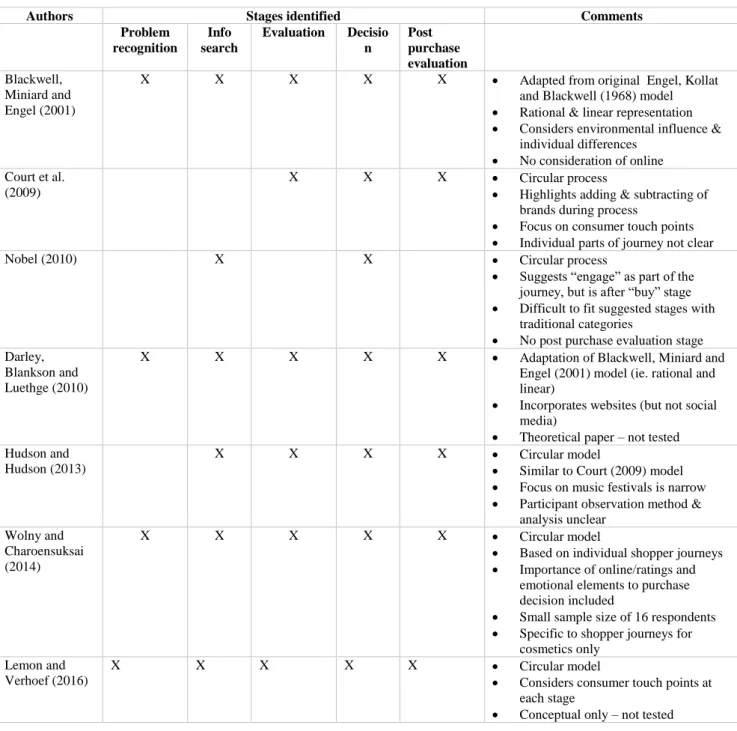
Hudson and Hudson (2013) suggest the stages are consider, evaluate, buy and enjoy/advocate/bond. They state that social media is extremely important at the evaluate stage and also the enjoy/advocate/bond stage of the decision journey. Moreover, Mix and Katzberg (2015) suggest that this is a “back and forth” approach, often involving online and offline, without any sort of plan regarding approach, illustrating a high degree of emotion rather than rationality. This supports the three shopper journeys developed by Wolny and Charoensuksai (2014) showing emotion, a more circular approach, and highlighting the influence of social media and influential groups within the process. Finally, Lemon and Verhoeaf (2016) present the Process Model for customer journey and experience, which consists of three key stages: prepurchase; purchase; and postpurchase. Customer touch points are considered at each stage, defined as “an episode of direct or indirect contact with the brand” (Baxendale, Macdonal and Wilson, 2015: 236). As with the previous Wolny and Charoensuksai (2014) model, influential groups are recognised within the process, such as bloggers, discussion boards, and product reviews In summary Table 1 provides a chronological review of decision making models and the stages in their development through to post purchase evaluation.
Table 1: Review of a selection of decision making models
Authors Stages identified Comments
Problem recognition Info search Evaluation Decisio n Post purchase evaluation Blackwell, Miniard and Engel (2001)
X X X X X Adapted from original Engel, Kollat
and Blackwell (1968) model Rational & linear representation Considers environmental influence &
individual differences No consideration of online Court et al.
(2009)
X X X Circular process
Highlights adding & subtracting of brands during process
Focus on consumer touch points Individual parts of journey not clear
Nobel (2010) X X Circular process
Suggests “engage” as part of the journey, but is after “buy” stage Difficult to fit suggested stages with
traditional categories
No post purchase evaluation stage Darley,
Blankson and Luethge (2010)
X X X X X Adaptation of Blackwell, Miniard and
Engel (2001) model (ie. rational and linear)
Incorporates websites (but not social media)
Theoretical paper – not tested Hudson and
Hudson (2013)
X X X X Circular model
Similar to Court (2009) model Focus on music festivals is narrow Participant observation method &
analysis unclear Wolny and
Charoensuksai (2014)
X X X X X Circular model
Based on individual shopper journeys Importance of online/ratings and
emotional elements to purchase decision included
Small sample size of 16 respondents Specific to shopper journeys for
cosmetics only Lemon and
Verhoef (2016)
X X X X X Circular model
Considers consumer touch points at each stage
Consumers perceive higher levels of risk for high involvement decisions such as with HE course selection, and are likely to search for more information to reduce this (Maringe and Carter, 2007; Simões and Soares, 2010). Word of Mouth (WOM)/electronic Word of Mouth (eWOM) has been found to play a key role to help reduce risk (Mazzarol and Soutar, 2007; Sweeney, Soutar and Turner, 2008), and is known to have much higher levels of credibility, empathy and relevance to customers (Bickart and Schindler, 2001; Katz and Lazerfield, 1955). Social media sites also facilitate the publishing of consumers’ evaluations (Chen, Scott and Qi, 2011). Furthermore, the influence of ‘significant others’ such as friends, class mates, family and teachers in the decision process has been well documented (see Harket, Slade and Harker, (2001); Hemsley-Brown, (1999); Soutar and Turner, (2002); Veloutsou, Paton, and Lewis, (2005); Haywood and Scullion, (2017)).
Postgraduate Higher Education
Post Graduate Higher Education has become a highly competitive sector resulting in a need to be more effective in student recruitment (Gibbs, 2001). It is clear that they are behaving more like consumers with the introduction of fees, with the associated debt constraint (Callender and Jackson, 2008), and the increasing amounts of data available to students on which to base their decision making (Littlemore 2011). At postgraduate level, the introduction of student loans of up to £10,000 saw a 22 per cent increase of students for 2016-17, compared to the previous year (for home and EU students that can access these loans) (Grove 2017). Furthermore, there has previously been a 54% increase in students on taught postgraduate courses since 2002-3. Much of this is a result of the 200% increase in international postgraduate enrolment (Higher Education Commission, 2012), with over half being international students within the area of Business and Administration (Universities UK, 2014). However, the UK share of the international student market has recently fallen from 12.6% to just under 10%, in a period where foreign students worldwide increased by almost 8%, suggesting the UK is becoming less attractive as a study destination (Morgan, 2016).
Research into decision making within higher education does not seem to have progressed in the same way as that outside of the sector. Decision making is still presented around a series of stages, such as that provided by Maringe (2006) of pre-search behaviour, search behaviour, application stage, choice decision and registration, along with many others that suggest similar stages (for example see Kotler (1976); Perun (1981); Litten (1982); Kotler and Fox (1985); Foskett and Hemsley-Brown (2001); Vrontis, Thrassou and Melanthiou (2004); Brown, Varley and Pal (2009)). This suggests that decision making within education is still based upon a rational and linear approach which provides the research gap that is addressed in this paper. Rational decision making is closely related to decisions that have a high level of risk (such as education), and is said to play a key role in the search for information. Hodkinson and Sparkes (1995: 33) found that “decisions were only partly rational, being also influenced by feelings and emotions”, and Foskett and Hemsley-Brown (2001) also suggest that choice consists of both rational and irrational or random elements, and that it is a complex process. Soilemetzidis, Bennett, and Leman (2014) highlight the most important criteria (in order of importance) for postgraduate students as: location of the institution, overall reputation of the institution, content of the course and reputation in chosen subject area/department. However, Lye, Shoe and Rundle-Thiele (2005) suggest that too much emphasis has been placed on the choice itself, and a more flexible approach to decision making is required.
The Millennial population are highly influenced by their peers, are technologically savvy, always digitally connected (Euromonitor International, 2011) and with an increasing reliance on eWOM predominantly using social media (Bolton et al., 2013). Furthermore, within this digital era “friends” may have a much wider definition with people connected to many hundreds of “friends” through social media sites such as Facebook, and online product ratings
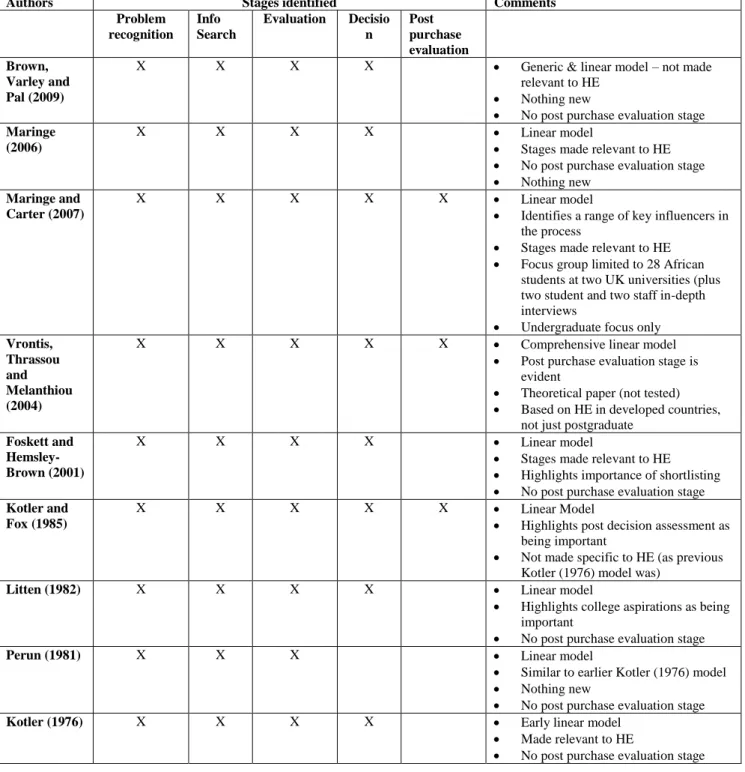
and online reviews have recently taken on a much larger role in the consumer decision process (Moe and Trusov, 2011). Hence, it is imperative that universities have an up-to-date view of how this important group of students make decisions in a highly digitally literate world in which that now live (Hesketh and Knight, 1999). There is however a lack of research that considers time factors within decision making, and Hall and Towers (2017) found increased use of people to validate decisions as journey length increased. Mainstream decision making suggests that the typical consumer may start with a more narrow initial consideration set with more alternatives considered at a later stage (Hudson and Hudson, 2013). In summary Table 2 below shows the development of decision making models in Higher Education course selection.
Table 2: Views of HE decision making stages
Authors Stages identified Comments
Problem recognition Info Search Evaluation Decisio n Post purchase evaluation Brown, Varley and Pal (2009)
X X X X Generic & linear model – not made
relevant to HE Nothing new
No post purchase evaluation stage
Maringe (2006)
X X X X Linear model
Stages made relevant to HE No post purchase evaluation stage Nothing new
Maringe and Carter (2007)
X X X X X Linear model
Identifies a range of key influencers in the process
Stages made relevant to HE Focus group limited to 28 African
students at two UK universities (plus two student and two staff in-depth interviews
Undergraduate focus only
Vrontis, Thrassou and Melanthiou (2004)
X X X X X Comprehensive linear model
Post purchase evaluation stage is evident
Theoretical paper (not tested) Based on HE in developed countries,
not just postgraduate
Foskett and Hemsley-Brown (2001)
X X X X Linear model
Stages made relevant to HE Highlights importance of shortlisting No post purchase evaluation stage
Kotler and Fox (1985)
X X X X X Linear Model
Highlights post decision assessment as being important
Not made specific to HE (as previous Kotler (1976) model was)
Litten (1982) X X X X Linear model
Highlights college aspirations as being important
No post purchase evaluation stage
Perun (1981) X X X Linear model
Similar to earlier Kotler (1976) model Nothing new
No post purchase evaluation stage
Kotler (1976) X X X X Early linear model
Made relevant to HE
Within higher education, models discussed in Table 2 do not appear to have developed very much over the last 40 years. All models within HE approach the decision making process from a rational/linear perspective, and many still do not see post purchase evaluation as an important stage. There has been no consideration within these HE models of how Millennials approach searching for information, engage with brands, write reviews, read blogs etc., and how this might impact upon their decision journey. Some of the models, although based on research within HE, still use generic terms (for example see Brown, Varley and Pal (2009) with a predominant focus on research at undergraduate and not postgraduate level. Therefore, there is a gap in current research and a need to gain a greater understanding of postgraduate student course selection decision making in a digital era.
Methodology
Having reviewed the existing models, a greater in-depth understanding of the current process in PGHE course selection decision making was undertaken required with a specific focus on the influence of the digital era and students who were particularly from the Millennial generation. An exploratory phenomenological approach was adopted as it seeks to explore the views and experiences of those that have lived the experience that is under study (Goulding, 2005; Spiegelberg, 1982).
Method: This exploratory research design consisted of focus groups, and enabled the researcher to explore how they came to select study at the university. Focus groups (FG) allow a quick, easy, cost effective way of carrying out research, and allow people to agree or disagree with others within their FG (Stokes and Bergin, 2006). The purpose was to gain a greater understanding of each of the decision making stages with postgraduate students in a digital era. Questions were therefore structured around the decision making stages, influencers and time considerations.
Sampling: A total of seven focus groups, consisting of full-time postgraduate students, at one university in the North of England were conducted. Respondents were selected via non-random methods, utilising convenience and purposive sampling methods, based upon demographics. Convenience sampling was used to select an easily accessible sample (Bryman and Bell (2007) from just one university. Purposive sampling was used to select participants based upon their eligibility to meet certain criteria (Easterby-Smith, Thorpe and Jackson, 2015) to represent postgraduate students: home, European Union and International, both male and female. A total of 50 students were selected from 25 countries across 4 continents: 21 were home students, 15 were EU students (from 12 countries), and 14 were Non-EU International students (from 12 countries).
Analysis: All FGs were digitally audio recorded, transcribed and recurrent meaningful themes were established from the participants’ stories (Strauss and Corbin, 1998). Each transcript was reread and appropriate significant statements were extracted for each theme in order to provide a thick description of the phenomenon under study. The results were structured under the common five key stages within models of problem recognition, information search, evaluation, decision and post-purchase evaluation. Influencers on the stages were also considered, along with whether the process is circular or linear.
Results
Problem recognition stage
Many of the existing generic models refer to either a problem recognition stage (e.g. Blackwell, Miniard and Engel, 2001), pre-shopping stage (e.g. Wolny and Charoensuksai, 2014), or in HE a pre-search behaviour stage (e.g. Maringe, 2006).
Respondents were asked when they had started to think about postgraduate study and courses. The majority of responses fitted into one or two years before the course started. Two responses suggested three to four years prior to starting. There were some last minute decisions however, with five students indicating time periods nine months before, down to just one month prior to starting. Two typical reasons for later applications can be seen below.
“Less than a month before the course started. I finished my degree, looked for a job, didn’t have much success and thought how am I going to increase my success of doing what I want to do” FG 2
“I did my undergraduate in IT, I thought when I graduated I would do the same sort of thing, but after working in it, I decided I didn’t” FG5
Postgraduate study for some is essential if they are unable to either secure an appropriate position, or to enable them to change direction. What is not yet known is whether applicants at earlier and later stages follow the same decision process, although in mainstream literature Johnston, Driskell, and Salas (1997) suggest that those under time pressures undertake a more selective search.
Information search stage
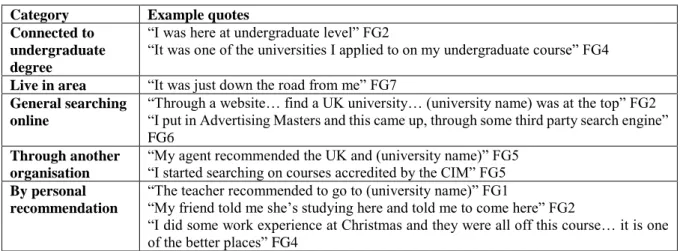
Previous research has shown that WOM/eWOM, product reviews/ratings/blogs are all important influencers (Mazzarol and Soutar (2007); Soutar and Turner (2002)) and are therefore part of the information search stage. Respondents were asked how they became aware of the university, and a number were already aware for reasons such as being there at undergraduate level, in their choice set at undergraduate level, or being aware because of living in the region. For some international students, agents appeared to be a key part of becoming aware of universities. Others became aware in various ways:
Table 3: How students became aware of the university
Category Example quotes
Connected to undergraduate degree
“I was here at undergraduate level” FG2
“It was one of the universities I applied to on my undergraduate course” FG4 Live in area “It was just down the road from me” FG7
General searching online
“Through a website… find a UK university… (university name) was at the top” FG2 “I put in Advertising Masters and this came up, through some third party search engine” FG6
Through another organisation
“My agent recommended the UK and (university name)” FG5 “I started searching on courses accredited by the CIM” FG5 By personal
recommendation
“The teacher recommended to go to (university name)” FG1
“My friend told me she’s studying here and told me to come here” FG2
“I did some work experience at Christmas and they were all off this course… it is one of the better places” FG4
Information searching becomes more important for high involvement decisions, with more time spent on this activity (Clarke and Belk, 1978). For some time now this has led to an increased search for information (Moutinho, 1987) as the respondents seek reviews (now online), consider university rankings and for some consider open days as important. These findings are in line with mainstream decision making literature that suggests that discussion boards, blogs, YouTube reviews and product reviews are all being extensively used by consumers (Wolny and Charoensuksai (2014).
Table 4: Where students searched for information on specific universities
“I just did a Google of Manchester/Salford, and a lot of people preferred (university name) to (university name), so that was like a positive thing” FG5
“I looked at a couple of reviews and what they had said, some were quite old like 2008, but some were like five-star ratings. A couple were like really bad value for money and stuff, but it was generally positive” FG5
“You obviously do your research and coming to the open evening is part of that, and looking at the kind of investment that is going into (university name) and your links with industry were part of that. What previous students say, for me they are not going to be an accurate gauge.”FG2
Evaluation stage
It is important to note that when an application is submitted, the prospective postgraduate student has still to make a choice. Many HE models refer to application as a stage (for example Maringe, 2006), whereas outside of HE it is frequently referred to as the evaluation stage (see Blackwell, Miniard and Engel, 2001) for example).
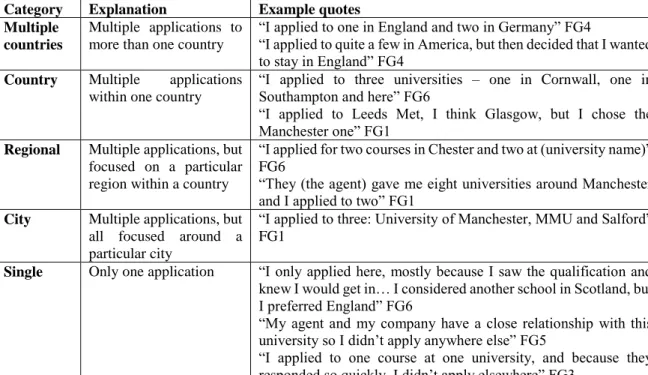
Considering the possible range of postgraduate courses available to the prospective student the number of universities applied to varied considerably. Some just applied to one university, others a few, at the higher end ranged from eight to between fifteen to twenty. Typically, most were up to three or four and it was found that applicants can be split into five different categories based upon their types and patterns of application, detailed in Table 5 below:
Table 5: Application pattern categories
Category Explanation Example quotes
Multiple countries
Multiple applications to more than one country
“I applied to one in England and two in Germany” FG4
“I applied to quite a few in America, but then decided that I wanted to stay in England” FG4
Country Multiple applications
within one country
“I applied to three universities – one in Cornwall, one in Southampton and here” FG6
“I applied to Leeds Met, I think Glasgow, but I chose the Manchester one” FG1
Regional Multiple applications, but focused on a particular region within a country
“I applied for two courses in Chester and two at (university name)” FG6
“They (the agent) gave me eight universities around Manchester and I applied to two” FG1
City Multiple applications, but all focused around a particular city
“I applied to three: University of Manchester, MMU and Salford” FG1
Single Only one application “I only applied here, mostly because I saw the qualification and knew I would get in… I considered another school in Scotland, but I preferred England” FG6
“My agent and my company have a close relationship with this university so I didn’t apply anywhere else” FG5
“I applied to one course at one university, and because they responded so quickly, I didn’t apply elsewhere” FG3
In addition to the number of universities applied to, it is interesting to note the range of countries, destinations within countries, and areas. Whilst some students did not appear to have made their minds up about which country they wanted to study in, others clearly knew the country, but hadn’t focused on a particular location. Others were more targeted and their choices were regional. Soilemetzidis, Bennett, and Leman (2014) suggests that location is important within the process. At the application stage a number of locations are considered, but it is not yet clear how a final decision is made. Furthermore, a number of comments support the hypothesis that students start with a wider choice set and narrow down. Examples are seen
where students have a narrow initial choice set and do not appear to increase this. This suggests that decision making models within HE need to be able to cater for these differences.
During the focus groups it became clear that there were many negative experiences during the application process. Most negative experiences were focused around delays in acknowledgement of applications, lack of communication during the application process, length of time taken to receive an offer, and issues regarding negative experiences when they contacted the university for an update.
“I got a reply back about four and a half months later. I was ready to go to the University of Hull, I had given the payments and everything” FG6
“I had to contact the tutors to see what was going on” FG4
Some of these negative experiences resulted in applicants looking elsewhere, as the following quote illustrates.
“I got really nervous and that’s why I applied to another university, and I got a response straight away” FG1
There were few positive experiences through central admissions area, however involvement of Course Leaders appeared to improve their experience.
“I had contact from the course leader, via emails, it was quite helpful” FG7
“I was told it was too late (to apply), but then I found your contact information (course leader) on the website and after that the whole process was incredibly simple” FG5
Whilst there is substantial research taking place at the post purchase evaluation stage, the above highlights the importance of understanding the student experience of the application process, i.e. a pre-purchase evaluation stage. This is important at postgraduate level as applications are direct to universities, and applicants have not yet made a choice (i.e. a notional or speculative application), and as the previous section indicated, many make multiple applications.
Decision
Existing research regarding criteria used to make the final decision regarding university selection has a focus at undergraduate level (Maringe, 2006), with some limited information available at postgraduate level (for example Maringe and Carter 2007; Cubillo, Sanchez and Cervino, 2006), including the PTES survey which provides insight into motivations for postgraduate study (Soilemetzidis, Bennett, and Leman, 2014). This research explored criteria important for postgraduate students to see if any new areas appeared. Price, course, content, location, accommodation/facilities (a new building), quick response, reputation, opportunities for internships/work placements, accredited by a professional body and practical nature of the course were all mentioned. However, price, course content and location were the most frequently mentioned factors.
Table 6: Criteria important for final decision
Criteria Example quote
Price “Living in London costs a lot more” FG4 “Price was a big issue” FG5 Course “The course is up-to-date” FG5 “I just liked the course structure” FG6
“I just couldn’t find anything else to beat it, but I actually didn’t want to stay in Manchester!” FG3
Content “The variety and depth of each unit, which would help when I get a job” FG5
Location “”Apart from London, Manchester is probably one of the biggest cities (for advertising), and it’s really vibrant as well” FG6
“Manchester has a big music scene” FG6 “I wanted somewhere I could commute to” FG6 Facilities “The really new building” FG5
Reputation “The strength of the degree. If you do get a degree from here it is well recognised” FG7 Employability “Good job prospects afterwards for me was a consideration” FG7
“I didn’t have work experience, and I don’t think the other universities had that (working on live briefs with clients)” FG5
Staff “What I really like on the Website is you can actually see the staff teaching the course” FG7
Two areas not previously covered in the literature which were mentioned were availability of internships and links with professional bodies and/or accreditation. The applied nature of the course was also important, and in existing research this may be covered within course/content. Post Purchase Evaluation stage.
Each of the focus groups were asked about what WOM/eWOM had taken place since starting on the course. In addition, it was also important to establish whether they were happy students, as unhappy customers generally write far more about their experience (Walker 1995), and online ratings and reviews have more recently taken on a much larger role in the consumer decision process (Moe and Trusov, 2011). This suggested that ratings and reviews can potentially reach a much wider audience online. Whilst many negative comments were received regarding the application process, comments regarding their experience on the course were very positive, as the following two examples illustrate:
“Probably one of the best decisions I have ever made” FG5; “It has exceeded my expectations” FG5
Table 7: Examples of WOM/eWOM
Category Example quotes
Traditional WOM
“Back home, where I come from, the university…. I have told them about the uni, and recommended it” FG2
“I have spoken to my old tutors” FG2
“I have spoken to the undergraduates that went on placement year, and say come here” FG2 e-WOM
“I have Tweeted a lot of things I have been doing in classes and things” FG4 “I have used Twitter a few times to talk about the course” FG2
e-WOM Facebook
“I’ve updated my profile to show I am studying at (university name), that’s all” FG5
“The only thing I have done is my Facebook profile saying that I am starting in this university” FG3
“I have posted Facebook status and things about how the course is going” FG4 e-WOM
blog
“I’ve done a blog post about postgraduate courses at (university name)” FG5 e-WOM
Foursquare
“I have taken a picture of my class and posted it on Foursquare and posted content on that link… and the view from the postgraduate common room” FG7
e-WOM other
“I have posted about the building. I have posted a link to (university name) explaining a lot of it and stuff and a picture” FG2
“I just wrote personal messages to people who are interested in here and I told them how I found the university and actually one guy said he would consider coming here because he thought it sounded really good” FG4
There appears to be a large amount of eWOM posting taking place, along with more traditional WOM, which has previously been associated with risk reduction (Sweeney, Soutar and Turner, 2008), and has higher levels of credibility (Bickart and Schindler, 2001). This final stage is likely to have increasing influence on other stages by other potential candidates going through the decision process. So for example, when searching for information, the comments made by existing/past students may be used. Also, this stage is increasingly linked to “significant others” – for example, an updated Facebook profile, and any other postings are likely to influence other friends that may be considering their university choice.
The circular HE decision making model
Previous research within HE suggests that decision making is both linear and rational (for example Maringe (2006), although outside HE some suggest a multi-phase perspective (Wolny and Charoensuksai (2014). There was some evidence from the empirical findings that suggested the process in HE was not necessarily linear.
“I applied one week before induction, because I had already gotten accepted at two others, but then I discovered this one and the course was better. I asked them to tell me if I was getting accepted so I knew what to tell the other guys. The answer came in three days”. FG6
“My friends suggestion (sic) I change to here. I was surely going to Edinburgh” FG2
These two quotes suggest that students had already made a decision regarding their narrow choice set, although they later added further choices to this initial choice set. This implies a more circular process is relevant.
Moreover, there was also some evidence to support decision making containing some emotional aspects, in addition to rational ones, as suggested by Hodkinson and Sparkes (1995).
“For me it was a decision even before I started my undergraduate course, because I wanted to be here doing this. I even thought about Manchester. I have always had passion for English people, because of the game on Commodore 64 when I was young. The only game I had was about Manchester United. I was really young, about 8”. FG6
“I started to say OK I want to go to England and I just looked at the map and I had my mind set on Manchester, I can’t say why. And then I started looking through courses and I played around with a few ideas and I thought OK I’m going to do this and I’m going to do it in Manchester and nowhere else” FG4
This second quote highlights how country image, and city image may influence the decision process. However, previous research has focused mainly on the role of country image in the decision process, rather than city image (Cubillo, Sanchez and Cervino, 2006), although both MORI (2001) and Hooley and Lynch (1981) have researched this area for student’ choice. Influencers on stages.
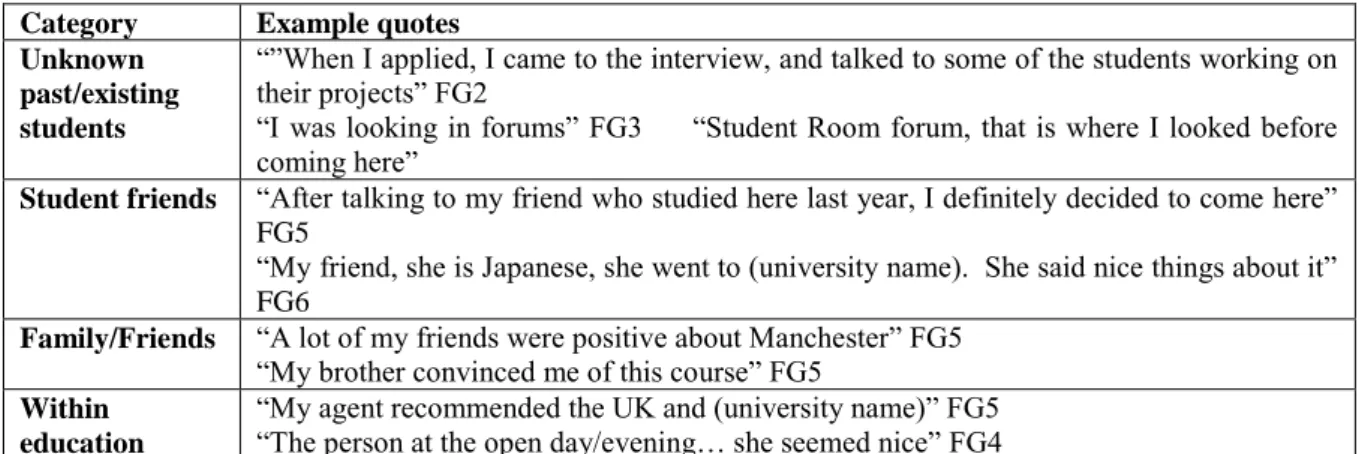
A number of people online and offline influence students throughout the decision process. People clearly play a significant role in influencing where prospective students look, and also which universities they finally choose. These influencers can be categorised into three main groups: past and existing students, family and friends, those within education. A more recent influencer is that of online forums (Wolny and Charoensuksai 2014), and their role within the process needs to be understood more, as it appears to be a strong influencer within the process.
Table 8: Student influencers – example quotes
Category Example quotes
Unknown past/existing students
“”When I applied, I came to the interview, and talked to some of the students working on their projects” FG2
“I was looking in forums” FG3 “Student Room forum, that is where I looked before coming here”
Student friends “After talking to my friend who studied here last year, I definitely decided to come here” FG5
“My friend, she is Japanese, she went to (university name). She said nice things about it” FG6
Family/Friends “A lot of my friends were positive about Manchester” FG5 “My brother convinced me of this course” FG5
Within education
“My agent recommended the UK and (university name)” FG5 “The person at the open day/evening… she seemed nice” FG4
What is not known however, is whether the use of an influencer in the process actually means a potential student bypasses the search for information, or if the search is reduced, or if it has no impact on their search for information. Plotting individual student decision journeys would assist in answering these questions.
Discussion
Changes in the amount, type and use of various information sources, changes in the influence of ‘significant others’ and generally what levels of credibility are attached to these are increasingly important in decision making. The HE environment is much more competitive (Universities UK 2016), postgraduate students are an increasingly important income stream and HEIs need to have an up-to-date view of how they make decisions, and what factors are important (Taylor, 2002; Hemsley-Brown and Oplatka, 2015).
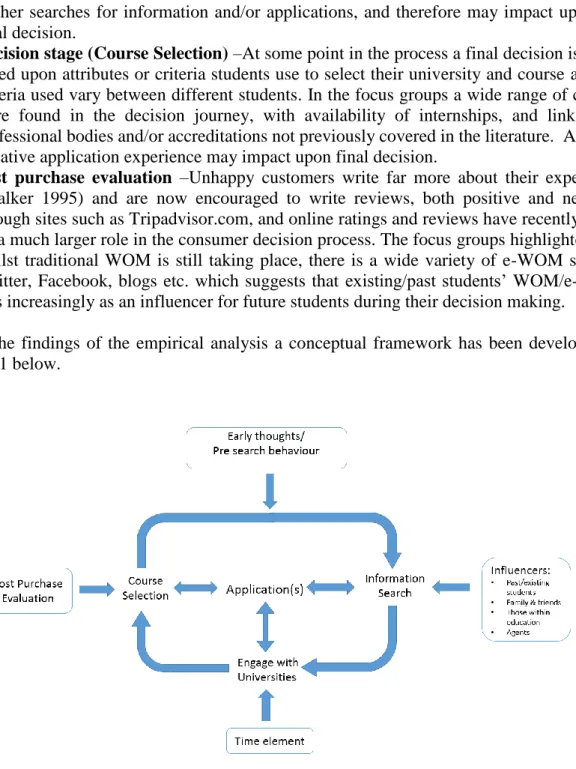
From the findings five key stages within the postgraduate HE course selection decision making process are suggested as part of the conceptual framework, using the HE contextualised descriptors: pre-search behaviour/early thoughts, information search, engagement with universities, application(s), final decision, post purchase evaluation leading to WOM/e-WOM: 1. Problem recognition stage (Pre-search behaviour/early thoughts): most of the existing models discuss either a problem recognition or pre-search stage. Maringe (2006) explains within the HE context this concerns early, passive thoughts regarding HE study. Moreover, the importance of maintaining an institutional presence with potential students is important. The primary research found that this was a valid stage, and explored reasons why students started to think about postgraduate study. It also found a huge variety of time periods. 2. Information search: This phase is present in all models. Furthermore, different search
patterns have been found. The primary research found that online reviews, university rankings, connecting with other students online (existing/past) were all undertaken by Millennial students. Also, checking staff blogs and Twitter activity was also mentioned. The online environment takes on a much larger role (Moe and Trusov 2011), and consumers now continually engage with brands and look for new information (Nobel 2010), rather than previously where information was used to evaluate a wide initial choice set and then narrow down as suggested by Lewis in 1903 (Vazquez et al, 2014). Information search was shown as an ongoing process until a final decision is made.
3. Evaluation stage (Application(s)) –Students are known to put in multiple applications and accept multiple offers (Maringe 2006), which suggests they have not yet made a choice. This stage appears therefore similar to the evaluation stage in models such as Blackwell, Miniard and Engel (2001), or Court et al. (2009). This primary research highlighted five different application patterns, and also the importance of understanding whether the application experience was positive or not. A negative application experience may mean
further searches for information and/or applications, and therefore may impact upon the final decision.
4. Decision stage (Course Selection) –At some point in the process a final decision is made based upon attributes or criteria students use to select their university and course and the criteria used vary between different students. In the focus groups a wide range of criteria were found in the decision journey, with availability of internships, and links with professional bodies and/or accreditations not previously covered in the literature. Again, a negative application experience may impact upon final decision.
5. Post purchase evaluation –Unhappy customers write far more about their experience (Walker 1995) and are now encouraged to write reviews, both positive and negative through sites such as Tripadvisor.com, and online ratings and reviews have recently taken on a much larger role in the consumer decision process. The focus groups highlighted that whilst traditional WOM is still taking place, there is a wide variety of e-WOM such as Twitter, Facebook, blogs etc. which suggests that existing/past students’ WOM/e-WOM acts increasingly as an influencer for future students during their decision making.
From the findings of the empirical analysis a conceptual framework has been developed in Figure 1 below.
Figure 1 Circular PGHE Decision Making Conceptual framework
The framework identified in Figure 1 above is illustrated as a circular rather than a linear process, as research outside of postgraduate HE suggest consumers do not now start with a wide initial choice set (Court et al., 2009), but add and subtract brands (Hudson and Hudson 2013). There are four new attributes that have been identified in the research of postgraduate student course selection, which will now be discussed.
Circular: All existing HE models are linear (see Table 2), and there is increasing evidence to suggest this does not accurately reflect behaviour by Millennials (for example see Wolny and Charoensuksai 2014, or Lemon and Verhoef 2016). The results from this study also suggest that the process is not necessarily linear for all students, with some found to be adding further universities/courses at a later date.
Influencers: Whilst not part of the stages, this is an important consideration. A wide range of people are known to influence decision making regarding postgraduate course selection
including friends, family and teachers (Usher et al., 2010), universities (Veloutsou, Paton and Lewis, 2005), ratings and reviews made by past users (Wolny and Charoensuksai 2014). With 36.5% of overseas students recruited via Agents, this suggests that Agents may also have a key influential role for some students (Havergal 2015). The focus groups demonstrated the significant influence from past/existing students, family/friends and those within education. Agents have not previously been included within models as an influencer, but clearly were present in the decision making stages.
Engage with universities: Previous models within HE have not explicitly included engage until a final stage. Millennials are always connected and more communicative than previous generations and they continually engage with brands and their peers regarding their decision (Hall and Towers 2017) whilst Nobel (2010) included an engage stage within their customer life cycle model. What was clear from this primary research was that the experience students received whilst engaging with universities influenced them not only in their decision, but also their application pattern. This will lead to pre-purchase evaluation, and if less than ideal, a possible further information search and/or application, as seen from this primary research. It is therefore essential that HEIs seek feedback on this important part of the postgraduate student customer journey.
Time: A time element has been included, as previous research has suggested that those who undertake decisions with limited time available have different patterns of behaviour (Johnston, Driskell, and Salas, 1997). Hall and Towers (2017) also found differences in consumer decision behaviour relating to time. It is not unreasonable, therefore, to factor in the time element for applicants that commence their journey earlier or later. The focus groups suggested one to two years prior to the course starting was common to start considering postgraduate study, although four years, down to one month prior were also seen. A time element therefore is essential to explore to see if different patterns of behaviour are seen on individual journeys. Also, time seems short if a university fails to respond with reassuring information during the application process.
Limitations and Future Research
This research was conducted at one English post-92 university, with postgraduate students on marketing related courses, and therefore does not necessarily represent the views of all postgraduate students within the country context. Furthermore, focus groups allow views to be obtained at various points within the students’ decision journey, but does not allow each unique decision journey to be plotted. Further research should therefore explore the links between the different stages and influences in the conceptual model to understand the importance of monitoring eWOM to ensure HEIs are aware of any negative comments. Future in-depth interviews are required in order to map each students’ unique decision journey to explore how searching, evaluation and decisions actually happen in reality. This would also allow understanding of what touch points postgraduate students experience. A wider student population would also assist in looking at whether viewpoints are consistent across different course types and universities.
References
Baxendale, S., E. Macdonald, and H. Wilson. 2015. “The impact of different touch points on brand consideration”, Journal of Retailing, 19: 235-253.
Bickart, B., and R. M. Schindler. 2001. Internet forums as influential sources of consumer information. journal of Interactive Marketing, 15 (3): 31-40.
Blackwell, R., P. Miniard, and J. Engel. 2001. Consumer Behaviour, Harcourt. Bolton, R., A. Parasuraman, A. Hoefnagels, N. Migchels, S. Kabadayi, T. Gruber, Y.
Loureiro, and D. Solnet. 2013. “Understanding Generation Y and their use of social media: a review and research agenda”, Journal of Service Management, 24 (3): 245-267.
Brown, C., P. Varley, and J. Pal. 2009. “University course selection and services marketing”,
Marketing Intelligence & Planning, 27 (3): 310-325.
Bryman, A., and E. Bell. 2007. Business Research Methods, Oxford.
Callender, C., and J. Jackson. 2008. “Does the fear of debt constrain choice of university and subject of study?” Studies in Higher Education, 33 (4): 405-429.
Chen, Y., F. Scott, and W. Qi 2011. “The role of marketing in social media: how online consumer revies evolve”, Journal of Interactive Marketing, 25 (2): 85-94. Clarke, K., and R. Belk. 1978. “The effects of product involvement and task definition on
anticipated consumer effort”, In Advances in Consumer Research edited by Hunt, H. and A. Arbor, 313-318. MI: Association for Consumer Research.
Court, D., D. Elzinga, S. Mulder, and O. Vetvik. 2009. The consumer decision journey.
McKinsey Quarterly.
Cubillo, J., J. Sanchez, and J. Cervino. 2006. “International students’ decision-making process”, International Journal of Educational Management, 20 (2): 101-115. Darley, W., C. Blankson, and D. Luethge. 2010. “Toward an integrated framework for online
consumer behaviour and decision making process: a review”, Psychology &
Marketing, 27 (2): 94-116.
Doherty, N., and F. Ellis-Chadwick. 2010. “Internet retailing: the past, the present and the future”, International Journal of Retail & Distribution Management, 38 (11/12): 943-965.
Easterby-Smith, M., R.Thorpe, and P. Jackson. 2015. Management & Business Research (5th Edition ed.), Sage.
Engel, J., D. Kollab, and R. Blackwell. 1968. Consumer Behaviour. New York: Holt, Rinehart & Winston, Inc.
Euromonitor International, 2011. Make way for Generation Z: marketing to today's tweens and teens - executive briefing
Foskett, N., and J. Hemsley-Brown. 2001. Choosing Futures: young peoples' decision
making in education, training and career markets, London: Routledge Falmer.
Galan, M., M. Lawley, and M. Clements. 2015. “Social media's use in postgraduate students' decision-making journey: an exploratory study”, Journal of Marketing for Higher
Education, 25 (2): 287-312.
Gibbs, P. 2001. “Higher Education as a market: a problem or a solution?”, Studies in Higher
Education, 26 (1): 85-94.
Goulding, C. 2005. “Grounded theory, ethnography and phenomenology: a comparative analysis of three qualitative strategies for marketing research”, European Journal of
Marketing, 39 (3/4): 294-308.
Grove, J. 2017. Postgraduate enrolments leap as loans introduced in England, 2nd March, Times Higher Education https://www.timeshighereducation.com/news/postgraduate-enrolments-leap-as-loans-introduced-in-england Accessed 30.1.18 0
Hall, A. and N. Towers. 2017. “Understanding how Millennial shoppers decide what to buy: Digitally connected unseen journeys”, International Journal of Retail & Distribution
Havergal, C. 2015. “At some institutions, agents line up majority of international signings”,
Times Higher Education, 16th April.
Haywood, H., and R. Scullion. 2017. “It’s quite difficult letting them go, isn’t it? UK parents’ experiences of their child ‘s higher education choice process”, Studies in Higher
Education, forthcoming.
Hemsley-Brown, J. 1999. “College choice: perceptions and priorities”, Educational
Management & Administration, 27 (1): 85-98.
Hemsley-Brown, J., and I. Oplatka. 2015. “University choice: what do we know, what don't we know and what do we still need to find out?”, International Journal of
Educational Management, 29 (3): 254-274.
Hesketh, A., and P. Knight. 1999. “Postgraduates choice of programme: Helping universities to market and postgraduates to choose,” Studies in Higher Education, 24 (2), pp151-63.
Higher Education Commission 2012. Postgraduate Education: an independent inquiry by the
Higher Education Commission, London: HEC
http://www.postgradexperience.org/other-research/higher-education-commission- 2012-postgraduate-education-an-independent-inquiry-by-the-higher-education-commission-london-hec/ Accessed 13.1.18
Hodkinson, P., and A. Sparkes. 1995. “Markets and Vouchers: the inadequacy of
individualist policies for vocational education and training in England and Wales”,
Journal of Education Policy, 10 (2): 189-207.
Hofacker, C., E. Malthouse, and F. Sultan. 2016. “Big Data and consumer behaviour: imminent opportunities”, Journal of Consumer Marketing, 33 (2): 89-97.
Hooley, G., and J. Lynch. 1981. “Modelling the student university choice process through the use of conjoint measurement techniques”, European Research, 9 (4): 158-170. Hudson, S., and R. Hudson. 2013. “Engaging with consumers using social media: a case
study of music festivals”, International Journal of Event and Festival Management,
4 (3): 206-223.
Johnston, J., J. Driskell, and E. Sala. 1997. “Vigilant and hypervigilant decision making”,
Journal of Applied Psychology, 82 (4): 614-622.
Jones, R., and R. Runyan. 2016. “Conceptualising a path-to-purchase fraework and exploring its role in shopper segmentation”, International Journal of Retail & Distribution
Management, 44 (8): 776-798.
Katz, E., and P. Lazerfield. 1955. Personal influence: the part played by people in the flow of
mass communications. New Brunswick: Transaction Publishers.
Kotler, P. 1976. Applying marketing theory to college admissions In a role for marketing
college admissions (pp. 54-72). New York: College Entrance Examination Board.
Kotler, P., and K. Fox. 1985. Strategic Marketing for Educational Institutions. New Jersey: Prentice-Hall.
Lemon, K., and P. Verhoef. 2016 “Understanding customer experience throughout the customer journey”, Journal of Marketing, 80 (November): 69-96.
Lewis, E. 1903 Advertising department: catch-line and argument. The Book-Keeper, 15: 124-128.
Lipshitz, R. 1993. “Converging themes in the study of decision making in realistic settings.”
In Decision making in action: model and methods, edited by Klein,G., J. Orasanu, R.
l. Calderwood and C. Zsambok, 103-147. Ablex: Norwood.
Litten, L. 1982 “Different strokes in the applicant pool: some refinements in a model of student college choice”, Journal of Higher Education, 53(4): 383-402.
Littlemore, S. 2011. Universities must deal better with complaints, (Online: accessed 5th February 2018) https://www.theguardian.com/education/2011/jun/14/university-complaints-rise-tuition-fees
Lock, H. 2015. Six ways higher education benefits the UK economy. The Guardian. Retrieved from
https://www.theguardian.com/higher-education-network/2015/jul/09/six-ways-higher-education-benefits-the-uk-economy Lye, A., W. Shao, and S. Rundle-Thiele. 2005. “Decision waves: consumer decisions in
today's complex world”, European Journal of Marketing, 39 (1/2): 216-230. Maringe, F. 2006. “University and course choice: Implications for positioning, recruitment
and marketing”, International Journal of Educational Management, 20 (6); 466-479. Maringe, F., and Carter, S. 2007. “International students' motivations for studying in UK HE:
insights into the choice and decision making of African students”, International
Journal of Educational Management, 21 (6): 459-475.
Mazzarol, T., and G. Soutar. 2007. “Concdeptualizing word-of-mouth activity, triggers and conditions: an exploratory study”, European Journal of Marketing, 41 (11/12): 1475-1494.
Mix, L., and J. Katzberg. 2015. Retails next top model: new perspectives on consumer
decision processes in a rapidly changing world. Paper presented at the ESOMAR
Qualitative, Paris. November.
https://www.tandfonline.com/action/authorSubmission?show=instructions&journalC ode=cshe20#refs accessed 18th October 2018
Moe, W. and M. Trusov. 2011. “The value of social dynamics in online product ratings forums”, Journal of Marketing Research, XLVIII (June): 444-456.
Moore, M. 2012. “Interactive media usage amongst millennial consumer”, Journal of
Consumer Marketing, 29 (6): 436-444.
Morgan, J. 2016. “UK frets over overseas students as Australia backs 'super growth”. Times
Higher Education, 15th May.
MORI. 2001. Student Living Report 2001. Bristol: Commissioned by UNITE, MORI. Moutinho, L. 1987. “Consumer Behaviour in Tourism”, European Journal of Marketing, 21
(10): 3-44.
Nobel, S. 2010. It's time to bury the marketing funnel: 28th October
http://blogs.forrester.com/steven_noble/10-10-28-its_time_to_bury_the_marketing_funnel
Perun, P. 1981. The undergraduate woman: issues in educational equity. Lexington, Mass.: D.C. Heath and Company/Lexington Books.
Simões, C., and A-M Soares 2010. “Applying to higher education: information sources and choice factors”, Studies in Higher Education, 35 (4): 371-89.
DOI: 10.1080/03075070903096490
Smith, K. T. 2012. “Longitudinal study of digital marketing strategies targeting Millennials”,
Journal of Consumer Marketing, 29 (2): 86-92.
Soilemetzidis, I., P. Bennett, and J. Leman. 2014. The Postgraduate Taught Experience
Survey: The Higher Education Academy.
Solomon, M. R. 2009. Consumer Behaviour: buying, having and being (Eigth ed.). New Jersey: Pearson Education Inc.
Soutar, G. N., and J.P. Turner 2002. “Students' preferences for university: a conjoint analysis”, The International Journal of Educational Management, 16 (1): 40-45. Spiegelberg, H. 1982. The Phenomenological Movement: a historical introduction. The
Hague: Martinus Nijhoff.
Stokes, D., and Bergin, R. 2006. “Methodology or”methodolatry”? An evaluation of focus groups and depth interviews”, Qualitative Market Research: an Intenational
Journal, 9 (1): 26-37
Strauss, A., and J. Corbin. 1998. Basics of qualitative research. Thousand Oaks, CA: Sage. Sweeney, J., G. Soutar, and T. Mazzarol. 2008. “Factors influencing word of mouth
effectiveness: receiver perspectives”, European Journal of Marketing, 42 (3/4): 344-364.
Taylor, J. 2002. “Changes in teaching and learning in the period to 2005: the case of
postgraduate higher education in the UK”, Journal of Higher Education Policy and
Management, 21 (1): 53-73.
Universities UK 2014. The funding environment for universities 2014: international students in higher education: the UK and its competition.
Universities UK 2015. Patterns and trends in UK Higher Education. Retrieved 23rd February 2018, from
http://www.universitiesuk.ac.uk/policy-and-analysis/reports/Documents/2015/patterns-and-trends-2015.pdf
Universities UK 2016. Higher education in numbers. Retrieved 15th September 2016, from http://www.universitiesuk.ac.uk/facts-and-stats/Pages/higher-education-data.aspx Universities UK 2017. Higher education in facts and figures, October. Retrieved 9th March
2018 http://www.universitiesuk.ac.uk/facts-and-figures
Usher, T., S. Baldwin, M.Munro, E. Pollard, and F. Sumption. 2010. “The role of Finance in the decision making of Higher Education applicants and students”, Institute of
Employment Studies, Department for Business Innovatioon & Skills: Brighton
Vazquez, S., O. Munoz-Garcia, I. Campanella, M. Poch, B. Fisas, and N. Bel. 2014. “A classification of user-generated content into consumer decision journey stages”,
Neural Networks, 58: 68-81.
Veloutsou, C., R. Paton, and J. Lewis. 2005. “Consultation and reliability of information sources pertaining to university selection: some questions answered?”, International
Journal of Educational Management, 19 (4): 279-291.
Vrontis, D., A. Thrassou, and Y. Melanthiou. 2004. “A contemporary higher education student-choice model for developed countries”, Journal of Business Research, 60: 879-989.
Walker, J. 1995. “Service encounter satisfaction: conceptualised”, Journal of Services
Marketing, 9 (1): 5-14
Wolny, J., and N. Charoensuksai. 2014. “Mapping customer journeys in multichannel decision-making”, Journal of Direct, Data and Digital Marketing Practice, 15: 317-326.
Worthington, A., and H. Higgs. 2004. “Factors explaining the choice of an economics major. The role of student characteristics, personality and perceptions of the profession”, International Journal of Social Economics, 31 (5/6): 593-613.