Procedia - Social and Behavioral Sciences 32 (2012) 176 – 183
1877-0428 © 2011 Published by Elsevier Ltd. Selection and/or peer-review under responsibility of the 4th International Conference of Cognitive Science doi:10.1016/j.sbspro.2012.01.028
Social and
Behavioral
Sciences
Procedia - Social and Behavioral Sciences 00 (2010) 000–000www.elsevier.com/locate/procedia
4
thInternational Conference of Cognitive Science (ICCS 2011)
Designing of rule base for a TSK- fuzzy system using bacterial
foraging optimization algorithm (BFOA)
Shima Kamyab
a, Abbas Bahrololoum
a,*aComputer Department, Sahid Bahonar University, 22 Bahman Blvd, Kerman, Iran
Abstract
Manual construction of a rule base for a fuzzy system is a hard and time-consuming task that requires expert knowledge. To ameliorate that, researchers have developed some methods that are more based on training data than on expert knowledge to gradually identify the structure of rule bases. In this paper we propose a method based on bacterial foraging optimization algorithm (BFOA), which simulates the foraging behavior of “E.coli” bacterium, to tune Gaussian membership functions parameters of a TSK-fuzzy system rule base. The effectiveness of modified BFOA in such identifications is then revealed for designing a fuzzy control system, via a comparison with available methods.
© 2011 Published by Elsevier Ltd.
Keywords:Bacterial Foraging Optimization Algorithm (BFOA); training data; fuzzy control; fuzzy rule learning
1. Introduction
Fuzzy systems are powerful tools which are applied in many applications such as automatic control, pattern recognition and decision making. Constructing a rule base for a fuzzy system is often difficult and time consuming and needs expert knowledge, which in turn make difficult to design a fuzzy system. To solve this problem, different solutions are proposed, which are based on the common methods in artificial intelligence such as evolutionary- algorithms – i.e., genetic algorithm-GA (Acosta & Todorovich, 2003; Papadakis & Theocharis, 2002), neural-network-based approaches (Baruch, Lopez, Guzman, & Flores, 2008; Majhi & Panda, 2011) and heuristic methods (Juang & Lo, 2008; Modares, Alfi, & Fateh, 2010; Lin, 2008; Zuo & Fan, 2006). Generally, the system identification process has two main steps:
1- Structure identification- in this step we need a priori knowledge to identify a set of models which are presented with a parameter function:
Y = f (u; θ) (1) Where Y is model output, u is input vector and θ is the parameter vector of the system. Appointment of this function depends on problem characteristics and is based on designer experience and system owner’s considerations. 2- Parameter identification- in this second step the structure is known and all we need is to use optimization * Corresponding author. Tel.: 09133407438; fax:+0-000-000-0000
E-mail address: [email protected]
© 2011 Published by Elsevier Ltd. Selection and/or peer-review under responsibility of the 4th International Conference of Cognitive Science Open access under CC BY-NC-ND license.
methods to tune parameter vector so it describes a suitable system (Jang, Sun, & Mizutani, 1997).
If there is no information about the target system, structure identification becomes to a difficult problem and we have to apply trial and error to identify the system.
Fortunately, nowadays we know a lot about engineering systems and industrial processes. Then usually it is possible to extract a set of models as parameter function with the best description of the system. Therefore, the system identification process can reduce to parameter identification step.
In parameter identification step, the goal is obtaining optimize parameters for the system so that the difference between system output and target output reaches to a minimum level. One of the methods to find the optimum value for parameters is to use heuristic algorithms which are derivative free methods and increase the speed to get to the suitable solutions.
One of the powerful heuristic methods that are used in system identification problems is particle swarm optimization algorithm (PSO) (Nedjah & de Macedo Mourelle, 2006) which simulates the movement of birds or fishes to find food in a search space. In recent years many studies are carried out in which various versions of PSO are used to adjust fuzzy system parameters (several studies (Juang & Lo, 2008; Modares et al., 2010; Majhi & Panda, 2011).
Bacterial foraging optimization algorithm (BFOA) is a new heuristic method which simulates the behaviour of a sort of bacterium in stomach called “E.coli”. Recently, some studies are done on this method, for example Alejandra
Guzman, Delgado and De Carvalho (2009) used chemotactic behaviour of “E. coli”, to solve multi objective
optimization problems. Kim, Abraham, and Cho (2007), combined BFOA and GA, to solve optimization problems.
Tabatabaei and Vahidi (2011) used BFOA and fuzzy decision making to identify the optimum location and size for
capacitors in a distributed radial system. And Hota, Barisal and Chakrabarti (2010), discussed a new algorithm using a modified version of BFOA to solve the economic and emission dispatch (EELD) problem, which is a nonlinear multi-objective optimization problem and is basically solved to generate optimal amount of generating power from the fossil fuel based generating units in the system by minimizing the fuel cost and emission level simultaneously. The approach utilizes the natural selection of global optimum bacterium having successful foraging strategies in the fitness function.
BFO and PSO algorithms are similar in several cases like considering position for agents in the search space so that it can change toward the location of the food (i.e., the optimum solution), iteratively. In PSO algorithm, each particle has a velocity value which adjusts its step size toward the food depending on its fitness value. In BFOA bacteria can change their direction and move to another way. If we combine the characteristics of these two methods, due to more intelligent movement of population toward optimum solution, it is possible to find more accurate solutions. In Gollapudi, Pattnaik, Bajpai, Devi, and Bakwad (2011) combined BFOA and a PSO based method as VMBFO algorithm to reduce convergence time and reach to more accuracy in solving optimization problems. In this paper, we use a BFOA based method in which some of BFOA operators are replaced by PSO algorithm ones to tune TSK type fuzzy system parameters.
The rest of paper is organized as follows: in section 2 the BFOA is described. Section 3 is about modelling the problem. In section 4 BFOA based algorithm is used to construct the rule base of a fuzzy controller system and the results of achieved fuzzy system via BFOA based method (that is called BSO) are shown in comparison with some available heuristic methods and finally section5 is the conclusion of using this method in comparison with PSO algorithm.
2. Bacterial Foraging Optimization Algorithm (BFOA)
BFOA is an algorithm that tries to simulate the foraging behavior of “E. coli” bacteria in solving optimization problems. It consists of four basic steps:
1 - Chemotaxis: that simulates the movement of each bacterium using run and tumble. A bacterium can alternate between these two movements in search space. It is implemented by (Eq. 2)
θ i (j + 1, k, l) = θ i (j, k, l) + C (i) (∆ (i)/Sqrt (∆T (i) ∆ (i)))
Where θi, C(i), ∆ (i), j, k, l stand for position, step size, random direction, chemotactic index, reproduction index, elimination-dispersal index of the bacterium (i), respectively.
2- Swarming: that simulates the indirect cell to cell signaling, among bacteria by which they inform each other of nutrient and noxious materials in the vicinity. It is modeled as (Jcc) in (Eq. 3).
Jcc (θ, P (j, k, l)) = ∑si=1 Jcc (θ, θi (j, k, l)) = ∑si=1 [-dattractant exp (-wattractant∑m=1p (θm – θmi)2)] + ∑s
i=1[hrepellant exp (-wrepellant ∑m=1p (θm – θmi)2)]
(3) Where S, P, θ, d, wstand for swarm size, space dimension, a point in space, depth and width of either attractant or repellant material through which the bacteria communicate, respectively. And hrepellant, dattractant are different coefficients.
3- Reproduction: that tries to simulate the reproduction via a bacterial health measure based on obtained food. But to avoid expansion in complexity, keeps the swarm size constant.
4- Elimination and Dispersal: that tries to simulate the environmental constrains via a mutation probability on the bacteria.
Figure1. shows the BFOA flowchart:
Where Nc, Nre, Ned stand for the maximum number of chemotactic, reproduction, and elimination-dispersal steps, respectively.
Problem modeling
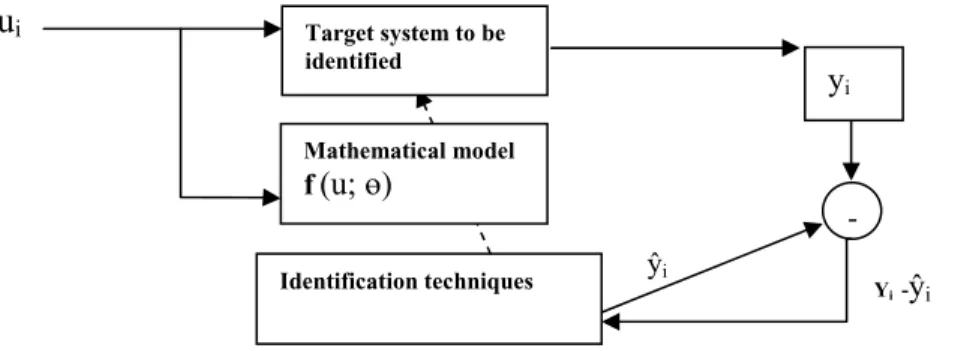
Figure 2 shows a schematic diagram of system identification process, in which the input ui is given to the target system and the model. The difference between target system output and model output is used to update the parameter vector θ.
ui
Figure 2. System identification process
In learning process of the system a set of ‘m’ input output training data pairs ((xi, yi), i= 1... m) is considered as u vector.
Totally, system identification is not a one step process and needs to repeat structure and parameter identification stages iteratively to reach a suitable result.
3-1. Fuzzy system to be used
The applied TSK-fuzzy system has rules of the form shown in (Eq. 4).
(4) Ri: If x1(k) is Ai1 AND … AND xn(k) is Ain Then y(k) is ai
Where k, X1(k) to Xn(k), Y(k), Aij, ai stand for time, input variables, output variable, a fuzzy set, and a crisp value, respectively.
Membership functions are picked to be Gaussian and firing strength of each rule is as follows:
(5) By having r Rules, the output of fuzzy system is calculated as a weighted average as follows:
(6) ŷi -Identification techniques Target system to be identified Mathematical model f(u; ө) yi Yi -ŷi
181
Shima Kamyab and Abbas Bahrololoum / Procedia - Social and Behavioral Sciences 32 (2012) 176 – 183
3-2. Modeling bacteria population in BFOA based algorithm (BSO)
In a TSK type fuzzy system if there are n input variable and r rules, the position of a bacterium in the search space is represented by s vector as shown in Equation 7:
s = [m11, σ11, …, m1n, σ1n, m2n, σ2n, …, mrn, σrn, a1, …, ar] (7)
Where m and σ are the center and width of membership functions and a is the consequent value of a specified rule in the fuzzy system. The number of s vector instances will be equal to (2n + 1) × r
To add the characteristics of PSO algorithm to BFOA we considered a velocity value for each bacterium in the search space.
The population is initialized randomly.
In elimination-dispersal stage of BFOA algorithm, we used a PSO based operator to mutate the position and velocity of bacteria as mentioned in Equation 8:
Vidnew = w. Vidold + c1φ1(θg-bestd – θdold(i, j + 1, k))
θdnew(i, j + 1, k) = θdold(i, j + 1, k) + Vidnew
(8)
Where Vid is the dth element of velocity vector of ith bacterium, θ is the position vector, j, k are chemotactic and reproduction indexes respectively, and w, c1, φ1 are PSO based coefficients.
3. Simulation results
In this section, to evaluate performance of our applied method, there is a comparison between BSO method and some known algorithms to system identification problem for a kind of fuzzy controller system called plant tracking control system [4].
In plant tracking control system the plant to be controlled is described as follows:
y(k + 1) = (y(k)/(1 + y2(k))) + u3(k) (9)
Where y(k) is in [-2, 2] and y(0) = 0 and u(k) is control input that is in [-1, 1]. The target system output equation is as follows:
yd(k) = sin(πk/50) cos(πk/30) kЄ[1, 250] (10)
The system to be modeled has two inputs and one output variables and their values in each iteration calculate through Eq. 9 and Eq. 10 in an on-line way.
(11) Input 1 = yd(k + 1) input 2 = y(k)
The Root Means Square Error (RMSE) function is used to calculate performance of achieved fuzzy systems.
RMSE = Sqrt(∑k=0249(yd(k + 1) – y(k + 1))2/250) (12)
And the fitness function will be as Equation 13: F = 1/(RMSE + ε)
182 Shima Kamyab and Abbas Bahrololoum / Procedia - Social and Behavioral Sciences 32 (2012) 176 – 183
The selected values for parameters of used algorithm are:
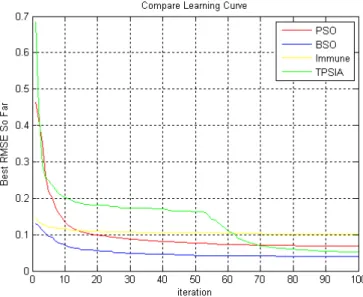
P = 75, S = 40, Nc = 20, Ns = 10, Nre = 500, Ped = 0.05, C (i) = 0.1 for each bacterium. The number of rules for fuzzy system is chosen 15. The result of comparison between BSO algorithm and some other algorithms via average of 20 times launching is shown in figure3, in order to compare their performance:
Figure 3. Compare learning control results
Where TPSIA is a two phase swarm intelligence algorithm in which the initial values for phase two (PSO phase) are obtain through phase one (ACO phase) (Juang & Lo, 2008). Immune algorithm is an algorithm which simulates the behavior of B cells of immune mechanism in human body (Lin, 2008; Zuo & Fan, 2006). Figure 4 shows the control result of achieved fuzzy system for plant tracking control system, through BSO algorithm in comparison with PSO algorithm.
4. Conclusion
Using heuristic methods for parameter identification step of system identification process turn it from a time-consuming to a simple and fast task. Bacterial Foraging Optimization algorithm, as one of the heuristic methods, is similar to PSO algorithm used in several identification processes with desirable solutions. But BFOA adds special characteristics to mobile agents in the search space like swimming toward nutrient and tumble which cause them to move more exactly toward the nutrient. Hence, if a bacterium finds out that it is going away from the nutrient, it changes the direction toward places with more probability of nutrient existing. In this paper some of BFOA operators are replaced with PSO ones to add PSO advantages to BFOA, which led to achieving more desirable results in TSK-type control fuzzy system identification for plant tracking plant.
Acknowledgment:
Special thanks to Mr. Abdol-Hamid Bahrololoum for helping us to conduct this research. References
Acosta, G., & Todorovich, E. (2003). Genetic algorithms and fuzzy control: A practical synergism for industrial applications. Journal of Computers in Industry, 52, 183–195.
Alejandra Guzman, M., Delgado, A., & De Carvalho, J. (2009). A novel multiobjective optimization algorithm based on bacterial chemotaxis.
Journal of Engineering Applications of Artificial Intelligence, 23, 292–301.
Baruch, I. S., Lopez, R. B., Guzman, J-L. O., & Flores, J. M. (2008). A fuzzy-neural multi-model for nonlinear systems identification and control.
Fuzzy Sets and Systems, 159, 2650-2667.
Gollapudi, S. V. R. S., Pattnaik, Sh. S., Bajpai, O. P., Devi, S., & Bakwad, K. M. (2011). Velocity Modulated Bacterial Foraging Optimization Technique (VMBFO). Applied Soft Computing, 11, 154–165.
Hota, P. K., Barisal, A. K., & Chakrabarti, R. (2010). Economic emission load dispatch through fuzzy based bacterial foraging algorithm. International Journal of Electrical Power and Energy Systems, 32, 794–803.
Jang, R. J-S., Sun, C-T., & Mizutani, E. (1997). Neur- fuzzy and soft computing, a computational approach to learning and machine intelligence.
USA: prentice-Hall.
Juang, C-F., & Lo, C. (2008). Zero-order TSK-type fuzzy system learning using a two-phase swarm intelligence algorithm. Fuzzy Sets and Systems, 159, 2910-2926.
Kim, D. H., Abraham, A., & Cho, J. H. (2007). A hybrid genetic algorithm and bacterial foraging approach for global optimization. Information Sciences, 177, 3918–3937.
Lin, Ch-J. (2008). An efficient immune-based symbiotic particle swarm optimization learning algorithm for TSK-type neuro-fuzzy networks design. Fuzzy Sets and Systems, 159, 2890-2909.
Majhi, B., & Panda, G. (2011). Robust identification of nonlinear complex systems using low complexity ANN and particle swarm optimization technique. Expert Systems with Applications, 38, 321–333.
Modares, H., Alfi, A., & Fateh, M-M. (2010). Parameter identification of chaotic dynamic systems through an improved particle swarm optimization. Expert Systems with Applications, 37, 3714–3720.
Nedjah, N., & de Macedo Mourelle, L. (2006).Swarm intelligent systems.Rio de Janeiro: Springer Inc.
Papadakis, S. E., & Theocharis, J. B. (2002). A GA-based fuzzy modeling approach for generating TSK models. Fuzzy Sets and Systems, 131, 121-152.
Tabatabaei, S. M., & Vahidi, B. (2011). Bacterial foraging solution based fuzzy logic decision for optimal capacitor allocation in radial distribution system. Electric Power Systems Research,81, 1045-1050.
Zuo, X. Q., & Fan, Y. S. (2006). A chaos search immune algorithm with its application to neuro-fuzzy controller design. Chaos, Solitons and Fractals, 30, 94–109.