Constraints – Revisited
Ignasi Ab´ıo, Robert Nieuwenhuis, Albert Oliveras,and Enric Rodr´ıguez-Carbonell
Technical University of Catalonia (UPC), Barcelona
Abstract. Pseudo-Boolean constraints are omnipresent in practical applications, and therefore a significant effort has been devoted to the development of good SAT encoding techniques for these constraints. Sev-eral of these encodings are based on building Binary Decision Diagrams (BDDs) and translating these into CNF. Indeed, BDD-based encodings have important advantages, such as sharing the same BDD for repre-senting many constraints.
Here we first prove that, unless NP = Co-NP, there are Pseudo-Boolean constraints that admit no variable ordering giving a polyno-mial (Reduced, Ordered) BDD. As far as we know, this result is new (in spite of some misleading information in the literature). It gives several interesting insights, also relating proof complexity and BDDs.
But, more interestingly for practice, here we also show how to over-come this theoretical limitation bycoefficient decomposition. This allows us to give the first polynomial arc-consistent BDD-based encoding for Pseudo-Boolean constraints.
1
Introduction
In this paper we study Pseudo-Boolean constraints (PB constraints for short), that is, constraints of the forma1x1+· · ·+anxn#K, where theai andK are
integer coefficients, thexi are Boolean (0/1) variables, and the relation operator # belongs to{<, >,≤,≥,=}. We will assume that # is≤and theai andK are positive since other cases can be easily reduced to this one (see [ES06]).
Such a constraint is a Boolean functionC:{0,1}n→ {0,1}that is monotonic decreasing in the sense that any solution forC remains a solution after flipping inputs from 1 to 0. Therefore these constraints can be expressed by a set of clauses with only negative literals. For example, each clause could simply define a (minimal) subset of variables that cannot be simultaneously true. Note however that not every such a monotonic function is a PB constraint. For example, the function expressed by the two clausesx1∨x2andx3∨x4has no (single) equivalent
PB constrainta1x1+· · ·+anxn ≤K(since wlog.a1≥a2anda3≥a4, and then
All the authors are partially supported by Spanish Min. of Educ. and Science through
the LogicTools-2 project (TIN2007-68093-C02-01). Ab´ıo is also partially supported by FPU grant.
K.A. Sakallah and L. Simon (Eds.): SAT 2011, LNCS 6695, pp. 61–75, 2011. c
also x1∨x3 is needed). Hence, even among the monotonic Boolean functions,
PB constraints are a rather restricted class (see also [J.S07]).
PB constraints are omnipresent in practical SAT applications, not just in typ-ical 0-1 linear integer problems, but also as an ingredient in new SAT approaches to, e.g., cumulative scheduling [SFSW09], so it is not surprising that a signifi-cant number of SAT encodings for these constraints have been proposed in the literature. Here we are interested in encoding a PB constraintCby a clause set
S (possibly with auxiliary variables) that is not only equisatisfiable, but also (generalized)arc-consistent: given a partial assignmentA, ifxi is false in every extension ofAsatisfyingC, then unit propagatingAonS setsxi to false.
To our knowledge, the only polynomial arc-consistent encoding so far was given by Bailleux, Boufkhad and Roussel [BBR09]. Other existing encodings are based on building (forms of) Binary Decision Diagrams (BDDs) and translating these into CNF. Although [BBR09] is not BDD-based, our motivation to revisit BDD-based encodings is twofold:
Example 1. Consider the constraint 3x1 + 2x2+ 4x3 ≤ 5 and the constraint
30001x1+ 19999x2+ 39998x3≤50007. Both are clearly equivalent: the Boolean
function they represent can be expressed, e.g., by the clausesx1∨x3andx2∨x3.
However, encodings like the one of [BBR09] heavily depend on the concrete co-efficients of each constraint, and generate a significantly larger SAT encoding for the second one. Since, given a variable ordering, (Reduced, Ordered) BDDs are a canonical representation for Boolean functions [Bry86], i.e., each Boolean function has a unique ROBDD, a ROBDD-based encoding will treat both
con-straints equivalently.
The second reason for revisiting BDDs is that in practical problems numerous PB constraints exist that share variables among each other. Representing them all as a single BDD has the potential of generating a much more compact SAT encoding that is moreover likely to have better propagation properties.
Related work. The same authors of [BBR09] proposed an encoding “very close to those using a BDD and translating it into clauses” [BBR06]. It is arc-consistent, but an example of a PB constraint family is given in [BBR06] for which their kind of non-reduced BDDs, with their concrete variable order-ing is exponentially large. However, as we show here, ROBDDs for this fam-ily are polynomial. Their method works as follows. Given the PB constraint
a1x1+· · ·+anxn ≤ K with coefficients ordered from small to large, the root
node is labelled with variableDn,K, expressing that the sum of the firstnterms is no more than K. Its two children are Dn−1,K and Dn−1,K−an, which
cor-respond to setting xn to false and true, respectively, etc. Two binary and two ternary clauses per node express the relationships between the variables.
Example 2. The encoding of [BBR06] on 2x1+· · ·+ 2x10+ 5x11+ 6x12≤10 is
illustrated in Figure 1. NodeD10,5represents 2x1+ 2x2+· · ·2x10≤5, whereas
nodeD10,4represents 2x1+ 2x2+· · ·2x10≤4. The method fails to identify that
both these PB constraints are equivalent and hence subtreesB and C will not be merged, yielding a much larger representation than with ROBDDs.
D12,10 D11,10 D11,4 D10,10 D10,5 D10,4 D≡10false,−1 0 0 0 1 1 1 A B C
Fig. 1.Tree-like construction of [BBR06] for 2x1+· · ·+ 2x10+ 5x11+ 6x12≤10
On the other hand, E´en and S¨orensson use ROBDDs in MiniSAT+ [ES06]. Their encoding uses six three-literal clauses per BDD node and is arc-consistent, but the proof of arc-consistency relies on a particular variable ordering. Regarding the size of their ROBDDs, they cite [BBR06] to say“It is proven that in general a PB-constraint can generate an exponentially sized BDD [BBR06]” which, as we have seen, cannot be concluded from that paper since they do not use ROB-DDs. Apart from their BDD-based encoding, [ES06] also suggests two alternative methods: one based on adder networks (O(n) in size but not arc-consistent) and another one based on sorting networks (O(nlogn) in size and not arc-consistent). Finally, as we have already mentioned, [BBR09] presents an arc-consistent and polynomial BDD-based SAT encoding (sizeO(n2log
nlogamax), i.e., it de-pends on the size of the coefficients) based on a network of unary adders. Main Contributions and Organization of This Paper
• Subsection 3.2: The first, to our knowledge, PB constraint family for which ROBDDs with small-to-large variable ordering are exponential in size (and also for the large-to-small ordering).
• Subsection 3.3: A proof that, unless NP=co-NP, there are PB constraints that admit no polynomial-size ROBDD, independently of the variable order.
• Subsection 4.1: A proof that PB constraints whose coefficients are powers of two do admit polynomial-size BDDs.
• Subsections 4.2 and 4.3: An arc-consistent and polynomial (size
O(n3log
amax)) BDD-based encoding for PB constraints.
• Section 5: An arc-consistent SAT encoding of BDDS for monotonic functions, a more general class of Boolean functions than PB constraints. This encoding uses only one binary and one ternary clause per node (the standard if-then-else encoding for BDDs used in, e.g., [ES06], requires six ternary clauses per node). Moreover, this translation works for any BDD variable ordering.
2
Preliminaries
We assume the reader is familiar with the basic notions of propositional logic. Otherwise, basic definitions can be found in [BHvMW09]. Pseudo-Boolean con-straints (PB concon-straints for short) are concon-straints of the form a1x1 +· · · +
anxn # K, where the ai and K are integer coefficients, the xi are Boolean (0/1) variables, and the relation operator # belongs to{<, >,≤,≥,=}. We will assume that # is≤and theaiandKare positive, since other cases can be easily reduced to this one1: (i) changing into≤is straightforward if coefficients can be
negative; (ii) replacing−axbya(1−x)−a; (iii) replacing (1−x) byx. Negated variables likexcan be handled as positive ones or, alternatively, replaced by a freshx and adding the clausesx∨x andx∨x.
Our main goal is to find SAT encodings for PB constraints. That is, given a PB-constraintC, construct an equisatisfiable clause set (a CNF)Ssuch that any model forSrestricted to the variables ofCis a model ofC. Two extra properties are sought: (i)consistency checking by unit propagation or simply consistency: whenever a partial assignment A cannot be extended to a model for C, unit propagation onS and A produces a contradiction (a literall and its negation
l); and (ii) (generalized)arc-consistency (again by unit propagation): given an assignment A that can be extended to a model of C, but such that A∪ {x} cannot, unit propagation onS and A producesx. More concretely, we will use BDDs for finding such encodings, as illustrated by the following example.
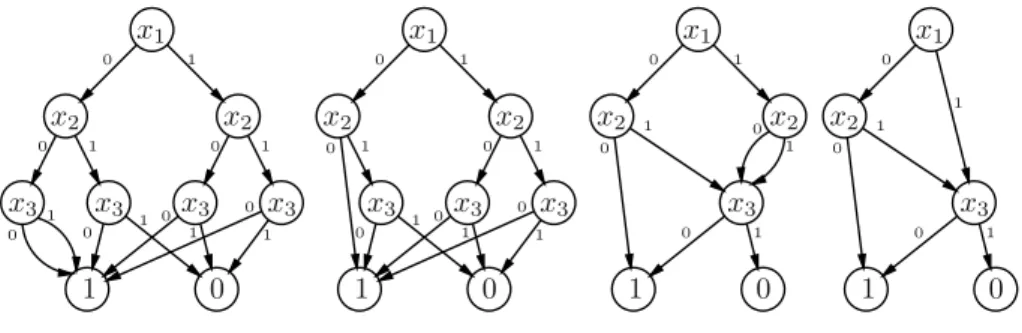
x1 x2 x2 x3 x3 x3 x3 0 1 1 1 1 1 1 1 1 0 0 0 0 0 0 0 x1 x2 x2 x3 x3 x3 0 1 1 1 1 1 1 1 0 0 0 0 0 0 x1 x2 x2 x3 0 1 1 1 1 1 0 0 0 0 x1 x2 x3 0 1 1 1 1 0 0 0
Fig. 2.Construction of a BDD for 2x1+ 3x2+ 5x3≤6
Example 3. Figure 2 explains (one method for) the construction of a ROBDD for the PB constraint 2x1+ 3x2+ 5x3 ≤ 6 and the ordering x1 < x2 < x3.
The root node has as selector variable x1. Its false child represents the PB
constraint assuming x1 = 0 (i.e., 3x2+ 5x3 ≤ 6) and its true child represents
2 + 3x2+ 5x3 ≤ 6, that is, 3x2+ 5x3 ≤ 4. The two children have the next
variable in the ordering (x2) as selector, and the process is repeated until we
reach the last variable in the sequence. Then, a constraint of the form 0≤ K is the True node (1 in the figure) if K ≥0 is positive, and the False node (0)
1 An =-constraint can be split into a≤-constraint and a≥-constraint. Here we
if K < 0. This construction (leftmost in the figure), is known as an Ordered BDD. For obtaining a Reduced Ordered BDD (BDD for short in the rest of the paper), two reductions are applied until fixpoint: removing nodes with identical children (as done with the leftmostx3node in the second BDD of the figure), and
merging isomorphic subtrees, as done forx3 in the third BDD. The fourth final
BDD is a fixpoint. For a given ordering, BDDs are a canonical representation of Boolean functions: each Boolean function has a unique BDD. BDDs can be encoded in CNF by introducing an auxiliary variable a for every node. If the selector variable of the node is xand the auxiliary variables for the false and true child aref andt, respectively, add the if-then-else clauses:
x∧f →a x∧t→a f ∧t→a
x∧f →a x∧t→a f ∧t→a
In what follows, the size of a BDD is its number of nodes. We will say that a BDD represents a PB constraint if they represent the same Boolean function. Given an assignmentAover the variables of a BDD, we define thepath induced byAas the path that starts at the root of the BDD and at each step, moves to the false (true) child of a node iff its selector variable is false (true) inA.
3
Exponential BDDs for PB Constraints
In this section, we prove that, unless NP=co-NP, there are PB constraints whose BDDs are all exponential, regardless of the variable ordering. We start by defin-ing the notion of the interval of a PB constraint. After that, we consider two families of PB constraints and we study the size of their BDDs. Finally, we prove the main result of this section.
3.1 Intervals
Example 4. Consider the constraint 2x1+ 3x2+ 5x3≤6. Since no combination
of its coefficients adds to 6, the constraint is equivalent to 2x1+ 3x2+ 5x3<6,
and hence to 2x1+ 3x2+ 5x3≤5. This process cannot be repeated again since 5
can be obtained with the existing coefficients.
Similarly, we could try to increase the right-hand side of the constraint. How-ever, there is a combination of the coefficients that adds 7, which implies that the constraint is not equivalent to 2x1+ 3x2+ 5x3≤7. All in all, we can state
that the constraint is equivalent to 2x1+ 3x2+ 5x3≤Kfor anyK∈[5,6]. It is
trivial to see that the set of validK’s is always an interval. Definition 1. Let C be a constraint of the form a1x1+· · ·+anxn ≤K. The
intervalof C consists of all integers M such that a1x1+· · ·+anxn≤M, seen
as a Boolean function, is equivalent toC.
In the following, given a BDD representing a PB constraint and a nodeν, we will refer tothe interval ofν as the interval of the constraint represented by the BDD rooted at ν. Unless stated otherwise, the ordering used in the BDD will bex1< x2< . . . < xn.
Proposition 2. If [β, γ] is the interval of a node ν with selector variable xi then:
1. There is an assignment {xj=vj}nj=i such that aivi+· · ·+anvn=β.
2. There is an assignment {xj=vj}nj=i such that aivi+· · ·+anvn=γ+ 1.
3. There is an assignment {xj = vj}ij−=11 such that K−a1v1−a2v2− · · · −
ai−1vi−1∈[β, γ]
4. Takeh < β. There exists an assignment{xj =vj}jn=i such that aivi+· · ·+
anvn > hand its path goes from ν to True.
5. Takeh > γ. There exists an assignment{xj=vj}jn=i such thataivi+· · ·+
anvn ≤hand its path goes from ν to False.
6. The interval of the True node is [0,∞).
7. The interval of the False node is(−∞,−1]. Moreover, it is the only interval with negative values.
We now prove that, given a BDD for a PB constraint, one can easily compute the intervals for every node bottom-up. We first start with an example.
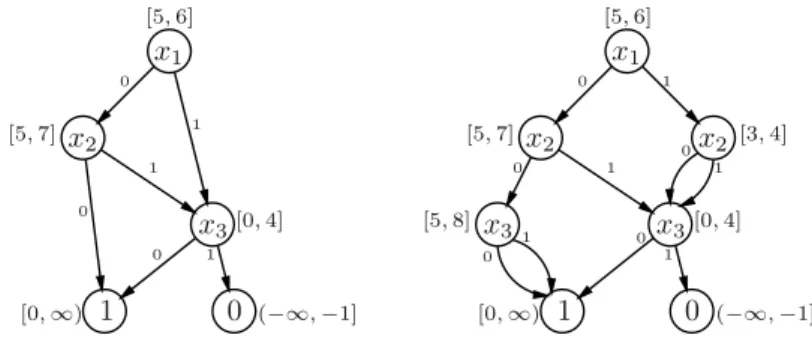
x1 x2 x3 0 1 1 1 1 0 0 0 [5,6] [5,7] [0,4] [0,∞) (−∞,−1] x1 x2 x2 x3 x3 0 1 1 1 1 1 1 0 0 0 0 0 [5,6] [5,7] [3,4] [5,8] [0,4] [0,∞) (−∞,−1]
Fig. 3.Intervals of the BDD for 2x1+ 3x2+ 5x3≤6
Example 5. Let us consider again the constraint 2x1+ 3x2+ 5x3≤6. Assume
that all variables appear in every path from the root to the leaves (otherwise, add extra nodes as in the rightmost BDD of Figure 3). Assume now that we have computed the intervals for the two children of the root (rightmost BDD in Figure 3). This means that the false child of the root is the BDD for 3x2+ 5x3≤
[5,7] and the true child the BDD for 3x2+ 5x3 ≤ [3,4]. Assuming x1 to be
false, the false child would also represent the constraint 2x1 + 3x2 + 5x3 ≤
[5,7], and assumingx1 to be true, the true child would represent the constraint
2x1+ 3x2+ 5x3≤[5,6]. Taking the intersection of the two intervals, we can infer
that the root node represents 2x1+ 3x2+ 5x3≤[5,6].
More formally, the interval of every node can be computed as follows:
Proposition 3. Leta1x1+a2x2+· · ·+anxn≤K be a constraint, and letB be
xi, false child νf (with selector variable xf and interval [βf, γf]) and true child
νt(with selector variablextand interval[βt, γt]). The interval ofνis[β, γ], with:
β = max{βf+ai+1+· · ·+af−1, βt+ai+ai+1+· · ·+at−1},
γ= min{γf, γt+ai}.
If in every path from the root to the leaves of the BDD all variables were present, the definition of β would be much simpler (β = max{βf, βt+ai}). The other coefficients are necessary to account for the variables that have been removed due to the BDD reduction process.
3.2 Some Families of PB Constraints and Their BDD Size
We start by revisiting the family of PB constraints given in [BBR06], where it is proved that, for their concrete variable ordering, their non-reduced BDDs grow exponentially for this family. Here we prove that ROBDDs are polynomial for this family, and that this is even independent of the variable ordering. The family is defined by consideringa,bandnpositive integers such that ni=1bi < a. The coefficients areωi=a+biand the right-hand side of the constraint isK=a·n/2. We will first prove that the constraintC:ω1x1+· · ·+ωnxn ≤K is equivalent
to the cardinality constraint C : x1+· · ·+xn ≤n/2−1. For simplicity, we
assume thatnis even.
– Take an assignment satisfying C. In this case, there are at mostn/2−1 variablesxiassigned to true, and the assignment also satisfiesCsince:ω1x1+
· · ·+ωnxn≤ n i=n/2+2 ωn= (n/2−1)a+ n i=n/2+2 bn< K−a+ n i=1 bi< K.
– Consider now an assignment not satisfying C. In this case, there are at least n/2 true variables in the assignment and it does not satisfy C either:
ω1x1+· · ·+ωnxn n/2 i=1 ωi= (n/2)·a+ n/2 i=1 bi>(n/2)·a=K.
Since the two constraints are equivalent and BDDs are canonical, the BDD representation ofC andC are the same. But the BDD ofC is known to be of quadratic size because it is a cardinality constraint (see, for instance, [BBR06]). Theorem 4. There exists a family of PB constraints parameterized byn, whose ROBDDs grow exponentially innwhen ordering the variables according to their coefficients from small to large. The same happens ordering from large to small.
Proof. We consider constraints of the forma1x1+· · ·+a4nx4n ≤K. It is
2n a1 = 0 0 0 0 0 · · · 01 = 1 a2 = 0 0 0 0 0 · · · 10 = 2 · · · . .. a2n−1 = 0 0 0 01 · · · 0 0 a2n = 0 0 0 10 · · · 0 0 = 22n−1 a2n+1 = 10 0 0 0 · · · 01 a2n+2 = 10 0 0 0 · · · 10 · · · . .. a4n−1 = 10 0 01 · · · 0 0 a4n = 10 0 10 · · · 0 0 K = dm . . . d00 0 1 1 · · · 1 1
wheredm. . . d0 is the binary representation ofn. Note that, to sum to exactly
K, one needs exactlyncoefficients of the bottom half (betweena2n+1 anda4n)
to obtain the digitsdm. . . d0, and that, once such a subset is chosen, a unique
subset of exactly n coefficients of the top half exists that will complete the 11. . .11 suffix ofK. Reversely, for each subset of sizenof the top half, a unique subset of sizenof the bottom half exists that complements it to sum exactlyK. Now consider a BDD orderedx1<· · ·< x4n, and any two distinct assignments
T and T for x1. . . x2n that set exactly n variables to true. Then T and T
induce paths that necessarily lead to different nodes of the BDD. To see this, wlog., assume that the sum of coefficients corresponding to true variables in T is smaller than the one ofT. Consider the assignmentBtox2n. . . x4nthat sets
to true the unique size-n subset of the bottom half coefficients that sums toK for T (and hence exceeds K for T). Then the PB constraint satisfies T ∪B, but notT∪B; henceB distinguishes the nodes forT andT. Altogether, the BDD must have at least as many nodes as distinct assignments setting exactly
n variables of the top half to true, i.e., an exponential number,
2n
n
. For the large-to-small ordering exactly the same reasoning applies2. For the PB constraint family of the previous proof, it can be shown that the “interleaved” ordering x1 < x2n+1 < x2 < x2n+2 < . . . < x2n < x4n leads to
a polynomial-sized BDD (the proof is non-trivial, but we had to omit it here due to space limitations). The next natural step would be to present a concrete family of PB constraints whose BDDs are always exponential regardless of the variable ordering. We have not been able to find such a family. But in the next section we prove that, unless NP=co-NP, such a family must exist.
3.3 Probably There Are No Small BDDs for All PB Constraints Our goal is now to prove that, unless NP=co-NP, there are PB constraints all whose BDDs are exponential, independently of the variable ordering. The
main ingredient is an algorithm that, given a BDDB and a PB constraint C:
a1x1+· · ·+anxn ≤K over the same set of variables, allows one to decide, in
time polynomial in the size of the BDD, whetherBrepresentsC. Again, w.l.o.g., we assume that the BDD ordering isx1< x2< . . . < xn.
Given the BDD, the algorithm first computes, in a bottom-up manner, an interval for every node of the BDD, as explained in Proposition 3 and points 6 and 7 of Proposition 2. Note that the cost of computing a single interval isO(n) and hence computing all intervals takesO(nm) time, wheremis the BDD’s size. After that, we know thatBis a representation of Cif and only if K belongs to the interval of the BDD root.
Theorem 5. Bis a BDD representing a PB constrainta1x1+· · ·+anxn≤Kif,
and only if,Kbelongs to the interval of the root ofBcomputed by our algorithm. Proof. IfBis a BDD representingC, thenK belongs to the interval of the root by definition of interval (Def. 1). Moreover, Proposition 3 guarantees that our algorithm correctly computes such an interval.
Let us now assume thatB is not a BDD representing C. Then, there exists an assignment{x1 =v1, . . . , xn =vn} that either satisfies C but leads to the
False node inBor does not satisfyC but leads to the True node inB.
Let us assume that the assignment satisfies C. The other case is analog to this one. In this case, we will prove thatγ1 < K, where [β1, γ1] is the interval
computed for the root node.
We define a sequence of nodesν1, ν2, . . . , νn, νn+1 as follows:ν1is the root of
B. If the selector variable ofν1 is notx1,ν2=ν1. Otherwise,ν2 is its false child
ifv1= 0 or its true child if v1= 1, and so on. By definition of the assignment,
νn+1 is the False node. If we let [βi, γi] be the computed interval for the node
νi, we want to prove that every nodeνi satisfiesγi< ai+1vi+1+· · ·+anvn.
Sinceνn+1 is the False node and its theoretical interval is (−∞,−1], it holds
thatγn+1<0. Assume that it is true for everyk > i, and let us prove it fori.
Let us assume that xi is the selector variable ofνi (in this case,i ≤ i by construction). There are two cases:
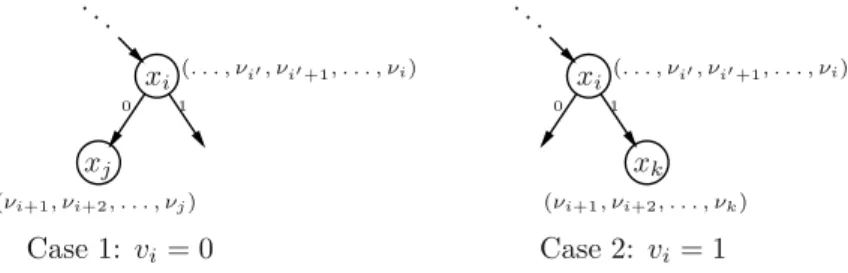
1 1 0 0 xi xi xj (. . . , νi, νi+1, . . . , νi) (. . . , νi, νi+1, . . . , νi) (νi+1, νi+2, . . . , νj) ... ... Case 1: vi= 0 xk (νi+1, νi+2, . . . , νk) Case 2: vi= 1
Fig. 4.Severalν’s refer to the same BDD node.νjandνkare the last in the sequence.
– vi = 0. Let us takejsuch thatνj is the false child ofνi and the selector vari-able ofνj isxj (see Figure 4). Then,γi ≤γjby definition of the algorithm.
Using the induction hypothesis:
γi ≤γj< aj+1vj+1+· · ·+anvn ≤ai+1vi+1+· · ·+anvn.
– vi = 1. Similarly, let us take ksuch thatνk is the true child ofνi and the
selector variable ofνk isxk (see Figure 4). Then,γi ≤γk+aiby definition
of the algorithm. Using the induction hypothesis and thatvi= 1:
γi ≤ai+γk < ai+ak+1vk+1+· · ·+anvn≤ai+1vi+1+· · ·+anvn.
Therefore, it holds thatγi< ai+1vi+1+· · ·+anvn for everyi. In particular, it
holds fori= 1. Since the assignment satisfies the PB constraint by hypothesis, we have
γ1< a1v1+· · ·+anvn≤K,
and henceK does not belong to the theoretical interval of the root node. Notice that if Bis not the BDD ofC some of the computed intervals might be empty. However, the algorithm will be able to compute the remaining intervals and, since the interval of the root node will be empty, the algorithm will also be correct. We are now ready for the following result.
Theorem 6. Unless NP=co-NP, there are PB constraints that do not admit polynomial BDDs.
Proof. A well-known NP-complete problem is the following (variant of the) sub-set sum problem: given a set of integers{a1, . . . , an} and an integer K, decide
whether there exists a subset of {a1, . . . , an} that sums to exactlyK. Here we
prove that if a polynomial-size BDD existed for every PB constraint then for ev-ery unsatisfiable subset sum problem a polynomial-size unsatisfiability certificate would exist, that could moreover be verified in polynomial time, thus collaps-ing NP and co-NP. Indeed, obviously, a subset sum problem ({a1, . . . , an}, K)
is unsatisfiable if, and only if, the PB constraintsa1x1+· · ·+anxn ≤K and
a1x1+· · ·+anxn ≤ K −1 are equivalent, i.e., they are the same Boolean
function. So if the subset sum problem ({a1, . . . , an}, K) is unsatisfiable, and a
polynomial-size BDD fora1x1+· · ·+anxn ≤K existed, this BDD would also
representa1x1+· · ·+anxn ≤K−1, which, as we proved in the previous
theo-rem, can be checked in polynomial time (for both PB constraints at once). We find it quite surprising that, even for the limited kind of monotonic functions that can be represented by a single PB constraint, the existence of polynomial-size BDDs would imply NP=co-NP. As said, to our knowledge it remains unknown whether there exists a family of PB constraints that admit no polynomial-size BDD. This situation is analogous to what happens with extended resolution in Cook’s program for propositional proof complexity: it is unknown whether there exists a family of propositional problems that admit no polynomial-size extended resolu-tion proof. So, finding successively more compact unsatisfiability certificates for subset sum might be an interesting alternative to Cook’s program for attacking the NP vs co-NP question.
4
Avoiding Exponential BDDs
In this section we introduce our positive results. We restrict ourselves to a par-ticular class of PB constraints, where all coefficients are powers of two. As we will show below, these constraints admit polynomial BDDs. Moreover, any PB constraint can be reduced to this class.
Example 6. Let us take the PB constraint 9x1+ 8x2+ 3x3 ≤10. Considering
the binary representation of the coefficients, this constraint can be rewritten into (23x3,1+ 20x0,1) + (23x3,2) + (21x1,3+ 20x0,3)≤10 if we add the binary clauses
expressing thatxi,r=xr for appropriateiandr.
4.1 Power-of-Two PB Constraints Do Have Polynomial-Size BDDs Let us consider a PB constraints of the form:
C: 20·δ0,1·x0,1 + 20·δ0,2·x0,2 +· · · + 20·δ0,n·x0,n +
21·δ1,1·x1,1 + 21·δ1,2·x1,2 +· · · + 21·δ1,n·x1,n +
. . . +
2m·δm,1·xm,1+ 2m·δm,2·xm,2+· · · + 2m·δm,n·xm,n≤K,
whereδi,r ∈ {0,1} for alli andr. Notice that every PB constraint whose coef-ficients are powers of 2 can be expressed in this way. Let us consider its BDD representation with the orderingx0,1< x0,2< . . . < x0,n< x1,1< . . . < xm,n.
Lemma 7. Let [β, γ] be the interval of a node with selector variablexi,r. Then
2i dividesβ and0≤β <(n+r−1)·2i.
Proof. By Proposition 2.1,βcan be expressed as a sum of coefficients all of which are multiples of 2i, and hence β itself is a multiple of 2i. By Proposition 2.7, the only node whose interval contains negative values is the False node, and henceβ 0. Now, using Proposition 2.3, there must be an assignment to the variables{x0,1, . . . , xi,r−1} such that 20δ0,1x0,1+· · ·+ 2iδi,r−1xi,r−1 belongs to
the interval. Therefore:
β≤20δ0,1x0,1+· · ·+ 2iδi,r−1xi,r−1≤20+ 20+· · ·+ 2i
=n20+n21+· · ·+n2i−1+ (r−1)·2i=n(2i−1) + 2i(r−1)
<2i(n+r−1)
Corollary 8. The number of nodes with selector variable xi,r is bounded by
n+r−1. In particular, the size of the BDD belongs toO(n2
m).
Proof. Letν1, ν2, . . . , νt be all the nodes with selector variablexi,r. Let [βj, γj]
the interval of νj. Note that such intervals are pair-wise disjoint since a non-empty intersection would imply that there exists a constraint represented by two different BDDs. Hence we can assume, w.l.o.g., thatβ1 < β2 < · · · < βt.
Due to Lemma 7, we know that βj−βj−1 2i. Hence 2i(n+r−1) > βt
4.2 A Consistent Encoding for PB Constraints
Let us now take an arbitrary PB constraintC:a1x1+· · ·anxn ≤Kand assume
that aM is the largest coefficient. For m= logaM, we can rewrite C splitting the coefficients into powers of two as shown in Example 6:
˜ C: 20· δ0,1·x0,1 + 20·δ0,2·x0,2 +· · · + 20·δ0,n·x0,n + 21· δ1,1·x1,1 + 21·δ1,2·x1,2 +· · · + 21·δ1,n·x1,n + . . . + 2m·δm,1·xm,1+ 2m·δm,2·xm,2+· · · + 2m·δm,n·xm,n≤K,
whereδm,rδm−1,r · · · δ0,r is the binary representation ofar. Notice thatCand
˜
C represent the same constraint if we add clauses expressing that xi,r =xi for appropriatei and r. This process is calledcoefficient decomposition of the PB constraint. A similar idea can be found in [BBR03].
The important remark is that, using a consistent SAT encoding of the BDD for ˜C (e.g. the one given in [ES06] or the one presented in the next section) and adding clauses expressing that xi,r = xi for appropriate i and r, we obtain a consistent encoding for the original constraint C using O(n2log
aM) auxiliary variables and clauses.
This is not difficult to see. Take an assignment A over the variables of C which cannot be extended to a model of C. This is because the coefficients corresponding to the variables true inAadd more thanK. Using the clauses for
xi,r =xi, unit propagation will produce an assignment to thexi,r’s that cannot be extended to a model of ˜C. Since the encoding for ˜Cis consistent, a false clause will be found. Conversely, if we consider an assignmentAover the variables ofC than can be extended to a model ofC, this assignment can clearly be extended to a model for ˜C and the clauses expressingxi,r =xi. Hence, unit propagation on those clauses and the encoding of ˜C will not detect a false clause.
4.3 An Arc-Consistent Encoding for PB Constraints
Unfortunately, the previous approach does not produce an arc-consistency en-coding. The intuitive idea can be seen in the following example:
Example 7. Let us consider the constraint 3x1+ 4x2 ≤ 6. After splitting the
coefficients into powers of two, we obtainC:x0,1+ 2x1,1+ 4x2,2≤6. If we set
x2,2to true,C implies that eitherx0,1orx1,1have to be false, but the encoding
cannot exploit the fact that both variables will receive the same truth value and hence both should be propagated. Adding clauses stating thatx0,1=x1,1 does
not help in this sense.
In order to overcome this limitation, we follow the method presented in [BKNW09, BBR09]. Let C : a1x1+· · ·+anxn ≤ K be an arbitrary PB
con-straint. We denote asCi the constrainta1x1+· · ·+ai·1 +· · ·+anxn≤K, i.e.,
the constraint assumingxi to be true. For everyiwith 1≤i≤n, we encodeCi as in Section 4.2 and, in addition, we add the binary clauseri∨ ¬xi, where ri
is the root of the BDD forCi. This clause helps us to preserve arc-consistency: given an assignmentAsuch thatA∪ {xi} cannot be extended to a model ofC, literalriwill be propagated usingA(because the encoding forCiis consistent). Hence the added clause will allow us to propagatexi.
All in all, the suggested encoding is arc-consistent and uses O(n3log(aM)) clauses and auxiliary variables, whereaM is the largest coefficient.
5
SAT Encodings of BDDs for Monotonic Functions
In this section we consider a BDD representing a monotonic functionF and we want to encode it into SAT. As expected, we want the encoding to be as small as possible and arc-consistent.As usual, the encoding introduces an auxiliary variable for every node. Letν be a node with selector variablexand auxiliary variablen. Letf be the variable of its false child andtbe the auxiliary variable of its true child. Only two clauses per node are needed:
¬f → ¬n ¬t∧x→ ¬n.
Furthermore, we add a unit clause with the variable of the True node and another one with the negation of the variable of the False node.
Theorem 9. The encoding is consistent in the following sense: a partial assign-mentA cannot be extended to a model of F if and only if ¬r is propagated by unit propagation, where ris the root of the BDD.
Proof. We prove the theorem by induction on the number of variables of the BDD. If the BDD has no variables, then the BDD is either the True node or the False node and the result is trivial.
Assume that the result is true for BDDs with less thankvariables, and letF be a function whose BDD haskvariables. Letrbe the root node,x1its selector
variable andf, trespectively its false and true children (note that we abuse the notation and identify nodes with their auxiliary variable). We denote byF1 the
functionF|x1=1 (i.e.,F after settingx1to true) and byF0 the functionF|x1=0.
– LetAbe a partial assignment that cannot be extended to a model ofF.
• Assumex1 ∈A. Since Acannot be extended, the assignment A\ {x1}
cannot be extended to a model of F1. By definition of the BDD, the
functionF1 hast as a BDD. By induction hypothesis,¬tis propagated,
and sincex1∈A,¬ris also propagated.
• Assumex1∈A. Then, the assignmentA\ {¬x1}cannot be extended to
a model ofF0. SinceF0 hasf as a BDD, by induction hypothesis¬f is
propagated, and hence¬ralso is.
– LetA be a partial assignment, and assume¬rhas been propagated. Then, either ¬f has also been propagated or¬t has been propagated andx1 ∈A
(note thatx1has not been propagated because it only appears in one clause
• Assume that ¬f has been propagated. Since f is the BDD of F0, by
induction hypothesis the assignmentA\ {x1,¬x1} cannot be extended
to a model ofF0. Since the function is monotonic,A\ {x1,¬x1}neither
can be extended to a model ofF. Therefore,Acannot be extended to a model ofF.
• Assume that¬thas been propagated andx1∈A. Sincetis the BDD of
F1, by induction hypothesisA\ {x1} cannot be extended to a model of
F1, so neither canA be extended to a model ofF.
For obtaining an arc-consistent encoding, we only have to add a unit clause. Theorem 10. If we add a unit clause forcing the variable of the root node to be true, the previous encoding becomes arc-consistent.
Proof. We will prove it by induction on the variables of the BDD. The casen= 0 is trivial, so let us prove the induction case.
As before, letrbe the root node,x1its selector variable andf, tits false and
true children. We denote byF1 andF1 the functionsF|x1=1and F|x1=0.
LetAbe a partial assignment that can be extended to a model ofF. Assume thatA∪ {xi}cannot be extended. We want to prove thatxi will be propagated. – Let us assume that x1 ∈A. In this case, t is propagated due to the clause
¬t∧x1 → ¬nand the unit clausen. Since x1∈Aand A∪ {xi} cannot be
extended to a model of F, A\ {x1} ∪ {xi} neither can be extended to an
assignment satisfyingF1. By induction hypothesis, sincetis the BDD of the
functionF1,¬xi is propagated.
– Let us assume that x1 ∈ A and xi = x1. Since F is monotonic, A∪ {xi}
cannot be extended to a model ofF if and only if it cannot be extended to a model ofF0. Notice thatf is propagated thanks to the clause ¬f →nand
the unit clausen. By induction hypothesis, the method is arc-consistent for
F0, soxiis propagated.
– Finally, assume thatx1∈Aandxi =x1. SinceA∪{x1}cannot be extended
to a model ofF, Acannot be extended to model of F1. By Theorem 9,¬t
is propagated and, due to¬t∧x1→ ¬nandn, also is¬x1.
6
Conclusions and Future Work
Both theoretical and practical contributions have been made. Regarding the the-oretical part, we have proved that, unless NP=co-NP, there are PB constraints that do not admit polynomial BDDs. The existence of a concrete PB constraint family for which no polynomial BDDs exist remains an open problem, with inter-esting connections to the area of proof complexity. One of our aims is to continue working on this open question in the near future.
At the practical level, we have introduced a BDD-based polynomial and consistent encoding of PB constraints and we have developed a BDD-based arc-consistent encoding of monotonic functions that only uses two clauses per BDD node. Indeed our initial motivation for this work has been practical, and we are currently working on implementation and experimental comparison of our encodings with other existing approaches on realistic problems.
References
[BBR06] Bailleux, O., Boufkhad, Y., Roussel, O.: A Translation of Pseudo Boolean Constraints to SAT. JSAT 2(1-4), 191–200 (2006)
[BBR09] Bailleux, O., Boufkhad, Y., Roussel, O.: New Encodings of Pseudo-Boolean Constraints into CNF. In: Kullmann, O. (ed.) SAT 2009. LNCS, vol. 5584, pp. 181–194. Springer, Heidelberg (2009)
[BBR03] Bartzis, C., Bultan, T.: Construction of efficient BDDs for Bounded Arithmetic Constraints. In: Garavel, H., Hatcliff, J. (eds.) TACAS 2003. LNCS, vol. 2619, pp. 394–408. Springer, Heidelberg (2003)
[BHvMW09] Biere, A., Heule, M.J.H., van Maaren, H., Walsh, T. (eds.): Handbook of Satisfiability. IOS Press, Amsterdam (2009)
[BKNW09] Bessiere, C., Katsirelos, G., Narodytska, N., Walsh, T.: Circuit Com-plexity and Decompositions of Global Constraints. In: IJCAI 2009, pp. 412–418 (2009)
[Bry86] Bryant, R.E.: Graph-based algorithms for boolean function manipula-tion. IEEE Trans. Computers 35(8), 677–691 (1986)
[ES06] E´en, N., S¨orensson, N.: Translating Pseudo-Boolean Constraints into SAT. JSAT 2, 1–26 (2006)
[J.S07] Smaus, J.: On Boolean Functions Encodable as a Single Linear Pseudo-Boolean Constraint. In: Van Hentenryck, P., Wolsey, L.A. (eds.) CPAIOR 2007. LNCS, vol. 4510, pp. 288–302. Springer, Heidelberg (2007)
[SFSW09] Schutt, A., Feydy, T., Stuckey, P.J., Wallace, M.: Why Cumulative De-composition Is Not as Bad as It Sounds. In: Gent, I.P. (ed.) CP 2009. LNCS, vol. 5732, pp. 746–761. Springer, Heidelberg (2009)
![Fig. 1. Tree-like construction of [BBR06] for 2x 1 + · · · + 2x 10 + 5 x 11 + 6 x 12 ≤ 10](https://thumb-us.123doks.com/thumbv2/123dok_us/530365.2562491/3.644.90.570.80.337/fig-tree-like-construction-bbr-x-x-x.webp)