DIRECTORATE GENERAL FOR INTERNAL POLICIES
POLICY DEPARTMENT A: ECONOMIC AND SCIENTIFIC POLICY
TTIP and Labour Standards
STUDY
Abstract
The Transatlantic Trade and Investment Partnership (TTIP) will follow EU and US recent trade policy practice to include labour provisions. These could limit the risk that liberalisation results in social dumping and promote upward change.
This Policy Department A study concludes that the EU could take a precautionary stance and employ various instruments that increase the chances that TTIP will have positive social consequences. TTIP may combine the strengths of the EU and US approaches to labour provisions, while improving their weaknesses. More analysis of the social consequences of liberalisation and labour provisions might be stimulated and strong flanking measures at the EU and national level be foreseen.
IP/A/EMPL/2015-07
June 2016
AUTHORS
Ferdi De Ville, Centre for EU Studies, Ghent University Jan Orbie, Centre for EU Studies, Ghent University
Lore Van den Putte, Centre for EU Studies, Ghent University
RESPONSIBLE ADMINISTRATOR Susanne KRAATZ EDITORIAL ASSISTANT Karine GAUFILLET LINGUISTIC VERSIONS Original: EN
ABOUT THE EDITOR
Policy departments provide in-house and external expertise to support EP committees and other parliamentary bodies in shaping legislation and exercising democratic scrutiny over EU internal policies.
To contact Policy Department A or to subscribe to its newsletter please write to: Policy Department A: Economic and Scientific Policy
European Parliament B-1047 Brussels
E-mail: [email protected]
Manuscript completed in March 2016 © European Union, 2016
This document is available on the Internet at:
http://www.europarl.europa.eu/studies
DISCLAIMER
The opinions expressed in this document are the sole responsibility of the author and do not necessarily represent the official position of the European Parliament.
Reproduction and translation for non-commercial purposes are authorised, provided the source is acknowledged and the publisher is given prior notice and sent a copy.
CONTENTS
LIST OF ABBREVIATIONS
4
LIST OF BOXES
5
LIST OF FIGURES
5
LIST OF TABLES
5
EXECUTIVE SUMMARY
6
TABLE 1:
MAIN RESULTS
6
INTRODUCTION
9
TRADE AGREEMENTS AND LABOUR CONDITIONS
13
2.1. Liberalisation and labour rights: a race-to-the-bottom? 13 2.2. Labour standards in trade agreements: a race-to-the-top? 15
LABOUR STANDARDS IN EU TRADE AGREEMENTS: EFFECTIVENESS,
MONITORING AND ENFORCEMENT
17
3.1. Background: A social clause in EU and international trade 18 3.2. Labour in EU Bilateral Agreements: Comparative overview 21
3.2.1. Content 24
3.2.2. Governance 26
3.2.3. Enforcement 27
3.3. Lessons learned 28
LABOUR PROVISIONS IN TTIP: EXPECTATIONS, OPPORTUNITIES
AND CHALLENGES
32
4.1. Comparison of EU and US approach to labour provisions in trade
and investment agreements 32
4.1.1. De jure comparison 32
4.1.2. De facto comparison 35
4.2. Comparison of EU and US ratification and implementation of ILO labour
conventions 35
4.3. Analysis of the EU proposal for labour provisions in TTIP 37 4.4. Global consequences of planned labour provisions in TTIP 42 4.5. Risks for a social race-to-the-bottom from other chapters in TTIP 43
4.6. European and national flanking measures 43
RECOMMENDATIONS
47
5.1. With regard to labour and other provisions in TTIP 47
5.2. With regard to flanking measures 49
5.3. With regard to gaps in research 50
REFERENCES
53
ANNEX: PROPOSAL FOR LABOUR DISPUTE SETTLEMENT MECHANISM
LIST OF ABBREVIATIONS
AFL-CIO
CAFTA-DR
CETA
American
Federation
of
Labour-Congress
of
Industrial
Organizations
Central-America-Dominican Republic-United States FTA
Comprehensive Economic and Trade Agreement
CLS
CSR
DAG
Core labour standards
Corporate social responsibility
Domest advisory group
EP
ETUC
European Parliament
European Trade Union Confederation
EU
FDI
European Union
Foreign direct investment
FTA
Free trade agreement
GATT
GSP
ICS
General Agreement on Tariffs and Trade
Generalised system of preferences
Investment Court System
ILO
International Labour Organisation
ISDS
ITO
KOREU
OECD
PCA
TSIA
Investor-state dispute settlement
International Trade Organization
EU-South Korea Free Trade Agreement
Organisation for Economic Cooperation and Development
Partnership and Cooperation Agreement
Trade sustainability impact assessment
TTIP
Transatlantic Trade and Investment Partnership
US
United States
LIST OF BOXES
Box 1: ILO Fundamental Principles and Core Conventions 10 Box 2: European Parliament resolution on TTIP: labour provisions 11 Box 3: Core Labour Standards in the Singapore Declaration 18 Box 4: ILO Core Conventions in recent EU trade agreements 24
Box 5: Non-lowering clause in recent EU FTAs 25
Box 6: Labour provisions implementation in KOREU 26
Box 7: Examples comparing US labour law with ILO Core Labour Conventions 36 Box 8: What difference does it make when a country has ratified ILO conventions? 37 Box 9: Labour provisions in the Trans-Pacific Partnership 39 Box 10: Position of stakeholders on labour provisions in TTIP 41 Box 11: Social analysis in the Trade Sustainability Impact Assessment 45
LIST OF FIGURES
Figure 1 : Evolution of the inclusion of labour provisions in trade agreements 21 Figure 2: Employment protection legislation in EU Member States and the US 44
LIST OF TABLES
Table 1: Main results 6
Table 2: Growing elaboration of trade-labour linkage in EU trade agreements, 22
Table 3: Legal comparison of US and EU approach 34
EXECUTIVE SUMMARY
Background
This study analyses the possible effects of the Transatlantic Trade and Investment Partnership (TTIP) on labour conditions in the European Union (EU), the United States (US) and third countries. It is based on a literature review, an evaluation of labour provisions in recent EU trade agreements, an assessment of primary documents and stakeholder positions, targeted interviews and our own on-going research. We provide recommendations to increase the chances that TTIP will have positive consequences for labour conditions in the EU, the US and third countries. This analysis comes against the background of an unprecedented debate on TTIP and trade policy in general, as well as of a prolonged economic crisis that has put social protection under strain. The possible impact of TTIP on labour conditions is therefore important for the legitimacy of the agreement and the trading system in general as well as for the trend of labour protection in the EU.
Aim
Both the negotiating directives of the Council and the European Parliament resolution of 8 July 2015 containing the European Parliament’s recommendation’s to the European Commission on the negotiations for the Transatlantic Trade and Investment Partnership (TTIP) attach great importance to the objective of promoting sustainable development, and labour rights in particular. In the context of the heated debate around TTIP, in which the risk of a race-to-the-bottom in social protection plays an important role, ensuring that TTIP not only stimulates trade and investment but also promotes social progress is key. This study goes beyond the Trade Sustainability Impact Assessment that is currently being developed (see European Commission 2014b, 2016) in adopting a broader view on labour standards (beyond the Core Labour Conventions) and, especially, by taking account of the possible indirect effects of TTIP on labour standards.
Table 1: Main results
1. What do we know about the effects of trade liberalisation and labour provisions in trade agreements on labour conditions?
Theoretically, liberalisation can lead to a top as well as a race-to-the-bottom in labour conditions. The main risk of liberalisation is that increased competition leads to pressure on social partners and governments to lower wages and other labour conditions. On the other hand, positive welfare effects resulting from liberalisation could lead to improvement in labour conditions. Which effect predominates has not been empirically settled in the literature. Labour provisions are included in trade agreements to limit the risk that liberalisation has negative social consequences and to maximise its potential for social progress. However, also our knowledge about the effectiveness of labour provisions in general and of various types of provisions in particular is currently limited.
2. How effective is the EU approach to labour provisions in FTAs?
The European Parliament has pushed for labour rights in trade policy since the 1980s. However, only since 2008 has the EU elaborated labour provisions in bilateral trade agreements. These have widened and deepened in terms of content (in terms of social cooperation, core labour standards, and domestic protection), governance (including civil society involvement), and enforceability. The EU’s approach is still in an experimental
phase and so far there is little evidence for its effectiveness. Compared to labour rights conditionality in the GSP+ (Generalised System of Preferences), bilateral agreements are weaker in terms of ratification requirements, enforcement provisions, and monitoring. Theoretically, serious violations of the core labour standards might be challenged under the ‘essential elements clause’, but this is unlikely to happen. An effective impact of the labour provisions may be expected in the long term, provided that the new civil society mechanisms facilitate the empowerment of marginalized groups and enhance the monitoring of labour rights.
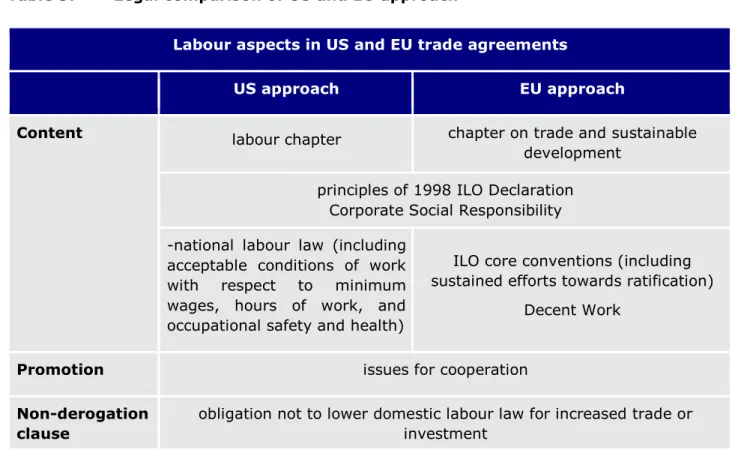
3. How do the EU and the US differ in their approaches to labour provisions? While the EU and US approaches to labour provisions in trade agreements are more similar than is often assumed, they display some important differences. The EU relies more on the agenda of the ILO and its Core Conventions, while the US mostly refers to the ILO 1998 Declaration. On the other hand, the US allows for the possibility of sanctions when labour commitments are violated while the EU only foresees cooperative mechanisms. If the aim is for TTIP to have positive effects on labour conditions, it is advisable to integrate the EU approach with that of the US at the highest rather than the lowest common denominator.
4. How do the EU and the US score in terms of ratification and implementation of Core Labour Conventions?
Both the EU Member States and the US are bound as ILO members to the fundamental labour rights included in the 1998 Declaration. However, EU countries have all ratified the eight Core Labour Conventions in full, while the US has only ratified two. Moreover, observers argue that US labour law and practice deviate significantly from the Core Labour Conventions in several respects, while also EU Member States’ implementation is sometimes criticised. If trade unions’ rights are severely restricted in some parts of a free trade area, this can result in unfair competition for other parts, thereby further aggravating the trade unions’ weakening of bargaining power as an automatic result of liberalisation. For this reason, it is important that provisions in TTIP help ensure that all parties respect the ILO Core Conventions, especially with regard to collective bargaining. The European Commission’s current approach to trade agreements is to demand for the implementation of the core labour standards and for sustained efforts towards ratifying the ILO Core Conventions.
5. What are the main policy recommendations from this study?
In general, TTIP provides an opportunity to improve the EU’s promotion of labour standards through trade
First, it allows the EU to reinforce the strengths of its approach to labour
provisions in trade agreements. This involves a highest common
denominator integration of EU and US approaches, allowing for sanctions as
the ultimate stick ensuring coherency with ILO activities and improving the
cooperative mechanisms as the potential of this approach has been
underutilised1. As for the latter, several suggestions have been made, including
awareness raising in third countries about treaty mechanisms to promote labour rights, funding enabling organizations to attend the civil society meetings, and separate meetings of labour representatives.
Second, as research shows the importance of social cohesion for sustainable support for economic integration, the development of instruments within the EU that allow for better redistributing the gains and compensating the losers from TTIP and other trade agreements across and within Member States seems advisable. This can range from a reinforcement of the Globalisation Adjustment Fund to the creation of more automatic stabilisers at the EU level. Moreover, a ‘social safeguard mechanism’ could be considered to respond to unforeseen negative social consequences.
Third, there is little evidence on the effectiveness of labour provisions. Therefore, further research on the impact of trade liberalisation and labour provisions in trade agreements is needed. Given the considerable uncertainties on the impact of trade liberalization and labour provisions in trade agreements, the EU could consider to apply a ‘precautionary approach’ to the impact of TTIP on labour conditions by employing various instruments in the agreement to guarantee positive social effects. This could reinforce the position of trade unions to counter their loss of bargaining power because of trade liberalisation. In addition, in-depth and systematic monitoring are recommended.
INTRODUCTION
KEY FINDINGS
In the heated debate on TTIP, the possible effects of the agreement on labour protection play an important role. While there is concern that TTIP might weaken labour protection in the EU, there is also hope that it could lead to upward change in transatlantic and worldwide labour protection.
The inclusion of strong labour provisions in TTIP is important for different reasons: it will help restore the legitimacy of the agreement; it will ensure that TTIP will not negatively affect labour conditions; and it might provide a gold standard for other agreements and reinforce the authority of multilateral organisations on trade and labour.
The European Parliament has insisted on strong labour provisions in TTIP, inter alia calling for the mandatory ratification of Core Labour Conventions and the enforceability of provisions before the general dispute settlement mechanism In response to the uncertainty about the effects of liberalisation and labour
provisions in trade agreements on labour conditions, a precautionary approach, where the EU includes various instruments to limit the social risks and maximise the social benefits of TTIP, could be considered.
The Transatlantic Trade and Investment Partnership (TTIP) has generated unprecedented public attention for and debate on European Union (EU) trade policy. This debate has largely focused on the controversial investor protection provisions (more specifically investor-state dispute settlement, or ISDS, in the meantime reformed and renamed into Investment Court System, or ICS) and the regulatory cooperation dimension. The common theme behind the concerns about TTIP is that the agreement will lower levels of protection within the EU and limit the policy space of governments to adopt measures in the public interest. Also in the US, the legitimacy of the free trade regime is increasingly questioned. Trade has become a core theme in the Presidential primaries and criticism towards the social consequences of past trade agreements is widely seen as one of the reasons for the success of candidates at the more radical wings of both major parties (see e.g. Summers 2016).
Labour standards2 are one of the areas for which it is feared, on the one hand, that
a Free Trade Agreement (FTA) with the United States (US) might lead to a race-to-the-bottom. On the other hand, the EU has the policy to include labour provisions in a Chapter on Trade and Sustainable Development in its trade agreements to prevent downward adjustment of labour and environmental protection and there is even hope that this might lead to upward change in transatlantic labour protection. While the scope of labour provisions included in trade agreements has recently expanded, the Fundamental Principles and Core Labour Conventions of the ILO play a central role, and are therefore introduced in front of this study in Box 1.
2 In this study, we will use the terms‘labour provisions’, ‘labour standards’, ‘labour rights’, and ‘social provisions’ to
refer to provisions in trade agreements that include: ‘any labour standard which establishes minimum working conditions, terms of employment or worker rights; any norm on the protection provided to workers under national labour law and its enforcement; as well as any framework for cooperation in and/or monitoring of these issues’ (ILO 2013: 6). We will use the term ‘labour conditions’ and ‘labour protection’ to refer to the level of protection at work applying within a country.
Box 1: ILO Fundamental Principles and Core Conventions Fundamental Principles
(ILO 1998 Declaration)
Corresponding Fundamental Conventions (ILO Core Conventions)
Freedom of association and the effective recognition of the right to collective bargaining
Freedom of Association and Protection of the Right to Organise Convention, 1948 (No. 87) Right to Organise and Collective Bargaining
Convention, 1949 (No. 98) Elimination of all forms of forced
or compulsory labour
Forced Labour Convention, 1930 (No. 29) Abolition of Forced Labour Convention, 1957
(No. 105)
Effective abolition of child labour Minimum Age Convention, 1973 (No. 138) Worst Forms of Child Labour Convention, 1999
(No. 182) Elimination of discrimination in
respect of employment and occupation
Equal Remuneration Convention, 1951 (No. 100) Discrimination (Employment and Occupation)
Convention, 1958 (No. 111)
The inclusion of strong labour provisions in TTIP is important and desirable for several reasons. First, it is one way to restore the legitimacy of TTIP by ensuring that it is not only (seen to be) pursuing the maximisation of transatlantic trade and investment as ends in themselves, but is contributing to the objective of sustainable development, as mandated by the Treaties (Art. 21 TEU, Art. 205 and 207 TFEU) and as elaborated in the recent EU trade strategy ‘Trade for all’ (European Commission 2015a). Especially since the TTIP has unleashed unprecedented debate about the desirable balance between liberalisation and the rights of foreign suppliers and investors on the one hand and protection and the right of governments to regulate on the other, the inclusion of a strong Chapter on Trade and Sustainable Development is key. It should be clear that currently not only the legitimacy of TTIP is being questioned, but the legitimacy of the free trade system in general is under challenge. Strong provisions in TTIP on sustainable development, and labour standards in particular, might be one way to restore the legitimacy of this particular agreement and trade policy in general.
Second, labour provisions can protect against possible negative effects of economic integration. As liberalisation of trade and investment might negatively affect labour conditions, the inclusion of labour provisions and effective participation of labour representatives might be countervailing factors to make TTIP more neutral with regard to the social consequences and the bargaining power of different societal groups. ‘Positive integration’ of labour rights might then compensate for ‘negative integration’ in trade and investment.
Third, strong labour provisions in TTIP can help reinforce the social dimension of globalisation at the multilateral level. TTIP is often presented as a ‘gold standard’ or ‘template’ agreement that will affect future agreements with and practices in other developed, emerging and developing countries. Hence, the extent to and manner in which labour standards are promoted through TTIP might spill over geographically to third countries and timewise into the future. In this way, TTIP might be a stepping-stone to reinforce the legitimacy and effectiveness of the global governance institutions that promote trade and
labour rights, the World Trade Organisation (WTO) and International Labour Organisation (ILO) respectively, and help to find a just balance between both.
It is hence logical that the European Parliament in its most recent resolution on TTIP of 8 July 2015 has paid considerable attention to the issue of labour standards.
Box 2: European Parliament resolution on TTIP: labour provisions
The European Parliament resolution on TTIP of 8 July 2015 contains five paragraphs (under section d ‘regarding the rules’) with recommendations on labour provisions:
(ii) to ensure that the sustainable development chapter is binding and enforceable and aims at the full and effective ratification, implementation and enforcement of the
eight fundamental International Labour Organisation (ILO) conventions and
their content, the ILO's Decent Work Agenda and the core international environmental agreements; provisions must be aimed at further improving levels of protection of labour and environmental standards; an ambitious trade and sustainable development chapter must also include rules on corporate social responsibility based on OECD Guidelines for Multinational Enterprises and clearly structured dialogue with civil society;
(iii) to ensure that labour and environmental standards are not limited to the trade and sustainable development chapter but are equally included in other areas of the agreement, such as investment, trade in services, regulatory cooperation and public procurement;
(iv) to ensure that labour and environmental standards are made enforceable, by building on the good experience of existing FTAs by the EU and US and national legislation; to ensure that the implementation of and compliance with labour provisions is subjected to an effective monitoring process, involving social partners and civil society representatives and to the general dispute settlement which applies to the whole agreement;
(v) to ensure, in full respect of national legislation, that employees of transatlantic companies, registered under EU member state law, have access to information and consultation in line with the European works council directive;
(vi) to ensure that the economic, employment, social, and environmental impact of TTIP is also examined by means of a thorough and objective ex-ante trade sustainability impact assessment in full respect of the EU Directive on SIA, with clear and structured involvement of all relevant stakeholders, including civil society, asks the Commission to conduct comparative in-depth impact studies for each Member State and an evaluation of the competitiveness of EU sectors and their counterparts in the US with the aim to make projections on job losses and gains in the sectors affected in each Member State, whereby the adjustment costs could be partly taken up by EU and Member State funding.
Source: European Parliament (2015), emphases added.
This study reviews the literature on the relationship between labour conditions, liberalisation and the inclusion of labour provisions in trade agreements and analyses what we currently know about the provisions in and effects of TTIP. Building on this, we aim to assess the potential social consequences of TTIP and to provide the European Parliament with concrete recommendations. The analysis is primarily based on desk research, comprising a systematic literature review, own research on the effectiveness of the inclusion of labour provisions in recent EU trade agreements and analysis of primary documents in TTIP. This desk research is complemented by analysis of position papers from as well as a number of targeted interviews with TTIP stakeholders and experts, and with
representatives from partners in EU trade agreements that include labour provisions (such as Colombia and Peru). A balance between governmental, producer and labour perspectives has been pursued. This study goes beyond the Trade Sustainability Impact Assessment that is currently being developed (see European Commission 2014b, 2016) in taking a broader view on labour standards (beyond the Core Labour Conventions) and, especially, by taking very seriously the possible indirect effects of TTIP on labour standards, primarily through the weakening of the bargaining power of trade unions (see infra).
The remainder of this study is structured as follows. In the second chapter, we review the academic literature on the relationship between liberalisation and labour standards. Does liberalisation result in a race-to-the-bottom in terms of social protection? And can the inclusion of labour provisions in trade agreements countervail such possible effects, and even contribute to a race-to-the-top? The third chapter discusses findings on the effectiveness of the inclusion of labour provisions in EU trade agreements so far. In the fourth chapter, we analyse the expected provisions in and consequences of TTIP on labour standards, by contrasting the EU and US approaches to labour provisions in FTAs, comparing the EU and US record in terms of ratifying and implementing the Core Labour Conventions, analysing the EU proposal on labour standards in TTIP, and assessing the possible consequences of TTIP for labour standards in third countries as well as within the EU. We conclude with recommendations regarding possible improvements to the sustainable development chapter(s) in EU trade agreements, on our knowledge of the effects of free trade agreements on labour standards, and concerning measures within the EU and Member States that can limit the social risks and maximise the social opportunities offered by TTIP.
TRADE AGREEMENTS AND LABOUR CONDITIONS
KEY FINDINGS
The dynamics between trade liberalisation and labour protection are multi-faceted. Liberalisation can have positive effects on labour protection by raising income levels, labour protection can boost competitiveness and welfare gains from liberalisation in the medium term, but liberalisation can also induce a race-to-the-bottom process. Which effect predominates has not been empirically settled.
Labour provisions in trade agreements can limit the risk that liberalisation results in a lowering of labour protection while increasing the possibility that the trade agreement contributes to improved labour conditions. However, the social effects of (different) labour provisions in FTAs has been insufficiently empirically determined.
Given these uncertainties in existing research, continuous monitoring of labour implications of trade agreements is advisable and adopting a precautionary approach towards the social consequences of TTIP recommended. Specific attention might go to limiting the possibility of social dumping and countervailing the loss of bargaining power of unions.
2.1. Liberalisation and labour rights: a race-to-the-bottom?
Theoretically, different dynamics might be at play in the relationship between liberalisation and labour rights. On the one hand, (at least) three channels might lead to an increase in labour conditions after liberalisation:
o liberalisation is generally assumed to result in higher average income levels, which is
considered to be conducive to higher labour standards (income channel) (e.g. Flanagan 2006):
o especially in the medium to long term, higher labour standards are considered to lead to increasing productivity and consequently competitiveness, incentivising firms to apply better labour conditions (productivity channel) (e.g. Bazillier 2008);
o integration into the global market might increase the demand from consumers for goods produced in decent working conditions (reputational channel).
On the other hand, liberalisation can also lead to lower labour standards (at least) through two dynamics (cfr. Brown, Deardorff & Stern 1996):
o liberalisation increases the competitive pressures on countries and firms and might lead them to resort to ‘social dumping’ tactics to improve their (short-term) cost competitiveness (cost channel);
o the free movement of goods, services and capital, but much less of employees, that
result from free trade agreements increases the bargaining power of employers and investors vis-à-vis workers and governments (bargaining power channel) (see e.g. Leahy & Pavelin 2004; Dumont, Rayp & Willemé 2006, 2012). This might lead to wage decreases, job insecurity and lower labour standards (Rodrik 1997).
The consequences of the increased attractiveness of social dumping and the weaker position of unions after liberalisation should not per se reveal themselves through explicit lowering of labour standards, but can also more subtly become evident by halting progress in social protection (social chill).
The more a trade agreement limits the ability to use other (industrial policy) instruments to protect domestic industries or promote their competitiveness (e.g. by restraining the use of tariffs, quotas, subsidies, technical standards, government procurement, domestic content requirements, etc.), the more governments might be inclined to use social (as well as fiscal and environmental) dumping to increase the competitiveness of their firms and attract investment (Arestoff-Izzo et al. 2008). As TTIP is considered the most advanced and profound trade and investment agreement to date disciplining the use of a wide array of policy instruments, the risk that governments will take recourse to lowering (or not increasing) labour standards is theoretically also higher. Therefore, strong labour provisions in TTIP are key to limit the risks of social dumping. Unfortunately, we don’t have a plethora of empirical studies at our disposal to decide which of the theoretically possible effects predominates. Indeed, Davies and Vadlamannati have argued that ‘there is little work on the potential strategic interactions in labour standards’ (2013: 1). Among the existing studies available, authors arrive at different conclusions. Olney (2013) has found evidence of a race-to-the-bottom in employment protection among Organisation for Economic Cooperation and Development (OECD) countries. He found that a reduction in employment protection rules leads to an increase in foreign direct investment (FDI) and that there is evidence that countries are competitively undercutting each other’s labour market standards. This can be an explanation for the finding that in the past three decades the increase in FDI and the decrease of average employment protection have gone hand in hand, including in OECD countries. This finding has been corroborated by Marx, Soares and Van Acker (2016) for freedom of association and collective bargaining rights. Others also find a race-to-the-bottom taking place. Davies and Vadlamannati (2013) have found interdependence between countries’ labour standards, meaning that a reduction in one country’s labour protection is positively correlated with a cut in others’ labour standards. They found that this effect is stronger for labour practices than for labour laws and that while the effect is prevalent in both developed and developing countries, it is strongest among the latter. Dumont et al. (2006, 2012) have found empirical evidence that globalisation weakens union bargaining power (and low-skilled workers’ unions especially), which may lead indirectly to a weakening of labour rights. On the other hand, Greenhill, Mosley and Prakash (2009) have found evidence for a race-to-the-top: strong legal protection of collective labour rights in the export markets of one country is positively correlated with more stringent labour laws in the exporting country. This effect is, different from the finding above, stronger for labour law than for labour practices.
A review of the literature on the relationship between liberalisation and labour protection hence does not provide unambiguous conclusions about the direction and strength of the effect. Due to variation in the definition of labour rights, the methodology used, the case selection and data availability, reliability and quality, authors arrive at different conclusions. Salem and Rozental (2012: 66) conclude: ‘disentangling the links between labor standards, trade openness and trade flows remains a challenge’ (also see ILO 2016: chapter 2). While there is still considerable uncertainty about the balance between positive and negative effects of liberalisation on labour standards, there is a consensus that liberalisation unavoidably creates (in the short-term) winners and losers within countries (e.g. Davidson & Matusz 2006) and that liberalisation at least also carries with it some risk to put in motion dynamics that might lead to lower levels of labour protection than would have been the case without the liberalisation. At least, we witness today that the perception that globalisation is hollowing out social protection leads to a popular backlash against trade agreements. Including strong labour provisions in trade agreements can be a way to ensure that globalisation is compatible with social stability and consensus in (su-pra-)national democracies (cfr. Rodrik 2011).
In this study, we will not try to judge if the (social) benefits of TTIP outweigh the costs. We argue for a precautionary approach that seeks to limit the social risks of TTIP and maximise its opportunities. The inclusion of labour standards in TTIP is one way to limit its social risks and increase its opportunities. What does the literature tell us about the effectiveness of labour standards in trade agreements?
2.2. Labour standards in trade agreements: a race-to-the-top?
Theoretically, labour standards are included in trade agreements for (at least) three possible reasons (cfr. ILO 2016):
o from an economic perspective, they should compensate for potential negative social effects of liberalisation and avoid that countries ‘abuse’ liberalisation by lowering labour standards to attain an unfair competitive advantage (‘social dumping’). The inclusion of labour standards in trade agreements contributes to levelling the playing field in the social dimension and ensures that all firms play by a minimum of social rules. According to critics of this argument, however, labour provisions can be abused as a ‘disguised protectionist instrument’, illegitimately protecting workers in developed countries against legitimate comparative advantages of workers in developing countries;
o from an ethical perspective, the inclusion of labour standards in trade agreements can be used as an instrument to improve labour conditions in third countries. Hence, here the motivation is not to protect domestic workers against unfair competition abroad, but using the leverage of trade to promote better working conditions abroad. But to what extent do labour standards in trade agreements reach these goals?;
o If they do not at all, from a negotiation-tactical perspective, their inclusion might merely be a useful social ‘fig leaf’ to ensure sufficient support for trade agreements.
Again, we lack extensive empirical research to answer the question which motive predominates. Salem & Rozental (2012: 73) argue that ‘[d]espite the growing inclusion of labor provisions in trade agreements, there is little research that examines how these commitments affect labor conditions’. Marx, Soares and Van Acker (2016: 14) state that ‘relatively little data is available to assess whether these labour standards [ILO conventions integrated in unilateral and bilateral trade policies] have had any real impact on the situation on the ground at the country level’. While providing an overview of the scarce literature, the ILO has recently concurred that ‘evidence with respect to the effectiveness of labour provisions in trade agreements is relatively sparse’ (ILO 2016: Chapter 2). Salem and Rozental (2012: 78ff) discuss a number of qualitative studies on the effectiveness of labour provisions. These have found that: weak enforcement mechanisms lower the effectiveness of labour obligations in the Dominican Republic-Central America-United States FTA (CAFTA-DR); the ILO’s “Better Factories Cambodia” program set up as part of the 1999 US-Cambodia trade agreement on textiles and apparel was relatively successful due to a combination of market access conditionality, monitoring, technical assistance and capacity-building (see also Polaski 2006); and that the threat of sanctions are most effective if accompanied by technical and financial help.
The ILO’s report ‘Social Dimensions of Free Trade Agreements’ (2013) provides an overview of the evolution, types and effectiveness of the inclusion of labour provisions in trade agreements. With regard to impact, it concluded that (for the conditional approach) ‘the more comprehensive effects on labour standards issues have emerged from pre-ratification conditionality, but … the[se] effects depend considerably on the accompanying advocacy
action of the social partners and civil society actors’ (2013:30). For post-ratification conditionality, through the use of dispute settlement procedures, there are very few cases to judge on impact. For the promotional approach, which is used in just about all of FTAs containing labour provisions of which around 60 per cent are exclusively promotional in nature (including those concluded by the EU, see infra), its impact has proven difficult to assess (ILO 2013: 67-8). Interestingly, the ILO (2016) also found that trade agreements with labour provisions do not have different effects on trade as compared with agreements without such provisions, refuting the ‘protectionist’ concerns of critics of such provisions.
In sum, the current state of the art does not provide clear answers about the effect of trade agreements and labour provisions therein on labour conditions. This is due to the complex, multifaceted nature of the dynamics between liberalisation, labour provisions and labour conditions and gaps in the literature that have to be filled. There are, however, a number of tentative conclusions that can be drawn. If it is the aim to limit negative social consequences of trade agreements, the possibility for social dumping and for the weakening of the bargaining power of trade unions should be avoided. While the precise effectiveness of labour provisions is still uncertain, it seems that a combination of various instruments has a higher probability to lead to positive results. Exactly because these findings have to be treated with caution, a precautionary approach guides our further analysis.
In the next chapter, we turn to our analysis of the EU’s track record so far as a stepping-stone for our evaluation of and recommendations for labour provisions in TTIP.
LABOUR STANDARDS IN EU TRADE AGREEMENTS:
EFFECTIVENESS, MONITORING AND ENFORCEMENT
KEY FINDINGS
Against the background of a failed social clause at the multilateral level (WTO), the EU started to include labour rights in the unilateral Generalised System of Preferences (GSP) since 1995. Although it managed to foster the ratification of ILO Core Labour Conventions in some countries, overall the success of GSP conditionality on implementation of core labour standards has been mixed. In practice the GSP is more and more replaced by bilateral FTAs.
Labour provisions are more elaborated in the new generation of EU FTAs (since the EU-Cariforum 2008 and the EU-Korea 2010 agreements) in terms of content, governance, and enforceability.
Nevertheless, the EU sticks to a soft approach to the trade-labour linkage. Weaknesses compared to the GSP are that ratification of ILO Core Labour Conventions is not strictly required, that enforceability is limited to government consultations, civil society monitoring, and blaming and shaming by a Panel of Exports (without sanctions), and that monitoring by the EU institutions seems to happen less thoroughly.
One noticeable new element is the non-lowering clause, which provides that Parties cannot weaken existing labour standards for the purpose of stimulating trade or investment. However, it seems difficult to ensure compliance with this obligation in practice.
Given the uncertainties about the impact of trade liberalisation on labour rights (see
chapter 2) and on the impact of labour provisions in trade agreements (see this
chapter), in-depth and systematic monitoring is key. In this regard, the new
institutionalised involvement of civil society at national and transnational level is an improvement of the EU’s cooperative approach. The civil society meetings could enable a more accurate monitoring of labour rights. Moreover, they have the potential for empowerment of marginalised civil society actors.
However, its potential has so far been underutilized. The EU’s approach to labour
provisions in trade agreements is still in an experimental phase and so far there is
little evidence for its effectiveness. There are several ways in which flaws within the
cooperative approach could be addressed, even without changes to the approach. Suggestions include awareness-raising about the existence of these mechanisms in third countries, funding to guarantee that civil society actors can attend the meetings, and secretarial support for their organization and follow-up. The EU could also foster closer coherence between the labour rights commitments in the trade agreements and its development cooperation policies, as well as with the activities of other actors such as the US and the ILO.
Finally, the EU could consider a sanction mechanism for serious and systematic
violations of core labour standards, as an instrument of last resort and in line with the activities of the ILO. There should not be a contradiction between cooperation and (ultimately) sanctioning, as the ‘stick’ of sanctions can be seen as a way of leveraging
the cooperative approach. The EU could also establish a public submission system
(or other complaint mechanism) that allows actors from third countries to bring up alleged violations of labour rights to the EU institutions.
3.1. Background: A social clause in EU and international trade
Although the debate on a ‘social clause’ in international trade goes back to the first wave of globalisation at the end of the 19th century (Charnovitz 1987), it took until the mid-1990s before European policy-makers started to advance concrete proposals in this regard. Within the EU, the European Parliament has been a frontrunner in calling for the inclusion of labour standards in international trade. Already in 1987 it approved a resolution on the observance and strengthening of international labour norms, which also suggested that a social clause should be included in the multilateral (General Agreement on Tariffs and Trade, GATT) and bilateral (Lomé) trade agreements (European Parliament 1986). While this proposal fell on deaf ears with the member states and the European Commission, the 1994 Sainjon Report (European Parliament 1994) would be more successful in sparking an EU debate on the trade-labour nexus.
Indeed, the time was ripe for a more serious consideration of the trade-labour linkage. In the context of the final phase of the GATT Uruguay Round negotiations (which would establish the WTO), increasing economic globalisation and growing unemployment rates in Western Europe, some EU member states and eventually also the European Commission started to support the idea that labour rights should be addressed in the world trade regime. However, divergences within the EU continued to exist. Whereas the EP and member states such as France and Belgium favoured a binding and enforceable social clause, most member states and the European Commission advanced that this issue should be addressed in a soft and cooperative way. The latter also argued that the ILO is the most appropriate forum to deal with international labour rights.
This soft and cooperative approach, with reference to the ILO’s expertise, continues to characterise the EU’s policies until today, as will become clear below.
It also became the consensus within the WTO. The trade-labour nexus was hotly debated in the run-up to the Ministerial Conference of Singapore (1996). The Declaration included a paragraph on ‘Core Labour Standards’ (CLS):
Box 3: Core Labour Standards in the Singapore Declaration
4. We renew our commitment to the observance of internationally recognized core labour standards. The International Labour Organization (ILO) is the competent body to set and deal with these standards, and we affirm our support for its work in promoting them. We believe that economic growth and development fostered by increased trade and further trade liberalization contribute to the promotion of these standards. We reject the use of labour standards for protectionist purposes, and agree that the comparative advantage of countries, particularly low-wage developing countries, must in no way be put into question. In this regard, we note that the WTO and ILO Secretariats will continue their existing collaboration.
Source: WTO, Ministerial Declaration, Singapore, 18 December 1996; WT/MIN(96)/DEC.
The Singapore Declaration thereby consolidated the perception that labour rights are incompatible with the international trading system (Wilkinson 2001). It basically holds that (1) the ILO is the competent body to deal with core labour standards, not the WTO, (2) trade liberalisation will lead to economic growth, development and thus eventually to better labour standards, and (3) labour standards cannot be used for protectionist purposes in order to offset the comparative advantage of low-wage developing countries. Hereby the WTO’s role has been effectively sidelined (except from the small addition that the WTO and ILO secretariats will continue their ‘existing’ – but de facto barely existing – collaboration). The consequence is that until today the multilateral trade and labour systems have
been fragmented, each with their own monitoring and enforcement mechanisms (cfr. De Schutter 2015).
To be sure, there is a consensus on the value of the fundamental principles of the ILO, as laid down in the 1998 ILO Declaration on Fundamental Principles and Rights at Work (see Box 1). The CLS are widely recognized to constitute human rights that should be upheld and promoted. However, the disagreement centres on the question whether trade instruments should be used for the purpose of upholding and advancing core labour standards. Underlying the belief that trade and labour should remain unlinked, is the fear that ‘ethical’ concerns on labour rights would be (mis-)used by western governments for protectionist purposes (see supra). This explains why not only advocates of free trade within and outside the EU, but also developing country governments have opposed a social clause in trade agreements. Hence the social clause has faced opposition from a strong coalition of free trade advocates, fearing that it would jeopardise the post-war liberal trading system, and developing countries, fearing that this would become yet another loophole for developed countries to safeguard their sensitive sectors. This potential conflation between ethical and economic motivations (see also above section 2) explains why the debate has been so sensitive.
Nevertheless, the separation between labour rights and international trade law is less self-evident than it might seem. What tends to be neglected in the debate is the linkage the architects of the post-war ‘embedded liberal’ global economic system did envisage. The 1948 Havana Charter for the establishment of the International Trade Organisation (ITO) included an Article on ‘Fair Labour Standards’, which stated that ‘unfair labour conditions, particularly in production for export, create difficulties in international trade, and, accordingly, each Member shall take whatever action may be appropriate and feasible to eliminate such conditions within its territory’ (Art.7). In this regard cooperation with the ILO was encouraged. The social provisions of the Havana Charter disappeared when the ITO was rejected by the US Congress and replaced by the more limited GATT, but, interestingly, one specific provision on the ‘products of prison labour’ has remained in the agreement. Until today, Article XX(e) of the GATT provides that the principles of free trade should not apply to goods involving prison labour. Some international trade lawyers argue that a more ‘enlightened’ interpretation of this GATT article, and of the ‘public morals’ exception in Article XX(a) GATT, would allow that countries also condition the import of products of which the production has involved a violation of certain labour norms. The problem is not so much the international trade rules, but much more their rigid interpretation (e.g. Howse and Mutua 2000).
When the WTO Doha Development Round was launched in 2001, the Singapore consensus on the exclusion of labour norms within the trading system was confirmed. Although the EU had become a cautious supporter of the trade-labour linkage since the end 1990s, it had already given up on this issue at the multilateral trading level before the conference started. In addition to developing countries’ resistance (with India being a vocal opponent), also the US government (the new Bush administration) had become less enthusiastic about the trade-labour linkage at the WTO; whereas for the EU the main priority was to make sure that a new trading round would be launched which included development-friendly provisions and new trade issues such as investment, competition and public procurement.
Meanwhile, the EU had been exploring alternative avenues to promote labour rights
through trade. The 1995 and 1998 reforms of its Generalised System of Preferences
(GSP) – which provides additional and unilateral trade advantages to developing countries – established for the first time a system of ‘hard’ and ‘soft’ social conditionality. Developing countries could either receive additional tariff preferences if they comply with the ILO Core
Labour Conventions, or lose existing preferences if they seriously and systematically violate these labour standards. The sanctioning part has been used only twice: Burma/Myanmar (1997-2013) and Belarus (2008 until today) lost their preferential GSP tariffs for the violation of conventions on forced labour and freedom of association respectively. The incentive system was extended in 2005 with the ‘GSP+’ enhanced preferences for ‘vulnerable’ countries that ratify and implement international conventions relating to human and labour rights, environment and good governance. Under the GSP+ the number of countries benefiting from additional trade incentives increased to about 15 (most of them are Latin American countries).
The success of this labour conditionality system has been mixed. Some countries ostensibly ratified a number of ILO conventions in order to receive the additional tariff concessions (e.g. Venezuela, El Salvador, Bolivia and Colombia). The effect of the GSP carrot was most obvious in the case of El Salvador, which ratified ILO Conventions No. 87 and 98 in order to benefit from larger access to the European market (Orbie and Tortell 2011, p.673). Ratification is also important because it enables the supervisory role of ILO expert bodies (see Box 8). However, this incentive scheme has been criticized for merely ‘ticking the box’ of ratification records without considering the implementation of the ILO core conventions (Velluti 2015). Third countries such as Colombia, Venezuela, Guatemala and Honduras received GSP+ market access even if the ILO expert bodies (the Committee of Experts on the Application of Conventions and Recommendations (CEACR) and the Committee on Freedom of Association (CFA)) issued very critical reports about their implementation of ILO Core Conventions (Orbie and Tortell 2011, p.676-678). .
Experience with GSP conditionality suggests two things that may also be relevant in the context of TTIP. First, ratification does not necessarily lead to implementation of ILO conventions. Second, the EU seems to lack the capacity to effectively monitor the observance of labour rights. Both issues are nevertheless related: ratification of ILO Conventions makes it easier to monitor the implementation because one can rely on reports of the competent ILO expert bodies which assess the implementation of the relevant conventions (see also infra, Box 8).
Under the new GSP regulation that went into force in 2014, EU monitoring has somehow improved. The European Commission conducts an annual analysis (‘scorecard’) of the extent to which the conventions have been applied, based on the reports of relevant monitoring bodies (e.g. the ILO committees). This evaluation, which is not disclosed to the public, is then sent to the third-country governments who are required to respond within three months. Wherever it is deemed appropriate, the issues raised in the report are subsequently discussed with the partner government. The follow-up process can also involve a monitoring visit – as happened for example in Costa Rica, Nicaragua and Guatemala in 2014. The drawback of the enhanced monitoring system is that it lacks transparency and involves state actors only. The scorecards are not publicly available and it is unclear when and how they lead to government consultations (Van den Putte & Orbie 2015). Moreover, only a limited number of ‘vulnerable’ countries are eligible for the GSP+, and this number has even further declined since countries concluding a bilateral trade agreement no longer qualify. This includes countries whose track record on core labour rights has been criticized, such as Colombia, Peru, and the Central American countries. Therefore, it is all the more important to look at how labour standards are addressed in the new free trade agreements.
3.2. Labour in EU Bilateral Agreements: Comparative overview3
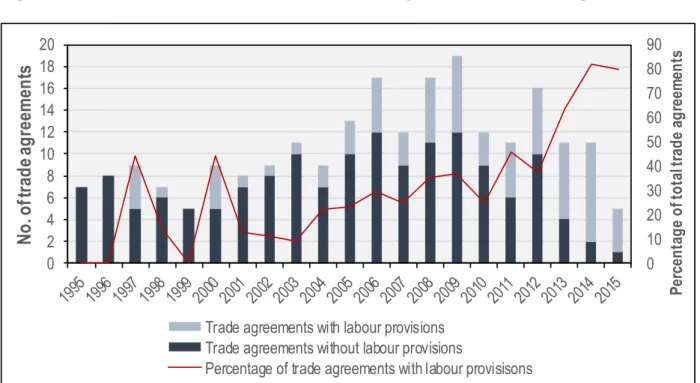
Since it became ever clearer during the second half of the 2000s that the Doha negotiations had reached an impasse, the number of bilateral agreements has increased exponentially. Not only has there been an increase in the number of free trade agreements, these agreements have also increasingly included labour provisions. Over 80 per cent of the trade agreements that entered into force since 2013 include labour provisions (ILO 2016: chapter 1; see Figure 1).
Figure 1 : Evolution of the inclusion of labour provisions in trade agreements
Source: reproduced from ILO (2016).
For the EU, the new generation of trade agreements has provided an opportunity to overcome the stalemate on a ‘social clause’ at the WTO by addressing it on the bilateral trade front. Although there is significant variation in the way and extent to which labour provisions feature in EU trade agreements, reflecting power and preferences of the EU’s trading partners, in general terms we notice a growing elaboration of the trade-labour linkage since the mid-2000s. This can be explained by the growing contestation against free trade agreements by civil society actors and policy-makers who are increasingly concerned about the potentially negative effects on trading partners and on European citizens. That the European Parliament now has full competence for trade policy decision-making since the Lisbon Treaty went into force in 2009, certainly also explains why labour rights (as well as human rights and sustainable development) cannot be ignored by EU trade negotiators. Since the EU’s approach continues to be soft and cooperative (see above), also opponents of a binding social clause are not concerned.
Thus, while the EU has continued to hold a soft and cooperative approach to the trade-labour linkage, at the same time it has also elaborated its approach over the past decade. Specifically, there are three dimensions in which the EU’s approach has been elaborated:
3 This section is partly based on Van den Putte and Orbie (2015) ‘EU Bilateral Trade Agreements and the Surprising
Rise of Labour Provisions’, International Journal of Comparative Labour Law, 31(3).
0
10
20
30
40
50
60
70
80
90
0
2
4
6
8
10
12
14
16
18
20
Pe
rc
en
ta
ge
o
f t
ot
al
tr
ad
e
ag
re
em
en
ts
N
o.
o
f t
ra
de
a
gr
ee
m
en
ts
Trade agreements with labour provisions
Trade agreements without labour provisions
o Content: Cooperation on social issues, commitment to respect core labour standards, and non-lowering of domestic labour protection.
o Governance: Involving business and civil society in monitoring and implementation.
o Enforceability: More opportunities for promoting compliance, yet no sanctions are
possible
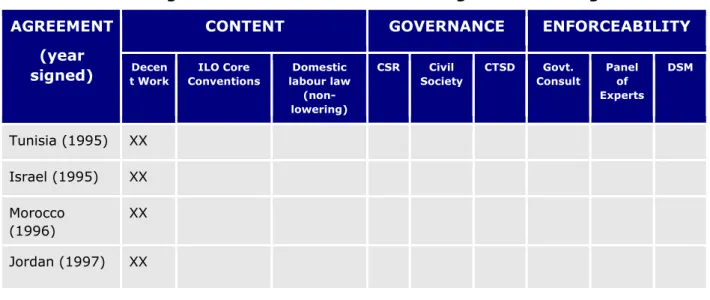
Analysing the evolution on these three dimensions, we notice not only a growing elaboration but also a basic distinction in two periods. Table 2 illustrates this, with the number of crosses broadly reflecting the extent to which the sub-issues are elaborated:
The old generation of EU trade agreements, ranging from the EuroMed agreements until the agreement with Chile (1990s–2003), displaying limited but gradually increasing labour provisions.
The new generation, starting with the CARIFORUM agreement (since 2008), shows an elaboration of the labour provisions on the three dimensions.
Table 2: Growing elaboration of trade-labour linkage in EU trade agreements4,5
AGREEMENT (year signed)
CONTENT GOVERNANCE ENFORCEABILITY
Decen t Work ILO Core Conventions Domestic labour law (non-lowering) CSR Civil Society CTSD Govt. Consult Panel of Experts DSM Tunisia (1995) XX Israel (1995) XX Morocco (1996) XX Jordan (1997) XX
4 We did not include the EPAs concluded with the West African States, East African Community and SADC (all to
be signed) because these resort under the Cotonou Agreement, and because it concerns limited goods-only agreements that are expected to be extended to other trade-related issues.
5 Here we give some guidance to understand table 2. We describe what each cross (X) means within each column,
which can be attributed to a higher score than one cross. Two crosses do not mean that they are twice as strong as one cross. Regarding Decent Work X means there is a reference to social protection or social dialogue. XX means there is a reference to social protection and social dialogue. In case of XXX there is a reference to the whole Decent Work Agenda. In the column on the ILO CLS X means there is a reference to some kind of basic social rights, while XX means there is a reference to the CLS and the principles are mentioned specifically. In the column on domestic labour law X refers to a provision on ‘upholding levels of protection’ stating that domestic labour law should not be lowered to attract trade or investment. In the column government consultations X refers to the possibility to initiate government consultations on any matter related to the agreement. XX refers to the possibility to have government consultations specifically on labour issues. In the column Panel of Experts X means that (an) expert(s) or arbitrator(s) can be appointed to settle a dispute related to the agreement as a whole. XX means that a Panel of Experts with specific rules can be set up to judge on labour issues. In the column on dispute settlement X means that the violation of labour provisions can be treated under the general dispute settlement system of the agreement. In the column on civil society X means that there is a provision concerning civil society dialogue on social provisions in a broad sense (thus not specifically focused on labour). XX means that the agreement contains provisions for domestic as well as transnational civil society dialogue on labour provisions. In the column on the Committee on Trade and Sustainable Development X means that there is a governmental body that meets regularly to oversee the implementation of the labour provisions. In the column on CSR X means there are provisions on CSR mentioned in the agreement.
AGREEMENT (year signed)
CONTENT GOVERNANCE ENFORCEABILITY
Decen t Work ILO Core Conventions Domestic labour law (non-lowering) CSR Civil Society CTSD Govt. Consult Panel of Experts DSM Mexico (1997) X South-Africa (1999) X XX Cotonou (2000) XX XX X Egypt (2001) XX Algeria (2002) XX X Lebanon (2002) XX Chile (2003) XX XX X CARIFORUM (2008) XXX XX X X X X X X X Korea (2010) XXX XX X X XX X X X Colombia/Peru (2012) XXX XX X X XX X X X Central-America (2012) XXX XX X X XX X X X Ukraine (2014) XXX XX X X XX X X X Georgia (2014) XXX XX X X XX X X X Moldova (2014) XXX XX X X XX X X X Singapore (not signed) XXX XX X X XX X X X Canada (2014) XXX XX X X XX X X X Vietnam (2015) XXX XX X X XX X X X
3.2.1. Content
First, the content has widened and deepened. In the early agreements, social provisions concerned cooperation in the field of social policy, which was mostly described in technical terms. The different areas of social cooperation correspond with the Decent Work agenda and are even more elaborated in recent agreements. Moreover, labour standards have more and more been presented as social human rights. All the agreements explicitly recognize the parties’ commitment to respect the fundamental principles and core conventions of the ILO (see Box 1). Thus, not only do new generation agreements refer to a larger number of social provisions, their legal importance has also increased.
However, unlike the GSP conditionality, ratification of the ILO Conventions is not explicitly required. The trade agreements can enter into force without the third parties having ratified all the eight ILO Core Conventions. Instead, EU agreements require the Parties to promote and implement in their domestic law and practice the fundamental ILO principles (sometimes with reference to the Core Conventions) and to make continued and sustained efforts towards ratifying the ILO Core Conventions.
Box 4: ILO Core Conventions in recent EU trade agreements
EU-KOREA AGREEMENT
“3. The Parties, in accordance with the obligations deriving from membership of the ILO and the ILO Declaration on Fundamental Principles and Rights at Work and its Follow-up, adopted by the International Labour Conference at its 86th Session in 1998, commit to
respecting, promoting and realising, in their laws and practices, the principles concerning the fundamental rights, namely:
(a) freedom of association and the effective recognition of the right to collective bargaining;
(b) the elimination of all forms of forced or compulsory labour; (c) the effective abolition of child labour; and
(d) the elimination of discrimination in respect of employment and occupation.
The Parties reaffirm the commitment to effectively implementing the ILO Conventions that Korea and the Member States of the European Union have ratified respectively. The Parties will make continued and sustained efforts towards ratifying the fundamental ILO Conventions as well as the other Conventions that are classified as ‘up-to-date’ by the ILO.” (Art. 13.4)
CETA
1. Each Party shall ensure that its labour law and practices embody and provide protection for the fundamental principles and rights at work which are listed below. The Parties affirm their commitment to respect, promote and realise those principles and rights in accordance with the obligations of the members of the International Labour Organization (the “ILO”) and the commitments under the ILO Declaration on Fundamental Principles and Rights at Work and its Follow-up of 1998 adopted by the International Labour Conference at its 86th Session:
(a) freedom of association and the effective recognition of the right to collective bargaining;
(c) the effective abolition of child labour; and
(d) the elimination of discrimination in respect of employment and occupation.
4. (…) The Parties shall make continued and sustained efforts to ratify the fundamental ILO Conventions if they have not yet done so. The Parties shall exchange information on their respective situations and advances regarding the ratification of the fundamental as well as priority and other ILO Conventions that are classified as up to date by the ILO. (Art. 23.3)
Importantly, the content of the new generation FTAs also extends to domestic labour protection (going beyond the core labour standards) by including a non-lowering clause. The agreements explicitly stipulate that existing levels of protection afforded under the parties’ labour laws shall not be reduced for the purpose of attracting investment or increasing trade. This basically constitutes a provision against social dumping: the Parties commit to weaken social protection de jure or de facto in order to encourage trade or investment. Again, there is variation in how these ‘non-lowering’ provisions are formulated in recent agreements (see Box 5).
Box 5: Non-lowering clause in recent EU FTAs
EU-KOREA AGREEMENT
“…. to promote foreign direct investment without lowering or reducing environmental, labour or occupational health and safety standards in the application and enforcement of environmental and labour laws of the Parties.” (Art. 1.1(h))
“A Party shall not weaken or reduce the environmental or labour protections afforded in its laws to encourage trade or investment, by waiving or otherwise derogating from, or offering to waive or otherwise derogate from, its laws, regulations or standards, in a manner affecting trade or investment between the Parties.” (Art. 13.7(2))
EU-CANADA AGREEMENT
“1. The Parties recognise that it is inappropriate to encourage trade or investment by lowering the levels of protection embodied in domestic labour law and standards.
2. A Party shall not waive or otherwise derogate from, or offer to waive or otherwise derogate from, its labour law, as an encouragement for trade or the establishment, acquisition, expansion or retention of an investment or an investor in its territory.
3. A Party shall not fail to effectively enforce its labour law, through a sustained or recurring course of action or inaction, as an encouragement for trade or investment.” (Art.4 of ‘Trade and Labour Chapter’)
So far there have not been applications of the non-lowering clause. It remains to be seen if the Parties will be able and willing to invoke this clause. The provision ‘not waive or otherwise derogate’ seems to encompass a wide range of weakening of labour rights. However, a major difficulty may be that one has to prove not only that there has been a weakening of labour standards, but also that this has been done in order to encourage trade and/or investment. Both the intentionality behind such measures and their economic impact on trade and investment are not easy to demonstrate.
New agreements also briefly mention fair or ethical trading schemes, as well as corporate social responsibility (CSR), although these issues are not elaborated.6
3.2.2. Governance
Second, the governance of these labour commitments has been elaborated. With governance we refer to the actors involved in the monitoring and implementation. The new generation of trade agreements involves more actors at more levels. Within the (Sub-) Committee/Board on Trade and Sustainable Development, senior government officials regularly meet to oversee the implementation of the labour (and environmental) commitments in the agreement. In addition, civil society actors officially take part in discussing social issues arising under a trade agreement through their participation in institutionalised civil society meetings. Since the Korea Agreement, each EU trade agreement establishes a domestic as well as a transnational forum of civil society actors. These civil society meetings could provide an opportunity for marginalised actors, such as some trade unions in Korea and Colombia, to express their voice on issues relating to trade and labour rights. As such the new forums for domestic and transnational discussions could lead to the