1
Impact of Mobile Banking on Microfinance Institutions:
A Case Study of Small and Micro Enterprise Program
(SMEP), Kenya
David Kitusa Nzioka
June 2010
School of Community Economic Development
Southern New Hampshire University
Submitted in Partial Fulfillment of Requirements for the
Masters of Science in International Community Economic Development
Approved by
2
Acknowledgement
First and foremost, I am most grateful to God for the gift of life and wisdom; his mercies and grace have been sufficient to me and to my family. May his name be exalted, honored, and glorified.
Secondly, I owe my greatest and deepest gratitude to my family, for the unrelenting love, encouragement, support, sacrifice and patience with me throughout my study. I am indebted to you all.
Special thanks to Prof. Puneetha for her encouragement, support and professional guidance throughout the entire time of my project. You truly made my experience memorable every step of the way.
I am highly indebted to Kiva.org-my employer and specifically to Patricia Gates and Ben Elberger for their unrelenting support and encouragement in undertaking this masters program.
To Phylis Mbungu-the Chief Executive Officer SMEP, thank you so much for allowing me to use your organization as a case study. God bless you.
To my classmates, when the going got tough I knew that I always had people that I could turn to. Each one of you is special and you helped to shape both my character and my career, may God bless you in your future endeavors.
3
Dedication
This project is dedicated to my lovely and dear wife
Kash and our two sons Darren and Warren.
4
Table of Contents
Acknowledgement ... 2 Dedication ... 3 Table of Contents ... 4 List of tables ... 6 List Figures ... 7List of Symbols, Abbreviations ... 8
Abstract ... 9
1.0 Problem Statement ... 10
2.0 Literature Review... 18
2.1 The purpose ... 18
2.2 Branchless banking ... 18
2.3 Lack of access to formal financial Services ... 19
2.4 Microfinance and mobile Banking ... 20
2.4.1 Opportunities ... 21
2.5 The Financial Sector in Kenya ... 24
3.0 Community Needs Assessment... 28
3.1 Purpose of the CNA ... 28
3.2 Major Questions that guided the CNA ... 28
3.3 CNA Methodology ... 28 3.3.1 Secondary Research: ... 28 3.3.2 Primary Research: ... 29 3.4 CNA Results ... 30 3.5 Stakeholder Analysis ... 35 4.0 Project Design ... 35
5
4.1 Project Objectives ... 35
4.2 Host Organization: ... 36
4.3Logical Framework ... 38
4.4 Detailed Implementation Plan ... 41
4.5 Budget Plan ... 42 5.0 Project Monitoring ... 42 6.0 Evaluation ... 45 6.1 Conceptual Framework ... 45 6.2 Objectives of evaluation ... 46 6.3 Statement of hypothesis ... 46 6.4 Methodology ... 47 7.0 Lessons learnt... 49 8.0 Recommendations ... 50 9.0 References ... 52 10.0 Appendices ... 55 10.1 Identification of Stakeholders ... 55
10.2 Estimated Attitude and Confidence towards the Project ... 55
10.3 Implementation plan ... 57
10.4 Budget Plan ... 58
10.5 Community Needs Assessment Questionnaire: ... 58
10.6 Research Questions ... 59
10.6.1 SMEP‘s Staff Questionnaire ... 59
6
List of tables
Table 1 Usage of Mobile Banking ... 30
Table 2 Functionalities of mobile banking ... 31
Table 3 CNA Responses ... 33
Table 4 Logical Framework ... 38
Table 5 Implementation Plan ... 57
7
List Figures
Figure 1 Masai Moran using a mobile ... 14
Figure 2 Problem Tree ... 16
Figure 3 Usage of mobile banking technology by MFIs ... 31
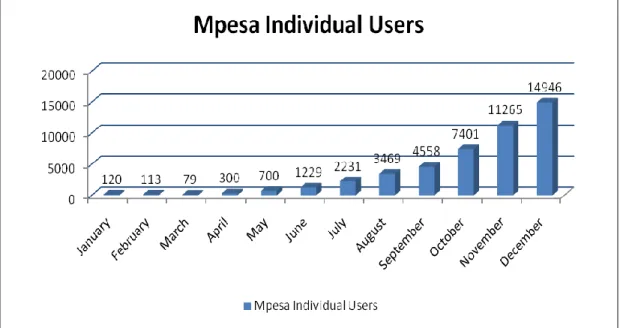
Figure 4 MPESA Individual Users ... 42
Figure 5 MPESA transactions per month ... 43
8
LIST OF SYMBOLS, ABBREVIATIONS
Abbreviation Definition
AMFI Association of Microfinance Institutions OF Kenya
ATM Automated Teller Machine
CBK Central Bank of Kenya
CFO Chief Financial Officer
CGAP Consultative Group to Assist the Poor
CNA Community Needs Assessment
FSS Financial Self Sufficiency
G-CASH Globe Cash
KIPPRA
Kenya Institute for Public Policy Research and Analysis
MF Microfinance
MFI Microfinance Institution
MPESA Mobile Money
OSS Operational Self Sufficiency
SMEP Small and Micro-Enterprise Program
SMS Short message Service
USD United States Dollar
9
Abstract
The goal of this project was to measure the impact on the usage of mobile banking technology by the microfinance industry. This project used SMEP, a local MFI in Kenya as a case study. Kenya was chosen because of its successful mobile payment service offered by Safaricom called M-PESA, as well as the convenience to the researcher in collecting data. This report provides detailed information on the advantages and challenges facing microfinance institutions in the implementation of mobile banking technology and ultimately strives to highlight the great potential of such technologies to increase access of financial services to the un-banked population.
10
1.0 Problem Statement
According to the United Nations Development Program ―Key Economic and Social Indicators 2006 – 2008,‖ Kenya has a population of 38.2 million people, with 22.6 million leaving in the rural areas (United Nations, 2008). In 2008, the economy was greatly affected by the post-election turmoil, which caused a drastic decline of GDP growth, from 7.1percent in 2007 (over 6percent in 2006) down to 1.7percent in 2008. Inflation was also strongly affected, rising from an average of under 10percent in 2007 to over 25percent in 2008, which eased slightly to around 17percent by mid 2009. Kenya‘s poverty levels declined in 2006/07. Though the proportion of the population living in poverty has declined, the number of those living below the poverty line is estimated to have increased from 13.4 million in 1997 to about 16.6 million in 2006 (Kenya Institute for Public Policy Research and Analysis[KIPPRA], 2009).
Kenya has one of the most dynamic financial sectors in Africa with over 40 banks, over 1500 SACCOs, microfinance institutions, insurance companies, and the Nairobi stock exchange, which is one of the largest in Africa and which is ranked fourth in terms of trading volume. However, despite the wide range and the high number of financial institutions, access to financial services has been limited to urban and peri-urban areas of the country. A recent Financial Access study (Kenya, 2009) undertaken jointly by the Central Bank of Kenya and Financial Sector Deepening, identified that only 22.6 percent of the total population aged 18years an above have access to formal financial services i.e. from the banks, Post Bank and insurance products. The study further identified the fact that 32.7 percent are financially excluded, though it was a decrease from 38.4 percent in 2006.
The study further notes that ―Almost half (47.5percent) of all Kenyan adults own a mobile phone (up from 26.9 percent in 2006), with the rate of ownership rising to 72.8 percent in
11
urban areas (up from 52.3percent in 2006) and 80.4percent in Nairobi (up from 63percent in 2006).‖ (Kenya, 2009, p. 19) Further, ―52percent received money in 2009 compared to 16.5percent in 2006. However, international remittances are still low, but 4.3percent claimed to have received money in 2009, up from 2.8percent in 2006.The most popular means of money transfer being M-PESA, now used by 39.9percent of all adults in Kenya. Twenty six percent of all M-PESA users also save money on their phones. One in six users, store value in their phone for use while travelling; M-PESA is perceived as the least risky by 26.2 percent of respondents, least expensive (31.7 percent), fastest (64.3 percent), easiest to get (47.8 percent) means of money transfer‖ (Kenya, 2009).
Technology is consistently cited as one of the greatest challenges faced by microfinance institutions (MFIs) around the world. It is widely recognized that technology is invaluable for improving efficiency, accuracy, increasing outreach and reducing costs. However, many MFIs lack sufficient funds to invest in suitable backend technologies, or operate in regions where access to critical infrastructure – such as the Internet – remains scarce. Still others sink funds into poor technology investments, or simply choose not to invest, limiting their ability to grow and compete (Rosenberg, 2009, ¶3).
According to a recent Consultative Group to Assist the Poor (CGAP) survey which involved 152 MFIs, it was realized that Sub-Saharan Africa, South Asia and East Asia and the Pacific have the greatest number of MFIs using manual systems and spreadsheets (roughly 20percent). ―Banks and Rural Banks reported to mostly using manual systems (roughly 10percent). The remaining systems are off-the-shelf or custom built. This lack of industry standardization can potentially increase costs for MFIs.‖ (CGAP , 2009, ¶) According to Mark
12
Pickens1 ―It seems like every week there‘s a new market study that comes out about mobile banking – but few of those (if any) focus exclusively on the opportunity to be found in serving poor, unbanked people in developing countries‖ (Pickens, 2009).
One of the recently emerging technologies in the microfinance industry is the use of mobile phone technology for both banking and remittance. According to a research firm Gartner Inc., ―Mobile payment users will reach 74.4 million in 2009, an increase of 70percent over the 43 million users in 2008. In 2012, that number should exceed 190 million users. Once the 2012 level is reached, Gartner said more than 3percent of all mobile-device users will be making mobile payments, at which point the practice will have become mainstream‖ (Hamblen, 2009).
The UN projects that there will be four billion mobile phone connections globally, with millions of air-time resellers and retail agents in developing countries making it possible to distribute financial services at far lower cost than through traditional channels. (Rosenberg 2008, page or para.) By the year 2012 CGAP and GSMA estimate that there will be 1.7 billion people with a mobile phone but not a bank account and as many as 364 million unbanked people could be reached by agent-networked banking through mobile phones (Rosenberg, 2009).
For most customers mobile banking presents a delicate balance between a conceptually powerful opportunity—being able to transact anytime, anywhere—and practical challenges — finicky menu sequences on a small screen and tiny buttons—(Kumar, 2008). Ivatury and Mas (2008) predicted that poor people are more likely to use mobile phones to undertake financial transactions than rich people. People in less developed countries have very few options, if any, for transferring money and accessing banking services. Further, in the developing world there is
13
less formal banking infrastructure—few bank branches, automated teller machines and low internet penetration.
Recognizing the potential that M-banking holds in strengthening the socioeconomic position of those currently lacking access to banking, especially the rural poor, Safaricom in Kenya and the two leading mobile operators in the Philippines (SMART2 and GLOBE) have both become facilitators of banking through the mobiles. Their respective services, M-PESA, SMART Money and GCash, enable users to send and receive money, pay bills and taxes, and purchase items in shops through simple SMS-based services.
In order to improve efficiency in the delivery of microfinance services, Kenya‘s leading mobile operator, Safaricom Ltd., has collaborated with several microfinance institutions including the Small and Micro-Enterprise Program (SMEP) to offer financial services through mobile technology. In Kenya, where the banking system is not well distributed, especially in the rural areas, such a system has proved a success in utilizing the existing large network of mobile phone users, airtime dealers, shops, and kiosks, where cash can be collected and paid in.
2Smart Communications, Inc. is the Philippines' leading wireless services provider with 38.5 million subscribers on
14
Figure 1 Masai Moran using a mobile
However, despite the fact that mobile phones are ingenious devices, one thing they cannot do by themselves is to convert cash into electronic value or dispense cash. Mobile phones can only be used to transfer or transform value electronically. ―A mobile banking platform therefore needs to be supported with cash conversion platform—whether full-blown bank branches, ATM terminals or third party agents‖ (Kumar, 2008, p.7). This means that any financial institution wishing to embrace the mobile banking technology, to increase outreach of its services to new geographical locations, will need to set up cash in/cash-out network in the same geographical region.
In recent years, a host of developing countries have issued regulations governing mobile transactions, e-money, and other aspects of branchless banking to aid in securely extending financial services to more citizens. Yet as adoption skyrockets for services ranging from smartcard-enabled agent networks to mobile phone payment systems, regulators continue to face challenges in ensuring adequate consumer protection, particularly for new users of financial
15
services. Challenges are intensified by the fact that many services have been widely available for only a short while. As a result, there are no ―off-the-shelf‖ regulatory frameworks that can successfully mitigate risks and address problems in complex and far-reaching branchless banking systems. Nor is there a rich trove of historical data to use in shaping policy.
Policy makers and regulators from all over the world will continue to grapple with the delicate issues of proportionate regulation of nonbank actors in branchless banking, as well as the issues around preserving consumers‘ trust; establishing a perfect balance between access to formal financial services, consumer protection, and financial stability in mobile banking still remains a big challenge.
While it cannot be argued that M-banking is the best for an improved banking service in developing countries, it is, however, certain that traditional banking service alone may not result in any significant improvement in providing the un-banked community with access to financial services. The speed and efficiency with which money can be transferred and monitored, through such mobile platforms, is likely to be far greater and higher as compared to a cash-based system. Apart from extending customer reach, financial institutions are able to reduce operational costs, which would have otherwise been incurred on disbursement and loan collection. By leveraging operator's retail ecosystem comprising distributors, retailers, and street resellers, they are able to streamline operations. The customers will also benefit by having better and close access to loans and lower borrowing costs.
16
Figure 2 Problem Tree
Lack of Technological capacity in Microfinance Institutions Lack of efficiency Low outreach Lack of Transparency Poor customer Service
Lack of timely and accurate reports
Poor reporting Low penetration in
the Rural areas Low product range Low savings Limited Branch Expansion High Cost of Technology Lack of Technological Skills Poor Infrastructure CORE PROBLEM C A U S E S E F F E C T S
Despite the many clear advantages of using technology by financial service providers including MFIs, and also due to the fact that the cost of hardware and connectivity is falling, successful use of technology in microfinance is still the exception rather than the rule. Several challenges remain that inhibit the widespread adoption of technology to extend financial service delivery across vast distances and to millions of people quickly: (Gateway,2010).
Capacity of financial service providers. Financial institutions, especially MFIs, have limited capacity to absorb technology. Financial service providers of all types tend to
17
focus on their own needs, rather than developing a solution that really works for their clients.
Infrastructure. Financial institutions in countries that lack strong communications and electric infrastructure may have a hard time implementing technology solutions that rely on internet connectivity—or even electricity.
Policy environment. As electronic banking expands, governments and regulators struggle to sort out the implications, for instance, of neighborhood shops taking deposits from the public without a formal license to do so. Conversely, governments can help expand access by issuing national identification systems (numerical- or biometric-based) or by distributing welfare payments, pensions, and salaries through electronic networks.
Consumer and staff literacy. Illiterate and uneducated clients do not always trust technology. Staff members may also be reluctant or ill equipped to adopt new technologies. Efforts to educate them may be necessary.
Sound information systems. Institutions should invest in advanced delivery technologies only if their foundation, the information system, is already sound. Yet, in many markets, these systems are not available or they are costly to develop. Microfinance institutions continue to struggle with integrating baseline technology into their operations for a number of reasons: many MFIs lack the technological know-how to make informed investment decisions when it comes to technology; commercially available software products can be expensive and vendors often do not provide sufficient local support to ensure efficient implementation of the system; MFIs perceive their operations as unique and, therefore, prefer to build custom applications which are difficult and costly to develop.
18
2.0 Literature Review
2.1 The purpose
The purpose of the literature review was to establish the linkage or connection between mobile banking technology and the provision of financial services especially by the microfinance institutions. Through the literature review the researcher sought to elucidate the benefits as well as the challenges faced by microfinance institutions in the use of mobile banking and more importantly whether mobile banking technology can be used as an alternative to increasing access to financial services to the unbanked.
2.2 Branchless banking
Branchless banking is the use of technology, such as mobile phones and bank cards, for the conduct of financial transactions electronically and remotely. The use of third party outlets as agents for example, retail shops, supermarkets and even gas stations for provision of financial services allows customers access to financial services without going to bank branches which ordinarily are located far away from the customers. In addition to transactional services, branchless banking provides basic cash deposit and withdrawal services (Ivatury & Mas, 2008).
Ivatura and Mas notes that ―Branchless banking has great potential to extend the distribution of financial services to the poor people who are not reached by traditional bank branch networks; it lowers the cost of delivery, including costs both to banks of building and maintaining a delivery channel and to customers of accessing services (e.g.travel or queuing times) (Ivatury & Mas, 2008, p. 1).
According to Amin, mobile banking or M-Banking also refers to the provisioning and availability of banking and financial services through mobile technology and the scope of
19
services offered may include facilities to conduct bank and stock market transactions, as well as enabling users to access customized information. Mobile Remittances, finance and Micro-payments services are likely to fuel the growth of M-banking in the developing countries especially amongst the un-banked segment (Amin, 2007).
However, the biggest question to ask is, ―What role can mobile telecommunications play in providing banking services?‖ One view is that mobile technology is just another, although highly innovative, access channel; an alternative is that mobile telecommunications networks are becoming the ‗front office‘ for financial services leaving the existing banks as providers of back office functions. But there is also another view which seeks to define the competitive advantages of the banking and mobile finance business models and then explore the ways in which these could give rise to new market structures within which the existing portfolio of financial services (savings, credits and transactions) can be unbundled‖ (Williams & Torma, 2007, p. 10).
According to Williams and Torma, mobile transactions can simultaneously enhance the outreach of financial services, reduce information asymmetries and provide relatively low cost informational and transactional financial products. It therefore has the potential to transform the access to finance for a significant number of people. It brings closer to reality the aspiration to provide mass access to finance to all countries and income groups (Williams & Torma, 2007, p 18).
2.3 Lack of access to formal financial Services
Lack of access to financial services has been one of the major obstacles to the development of impoverished rural areas in developing nations. Although there have been establishments of subsidized government lending schemes and rural co-operatives, none of such endeavors has been fruitful in overcoming the various problems that restrict their access to the
20
formal financial sector, thus leaving this particular segment ‗un-banked.‘ Increasing popularity of remittance services and emergence of various microfinance programs coupled with the proliferation of mobile services in developing countries seem to have created a unique potential to provide financial services to the ‗un-banked‘ segment over the mobile network, and at the same time, streamline operations and reduce operational overheads.
2.4 Microfinance and mobile Banking
Microfinance was initially developed to provide access of credit services to the low‐income households and also as a way to build and expand their financial resources. From a small experiment of delivery of credit by Prof. Mahammad Yunus the founder and Chairman of Grameen Bank, microfinance has grown dramatically not only in the provision of credit but also a wide range of financial services ranging from savings to insurance for the low income people. However, despite the exponential growth experienced in the last couple of years‘ as well as the growing success in reaching the ―unbanked,‖ many low income households still continue to lack access to formal or semi‐formal financial services (Kohen, Hopkins, & Lee, 2008).
Currently, a major constraint to microfinance is the high cost of operating in remote areas. Many institutions are now working toward low-cost delivery options such as internet banking and cashless transactions to help the rural poor. In fact, it may not be the internet, but the mobile devices that could be a more efficient tool for such transactions. For people in such rural areas, using computers is often a problem due to faulty Internet connections and frequent power failures. Hence, providing Micro-Credits through a mobile platform (SMS-based) could be the best way to reach out to the poor in the rural areas.
In the recent past, microfinance programs have become one of the more promising ways to use scarce development funds to achieve the objectives of poverty alleviation. Traditionally,
21
banks and lending institutions would not lend money to low-income individuals due to various reasons, which include the lack of information about clients, the lack of acceptable collateral, and the high transaction cost of processing small loans.
While countries such as the Philippines and Vietnam rely on a large microenterprise sector to fuel the economy, not many financial institutions, including rural banks, until recently, were enthusiastic and well equipped to service their needs. However, currently, the scenario is changing and there has been a growing market in the developing countries for lending services provided mostly by non-governmental organizations. The rapid growth in the recent years coupled with commercialization of microfinance services has led to the emergence of more innovative and creative delivery channels of financial services to the rural areas.
2.4.1 Opportunities
A recent survey that was undertaken by CGAP in conjunction with GSM Association (GSMA)—a global trade association for the mobile communications industry—and McKinsey— a global management consulting firm—to measure the global market for financial services delivered via mobile phones (mobile money) in 147 developing countries, notes that 1 billion people do not have a bank account but do have a mobile phone. The survey notes that by 2012 that number will grow to 1.7 billion, making mobile phones a direct conduit to nearly half of the world‘s unbanked.
As many as 364 million low-income, unbanked people will use mobile phones, generating US$7.8 billion in new revenues for the mobile money industry via transaction fees, improved loyalty, and more cost efficient airtime distribution. With this notable growth, it is approximated that about 120 mobile money services will be launched in developing countries in
22
2009 (Pickens, 2009). These ‗unbanked mobiled‘ individuals represent a compelling market opportunity for the mobile operators. However, to successfully address this opportunity, operators—in the Philippines and beyond—must base mobile money offerings on a thorough understanding of the complex financial lives of the unbanked (Pickens, 2009).
Over the past few years, there has been a realization that mobile phones have a huge role to play in increasing access to financial services especially in the rural areas and to the unbanked population. ―According to a research firm Gartner Inc. the number of people using mobile devices to purchase goods and services is expected to more than double by the end of 2012 globally (Hamblen, 2009). Mobile payments are growing along with growth in mobile devices because of better money transfer services and trials of newer mobile payment technologies, such as Near-Field Communication (NFC), which is already being used in Japan and other countries for quick transit purchases or in-store purchases.
The ubiquity of mobile technology opens avenues to very innovative applications highlighting the unique ICT potential to leapfrog development and fast-track socio-economic transformation in the developing world. This is notably illustrated at national level by new services such as the M-PESA in Kenya, SMART Money and GCash in the Philippines. (Commission, 2010). In Phillipines for example, the country provides a unique window onto the complex financial lives of the low-income families. For example, ―three out of four Filipinos are unbanked‖ (Demirgüç-Kunt, Beck, & Honohan 2008). This is despite the fact that the country hosts two of the earliest pioneers in mobile money—Smart‘s Smart Money launched in 2001 and Globe‘s GCash launched in 2004 (Pickens, 2009).
Mobile banking, especially in developing countries, is used to pay bills more conveniently, transfer money, and to gain access to loans and other financial services that might
23
not have been possible before. This becomes not a substitute but rather as the only convenient option available to the unbanked population. According to Sandy Shen, a Gartner analyst, the most profound impact of mobile banking and payment services is that they provide the nonbanking population with access to modern financial services, giving them tools to improve their living standards (Hamblen, 2009).
For Users – It facilitates and reduces the cost of remittances, and enables financial transactions without the costs and risks associated with the use of cash, including theft and cost of travel to pay-in-person
For financial Institutions – Financial institutions have extensive knowledge of financial models and a good reach worldwide. Mobile Banking provides them with an opportunity to further enhance their customer reach by migrating customers upward in the use of mobile technology—move the "un-banked" community toward the "banked" status. For Network Operators – Mobile Network Operators (MNOs) have a unique advantageous position, as they are the first-point of contact with the customers. They also tap the growing subscriber base with new offerings providing consumers a strong value proposition. Thus, MNOs should be looking at M-banking as an important source of revenue. As the core competence of the MNOs lies in delivering mobility solutions to their customers, it is prudent for them to partner with a financial institution in order to gain access to credit facilities, credit payment management and other financial services (Amin, 2007).
However, with banks not being able to reach the unbanked, who represent half of the world‘s population, with their traditional distribution channels of braches and ATM‘s, mobile
24
phone operators are taking full advantage of that gap and are penetrating to the unserved market. With more than 4 billion mobile subscriptions in the world today; according to Wireless Intelligence this deep reach of mobile is a potential launch pad for a considerable commercial opportunity of up to US$7.8 billion in direct and indirect revenues by 2012 (Pickens, 2009)
2.5 The Financial Sector in Kenya
Kenya like most other developing countries has experienced the success of mobile payment and mobile banking systems as evidenced by M-PESA. The M-PESA product offered by Safaricom has exceeded most people‘s expectations in regards to its sudden growth in clients‘ uptake and this has led to greater numbers of formal financial sector players taking notice. According to the Central Bank of Kenya (CBK), M-PESA—Kenya‘s leading mobile payment system offered by Safaricom—may have already made an impact on the formal financial sector, given the increase in formal bank accounts during the period M-PESA has been operational.
At the end of 2005, there were 2.6 million formal bank accounts, but by the end of 2008 that number had increased almost 150 percent to 6.4 million accounts3. There are over 7,000 M-PESA agents substantially more points of service than the combined number of bank branches (887) and automatic teller machines (1,435) in the country—serving 6 million customers or 15.3percent of Kenya‘s population of 39 million. The monthly value of person-to-person money transfers as of the end of February 2009 was KES 14.5 billion (USD 190.3 million5), and the cumulative value of these money transfers since launch in March 2007 of the service is KES 118 billion (USD 1.5 billion). Safaricom‘s CFO
3
Matu Mugo, Manager Bank Supervision, Central Bank of Kenya, on March 26, 2009 in an interview with Liu and Mithika; M-PESA does not require users to have a bank account, but perhaps once users became accustomed to their ―virtual account‖ associated with their mobile number, some decided they needed a formal bank account
25
asserted in a June 2008 interview that Safaricom is the biggest generator of cash in Kenya, with the exception of the government (Liu & Mithika, 2009, p. ix )
Further, Kenya has one of the most dynamic financial sectors in Africa with over 40 banks, over 1500 SACCOs, Microfinance Institutions, insurance companies, and the Nairobi stock exchange, which is one of the largest in Africa and which is ranked fourth in terms of trading volume. However, despite the wide range and the high number of financial institutions, access to financial services has been only limited to urban and peri-urban areas of the country. Indeed, the government of Kenya in the Vision 2030 plan, identifies access to financial services as one of the biggest challenges facing the small and medium enterprises in the country (Government of Kenya, 2007).
A recent Financial Access study (Kenya, 2009) undertaken jointly by the Central Bank of Kenya and Financial Sector Deepening, identified that only 22.6percent of the total population aged 18 years an above have access to formal financial services i.e. from the banks, Post Bank and insurance products. The study further identified the fact that 32.7percent are financially excluded from the formal financial sector, though it was a decrease from 38.4percent in 2006. With almost half (47.5percent) of all Kenyan adults owning a mobile phone , this presents a great opportunity for financial service providers to partner with mobile phone service providers in the provision of financial services (Kenya, 2009).
With technology infrastructure being one of the biggest challenges in Kenya and especially a slow and relatively expensive internet, the government of Kenya has through a joint project with the Emirates Telecommunications Technology (Etisalat) together with a consortium of local investors are in the process of finalizing the laying down of a fibre optic submarine
26
cable. This cable is expected to boost internet connections and greatly reduce the cost of telecommunications, especially data transmission in the region. President Mwai Kibaki during the launch of the project said that it was a landmark in Kenya's national development history, "with the launch of this project Kenya is now equipped with one of the most advanced and cost effective, nation-building tools," said Kibaki, adding it would allow East Africans to be "fully digital citizens of the 21st century" (Mbote, 2009, ¶2). The 4,500 kilometers (2,790 mile) cable links Mombasa on the Kenyan coast to Fujairah in the United Arab Emirates and ultimately the rest of the world.
However, in a more recent development in Kenya, on Tuesday May 18, 2010, Safaricom the biggest mobile phone company in terms of subscribers, partnered with Equity Bank, also the biggest bank in terms account holders, to launch a new product called M-KESHO an interest bearing account. This product allows Kenya‘s MPESA 9.4 million users to have access to micro savings, micro insurance, and other banking services from Equity Bank. Speaking during the Launch, Safaricom‘s Chief Executive Officer Michael Joseph noted that the new product will promote a savings culture in Kenya. Dr. James Mwangi, the Chief Executive Officer of Equity Bank, further noted that Kenyans will have self-service savings accounts on their cell phones and with the linkage of these accounts via M-PESA, Kenya will be the most-banked country in Africa and the developing world (Rosenberg, 2010).
Indeed, in a recent article in one of the Kenyan local newspapers, the writer refers to Nairobi as the new Silicon Valley of financial innovation. The writer notes that Kenya has earner its place of pride in the global technological spehere through the revolutionary MPESA service by Safaricom. He further notes that has trnasformed lives and given most Kenyans who for many years had been ignored by the main stream commercial banks a reason to smile. In his
27
article, Mwangi notes that MPESA users have grown to over 9.5million users since its launch in 2007 with an average of 14,000 new registrations daily and an agent network of more than 27,000 agents (Mwangi, 2010).
The writer further notes that, ―...mobile banking is a powerful tool that can be used to deliver financial services to millions of Kenyans who have a mobile phone but do not have a bank account due to challenges associated with accessing financial services, especially in the rural areas of the country. The new concept has also taken a notch higher the concept of branchless banking, a distribution channel strategy used for delivering financial services without relying on the brick and mortar bank branches‖ (Mwangi, 2010¶ 8).
A European Commission staff working document on the ―progress made on the millennium development goals and key challenges for the road ahead‖ and dated 21, April 2010, notes that Information and Communication Technologies (ICTs) offer tremendous opportunities for developing countries, not only in the field of telephony but also in terms of increased productivity, sustained economic growth and improved service delivery in all socio-economic areas. The paper continues to highlight that good progress has been made over the last years in bridging the so-called "digital divide." ―[Sixty-seven percent]of the world's population, representing around 4.6 billion people, are today mobile subscribers, up from only 1 billion in 2002 and the fastest penetration rates have occurred in developing countries. In Africa alone the number of mobile subscribers has increased from less than 10 million in 2000 to around 400 million today‖ (Commission, 2010, p.27).
28
3.0 Community Needs Assessment
3.1 Purpose of the CNA
The main purpose of the community needs assessment was to get a deeper understanding on the extent of technological use by Microfinance Institutions in Kenya and in particular the use of mobile banking technology. Using both telephone and face to face interviews the researcher hoped to validate the problem and through an all inclusive process come up with possible solutions to the problem. The project hence focused on the planning, implementation, monitoring and evaluation of the same.
3.2
Major Questions that guided the CNA
1. What is the extent of mobile technology use by MFIs?
2. What forms of mobile technology are currently being used by the MFIs? 3. What are the benefits of using the mobile banking technology?
4. What are the specific issues/challenges faced by MFIs in using or getting access to the mobile banking technology?
3.3
CNA Methodology
3.3.1 Secondary Research:
A thorough review of literature was conducted although there was limited published material on mobile technology in the Microfinance industry. However, the CGAP technology site4 offered much-needed insights on global technological developments in the microfinance industry. The
29
purpose of the secondary data was to understand the various lessons learnt in different parts of the world as well as to draw from any previous relevant research on the subject. Studies conducted in various parts of the world and especially in the developing countries where access to financial services is still a big challenge confirm that technology is still one of the biggest challenges facing Microfinance institutions.
Because microfinance strives to serve the unbanked and un-served clients in the heart of the rural areas where there is poor or no infrastructure at all, doing business in these areas is extremely expensive. Experiences from different parts of the world confirm that people in developing countries have fewer options (if any) for accessing financial services, transferring money and accessing banking services, as there is less formal banking infrastructure (fewer branches, ATMs generally co-located to relieve branches rather than stand-alone, low internet penetration).
The secondary research further highlighted how different countries have been able to leverage the mobile banking technology to increase access to financial services to the unbanked and especially the rural poor. For example, Safaricom in Kenya and the two leading mobile operators in the Philippines (SMART and GLOBE) have both become leading facilitators of banking through the mobiles. Their respective services, M-PESA, SMART Money and GCash, enable users to send and receive money, pay bills and taxes, and purchase items in shops through simple SMS-based services.
3.3.2 Primary Research:
30
3.2.2.1 Sampling: A questionnaire regarding the use of mobile banking technology was mailed to a selected number of MFIs in Kenya to ascertain the extent of usage by the MFIs. Then one of the MFI‘s was purposively selected by the researcher – one that has just started the use of mobile banking technology, so as to find out the benefits and constraints of the use of mobile banking technology in the Microfinance industry. The project also monitored the progress of implementation of the new technology as well as assessed client‘s perception towards the technology. Clients of the microfinance institution were interviewed to get a client perspective on the use of or lack of the use of technologies in the MF sector.
3.4
CNA Results
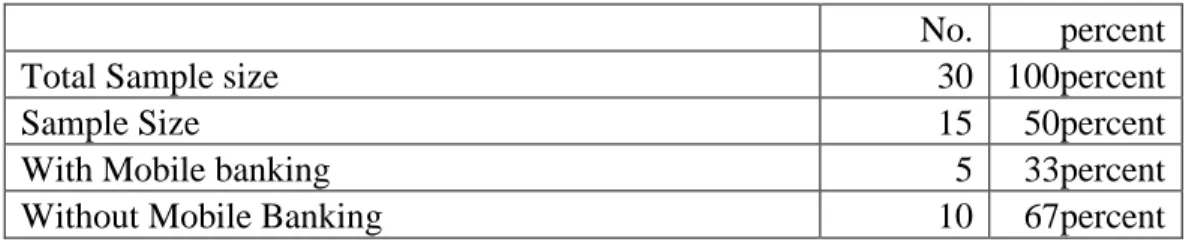
A simple random sampling was used to select 15 retail Microfinance Institutions out of a total of 30 Retail Microfinance Institutions who are members of the Association of Microfinance Institutions of Kenya (AMFI)5. Questionnaires were emailed to all the 15 MFIs and the researcher also followed up with phone calls to the Executive Directors to discuss more on the same. Only 5 MFIs representing 33percent out of the sample of 15 were currently having a mobile banking product. None of the five MFIs had the product for more than one year apart from SMEP which was among the first MFIs to partner with Safaricom. Further, all the five MFIs were all using Safaricom‘s MPESA mobile banking product.
Table 1 Usage of Mobile Banking
No. percent
Total Sample size 30 100percent
Sample Size 15 50percent
With Mobile banking 5 33percent
Without Mobile Banking 10 67percent
31
Figure 3 Usage of mobile banking technology by MFIs
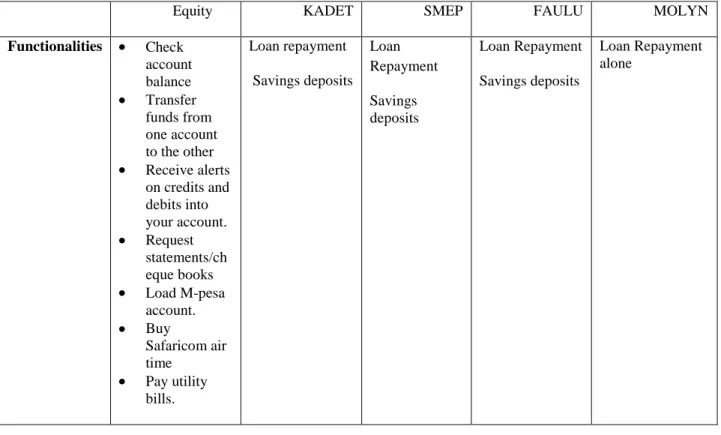
Further, the following matrix reflected the use the mobile banking product by the five different MFIs and the functionalities of their products.
Table 2 Functionalities of mobile banking
Equity KADET SMEP FAULU MOLYN
Functionalities Check account balance Transfer funds from one account to the other Receive alerts on credits and debits into your account. Request statements/ch eque books Load M-pesa account. Buy Safaricom air time Pay utility bills. Loan repayment Savings deposits Loan Repayment Savings deposits Loan Repayment Savings deposits Loan Repayment alone
32
Further, all the ten microfinance institutions that did not have a mobile banking product had plans to introduce the mobile banking product in the next twelve months. When asked with which mobile service provider they planned to partner, all of them said they would go for Safaricom‘s MPESA; this is despite the fact that there are two major mobile service providers in Kenya, i.e. Safaricom and Zain, and both have mobile banking products: MPESA for Safaricom and ZAP for Zain
A more detailed matrix of the responses from the five Microfinance Institutions that have a mobile banking product is as outlined below:
33
Table 3 CNA Responses
Equity KADET SMEP FAULU MOLYN
Forms of Technology
Banking Halls ATM‘s Mobile Banks POS – Point of sales cash Backs.
Internet Banking GPRS or mobile telephone enabled.
MIS for Loan tracking and accounting
Mobile Banking
MIS for both Loan tracking and accounting
MIS for both Loan tracking and accounting.
Excel based system for both Loan tracking and accounting
Functionalities Check account balance
Transfer funds from one account to the other
Receive alerts on credits and debits into your account.
Request
statements/cheque books
Load M-pesa account. Buy Safaricom air time
Pay utility bills.
Loan repayment Savings deposits Loan Repayment Savings deposits Loan Repayment Savings deposits Loan Repayment alone Advantages Convenience Reduction of queues in the banking hall.
Convenient for client; Saves on time to go to the bank, Reduces risk of Time saving-No long queues Cost effective-Less costly and instant
Time saving-No long queues Cost effective-Less costly and instant
Time saving-No long queues Cost effective-Less costly and instant
34
theft of cash while on transit to bank by client,
Immediate reconciliation hence saving some costs like costs of statement
Immediate reconciliation hence saving some costs like costs of statement Reduction of risk of theft Challenges The network uptime.
Most of the time, it is hard to transact. Most customers not technology savvy. Very low usage.
System breakdown (M-Pesa which means delayed payments)
Increased expenses
Systems are not integrated and hence it takes time to update the client‘s records. Network problems Lack of agents in some areas Takes time to download Lack of system integration Network problems Lack of system integration.
How Long 18 Months Months (From August 2009
35
3.5 Stakeholder Analysis
The project involved several stakeholders including; microfinance Institutions, executive directors of microfinance institutions, microfinance clients, both senior and junior staff of the microfinance institutions, the mobile phone service provider and even the government under the central bank. The most critical stakeholders were the microfinance institution‘s staff and clients of the host organization who interacted with the researcher throughout the entire project time. Both the MFI staff and clients had the highest influence on the actual implementation, monitoring as well as the final outcome of the project.
For further details refer to Appendix 10.1 and 10.2
4.0 Project Design
The goal of this project was to measure the impact on the usage of mobile banking technology by the microfinance industry. Given the challenges associated with extending access of financial services to the low income and the unbanked, the researcher hopes to evaluate the benefits and challenges of mobile banking technology. The results of this project will inform microfinance players in Kenya and across the world regarding the advantages of mobile banking as well as recommend strategies for improving mobile banking technology.
4.1 Project Objectives
1. To determine the extent of the use of mobile banking technology by microfinance institutions
2. To evaluate the advantages and challenges of using the mobile banking technology by MFIs
36
3. Based on a detailed research, make recommendations to the host organization and the entire microfinance industry in Kenya regarding the best approaches to leveraging mobile banking technology by MFIs
4.2 Host Organization:
The host organization was Small and Micro Enterprise Programme (SMEP), a medium sized microfinance Institution based in Kenya and which is among the first MFIs to embrace mobile banking technology in Kenya. Small and Micro Enterprise Programme (SMEP) is a Kenyan credit-only microfinance institution born out of an initiative of the National Council of Churches of Kenya (NCCK) to alleviate poverty by empowering those who are economically marginalized through provision of both financial and non-financial services. SMEP began as a feeding program for the poor in Mathare, a slum near Nairobi, in 1975. In 1978, NCCK realized that the poor needed to be self-reliant and economically empowered and the feeding program was transformed in to a microcredit scheme known as Small Scale Business Enterprise (SSBE). SSBE began with financial assistance from USAID, channeled through K-Rep NGO, and, by 1997, SSBE had grown to a client base of 2,500 and a loan portfolio of Ksh 26 million.
In 1999, through a managed institutional developed process, the project transformed into an independent micro finance institution registered as a private company limited by guarantee. However, SMEP is currently in a transitional period from credit-only MFI to a deposit taking MFI under the Kenyan Microfinance Act of 2006. The Act requires all transforming institutions to register as a company limited by shares and, hence, SMEP has already registered a separate company limited by shares to conform to the new law.
SMEP is uniquely focused upon Kenya‘s deep and rural poor and is a leader in agricultural lending and innovation in financial services. It provides a very diverse product
37
offering, partners with exciting organizations to offer products such as solar panel leasing and micro-health insurance, and has recently teamed up with MPESA to allow easier repayment by clients via mobile phone. SMEP‘s Board is a strong guardian of the organization‘s mission and is specifically taking steps to ensure continued outreach to the rural poor. Currently SMEP has over 78,000 clients with an outstanding loan portfolio of Ksh.951million. It has a branch network of 19branches with 130 loan officers and a total staff load of 202 members of staff.
38
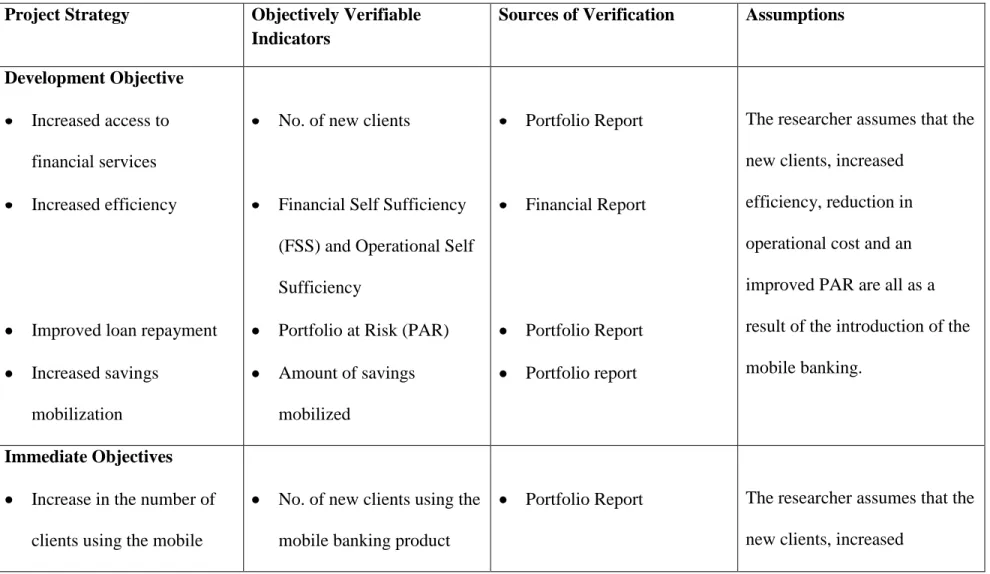
4.3
Logical Framework
Table 4 Logical Framework
Project Strategy Objectively Verifiable Indicators
Sources of Verification Assumptions
Development Objective
Increased access to financial services Increased efficiency
Improved loan repayment Increased savings
mobilization
No. of new clients
Financial Self Sufficiency (FSS) and Operational Self Sufficiency
Portfolio at Risk (PAR) Amount of savings mobilized Portfolio Report Financial Report Portfolio Report Portfolio report
The researcher assumes that the new clients, increased
efficiency, reduction in operational cost and an improved PAR are all as a result of the introduction of the mobile banking.
Immediate Objectives
Increase in the number of clients using the mobile
No. of new clients using the mobile banking product
Portfolio Report The researcher assumes that the
39
banking product
Increase in the number of clients being served by the MFI
More savings mobilized
Increased FSS
Increase in the total no. of clients served by the MFI
Increase in the amount of savings mobilized Decrease in transaction costs Portfolio Report Financial/portfolio report Financial Report efficiency, reduction in operational cost and an improved PAR are all as a result of the introduction of the mobile banking.
Outputs
Implementation of the mobile banking technology
Clients receiving more efficient services Delivery of financial services to clients in cost
No. of New clients using the mobile banking technology
Clients perception of the mobile banking technology Operational Self
Sufficiency
Portfolio Report
Financial Report
40
effective way
Increased transactions per client per month
No. of transactions per day Portfolio Report
Activities
Community Needs Assessment
Research to shape the introduction of mobile banking
Project Implementation Monitoring and Evaluation
Design of the CNA questionnaires Conducting the CNA exercise Results of the Community Needs Assessment Literature Review Project Report Project Report
41
4.4 Detailed Implementation Plan
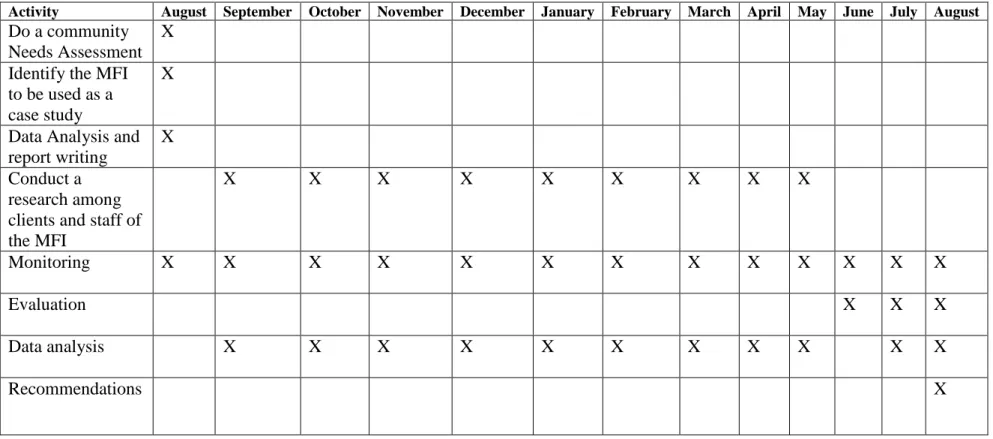
Small and Micro enterprise Program, a microfinance institution in Kenya that had started a pilot testing on the mobile banking technology was purposively selected by the researcher. The microfinance institution‘s clients were interviewed together with the MFI‘s staff to establish the benefits as well as the constraints faced by the clients and the MFI in the implementation of the mobile banking technology. The researcher monitored the product for 12 consecutive months to determine the impact and progress of the product.
42
4.5
Budget Plan
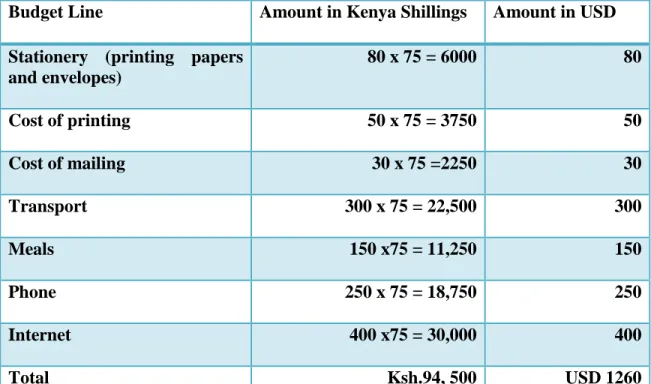
For details on the Budget please refer to Appendix
5.0 Project Monitoring
The implementation of the project was closely monitored to ensure that the objectives were realized. The monitoring process helped to determine whether the implementation was on course and informed the researcher if there was need for any adjustments in light of the ever changing socio economic and political environments. Monitoring, follow up and control systems were put in place at both the organization and client level. The researcher also collected and analyzed 12 months of detailed information on the progress of the project implementation from commencement date in January 2009 to December 2009.
43
The chart above clearly demonstrates that there was gradual increase on the number of users of the product from the first month of implementation. However, the graph also depicts an interesting trend especially in the month of March where there was a decrease in the number of users from the previous month of February. When asked about the decrease in the month of March the marketing manager at SMEP, indicated that they‘re still doing their analysis to establish what would have contributed to the decline (Mwamburi, 2010).
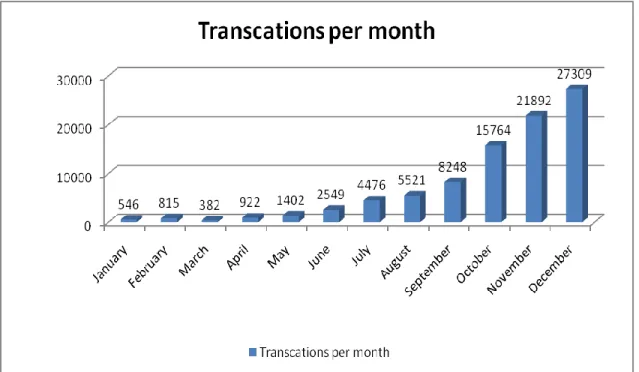
Figure 5 MPESA transactions per month
The above chart further outlines the number of transactions on a month by month basis in the same period of time. The graph clearly shows that there were more transactions on a monthly basis than there was with individual users.
Further monitoring, and follow ups where done by the researcher by collecting the overall organization performance parameters that helped to monitor the progress of the project. The
44
detailed organizational reports where collected from the MFI‘s; Quarterly portfolio and financial Reports as well as quarterly review meetings with both the management and the clients
45
6.0 Evaluation
Due to time constraints the researcher was not able to do an evaluation. However, a detailed evaluation will be undertaken before the end of the year and will be based on the information gathered over the period of the project as highlighted in the implementation plan.
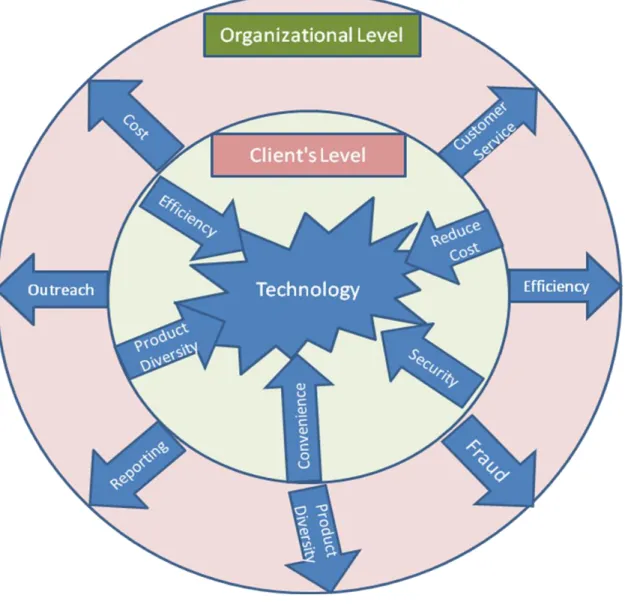
This project was based on the following conceptual framework.
6.1 Conceptual Framework
46
The impact on the use of technology is felt on two levels; at the financial institutions level and the client‘s level. The conceptual framework will be based on the assumption that the implementation of an appropriate technology in financial institutions brings with it benefits to both the financial institution and the clients too.
6.2 Objectives of evaluation
The objective of the evaluation will be to measure the outcomes of the project as described by the Logical Framework. The outcome evaluation will be used to assess the extent to which the introduction of mobile banking technology in a local MFI affected both the organization and their clients for a period of twelve months from the date of inception. Further, the evaluation will be used analyze the challenges faced by both the organization and the clients during the first phase of implementation.
6.3 Statement of hypothesis
At the organizational level:
The use of mobile banking technology leads to changes in the access to financial services. This will be tested by the increase in the number of clients receiving financial services. The use of mobile banking has helped financial institutions and specifically microfinance institutions to reach the un-banked market whom in most cases are located in very remote areas with poor infrastructure and hence a very high cost of operating in such areas. The use of mobile banking is able to penetrate such areas as financial institutions do not require any brick and mortar branches to reach out to the clients. Further, the increased outreach of mobile telephony is expected to help in spurring growth in such rural and remote areas by increasing the number of clients being served by the financial institutions.
47
At the Client level:
The use of mobile banking technology leads to changes in cost. This hypothesis will be tested by the total cost incurred by clients to access financial institutions as well as the cost incurred by the institution in providing access the financial services. Clients are able to deposit money, withdraw as well as transfer money at the comfort of their houses as opposed to travelling many kilometers especially in the rural areas so as to get to any nearby bank branch.
It‘s hoped that the introduction of mobile banking will substantially reduce the cost of clients having to travel long distances to access financial services. However, further research needs to be undertaken to ascertain the true reduction of cost the client. A recent survey by CGAP that compared sixteen leading branchless banking services against ten formal banks targeting the mass market, notes that on average branchless banking is nineteen percent cheaper than banks. Further, the survey notes that the lower the transaction value, the cheaper branchless banking is in comparison with the banks (McKay & Pickens, 2010).
6.4 Methodology
This project used SMEP, a local MFI in Kenya as a case study. Kenya was chosen because of its successful mobile payment service offered by Safaricom called M-PESA, as well as the convenience to the researcher in collecting data.
A combination of both quantitative and qualitative research was used to collect data; together with a combination of various tools. The researcher used questionnaires, face to face discussions and focus group discussions to gather information from both the organization‘s staff as well as the clients. The target group consisted of thirty five microfinance clients and ten members of staff of the host organization who were randomly selected to create the sample
48
group. All the research tools where intended to gather information on two broad categories; the impact of the mobile banking technology on the organization and on the client.
Organizational Level: The research methodology was meant to inform the researcher on the challenges and benefits accrued to the organization‘s continuous implementation of the mobile banking technology. Further the research methodology strived to understand the mobile banking technology so as to make recommendations to the host organizations on the areas of improvement.
See Appendix 10:5:1
Client level: The research methodology was also intended to gather general demographic information about the microfinance clients of the host organization as well as the clients‘ perception towards the use of and implementation of the mobile banking technology. Further, the researcher sought to understand the clients‘ level of usage and willingness to continue using the product.
49
7.0 Lessons learnt
Based on the discussions with microfinance clients, the host organization and the literature review the researcher gathered that although there was a general interest in both the clients and the organization on the potential of mobile banking, the service has a myriad of challenges that need to be overcome to make it a success. Ninety percent of the clients interviewed expressed satisfaction with the service and were willing to continue using the service; with the organization admitting to investing more on perfecting the product. The organization also said they would introduce disbursements through the mobile as soon as they can integrate the Safaricom system with their own MIS. Other noted challenges were:-
Network breakdown
Both the organization and the clients expressed dissatisfaction with the frequent system breakdown from Safaricom, the mobile service provider to an extent whereby clients are not able to deposit money or the organization cannot be able to do the downloads in their system. SMEP is currently engaging Safaricom to ensure that the problem is addressed as soon as possible.
Erodes group guarantee
There were concerns from SMEP that the mobile banking technology slowly erodes the group guarantee mechanism which is the foundation of the majority of the MFIs. This is due to the fact that when a client pays their loans through the service, they do not then see the reason for attending the group meeting. The organization together with the clients are mitigating this major challenge by introducing more stricter rules on group attendance with failure to attend group meetings leading to a fine or refusal when one applies for their subsequent loan.
50
Lack of system integration
There were also concerns that due to lack of system integration, the organization had to manually download the payments from a Safaricom‘s secure URL and then have it manually inputted in to the SMEP MIS. SMEP is currently working with their MIS developers together with Safaricom to work on an integration of the two systems so that when a client deposits money in their account it‘s automatically credited into their SMEP account without having it to be manually inputted by data input clerks.
Lack of agents in some areas
The lack of safaricom agents who receive money on behalf of Safaricom in some areas is making it difficult for SMEP to reach some of the areas without access to financial services.
Customers not technology savvy
Some of the interviewed clients also expressed concern with the process involved in deposit and transferring money to SMEP as quite detailed and that it creates challenges for the clients who are illiterate.
Finally, it was clear from the discussions from the clients of the host organization that more awareness creation is required by the MFI to their clients. Several of the interviewed clients did not know how the product worked as a good number too did not know of its existence.
8.0 Recommendations
Based on the lessons learnt, both from the project as well as the literature review, the researcher strongly recommends a much more deeper and detailed study to be done with a bigger sample group involving more financial institutions with different mobile providers. Of course this should be undertaken after the evaluation has been done and results analyzed so as to inform
51
the follow up study. This should be able to give a more broad analysis on the impact of technology on microfinance institutions. However, based on the available information from the research on the host organization, the researcher recommends the following to the host organization.
Marketing: SMEP needs to invest more in marketing their mobile banking product as several of their clients seemed not aware of the product and the ones who were aware did not fully understand its usage.
System Integration: SMEP needs to work with Safaricom to ensure that the two systems are integrated and SMEP does not need to manually post the deposits every day. This is because, that approach makes it prone to mistakes as well as fraud.
System breakdown: SMEP needs to express its concern to Safaricom about the continued breakdown of the system making it difficult for the clients to make their payments.
Disbursements: Most of the clients interviewed were of the opinion that SMEP needs to introduce disbursements to their clients through the mobile and especially the ones who are far away from the bank branches.
Interest on Savings: Clients expressed desire to have interest paid on their savings and especially the ones not linked to their loan accounts. Further, the clients were of the opinion that for the savings account they should be able to withdraw them from the ATM‘s without any problem
52
9.0 References
Amin, S. I. (2007). M-Banking- To Bank the "Unbanked". 1-6.
Amin, S. I. (2007, May 14). M-Banking -To Bank the "Unbanked". Retrieved January 10, 2010, from Frost and Sullivan:
http://www.frost.com/prod/servlet/market-insight-top.pag?docid=98655381
Amin, S. I. (2007, May 14). M-Banking to the Un-Banked. Retrieved May 26, 2010, from Frost and Sullivan: http://www.frost.com/prod/servlet/market-insight-top.pag?docid=98655381 CGAP . (2009, March). 2008 Microfinance Technology Survey. 2008 Microfinance Technology
Survey . CGAP:http://www.cgap.org/p/site/c/template.rc/1.26.10622/
Commission, E. (2010). Progress made on the Millenium Development Goals and Key Challenges for the Road ahead. Brussels: Europen Commission.
Demirgüç-Kunt, Asli,Thorsten Beck, and Patrick Honohan.2008 Finance for all? Policies and pitfalls in expanding access Washington, D.C.: World Bank.
Government of Kenya. (October 2007). Kenya Vision 2030. Nairobi: Government of Kenya. Hamblen, M. (2009, May 28). Gartner: Users of Mobile phone Users to double by 2012.
Retrieved June 22, 2009, from Computer World:
http://www.computerworld.com/action/article.do?command=viewArticleBasic&articleId =9133633&intsrc=news_ts_head
Ivatury, G., & Mas, I. (April 2008). CGAP Focus Note No.46. The early experience with branchless banking .
Kenya Institute for Public Policy Research and Analysis. (2009). Kenya Economic Report 2009. Nairobi: Kenya Institute for Public Policy Research and Analysis.
Kenya, F. S. (2009). National Survey 2009 (Dynamics of Kenyas changing Financial landscape). Nairobi.
Kohen, M., Hopkins, D., & Lee, J. (2008). Financial Education: A Bridge between Branchless Banking and Low-income Clients. Washington DC: Microfinance Opportunities.
Kumar, I. M. (2008, June). Banking on Mobiles: Why, How for whom? Focus Note No.48 , p. 1. Liu, A. T., & Mithika, M. K. (April 2009). Mobile Banking-The Key to building Credit History
53
Mbote, S. (2009, June 12). Kibaki commissions fibre optic cable. Retrieved June 21, 2009, from KBC(Kenya Broadcasting Corporation): http://www.kbc.co.ke/story.asp?ID=57958 McKay, C., & Pickens, M. (2010). Branchless Banking Pricing Analysis. CGAP.
Microfinance Gateway. (n.d.). Technology FAQs. Retrieved May 25, 2010, from Microfinance Gateway:
http://www.microfinancegateway.org/p/site/m/template.rc/1.11.48240/1.26.9192/#2 Mwamburi, A. (2010, March 16). Marketing Manager . (D. Kitusa, Interviewer)
Mwangi, J. (2010, May 27). The New Silicon Valley of Financial Innovation. The Standard: Online Edition:
http://www.standardmedia.co.ke/InsidePage.php?id=2000010308&cid=14&j=&m=&d= Pickens, M. (2009, June 4). Mobile Money by the Numbers. Retrieved June 22, 2009, from
CGAP: http://technology.cgap.org/2009/06/04/mobile-money-by-the-numbers/#more-1006
Pickens, M. (December 2009). Window on the Unbanked: Mobile Money in the Phillipines. CGAP Brief , 1-2.
Pickens, O. M. (2009, August). Poor people Using Mobile Financial Services: Observations on Customer Usage and Impact from M-PESA. CGAP Brief , p. 1.
Rosenberg, J. (2009, June 4). Banking where electrons have never been before.... Retrieved June 21, 2009, from CGAP: http://technology.cgap.org/2009/06/04/banking-where-electrons-have-never-been-before/
Rosenberg, J. (2010, May 18). MPESA meets microsavings with Equity Bank deal in Kenya. Retrieved May 28, 2010, from CGAP:
http://technology.cgap.org/2010/05/18/m-pesa-meets-microsavings-with-equity-bank-deal-in-kenya/
Rosenberg, J. (2009, June 24). The Hype Cycle and Mobile Banking, 2009. Retrieved June 27, 2009, from CGAP: http://technology.cgap.org/
Rosenberg, J. (2008, December 11). updated-Mobile banking for poor people: Pioneer perspectives. Retrieved June 21, 2009, from CGAP:
http://technology.cgap.org/2008/12/11/happening-now-mobile-banking-for-poor-people-pioneer-perspectives/
United Nations. (2008). Facts and Figurs. Retrieved May 28, 2010, from United Nations Development Programme-Kenya: http://www.ke.undp.o