Clemson University
TigerPrints
All Dissertations Dissertations
May 2019
Development of
Helicoverpa zea
(Lepidoptera:
Noctuidae) in Transgenic Corn Producing BT
Toxins and Implications for Resistance
Thomas Bilbo
Clemson University, [email protected]
Follow this and additional works at:https://tigerprints.clemson.edu/all_dissertations
This Dissertation is brought to you for free and open access by the Dissertations at TigerPrints. It has been accepted for inclusion in All Dissertations by an authorized administrator of TigerPrints. For more information, please [email protected].
Recommended Citation
Bilbo, Thomas, "Development ofHelicoverpa zea(Lepidoptera: Noctuidae) in Transgenic Corn Producing BT Toxins and Implications for Resistance" (2019).All Dissertations. 2384.
DEVELOPMENT OF Helicoverpa zea (LEPIDOPTERA: NOCTUIDAE) IN TRANSGENIC CORN PRODUCING BT TOXINS AND
IMPLICATIONS FOR RESISTANCE A Dissertation
Presented to the Graduate School of
Clemson University In Partial Fulfillment
of the Requirements for the Degree Doctor of Philosophy
Entomology by
Thomas Richard Bilbo May 2019 Accepted by:
Dr. Francis Reay-Jones, Committee Chair Dr. Jeremy Greene, Committee Chair
Dr. Matthew Turnbull Dr. Dominic Reisig
ABSTRACT
The corn earworm, Helicoverpa zea, is a highly polyphagous insect that is a pest of corn, cotton, sorghum, and soybeans in the southern United States. It is currently managed primarily using transgenic cultivars producing insecticidal proteins derived from the bacterium Bacillus thuringiensis (Bt) in corn and cotton, and foliar insecticides in sorghum and soybeans. However, the development of resistance to several Bt toxins has been reported and is the primary threat to the success and longevity of Bt crops. We performed a number of field and laboratory experiments over three years to investigate the development, survival, and feeding behavior of H. zea in Bt corn with implications for resistance. H. zea feeding on Bt corn significantly reduced pupal weight but this did not result in detectable effects on fecundity or egg viability. We characterized the age- and tissue-specific feeding behavior of H. zea larvae in silk, tip, and kernel ear tissues in relation to tissue-specific concentrations of Cry1F and Cry2Ab2 using ELISA. Bt protein concentration varied in space and time, but we did not detect changes in larval feeding behavior between Bt and non-Bt hybrids, although development was delayed on several Bt hybrids. Resistance monitoring of 22 field-collected populations from North and South Carolina was conducted using purified protein diet-overlay bioassays to determine
susceptibility to Cry1A.105 and Cry2Ab2. Compared with a susceptible laboratory colony, resistance ratios indicated that H. zea resistance to Cry1A.105 is widespread across North and South Carolina and resistance to Cry2Ab2 was detected in several populations but others remain susceptible. Susceptibility to Cry proteins did not correlate with H. zea developmental parameters. We evaluated the use of Bt and non-Bt corn
hybrids in combination with foliar applications of chlorantraniliprole at varying infestation thresholds to protect field corn from infestation and damage and determine effects on grain yield. All Bt hybrids were more effective at reducing fall armyworm, Spodoptera frugiperda, infestation rates and leaf injury than multiple insecticide sprays, and no Bt hybrid required supplemental insecticide treatments. Significant protection of yield was detected only in the Bt hybrids producing Cry1A.105 + Cry2Ab2. These data fill knowledge gaps that can be incorporated into insect resistance management (IRM) models, which can aid in the implementation of IRM strategies that can improve risk management decisions regarding H. zea in Bt crops in the complex landscapes of the southern United States.
ACKNOWLEDGMENTS
This work would not have been possible without the financial support of the Pee Dee Research and Education Assistantship, the USDA/NIFA Biotechnology Risk Assessment program grant #2014-33522-22265, travel and research grants from the Nettles Memorial Endowment, and the Joel. A. Berly Research Fellowship.
I am extremely grateful to everyone at Clemson University with whom I have had the pleasure to work with and learn from throughout my Ph.D. I would like to thank my major advisors, Dr. Francis Reay-Jones and Dr. Jeremy Greene, for giving me the opportunity to work and study under their guidance, for their help and encouragement to grow as a scientist, and for always taking the time to answer my questions and discuss a problem. My committee members, Dr. Dominic Reisig and Dr. Matt Turnbull, provided invaluable feedback and assistance on experimental design and interpretation. I also wish to thank our farm crew, William Griggs, Terry Teal, Matt Lennon, and Benj Jones for countless hours of help in the field and lab. Dr. Fran Stubbins was immensely helpful in helping me move to Greenville, navigating my way through graduate school at Clemson, and in finding and preparing for job interviews. I would also like to thank Dr. Tom Schultz of Denison University for teaching such an inspiring introductory Entomology course that it changed the trajectory of my life in unpredictably enriching and fruitful ways. Lastly, I would not be where I am or who I am today without the unconditional love, support, and encouragement of my mother, father, and sister. My wife, Rachel, has always stood by my side and makes every day better than the last.
TABLE OF CONTENTS
Page
TITLE PAGE ... i
ABSTRACT ... ii
ACKNOWLEDGMENTS ... iv
LIST OF TABLES ... viii
LIST OF FIGURES ... x
CHAPTER I. INTRODUCTION AND LITERATURE REVIEW ... 1
Biology, Ecology, and Behavior ... 1
Management in Diverse Agroecosystems ... 4
Bacillus thuringiensis (Bt) and transgenic crops ... 5
Bt Insecticidal Proteins and Genetic Engineering ... 6
Benefits and Risks of Bt Technology ... 8
Bt Mode of Actions ... 10
Bt Resistance and Management ... 12
References ... 17
II. EFFECTS OF BT CORN ON THE DEVELOPMENT AND FECUNDITY OF CORN EARWORM (LEPIDOPTERA: NOCTUIDAE) ... 31
Abstract ... 31
Introduction ... 32
Materials & Methods ... 35
Results ... 39
Discussion ... 41
Acknowledgments ... 48
Table of Contents (Continued)
Page III. SUSCEPTIBILITY OF CORN EARWORM
(LEPIDOPTERA: NOCTUIDAE) TO CRY1A.105 AND CRY2AB2 IN NORTH AND SOUTH
CAROLINA ... 65
Abstract ... 65
Introduction ... 66
Materials & Methods ... 69
Results ... 76
Discussion ... 80
Acknowledgments ... 91
References ... 92
IV. DEVELOPMENT, SURVIVAL, AND FEEDING BEHAVIOR OF Helicoverpa zea (LEPIDOPTERA: NOCTUIDAE) RELATIVE TO BT PROTEIN CONCENTRATIONS IN CORN EAR TISSUES ... 110
Abstract ... 110
Introduction ... 112
Materials & Methods ... 114
Results ... 122
Discussion ... 127
Acknowledgments ... 138
References ... 139
V. EVALUATION OF INSECTICIDAL SPRAY THRESHOLDS IN LATE-PLANTED BT AND NON-BT CORN FOR MANAGEMENT OF THE FALL ARMYWORM (LEPIDOPTERA: NOCTUIDAE) ... 158
Abstract ... 158
Introduction ... 160
Materials & Methods ... 162
Results ... 165
Discussion ... 169
Acknowledgments ... 174
Table of Contents (Continued)
Page
VI. CONCLUSIONS AND FUTURE WORK ... 188
References ... 192
APPENDICES ... 193
A: List of publications ... 194
B: Letter of permission to include copyrighted works: Chapter II ... 195
C: Letter of permission to include copyrighted works: Chapter III ... 196
D: Supplementary figures and table to Chapter 4. Injury data analyzed per injured ear ... 197
LIST OF TABLES
Table Page
2.1 Corn hybrids planted in Florence, SC, Plymouth, NC,
and Starkville, MS, in 2014-2016 ... 58 2.2 ANOVA statistics for H. zea pupal weights from trials
in Florence, SC, Plymouth, NC, and Starkville,
MS, 2014-2016 ... 59 2.3 ANOVA statistics for H. zea fecundity and egg
viability from trials in Florence, SC, and
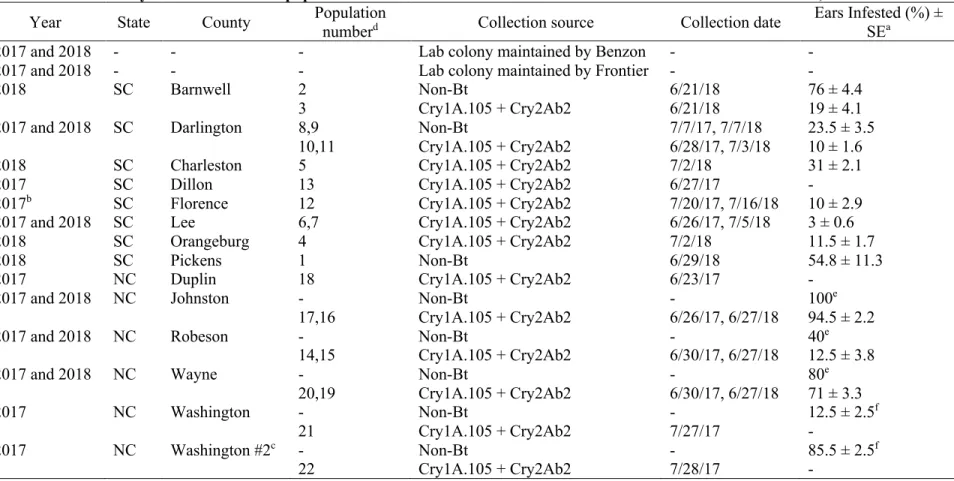
Plymouth, NC, 2014-2016 ... 61 3.1 Laboratory and field-collected populations of H. zea
from Bt and non-Bt corn in North and South
Carolina, 2017-2018 ... 102 3.2 Susceptibility of laboratory and field populations of
H. zea collected in North and South Carolina to purified Cry1A.105 protein overlaid on artificial
diet, using the response criterion MIC-2 ... 103 3.3 Susceptibility of laboratory and field populations of
H. zea collected in North and South Carolina to purified Cry2Ab2 protein overlaid on artificial
diet, using the response criterion MIC-2 ... 104 4.1 Corn hybrids planted in Florence, South Carolina,
2016-2017 ... 148 4.2 ANOVA Statistics for H. zea Bt corn ear feeding in
trials in Florence, South Carolina, 2016-2017 ... 149 4.3 ANOVA Statistics for H. zea characteristics in Bt corn
trials in Florence, South Carolina, 2016-2017 ... 150 4.4 ANOVA Statistics for H. zea larvae characteristics by
tissue location (Florence, South Carolina, 2016-2017) ... 151 5.1 Corn hybrids planted in Florence, South Carolina in
List of Tables (Continued)
Table Page
5.2 Effects of late-planted Bt and non-Bt corn hybrids treated with chlorantraniliprole on fall armyworm infestation, leaf injury, and grain yield in Florence,
South Carolina in 2016 and 2017 ... 182 5.3 Effects of late-planted Bt and non-Bt corn hybrids
treated with chlorantraniliprole on fall corn earworm infestation and injury to ear tissues in
LIST OF FIGURES
Figure Page
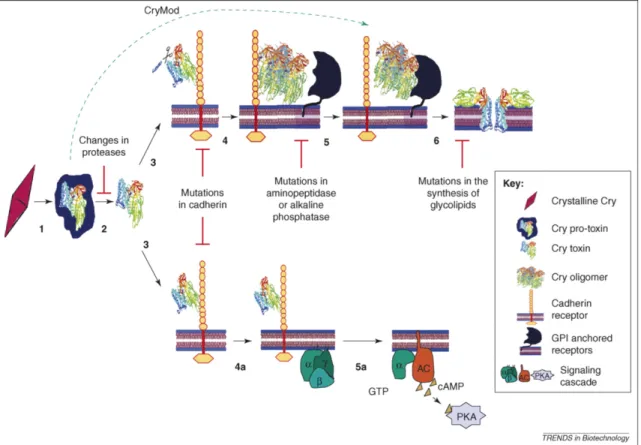
1.1 Proposed models for Cry toxin mode of action with
corresponding sites of known or possible resistance ... 30 2.1 Mean (± SEM) H. zea male and female pupal weight in
Florence, SC, Plymouth, NC, and Starkville, MS,
during 2014-2016 ... 62 2.2 Mean (± SEM) H. zea fecundity in Florence, SC, and
Plymouth, NC, during 2014-2016 ... 63 2.3 Mean (± SEM) H. zea egg viability in Florence, SC,
and Plymouth, NC, during 2014-2016 ... 64 3.1 Map of sampling locations for field-collected populations
of H. zea from Bt and non-Bt corn in North and South
Carolina, 2017-2018 ... 105 3.2 Growth inhibition (± SE) of H. zea larvae feeding
on Cry1A.105 or Cry2Ab2-treated artificial diet
after seven days ... 106 3.3 F0 and F1 pupal weights for laboratory and field
populations of H. zea collected in 2017 and 2018 on non-Bt and Bt (Cry1A.105 + Cry2Ab2) corn in
North and South Carolina ... 107 3.4 Duration (mean and 95% CI) of pupal stage of F0 and
F1 generations of field populations of H. zea collected in 2018 on non-Bt and Bt (Cry1A.105 + Cry2Ab2)
corn in North and South Carolina ... 108 3.5 Duration (mean and 95% CI) of egg hatching to adult
eclosion of laboratory and field populations of H. zea collected in 2018 on non-Bt and Bt (Cry1A.105 + Cry2Ab2) corn in North and
List of Figures (Continued)
Figure Page
4.1 Mean H. zea feeding injury to silk, tip, and kernel tissues in the Dekalb 2 hybrid family in Florence,
South Carolina, in 2016 and 2017 ... 152 4.2 Mean H. zea feeding injury to silk, tip, and kernel
tissues in the Pioneer hybrid family in Florence,
South Carolina, in 2016 and 2017 ... 153 4.3 Mean number of H. zea larvae per 10 ears for hybrids in
the Dekalb 2 and Pioneer hybrid families in Florence,
South Carolina, in 2016 and 2017 ... 154 4.4 Mean H. zea head capsule width for larvae collected in
the Dekalb 2 and Pioneer hybrid families in Florence,
South Carolina, in 2016 and 2017 ... 155 4.5 Age, number, and feeding location of H. zea larvae in
ear tissues. (A) Distance larval feeding penetrance into corn ears of hybrids in the Dekalb 2 and Pioneer
families by larval age group in 2017 ... 156 4.6 Mean concentration of Cry1F and total protein among
tissue types for hybrid family Pioneer in Florence,
South Carolina, in 2016 and 2017 ... 157 5.1 Mean [±SEM] infestation rates of fall armyworm larvae
in leaves and whorl of late-planted Bt and non-Bt corn hybrids treated with chlorantraniliprole in Florence,
South Carolina in 2016 and 2017 ... 184 5.2 Mean [±SEM] leaf injury rating by fall armyworm
larvae in late-planted Bt and non-Bt corn hybrids treated with chlorantraniliprole in Florence, South
Carolina in 2016 and 2017. ... 185 5.3 Mean [±SEM] ear infestation and feeding injury to the
ear tip and kernels in late-planted Bt and non-Bt corn hybrids treated with chlorantraniliprole in Florence,
List of Figures (Continued)
Figure Page
5.4 Mean [±SEM] corn grain yields of late-planted Bt and non-Bt corn hybrids treated with chlorantraniliprole
CHAPTER ONE
INTRODUCTION AND LITERATURE REVIEW Helicoverpa zea: Biology, Ecology and Behavior
Helicoverpa zea (Lepidoptera: Noctuidae)—commonly known as the corn earworm, cotton bollworm or tomato fruitworm—is a highly polyphagous, mobile, and multivoltine
agricultural pest. It is geographically distributed throughout the Americas, ranging from southern Canada to parts of Chile and Argentina with populations capable of overwintering in most areas between 40°N and 40°S (Sharma 2005). The key characteristics enabling its capabilities as a pest are its high polyphagy, high mobility, high fecundity, and facultative diapause (Fitt 1989).
The H. zea life cycle is completed in 28-30 days at temperatures of 25°C but this can be extended upwards of 70 days under colder conditions (Sharma 2005). Thus, the number of generations per year generally decreases as latitude increases. In the southern United States H. zea may complete 4-7 generations per year with the final generation entering diapause based on photoperiod and host quality (Stadelbacher 1981). Oviposition occurs in the early evening hours and eggs are deposited singly on a host. Fecundity estimates range from 300 to 3000 eggs per female (Adler et al. 1991, Fitt, 1989), although it is unclear how well laboratory estimates apply to fecundity in the field. Egg development lasts approximately 70 hours and upon hatching most larvae will feed on the cast chorion within 1 to 4 minutes (Adler and Dial 1989). Larvae develop through 4 to 6 instars and as they mature they become increasingly prone to cannibalism, a behavior that can be a significant regulatory factor in H. zea populations (Dial and Adler 1990, Stinner et al. 1977). Once the growth threshold for pupation has been met, larvae cease feeding, drop to the ground, and pupate in the soil. Adults emerge after 14 to 21 days and feed on nectar
(Pedigo and Rice 2009). The emergence of diapausing pupae in the spring is dependent on soil temperature and can be predicted using a heat unit model (Rummel and Hatfield 1988).
The polyphagous nature of H. zea affords it distinct advantages of survival and
reproduction in agroecosystems. Populations can develop simultaneously on a variety of hosts, they can develop continuously by exploiting a succession of hosts throughout the season, and they can persist at low densities since there is almost always a suitable cultivated or uncultivated host in an area (Fitt 1989). The number and diversity of suitable hosts is substantial and H. zea larvae have been recovered from at least 240 plant species in 36 plant families (Kogan et al. 1989). H. zea infests a wide range of important agricultural crops such as corn, cotton, soybean, tomato, sorghum, sunflower and okra (Fitt 1989). It has been argued that one of the primary factors shaping the feeding habits and feeding preference of H. zea and related species is the requirement of obtaining food with high enough protein content (Hardwick 1965). Support for this argument is reflected in the preference for feeding on the nitrogen-rich flowers and fruits of host plants as well as the strong cannibalistic tendencies.
With the long generation time relative to the period of host suitability, H. zea adults usually disperse from their emergence sites to reproduce and this movement can range from less than a few miles to hundreds of miles (Culin 1995, Harstack et al. 1982). Despite this potential for long-range migration, H. zea in the agroecosystem of eastern North Carolina and the surrounding region may comprise a mostly distinct population because of the piedmont and mountains to the west, the Atlantic Ocean to the east, and overwintering limitation to the north (Storer 1999). There are fewer constraining factors to the south, but it is thought H. zea moths moving into North and South Carolina from the south are insignificant relative to the local production of H. zea (Stinner et al. 1977).
As different plants flower and fruit at different times throughout the season, so follows H. zea. In North Carolina when overwintering H. zea moths first emerge in mid-May the available hosts include whorl-stage corn and flowering uncultivated hosts such as geranium and toadflax (Neunzig 1963, Storer 1999, Stadelbacher 1981). These and other early-flowering wild hosts act as a nursery and bridge the gap between spring emergence and the cultivated hosts, such as ear-stage corn (Kennedy and Storer 2000). In eastern North Carolina the adults produced from the first generation (F1) eclose late June/early July (Storer 1999). At this time most wild plants have finished flowering and corn has begun silking—the most attractive stage. Female moths will oviposit on fresh silks in preference to any other available host (Isely 1942) and the abundance of corn results in most of the second generation (F2) developing on ear-stage corn (Stinner et al. 1977). By the time F2 adults in North Carolina begin emerging from corn at the end of July, corn has matured and is no longer attractive; however, cotton and some soybean fields are in peak bloom and become the preferred host for this third generation (Storer 1999). In the southern United States H. zea can complete multiple generations on these late-season crop hosts in addition to fall flowering wild hosts (Neunzig 1963, Storer, 1999).
H. zea is one of the most economically important pests in diverse agroecosystems in the United States because it is such a mobile, fecund and polyphagous fruit feeder of major
agricultural and vegetable crops (Fitt 1989; Luttrell and Jackson 2012). In the southern United States, field corn is the most significant producer of H. zea (Jackson et al. 2007) where it can act as a nursery crop and produce large numbers of adults that then emigrate to later-maturing crops such as cotton and soybean (Bradley 1993). In corn, damage by H. zea is generally not high enough for treatment to be economically feasible but because of the population dynamics of H. zea and its pest status on other crops many efforts have been made to manage H. zea populations.
Management of H. zea in diverse agroecosystems
Efforts to manage H. zea populations and the damage they can confer on field crops can take many forms. An understanding of H. zea ecology and phenology permits the exploitation of cultural control methods such as manipulating planting dates, destroying or manipulating
alternate hosts, stubble cultivation and destruction of crop residues, destroying diapausing pupae through cultivation, and modifying distance between crop canopies (Fitt 1989; Alston et al. 1991). In addition, trap cropping and area-wide suppression have been proposed as potential management options (Fitt 1989). For host-plant resistance, crop varieties have been bred for traits that reduce feeding damage by H. zea. In corn, traits such as husk tightness and maysin concentration in silks have had success in reducing damage (Rector et al. 2002; Wiseman et al. 1992; Wiseman and Carpenter 1995).
Biological control of H. zea populations is carried out by a wide variety of natural enemies, with reports spanning over 60 parasitic hymenopteran species, 61 parasitic dipteran species, and 142 predator species (King and Coleman 1989). To improve biological control, research has been conducted on how intercropping flowering plants with field crops influences predator and parasitoid abundance and efficacy (Manandhar and Wright 2016). However, results are mixed on whether natural enemies can control H. zea to effectively prevent economic injury in different crops (Archer and Bynum 1994, Swenson et al. 2013)
Chemical insecticides—such as pyrethroids, carbamates, and diamides—can be an important component in controlling H. zea and are therefore used frequently in some crops, including soybean (Swenson et al. 2013). Despite their use there are significant limitations and disadvantages to chemical control such as the development of resistance, disruption of beneficial
natural enemies and inadequate exposure because of larval feeding within fruits and husks
(Brown et al. 1998, Hutchinson et al. 2007, Mueller et al. 1984). In response to the disadvantages and shortcomings of using broad-spectrum synthetic insecticides to control lepidopteran pests such as H. zea, important agricultural crops throughout the world have been increasingly shifting towards the use of biotechnology for pest management.
Bacillus thuringiensis (Bt) and transgenic crops
Bacillus thuringiensis (Bt) is a gram-positive, rod-shaped, sporulating bacterium that produces insecticidal proteins that, once ingested, can be toxic against a variety of insects (Palma et al. 2014). Bt was first isolated in 1901 (Ishiwata 1901) and then rediscovered and first
described in 1911 by Ernst Berliner (Beegle and Yamamoto 1992). In 1962, Edouard Kurstak discovered a Bt subspecies that specifically targets lepidopteran pests—now known as Bacillus thuringiensis variety kurstaki (Kurstak 1962). This isolate would later be developed into many commercial products such as Dipel, which can be formulated into a variety of insecticidal sprays or dusts and are certified for organic agriculture (OMRI 2016). However, Bt spray and dry formulations have practical limitations hampering their acceptance and use, notably their slow action, quick degradation, and high costs incurred by multiple applications (Barton et al. 1987; Beegle and Yamamoto 1992). To address these shortcomings and improve the efficiency of Bt insecticidal properties, several research groups demonstrated the feasibility of generating lepidopteran-resistant transgenic tobacco and tomato plants expressing insecticidal proteins encoded by genes from Bt (Barton et al. 1987, Fischhoff et al. 1987, Vaeck et al. 1987). The commercial production of transgenic Bt corn and cotton began in 1996 and today Bt crops are
planted on over a billion acres worldwide, accounting for approximately 70% of the corn and 90% of the cotton grown in the United States (Tabashnik et al. 2013).
Bt insecticidal proteins and genetic engineering
Of the Bt insecticidal proteins, the most relevant to agricultural production are the Cry and Vip toxins. Cry toxins impart their insecticidal activity on insects by being ingested,
solubilized in the midgut, proteolytically activated by proteases, and binding to specific receptors causing cell lysis and death (mode of action described in greater detail later) (Schnepf et al. 1998). Cry toxins, also known as δ-endotoxins, are synthesized as parasporal crystalline inclusions during sporulation and the stationary phase of bacterial growth (Palma et al. 2014). Cry toxins make up the largest group of Bacillus insecticidal proteins and there have been 74 different types of Cry proteins classified, Cry1 to Cry74 (Crickmore et al. 2016). Cry toxins belonging to the domain family are globular molecules with a highly conserved three-domain structure. The N-terminal three-domain (I) is involved in membrane insertion and pore-formation, the central domain (II) is involved in toxin-receptor interactions, and the galactose-binding domain (III) is involved in receptor galactose-binding and pore formation (Bravo et al. 2007).
Vip toxins—vegetative insecticidal proteins—are different from Cry toxins in that they are secreted during the vegetative growth phase of Bt. Vip proteins have been classified into four different families, Vip1 to Vip4 (Crickmore et al. 2016). The Vip toxins currently being used in transgenic crops belong to Vip3.
The naming system used to identify and distinguish among Cry, Vip, and other proteins is based on pairwise amino acid similarities within each toxin group (Crickmore et al. 2016). In this system each toxin is labeled with a protein type and four ranks, with Arabic numbers used for the
first and fourth ranks, an uppercase letter for the second rank, and a lowercase letter for the third rank (ex: Cry3Bb1). Proteins sharing <45% amino acid identity are given a different first rank, proteins sharing < 78% amino acid identity are given a different second rank, <95% are given a different third rank, and >95% are given a different fourth rank. For example, Cry1Ab1 and Cry1Ab2 would share >95% amino acid identity but Cry1Ab1 and Cry3Bb1 share <45% amino acid identity. While this nomenclature system aids in classifying different toxins, it is not necessarily representative of protein structure, host range, or even mode of action (Palma et al. 2014).
The process of genetically engineering a plant to express insecticidal proteins encoded by genes from Bt can be accomplished a variety of ways depending on the type of plant. The
general process is outlined in Pedigo and Rice (2009) and will be briefly summarized here. Recombinant DNA principles are used to transfer the gene responsible for producing Cry or Vip toxins from Bacillus thuringienesis into a plant-cell chromosome and then the transgenic plant cell is cultured and grown into a whole plant. This whole plant will produce seeds expressing the toxin(s). To be commercialized, plant breeders need to backcross the transgene from the tissue culture variety into an elite experimental line or variety to combine the transgenic technology with high yielding and other desirable adaptive traits. The gene transfer can be accomplished using a vector-bacterium such as Agrobacterium tumefaciens, biolistics (“gene gun”), zinc finger nucleases, TALENs, or CRISPR. With A. tumefaciens, the isolated DNA fragment for the Cry or Vip gene is transformed into a specific A. tumefaciens plasmid and then the transgenic A.
tumefaciens is used to transfer the toxin gene into a plant-cell chromosome. This procedure works well for plants in the family Solanaceae, such as cotton, tobacco, tomato, and potato, and was the process used by Monsanto to create Bollgard® cotton released in 1996. However, this
method is not nearly as compatible with cereals and so “gene gun” technology has been used for generating transgenic corn varieties. This method uses a burst of helium gas to propel tiny particles coated with a Bt gene through plant-cell walls. Gene transfer using zinc finger nucleases is said to significantly decrease the time required to develop new cultivars. This process uses arrays of zinc finger proteins to target and cleave specific DNA sequences and insert replacement DNA containing a Cry or Vip gene. Bt genes are transformed as different events and include different promoter and terminator sequences that regulate when and where the gene expresses itself in a plant.
The expression and concentration of Bt toxins within transgenic crops is known to vary with plant type, plant tissue, plant phenology, environmental conditions and Bt protein type (Adamczyk et al. 2001, Greenplate et al. 2003, Penn et al. 2001, Siebert et al. 2009). Among specific Bt proteins, Cry1Ac concentration has been shown to decrease with tissue age in cotton (Greenplate 1999, Siebert et al. 2009) while Cry1F concentration will generally increase (Siebert et al. 2009). In transgenic corn, Cry1Ab expression was generally higher in younger plants (V6) than older plants (VT) and that environment (Closed glasshouse, open glasshouse, or field) had a significant influence on protein expression (Dutton et al. 2004). Heliothis/Helicoverpa larvae have demonstrated the ability avoid Bt toxins in their diet post ingestion (Gould et al. 1991, Horner et al. 2003) but Bt expression does not seem to influence oviposition behavior (Torres and Ruberson 2006).
Benefits and risks of Bt technology
The benefits of widespread planting of transgenic corn can include protection of yield from herbivory, farm-level cost savings, reduced herbicide and insecticide use, reduced impact
on nontarget invertebrates, widespread suppression of certain insect pests, and possible benefits to human health (Cattaneo et al. 2006, Kershen 2006, Marvier et al. 2007, Hutchinson et al. 2010, U.S. Environmental Protection Agency [U.S. EPA] 2010, Lu et al. 2012, Perry et al. 2016). Injury to corn ears increases the likelihood of infestation by mycotoxin-producing fungi that result in several hundreds of millions of dollars in losses each year in the United States. When Bt proteins are effective at reducing damage caused by ear-feeding pests, fungi infestation and mycotoxin levels can be reduced (Dowd 2001). Dively et al. (2018) provided evidence for the widespread suppression of H. zea and O. nubilalis in the Mid-Atlantic United States, as a result of the area-wide adoption of Bt field corn. The reduction in pest populations was
associated with decreased economic injury to vegetable crops with decreases in the number of recommended insecticidal applications and insecticides applied. Similarly, in the U.S. corn belt, the widespread suppression of O. nubilalis was calculated to have saved >$3 billion for corn growers and even >$2 billion in savings for non-Bt corn growers (Hutchinson et al. 2010). Lu et al. (2012) used data from the agricultural regions of northern China to demonstrate that
decreased insecticide use associated with the planting of Bt cotton resulted in a marked increase in the abundance of generalist arthropod predators and their biocontrol services. Furthermore, they found evidence that these benefits “spilled over” into neighboring corn, peanut and soybean fields.
While the reductions in insecticide use associated with planting Bt corn and cotton are generally regarded as a positive outcome, it has likely played a role in the increased incidence of non-target pests (e.g. hemipterans). In the southeastern United States, the adoption of Bt cotton has been associated with an increased abundance of and damage from stink bug pests. Evidence for the causes of this phenomenon point towards reduced mortality from insecticides as well as a
release from competition with Bt-susceptible target pests (e.g. H. zea) (Zeilinger et al. 2015). Lu et al. (2010) investigated the effects of the wide-scale adoption of Bt cotton in northern China. Their analyses found that mirid bug (Heteroptera: Miridae) outbreaks were correlated with increases in Bt cotton adoption and that Bt cotton fields had become a source of mirid bugs. Despite these issues with non-target pests of Bt crops, these pests can be managed using Integrated Pest Management (IPM).
The greatest perceived threat to the success and longevity of Bt crops is the development of resistance by target pests (Carriére et al. 2010). To understand and manage resistance of target pests to Bt crops it is necessary to understand how different Bt toxins work and how resistance to them is manifested on both the mechanistic and population level.
Bt mode of action
Understanding the mode of action of Bt toxins as well as the mechanisms behind
resistance is crucial in enhancing their efficacy and ensuring their longevity. The mode of action of Bt Cry toxins have been most studied using lepidopteran species including Manduca sexta, Spodoptera exigua, Helicoverpa armigera, and H. zea (Bravo et al. 2007, Hernández and Ferré 2005, Knight et al. 1994). The primary mode of action of Cry toxins is widely accepted: when susceptible lepidopteran larvae ingest Cry protein crystal inclusions they are solubilized in the alkaline environment of the midgut, the inactive protoxins are cleaved by proteases (e.g. trypsin), the activated toxins bind to specific receptors on the brush border membrane of midgut
epithelium columnar cells before inserting into the membrane, lytic pores form in the microvilli of apical membranes, and then disruption and lysis of the midgut epithelial cells releases cell
contents providing Bt spores a germinating medium leading to septicemia and eventually death (Bravo et al. 2007).
Nonetheless, other models have been proposed for the mode of action of Cry proteins and are described in detail by Vachon et al. (2012) and Palma et al. (2014). Briefly, there is evidence to support a “sequential binding model” whereby activated toxins bind to cadherin-like receptors and undergo a conformational change and proteolytic removal an α -1 helix forming an
oligomeric pre-pore structure that later binds to a secondary receptor (e.g. aminopeptidase) forming a pore that leads to cellular and insect death. There is also some evidence to support a “signaling-pathway model” whereby toxin binding to cadherin receptors triggers an Mg2+ -dependent and adenylyl cyclase/protein kinase A signaling pathway that results in necrotic cell death. Additionally, recent evidence has contradicted the notion that the Cry protoxin is
“inactive,” instead demonstrating that the protoxin can exert toxic effects and can be more potent than corresponding activated toxins against resistant insect strains (Tabashnik et al. 2015). It is indeed probable that distinct Cry proteins interact differently in different lepidopteran species and populations.
Generally, the most implicated receptor proteins involved with Cry toxin binding are cadherins and aminopeptidases but also alkaline phosphatases, prohibitin, alpha amylases, and alpha glycosidases (Palma et al. 2014). Many investigations have been conducted to determine the specific binding sites of different Cry proteins in different lepidopteran pests. Karim et al. (2000) found that H. zea was more susceptible to Cry1Ac and Cry1Ab than other Cry1 variants or Cry2Aa and that these proteins showed high-affinity binding to the brush border membrane vesicles (BBMVs) of H. zea and P. gossypiella. Furthermore, it was concluded that Cry1Aa, Cry1Ab, and Cry1Ac (but not Cry2Aa) recognize the same binding site. Hernández and Ferré
(2005) also found that in H. armigera, H. zea, and S. exigua the toxins Cry1Ac, Cry1Fa, and Cry1Ja share a common receptor. Hernández-Rodriguez et al. (2013) used O. nubilalis and S. frugiperda to demonstrate a shared binding on BBMVs for Cry1A.105, Cry1Aa, Cry1Ab,
Cry1Ac, and Cry1Fa. Understanding the target site of Cry toxins and the similarity between them is important in being able to predict and delay the development of resistance.
Bt resistance and management
The developmental of resistance to pesticides is an increasingly urgent problem that threatens the efficacy and longevity of essential pesticides as well as the well-being of human health and agriculture worldwide (Tabashnik et al. 2014). Resistance has been defined as a “genetically based decrease in susceptibility to a pesticide” and rather than being an all-or-nothing phenomenon, it has been specified as “slight, marked, or complete” and “homogenous, patchy, or rare” (Brent 1986, Tabashnik et al. 2014).
Resistance to Cry toxins has occurred in both the lab and the field and the most frequent mechanism of resistance involves modifications in receptor binding (Ferré and Van Rie 2002). Heckel et al. (2007) showed that resistance in H. virescens, P. gossypiella, and H. armigera is caused by a mutation in the cadherin primary sequence preventing its normal localization in the membrane. In P. xylostella, genetic data showed resistance was involved with a protoxin-processing protease. Cadherin has been at least one of the receptors involved in Cry toxin resistance in several other cases, with polymorphisms occurring in the cadherin gene in H. virescens (Gahan et al. 2001), P. gossypiella (Morin et al. 2003), and H. armigera (Xu et al. 2005, Zhao et al. 2010). A recent study by Fabrick et al. (2014) associated mutations in the cadherin gene with P. gossypiella resistance to Bt cotton in India while another study showed
both recessive and nonrecessive cadherin mutations in H. armigera in Bt cotton in China (Zhang et al. 2012). The culmination of these and other studies provide strong support that the cadherin gene is a leading target for DNA-based screening of resistance. Other recorded modes of resistance have been reported with the receptor alkaline phosphatase (Caccia et al. 2012, Jurat-Fuentes et al. 2011), an ABC transport protein (Tay et al. 2015), and elevated esterase levels (Gunning et al. 2005). Resistance could theoretically occur at any step throughout Bt activation and intoxication, as summarized in Figure 1.1.
Field-evolved resistance is defined as “a genetically based decrease in susceptibility of a population to a toxin caused by exposure of the population to the toxin in the field” (Tabashnik et al. 2009). For resistance to be demonstrated, it has to be experimentally verified that exposure to Bt toxins in a field has resulted in the increased frequency of alleles conferring resistance in a subsequent generation (Tabashnik et al. 2012). Evidence for field-evolved resistance exists for at least 24 cases throughout the world in both single trait Bt corn and Bt cotton (Tabashnik et al. 2013). These cases include resistance of P. gossypiella to Cry1Ac and Cry2Ab in cotton the US, S. frugiperda to Cry1F corn in the US, H. armigera to Cry1Ac and Cry2Ab cotton in China and Australia, and H. zea to Cry1Ac, Cry1Ab and Cry2A cotton in the US (Reisig et al. 2018). In an effort to mitigate and delay current and future field-evolved resistance to Bt crops, insect
resistance management (IRM) strategies have established.
The US Environmental Protection Agency defines IRM as a “term used to describe practices aimed at reducing the potential for insect pests to become resistant to a pesticide” (US EPA 2001). Several tactics have been suggested for IRM in Bt crops and include: 1) Moderate toxin dosage to ensure survival of fraction of susceptible insects; 2) High toxin dosage to kill insects heterozygous for resistance; 3) Using a pyramid (combination) of toxins; 4) Temporal or
tissue-specific toxin expression; and 5) Provision of nontoxic plants (“refuge”) (Bates et al. 2005). Furthermore, the US EPA has identified seven elements that should be addressed in an IRM plan for Bt crops: 1) Knowledge of pest biology and ecology; 2) Appropriate dose
expression strategy; 3) Appropriate refuge; 4) Resistance monitoring and a remedial action plan should resistance occur; 5) Employment of integrated pest management (IPM); 6)
Communication and education strategies on use of the product; and 7) Development of alternative modes of action (US EPA 2001).
The primary approach used worldwide to delay resistance to Bt crops has been the high dose/refuge strategy (Tabashnik et al. 2012). This strategy is derived from the principle that insect populations have a natural genetic variation in susceptibility to a toxin and that some alleles confer susceptibility while others confer resistance. Furthermore, assumptions are made such as that resistance alleles are rare in a population prior to Bt toxin exposure, that resistance is recessive, and that there will be extensive random mating between any resistant individuals and susceptible adults (Tabashnik et al. 2012). A high dose is such that Bt plants should kill at least 99.99% of susceptible insects in the field and that any surviving recessive resistant individuals will mate with susceptible adults to produce heterozygous progeny that are also susceptible to Bt crops (US EPA 2001). However, if a Bt plant does not express Bt toxins at a high dose it could allow partially resistant individuals (individuals heterozygous for resistance) to survive,
increasing the frequency of resistance alleles in a population (US EPA 2001).
The goal of a refuge is to produce susceptible adults. A structured refuge is a portion of the crops being grown that is non-Bt and the purpose is to produce susceptible adults in high enough numbers (500:1) to ensure any resistant adults emerging from the Bt crops will mate with susceptible adults. This strategy delays resistance because resistant alleles are removed the
population. The US EPA has established refuge requirements that vary depending on factors such as regional differences, crop type, number of Bt traits in a pyramid, and level of Bt dose in the crop. Guidelines for optimizing the refuge design include refuge host type, relative placement (seed mixes vs. in-field strips vs. external blocks), and proximity (US EPA 2001). Seed mixtures (“refuge in a bag”) can be effective for ensuring the compliance of percent refuge but may have significant drawbacks, such as cross-pollination resulting in Bt expression in refuge crops (Yang et al. 2014) and facilitating an increase in dominance of resistance in pests like H. zea (Brévault et al. 2015). In some regions and crops a structured refuge may play a minor role relative to the abundance and distribution of natural refuges. This has been shown for H. zea on cotton in the southern United States (Head et al. 2010). Success of the high-dose/refuge strategy in delaying resistance has been reviewed (Huang et al. 2011) but much work is still needed to improve upon its theory and implementation.
In order to effectively compare and implement IRM strategies for Bt crops the EPA relies on mathematical models, which are dependent on both theory and empirical data. In 2000, EPA’s FIFRA Scientific Advisory Panel (SAP) came to the consensus that models were an important tool in determining IRM strategies and that “mathematical models were the only scientifically rigorous way to integrate all of the biological information available, and that without these models, the [Environmental Protection] Agency would have little scientific basis for choosing among alternative resistance management options. However, Panel members felt that there was a need to better define just how to weigh the results of models in decision making, and how to judge the accuracy and applicability of specific models” (US EPA 2001). Furthermore, the Panel also stated that IRM models are “only…as good as the data that are used to parameterize them” (FIFRA SAP 2001). These decisions by the EPA and SAP demonstrate the importance of
generating reliable data for implementation into IRM models and that without meeting underlying model assumptions IRM strategies will not be successful at delaying resistance.
In the southern United States, Helicoverpa zea is a significant pest in numerous
agricultural crops and is managed in part by existing Bt traits. However, because H. zea is highly mobile and is attracted to crops that employ Bt toxins, such as corn and cotton, a high proportion of the population is expected to be exposed to Bt for multiple generations a year. Furthermore, in the southern US corn and cotton produce many of the same or similar Bt proteins so IRM
programs for cotton should also include corn. Because of this high selection pressure it is critical that IRM models for delaying resistance in H. zea are accurate and that there is empirical data to satisfy the underlying model assumptions, but this is not always the case. For example, in Cry1Ab corn where H. zea is a non-target pest, the high-dose requirement of killing 95% of heterozygous individuals is not met because H. zea has an inherentlylower susceptibility (Storer et al. 2001). Additionally, selecting H. zea for resistance with Cry1Ac demonstrated dominant inheritance of resistance (Tabashnik et al. 2008). The low inherent susceptibility of H. zea to several Bt toxins has caused some to argue for a required refuge of at least 40% (International Life Science Institute 1999).
H. zea resistance development is of particular concern because it is expected to evolve resistance faster than other pests (Tabashnik et al. 2008) and in the southern United States refuge compliance is often not met (Reisig 2017). Field-evolved resistance has been documented to Cry1Ac cotton in the southern US (Ali et al., 2006, Tabashnik et al. 2008) and there is recent evidence that resistance has developed to Cry1Ab in corn (Reisig and Reay-Jones 2015, Dively et al. 2016). Two recent studies provide strong evidence for field-evolved practical resistance. Dively et al. (2016) used Bt and non-Bt sweet corn sentinel plots in Maryland to monitor for
changes in ear infestation, kernel damage, and larval development. Sweet corn expressing Cry1Ab was monitored from 1996-2016 and sweet corn expressing Cry1A.105 + Cry2Ab2 was monitored from 2010-2016. From the initial commercialization of both hybrids, larvae
successfully infested an increasing proportion of ears, consumed more kernel area, and developed to later instars. Reisig et al. (2018) reported H. zea damage to Bt cotton bolls and found that increased damage in North Carolina Bt-pyramided cotton fields in 2016 (Cry1Ac + Cry1F and Cry1Ac + Cry2Ab2) resulted in increased insecticide field sprays for H. zea, demonstrating practical resistance. They supported their field data with Cry1Ac (but not Cry2Ab2) laboratory diet bioassay data against H. zea collected throughout the southeastern United States, and showed large variation in susceptibility, but also evidence of widespread resistance to Cry1Ac. The IRM strategies in place for managing the development of resistance in H. zea rely on empirical evidence but there currently knowledge gaps that need to be addressed to improve the modeling of resistance risk.
References
Adamczyk, J. J., Jr., L. C. Adams, and D. D. Hardee. 2001. Field efficacy and seasonal expression profiles for terminal leaves of single and double Bacillus thuringiensis toxin cotton genotypes. J. Econ. Entomol. 94: 1589-1593.Adler PH and Dial CI. 1989. Egg-hatching behavior of Heliothis zea and H. virescens (Lepidoptera: Noctuidae). J. Kansas Entomol. Soc. 62(3): 413-416.
Ali, M. I., R. G. Luttrell, and S. Y. Young, 3rd. 2006. Susceptibilities of Helicoverpa zea and Heliothis virescens (Lepidoptera: Noctuidae) populations to Cry1Ac insecticidal protein. J. Econ. Entomol. 99: 164–175.
Adler P.H., M. B. Willey, and M. R. Bowen. 1991. Temporal oviposition patterns of Heliothis zea and Spodoptera ornithogalli. Entomol. Exp. Appl. 58: 159-164.
Alston D.G., J. R. Bradley, D. P. Schmitt, and H. D. Coble. 1991. Response of Helicoverpa zea (Lepidoptera: Noctuidae) populations to canopy development in soybean as influenced by Heterodera glycines (Nematoda: Heteroderidae) and annual weed population densities. J. Econ. Entomol. 84(1): 267-276.
Archer T.L. and E. D. Bynum Jr. 1994. Corn earworm (Lepidoptera: Noctuidae) biology on food corn on the High Plains. Env. Entomol. 23: 343-348.
Barton K.A., H. R. Whiteley, and N. Yang. 1987.Bacillus thuringiensis δ-endotoxin expressed in transgenic Nicotiana tabacum provides resistance to Lepidopteran insects. Plant Physiology. 85: 1103-1109.
Bates S.L., J. Z. Zhao, R. T. Roush, A.M. Shelton. 2005. Insect resistance management in GM crops: past, present and future. Nat. Biotech. 23(1): 57-62.
Bradley, J.R. 1993. Influence of habitat on the pest status and management of Heliothis species on cotton in the southern United States. Pp. 375-391 in Kim KC and BA Mcpheron, eds.
Evolution of Insect Pests: Patterns of Variation. New York: J. Wiley and Sons. 479 pp. Beegle, C. C. and T. Yamamoto. 1992. Invitation paper (C.P. Alexander Fund): history of Bacillus thuringiensis Berliner research and development. Canadian Entomologist. 124: 587-616. Bravo, A., S. S. Gill, and M. Soberón. 2007. Mode of action of Bacillus thuringiensis Cry and Cyt toxins and their potential for insect control. Toxicon 49(4): 423-435.
Bravo, A. and M. Soberon 2008. How to cope with insect resistance to Bt toxins? Trends Biotechnol. 26(10): 573-579.
Brent, K.J. 1986. Detection and monitoring of resistant forms: an overview. In National
Research Council (ed.), Pesticide resistance: strategies and tactics for management pp. 298-312. National Academy Press, Washington, DC.
Brévault, T., B. E. Tabashnik, Y. Carriére. 2015. A seed mixture increases dominance of resistance to Bt cotton in Helicoverpa zea. Sci. Rep. doi:10.1038/srep09807
Brown T.M., P. K. Bryson, D. S. Brickle, S. Pimprale, F. Arnette, M. E. Roof, J. T. Walker, and M. J. Sullivan. 1998. Pyrethroid-resistant Helicoverpa zea and transgenic cotton in South Carolina. Crop Protection 17(5): 441-445.
Caccia, S, W. J. Moar, J. Chandrashekhar, C. Oppert, K. J. Anilkumar, J. L. Jurat-Fuentes, and J. Ferré. 2012. Association of Cry1Ac toxin resistance in Helicoverpa zea (Boddie) with increased alkaline phosphatase levels in the midgut lumen. Appl. Environ. Microbiol. 78(16): 5690-5698.
Cattaneo, M. G., C. Yafuso, C. Schmidt, C. Huang, M. Rahman, C. Olson, C. Ellers-Kirk, B. J. Orr, S. E. Marsh, L. Antilla, P. Dutilleul, and Y. Carrière. 2006. Farm-scale evaluation of the impacts of transgenic cotton on biodiversity, pesticide use, and yield. Proc. Natl Acad. Sci. USA doi:10.1073/pnas.0508312103
Crickmore, N., J. Baum, A. Bravo, D. Lereclus, K. Narva, K. Sampson, E. Schnepf, M. Sun, and D. R. Zeigler. 2016. "Bacillus thuringiensistoxin nomenclature"
http://www.btnomenclature.info/ (accessed on 21 April 2016).
Culin, J. D. 1995. Local dispersal of male Helicoverpa zea. Entomol. Exp. Appl. 74:165–76 Dial, C. I. and P. H. Adler. 1990. Larval Behavior and Cannibalism in Heliothis zea
Dively, G. P., P. D. Venugopal, and C. Finkenbinder. 2016. Field-evolved resistance in corn earworm to cry proteins expressed by transgenic sweet corn. PLoS ONE 11: e0169115.
Dively, G. P., P. D. Venugopal, D. Bean, J. Whalen, K. Holmstrom, T. P. Kuhar, H. B. Doughty, T. Patton, W. Cissel, and W. D. Hutchison. 2018. Regional pest suppression
associated with widespread Bt maize adoption benefits vegetable growers. Proc. Natl Acad. Sci. USA. 115: 3320–3325.
Dowd, P. F. 2001. Biotic and abiotic factors limiting efficacy of Bt corn in indirectly reducing mycotoxin levels in commercial fields. J. Econ. Entomol. 94: 1067-1074.
Dutton, A., M. D’allesandro, J. Romeis, and F. Bigler. 2004. Assessing expression of Bt-toxin (Cry1Ab) in transgenic maize under different environmental conditions. IOBC/WPRS Bulletin 27: 49-55.
Fabrick, J.A., J. Ponnuraj, A. Singh, R. K. Tanwar, G. C. Unnithan, A. J. Yelich, X. Li, Y. Carriére, B. E. Tabashnik. 2014. Alternative splicing and highly variable cadherin transcripts associated with field-evolved resistance of pink bollworm to Bt cotton in India. PLoS ONE 9(5): e97900. doi:10.1371/journal.pone.0097900
Ferré J and J. van Rie. 2002. Biochemistry and genetics of insect resistance to Bacillus thuringiensis. Ann. Rev. Entomol. 47:501–533.
FIFRA Scientific Advisory Panel. 2001. Report. Sets of scientific issues being considered by the Environmental Protection Agency regarding: Bt plant-pesticides risk and benefit
assessments. SAP Report No. 2000-07.
Fischhoff, D. A., K. S. Bowdish, F. J. Perlak, P. G. Marrone, S. M. McCormick, J. G. Niedermeyer, D. A. Dean, K. Kusano-Kretzmer, E. J. Mayer, D. E. Rochester, S. G. Rogers, R. T. Fraley. 1987. Insect tolerant transgenic tomato plants. Bio/Technology 5:
807-813.
Fitt, G.P. 1989. The ecology of Heliothis species in relation to agroecosystems. Ann. Rev. Entomol.. 34: 17-52.
Gahan, L. J., F. Gould, D. G. Heckel. 2001. Identification of a gene associated with Bt resistance in Heliothis virescens. Science 293: 857-860.
Greenplate, J. T. 1999. Quantification of Bacillus thuringiensis insect control protein Cry1Ac over time in Bollgard cotton fruit and terminals. J. Econ. Entomol. 92(6): 1377-1383.
Greenplate, J. T., J. W. Mullins, S. R. Penn, A. Dahm, B. J. Reich, J. A. Osborn, P. R. Rahn, L. Ruschke, and Z. W. Shappley. 2003. Partial characterization of cotton plants expressing two toxin proteins from Bacillus thuringiensis: relative toxin contribution, toxin interaction, and resistance management. J. Appl. Entomol. 127: 340-347.
Gunning, R. V., H. T. Dang, F. C. Kemp, I. C. Nicholson, G. D. Moores. 2005. New resistance mechanism in Helicoverpa armigera threatens transgenic crops expressing Bacillus thuringiensis Cry1Ac toxin. Appl. Environ. Microbiol. 71(5): 2558-2563.
Hardwick, D.F. 1965. The corn earworm complex. Mem. Entomol. Soc. Can. 40: 1-247. Harstack, A. W., J. D. Lopez, R. A. Muller, W. L. Sterling, E. G. King, et al. 1982. Evidence of long-range migration in Heliothis zea into Texas and Arkansas. Southwest. Entomol. 7:188– 201.
Head, G., R. E. Jackson, J. Adamczyk, J. R. Bradley, J. Van Duyn, J. Gore, D. D. Hardee, B. R. Leonard, R. Luttrell, J. Ruberson, et al. 2010. Spatial and temporal variability in host use by Helicoverpa zea as measured by analyses of stable carbon isotope ratios and gossypol residues. J. Appl. Ecol. 47: 583–592.
Hernández, C.S. and J. Ferré. 2005. Common receptor for Bacillus thuringiensis toxins Cry1Ac, Cry1Fa and Cry1Ja in Helicoverpa armigera, Helicoverpa zea, and Spodoptera exigua. Appl. Environ. Microbiol. 71(9): 5627-5629.
Hernández-Rodríguez, C.S., P. Hernández-Martínez, J. Van Rie, B. Escriche, and J. Ferré. 2013. Shared Midgut Binding Sites for Cry1A.105, Cry1Aa, Cry1Ab, Cry1Ac and Cry1Fa Proteins from Bacillus thuringiensis in Two Important Corn Pests, Ostrinia nubilalis and Spodoptera frugiperda. PLoS ONE 8(7): e68164. doi:10.1371/journal.pone.0068164
Huang, F., D. A. Andow, L. L. Buschman. 2011. Success of the high-dose/refuge resistance management strategy after 15 years of Bt crop use in North America. Entomol.Exp. Appl. 140: 1-16.
Hutchison, W.D., E. C. Burkness, B. Jensen, B. R. Leonard, J. Temple, D. R. Cook, R. A. Weinzier, R. E. Foster, T. L. Rabaey, and B. R. Flood. 2007. Evidence for
decreasing Helicoverpa zea susceptibility to pyrethroid insecticides in the Midwestern United States. Online. Plant Health Progress doi:10.1094/PHP-2007-0719-02-RV.
Hutchinson, W. D., E. C. Burkness, P. D. Mitchell, R. D. Moon, T. W. Leslie, S. J.
Fleischer, M. Abrahamson, K. L. Hamilton, K. L. Steffey, M. E. Gray, et al. 2010. Areawide suppression of European corn borer with Bt maize reaps savings to non-Bt maize growers. Science 330: 222–225.
International Life Science Institute. 1999.An Evaluation of Insect Resistance Management in Field Corn: A Science-Based Framework for Risk Assessment and Risk Management (International Life Science Institute, Washington, DC).
Ishiwata, S. 1901. On a kind of severe flacherie (sotto disease) (no.1). Daininhon Sanshi Kaiho. 114: 1-5
Jackson, R. E., J. Bradley, J. Van Duyn, B. R. Leonard, C. Allen, R. Luttrell, J. J. Adamczyk, Jr, J. Gore, D. D. Hardee, R. Voth, et al. 2008. Regional assessment of Helicoverpa zea (Lepidoptera: Noctuidae) populations on cotton and non-cotton crop hosts. Entomol. Exp. Appl. 126: 89–106.
Jurat-Fuentes, J.L., L. Karumbaiah, S. R. K. Jakka, C. Ning, C. Liu, et al. 2011. Reduced Levels of Membrane-Bound Alkaline Phosphatase Are Common to Lepidopteran Strains Resistant to Cry Toxins from Bacillus thuringiensis. PLoS ONE 6(3): e17606.
doi:10.1371/journal.pone.0017606
Karim, S. S. Riazuddin, F. Gould, and D. H. Dean. 2000. Determination of Receptor binding properties of Bacillus thuringiensis δ-Endotoxins to Cotton Bollworm (Helicoverpa zea) and Pink Bollworm (Pectinophora gossypiella) Midgut Brush Border Membrane Vesicles. Pest. Biochem. Physiol. 67: 198-216.
Kennedy, G. G. and N. P. Storer. 2000. Life systems of polyphagous arthropod pests in temporally unstable cropping systems. Ann. Rev. Entomol. 45: 467-493.
Kershen, D. L. 2006. Health and food safety: The benefits of Bt-corn. Food Drug Law J. 61: 197-235.
King, E. G. and R. J. Coleman. 1989. Potential for biological control of Heliothis species. Ann. Rev. Entomol. 34: 53-75.
Knight, P., N. Crickmore, D. J. Ellar. 1994. The receptor for Bacillus thuringiensis CryIA(c) delta-endotoxin in the brush border membrane of the lepidopteran Manduca sexta is
Kogan, M., C. G. Helm, J. Kogan, and E. Brewer. 1989. Distribution and economic
importance of Heliothis virescens and Helicoverpa zea in North, Central and South America and of their natural enemies and host plants. New Delhi, India pp. 241-297.
Kurstak, E. 1962. Donnees sur l’epizootie bacterienne naturelle provoguee par Bacillus thuringiensis sur Ephestia kuhniella Zellar. Entomophaga Mem. Hors Ser. 2: 245-247.
Lu, Y., K. Wu, Y. Jiang, B. Xia, P. Li, H. Feng, K.A.G. Wyckhuys, Y. Guo. 2010. Mirid bug outbreaks in multiple crops correlated with wide-scale adoption of Bt cotton in China. Science. 10.1126/science.1187881
Lu, Y., K. Wu, Y. Jiang, Y. Guo, and N. Desneux. 2012. Widespread adoption of Bt cotton and insecticide decrease promotes biocontrol services. Nature. doi:10.1038/nature11153 Luttrell, R.G. and R. E. Jackson. 2012. Helicoverpa zea and Bt cotton in the United States. GM Crops Food 3(3): 213-227.
Manandhar, R. and M. G. Wright. 2016. Effects of interplanting flowering plants on the biological control of corn earworm (Lepidoptera: Noctuidae) and thrips (Thysanoptera: Thripidae) in sweet corn. J. Econ. Entomol. 109(1): 113-119.
Morin, S.M., R. W. Biggs, M. S. Sisterson, L. Shriver, C. E. Ellers-Kirk, D. Higginson, D. Holley, L. J. Gahan, D. G. Heckel, Y. Carriére, T. J. Dennehy, J. K. Brown, B. E.
Tabashnik. 2003. Three cadherin alleles associated with resistance to Bacillus thuringiensis in pink bollworm. Proc. Natl Acad. Sci. USA 100(9): 5004-5009.
Mueller, T. F., V. E. Harris, J. R. Phillips. 1984. Theory of Heliothis (Lepidoptera: Noctuidae) management through reduction of the first spring generation: a critique. Env. Entomol.13:625–34.
Neunzig, H. H. 1963. Wild host plants of the corn earworm and the tobacco budworm in eastern north Carolina. J. Econ. Entomol. 56(2): 135-139.
Organic Materials Review Institute. 2016. OMRI Products List 2016. Accessed 20 April 2016. < http://www.omri.org/ubersearch>
Palma, L., D. Munoz, C. Berry, J. Murillo, P. Caballero. 2014. Bacillus thuringiensis toxins: an overview of their biocidal activity. Toxins 6: 3296-3325. doi:10.3390/toxins6123296 Pedigo, L. P. and M. E. Rice. 2009. Entomology and pest management. 6th ed. Pearson Prentice Hall. Columbus, OH.
Penn, S. R., B. Reich, J. Osborn, K. Embry, and J. Greenplate. 2001. Quantification of Lepidopeteran activity in a two-gene product: a two year summary of Bollgard II®, pp. 830-832.
In Proceedings of the Beltwide Cotton Conferences, January 9-13, Anaheim, CA. National Cotton Council of America, Memphis, TN.
Rector, B. G., M. E. Snook, and N. W. Widstrom. 2002. Effect of husk characters on
resistance to corn earworm (Lepidoptera: Noctuidae) in high-maysin maize populations. J. Econ. Entomol. 95(6): 1303-1307.
Reisig, D. D., and F. P. Reay-Jones. 2015. Inhibition of Helicoverpa zea (Lepidoptera: Noctuidae) growth by transgenic corn expressing Bt toxins and development of resistance to Cry1Ab. Environ. Entomol. 44: 1275–1285.
Reisig, D. D. 2017. Factors associated with willingness to plant non-Bt maize refuge and suggestions for increasing refuge compliance. J. Integrat. Pest Manag. 8: 1–10.
Reisig, D. D., and R. Kurtz. 2018. Bt resistance implications for Helicoverpa zea (Lepidoptera: Noctuidae) insecticide resistance management in the United States. Environ. Entomol. 47: 1357-1364.
Reisig, D. D., A. S. Huseth, J. S. Bacheler, M. A. Aghaee, L. Braswell, H. J. Burrack, K. Flanders, J. K. Greene, D. A. Herbert, A. Jacobson, et al. 2018. Long-term empirical and observational evidence of practical Helicoverpa zea resistance to cotton with pyramided toxins. J. Econ. Entomol. 111: 1824–1833.
Romeis, J., M. Meissle, and F. Bigler. 2006. Transgenic crops expressing Bacillus thuringiensis toxins and biological control. Nat. Biotech. 24: 63-71.
Schnepf, E., N. Crickmore, J. van Rie, D. Lereclus, J. Baum, J. Feitelson, D. R. Zeigler, D. H. Dean. 1998.Bacillus thuringiensis and its pesticidal crystal proteins. Microbiol. Mol. Biology Rev. 62(3): 775–806.
Sharma, H.C. 2005. Heliothis/Helicoverpa management: emerging trends and strategies for future research. Science Publishers, Inc., Plymouth, U.K.
Shelton, A. M., J. Z. Zhao, and R. T. Roush. 2002. Economic, ecological, food safety, and social consequences of the deployment of Bt transgenic plants. Ann. Rev. Entomol. 47: 845-81. Siebert, M. W., T. G. Patterson, G. J. Gilles, S. P. Nolting, L. B. Braxton, B. R. Leonard, J. W. Van Duyn, and R. B. Lassiter. 2009. Quantification of Cry1Ac and Cry1F Bacillus
thuringiensis insecticidal proteins in selected transgenic cotton plant tissue types. J. Econ. Entomol. 102: 1301-1308.
Snow, J.W. , J. H. Hamm, J. R. Brazzel. 1966.Geranium carolinianum, as an early host for Heliothis zea and H. virescens (Lepidoptera: Noctuidae) in the southeastern United States, with notes on associated parasites. Ann. Entomol. Soc. Am. 59:506–9.
Stadelbacher, E. A. 1981. Role of early season wild and naturalized host plants in the build-up of the F1 generation of Heliothis zea and H. virescens in the delta of Mississippi. Env.
Stinner, R. E., R. L. Rabb & J. R. Bradley, Jr. 1977. Natural factors operating in the population dynamics of Heliothis zea in North Carolina, pp. 622-642. Proceedings, 15th International Congress of Entomology, Entomological Society of America, College Park, Md. Storer, N. P. 1999. The corn earworm, Bt transgenic corn and Bt-resistance evolution in a mixed cropping system. Ph.D. dissertation, North Carolina State University.
Storer, N. P., J. W. van Duyn, G. G. Kennedy. 2001. Life history traits of Helicoverpa zea (Lepidoptera: Noctuidae) on non-Bt and Bt transgenic corn hybrids in eastern North Carolina. J. Econ. Entomol. 94(5): 1268-1279.
Swenson, S.J., D. A. Prischmann-Voldseth, F. R. Musser. 2013. Corn earworms (Lepidoptera: Noctuidae) as pests of soybean. J. Integr. Pest Manag. 4(2); DOI:
http://dx.doi.org/10.1603/IPM13008.
Tabashnik, B. E., J. B. Van Rensburg, and Y. Carrière. 2009. Field-evolved insect resistance to Bt crops: definition, theory, and data. J. Econ. Entomol. 102: 2011–2025.
Tabashnik, B. E., T. Brevault, Y. Carriere. 2013. Insect resistance to Bt crops: lessons from the first billion acres. Nat. Biotech. 31(6): 510-521.
Tabashnik, B. E., D. Mota-Sanchez, M. E. Whalon, R. M. Hollingworth, and Y. Carrière. 2014. Defining terms for proactive management of resistance to Bt crops and pesticides. J. Econ. Entomol. 107: 496-507.
Tabashnik, B. E., M. Zhang, J. A. Fabrick, Y. Wu, M. Gao, F. Huang, J. Wei, J. Zhang, A. Yelich, G. C. Unnithan, A. Bravo, M. Soberón, Y. Carriére, and L. Xianchun. 2015. Dual mode of action of Bt proteins: protoxin efficacy against resistant insects. Sci. Rep. 5:15107. doi: 10.1038/srep15107.
Tay, W. T., R. J. Mahon, D. G. Heckel, T. K. Walsh, S. Downes, W. J. James, et al. 2015. Insect Resistance to Bacillus thuringiensis Toxin Cry2Ab Is Conferred by Mutations in an ABC Transporter Subfamily A Protein. PLoS Genetics 11(11): e1005534.
doi:10.1371/journal.pgen.1005534
Torres, J. B., and J. R. Ruberson. 2006. Spatial and temporal dynamics of oviposition behavior of bollworm and three of its predators in Bt and non-Bt cotton fields. Entomol. Exp. Appl. 120: 11-22.
(US EPA) US Environmental Protection Agency. 2001. Biopesticide registration action document. Bacillus thuringiensis (Bt) plant-incorporated protectants. 15 October 2001. https://www3.epa.gov/pesticides/chem_search/reg_actions/pip/bt_brad2/4-irm.pdf
Vachon, V., R. Laprade, J. L. Schwartz. 2012. Current models of the mode of action of Bacillus thuringiensis insecticidal crystal proteins: A critical review. J. Invertebr. Pathol. 111: 1– 12.
Vaeck, M., A. Reynaerts, H. Hofte, S. Jansens, M. de Beuckeleer, C. Dean, M. Zabeau, M. van Montagu, J. Leemans. 1987. Transgenic plants protected from insect attack. Nature 328: 33-37.
Wiseman, B. R., M. E. Snook, D. J. Isenhour, J. A. Mihm, N. W. Widstrom. 1992. Relationship between growth of corn earworm and fall armyworm larvae (Lepidoptera: Noctuidae) and maysin concentration in corn silks. J. Econ. Entomol. 85(6): 2473-2477.
Wiseman, B. R. and J. E. Carpenter. 1995. Growth inhibition of corn earworm (Lepidoptera: Noctuidae) larvae reared on resistant corn silk diets. J. Econ. Entomol. 88(4): 1037-1043.
Xu, X, L. Yu, Y. Wu. 2005. Disruption of a cadherin gene associated with resistance to Cry1Ac δ-endotoxin of Bacillus thuringiensis in Helicoverpa armigera. Appl. Environ. Microbiol. 71: 948-954.
Yang, F., D. L. Kerns, G. P. Head, B. R. Leonard, R. Levy, Y. Niu, and F. Huang. 2014. A challenge for the seed mixture refuge strategy in Bt maize: impact of cross-pollination on an ear-feeding pest, corn earworm. PLoS ONE 9(11): e112962.
Zeilinger, A. R., D. M. Olson, D. A. Andow. 2015. Competitive release and outbreaks of non-target pests associated with transgenic Bt cotton. Ecol. Appl. 26: 1047-1054.
Zhang, H., W. Tian, J. Zhao, L. Jin, J. Yang, C. Liu, Y. Yang, S. Wu, K. Wu, J. Cui, B. E. Tabashnik, and Y. Wu. 2012. Diverse genetic basis of field-evolved resistance to Bt cotton in cotton bollworm from China. Proc. Natl Acad. Sci. USA 109(26): 10275-10280.
Zhao, J., L. Jin, Y. Yang, and Y. Wu . 2010. Diverse cadherin mutations conferring resistance to Bacillus thuringiensis toxin Cry1Ac in Helicoverpa armigera. Insect Biochem. Mol. Biol. 40: 113-118.
Figure 1.1. Proposed models for Cry toxin mode of action with corresponding sites of known or possible resistance. (Top) pore-formation model. (Bottom) Signaling transduction model. (From: Bravo and Soberon 2008)
CHAPTER TWO
EFFECTS OF BT CORN ON THE DEVELOPMENT AND FECUNDITY OF CORN EARWORM (LEPIDOPTERA: NOCTUIDAE)1
Abstract
The corn earworm, Helicoverpa zea (Boddie) (Lepidoptera: Noctuidae), is only moderately susceptible to most toxins from the bacterium Bacillus thuringiensis (Bt) expressed in transgenic corn. To better understand the impact of Bt corn on the life cycle of H. zea, we collected pupae of H. zea during 2014-2016 in North Carolina, South Carolina, and Mississippi from corn
hybrids expressing Cry1Ab, Cry1F, Cry1F + Cry1Ab, Cry1F + Cry1Ab + Vip3Aa20, Cry1A.105 + Cry2Ab2, and Cry1A.105 + Cry2Ab2 + Cry1F, as well as from non-Bt near isolines. We investigated the effect of Bt corn on pupal weight, fecundity, and egg viability of H. zea. Pupal weights were significantly reduced for males and females from all Bt hybrids compared with non-Bt near isolines. Female pupae from the hybrid expressing Cry1F + Cry1Ab were also significantly lighter relative to those from the near isolines expressing only Cry1F. Reductions in pupal weight did not result in any detectable effects on fecundity or egg viability. The reduction in pupal weight in the hybrids expressing Cry1F and Cry1F + Cry1Ab significantly declined over time in South Carolina, possibly indicating developing resistance to these Bt toxins. These data can be incorporated into insect resistance management models used to improve risk
management decisions regarding H. zea in Bt crops in the complex landscapes of the southern United States.
KEY WORDS pupae, fecundity, egg viability, resistance
Introduction
In 2017, 80% of the corn (Zea mays L.) grown in the United States was genetically engineered to produce insecticidal proteins from the bacterium Bacillus thuringiensis (Bt) (USDA Economic Research Service 2017). The benefits of widespread planting of transgenic corn can include protection of yield from herbivory, farm-level cost savings, reduced herbicide and insecticide use, reduced impact on non-target invertebrates, widespread suppression of certain insect pests, and possible benefits to human health (Cattaneo et al. 2006; Kershen 2006; Marvier et al. 2007; US EPA 2010; Hutchinson et al. 2010; Lu et al. 2012; Perry et al. 2016). In 1996, Bt corn was first commercialized in the United States to target the European corn borer, Ostrinia nubilalis (Hübner) (Lepidoptera: Crambidae), and other stalk-boring pests (Koziel et al. 1993). The first Bt corn hybrids expressed only a single toxin (Cry1Ab or Cry1F) for above-ground pests while more recent Bt corn hybrids express multiple toxins, known as pyramids (combinations of Cry1F, Cry1Ab, Cry1A.105, Cry2Ab2, and/or Vip3Aa20) (Carrière et al. 2015). Advantages that pyramided hybrids have over single-toxin hybrids can include reduced crop damage, improved control of individual pest species, control of a broader range of pest species, reduced size of associated non-Bt refuge, and reduced production of resistant phenotypes in a given population (Carrière et al. 2010, 2015, 2016; Storer et al. 2012).
Single and pyramided Bt corn hybrids can control or suppress a range of insect pests, including the corn earworm, Helicoverpa zea (Boddie) (Lepidoptera: Noctuidae), and fall armyworm, Spodoptera frugiperda (J.E. Smith) (Lepidoptera: Noctuidae). Helicoverpa zea is one of the most common pests of corn and cotton (Gossypium hirsutum L.) in the southeastern United States, though it is generally not an economic threat in corn (Cartwright 1939; Reay-Jones and Reisig 2014). Initial generations feed primarily in wild hosts before moving into the