Volume 2 (2006)
Proceedings of the
Workshop on Petri Nets and Graph Transformation
(PNGT 2006)
Graph transformation systems, Petri nets and Semilinear Sets: Checking
for the Absence of Forbidden Paths in Graphs
Barbara K¨onig
11 pages
Guest Editors: Paolo Baldan, Hartmut Ehrig, Julia Padberg, Grzegorz Rozenberg Managing Editors: Tiziana Margaria, Julia Padberg, Gabriele Taentzer
Graph transformation systems, Petri nets and Semilinear Sets:
Checking for the Absence of Forbidden Paths in Graphs
Barbara K¨onig1
1barbara [email protected],http://www.ti.inf.uni-due.de/people/koenig/
Abteilung f¨ur Informatik und Angewandte Kognitionswissenschaft Universit¨at Duisburg-Essen, Germany
Abstract: We introduce an analysis method that checks for the absence of (Euler) paths or cycles in the set of graphs reachable from a start graph via graph transfor-mation rules. This technique is based on the approxitransfor-mation of graph transfortransfor-mation systems by Petri nets and on semilinear sets of markings. An important application is deadlock analysis in distributed systems.
Keywords: graph transformation systems, Petri nets, static analysis, verification, deadlock detection
1
Introduction.
Graph transformation systems [17] are a powerful specification formalism that can be used to model systems with a dynamic evolution, such as mobile and distributed systems. Other typical examples are evolving object graphs or the heap of a program with its pointer structures. The power to model features such as infinite state spaces, dynamic creation and deletion of objects and variable topologies leads to great challenges concerning analysis and verification techniques for such systems.
In recent years there have been several approaches directed specifically at the verification of graph transformation systems, for instance [15,7,19]. In this paper we continue to develop our approach [2,4], which over-approximates graph transformation systems by Petri nets and allows to use existing techniques in order to analyze the resulting net.
An important issue in this technique is to translate properties of graphs and graph transfor-mation systems into properties concerning Petri net markings and reachability of markings. We have so far studied how to handle the following properties:
• Non-reachability of certain subgraphs: given a fixed graphG, show that no reachable graph in the graph transformation system containsGas a subgraph. This can be done via coverability checking on the net, by either using coverability graphs [14,11] or techniques for well-structured transition systems [9,1,10].
• First-order or second-order monadic logic on graphs [5]:given an over-approximating Petri net, formulas on graphs can be encoded into propositional formulas on markings using propositions of the form #s≤c(the number of tokens in places is always smaller than or equal to some constantc).
The aim of this paper is to use deeper results from Petri net theory than the ones employed so far in order to check for the absence of Euler paths or cycles in graphs, i.e., paths which traverse every edge of the graph exactly once. For this we need the notion of semilinear sets of markings of Petri nets and techniques for (approximative) reachability checking [8] in this setting. An important application is to verify the absence of deadlocks, which often manifest themselves as cycles. Hence we will study an infinite-state version of the dining philosophers (which first appeared in [2]) as a running example.
2
Graph Transformation Systems and Petri nets
In this section we describe the notions of graph transformation system (GTS) and Petri net. Here we will use only directed graphs, but we also plan to generalize the methods presented here to hypergraphs.
Definition 1 (graphs and graph morphisms) LetΛ be a set of labels. A graph G is a tuple (VG,EG,sG,tG,lG), whereVG is a set of nodes, EG is a set of edges, sG,tG:EG→VG are the
source and target functions andlG:EG→Λis the labeling function.
LetG1andG2be two graphs. Agraph morphism(or simplymorphism)ϕ:G1→G2consists of a pair of total functionsϕV :VG1→VG2andϕE:EG1→EG2 such that for everye∈EG1 it holds thatlG1(e) =lG2(ϕE(e)),ϕV(sG1(e)) =sG2(ϕE(e))andϕV(tG1(e)) =tG2(ϕE(e)). A morphism is called edge-bijective (edge-injective) whenever it is bijective (injective) on edges. It is an
isomorphismwhenever it is bijective on nodes and edges.
Graphs can be rewritten using rules of the following kind. Since there is a tradeoff between the complexity of rules and the power of the verification technique, we choose a very simple rule format.
Definition 2(rewriting rules and steps) A rewriting rule r is a span of injective graph mor-phismsL←ϕL K→ϕR Rwhere (i)EL6= /0, (ii)Kis discrete, (iii)ϕLis bijective on nodes, (iv) there
are no isolated nodes inLand each isolated node inRbelongs toϕR(VK).
AmatchofLin a graphGis given by an edge-injective graph morphismψ:L→G.
We say that a graph Gcan evolveto H (written: G⇒r H) if we can obtainH from Gby
applying rulerto a matchψas specified by the double-pushout approach to graph rewriting [6].
In the following we will assume that the morphismsϕL,ϕRare inclusions and hence the union
L∪Rof the left-hand and right-hand sides is well-defined. AlternativelyL∪Rcan be obtained as the pushout ofϕLandϕR.
Agraph transformation system (GTS) G = (R,G0)consists of a finite set of rewriting rules Rtogether with an initial graphG0.
Example1 As a running example we will use an infinite-state dining philosophers system (see Figure1). In order to avoid deadlocks we mix left-handed and right-handed philosophers. There is a left-handed philosopher which can be in statesHL(hungry),WL(waiting for the second fork)
1 2 3 1 2
3
1 2 3 1
2 3
1 2
1 2
1 2 3 1 3
2
3 1
2 3
1 2 1
1
2
2
(RepX) (HungryX) (EatR)
(WaitR)
(EatL)
(WaitL) F ⇒ WL
WL ⇒ EL
F ⇒ WR
WR ⇒
F
⇒ HX
F
ER
F
EX X∈ {L,R}
Rules:
X∈ {L,R}
EX HX F
⇒
EX
Start Graph:
F
HL HR
F
HL
F HR
Figure 1: Dining philosophers system represented by aGTS.
that the left-handed philosopher first picks up the fork to his left (ruleWaitL) and then the fork
to his right (ruleEatL), whereas the the right-handed philosopher behaves in the opposite way
(rules WaitR, EatR). Finally, both forks can be returned and the philosopher becomes hungry
again (ruleHungryX).
In order to obtain an infinite-state system we add a rule for replication which allows an eating philosopher to reproduce and create another hungry philosopher and a fork (rule RepX), thus increasing the number of philosophers at the table by one.
In order to approximateGTSs we will employ Petri nets, which, as multiset rewriting systems, can be seen as a special case of graph rewriting. By approximating with Petri nets we will be able to preserve nice properties of theGTSmodel, such as locality (state changes are only described locally) and concurrency (no unnecessary interleaving of events) in the approximation.
Some basic notation concerningmultisets(ormarkings) is needed in order to deal with Petri nets. Given a setAwe will denote byA⊕the free commutative monoid overA, whose elements will be calledmultisetsoverA. The monoid operation is denoted by⊕and form∈A⊕,k∈N0
we writek·mform⊕ · · · ⊕m(ktimes). A multisetmcan also be written asL
a∈Am(a)·a.
Given a function f: A→B, by f⊕: A⊕ →B⊕ we denote its extension to multisets, i.e.,
f⊕(m)(b) =∑f(a)=bm(a)for everyb∈B.
Definition 3(Petri net) Let∆ be a finite set of labels. A∆-labelled Petri netis a tuple N= (S,T,•(),()•,p), whereSis the set of places,T is a set of transitions,•(),()•:T→S⊕assign to each transition its pre-set and post-set andp:T→∆assigns a label to each transition. A marked
Petri net is a pair(N,mN), whereNis a Petri net andmN∈S⊕is the initial marking.
their post-sets and byΘ•the set of all transitions having a place ofΘin their pre-sets.
3
Approximated Unfolding
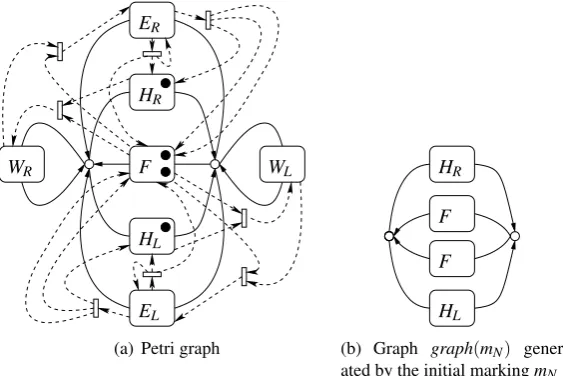
In this section we will give a short overview over the approximated unfolding technique de-scribed in [2]. First we define the notion of Petri graph which will be used to represent an over-approximation of a given GTS. Note that the edges of the graph are at the same time the places of the net and that the transitions are labelled with rules of theGTS.
Definition 4 (Petri graph) Let G = (R,G0) be a GTS. A Petri graph (over R) is a tuple
P= (G,N,µ), whereGis a graph,N= (EG,TN,•(),()•,pN)is anR-labelled Petri net where the
places are the edges ofGandµ associates to each transitiont∈TN, withpN(t) = (L,R,id), a
graph morphismµ(t):L∪R→Gsuch that•t=µ(t)⊕(EL)andt•=µ(t)⊕(ER).
A Petri graph for the GTS G is a pair (P,ι), where P= (G,N,µ) is a Petri graph over R andι :G0→Gis a graph morphism. A marking is reachable (coverable) in Petri graph if it is reachable (coverable) in the underlying Petri net with the multisetι⊕(EG0)as the initial marking.
We view Petri graphs as symbolic representations of transition systems with graphs as states. Specifically each markingm∈EG⊕of a Petri graph(G,N,µ)can be seen as representation of a graph, denoted bygraph(m), according to the following definition: We take the marked subgraph ofGand duplicate (or multiply) each edge as indicated by the marking. (See also Example3.)
More formally one can define graph(m) as the unique graph H, up to isomorphism, such thatH has no isolated nodes and there exists a morphismψ :H→G, injective on nodes, with ψ⊕(EH) =m.
In order to obtain a Petri graph approximating aGTS, we first need—as building blocks—Petri graphs that describe the effect of a single rule.
Definition 5(Petri graph for a rewriting rule) Letr= (L,R,id)be a rewriting rule. ByP(t,r) = (G,N,µ)we denote a Petri graph withG=L∪RandNis a net with placesSN=EL∪ERand one
transitiontsuch thatpN(t) =r,•t=ELandt•=ER. Furthermore the morphismµ(t):L∪R→G
is the identity.
Given aGTSG = (R,G0)one can construct an over-approximating Petri graphCG (also called thecoveringofG), using the following algorithm. It starts with a Petri graphP0that consists only of the start graph and computesCG iteratively. It is based on an unfolding technique which is combined with over-approximating folding steps which guarantee a finite approximation. Note that the covering returned is the coarsest over-approximation and there are various ways to refine it [4,12].
Algorithm 1(approximated unfolding) We setP0= (G0,N0,µ), whereN0contains no transi-tions,m0=EG0 and letι0: G0→G0 be the identity. As long as one of the following steps is applicable, transformPiintoPi+1according to one of the possibilities given below (where folding steps take precedence over unfolding steps).
EL
F ER
WR WL
HR
HL
(a) Petri graph
F F HR
HL
(b) Graph graph(mN)
gener-ated by the initial markingmN
Figure 2: Petri graph and generated graph for the dining philosophers example
Then choose a new transitiontand extendPiby attachingP(t,r), i.e., take the disjoint union of
both Petri graphs and factor through the equivalence≡generated bye≡ϕ(e)for everye∈EL.
Folding: Find a ruler= (L,R,id)∈R and two matchesϕ,ϕ0:L→Gi such that ϕ⊕(EL)and
ϕ0⊕(EL)are coverable inNiand the second match is causally dependent on the transition
unfold-ing the first match. Then merge the two matches by settunfold-ing ϕ(e)≡ϕ0(e)for each e∈EL and
factoring through the resulting equivalence relation≡.
If neither possibility applies the Petri graphPiobtained in the last step is returned. The result
is denoted byCG. In [2] it has been shown that the algorithm always terminates with a result unique up to isomorphism.
This approximated unfolding procedure has been implemented in the verification tool AU -GUR1, together with support for counterexample-guided abstraction refinement [12].
Example 2 For our running example (dining philosophers), the algorithm above returns the Petri graph depicted in Figure2(a). While the graph component is drawn as before, the Petri net transitions are depicted by small rectangular boxes with dashed lines connecting them to their pre- and post-sets. Furthermore the initial marking, i.e., the multiset image of the start graph underι, is indicated.
The algorithm above can be shown to be correct in the following sense.
Proposition 1(correctness of the approximated unfolding algorithm [5]) LetG = (R,G0)be
aGTSand letCG = ((G,N,µ),ι)be the covering obtained by Algorithm1. Then for every graph
G that is reachable inG from G0, there exists a marking m, reachable from the initial marking
ι⊕(EG0)in the net N, such that there is an edge-bijective morphism G→graph(m).
Example 3 The initial marking mN of the Petri graph in Figure 2(a) generates the graph
graph(mN)depicted in Figure2(b). Note that the two tokens in the edge (place) labelledFresult
in two parallelF-edges. All edges that are unmarked bymN disappear ingraph(mN). Also note
that there is an edge-bijective morphism from the start graph shown in Figure1tograph(mN).
This morphism merges the north-west and the south-east node as well as the north-east and the south-west node of the initial graph.
We will in the following show how to use the information provided by the over-approximation in order to verify that certain Euler paths or cycles do not appear in any reachable graph.
4
Euler Cycles and Semilinear Sets
Given a graph transformation system and a regular expressionr, we now want to show that no reachable graph admits a (Euler) path such that the sequence of labels on this path is described byr. That is, the regular expression specifies a set of forbidden paths.
Definition 6(Euler paths and cycles) LetGbe a graph andra regular expression over the al-phabetΛ. Then we say thatGcontains apath corresponding to rif there is a sequencee1. . .enof
edges such thattG(ei) =sG(ei+1)fori∈ {1, . . . ,n−1}and the wordlG(e1). . .lG(en)is contained
in the language ofr. This path is called anEuler pathif every edge ofGoccurs in the sequence exactly once. The graphGcontains anEuler cycle corresponding to rif it contains an Euler path for which additionallytG(en) =sG(e1)is satisfied.
As a starting point for our method we assume that the given (hyper-)graph transformation systemG has already been approximated by a Petri graphP= (G,N,µ).
Now, given a regular expressionr, the idea is to specify a set of markingsS⊆EG⊕of the Petri graphPsuch that a markingmis contained inSif and only ifgraph(m)has an Euler path (resp. cycle) corresponding tor. Since furthermore the property of having an Euler path is preserved by edge-bijective graph morphisms, it is sufficient to check that no such marking ofSis reachable in the approximating net.
It will turn out that the setSis alwayssemilinar[16], where semilinearity is defined as follows.
Definition 7(semilinear sets) LetS⊆EG⊕ be a set of markings. It is calledsemilinearif it is the finite union of sets of the form{m0⊕k1·m1⊕ · · · ⊕kn·mn|ki∈N0}, wherem0,m1, . . . ,mn
are markings.
Furthermore S can be computed via products of finite automata as shown in the following proposition.
Proposition 2(computing semilinear sets) Let G be a graph and let r be a regular expression. Then there (constructively) exists a semilinear set SGp,rsuch that for every m∈EG⊕
m∈SGp,r ⇐⇒ graph(m)has an Euler path corresponding to r.
Proof. For Euler paths, first construct an automatonA = (QA,Λ,δA,Q0A,FA)accepting the language ofr, whereQA is the set of states,Λis the alphabet,δA:QA ×Λ→P(QA)is the
transition function andQ0A,FA ⊆QA are the sets of initial respectively final states.
Now compute the cross product ofGandA where the transitions of the resulting automaton Bare labelled with the edge names ofG. In more detail:
QB = VG×QA
ΣB = EG
δB((v,q),e) = {(v0,q0)|sG(e) =v,tG(e) =v0,q0∈δA(q,lG(e))}
Q0B = VG×Q0A
FB = VG×FA
The automatonBaccepts the set of paths ofGthat correspond tor. We consider the monoid morphism α: EG∗ →EG⊕ from the free monoid EG∗ =Σ∗B to the free commutative monoid EG⊕
induced bye7→e. SinceL(B)(the language generated byB) is a rational set ofΣ∗Bit holds that
its imageSGp,r=α(L(B))is a rational and hence semilinear set ofEG⊕.
The easiest way to construct SGp,r is to transformB into a regular expressionr0 and then to inductively apply a functionα0convertingr0to a semilinear set:
α0(/0) = /0
α0(ε) = {0} (where 0 is the empty multiset) α0(e) = 1·e (ife∈EG)
α0(r1r2) = {m1⊕m2|m1∈α0(r1),m2∈α0(r2)} α0(r1+r2) = α0(r1)∪α0(r2)
α0(r∗) = {k1·m1⊕ · · · ⊕kn·mn|m1, . . . ,mn∈α0(r),k1, . . . ,kn∈N}
With some simplifications one then obtains a semilinear set as in Definition7.
It remains to check that a markingmis contained inSGp,rif and only if the graph generated by
mallows an Euler path corresponding tor:
m∈SGp,r=α(L(B))
⇐⇒ ∃e1. . .en∈L(B)s.t.m=α(e1. . .en)
⇐⇒ e1. . .enis a path in graphGwhich corresponds torand each edgee∈EGis
visitedm(e)times
⇐⇒ e1. . .enis a Euler path ofgraph(m)
For Euler cycles take several automata, one for each node v∈VG. For each automaton let {v} ×Q0A be the set of initial states and{v} ×FA the set of final states. This ensures that the accepted path starts and ends in the same node. Then take asScG,r the union of all languages generated by such automata.
Note that it is not particularly surprising that we obtain a semilinear set in this way. In a sense this can be seen as a corollary of Parikh’s theorem [13] which states that the Parikh image of every context-free language is semilinear. The Parikh image of a word language over the alphabetΣ
is a set of multisets over Σ, where the order of alphabet symbols is forgotten and only their
multiplicity is remembered. For instance, the Parikh image of the language{aabca,bbc, . . .}is the set{3·a⊕1·b⊕1·c,2·b⊕1·c, . . .}.
The functionα0used in the proof of Proposition2converting regular expressions into semi-linear sets works similarly: For instance let r0 =ab(b+c)∗ab be a regular expression. Then α0(r0) ={(2·a⊕2·b)⊕k1·b⊕k2·c|k1,k2∈N}.
Example4 We will now exemplify how semilinear sets can be used to verify the absence of deadlocks in our running example: by inspection of the rules we can observe that all reachable states are cycles and that furthermore the language of all cycles allowing a rule application is described by the following regular expressionrlhs:
Σ∗ELΣ∗+Σ∗ERΣ∗+Σ∗FHLΣ∗+HLΣ∗F+Σ∗HRFΣ∗+
FΣ∗HR+Σ∗WLFΣ∗+FΣ∗WL+Σ∗FWRΣ∗+WRΣ∗F.
This regular expression can be obtained by taking the labels of the left-hand sides in Figure1, ordering them as indicated by the edge directions and addingΣ∗ in order to indicate other, un-specified, labels on the cycle.
Then the regular expressionrdescribing forbidden deadlock states, allowing no rule applica-tion, can be obtained as the complement ofrlhs. (We do not give r explicitly, since it is fairly
complex.)
Using the technique explained above we obtain the following semilinear set S for the Petri graphCG approximating the dining philosophers system (see Figure2(a)):
S={k·e(WL)|k∈N} ∪ {k·e(WR)|k∈N}
wheree(WL)ande(WR)are the only edges inCG labelledWLandWRrespectively. This means,
the only way to obtain an Euler cycle allowing no rule applications is to have a cycle consisting exclusively ofWL-edges or exclusively ofWR-edges.
It now remains to show that no marking in the setSis reachable in the Petri graph.
5
Analysis of Graph Transformation Systems.
Theorem 1 LetG = (R,G0)be aGTSand letCG = ((G,N,µ),ι)be the covering obtained by
Algorithm1. Furthermore let r be a regular expression and let SGp,r, SGc,r be the semilinear sets of Proposition2(for paths respectively cycles).
If no marking of N, reachable fromι⊕(EG0), is contained in S
p
G,r, then no reachable graph of
G has a path corresponding to r. Furthermore, if no marking of N, reachable fromι⊕(EG0), is
contained in ScG,r, then no reachable graph ofG has a cycle corresponding to r.
The problem of checking whether a marking of a semilinear setSis reachable in a net N is decidable, since it is reducible to the reachability problem for Petri nets [16]. However, since this problem is not known to be primitive recursive and all known algorithms are very complex, it will usually be necessary to resort to approximative reachability methods based on the mark-ing equation and traps [8, 18, 20]. In the following we will study how traps can be used for approximative reachability checks.
Definition 8(trap) LetN be a Petri net. Atrap is a setΘof places such thatΘ•⊆•Θ, i.e.,
every transition that removes a token from a trap must also put a token into the trap.
For a trapΘit always holds that once it is marked, it will always be marked. Hence, ifΘis
initially marked, then a markingmwhich does not have a token insideΘcan not be reachable.
Example5 In the dining philosophers system the setΘ={e(F),e(WL),e(EL)}is a trap. Hence
we can conclude that a marking consisting only of tokens inWRcan not be reached. Symetrically
one can show that a marking consisting only of tokens inWLis not reachable. This concludes
the proof that no marking in the setSdefined above is reachable, hence the absence of this form of deadlocks is verified.
Instead of checking for the absence of paths or cycles where every edge is traversed exactly once, it is often useful to be able to verify the absence of paths where very edge is traversed at most once. The corresponding setS0 of markings can be easily obtained fromS as follows: replace every set of the form{m0⊕k1·m1⊕ · · · ⊕kn·mn|ki∈N0}by{m|m≥m0}, i.e., only the minimal elements are kept. To check whether a marking ofS0is reachable is a simpler prob-lem called the coverability probprob-lem for Petri nets and can be checked via so-called coverability graphs, although for efficiency reasons it can also be useful to employ the approximative methods described above.
6
Conclusion.
derived from the Petri net component.
On the practical side, checking whether a reachable marking is contained in a semilinear set can be done by solving linear inequations over the natural numbers in order to find suitable traps. Apart from traps other invariants (such as the marking equation) can be employed. For this task efficient tools such aslp solveare available (see also [20] which describes an implementa-tion).
Acknowledgements: I would like to thank Volker Diekert, Javier Esparza, Paolo Baldan and Arwed von Merkatz for interesting discussions on the topics of this paper. Furthermore I would like to thank Vitali Kozioura for developing and maintaining the AUGURtool.
Bibliography
[1] Parosh Aziz Abdulla, Bengt Jonsson, Mats Kindahl, and Doron Peled. A general approach to partial order reductions in symbolic verification. InProc. of CAV ’98, pages 379–390. Springer, 1998. LNCS 1427.
[2] Paolo Baldan, Andrea Corradini, and Barbara K¨onig. A static analysis technique for graph transformation systems. InProc. of CONCUR ’01, pages 381–395. Springer-Verlag, 2001. LNCS 2154.
[3] Paolo Baldan, Andrea Corradini, Barbara K¨onig, and Alberto Lluch Lafuente. A temporal graph logic for verification of graph transformation systems. InProc. of WADT ’06 (Work-shop on Algebraic Development Techniques), pages 1–20. Springer, 2007. LNCS 4409.
[4] Paolo Baldan and Barbara K¨onig. Approximating the behaviour of graph transformation systems. InProc. of ICGT ’02 (International Conference on Graph Transformation), pages 14–29. Springer-Verlag, 2002. LNCS 2505.
[5] Paolo Baldan, Barbara K¨onig, and Bernhard K¨onig. A logic for analyzing abstractions of graph transformation systems. In Proc. of SAS ’03 (International Static Analysis Sympo-sium), pages 255–272. Springer-Verlag, 2003. LNCS 2694.
[6] Andrea Corradini, Ugo Montanari, Francesca Rossi, Hartmut Ehrig, Reiko Heckel, and Michael L¨owe. Algebraic approaches to graph transformation—part I: Basic concepts and double pushout approach. In Grzegorz Rozenberg, editor,Handbook of Graph Grammars and Computing by Graph Transformation, Vol. 1: Foundations, chapter 3. World Scientific, 1997.
[7] Fernando Lu´ıs Dotti, Luciana Foss, Leila Ribeiro, and Osmar Marchi Santos. Verification of distributed object-based systems. In Proc. of FMOODS ’03, pages 261–275. Springer, 2003. LNCS 2884.
[9] Alain Finkel and Phillipe Schnoebelen. Well structured transition systems everywhere!
Theoretical Computer Science, 256(1-2):63–92, 2001.
[10] Gilles Geeraerts, Jean-Franc¸ois Raskin, and Laurent Van Begin. Expand, enlarge, and check - new algorithms for the coverability problem of WSTS. In Proc. of FSTTCS ’04, pages 287–298. Springer, 2004. LNCS 3328.
[11] Richard M. Karp and Raymond E. Miller. Parallel program schemata.Journal of Computer and System Sciences, 3(2):147–195, 1969.
[12] Barbara K¨onig and Vitali Kozioura. Counterexample-guided abstraction refinement for the analysis of graph transformation systems. InProc. of TACAS ’06, pages 197–211. Springer, 2006. LNCS 3920.
[13] Rohit Parikh. On context-free languages. Journal of the ACM, 13(4):570–581, 1966.
[14] Wolfgang Reisig. Petri Nets: An Introduction. EATCS Monographs on Theoretical Com-puter Science. Springer-Verlag, Berlin, Germany, 1985.
[15] Arend Rensink and Dino Distefano. Abstract graph transformation. InProc. of SVV ’05 (3rd International Workshop on Software Verification and Validation), volume 157.1 of
ENTCS, pages 39–59, 2005.
[16] Christophe Reutenauer. Aspects math´ematiques des r´eseaux de P´etri. Masson, 1989.
[17] Grzegorz Rozenberg, editor. Handbook of Graph Grammars and Computing by Graph Transformation, Vol.1: Foundations, volume 1. World Scientific, 1997.
[18] Claus Schr¨oter. Halbordnungs- und Reduktionstechniken f¨ur die automatische Verifikation von verteilten Systemen. PhD thesis, Universit¨at Stuttgart, 2005.
[19] D´aniel Varr´o. Towards symbolic analysis of visual modeling languages. InWorkshop on Graph Transformation and Visual Modeling Techniques ’02, volume 72 of ENTCS. Else-vier, 2002.