Dissertations - ALL SURFACE
May 2018
Efficient Online Scheduling in Distributed Stream Data Processing
Efficient Online Scheduling in Distributed Stream Data Processing
Systems
Systems
Teng LiSyracuse University
Follow this and additional works at: https://surface.syr.edu/etd
Part of the Engineering Commons
Recommended Citation Recommended Citation
Li, Teng, "Efficient Online Scheduling in Distributed Stream Data Processing Systems" (2018). Dissertations - ALL. 861.
https://surface.syr.edu/etd/861
This Dissertation is brought to you for free and open access by the SURFACE at SURFACE. It has been accepted for inclusion in Dissertations - ALL by an authorized administrator of SURFACE. For more information, please contact [email protected].
General-purpose Distributed Stream Data Processing Systems (DSDPSs) have attracted extensive attention from industry and academia in recent years. They are capable of pro-cessing unbounded big streams of continuous data in a distributed and real (or near-real) time manner. A fundamental problem in a DSDPS is the scheduling problem, i.e., assigning threads (carrying workload) to workers/machines with the objective of minimizing average end-to-end tuple processing time (or simply tuple processing time). A widely-used solu-tion is to distribute workload over machines in the cluster in a round-robin manner, which is obviously not efficient due to the lack of consideration for communication delay among processes/machines. A scheduling solution makes a significant impact on the average tuple processing time. However, their relationship is very subtle and complicated. It does not even seem possible to have a mathematical programming formulation for the scheduling problem if its objective is to directly minimize the average tuple processing time.
In this dissertation, we first propose a model-based approach that accurately models the correlation between a scheduling solution and its objective value (i.e. average tuple pro-cessing time) for a given scheduling solution according to the topology of the application graph and runtime statistics. A predictive scheduling algorithm is then presented, which as-signs tasks (threads) to machines under the guidance of the proposed model. This approach achieves an average of24.9% improvement over Storm’s default scheduler. However, the
model-based approach still has its limitations: the model may not be able to fully capture the features of a DSDPS; prediction may not be accurate enough; and a large amount of high-dimensional data may lead to high overhead.
To address the limitations, we develop a model-free approach that can learn to control a DSDPS from its experience rather than adopting accurate and mathematically solvable
proach for enabling effective model-free control. The proposed DRL-based model-free approach minimizes the average end-to-end tuple processing time by jointly learning the system environment via collecting very limited runtime statistics and making decisions under the guidance of powerful Deep Neural Networks (DNNs). This approach achieves great performance improvement over the current practice and the state-of-the-art model-based approach.
Moreover, there is still room for improvement for the above model-free approach: For the above model-free approach and most existing methods, a user specifies the number of threads for an application in advance without knowing much about runtime needs, which, however, remains unchanged during runtime. This could severely affect the performance of a DSDPS. Therefore, we further develop another model-free approach using DRL, EX-TRA, which enables the dynamic use of a variable number of threads at runtime. It has been shown by extensive experimental results, by adding this new feature, EXTRA can achieve further performance improvement and greater flexibility on scheduling.
STREAM DATA PROCESSING SYSTEMS
By
Teng Li
B.S. (Applied Mathematics), Beijing University of Posts and Telecommunications, 2010
DISSERTATION
Submitted in partial fulfillment of the requirements for the degree of Doctor of Philosophy in Electrical and Computer Engineering
Syracuse University May 2018
I would like to express my sincere appreciation for all the guidance, supports and company I had received during my rewarding Ph.D. journey.
I would like to express my deepest gratitude to my advisor, Dr. Jian Tang. for the continuous support of my Ph.D. study and research. Your patience, motiva-tion and immense knowledge sets me a living example of a great researcher and a mentor. Your guidance is a beacon leading me through the research journey full of thorns, helping me get thorough the darkest days. You point out my weakness and help me improve. I could not have imagined having a better advisor for my Ph.D. study.
Besides my advisor, I would like to thank the committee members for all your insightful feedbacks and encouragements.
I also would like to thank my fellow lab mates for the stimulating discussions, for the sleepless nights we were working together before deadlines, and for all the fun we have had in the past six years. I wish you all the best.
My final but everlasting gratitude goes to my family, who have been a constant source of love and strength. Your sacrificial love and prayers have strengthened me to finish my study through the toughest times. I owe you my deepest respect and gratitude.
Acknowledgments v
1 Introduction 1
1.1 Motivations . . . 1
1.2 Background . . . 5
1.2.1 Distributed Stream Data Processing System (DSDPS) . . . 5
1.2.2 Apache Storm . . . 8
1.2.3 Deep Reinforcement Learning (DRL) . . . 8
1.3 State of the Art and Literature Gap . . . 11
1.4 Contributions and Dissertation Organization . . . 16
2 Model-based Scheduling for Distributed Stream Data Processing Systems (DS-DPSs) 18 2.1 Overview . . . 18
2.2 Design and Implementation of the Proposed Framework . . . 19
2.2.1 Overview of Our Design . . . 19
2.2.2 Performance Prediction-based Scheduling . . . 21
2.2.3 Implementation Details . . . 28
2.3 Performance Evaluation . . . 31
2.3.1 Experimental Setup . . . 31
2.3.2 Experimental Results and Analysis . . . 34
2.4 Summary . . . 39 vi
3.2 Design and Implementation of the Proposed Framework . . . 42
3.2.1 Overview of Our Design . . . 42
3.2.2 DRL-based Scheduling . . . 44
3.2.3 Implementation Details . . . 52
3.3 Performance Evaluation . . . 53
3.3.1 Experimental Setup . . . 53
3.3.2 Experimental Results and Analysis . . . 54
3.4 Summary . . . 62
4 Model-free Scheduling for DSDPSs with a Variable Number of Threads 64 4.1 Overview . . . 64
4.2 Design and Implementation of the Proposed Framework . . . 65
4.2.1 Overview of Our Design . . . 65
4.2.2 DRL-based Scheduling with a Variable Number of Threads . . . 66
4.2.3 Implementation Details . . . 73
4.3 Performance Evaluation . . . 74
4.3.1 Experimental Setup . . . 74
4.3.2 Experimental Results and Analysis . . . 77
4.4 Summary . . . 82
5 Conclusion and Future Work 83
References 85
C
HAPTER
1
I
NTRODUCTION
1.1 Motivations
Emerging big stream data applications demand the underlying system to process hetero-geneous, fast and high-volume data in a distributed and timely manner. A widely-used solution is parallel/distributed data processing, which divides input data into many small pieces and processes them in parallel over a large number of physical machines. MapRe-duce [1] and Hadoop [2] have emerged as thede factoprogramming model and system for big data processing respectively. However, they are not suitable for continuous stream data or online processing because they were designed for offline batch processing of static data, in which all input data need to be stored on a distributed file system in advance.
Here we focus on general-purpose Distributed Stream Data Processing Systems (DS-DPSs) (such as Apache Storm [3] and Google’s MillWheel [6]), which deal with pro-cessing of unbounded streams of continuous data at scale distributedly in real or near-real time. Their programming models and runtime systems are quite different from those of MapReduce-based batch processing systems, such as Hadoop [2] and Spark [27], which usually handle static big data in an offline manner, and they employ different message passing, fault tolerance and resource allocation mechanisms that are designed specifically
for online stream data processing.
In a Distributed Stream Data Processing System (DSDPS), an application is usually modeled using a directed graph, in which each vertex corresponds to a data source or a Processing Unit (PU), and edges indicate data flow.
A stream data processing system handles unbounded streams of data tuples, which may last for a long time, therefore, the tuple processing time, i.e., the time between when the tuple comes out of the data source and the time when its processing is completed and acknowledged, is usually used as the primary performance metric. A tuple may traverse multiple PUs and experience various latencies (such as processing latency at a PU and transfer latency between PUs) during its lifetime.
A fundamental problem in a DSDPS is the scheduling problem (i.e., assigning work-load to workers/machines) with the objective of minimizing average (end-to-end) tuple processing time (i.e. end-to-end delay). A widely-used solution is to distribute workload over machines in the cluster in a round-robin manner [3], which is obviously not efficient due to lack of consideration for communication delay among processes/machines.
In distributed batch processing systems (such as MapReduce-based systems), an indi-vidual task’s completion time can be well estimated [46], and the scheduling problem can be well formulated into a Mixed Integer Linear Programming (MILP) problem with the ob-jective of minimizing the makespan of a job [47, 48]. Then it can be tackled by optimally solving the MILP problem or using a fast polynomial-time approximation/heuristic algo-rithm. However, in a DSDPS, a task or an application never ends unless it is terminated by its user. A scheduling solution makes a significant impact on the average tuple processing time. But their relationship is very subtle and complicated. It does not even seem pos-sible to have a mathematical programming formulation for the scheduling problem if its objective is to directly minimize average tuple processing time.
We may be able to better solve the scheduling problem if we can accurately model the correlation between a scheduling solution and its objective value (i.e. average tuple
pro-cessing time), that is, to predict/estimate average tuple propro-cessing time for a given schedul-ing solution. However, how to accurately model and predict tuple processschedul-ing time in a DSDPS is quite challenging and has not yet been well studied.
Queueing theory has been applied for modeling and prediction in distributed database systems [5]. However, it does not work for general-purpose stream data processing due to the following reasons: 1) Queueing theory can only offer good estimation for queueing de-lay under a few assumptions (e.g, tuple arrivals follow a Poisson distribution, etc), which, may not hold in a complex distributed data processing system. 2) In queueing theory, many problems in a queueing network (instead of a single queue) remain unknown, while a dis-tributed data processing system represents a fairly complicated multi-point to multi-point queueing network where tuples from a queue may be distributed to multiple downstream queues, and a queue may receive tuples from multiple different upstream queues.
We plan to propose a novel predictive scheduling framework to enable fast and dis-tributed stream processing, which features application-aware modeling for performance prediction and predictive scheduling. The application-aware modeling will accurately model and predict the average tuple processing time for a given scheduling solution, according to the topology of the application graph and runtime statistics. The scheduling will assign tasks (threads) to machines under the guidance of the prediction results.
Even if we could develop a relatively accurate model to calculate the objective value win the knowledge of a given scheduling solution, the approach still suffers from two prob-lems: 1) In a very complicated distributed computing environment such as a DSDPS, tu-ple processing time may be caused by many factors, which are not fully captured by the model. 2) Prediction for each individual component may not be accurate enough. 3) A large amount of high-dimensional statistics data need to be collected to build and update the model, which leads to high overhead.
Therefore it is desirable to develop a model-free approach that can learn to well con-trol a DSDPS from its experience rather than adopting accurate and mathematically
solv-able system models, just as a human learns a skill (such as cooking, driving, swimming, etc.) Besides, recent breakthrough of Deep Reinforcement Learning (DRL) [41] provides a promising technique for enabling effective model-free control. DRL [41] (originally devel-oped by a startup named DeepMind) enables computers to learn to play games, including Atari 2600 video games and one of the most complicated games, Go (AlphaGo [42]), and beat the best human players.
DRL consists of an offline Deep Neural Networks (DNN) construction phase, which correlates the value function with corresponding states and actions, and an online deep Q-learning phase for action selection, system control, and DNN updating. We believe DRL is especially promising for control in DSDPSs because: 1) It has advantages over other dynamic system control techniques such as model-based predictive control in that the former is model-free and does not rely on accurate and mathematically solvable system models (such as queueing models), thereby enhancing the applicability in complex systems with randomized behaviors. 2) it is capable of handling a sophisticated state space (such as AlphaGo [42]), which is more advantageous over traditional Reinforcement Learning (RL) [45]. 3) It is able to deal with time-variant environments such as varying system states and user demands.
However, direct application of the basic DRL technique, such as Deep Q Network (DQN) based DRL proposed in the pioneering work [41], may not work well here since it is only capable of handling control problems with a limited action space but the control problems (such as scheduling) in a DSDPS usually have a sophisticated state space, and a huge action (worker threads, worker processes, virtual/physical machines, and their combi-nations) space. Moreover, the existing DRL methods [41] usually need to collect big data (e.g., lots of images for the game-playing applications) for learning, which are additional overhead and burden for an online system. Our goal is to develop a method that only needs to collect very limited statistics data during runtime.
model-free approach to control DSDPSs.
Even if an approach described above could be developed, there is still room for im-provement: while in those approaches (including most current state-of-the-art), a user spec-ifies the number of threads/processes for a (logic) Processing Unit (PU) in an application in advance without knowing much about runtime needs, which, however, remains unchanged during runtime. This could severely affect the performance of the DSDPSs.
We aim to develop a scheduling framework for DSDPSs which is capable of integrating changing the number of threads into the data/experience-driven model-free control frame-work, which can fully embrace the power and flexibility brought by a variable number of threads. However, this new feature makes the scheduling problem much harder since the new problem involves jointly determining the number of threads and their assignment at the same time.
1.2 Background
In this section, we provide a brief background introduction to DSDPS, Apache Storm and DRL.
1.2.1 Distributed Stream Data Processing System (DSDPS)
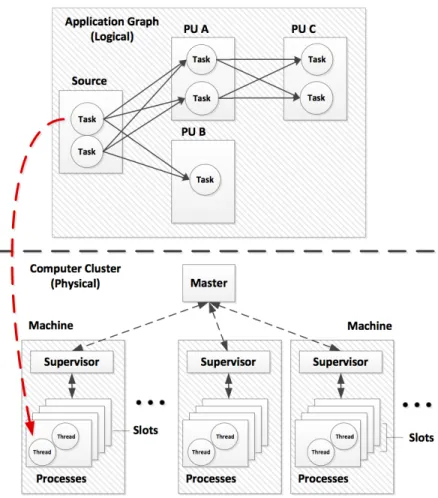
The typical architecture of a Distributed Stream Data Processing System (DSDPS) is il-lustrated in Fig. 1.1. As mentioned above, a stream is defined as an unbounded sequence of tuples and an application is usually modeled as a directed graph (known as topology in Storm), which includes two types of components: data source (known as spout in Storm) and Processing Unit (PU, known as bolt in Storm). A data source reads data from external source(s) and then emits tuples into the topology. A PU consumes tuples from data sources or other PUs, and processes them using code provided by the user. A PU can either store data to a database, or pass it to some other units for further processing. These components
are represented by vertices in the application graph, where directed edges indicate how data streams are routed. Data sources and PUs can be executed as many parallel tasks on mul-tiple physical/virtual machines, therefore a task can be considered as an instance of a data source or processing unit. To ensure reliability, when the message ID of a tuple coming out of a data source successfully traverses the whole application graph, a special acker is called to inform the originating data source that message processing is complete. The tuple processing is the duration between when the data source emits the tuple and when it has been acked (fully processed). Note that we are only interested in the processing times of those tuples emitted by data sources since they reflect processing latency over the whole application. Clearly, a scheduling solution has a significant impact on the tuple processing time. There are 5 ways for grouping, which define how to route tuples between sets of tasks:
• Shuffle grouping: Tuples are randomly distributed across receiving bolt’s tasks and
each task is guaranteed to receive an equal number of tuples.
• Fields grouping: A field of a tuple is used as the key to partition the stream. Tuples with the same key will be mapped to the same task.
• All grouping: Each tuple is broadcasted to all tasks of the corresponding bolt. • Global grouping: The entire stream is routed to one of the bolt’s tasks, usually the
task with the lowest ID.
• Direct grouping: The producer of the stream decides which task of the consuming
bolt will receive each tuple.
A DSDPS usually uses two levels of abstractions (logical and physical) to express par-allelism. In the physical layer, it usually consists of a master (known as Nimbus in Storm) that serves as the central control unit, and a set of machines (called worker nodes in Storm)
that actually process incoming data. An application graph (topology) is executed on multi-ple worker processes (called workers in Storm) running on one or multimulti-ple worker nodes. Each worker node runs a daemon called supervisor that listens for any work assigned to it by the scheduler. Slots are configured on each worker node. The number of slots indicates the number of workers that can be run on this worker node, and is usually pre-configured by the cluster operator based on hardware constraints such as the number of CPU cores. Each worker uses multiple threads (known as executors in Storm) to actually process data according to user code.
Fig. 1.1: The typical architecture of a Distributed Stream Data Processing System (DS-DPS)
The master is responsible for distributing users’ code around the cluster, scheduling tasks, and monitoring them for failures. A scheduling solution specifies how to assign threads (executors) to processes (workers) and physical/virtual machines (worker nodes).
Storm includes a default scheduler, which uses a simple scheduling solution, which assigns executors to pre-configured workers in a round-robin manner and then evenly assigns those workers to available slots on worker nodes. This scheduling solution leads to almost even distribution of executors over available slots.
1.2.2 Apache Storm
Since we implemented the proposed frameworks based on Apache Storm [3], we briefly introduce it here. Apache Storm is an open-source and fault-tolerant DSDPS, which has an architecture and programming model very similar to what described above, and has been widely used by quite a few companies and institutes. In Storm, data source, PU, appli-cation graph, master, worker process and worker thread are called spout, bolt, topology, Nimbus, worker and executor, respectively. Storm usesZooKeeper[43] as a coordination service to maintain it’s own mutable configuration (such as scheduling solution), naming, and distributed synchronization among machines. All configurations stored in ZooKeeper are organized in a tree structure. Nimbus (i.e., master) provides interfaces to fetch or update Storm’s mutable configurations. A Storm topology contains a topology specific configura-tion, which is loaded before the topology starts and does not change during runtime.
1.2.3 Deep Reinforcement Learning (DRL)
A standard RL setup consists of an agent interacting with an environment in discrete de-cision epochs. The agent observes state st, takes an action at and receives a rewardrt at
each decision epocht. The goal is to find a policy⇡(s)that maps a state to an action or
ac-tions deterministically or probabilistically to maximize the discounted cumulative reward
R0 = PTt=0 tr(st,at), where r(·) is the reward function and 2 [0,1] is the discount
factor.
DRL [41] extends the well-known Q-learning to support end-to-end system control based on high-dimensional sensory input (such as raw images) using a Deep Neural
Net-work (DNN). During the training phase, a DNN called Deep Q-NetNet-work (DQN) is built to derive the correlation between each state-action pair(st,at)of the system under control
and its value function Q(st,at), which is the expected discounted cumulative reward. if
the system is in state st and follows action at at decision epocht (and a certain policy⇡
thereafter): Q(st,at) = E h Rt|st,at i , (1.1)
whereRt =PTk=t kr(st,at). A commonly-used off-policy method takes the greedy
pol-icy:⇡(st) = argmaxatQ(st,at). The DQN can be trained by minimizing the loss:
L(✓Q) =Ehyt Q(st,at|✓Q) i
, (1.2)
where✓Qis the weight vector of the DQN andy
tis the target value, which can be estimated
by:
yt=r(st,at) + Q(st+1,⇡(st+1|✓⇡)|✓Q). (1.3)
Using a neural network (or even a DNN) as the function approximator in RL is not new. However, such a non-linear approximator is known to suffer from instability or even divergence. Two effective techniques were introduced in [41] to improve stability: experi-ence replay and target network. Unlike traditional RL, a DRL agent updates the DNN with a mini-batch from an experience replay buffer [41], which stores state transition samples collected during learning. Compared to the original Q-learning using only immediately collected samples, DRL randomly sample from the experience replay buffer. This allows a DRL agent to break the correlation among sequentially generated samples, and learn from a more independently and identically distributed past experiences, which is required by most of the training algorithms, such as Stochastic Gradient Descent (SGD). So experience replay can smooth out learning as well as avoiding oscillations or divergence. In addition, a DRL agent introduces a separate target network (with the same structure as DQN) to es-timate target values< yt >for training the DQN, whose parameters, however, are slowly
updated with the DQN weights everyC >1epochs and are held fixed between individual
updates.
The DQN-based DRL only works for control problems with a low-dimensional discrete action space. It is not trivial to extend it to deal with a continuous or high-dimensional dis-crete action space since it needs to find the action that maximizes the action-value function, which, however, requires an iterative process to solve a non-trivial non-linear optimization problem (continuous) or search for the best action in a large space at each epoch.
The commonly-used method for continuous control is the actor-critic approach [49], which employs the policy gradient to search for the optimal policy. The traditional actor-critic approach can also be extended to embrace DNN (such as DQN) to guide decision making [59]. For example, a recent work [59] from DeepMind introduced a deterministic actor-critic method, called Deep Deterministic Policy Gradient (DDPG), which has been shown to be very effective for continuous control. The basic idea is to maintain a parame-terized actor function⇡(st|✓⇡)and a parameterized critic functionQ(st,at|✓Q). The critic
function can be implemented using the above DQN, which returns Q value for a given
state-action pair. The actor function can also be implemented using a DNN, which speci-fies the current policy by mapping a state to a specific action. According to [54], the actor network can be updated by applying the chain rule to the expected cumulative reward J
with respect to the actor parameters✓⇡:
r✓⇡J ⇡E h r✓⇡Q(s,a|✓Q)|s=st,a=⇡(st|✓⇡) i =EhraQ(s,a|✓Q)|s=st,a=⇡(st)·r✓⇡⇡(s|✓ ⇡) |s=st i . (1.4)
Note that the experience replay and target network introduced above can also be integrated to this approach to ensure stability.
1.3 State of the Art and Literature Gap
Distributed/Parallel Stream Data Processing Systems (DSDPSs):
Recently, several general-purpose distributed/parallel systems have been developed par-ticularly for stream data processing. As introduced above, Apache Storm [3] is an open-source, distributed, reliable and fault-tolerant DSDPS that is designed particularly for on-line processing of unbounded stream data. Storm provides a directed graph based model for programming as well as an effective mechanism to guarantee message processing. It supports fault-tolerance by monitoring worker processes and re-starting failed ones in a timely manner. Apache S4 (Simple Scalable Streaming System) [4] is another general-purpose, distributed, scalable and pluggable platform for processing continuous and un-bounded streams of data. Time-Stream [7] is a distributed system designed by Microsoft specifically for low-latency continuous processing of big streaming data in the cloud. It employs a powerful new abstraction called resilient substitution that caters to the specific needs in this new computation model to handle failure recovery and dynamic reconfigu-ration in response to load changes. MillWheel [6] is a platform for building low-latency data processing applications, which is widely used at Google. In MillWheel, users specify a directed computation graph and application code for individual nodes, and the system manages persistent states and the continuous flows of data, all within the envelope of the framework’s fault-tolerance guarantees. In addition, Apache Flink [18] is a open source framework for distributed big data analytics, the core of which is a distributed streaming data flow engine written in Java and Scala.
A few other distributed systems were developed to extend MapReduce to support stream data processing. In [20], Kumaret al. extended IBM’s System S stream processing mid-dleware with support for MapReduce by providing language and runtime support for speci-fying and embedding MapReduce jobs as elements of a larger data flow. In [21], a modified MapReduce architecture was introduced, which allows data to be pipelined between oper-ators. This extends the MapReduce programming model beyond batch processing, and can
reduce completion times and improve system utilization for batch processing jobs. Karveet al. in [22] proposed to use pipelining between the map and reduce phases to ensure the output of the map phase is made available to the reduce phase as soon as possible to speed up the execution of MapReduce jobs. In [23], Alyet al. presented a Hadoop-based sys-tem,M3, which bypasses the HDFS to support main-memory-only processing and allows
for continuous execution of the map and reduce phases where individual mappers and re-ducers never terminate. Backman et al. presented C-MR [24], a modified MapReduce processing model to continuously execute workflows of MapReduce jobs on unbounded data streams. Other MapReduce-like systems include Google’s FlumeJava [25] and Wal-martLab’s Muppet [26], Twitter’s Heron [55] and commercial solutions including Azure Stream Analytics [56] and Amazon Kinesis [57]. Muppet [26] was developed by Wal-martLab for fast data processing, in which an update (instead of reduce) function is used to continuously update output based on data streams. FlumeJava was presented in [25], which is a Java library that makes it easy to develop, test, and run efficient data parallel pipelines. In addition, Apache Spark [27] is currently one of the most popular open source MapReduce-based frameworks. Spark Streaming [28] is a stream data processing system that uses the core Apache Spark API and its fast scheduling capability to perform stream-ing analytics. It stream-ingests data in mini-batches and performs RDD transformations on those mini-batches of data. In [29], the authors presented design, implementation and evaluation of a novel GPU-accelerated system, G-Storm, for distributed stream data processing.
Unlike these related works that presented design and implementation of programming model and/or runtime systems for distributed stream data processing, in Chapter 2, our model-based scheduling framework focuses on performance modeling and prediction.
Modeling and Scheduling in DSDPSs: In [30], scheduling strategies aiming at mini-mizing tuple latency and total memory requirement were proposed for a Data Stream Man-agement System (DSMS). The authors first proposed a strategy with a goal of minimizing tuple latency, followed by another one minimizing maximal memory requirement. This
work mainly focused on deciding the processing order of the arriving tuples; while our work highlights the scheduling assignment of working threads. In another early work [31], the authors proposed novel operator scheduling approaches for data stream systems, which specify (1) which operators to schedule, (2) in which order to schedule the operators, and (3) how many tuples to process at each execution step. They studied the proposed ap-proaches in the context of the Aurora data stream manager. In [32], an offline sched-uler and an online schedsched-uler were presented for Storm. The former works by analyzing the topology structure and making scheduling decisions; the latter works by continuously monitoring system performance and rescheduling executors at runtime to improve overall performance. Xuet al. presented T-Storm in [9], which focused on traffic-aware schedul-ing that minimizes inter-node and inter-process traffic in Storm while ensurschedul-ing no worker nodes were overloaded. It also enables fine-grained control over worker node consolida-tion. In [33], Bellavista et al. proposed a general and simple technique to design and implement priority-based resource scheduling in flow-graph-based distributed stream pro-cessing systems by allowing application developers to augment flow graphs with priority metadata and by introducing an extensive set of priority schemas. In an early work [5], Nicola and Jarke provided a survey of performance models for distributed and replicated database systems, especially queueing theory based models. In [34], Weiet al. proposed a prediction based Quality-of-Service (QoS) management scheme for periodic queries over dynamic data streams. The scheme features novel query workload estimators which predict the query workload using execution time profiling and input data sampling. The authors of [35] described a decentralized framework for proactively predicting and alleviating hot-spots in distributed stream processing applications in real-time. In a recent work [36], the authors presented a novel technique for resource usage estimation of data stream process-ing workloads in the cloud, which uses mixture density networks, a combined structure of neural networks and mixture models, to estimate the whole spectrum of resource usage as probability density functions. In [37], Bediniet al. presented a set of models that formalize
the performance characteristics of a practical distributed, parallel and fault-tolerant stream processing system using Actor Model theory. They modeled the characteristics of the data flow, the data processing and the system management costs at a fine granularity within the different steps of executing a distributed stream processing job. In addition, they presented an experimental validation of the proposed performance models using Storm. In a very recent work [50], Li et al. proposed a dynamic optimization algorithm for Storm based on the theory on constraints (STDO-TOC), which dynamically eliminates the performance bottleneck of a topology. In addition, they proposed a real-time scheduling algorithm based on topology and traffic to effectively solve the problem of inter-node load imbalance.
Unlike these related works, in Chapter 2, we present a application-aware method to predict average tuple processing time (rather than hotspot [35], workloads [36], or data processing and system management costs [37]) particularly for a typical big stream data processing system (such as Storm and S4), whose programming model and runtime system are different from those in [30, 31, 34]. In addition, we develop a predictive scheduling algorithm (that works closely with the proposed prediction method), which is different from priority-based methods [33] or those algorithms aiming at minimizing traffic between worker nodes [9, 32].
Moveover, unlike these related works, in Chapter 3 and Chapter 4, we also aim to de-velop an experience/data driven model-free approach for scheduling in DSDPSs to directly minimize the average tuple processing time with the application of the state-of-the-art DRL techniques, which has no been done before. Regarding dynamically changing the number of threads on the fly, Liet al. did include this feature in their work [50], however, the pa-rameters were controlled by mathematical models, while ours takes a model-free approach with DRL techniques.
Deep Reinforcement Learning (DRL):DRL has recently attracted extensive attention from both industry and academia. On one hand, some works were focused on discrete con-trol with a limited action space. In a pioneering work [41], Mnih et al. proposed Deep
Q Network (DQN), which can learn successful policies directly from high dimensional sensory inputs. This work bridges the gap between high-dimensional sensory inputs and actions, resulting in the first artificial agent that is capable of learning to excel at a diverse array of challenging gaming tasks. The paper [60] considered a problem of multiple agents sensing and acting with the goal of maximizing their shared utility, based on DQN. The au-thors designed agents that can learn communication protocols to share information needed for accomplishing tasks. The authors of [61] proposed Double Q-learning as a specific adaptation to the DQN, which is introduced in a tabular setting and can be generalized to work with a large-scale function approximation. Schaulet al. proposed the prioritized ex-perience replay in DQN in [51], in order to replay important transitions more frequently thus learn more efficiently. On the other hand, other works further extend DRL to address continuous control. Lillicrapet al. [59] proposed an actor-critic, model-free algorithm , DDPG, based on the deterministic policy gradient that can operate over continuous action spaces. Duanet al. [62] presented a benchmark suite of control tasks to quantify progress in the domain of continuous control. Gu et al. presented normalized advantage functions to reduce sample complexity for continuous tasks in [63]. Mnihet al. [53] presented asyn-chronous gradient descent for optimizing learning with DNNs with the result of successes of asynchronous actor-critic method on various continuous motor control tasks. Arnoldet al. [64] extended the methods proposed for continuous actions to make decisions within a large discrete action space. In [58], the authors employed a DRL framework to jointly learn state representations and action policies using game rewards as feedback in the task of learning control policies for text-based games, where the action space contains all possible text descriptions. Guet al. [52] proposed a policy gradient method named Q-Prop with the application of a Taylor expansion of the off-policy critic as a control variant.
In addition, RL/DRL has been applied to control of big data and cloud systems. In [71], the authors proposed a novel MapReduce scheduler in heterogeneous environments based on RL, which observes the system state of task execution and suggests speculative
re-execution of the slower tasks on other available nodes in the cluster. An RL approach was proposed in [72] to enable automated tuning configuration of MapReduce parameters. Liu
et al. [73] proposed a novel hierarchical framework for solving the overall resource re-source allocation and power management problem in cloud computing systems with DRL. The control problems in MapReduce and cloud systems are quite different from the prob-lem studied here. Hence, the methods proposed in these related works cannot be directly applied here.
Even though the emerging DRL has made tremendous successes on various control tasks, it remains unknown if and how it can be applied to solving complicated control and resource allocation problems in complex distributed computing systems such as DSDPSs. The proposed work makes one of the first efforts along this line.
1.4 Contributions and Dissertation Organization
In the dissertation, we propose efficient online scheduling in Distributed Stream Data Pro-cessing Systems (DSDPSs). Specifically, we make the following contributions:
• In Chapter 2, we propose a novel predictive scheduling framework to enable fast and distributed stream data processing, which features application-aware modeling for performance prediction and predictive scheduling. For prediction, we present a application-aware method to accurately predict the average tuple processing time of an application for a given scheduling solution, according to the topology of the application graph and runtime statistics. For scheduling, we present an effective algorithm to assign threads to machines under the guidance of prediction results.
• In Chapter 3, we present a novel model-free approach that can learn to well con-trol a DSDPS from its experience rather than accurate and mathematically solvable system models, just as a human learns a skill (such as cooking, driving, swimming,
etc). Specifically, we, for the first time, propose to leverage emerging Deep Rein-forcement Learning (DRL) for enabling model-free control in DSDPSs; and present design, implementation and evaluation of a novel and highly effective DRL-based control framework, which minimizes average end-to-end tuple processing time by jointly learning the system environment via collecting very limited runtime statistics data and making decisions under the guidance of powerful Deep Neural Networks (DNNs).
• In Chapter 4, we present a model-free approach with a variable number of threads. The proposed approach enables a DSDPS to dynamically change the number of threads during runtime according to system states and demands. Moreover, the proposed approach leverages an experience/data driven model-free approach for dy-namic control using the DRL, which enables a DSDPS to learn the best way to control itself from its own experience.
The rest of the dissertation is organized as follows: We propose a novel predictive scheduling framework featuring application-aware modeling for performance prediction and predictive scheduling in Chapter 2. In Chapter 3, we propose a novel model-free approach that can learn to well control a DSDPS from its experience with the application of DRL. In Chapter 4, a model-free approach with a variable number of threads is proposed, enabling a DSDPS to dynamically change the number of threads on the fly during runtime, which extends the previous model-free approach and leads to more flexible and efficient control. The conclusion of the dissertation is presented in Chapter 5.
C
HAPTER
2
M
ODEL
-
BASED
S
CHEDULING FOR
D
ISTRIBUTED
S
TREAM
D
ATA
P
ROCESSING
S
YSTEMS
(DSDPS
S
)
2.1 Overview
In this chapter, we propose a novel predictive scheduling framework to enable fast and dis-tributed stream data processing, which features topology-aware modeling for performance prediction and predictive scheduling. Moreover, we validate and evaluate the proposed framework based on an emerging platform, Apache Storm [3], which has been widely used in many companies and organizations, such as Twitter, Groupon, Yelp, etc. We summarize our contributions in the following:
• For prediction, we present a topology-aware method to accurately model and predict
the average tuple processing time of an application for a given scheduling solution, according to the topology of the application graph and runtime statistics.
ma-chines under the guidance of the prediction results.
• We implemented the proposed framework based on Storm, and tested it with 3 rep-resentative applications: word count (stream version), log stream processing and continuous queries. It has potential to be applied to other similar platforms, such as Yahoo!’s S4 [4] Google’s MillWheel [6] and Microsoft’s TimeStream [7].
• Extensive experimental results well justify accuracy of the proposed prediction method
and effectiveness of the proposed scheduling algorithm.
To the best of our knowledge, we are the first to propose a method for modeling and predicting the average tuple processing time in a distributed stream data processing system and validate the proposed method with the widely-used open-source platform, Storm.
2.2 Design and Implementation of the Proposed
Frame-work
In this section, we present the design and implementation details of the proposed frame-work.
2.2.1 Overview of Our Design
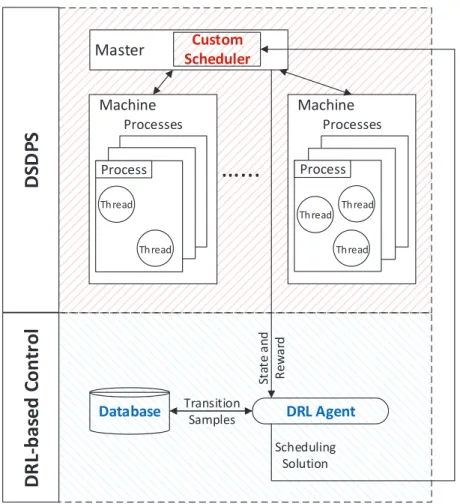
As illustrated in Fig. 2.1, the proposed framework consists of several modules, including data collector, data store, time synchronizer, data pre-processor, performance predictor, schedule generator, and custom scheduler. The data collector runs as multiple threads to collect runtime statistics from all processes/machines in the cluster, which are then stored into the distributed data store. The data pre-processor prepares input data for prediction and scheduling based on raw data in the data store. The time synchronizer provides necessary synchronization for threads of the data collector.
Master Processes Process Machine
…
...
DS
D
PS
Process Custom Scheduler Database DRL Agent Machine ProcessesD
R
L-b
as
ed
C
on
tr
ol
St at e an d R ew ar d Scheduling Solution Transition Samples Thread Thread Thread Thread ThreadFig. 2.1: The proposed predictive scheduling framework
The most important modules of the proposed framework include performance predic-tor, schedule generator and the custom scheduler. The performance predictor employs the proposed prediction method to predict the average tuple processing time of an applica-tion, which is introduced in Sections 2.2.2. The schedule generator generates a scheduling solution that defines how executors (i.e., instances of stream operators) are assigned to workers/worker nodes using the proposed scheduling algorithm (Section 2.2.2). The cus-tom scheduler keeps reading the current scheduling solution from the schedule generator and deploys executors accordingly with the help of the master node on the fly.
Next, we introduce the proposed prediction and scheduling methods first, and then we describe the functions and implementation of these modules in details in Section 2.2.3. Note that the proposed modeling and prediction method works (or can be slightly modified
to work) for any system in which an application is modeled using a directed graph and the proposed predictive scheduling algorithm works for any runtime system in which each PU is executed using multiple threads at runtime.
2.2.2 Performance Prediction-based Scheduling
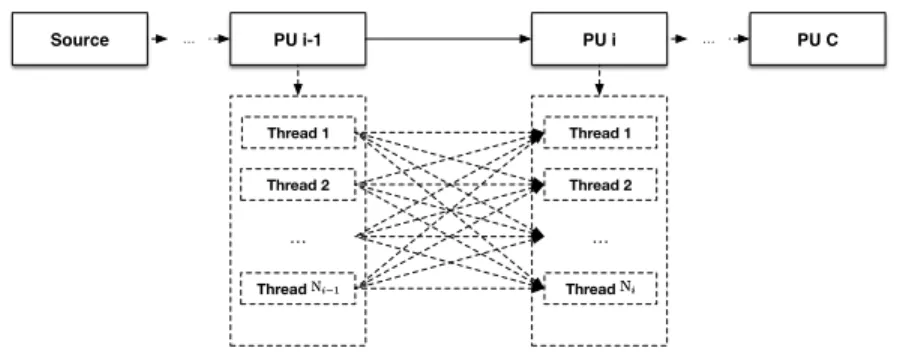
Topology-aware Performance Prediction ModelWe aim to model and predict the average tuple processing time of an application for a given scheduling solution, which can serve as a guideline to make a wise decision on task scheduling. Our idea is to predict the average tuple processing latency at each PU and the average tuple transfer latency between PUs (including both queueing and communication latencies) and add them up in a certain way according to the topology of the application graph. First, we show how to model the average tuple processing time of a typical applica-tion, whose topology is a chain. Then we extend it to graphs with general topologies.
PU i-1 PU i Thread 1 Thread 2 Thread NiNi11 Thread 1 Thread 2 Thread NNii … … Source … … PU C
Fig. 2.2: A chain topology
First, we focus on a typical application graph with a chain topology as shown in Fig. 2.2. There are a total of C + 1 components in the topology with C PUs and a data source.
Particularly, i = 0 corresponds to the data source. At runtime, the ith component (i 2
{0,· · · , C}) runs asNithreads. Consider latency involving PUi(i2{1,· · · , C}), denoted
astPUi : after a tuple is processed by a thread of component (source or a PU)(i 1), it is
a thread of PUi, which is then inserted to an incoming queue in that thread. Again, after
certain waiting time, it is processed by a thread of PUi. This latency can be obtained as
follows:
tPUi =tProci +tTrani , (2.1)
wheretProci andtTrani are the average tuple processing latency at PUiand the average tuple
transfer latency over edge(i 1, i)respectively, which can be estimated using:
tProci = Ni X j=1 w(i, j)⇤tProcij . (2.2) tTrani = NXi 1 j=1 Ni X k=1 w(i, j, k)⇤tTranijk . (2.3)
Here, tProcij is the average tuple processing latency of jth thread at PU i, which can
be predicted using a supervised learning algorithm introduced later. w(i, j)is the weight
corresponding to that thread. In our implementation, it was set to the ratio of the number of tuples received atjth thread of PUito the total number of tuples received by all threads of
PUi within the past10minutes, which can be obtained using runtime statistics collected
by the data collector.tTranijk is the average tuple transfer latency between thejth thread of PU i 1and thekth thread of PUi, which includes communication delay and queueing delay
on both ends as described above. This can also be predicted using a supervised learning algorithm introduced later. w(i, j, k)is the corresponding weight, which was set to the ratio
between the number of tuples sent from thejth thread of PUi 1to thekth thread of PU iand the total number of tuples sent from PUi 1to iwithin the past10minutes in our
implementation. Note that our framework is not restricted to a particular weight function. Other weight functions may also be used here.
tp = C X
i=1
tPUi . (2.4)
Predicting the average tuple processing time of an application graph with a general topology is harder. However, an application graph is usually not very complicated so all paths from data sources can be easily enumerated. How to estimate average tuple process-ing time overa path (i.e., a chain)has been described above. Suppose that there are a total ofP paths from a data source to the acker and the average tuple processing time of thepth
path istp, then we have:
tG= max
p2{1,···,P}tp. (2.5)
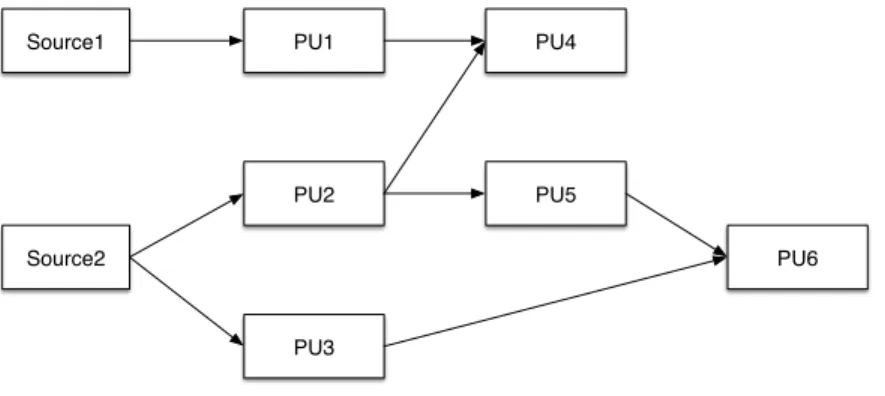
Next, we use a simple example in Fig. 2.3 to illustrate how our performance model works on a general topology.
Source2 PU1 PU2 PU3 PU4 PU5 PU6 Source1
Fig. 2.3: An example for performance modeling
In this example, there are 2data sources, 6PUs and2ackers. There exist4paths: p1
= (Source1, PU1, PU4) and p2 = (Source2, PU2, PU4), p3 = (Source2, PU2, PU5, PU6), p4 = (Source2, PU3, PU6). Suppose at runtime, each of the data sources and PUs has
2threads. In addition, shuffle grouping is used so that the work load is evenly distributed
from an upstream thread to downstream threads. According to our model, the average tuple processing time is:
tG = max
p2{1,···,4}tp. (2.6)
Take path p3 = (Source2, PU2, PU5, PU6) as an example, the chain topology con-sists of 3 PUs and one source, thus C = 3. According to our assumption, w(i, j) = 0.5, w(i, j, k) = 0.25,8i, j, k. The average tuple processing time of path p3 can be
esti-mated as: t3 = 3 X i=1 tPUi = 3 X i=1 tProci +tTrani = 3 X i=1 ( 2 X j=1 0.5⇤tProcij + 2 X j=1 2 X k=1 0.25⇤tTranijk ). (2.7)
In order to use the above model for prediction, we need to predict the average tuple processing latency at a thread, tProcij , and the average tuple transfer latency between two
threads, tTranijk . We propose to employ a supervised learning algorithm to predict the two
types of latencies. Intuitively, they can be affected by many factors, including system configurations, workload of threads and machines, co-located threads, etc. We carefully select a set of features, which have been observed to have an impact on tuple processing and transfer latencies. We list the set of features selected for predicting the average tuple processing latency of a thread,tProcij , in the following:
• Machine-CPU: The number of CPU cores of the machine at which the target thread
is located. This could be the total capacity of these CPU cores if machines have different CPUs.
• Machine-Memory: The size of memory (GB) of the machine at which the target
thread is located.
• Thread-Workload: The number of tuples that the target thread processes within a window (30 seconds in the current implementation).
• Machine-Workload: The number of tuples that the machine (at which the target
thread is located) processes within a window (30 seconds in the current implementa-tion).
• Co-located-Threads: The total number of threads located at the same machine as the
target thread.
Note that machines could be physical machines or Virtual Machines (VMs).
Predicting the average tuple transfer latency is more difficult sincetTranjk involves threads
on both ends. We summarize our feature selection in the following:
• Machine-CPU-U: The number of CPU cores of the machine at which the upstream
thread is located.
• Machine-Memory-U: The size of memory (GB) of the machine at which the up-stream thread is located.
• Thread-Workload-U: The number of tuples that the upstream thread processes within
a window (30 seconds in the current implementation).
• Machine-Workload-U: The number of tuples that the machine (at which the upstream
thread is located) processes during a window (30 seconds in the current implementa-tion).
• Machine-CPU-D: The number of CPU cores of the machine at which the downstream thread is located.
• Machine-Memory-D: The size of memory (GB) of the machine at which the
down-stream thread is located.
• Thread-Workload-D: The number of tuples that the downstream thread processes
• Machine-Workload-D: The number of tuples that the machine (at which the
down-stream thread is located) processes during a window (30 seconds in the current im-plementation).
• Co-location (boolean): if it is1, the upstream thread and the downstream thread are
located at the same machine; 0, otherwise.
Among all the selected features, some are general system features such as CPU and memory, which are well-known to have an impact on performance of a computing system. For example, in [38], Matsunaga et al. included CPU and memory of the machines as features in their training dataset. And, Xue et al. [39] chose them as features for their prediction framework. Other features are stream processing specific features such as work-load and co-location, which have shown by our early work [9] to play an important role in system performance (i.e., average tuple processing time).
Since latency can be any real value, we need to use a regression algorithm to make prediction. This problem has high-dimensional input data with both continuous and cate-gorical attributes, which makes it inappropriate to apply parametric regression algorithms such as linear and non-linear regression. The non-parametric regression algorithms, Sup-port Vector Regression (SVR), is a good candidate for this problem because SVR scales relatively well to high dimensional data and the trade-off between classifier complexity and error can be controlled explicitly [8]. We used cross-validation for kernel function se-lection and the results show that radial basis kernel function outperforms the linear kernel, the polynomial kernel and the sigmoid kernel.
Predictive Scheduling
The prediction serves as a guideline for a schedule algorithm to assign threads to machines. Next, we discuss the scheduling problem and present the proposed algorithm.
Given the set of machines M, the set of processes Q, and the set of threads N, the
mappings:N 7!QandQ7!M. Our design ensures that on every machine, threads from
the same application are assigned to no more than one process. This is enforced because assigning threads from one application to multiple (instead of one) processes on a machine introduces inter-process traffic and may lead to serious performance degradation, which has been shown in [9]. Therefore the two mappings can be merged to just one mapping:
N 7!M, that is, to assign each thread to a machine.
The objective of the scheduling problem is to minimize the average tuple process-ing time over an application graph G. Let the scheduling solution be X = hxiji, i 2 {1, ..., N}, j 2 {1, ..., M}, where xij = 1 if threadi is assigned to machinej. Note that
different scheduling solutions can lead to different tuple processing and transfer latencies thus different tuple processing time.
The proposed algorithm computes a scheduling solution based on the average tuple processing time predicted by the method described above, which is denoted as Pred(·)in
the following. We formally present the proposed predictive scheduling algorithm as Al-gorithm 1. The alAl-gorithm is essentially a greedy alAl-gorithm, which starts from an initial solution and keeps improving it by adjusting the thread-machine scheduling solution ac-cording to the prediction results. Then it tries to re-assign threads so as to achieve less average tuple processing time. The algorithm re-assigns one thread at a time in a greedy manner by picking the machine that minimizes Pred(tG(X)).
In Algorithm 1, first we initializeXwith a feasible solutionX0. In our implementation,
X0 was set to the solution given by Storm’s default scheduler, which evenly distributes
threads over all machines in an round robin manner. Then all threads are enumerated and traversed (Line 2), and for each thread, the algorithm tries to re-assign it to every possible machine (Line 3–7) that is different from the current solution to see if any improvement can be made. While it tries different solutions for threads, the prediction model produces the corresponding (predicted) average tuple processing time (Lines 8–9). Every time, the algorithm selects the solution that yields the smallest predicted value. Since the prediction
Algorithm 1Predictive Scheduling Algorithm
Input: M,N
Output: X =hxiji,i2{1, ..., N},j 2{1, ..., M}
1: X :=X0, whereX0 can be any feasible solution;
2: fori= 1toN do 3: forj = 1toM do 4: X0 :=X; 5: ifxij = 0then 6: x0ij := 1; 7: x0 ik := 0,8k 6=j;
8: ifPred(tG(X0))<Pred(tG(X))then
9: X :=X0; 10: end if 11: end if 12: end for 13: end for 14: return X;
model is already trained, Line 8 is considered to take constant time. Therefore the overall time complexity of Algorithm 1 is onlyO(M N).
2.2.3 Implementation Details
In this section, we describe the functions and implementation details of different modules in the proposed scheduling framework.
Data Collector
The data collector runs as multiple threads throughout all machines in the cluster. When a tuple arrives from another thread of a PU or a data source, the tuple transfer latency is recorded with a unique tuple ID. Then the tuple will be processed and sent to a thread of the next PU, while the tuple processing latency is again recorded by the data collector with the tuple ID. Timestamps are captured and inserted into data records and further sent to the distributed data store (described next). Every collected data record comes with a unique
tuple ID, which ensures correct tracking of every tuple’s processing and transfer latencies.
Data Store
The distributed data store works closely with the data collector. Whenever a data record is collected by the data collector, it will be sent to the distributed datastore, which is a shared data grid throughout the cluster. The data store is implemented by integrating Hazel-cast [10] into the proposed framework, which is an open source in-memory data grid that performs well on distributed data storage and computation across machines and clusters. Usually, several data records will be generated by different threads at a time, which will be sent to the distributed data store simultaneously. In this case, these raw data records from different threads are mixed together disorderly and needs to be further processed by the data pre-processor (described next) so that they can be used for prediction.
Time Synchronizer
Threads of the data collector are distributed over processes/machines across the whole clus-ter, which require time synchronization over the network. The time synchronization is im-plemented by integrating PTP daemon (PTPd) [11] into the framework, which is an open source tool that implements the Precision Time Protocol (PTP) defined by the IEEE-1588 standard [12]. It makes available very precise time coordination of LAN connected com-puters, achieving clock accuracy in the order of sub-microsecond.
Data Pre-processor
Since the data records are collected from threads, processes and machines throughout the cluster, for every single tuple, there could be several corresponding data records in the data store, mixed with data records of other tuples. Those raw data records are shattered pieces and cannot be directly used for prediction. They need to be concatenated into new records such that there is a one-to-one correspondence between a data record and a tuple.
To achieve this, the data pre-processor congregates data records with the same tuple ID into a new record containing information needed for prediction. After the concatenation, every new record will consist of a tuple ID and corresponding processing and transfer latencies.
Performance Predictor
The performance predictor builds a prediction model using the method described in Sec-tion 2.2.2 based on the configuraSec-tion informaSec-tion of the cluster and runtime data provided by the data pre-processor. Our framework is not restricted to the proposed prediction model. The other models can also be applied here.
Schedule Generator
The schedule generator generates a scheduling solution using the predictive scheduling algorithm described in Section 2.2.2 based on the prediction results provided by the perfor-mance predictor.
Custom Scheduler
After the scheduling solution is generated by the schedule generator, the custom scheduler deploys it on the cluster via the master. Note that our design handles schedule genera-tion and deployment with two separate modules such that with our framework, the current scheduling algorithm can be replaced by a new one at runtime without shutting down the cluster.
Note that the overhead of the proposed predictive scheduling framework is not signifi-cant. First, traffic load for data collection is light since it only involves simple information such as timestamp and tuple ID. Second, data samples are first stored into local memory, which do not need to be collected frequently for prediction (every 20 minutes). Third, we use an efficient and mature software tool Hazelcast to create a separated channel for data collection, which further reduces its impact to regular tuple processing and
communica-tion. In addition, our framework starts to predict with limited data and then keeps updating the prediction model with new data. So it does not need to wait until a large amount of data are collected. Almost all the experimental results (presented later) show the original Storm and the Storm with the proposed framework stabilize after roughly the same amount of time (around 8 minutes), which justifies our argument.
2.3 Performance Evaluation
In this section, we describe experimental settings, followed by experimental results and analysis.
2.3.1 Experimental Setup
We implemented the proposed predictive scheduling framework over Apache Storm 0.9.2 release [13] (obtained from Storm’s repository on Apache Software Foundation) and in-stalled it on top of Ubuntu Linux 12.04. Experiments were performed on a cluster at Syracuse University’s Green Data Center for performance evaluation. The Storm cluster consists of 10 IBM blade servers connected by a 1Gbps network, each of which was con-figured to have10slots. In order to fully test the performance of the proposed framework, 3
representative stream data processing applications (topologies) were implemented and de-ployed in our cluster: word count (stream version), log stream processing and continuous queries. We describe these topologies in the following.
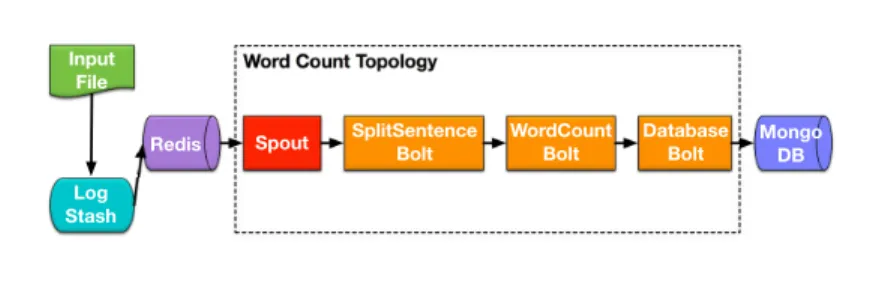
Word Count Topology (stream version) (Fig. 2.4): Widely known as a MapReduce application, Word Count lists every word’s number of appearances in a set of files. The stream version used in our experiments does a very similar job but with a stream data source. The topology has a chain-like structure with one spout and three bolts. The topol-ogy uses an open-source log agent called LogStash [14] to read data from input source files. LogStash submits input file lines as separate JSON values into a Redis [15] queue,
which are consumed and emitted into the topology. The input file is the text file of Alice’s Adventures in Wonderland [16]. The spout produces data stream while the input file is pushed into the queue. The spout is connected with the SplitSentence bolt which splits each input line into individual words and feeds them to a WordCount bolt that counts the number of appearances using fields grouping. The results are further sent to a Mongo bolt which stores them into a Mongo database. In the experiments, the topology was set to have 6 Spout executors (threads), 8 SplitSentence bolt executors, 8 WordCount bolt executors and 8 Mongo bolt executors.
Word Count Topology
Spout SplitSentenceBolt Redis Input File Log Stash WordCount Bolt Database Bolt MongoDB
Fig. 2.4: Word Count Topology (stream version)
Word Count Topology (stream version) with 2 sources: This topology is almost
same as the above expect that it includes an additional spout, which directly reads from the file [16]. In the experiment, the topology was set to have 6 executors for Spout 1, 6 executors for Spout 2, 8 SplitSentence bolt executors, 8 WordCount bolt executors and 8 Mongo bolt executors.
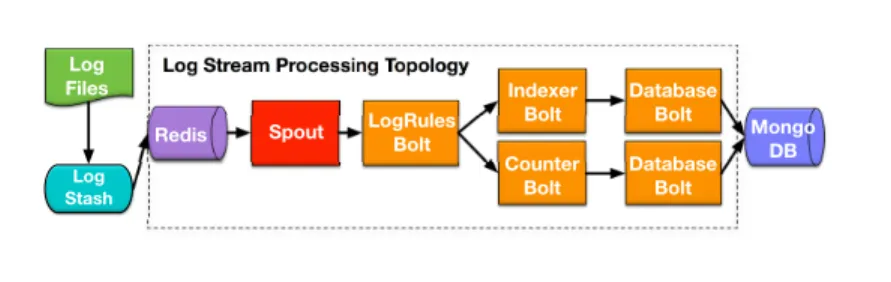
Log Stream Processing Topology (Fig. 2.5): Log stream processing represents one of the most popular use cases for Storm. The topology also uses Logstash [14] to read data from log files. LogStash submits log lines as separate JSON values into a Redis [15] queue which emits the output into the topology. Microsoft IIS log files obtained from the College of Engineering and Computer Science at Syracuse University were used as the input data. The LogRules bolt performs rule-based analysis on the log stream and delivers values containing a specific type of log entry instance. The log entry is then sent to two separate bolts simultaneously: one is the Indexer bolt which performs index actions and
another one is the Counter bolt which performs counting actions on the log entries. For testing purpose, the original topology was slightly modified by introducing two Mongo bolts, one for the Indexer bolt and another one for the Counter bolt. These two Mongo bolts store the results into separate collections in a Mongo database for verification. In the experiments, the Storm cluster was configured to have 3 Spout executors (threads), 6 LogRules bolt executors, 6 Indexer bolt executors, 6 Count bolt executors and 6 executors for each Mongo bolt.
Log Stream Processing Topology
Log Files
Log Stash
Redis Spout LogRules
Bolt
Indexer
Bolt DatabaseBolt
Counter
Bolt DatabaseBolt
Mongo DB
Fig. 2.5: Log Stream Processing Topology
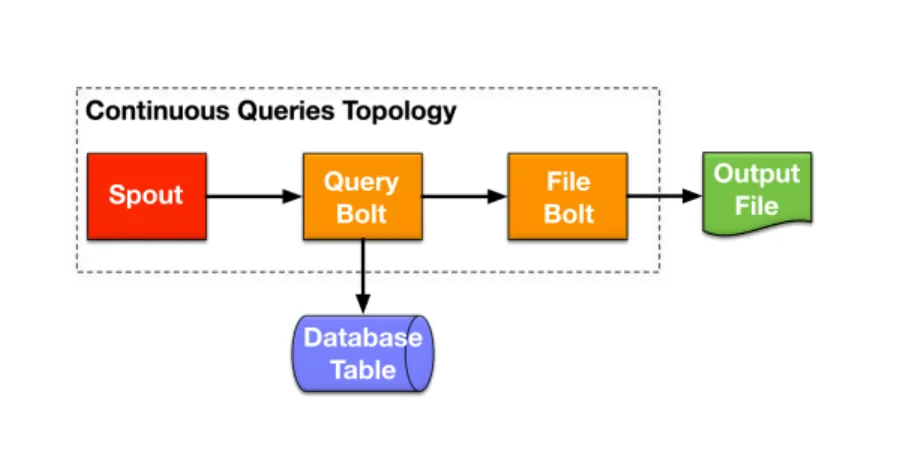
Continuous Queries Topology (Fig. 2.6): This is another popular application on Storm. The topology is a select query that works by initializing access to a mapping table created in memory and looping over each row to check there is a hit [17].
It consists of a spout and two bolts. The spout continuously emits a randomly generated query, which is sent to a Query bolt. The database table is placed in memory on the host machine for Storm. The Query bolt takes queries from the spout and iterates over the database table to check if there are matching records. A hit on a matching record is then emitted to the last PU named the Printer bolt, which takes matching records and writes them to a file. In our experiments, we randomly generated a database table with vehicle plates and their owners’ information (such as names and SSNs). Queries were also randomly generated to search the table for the speeding vehicles’ owners (vehicle speed was randomly generated and attached to every entry). The experiments were conducted with 5 Spout executors (threads), 13 Query bolt executors and 13 Printer bolt executors.
Continuous Queries Topology
Spout Query
Bolt BoltFile
Output File
Database Table
Fig. 2.6: Continuous Queries Topology
PU0−PU1 PU1 PU1−PU2 PU2 PU2−PU3 PU3 Overall 0.7 0.75 0.8 0.85 0.9 0.95 1 PU Prediction accuracy
(a) Prediction accuracy
PU0−PU1 PU1 PU1−PU2 PU2 PU2−PU3 PU3 0 0.1 0.2 0.3 0.4 0.5 0.6 0.7 PU
Average tuple processing time (ms)
Predictive Default
(b) Average tuple process-ing/transfer latencies at/between PUs 0 5 10 15 20 1.5 2 2.5 3 3.5 4 4.5 5 5.5 6
Running time (min)
Average tuple processing time (ms)
Predictive Default
(c) Average tuple processing time (over the topology)
Fig. 2.7: Performance on a word count topology (stream version)
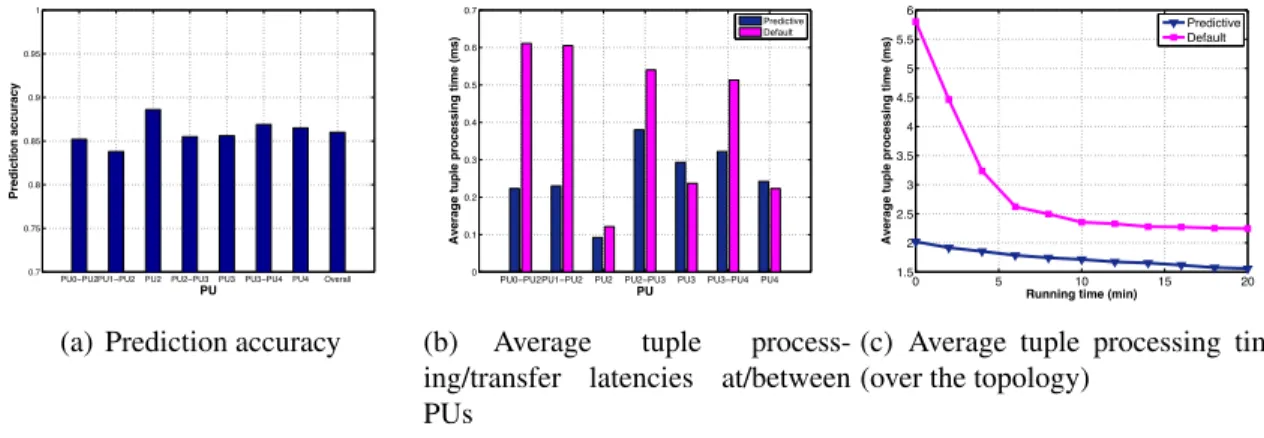
PU0−PU1PU1PU1−PU2PU2PU1−PU4PU4PU2−PU3PU3PU4−PU5PU5 Overall 0.7 0.75 0.8 0.85 0.9 0.95 1 PU Prediction accuracy
(a) Prediction accuracy
PU0−PU1PU1PU1−PU2PU2PU1−PU4PU4PU2−PU3PU3PU4−PU5PU5 0 0.1 0.2 0.3 0.4 0.5 0.6 0.7 0.8 0.9 1 PU
Average tuple processing time (ms)
Predictive Default
(b) Average tuple process-ing/transfer latencies at/between PUs 0 5 10 15 20 2 2.5 3 3.5 4 4.5 5
Running time (min)
Average tuple processing time (ms)
Predictive Default
(c) Average tuple processing time (over the topology)
Fig. 2.8: Performance on a log stream processing topology
2.3.2 Experimental Results and Analysis
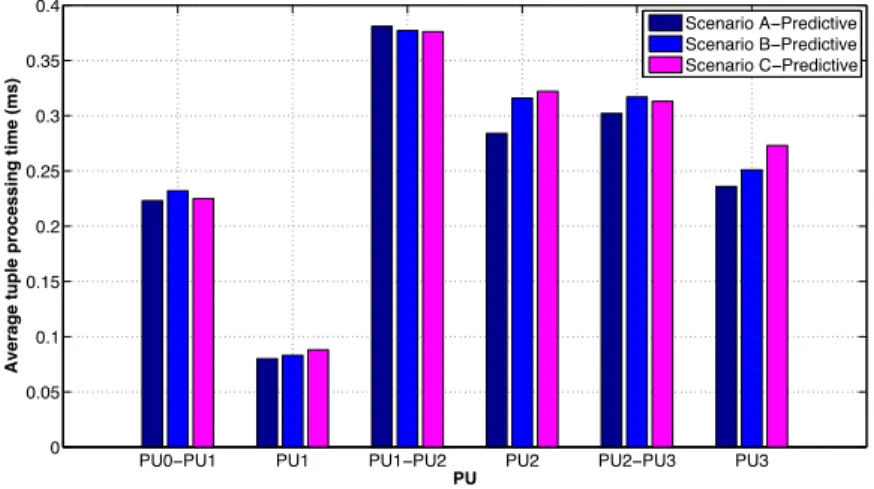
In this section, we present and analyze experimental results of the 3 applications introduced above. We used two commonly used metrics for performance evaluation, including
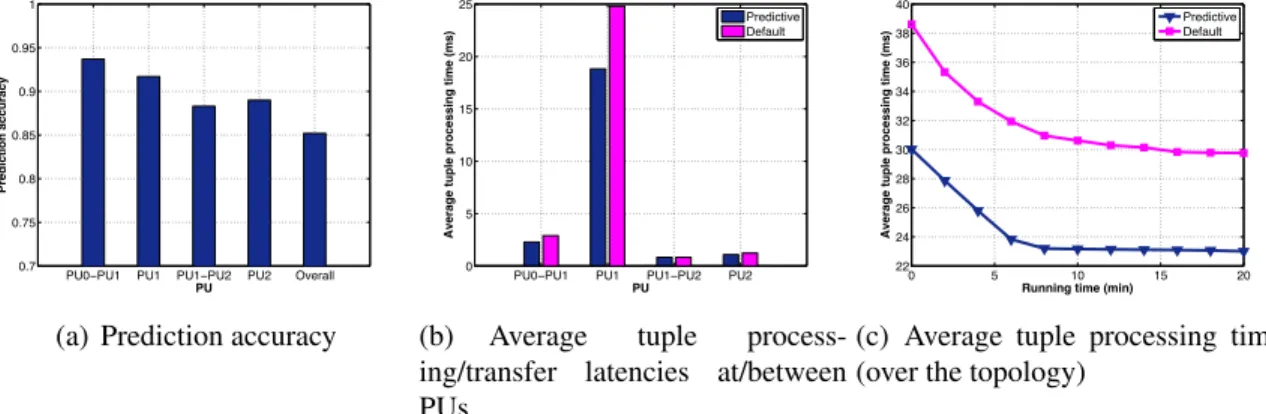
predic-PU0−PU1 PU1 PU1−PU2 PU2 Overall 0.7 0.75 0.8 0.85 0.9 0.95 1 PU Prediction accuracy
(a) Prediction accuracy
PU0−PU1 PU1 PU1−PU2 PU2 0 5 10 15 20 25 PU
Average tuple processing time (ms)
Predictive Default
(b) Average tuple process-ing/transfer latencies at/between PUs 0 5 10 15 20 22 24 26 28 30 32 34 36 38 40
Running time (min)
Average tuple processing time (ms)
Predictive Default
(c) Average tuple processing time (over the topology)
Fig. 2.9: Performance on a continuous queries topology
tion accuracy and average tuple processing time (of a topology after stabilization) [9]. To justify the effectiveness of the proposed scheduling algorithm, Storm’s default scheduler was used as the baseline solution for comparison.
For each topology, three figures are presented to show the experimental results. The first one shows the prediction accuracy, which is given by(1 |Pred ActAct |), where Pred is the
predicted value and Act is obtained from actual readings collected by data collector. For prediction, we used the readings of various features (described above) within the first20
minutes after stabilization as the training data. During the training phase, randomly gener-ated scheduling solutions were used to obtain sufficient amount of diverse data for training. In the corresponding figures, “PU0-PU1", “PU1" and “Overall" refer to the prediction ac-curacy of average (over 30 seconds) tuple transfer latency between PU0 and PU1, average tuple processing latency at PU1 and average tuple processing time of the whole topology af-ter stabilization, respectively. The second figure shows the average (over 30 seconds) tuple processing time at a PU and average tuple transfer latency between PUs (after stabilization) given by the proposed scheduling framework and the default scheduler respectively. The third figure shows the average tuple processing time of the whole topology (given by the proposed scheduling framework and the default scheduler respectively) over a period of 20 minutes. From these experimental results, we can make the following observations.