Incremental Clustering for Mining
in a Data Warehousing Environment
Martin Ester, Hans-Peter Kriegel, Jörg Sander, Michael Wimmer, Xiaowei Xu
Institute for Computer Science, University of MunichOettingenstr. 67, D-80538 München, Germany
email: {ester | kriegel | sander | wimmerm | xwxu}@informatik.uni-muenchen.de
Abstract
Data warehouses provide a great deal of opportu-nities for performing data mining tasks such as classification and clustering. Typically, updates are collected and applied to the data warehouse pe-riodically in a batch mode, e.g., during the night. Then, all patterns derived from the warehouse by some data mining algorithm have to be updated as well. Due to the very large size of the databases, it is highly desirable to perform these updates mentally. In this paper, we present the first incre-mental clustering algorithm. Our algorithm is based on the clustering algorithm DBSCAN which is applicable to any database containing data from a metric space, e.g., to a spatial database or to a WWW-log database. Due to the density-based na-ture of DBSCAN, the insertion or deletion of an object affects the current clustering only in the neighborhood of this object. Thus, efficient algo-rithms can be given for incremental insertions and deletions to an existing clustering. Based on the formal definition of clusters, it can be proven that the incremental algorithm yields the same result as DBSCAN. A performance evaluation of Incre-mentalDBSCAN on a spatial database as well as on a WWW-log database is presented, demonstrat-ing the efficiency of the proposed algorithm. Incre-mentalDBSCAN yields significant speed-up factors over DBSCAN even for large numbers of daily updates in a data warehouse.
1
Introduction
Many companies have recognized the strategic impor-tance of the knowledge hidden in their large databases and,
therefore, have built data warehouses. A data warehouse is a collection of data from multiple sources, integrated into a common repository and extended by summary information (such as aggregate views) for the purpose of analysis [MQM 97]. When speaking of a data warehousing environ-ment, we do not anticipate any special architecture but we address an environment with the following two characteris-tics:
(1) Derived information is present for the purpose of analysis.
(2) The environment is dynamic, i.e. many updates occur.
In such an environment, either manual analyses support-ed by appropriate visualization tools or (semi)automatic data mining may be performed. Data mining has been de-fined as the application of data analysis and discovery algo-rithms that - under acceptable computational efficiency limitations - produce a particular enumeration of patterns over the data[FPS 96]. Several data mining tasks have been identified [FPS 96], e.g., clustering, classification and sum-marization. Typical results of data mining are as follows: • Clusters of items which are typically bought together by
some set of customers (clustering in a data warehouse storing sales transactions).
• Symptoms distinguishing disease A from disease B (clas-sification in a medical data warehouse).
• Description of the typical WWW access patterns (sum-marization in the data warehouse of an internet provider). The task considered in this paper is clustering [KR 90], i.e. grouping the objects of a database into meaningful sub-classes. Recently, several clustering algorithms for mining in large databases have been developed [NH 94], [ZRL 96], [EKSX 96].
Typically, a data warehouse is not updated immediately when insertions and deletions on the operational databases occur. Updates are collected and applied to the data ware-house periodically in a batch mode, e.g., each night [MQM 97]. Then, all patterns derived from the warehouse by data mining algorithms have to be updated as well. This update must be efficient enough to be finished when the warehouse has to be available for users again, e.g., the next morning. Due to the very large size of the databases, it is highly desirable to perform these updates incrementally ([FAAM 97], [Huy 97]), so as to consider only the old
clus-Permission to copy without fee all or part of this material is granted provided that the copies are not made or distributed for direct com-mercial advantage, the VLDB copyright notice and the title of the publication and its date appear, and notice is given that copying is by permission of the Very Large Data Base Endowment. To copy otherwise, or to republish, requires a fee and/or special permission from the Endowment.
Proceedings of the 24th VLDB Conference New York, USA, 1998
ters and the objects inserted or deleted during the day, in-stead of applying the clustering algorithm to the (very large) updated database.
Maintenance of derived information such as views and summary tables has been an active area of research [MQM 97], [Huy 97]. The problem of incrementally updat-ing mined patterns on changes of the database, however, has just recently started to receive more investigation. [CHNW 96] and [FAAM 97] propose efficient methods for incrementally modifying a set of association rules mined from a database. [EW 98] introduces generalization algo-rithms for incremental summarization in a data warehous-ing environment.
In this paper, we present the first incremental clustering algorithm. Our algorithm is based on DBSCAN [EKSX 96], [SEKX 98] which is an efficient clustering al-gorithm for metric databases (that is, databases with a dis-tance function for pairs of objects) for mining in a data warehousing environment. Due to the density-based nature of DBSCAN, the insertion or deletion of an object affects the current clustering only in the neighborhood of this ob-ject. We demonstrate the high efficiency of incremental clustering on a spatial database [Gue 94] as well as on a WWW access log database [MJHS 96].
The rest of this paper is organized as follows. We discuss related work on clustering algorithms in section 2. In section 3, we briefly introduce the clustering algorithm DB-SCAN. The algorithms for incrementally updating a clus-tering on insertions and deletions of the database are pre-sented in section 4 and an extensive performance evaluation is reported in section 5. Section 6 concludes with a summary and some directions for future research.
2
Related Work
The problem of incrementally updating mined patterns after making changes to the database has just recently start-ed to receive more attention.
The task of mining association rules has been introduced by [AS 94]. An association rule is a rule I1⇒ I2 where I1
andI2 are disjoint subsets of a set of items I. For a given
da-tabase DB of transactions (i.e. each record contains a set of items bought by some customer in one transaction), all as-sociation rules should be discovered having a support of at least minsupport and a confidence of at least minconfidence
in DB. The subsets of I that have at least minsupport in DB
are called frequent sets.
[FAAM 97] describes two typical scenarios for mining association rules in a dynamic database. For example, in a medical database, one may seek associations between treat-ments and results. The database is constantly updated and at any given time, the medical researcher is interested in ob-taining the current associations. In a database conob-taining news articles, e.g., patterns of co-occurrence amongst the topics of articles may be of interest. An economic analyst receives a lot of new articles every day and he would like to find relevant associations based on all current articles.
[CHNW 96] proposes to apply a non-incremental algo-rithm for mining association rules to the newly inserted da-tabase objects, i.e. to the increment of the dada-tabase, and then
to combine the frequent sets of both the database and the in-crement. The incremental algorithms presented in [FAAM 97] are based on information about the frequency of attribute pairs and border sets respectively. While the space overhead for keeping track of these frequencies is small, the incremental algorithms yield a speed-up of sever-al orders of magnitude compared to the non-incrementsever-al sever- al-gorithm.
Summarization, e.g., by generalization, is another impor-tant task of data mining. Attribute-oriented generalization
[HCC 93] of a relation is the process of replacing the at-tribute values by a more general value, one atat-tribute at a time, until the number of tuples of the relation becomes less than a specified threshold. The more general value is taken from a concept hierarchy which is typically available for most attributes in a data warehouse.
[EW 98] presents algorithms for incremental attribute-oriented generalization with the conflicting goals of good efficiency and minimal overly generalization. The algo-rithms for incremental insertions and deletions are based on the materialization of a relation at an intermediate generali-zation level, i.e. the anchor relation. Experiments demon-strate that incremental generalization can be performed ef-ficiently at a low degree of overly generalization.
This paper focuses on the data mining task of clustering and, in the following, we review clustering algorithms from a data mining perspective.
Partitioning algorithms construct a partition of a data-base DB of n objects into a set of k clusters where k is an in-put parameter. Each cluster is represented by the center of gravity of the cluster (k-means) or by one of the objects of the cluster located near its center (k-medoid) [KR 90] and each object is assigned to the cluster with its representative closest to the considered object. Typically, partitioning al-gorithms start with an initial partition of DB and then use an iterative control strategy to optimize the clustering quality, e.g., the average distance of an object to its representative.
[NH 94] explores partitioning algorithms for mining in spatial databases. An algorithm called CLARANS (Cluster-ing Large Applications based on RANdomized Search) is introduced which is more effective and more efficient than previous partitioning algorithms.
Hierarchical algorithms create a hierarchical decompo-sition of DB. The hierarchical decomposition is represented by a dendrogram, a tree that iteratively splits DB into small-er subsets until each subset consists of only one object. In such a hierarchy, each level of the tree represents a cluster-ing of DB.
The basic hierarchical clustering algorithm works as fol-lows ([Sib 73], [Bou 96]). Initially, each object is placed in a unique cluster. For each pair of clusters, some value of dissimliarity or distance is computed. For instance, the dis-tance may be the minimum disdis-tance of all pairs of points from the two clusters (single-link method). [Bou 96] dis-cusses alternative definitions of the distance and shows that, in general, no one approach outperforms any other in terms of clustering quality. In every step, the clusters with the minimum distance in the current clustering are merged until all points are contained in one cluster.
None of the above algorithms is efficient on large data-bases. Therefore, some focusing techniques have been pro-posed to increase the efficiency of clustering algorithms.
[EKX 95] presents an R*-tree based focusing technique (1) creating a sample of the database that is drawn from each R*-tree data page and (2) applying the clustering algo-rithm only to that sample. [ZRL 96] proposes a special data structure to condense information about subclusters of points. A Clustering Feature (CF) is a triple that contains the number of points, the linear sum and the square sum of all points in the cluster. Clustering features are organized in a height balanced tree, i.e. the CF-tree. BIRCH (Balanced Iterative Reducing and Clustering using Hierarchies)
[ZRL 96] is a CF-tree based multiphase clustering method. First, the database is scanned to build an initial in-memory CF-tree. In an optional second phase, this CF-tree can be further reduced until a desired number of leaf nodes is reached. In phase 3 an arbitrary clustering algorithm is used to cluster the values stored in the leaf nodes of the CF-tree. Note that the CF-tree is an incremental structure but phase 3 of BIRCH is non-incremental.
Recently, a new type of single scan clustering algorithms has been introduced. The basic idea of a single scan algo-rithm is to group neighboring objects of the database into clusters based on a local cluster condition, thus performing only one scan through the database. Single scan clustering algorithms are very efficient if the retrieval of the neighbor-hood of an object is efficiently supported by the DBMS. Different cluster conditions yield different cluster defini-tions and algorithms. For instance, DBSCAN (Density Based Spatial Clustering of Applications with Noise)
[EKSX 96] [SEKX 98] relies on a density-based notion of clusters.
We use DBSCAN as a base for our incremental cluster-ing algorithm due to the followcluster-ing reasons. First, DBSCAN is one of the most efficient algorithms on large databases. Second, whereas BIRCH is applicable only to spatial data-bases (Euclidean vector space), DBSCAN can be applied to any database containing data from a metric space (only as-suming a distance function).
3
The Algorithm DBSCAN
The key idea of density-based clustering is that for each object of a cluster the neighborhood of a given radius (Eps) has to contain at least a minimum number of objects (MinPts), i.e. the cardinality of the neighborhood has to ex-ceed some threshold.
We will first give a short introduction to DBSCAN in-cluding the definitions which are required for incremental clustering. For a detailed presentation of DBSCAN see [EKSX 96].
Definition 1:(directly density-reachable) An object p is
directly density-reachable from an object q wrt. Eps and
MinPts in the set of objects D if
1) p ∈ NEps(q)(NEps(q) is the subset of D contained in the
Eps-neighborhood of q.) 2) Card(NEps(q)) ≥ MinPts.
Definition 2: (density-reachable) An object p is density-reachable from an object q wrt. Eps and MinPts in the set of
objects D, denoted as p >D q, if there is a chain of objects
p1, ..., pn, p1 = q, pn = p such that pi∈D and pi+1 is directly
density-reachable from pi wrt. Eps and MinPts.
Density-reachability is a canonical extension of direct density-reachability. This relation is transitive, but it is not symmetric. Although not symmetric in general, it is obvi-ous that density-reachability is symmetric for objects o with
Card(NEps(o)) ≥ MinPts. Two “border objects” of a cluster are possibly not density-reachable from each other because there are not enough objects in their Eps-neighborhoods. However, there must be a third object in the cluster from which both “border objects” are density-reachable. There-fore, we introduce the notion of density-connectivity.
Definition 3: (density-connected) An object p is density-connected to an object q wrt. Eps and MinPts in the set of objects D if there is an object o∈D such that both p and q
are density-reachable from o wrt. Eps and MinPts in D. Density-connectivity is a symmetric relation. Figure 1 il-lustrates the definitions on a sample database of objects from a 2-dimensional vector space. Note however, that the above definitions only require a distance measure and will also apply to data from a metric space.
A cluster is defined as a set of density-connected objects which is maximal wrt. density-reachability and the noise is the set of objects not contained in any cluster.
Definition 4: (cluster) Let D be a set of objects. A cluster C wrt. Eps and MinPts in D is a non-empty subset of D sat-isfying the following conditions:
1) Maximality: ∀p,q ∈D: if p ∈C and q >D p wrt. Eps and
MinPts, then also q ∈C.
2) Connectivity: ∀p,q ∈ C: p is density-connected to q
wrt. Eps and MinPts in D.
Definition 5: (noise) Let C1 ,. . ., Ckbe the clusters wrt.
Eps and MinPts in D. Then, we define the noise as the set of objects in the database D not belonging to any cluster Ci , i.e. noise = {p ∈D | ∀ i: p ∉Ci}.
We omit the term “wrt. Eps and MinPts” in the following whenever it is clear from the context. There are two differ-ent kinds of objects in a clustering: core objects (satisfying condition 2 of definition 1) and non-core objects (other-wise). In the following, we will refer to this characteristic of an object as the core object property of the object. The non-core objects in turn are either border objects (not a core ob-ject but density-reachable from another core obob-ject) or
noise objects (not a core object and not density-reachable from other objects).
The algorithm DBSCAN was designed to efficiently dis-cover the clusters and the noise in a database according to
p
q
o
p
q
Figure 1: : density-reachability and density-connectivity p density-reachable from q
q not density-reachable from p
p and q density-connected to each other by o
the above definitions. The procedure for finding a cluster is based on the fact that a cluster is uniquely determined by any of its core objects:
• First, given an arbitrary object p for which the core object condition holds, the set {o | o >D p} of all objects o
den-sity-reachable from p in D forms a complete cluster C
and p ∈ C.
• Second, given a cluster C and an arbitrary core object p ∈ C, C in turn equals the set {o | o >D p} (c.f. lemma 1 and 2 in [EKSX 96]).
To find a cluster, DBSCAN starts with an arbitrary object
p in D and retrieves all objects of D density-reachable from
p with respect to Eps and MinPts. If p is a core object, this procedure yields a cluster with respect to Eps and MinPts. If
p is a border object, no objects are density-reachable from p
and p is assigned to the noise. Then, DBSCAN visits the next object of the database D.
The retrieval of density-reachable objects is performed by successive region queries. A region query returns all ob-jects intersecting a specified query region. Such queries are supported efficiently by spatial access methods such as R*-trees [BKSS 90] for data from a vector space or M-R*-trees [CPZ 97] for data from a metric space.
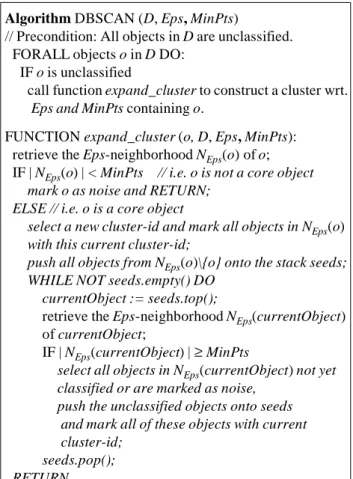
The algorithm DBSCAN is sketched in figure 2.
4
IncrementalDBSCAN
DBSCAN, as introduced in [EKSX 96], is applied to a static database. In a data warehouse, however, the databases may have frequent updates and thus may be rather dynamic. For example, in a WWW access log database, we may want to find and monitor groups of similar access patterns by clustering the access sequences of different users. These patterns may change over time because each day new log-entries are added to the database and old log-entries (past a user-supplied expiration date) are deleted. After insertions and deletions to the database, the clustering discovered by DBSCAN has to be updated. In section 4.1, we examine which part of an existing clustering is affected by an update of the database. We present algorithms for incremental up-dates of a clustering after insertions (section 4.2) and dele-tions (section 4.3). Based on the formal notion of clusters, it can be proven that the incremental algorithm yields the same result as the non-incremental DBSCAN algorithm. This is an important advantage of our approach.
4.1 Affected Objects
We want to show that changes of some clustering of a da-tabase D are restricted to a neighborhood of an inserted or deleted object p. Objects contained in NEps(p) can change their core object property, i.e. core objects may become non-core objects and vice versa. The objects contained in
N2Eps(p) \ NEps(p) keep theircore object property, but non-core objects may change their connection status, i.e. border objects may become noise objects or vice versa, because their Eps-neighborhood may contain objects with a changed core object property. For all objects outside of
N2Eps(p), it holds that neither these objects themselves nor objects in their Eps-neighborhood change their core object property. Therefore, the connection status of these objects is unchanged.
After the insertion of some object p, non-core objects (border objects or noise objects) in NEps(p) may become core objects implying that new density connections may be established, i.e. chains p1, ..., pn, p1 = r, pn = s with pi+1 di-rectly density-reachable from pi for two objects r and s may
arise which were not density-reachable from each other be-fore the insertion. Then, one of the pi for i < n must be
con-tained in NEps(p).
When deleting some object p, core objects in NEps(p) may become non-core objects implying that density connections may be removed, i.e. there may no longer be a chain
p1, ..., pn, p1 = r, pn = s with pi+1 directly density-reachable from pi for two objects r and s which were density-reach-able from each other before the deletion. Again, one of the
pi for i < n must be contained in NEps(p).
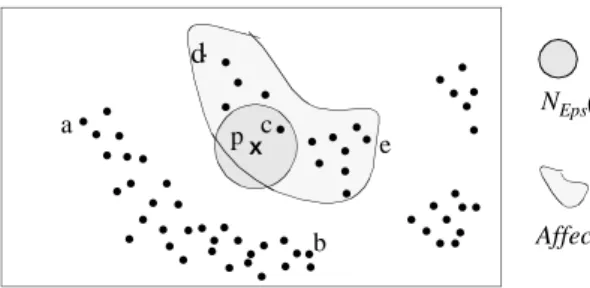
Figure 3 illustrates our discussion using a sample data-base of 2D objects and an object p to be inserted or to be de-leted. The objects a and b are density connected wrt. Eps as depicted and MinPts = 4 without using one of the elements of NEps(p). Therefore, a and b belong to the same cluster
in-dependently from p. On the other hand, the objects d and e
in D \ NEps(p) are only density-connected via c in NEps(p) if
Algorithm DBSCAN (D, Eps, MinPts)
// Precondition: All objects in D are unclassified. FORALL objects o in D DO:
IF o is unclassified
call function expand_cluster to construct a cluster wrt.
Eps and MinPts containing o.
FUNCTION expand_cluster (o, D, Eps, MinPts): retrieve the Eps-neighborhood NEps(o) of o; IF | NEps(o) | <MinPts // i.e. o is not a core object
mark o as noise and RETURN; ELSE // i.e. o is a core object
select a new cluster-id and mark all objects in NEps(o)
with this current cluster-id;
push all objects from NEps(o)\{o} onto the stack seeds; WHILE NOT seeds.empty() DO
currentObject := seeds.top();
retrieve the Eps-neighborhood NEps(currentObject) of currentObject;
IF | NEps(currentObject) |≥MinPts
select all objects in NEps(currentObject) not yet classified or are marked as noise,
push the unclassified objects onto seeds and mark all of these objects with current cluster-id;
seeds.pop(); RETURN
the object p is present, so that the cluster membership of d
and e is affected by p.
In general, on an insertion or deletion of an object p, the set of affected objects, i.e. objects which may potentially change cluster membership after the update, is the set of ob-jects in NEps(p) plus all objects density-reachable from one of these objects in D ∪ {p}. The cluster membership of all other objects not in the set of affected objects will not change. This is the intuition of the following definition and lemma. In particular, the lemma states that a cluster c in the database is independent of an insertion or deletion of an ob-ject p if a core object of the cluster is outside the set Affect-edD(p). Note that a cluster is uniquely determined by any of its core objects. Therefore, by definition of AffectedD(p) it follows that if one core object of a cluster is outside (inside)
AffectedD(p) then all core objects of the cluster are outside (inside) the set AffectedD(p).
Definition 6: (affected objects) Let D be a database of objects and p be some object (either in or not in D). We de-fine the set of objects in D affected by the insertion or dele-tion of p as
AffectedD(p) = NEps(p)∪ {q | ∃ o∈NEps(p) ∧ q >D∪{p} o}. Lemma 1: Let D be a set of objects and p be some object. Then ∀ o ∈ D: o ∉AffectedD(p) ⇒ {q | q >D\{p} o} = {q | q >D∪{p}o}.
Proof (sketch): 1) ⊆ : because D \ {p} ⊆D∪ {p}. 2) ⊇ : if q ∈{q | q >D∪{p}o}, thenthere is some chain q1, ..., qn, q1 = o, qn = q, qi+1∈NEps(qi) and qi is a core object in D∪ {p}
for all i < n and, for all i, it holds that qi >D∪{p}o. Because
qi is a core object for all i < n and density-reachability is symmetric for core objects, it also holds that o >D∪{p}qi. If there existed an i < n such that qi ∈NEps(p), then qi >D∪{p}p
implying also o >D∪{p} p due to the transitivity of density-reachability. By definition of the set AffectedD(p) it now
fol-lows that o ∈AffectedD(p), in contrast to the assumption.
Thus, qi ∉ NEps(p) for all i < n implying that all the objects
qi, i < n, are core objects independent of p and also qn≠ p
because otherwise qn-1 ∈NEps(p). Thus, the chain q1, ..., qn
exists also in the set D \ {p} and then q∈{q | q >D \ {p} o}. o Due to lemma 1, after inserting or deleting an object p, it is sufficient to reapply DBSCAN to the set AffectedD(p) in order to update the clustering. For that purpose, however, it is not necessary to retrieve the set first and then apply the clustering algorithm. We simply have to start a restricted version of DBSCAN which does not loop over the whole database to start expanding a cluster but only over certain
“seed”-objects which are all located in the neighborhood of
p. These “seed”-objects are core objects after the update op-eration which are located in the Eps-neighborhood of a core object in D ∪ {p} which in turn is located in NEps(p). This is the content of the next lemma.
Lemma 2: Let D be a set of objects. Additionally, let
D*=D ∪ {p} after insertion of an object p or D*=D \{p} af-ter deletion of p and let c be a core object in D*.
C = {o | o >D* c} is a cluster in D* and C ⊆AffectedD(p)⇔
∃ q, q’: q∈NEps(q’), q’∈NEps(p), c >D∗ q, q is core object in D* and q’ is core object in D∪ {p}.
Proof (sketch): If D* = D ∪ {p} or c ∈ NEps(p), the lemma
is obvious by definition of AffectedD(p). Therefore, we con-sider only the case D* = D \{p} and c ∉ NEps(p).
“=>”: C ⊆ AffectedD(p) and C ≠ ∅. Then, there exists
o∈ NEps(p) and c >D∪{p}o, i.e. there is a chain of directly density-reachable objects from o to c. Now, because
c ∉ NEps(p) we can construct a chain o=o1, . . ., on=c,
oi+1∈NEps(oi) with the property that there is j ≤ n such that for all k, j ≤ k ≤ n, ok ∉ NEps(p) and for all k, 1≤ k< j, ok ∈ NEps(p). Then q=oj ∈ NEps(oj-1), q’=oj-1 ∈NEps(p),
c >D∗ oj, oj is a core object in D*and oj-1 is a core object in
D∪ {p}.
“<=”: obviously, C = {o | o >D* c} is a cluster (see the
com-ments on the algorithm after definition 5). By assumption, c
is density-reachable from a core object q in D* and q is den-sity-reachable from an object q’∈NEps(p) in D ∪ {p}. Then also c and hence all objects in C are density-reachable from
q’ in D ∪ {p}. Thus, C ⊆AffectedD(p).o
Due to lemma 2, the general strategy for updating a clus-tering would be to start the DBSCAN algorithm only with core objects that are in the Eps-neighborhood of a (previ-ous) core object in NEps(p). However, it is not necessary to rediscover density-connections which are known from the previous clustering and which are not changed by the up-date operation. For that purpose, we only need to look at core objects in the Eps-neighborhood of those objects that change their core object property as a result of the update. In case of an insertion, these objects may be connected after the insertion. In case of a deletion, density connections be-tween them may be lost. In general, this information can be determined by using very few region queries. The remain-ing information needed to adjust the clusterremain-ing can be de-rived from the cluster membership before the update. Defi-nition 7 introduces the formal notions which are necessary to describe this approach. Remember: objects with a changed core object property are all located in NEps(p).
Definition 7: (seed objects for the update) Let D be a set of objects and p be an object to be inserted or deleted. Then, we define the following notions:
UpdSeedIns = {q | q is a core object in D ∪ {p}, ∃ q’: q’ is core object in D ∪ {p} but not in D
and q∈NEps(q’)}
UpdSeedDel = {q | q is a core object in D \{p}, ∃ q’: q’ is core object in D but not in D \{p} and q∈NEps(q’)}
We call the objects q ∈ UpdSeed “seed objects for the up-date”. Note that these sets can be computed rather efficient-ly if we additionalefficient-ly store for each object the number of
ob-NEps(p)
Figure 3: : Affected objects in a sample database
AffectedD(p)
.
.
p..
.
.
.
.
.
.
.
.
. . .
. .
a b c d.
.
..
.. ..
.
.
.
e...
.
.
.
. .
.. ...
.
.
.
.
.
...
.
...
. ..
.
.
..
xjects in its neighborhood when initially clustering the database. Then, we need only to perform a single region query for the object p to be inserted or deleted to detect all objects q’ with a changed core object property (i.e. objects in NEps(p) with number = MinPts-1 in case of an insertion, objects in NEps(p) with number = MinPts in case of a
dele-tion). Only for these objects q’ (if there are any) do we have to retrieve NEps(q’) to determine all objects q in the set
UpdSeed. Since at this point of time the Eps-neighborhood of p is still in main memory we first check this set for neigh-bors of q’ and perform an additional region query only if there are more objects in the neighborhood of q’ than al-ready contained in NEps(p). Our experiments, however, in-dicate that objects with a changed core object property after an update (different from the inserted or deleted object p) are not very frequent (see section 5). Therefore, in most cas-es we just have to perform the Eps-neighborhood query for
p and to change the counter for the number of objects in the neighborhood of the retrieved objects.
4.2 Insertions
When inserting a new object p, new density-connections may be established, but none are removed. In this case, it is sufficient to restrict the application of the clustering proce-dure to the set UpdSeedIns. If we have to change cluster membership for an object from C to D we perform the same change of cluster membership for all other objects in C.
Changing cluster membership of these objects does not in-volve the application of the clustering algorithm but can be handled by simply storing the information about which clusters have been merged.
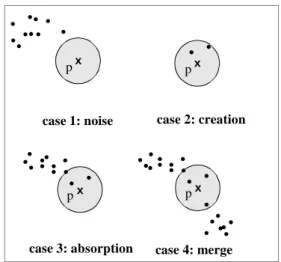
When inserting an object p into the database D, we can distinguish the following cases:
(1) (Noise)
UpdSeedIns is empty, i.e. there are no “new” core objects af-ter insertion of p. Then, p is a noise object and nothing else is changed.
(2)(Creation)
UpdSeedIns contains only core objects which did not belong to a cluster before the insertion of p, i.e. they were noise ob-jects or equal to p, and a new cluster containing these noise objects as well as p is created.
(3) (Absorption)
UpdSeedIns contains core objects which were members of exactly one cluster C before the insertion. The object p and possibly some noise objects are absorbed into cluster C.
(4) (Merge)
UpdSeedIns contains core objects which were members of several clusters before the insertion. All these clusters and the object p are merged into one cluster.
Figure 4 illustrates the most simple forms of the different cases when inserting an object p into a sample database of 2D points, using parameters Eps as depicted and MinPts=3.
Figure 5 presents a more complicated example of merg-ing clusters when insertmerg-ing an object p. In this example the value for Eps is as depicted and MinPts = 6. Then, the in-serted point p is not a core object, but o1, o2, o3 and o4 are core objects after the update. The previous clustering can be adapted by analyzing only the Eps-neighborhood of these objects: cluster A is merged with cluster B and C because o1
and o4 as well as o2 and o3 are mutual directly density-reachable, implying the merge of B and C. The changing of cluster membership for objects in case of merging clusters can be done very efficiently by simply storing the informa-tion about the clusters that have been merged. Note that this kind of “transitive” merging can only occur if MinPts is larger than 5, because otherwise p would be a core object and then all objects in NEps(p) would already be density-reachable from p.
Figure 4: : The different cases of the insertion algorithm p
.
.
.
. . .
..
.
.
p.
.
p... .
.
.
.
.
..
case 1: noise p... .
.
case 2: creationcase 3: absorption case 4: merge
.
.
...
...
...
x x x xFigure 5: : “Transitive” merging of clusters A, B, C by the insertion algorithm
X
A o
1 o2
objects from cluster A objects from cluster B objects from cluster C
B
C o3
o4 p
4.3 Deletions
As opposed to an insertion, when deleting an object p, density-connections may be removed, but no new connec-tions are established. The difficult case for deletion occurs when the cluster C of p is no longer density-connected via (previous) core objects in NEps(p) after deleting p. In this
case, we do not know in general how many objects we have to check before it can be determined whether C has to be split or not. In most cases, however, this set of objects is very small because the split of a cluster is not very frequent and in general a non-split situation will be detected in a small neighborhood of the deleted object p.
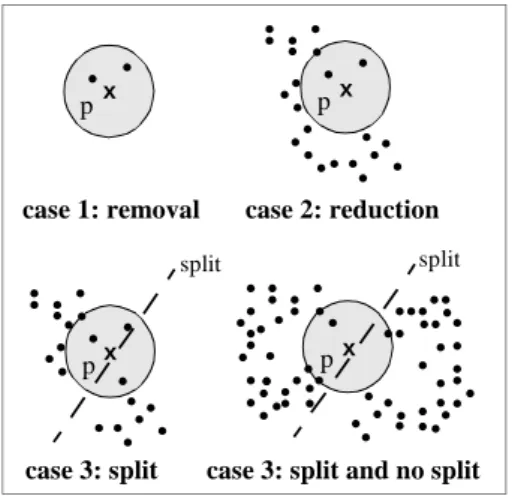
When deleting an object p from the database D we can distinguish the following cases:
(1) (Removal)
UpdSeedDel is empty, i.e. there are no core objects in the neighborhood of objects that may have lost their core object property after the deletion of p. Then p is deleted from D
and eventually other objects in NEps(p) change from a former cluster C to noise. If this happens, the cluster C is completely removed because then C cannot have core ob-jects outside of NEps(p).
(2) (Reduction)
All objects in UpdSeedDel are directly density-reachable from each other. Then p is deleted from D and some objects in NEps(p) may become noise.
(3) (potential Split)
The objects in UpdSeedDel are not directly density-reach-able from each other. These objects belonged to exactly one cluster C before the deletion of p. Now we have to check whether or not these objects are density-connected by other objects in the former cluster C. Depending on the existence of such density-connections, we can distinguish a split and a non-split situation.
Figure 6 illustrates the different cases when deleting p
from a sample database of 2D points using parameters Eps
as depicted and MinPts = 3. Note that the situations de-scribed in case 3 may occur simultaneously.
If case (3) occurs, then the clustering procedure must also consider objects outside of UpdSeedDel, but it stops in case
of a non-split situation as soon as the objects from the set
UpdSeedDel are density-connected to each other.
Case (3) is implemented by a procedure similar to the function expand_cluster in algorithm DBSCAN (see figure 2) starting in parallel from the elements of the set
UpdSeedDel. The main difference is that the candidates for further expansion are managed in a queue instead of a stack. Thus, a breadth-first search for the missing density-connec-tions is performed which is more efficient than a depth-first search due to the following reasons:
• In a non-split situation, we stop as soon as all members of
UpdSeedDel are found to be density-connected to each other. The breadth-first search implies that density-con-nections with the minimum number of objects (requiring the minimum number of region queries) are detected first.
• A split situation is in general the more expensive case be-cause the parts of the cluster to be split actually have to be discovered. The algorithm stops when all but the last part have been visited. Usually, a cluster is split only into two parts and one of them is relatively small. Using breadth-first search we only have to visit the smaller part and a small percentage of the larger one.
5
Performance Evaluation
In this section, we evaluate the efficiency of Incremen-talDBSCAN versus DBSCAN. We present an experimental evaluation using a 2D spatial database as well as a WWW access log database. For this purpose, we implemented both algorithms in C++ based on implementations of the R*-tree [BKSS 90] (for the 2D spatial database) and the M-tree [CPZ 97] (for the WWW log database) respectively. Fur-thermore, we present an analytical comparison of both al-gorithms and derive the speed-up factors for typical param-eter values depending on the database size and the number of updates.
For the first set of experiments, we used a synthetic data-base of 1,000,000 2D points with k = 40 clusters of similar sizes. 21.7% of all points are noise, uniformly distributed outside of the clusters, and all other points are uniformly distributed inside the clusters with a significantly higher density than the noise. In this database, the goal of cluster-ing is to discover groups of neighborcluster-ing objects. A typical real world application for this type of database is clustering earthquake epicenters stored in an earthquake catalog. Earthquake epicenters occur along seismically active faults, and are measured with some errors, so that over time ob-served earthquake epicenters should be clustered along such seismic faults [AF 96].
In this type of application, there are only insertions. The Euclidean distance was used as distance function and an R*-tree [BKSS 90] as an index structure. Eps was set to 4.48 and MinPts was set to 30. Note that the MinPts value had to be rather large due to the high percentage of noise. We performed experiments on several other synthetic 2D databases with n varying from 100,000 to 1,000,000, k
varying from 7 to 40 and with the noise percentage varying from 10% up to 20%. Since we always obtained similar re-sults, we restrict the discussion to the above database. Figure 6: : The different cases of the deletion algorithm
.
.
p
case 1: removal
case 3: split case 3: split and no split
... .
.
.
...
case 2: reduction...
...
... .
.
.
...
...
..
...
.
.
.
...
.
..
.
.
... .
.
....
...
. ...
...
.
....
..
..
...
.
.
.
.
x x x x p p p p split split.
.
..
.
.
....
.
.
.
For the second set of experiments, we used a WWW ac-cess log database of the Institute for Computer Science of the University of Munich. This database contains 1,400,000 entries following the Common Log Format specified as part of the HTTP protocol [Luo 95]. Figure 7 depicts some sam-ple log entries.
All log entries with identical IP address and user id within a given maximum time gap are grouped into a session and redundant entries, i.e. entries with filename suffixes such as “gif”, “jpeg”, and “jpg” are removed [MJHS 96]. A session has the following structure:
session::= <ip_address, user_id, [url1, . . ., urlk]>
In this application, the goal of clustering is to discover groups of similar sessions. A WWW provider may use the discovered clusters as follows:
• The users associated with the sessions of a cluster form some kind of user group which may be used to develop marketing strategies.
• The URLs of the sessions contained in a cluster seem to be logically correlated and should be made easily acces-sible from each other via appropriate links.
Entries are deleted from the WWW access log database after six months. Assuming a constant daily number of WWW accesses, the numbers of insertions and deletions are the same. We used the following distance function for pairs of sessions s1 and s2 :
The domain of dist is the interval [0 . . 1], dist(s,s) = 0, dist
is symmetric and it fulfills the triangle inequality. Other dis-tance functions may use the hierarchy of the directories to define the degree of similarity between two URLs. The da-tabase was indexed by an M-tree [CPZ 97]. Eps was set to 0.4 and MinPts to 2.
In the following, we compare the performance of Incre-mentalDBSCAN versus DBSCAN. Typically, the number of page accesses is used as a cost measure for database algo-rithms because the I/O time heavily dominates CPU time. In both algorithms, region queries are the only operations requiring page accesses. Since the number of page accesses of a single region query is the same for DBSCAN and for IncrementalDBSCAN, we only have to compare the num-ber of region queries. Thus, we use the numnum-ber of region queries as the cost measure for our comparison. Note that we are not interested in the absolute performance of the two algorithms but only in their relative performance, i.e. in the speed-up factor as defined below. To validate this ap-proach, we performed a set of experiments on our test data-bases and found that the experimental speed-up factor al-ways was slightly larger than the analytically derived speed-up factor (experimental value 1.6 times the expected value in all experiments).
DBSCAN performs exactly one region query for each of the n objects of the database (see algorithm in figure 2), i.e. the cost of DBSCAN for clustering n objects, denoted by
CostDBSCAN(n), is
The number of region queries performed by Incremen-talDBSCAN depends on the application and, therefore, it must be determined experimentally. In general, a deletion affects more objects than an insertion. Thus, we introduce two parameters rins and rdel denoting the average number of region queries for an incremental insertion resp. deletion. Let fins and fdel denote the percentage of insertions resp. de-letions in the number of all incremental updates. Then, the cost of IncrementalDBSCAN for performing m incremental updates, denoted by CostIncrementalDBSCAN (m), is as follows:
Table 1 lists the parameters of our performance evalua-tion and the values obtained for the 2D spatial as well as for the WWW-log database. To determine the average values Figure 7: : Sample WWW access log entries
romblon.informatik.uni-muenchen.de lopa - [04/Mar/1997:01:44:50 +0100] "GET /~lopa/ HTTP/1.0" 200 1364 romblon.informatik.uni-muenchen.de lopa - [04/Mar/1997:01:45:11 +0100] "GET /~lopa/x/ HTTP/1.0" 200 712 fixer.sega.co.jp unknown - [04/Mar/1997:01:58:49 +0100] "GET /dbs/porada.html HTTP/1.0" 200 1229 scooter.pa-x.dec.com unknown - [04/Mar/1997:02:08:23 +0100] "GET /dbs/kriegel_e.html HTTP/1.0" 200 1241
dist s( 1,s2) Cardinality s( 1\s2)+Cardinality s( 2\s1) Cardinality s( )1 +Cardinality s( )2
---=
CostDBSCAN( )n = n
(rinsand rdel), the whole databases were incrementally insert-ed and deletinsert-ed, although fdel = 0 for the 2D spatial database. Now, we can calculate the speed-up factor of Incremen-talDBSCAN versus DBSCAN. We define the speed-up fac-tor as the ratio of the cost of DBSCAN (applied to the data-base after all insertions and deletions) and the cost of m
calls of IncrementalDBSCAN (once for each of the inser-tions resp. deleinser-tions), i.e.:
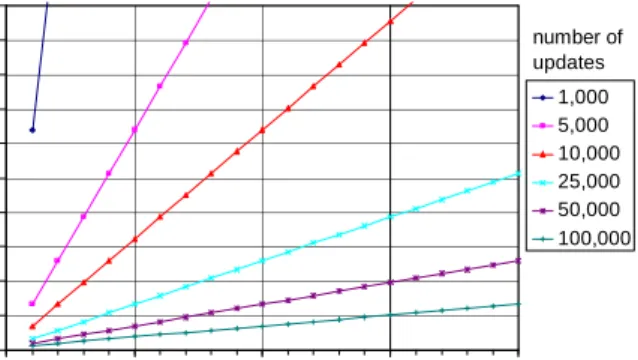
Figure 8 and figure 9 depict the speed-up factors depend-ing on n for several values of m. For relatively small num-bers of daily updates, e.g., m = 1,000 and n = 1,000,000, we obtain speed-up factors of 633 for the 2D spatial database and 260 for the WWW-log database. Even for rather large numbers of daily updates, e.g., m = 25,000 and n = 1,000,000, IncrementalDBSCAN yields speed-up factors of 26 and 10 for the 2D spatial as well as for the WWW-log database.
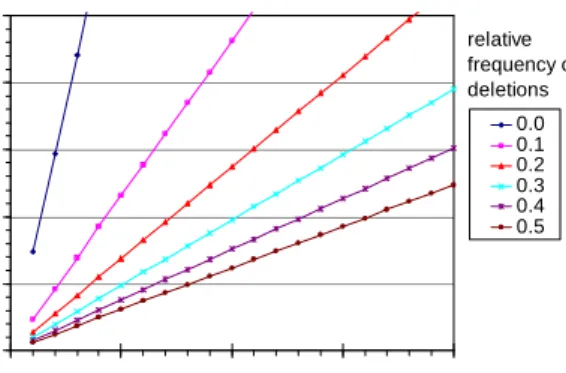
When setting the speed-up factor to 1.0, we obtain the number of updates (denoted by MaxUpdates) up to which the multiple application of IncrementalDBSCAN for each update is more efficient than the single application of DBSCAN to the whole updated database. Figure 10 depicts the values of MaxUpdates dependingon n for fdelvalues of up to 0.5 which is the maximum value to be expected in most real applications. This figure was derived by setting
rins to 1.34 and rdel to 6.75 which are the averages over the respective values obtained for our test databases. Note that - in contrast to the significant differences of other character-istics of the two applications - the differences of both rins
and rdel are rather small indicating that the average values
are a realistic choice for many applications. The MaxUp-datesvalues obtained are much larger than the actual num-bers of daily updates in most real databases. For databases without deletions (that is, fdel = 0), MaxUpdates is approxi-mately 3 *n, i.e. the cost for 3 *n updates on a database of
n objects using IncrementalDBSCAN is the same as the cost of DBSCAN on the updated database containing 4 *n
objects. Even in the worst case of fdel = 0.5, MaxUpdates is approximately 0.25 *n. These results clearly emphasize the relevance of incremental clustering.
Table 1: Parameters of the performance evaluation
Parameter Meaning Value for 2D
spatial
Value for WWW-log
n number of database objects 1,000,000 69,000
m number of (incremental) updates varying varying
rins average number of region queries for an incremental insertion 1.58 1.1
rdel average number of region queries for an incremental deletion 6.9 6.6
fdel relative frequency of deletions in the number of all updates 0 0.5
fins relative frequency of insertions in the number of all updates (1- fdel) 1.0 0.5
SpeedupFactor CostDBSCAN(n+fins×m–fdel×m) CostIncrementalDBSCAN( )m
---=
n+fins×m–fdel×m
( )
m×(fins×rins+fdel×rdel)
---= 0 10 20 30 40 50 60 70 80 90 100 0 500,000 1,000,000 1,500,000 2,000,000 size of database (n) speed-up factor 1,000 5,000 10,000 25,000 50,000 100,000 number of updates
Figure 8: : Speed-up factors for 2D spatial database
0 20 40 60 80 100 0 500,000 1,000,000 1,500,000 2,000,000 size of database (n) speed-up factor 1,000 5,000 10,000 25,000 50,000 100,000 number of updates (m)
6
Conclusions
Data warehouses provide a great deal of opportunities for performing data mining tasks such as classification and clustering. Typically, updates are collected and applied to the data warehouse periodically in a batch mode, e.g., dur-ing the night. Then, all patterns derived from the warehouse by some data mining algorithm have to be updated as well. In this paper, we presented the first incremental cluster-ing algorithm - based on DBSCAN - for mincluster-ing in a data warehousing environment. DBSCAN requires only a dis-tance function and, therefore, it is applicable to any data-base containing data from a metric space. Due to the densi-ty-based nature of DBSCAN, the insertion or deletion of an object affects the current clustering only in a small neigh-borhood of this object. Thus, efficient algorithms could be given for incremental insertions and deletions to a cluster-ing. Based on the formal definition of clusters, it was prov-en that the incremprov-ental algorithm yields the same result as DBSCAN.
A performance evaluation of IncrementalDBSCAN ver-sus DBSCAN using a spatial database as well as a WWW-log database was presented, demonstrating the efficiency of the proposed algorithm. For relatively small numbers of daily updates, e.g., 1,000 updates in a database of size 1,000,000, IncrementalDBSCAN yielded speed-up factors of several hundred. Even for rather large numbers of daily updates, e.g., 25,000 updates in a database of 1,000,000 ob-jects, we obtained speed-up factors of more than 10 versus DBSCAN.
In this paper, we assumed that the parameter values Eps
and MinPts of DBSCAN do not change significantly when inserting and deleting objects. However, there may be ap-plications where this assumption does not hold, i.e. the pa-rameters may change after many updates of the database. In our future work, we plan to investigate this case. In this pa-per, sets of updates are processed one at a time without con-sidering the relationships between the single updates. In the future, bulk insertions and deletions will be considered to further improve the efficiency of IncrementalDBSCAN.
Acknowledgments
We thank Marco Patella for the M-tree implementation and Franz Krojer for providing us with the WWW access log database.
References
[AF 96] Allard D. and Fraley C.:”Non Parametric Maximum Likelihood Estimation of Features in Saptial Point Process Using Voronoi Tessellation”, Journal of the American Statistical Association, December 1997. [also http://www.stat.washington.edu/tech.reports/ tr293R.ps].
[AS 94] Agrawal R., Srikant R.: “Fast Algorithms for Mining Association Rules”, Proc. 20th Int. Conf. on Very Large Data Bases, Santiago, Chile, 1994, pp. 487-499.
[BKSS 90] Beckmann N., Kriegel H.-P., Schneider R., Seeger B.: “The R*-tree: An Efficient and Robust Access Method for Points and Rectangles”, Proc. ACM SIGMOD Int. Conf. on Management of Data, Atlantic City, NJ, 1990, pp. 322-331.
[Bou 96] Bouguettaya A.: “On-Line Clustering”, IEEE Transactions on Knowledge and Data Engineering, Vol. 8, No. 2, 1996, pp. 333-339. [CHNW 96] Cheung D. W., Han J., Ng V. T., Wong Y.:
“Maintenance of Discovered Association Rules in Large Databases: An Incremental Technique”, Proc. 12th Int. Conf. on Data Engineering, New Orleans, USA, 1996, pp. 106-114.
[CPZ 97] Ciaccia P., Patella M., Zezula P.: “M-tree: An Efficient Access Method for Similarity Search in Metric Spaces”, Proc. 23rd Int. Conf. on Very Large Data Bases, Athens, Greece, 1997, pp. 426-435.
[EKSX 96] Ester M., Kriegel H.-P., Sander J., Xu X.: “A Density-Based Algorithm for Discovering Clusters in Large Spatial Databases with Noise”, Proc. 2nd Int. Conf. on Knowledge Discovery and Data Mining, Portland, OR, 1996, pp. 226-231.
[EKX 95] Ester M., Kriegel H.-P., Xu X.: “Knowledge Discovery in Large Spatial Databases: Focusing Techniques for Efficient Class Identification”, Proc. 4th Int. Symp. on Large Spatial Databases, Portland, ME, 1995, in: Lecture Notes in Computer Science, Vol. 951, Springer, 1995, pp. 67-82. 0 200,000 400,000 600,000 800,000 1,000,000 0 500,000 1,000,000 1,500,000 2,000,000 size of database (n) MaxUpdates 0.0 0.1 0.2 0.3 0.4 0.5 relative frequency of deletions (f_del)
Figure 10: MaxUpdates depending on database size for different relative frequencies of deletions
[EW 98] Ester M., Wittmann R.: “Incremental Generalization for Mining in a Data Warehousing Environment”, Proc. 6th Int. Conf. on Extending Database Technology, Valencia, Spain, 1998, in: Lecture Notes in Computer Science, Vol. 1377, Springer, 1998, pp. 135-152.
[FAAM 97] Feldman R., Aumann Y., Amir A., Mannila H.: “Efficient Algorithms for Discovering Frequent Sets in Incremental Databases”, Proc. ACM SIGMOD Workshop on Research Issues on Data Mining and Knowledge Discovery, Tucson, AZ, 1997, pp. 59-66. [FPS 96] Fayyad U., Piatetsky-Shapiro G., and Smyth
P.: “Knowledge Discovery and Data Mining: Towards a Unifying Framework”, Proc. 2nd Int. Conf. on Knowledge Discovery and Data Mining, Portland, OR, 1996, pp. 82-88. [Gue 94] Gueting R. H.: “An Introduction to Spatial
Database Systems”, The VLDB Journal, Vol. 3, No. 4, October 1994, pp. 357-399.
[HCC 93] Han J., Cai Y., Cercone N.: “Data-driven Discovery of Quantitative Rules in Relational
Databases”, IEEE Transactions on
Knowledge and Data Engineering, Vol.5, No. 1, 1993, pp. 29-40.
[Huy 97] Huyn N.: “Multiple-View Self-Maintenance in Data Warehousing Environments”, Proc. 23rd Int. Conf. on Very Large Data Bases, Athens, Greece, 1997, pp. 26-35.
[KR 90] Kaufman L., Rousseeuw P. J.: “Finding Groups in Data: An Introduction to Cluster Analysis”, John Wiley & Sons, 1990.
[Luo 95] Luotonen A.: “The common log file format”, http://www.w3.org/pub/WWW/, 1995. [MJHS 96] Mombasher B., Jain N., Han E.-H., Srivastava
J.: “Web Mining: Pattern Discovery from World Wide Web Transactions”, Technical Report 96-050, University of Minnesota, 1996. [MQM 97] Mumick I. S., Quass D., Mumick B. S.:
“Maintenance of Data Cubes and Summary
Tables in a Warehouse”, Proc. ACM
SIGMOD Int. Conf. on Management of Data, 1997, pp. 100-111.
[NH 94] Ng R. T., Han J.: “Efficient and Effective Clustering Methods for Spatial Data Mining”, Proc. 20th Int. Conf. on Very Large Data Bases, Santiago, Chile, 1994, pp. 144-155. [SEKX 98] Sander J., Ester M., Kriegel H.-P., Xu X.:
“Density-Based Clustering in Spatial Databases: The Algorithm GDBSCAN and its Applications”, will appear in: Data Mining and Knowledge Discovery, Kluwer Acedemic Publishers, Vol. 2, 1998.
[Sib 73] Sibson R.: “SLINK: an optimally efficient algorithm for the single-link cluster method”, The Computer Journal, Vol. 16, No. 1, 1973, pp. 30-34.
[ZRL 96] Zhang T., Ramakrishnan R., Linvy M.:
“BIRCH: An Efficient Data Clustering Method for Very Large Databases”, Proc. ACM SIGMOD Int. Conf. on Management of Data, 1996, pp. 103-114.