Symbolic Protocol Analysis With an Abelian
Group Operator or Diffie-Hellman Exponentiation
Jonathan Millen and Vitaly Shmatikov
Computer Science Laboratory
SRI International
millen,shmat
@csl.sri.com
Abstract
We demonstrate that for any well-defined cryptographic protocol, the symbolic trace reachability problem in the presence of an Abelian group operator (e.g., multi-plication) can be reduced to solvability of a decidable system of quadratic Diophantine equations. This result enables complete, fully automated formal analysis of protocols that employ primitives such as Diffie-Hellman exponentiation, multiplication, andxor, with a bounded number of role instances, but without imposing any bounds on the size of terms created by the attacker.
1
Introduction
Conventional formal analysis of cryptographic protocols relies on the so called “Dolev-Yao” attacker model, which assumes that the attacker can intercept any message and con-struct or modify messages using a given set of computational and cryptographic primitives. Cryptographic operations are treated abstractly as black boxes, in the sense that they are assumed to have no computational features other than those associated with encryption and decryption. Black-box cryptographic primitives are characterized using simple axioms such asdec enc , where is the inverse key to, which might be
eitheritself for symmetric encryption, or the corresponding private key for public-key
encryption. Sometimes even less is assumed: for example, in the free algebra modeldec
is not used explicitly (the consequences of this restriction are discussed in [Mil03]). This rudimentary treatment of encryption is not adequate to deal with primitives such as
xor(exclusive or), multiplication, and Diffie-Hellman exponentiation, which are widely used in security protocols. The attacker can and will exploit associativity, commutativ-ity, cancellation, and other properties of these operations. For example, Bull’s recursive authentication protocol was formally proved correct in a model that treatedxoras an ab-stract encryption, and then found to be vulnerable once self-cancellation properties ofxor
are taken into account [Pau97, RS98].
We use symbolic trace reachability as the standard representation of the protocol analy-sis problem for trace-based security properties, which include secrecy and most authentica-tion properties. This problem has been shown to be undecidable in several general settings
Partially supported by ONR Grants N00014-01-1-0837 and N00014-03-1-0961, and by DARPA contract N66001-00-C-8014.
(for example, see [DLMS99]). Our approach follows the line of research that makes the reachability problem decidable by bounding the number of sessions, but allowing an un-bounded attacker who may create messages of arbitrary depth [AL00, FA01, Bor01, MS01]. Other model checking approaches require a priori bounds on message complexity or may fail to terminate. Inductive proof approaches have no finiteness limitations, but require substantially more human effort per protocol, and are still subject to undecidability results. In symbolic approaches, messages are represented as terms in an algebra generated by abstract computational primitives. Messages may contain variables, representing data fields whose value is not known in advance to the recipient. A variable can be viewed as the attacker’s input to the protocol execution since the attacker can instantiate it with any term available to him as long as the instantiation is consistent in every term where the variable appears.
A trace is a sequence of messages sent and received. A trace is reachable if there is a substitution that instantiates all variables with ground terms such that all messages sent by the honest parties are consistent with the protocol specification, and all messages received by the honest parties from the network could have been constructed by the attacker from the previously sent messages and attacker’s initial knowledge.
A trace is an attack if it violates the security condition – in the case of secrecy, if a value that is supposed to remain secret appears in the trace as an unencrypted received message (i.e., is announced by the attacker). For a bounded number of sessions, the symbolic trace reachability problem has been shown to be NP-complete [RT01], assuming a free term algebra.
Our main contribution is to extend the constraint solving approach, first proposed in [MS01], to handle the algebraic properties of Abelian group operators. For any well-defined cryptographic protocol, we show that symbolic trace reachability is equivalent to solvability in integers of a certain system of quadratic equations. We then prove that this system is decidable. Decidability of the bounded-session protocol insecurity problem for
xor(first shown in [CLS03, CKRT03b]) and for the free attacker algebra without equa-tional properties (previously proved in [RT01, CCM01, MS01]) follow as special cases.
1.1
Overview
In Section 2, we introduce our formal model and describe how to reduce the protocol anal-ysis problem to a sequence of symbolic constraints. In Section 3, we posit the origination
stability condition, which is a necessary property of any well-defined protocol. In
Sec-tion 4, we summarize the theory of ground term derivability in the presence of an Abelian group operator, due to Comon-Lundh and Shmatikov [CLS03].
The main technical result of the paper appears in Section 5. If the constraint sequence has a solution, we prove that it has a conservative solution. Intuitively, the conservative solution uses only the structure that is already present in the original sequence. We show that the substitution for any variable is a product of terms (and their inverses) drawn from a finite set: the non-variable subterms of the original constraint sequence. The resulting set of product derivation problems is naturally reduced to a system of quadratic Diophan-tine equations, as shown in Section 6. One of the steps along the way is Abelian group unification, which is known to be decidable [BS01]. We then proceed to demonstrate that the quadratic system has a solution if and only if a particular linear subsystem has a so-lution. Since linear Diophantine equations are decidable (e.g., [CD94]), this establishes decidability of the protocol analysis problem in the presence of an Abelian group operator.
In Section 7, we extend our approach to protocols with Diffie-Hellman exponentia-tion, under the restriction that multiplication may appear only in exponents. We replace exponentials by a combination of products and uninterpreted functions, which reduces the symbolic analysis problem for such protocols to the solvability of a symbolic constraint sequence with an Abelian group operator. Conclusions are in Section 8.
1.2
Related work
Boreale and Buscemi [BB03] and Chevalier et al. [CKRT03a] recently developed decision procedures for protocol analysis in the presence of Diffie-Hellman exponentiation. Neither addresses decidability in the presence of an Abelian group operator. The decision procedure of [BB03] requires an a priori upper bound on the number of factors in each product, but the paper does not indicate how to compute this bound for a given symbolic trace. In general, establishing upper bounds on the size of variable instantiations needed for a feasible attack on a protocol is a highly non-trivial problem and one of the main challenges in proving decidability. Therefore, the technique of [BB03] cannot be considered a complete decision procedure even for protocols with Diffie-Hellman exponentiation.
Chevalier et al. [CKRT03a] proved that the insecurity problem for a restricted class of protocols is NP-complete in the presence of Diffie-Hellman exponentiation. They do not consider Abelian group operators outside exponents, and their result only applies to protocols in which no more than one new variable is introduced in each protocol message. Also, they do not permit variables to be instantiated with products. These restrictions are quite strong, ruling out some well-defined protocols. For example, a protocol in which an honest participant receives , then receives, and then sends is not permitted by the
syntactic restrictions of [CKRT03a] (this protocol may be rewritten so as to satisfy the re-strictions, but it is not clear whether there exists a general-purpose syntactic transformation that converts any protocol into one satisfying the restrictions of [CKRT03a]). In contrast, the results of this paper are directly applicable to any protocol which is well-defined in the following sense: an honest participant is not required to output the value of an attacker’s variable before he has received any message containing that variable.
The technique of [CKRT03a] is more general in its treatment of Diffie-Hellman expo-nentiation since it allows expoexpo-nentiation from an arbitrary base, while only constant-base exponentiation is considered in this paper. See [Shm04] for an extension of our constraint solving technique to modular exponentiation from an arbitrary base.
Pereira and Quisquater [PQ01] discovered an attack on a group Diffie-Hellman (GDH) protocol that exploits algebraic properties of Diffie-Hellman exponents. Their approach is specific to GDH-based protocols, and the attacker model is restricted correspondingly (e.g., the attacker is not even equipped with the ability to perform standard symmetric encryption). They do not attempt to address the general problem of deciding whether a term is derivable in an attacker algebra with the equational theory of multiplication, or whether a particular symbolic attack trace has a feasible instantiation. Since they only consider the problem in the ground case, the resulting system of equations is linear, whereas the system we obtain in the general case with variables is quadratic (see Section 6). An application of our approach to one of the Pereira-Quisquater examples is summarized in Section 7.
Recent research by Narendran et al. focuses on decidability of unification modulo the equational theory of multiplication and exponentiation [MN02, KNW02, KNW03]. While equational unification is an important subproblem in symbolic protocol analysis, unification alone is insufficient to decide whether a particular symbolic attack trace is feasible.
Decidability of symbolic protocol analysis in the presence ofxor has been proved in [CKRT03b, CLS03]. Chevalier et al. [CKRT03b] showed that the problem is NP-complete in a restricted protocol model which is very similar to the one proposed in this paper. Independently, Comon-Lundh and Shmatikov [CLS03] demonstrated decidability of symbolic protocol analysis withxorin the unrestricted model. This paper lifts the results of [CLS03] by considering the symbolic analysis problem in the presence of an arbitrary Abelian group operator, resulting in a substantially more complicated theory than in the
xorcase. In contrast, [CLS03] only considers Abelian group operators in the ground case, and obtains symbolic decidability results forxoronly.
Bertolotti et al. [BDSV03] investigated cryptographic protocol analysis in the presence of associative and commutative operators. The algebraic theory considered in this paper is significantly more complicated. In protocols such as group Diffie-Hellman [STW96], the exponents form an Abelian group. In particular, the attacker can easily compute multiplica-tive inverses. To discover attacks such as that found by Pereira and Quisquater [PQ01], the algebraic theory must include inverses and cancellative reductions such as .
Demonstrating decidability in the presence of an Abelian group operator (rather than mere associativity and commutativity) is the main technical contribution of this paper.
2
Model
We begin with the strand space model of [THG99]. A strand is a sequence of nodes rep-resenting the activity of one party executing the protocol. Strands are finite and do not have branching or loops. Associated with each node is a message term with a sign, + or
, indicating that the message is sent or received, respectively. Messages in a strand are
ground terms in a suitable algebra.
A protocol specification is a set of roles for legitimate parties in the protocol. A role can be instantiated with different data in different protocol sessions. Hence, roles in a protocol are specified as strand schemas, in which message terms may contain variables. A role strand is a partially (or fully or un-) instantiated strand schema that is a role; a role
instance is a fully instantiated (ground) role strand.
In the usual strand space model, there is a standard set of penetrator roles represent-ing primitive computations that an attacker can perform. An attack on a protocol may involve many concurrent sessions or role instances woven together with penetrator strands. A bundle is a collection of (protocol and penetrator) role instances in which the source of each received message is identified. Thus, nodes in a bundle are partially ordered by their strand sequence and also by the connection of a send node to a receive node for the same message. Bundles are backward complete in the sense that the strand predecessor of each (non-initial) node must be present, and the send node for each receive node must be present. A bundle is essentially a Lamport diagram [Lam78] in which the processes are strands. (Lamport called this a space-time diagram, but others renamed it in the context of distributed systems.)
2.1
Overview of constraint solving
It is shown in [THG99] and elsewhere how security questions can be reduced to questions about the existence of a bundle that exhibits a security violation. In our constraint solving approach begun in [MS01], bundle existence is determined by starting with a semibundle
consisting of partially instantiated role instances, in which the sources of received mes-sages are not necessarily determined. (The term “semibundle” comes from the Athena paper [Son99].) In a semibundle to be analyzed, the number of instances of each role has been chosen, and variables representing nonces (or session keys) have been instantiated to symbolic constants in the roles that generate them. The remaining variables are, for purposes of analysis, viewed as chosen or constructed by the attacker.
As in Athena, search for a solution begins with a semibundle that has no penetrator strands. Athena adds penetrator strands and role strands as necessary to extend the semi-bundle until it is a complete semi-bundle. We never add role strands, because we bound the number of roles to begin with to achieve decidability. We never add penetrator strands, because their purpose is modeled implicitly by derivation constraints. We solve the con-straints to see if the original semibundle can be instantiated to the role strands of a bundle. Unlike Athena, we solve the problem in an infinite state space that includes all possible combinations of penetrator strands.
A different sequence of derivation constraints is generated for each possible trace. Derivation constraints assert that each received message is derivable, using attacker term-generation rules, from messages that were previously sent in the trace. A solution instan-tiates variables in the semibundle so that ground terms representing received messages are all derivable. If the constraint sequence is not solvable for any of the possible traces, then an attack bundle does not exist for the given set of role strands (though one might exist for a larger set).
An efficient method for generating traces and solving a set of derivation constraints by applying rules for successive transformations of the constraint sequence is given in [MS01]. One important advance in that paper is the ability to handle non-atomic or constructed symmetric keys, that is, keys that may be the result of a combination of operations such as concatenation, encryption, and hashing. Some work was done subsequently to improve the efficiency of constraint generation and solving. Corin and Etalle devised an incremental approach [CE02] that has been adopted and incorporated into our own software tool. Re-cently, the AVISPA project made further improvements with a “constraint differentiation” approach [BMV03].
This paper focuses on the decidability of constraint solving in the extended model with Abelian group operations. The constraint solving step is different from that of [MS01], and consists mainly in reducing the constraint solving problem to a choice among a finite selection of substitutions, followed by solving a system of simultaneous linear Diophantine equations.
The solution approach presented here is aimed only at establishing decidability. An-alyzing complexity and finding an efficient way to carry out protocol analysis are left to future work. A practical algorithm similar to that of [MS01] may work by gradual discov-ery of the right set of substitutions by successive unifications, but unification would have to be performed modulo the equational theory of Abelian groups, followed by solving a sys-tem of linear Diophantine equations. Practical techniques for solving linear Diophantine equations have already been developed in the context of associative-commutative unifica-tion [LC89].
2.2
Term algebra
To focus on decidability in the presence of an Abelian group operator, we use a simplified term algebra that includes only pairing, symmetric encryption (but not decryption), a
one-argument function modeling a one-way hash function, and an Abelian group operator
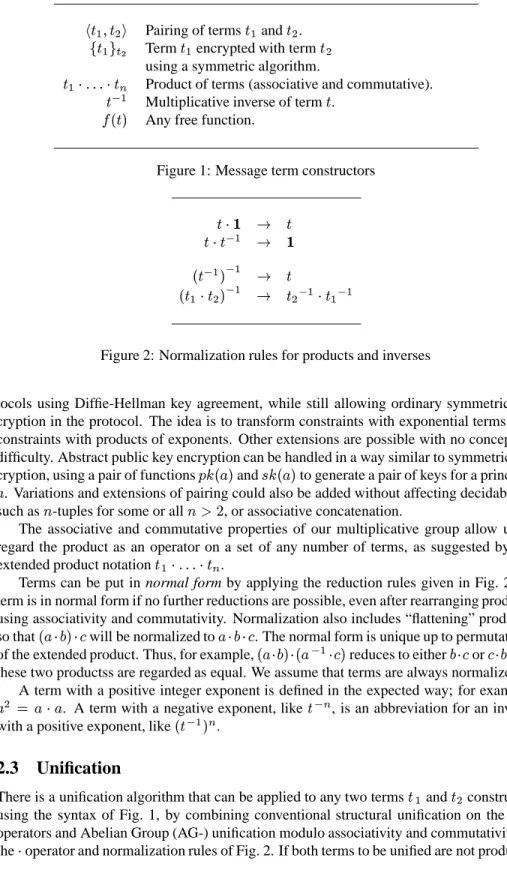
written as multiplication. There are also assumed to be an unlimited number of variables and free constants (zero-argument functions). This is almost a free algebra, that is, one with no valid equations between terms (other than identities). But our term algebra is not free because multiplication forms an Abelian group, with unit and a multiplicative inverse. The notation for these operations is shown in Fig. 1.
As in prior work with free algebras, there is no explicit decryption operator. Decryption is performed implicitly by protocol participants. The attacker’s ability to extract compo-nents of a pair, or to decrypt an encrypted term when he knows the decryption key is modeled by separate attacker inference rules, which are discussed in Section 2.4.
The overall algebraic structure is described as the disjoint combination of a free theory and the Abelian group theory, following [SS89]. In this context, “disjoint” means that each relation involves only functions (and constants) from one theory at a time, in this case the group theory. However, any term is acceptable as an argument to any function. One way of viewing this is that all terms are untyped (or share a common base type, or sort). In particular, we do not distinguish between keys and other kinds of messages.
Actual cryptographic operators do have requirements on their arguments, at least on their size in bits, and in many cases more subtle restrictions. Protocol implementations depend on observing these restrictions. For example, our algebra would allow a term like
¼
, but a protocol would normally have to apply a type coercion operator (a hash or
truncation, perhaps) to
before it could be used as a key. Moreover, when the Abelian
group operator is applied to a compound term (e.g., a pair), in the actual implementation the corresponding bitstring must be interpreted as an element of the right group, which may or may not be possible. We trust the protocol specification in this respect. If terms appearing in the abstract protocol specification involve application of the Abelian group operator to compound terms, we assume that such terms can be mapped into the group. Nevertheless, due to our abstract treatment of cryptographic functions, our analysis may generate unimplementable attacks, e.g., those involving application of the Abelian group operator to ciphertexts encrypted with a symmetric key, etc. These spurious attacks can be recognized by static inspection and discarded.
It is natural to ask here about the relationship between ground terms in our term algebra and the bitstrings they are mapped to in the protocol implementation. This is not an easy question to answer because of the level of abstraction of our model (and all Dolev-Yao-style [DY83] models in general). For example, regarding encryption as a free operator means that the infinite sequence of terms are all distinct, whereas in
practice the bitstring values would all have the same length and could not all be distinct. Thus, there are additional relations in reality, and this implies that there may be more attacks on the real protocol than on the abstract version. Such concerns are addressed in work on computationally sound formal models, which is beyond the scope of this paper. The Abadi-Rogaway paper [AR02] is a good introduction to this issue.
Additional relations may also come about because of particular ways that encryption is performed. Encryption can be accomplished using exponentiation or multiplication, for example, and some interaction with the multiplicative Abelian group operator could occur, especially if they both use modular arithmetic. Such design choices might lead to attacks that would not be discovered in the present model. However, our decision procedure will determine the existence of any attack strategies that work uniformly, that is, for all possible cryptographic implementations that satisfy the abstract axioms.
Pairing of terms and .
Term
encrypted with term
using a symmetric algorithm.
Product of terms (associative and commutative). Multiplicative inverse of term.
Any free function.
Figure 1: Message term constructors
Figure 2: Normalization rules for products and inverses
tocols using Diffie-Hellman key agreement, while still allowing ordinary symmetric en-cryption in the protocol. The idea is to transform constraints with exponential terms into constraints with products of exponents. Other extensions are possible with no conceptual difficulty. Abstract public key encryption can be handled in a way similar to symmetric en-cryption, using a pair of functions and to generate a pair of keys for a principal . Variations and extensions of pairing could also be added without affecting decidability,
such as-tuples for some or all, or associative concatenation.
The associative and commutative properties of our multiplicative group allow us to regard the product as an operator on a set of any number of terms, as suggested by the extended product notation
.
Terms can be put in normal form by applying the reduction rules given in Fig. 2. A term is in normal form if no further reductions are possible, even after rearranging products using associativity and commutativity. Normalization also includes “flattening” products, so that will be normalized to . The normal form is unique up to permutations
of the extended product. Thus, for example, reduces to either or , and
these two productss are regarded as equal. We assume that terms are always normalized. A term with a positive integer exponent is defined in the expected way; for example,
. A term with a negative exponent, like
, is an abbreviation for an inverse with a positive exponent, like
.
2.3
Unification
There is a unification algorithm that can be applied to any two terms and
constructed
using the syntax of Fig. 1, by combining conventional structural unification on the free operators and Abelian Group (AG-) unification modulo associativity and commutativity of the operator and normalization rules of Fig. 2. If both terms to be unified are not products,
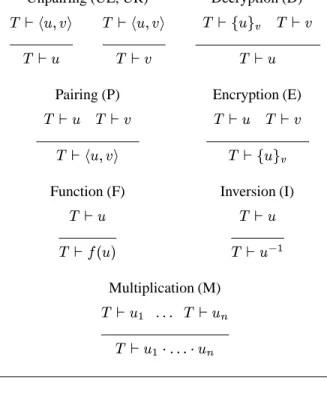
Unpairing (UL, UR) Decryption (D)
Pairing (P) Encryption (E)
Function (F) Inversion (I)
Multiplication (M)
Figure 3: Attacker’s capabilities
we use conventional unification by structural recursion, treating all constructors of Fig. 1 as free functions. If at least one of the terms is a product, unification is performed modulo AG, which is known to be decidable [BS01] and which produces a finite number of most general unifiers. In the rest of the paper, we use
notation for the finite
set of most general unifiers of and
. Note that because a non-product term may contain
products as inner subterms, and
may have more than one most general unifier even if
neither is a product.
2.4
Attacker model
We use the standard attacker model augmented with rules concerning products and inverses (an extension to exponentials can be found in Section 7). The attacker’s ability to derive terms is characterized as a term closure under the inference rules of Fig. 3. The sequent
means thatis derivable (computable) from the terms in the set. The term closure
of is the set of all terms derivable from(including members of).
2.5
Constraint generation
Suppose we are given a protocol specified as a set of roles (strand schemas). We first choose a finite set of role strands for the semibundle. (There is no algorithm to determine how many of each are needed.) Each role may be instantiated zero or more times. In each
role strand, any nonce variable generated by that role is instantiated with a distinct symbolic constant.
As an example, consider the protocol with two roles and
, where and are nonces, and the security policy is to keepsecret. In the semibundle pictured below,
has been instantiated within the first role strand, which generates it, andhas been
instantiated with.
The third strand (node 4) is an artificial “test” strand introduced to detect compromise of. Ifcan be received (in the clear) by the test party, thenhas been compromised.
?>=< 89:; / / / /?>=<89:; ?>=< 89:; o o ?>=<89:; o o
No variables remaining in a semibundle should occur in more than one strand. Even though role specifications may use the same variable likeorin different roles because
the value is expected to be the same, there is no guarantee that corresponding variables will be instantiated with the same value during execution.
We generate all possible node orderings, or traces, that are consistent with the given strands. This is a finite set that grows exponentially with the number of strands. (Some traces can be discarded safely, but for proving decidability we may as well assume that we have all of them.) Each trace yields a sequence of derivation constraints.
In general, if is the sequence of receive-node messages, and
is the set of
messages sent in nodes prior to the node in which
is received, then the constraints are
just the sequence
Each individual constraint
can be interpreted as “at step
, the attacker knows
messages in
and needs to generate message
.” We will refer to
as the target term
of the constraint, and
as the source set of the constraint. Both
and messages in
may contain variables. We assume that contains terms that are initially known to the
attacker, such as constants specific to the protocol and the attacker’s own long-term keys. It is usually not necessary to include the constant , since if contains any term, the
attacker can derive as .
The properties of protocol-generated sequences are discussed in Section 3.
Our example semibundle has traces corresponding to all node orderings that respect the ordering of nodes 2 and 3. Note also that the only traces of interest are attacks, which end with node 4. Thus, the complete set of orderings to examine is 1234, 124, 14, 2134, 2314, 214, 24, 4. (One can show that it is sufficient to examine 1234 and 14, since any attack possible with a different ordering is possible with one of these.) The ordering 1234 generates the constraint sequence
For convenience, we simplify the notation for source sets by regarding a list as a union. Thus,
may be written
and may be written .
We say that is a solution of (written ) ifis a ground substitution
Given a constraint sequence
, is a solution of the constraint sequence
() ifsimultaneously solves every constraint
.
The constraint sequence arising from the trace 1234 in the example can be satisfied with the substitution , since the attacker’s Decryption rule (D) can be applied to satisfy
the second constraint.
2.6
Subterms and product closures
We introduce a few definitions for convenience. If is a finite set of terms, let be
the set of subterms of, which is the least set of terms such that:
If then If then If then If then If then for each Note that
is not considered a subterm of
. For an individual term , . We say thatis a superterm ofif .
Define or is a variable
Thus, is the set of all non-variable subterms of, and
is the closure of this set
under product ( ) and inverse.
3
Well-Defined Protocols and Constraint Sequences
We start by defining two properties of constraint sequences that are essential for establish-ing decidability: monotonicity and origination. Conceptually, these properties are similar to those defined for the constraint solving method of [MS01]. Informally, monotonicity means that the attacker’s knowledge never decreases as the protocol progresses: all mes-sages intercepted by the attacker are simply added to the set of terms available to him.
Origination means that each variable appears for the first time in some message generated
by the attacker (recall that in the symbolic analysis approach, variables model attacker’s input to the protocol execution).
Our proof of decidability requires that monotonicity and origination be preserved by any partial substitution (this is a technical difference from [MS01]). In this section, we argue that this is true for any symbolic constraint sequence associated with a well-defined
protocol. Our notion of well-definedness is formalized below, but it can be informally understood as follows. For any choice of attacker’s inputs to the protocol execution, the protocol should never require an honest participant to generate a message containing an attacker’s input before the attacker sent any message with that input.
Although a constraint sequence must be solved by a ground substitution, the substiti-tions we work with below are not always ground substitusubstiti-tions. We do assume, for con-venience, that all substitutions are idempotent. An idempotent substitution eliminates ev-ery variable it instantiates. That is, if we define the domain , then implies . Furthermore, a substitution does not introduce new
vari-ables in the context of a constraint sequence: .
3.1
Monotonicity and origination
Let
be any constraint sequence generated from a protocol. Definition 3.1 (Monotonicity) satisfies the monotonicity property ifimplies that
.
This property means that the attacker does not “forget” terms. As the protocol pro-gresses, the set of the terms available to the attacker does not decrease. The constraint generation procedure described in Section 2.5 produces monotonic constraint sequences. Furthermore, this property is preserved by substitutions.
To understand the origination property, recall that variables represent the attacker’s input to the protocol execution. Therefore, each variable must appear for the first time in some message generated by the attacker, i.e., in some message received by an honest party.
Definition 3.2 (First occurrence) Given a constraint sequence , define
for any variable to be the index of the constraint in which appears for the first time, i.e., , but
. Whereis clear from the context, we will refer to
simply as. Definition 3.3 (Origination) A constraint sequence
satisfies the
origina-tion property if
.
Origination implies that the first occurrence of a variable is in a target term, since, if
, we would have
, which is impossible.
In order to ensure this property for the initial constraint sequence generated from a protocol specification, we observe two conventions. First, nonces generated by a role are instantiated with new symbolic constants in that role. This ensures (in a free constant context) that all nonces are different. Second, we require that any other variables chosen by a role, such as the choice of responder principal made by an initiator, and the choice of initiator as well, are either instantiated with constants (for the strand containing a shared secret), or are placed in a prior received message, as if the attacker chose these values. This is artificial, but it makes sense for analysis, since we want to find attacks in which these values are chosen in a worst-case way, and we may as well assume that the attacker has chosen them.
For example, the one-message protocol would have an additional
initially knows constantsrepresenting principals’ names. We can model this with
another, earlier message. The two role strand schemas are then
and .
In a semibundle with onestrand and onestrand, the noncewould be instantiated in ’s role, producing the constraint sequence
(In this example we assumed that constantsare known initially to the attacker, and
is a new constant for the nonce generated by.)
3.2
Well-defined protocols
For subsequent results, we need the property that origination is preserved by substitutions. This property will follow from a condition, defined below, called well-definedness, which is intuitively equivalent to requiring that honest participants make no undetermined choices. If a protocol is presented in a way that allows an undetermined choice, we want to analyze the protocol as though the attacker made the choice.
To explain our notion of an ill-defined protocol, suppose a protocol specification re-quires an honest participant to receive at a point in the protocol where he has never
received any messages containing orbefore, and then return . This is an undetermined
choice, because an honest recipient needs to split a product of two unknown values. Recall that the attacker has complete control over the values of and. Suppose the attacker
chooses andso that in some execution of the protocol. Then, in this execution
of the protocol, the honest participant will receive (since ), and will then have
to return , even though he has not received any prior message containing and thus
has no way of knowing what value was chosen by the attacker for. In this example, the
protocol is not implementable as specified, since there is no way for the honest participant to determine which value ofthe attacker had in mind.
We stress that non-implementability of this protocol is unrelated to hardness of factor-ization. Even if had unique factorization and the honest participant had unlimited
computational power, he would still have no way of determining which of the two factors was chosen by the attacker as (because is commutative, values of andare completely
symmetric). In this case, the honest participant has to make an undetermined choice be-tween two candidates, which means that the protocol cannot be implemented as specified.
In contrast, suppose a protocol specification requires an honest participant to receive
, then receive, and then return . The correct choice of is then determined and
computable as . This protocol is well-defined.
The ability of an honest participant to compute the messages he is required to send by the protocol specification is no different in principle from the ability of the attacker to compute the messages received by honest participants (although honest participants may have access to term generation rules other than those of Fig. 3). The honest participants’ computations required by the protocol are, roughly, the mirror image of the attacker’s com-putations. Thus, if a constraint sequence is generated from a trace of a well-defined
protocol, each attacker term set
by honest participants, namely
, plus any initial knowledge of honest
partic-ipants such as their own secret keys. (At each step, an honest participant needs only to generate the difference
.) This observation will lead us to the formal definition of
well-definedness below.
We start by definining the honest participants’ knowledge at each step of the symbolic protocol trace. Each
is a set of terms. Even though there may be more than one honest
participant, we combine all honest participants’ knowledge into one set, because this is sufficient for our purpose.
Definition 3.4 Let
be a constraint sequence generated from the protocol, and let
be the set of terms collectively known to honest participants before the start of protocol execution. For allsuch that, define
. Note that
does not contain any terms with variables with them. The reason for this
is the origination property, which requires that every variable must appear for the first time in some message sent by the attacker, and no messages had been sent before the protocol started.
Consider the computation that the honest participants must execute according to the protocol specification. In a sense, it is the mirror image of the attacker computation. Recall that each constraint
means that the attacker needs to generate
from terms in
. For honest participants, the reverse is true: they must generate terms in
from their
knowledge .
Informally, a protocol is well-defined if it does not require honest participants to output a message containing a variable that they have never observed before. Moreover, this condi-tion must hold for any value of variables. Since variables are controlled by the attacker and represent the attacker’s input to the protocol execution, the protocol must be well-defined for any choice of these values. Intuitively, this means that a participant’s behavior in the protocol must be well-defined regardless of how other participants choose their nonces, what they send in lieu of ciphertexts encrypted by unknown keys, and so on.
Definition 3.5 (Well-defined protocol) A protocol is well-defined if every symbolic con-straint sequence
generated from its specification satisfies the following property: for any, for any partial substitution,
,
As mentioned above, an example of an ill-defined protocol is a protocol in which an honest participant receives and is then required to send . This means that honest
par-ticipants must produce from their knowledge
where
. Observe
that there exist variable values (modeled as partial substitutions), e.g., ,
such that in the resulting concrete protocol execution the honest participant’s knowledge is
and he is required to output even though he has never seen any terms
con-taining before. This protocol is not well-defined. On the other hand, a protocol in which an honest participant is required to output when his knowledge is
is
well-defined. Under any partial substitution, .
We argue that any protocol that does not force honest participants to make undeter-mined choices satisfies Definition 3.5. Otherwise, the behavior of some honest participant is not defined for some values of attacker’s inputs. For those values, the honest participant is expected to output the value of an attacker’s variable before the attacker has sent any messages containing that value.
If a protocol designer wishes to check whether his protocol specification is well-defined, Definition 3.5 may be difficult to verify to practice because, for each constraint sequence generated from the protocol specification, it quantifies over all possible substitutions. In ap-pendix A, we explain how to check whether a constraint sequence satisfies Definition 3.5 by considering only a finite number of substitutions (namely, those that may lead to can-cellation of variables in the knowledge of honest participants).
We now prove a simple auxiliary lemma that will help demonstrate stability of origina-tion under any partial substituorigina-tion.
Lemma 3.6 If the protocol is well-defined according to Definition 3.5, and
is the corresponding symbolic constraint sequence, then, for any partial substitution ,
.
Proof: Proof is by induction over all constraints in. By Definition 3.3, ,
thus the lemma is satisfied vacuously. Suppose the lemma holds for all where . Consider . By Definition 3.5, . By
the induction hypothesis, . Therefore
. This completes the
in-duction.
3.3
Stability of monotonicity and origination
This section contains the results which are used in the rest of the paper.
Theorem 3.7 (Stability of monotonicity) Let
be a constraint sequence generated from a protocol. Thenimplies
. Proof: Observe that for all
there exists such that . Sinceis
generated from the protocol, it satisfies Definition 3.1. Therefore, if , then for all
, and for all , there exists such that . There-fore, .
Theorem 3.8 (Origination stability) Let
be a constraint se-quence generated from a well-defined protocol. For any partial substitution,satisfies the origination property.
Proof: Stability of origination under any substitution follows directly from Lemma 3.6.
As described in Section 3.3,satisfies the origination property by construction. Consider
any partial substitution, let be some variable occurring in and let
be the
in-dex of the constraint in which it occurs for the first time. By Lemma 3.6,
. Therefore, for any variable ,occurs in some
where . We conclude that
, and the origination property is satisfied.
4
Ground Derivability
In this section, we outline the theory of ground term derivability in the attacker model with an Abelian group operator due to Comon-Lundh and Shmatikov [CLS03]. We only state the key lemmas. Proofs can be found in [CLS03]. Note that in [CLS03], Abelian groups were considered only in the ground case. In contrast, this paper is devoted to solving the problem in the symbolic case.
The normalization property stated in Lemma 4.5 may appear superficially similar to the analysis-followed-by-synthesis closure previously established for the free attacker al-gebra [Pau98, CJM00]. Normalization results of [Pau98, CJM00] do not apply, however, to attacker models with non-atomic encryption keys and equational theories with cancel-lation, requiring development of a new proof normalization theory such as [CLS03]. For example,cannot be derived from
by any sequence in which analysis
steps are followed only by synthesis steps.
Definition 4.1 (Ground proof) A ground proof of is a tree labeled with sequents such that all terms in,andare ground and:
Every leaf is labeled with such that
Every non-leaf node labeled with has parents
such that
is an instance of one of the inference rules of Fig. 3 The root is labeled with
The size of a proof is the number of its nodes.
Informally, there exists a proof of if and only if the attacker can construct term from the term set using its capabilities as defined by the rules of Fig. 3.
Lemma 4.2 If there is a minimal size proof of one of the following forms: .. . .. . .. . .. . then , , or , respectively.
Proof: This lemma was proved in [CLS03].
Definition 4.3 (Proof composition) If
is a proof of for andis a proof of
, then the composition
is the proof of constructed by putting proofs
together in the obvious way.
Definition 4.4 (Normal ground proof) A ground proofofis normal if either and every node ofis labeled with ,
or
where every proof
is a normal proof of some
with
and proofis built using the inference rules (P),(E),(F),(M),(I) only. Lemma 4.5 (Existence of normal ground proof) If there is a ground proof of , then there is a normal ground proof of .
Proof: This lemma was proved in [CLS03] for an attacker theory which is identical to that
of Fig. 3, but without (F) rule. The proof can be trivially extended to account for (F).
Lemma 4.6 If there exists a proof of and , where is either ,, or, then either
, or
there exist normal proofs of and in which no nodes are labeled with
.
Proof: We prove the lemma for(the proofs forand
are similar).
Suppose , but . Consider the minimal size normal proof of (such a proof must exist by Lemma 4.5). By Definition 4.4, this proof has the form
where
is the proof of some
, and contextis built using the
inference rules (P),(E),(F),(M),(I) only. By assumption, for all,
(otherwise, there is a contradiction with
since
, thus
). Consider the first inference in
that results in the appearance of, i.e.,
such that
but for all,
. Let
be the subproof of
. By minimality of the proof,
, no node in the subproof of
is labeled with
.
For rules (E),(F),(M),(I), if
, then there existssuch that
.
The condition
can hold only if (i) the inference rule in question is (P),
and (ii)
. Therefore, the inference has the form
. In this case,
. Therefore, no node of the subproof of is labeled with .
5
Conservative Solutions
We will use the ground derivability results of [CLS03] as summarized in Section 4 to reason about solutions of symbolic constraint sequences. Our main insight is that, assuming the symbolic constraint sequenceis generated from a well-defined protocol and has a
solution, there exists a conservative solution that uses only the structure already present in. Even though variables may need to be instantiated, in the conservative solution all
instantiations are products of subterms (and their inverses) that are already present in the original sequence.
To illustrate by example, consider the following constraint sequence, where andare
variables:
One solution of this sequence is the substitution .
This solution, however, is not conservative, since theterm is not among the subterms
of the original (uninstantiated) constraint sequence. We demonstrate that if the constraint sequence is solvable, then it also has a conservative solution — in this case,
. We can then reduce the protocol analysis problem to the search for conservative
solutions of the corresponding constraint sequence.
Lemma 5.1
.
Proof: It is sufficient to show that, for all .
The proof is by induction on the depth of’s structure. For the induction basis, consider
the case when the depth ofis 0, i.e.,for some constant, in which case , or for some variable , in which case . Now
suppose for anyof depth less than or equal to, and
considerof depth. If, then .
Observe that , and, since the induction hypothesis holds
for and,
.
Because and , we obtain that
. The proofs for
,
and
are identical.
Lemma 5.2 (Instantiation doesn’t introduce structure) Letbe a constraint sequence generated from a protocol, and let
be some term set such that
. If, for some term, there is a minimal size normal proofof one of the following forms:
.. . .. . .. . .. . Then (resp. , resp. ). Proof: We prove the lemma for. The proofs forand
are similar.
By Lemma 4.2 and Lemma 5.1, . If
is empty, the lemma follows trivially. Suppose
is not empty. Since
is generated from a well-defined protocol,satisfies the origination stability property by
Theorem 3.8. Construct a linear orderingonconsistent with the order of first
occurrence, so that implies . Arrange variables so that .
We prove the lemma by induction over the size of
. More precisely, we will
show, if , then if , then .
By the origination property (Definition 3.3), there existssuch that
and
implies . Observe that .
By the monotonicity property (Definition 3.1),
(in fact, since
and , ). Therefore, and . Since
implies , it must be that
where .
Therefore, for all . We conclude that
. To complete the induction step, it remains
to show that
.
Since
(by the origination property) and (by assumption),
. We apply Lemma 4.6 to the proof of . If , we are done. Now suppose
. By Lemma 4.6, there must exist a proof of
such that no node is labeled with . Since
, this proof can also serve
as the proof of
. But this contradicts the assumption that the minimal size normal
proof of relies on . We conclude that . Lemma 5.3 If (resp. , ), then there exists (resp. ¼ ) such that . Proof: Observe that
, and .
Therefore, it follows immediately from the definition
that
if and only if . This implies that there exists such that
. The proofs for and
are
iden-tical.
Lemma 5.4 Suppose is a proof by Definition 4.1, and let
be an inference inwhich is an instance of some rule other than (M) or (I) (the
premise may be absent). For , if
for some, then
.
Proof: If the rule is (P), then . By assumption, . By Lemma 5.3, there exists such that for . Therefore, and, since by definition for ,
. If the rule is (UL), then
for some term
. By assumption,
. By Lemma 5.3, this implies
that , and, by the same reasoning as above,
. The proofs for
(UR),(D),(E),(F) are similar.
Definition 5.5 (Conservative substitution) Substitutionis conservative if
Intuitively, a conservative substitution does not introduce any structure that was not already present in the original symbolic sequence. We will prove that if there exists
some solution, then there exists a conservative solution
Define transformation on normalized ground terms as follows: if otherwise if otherwise if otherwise if otherwise
Then define substitution as . Essentially, is the same as ,
except that all subterms of that are not in
have been eliminated by the
transfor-mation .
In our choice of , we use as the replacement for any subterm whose structure was
not already present in the original constraint sequence. This choice is arbitrary. In fact, any value computable by the attacker would work just as well. The essence of our argument in the rest of this section is that if there exists some attack (i.e., some instantiation of variables that makes the symbolic trace feasible), then there is an equivalent attack which can be constructed without using these terms at all. Therefore, it does not matter what these subterms are replaced with, as long as the replacement value can be feasibly computed by the attacker. Lemma 5.6 If or , then . Proof: If , then by definition of . Otherwise, by induction on the structure of. If ,is a constant, then
. For the induction hypothesis, assume that the lemma is true for .
For the induction step, we need to show that it holds for , , , and . Consider
. This implies that . Observe that , and
. By the induction hypothesis, . Given that , by definition of , . The proofs for
,
, and are similar.
Lemma 5.7
is a conservative substitution.
Proof: Consider any . By definition,
. We prove that
by induction on the structure of .
If whereis a constant, then, by definition of , it must be that
. For the induction hypothesis, suppose or or or or , and .
First, consider the case when
(the and
cases are similar).
If
, then, by definition of , it must be the case that
, and we obtain a contradiction. Therefore,
Now consider the case when or and, by the
induction hypothesis,
for all. Since
is closed under and inverse,
.
Lemma 5.8 Given and some ground term, if there exists a proof of , then there exists a proof of
.
Proof: Let be the normal proof of using the inference rules of Fig. 3. Such a
proof exists by Lemma 4.5. We prove the lemma by induction over the structure of.
For the induction basis, suppose thatconsists of a single leaf nodesuch that . This implies that there exists such that . Either ,
or
. In either case, by Lemma 5.6,
. Therefore,
, and the proof of
consists of a single node
.
Consider one inference of of the form
(the
premises for may be absent) and assume as the induction hypothesis that for all
there exist proofs of
. To complete the induction, it is sufficient to show
that for any inference rule, there exists a proof of
.
If the rule is (D), then
,
for some term . By Lemma 5.2,
, i.e., there exists
such that . Since , we obtain that . Therefore, , thus
. By the induction hypothesis,
is the proof of and is the proof of . The proof of
is then constructed as follows:
A similar argument applies for rules (UL),(UR). If the rule is (P), then
. According to the definition of , there are two
possibilities. If , then
, and the proof of
consists of one node . If , the proof of is constructed as follows:
A similar argument applies for rules (E),(F),(M),(I).
Theorem 5.9 (Existence of conservative solution) If there exists a solution , then there exists a conservative solution
.
Proof: Let be a solution of. Define substitution
with domain by
. By Lemma 5.7,
is a conservative substitution. To show that
consider any constraint . Since , there exists a proof of .
Either , or
. In either case, by Lemma 5.6,
. By Lemma 5.8, there exists a proof of . Therefore, .
Lemma 5.10 Ifis a conservative substitution, then
.
Proof: First, observe that
. By definition of , . By Definition 5.5, . Therefore, .
Definition 5.11 (Conservative proof) Given and a substitution, a proof ofis conservative if, for every node oflabeled,
either , or
node is obtained by (M) or (I) inference rule and is only used as a premise of an (M) or (I) rule.
Lemma 5.12 (Existence of conservative proof) If is a conservative solution, then there exists a conservative proof of
for each. Proof: Let
be the conservative solution of. Consider any constraint
. Since
, by Lemma 4.5 there exists a normal proof of . Let , and let
. ¿From Definition 4.4 of normal proofs, it follows
that every node of
is labeled where . Since , by Lemma 5.10 . Any inference in
other than (M) or (I) must have the form
. Since , by Lemma 5.4 .
6
Decision Procedure for Symbolic Constraints
In this section, we present a decision procedure for symbolic constraint sequences associ-ated with well-defined protocols. The essence of our decidability result is the proof that for each symbolic constraint sequence , there exists a finite number of systems of
si-multaneous Diophantine equations such that (i) each system is decidable, and (ii)has a
solution if and only if at least one of the systems has a solution in integers. We emphasize that our goal is a theoretical decidability result. Therefore, we are concerned only with showing finiteness of our procedure and decidability of a particular class of Diophantine equations. In future work, we plan to investigate an efficient constraint solving procedure based on [MS01] that can be applied to practical protocol analysis.
Our decision procedure starts with two finite, nondeterministic steps and ,
fol-lowed by two deterministic steps and
. Let
be an initial constraint sequence
generated from the protocol specification. For each step
finitely many such that , and (ii)
has a solution if and only if at least
one
has a solution. This guarantees soundness and completeness. Soundness means
that if any member of the set of sequences obtained by a particular step has a solution, then the original sequence has a solution. Completeness means that if the original sequence has a (conservative) solution, then at least one of the sequences obtained at each step has the same solution. Performing the steps does not require a priori knowledge of the solution. If a solution exists, it will be discovered by exhaustively enumerating all possible sequences produced by our procedure and checking whether each one has a solution.
For each of the constraint sequences
produced by the last step, we show that
has
a solution if and only if a special system of quadratic Diophantine equations has a solution. Quadratic Diophantine equations are undecidable in general, but the system obtained in our case is solvable if and only if a particular linear subsystem is solvable. Since linear Diophantine equations are decidable, this establishes that the symbolic protocol analysis problem is decidable in the presence of an Abelian group operator.
Following Theorem 5.9, we limit our attention to conservative solutions. Our decision procedure consists in the following steps:
1. Guess subterm equalities.
2. For each constraint, guess all subterms derivable from the set of terms available to the attacker, and add them to this set.
3. Remove all constraints in which the derivation involves inference rules other than (M) or (I).
4. Substitute all target terms that introduce new variables.
5. For each of the resulting sequences, solve a system of linear Diophantine equations to determine whether the sequence has a solution or not.
Running example. We will use the following symbolic trace as an (artificial) running example to illustrate our decision procedure. An eventis anode in an-role
strand, etc. ! " ! "
Recall that the goal of symbolic protocol analysis is to determine whether this trace is
feasible, i.e., whether there exists an instantiation of variables" and! such that every
term sent from the network and received by an honest participant (i.e., every term of the form# ) is derivable using the rules of Fig. 3. This is equivalent to deciding whether
the corresponding symbolic constraint sequencehas a solution: " ! ! "
6.1
Determine subterm equalities
Supposehas some solution. In the first step , we guess the equivalence relation
on induced by substitution . As we argue below, there are only finitely many
possibilities to consider, and one of them is the right one. Of course, we don’t know
beforehand. Therefore, to discover which equivalence relation is the right one, we will need to enumerate all possible relations and perform the remaining steps of the decision procedure for each one to determine whether it leads to a solvable sequence. If does not have a solution, it will not matter which equivalence relation we choose, since none of
them will lead to a solvable sequence. More precisely, for all
, we guess whether or not. Since is finite, there are only a finite number of possible equivalence relations to consider.
Each equivalence relation represents a set of unification problems modulo associativity and commutativity of and normalization rules of Fig. 2 (see Section 2.3). There are finitely many most general unifiers consistent with any given equivalence relation. Letbe the
finite set of candidate unifiers. For each , let .
Observe that for any substitution, there exists a partial substitution such that if and only if . Therefore, any Æ
for some . (Notation:
Composition of substitutions is left to right, so Æ
.)
Lemma 6.1 (Soundness:) For any such that , if there exists a solution , then there exists a solution.
(Completeness:) If there exists a solution , then such that and .
Proof: To prove soundness, suppose some where for some .
This means that ,
is derivable. Choose asany substitution
of the formÆ
such that . Observe that is derivable. Therefore, .
To prove completeness, observe that, by our definition of , for any substitution
there exists a unifier such that Æ
. Therefore, for any such that ,
there exists such that .
Lemma 6.2 Suppose . Consider such that and , and any . If , then . Proof: By construction of , for all
, there exist such that . Since Æ , and . By choice of, if , then . Therefore, if , then
, or, reversing the order of implication, if
, then
.
Running example. In our running example, we guess that the only subterm equality is
!
, giving us partial substitution
! and producing the following :
" "
6.2
Determine order of subterm derivation
In the second step
, we nondeterministically choose one of the candidate sequences
produced by . Assuming has a solution, we (1) guess which subterms of
can be derived by the attacker using inference rules of Fig. 3, and (2) add each derivable subterm to every constraint
such that is derivable from
.
In the resulting constraint sequence, every constraint is solved either by application of a single inference rule, or the derivation involves only rules (M) and (I). In the former case, we can discover the right rule by syntactic inspection. In the latter case, only multiplicative operations are used, and we will convert the constraint solving problem into a system of simultaneous Diophantine equations.
Since we don’t knowin advance, we need to exhaustively try all possible
combina-tions of subterms and constraints. If the chosen has a solution, one of the candidate
combinations will be the right one. If the chosen does not have a solution, all candidate
sequences will be unsolvable. Formally, the
step consists in the following sub-steps:
1. Guess$
such that there exists a proof of
, i.e.,$
is the set of subterms that are derivable from some term set available to
the attacker. This terminates, since there are only finitely many subsets of to
consider. 2. For all $
guess
such that there exists a proof of , but there is no proof of . In other words,
is the index of the first constraint
in from whose source term set can be constructed. This terminates, since$ is
finite, and, for each member of$
, there are only finitely many constraints in
to
consider.
3. By definition of the normal proof, for any solution , any term setsuch that
, any
$
, if the minimal size normal proof of
contains
a node labeled
, then the minimal size normal proof of
does not
contain a node labeled . Therefore,is consistent with at least one linear
orderingon$
that satisfies the following property:
If
, then the normal proof of does not contain any node labeled
with
.
Of all possible orderings on$
that satisfy this property, we pick one that also
satis-fies If ¼, then . This is possible since
¼ means that there does not exist a proof of .
Therefore, the proof of
cannot have a node labeled
.
Intuitively,is the order in which members of$
are derived. Since there are only
finitely many possible linear orderings on$
to consider, we find
by exhaustive
enumeration.
4. We arrange $
according to the ordering
, and insert each
in the
constraint sequence immediately before the
replace with
Call the resulting sequence
, and repeat this step for
$ . Given , is constructed by inserting immediately before
and adding to the term sets of all subsequent constraints.
Let
. Without loss of generality, assume that all duplicated constraints are removed from
.
In the following lemma, we use
as a shorthand for
. Lemma 6.3 (Soundness:) For any
such that
, if there exists a solution
, then there exists a solution.
(Completeness:) If there exists a solution , then
such that
and .
Proof: To prove soundness, observe that for every constraint there exists
such that
. Consider all subterms . By construction of , , , and . Because , there exists a proof of . By induction over
, there exists a proof of
. Since
, there also exists a proof of
. Therefore, for
all , there exists a proof of . We conclude that
. By Lemma 6.1, this implies that there exists a solution.
Completeness follows directly from the construction of
. For any substitution such
that , there exists a finite set of derivable subterms$
. Also, for each derivable
subterm $
, there exists some constraint
such that is derivable
from
, but not from the preceding
. Since we consider all candidate sequences
associated with all possible values of$ and , there exists such that and
. Completeness then follows from Lemma 6.1.
Lemma 6.4 Suppose . Consider
such that and , and any . If , then . Proof: Follows from Lemma 6.2 since
Lemma 6.5 $ where . Proof: Proof is by induction over %. If ,
satisfies the lemma by construction. Suppose the result holds for
. By construction, where . By the induction hypothesis,&
implies ¼ where
. By our choice of ordering, and . Therefore, ¼ ¼ and& ¼ ¼ . Lemma 6.6 $ % appears in before . Proof: The proof is by induction over%. For the induction basis, consider that
and appears before
by Lemma 6.5. Suppose the result holds for
and consider
. By the induction hypothesis,
appears in before . Since
, this means that appears in before . By Lemma 6.5, such that appears before , appears in before . Therefore, appears in before .