!
!
!
!
!
! !!
FACT SHEET
SELECTIVITY
MARKET REGULATION IN THE
DUTCH AIRPORT SYSTEM
Introduction
State secretary Mansveld (Ministry of Infrastructure and the Environment) and Minister Hennis-Plasschaert (Ministry of Defence) recently (October 15, 2014) signed the definite Luchthavenbesluit Eindhoven, which states that Eindhoven Airport can develop itself by partially taking over the air traffic movements from Schiphol Airport. As a result of the Luchthavenbesluit the airport can develop and accommodate the growth of Schiphol step by step. The accommodation of air traffic at Eindhoven Airport is an important step within the Dutch selectivity-policy 1.
What is the selectivity-policy and which reasoning is used when creating the policy? This fact sheet addresses the why behind selectivity, upon whom selectivity
is applied and the discussion around the policy. This factsheet solely covers the Dutch government’s ambition to apply market regulation within the Dutch airport system.
The Why behind Selectivity
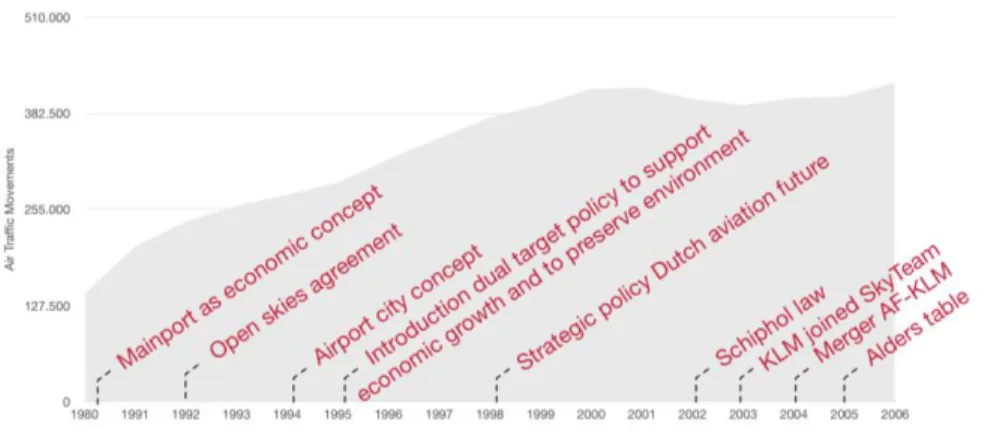
Selectivity within the Dutch airport system is the result of a long-term policy-making process driven by rapid traffic growth, starting in the eighties and continuing into the nineties and the new millennium (Figure 1) 2. In the
eighties a broad-based study, the “economische betekenis van Schiphol”,
introduced the economic importance of Schiphol into the political climate. This research stressed the importance of Schiphol for the Dutch economy in terms of jobs and added value. Furthermore, the gateway or hub function and the importance of connectivity were recognised. Also in this period, the term mainport was introduced as an economic concept. The government followed the research outcomes. They emphasised the significance of the
mainport in their policy making and stressed that Schiphol’s connections
with the hinterland were critical for the further development of the country. In this light Schiphol was seen by the Dutch government as important traffic node for the Dutch economy and as important structure for the business climate in the Netherlands 3. During the nineties the government asked
Schiphol and KLM to join the policy making process. Project groups started to research the future growth of aviation and the infrastructure required to facilitate this growth.
The parties involved worked with a dual objective. They recognised steps that had to be taken to secure future economic growth, but those efforts were also required to protect the environment. In the late nineties the government adopted a vision where they chose to selectively strengthen the mainport function of Schiphol and to improve the quality of the environment in the surroundings of the airport 3. The goal of this policy is to exploit Schiphol’s capacity for mainport related traffic 4.
On the one hand, growth at Schiphol focussed on an increase in hub-related traffic, and thus implicitly KLM traffic which is the core of the hub at Schiphol. On the other hand, environmental issues regarding limitations of noise hinder and emissions are addressed with selectivity 3. The research
performed during the preceding years into the further expansion of Schiphol needed to be translated into a new Aviation Act. However, the process of transforming plans into policy was delayed due to juridical struggles. This was a result of the unexpected and rapid growth of Schiphol. Environmental parties and local residents questioned the environmental objectives set out by the government.
To prevent further delays, environmental as well as public and private interest groups were allowed to join the early stages of policy-making. The goal was to create a relationship between Schiphol and its stakeholders in order to develop Schiphol while taking environmental objectives into
account. The new Aviation Act, better known as the Schiphol Law, was accepted by the government in 2002 after years of discussion 3.
The expanded stakeholder involvement in the policy-making process paved the way for the creation of the Alders table in 2006. The objective of the Alders table is to advise the government on the selective development of Schiphol Airport in conjunction with the airports of Lelystad and Eindhoven. This is performed through discussion with stakeholders from the aviation sector and the aviation region. The Alders table tries to find common ground in the development of Schiphol Airport by taking into account both economic and environmental interests 5.
Figure 1 Selectivity policy development 2
Selectivity in Context of the Government’s A
mbition
The term selectivity literally means a policy of selection or choice 6. However,
the Ministry of Transport, Public Works and Water Management (nowadays the Ministry of Infrastructure and the Environment) defined selectivity as the implementation of restrictions or measures to influence the use of airport capacity and particularly Schiphol Airport 6. The Ministry of Infrastructure
and the Environment later explained that selectivity means that the demand for air connections and the supply of airport capacity are well-coordinated and that sustainable aviation is stimulated at all airports 7. By the
explanations of the government it is clear that there is a focus on managing supply and demand while taking a limited airport capacity into account (Figure 2).
Airport
capacity
Mainport
(demand)
Hub (supply)
A Need for Market Regulation
The Alders table has resulted in a defined maximum capacity of 510,000 Air Traffic Movements (ATM) at Schiphol in 2020 8. The government response
to the Alders table recommendation is to implement the maximum capacity of 510,000 ATM at Schiphol, of which a maximum of 29,000 will take place during the night (from 11pm to 7am) 9.
Looking at other market forecasts, various scenarios demonstrate that the amount of ATM will be between 570,000 and 675,000 in 2020 10. Assuming a
growth factor of three per cent annually, the Alders table expected a demand of 600,000 ATM in 2020. However, the Alders table adjusted the expected growth to 580,000 ATM 11. The total demand for aviation will exceed the
maximum capacity of 510,000 ATM at Schiphol. Up to 70,000 ATM have to be relocated from 2015 onwards 8.
Based on a quote of the State Secretary Mansveld (Ministry of Infrastructure and the Environment): "We have to maintain and expand the network and at the same time create capacity for the increasing demand", it is clear that the government wants to maintain every ATM 9. The fact that there is a
maximum airport capacity at Schiphol (510,000 ATM) that is not sufficient to handle the expected aviation demand (580,000 ATM), suggests there is a need for market regulation.
The Dutch government chose to implement the advice of the Alders table to regulate the market via selectivity 12.
Multi-airport System
Due to coherence in the catchment area and use of airspace among Schiphol, Rotterdam, Lelystad, and Eindhoven, the Dutch Government decided that these airports have to collaborate for the purpose of providing connectivity (Figure 3).
Figure 3 Dutch national airports
The airport system must aim to realise an optimal distribution related to connectivity in the Netherlands, and strengthen the economic region 7. For
each airport of the airport system, the government defined specific functions (Table 1).
Airport
Function
Schiphol
Traffic that contributes to connectivity, hub
function at the mainport, and to the economic
region
Rotterdam
Specialised
business
airport
serving
the
international functions of The Hague and the
mainport Rotterdam (Seaport)
Lelystad
&
Eindhoven
Function as extra capacity for non-mainport related
traffic
Upon whom is Selectivity Applied?
In the Luchtvaartnota, the Dutch government states that Schiphol must concentrate on the mainport function. The mainport function of Schiphol will be safeguarded and further developed by specialising on hub and mainport-related traffic 5.
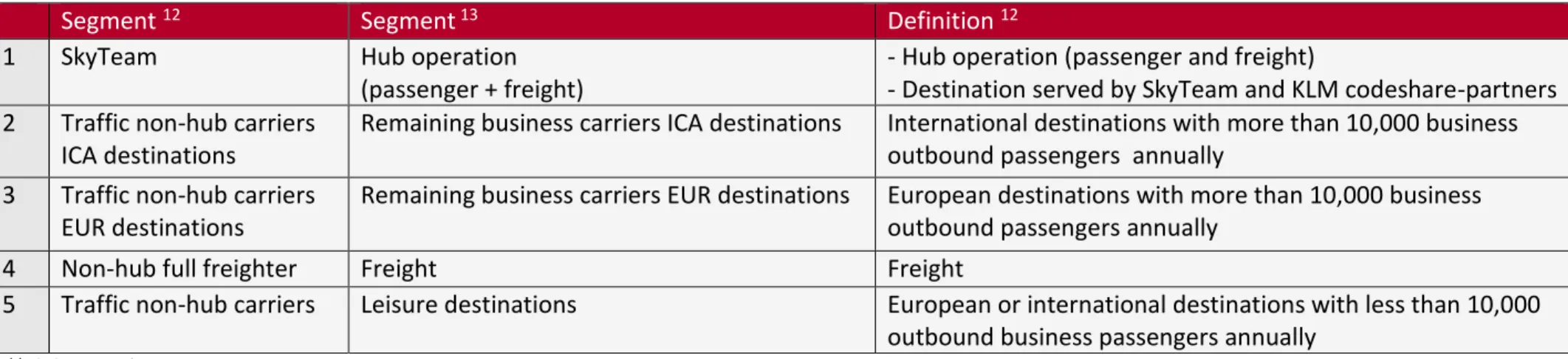
To apply selectivity, the Alders table presented a way to define which airline (and type of traffic) can stay at Schiphol or which airline can be relocated to another airport 5. Traffic segmentation is introduced focussing on five different types of traffic (Table 2).
Of the five segments, the first four are hub and mainport-related. The fifth segment, applies to non mainport-related traffic. The airlines that can be categorised within the fifth segment are therefore the ones that need to be relocated 13.
Segment
12Segment
13Definition
121
SkyTeam
Hub operation
(passenger + freight)
- Hub operation (passenger and freight)
- Destination served by SkyTeam and KLM codeshare-partners
2
Traffic non-hub carriers
ICA destinations
Remaining business carriers ICA destinations
International destinations with more than 10,000 business
outbound passengers annually
3
Traffic non-hub carriers
EUR destinations
Remaining business carriers EUR destinations
European destinations with more than 10,000 business
outbound passengers annually
4
Non-hub full freighter
Freight
Freight
5
Traffic non-hub carriers
Leisure destinations
European or international destinations with less than 10,000
outbound business passengers annually
Table 2. Segmentation.
Which Instruments are used for Selectivity Policy
Implementation?
The instrument related to the re-allocation of airlines is limited to economic measures 11. By providing financial incentives Schiphol Group anticipates that
Lelystad Airport will provide an attractive alternative for airlines 14. These
financial incentives relate to airport visit costs, which airport users are charged for using airport facilities and services.
However, the price incentive instrument is weak from the airline point of view. It is for the airline to decide whether or not to move to another airport. With price incentives, the airline will base the choice on own financial trade-offs 11. Depending on the type of airline, the airport visit costs are relatively
Discussion on Selectivity Criteria
The above-presented facts are based on the Dutch political perspective regarding the selectivity policy. However, the applied principal of selectivity let to discussions within all involved parties in the selectivity process. This factsheet therefore presents an overview of the related discussion points. These related discussions concern the mainport phrase, segmentation of selectivity, the economic importance of Schiphol Airport and the multi-airport system as a solution for growth.
What is a Mainport?
In the Netherlands the term “mainport” is used to refer to Schiphol and the port of Rotterdam. This term is not common in other countries to refer to airports; therefore it is crucial to elaborate the meaning of the term 16. Some
argue that the mainport has been an established combination term in Dutch policy to advocate the idea that the national seaport and airport should be in the European top 17. Actors annoyed by noise pollution believe that the
mainport concept is a tactical trick to justify economic growth 3.
Jan Oosterhaven, professor in spatial economics at the University of Groningen, doubts the term mainport. The professor even stated that the term mainport is a myth 18. The idea that the economy would come to a halt
without Schiphol Airport is wrong, and is based on the lobby of Nederland Distributieland 19. The presence of an airport is essential for the Randstad,
but there is no linear relation between the size of Schiphol Airport and its importance to the economy, as stated by professor Oosterhaven 18. Schiphol
Airport is perhaps more dependent on the Dutch economy than vice versa
19. Those who claim that the economy is dependent on Schiphol have a
vested interest in Schiphol Airport, or they do not see the correlation between various developments regarding economy and mainport 19.
Segmentation of Selectivity
During a general debate about aviation there has been doubt among the members of the Dutch government about the segmentation categories of selectivity 20. Besides the national government, the municipality
Haarlemmermeer doubts the segmentation as well, especially looking at segment number four: the non-hub full freighter. To prevent damage to the local and regional economy, there should be no selective policy towards freight air traffic movements at Schiphol Airport. The selectivity should be focused on the added value of the freight towards the region 21.
Focus on Transfer Traffic or Focus on O-D Traffic?
Proponents of selectivity, other than the Dutch government, state that the priority should lie with Origin – Destination (O-D) traffic that actually contributes to the Dutch economy in contrast to transfer traffic that barely contributes. In other words, transfer traffic should be replaced for O-D traffic, or the priority should shift to business traffic. This is substantiated with the fact that transfer traffic does not yield the airport and only gives Schiphol Airport the rank of fourth airport in Europe 19.
Different View of Economic Growth Linked to the Growth
of Airports
The broad-based study, “The Economic importance of Schiphol”, concluded
that Schiphol Airport was important for the growth of the Amsterdam region and the national economy as a whole 3. However, it is not always the case
that there is a connection between the economic growth and the airport development. For instance Brussel, where despite the loss of a hub status, the economy showed an above-average growth 16.
In addition, a research in high-technology employment and hub airport published in The Journal of Air Transport Management 22 regarding the
relation between economic growth and transfer traffic at hub airports states:
“It could be argued that the economic growth that has been demonstrated at hub airport cities is not due to the services offered by the airlines, but rather that the airlines have moved to these locations simply to exploit strong, natural economic growth”.
The Multi-airport System as a Solution for Growth
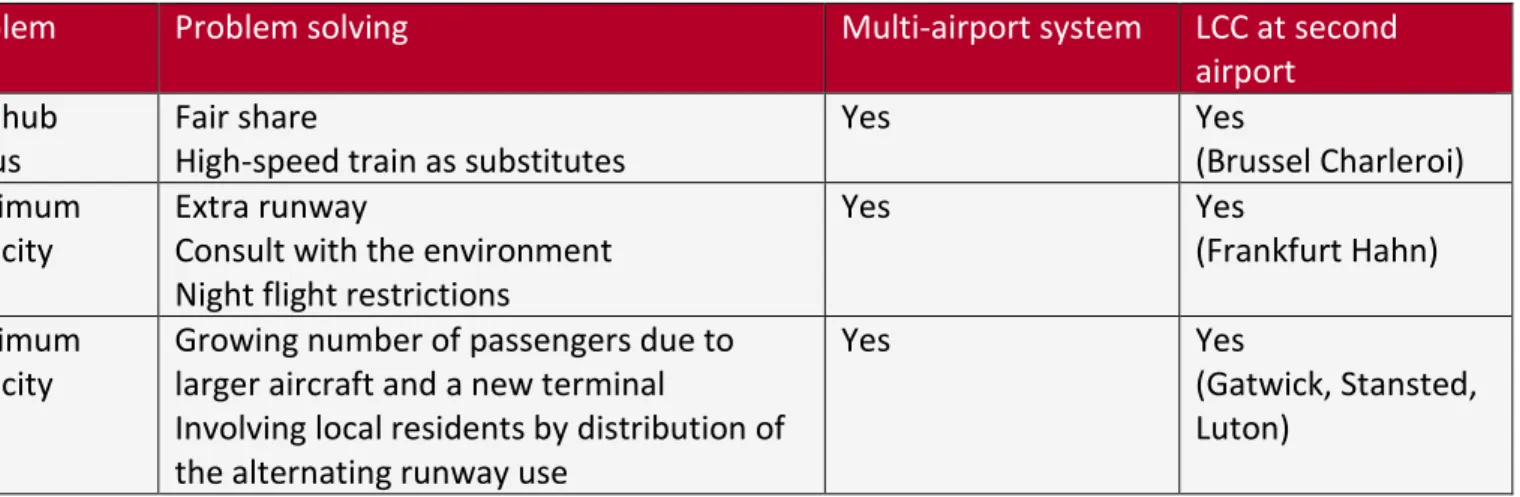
A solution to cope with capacity problems is to use the multi-airport system. This means that the ATM of a region will be relocated to differed airports. It is usual that a second airport will be used for charter-, cargo- or low cost carrier traffic. Several examples for multi airport systems are; Brussel Zaventem, Frankfurt, and London Heathrow (Table 3). However, the process of regulating traffic as a capacity problem solution is implemented in a
different way than the Dutch government’s current selectivity-policy 16.
Table 3. Airport benchmark coping with growth and capacity.
Airport
Problem
Problem solving
Multi-airport system
LCC at second
airport
Brussel
Zaventem
Lost hub
status
Fair share
High-speed train as substitutes
Yes
Yes
(Brussel Charleroi)
Frankfurt
Maximum
capacity
Extra runway
Consult with the environment
Night flight restrictions
Yes
Yes
(Frankfurt Hahn)
London
Heathrow
Maximum
capacity
Growing number of passengers due to
larger aircraft and a new terminal
Involving local residents by distribution of
the alternating runway use
Yes
Yes
(Gatwick, Stansted,
Luton)
Glossary
English Dutch Definition
AAS AAS Amsterdam Airport Schiphol, the main international airport of the Netherlands
Air Traffic Movements Vliegbewegingen Every take-off or landing of an aircraft
Alderstafel Alderstafel Independent organ advising the Dutch government on aviation developments
Alliance Alliantie Association of airlines to advance common interests
Capacity Capaciteit The total ability to produce
Catchment area Verzorgingsgebied The area and population from which a service attracts visitors or customers
Connectivity Connectiviteit The amount and availability of connections at a certain moment
Full freighter Vrachtvervoerder Airline with its core business in transporting cargo
General aviation Algemene luchtvaart Civil aviation operations other than scheduled air services and non-scheduled air transport operations
Hub Hub Airport where flights are connected to offer passengers a network
Intercontinental Intercontinentaal In relation to travel this refers to the connection between multiple continents.
KLM KLM KLM Royal Dutch Airlines, Dutch national carrier
Luchthavenbesluit Luchthavenbesluit A certification required by any airport of national interest
Luchtvaartnota Luchtvaartnota Dutch government decision on national aviation development
Mainport Mainport An economic concept introduced in the eighties. Has multiple definitions and is not always
recognized as a term.
Market Regulation Marktregulatie A controlled market wherein the government controls supply and demand
Multi-airport system Luchthavensystemen A system consisting of multiple airport aiming to realize an a shared interest
Network Netwerk The system of routes an airline operates connections to and from
O-D Traffic O-D bewegingen Non-transfer air traffic movements
Bibliography
1HET RIJK, 10-15-2014, , Luchthavenbesluit Eindhoven definitief [Homepage of
Rijksoverheid], [Online]. Available:
http://www.rijksoverheid.nl/onderwerpen/luchtvaart/nieuws/2014/10/15/luchtha
venbesluit-eindhoven-definitief.html [10-16-2014,.
2
SCHIPHOL GROUP (2014): Monthly traffic data 1992-now [Online] Available at:
http://www.schiphol.nl/SchipholGroup/Company1/Statistics/TransportAndTrafficS
tatistics.htm Accessed: 09 October 2014
3
DE JONG, B., 2012. The airport assembled, Universiteit Utrecht. 4
BURGHOUWT, G. and KRUL, J., 2013. Stimuleringsbeleid en verkeersverdelingsregels:
Afwegingen in het Nederlandse selectiviteitsbeleid. 18. Amsterdam: SEO. 5
ALDERS, H., 2008-last update, Adviezen van de Alderstafel Schiphol [Homepage of De Alderstafel], [Online]. Available: http://www.alderstafel.nl/adviezen.html [10/02, 2014]
6
KAASHOEK, B., DE JONG, D. and ZONDAG, W.J., 2008. Blue skies or storm clouds?
Scienceguide. 7
LUCHTVAARTNOTA. 2009. Den Haag: Ministerie van Verkeer en Waterstaat en
ministerie van Volkshuisvesting, Ruimtelijke Ordening en Milieubeheer. 8
KWAKKEL, J., 2011. Exploratory modelling and analysis, an approach for model-based foresight under deep uncertainty, , 05-12-2011 2011, Future-oriented technology analysis.
9
MANSVELD, W., 10/14/2014, , Spreektekst staatssecretaris Wilma Mansveld tijdens
Schipholdiner [Homepage of Het Rijk], [Online]. Available:
http://www.rijksoverheid.nl/onderwerpen/luchtvaart/documenten-en- publicaties/toespraken/2014/10/14/spreektekst-staatssecretaris-wilma-mansveld-tijdens-schipholdiner.html [10/15, 2014].
10
VELDHUIS, J., 2009. Het realiteitsgehalte van 580 duizend vliegtuigbewegingen op Schiphol in 2020. 17. Amsterdam: SEO.
11
ADVIES COMMISSIE SELECTIVITEIT, 2008. Convenant behoud en versterking mainport functie en netwerkkwaliteit luchthaven Schiphol. Amsterdam: N.V. Luchthaven Schiphol; Verkeer en Waterstaat; Volkshuisvesting, Ruimtelijke Ordening en Milieubeheer.
12
ALDERS, H., 2012. Advies over uitvoering selectiviteitsbeleid Schiphol. Amsterdam: Commissie Shared Vision.
13
CROS, 2013. Uitvoering Convenant "behoud en versterking mainport functie en netwerkkwaliteit luchthaven Schiphol". Schiphol: CROS.
14
SCHIPHOL GROUP, 04/08, 2014-last update, Development of Lelystad key to growth
of Schiphol [Homepage of Schiphol Group], [Online]. Available:
http://www.schiphol.nl/Travellers/News/DevelopmentOfLelystadKeyToGrowthOfS chiphol.htm [10/20, 2014].
15
GRAHAM, A. (2014) Managing Airports: An International Perspective, 3th Edition,
16
ADSE and STRATAGEM, 2005. Evaluatie Schipholbeleid: leerervaringen uit het
buitenland. Ministerie van Verkeer en Waterstaat. 17
VAN WIJK, M., VAN BUEREN, E. and BRÖMMELSTROET, M., 2014. Governing structures for airport regions: Learning from the rise and fall of the 'Bestuursforum' in the Schiphol airport region. (36), pp. 139-150.
18
DE VRIES, K., 10/02, 2003-last update, Schiphol wordt groter gemaakt dan het is
[Homepage of TROUW], [Online]. Available:
http://www.trouw.nl/tr/nl/4324/Nieuws/archief/article/detail/1775747/2003/10/
02/Schiphol-wordt-groter-gemaakt-dan-het-is.dhtml [10/10, 2014].
19
DE VOS, A., 10/15, 2002-last update, Mainport Schiphol [Homepage of
vlieghinder.nl], [Online]. Available:
http://www.vlieghinder.nl/reacties.php?id=P2168_0_1_0 [10/16, 2014].
20
SNEEP, 2014. Luchtvaartbeleid: verslag van een algemeen overleg. Den Haag: Ministerie Infrastructuur en Milieu.
21
DE JONG, B., 2013. Maatschappelijke en Economische Ontwikkeling:
Voortangsrapportage luchthavenzaken. Hoofddorp: Gemeente Haarlemmermeer.
22
BUTTON, K., LALL, S., STOUGH, R. and TRICE, M., 1999. High-technology employment
and hub airports. 5, pp. 53-59.
Front page image: www.amazing-aviation.com
Dit is een uitgave van: Luchtvaartfeiten.nl
Overnemen van teksten is toegestaan. Graag bij citeren vermelden:
‘Luchtvaartfeiten.nl (2014), Factsheet Selectivity, www.luchtvaartfeiten.nl’
Luchtvaartfeiten.nl is een initiatief van de HvA Aviation Academy.
Studenten en docenten delen kennis met politiek en publiek, om te zorgen voor een discussie op basis van feiten.