AMD designs and integrates technology that powers millions
of intelligent devices, including personal computers, tablets,
game consoles and cloud servers, among other solutions for
the commercial and consumer markets.
This case study will discuss AMD’s “Build vs. Buy” approach
for business intelligence software for their semiconductor
manufacturing and test operations.
The Changing Landscape
Companies comprising the semiconductor manufacturing market sector are continually being challenged to provide more and better products while reducing internal costs and increasing efficiency in order to improve profit margins and reduce external costs to their customer base.
As a result, most fabless semiconductor companies and IDMs are re-evaluating their internal processes to identify capabilities that may have been a necessity or a competitive differentiator at one point in time, but over the years have not been kept up-to-date and even surpassed by commercial offerings. One competence that falls into this category is software for semiconductor manufacturing operations and test management.
Historically, this was a key capability that was typically developed in-house due to the critical dependence on widely diverse manufacturing environments and infrastructures, as well as the desire for each company to have a solution that met their own specific needs. But the continued disaggregation of the semiconductor supply chain combined with industry standardization around manufacturing test is triggering many companies to re-evaluate their core competencies and whether or not a continued investment in this area is necessary or practical.
Build vs. Buy: AMD’s Approach to Semiconductor
AMD’s Business and Process Reset
As one of the top semiconductor vendors in the world, and a former Integrated Device Manufacturer (IDM), AMD had a complex manufacturing supply chain comprised of legacy internal operations and external suppliers. This “hybrid” supply chain resulted in complicated manufacturing variations across AMD’s global supply chain that were a challenge to optimize.
AMD realized that to remain an industry leader they needed to undergo a business and process “reset” in their manufacturing operations which included leveraging commercial tools to take advantage of solutions that had proven themselves in the market. This reset focused on addressing the challenges of their hybrid supply chain, transforming internal attitudes to create a greater sense of urgency regarding their production competitiveness, and taking a fresh look at commercial solutions that would enable them to redirect internal resources on efforts that would create greater product differentiation.
Realizing the challenges and investment required in managing their hybrid supply chain, AMD embarked on an extensive “build vs. buy” analysis which also included engaging in a pilot project with Optimal+ to determine the viability of commercial solutions for improving AMD’s manufacturing and test operations.
This pilot project provided AMD with compelling evidence that a commercial solution was able to provide additional capabilities and drive measurable ROI over their internally developed solutions, creating a foundation that would enable AMD to become even more competitive in the marketplace.
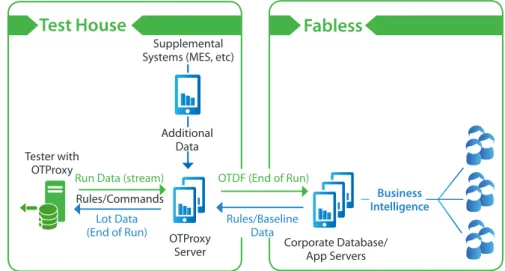
Figure 1: Optimal+ Architecture
Fabless Business Intelligence OTProxy Server Supplemental Systems (MES, etc)
Lot Data (End of Run)
Run Data (stream) Rules/Commands
Rules/Baseline Data
OTDF (End of Run) Additional Data Tester with OTProxy Test House QUALITY QUALITY OT PORTAL OT RULES RMA MANAGEMENT YIELD EFFICIENCY ROI GLOBAL OPS TEST FLOOR OPS ESCAPE
PREVENTION
FILE TYPES
OT MANAGER OT CONTROL ROOM DATABASE
CUSTOMER OPTIMAL PLUS DATABASE OT PROXY
ROI
PROXY APPLICATIONS SERVICES
PDZ FILE TYPES OTDF FILE TYPES WAFER MAP USER USER USER 1 2 3 4 5 6 7 8 9 10 TESTER TTR STDF FILE TYPES ROI HOME
“We went from we
can’t afford to do this
[Optimal+]” to “We
can’t afford not to do
this [Optimal+]”
Carl Bowen, AMD Fellow
Corporate Database/ App Servers
Build vs. Buy Challenges
For many companies, it is a challenging process to replace internally developed tools with commercial applications. Depending on the size and scope of the internal tools, there are several key obstacles that must be addressed:
Cost:
It is a common misperception that internal tools have a lower cost than commercially available solutions, especially at the project or program level where the full cost of internal tools is rarely understood. For this reason, a corporate-level evaluation is strongly encouraged so that a proper analysis can be done that considers the full cost of an internal solution vs. a commercial one, including the continued investment needed to maintain and update the internal solution to keep pace with new and ongoing business demands.Time and effort to deploy:
This is a valid concern and one that should not be taken lightly. For customers in very competitive market segments, one bad misstep in the operations phase could result in significant problems in bringing new products to market. That is why any commercial solution being considered must be able to demonstrate how the solution works, not just in an isolated test case but in an actual production mode.Not invented here (NIH):
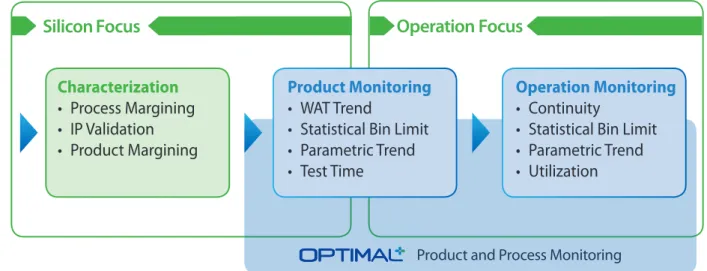
This is a difficult objection to address because most companies are rightfully proud of their internal processes and the benefits they provide to the company. However, as the semiconductor industry has matured, many internal capabilities that were necessary and differentiated have become outdated and surpassed by commercially available solutions. It takes a confident organization to do an honest assessment of their core competencies to determine what aspects of their operations should be continued due to the differentiated value they provide, and what aspects can be replaced or even strengthened by commercially available solutions. Additionally, there is typically a concern by internal tools groups that the adoption of 3rd party applications may have a negative impact on their organization.Figure 2: Optimal+ Compliments Existing Manufacturing Flows
Product and Process Monitoring
Characterization
• Process Margining • IP Validation • Product Margining
Silicon Focus Operation Focus
Product Monitoring • WAT Trend
• Statistical Bin Limit • Parametric Trend • Test Time
Operation Monitoring • Continuity
• Statistical Bin Limit • Parametric Trend • Utilization
Establishing Evaluation Parameters
In addition to addressing the technology-related and cost concerns listed in the prior section, it was necessary for AMD to consider both the actual and perceived impact that a commercial solution would have on the company including:
• Acknowledging a new investment in a cost-cutting environment: AMD was in the midst of implementing significant cost savings programs.
• Accepting the reality that AMD could not maintain the staffing necessary
to internally “reinvent the wheel” every time a new challenge emerged.
• Realizing that for high volume products, internal test tools were not
a viable option because their internal time-to-data was too long (8-24 hours) to take meaningful action.
• Recognizing that within their isolated in-house community that different
groups do things in different ways, and unplanned resources were required to accommodate this scenario.
In order to successfully navigate the broader concerns and the internal issues facing the company, AMD aligned all key stakeholders on what AMD’s manufacturing test operations needed to look like with a commercial solution.
AMD Internal Challenges
AMD also realized that they had some specific internal challenges that they needed to address in order for them to reinvent their engineering operations to become more competitive.
• Finding a way to address unplanned events in their semiconductor
manufacturing operations. Prior to engaging with Optimal+, the time to detect and react to events such as bin distribution shifts and tester or load board problems was not acceptable.
• Being able to quickly determine if yield issues were the result of equipment problems or silicon problems so that appropriate remedial actions could be taken. With AMD’s existing environment, their time to actionable data was 8-24 hours. Their goal was to reduce it to less than 1 hour.
• Taking advantage of opportunities in retest bin optimization and
simple test time optimization and make it part of an overhaul of the manufacturing and business plan.
• Having the ability to compare the output from all of the companies in AMD’s global manufacturing supply chain within a single tool and a common database so that global efficiencies could be realized.
The disaggregation
of the semiconductor
supply chain is
triggering many
companies to
re-evaluate their
core competencies.
A Thoughtful Approach
To achieve their new vision for their manufacturing test operations, AMD set up a multi-phased approach to their “build vs. buy” evaluation that would provide transparency for all parties involved.
Phase 1: Data analysis on four devices. Optimal+ imported AMD’s existing product data and analyzed it to demonstrate the solution’s ability to identify areas of opportunity for yield improvement, test time reduction and general operational efficiency that were currently not addressed by AMD’s internal tools.
Phase 2: Justification for a pilot project. Based on the actionable data provided by the data analysis step and verified by AMD engineers, there was justification to move forward with a pilot project that would replicate the data analysis performed in Phase 1 but on live test data.
Phase 3: Set up pilot, logistics, and a Statement of Work. This required a clear understanding of what products AMD wanted to analyze, where those parts were tested, how they were tested and where the analysis would take place.
Phase 5: Final presentation to AMD, detailing the findings of the pilot program and moving from the pilot to a full-up production program.
Phase 4: Run pilot program and analyze real-time data. Optimal+ engineers worked side-by-side with AMD engineers on the data to provide root cause analysis for manufacturing issues that would improve yield, and increase overall efficiency. In addition, AMD and Optimal+ worked together to identify and resolve issues that were not being addressed with the company’s internally-developed software solutions.
Additional Benefits Realized
AMD builds to demand, not supply, so when demand shifts between ordering parts, misalignment of desired bin distributions can occur. It was important for AMD to be able to decouple a bin distribution shift related to moving from one product to another from unexpected shifts due to test or load board impacts.
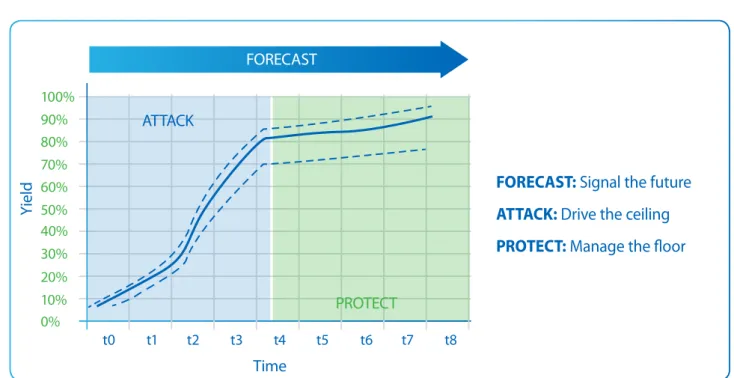
In order to prevent excursions from dragging down yield as products enter the “protect” phase (Figure 3), AMD relies on early detection. Through the use of Optimal+, AMD has been able to manage their test floors better, prevent excursions and when excursions do occur, have the ability to address them more quickly.
Additionally, it would be extremely beneficial for AMD to increase its throughput by 10-20%. For these target areas, as well as for several others, AMD identified the following unanticipated benefits as a result of the pilot program.
• Realizing increased tester utilization with greater efficiency by being
able to identify non-testing times, such as pause times and other operational latencies. Prior to using Optimal+, AMD did not have any visibility into or the ability to optimize these elements.
• Driving increased throughput by knowing what was occurring between test probe touchdowns and due to greater visibility into both test programs and test results.
AMD determined
that Optimal+ could
deliver significantly
greater ROI for the
entire company
through capabilities
and benefits that
had not even
been considered
achievable.
This multi-phased approach not only addressed the key concerns of cost, NIH and productivity disruption, it also provided AMD with measurable ROI for their manufacturing operations. Two specific examples of ROI improvements that were identified were hold lots related to bin limits and lost yield due to test or load board impacts. Every step was essential in building internal confidence that the new solution would not be disruptive or hurt AMD’s productivity.
After completing the pilot, AMD was able to clearly understand the exact benefits they would achieve with the implementation of the Optimal+ solution over their in-house tools. In addition, the realization that the Optimal+ solution was accretive to, and not a wholesale replacement for existing AMD tools, defused many internal concerns and NIH sentiments.
• Enabling data-driven planning and pricing. Using Optimal+, the time required to test each wafer
would be measurably shorter, allowing AMD the ability to negotiate for a lower wafer test price, enabling AMD to ship more parts at a lower cost per wafer.
• Taking advantage of the industry-wide best known method (BKM) capabilities that have been
aggregated into the Optimal+ solution, which greatly expanded the capabilities that had been developed internally for AMD’s specific needs.
For AMD, as well as any other similar solutions provider, without a highly effective, tightly-integrated test environment, the time to build can be longer, overall expenses potentially higher and there are additional costs associated with lost opportunities. The pilot program with Optimal+ was instrumental in identifying new opportunities to leverage data within AMD to help increase their competitiveness and profitability.
FORECAST: Signal the future ATTACK: Drive the ceiling PROTECT: Manage the floor
FORECAST Time Yie ld 100% 80% 60% 40% 20% 0% 90% 70% 50% t0 t1 t2 t3 t4 t5 t6 t7 t8 30% 10% PROTECT ATTACK
Figure 3: Key Phases of Yield Management at AMD
Yield Management at AMD
a commercially-available solution could not only provide equivalent capabilities to what had been developed internally, but deliver significantly greater ROI for the entire company through capabilities and benefits that previously had not even been considered achievable.
With the “early warnings” provided by Optimal+, AMD can see important test parameters far more quickly than was possible with their previous multi-week cycles; manage its business more effectively and act upon the data it receives rather than just consume it.
Initially, AMD had a very conservative ROI expectation, but Optimal+ started showing results immediately for AMD with better than expected month-on-month returns. The two companies are continuing to work together on implementing the Optimal+ toolset throughout AMD’s entire global semiconductor manufacturing test operations.
STUDIO DALIA INBAR