EARTHQUAKE DISASTER MITIGATION USING
INNOVATIVE RETROFITTING METHOD
Eric Augustus J. Tingatinga∗1and Hideji Kawakami2
1Institute of Civil Engineering, University of the Philippines, Diliman Quezon City, Philippines 2Geosphere Research Institute of Saitama University (GRIS), Saitama Japan
Abstract
The Philippines, because of its geographic location, has been battling the onslaught of natural hazards. About 20 tropical cyclones visit the country every year, active volcanoes erupt within few decades, and earthquakes frequent the country causing damages to structures. Field studies have reported that the casualties and damages due to strong earthquakes have been attributed mainly to collapse of civil engi-neering structures. Therefore, in order to guarantee the safety of the general public in the event of fu-ture earthquakes, it is necessary to study the mech-anisms of collapse of these built structures and to provide ways to identify their weak points for the benefit of retrofitting. To address the above issues, a new methodology was developed for the seismic performance assessment of structures. This method-ology identifies local failures such as column buck-ling and connection fracture, which may induce the global system to collapse. In this study, a three-dimensional rigid body-spring method, which can describe the inelastic behavior of a structure and sim-ulate the progressive collapse process, was employed. The sequence of the analysis and results in the form of computer animations offer a real-time assessment of the structural integrity of buildings during earth-quakes.
Keywords: Collapse, damage, buildings, rigid body-spring method, simulation
∗Corresponding author: E.A.J. TINGATINGA, In-stitute of Civil Engineering, University of the Philip-pines, Diliman Quezon City, Philippines. E-mail: [email protected]
1 Introduction
The Philippines has been battling the onslaught of natural hazards. This is not surprising con-sidering its geographic location. Yearly, about 20 tropical cyclones visit the country and about five of them may cause significant damages. The Philippines also has 220 volcanoes; 22 of which are considered active that had erupted in the last 10,000 years.
The country also has a complex tectonic setting (islands are sandwiched between two opposite subduction zones) and Luzon Island shows high seismic activity. The 1990 Luzon earthquake is considered to be the strongest and most fatal of all earthquakes generated by this fault zone. And like most deadly earth-quakes, the death toll was reported to be mostly caused by collapse of buildings.
The collapse of engineering structures is a clear manifestation of not only strength of an earthquake, but also the inadequacy of seismic code provisions in an area and poor construc-tion method of buildings. While the former is beyond human control, the consequences due to the latter may be mitigated. It is essential, therefore, for engineers to analyze the mecha-nisms of collapse of buildings as well as top-pling of office and household utilities during strong motion earthquakes.
The evolution in computer hardware has re-markable impact on engineering analysis and design. Computer experiments utilizing state-of the-art computer techniques such as mul-timedia, realistic computer graphics and ani-mation reinforce, if not replace, traditional
ex-pensive experiments. Recent efforts to simu-late earthquake response due to strong motion earthquakes attracted many researchers in the field of architecture, structural and earthquake engineering.
This study presents a three-dimensional sim-ulation of structure collapse during strong motion earthquakes, such as the 1995 Great Hanshin Earthquake, using Rigid Body-Spring Method (RBSM). Various modes of collapse of a wooden structure modeled as an assem-bly of rigid bodies connected by rigid links at their ends will be presented. In modeling structural components, a link configuration is suggested utilizing a Kelvin link to take into account structural damping and elasto-plastic behavior. Being vital in computer graphics and animation, collision detection, collision re-sponse, contact handling, and the accuracy of the integration method of the animation system have been comprehensively investigated. Summary of previous works
While Isobe and Toi (1998) used Adaptively Shifted Integration (ASI) technique to perform seismic damage analysis, most researchers (Me-guro and Katayama (1997), Ren et.al. (1999), Tagel-Din and Meguro (2000), Kuwata and Takada (2004), Kiyono and Furukawa (2006)) have developed methods based on the dis-tinct element method originally proposed by Cundall (1971). With regards to simulating dynamic response and collapse of wooden houses during strong earthquakes, previous works were limited to one-story building mod-els, or frame models or buildings subjected to two-dimensional seismic wave. Further-more, although some researchers validated their work using real experiments in full-scale, e.g. Sakamoto, et.al. (2006), details of the numerical method used and the modeling of structural components are not extensive.
This study proposes three-dimensional rigid body-spring method to be use in collapse ulations. Rigid body spring method can sim-ulate, using detailed modeling, the onset of collapse such as joint failures, and can accu-rately simulate the progress of collapse by con-sidering collision and contact forces natively.
The theory has been extensively discussed by several researchers in the fields of computer graphics/animation and robotics, e.g. Baraff (1992), Witkin and Baraff (2001), and will not be discussed in detail in this thesis. In eling beams and columns, multi-spring mod-els similar to that introduced by Lai, et. al. (1984) and Li and Otani (1993) in simulating hysteretic behavior of RC members, are uti-lized. Each spring exhibits nonlinear restor-ing force-deformation relation and may demon-strate hysteresis based on the models discussed by experimental researchers (see Otani (1981)) 2 Rigid body simulation
In rigid body-spring method, the basic proach is to divide the given structure into ap-propriate number of rigid elements connected by spring systems between elements. The dis-placements are completely described by the po-sition and rotations of the rigid bodies while the deformation energy of the structural element is stored only in the spring system.
Motion equations
To animate various systems using rigid bodies, appropriate forces must be taken into account. Forces that arise due to relative positioning of objects (e.g. contact, collision), object’s velocity, connections (e.g., spring, damper), and user-specified vector fields (e.g. gravity, other exter-nal forces) must be exerted on bodies properly. These forces induce linear and angular acceler-ations depending on the mass and mass distri-bution of the body, respectively.
The two fundamental equations used to ana-lyze motion of rigid bodies in space are
∑
F=mr¨ (1)∑
MG= H˙G (2)where ¨r is the acceleration of the center of mass and ˙HGis the rate of change of the angular
momentum about the mass center of the rigid body.
Simulation of earthquake motions
It is a well-known fact in structural dynamics that the displacement or deformation u(t) of the structure due to ground acceleration ¨ug(t)
will be identical to the displacement or defor-mation of the structure if its base were fixed and if it were subjected to an external force equal to−mu¨g(t). Therefore, to simulate
earth-quake motion in rigid body systems, an effec-tive earthquake force (inertial force) which is equal to the rigid body mass times the ground acceleration and acting opposite to the acceler-ation will be exerted.
Moreover, to obtain more realistic anima-tions, absolute motion of objects must be simu-lated by viewing it from a fixed frame or loca-tion not attached to the ground. For this pur-pose, the animation camera is moved in a direc-tion opposite the ground displacement.
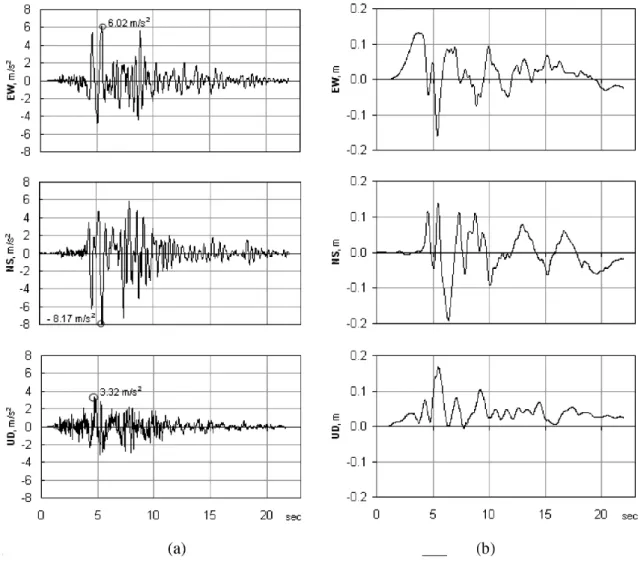
Throughout the scope of this paper, the earth-quake accelerogram used was that of the 1995 Kobe earthquake. The maximum accelerations in EW-, NS-, and UD-directions are 0.6g at 5.46 s, 0.83g at 5.52 s, and 0.3g at 4.72 s, re-spectively. Figure 1b shows the corresponding displacement-time history used in moving the animation camera.
3 Nonlinear response analysis System of Kelvin links
A new link consisting of a spring and a damper, parallel to one another is introduced. Since it is analogous to a Voigt/Kelvin element in modeling viscoeleastic materials in mechanics of materials, it is herein named as a Kelvin link. Forces exerted to points on connected bodies is the vector sum of spring and damper compo-nents.
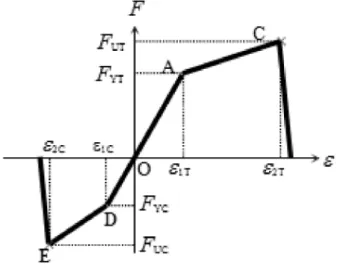
The stress-strain behavior of materials, as modeled by springs, is idealized by the straight lines in Figure 2. In the tensile region, the restor-ing force is proportional to the strain up toε1T
with maximum yield restoring force FYT. The
second straight line represents in an idealized fashion; the strain-hardening range comes until breaking point C when the restoring force reach its ultimate valueFUT.
Figure 2: Force exert
A new link configuration is introduced to model plastic hinges at the end of beams and columns. It consists of 12 Kelvin links posi-tioned to model axial, shear, and bending de-formations (see Figure 3)
Figure 3: Plastic hinge
Typical modes of collapse of wooden houses Consider modeling wooden houses as shown in Figure 4. The dead load of the floor slab, beams, columns, walls and roofs, and the live load are estimated. The stress-strain curves for the mate-rial of the structural members are modeled and are used.
Using the numerical method presented in the previous section, earthquake responses of typ-ical wooden houses in Japan were computed.
Figure 1: Time history of (a) ground acceleration and (b) ground displacement of the 1995 Kobe earthquake used in analyses
In modeling, the dead load of the floor slab, beams, columns, walls and roofs, and the live loads were estimated. The stress-strain curves for the material of the structural members were taken into account. The model structures were then subjected to doubly-amplified waves of the 1995 Kobe earthquake in Figure 1.
Figures 4a-d show various collapse mecha-nisms of wooden houses including (a) collapse due to the soft first story, (b) tumbling type col-lapse, (c) failure at the second floor due to the amplification of the vibration at the upper floor, and (d) collapse of intermediate floor. Even though the soft first story type of collapse is often stressed, the failure mechanism depends on the design and physical layout of the struc-ture, i.e., strength and distributions of columns, beams and walls.
Retrofitting Example
When wooden houses need structural rein-forcement, structural engineers must confer with the building owner before carrying out ap-propriate retrofit methods. A retrofit plan may not be implemented if the structural engineer can not have the building owner understand the performance assessment of the building. The method presented in the previous sections was developed for the purpose of seismic per-formance assessment and retrofit strategy for woodframed buildings.
As shown in the examples, the sequence of the analysis and results in the form of com-puter animations allow engineers to identify lo-cal failures such as column buckling and con-nection fracture, which may induce the global system to collapse. This method, therefore, is useful in reinforcing the system by adding stiff-ness or strength to the weak members.
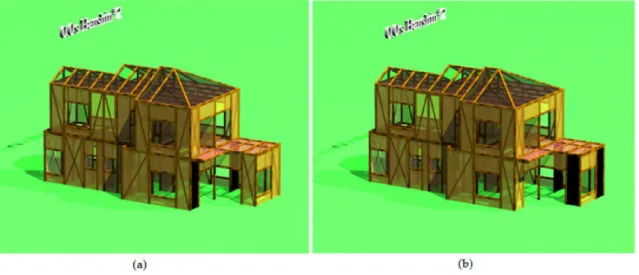
In order to avoid the collapse, several retrofit plans were developed such as shown in Fig-ures 5(a) and (b), where the black walls indi-cate those reinforced by diagonal braces and structural boards. The method proposed in this study as described was then used to simulate the earthquake response of each of the rein-forced houses. Results showed that the house in Figure 5(a) withstood the same earthquake mo-tions used in Figure 1, i.e., the doubly-amplified
waves of the 1995 Kobe earthquake. The house in Figure 5(b) also resisted the strong ground motion but the reinforcement was not as effi-cient as that employed in Figure 5(a). Based on the obtained results, therefore, engineers can propose retrofit plans so house owners can im-prove the performance of their houses against earthquakes.
4 Summary and conclusions
This paper attempted to simulate seismic col-lapse of wooden houses subjected to the 1995 Kobe earthquake using the Rigid Body-Spring Method (RBSM), and the following conclusions were drawn:
1. The simplified model of wooden houses is capable of demonstrating, to some ex-tent, various collapse behaviour during strong motion earthquakes. More accu-rately, the link system used to character-ize plastic hinges can simulate local failure that causes the entire house to collapse dur-ing strong motion earthquakes.
2. The method provides a way to identify the weak point of a structure, thus allowing engineers to perform retrofitting analysis easily so as to suggest ways to improve the seismic performance of built wooden houses.
References
Cundall, P.A. (1971). A computer model for simulat-ing progressive large scale movements in blocky rock systems, ISRM Symposium, Nancy, France, Proc. 2, pp. 129-136.
Isobe, D. and Toi, Y. (1998) ASI finite element analy-sis of dynamic collapse behaviors of framed struc-tures considering member fracture. Proceedings of the 4th World Congress on Computational Me-chanics, Buenos Aires, Argentina.
Kiyono, J. and Furukawa, A (2006). Bracing ef-fect mechanism in the collapse of timber-frame houses due to earthquake and snow weight. Jour-nal of Natural Disaster Science: Vol. 28, No. 1, pp. 1-13.
Kuwata, Y. and Takada, S. (2004) Collapse of wooden houses considering instantaneous in-strumental seismic intensity. Asian Journal of Civil Engineering (Building and Housing); 5(1-2).
Figure 5: Two examples of reinforcement plans of the wooden house. The walls shown in black are reinforced by diagonal braces and structural boards
Lai, S.-S. (1984). Model for inelastic biaxial bending of concrete frames. ASCE Journal of Structural Engineering; Vol. 110, No. 11, November 1984, pp. 2563-2584.
Li, K.-N. and S. Otani, S. (1993). Multi-spring Model for 3-Dimensional Analysis of RC Members, Jour-nal of Structural Engineering and Mechanics, Vol. 1, No. 1, pp. 17-30.
Meguro, K. and Katayama, T. (1997) Simulation of collapse process of elevated expressway bridges due to the Kobe earthquake. Proc. of the Workshop on Earthquake Engineering Frontiers in Transportation Facilities, Post-Earthquake Re-construction Strategie, NCEER-INCEDE Center-to-Center Project, Technical Report NCEER-97-0005/INCEDE Report No.1997-01, pp. 155-162 Otani, S. (1981). Hysteresis Model of Reinforced
Concrete for Earthquake Response Analysis, Journal of Faculty of Engineering, University of Tokyo, Series B, Vol. XXXVI-II, No. 2, pp. 407-441.
Ren, W.-X., Tan, X. and Zheng, Z. (1999) Nonlinear analysis of plane frames using rigid body-spring element method. Computers & Structures, 71(1): 105-119.
Sakamoto, I. et al. (2006) Wood Building Collapse Test Using E-Defense, Technical Memorandum of Public Works Research Institute, No. 4022, pp. 87 (in Japanese) , 2006.
Tagel-Din, H. and Meguro, K. (2000) Analysis of small scale RC building subjected to shaking ta-ble tests using applied element method. Proceed-ings of the 12th World Conference on Earthquake Engineering, New Zealand.
Witkin, A. and Baraff, D. (2001). Physically Based Modeling - ONLINE SIGGRAPH 2001 COURSE NOTES, Pixar Animation Studios, http://www.pixar.com/companyinfo/rese-arch/pbm2001/.