Common Security Protocol
(CSP)
ACP 120
Foreword
1. ACP120, COMMON SECURITY PROTOCOL, is an UNCLASSIFIED publication. Periodic accounting is not required.
2. ACP120 will be effective for National, Service, or Allied use when directed by the appropriate Implementing Agency; refer to the National Letter of Promulgation (LOP).
3. This publication contains Allied military information and is furnished for official purposes only.
4. This publication is not releasable without prior approval from the United States Military Communications-Electronic Board (USMCEB).
5. It is permitted to copy or make extracts from this publication without consent of the Authorizing Agency.
RECORD OF CHANGES AND CORRECTIONS Enter Change or Correction in Appropriate Column
Identification of Change or Correction; Reg. No. (if any) and date of same
Date Entered By whom entered (Signature; rank, grade, or rate; name
of command)
RECORD OF CHANGES AND CORRECTIONS Enter Change or Correction in Appropriate Column
Identification of Change or Correction; Reg. No. (if any) and date of same
Date Entered By whom entered (Signature; rank, grade, or rate; name
of command)
Table of Contents
FOREWORD...III LETTER OF PROMULGATION... V RECORD OF CHANGES AND CORRECTIONS... VII RECORD OF CHANGES AND CORRECTIONS... VIII TABLE OF CONTENTS... IX
CHAPTER 1 GENERAL
101. INTRODUCTION...1-1 102. SCOPE AND FIELD OF APPLICATION...1-1 103. STRUCTURE OF THIS DOCUMENT...1-1 104. REFERENCES...1-2 105. EXTERNAL DEFINITIONS...1-3 105.a Open System Interconnection...1-3 105.b Message Handling System ...1-3 105.c The Directory...1-3 105.d The Directory Authentication Framework ...1-3 105.e Secure Data Network Systems ...1-4 106. MESSAGE SECURITY DEFINITIONS...1-4 107. X.500 SECURITY DEFINITIONS...1-5 108. SYMBOLS AND ABBREVIATIONS...1-6
CHAPTER 2 ELEMENTS OF SERVICE
201. ELEMENTS OF SERVICE...2-1 202. CONFIDENTIALITY OF CONTENT AND INTEGRITY...2-2 203. PROOF OF CONTENT ORIGINATION...2-3 204. PROOF OF CONTENT DELIVERY...2-3 205. INTEGRITY OF CSP ENCAPSULATION...2-4 206. CONTENT DESCRIPTION...2-4 207. MAIL LIST EXPANSION HISTORY...2-4 208. ADDITIONAL SIGNATURES AND TIME STAMPING...2-4 209. EXTENSIONS...2-5 210. FORWARDING...2-5 211. GROUP ADDRESSING...2-6 212. CONTENT TYPE AND MESSAGE IDENTIFICATION...2-6 213. BLIND COPIES...2-6
CHAPTER 3
PROCEDURES FOR THE COMMON SECURITY PROTOCOL
SECTION II
PROCEDURES FOR CONTENT CONFIDENTIALITY AND INTEGRITY WITH
AUTHENTICATED KEY DISTRIBUTION AND ACCESS CONTROL (ENCRYPTION AND KEY DISTRIBUTION)
302. CSP WITH CONTENT CONFIDENTIALITY AND INTEGRITY...3-1 303. ORIGINATORSECURITYDATA...3-1 303.a Procedures ...3-1 303.b ProtectedMessageSecurityData ...3-2 303.c SecurityLabel...3-2 303.d AttributeCertificationPath ...3-2 304. PERRECIPIENTTOKEN...3-2 304.a Procedure...3-2 304.b Tag...3-3 304.c PairwiseTag...3-3 304.d Kmid...3-3 304.e MLTag ...3-3 304.f KeyTransferTag...3-4 304.g ProtectedRecipientKeyToken and RecipientKeyToken...3-4 305. GENERATING A CSP MESSAGE...3-5 305.a Security Service Selection ...3-5 305.b Access Control ...3-5 305.c Per Message Processing ...3-6 305.d Per-recipient Processing...3-6 306. PROCESSING A CSP MESSAGE...3-6 306.a Security Service Determination ...3-6 306.b Token Selection...3-7 306.c Rule-Based Access Control ...3-7 306.d Message Processing...3-7
SECTION III
PROCEDURES FOR PROOF OF CONTENT ORIGIN (MESSAGE SIGNATURE)
307. CSP WITH PROOF OF CONTENT ORIGIN...3-8 308. SIGNATUREBLOCK...3-8 308.a ControlInformation ...3-8 308.b SignatureInformation ...3-8 308.c CspContentType...3-9 308.d ReceiptsIndicator ...3-10 309. SIGNATURE GENERATION...3-10 310. SIGNATURE VALIDATION...3-11 SECTION IV
PROCEDURES FOR PROOF OF CONTENT DELIVERY (SIGNED RECEIPTS)
311. CSP WITH PROOF OF CONTENT DELIVERY...3-11 312. CONTROLINFORMATION...3-11 313. RECEIPTINFORMATION...3-11 314. RECEIPT PROCESSING...3-12 314.a Hash Calculations for a Signed Receipt ...3-12 314.b Signed Receipt Generation ...3-12
SECTION V
PROCEDURES FOR INTEGRITY OF CSP ENCAPSULATION (SEQUENCE SIGNATURE)
315. CSP WITH INTEGRITY OF CSP ENCAPSULATION...3-14
SECTION VI
PROCEDURES FOR CONTENT DESCRIPTION (CONTENT DESCRIPTION)
316. CSP WITH CONTENT DESCRIPTION...3-14
SECTION VII
PROCEDURES FOR MAIL LIST EXPANSION HISTORY (ML EXPANSION HISTORY)
317. CSP WITH MAIL LIST EXPANSION HISTORY...3-15 318. MLEXPANSIONHISTORY...3-15 319. MLDATA...3-15 320. MLRECEIPTPOLICY...3-15 321. MAIL LIST AGENT PROCESSING...3-16
SECTION VIII
CSP HEADING CONSTRUCTION
322. CSP HEADING CONSTRUCTION...3-17
SECTION IX
PROCEDURES FOR ADDITIONAL SIGNATURE PROCESSING
323. ADDSIGNATURE...3-17 323.a AddSigControlInfo ...3-18 323.b AddSigData ...3-18 323.c TimeStampData ...3-18 324. GENERATING ADDITIONAL SIGNATURES ON MESSAGE CONTENT...3-19 325. VALIDATING ADDITIONAL SIGNATURES ON MESSAGE CONTENT...3-19 326. GENERATING ADDITIONAL SIGNATURES ON RECEIPT...3-19 327. VALIDATING ADDITIONAL SIGNATURES ON RECEIPT...3-20
SECTION X
PROCEDURES FOR EXTENSIONS
328. CSP WITH EXTENSIONS...3-20 329. CONSTRUCTION OF EXTENSIONS...3-20 330. EXTENSION PROCESSING...3-21
SECTION XI BLIND CARBON COPY
331. CSP WITH BLIND CARBON COPY...3-21
CHAPTER 4
DEFINITIVE CSP ASN.1 MODULE
CHAPTER 5 ERROR CONDITIONS
501. ORIGINATOR ERROR CONDITIONS...5-1 501.a Access Control Failure...5-1 501.b Recipient Certificate Validation Failure ...5-1 502. RECIPIENT ERROR CONDITIONS...5-1 502.a Access Control Failure...5-1 502.b Originator Certificate Validation Failure ...5-1 502.c Signature (sigValue) Verification Failure ...5-2 502.d Message Hash (msgHash) Verification Failure...5-2 502.e Sequence Signature Verification Failure ...5-2
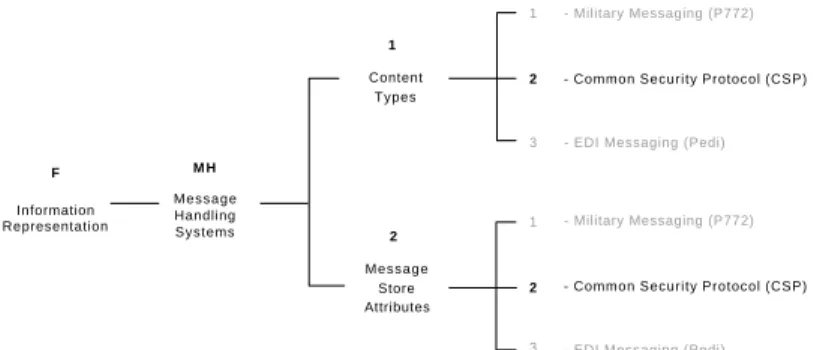
CHAPTER 6 PROFILES 601. OVERVIEW...6-1 SECTION II TAXONOMY 602. PROFILE TAXONOMY...6-1 603. F PROFILES...6-2 SECTION III STANDARD PROFILE 604. PROFILE DEFINITION...6-2 605. IMPLEMENTATION REQUIREMENTS...6-2 ANNEX A
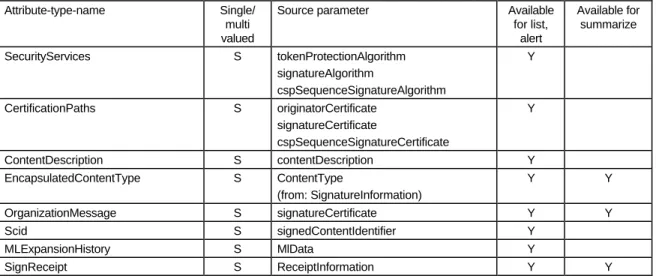
CSP MESSAGE STORE ATTRIBUTES... A-1 A-101. OVERVIEW... A-1 A-102. ATTRIBUTES... A-1 A-102.a Security Services... A-1 A-102.b Certification Paths ... A-2 A-102.c Content Description ... A-2 A-102.d Encapsulated Content Type... A-2 A-102.e Organizational Message ... A-3 A-102.f Signed Content Identifier ... A-3 A-102.g Mail List Expansion History... A-3 A-102.h Signed Receipt ... A-3 A-103. DEFINITIVE CSP MS ATTRIBUTE ASN.1 MODULE... A-4
ANNEX B
COMMON SECURITY PROTOCOL INFORMATION OBJECT IMPLEMENTATION CONFORMANCE STATEMENT (IO-ICS) PROFORMA... B-1
ANNEX C
PROFILE FOR MESSAGING IN THE COMBINED MESSAGING AND DIRECTORY ENVIRONMENT... C-1
ANNEX D
Chapter 1 General
101. Introduction
a. The requirement for secure electronic mail and secure messaging resulted in the development of a security protocol to be used with the CCITT X.400 Message Handling System. This protocol was called the Message Security Protocol (MSP). MSP was initially considered for Defense messaging applications only. In order to commercialize MSP as a Common Security Protocol (CSP) for wider use, the original document (SDN.701) has been re written to form this document.
b. While this specification is oriented around use within an X.400 Message Handling System, CSP may also be used as a secure message/protocol encapsulation facility with other distributed computing environments, such as directory access and key material distribution.
c. This document describes additional functionality to the CCITT X.400 Recommendations (either 1984, 1988, or 1992) that permit any type of message (including interpersonal messages) to be sent and received securely. For example, the ANSI defined X.400 Message Transfer System conventions for Electronic Data Interchange (EDI) can be exchanged securely or application level operations between distributed directory functions.
102. Scope and Field of Application
a. The CSP provides originator to recipient security services. These security services include content confidentiality and integrity, proof of content origin, and proof of content delivery.
b. This document specifies the services and protocol implemented in a CSP User Agent (CSP UA). The CSP UA provides these services by encapsulating the message content and adding a CSP heading before submission to the MTS. CSP is used to protect data regardless of the format of the encapsulated content. However, to enable the definition of CSP in context, its use within X.400 is chosen. CSP is a content that the X.400 MTS transports, and thus is transparent to the X.400 MTS.
c. While this specification is oriented around use within an X.400 Message Handling System, CSP may also be used as a secure message encapsulation facility with other messaging environments. The examples provided in this specification for integrating CSP services and mechanisms with the X.400 MHS model can be applied to other models. This specification refers to the X.400 MHS as an example, but it does not limit the use of CSP to only secure the X.400 MHS.
103. Structure of This Document
a. The structure of this publication is as follows:
Chapter 1 General - includes references, definition, and abbreviations.
Chapter 2 Elements of Service - is a description of the security services provided by CSP.
Chapter 3 Procedures For The Common Security Protocol - contains the processing rules for CSP.
103. (Continued)
Chapter 4 Definitive CSP ASN.1 Module - defines the structures of a CSP protected message.
Chapter 5 Error Conditions - describes CSP error conditions. 104. References
a. CCITT X.200 Open Systems Interconnection - Basic Reference Model for CCITT Applications.
b. ISO 7498/2 Information Processing Systems Open Systems Interconnection -Security Architecture.
c. CCITT X.208 Open Systems Interconnection - Specification of Abstract Syntax Notation One (ASN.1).
d. CCITT X.209 Open Systems Interconnection - Specification of Basic Encoding Rules for Abstract Syntax Notation One (ASN.1).
e. CCITT X.400 Message Handling: Service and System Overview.
f. CCITT X.411 Message Handling: Message Transfer System [part 1] Abstract Service Definition and Procedures.
g. CCITT X.419 Message Handling: Protocol Specification.
h. CCITT X.420 Message Handling: Interpersonal Messaging System. i. CCITT X.501 The Directory - Models.
j. ITU-T X.509 (1997)|ISO/IEC 9594-8: 1997, Information Technology -- Open System Interconnection - The Directory: Authentication Framework
k. CCITT X.518 The Directory - Procedures for Distributed Operation. l. CCITT X.519 The Directory - Protocol Specification.
m. CCITT X.525 The Directory - Replication. n. SDN.701 SDNS Message Security Protocol.
o. ACP 133 Common Directory Services and Procedures, draft, Version 1.3, August 1996.
105. External Definitions
105.a Open System Interconnection
This document uses the following terms contained in the Basic Reference Model for Open Systems Interconnection (ISO 7498), specifically the Security Architecture (ISO 7498/2):
(1) Access control
(2) Connectionless confidentiality (3) Connectionless integrity (4) Data origin authentication
(5) Non-repudiation with proof of delivery (6) Non-repudiation with proof of origin 105.b Message Handling System
This document uses the following terms contained in CCITT X.400, Message Handling: Service and System Overview:
(1) Content (2) Content type
(3) Distribution List (DL)
(4) Interpersonal Messages (IPM) (5) Message Transfer Agent (MTA) (6) Message Transfer System (MTS) (7) O/R Address (8) O/R Name (9) P2 (10) P3 (11) P7 (12) SUBMIT
(13) User Agent (UA) 105.c The Directory
This document uses the following terms contained in CCITT X.500 series, The Directory: (1) Directory User Agent (DUA)
(2) Directory System Agent (DSA)
105.d The Directory Authentication Framework
This document uses the following terms contained in CCITT X.509, The Directory Authentication Framework:
(1) Certificate
(2) Certification Authority (CA) (3) Certificate Revocation List (CRL) (4) Compromised Key List (CKL)
105.e Secure Data Network Systems
This document use the following terms from the SDNS specifications: (1) Key Material IDentifier (KMID)
(2) Key Management System (KMS) 106. Message Security Definitions
For the purposes of this document the following definitions apply:
a. Common Security Protocol (CSP): The commercially applied common security protocol for X.400 message security, X.500 directory access security and distributed computing environments based on MSP (see MSP below).
b. Common Security Protocol User Agent (CSP UA): A messaging user agent which includes an active implementation of the CSP.
c. Directory Service (DS): A database server containing information (e.g., certificates and user keying material) corresponding to recipients.
d. Local Management Authority (LMA): The LMA controls a single local access control domain by signing attribute certificates for that domain.
e. Mail List (ML): A list or group of recipients which are addressed with a single O/R Address, i.e. an Address List.
f. Mail List Agent (MLA): An agent which a message originator addresses and which represents a group of recipients. The MLA provides message security processing and distribution to that group on behalf of the message originator.
g. Mail List Key (MLK): A token protection key held by all members of a mail list or addressable group.
h. Message Security Protocol (MSP): The SDNS protocol for X.400 message security. MSP for X.400 messaging is a content protocol and is implemented within the originator and recipient MSP UAs. MSP processing occurs prior to submitting a message to the MTS and after accepting delivery of a message from the MTS. MSP provides security for the MSP user's content protocol (e.g. IPM, EDI), but MSP is independent of the MSP user's content protocol.
i. Message Security Protocol User Agent (MSP UA): A user agent which includes an active implementation of the SDNS MSP.
j. Originator UA: The user agent process which originates a message. k. Recipient UA: The user agent process which receives a message.
l. Travelling User (TU): A CSP user visiting a CSP equipped facility other than the one at which the user normally processes messages or receives directory access and who wishes to read, process, and/or originate CSP protected messages. A travelling user does not transport CSP equipment, but makes use of CSP equipment located at the site being visited.
107. X.500 Security Definitions
For the purposes of this document the following definitions apply:
a. authentication token (token): Information conveyed during a strong authentication exchange, which can be used to authenticate its sender;
b. user certificate (certificate) : The public keys of a user, together with some other information, rendered not forgeable by encipherment with the private key of the certification authority which issued it;
c. certification authority : An authority trusted by one or more users to create and assign certificates. Optionally the certification authority may create the user's keys;
d. certification path : An ordered sequence of certificates of objects (certificate users and issuers) in the DIT which, together with the public key of the initial certificate in the path, can be processed to obtain that of the named object in the path;
e. cryptographic system, cryptosystem : A collection of transformations from plain text into ciphertext and vice versa, the particular transformation(s) to be used being selected by keys. The transformations are normally defined by a mathematical algorithm.
f. hash function : A (mathematical) function which maps values from a large (possibly very large) domain (information set) into a smaller range. A “good” hash function is such that the results of applying the function to a (large) set of values in the domain will be evenly distributed (and apparently at random) over the range;
g. one-way function : A (mathematical) function f which is easy to compute, but which for a general value y in the range, it is computationally difficult to find and a value x in the domain such that f(x) = y. There may be a few values y for which finding x is not computationally difficult;
h. public key : (In a public key cryptosystem) that key of a user’s key pair which is publicly known;
i. private key (secret key — deprecated): (In a public key cryptosystem) that key of a user's key pair which is known only by that user;
j. simple authentication : Authentication by means of simple password arrangements; k. security policy : The set of rules laid down by the security authority governing the use and provision of security services and facilities;
l. strong authentication : Authentication by means of cryptographically derived credentials; m. trust:: Generally, an entity can be said to “trust” a second entity when it (the first entity) makes the assumption that the second entity will behave exactly as the first entity expects. This trust may apply only for some specific function. The key role of trust in the authentication framework is to describe the relationship between an authenticating entity and a certification authority; an authenticating entity shall be certain that it can trust the certification authority to create only valid and reliable certificates;
n. certificate serial number: An integer value, unique within the issuing CA, which is unambiguously associated with a certificate issued by that CA.
108. Symbols and Abbreviations
ACP Allied Communications Publication CA Certification Authority
CMIP Common Management Information Protocol
CMISE Common Management Information Service Elements
CSP Common Security Protocol
CSP DSA Common Security Protocol Directory System Agent CSP DUA Common Security Protocol Directory User Agent CSP UA Common Security Protocol User Agent
DAP Directory Access Protocol DIB Directory Information Base
DISP Directory Information Shadowing Protocol
DL Distribution List
DOP Directory Operational Protocol
DSA Directory System Agent
DSP Directory System Protocol
DUA Directory User Agent
IPM Interpersonal Message
KMID Key Material Identifier
KMS Key Management System
LMA Local Management Authority LRBAC Local Rule-Based Access Control
ML Mail List
MLA Mail List Agent
MLK Mail List Key
Ms Message Store
MSP Message Security Protocol
MSP UA Message Security Protocol User Agent
MTA Message Transfer Agent
MTS Message Transfer System
PRBAC Partition Rule-Based Access Control
RA Release Authority
UA User Agent
Chapter 2 Elements of Service
201. Elements of Service
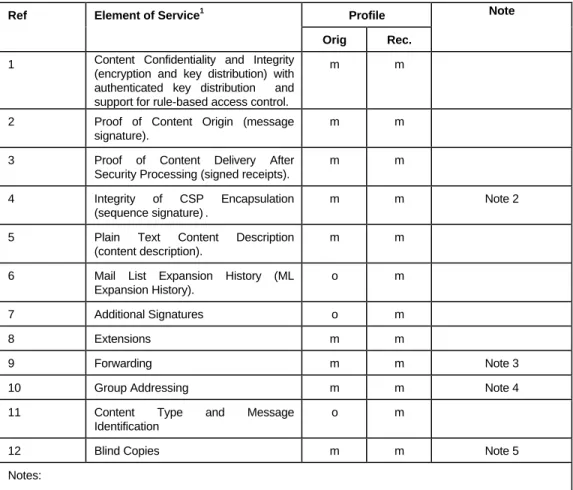
a. CSP offers security services that are applied directly to the content. This content can be any type of information object, but is described here within the context of a message system. The security services (with the mechanism listed within parenthesis) provided by CSP include:
(1) Content Confidentiality and Integrity (encryption and key distribution) with authenticated key distribution and support for rule-based access control.
(2) Proof of Content Origin (message signature).
(3) Proof of Content Delivery After Security Processing (signed receipts). (4) Integrity of CSP Encapsulation (sequence signature).
(5) Plain Text Content Description (content description).
b. A system that offers security for messages requires several additional supporting processes, such as group addressing or a time stamping service. CSP conveys information that can support these processes, and this information includes:
(1) Mail List Expansion History (ML Expansion History) (2) Additional Signatures
(3) Extensions
c. The addition of CSP security services has an effect on some of the other capabilities offered by a message system. Not all message systems offer these capabilities, but when they do, special considerations need to me made with respect to CSP processing. These capabilities are:
(1) Forwarding (2) Group Addressing
(3) Content Type and Message Identification (4) Blind Copies
d. CSP is designed to provide these services for messages sent to one or more recipients. The facilities in X.400 which support multiple recipients remain essentially unchanged with the addition of CSP. The CSP security services to be applied to a particular message are selected by the user within the constraints of a site policy. As a consequence of the staged delivery nature of electronic messaging, there is no direct, real-time association formed between an originator and a recipient. Therefore, all of the security functions must be performed independently by the originator and by the recipient, based on both originator and recipient information.
e. The CSP operates by performing security operations on X.400 messages at the originator and recipient UAs. These functions are performed in an independent but consistent fashion at each end of the message exchange based on user security information. This security information includes the user's identity, authorizations, and cryptographic material. CSP processing includes both per-message operations and information and per-recipient operations and information. These operations involve the parsing and generation of elements of the CSP heading based on the services requested by the originator, and the encryption, when requested, of the message content. Per-recipient operations involve the generation of information (known as per-recipient tokens) needed by each recipient to decrypt the message.
202. Confidentiality of Content and Integrity
a. This element of service enables an originator to ensure the confidentiality of the content of the message, and assures the recipient that the message content he received is the same as that which the originator sent. Also, this element of service assures the originator that the message he sent cannot be modified without the recipient detecting the modification.
b. Confidentiality and integrity are provided through the encryption of the message content, the calculation of a message hash, and the encryption of the security label, if it is present. CSP offers content confidentiality and integrity to limit disclosure of the message to only the intended recipients. CSP makes no assumptions about the security services provided by lower layers.
c. The associated key management mechanism assures that only the intended recipients can decrypt the message. The authenticated key distribution provides a form of data origin authentication, because it assures a recipient that the message was originated by the user indicated as the originator. In addition the authenticated key distribution preserves, through the staged delivery of a message, a form of peer entity authentication, because it assures the originator that only his intended recipients can receive the message.
d. The CSP UA performs per-recipient processing only for encrypted messages by creating tokens. A token is created for each recipient of the message and for the message originator. The token contains information needed to decrypt and validate the integrity of the message. It also contains information regarding whether the message is also signed, and optionally information in support of rule-based access control.
e. A message key is used to encrypt the message, and also a message hash is calculated. To form a token, this message key and message hash, along with additional control information, is encrypted using one of three key techniques. The techniques allow the use of public key based key agreement technique, public key based key transfer technique, or previously distributed symmetric keys. Both of the public key cryptographic techniques require use of both the originator’s and recipient’s cryptographic material. When using either of these techniques, this publication uses the term pairwise to describe the cryptographic protection of the token. This assures that one recipient can not modify the message unbeknown to another recipient. Also, this publication focuses on the public key based key agreement technique, because this is the current CCEB agreed key distribution technique.
f. When access control is used within CSP, it involves rule based access control. Based on the sensitivity of the message and the authorizations of the originator, recipient, and workstation, CSP makes the access control decision. Identity-based access controls are the responsibility of the originator, supported by the authenticated key distribution provided by CSP.
g. In support of rule-based access control, this element of services permits an originator to apply a security label to a message and securely bind the label to the content of the message by including an integrity value (hash calculated using the security label) for the security label. Additionally, this security label is encrypted using the same key used to encrypt the content. On receipt, this element of service enables a recipient to verify the binding of the security label to the CSP encapsulated content. CSP processing uses the security label at both origination and reception to make an access control decision, which limits disclosure to authorized parties.
203. Proof of Content Origination
a. This element of service provides the recipient of a message with proof that the message came from the user who originated the message. Proof of content origination is provided through a digital signature. The public key needed to validate the digital signature and identity of the message originator are included in the originator’s certificate. The certificate validation process ensures that the originator is a valid user.
b. This service supports the non-repudiation service, which provides the recipient with evidence that demonstrates, to a third-party, who originated the message, and protects against any attempt by the message originator to falsely deny having sent the message. This evidence, provided by the proof of content origin service, is the digital signature along with the certificates necessary to verify it. However, to preclude a subsequent denial by the originator of having sent the message, the digital signature for this particular message must not be effected by subsequent revocations of the originator's certificates. To preserve this evidence, additional records management procedures must be applied. These include trusted timestamps with another signature, and audit logs.
204. Proof of Content Delivery
a. This element of service provides the originator of a message with proof that the recipient CSP UA successfully performed CSP processing of the message. Proof of content delivery is provided when the recipient CSP UA returns a digitally signed receipt. Recipient CSP UAs may automatically return signed receipts without interaction with the human user. The public key needed to validate the digital signature on the receipt and identity of the message recipipient are included in the recipient’s certificate. The certificate validation process ensures that the recipient is a valid user.
b. This service supports the non-repudiation service, which provides the originator with evidence that demonstrates, to a third-party, who received the message, and protects against any attempt by the message recipient to falsely deny having received the message. However, to preclude a subsequent denial by the recipient of having received the message, the signed receipt for this particular message must not be effected by subsequent revocations of the recipient's certificates. To preserve this evidence, additional records management procedures must be applied. These include trusted timestamps with another signature, and audit logs.
c. The originator may specify the recipient from which he requests proof of content delivery, via a signed receipt. After successfully validating the signature of the original message, the recipient calculates the signature value in the signed receipt by including the signature value from the original message. This binds the receipt to the original message. Consequently, this service may be requested only if a signature value was generated for the original message (proof of content delivery).
d. To validate a signed receipt, the originator of the message should store information about the message and its original signature. Then upon receiving a signed receipt, it may be validated by using the stored information to verify the signature contained in the receipt.
205. Integrity of CSP Encapsulation
This element of service provides a CSP entity which handles a message with proof of the identity of the CSP entity that last processed the message and that an unauthorized party has not modified the CSP heading. CSP offers this service by the calculation of a digital signature over the entire CSP content, including CSP heading fields and protected content. (Note, if the message content is encrypted, this signature is calculated over the encrypted content and the per-recipient tokens used for key management.)
206. Content Description
The content description is information available prior to CSP processing. The content description is a string of characters (not encrypted), which may offer some processing information to the recipient or support delivery to the appropriate recipient.
207. Mail List Expansion History
This service offers the recipient of a message information about the intermediate processes that have processed the message to expand address lists. This service also provides information to the process that expanded a message to assure it that the message has not been previously processed. This prevents messages from “looping” through these processes indefinitely. See paragraph 211 below. A process that expands an address list must use this service and record its identity in the CSP heading. This process must also apply integrity of CSP encapsulation.
208. Additional Signatures and Time Stamping
a. Additional signatures may be used to demonstrate that the message or receipt was prepared or received by a particular time, where the time stamp is provided by a trusted third party. Likewise, additional signatures of third parties on messages can be used to convey support or concurrence to the content. Also, this service provides a means to support the conveyance of digital signatures into non-CSP environments; e.g. X.400 S1c environments. When used in this manner, the additional signature is not necessarily generated by a third party, but by the message originator.
b. To obtain an additional signature on a message content, the message content or the message hash must be transferred to the third party, then the third party generates a signature. The signature may optionally cover the originator's signature, and optionally a time stamp in addition to the message content.
c. To obtain an additional signature on a receipt, the receipt or the receipt hash must be transferred to the third party, then the third party generates a signature. The signature may optionally cover a time stamp in addition to the receipt.
209. Extensions
a. This element of service enables a user to apply a registered extension to the CSP. This extension must be understood by both the originator and recipient for it to convey any meaning.
b. Extension may be used to support routing decisions while a message is in transit within a protected environment. However, when the message leaves the protected environment, the extension should be removed. A plain text security label used to support routing decisions would be conveyed in an extension.
210. Forwarding
a. One of the characteristics of the proof of content origination service provided by message signatures is the ability to establish the identity of the originator to a third party. Since the forwarding of messages is a standard part of electronic message systems, forwarding signed messages should be a part of these systems also. Likewise, since replying to a message and including the original message in the response is a standard part of electronic message systems, inclusion of a signed message in a reply should be a part of these systems also.
b. Messages are forwarded or included in a reply by placing them within the content of a new message. An CSP protected message can be forwarded only if the protected content supports forwarding, because the CSP message is forwarded by including it within the new content. For example, Recommendation X.420 defines a Forwarded Interpersonal Message as a message body part, which is used to forward a previously received IPM. This same body part may contain the original message associated with a reply. Similarly, this document defines a body part, which allows a previously received CSP message or any CSP message, along with its CSP heading which may contain its signature, to be included as part of a new content. This body part is a Forwarded-CSP-Message-Body-Part, which is an extended X.420 body part, and is assigned a registered Object Identifier.
Figure 2-1 Forwarded Signed Message CSP Heading SigBlock P772 Content To: zz From: xx BodyPart Vvvvvvvvvv BodyPart ForwardedCSPMessage CSP Heading SigBlock P772 Content To: xx From: yy BodyPart Vvvvvvvvvv Signature value calculated by yy over P772 Content Signature value calculated by xx over P772 Content
210. (Continued)
c. Any number of forwarded CSP messages may be conveyed within a new message. Also, forwarded CSP messages may be nested within one another, and signed receipts may be forwarded. The forwarded CSP message may contain only the original unencrypted content and the original CSP signature; however, forwarded messages must be adequately protected. Encrypted CSP messages may also be forwarded if the recipient possesses the cryptographic material required to decrypt the forwarded CSP message. The forwarded CSP message may also contain other CSP heading fields such as the extensions field element, subject to the local security policy.
211. Group Addressing
Group addressing allows the message originator to submit a protected message to multiple recipients without selecting each individual recipient or the burden of per-recipient processing for each recipient. The description of originator processing indicates that the CSP UA generates a token for each recipient of an encrypted message. This process can impair performance for messages sent to a large number of recipients. Consequently, CSP includes support of address lists by a process called a Mail List Agent (MLA). An MLA appears to the message originator as a normal message recipient, but the MLA acts as a message expansion point for a Mail List (ML). The administrator of an ML is responsible for establishing rules governing the submission of messages to the list and for ensuring that all members of the ML have appropriate access control authorizations. The originator of a message directs the message to the MLA which then redistributes the message to the members of the ML. This process off loads the per-recipient processing from individual user agents and allows for more efficient management of large MLs. 212. Content Type and Message Identification
a. On origination, this element of service enables a user to indicate and on receipt for a user to verify the content type and message identification of a message protected by CSP. Also, the content type permits subtyping in support of fully automated processes.
b. Message Identification allows the originator to relate a signed receipt to a previously originated message. The message identifier (e.g. the IPMIdentifier in an ACP123 message) of the original message is used if it is present. If it is not present an identifier is assigned my the CSP UA.
213. Blind Copies
a. If a message system supports Blind Copy (BC), where a recipient is unaware of additional recipients of the message, then at least two messages must created. The first message has the primary and copy recipients. The other messages have the primary, copy and one blind copy recipient. These messages differ in the heading fields, but may contain the same message identifier. Because the messages differ, they have different signature values if they are signed.
b. For proof of content delivery (signed receipts), the correlation of receipts with message to provide validation is done with the Signed Content IDentifier (SCID) which is defined for P772 message to be the IPMIdentifier. If the originator requests proof of content delivery from all of the recipients, then the originator must store all of the signature values associated with the message, and the originator’s CSP UA must assign message identifiers for each message and message signature to relate the signed receipt to the original message signature.
Chapter 3
Procedures For The Common Security Protocol
301. Overview
a. This Chapter specifies the structure of CSP and the procedures for processing CSP for each of the security services described in Chapter 2.
b. The CSP heading, i.e., all the CSP except for the encapsulated content, shall be encoded using the Distinguished Encoding Rules. The algorithms parameters shall use EXPLICIT tagging.
SECTION II
Procedures for Content Confidentiality and Integrity with Authenticated Key Distribution and Access Control (encryption and key distribution)
302. CSP with Content Confidentiality and Integrity
The structure of CSP is as follows when only content confidentiality and integrity are selected.
Csp ::= SEQUENCE {
originatorSecurityData [0] OriginatorSecurityData OPTIONAL,
recipientSecurityData [2] SEQUENCE (SIZE (1..ub-recipients)) OF PerRecipientToken OPTIONAL,
encapsulatedContent [8] OCTET STRING (SIZE (1..ub-content-length)) OPTIONAL }
303. OriginatorSecurityData
303.a Procedures
(1) OriginatorSecurityData is a sequence of security information pertaining to the originator of the message. It contains the keyManagementCertificate, messageSecurityData, confidentialityAlgorithm, integrityAlgorithm, msdProtectionAlgorithm, and
tokenProtectionAlgorithm. If access control is required, then messageSecurityData and msdProtectionAlgorithm must both be present inorginatorSecurityData. If access control is not required, thenmessageSecurityData may be absent. If messageSecurityData is absent, then msdProtectionAlgorithmmust also be absent.
(2) The keyManagementCertificate is an X.509 certification path which establishes the binding between the originator's Subject Name and the originator's key management public cryptographic material, and KMID. The keyManagementCertificate provides each recipient with information necessary to process his PerRecipientToken.
OriginatorSecurityData ::= SEQUENCE {
confidentialityAlgorithm AlgorithmIdentifier, integrityAlgorithm AlgorithmIdentifier, tokenProtectionAlgorithm AlgorithmIdentifier,
msdProtectionAlgorithm AlgorithmIdentifier OPTIONAL, keyManagementCertificate [0] CertificationPath OPTIONAL,
303.b ProtectedMessageSecurityData
(1) ProtectedMessageSecurityData contains the SecurityLabel of the message, and optionally the structure AttributeCertificationPath, which includes the originator’s AttributeCertificate. The CSP UA encrypts MessageSecurityData to form ProtectedMessageSecurityData. The CSP UA uses the msgKey and the msdProtectionAlgorithm to encrypt MessageSecurityData.
(2) When the originator’s AttributeCertificates are associated with the user’s X.509 key management certificate, then these attribute certificates are included in kmAttrCerts. ProtectedMessageSecurityData ::= OCTET STRING
-- Protected form of MessageSecurityData, encrypted using msgKey MessageSecurityData ::= SEQUENCE {
label SecurityLabel,
kmAttrCerts SEQUENCE OF AttributeCertificationPath OPTIONAL } 303.c SecurityLabel
The SecurityLabel contains information regarding the classification of the original content that is protected by the CSP encapsulation. This definition is imported 1988 CCITT Recommendation X.411.
303.d AttributeCertificationPath
AttributeCertificationPath contains the AttributeCertificate of the originator, and a sequence of AttributeCertificates and Certificates from the authorities that issued the AttributeCertificate to the originator.
-- Imported from the Draft 1997 X.509 Recommendation Definitions AttributeCertificate, AttributeCertificationPath, ACPathData
FROM AuthenticationFramework {joint-iso-ccitt ds(5) module(1) authentication-framework(7) 3}
304. PerRecipientToken
304.a Procedure
Each PerRecipientToken contains information for an intended recipient of the message. There is one of these for each recipient, and it has two parts, the Tag and the ProtectedRecipientKeyToken. The tag is clear text and contains identifying information each recipient uses to select and process his PerRecipientToken. The ProtectedRecipientKeyToken is an OCTET STRING, the value of which the originator encrypted in a key that only the intended recipient can obtain. If an MLA is processing a message then the ProtectedRecipientKeyToken value is the result of the MLA encrypting the RecipientKeyToken with a pairwise key or ML Key
PerRecipientToken ::= SEQUENCE {
tag Tag,
304.b Tag
The Tag is clear text and contains identifying information each recipient uses to select and process his PerRecipientToken. The Tag may either be a PairwiseTag, MLTag or KeyTransferTag. The recipient uses PairwiseTag to identify a token protected with a pairwise key, and uses MLTag to identify a token protected with a MLKey. The recipient uses the KeyTransferTag to identify another form of pariwise key, where a symmetric key is conveyed from the originator to each recipient by using reversible public key algorithms. Tag ::= CHOICE {
pairwise PairwiseTag,
mlTag [0] MLTag,
keyTransfer [1] KeyTransferTag} 304.c PairwiseTag
The PairwiseTag is used when a key agreement technique of key distribution is used. This technique allows both the originator and each recipient to calculate a secret symmetric key. The PairwiseTag is generated by the Originator CSP process and contains information that the recipient uses to identify which of its posted certificates and UKMs the Originator CSP UA used to protect the token. The kmid and the edition identify the certificate, and the date, if present, identifies the recipient's UKM.
PairwiseTag ::= SEQUENCE {
kmid Kmid,
edition INTEGER (1..ub-edition-size),
date UTCTime OPTIONAL }
304.d Kmid
The Kmid is a unique identifier associated with the user's key management public cryptographic material. The KMID is the subject key identifier extension contained in the Version 3 X.509 Certificate. If this extension is not present, then a hash of the subject public key may be used instead. The hash algorithm used for the creation of the KMID is implied by the tokenProtectionAlgorithm.
Kmid ::= OCTET STRING 304.e MLTag
(1) If an MLA is not using pairwise keys, then it protects the originator's RecipientKeyToken using a single Mail List Key (MLK). After protecting it with the MLK, the MLA includes this token in the ProtectedRecipientKeyToken. For the remainder of this document, when the token is protected with an MLK, the token is referred to as the mlKeyToken. The Tag associated with the mlKeyToken is an mlTag.
(2) MLTag is generated by an MLA and contains an mlid that is the Kmid of MLA, and an mlKeyDate is the date the MLA performed redistribution.
MLTag ::= SEQUENCE {
mlid Kmid,
304.f KeyTransferTag
The KeyTransferTag is used when a symmetric key is conveyed from the originator to each recipient by using reversible public key algorithms. The originator CSP UA generates the KeyTransferTag and it contains the information that the recipient uses to identify which of its posted certificates the originator CSP UA used to protect the token. The recipient CSP UA identifies the certificate used by the values of issuer and serialNumber. The pkEncryptedTokenPrototectionKey contains a symmetric key that the originator CSP UA has encrypted with the recipient’s public key. When this format of tag is used, the CSP UA must apply CSP Encapsulation Integrity.
KeyTransferTag ::= SEQUENCE {
issuer GeneralNames,
serialNumber CertificateSerialNumber, pkEncryptedTokenProtectionKey OCTET STRING } CertificateSerialNumber INTEGER 304.g ProtectedRecipientKeyToken and RecipientKeyToken
The ProtectedRecipientKeyToken is the protected form of RecipientKeyToken. The RecipientKeyToken contains the msgKey that is used to protect the message. The msgHash is calculated over the (original unprotected text) message content. The signatureBlockIndicator is set to true if a signatureBlock is present. The encapsulatedContentType is the Content Type of the message that is protected by CSP. If the msdHash is present, then the OriginatorSecurityData MessageSecurityData component must also be present and the msdHash is calculated over the MessageSecurityData. If the msdHash is absent, then the OriginatorSecurityData MessageSecurityData component must also be absent. If this check fails, then a security error has occurred and the CSP UA shall reject the CSP message before decrypting the encapsulated content.
ProtectedRecipientKeyToken ::= OCTET STRING -- Protected form of RecipientKeyToken RecipientKeyToken ::= SEQUENCE {
msgKey OCTET STRING,
msgHash OCTET STRING,
signatureBlockIndicator BOOLEAN, encapsulatedContentType CspContentType,
305. Generating a CSP Message
305.a Security Service Selection
(1) The CSP UA processes a message content that is accompanied, implicitly or explicitly, by submission envelope information. In some UA-MTA configurations an explicit submission envelope may not be employed but equivalent information will be present as the message is transferred between the UA and the MTA. From the submit envelope, the CSP UA uses the following values:
− originator-name
− recipient-names
− content-type
− content
(2) The CSP UA determines message-security-label information in one of two ways: implicitly, based on local processing context, or explicitly, based on a message-security-label argument.
305.b Access Control
(1) Rule-based Access Control is optional in CSP. Access control is a determination made concerning the authorization of the originator to send and the recipient to receive the message. These access control decisions are based on the authorization information of the originator, the recipient, and the system on which the originator's user agent resides. The system on which the recipient’s user agent resides cannot be included in this access control decision. The recipient may use more than one user agent, each located on a different system, each with different authorizations.
(2) User authorization information is determined from the users' key management certificates and kmAttrCerts while the system authorization is determined from local configuration data. Additional authorization information may be contained in the originator's (kmAttrCerts) and recipient's attribute certificates. If the originator's attribute certification path is required, then the CSP UA places the originator’s attribute certificates in AttributeCertificationPath. Additional X.509 certificates and attribute certificates needed to verify the originator’s attribute certificate may also be included in the AttributeCertificationPath. If applicable, the CSP UA includes the security-categories within the SecurityLabel to specify the sensitivity of the encapsulated content.
(3) Within SecurityLabel, the PrivacyMark is carried as provided by the originating UA, but it is not used in access control decisions by the CSP UA. A security-policy-identifier may be used to identify the security policy in force to which the SecurityLabel relates. If present, a classification may have one of a list of values. The basic security-classification hierarchy is defined in the X.411 specification, but the use of these values is defined by the security-policy in force.
305.c Per Message Processing
(1) The CSP UA calculates a hash value over the (original unprotected text) message content, and stores this value in msgHash. The CSP UA obtains a msgKey1, and then uses it to encrypt the message content forming encapsulatedContent2. The message content is encrypted as a single string. The CSP UA constructs the RecipientKeyToken.
(2) Optionally, the CSP UA builds the MessageSecurityData structure including the securityLabel. The CSP UA calculates a cryptographic hash function over MessageSecurityData, which it places in msdHash. The CSP UA then encrypts the structure MessageSecurityData, using msgKey, to form ProtectedMessageSecurityData. The CSP UA indicates the integrity and confidentiality algorithms it used in msdProtectionAlgorithm, and places any parameters required by the algorithms there as well.
305.d Per-recipient Processing
(1) Establish a symmetric key to be used with the algorithm specified in the tokenProtectionAlgorithm. The symmetric key may be establised through key agreement techniques, key transfer techniques, or out-of-band distribution eechniques. If the algorithm requires, the CSP UA obtains the recipient's SIGNED UKM, which the recipient has posted to the directory. After validating the authenticity of the signature associated with the UKM, the CSP UA uses the UKM to form a pairwise key that only this intended recipient can derive. When forming the tag, the Date identifies the posted UKM that the CSP UA used to protect the RecipientKeyToken.
(2) The CSP UA encrypts the RecipientKeyToken, forming the protectedRecipientKeyToken. This along with the tag, which identifies the recipient's certificate through the KMID, forms the PerRecipientToken. The CSP UA forms one of these for each recipient.
(3) If the originator is not already an explicit recipient, then the CSP UA generates a RecipientKeyToken for the originator. This allows the originator to decrypt a message, in case it is returned for non-Delivery.
306. Processing a CSP Message
306.a Security Service Determination
The recipient requests the UA to accept delivery of a message from the MTA, or the UA retrieves a message from an MS. If the ContentType, an OBJECT IDENTIFIER, indicates CSP, then CSP processing commences. Next the CSP UA determines, by processing the CSP structure, that OriginatorSecurityData is present, and thus the originator invoked content confidentiality and integrity with authenticated key distribution services.
1
306.b Token Selection
(1) The CSP UA selects the correct PerRecipientToken by first examining each PerRecipientToken with a PairwiseTag until it identifies a PairwiseTag that contains the CSP UA’s Kmid. When date is present in the PairwiseTag, the recipient may use it to discover which previously posted UKM was used by the originator.
(2) If no PerRecipientToken is identified, the CSP UA then first examines each KeyTransferTag based on the IssuerName and CertificateSerialNumber of the CSP UA. If no KeyTransferTag is identified, the CSP UA then examines the PerRecipientToken with an MLTag until it identifies an MLTag that contains the Kmid of an ML of which it is a member.
(3) If OriginatorSecurityData is present and a correct PerRecipientToken is not found then a security error has occurred.
(4) Once the correct token is identified, the CSP UA decrypts the token. The CSP UA then checks if signatureBlockIndicator is true. If it is true and the SignatureBlock is not present, then a security error has occurred.
(5) If msdHash is present, then the CSP UA uses the msgKey to decrypt ProtectedMessageSecurityData. The CSP UA then calculates a hash using MessageSecurityData and compares the result of the hash calculation to msdHash. If the comparison fails, then a security error has occurred. If either msdHash is present, and ProtectedMessageSecurityData is not present or msdHash is not present and ProtectedMessageSecurityData is present, then a security error has occurred.
306.c Rule-Based Access Control
If MessageSecurityData is present, then the CSP UA enforces rule based-access control, which is a determination made concerning the authorization of the originator and recipient to process and receive the message. These authorizations are based on the authorization information of the originator (obtained from keyManagementCertificate and kmAttrCert), the recipient and the recipient's end system. User authorizations represent a maximum clearance, while the end system authorization represents a range. The CSP UA checks that both the originator and recipient have the required authorizations and the securityLabel is dominated by the high end of the range of the recipient's end system. If the message security level is below the minimum of the range of the recipient's end system, the CSP UA upgrades the message to this minimum security level prior to delivering it to the user.
306.d Message Processing
From the RecipientKeyToken, the CSP UA obtains the msgKey and then decrypts the message. The CSP UA calculates a hash value as a function of the content, and if the value is equal to the msgHash, the content integrity is verified. Once the recipient UA has access to the msgKey, it can decrypt the security label if it is present. The recipient UA has access to the unencrypted content of the message by virtue of possession of msgKey. If the access control check subsequently fails, the user could then have unauthorized access to the unencrypted message content. For this reason, the access control functionality and the message decryption functionality must remain separate processes.
SECTION III
Procedures for Proof of Content Origin (message signature)
307. CSP with Proof of Content Origin
The structure of CSP is as follows when only Proof of Content Origin is selected. Csp ::= SEQUENCE {
signatureBlock [1] SignatureBlock OPTIONAL,
encapsulatedContent [8] OCTET STRING (SIZE (1..ub-content-length)) OPTIONAL }
308. SignatureBlock
The SignatureBlock contains information used to provide proof of content origin. The CSP UA calculates a digital signature, which consists of signing a hash using the originator's private cryptographic signature material. Whenever the CSP UA applies confidentiality to the message (i.e. encrypts the message), it may apply confidentiality to the signature value by using encSigData for signatureValue. If AttributeCertificates are associated with the user’s X.509 signature certificate, then these attribute certificates are included in sigAttrCerts.
SignatureBlock ::= SEQUENCE {
signatureAlgorithm AlgorithmIdentifier, signatureValue SignatureValue, controlInformation ControlInformation,
signatureCertificate [0] CertificationPath OPTIONAL,
sigAttrCerts [1] SEQUENCE OF AttributeCertificationPath OPTIONAL } SignatureValue ::= CHOICE { sigValue SigValue, encSigData EncSigData } EncSigData ::= SEQUENCE { encSigAlgorithm AlgorithmIdentifier, encSigValue ProtectedSigValue } ProtectedSigValue := OCTET STRING
--Protected form of SigValue SigValue ::= OCTET STRING 308.a ControlInformation
ControlInformation is SignatureInformation that contains additional information from the originator including receipt requests.
ControlInformation ::= CHOICE {
signatureInformation [0] SignatureInformation } 308.b SignatureInformation
(1) The encapsulatedContentType specifies the CspContentType of the original message. The signedContentIdentifier must be generated by the originator of the message. The original UA should generate the identifier. In the case that the original content is either P22 (Interpersonal Message) or P772 (Military Message Handling Structure) then this value should be IPMIdentifier, and should always be present on signed messages.
306.b (Continued)
(2) If the original UA cannot generate a content identifier, then the signedContentIdentifier, which is specified as an OCTET STRING must be globally unique. To assure its global uniqueness, this OCTET STRING must contain the concatenation of the KMID (see paragraph 302.3 with respect to the KMID) from the key management public cryptographic material or the public signature keying material, followed by a thirteen octet UTCTime with a value of yymmddhhmmssZ, followed by a random number.
(3) The originator may request a signed receipt by placing the receiptRequest in SignatureInformation. The receiptRequests indicates from which recipients the originator requests signed receipts. The originator retains the signedContentIdentifier along with the receiptRequests, the hash that was used to compute the signatureValue, and the signatureValue in a local database. The database is used for later processing of signed receipts.
(4) The originator uses the receiptsTo field to identify the users to whom the receiving UA should send signed receipts. It is used only if signed receipts are to be sent to users other than, or in addition to, the originator. If the receiptsTo field is used to designate recipients in addition to the originator, then the originator's GeneralNames must be included in the receiptsTo list. Originators should always use the newReceiptsTo form of receiptsTo. The oldReceiptsTo form of receiptsTo is included to allow the CSP UA to validate signatures on messages created with an earlier protocol.
SignatureInformation ::= SEQUENCE {
encapsulatedContentType CspContentType OPTIONAL, signedContentIdentifier OCTET STRING,
receiptRequests ReceiptsIndicator, receiptsTo ReceiptsTo OPTIONAL } ReceiptsTo ::= CHOICE {
newReceiptsTo [0] SEQUENCE (SIZE (1..ub-receiptsTo)) OF GeneralNames,
oldReceiptsTo SEQUENCE (SIZE (1..ub-receiptsTo)) OF ORName }
308.c CspContentType
(1) CspContentType specifies the content type of the original message. Its structure is based on to that contained within X.411 Abstract Services:
MTSAbstractService {joint-iso-ccitt mhs-motis(6) mts(3) modules(0) mts-abstract-service(1)}
(2) But, this definition includes a third syntax, externalWithSubtype, which has been added to support the automatic processing of specialized messages.
CspContentType ::= CHOICE {
built-in BuiltinContentType, external ExternalContentType,
externalWithSubtype ExternalContentWithSubtype } BuiltinContentType ::= [APPLICATION 6] INTEGER {
unidentified (0), external (1),
interpersonal-messaging-1984 (2),
interpersonal-messaging-1988 (22) } (0..ub-built-in-content-type) ExternalContentType ::= OBJECT IDENTIFIER
ExternalContentWithSubtype ::= SEQUENCE { external ExternalContentType, subtype INTEGER }
308.d ReceiptsIndicator
(1) ReceiptsIndicator allows the Originator to specify either a list of recipients that should send signed receipts (receiptList), or an enumerated value (allOrNone).
(2) The value receiptList is a list of GeneralNames. AllOrNone can either be noReceipt (0), allReceipts (1), or firstTierRecipients (2).
(3) The value noReceipt means no recipient should send a receipt. The value allReceipts means all recipients should send receipts. The value firstTierRecipients means recipients with no information present in the mlExpansionHistory should send receipts; that is the recipient did not receive this message as a result of being a member of an ML. ReceiptsIndicator ::= CHOICE {
allOrNone [0] AllOrNone,
oldReceiptList [1] SEQUENCE OF ORName, receiptList [2] SEQUENCE OF GeneralNames } AllOrNone ::= INTEGER {
noReceipt (0), allReceipts (1), firstTierRecipients (2) } 309. Signature Generation
a. Since content proof of origin3 is invoked, the CSP UA forms a signedContentIdentifier, which it retains in a local database along with the hash value used to compute the signatureValue, the signatureValue, and receiptRequests associated with this message.
b. If content proof of delivery4 is invoked also, the originator must request that either all recipients send receipts (allOrNone {1}), only Tier One recipients send receipts (allOrNone {2}), or a specific list of recipients should send receipts (receiptList).
c. Having completed the construction of signatureInformation, the CSP UA calculates a hash value, msgHash. The message hash value is calculated over the original unprotected data included within the encapsulatedContent OCTET STRING. The msgHash is calculated over the value bytes of the encapsulatedContent OCTET STRING; the tag and length bytes of the encapsulatedContent OCTET STRING are not included in the hash calculation. If confidentiality is invoked,the CSP UA places the msgHash in the RecipientKeyToken,. The CSP UA calculates a second hash value over the concatenation of the msgHash and signatureInformation (ControlInformation CHOICE including the context-specific tag [0] ); i.e., a hash calculated over the value of msgHash prepended to ControlInformation. The CSP UA uses this second hash as the input to the signature algorithm, which the CSP UA uses to calculate the signatureValue associated with this message. Whenever the CSP UA applies confidentiality to the message (i.e., encrypts the message), it may apply confidentiality to the signature value (i.e., may encrypt the signature value).
3
310. Signature Validation
If the SignatureBlock is present, the CSP UA calculates the hash value over the content. This hash is the msgHash, which has been previously compared to msgHash contained in the RecipientKeyToken, if confidentiality is invoked. A second hash value is calculated over the concatenation of the msgHash and signatureInformation (ControlInformation CHOICE including the context-specific tag [0] ); i.e., a hash calculated over the value of msgHash prepended to ControlInformation. This second hash is used as the input to the signature algorithm, which the CSP UA uses to validate the signatureValue associated with this message. If the originator had applied confidentiality to the message then it may have also applied confidentiality to the signatureValue. In this case, the CSP UA must decrypt the signature value before it can validate the signatureValue.
SECTION IV
Procedures for Proof of Content Delivery (signed receipts)
311. CSP with Proof of Content Delivery
The structure of CSP is as follows when Proof of Content Delivery is selected. Csp ::= SEQUENCE {
signatureBlock [1] SignatureBlock OPTIONAL } SignatureBlock ::= SEQUENCE {
signatureAlgorithm AlgorithmIdentifier, signatureValue SignatureValue, controlInformation ControlInformation,
signatureCertificate [0] CertificationPath OPTIONAL,
sigAttrCerts [1] SEQUENCE OF AttributeCertificationPath OPTIONAL }
SignatureValue ::= CHOICE {
sigValue SigValue } SigValue ::= OCTET STRING
312. ControlInformation
ControlInformation is ReceiptInformation that contains information from the recipient used to identify the message for which the recipient has returned the receipt.
ControlInformation ::= CHOICE {
receiptInformation [1] ReceiptInformation } 313. ReceiptInformation
ReceiptInformation is included in the SignatureBlock generated by a recipient of a message in response to the originator's request for signed receipts. The encapsulatedContentType is the content type of the original message. The signedContentIdentifier is the identifier of the original message. ReceiptInformation ::= SEQUENCE {
encapsulatedContentType CspContentType OPTIONAL, signedContentIdentifier OCTET STRING }
314. Receipt Processing
This section describes the procedures for the generation and validation of signed receipts. The originator of a message may request recipients to return signed receipts only if the originator has signed the message.
314.a Hash Calculations for a Signed Receipt
When the signature for a receipt is either generated by the recipient of a signed message that includes a request for a signed receipt, or validated by the originator of a signed message after receiving the signed receipt, the signature value of the original message is included in the hash calculation. The CSP UA obtains the encapsulatedContentType, signedContentIdentifier, and the SigValue from the original message, and places them into the LocalReceiptInformation structure; prepends the hash value used to verify SigValue to the LocalReceiptInformation structure, and then calculates the hash. LocalReceiptInformation is only used by an implementation; it is not contained within CommonSecurityProtocol.
LocalReceiptInformation ::= SEQUENCE {
encapsulatedContentType CspContentType OPTIONAL, signedContentIdentifier OCTET STRING,
originatorSignatureValue OCTET STRING } 314.b Signed Receipt Generation
(1) If the recipient is generating a signed receipt, then a hash value is calculated using the hash value used to compute the SigValue of the original message prepended to a locally constructed structure (See Paragraph 310.1), and then signed. The signatureAlgorithm identifies the algorithm used to generate the digital signature including the hash function. The signatureCertificate is an X.509 certification path which establishes the binding between the recipient's Subject Name and the recipient's digital signature public cryptographic material.
(2) When the recipient requests the CSP UA to process a message, the CSP UA determines whether the originator has requested this recipient to return a signed receipt, by examining the structures ReceiptsIndicator, and MlExpansionHistory if it is present. If MlExpansionHistory is present, then the last occurrence of MlData is used in the following process. The following is an outline of a procedure for determining whether a signed receipt should be generated. An implementation shall be functionally equivalent to the external behavior resulting from this procedure.
− If ReceiptsIndicator contains the value allOrNone and it is equal to noReceipt (0), then the originator has not requested a signed receipt and the CSP UA terminates processing of a receipt for this message; i.e. the CSP UA does not generate a signed receipt.
− If the MlExpansionHistory is present and if MlReceiptPolicy contains the value none (NULL), then the receipt policy of the ML supersedes the originator’s request for a signed receipt, and the CSP UA terminates processing of a receipt for this message.
306.b (Continued)
− If allOrNone is equal to the allReceipts (1), then the CSP UA generates a signed receipt.
− If ReceiptsIndicator contains the value allOrNone, and it is equal to firstTierRecipients (2), and the MlExpansionHistory structure is not present, then the CSP UA generates a signed receipt. If allOrNone is equal to firstTierRecipients (2), and the MlExpansionHistory structure is present, then the CSP UA terminates processing of a receipt for this message.
− If ReceiptsIndicator contains the value receiptList, and the receiptList contains the GeneralNames of this recipient, then the CSP UA generates a signed receipt. If ReceiptsIndicator contains the value receiptList and the receiptList does not contain the GeneralNames of this recipient the CSP UA terminates processing of a receipt for this message.
(3) The CSP UA generates the ReceiptInformation structure, which does not include the signatureValue of the original message. Rather, when calculating hash for the receipt’s signatureValue, the CSP UA includes the SigValue of the original message. The CSP UA calculates the hash as specified above in Paragraph 310.1. The receipt’s signatureValue is the result of signature generation, which uses this hash value. When generating the signature for a signed receipt, the CSP UA always uses the unprotected form of SignatureValue, i.e. SigValue.
(4) The CSP UA constructs the structure SignatureBlock using ReceiptInformation (ControlInformation CHOICE including the context-specific tag [1]). The CSP UA constructs the sequence CommonSecurityProtocol, which contains the SignatureBlock.
(5) The CSP UA constructs a sequence of recipients for the signed receipts. If the value receiptsTo is not present, then the CSP UA places the originator of the original message in the sequence of recipients of the signed receipt. If the value receiptsTo is present, then the CSP UA uses the value of receiptsTo as the sequence of recipients of the signed receipt. If MlExpansionHistory is present and contains the value insteadOf the CSP UA replaces the sequence of recipients of the signed receipt with the value insteadOf. If MlExpansionHistory is present and contains the value inAdditionTo, the CSP UA adds the sequence of recipients contained in the value inAdditionTo to the sequence of recipients of the signed receipt.
(6) The ACP123 UA associated with the CSP UA creates an X.400 submission envelope for the results of the preceding processing. The ACP123 UA includes in this submission envelope the sequence CommonSecurityProtocol, which is either Csp, or SIGNED Csp. The CSP UA submits this envelope to the MTS for transfer and subsequent delivery.