Resource Orchestration in
Softwarized Networks
by
Md. Faizul Bari
A thesis
presented to the University of Waterloo in fulfillment of the
thesis requirement for the degree of Doctor of Philosophy
in
Computer Science
Waterloo, Ontario, Canada, 2018
c
Examining Committee Membership
The following served on the Examining Committee for this thesis. The decision of the Examining Committee is by majority vote.
External Examiner Yashar Ganjali
Associate Professor
Department of Computer Science University of Toronto
Supervisor Raouf Boutaba
Professor
David R. Cheriton School of Computer Science University of Waterloo
Internal Member Martin Karsten
Associate Professor
David R. Cheriton School of Computer Science University of Waterloo
Internal Member Bernard Wong
Associate Professor
David R. Cheriton School of Computer Science University of Waterloo
Internal-external Member Pin-Han Ho Professor
Department of Electrical & Computer Engineering University of Waterloo
Author’s Declaration for Electronic Submission of Thesis
I hereby declare that I am the sole author of this thesis. This is a true copy of the thesis, including any required final revisions, as accepted by my examiners.
I understand that my thesis may be made electronically available to the public.
Abstract
Network softwarization is an emerging research area that is envisioned to revolutionize the way network infrastructure is designed, operated, and managed today. Contemporary telecommunication networks are going through a major transformation, and softwarization is recognized as a crucial enabler of this transformation by both academia and industry. Softwarization promises to overcome the current ossified state of Internet network archi-tecture and evolve towards a more open, agile, flexible, and programmable networking paradigm that will reduce both capital and operational expenditures, cut-down time-to-market of new services, and create new revenue streams. Software-Defined Networking (SDN) and Network Function Virtualization (NFV) are two complementary networking technologies that have established themselves as the cornerstones of network softwariza-tion. SDN decouples the control and data planes to provide enhanced programmability and faster innovation of networking technologies. It facilitates simplified network control, scalability, availability, flexibility, security, cost-reduction, autonomic management, and fine-grained control of network traffic. NFV utilizes virtualization technology to reduce dependency on underlying hardware by moving packet processing activities from propri-etary hardware middleboxes to virtualized entities that can run on commodity hardware. Together SDN and NFV simplify network infrastructure by utilizing standardized and commodity hardware for both compute and networking; bringing the benefits of agility, economies of scale, and flexibility of data centers to networks.
Network softwarization provides the tools required to re-architect the current network infrastructure of the Internet. However, the effective application of these tools requires efficient utilization of networking resources in the softwarized environment. Innovative techniques and mechanisms are required for all aspects of network management and control. The overarching goal of this thesis is to address several key resource orchestration challenges in softwarized networks. The resource allocation and orchestration techniques presented in this thesis utilize the functionality provided by softwarization to reduce operational cost, improve resource utilization, ensure scalability, dynamically scale resource pools according to demand, and optimize energy utilization.
Acknowledgements
First and foremost I thank Allah, the Exalted in Might, the Wisest, and the Omniscient for bringing me into existence and enabling me to complete this work.
I express my warmest gratitude to my supervisor, Professor Raouf Boutaba, for sup-porting me with a continuous stream of intellectual, moral and financial assistance. He has always encouraged me to pursue my own ideas and provided invaluable feedback to improve the quality of my research. I am especially thankful for his honest feedback that improved me as a researcher and a person. He is not only a true mentor to me in the avenues of research but also an invaluable friend in the ways of life. I want to extend my gratitude and acknowledgments to Professor Yashar Ganjali, Professor Martin Karsten, Professor Bernard Wong, and Professor Pin-Han Ho for their insightful comments and constructive criticisms of the work.
I am truly grateful to my father Dr. Ali Hossen Bhuyian and mother Dr. Monowara Begum for constantly inspiring me in the quest for knowledge and for securing a paved the way for my career plans. I owe my deepest gratitude to my beloved wife Dr. Mahmuda Yesmin for her patience and support during the time of hardship. Without the support and security from my wife, it would be impossible for me to complete this work.
I thank all my teachers for their inspiration, wisdom and endless efforts. I am thankful to my colleagues for the productive discussions and reviews. Last but not the least, I thank everyone who has contributed to this thesis, directly or indirectly.
Dedication
Table of Contents
Committee ii
Author’s Declaration iii
Abstract iv
Acknowledgements v
Dedication vi
Table of Contents vii
List of Tables xii
List of Figures xiii
List of Algorithms xvi
1 Introduction 1
1.1 Enabling Technologies for Softwarization . . . 4
1.2 Challenges in Softwarized Networks . . . 5
1.2.1 Multiple Controllers in SDN . . . 6
1.3 Research Contributions . . . 14
1.3.1 Dynamic Controller Provisioning . . . 14
1.3.2 Orchestrating Virtual Network Functions . . . 14
1.3.3 Energy Smart Service Function Chain Orchestration . . . 15
1.4 Thesis Organization . . . 15
2 Dynamic Controller Provisioning 16 2.1 Software-Defined Networking (SDN) . . . 17
2.1.1 Traditional vs. Software-Defined Network . . . 18
2.1.2 SDN Architecture . . . 18
2.1.3 OpenFlow Switch . . . 21
2.1.4 Switch – Controller Interaction . . . 23
2.2 Related Work . . . 24
2.2.1 Control Plane Scalability . . . 24
2.2.2 Multi-Controller Provisioning . . . 26
2.3 Control Plane Assumptions . . . 27
2.3.1 Logically Centralized – Physically Distributed . . . 27
2.3.2 In-Band vs. Out-of-Band Signaling . . . 28
2.3.3 Control Channel Bootstrapping . . . 29
2.3.4 Switch Reassignment . . . 29
2.3.5 Inter-Controller Communication & State Synchronization . . . 30
2.4 System Description . . . 31
2.4.1 Control Plane Management System . . . 33
2.4.2 Path Setup Process . . . 35
2.5 Mathematical Formulation . . . 36
2.5.1 Problem Definition . . . 36
2.5.2 Problem Formulation . . . 38
2.6.1 Dynamic Controller Provisioning with Greedy Knapsack (DCP-GK) 41 2.6.2 Dynamic Controller Provisioning with Simulated Annealing (DCP-SA) 42
2.7 Evaluation . . . 46
2.7.1 Simulation Setup . . . 46
2.7.2 Results . . . 47
2.8 Conclusion . . . 53
3 Orchestrating Virtual Network Functions 55 3.1 Introduction . . . 55
3.2 Network Function Virtualization . . . 58
3.3 Mathematical Model and Problem Definition . . . 60
3.3.1 Physical Network . . . 61
3.3.2 Virtualized Network Functions (VNFs) . . . 61
3.3.3 Traffic Request . . . 62
3.3.4 VNF Orchestration Problem (VNF-OP) . . . 63
3.4 Problem Formulation and Complexity Analysis . . . 64
3.4.1 Physical Network Transformation . . . 65
3.4.2 ILP Formulation . . . 67
3.5 Heuristic Solution . . . 75
3.5.1 Modeling with Multi-Stage Graph . . . 75
3.5.2 Heuristic Algorithm . . . 76
3.5.3 Finding a Near-Optimal Solution . . . 77
3.5.4 Heuristic in Action . . . 78
3.6 Performance Evaluation . . . 79
3.6.1 Simulation Setup . . . 80
3.6.2 Performance Metrics . . . 83
3.6.3 VNFs vs. Hardware Middleboxes . . . 83
3.6.5 Performance Comparison with Previous Work . . . 91
3.6.6 Scalability of Heuristic . . . 92
3.6.7 Effect of High Traffic Volume . . . 92
3.7 Related Work . . . 94
3.7.1 Management and Orchestration of Network Functions . . . 94
3.7.2 VNF and VNF Chain Placement . . . 94
3.7.3 Enabling Technologies for NFV . . . 95
3.8 Conclusion . . . 95
4 Energy Smart Service Function Chain Orchestration 97 4.1 Introduction . . . 97
4.2 Background . . . 100
4.2.1 Fluctuation in Availability of Renewable Energy . . . 100
4.2.2 Variation in Different Electricity Grids’ Carbon Footprint . . . 100
4.2.3 Energy Consumption States of Networking Equipment . . . 102
4.2.4 Central Office Re-architected as Data Center (CORD) . . . 102
4.2.5 SFC Migration and Virtualization Technology . . . 102
4.3 System Architecture . . . 103
4.3.1 Assumptions . . . 103
4.3.2 ESSO Architecture . . . 105
4.4 Problem Formulation . . . 107
4.4.1 Multi-Location SFC Orchestration (MLSO) Problem . . . 107
4.4.2 Input Representation . . . 108
4.4.3 Physical Infrastructure Representation . . . 109
4.4.4 Decision Variables . . . 112
4.4.5 ILP Formulation . . . 112
4.4.6 Objective Function . . . 114
4.5.1 SFC Embedding . . . 116 4.5.2 SFC Migration . . . 121 4.5.3 SFC Consolidation . . . 122 4.6 Performance Evaluation . . . 122 4.6.1 Datasets . . . 124 4.6.2 Performance Metrics . . . 126
4.6.3 Migration and Reduction in Carbon Footprint . . . 127
4.6.4 Simulation Setup . . . 127
4.6.5 Results . . . 128
4.7 Related Work . . . 137
4.8 Conclusion . . . 139
5 Conclusion and Future Research Directions 140 5.1 Conclusion . . . 140
5.2 Future Research Directions . . . 142
List of Tables
2.1 Characteristics of the simulated ISP topologies . . . 46
2.2 Simulated annealing parameters . . . 47
3.1 Glossary of symbols . . . 68
3.2 Server and middlebox data used in evaluation . . . 81
3.3 Average execution time . . . 88
4.1 Cost-matrix computed by L-Or . . . 117
4.2 Embedding table for tabu search . . . 117
4.3 Server, switch, and VNF power consumption . . . 125
4.4 Network topologies . . . 126
4.5 Running time of heuristic (per SFC request) . . . 133
List of Figures
1.1 Flow setup process . . . 7
1.2 Network with a single controller . . . 8
1.3 Network with multiple controllers . . . 8
1.4 Service Function Chains (SFCs) in different domains . . . 10
1.5 Fluctuation in renewable energy production . . . 13
2.1 Routing in traditional vs. software-defined networks . . . 19
2.2 SDN architecture . . . 20
2.3 Components of an OpenFlow switch . . . 21
2.4 Components of an OpenFlow flow-entry . . . 22
2.5 Match fields in OpenFlow flow-entry . . . 22
2.6 Packet forwarding by an OpenFlow switch . . . 23
2.7 Path setup for new flow . . . 24
2.8 Control plane deployment . . . 27
2.9 In-band vs. out-of-band control channel . . . 28
2.10 Distributed data-store for inter-controller state synchronization . . . 30
2.11 Management system architecture . . . 34
2.12 Path setup method with flow-setup cost . . . 37
2.13 RF-I: Controller count and flow-setup time vs. time . . . 48
2.14 RF-II: Controller count and flow-setup time vs. time . . . 49
2.16 Summary of overhead and average flow-setup time . . . 52
3.1 NFV architectural framework . . . 59
3.2 VM sharing and embedding of SFC-A and SFC-B . . . 60
3.3 VNF chain . . . 62
3.4 Network transformation . . . 66
3.5 Modeling with multi-stage graph . . . 78
3.6 Traffic distribution over time for different scenarios . . . 80
3.7 Time vs. cost ratio . . . 82
3.8 Topological property comparison between hardware middlebox and VNF deployment (Internet2) . . . 85
3.9 Resource utilization . . . 86
3.10 Topological properties of solution . . . 87
3.11 OPEX components for AS-3967 . . . 89
3.12 Results for Rocketfuel topology (AS-3967) . . . 90
3.13 Performance comparison . . . 91
3.14 Scalability of heuristic . . . 92
3.15 Cost ratio (heuristic / CPLEX) with varying load . . . 93
4.1 Tiered network structure . . . 99
4.2 Renewable energy and grid carbon footprint data (June 2017) . . . 101
4.3 Multi-tiered NFV-PoD network . . . 104
4.4 Components of local orchestrator . . . 105
4.5 Components of global orchestrator . . . 106
4.6 A Service Function Chain (SFC) . . . 108
4.7 Graph representation of an SFC . . . 109
4.8 Example of a service chain . . . 116
4.9 Traffic pattern and overall carbon footprint for AS-13129 . . . 129
4.11 Traffic pattern and overall carbon footprint for AS-3549 . . . 131
4.12 Traffic pattern and overall carbon footprint for AS-3561 . . . 132
4.13 Green energy utilization (AS-13129) . . . 134
4.14 Green energy utilization (AS-7170) . . . 134
4.15 Acceptance ratio . . . 135
List of Algorithms
1 Algorithm for generating feasible initial state . . . 43
2 Reassignment algorithm . . . 45
3 ProvisionTraffic(t, ¯G) . . . 77
4 Embedding: Stage 1 (runs @G-Or) . . . 118
5 Embedding: Stage 2 (runs @L-Or) . . . 119
6 Embedding: Stage 3 (runs @G-Or) . . . 120
Chapter 1
Introduction
The proliferation of the Internet has created a digital society where online communication has become an essential and ubiquitous part of our lives. Online communication services have evolved into an infrastructure utility that enables everyone and everything to com-municate with each other. The Internet’s history is marked by continuous evolution and growth of user demand and capacity; coupled with the explosive growth of new services and applications provided on top of it. A direct consequence of this phenomenon is observed through the tremendous growth experienced by the Internet over the last 30 years [1]. In 2016, per year global Internet traffic was at 1.2 ZB, and is predicted to reach 3.3 ZB per year by 2021; indicating a threefold increase within a duration of 5 years [2]. This growth is driven by the rapid surge of devices like smartphones, smart-things, tablets, and laptops connecting to the Internet and emerging technologies like cloud computing, storage synchronization services, photo-intensive social networks, big data, on-demand video streaming, online gaming, Internet of Things (IoT), and Virtual/Augmented Reality (VR/AR) applications. These new applications and technologies require ultra-low latency and significantly higher bandwidth; imposing new challenges like on-demand scaling, high-resiliency, and on-the-fly service configuration for the contemporary and future network architectures.
Networking technologies have always faced requirements from multiple stakeholders like network operators, service providers, content providers, application developers, and end-users. Most often these requirements do not comply with each other,e.g., an end-user may want to have the best possible Quality of Service (QoS), while the network operator prefers to minimize cost for providing just enough QoS. Contemporary and emerging Internet applications and services have highly diverse requirements; for example, streaming one minute of High Definition (HD) video requires sending around 4 megabytes of data; in
contrast, streaming one minute of VR video takes hundreds of megabytes [3]. With the increasing popularity of VR, a much higher bandwidth requirement will be imposed on the network infrastructure. In addition, IoT is encouraging the rapid deployment of Internet-connected devices that are often controlled and monitored through the Internet. Most IoT applications require ultra-low latency and at the same time generate mountains of data that must be transported through the network for cloud-based storage and analytics. The number of IoT devices is estimated to reach 20–50 billion by 2020 [4]; therefore, the demand for both ultra-low latency and high bandwidth network will continue to rise. The requirements mentioned above demand sophisticated technologies to diversify and enhance network transport’s flexibility, agility, and capacity.
Technological innovations in the Internet’s architecture have not progressed at the same pace as that of the services and applications provided on top of it. The underlying infras-tructure and technology have mostly remained ossified at the same stage for decades. The primary reason behind this ossification is the unnecessary coupling between the service-oriented features and transport-service-oriented infrastructure of the Internet. A network operator is constrained within the functionalities provided by equipments of the underlying infras-tructure. Whenever a new network requirement is identified, a Request For Proposal (RFP) is issued by the network operator. Several vendors can offer solutions conforming to the requirements, and then the network operator picks one of them. Vendors typically use specialized hardware and closed-source software to retain their market position and optimize their product for both cost and performance. Most often network operators do not have enough flexibility or programmability to add, modify, or remove any built-in func-tionality of the appliance. This approach introduces a dependency on proprietary, closed, and vertically-integrated networking hardware and software; creates vendor and platform lock-in, and restrains the operator within limited options to upgrade an existing appliance. In most cases, network operators must purchase a new product, possibly from the same vendor, to introduce new services in their networks.
Apart from the issues mentioned above, another category of issues arises due to the way network capacity is planned and the rampant rise of Internet traffic. The traditional approach to network capacity planning involves over-provisioning of resources to meet es-timated future requirements. The current rapid growth of traffic forces network planners to pre-allocate significant amount of additional resources that reduces the overall utiliza-tion of the network. To overcome this challenge, the current network architecture must circumvent the hardware-centric design paradigm and transition towards an open-source and programmable software-centric network paradigm, where network resources are provi-sioned autonomously and dynamically based on actual traffic volume. For example, Google developed a private WAN, called B4 [5], to connect its data-centers around the globe
us-ing commodity switches built from merchant silicon and software-based control platform. B4 provided substantial cost-saving by enabling Google to run many network links near 100% utilization for extended periods of time. A move from closed-source and proprietary hardware-based approach to open-source and programmable software-enabled networking will enable network operators to adapt their network in the most suitable and optimal manner to reduce cost and provide better QoS.
The lack of programmability and closed-source nature of network appliances lead to complex and inflexible network control and management systems, cripple service flexibility and agility, prolong time to market for new services, and hinder innovation and adoption of new technologies. Contemporary and emerging Internet applications and services require a paradigm shift in the networking architecture to ensure a fast, secure, reliable, flexible, and agile underlying network infrastructure. Network softwarization [6] is an emerging area of research that can address the limitations mentioned above. It offers a new networking paradigm that has the potential to overcome inflexibilities in current network architecture, redesign and significantly enhance service provisioning, reduce capital (CAPEX) and opera-tional (OPEX) expenditures through better resource utilization, provide self-management, and bring cloud-like agility, flexibility and economies of scale to the network infrastructure. Network softwarization revolutionizes the way network infrastructure is designed, operated, and managed by facilitating the unification of network and cloud applications. This rev-olution is further driven by the wide availability and adoption of open-source software platforms like OpenStack [7], OpenDaylight [8] and OPNFV [9]. Network softwarization enables a network operator to reduce CAPEX by using commodity servers and switches in-stead of vendor-specific proprietary hardware. Similar to cloud computing, softwarization empowers an network operator to open up the infrastructure with programmable interfaces for third-party content providers and software developers as a way to generate new revenue streams. To fully exploit the benefits of network softwarization, innovative techniques and mechanisms are required for all aspects of network management and control.
The overarching theme of this thesis is the development of resource allocation and orchestration techniques for addressing several critical obstacles in softwarized networks. In the rest of this chapter, an overview of key enabling technologies for softwarization are provided; then several key challenges in softwarized networks are presented. Next, the main contributions of this dissertation are summarized, and finally, an outline of the next chapters is provided.
1.1
Enabling Technologies for Softwarization
Transitioning from a hardware-centric to a software-centric paradigm requires the disag-gregation of packet processing logic from the underlying hardware switching fabric. The infrastructure should utilize standardized and commodity hardware whenever possible; this will eliminate vendor lock-ins, and new technological innovations will be easier to integrate. Moreover, the software for processing network packets can evolve independently of the un-derlying hardware equipment. A software-driven infrastructure enables a higher degree of operational automation through standardized APIs, and SDKs. Different software-based network components can share the commodity hardware pool; thereby reducing cost and increasing utilization. In addition, network capacity can be planned and scaled in a fluid manner by adding additional hardware resources only when they are required. The transformation towards a software-centric network architecture or network softwarization is envisioned to drive the next evolution of Internet’s underlying network architecture. This section provides a brief description of Software-Defined Networking (SDN) [10] and Network Function Virtualiztion (NFV) [11], which have emerged as the primary enabling technologies for softwarization.
SDN and NFV are two complementary networking technologies that have established themselves as the cornerstones of network softwarization. SDN proposes to decouple the control and data planes of the network by stripping the control logic from network de-vices. The control logic is provisioned on a logically centralized entity called the network controller that maintains a global network view and is typically deployed on a single or cluster of servers. In traditional networks, the data and control planes are coupled in the hardware. The control plane runs distributed routing protocols like OSPF, IS-IS, or BGP to compute packet forwarding rules that are utilized by the data plane to forward traffic. In most cases, network devices are proprietary, closed-source, and vertically inte-grated. It is very complicated or in most cases impossible to deploy a new routing protocol without upgrading networking devices. In an SDN, the data plane is implemented by simple commodity network devices that can efficiently forward traffic based on forwarding table rules. The rules in the forwarding table are computed and installed by the con-troller using a standardized communication protocol like OpenFlow [12]. SDN promises flexibility and programmability to dynamically re-configure the data plane in real-time. Al-though software has been deployed for decades to control networks, SDN enables software to define network behaviors rather than merely controlling network operations. It facili-tates simplified network control, scalability, availability, flexibility, security, cost-reduction, failure-restoration, autonomic management, and fine-grained control of network traffic.
by virtualizing network functions that were previously provided by dedicated hardware ap-pliances or middleboxes. NFV utilizes virtualization technology to reduce dependency on underlying hardware by moving packet processing activities from proprietary hardware middleboxes to virtualized entities called Virtual Network Functions (VNFs) that can be instantiated on commodity hardware. In traditional networks, services are materialized by utilizing various types of middleboxes which are usually procured from third-party ven-dors. Middleboxes are typically vendor-specific, vertically-integrated, and closed-source. Network operators are locked-in with a vendor once its middleboxes are integrated into the network. In addition, middleboxes require specially trained personnel for on-going op-eration and maintenance which leads to high OPEX [13, 14]. Moreover, the closed-source nature of middleboxes hinders innovation and prolongs the time-to-market of new ser-vices. NFV resolves these issues by decoupling a middlebox’s packet processing logic from the underlying hardware through virtualization. VNFs can be deployed in data centers, telecommunication central offices, network nodes, and even in customer premises equip-ments. SDN and NFV simplify network infrastructure by utilizing inexpensive commodity hardware for both compute and networking; bringing the benefits of agility, economies of scale, and flexibility of data centers to networks.
All together, network softwarization provides the tools required to re-architect the cur-rent network infrastructure of the Internet. However, the effective application of these tools requires efficient utilization of network resources in the softwarized environment. SDN pro-vides control over the paths taken by different traffic flows; NFV enables software-based packet processing to realize network services, and together they provide the ability to dynamically orchestrate resources to satisfy application requirements, achieve energy effi-ciency, and lower operational costs through optimal resource allocation and orchestration.
1.2
Challenges in Softwarized Networks
This section provides an overview of the key research challenges of resource orchestration in softwarized networks addressed in this thesis. First, we discuss the performance and scalability challenges for multi-controller deployment in SDN. Then we describe several issues related to resource allocation and energy efficiency for network function orchestration in softwarized networks.
1.2.1
Multiple Controllers in SDN
A common misconception about SDN based deployment is that a single physical server operates as the centralized controller [15, 16]. However, the controller is onlylogically cen-tralized; it can be physically distributed. In most cases, a single server will not be enough to meet the processing, delay, or fault-tolerance requirements of a network [17, 18, 19]. First, the number of events like flow-setup requests and packet counter updates grows with the number of switches, flows, and traffic. A single physical server may not have enough processing capacity to handle all the incoming requests. Second, a single controller will always be too far from some switches if the network spans a moderately large geographic area. Hence, multiple controllers will be required to keep the switch-to-controller latency within acceptable limits. Finally, a single controller introduces a single-point-of-failure for the entire network. So, in most SDN deployments, the logically centralized controller is realized by deploying it as a distributed entity. The controller can be distributed using different techniques, for example, a good number of research works like FlowVisor [20], Onix [21], Kandoo [22], SiBF [23], HyperFlow [24], and Devolved-Controllers [25] explored the system level technicalities of this issue and proposed techniques to distribute the con-troller. In this work, we focus on the development of efficient algorithms to dynamically determine the best locations to place multiple controllers within a network.
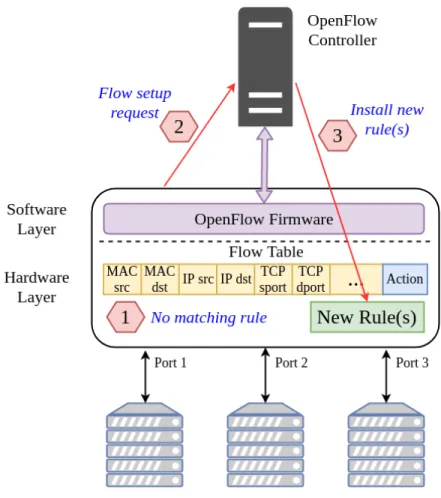
In an SDN network, the logically centralized controller maintains a global network view and controls all network devices. Whenever a switch or router receives a new flow, it first checks its local flow-table(s) for a matching forwarding rule. If no matching rule is found, then it requests the controller for a traffic forwarding rule. Based on the properties of the flow, the controller determines the appropriate route for the traffic and installs forwarding rules on all devices on the path. From that point on, all switches on the path handle packets in that flow using the newly installed rules. The flow-setup process is depicted in Figure 1.1, and the time required to perform this operation is commonly known as the flow-setup time. It includes the controller’s processing delay to determine the forwarding rules and maximum Round-Trip-Time (RTT) between any switches on the path and the controller. The controller’s processing delay depends on the number of pending tasks at that particular time-instance and the computational overhead required to determine the forwarding rules. Several studies have shown that the processing delay at the controller increases exponentially once the number of pending requests exceeds a certain threshold [26, 27, 28]. The RTT component of the flow-setup time depends on the network topology, maximum network distance between any switch on the path and the controller, and the amount of congestion on the paths between the switches and controller. In large-scale WAN and data center deployments, a single controller will certainly lead
Figure 1.1: Flow setup process
to performance and scalability issues [15]. Deploying multiple controllers is an effective solution to this problem. Figure 1.2 and Figure 1.3 show the same network with a single and then with multiple controllers, respectively. With multiple controllers, the network is effectively divided into zones where each controller takes the responsibility to control the switches in its own zone. However, to efficiently utilize multiple controllers, we need to dy-namically adapt the number and locations of controllers according to demand fluctuations and topological characteristics of the network. On one hand, the number of controllers should be sufficient to handle network load, and their locations should ensure acceptable switch-to-controller latencies. On the other hand, the deployment of multiple controllers re-quires regular state synchronization between the controllers to maintain a consistent global network view [19]. The overhead for state synchronization can be significant if the number of controllers in the network is large. In addition, network dynamicity is a major concern as
Figure 1.2: Network with a single controller
Figure 1.3: Network with multiple controllers
traffic pattern and volume in both WAN and data center environments exhibit significant spatial and temporal fluctuations [29, 30, 31]. The controller provisioning scheme needs to react to network “hotspots” and dynamically re-adjust the number and locations of con-trollers to ensure an acceptable flow-setup time. A static controller placement provisioned for peak usage across all regions will require a large number of controllers and incur a high state synchronization overhead. Alternatively, if the number of provisioned controllers is not sufficient to handle the network load, then the performance of all applications and services provided by the network will degrade. Hence, we need to find the right trade-off between performance, scalability, and inter-controller state synchronization overhead to dynamically provision multiple controllers in an SDN.
1.2.2
Service Function Chain (SFC) Orchestration
A second challenging issue for softwarized networks is the network service provisioning platform [6, 11]. Contemporary communication networks deploy a diverse set of net-work services to achieve different types of security and performance objectives [32, 14]. These services are materialized by utilizing various types of hardware appliances or mid-dleboxes [13, 14]. Examples of such midmid-dleboxes include firewall, proxy, WAN optimizer, Evolved Packet Core (EPC), IP Multimedia Subsystem (IMS), Intrusion Detection System (IDS) and Intrusion Prevention System (IPS). These middleboxes have become an integral part of modern networks to such an extend that several recent studies found the number of middleboxes to be comparable to the number of routers and switches in enterprise and data center networks [14, 33, 34]. Although, middleboxes are ubiquitously deployed in modern networks, they result in a lot of management and operational complexities along with significant CAPEX and OPEX [35]. The primary reason behind this situation can be attributed to the vendor-specific, vertically-integrated, and closed-source nature of middle-boxes.
Hardware middleboxes are expensive and require specially trained personnel for de-ployment and maintenance. The closed and proprietary nature of traditional middleboxes makes it very challenging and cumbersome for the network operator to introduce new ser-vices [11]. It is often impossible to add new functionality to an existing middlebox. In many cases, the network operator is compelled to upgrade or purchase new hardware. Today’s networks are facing an ever-increasing requirement to introduce diverse and often short-lived services to retain customer base. These services often require the purchase of new network equipment that is operated only for a short time-span; sometimes the equipment becomes obsolete even before any profit is earned from the offered service [11]. In addition, diverse services demand rapidly changing skill-sets from the operational and management team members of the telecommunication network. Moreover, the telecommunication indus-try is finding it difficult to raise their profit margin due to ever increasing competition with Over-The-Top (OTT) service providers, as increasing service prices will certainly lead to customer churn [36, 11]. To overcome these issues, a flexible, agile, and innovative service provisioning platform is required that can reduce both CAPEX and OPEX for network services and provide fast and simple mechanisms to introduce new services in the network. Network services are composed by arranging multiple middleboxes in a specific order to assemble a processing pipeline. Network traffic passes through this pipeline, procuring multiple stages of middlebox processing to ensure a particular security or performance objective [32, 14]. For example, a traffic may need to go through a firewall, then an IDS, and finally through a proxy [37]. This process is very common for middleboxes and is
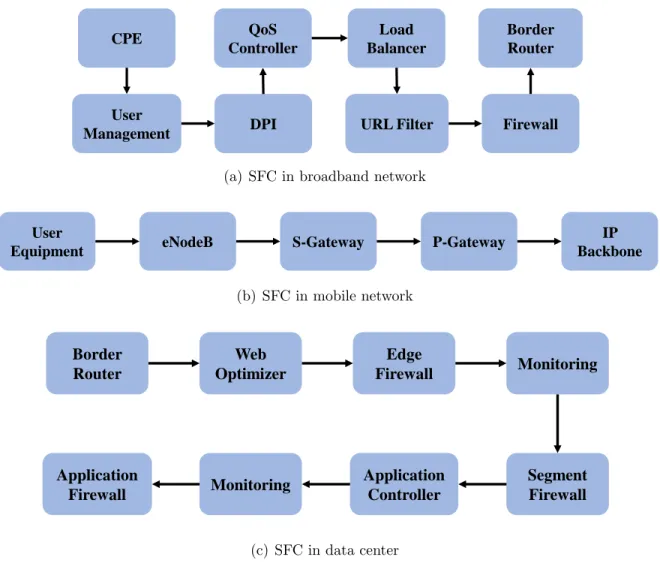
typically called Service Function Chaining (SFC) [38]. SFCs are used to provide various types of user-facing services that are crucial for generating revenue and avoiding customer churn. Different types of SFCs are customarily used for everyday operations in modern networks. The IETF Network and Service Chaining Working Group has several IETF drafts showcasing middlebox chaining use-cases in ISP [39], mobile [40], and data center networks [41]. Figure 1.4 depicts three such SFCs that are frequently deployed in real-world networks: (i) native IPv4 user subscription chain in broadband, (ii) 3GPP mobile network services, and (iii) access to application level SFC in data center.
CPE User Management QoS Controller DPI Load Balancer Border Router Firewall URL Filter
(a) SFC in broadband network
User
Equipment eNodeB S-Gateway P-Gateway
IP Backbone (b) SFC in mobile network Border Router Web Optimizer Monitoring Edge Firewall Segment Firewall Application Firewall Monitoring Application Controller (c) SFC in data center
The process of sequencing an in-network middlebox chain is commonly referred to as SFC Orchestration [42]. Currently, middleboxes are attached to particular routers or switches within the network. In most cases, operators route traffic through the required sequence of middleboxes by manually crafting the routing table entries [43]. Moreover, the proprietary and closed-source nature of these middleboxes creates isolated silos of manage-ment and operational groups that result in undesirable hindrance in the SFC orchestration process. Network operators need to coordinate between multiple management groups for resource allocation and routing table manipulation for setting up a service chain. Mid-dleboxes effectively behave as bumps on the wire where the traffic leaves the primary forwarding path to go through the middlebox and then return to the primary path again. It is a cumbersome and error-prone process that introduces a lot of management and op-erational headache. Furthermore, the fixed locations of middleboxes forces the network operator to use suboptimal routing paths. Network flows are negatively impacted in this architecture; they need to travel to particular middleboxes to get the required services. If we could instantiate a middlebox in real-time, at locations where they are required, at a particular time, then we will be able to better serve network flows.
Network Function Virtualization or NFV is an emerging and promising technology that can address these limitations [44, 42, 11]. It proposes to move packet processing from hard-ware middleboxes to softhard-ware programs or Virtual Network Functions (VNFs) running on commodity (e.g.,x86based systems) servers. This approach decouples the packet process-ing logic from the underlyprocess-ing hardware appliance and brprocess-ings the benefits of economies of scale, similar to that in cloud computing, to the network infrastructure. NFV provides ample opportunities for network optimization and cost reduction. Previously, middleboxes were placed at fixed locations, but now we can deploy a VNF at any location where there are compute resources. In telecommunication networks, these locations are typically called Central Office (CO) or Point-of-Presence (PoP), and they already contain the required infrastructural setup for compute and network resources that can be utilized for VNF deployment. NFV can open-up these resources to enable opportunistic utilization of the network infrastructure. Efficient algorithms can be designed to simultaneously optimize VNF locations and traffic routing paths that will significantly reduce the network OPEX. This approach will not hamper performance as many state-of-the-art software middleboxes have already shown the potential to achieve near-hardware performance [45, 46, 47].
Another interesting research challenge in service function chaining, is the issue of re-source orchestration for energy efficiency. Most often middleboxes are provisioned to handle the peak traffic of a network and consume significant amount of energy. For example, in 2013, worldwide telecommunication networks consumed around 83 Giga-Watts of electric-ity that is equivalent to the power consumed by 12 New York cities [48]. The huge energy
requirement comes with negative environmental implications through emission of several million tons of carbon [49]. In 2007, the annual carbon footprint for the Information and Communication Technology (ICT) sector was around 830 metric tons and is projected to double by 2020 [50]. Within the ICT sector, the telecommunication industry is responsible for around 47% of the total carbon emissions [50]. With the growing demand for today’s bandwidth-intensive Internet services, the energy requirement of these networks will con-tinue to grow and increase their carbon footprint. Several government regulations and carbon emission taxes were established to drive companies to use renewable sources of en-ergy [51, 52, 53]. Moreover, an organization’s reputation can significantly decrease if it has a high carbon footprint or does not disclose carbon emission values [54]. Hence, to comply with regulations and uphold corporate reputation, telecommunication networks need to reduce carbon footprint without significantly increasing operational costs [55, 56, 57].
Network softwarization enables innovative ways to reduce the carbon footprint of a network. For example, the utilization of on-site renewable energy sources like wind turbines or solar panels can be maximized by migrating service chains across COs or PoPs. SFCs can be provisioned intelligently in a topology aware manner to opportunistically switch-off unused servers, switches, and switch ports [58, 59]. However, the availability of renewable energy sources like solar and wind fluctuates a lot between different locations. They are very intermittent in nature and vary with time and weather conditions. Using the data collected by the U.S. Climate Reference Network and Regional Climate Reference Network [60], estimated energy generation potential from solar and wind for six different cities in six different states in the U.S. are shown in Figure 1.5(a) and Figure 1.5(b), respectively. As we can see from the figure, the production rate of renewable energy fluctuates both in spatial and temporal dimensions significantly. Intelligent and adaptable resource orchestration schemes are required to handle this fluctuation and efficiently utilize the available renewable energy.
With SDN and NFV, VNFs are not restricted to any fixed location; they can be pro-visioned on any compute server within the network. Moreover, coupled with an SDN controller, VNFs and their associated traffic flows can be migrated to different compute servers within a short time-frame [61, 62, 63]. Intelligent algorithms can be designed to re-duce the overall energy consumption and carbon footprint by (i) opportunistically utilizing more resources at locations with surplus renewable energy while minimizing consumption at locations where brown energy is the only option and (ii) making VNF placement de-cisions in a manner that allows switches, switch ports, and servers to be put into low consumption state to reduce the overall power consumption.
0 1 2 0 12 24 36 48 60 72 84 96 Po w er (k W) Time (hour) CA UT KS IL OH NY
(a) Solar energy
0 0.2 0.4 0.6 0.8 1 0 12 24 36 48 60 72 84 96 Po w er (MW) Time (hour) CA UT KS IL OH NY (b) Wind energy
1.3
Research Contributions
This dissertation makes the following contributions:
1.3.1
Dynamic Controller Provisioning
SDN has emerged as a new paradigm that offers programmability required to dynamically configure and control a network. SDN decouples the data and control planes and relies on a centralized server to implement the control plane. However, in large-scale WAN and data centers, a single physical server will have several performance and scalability limitations. To address these issues, multiple controllers are typically deployed to work cooperatively to control the switches in the network. Nonetheless, this approach raises an interesting problem, which we call the Dynamic Controller Provisioning Problem (DCPP). DCPP requires dynamic scaling of the number of controllers and their locations with changing network conditions, in order to minimize flow-setup time and communication overhead for state synchronization between controllers. To tackle this problem, we develop a system for deploying multiple controllers in a network. Our system dynamically scales-up or down the number of active controllers and delegates to each controller a subset of OpenFlow switches according to network dynamics while ensuring minimal flow-setup time and communication overhead. To this end, we formulate the DCPP as an Integer Linear Program (ILP) and propose two heuristics to solve it. Simulation results show that our solution minimizes flow-setup time while incurring very low communication overhead.
1.3.2
Orchestrating Virtual Network Functions
Middleboxes or network appliances like firewalls, proxies and WAN optimizers have become an integral part of today’s ISP, data center, and enterprise networks. Middlebox function-alities are usually deployed on expensive and proprietary hardware that require specially trained personnel for deployment and maintenance. Middleboxes contribute significantly to a network’s capital and operation costs. In addition, organizations often require their traffic to pass through a specific sequence of middleboxes for compliance with security and per-formance policies, which leads to complicated routing configurations for the network. NFV is an emerging and promising technology that is envisioned to overcome these challenges. It proposes to move packet processing from dedicated hardware middleboxes to software running on commodity servers. However, in NFV, it is a challenging problem to determine the required number and placement of VNFs that optimizes network operational costs and
utilization, without violating service level agreements. We call this the VNF Orchestration Problem (VNF-OP) and provide an Integer Linear Programming (ILP) formulation. We also provide a dynamic programming based heuristic to solve larger instances of VNF-OP. Trace driven simulations on real-world network topologies demonstrate that the heuristic can provide solutions that are within 1.3 times of the optimal solution. Our experimental results suggest that deploying VNFs instead of hardware middleboxes can provide more than four times reduction in the operational cost of a network.
1.3.3
Energy Smart Service Function Chain Orchestration
Telecommunication COs and PoPs are deployed in cities and metropolitan areas to provide broadband and wireless Internet services to both commercial and residential customers. These locations host a large number of middleboxes to provide last mile connectivity and different network services [64]. In recent years, the rapid development of technologies like cloud computing, photo-intensive social networks, on-demand video streaming, online gaming, and the Internet of Things (IoT) has triggered a tremendous growth in the telecom-munication industry. With the growing demand for today’s bandwidth-intensive Internet services, the energy requirement of these networks will continue to grow and increase their carbon footprint. In this context, we propose an Energy Smart Service Function Chain Orchestrator calledESSO that reduces the overall carbon footprint of a telecommunication network by opportunistically adapting the SFC embedding locations to utilize more energy at locations with surplus renewable energy. ESSO minimizes brown energy consumption by migrating SFCs across different locations. In addition, ESSO provisions individual VNFs and the virtual links between them in a manner that allows switches, switch ports, and servers to be put into low-power consumption state. ESSO employs a number of heuristic algorithms to take embedding, consolidation, and migration decisions to utilize a maximal amount of renewable energy and reduce the overall carbon footprint of the network.
1.4
Thesis Organization
The rest of this thesis is organized as follows: The work on dynamic controller provisioning is discussed in Chapter 2. Next, we describe the issue of VNF orchestration in Chapter 3. After that we present the work on energy smart SFC orchestration in Chapter 4. Conclud-ing remarks are presented in Chapter 5 includConclud-ing a summary of the contributions of this thesis and a discussion of potential future research directions.
Chapter 2
Dynamic Controller Provisioning
Software-defined networking (SDN) has emerged as a new paradigm that offers the pro-grammability required to configure and manage the network dynamically. By separating the control plane from the data plane and shifting the control plane to a logically central-ized controller, SDN provides network operators the flexibility to implement a wide-range of network policies (e.g.,routing, security, fault-tolerance) and the ability to rapidly deploy new network technologies.
The most common SDN implementation today relies on a logically centralized controller that possesses a global view of the network. Whenever a switch receives a new flow, it requests the controller to install appropriate forwarding rules along the desired flow path. The time required to complete this operation is known as the flow-setup time. However, in a large-scale WAN deployment, this rudimentary centralized approach has several limitations related to performance and scalability. First, it is not always possible to find an optimal provisioning of the controller that can ensure acceptable latencies between the controller and the switches situated at geographically distributed locations. Secondly, a single controller usually has a limited resource capacity and hence cannot handle a large number of flows originating from the infrastructure switches. In this case, the average flow-setup time can rise significantly and degrade application and service performance [28].
To address these limitations, recent proposals have advocated to deploy multiple con-trollers that work cooperatively to better manage network traffic flows [24, 22]. Nonethe-less, this approach introduces a new problem: minimizing flow-setup times by dynamically adapting the number of controllers and their locations according to demand fluctuations in the network. We call this problem the Dynamic Controller Provisioning Problem (DCPP). Specifically, DCPP requires the number of controllers to be sufficient to handle the current
network traffic, and their locations should ensure low switch-to-controller latencies. How-ever, the multi-controller deployment also requires regular state synchronization between the controllers to maintain a consistent view of the network [19]. This communication overhead can be significant if the number of controllers in the network is large. Finally, as network traffic patterns and volumes at different locations can vary significantly over-time, the controller provisioning scheme has to react to network “hotspots” and dynamically re-adjust the number and the location of controllers. Hence, the solution to DCPP must always find the right trade-off between performance (in terms of flow-setup time) and overhead (controller synchronization and management).
To the best of our knowledge, the only work that has investigated the controller pro-visioning problem is the one by Heller et al. [15]. They studied a static version of the problem where controller provisioning remains fixed over time and analyzed the impact of the controller locations on the average and worst-case controller-to-switch propagation delay. However, a static controller provisioning configuration may not be suitable for very long as network conditions can change over time.
To address this limitation, we propose a management system for dynamically deploying multiple controllers within a WAN. Specifically, we consider the dynamic version of the controller provisioning problem where both the numbers and locations of controllers are adjusted according to network dynamics. Our solution takes into account the dynamics of traffic patterns in the network while minimizing costs for (i) switch state collection, (ii) inter-controller synchronization, and (iii) switch-to-controller reassignment. First, we provide background on SDN and its control plane in Section 2.1 and Section 2.3, respec-tively. After that, we describe our proposed management system in Section 2.4. Next, we formulate DCPP as an Integer Linear Program (ILP) that considers all aforementioned costs in Section 2.5. We then propose two heuristics that dynamically estimate the number of controllers and decide their placement in order to achieve the desired objectives in Sec-tion 2.6. The effectiveness of our soluSec-tion is then demonstrated using realistic traces and WAN topologies in Section 2.7. Our results show that the proposed algorithms minimize the average flow-setup time while incurring very low communication overhead. Related work is presented in Section 2.2, and finally, we provide concluding remarks in Section 2.8.
2.1
Software-Defined Networking (SDN)
The Open Networking Foundation (ONF) defines Software-Defined Networking or SDN as an emerging networking architecture that decouples network control from forwarding in the data plane, enables direct programmability of the network, and abstracts the underlying
infrastructure for network applications and services [65]. SDN provides open interfaces to program and control network elements (e.g., switch or router) to define the data forwarding and processing operations. SDN separates the control and data forwarding functions and relocates the control functions into a dedicated entity called the SDN Controller. The behavior of the network elements is controlled and managed by SDN Applications that run on top of the controller. Another differentiating feature of SDN is the treatment of traffic in terms of flows based on protocol headers of a packet. A flow in SDN represents all packets in a data flow that have the same set of values for a specified set of protocol header fields.
2.1.1
Traditional vs. Software-Defined Network
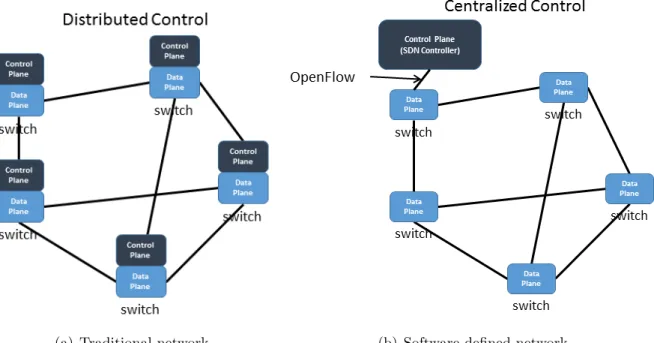
Traditional IP networks are operated by running distributed routing protocols that are embedded within the router or switch. These routing protocols exchange messages with neighboring devices to converge to a consistent view of the network and then determine traffic forwarding rules by executing path computation algorithms. Each device constructs its own perspective of the network, and the only way to inspect this view is by connecting to the device via its CLI. In a traditional network, the data and control planes are blended within the device as shown in Figure 2.1(a). Network operators express high-level poli-cies by manually configuring each device through the device’s CLI or other vendor-specific tools, which is a complicated, cumbersome, and error-prone process. Moreover, due to the closed-source, vertically-integrated, and proprietary nature of network devices, auto-matic reconfiguration and dynamic adaptation to traffic fluctuations are very challenging in current networks.
SDN proposed to address this issues by decoupling the data and control planes. The SDN architecture enables the control and data planes to evolve independently. It facili-tates isolated optimization and life-cycle management of data and control plane technolo-gies. Figure 2.1(b) depicts an SDN network where the control plane of the network devices are placed on a logically centralized and programmable software platform known as the network controller.
2.1.2
SDN Architecture
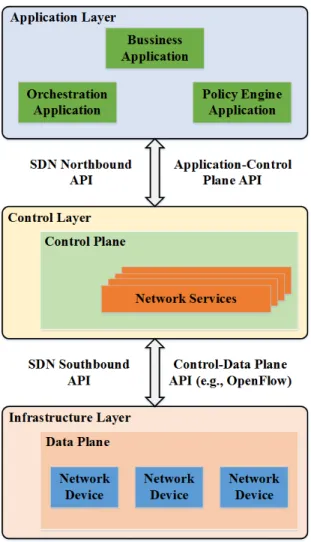
The SDN architecture, proposed by ONF, is shown in Figure 2.2 [65]. ONF divides the SDN architecture into three layers: (i) Infrastructure Layer, (ii) Control Layer, and (iii) Application Layer. The infrastructure layer consists of the data plane devices like switches
(a) Traditional network (b) Software-defined network
Figure 2.1: Routing in traditional vs. software-defined networks
and routers. This plane is commonly referred to as the data plane. Its primary functions include data forwarding, local monitoring, and statistics collection. The control layer includes the SDN control software or the network controller; it can be deployed either on a single server or cluster of servers to satisfy performance, reliability, security, and availability requirements.
The separation between the control and data planes is achieved by means of a well-defined and standardized communication channel between the controller and data plane devices. The protocol for the communication between the controller and data plane is referred to as the Southbound API (SBI). OpenFlow has emerged as the de-facto standard for SBI by providing flow-level granularity, vendor-neutrality, and an abstraction that is generic enough to promote innovation and provide adequate functionality for network programmability. Key control plane functions include the control and monitoring of the network infrastructure. Data plane devices expose their functionalities, capabilities, and current state to the control plane through a specific set of messages defined by the SBI. The controller collects network statistics from network devices using these messages and maintains a global view of the network. The control plane also provides the means to
Figure 2.2: SDN architecture control data plane devices through a set of SBI messages.
The controller provides the global network view to the application plane through a standardized and programmable API known as the Northbound API (NBI). The appli-cation layer consists of appliappli-cations or services like router, firewall, and load-balancer, implemented as special purpose software modules that run on top of the controller. These applications use the NBI to program network devices through the controller. Unlike the SBI, there is still no standardized NBI; each controller implementation provides its own feature-set and implementation for the NBI. The controller translates the application logic to control instructions (defined by SBI) for the network devices enabling infrastructure
independent development of SDN applications. The behavior of a switch or router is gov-erned by the instructions or flow-table rules received from the controller that are sanctioned through the policies imposed by the applications running on top of it.
2.1.3
OpenFlow Switch
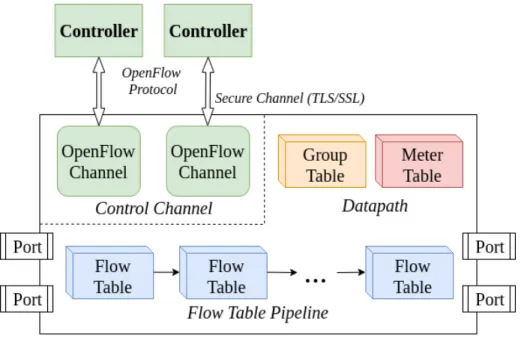
An OpenFlow enabled switch is shown in Figure 2.3. It has one or more flow-tables that contain forwarding rules to determine how to handle data traffic. Each rule matches a subset of fields in the packet header; it identifies a flow in the network and can perform operations like drop packet, modify packet headers, or forward packet through one or more outgoing ports. The group table contains flow-entries to perform operations like flooding, aggregation, and multi-path forwarding. The meter table is used to control parameters related to QoS of the switch. Each switch also contains one or more OpenFlow channel or agent to communicate with the controller. The communication is usually performed over a secure channel to exchange both control and data packets. The controller can add, update, or delete flow-table entries in the flow-tables via the OpenFlow protocol.
Figure 2.3: Components of an OpenFlow switch
field contains the ingress port, packet headers, and other metadata to match incoming packets (Figure 2.5). Match fields can contain wildcards to match aggregate flows. A switch typically uses Ternary Content Addressable Memory (TCAM) to enable fast lookups for wildcard matches. The priority field in the flow-entry represents the matching preference within a flow-table, counters are used for storing match statistics, instructions are used to control processing of packets through the tables, timeout is used to expire a flow-entry, and the cookie is used by the controller to filter flow-entries. The counters store the number of received packets and bytes, which can be used to determine different metrics about the links connected to the switch. The OpenFlow protocol provides packet and byte counters at the granularity of flow-table, flow-entry, port, and queue.
Figure 2.4: Components of an OpenFlow flow-entry
Figure 2.5: Match fields in OpenFlow flow-entry
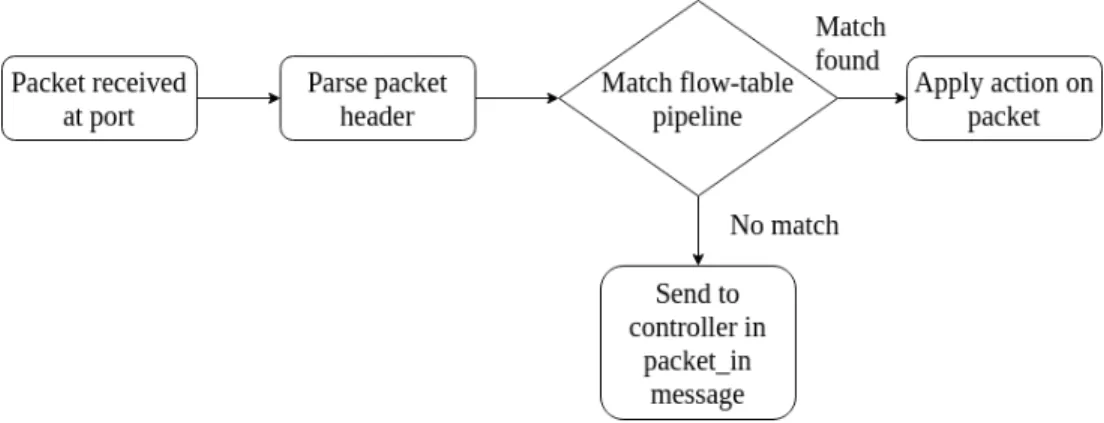
Each OpenFlow switch contains one or more flow-tables. Packet matching always starts at the first flow-table, then based on the instructions installed in the matching flow-entries it can be forwarded to other flow-tables in the flow-table pipeline (see Figure 2.3). Flow-entries are matched according to the priority (higher value means higher priority) of the flow-entries in the flow-table. The pipeline processing is performed in two stages: (i) ingress and (ii) egress processing. If a matching entry is found, then the processing ends with either dropping, modifying and/or forwarding the packet through one or more output port. If no entry matches the flow, then the outcome depends on the configuration of the table-miss flow entry, which has the lowest priority and a wild-card match rule to match all packets. The table-miss flow-entry is usually configured to forward packets to the controller; however, it can also drop all packets or process packets through the traditional (non-OpenFlow) pipeline of the switch.
OpenFlow uses a special output port called ‘NORMAL’ to represent the traditional pro-cessing pipeline of the switch. Any flow-entry with an action to forward a packet to the NORMAL output port, skips the OpenFlow based flow-table pipeline and hands-over the packet to the traditional fully-distributed routing protocol based forwarding mechanism of
the switch. In this case, the forwarding is performed based on the information gathered in Routing Information Base (RIB) of the switch using routing protocols like OSPF, STP, or RIP.
2.1.4
Switch – Controller Interaction
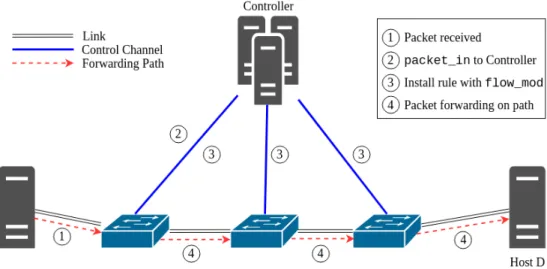
The process of handling packets for which no flow-entry is installed in the switch is depicted in Figure 2.6 and Figure 2.7. In the traditional OpenFlow switch configuration, if the packet-miss flow entry specifies that a packet should be forwarded to the controller, then every first packet of a new incoming flow (without a matching flow-entry) is forwarded to the controller (step 1 in Figure 2.7). The packet is either buffered at the switch or encapsulated in the packet forwarded to the controller based on available buffer-space at the switch (step 2). In either case, the packet headers are included in the special control packet calledpacket in, which is sent from the switch to the controller.
Figure 2.6: Packet forwarding by an OpenFlow switch
The controller extracts the data packet information from the packet in message and forwards the packet to a controller application responsible for handling such packet in messages. The application eventually determines one or more flow-table entries to handle the corresponding flow. The controller then sends back another control packet, called the flow mod, to install the new rules in the switch’s flow-table (step 3 in Figure 2.7). Subsequent packets in the flow are processed by the newly installed flow-table entries. In most cases, the controller sets up the entire path by installing flow-entries in all switches on the path used to forward the flow packets, as shown in step 4 of Figure 2.7.
Figure 2.7: Path setup for new flow
2.2
Related Work
2.2.1
Control Plane Scalability
SDN’s proposal to have a logically centralized control plane has motivated a spate of research works that explored the scalability, performance, and reliability of the control plane under different design assumptions. The first and basic design choice is the case of a single controller. Heller et al. was the first to analyze control plane performance based on only switch to controller latencies [15]. They analyzed a number of network topologies and showed that the number and placement of controllers depend on the desired controller to switch reaction time, the metric of choice to be optimized, and the network topology. They also reported that for the Internet2 [66] topology that has 34 nodes and 41 links, at least three controllers are required to ensure a reasonable controller to switch latency [15]. However, in their work, Heller et al. did not consider either the effect of load on the controller or the variation of traffic load across time and location. Tootoonchian et al.
tested the performance of an SDN controller called NOX [67] in [28]. They developed a tool called cbench to stress test SDN controllers, and reported that if the number of switches is far greater than the number of available CPU cores, then the average response time of the controller increases significantly. Increased contention across threads, TCP dynamics, and internal task scheduling overhead at the controller are the primary reasons for this performance degradation. A number of research works have proposed different techniques to overcome this scalability limitation. These techniques can be classified into
two broad categories: (1) pushing intelligence into the switch to offload the controller, and (2) distributing the control plane across multiple controllers.
Pushing Down Intelligence
DevoFlow [18] and DIFANE [17] fall in the first category of techniques. DevoFlow proposes to pre-install wildcard rules in the switches that can replicate themselves for the mice flows to create flow specific rules. The switches also have the intelligence to detect elephant flows. The controller is only responsible for making the forwarding decision for elephant flows. Similarly, in DIFANE, the controller generates the forwarding rules, but it is not involved in the setup of each new flow. Rather, the rules are partitioned and distributed among a subset of switches called “authoritative switches”. The regular switches, which forward packets in the data plane, redirect new flows to the authoritative switches to learn about the forwarding rules. However, both of these proposals require some changes to be made to the commodity switches to increase their intelligence.
Distributed Control Plane
On the other hand, Kandoo [22], HyperFlow [24], and Onix [21] propose to distribute the control plane across multiple controllers to improve SDN’s scalability. Each of them dis-tributes controller states differently. Kandoo disdis-tributes controller states by placing the controllers in a two-level hierarchy comprising a root controller and multiple local con-trollers. Local controllers respond to the events that do not depend on global network state (e.g., elephant flow detection), while the root controller takes actions that require global network view (e.g., re-routing elephant flows). Hyperflow provides a logically cen-tralized view of the control plane to network applications. However, the control plane itself is physically distributed. Each physically distinct controller in the network is responsible for handling requests from a subset of the network switches. HyperFlow handles state dis-tribution of the distributed controllers through a publish/subscribe system based on the WheelFS [68] distributed file system. The physically distributed controllers share the same network-wide view through the publish/subscribe system. Finally, controller state distri-bution in Onix is managed through a distributed hash table. This allows the controllers to handle network events locally without the necessity of communicating with remote nodes.
2.2.2
Multi-Controller Provisioning
None of the aforementioned works considered the issue of choosing suitable network loca-tions for controller provisioning and adapting the provisioning according to the dynamic behavior of the network. To the best of our knowledge, we were the first to identify this problem as the Dynamic Controller Provisioning Problem (DCPP) [69]. We also proposed a management system that takes both network performance (in terms of flow-setup time) and management overhead (for state synchronization) into consideration to determine the number and placement of controllers in the network. A good number of research works built upon our work on multi-controller provisioning. Yao et al. considers a variation of DCPP where different controllers have different processing capacities and allocated switches in a way that does not overload any controller in the network [70]. While in our experi-ments we used controllers with the same capacity, there are no restrictions in the problem formulation or the heuristic algorithm on using a heterogeneous class of controllers.
Another work that followed is the Pareto-Optimal Controller Placement (POCO) frame-work [71, 72] that considers additional metrics like controller-controller latency, load-balancing among controllers, and resilience in case of double node or link failures. The authors propose an algorithm that generates all possible combinations for k-controllers and then selects the best one based on the metrics mentioned above. The number of controllers (k) is an input to the algorithms. In contrast, we determine the optimal number of con-trollers and also change their number and location based on traffic fluctuations. Lange et al. extended the algorithms in POCO, with heuristics so that it can support larger and dynamic networks. However, the number of controllers is still taken as an input, instead of being optimized. Obadiaet al.proposed a greedy heuristic to assign switches to a controller in a manner that minimizes control plane traffic [73]; whereas, our work minimizes both control plane traffic and flow-setup time. Rath et al. proposed a zero-sum game based distributed controller provisioning mechanism where a controller communicates with its neighboring controllers to determine a payoff for staying active. However, the authors did not provide any details on the control plane messaging overhead.
Another group of works targets the controller provisioning problem from the viewpoint of reliability. Hu et al.introduce the reliability-aware controller provisioning problem and propose a metric called control-path loss to measure the reliability of a controller place-ment [74, 75]. This group of works targets a different problem than DCPP; they are more similar to fault-tolerant virtual network embedding problems [74]. Another related work is presented in [76], where the authors provide a mathematical formulation and heuristic algorithms for ensuring five-nines availability. However, in their work, they assume that a switch can connect to more that one controller simultaneously and send updates regarding
its state to all of the controllers. While the first assumption is in line with traditional SDN switch-to-controller interaction, the second one will need modifications to the OpenFlow standard. Authors in [77, 75, 78] proposed algorithms that provision controllers to ensure that the control network can tolerate single link failures.
2.3
Control Plane Assumptions
2.3.1
Logically Centralized – Physically Distributed
SDN control plane is typically deployed as a logically centralized and physically distributed collection of servers, as shown in Figure 2.8. A single controller faces problems and issues related to scalability, reliability, performance, and single-point-of-failure. For this reason, a cluster of servers at a location or multiple servers distributed across locations are generally used to implement the SDN control plane. In Figure 2.8, each controller is in-charge for a subset of the switches. A controller collects network statistics from the switches which are under its control and then synchronizes the collected data with other controllers using the Controller-to-Controller API (C2I), which is also known as the East-West API.
Figure 2.8: Control plane deployment
The C2I is not yet standardized; different controller vendors implement different in-terfaces for inter-controller communication. However, irrespective of the vendor, all SDN
controllers provide a global network view to the network applications. The distribution of control plane responsibilities can be organized in either a flat or hierarchical manner. A flat structure is similar to the one shown in Figure 2.8, where each controller is responsible for a subset of switches, and the controllers communicate with each other in a peer-to-peer manner to synchronize data. In a hierarchical structure, controllers are organized into layers of nodes in a tree. Controllers on the higher layer manage controllers on a lower layer. Only the controllers on the lowest layer interact directly with the switches, and their interactions are governed by the policies enforced by the controller at the higher layers.
2.3.2
In-Band vs. Out-of-Band Signaling
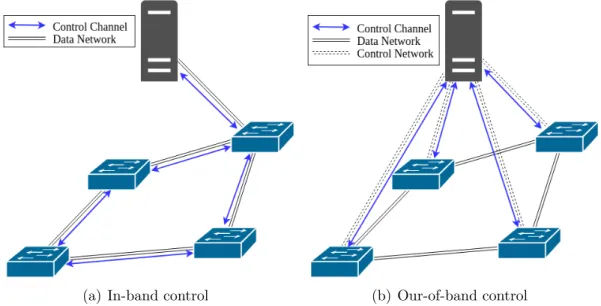
(a) In-band control (b) Our-of-band control
Figure 2.9: In-band vs. out-of-band control channel
The communication between the controllers and switches can be either in-band or out-of-band. With in-band control, control traffic shares the same network infrastructure as data traffic, as shown in Figure 2.9(a). This approach does not require a separate network for control traffic; however, it has security and fault-tolerance issues. Control traffic is passed through the same network as data traffic, which raises security concerns. In addition, failure of any link in the data network can affect the control channel as well. Out-of-band control is an alternative to overcome this issues. The out-Out-of-band model for control plane signaling is shown in Figure 2.9(b). Out-of-band control requires a separate network
between the controllers and the switches, which increases both capital and operational cost of the network. Moreover, in most c