C. J. van RIJSBERGEN B.Sc., Ph.D., M.B.C.S.
Department of Computing Science
The major change in the second edition of this book is the addition of a new chapter on probabilistic retrieval. This chapter has been included because I think this is one of the most interesting and active areas of research in information retrieval. There are still many problems to be solved so I hope that this particular chapter will be of some help to those who want to advance the state of knowledge in this area. All the other chapters have been updated by including some of the more recent work on the topics covered. In preparing this new edition I have benefited from discussions with Bruce Croft, David Harper, Stephen Robertson and Karen Sparck Jones. I am grateful to the University of Cambridge Computer Laboratory for providing me with the facilities for carrying out the work. Finally, I am indebted to the Royal Society for supporting me on their Scientific Information Research Fellowship.
PREFACE TO THE FIRST EDITION
The material of this book is aimed at advanced undergraduate information (or computer) science students, postgraduate library science students, and research workers in the field of IR. Some of the chapters, particularly Chapter 6* , make simple use of a little advanced
mathematics. However, the necessary mathematical tools can be easily mastered from numerous mathematical texts that now exist and, in any case, references have been given where the mathematics occur.
I had to face the problem of balancing clarity of exposition with density of references. I was tempted to give large numbers of references but was afraid they would have destroyed the continuity of the text. I have tried to steer a middle course and not compete with the
Annual Review of Information Science and Technology.
accessible form, such as a book or periodical. Unfortunately, much of the interesting work in IR is contained in technical reports and Ph.D. theses. For example, most the work done on the SMART system at Cornell is available only in reports. Luckily many of these are now available through the National Technical Information Service (U.S.) and University Microfilms (U.K.). I have not avoided using these sources although if the same material is accessible more readily in some other form I have given it preference.
I should like to acknowledge my considerable debt to many people and institutions that have helped me. Let me say first that they are responsible for many of the ideas in this book but that only I wish to be held responsible. My greatest debt is to Karen Sparck Jones who taught me to research information retrieval as an experimental science. Nick Jardine and Robin Sibson taught me about the theory of automatic classification. Cyril Cleverdon is responsible for forcing me to think about evaluation. Mike Keen helped by providing data. Gerry Salton has influenced my thinking about IR considerably, mainly through his published work. Ken Moody had the knack of bailing me out when the going was rough and encouraging me to continue experimenting. Juliet Gundry is responsible for making the text more readable and clear. Bruce Croft, who read the final draft, made many useful comments. Ness Barry takes all the credit for preparing the manuscript. Finally, I am grateful to the Office of Scientific and Technical Information for funding most of the early experimental work on which the book is based; to the Kings College Research Centre for providing me with an environment in which I could think, and to the Department of Information Science at Monash University for providing me with the facilities for writing.
Contents
One: INTRODUCTION...1
The structure of the book...2
Outline...3
Information retrieval...3
An information retrieval system...4
IR in perspective...5
Effectiveness and efficiency...6
Bibliographic remarks...7
References...7
Two: AUTOMATIC TEXT ANALYSIS...10
Luhn's ideas...10
Generating document representatives - conflation...12
Indexing...13
Index term weighting...13
Probabilistic indexing...15
Discrimination and/or representation...17
Automatic keyword classification...17
Three: AUTOMATIC CLASSIFICATION...23
Measures of association...24
The cluster hypothesis...29
Single-link...35
The appropriateness of stratified hierarchic cluster methods...36
Single-link and the minimum spanning tree...38
Implication of classification methods...38
Conclusion...40
Bibliographic remarks...40
References...41
Four: FILE STRUCTURES...46
A language for describing file structures...47
Basic terminology...47
Trees...58
Scatter storage or hash addressing...61
Bibliographic remarks...63
References...64
Five: SEARCH STRATEGIES...68
Introduction...68
Boolean search...68
Matching functions...69
Serial search...70
Cluster representatives...70
Cluster-based retrieval...73
Interactive search formulation...74
Feedback...75
Bibliographic remarks...77
References...77
Six: PROBABILISTIC RETRIEVAL...5
Introduction...5
Estimation or calculation of relevance...6
Basic probabilistic model*...7
Form of retrieval function...9
The index terms are not independent...10
Selecting the best dependence trees...12
Estimation of parameters...14
Recapitulation...16
The curse of dimensionality...17
Computational details...17
An alternative way of using the dependence tree (Association Hypothesis) 19
Discrimination power of an index term...20
Seven: EVALUATION...5
Introduction...5
Relevance...6
Precision and recall, and others...7
Averaging techniques...9
Interpolation...10
Composite measures...12
The Swets model...12
Foundation...22
Presentation of experimental results...28
Significance tests...29
Bibliographic remarks...30
References...31
Eight: THE FUTURE...35
Future research...35
Automatic classification...35 File structures...36 Search strategies...36 Simulation...36 Evaluation...37 Content analysis...37Future developments...38
One
INTRODUCTION
Information retrieval is a wide, often loosely-defined term but in these pages I shall be concerned only with automatic information retrieval systems. Automatic as opposed to manual and information as opposed to data or fact. Unfortunately the word information can be very misleading. In the context of information retrieval (IR), information, in the technical meaning given in Shannon's theory of communication, is not readily measured (Shannon and Weaver1). In fact, in many cases one can adequately describe the kind of retrieval by simply substituting 'document' for 'information'. Nevertheless, 'information retrieval' has become accepted as a description of the kind of work published by Cleverdon, Salton, Sparck Jones, Lancaster and others. A perfectly straightforward definition along these lines is given by Lancaster2: 'Information retrieval is the term conventionally, though somewhat inaccurately, applied to the type of activity discussed in this volume. An information retrieval system does not inform (i.e. change the knowledge of) the user on the subject of his inquiry. It merely informs on the existence (or non-existence) and whereabouts of documents relating to his request.' This specifically excludes Question-Answering systems as typified by Winograd3 and those described by Minsky4. It also excludes data retrieval systems such as used by, say, the stock exchange for on-line quotations.
To make clear the difference between data retrieval (DR) and information retrieval (IR), I have listed in Table 1.1 some of the distinguishing properties of data and information retrieval. One
Table 1.1 DATA RETRIEVAL OR INFORMATION RETRIEVAL?
_____________________________________________________________________________ Data Retrieval (DR) Information Retrieval (IR)
_____________________________________________________________________________
Matching Exact match Partial match, best match
Inference Deduction Induction
Model Deterministic Probabilistic
Classification Monothetic Polythetic
Query language Artificial Natural
Query specification Complete Incomplete
Items wanted Matching Relevant
Error response Sensitive Insensitive
_____________________________________________________________________________ may want to criticise this dichotomy on the grounds that the boundary between the two is a vague one. And so it is, but it is a useful one in that it illustrates the range of complexity associated with each mode of retrieval.
Let us now take each item in the table in turn and look at it more closely. In data retrieval we are normally looking for an exact match, that is, we are checking to see whether an item is or is not present in the file. In information retrieval this may sometimes be of interest but more generally we want to find those items which partially match the request and then select from those a few of the best matching ones. The inference used in data retrieval is of the simple deductive kind, that is, aRb and bRc then aRc. In information retrieval it is far more common to use inductive inference; relations are only specified with a degree of certainty or uncertainty and hence our confidence in the inference is variable. This
distinction leads one to describe data retrieval as deterministic but information retrieval as probabilistic. Frequently Bayes' Theorem is invoked to carry out inferences in IR, but in DR probabilities do not enter into the processing.
Another distinction can be made in terms of classifications that are likely to be useful. In DR we are most likely to be interested in a monothetic classification, that is, one with classes defined by objects possessing attributes both necessary and sufficient to belong to a class. In IR such a classification is on the whole not very useful, in fact more often a polythetic classification is what is wanted. In such a classification each individual in a class will possess only a proportion of all the attributes possessed by all the members of that class. Hence no attribute is necessary nor sufficient for membership to a class.
The query language for DR will generally be of the artificial kind, one with restricted syntax and vocabulary, in IR we prefer to use natural language although there are some notable exceptions. In DR the query is generally a complete specification of what is wanted, in IR it is invariably incomplete. This last difference arises partly from the fact that in IR we are searching for relevant documents as opposed to exactly matching items. The extent of the match in IR is assumed to indicate the likelihood of the relevance of that item. One simple consequence of this difference is that DR is more sensitive to error in the sense that, an error in matching will not retrieve the wanted item which implies a total failure of the system. In IR small errors in matching generally do not affect performance of the system significantly.
Many automatic information retrieval systems are experimental. I only make occasional reference to
operational systems. Experimental IR is mainly carried on in a 'laboratory' situation whereas operational
systems are commercial systems which charge for the service they provide. Naturally the two systems are evaluated differently. The 'real world' IR systems are evaluated in terms of 'user satisfaction' and the price the user is willing to pay for their services. Experimental IR systems are evaluated by comparing the retrieval experiments with standards specially constructed for the purpose. I believe that a book on
experimental information retrieval, covering the design and evaluation of retrieval systems from a point
of view which is independent of any particular system, will be a great help to other workers in the field and indeed is long overdue.
Many of the techniques I shall discuss will not have proved themselves incontrovertibly superior to all other techniques, but they have promise and their promise will only be realised when they are understood. Information about new techniques has been so scattered through the literature that to find out about them you need to be an expert before you begin to look. I hope that I will be able to take the reader to the point where he will have little trouble in implementing some of the new techniques. Also, that some people will then go on to experiment with them, and generate new, convincing evidence of their efficiency and effectiveness.
My aim throughout has been to give a complete coverage of the more important ideas current in various special areas of information retrieval. Inevitably some ideas have been elaborated at the expense of others. In particular, emphasis is placed on the use of automatic classification techniques and rigorous methods of measurement of effectiveness. On the other hand, automatic content analysis is given only a superficial coverage. The reasons are straightforward, firstly the material reflects my own bias, and secondly, no adequate coverage of the first two topics has been given before whereas automatic content analysis has been documented very well elsewhere. A subsidiary reason for emphasising automatic classification is that little appears to be known or understood about it in the context of IR so that research workers are loath to experiment with it.
The structure of the book
The introduction presents some basic background material, demarcates the subject and discusses loosely some of the problems in IR. The chapters that follow cover topics in the order in which I would think about them were I about to design an experimental IR system. They begin by describing the generation of machine representations for the information, and then move on to an explanation of the logical structures that may be arrived at by clustering. There are numerous methods for representing these structures in the computer, or in other words, there is a choice of file structures to represent the logical structure, so these are outlined next. Once the information has been stored in this way we are able to search it, hence a discussion of search strategies follows. The chapter on probabilistic retrieval is an attempt to create a formal model for certain kinds of search strategies. Lastly, in an experimental situation all of the above will have been futile unless the results of retrieval can be evaluated. Therefore a
large chapter is devoted to ways of measuring the effectiveness of retrieval. In the final chapter I have indulged in a little speculation about the possibilities for IR in the next decade.
The two major chapters are those dealing with automatic classification and evaluation. I have tried to write them in such a way that each can be read independently of the rest of the book (although I do not recommend this for the non-specialist).
Outline
Chapter 2: Automatic Text Analysis - contains a straightforward discussion of how the text of a
document is represented inside a computer. This is a superficial chapter but I think it is adequate in the context of this book.
Chapter 3: Automatic Classification - looks at automatic classification methods in general and then
takes a deeper look at the use of these methods in information retrieval.
Chapter 4: File Structures - here we try and discuss file structures from the point of view of someone
primarily interested in information retrieval.
Chapter 5: Search Strategies - gives an account of some search strategies when applied to document
collections structured in different ways. It also discusses the use of feedback.
Chapter 6: Probabilistic Retrieval - describes a formal model for enhancing retrieval effectiveness by
using sample information about the frequency of occurrence and co-occurrence of index terms in the relevant and non-relevant documents.
Chapter 7: Evaluation - here I give a traditional view of the measurement of effectiveness followed by
an explanation of some of the more promising attempts at improving the art. I also attempt to provide foundations for a theory of evaluation.
Chapter 8: The Future - contains some speculation about the future of IR and tries to pinpoint some
areas of research where further work is desperately needed.
Information retrieval
Since the 1940s the problem of information storage and retrieval has attracted increasing attention. It is simply stated: we have vast amounts of information to which accurate and speedy access is becoming ever more difficult. One effect of this is that relevant information gets ignored since it is never uncovered, which in turn leads to much duplication of work and effort. With the advent of computers, a great deal of thought has been given to using them to provide rapid and intelligent retrieval systems. In libraries, many of which certainly have an information storage and retrieval problem, some of the more mundane tasks, such as cataloguing and general administration, have successfully been taken over by computers. However, the problem of effective retrieval remains largely unsolved.
In principle, information storage and retrieval is simple. Suppose there is a store of documents and a person (user of the store) formulates a question (request or query) to which the answer is a set of documents satisfying the information need expressed by his question. He can obtain the set by reading all the documents in the store, retaining the relevant documents and discarding all the others. In a sense, this constitutes 'perfect' retrieval. This solution is obviously impracticable. A user either does not have the time or does not wish to spend the time reading the entire document collection, apart from the fact that it may be physically impossible for him to do so.
When high speed computers became available for non-numerical work, many thought that a computer would be able to 'read' an entire document collection to extract the relevant documents. It soon became apparent that using the natural language text of a document not only caused input and storage problems (it still does) but also left unsolved the intellectual problem of characterising the document content. It is conceivable that future hardware developments may make natural language input and storage more feasible. But automatic characterisation in which the software attempts to duplicate the human process of 'reading' is a very sticky problem indeed. More specifically, 'reading' involves attempting to extract information, both syntactic and semantic, from the text and using it to decide whether each document is relevant or not to a particular request. The difficulty is not only
knowing how to extract the information but also how to use it to decide relevance. The comparatively slow progress of modern linguistics on the semantic front and the conspicuous failure of machine translation (Bar-Hillel5) show that these problems are largely unsolved.
The reader will have noticed that already, the idea of 'relevance' has slipped into the discussion. It is this notion which is at the centre of information retrieval. The purpose of an automatic retrieval strategy is to retrieve all the relevant documents at the same time retrieving as few of the non-relevant as possible. When the characterisation of a document is worked out, it should be such that when the document it represents is relevant to a query, it will enable the document to be retrieved in response to that query. Human indexers have traditionally characterised documents in this way when assigning index terms to documents. The indexer attempts to anticipate the kind of index terms a user would employ to retrieve each document whose content he is about to describe. Implicitly he is constructing queries for which the document is relevant. When the indexing is done automatically it is assumed that by pushing the text of a document or query through the same automatic analysis, the output will be a representation of the content, and if the document is relevant to the query, a computational procedure will show this.
Intellectually it is possible for a human to establish the relevance of a document to a query. For a computer to do this we need to construct a model within which relevance decisions can be quantified. It is interesting to note that most research in information retrieval can be shown to have been concerned with different aspects of such a model.
An information retrieval system
Let me illustrate by means of a black box what a typical IR system would look like. The diagram shows three components: input, processor and output. Such a trichotomy may seem a little trite, but the components constitute a convenient set of pegs upon which to hang a discussion.
Starting with the input side of things. The main problem here is to obtain a representation of each document and query suitable for a computer to use. Let me emphasise that most computer-based retrieval systems store only a representation of the document (or query) which means that the text of a document is lost once it has been processed for the purpose of generating its representation. A document
representative could, for example, be a list of extracted words considered to be significant. Rather than
have the computer process the natural language, an alternative approach is to have an artificial language within which all queries and documents can be formulated. There
Feedback
Output
Processor
Queries
Input
Documents
Figure 1.1. A typical IR system
is some evidence to show that this can be effective (Barber et al.6). Of course it presupposes that a user is willing to be taught to express his information need in the language.
When the retrieval system is on-line, it is possible for the user to change his request during one search session in the light of a sample retrieval, thereby, it is hoped, improving the subsequent retrieval run. Such a procedure is commonly referred to as feedback. An example of a sophisticated on-line retrieval system is the MEDLINE system (McCarn and Leiter7). I think it is fair to say that it will be only a short time before all retrieval systems will be on-line.
Secondly, the processor, that part of the retrieval system concerned with the retrieval process. The process may involve structuring the information in some appropriate way, such as classifying it. It will also involve performing the actual retrieval function, that is, executing the search strategy in response to a query. In the diagram, the documents have been placed in a separate box to emphasise the fact that they are not just input but can be used during the retrieval process in such a way that their structure is more correctly seen as part of the retrieval process.
Finally, we come to the output, which is usually a set of citations or document numbers. In an operational system the story ends here. However, in an experimental system it leaves the evaluation to be done.
IR in perspective
This section is not meant to constitute an attempt at an exhaustive and complete account of the historical development of IR. In any case, it would not be able to improve on the accounts given by Cleverdon8 and Salton9. Although information retrieval can be subdivided in many ways, it seems that there are three main areas of research which between them make up a considerable portion of the subject. They are: content analysis, information structures, and evaluation. Briefly the first is concerned with describing the contents of documents in a form suitable for computer processing; the second with exploiting relationships between documents to improve the efficiency and effectiveness of retrieval strategies; the third with the measurement of the effectiveness of retrieval.
Since the emphasis in this book is on a particular approach to document representation, I shall restrict myself here to a few remarks about its history. I am referring to the approach pioneered by Luhn10 . He used frequency counts of words in the document text to determine which words were sufficiently significant to represent or characterise the document in the computer (more details about this in the next chapter). Thus a list of what might be called 'keywords' was derived for each document. In addition the frequency of occurrence of these words in the body of the text could also be used to indicate a degree of significance. This provided a simple weighting scheme for the 'keywords' in each list and made available a document representative in the form of a 'weighted keyword description'.
At this point, it may be convenient to elaborate on the use of 'keyword'. It has become common practice in the IR literature to refer to descriptive items extracted from text as keywords or terms. Such items are often the outcome of some process such as, for example, the gathering together of different morphological variants of the same word. In this book, keyword and term will be used interchangeably.
The use of statistical information about distributions of words in documents was further exploited by Maron and Kuhns11 and Stiles12 who obtained statistical associations between keywords. These associations provided a basis for the construction of a thesaurus as an aid to retrieval. Much of this early research was brought together with the publication of the 1964 Washington Symposium on Statistical
Association Methods for Mechanized Documentation (Stevens et al. 13 ).
Sparck Jones has carried on this work using measures of association between keywords based on their frequency of co-occurrence (that is, the frequency with which any two keywords occur together in the same document). She has shown14 that such related words can be used effectively to improve recall, that is, to increase the proportion of the relevant documents which are retrieved. Interestingly, the early ideas of Luhn are still being developed and many automatic methods of characterisation are based on his early work.
The term information structure (for want of better words) covers specifically a logical organisation of information, such as document representatives, for the purpose of information retrieval. The development in information structures has been fairly recent. The main reason for the slowness of development in this area of information retrieval is that for a long time no one realised that computers
would not give an acceptable retrieval time with a large document set unless some logical structure was imposed on it. In fact, owners of large data-bases are still loath to try out new organisation techniques promising faster and better retrieval. The slowness to recognise and adopt new techniques is mainly due to the scantiness of the experimental evidence backing them. The earlier experiments with document retrieval systems usually adopted a serial file organisation which, although it was efficient when a sufficiently large number of queries was processed simultaneously in a batch mode, proved inadequate if each query required a short real time response. The popular organisation to be adopted instead was the inverted file. By some this has been found to be restrictive (Salton15 ). More recently experiments have attempted to demonstrate the superiority of clustered files for on-line retrieval.
The organisation of these files is produced by an automatic classification method. Good16 and Fairthorne17 were among the first to suggest that automatic classification might prove useful in document retrieval. Not until several years later were serious experiments carried out in document clustering (Doyle18 ; Rocchio19 ). All experiments so far have been on a small scale. Since clustering only comes into its own when the scale is increased, it is hoped that this book may encourage some large scale experiments by bringing together many of the necessary tools.
Evaluation of retrieval systems has proved extremely difficult. Senko20 in an excellent survey paper states: 'Without a doubt system evaluation is the most troublesome area in ISR ...', and I am inclined to agree. Despite excellent pioneering work done by Cleverdon et al.21 in this area, and despite numerous measures of effectiveness that have been proposed (see Robertson22, 23 for a substantial list), a general theory of evaluation had not emerged. I attempt to provide foundations for such a theory in Chapter 7 (page 168).
In the past there has been much debate about the validity of evaluations based on relevance judgments provided by erring human beings. Cuadra and Katter24 supposed that relevance was measurable on an ordinal scale (one which arises from the operation of rank-ordering) but showed that the position of a document on such a scale was affected by external variables not usually controlled in the laboratory. Lesk and Salton25 subsequently showed that a dichotomous scale on which a document is either relevant or non-relevant, when subjected to a certain probability of error, did not invalidate the results obtained for evaluation in terms of precision (the proportion of retrieved documents which are relevant) and recall(the proportion of relevant documents retrieved). Today effectiveness of retrieval is still mostly measured in terms of precision and recall or by measures based thereon. There is still no adequate statistical treatment showing how appropriate significance tests may be used (I shall return to this point in the Chapter on Evaluation, page 178). So, after a few decades of research in this area we basically have only precision and recall, and a working hypothesis which states, quoting Cleverdon26 : 'Within a single system, assuming that a sequence of sub-searches for a particular question is made in the logical order of expected decreasing precision, and the requirements are those stated in the question, there is an inverse relationship between recall and precision, if the results of a number of different searches are averaged.'
Effectiveness and efficiency
Much of the research and development in information retrieval is aimed at improving the effectiveness and efficiency of retrieval. Efficiency is usually measured in terms of the computer resources used such as core, backing store, and C.P.U. time. It is difficult to measure efficiency in a machine independent way. In any case, it should be measured in conjunction with effective-ness to obtain some idea of the benefit in terms of unit cost. In the previous section I mentioned that effectiveness is commonly measured in terms of precision and recall. I repeat here that precision is the ratio of the number of relevant documents retrieved to the total number of documents retrieved, and recall is the ratio of the number of relevant documents retrieved to the total number of relevant documents (both retrieved and not retrieved). The reason for emphasising these two measures is that frequent reference is made to retrieval effectiveness but its detailed discussion is delayed until Chapter 7. It will suffice until we reach that chapter to think of retrieval effectiveness in terms of precision and recall. It would have been possible to give the chapter on evaluation before any of the other material but this, in my view, would have been like putting the cart before the horse. Before we can appreciate the evaluation of observations we need to understand what gave rise to the observations. Hence I have delayed discussing evaluation
until some understanding of what makes an information retrieval system tick has been gained. Readers not satisfied with this order can start by first reading Chapter 7 which in any case can be read independently.
Bibliographic remarks
The best introduction to information retrieval is probably got by reading some of the early papers in the field. Luckily many of these have now been collected in book form. I recommend for browsing the books edited by Garvin27 , Kochen28 , Borko 29 , Schecter30 and Saracevic31 . It is also worth noting that some of the papers cited in this book may be found in one of these collections and therefore be readily accessible. A book which is well written and can be read without any mathematical background is one by Lancaster2. More recently, a number of books have come out entirely devoted to information retrieval and allied topics, they are Doyle32 , Salton33 , Paice34 , and Kochen35 . In particular, the latter half of Doyle's book makes interesting reading since it describes what work in IR was like in the early days (the late 1950s to early 1960s). A critical view of information storage and retrieval is presented in the paper by Senko20 . This paper is more suitable for people with a computer science background, and is particularly worth reading because of its healthy scepticism of the whole subject. Readers more interested in information retrieval in a library context should read Vickery36 .
One early publication worth reading which is rather hard to come by is the report on the Cranfield II project by Cleverdon et al.21 . This report is not really introductory material but constitutes, in my view, one of the milestones in information retrieval. It is an excellent example of the experimental approach to IR and contains many good ideas which have subsequently been elaborated in the open literature. Time spent on this report is well spent.
Papers on information retrieval have a tendency to get published in journals on computer science and library science. There are, however, a few major journals which are largely devoted to information retrieval. These are, Journal of Documentation, Information Storage and Retrieval (now called
Information Processing and Management), and Journal of the American Society for Information Science.
Finally, every year a volume in the series Annual Review of Information Science and Technology is edited by C. A. Cuadra. Each volume attempts to cover the new work published in information storage and retrieval for that year. As a source of references to the current literature it is unsurpassed. But they are mainly aimed at the practitioner and as such are a little difficult to read for the uninitiated.
References
1. SHANNON, C.E. and WEAVER, W., The Mathematical Theory of Communication, University of Illinois Press, Urbana (1964).
2. LANCASTER, F.W., Information Retrieval Systems: Characteristics, Testing and Evaluation, Wiley, New York (1968).
3. WINOGRAD, T., Understanding Natural Language, Edinburgh University Press, Edinburgh (1972). 4. MINSKY, M., Semantic Information Processing, MIT Press, Cambridge, Massachusetts (1968).
5. BAR-HILLEL, Y., Language and Information. Selected Essays on their Theory and Application, Addison-Wesley, Reading, Massachusetts (1964).
6. BARBER, A.S., BARRACLOUGH, E.D. and GRAY, W.A. 'On-line information retrieval as a scientist's tool', Information Storage and Retrieval, 9, 429-44- (1973).
7. McCARN, D.B. and LEITER, J., 'On-line services in medicine and beyond', Science, 181, 318-324 (1973). 8. CLEVERDON, C.W., 'Progress in documentation. Evaluation of information retrieval systems', Journal of
Documentation, 26, 55-67, (1970).
10. LUHN, H.P., 'A statistical approach to mechanised encoding and searching of library information', IBM Journal
of Research and Development, 1, 309-317 (1957).
11. MARON, M.E. and KUHNS, J.L., 'On relevance, probabilistic indexing and information retrieval', Journal of
the ACM, 7, 216-244 (1960).
12. STILES, H.F., 'The association factor in information retrieval', Journal of the ACM, 8, 271-279 (1961). 13. STEVENS, M.E., GIULIANO, V.E. and HEILPRIN, L.B., Statistical Association Methods for Mechanised
Documentation, National Bureau of Standards, Washington (1964).
14. SPARCK JONES, K., Automatic Keyword Classification for Information Retrieval, Butterworths, London (1971).
15. SALTON, G., Paper given at the 1972 NATO Advanced Study Institute for on-line mechanised information retrieval systems (1972).
16. GOOD, I.J., 'Speculations concerning information retrieval', Research Report PC-78, IBM Research Centre, Yorktown Heights, New York (1958).
17. FAIRTHORNE, R.A., 'The mathematics of classification', Towards Information Retrieval, Butterworths, London, 1-10 (1961).
18. DOYLE, L.B., 'Is automatic classification a reasonable application of statistical analysis of text?', Journal of the
ACM, 12, 473-489 (1965).
19. ROCCHIO, J.J., 'Document retrieval systems - optimization and evaluation', Ph.D. Thesis, Harvard University. Report ISR-10 to National Science Foundation, Harvard Computation Laboratory (1966).
20. SENKO, M.E., 'Information storage and retrieval systems'. In Advances in Information Systems Science, (Edited by J. Tou) Plenum Press, New York (1969).
21. CLEVERDON, C.W., MILLS, J. and KEEN, M., Factors Determining the Performance of Indexing Systems, Vol. 1, Design, Vol.II, Test Results, ASLIB Cranfield Project, Cranfield (1966).
22. ROBERTSON, S.E., 'The parametric description of retrieval tests', Part 1; The basic parameters, Journal of
Documentation, 25, 11-27 (1969).
23. ROBERTSON, S.E., 'The parameter description of retrieval tests', Part 2; Overall measures, Journal of
Documentation, 25, 93-107 (1969).
24. CUADRA, A.C. and KATTER, R.V., 'Opening the black box of "relevance"', Journal of Documentation, 23, 291-303 (1967).
25. LESK, M.E. and SALTON, G., 'Relevance assessments and retrieval system evaluation', Information Storage
and Retrieval, 4, 343-359 (1969).
26. CLEVERDON, C.W., 'On the inverse relationship of recall and precision', Journal of Documentation, 28, 195-201 (1972).
27. GARVIN, P.L., Natural Language and the Computer, McGraw-Hill, New York (1963).
28. KOCHEN, M., The Growth of Knowledge - Readings on Organisation and Retrieval of Information, Wiley, New York (1967).
29. BORKO, H., Automated Language Processing, Wiley, New York (1967).
30. SCHECTER, G. Information Retrieval: A Critical View, Academic Press, London (1967).
31. SARACEVIC, T., Introduction to Information Science, P.R. Bowker, New York and London (1970).
32. DOYLE, L.B., Information Retrieval and Processing, Melville Publishing Co., Los Angeles, California (1975). 33. SALTON, G., Dynamic Information and Library Processing, Prentice-Hall, Englewoods Cliffs, N.J. (1975).
34. PAICE, C.D., Information Retrieval and the Computer, Macdonald and Jane's, London (1977).
35. KOCHEN, M., Principles of Information Retrieval, Melville Publishing Co., Los Angeles, California (1974). 36. VICKERY, B.C., Techniques of Information Retrieval, Butterworths, London (1970).
Two
AUTOMATIC TEXT ANALYSIS
Introduction
Before a computerised information retrieval system can actually operate to retrieve some information, that information must have already been stored inside the computer. Originally it will usually have been in the form of documents. The computer, however, is not likely to have stored the complete text of each document in the natural language in which it was writtten. It will have, instead, a document representative which may have been produced from the documents either manually or automatically.
The starting point of the text analysis process may be the complete document text, an abstract, the title only, or perhaps a list of words only. From it the process must produce a document representative in a form which the computer can handle.
The developments and advances in the process of representation have been reviewed every year by the appropriate chapters of Cuadra's Annual Review of Information Science and
Technology* . The reader is referred to them for extensive references. The emphasis in this Chapter is on the statistical (a word used loosely here: it usually simply implies counting) rather than linguistic approaches to automatic text analysis. The reasons for this emphasis are varied. Firstly, there is the limit on space. Were I to attempt a discussion of semantic and syntactic methods applicable to automatic text analysis, it would probably fill another book. Luckily such a book has recently been written by Sparck Jones and Kay2. Also Montgomery3 has written a paper surveying linguistics in information science. Secondly, linguistic analysis has proved to be expensive to implement and it is not clear how to use it to enhance information retrieval. Part of the problem has been that very little progress has been made in formal semantic theory. However, there is some reason for optimism on this front, see, for example, Keenan4, 5. Undoubtedly a theory of language will be of extreme importance to the development of intelligent IR systems. But, to date, no such theory has been sufficiently developed for it to be applied successfully to IR. In any case satisfactory, possibly even very good, document retrieval systems can be built without such a theory. Thirdly, the statistical approach has been examined and tried ever since the days of Luhn and has been found to be moderately successful.
The chapter therefore starts with the original ideas of Luhn on which much of automatic text analysis has been built, and then goes on to describe a concrete way of generating document representatives. Furthermore, ways of exploiting and improving document representatives through weighting or classifying keywords are discussed. In passing, some of the evidence for automatic indexing is presented.
Luhn's ideas
In one of Luhn's6 early papers he states: 'It is here proposed that the frequency of word occurrence in an article furnishes a useful measurement of word significance. It is further proposed that the relative position within a sentence of words having given values of significance furnish a useful measurement for determining the significance of sentences. The significance factor of a sentence will therefore be based on a combination of these two measurements.'
I think this quote fairly summaries Luhn's contribution to automatic text analysis. His assumption is that frequency data can be used to extract words and sentences to represent a document.
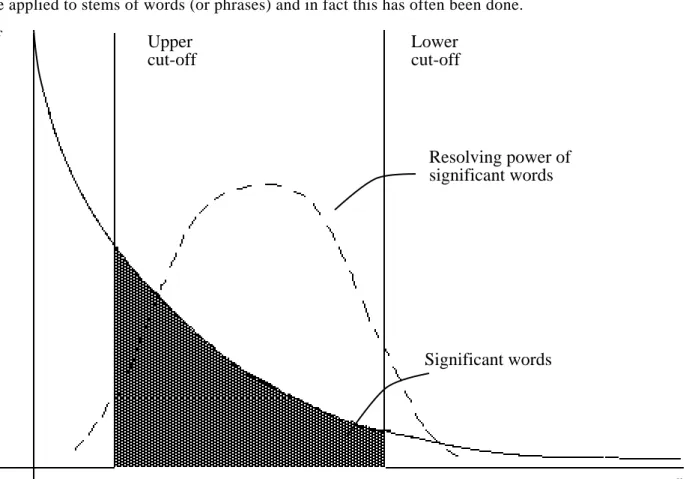
Let f be the frequency of occurrence of various word types in a given position of text and r their rank order, that is, the order of their frequency of occurrence, then a plot relating f and r yields a curve similar to the hyperbolic curve in Figure 2.1. This is in fact a curve demonstrating
Zipf's Law7* which states that the product of the frequency of use of wards and the rank order is approximately constant. Zipf verified his law on American Newspaper English. Luhn used it as a null hypothesis to enable him to specify two cut-offs, an upper and a lower (see Figure 2.1.), thus excluding non-significant words. The words exceeding the upper cut-off were considered to be common and those below the lower cut-off rare, and therefore not contributing significantly to the content of the article. He thus devised a counting technique for finding significant words. Consistent with this he assumed that the resolving power of significant words, by which he meant the ability of words to discriminate content, reached a peak at a rank order position half way between the two cut-offs and from the peak fell off in either direction reducing to almost zero at the cut-off points. A certain arbitrariness is involved in determining the cut-offs. There is no oracle which gives their values. They have to be established by trial and error.
It is interesting that these ideas are really basic to much of the later work in IR. Luhn himself used them to devise a method of automatic abstracting. He went on to develop a numerical measure of significance for sentences based on the number of significant and non-significant words in each portion of the sentence. Sentences were ranked according to their numerical score and the highest ranking were included in the abstract (extract really). Edmundson and Wyllys8 have gone on to generalise some of Luhn's work by normalising his measurements with respect to the frequency of occurrence of words in general text.
There is no reason why such an analysis should be restricted to just words. It could equally well be applied to stems of words (or phrases) and in fact this has often been done.
Frequency of words
Upper
cut-off
Lower
cut-off
Resolving power of
significant words
f
r
Figure 2.1. A plot of the hyperbolic curve relating f, the frequency of occurrence and r, the rank
order (Adaped from Schultz page 120)
44Words by rank order
Resolving power of
significant words
Significant words
* Also see,Fairthorne,R. A.,'Empirical hyperbolic distributions (Bradford-Zipf-Mandlebrot) for bibliometric
Generating document representatives - conflation
Ultimately one would like to develop a text processing system which by means of computable methods with the minimum of human intervention will generate from the input text (full text, abstract, or title) a document representative adequate for use in an automatic retrieval system. This is a tall order and can only be partially met. The document representative I am aiming for is one consisting simply of a list of class names, each name representing a class of words occurring in the total input text. A document will be indexed by a name if one of its significant words occurs as a member of that class.
Such a system will usually consist of three parts: (1) removal of high frequency words, (2) suffix stripping, (3) detecting equivalent stems.
The removal of high frequency words, 'stop' words or 'fluff' words is one way of implementing Luhn's upper cut-off. This is normally done by comparing the input text with a 'stop list' of words which are to be removed.
Table 2.1 gives a portion of such a list, and demonstrates the kind of words that are involved. The advantages of the process are not only that non-significant words are removed and will therefore not interfere during retrieval, but also that the size of the total document file can be reduced by between 30 and 50 per cent.
The second stage, suffix stripping, is more complicated. A standard approach is to have a complete list of suffixes and to remove the longest possible one.
Table 2.2 lists some suffixes. Unfortunately, context free removal leads to a significant error rate. For example, we may well want UAL removed from FACTUAL but not from EQUAL. To avoid erroneously removing suffixes, context rules are devised so that a suffix will be removed only if the context is right. 'Right' may mean a number of things:
(1) the length of remaining stem exceeds a given number; the default is usually 2; (2) the stem-ending satisfies a certain condition, e.g. does not end with Q.
Many words, which are equivalent in the above sense, map to one morphological form by removing their suffixes. Others, unluckily, though they are equivalent, do not. It is this latter category which requires special treatment. Probably the simplest method of dealing with it is to construct a list of equivalent stem-endings. For two stems to be equivalent they must match except for their endings, which themselves must appear in the list as equivalent. For example, stems such as ABSORB- and ABSORPT- are conflated because there is an entry in the list defining B and PT as equivalent stem-endings if the preceding characters match.
The assumption (in the context of IR) is that if two words have the same underlying stem then they refer to the same concept and should be indexed as such. This is obviously an over-simplification since words with the same stem, such as NEUTRON AND NEUTRALISE, sometimes need to be distinguished. Even words which are essentially equivalent may mean different things in different contexts. Since there is no cheap way of making these fine distinctions we put up with a certain proportion of errors and assume (correctly) that they will not degrade retrieval effectiveness too much.
It is inevitable that a processing system such as this will produce errors. Fortunately experiments have shown that the error rate tends to be of the order of 5 per cent (Andrews9). Lovins 10, 11 using a slightly different approach to stemming also quotes errors of the same order of magnitude.
My description of the three stages has been deliberately undetailed, only the underlying mechanism has been explained. An excellent description of a conflation algorithm, based on Lovins' paper10 may be found in Andrews9, where considerable thought is given to implementation efficiency.
Surprisingly, this kind of algorithm is not core limited but limited instead by its processing time.
The final output from a conflation algorithm is a set of classes, one for each stem detected. A class name is assigned to a document if and only if one of its members occurs as a significant
word in the text of the document. A document representative then becomes a list of class names. These are often referred to as the documents index terms or keywords.
Queries are of course treated in the same way. In an experimental situation they can be processed at the same time as the documents. In an operational situation, the text processing system needs to be applied to the query at the time that it is submitted to the retrieval system.
Indexing
An index language is the language used to describe documents and requests. The elements of the index language are index terms, which may be derived from the text of the document to be described, or may be arrived at independently. Index languages may be described as
pre-coordinate or post-pre-coordinate, the first indicates that terms are pre-coordinated at the time of
indexing and the latter at the time of searching. More specifically, in pre-coordinate indexing a logical combination of any index terms may be used as a label to identify a class of documents, whereas in post-coordinate indexing the same class would be identified at search time by combining the classes of documents labelled with the individual index terms.
One last distinction, the vocabulary of an index language may be controlled or uncontrolled. The former refers to a list of approved index terms that an indexer may use, such as for example used by MEDLARS. The controls on the language may also include hierarchic relationships between the index terms. Or, one may insist that certain terms can only be used as adjectives (or qualifiers). There is really no limit to the kind of syntactic controls one may put on a language.
The index language which comes out of the conflation algorithm in the previous section may be described as uncontrolled, post-coordinate and derived. The vocabulary of index terms at any stage in the evolution of the document collection is just the set of all conflation class names.
There is much controversy about the kind of index language which is best for document retrieval. The recommendations range from the complicated relational languages of Farradane et
al.12 and the Syntol group (see Coates13 for a description) to the simple index terms extracted by text processing systems just described. The main debate is really about whether automatic indexing is as good as or better than manual indexing. Each can be done to various levels of complexity. However, there seems to be mounting evidence that in both cases, manual and automatic indexing, adding complexity in the form of controls more elaborate than index term weighting do not pay dividends. This has been demonstrated by the results obtained by Cleverdon et al.14, Aitchison et al.15, Comparative Systems Laboratory16 and more recently Keen and Digger 17 . The message is that uncontrolled vocabularies based on natural language achieve retrieval effectiveness comparable to vocabularies with elaborate controls. This is extremely encouraging, since the simple index language is the easiest to automate.
Probably the most substantial evidence for automatic indexing has come out of the SMART Project (1966). Salton18 recently summarised its conclusions: ' ... on the average the simplest indexing procedures which identify a given document or query by a set of terms, weighted or unweighted, obtained from document or query text are also the most effective'. Its recommendations are clear, automatic text analysis should use weighted terms derived from document excerpts whose length is at least that of a document abstract.
The document representatives used by the SMART project are more sophisticated than just the lists of stems extracted by conflation. There is no doubt that stems rather than ordinary word forms are more effective (Carroll and Debruyn19). On top of this the SMART project adds index term weighting, where an index term may be a stem or some concept class arrived at through the use of various dictionaries. For details of the way in which SMART elaborates its document representatives see Salton20.
In the next sections I shall give a simple discussion of the kind of frequency information that may be used to weight document descriptors and explain the use of automatically constructed term classes to aid retrieval.
Index term weighting
Traditionally the two most important factors governing the effectiveness of an index language have been thought to be the exhaustivity of indexing and the specificity of the index language.
There has been much debate about the exact meaning of these two terms. Not wishing to enter into this controversy I shall follow Keen and Digger17 in giving a working definition of each.
For any document, indexing exhaustivity is defined as the number of different topics indexed, and the index language specificity is the ability of the index language to describe topics precisely. Keen and Digger further define indexing specificity as the level of precision with which a document is actually indexed. It is very difficult to quantify these factors. Human indexers are able to rank their indexing approximately in order of increasing exhaustivity or specificity. However, the same is not easily done for automatic indexing.
It is of some importance to be able to quantify the notions of indexing exhaustivity and specificity because of the predictable effect they have on retrieval effectiveness. It has been recognised (Lancaster21) that a high level of exhaustivity of indexing leads to high recall and low precision* . Conversely, a low level of exhaustivity leads to low recall and high precision. The converse is true for levels of indexing specificity, high specificity leads to high precision and low recall, etc. It would seem, therefore, that there is an optimum level of indexing exhaustivity and specificity for a given user population.
Quite a few people (Sparck Jones22, 23, Salton and Yang24), have attempted to relate these two factors to document collection statistics. For example, exhaustivity can be assumed to be related to the number of index terms assigned to a given document, and specificity related to the number of documents to which a given term is assigned in a given collection. The importance of this rather vague relationship is that the two factors are related to the distribution of index terms in the collection. The relationships postulated are consistent with the observed trade-off between precision and recall just mentioned. Changes in the number of index terms per document lead to corresponding changes in the number of documents per term and vice versa.
I am arguing that in using distributional information about index terms to provide, say, index term weighting we are really attacking the old problem of controlling exhaustivity and specificity. If we go back to Luhn's original ideas, we remember that he postulated a varying discrimination power for index terms as a function of the rank order of their frequency of occurrence, the highest discrimination power being associated with the middle frequencies. His model was proposed for the selection of significant terms from a document. However, the same frequency counts can be used to provide a weighting scheme for the individual terms in a document. In fact, there is a common weighting scheme in use which gives each index term a weight directly proportional to its frequency of occurrence in the document. At first this scheme would appear to be inconsistent with Luhn's hypothesis that the discrimination power drops off at higher frequencies. However, referring back to Figure 2.1, the scheme would be consistent if the upper cut-off is moved to the point where the peak occurs. It is likely that this is in fact what has happened in experiments using this particular form of weighting.
Attempts have been made to apply weighting based on the way the index terms are distributed in the entire collection. The index term vocabulary of a document collection often has a Zipfian distribution, that is, if we count the number of documents in which each index term occurs and plot them according to rank order, then we obtain the usual hyperbolic shape. Sparck Jones22 showed experimentally that if there are N documents and an index term occurs in n of them then a weight of log(N/n) + 1 leads to more effective retrieval than if the term were used unweighted. If indexing specificity is assumed to be inversely proportional to the number of documents in which an index term occurs then the weighting can be seen to be attaching more importance to the more specific terms.
The difference between the last mode of weighting and the previous one may be summarised by saying that document frequency weighting places emphasis on content description whereas weighting by specificity attempts to emphasise the ability of terms to discriminate one document from another.
Salton and Yang24 have recently attempted to combine both methods of weighting by looking at both inter document frequencies and intra document frequencies. Their conclusions are really an extension of those reached by Luhn. By considering both the total frequency of occurrence of a term and its distribution over the documents, that is, how many times it occurs in each
document, they were able to draw several conclusions. A term with high total frequency of occurrence is not very useful in retrieval irrespective of its distribution. Middle frequency terms are most useful particularly if the distribution is skewed. Rare terms with a skewed distribution are likely to be useful but less so than the middle frequency ones. Very rare terms are also quite useful but come bottom of the list except for the ones with a high total frequency. The experimental evidence for these conclusions is insufficient to make a more precise statement of their merits.
Salton and his co-workers have developed an interesting tool for describing whether an index is 'good' or 'bad'. They assume that a good index term is one which, when assigned as an index term to a collection of documents, renders the documents as dissimilar as possible, whereas a bad term is one which renders the documents more similar. This is quantified through a term discrimination value which for a particular term measures the increase or decrease in the average dissimilarity between documents on the removal of that term. Therefore, a good term is one which on removal from the collection of documents, leads to a decrease in the average dissimilarity (adding it would hence lead to an increase), whereas a bad term is one which leads on removal to an increase. The idea is that a greater separation between documents will enhance retrieval effectiveness but that less separation will depress retrieval effectiveness. Although superficially this appears reasonable, what really is required is that the relevant documents become less separated in relation to the non-relevant ones. Experiments using the term discrimination model have been reported25, 26. A connection between term discrimination and inter document frequency has also been made supporting the earlier results reported by Salton, Wong and Yang27. The main results have been conveniently summarised by Yu and Salton28, where also some formal proofs of retrieval effectiveness improvement are given for strategies based on frequency data. For example, the inverse document frequency weighting scheme described above, that is assigning a weight proportional to log (N/n) + 1, is shown to be formally more effective than not using these weights. Of course, to achieve a proof of this kind some specific assumptions about how to measure effectiveness and how to match documents with queries have to be made. They also establish the effectiveness of a technique used to conflate low frequency terms, which increases recall, and of a technique used to combine high frequency terms into phrases, which increases precision.
Probabilistic indexing
In the past few years, a detailed quantitative model for automatic indexing based on some statistical assumptions about the distribution of words in text has been worked out by Bookstein, Swanson, and Harter29, 30, 31. The difference between the terms word-type and word-token is crucial to the understanding of their model. A token instantiates a type, so that it is possible to refer to the occurrence of a word-type WAR; then a particular occurrence at one point in the text of a document (or abstract) will be a word-token. Hence 'the frequency of occurrence of word w in a document' means the number of word-tokens occurring in that document corresponding to a unique word-type. The type/token qualification of a word will be dropped whenever the context makes it clear what is meant when I simply refer to a 'word'.
In their model they consider the difference in the distributional behaviour of words as a guide to whether a word should be assigned as an index term. Their starting point has been the much earlier work by Stone and Rubinoff32, Damerau33, and Dennis34 who showed that the statistical behaviour of 'speciality' words was different from that of 'function' words. They found that function words were closely modelled by a Poisson distribution over all documents whereas specialty words did not follow a Poisson distribution. Specifically, if one is looking at the distribution of a function word w over a set of texts then the probability, f(n), that a text will have
n occurrences of the function word w is given by
e x
-x nf(n) =
n!
In general the parameter x will vary from word to word, and for a given word should be proportional to the length of the text. We also interpret x as the mean number of occurrences of the w in the set of texts.
The Bookstein-Swanson-Harter model assumes that specialty words are 'content-bearing' whereas function words are not. What this means is that a word randomly distributed according to a Poisson distribution is not informative about the document in which it occurs. At the same time,
the fact that a word does not follow a Poisson distribution is assumed to indicate that it conveys information as to what a document is about. This is not an unreasonable view: knowing that the specialty word WAR occurs in the collection one would expect it to occur only in the relatively few documents that are about WAR. On the other hand, one would expect a typical function word such as FOR to be randomly distributed.
The model also assumes that a document can be about a word to some degree. This implies that in general a document collection can be broken up into subsets; each subset being made up of documents that are about a given word to the same degree. The fundamental hypothesis made now is that a content-bearing word is a word that distinguishes more than one class of documents with respect to the extent to which the topic referred to by the word is treated in the documents in each class. It is precisely these words that are the candidates for index terms. These content-bearing words can be mechanically detected by measuring the extent to which their distributions deviate from that expected under a Poisson process. In this model the status of one of these content words within a subset of documents of the same 'aboutness' is one of non-content-bearing, that is, within the given subset it does not discriminate between further subsets.
Harter31 has identified two assumptions, based upon which the above ideas can be used to provide a method of automatic indexing. The aim is to specify a rule that for any given document will assign it index terms selected from the list of candidates. The assumptions are:
(1) The probability that a document will be found relevant to a request for information on a subject is a function of the relative extent to which the topic is treated in the document.
(2) The number of tokens in a document is a function* of the extent to which the subject referred to by the word is treated in the document.
In these assumptions a 'topic' is identified with the 'subject of the request' and with the 'subject referred to by the word'. Also, only single word requests are considered, although Bookstein and Kraft35 in a more recent paper have attempted an extension to multi-word requests. The indexing rule based on these assumptions indexes a document with word w if and only if the probability of the document being judged relevant to a request for information on w exceeds some cost function. To calculate the required probability of relevance for a content-bearing word we need to postulate what its distribution would look like. We know that it cannot be a single Poisson distribution, and that it is intrinsic to a content-bearing word that it will distinguish between subsets of documents differing in the extent to which they treat the topic specified by the word. By assumption (2), within one of these subsets the distribution of a content-bearing can however be described by a Poisson process. Therefore, if there are only two such subsets differing in the extent to which they are about a word w then the distribution of w can be described by a mixture of two Poisson distributions. Specifically, with the same notation as before we have
f(n) =
p e x
1 -x1 1 nn!
+
(1 -p )
1e
-x 2x
2 nn!
here p1 is the probability of a random document belonging to one of the subsets and x1 and
x2 are the mean occurrences in the two classes. This expression shows why the model is
sometimes called the 2-Poisson model. It is important to note that it describes the statistical behaviour of a content-bearing word over two classes which are 'about' that word to different extents, these classes are not necessarily the relevant and non-relevant documents although by assumption (1) we can calculate the probability of relevance for any document from one of these classes. It is the ratio
1
p e x
-x1 1 k+
(1 -p )
1e
-x 2x
2 kp e x
-x1 1 1 k* Although Harter31 uses 'function' in his wording of this assumption, I think 'measure' would have been
that is used to make the decision whether to assign an index term w that occurs k times in a document. This ratio is in fact the probability that the particular document belongs to the class which treats w to an average extent of x1 given that it contains exactly k occurrences of w. This ratio is compared with some cost function based on the cost a user is prepared to attach to errors the system might make in retrieval. The details of its specification can be found in the cited papers.
Finally, although tests have shown that this model assigns 'sensible' index terms, it has not been tested from the point of view of its effectiveness in retrieval. Ultimately that will determine whether it is acceptable as a model for automatic indexing.
Discrimination and/or representation
There are two conflicting ways of looking at the problem of characterising documents for retrieval. One is to characterise a document through a representation of its contents, regardless of the way in which other documents may be described, this might be called representation without
discrimination. The other way is to insist that in characterising a document one is discriminating it
from all, or potentially all, other documents in the collection, this we might call discrimination
without representation. Naturally, neither of these extreme positions is assumed in practice,
although identifying the two is useful when thinking about the problem of characterisation. In practice, one seeks some sort of optimal trade-off between representation and discrimination. Traditionally this has been attempted through balancing indexing exhaustively against specificity. Most automatic methods of indexing can be seen to be a mix of representation versus discrimination. In the simple case of removing high frequency words by means of a 'stop' word list we are attempting to increase the level of discrimination between document. Salton's methods based on the discrimination value attempts the same thing. However, it should be clear that when removing possible index terms there must come a stage when the remaining ones cannot adequately represent the contents of documents any more. Bookstein-Swanson-Harter's formal model can be looked upon as one in which the importance of a term in representing the contents of a document is balanced against its importance as a discriminator. They, in fact, attempt to attach a cost function to the trade-ff between the two.
The emphasis on representation leads to what one might call a document-orientation: that is, a total preoccupation with modelling what the document is about. This approach will tend to shade into work on artificial intelligence, particularly of the kind concerned with constructing computer models of the contents of any given piece of natural language text. The relevance of this work in AI, as well as other work, has been conveniently summarised by Smith36.
This point of view is also adopted by those concerned with defining a concept of 'information', they assume that once this notion is properly explicated a document can be represented by the 'information' it contains37.
The emphasis on discrimination leads to a query-orientation. This way of looking at things presupposes that one can predict the population of queries likely to be submitted to the IR system. In the light of data about this population of queries, one can then try and characterise documents in the optimal fashion. Recent work attempting to formalise this approach in terms of utility theory has been done by Maron and Cooper38, 39, although it is difficult to see at this stage how it might be automated.
Automatic keyword classification
Many automatic retrieval systems rely on thesauri to modify queries and document representatives to improve the chance of retrieving relevant documents. Salton40 has experimented with many different kinds of thesauri and concluded that many of the simple ones justify themselves in terms of improved retrieval effectiveness.
In practice many of thesauri are constructed manually. They have mainly been constructed in two ways:
(1) words which are deemed to be about the same topic are linked; (2) words which are deemed to be about related things are linked.
The first kind of thesaurus connects words which are intersubstitutible, that is, it puts them into equivalence classes. Then one word could be chosen to represent each class and a list of these words could be used to form a controlled vocabulary. From this an indexer could be instructed to select the words to index a document, or the user could be instructed to select the words to express his query. The same thesaurus could be used in an automatic way to identify the words of a query for the purpose of retrieval.
The second kind of thesaurus uses semantic links between words to, for example, relate them hierarchically. The manually constructed thesaurus used by the MEDLARS system is of this type. However, methods have been proposed to construct thesauri automatically. Whereas, the manual thesauri are semantically based (e.g. they recognise synonyms, more general, or more specific relationships) the automatic thesauri tend to be syntactically and statistically based. Again the use of syntax has proved to be of little value, so I shall concentrate on the statistical methods. These are based mainly on the patterns of co-occurrence of words in documents. These 'words' are often the descriptive items which were introduced earlier as terms or keywords.
The basic relationship underlying the automatic construction of keyword classes is as follows: If keywords a and b are substitutible for one another in the sense that we are prepared to accept a document containing one in response to a request containing the other, this will be because they have the same meaning or refer to a common subject or topic. One way of finding out whether two keywords are related is by looking at the documents in which they occur. If they tend to co-occur in the same documents, the chances are that they have to do with the same subject and so can be substituted for one another.
It is not difficult to see that, based on this principle, a classification of keywords can be automatically constructed, within which the classes are used analogously to those of the manual thesaurus mentioned before. More specifically we can identify two main approaches to the use of keyword classifications:
(1) replace each keyword in a document (and query) representative by the name of the class in which it occurs;
(2) re