(IJSBAR)
ISSN 2307-4531
(Print & Online)
http://gssrr.org/index.php?journal=JournalOfBasicAndApplied
---
117
The Development of Learning Tools Oriented Industrial
Revolution 4.0 to Improve Students' Creative Thinking
Skills
Sri Mandari Arbia
a*, Elsje Theodora Maasawet
b, Muh. Amir Masruhim
ca,bDept. Biology,Mulawarman University, Kalimantan Timur, Indonesia
cDept Chemistry,Mulawarman University, Kalimantan Timur, Indonesia
aEmail: [email protected], bEmail: [email protected], cEmail: [email protected]
Abstract
Learning tools are a set of teaching aids in teaching that each part of the device has an interrelated relationship. In its application, teachers must develop learning tools that are tailored to the needs of students, especially students' creative thinking skills. One of the methods that can be used to overcome these problems is to use learning tools oriented Industrial Revolution 4.0. The purpose of this research was to compile the design of Biology learning tool which is oriented Industrial Revolution 4.0, to find out validity, practicality and effectiveness of the learning device products that have been developed on animal tissue material in class XI. The development procedure used refers to the development model by Borg and Gall. Validity and practicality analysis techniques in this study used percentage descriptive techniques, while the effectiveness was by seeing an increase in the gain score from the results of students' pretest-posttest. The validity of the learning tools produced was categorized as very valid. The learning tools produced are also very practical. The effectiveness of learning tools that have been developed from the results of the N-Gain pretest and posttest of students are very effective.
Keywords: Learning Tools Oriented Industrial Revolution 4.0; Creative Thinking Skills.
--- * Corresponding author.
118
1.Introduction
In education, there are many problems occur related to teaching and learning activities in schools. Problems that occur in schools are usually problems related to teachers and students in the learning process. The learning process is one of the important elements to achieve success in learning process [25]. Problems that occur in the learning process of teachers because there are still many teachers who are confused or lost direction because they do not have learning tools as a reference to carry out the teaching and learning process. Daily teaching and learning activities cannot be separated from the relevant components of learning tools, namely, syllabus, lesson plan, teaching materials, teaching media, student worksheets, and evaluations. Therefore, the learning tools provide guidance that contains the steps that must be done by a teacher in the learning process. However, the existing learning tools are mostly incompatible with the model used by the teacher in delivering the learning material. Therefore, teachers are expected to have skills in developing learning tools that will be used in accordance with the creativity of each teacher in compiling and developing learning tools [24]. In addition, by developing owned by the teachers will provide the ability to develop teaching techniques and become the basis for designing better tools. The development of learning tools must also be adjusted to current development so that students can more easily understand and increase the competitiveness of students. The competitiveness of students in the 21st century can be related to the industrial revolution 4.0 where innovation competition is very visible even in the learning process. In the era of the Industrial Revolution 4.0, teachers must be able to answer it with new literacy skills with aspects of data literacy, technological literacy, and humanism/human resources. One of the ways to realize human resources in accordance with the era of the industrial revolution 4.0 is by using the 4C strategies (Creative, Critical Thinking, Communicative, and Collaborative) which are applied in the learning process. Demands that must be fulfilled by human resources in the Industrial Revolution 4.0 era can innovate through creative thinking to solve problems. Creative thinking is the ability to think that starts from the sensitivity of a problem that must be faced and must be resolved. Creative thinking arises from the creativity of students which is an ability to produce something new or new ideas in dealing with a problem. Aware of the importance of creativity in solving problems, teachers are expected to design learning methods and approaches that can develop students' creativity but before that, the teacher must know the extent of creativity owned by students by asking students to solve problems that not only focus on one solution but also several solutions. Therefore, it is very important to measure how creative thinking skills possessed by students, especially creative thinking skills in every aspect, so that teachers can recognize the potential of each student and can determine the right method for developing students' creative thinking skills in every aspect. In fact, the teachers still have not developed the learning tools they have, this can be proven by the result of observations at SMA Negeri 1 Samarinda, SMA Negeri 1 Muara Badak, SMA Advent, SMA Negeri 2 Sangatta Utara, and SMA Yabis Bontang. The result of observations made on Biology teacher in sample schools, the teacher still has not tried to develop learning tools related to the development of students’ creative thinking skills. The obstacles faced by teachers in using the learning model is that they are less able to adapt the learning model to the conditions of their students who have variety of skills in school. The teacher also ensures that students' creative thinking skills are still lacking in the learning process, can be seen from students who have not been creative and have not been active to ask questions and answers during the learning process because students lack understanding of the learning material. Such difficulties will not be faced by the teachers in the class during the learning process if
119
the teaching component is well prepared. Based on the background of the study, the researcher has tried to develop learning tools using strategies based on learning models to improve the results of creative thinking skills in Biology lesson at SMA Negeri 1 Samarinda, SMA Negeri 1 Muara Badak, SMA Advent, SMA Negeri 2 Sangatta Utara, and Yabis Bontang High School.
2.Materials and Methods
2.1 Research Subjects
The research subjects were 60 SMA Negeri 1 Samarinda students, divided into 3 classes where in the product trial two classes were used and 1 class was used for the trial. In the trial product class 1 will be used as a control class with teacher treatment and learning devices owned by the teacher will be used in the class, other than that 1 other class will be used by researchers and the device developed by researchers is used in this class. The product trial results in the form of teacher's class pretest and posttest will be compared with the results of the research class pretest and posttest. Furthermore, the use of the trial will be used to assess the effectiveness of learning devices using 1 class, where the teacher will teach with tools that have been developed by researchers, the results of the use of trials in the form of pretest, posttest of students and student questionnaire responses. Pretest and posttest will be analyzed using the percentage increase, while the questionnaire responses of students will be taken into consideration to improve learning tools. In addition, the subject of this study was a Biology teacher at Samarinda State High School. This Biology subject teacher will provide responses and input to the learning tools developed by filling in the teacher's questionnaire responses.
2.2 Objects
The object of research in this study is the validity, practicality and effectiveness of the learning tools developed.
2.3 Development Research Model
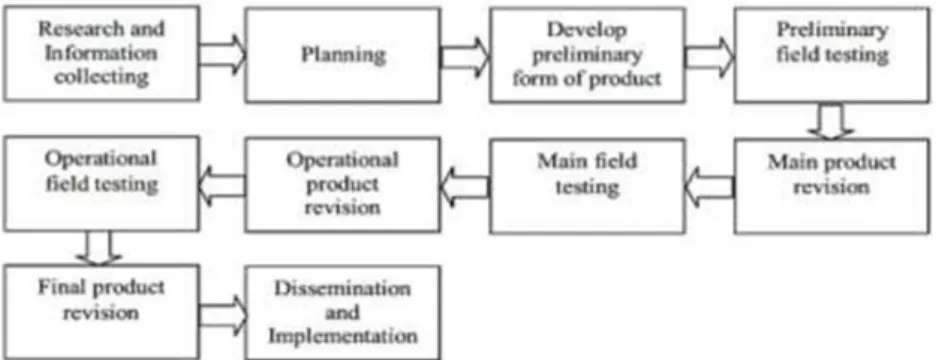
The research method used in this research was Research and Development (R&D) based on Borg and Gall [7]. This method is used to fulfill research objectives, namely to design and develop problem-based instruction learning models by assessing the validity/quality, practicality and effectiveness in the learning process of Biology for students in class XI.
120
There were 3 methods of data analysis techniques in this study to get results, namely assessing the validity and quality of learning tools, the practicality of learning tools when used, and the effectiveness of the device.
2.4 Validity of learning tools
Data to assess the validity of learning tools by experts was obtained from a validation questionnaire by learning experts, material experts and language experts. This data analysis is carried out in the following stages:
a. Calculate the average total score of each expert validation assessment by using descriptive percentage techniques [32] with the formula:
b. The results of the calculation of the validity of the learning tools (%), then it can be matched with the range of percentages and the qualitative criteria of the validity test of the learning tools presented in table 1.
Table 1: Range of percentage and Qualitative Criteria of Tools Validity Test by Experts
Value Scale (100%) Criteria
81,00-100 Very Valid
62,00-81,00 Valid
43,00-62,00 Valid Enough
25,00-43,00 Invalid
<25,00 Very Invalid
2.5 Practicality of Learning Tools
The practicality of the learning tool was obtained from the questionnaire responses of students to the device that has been developed and tested at the school. Data analysis was conducted as in the validity analysis of learning tools by experts, but in this analysis aims to determine the responses of teachers and students so that data can be obtained whether the device is easy to use or not to be applied in the learning process. In each statement were scored according to the form of the statement, then the total score of the assessment results were analyzed with the following stages:
a. Calculate the total score of students’ answer by using the formula:
b. Convert the score obtained into qualitative criteria of tools practicality from student responses with a table reference adapted from [32] as presented in table 2.
121
Table 2: Range of Percentage and Qualitative Criteria of Tools Practicality Test by Students
Percentage Range Qualitative Criteria
80,00% - 100% Very Practical
70,00% - 80,00% Practical
60,00% - 70,00% Practical Enough
50,00% - 60,00% Not Practical
<50% Very Unpractical
2.6 The effectiveness of Learning Tools
The effectiveness of learning tools in the form of an assessment of students' pretest and posttest of the eight questions in the form of essays and to find out whether there is an increase in students' creative thinking skills, it is necessary to see the percentage of improvement through the results of the pretest and posttest in the experimental class. To find out the N-gain, the following formula from Arikunto is used [21]:
Table 3: Normalized Gain Criteria
Percentage Range Qualitative Criteria
0,70 ≤ g ≤ 1,00 High 0,30 ≤ g < 0,70 Is 0,00 < g < 0,30 Low g = 0,00 No Increase -1,00 ≤ g < 0,00 Decreased 3.Results
In this study, the researcher measured the validation of learning tools assessed by experts, the practicality of assessment questionnaire responses of teachers and students, and the effectiveness of the N-Gain pretest and posttest.
3.1 Expert Validation
Validation of learning tools that have been developed is carried out by 3 experts namely: equipment experts, material experts and language experts. In the validation process, the learning tools were revised with some improvements, before being tested on the experimental class.
122
Table 4: Validation Score by the Experts
No. Learning Tools
Expert
Device Theory Language
1. Lesson Plan 234 220 243 2. Teaching materials 3. Student Worksheets 4. Evaluation Average 92,20%
Based on table 4, the expert validation score obtained an average value of 92.20% which can be said that the learning tools oriented Industrial Revolution 4.0 that have been developed are very valid to be used by teachers and students as teaching materials and worksheets for students in the learning process. After the learning tool has been stated that it is valid / feasible to use, then the learning tool can be used in the learning process in the experimental class in product trials.
3.2 Practicality of learning tools oriented Industrial Revolution 4.0
Practicality test was conducted to assess the practicality of the use of tools that have been developed in the learning process. The practicality assessment used the questionnaire given to the teacher to assess the learning tools that have been developed (lesson plan, Teaching Materials, student worksheet and Evaluation) while the questionnaire given to students is only to assess the teaching materials and student worksheet.
a. Teacher Questionnaire
Teacher questionnaire contains an assessment to assess the lesson Plan (RPP), Teaching Materials, Student Worksheets (LKPD) and Evaluation and Assessment Instruments.
Table 5: Percentage of Teacher Questionnaire
No School Percentage of Teacher Questionnaire
1 SMAN 1 Samarinda 100%
2 SMA Advent Balikpapan 100%
3 SMAN 1 Muara Badak 91,67%
4 SMA Yabis Bontang 91,67%
5 SMAN 2 Sanggata 91,67%
Average 95,00% (Very practical)
From table 5, the percentage of teacher questionnaires to assess learning tools that have been developed is 95.00% which can be interpreted as very practical to be used in the learning process.
123
Student questionnaire contains an assessment to assess the Teaching Materials and Student Worksheets (LKPD).
Table 6: Percentage of Student Questionnaire
No School Percentage of Student Questionnaire
1 SMAN 1 Samarinda 98,25%
2 SMA Advent Balikpapan 89,75%
3 SMAN 1 Muara Badak 84,49%
4 SMA Yabis Bontang 87,08%
5 SMAN 2 Sanggata 89,67%
Average 89,85 % (very practical)
From table 6, the percentage of student responses to the questionnaire evaluating the learning tools that have been developed obtained a value of 89.85% which can be interpreted very practical to be used in the learning process. From the results of the teacher questionnaire and student questionnaire analysis, it was concluded that it was very practical because it had an average of above 80.00%. Learning tools are stated to be very practical because teachers can understand the use of lesson plans in the learning process, teaching materials that have been developed are easy to understand and their contents are interesting, student worksheets help teachers to bring up creative thinking skills in students, and evaluation contains questions that are in accordance with indicators of creative thinking skills. Meanwhile, the practicality assessment of students for teaching materials is very interesting and helps in the learning process, for student worksheets it is also very interesting and helps to direct students in working in groups and thinking creatively.
3.3 The effectiveness of learning tools oriented Industrial Revolution Orientation 4.0
The effectiveness of the learning tools that have been developed is assessed by conducting product trials and usage trials by looking at the N-Gain obtained from the pretest and posttest which contains questions that indicate creative thinking skills. Then, it was continued with the application test to see the effectiveness of the learning tools that have been developed to be used in all schools.
a. Product trials
In product trials conducted at SMAN 1 Samarinda by using 2 classes, namely class XI MIPA 3 as a control class and class XI MIPA 4 as an experimental class.
Table 7: Gain Value in Product Trial
Creative Thinking Skills
No Data Average of Normalized Gain Information
1. Pretest and Posttest Control Class 0,54 Is
124
In table 7, the product trial gain values used two classes, namely the control class and the experimental class. In this product trial, the teacher taught using the learning tool that the teacher has in the control class while the researcher taught using the learning tool that has been developed in the experimental class. In both classes, Pretest and Posttest were given. Comparison of values before and after the learning process using N-Gain. The results of the control class were 0.54 which can be said to be moderate, whereas for the experimental class it was obtained 0.70 which can be said to be high.
b. Trial Usage
In the trial usage, this was done at SMAN 1 Samarinda using class XI MIPA 1 as a control class and class XI MIPA 5 as an experimental class.
Table 8: Gain Value in Usage Trials
Creative Thinking Skills
No Data Average of Normalized Gain Information
1. Pretest and Posttest in Control Class 0,54 Is
2. Pretest and Posttest in Experiment Class 0,76 High
In table 8, the gain value of the product trial used two classes, namely the control class and the experimental class. In the trial of this product, the teacher taught using the learning tool that the teacher has in the control class while in the experimental class the teacher taught using learning tool oriented industrial revolution 4.0 that has been developed. In both classes, Pretest and Posttest were given. Comparison of values before and after the learning process using N-Gain. The results of the control class were 0.54 which can be said to be moderate, whereas for the experimental class it was obtained 0.76 which can be said to be high.
c. Deployment Test
The implementation test is carried out after the product trial and usage trial has received a high category N-Gain value.
Table 9: Gain Value in Application Tests
No Step Creative Thinking Skills Information
1 Product Trial 0,70 High
2 Trial Usage 0,76 High
3 Application
SMA Advent Balikpapan 0,77
High
SMAN 1 Muara Badak 0,78 High
SMA Yabis Bontang 0,79 High
SMAN 2 Sanggata Utara 0,77
High
125
Bontang and 0.77 in SMAN 2 Sangata Utara where all N-Gain scores can be said to be high. N-Gain is used to measure students' creative thinking skills. Creative thinking skills are assessed from the students' pretest and posttest scores to see the level of understanding of students in the learning process. N-Gain test is used to measure how much students' understanding after learning implemented [32]. The increase in value after being given a pretest and posttest is characterized by a gain to determine the effectiveness of improving learning outcomes. So, it can be said when N-Gain is said to be high then the learning tools that have been developed are very effective for improving creative thinking skills
4.Discussion
Development of biological devices needs to be done based on several considerations. The consideration referred to is student skills and in terms of learning tools. Student skills need to be developed to produce human resources that can compete in the era of the industrial revolution 4.0. Given that each student has a different background, it is not easy to invite students to develop their skills in the classroom with a monotonous atmosphere. In accordance with the 2013 curriculum stated in Permendikbud, (2017: 5) states that learning the 2013 curriculum is a response from 21st century learning, where in 21st century learning there are skills namely 4C (Communication, Collaboration, Critical Thinking, and Creativity) 4C is a type of soft skill which in daily implementation, is far more useful than just the handling of hardskill. The implementation of 21st century skills demand implementation is carried out through a learning process that empowers 4C skills (Creative, Critical, Communicative, and Collaborative) [16]. Students are required to play an active role in learning activities, develop concepts, and interpret the learning outcomes that students receive on that day (Permendikbud No. 22 2016). More preparation is needed in order to produce quality learning. Departing from this, there have been many considerations to use the concept of the industrial revolution 4.0 using the 4C strategy (Creative, Critical thinking, Communication, Collaboration) but more emphasis on Creative in learning. The concept of the industrial revolution oriented 4.0 is seen in accordance with current educational policies that better emphasize learning that can meet the needs of students, in addition to teaching subject matter [11]. Therefore, learning oriented towards the industrial revolution 4.0 especially using creative strategies can be an alternative to fulfill the mandate of the Ministerial regulation. The creative strategy is then outlined in the learning tool. The learning tools used by the teacher so far have not used the learning tools with nuances of creative strategies in the basic competency and the indocator only includes cognitive aspects. The lesson plans that have been made do not follow the syntax of learning and the learning objectives only include the product and do not include the process. Planned learning activities are less able to make students active in learning, because they are more dominant using the lecture method. Learning resources used are less varied, namely printed books, presentation slides, and practical tools. Learning media use printed books and presentation slides only. And the assessment carried out still includes cognitive aspects in the form of tests, and supplemented with independent assignments. Learning tools developed based on creative strategies aim to develop students' creative thinking skills. Creative thinking is cognitive activity in finding solutions to solve a problem [2]. Creative thinking is an original and reflective way of thinking and produces a complex product. Included in creative thinking is to synthesize ideas, generate new ideas, and determine the effectiveness of existing ideas [26]. Creative thinking skills are an important aspect for students to be able to solve a problem [20] and find ideas to solve the problem [12]. Creative thinking skills can train students to develop many ideas and arguments, ask questions, acknowledge the
126
truth of an argument, and even make students able to be open and responsive to different perspectives [17]. According to [8] Creative thinking is a process that involves elements of originality, fluency, flexibility, and elaboration. In this study the selection of populations using class XI is because the level of understanding and thinking of students has reached a formal stage where students have been able to think more abstractly and understand higher things in accordance with the theory of cognitive development of children. The level of cognitive development of children in the fourth stage, namely Formal Operational adolescent-adult which means children are able to think abstractly and can analyze scientifically and then solve problems can also use their skills more optimally. Each student has a different level of creative thinking skills. Therefore learning will be better if students are accustomed to thinking creatively so that learning feels more meaningful to students. Learning tools developed are said to be of quality if they meet three criteria, namely validity, practicality, and effectiveness [27]. The learning device is said to be valid if there is a consistent linkage of each component of the learning device that is developed with the characteristics of the learning model applied, it is said to be practical if the device is easy and can be implemented, and is said to be effective if the learning objectives can be achieved through the use of the developed learning device [4]. Industry revolution-oriented learning tools use creative strategies to improve creative thinking skills in the form of lesson plans, lesson materials, student worksheets (LKPD), evaluation and assessment instruments. Learning tools that have been developed are then validated by a validation team of learning device experts, material experts and language experts to find out the validity of development products. Learning tools that have been developed get some input from the validator team, the authors continue to improve the product development in accordance with the input of the validator team. The results of validation are in the form of an average rating of 92.20% and are declared to be very valid, in addition there are suggestions and input that guide the improvement of the product until the product becomes a viable development product. The learning device products that have been feasible are then tested on the product at SMAN1 Samarinda using class XI MIPA 3 as a control class and class XI MIPA 4 as a treatment class. Based on the product trial analysis, the result of creative thinking skills in the control class is seen from the average gain score of 0.54 (moderate), whereas the treatment class obtained an average gain score of 0.70 (high). To see the real meaning of whether there is a difference between the control class and treatment, it is necessary to do a data analysis using the independent t test on students' creative thinking skills. The initial step at this stage is to test homogeneity using the levene formula in SPSS on the pretest and posttest values in the control class and treatment class. Homogeneity test results in both classes are homogeneous, with a significance value of 0.087> 0.005. The next step is to test the independent t test on the posttest value of the control class and the treatment class get a significance of 0,000 <0.005 with posttest significance less than 0.005 means that the posttest of the control class and treatment class there is a significant difference. Followed by the independent t test by using the gain score to see differences in the effectiveness of the device in students' thinking skills. The results of the independent t test on the gain score of 0,000 <0.005 which can be interpreted there is a significant difference in the gain score of the control class and the treatment class in the product trial. Based on the explanation and explanation of the results above, it can be concluded that in the trial of this product, the class taught by the teacher using the school equipment (XI MIPA 3) is not the same as the class taught by the researcher using the developed learning device (XI MIPA 4). or more specifically it can be said that classes taught by teachers using school equipment (XI MIPA 3) are no better than classes taught by researchers using learning tools that have been developed (XI MIPA 4). In the product trial process is inseparable from the
127
constraints in the learning process, namely the timeliness in the learning process due to students who are not familiar with the syntax contained in the device, and the responses of students who are not used to being directed to think creatively in the learning process. Based on the results of product trials that have been conducted, the researchers make improvements to the products that are developed based on experience when doing learning activities. After making improvements, the next step is to carry out a trial of use where the teacher acts as a teacher by using learning tools that have been developed. The results of the final analysis carried out to determine the increase in learning outcomes of students by using the product development of learning equipment oriented industry revolution 4.0 then used the gain score analysis of XI MIPA 1 as a control class and class XI MIPA 5 as a treatment class. Based on the analysis of the use of trials obtained the results of students' creative thinking skills average score gain of 0.54 (moderate). For the treatment class, the average result of creative thinking skills is obtained through a gain score of 0.76 (high). The next process is the independent t test with a homogeneity step in both classes is homogeneous, with a significance value of 0.383> 0.005. The next step is to test the independent t test on the posttest value of the control class and the treatment class get a significance of 0,000 <0.005 with posttest significance less than 0.005 means that the posttest of the control class and treatment class there is a significant difference. Followed by the independent t test by using the gain score to see differences in the effectiveness of the device in students' thinking skills. The results of the independent t test on the gain score of 0,000 <0.005 which can be interpreted that there is a significant difference in the gain score of the control class and the treatment class in the usage test . Independent t test test analysis was used to see significant differences in posttest scores and gain scores in the control class and treatment class. While the control class and treatment class gain scores represent progress or improvement of the sample after the learning activities have been carried out. The results obtained on the gain score is an increase after learning by using learning devices oriented industry revolution 4.0 towards students' creative thinking skills on learning materials in the Animal Biology Network of 0.76 (high). The value of the gain score which indicates a high category can be interpreted that learning using the industrial revolution learning device 4.0 is very effective in the learning process. The final activity after providing learning and evaluation in the form of a test the author gives a questionnaire response to each student, the questionnaire is given aims to determine the response and assessment of students to the practicality of learning tools in the form of teaching materials and LKPD that have been made by researchers. The results of the students' responses at Samarinda 1 High School were said to be very practical with an average percentage score of 98.25%. To assess the practicality of the use of learning tools oriented industry revolution 4.0 on the teacher is also given a questionnaire whose assessment uses the Guttman scale. Questionnaire responses given to teachers to assess the practicality of lesson plans, teaching materials, LKPD, evaluation and assessment instruments. The results of the teacher's response at SMAN 1 Samarinda are said to be very practical with an average percentage score of 100%. Development of learning devices oriented towards the Industrial Revolution 4.0 Towards Creative Thinking Skills for Students in Class XI of SMA Negeri 1 Samarinda. Based on the results of the trial and assessment analysis, the product development was declared to be very valid, effective and very practical. The product of the development that has been tested is then implemented in 4 schools in 4 cities, namely Advent Adventist High School, Muara Badak 1 High School, Yabis Bontang High School, and North Veryta High School 2. Obtained the results of the score gain from the pretest and posttest values by using learning tools oriented industry revolution 4.0 in the learning process with each value for creative thinking skills namely Advent Advent High School at 0.77 (high),
128
SMAN 1 Muara Badak 0.78 (high ), Yabis Bontang High School 0.79 (high), and SMAN 2 Utara Sangatta 0.77 (high). The four schools were also given questionnaires for student responses and teacher questionnaires to see the practicality of the learning tools that had been used. The results of the questionnaire analysis of responses from Advent Advent High School students were 84.49% (very practical), SMAN 1 Muara Badak 89.75% (very practical), Yabis Bontang High School 87.08% (very practical), and SMAN 2 Sangatta Utara 89 67% (very practical). The results of the questionnaire analysis responses of Balikpapan Adventist high school teachers were 100% (very practical), SMAN 1 Muara Badak 83.33% (very practical), Yabis Bontang High School 83.33% (very practical), and SMAN 2 Sangatta Utara 83.33 % (very practical). From the haril application that is done at Advent Advent High School, Muara Badak High School 1, Yabis Bontang High School, and SMAN 2 Sangatta by seeing the effectiveness value through high score gain values, it can be interpreted that the learning device products that have been developed are very effective. The results of the questionnaire analysis of student responses can be interpreted that the learning device oriented industry revolution 4.0 is very practical to be used in the learning process. Industrial revolution oriented learning tools products 4.0 which have been tested and implemented can be used throughout schools and can improve students' creative thinking skills. From the research results obtained that the learning tools developed are very valid, effective and very practical so that development products can be used throughout the school.
5.Conclusion
Based on the data from the results of research and data analysis, it can be said that in general the development of learning tools oriented the industrial revolution 4.0 towards the creative thinking skills of students in class XI can be implemented. The statement is based on the conclusions: 1. The validity of the learning tools developed has very good quality. 2. Practicality of learning tools that have been developed is very good. 3. The effectiveness of the learning tools that have been developed is very good 4. Based on the results of the validity, practicality, and effectiveness, it can be concluded that the learning tools oriented industrial revolution 4.0 to improve students' creative thinking skills is feasible to be used as a learning tool and can be applied in all schools.
6.Limitations of the study
This research is still very limited to see students 'thinking skills in the era of the industrial revolution 4.0 where a lot of students' thinking skills must be developed, but by conducting research by testing creative thinking skills show students can think at a higher level. However, it is expected to carry out future studies continuing with other thinking skills.
7.Recommendations
Based on the results of research that has been done the author conveys the following suggestions:1. Teachers can use learning products products oriented to the Industrial Revolution 4.0 to improve students 'creative thinking skills as an alternative to learning in school, especially by looking at students' needs when learning. 2. Researchers who will develop learning tools can make this revolution-oriented learning tool product 4.0 as a
129
reference material and implement it more broadly.
References
[1]. B.S. Bloom .Taxonomy of educational objectives: The classification of educational goals: Handbook I, cognitive domain. New York: Longman,1956.
[2]. K. Adams. The Sources Of Innovation On Creativity. A Paper Commsioned by The National Center On Education And The Economy For New Commision on the Skills Of The American Workforce. Amerika: National Center On Education and The Economy.2005.
[3]. L.W. Anderson & D.R. Karthwohl. A Taxonomy for Learning, Teaching, and Assesing: A Refision of Bloom's Taxonomy of Educational Objective. New York: Addison Wesley Longman, 2001.
[4]. N. Nieveen. Prototyping to Reach Product Quality. Jan Van den Akker, Robert Maribe Braneh, Ken Gustafson, and Tjeerd Plomp (Ed). London: Kluwer Academic Plubishers. 1999.
[5]. N. Sudjana. Penilaian Hasil Proses Belajar Mengajar. Bandung: Rosdakarya, 2009.
[6]. S. Arikunto. Prosedur Penelitian Suatu Pendekatan Praktek. Jakarta: PT Rineka Cipta, 2006.
[7]. Sugiyono. Metode Penelitian Kuantitatif, Kualitatif dan R&D. Bandung: Alfabeta, 2017.
[8]. Susanto. Teori Belajar dan Pembelajaran di Sekolah Dasar.Jakarta: PT Fajar Interpratama Mandiri. 2013.
[9]. A. Hermawan. “Konsep Belajar Dan Pembelajaran Menurut Al-Ghazali”. Jurnal Qathrunâ, vol 1, pp. 89, 2017.
[10]. A. Mahabbati. “Language And Mind Menurut Vygotsky”. Jurnal Pendidikan, vol 2, pp. 5-7, 2013.
[11]. E. Eisner. “Multiple Intelegences:Its Tension and Possibilities” .Teacher College Record, vol 106, pp. 36. 2004.
[12]. F.O. Okpara.”The Value Of Creativity And Innovation In Entrepreneurship”. Journal Of Asia Enterpreneurship And Sustainibility, vol 3, pp. 2-6 ,2007.
[13]. G.B. Leighbody. Method of Teaching Shop and Tehnical Subjects. New York: Delmar Publishing , 1968.
[14]. H. Ibda. “Penguatan Literasi Baru Pada Guru Madrasah Ibtidaiyah Dalam Menjawab Tantangan Era Revolusi Industri 4.0”. Journal of Research and Thought of Islamic Education, vol 1, pp. 12-13, 2018.
130
[15]. H. Yuliani. “Keterampilan Berpikir Kreatif Pada Siswa Sekolah Menengah di Palangka Raya Menggunakan Pendekatan Saintifik”. Jurnal Pendidikan Fisika dan Keilmuan (JPFK), vol 3, pp. 55, 2017.
[16]. I.D. Sumiati, S. Mahanal dan S. Zubaidah. “Potensi Pembelajaran RICOSRE pada Peningkatan Hasil Belajar Kognitif Siswa Kelas XI”.Jurnal Pendidikan, vol 3, pp.1319, 2018.
[17]. J.C. Forrester. “Thinking Creatively; Thinking Critically”. Asean Socila Science Journal, vol 4, pp. 100-105.2008
[18]. L. Moma. “Pengembangan Intstrumen Kemampuan Berpikir Kreatif Matematis Untuk Siswa SMP”. Jurnal Matematika dan Pendidikan Matematika, vol 4, pp. 32-33, 2015.
[19]. L. Rohida. “Pengaruh Era Revolusi Industri 4.0 terhadap Kompetensi Sumber Daya Manusia”. Jurnal Manajemen Bisnis Indonesia, vol 6, pp. 135, 2018.
[20]. M. Salih. “Developing Thinking Skills in Malaysian Science Students Via An Analogical Task”.Journal of Science and Mathematics Education in Southeast Asia, vol 33, pp. 110-128,2010. [21]. Nismalasari. “Penerapan Pembelajaran Learning Cycle Terhadap Keterampilan Proses Sains dan Hasil
Belajar Siswa Pada Pokok Bahasan Getaran Harmonis”. Jurnal EduSains vol 4, pp. 83, 2016.
[22]. N. Marliani, Hasanuddin, and C. Nurmaliah. “Pengaruh Model Pembelajaran Science, Technologi, Society, Environment (STSE) Terhadap Keterampilan Berpikir Kritis Dan Hasil Belajar Siswa Pada Materi Pencemaran Lingkungan Di Mas Jeumala ’Amal”. Jurnal Edubio Tropika, vol 5, pp. 40-43, 2017.
[23]. N. Nieveen. “Formative evaluationv In Educational Design Research,” in Proc. the seminar Conducted At the East China Normal Universary, Shanghai ( PR China), 2007, pp.23-26.
[24]. Nuraini, M. Tindangen dan E.T. Maasawet. “Analisis Permasalahan Guru Terkait Perangkat Pembelajaran Berbasis Model Inquiry dan Permasalahan Siswa Terkait Kemampuan Pemecahan Masalah Dalam Pembelajaran Biologi di SMA”. Jurnal Pendidikan, vol 1, pp. 2067, 2016.
[25]. Nurani, M.A. Masruhim dan E. Palenewen. “Analisis Kebutuhan Pengembangan Media Audio Visual Pokok Bahasan Sintesis Protein Untuk SMA”. Jurnal Varia Pendidikan, vol 28, pp. 91, 2016.
[26]. Safilu.“Hakekat dan Strategi Pembelajaran Biologi untuk Memberdayakan Keterampilan Berpikir Siswa”. Jurnal Pendidikan Biologi, vol 2, pp. 1-11, 2010.
[27]. S. McKenney, N. Nieveen and J. van den Akker.”Computer Support for Curriculum Developers”. CASCADE. ETR&D, vol 50, pp. 25–35, 2002.
131
[28]. S. Sudarisman. “Memahami Hakikat Dan Karakteristik Pembelajaran Biologi Dalam Upaya Menjawab Tantangan Abad 21 Serta Optimalisasi Implementasi Kurikulum 2013”. Jurnal Florea, vol 2, pp. 29 – 35, 2015.
[29]. T. Muah. “Penggunaan Model Pembelajaran Problem Based Instruction (PBI) Untuk Meningkatkan Keaktifan Dan Hasil Belajar Metematika Siswa Kelas 9B Semester Gasal Tahun Pelajaran 2014/2015 SMP Negeri 2 Tuntang”. Scholaria, vol 6, pp. 41-53, 2016.
[30]. V. Heryanti. “Meningkatkan Perkembangan Kognitif Anak Melalui Permainan Tradisional (Congklak)”. Jurnal UNIB Scholar Repository, vol 2, pp. 22, 2014.
[31]. E. Corcoran. A Statical Model of Student Knowledge for a Corrected Conceptual Gain. thesis, University of Arkansas , USA, 2005.
[32]. G. Rosginasari. “Pengembangan Media Pembelajaran Berbasis Audiovisual Pada pembelajaran Ekstraksi di SMKN 2 Indramayu”. Internet: http://repository.upi.edu/11647/, Oct. 15, 2014[ Feb. 1, 2019].
[33] R.D. Munggaran. “Pemanfaatan Open Source Software Pendidikan Oleh Mahasiswa Dalam Rangka Implementasi Undang-Undang No.19 Tahun 2002”. Internet: http://repository.upi.edu/8362/, Jun. 25,2014. [23 March 2020]
[34]. PISA. “Field Trial Problem Solving Framework”. Internet: