Reliability Techniques for RFID-Based Object Tracking Applications
Ahmad Rahmati, Lin Zhong
Dept. of ECE, Rice University
Houston, TX 77005
{
rahmati, lzhong
}
@rice.edu
Matti Hiltunen, Rittwik Jana
AT&T Labs - Research
Florham Park, NJ 07932
{
hiltunen, rjana
}
@research.att.com
Abstract
Radio Frequency Identification (RFID) technology has the potential to dramatically improve numerous industrial practices. However, it still faces many challenges, including security and reliability, which may limit its use in many ap-plication scenarios. While security has received consider-able attention, reliability has escaped much of the research scrutiny. In this work, we investigate the reliability chal-lenges in RFID-based tracking applications, where objects (e.g., pallets, packages, and people) tagged with low-cost passive RFID tags pass by the RFID reader’s read zone. Our experiments show that the reliability of tag identifica-tion is affected by several factors, including the inter-tag distance, the distance between the tag and antenna, the ori-entation of the tag with respect to the antenna, and the lo-cation of the tag on the object. We demonstrate that RFID system reliability can be significantly improved with the ap-plication of simple redundancy techniques.
1. Introduction
RFID leverages electromagnetic or electrostatic cou-pling in the radio frequency portion of the electromagnetic spectrum to identify objects over a distance of potentially several meters. While its origins can be traced back to 1940s (e.g., [16]), its commercial applications have started expanding significantly recently as a replacement or supple-ment to barcode technology, thanks in part to standardiza-tion, availability of commercial off-the -shelf (COTS) com-ponents, and their reducing cost1. RFID systems are
em-ployed to track shipments and manage supply-chains (e.g., Wal-Mart [2]) and to automate toll collection on highways, and are being deployed for many new application areas (e.g., passports, airline boarding passes, luggage tags, etc.). However, practical applications of RFID technology face significant security and reliability challenges. The secu-1For example, in May 2006, SmartCode announced a price of $0.05 per
EPC Gen 2 tag in volumes of 100 million (www.smartcodecorp.com).
rity challenges, such as remote spying on people and their possessions, have received considerable attention from both media and academia [5, 7, 8, 13]. Nevertheless, the reliabil-ity challenges have only recently been noted [4, 6, 12, 15, 17]. Unfortunately, poor reliability may render RFID tech-nology practically infeasible for many application scenar-ios, as highlighted by pilot studies in [1, 2, 3, 14].
In this work, we experimentally examined and measured the reliability challenges in RFID systems and their major causes. Our focus is on the reliability of reading low-cost passive UHF tags, particularly tracking tagged mobile ob-jects that pass unimpeded by an RFID antenna. Our re-search highlights the reliability challenges in RFID tech-nology: passive tags have a much weaker signal, a much shorter communication range, and thus much lower read re-liability than battery-powered, active, RFID tags. Nonethe-less, our techniques and results can be applied to other RFID systems as well, including active tag systems.
The rest of the paper is structured as follows. We start with an overview of RFID systems, their reliability chal-lenges, and related work in Section 2. We present our find-ings on how the reliability depends on range, orientation, and the effect of multiple tags in Section 3. We also pro-vide experimental results from two real world applications of RFID systems, namely identification and tracking of ob-jects and humans. We investigate the use of fault-tolerance techniques and their impact on reliability in Section 4. Fi-nally, we conclude in Section 5.
2. Overview
The application of RFID technology requires RFID tags attached to objects and an infrastructure for reading the tags and processing tag information. The infrastructure typically consists of antennas, readers (each typically controlling 1 to 4 antennas), and a back-end system with edge servers, application servers, and databases. An antenna employs RF signal to activate the tag, which then responds with its data, typically a unique 96 bit identification code and some asset related data. The reader collects the data and forwards it
to the back-end system. The back-end system implements the logic and actions for when a tag is identified. The logic can be as simple as opening a door, setting off an alarm, updating an database, or complicated, such as an integrated management and monitoring for shipment tracking.
2.1. Reliability: Definitions and Challenges
We define the read reliability as the probability that an RFID reader successfully detects and identifies an RFID tag when it is in the read range of one of the reader’s antennas. Similarly, we define the tracking reliability of an RFID sys-tem as the probability that the syssys-tem successfully detects and identifies an object when it is present in a designated area. Note that the system-level definition of tracking relia-bility obviates a one-to-one mapping between a tag and an object. For example, an object may carry multiple tags or a human may be identified indirectly based on tagged ob-jects in his possession. In this paper, we will only consider the reliability of detection and identification of tags and/or objects, not the reliability of the individual system compo-nents or the actions taken by the system logic.
There are many factors that can impact read reliability, including the type of material surrounding a tag (e.g., met-als or liquids), the inter-tag distance, the orientation of the tags with respect to the antenna, the tag-antenna distance, the number of tags in the read range of the antenna, and the speed of the tagged objects. Materials such as metals and liquids not only block the signal when the material is placed between the antenna and the tag, but may act as a grounding plate if the tag is too close to the material even if the mate-rial is not between the tag and the antenna. Tags placed too close to one another also interfere with each others opera-tion. The orientation of the tags, specifically, the orientation of the tag’s antenna with regard to the reader antenna has a large impact on how much of the reader signal the tag is able to absorb. The number of tags in the read range of an antenna affects reliability because only one tag can be read concurrently but multiple tags may respond in a given read slot, causing collisions. State of the art RFID systems use sophisticated collision control mechanisms to reduce colli-sions. Finally, higher object speeds limit the time when tags are visible to an antenna.
RFID measurements are particularly prone to false neg-ative reads, where a tag present in the read range of an an-tenna is not detected. In some cases, it is also possible to get false positive reads, where RFID tags might be read from outside the region normally associated with the tenna, leading to a misbelief that the object is near the an-tenna [3]. We focus on false negatives since false positives can typically be eliminated by increasing the distance be-tween antennas and/or by decreasing the power output of the readers.
Note that we do not consider intentional destruction of
tags (e.g., removal of tag antenna [8] or removal of the whole tag), hiding of tags by shielding them, or interfering with the read protocol [7]. Furthermore, we do not consider modifications to the RFID protocol itself such as better col-lision control algorithms that can significantly improve re-liability in multiple tag situations [9, 18].
2.2. Related work
Several recent pilot studies have evaluated the reliabil-ity aspects of RFID technology. A pilot study of a phar-maceutical supply-chain tracking system [1] observed read reliabilities ranging from under 10% to 100% for item-level and case-level tags in different stages of the shipping pro-cess. A performance benchmark [12] presented the results from number of experiments including read speed for a pop-ulation of stationary tags and read reliability for different tagged materials on a conveyer belt. However, neither work attempted to develop techniques to improve reliability.
Other research efforts have proposed techniques to im-prove the reliability of RFID systems. In [10], the authors propose a cascaded tagging approach, where in addition to normal item level tags, the cases, pallets, and truckloads are tagged with ‘macro tags’. A macro tag provides informa-tion about the tags contained in the macro tagged collec-tion. The macro tags are typically different from the item-level tags to make them easier to detect, for example, they may have larger antennas or be active tags. In this paper, we only consider techniques that use identical tags. In [17], the authors propose redundancy and diversity of antennas, readers, and tags, as methods to increase system reliability. Neither of these two efforts evaluates the effectiveness of their proposed techniques. Finally, in [6], the authors pro-pose to use real-world constraints to correct missed reads for tracking mobile objects. Specifically, they consider con-straints related to possible physical movement paths of jects (‘route constraint’) and known groupings of tagged ob-jects (‘accompany constraint’).
3. RFID Reliability Experiments and Results
To highlight the reliability challenge in current state of the art EPC Gen 2 RFID systems, we have conducted nu-merous experiments that reproduce various real-world situ-ations in our lab using COTS components. We used single-dipole Gen 2 tags from Symbol Technologies, which had an antenna patch size of 2.5 cm by 10 cm. We used the Matrix AR400 reader along with a single area antenna. We used the default settings on the reader, which included a maxi-mum power output of 30 dBm (1 watt). While our exper-iments consider only one type of tags, readers, and anten-nas, our results offer insights to (1) a number of important parameters impacting RFID system reliability, and (2) the effectiveness of system-level reliability techniques. We
y x
Figure 1. Tag placement for read range exp.
veloped software in Java to interface with the reader. Our software sends commands to the reader over its HTTP in-terface and the reader responds with a list of tags in XML format. For all but the read range experiment, the readers were operated in a buffered (continuous) read mode and our tracking results were independent of the application level polling speed.
Read Range: The read range of RFID systems depends a
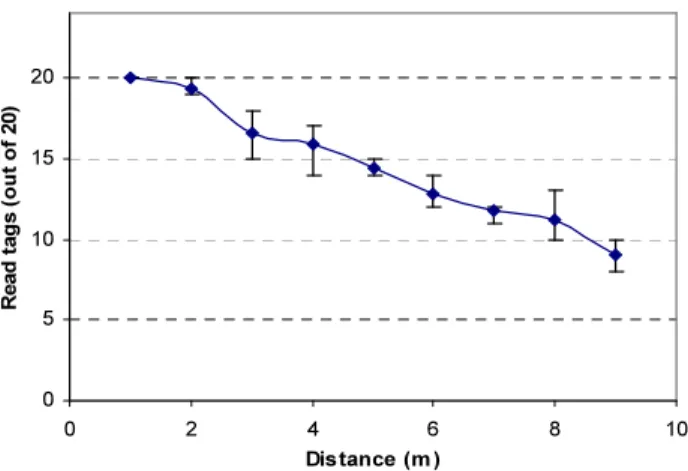
lot on their operating frequencies. For the UHF systems we used, it is generally a few meters. To characterize the impact of the tag-antenna distance on read reliability, we placed 20 tags in a single plane, parallel to the antenna. The tag place-ment is shown in Figure 1. Inter-tag distances were 12.5 cm and 20 cm along the x and y axes, respectively. Our exper-iments showed that this distance is more than sufficient to eliminate direct interference between tags. The tags were fixed in position facing a single antenna, and a single read was performed each time. We repeated the read 40 times for each distance. Figure 2 shows the average number of tags read, and the upper and lower quartiles. Our results show a 100% read reliability at a distance of 1 m. However, reliability gradually dropped between 2 m and 9 m.
Inter-Tag Distance and Tag Orientation: In many
prac-tical scenarios, tags may be placed close to one other, in parallel, and/or in different orientations with regard to the antennas. To characterize the impacts of inter-tag distances
0 5 10 15 20 0 2 4 6 8 10 Distance (m) R ea d ta gs (o ut of 20 )
Figure 2. Read reliability vs. antenna
dis-tance. 1 5 3 4 6 Antenna Movement direction 2 Inter-tag distance 72 cm 32 cm
Figure 3. Tag orientation and antenna.
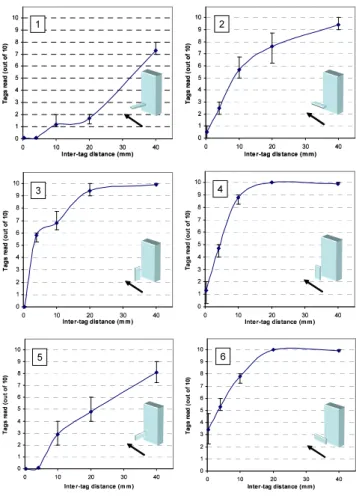
and tag orientation with respect to the antenna, we per-formed multiple experiments using 10 tags in parallel to each other. We mounted the tags on a cardboard box, and used a cart to pass them in front of a single antenna with a speed of about 1 m/s and antenna-tag distance of 1 m. This represents a situation where items are carried by a conveyor belt through a gate.
We tested the combination of five different inter-tag dis-tances: 0.3 mm, 4 mm, 10 mm, 20 mm, and 40 mm, and six different tag orientations (Figure 3). We repeated each experiment at least 10 times. Figure 4 shows the average number of tags read, and the upper and lower quartiles for each experiment. We are interested in finding the minimum ‘safe’ distance between tags where they will not interfere with each other. Our results show that, depending on ori-entation, tags require at least 20 to 40 mm spacing between them to operate in a reliable fashion. We can also see the ef-fect of tag orientation. It is not surprising that tag reads are least reliable when the tags are perpendicular to the antenna (cases 1 and 5). Our results clearly indicate that current UHF tags would not work well for scenarios where tags are placed very close to each other and are perpendicular to the antenna, such as on book covers in a bookshelf.
Object Tracking: In the previous experiments, the tags
were not attached to any objects. However, in real world situations, tags are placed on objects that may interfere with RF signals. To measure RFID performance for realistic case level and item level tagging, we individually tagged 12 identical boxes, each containing a network router and accessories in original packaging. The metal casing and relatively large size of the routers compared to their packag-ing material would make them a challengpackag-ing scenario for an RFID system. We placed the boxes on a cart as three rows of 2x2 boxes, and passed the cart in front of the antenna with a speed of 1 m/s at a distance of 1 m. We performed this ex-periment for different tag locations, namely top, front, side closer to antenna, and side farther from antenna. The ex-periments were repeated 12 times. Our results in Table 1 demonstrate that the location of a tag on an object has a dramatic impact on the tag read reliability. Assuming that
! " # ! $ % & ' ( ) * + , -. / 0 1 )( ( )( *( + ( , ( 23456748 9:;<483=5>??@ A B C D E F B G H I J K I L M N O P Q R S T U V W X Y QP P QP R P S P T P Z[\]^ _\`abcd\`[ e]fggh i j k l m n j o p q r s q t u v w x y z { | } ~ yx x yx zx {x |x ¡ ¢ £ ¤ ¥ ¦ § ¨ © ¡ ¡ ¢ £ ¤ ª«¬ ® ¯¬ °±² ³´¬°«µ¶··¸ ¹ º » ¼ ½ ¾ º ¿ À Á  à Á Ä Å Æ Ç È É Ê Ë Ì Í Î Ï Ð Ñ ÉÈ È ÉÈ Ê È Ë È ÌÈ ÒÓÔÕÖ×ÔØÙÚÛÜÔØÓ ÝÕÞßßà á â ã ä å æ â ç è é ê ë é ì í î ï 1 2 3 4 6 5
Figure 4. Tag orientation and inter-tag dis-tance.
tag read reliabilities are equal between the front and back of the box, and between the top and bottom of the box, the average read reliability for all locations is 63%. While guar-anteeing the exact location of tags upon passing in front of a reader is impractical for many scenarios, it is often prac-tical to avoid the worst locations (in this case, the top of the box). Our measurements show determining and avoiding the worst case locations can greatly improve average relia-bility. This is similar to the orientation tests, where two out of six orientations had considerably worse reliability.
Table 1. Read reliability for tags on objects.
Tag location Reliability Front 87% Side (closer) 83% Side (farther) 63% Top 29% Average 63%
Human Tracking: One application of RFID systems is
tracking humans. Active tags have been employed for hu-man location sensing and tracking [11]. Passive RFID tags are currently in use for identification purposes in access
cards and credit cards. We set out to evaluate the perfor-mance of passive RFID systems for human identification and tracking.
We experimented with multiple tag locations, and found that for best performance, tags and antennas should be at the same height, and tags should not touch the body. There-fore, we placed the tags at waist level, hanging from the belt or pocket, as often seen with ID cards, to achieve best per-formance. We placed a tag on one or two volunteers and they walked in front of an antenna at a distance of 1 meter. The volunteers tried to walk in parallel for the two person tests to maximize blocking. This could resemble a typical case for people with a RFID tagged ID card passing through a gate or doorway. It can also be used for human tracking with room-level accuracy. We tested with multiple tag lo-cations. Each test was repeated 20 times. From the results in Table 2, the read reliability averaged 63% for one sub-ject. Blocking by the closer subject caused the two subject read reliability to average 56%. Interestingly, read reliabili-ties for the closer subject in the two subject case was higher than those for a single subject. Further tests showed the reason was not the slightly closer distance. We attribute the higher read reliabilities to signal reflections off the farther subject. The low reliability in all of these cases motivates us to apply simple fault-tolerance techniques.
Table 2. Read reliability for tags on humans.
One Two subjects Tag location subject Closer Farther Average Front / Back 75% 90% 50% 70% Side (closer) 90% 90% 50% 70% Side (farther) 10% 30% 0% 15% Average 63% 75% 38% 56%
4. Improving RFID Reliability
We investigated the use of redundancy to improve the reliability of RFID systems and evaluated its effectiveness through both analytical analysis and experimental measure-ments. Redundancy in the form of replication is a widely used fault-tolerance technique for improving reliability. It can be applied to RFID systems in a number of ways: tiple antennas per portal, multiple readers per portal, or mul-tiple tags per object.
Multiple antennas mounted per portal is a widely used technique and virtually all readers have built-in support for assigning two or more antennas to a single zone or portal. Even though readers employ measures such as TDMA to prevent interference between two or more of their antennas, our initial observations showed a slight decrease in perfor-mance when blocking was not an issue. Nonetheless, in realistic cases, there was a distinctive gain using multiple antennas. For multiple antenna tests, we used two area
an-tennas placed at a distance of 2 meters from each other and connected to the same reader. While one might expect to see similar improvements for multiple readers per portal, our measurement clearly showed the opposite: read relia-bility was severely reduced in our experiments. The reason is reader-to-reader RF interference. While Gen 2 has stan-dard measures to combat this problem, called dense-reader mode, it is optional for readers. Our readers did not sup-port dense-reader mode, and neither do most older Gen 2 readers.
While using multiple tags for each object seems straight-forward, to the best of our knowledge it has not been eval-uated before in scientific literature. Multiple tags on dif-ferent sides of an object and/or with difdif-ferent orientations increases the probability that at least one of the tags is suc-cessfully read by a reader. However, if the tags are too close, they may interfere with one another and actually reduce the read reliability. Furthermore, if the number of tags in the antenna read area gets large, it can take considerably longer to read the tags.
We now use a simple analytical model for multiple tag and/or antenna scenarios. We define every combination of tag and antenna in the same area as a read opportunity. As-suming read opportunities are independent, if the reliabili-ties for read opportunireliabili-ties leading to an object identification areP1,P2,,Pn, the expected object tracking reliabilityRC
is:
RC= 1−((1−P1)(1−P2)...(1−Pn))
We will next present our experimental results, and compare their performance with the analysis. All measurements and conclusions in this section are dependent on not exceeding the minimum safe tag distances measured in Section 3.3, and allowing adequate time for all tags to be read, which is around .02 sec per tag.
4.1. Reliable Object Tracking
To characterize the effect of reliability techniques for ob-ject tracking, we repeated the same experiment as in Section 3, while employing redundancy at different levels. We will present both the measured reliabilityRM and the expected
reliability RC, where RC is calculated based on the read
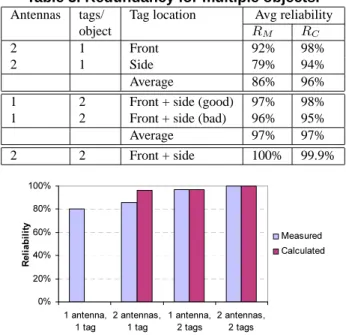
reliabilities measured in Section 3. We have investigated the following cases: two antennas per portal instead of one, two tags per object instead of one, and two tags per object and two antennas per portal. The results for all cases are shown in Table 3 and Figure 5. Our measurements show the performance of multiple tags per object is better than multiple antennas per portal, and very similar to the analyt-ical model. Using two tags instead of one, we increased the average object tracking reliability from 80% to 97%.
Table 3. Redundancy for multiple objects.
Antennas tags/ Tag location Avg reliability
object RM RC
2 1 Front 92% 98%
2 1 Side 79% 94%
Average 86% 96% 1 2 Front + side (good) 97% 98% 1 2 Front + side (bad) 96% 95% Average 97% 97% 2 2 Front + side 100% 99.9% 0% 20% 40% 60% 80% 100% 1 antenna,
1 tag 2 antennas,1 tag 1 antenna,2 tags 2 antennas,2 tags
Re lia bi lit y Measured Calculated
Figure 5. Object tracking with redundancy.
4.2. Reliable Human Tracking
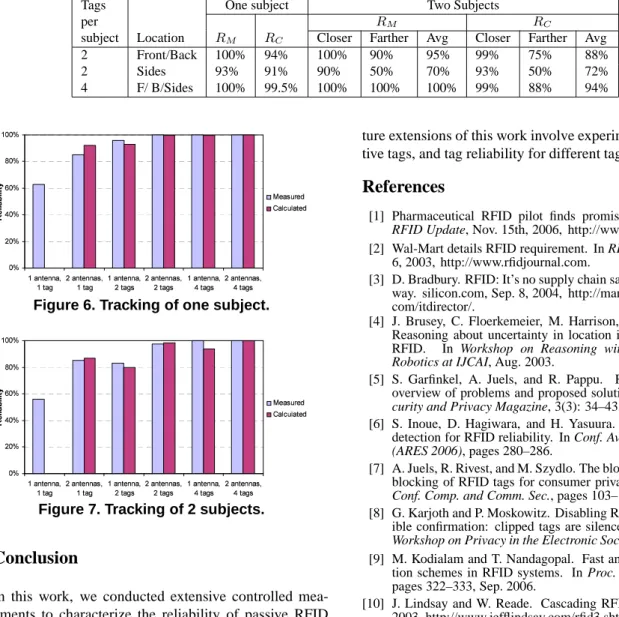
To characterize the effect of reliability techniques for hu-man tracking, we repeated the same experiment as in Sec-tion 3, while employing redundancy at different levels. We present both experimental results and expected tracking re-liability for the combination of two antennas per portal, and two or four tags per person. The results for 1-antenna and 2-antenna cases are presented in Table 4 and Table 5 re-spectively. The average performances for one-subject and two-subject cases are shown in Figure 6 and Figure 7, re-spectively.
Similar to object tracking, the performance of multiple tags per person is better than multiple antennas per portal. Using two tags instead of one, increases average reliability from 63% to 96% for 1-person cases, and from 56% to 83% in 2-person cases. Reliability virtually reaches 100% using four tags per person or a combination of two tags per person and two antennas per portal.
We can clearly see that simple reliability techniques, es-pecially using multiple tags per object, can significantly im-prove RFID system reliability to near 100%, even for appli-cations that previously seemed out of the domain of passive RFID systems.
Table 5. Human tracking, 2 antennas.
Tags per One subject Two Subjects subject Location RM RC RM RC 1 Front/Back 80% 94% 90% 95% 1 Side 90% 91% 80% 78% 2 Front/Back 100% 99.6% 100% 99.8% 2 Sides 100% 99.2% 95% 97% 4 F/B/Sides 100% 100% 100% 99.9%
Table 4. Human tracking reliability, 1 antenna.
Tags One subject Two Subjects
per RM RC
subject Location RM RC Closer Farther Avg Closer Farther Avg
2 Front/Back 100% 94% 100% 90% 95% 99% 75% 88% 2 Sides 93% 91% 90% 50% 70% 93% 50% 72% 4 F/ B/Sides 100% 99.5% 100% 100% 100% 99% 88% 94%
Figure 6. Tracking of one subject.
! " # #$ %&'%% $ ( #&$) $ %&'%% $ * ( #&$) #$ %&'%% $ ( &$)* $ %&'%% $ * ( &$)* #$ %&'%% $ ( &$)* $ %&'%% $ * ( &$)* + , -. / 0 . -. 1 2 3'$*45'6 7$8948$&'6
Figure 7. Tracking of 2 subjects.
5. Conclusion
In this work, we conducted extensive controlled mea-surements to characterize the reliability of passive RFID tags for tracking mobile objects and humans. Our measure-ments revealed critical insights into how reliability depends on various practical factors, such as inter-tag distances, lo-cation of the tag on an object, and tag orientation. To improve reliability, we explored simple and cost-effective reliability techniques, namely redundancy at the tag level, the antenna level, and the reader level. Our measurement clearly showed the high effectiveness of tag-level redun-dancy, followed by antenna-level redunredun-dancy, in increas-ing system reliability. Because our readers did not sup-port dense-reader mode, reader-level redundancy severely reduced reliability in our experiments, due to reader-reader interference. To the best of our knowledge, our work is the first that systematically characterizes the reliability of RFID systems and its dependence on various practical fac-tors. Our results provide important guidelines for real-world deployment of RFID-based tracking applications as well as simple yet effective solutions to guarantee reliability.
Fu-ture extensions of this work involve experimenting with ac-tive tags, and tag reliability for different tag designs.
References
[1] Pharmaceutical RFID pilot finds promise, problems. In
RFID Update, Nov. 15th, 2006, http://www.rfidupdate.com.
[2] Wal-Mart details RFID requirement. In RFID Journal, Nov. 6, 2003, http://www.rfidjournal.com.
[3] D. Bradbury. RFID: It’s no supply chain savior - not yet any-way. silicon.com, Sep. 8, 2004, http://management.silicon.-com/itdirector/.
[4] J. Brusey, C. Floerkemeier, M. Harrison, and M. Fletcher. Reasoning about uncertainty in location identification with RFID. In Workshop on Reasoning with Uncertainty in
Robotics at IJCAI, Aug. 2003.
[5] S. Garfinkel, A. Juels, and R. Pappu. RFID privacy: an overview of problems and proposed solutions. In IEEE
Se-curity and Privacy Magazine, 3(3): 34–43, 2005.
[6] S. Inoue, D. Hagiwara, and H. Yasuura. Systematic error detection for RFID reliability. In Conf. Avail., Rel. and Sec.
(ARES 2006), pages 280–286.
[7] A. Juels, R. Rivest, and M. Szydlo. The blocker tag: selective blocking of RFID tags for consumer privacy. In 10th ACM
Conf. Comp. and Comm. Sec., pages 103–111, 2003.
[8] G. Karjoth and P. Moskowitz. Disabling RFID tags with vis-ible confirmation: clipped tags are silenced. In 2005 ACM
Workshop on Privacy in the Electronic Society, pages 27–30.
[9] M. Kodialam and T. Nandagopal. Fast and reliable estima-tion schemes in RFID systems. In Proc. 12th MOBICOM, pages 322–333, Sep. 2006.
[10] J. Lindsay and W. Reade. Cascading RFID tags. Dec. 23, 2003, http://www.jefflindsay.com/rfid3.shtml.
[11] L. Ni, Y. Liu, Y. Lau, and A. Patil. LANDMARC: Indoor location sensing using active RFID. In Wireless Networks, 10(6): 701-710. 2004.
[12] K. Ramakrishnan and D. Deavours. Performance bench-marks for passive UHF RFID tags. In 13th GI/ITG Conf.
Measurement, Modeling, and Eval. of Comp. and Comm. Sys., pages 137-154, 2006.
[13] M. Rieback, B. Crispo, and A. Tanenbaum. The evolution of RFID security. In IEEE Perv. Comp. 5(1): 62-69, 2006. [14] E. Schuman. RFID trials show mixed results. eWEEK.com,
Nov. 15, 2006, http://www.eweek.com/.
[15] R. Shawn, G. Minos, and J. Michael. Adaptive cleaning for RFID data streams. In Proc. 32nd VLDB, pages 163–174, 2006.
[16] H. Stockman. Communication by means of reflected power. In Proc. IRE, 36, pages 1196-1204, 1948.
[17] N. Vaidya and S. Das. RFID-based networks - exploiting diversity and redundancy, UIUC, WINGS Lab TR, 2006. [18] Vogt, H. Multiple object identification with passive RFID
tags. In IEEE Conf. Systems, Man and Cybernetics, Vol. 3, pages 6-9, Oct 2002.