JOB SATISFACTION AS A MEDIATING VARIABLE IN THE EFFECT OF
TRANSFORMATIONAL LEADERSHIP ON PERFORMANCE
Fatwa Tentama1*, Desta Rizky Kusuma2, Subardjo3 1
Faculty of Psychology Ahmad Dahlan University Yogyakarta, Indonesia, 2Faculty of Economics Ahmad Dahlan University Yogyakarta, Indonesia, 3Faculty of Law Ahmad Dahlan University Yogyakarta, Indonesia.
Email: *[email protected]
Article History: Received on 21st September 2019, Revised on 29th November 2019, Published on 02nd January 2020 Abstract
Purpose: This study aims to examine the direct and indirect effect of transformational leadership on performance with job satisfaction as a mediator of the educational staff at the University of X Yogyakarta, and the direct effect of job satisfaction on the performance of educational staff at the University of X Yogyakarta.
Methodology: The population of this study was the educational staff at the University of X. The sampling technique used in this study was stratified random sampling, involving a total of 50 educational staff as samples. Data collection was done using a performance scale, job satisfaction scale, and transformational leadership scale. The data were analyzed using the path regression ordinary least square technique.
Main Findings: The results showed that transformational leadership has a significant effect on job satisfaction of educational staff, transformational leadership does not effect on performance of educational staff, job satisfaction has a significant effect on performance of educational staff and transformational leadership has a significant effect on performance through job satisfaction as a mediator of educational staff. Thus, job satisfaction can play a good role as a mediator.
Applications of this study: Satisfaction has an important role in increasing work productivity which includes quantity and quality of work, timeliness of work, work effectiveness, independence, and commitment. Leaders in implementing a transformational leadership style must be accompanied by efforts to create a work environment that supports the realization of the job satisfaction of its employees. Regardless of employee job satisfaction, the leader’s transformational leadership style will be in vain.
Novelty: To the best of our knowledge, research on job satisfaction as a mediating variable in the effect of transformational leadership on the performance of educational staff is still rarely done both in Indonesia and abroad. Previous studies only positioned job satisfaction as an independent variable that affects performance and not as a mediator variable. This study focuses on job satisfaction as a mediator the effect of transformational leadership on the performance of educational staff.
Keywords: Transformational Leadership, Job Satisfaction, Performance, Educational Staff, University,Path Regression Ordinary Least Square Technique.
INTRODUCTION
Performance problems are now a major issue in every organization because performance is a step towards achieving organizational goals. Success and performance organization can be seen from the performance that has been achieved by its employees, therefore each organization will demand that its employees are able to display optimal performance because the good and bad performance achieved by employees will affect the overall performance and success of the organization. Various efforts must be made by the organization in managing its management functions, one of which is managing employees to be able to improve work efficiency and effectiveness.
Munandar (2001) states that employees are the main assets of an organization, or in other words, the main wealth of the organisation. An organisation can only develop if employees support that also continue to develop (Cascio, 1998). Human resources are among one of the most critical factors in an organisation as it is a determinant of organisation success (Yukl, 2009). Proper management and development of human resources can improve employee performance, which in turn helps achieve organisational effectiveness. An organisation perceives that there is a need for good employee performance in order to attain organisational goals because employee performance is relevant to achieving organisational goals (Heslin, Latham, & VandeWalle, 2005). Good employee performance is among one of the organisational goals needed to achieve high work productivity.
Performance is defined as all actions or behaviours that are controlled by individuals and contribute to the achievement of the organisational goals (Rotundo & Sackett, 2002). The presence of employees with high performance will deliver the organisation to a favourable condition. High employee performance is demonstrated by productivity, presence, loyalty, hard work and job satisfaction. If an organisation's employees display low performance indicated by absenteeism, coming late to work, working indifferently, delaying work, low cooperation, to the point of resigning from the job, the organisation will experience a negative impact. This is in line with the opinion of Robbins (2003), who stated that performance, otherwise termed as human output, can be measured through productivity, absence, turnover, citizenship, and satisfaction. The importance of employee performance requires every organization to pay attention to
and examine the factors that influence performance, including transformational leadership (Ishikawa, 2012;MacKenzie, Podsakoff & Rich, 2001;Noruzy, Dalfard, Azhdari, Shirkouhi & Rezazadeh, 2012; Sun, Xu & Shang, 2014) and job satisfaction of employees (Chen, Yang, Shiau, & Wang, 2006;Hayati & Caniago, 2012;Peng, 2014;Platis, Reklitis, & Zimeras, 2015;Tentama, 2015a;Umar, 2014).
This study aims to examine the indirect effect of transformational leadership on performance with job satisfaction as a mediator of educational staff at University of X Yogyakarta, examine the direct effect of transformational leadership on performance of educational staff at University of X Yogyakarta and the direct effect of job satisfaction on performance of educational staff at University of X Yogyakarta.
LITERATURE REVIEW
Transformational leadership is an illustration of the impact that leaders can have on their employees, that is to say, that employees trust, admire, are loyal, and respect their leaders, and are motivated to do more work than they should (Bass, 1985;Antonakis, Bastardoz, Liu, & Schriesheim, 2014). According to Bass, transformational leadership is a leadership style that allows leaders to motivate their followers in three different ways: First, by making them more aware of the importance of their job results. Second, by encouraging them to be more concerned with the organisation or teams instead of putting more self-interest. Third, by activating employee's needs of a work superior (Yukl, 2009). As a consequence, employees will respond by showing maximum work results, as transformational leadership styles have been proven to influence on employee performance (Lam & O’Higgins, 2012;Ugwu, Enwereuzor & Orji, 2015). Some researchers find that employees tend to be more productive with leaders who apply transformational leadership styles
(Barrick, Thurgood, Smith, & Courtright, 2015), besides this, the transformational leadership style can make employees more creative in completing various tasks (Chen, Farh, Campbell-Bush, Wu, & Wu, 2013;Choi, 2009).
Another factor that influences employee performance is the job satisfaction of employees (Arifin, 2015). The relationship between job satisfaction and employee performance has attracted scientific attention from the beginning of the history of industrial and organisational psychology (Wright, Cropanzano, & Bonett, 2007). Ultimately, the relationship between job satisfaction and work performance has also attracted much research attention (Judge, Thoresen, Bono, & Patton, 2001). Job satisfaction is defined as a pleasant emotional attitude in which an employee loves his or her job; job satisfaction is reflected by a balanced emotional attitude between a reciprocity of service and duty implementation/execution (Hasibuan, 2012). The success of an organization in achieving a goal is very dependent on the high performance of employees (Dessler, 2016). Successful organizations believe that employee satisfaction will affect the level of performance (Shmailan, 2015), therefore organizations need to understand that employees have personal desires that make themselves feel positive (Schermerhorn, 2017). Employees who are satisfied with their jobs tend to have better performance (Saari & Judge, 2004). Job satisfaction can affect employee performance (Shokrkon & Naami, 2009;Ahmad, Ahmad, & Shah, 2010). If employee satisfaction increases, opportunities for productivity will be higher. According to Jain and Triandis (1997), job satisfaction can produce high productivity. Thus, job satisfaction can produce better performance, reduce employee turnover, and lead to behavioural changes (Levy, 2003). Job satisfaction is essential and can be considered one of the main determinants of employee performance in an organisation (Riketta, 2002;Gu & Chi Sen Siu, 2009).
Job satisfaction can act as a mediator in the indirect effect of transformational leadership on employee performance. In other words, transformational leadership can influence employee performance through employee job satisfaction. Aside from influencing employee performance, job satisfaction in its role as a mediator variable is also influenced by transformational leadership (Choi, Goh, Adam & Tan, 2016;Dewi, 2013;Anggraeni & Santosa, 2013;Dewi & Subudi, 2015). Findings from the study of Mariam (2009) confirm that job satisfaction can act as a mediator, in which leadership style has a positive effect on job satisfaction and has a positive effect on employee performance. This indicates that job satisfaction can act as a mediator between leadership style and performance. In accordance with Mariam (2009),
Hartanto (2014) stated that job satisfaction could become an intervening variable in the effect of transactional leadership on employee performance. Thus, the mediator variable, namely job satisfaction, is influenced by transformational leadership and affects employee performance. Other research findings also show that job satisfaction can act as a good mediator on employee performance (Cahyasumirat, 2006; Husnawati, 2006; Mantauv, 2014) and can mediate transformational leadership (Dewi, 2013).
This research was conducted to see the effect of transformational leadership on employee performance, both directly and indirectly, through job satisfaction as an intervening variable. Thus, it can be proven whether or not job satisfaction can act as a good mediator variable in the effect of transformational leadership on employee performance or vice versa. The hypotheses in this study are:
1. Transformational leadership has an influence on performance with job satisfaction as a mediator of education staff at the University of X Yogyakarta.
2. Transformational leadership has a positive effect on the performance of educational staff at the University of X Yogyakarta.
3. Transformational leadership has a positive effect on the job satisfaction of educational staff at the University of X Yogyakarta.
4. Job satisfaction has a positive effect on the performance of educational staff at the University of X Yogyakarta.
METHODOLOGY
This research is a quantitative study that consists of three variables: performance as a dependent variable, job satisfaction as a mediator variable and transformational leadership as an independent variable.
Population, Sample and Sampling Technique
The population of this study was employees at the University of X who came from various educational backgrounds. The sampling technique used in this study was stratified random sampling. The number of samples in this study was 50 of the educational staff at the University of X Yogyakarta, Indonesia.
Measurement Instruments
Data collection was done using a performance scale, job satisfaction scale, and transformational leadership scale. The response format on this scale consists of strongly agree, agree, disagree, and strongly disagree. The performance scale refers to the aspects of performance coined by Bernardin and Russell (1993), namely the quantity of work, quality of work, timeliness, effectiveness, independence, and work commitment. An example of an item on this scale is "I complete my tasks on time."
The job satisfaction scale refers to the aspects of job satisfaction according to Smith, Kendall & Hulin (as cited in
Luthans, 2008;Kreitner & Kinichi, 2000), namely the work itself, salary, promotion, supervision, and co-workers. An example of an item on this scale is "I feel comfortable working in this organisation".
The transformational leadership scale refers to aspects of transformational leadership according to Bass (1985,1990), namely charisma, inspirational motivation, intellectual stimulation, and individual consideration. An example of an item on this scale is "Leaders direct employees who experience difficulties doing their jobs".
Validity and reliability of measurement instruments
Based on the trial results involving 50 subjects, the performance scale obtained a reliability coefficient (α) of 0.794 with a discrimination index (corrected item-total correlation) that ranges between 0.260 to 0.699. These items are deemed to have good discrimination, good reliability and can be used for this research.
Based on the trial results involving 50 subjects, the job satisfaction scale obtained a reliability coefficient (α) of 0.706 with a discrimination index (corrected item-total correlation) that ranges between 0.267 to 0.581. These items are deemed to have good discrimination, good reliability and can be used for this research.
Based on the trial results involving 50 subjects, the transformational leadership scale obtained a reliability coefficient (α) of 0.728with a discrimination index (corrected item-total correlation) that ranges between 0.269 to 0.655. These items are deemed to have good discrimination, good reliability and can be used for this research.
The procedure of data collection
The procedure of this research was carried out in two stages, the first stage was the trial phase of measuring instruments which were carried out by collecting data using a performance scale, job satisfaction scale and transformational leadership scale. A trial scale was given to 50 subjects directly at the study site and after completing the scale, the researcher checked the subject's answers and the next step was to input the data and analyze it. The second stage is the stage of research data retrieval using performance scale, job satisfaction scale and transformational leadership scale that have been valid and reliable based on the results of the analysis of the trials of the previous measuring tool. The scale of the study was given to 50 subjects directly and after checking the answers of the subjects, the final step was to analyze the hypothesis test.
Data analysis
The collected data was analyzed using the path regression ordinary least square technique to discover the direct relationship and indirect relationship between variables, namely the direct effect of transformational leadership style on employee performance and the indirect effect of transformational leadership on employee performance through job satisfaction as a mediator variable. Data analysis was carried out using SPSS 19.0 for Windows.
RESULTS AND DISCUSSION
This study was conducted to examine the role of job satisfaction as a mediator of the effect of transformational leadership on the performance of educational employees so that testing is conducted with the path regression ordinary least square technique. Assumptions tests carried out before hypothesis testing are normality tests, linearity tests, multicollinearity tests, and heteroscedasticity tests.
Assumptions Testing Normality Test
Table 1: Distribution of Normality Test
Variable K-SZ Sig. Threshold Annotation
Performance 1.010 0.260 P>0.05 Normal Job satisfaction 1.248 0.089 P>0.05 Normal Transformational Leadership 1.253 0.086 P>0.05 Normal
The normality test aims to see whether or not the distribution of subject scores is normal in the transformational leadership, job satisfaction, and performance variables. The normality test is carried out using the one-sample Kolmogorov-Smirnov Test. The analysis results show that the three variables have a normal distribution, as displayed in table 1.
Linearity Test
Table 2: Linearity Test
Variable F Linearity Sig. Threshold Annotation
Job Satisfaction 36.457 0.000 p < 0.05 Linear Transformational Leadership 4.404 0.043 p < 0.05 Linear
The linearity test results of transformational leadership on the performance obtained an F linearity of 4.404 with a significance level (p) of 0.043, which indicates linearity or the presence of a line that connects the transformational leadership and performance variables. The linearity test results of job satisfaction on the performance obtained an F linearity of 36.457 with a significance level (p) of 0.000, which indicates linearity or the presence of a straight line that connects the job satisfaction and performance variables. The linearity test results can be seen in table 2.
Multicollinearity Test
Table 3: Multicollinearity Test
Variable Tolerance VIF Threshold Annotation
Job Satisfaction 0.670 1.492 Reference value for tolerance > 0,1 Reference value for VIF < 10
No
multicollinearity Transformational Leadership 0.670 1.492 Reference value for tolerance > 0,1
Reference value for VIF < 10
No
multicollinearity The multicollinearity test aims to ensure that there is no multicollinear relationship between the two independent variables. Table 3 below shows that transformational leadership and job satisfaction have an VIF value = 1.492 (VIF <10) and tolerance = 0.670 (tolerance> 0.1), indicating that there is no multicollinearity between transformational and job satisfaction.
Heteroscedasticity Test
Table 4: Heteroscedasticity Test
Variable Sig. Tolerance Annotation
Transformational Leadership 0.981 P>0.05 Homoscedasticity Job Satisfaction 0.911 P>0.05 Homoscedasticity
The heteroscedasticity test aims to ensure that there is no problem with the heteroscedasticity. Heteroscedasticity is tested using the Spearman Rho test. Based on table 4, the significance value (p) of transformational leadership is 0.981 (p > 0.05) and job satisfaction is 0.911 (p > 0.05), which means that there is no problem with heteroscedasticity in both variables.
Hypothesis Testing
Direct Effect of Transformational Leadership on Job Satisfaction
Table 5: Analysis Results of the Effect of Transformational Leadership on Job Satisfaction
The results of the analysis shown in Table 5 inform a t value of 4.807 with a significance of 0.000 (<0.05), meaning that there is a probability of alpha 5% (0.05). Thus, it can be concluded that transformational leadership has a significant effect on job satisfaction of educational staff.
Direct Effect of Transformational Leadership on Performance
Variable t Sig. Criterion Annotation
Table 6: Analysis Results of the Effect of Transformational Leadership on Performance
The result of the analysis shown in Table 6 informs t value of 1.925 with a significance of 0.06 (> 0.05) meaning that there is a probability of more than alpha 5% (0.05). Thus it can be concluded that transformational leadership does not effect the performance of educational staff.
The direct effect of Job Satisfaction on Performance
Table 7: Analysis Results of the Effect of Job Satisfaction on Performance
Analysis results are shown in Table 7. inform a t value of 6.094 with a significance of 0.000 < 0.05), meaning that there is a probability of less than alpha 5% (0.05). Thus it can be concluded that job satisfaction has a significant effect on the performance of educational staff.
Indirect Effect of Transformational Leadership on Employee Performance through Job Satisfaction
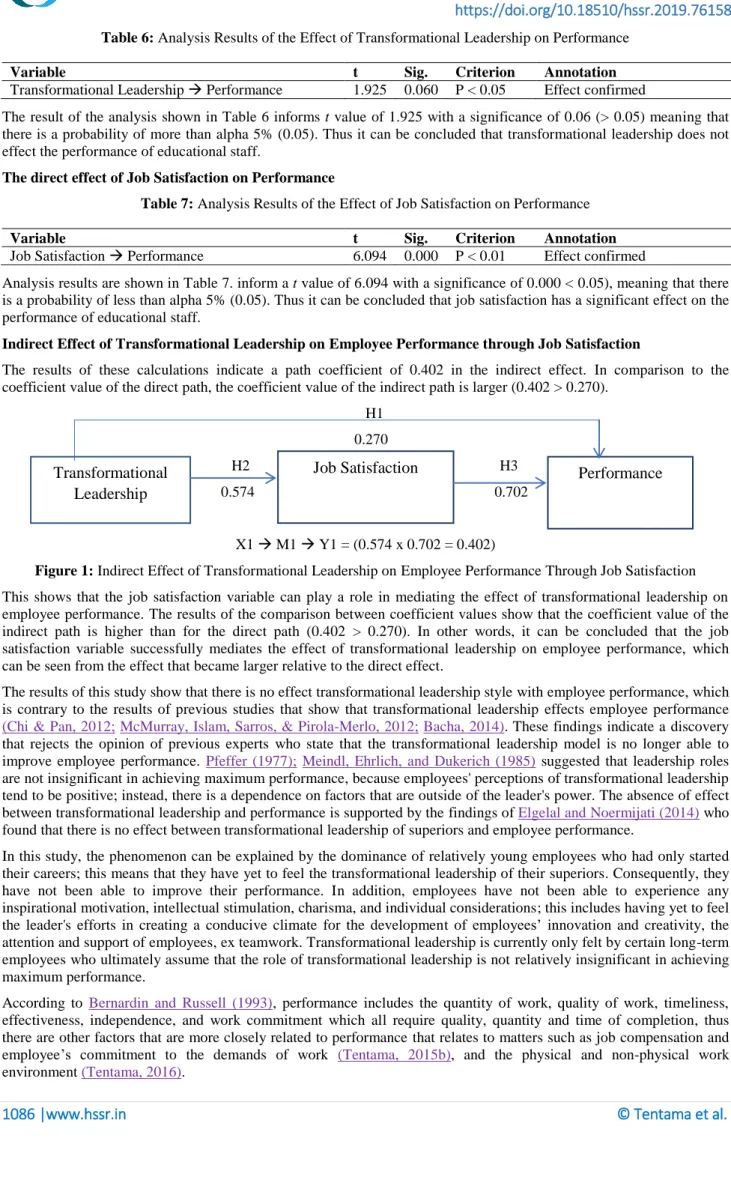
The results of these calculations indicate a path coefficient of 0.402 in the indirect effect. In comparison to the coefficient value of the direct path, the coefficient value of the indirect path is larger (0.402 > 0.270).
H1 0.270
H2 H3 H3 0.574 0.574 0.702
X1 M1 Y1 = (0.574 x 0.702 = 0.402)
Figure 1: Indirect Effect of Transformational Leadership on Employee Performance Through Job Satisfaction This shows that the job satisfaction variable can play a role in mediating the effect of transformational leadership on employee performance. The results of the comparison between coefficient values show that the coefficient value of the indirect path is higher than for the direct path (0.402 > 0.270). In other words, it can be concluded that the job satisfaction variable successfully mediates the effect of transformational leadership on employee performance, which can be seen from the effect that became larger relative to the direct effect.
The results of this study show that there is no effect transformational leadership style with employee performance, which is contrary to the results of previous studies that show that transformational leadership effects employee performance
(Chi & Pan, 2012;McMurray, Islam, Sarros, & Pirola-Merlo, 2012;Bacha, 2014). These findings indicate a discovery that rejects the opinion of previous experts who state that the transformational leadership model is no longer able to improve employee performance. Pfeffer (1977);Meindl, Ehrlich, and Dukerich (1985) suggested that leadership roles are not insignificant in achieving maximum performance, because employees' perceptions of transformational leadership tend to be positive; instead, there is a dependence on factors that are outside of the leader's power. The absence of effect between transformational leadership and performance is supported by the findings of Elgelal and Noermijati (2014) who found that there is no effect between transformational leadership of superiors and employee performance.
In this study, the phenomenon can be explained by the dominance of relatively young employees who had only started their careers; this means that they have yet to feel the transformational leadership of their superiors. Consequently, they have not been able to improve their performance. In addition, employees have not been able to experience any inspirational motivation, intellectual stimulation, charisma, and individual considerations; this includes having yet to feel the leader's efforts in creating a conducive climate for the development of employees’ innovation and creativity, the attention and support of employees, ex teamwork. Transformational leadership is currently only felt by certain long-term employees who ultimately assume that the role of transformational leadership is not relatively insignificant in achieving maximum performance.
According to Bernardin and Russell (1993), performance includes the quantity of work, quality of work, timeliness, effectiveness, independence, and work commitment which all require quality, quantity and time of completion, thus there are other factors that are more closely related to performance that relates to matters such as job compensation and employee’s commitment to the demands of work (Tentama, 2015b), and the physical and non-physical work environment (Tentama, 2016).
Variable t Sig. Criterion Annotation
Transformational Leadership Performance 1.925 0.060 P < 0.05 Effect confirmed
Variable t Sig. Criterion Annotation
Job Satisfaction Performance 6.094 0.000 P < 0.01 Effect confirmed
Performance
Job Satisfaction
Transformational
Leadership
The so-called direct effect is different when there is a mediator between the effect of transformational leadership on employee performance. The results of this study indicate that transformational leadership can effect performance through job satisfaction as a mediating variable. This means that job satisfaction can be a good mediator in increasing the effect of transformational leadership on performance. When the application of transformational leadership is supported or accompanied by the employee’s satisfaction towards work, salary, promotion, supervision, and co-workers, then employee performance can be improved. This is in line with the findings of Elgelal and Noermijati (2014) who suggested that transformational leadership has a significant effect on employee performance through job satisfaction, meaning that job satisfaction can mediate the careers of transformational leadership on employee performance.
Nimalathasan and Brabete (2010) found a positive relationship between two variables, namely job satisfaction and performance, that is high levels of fair promotion, reasonable salary system, proper work, and good working conditions that lead to high levels of employee performance. Findings of a study conducted by Prasanga and Gamage (2012) show that job satisfaction is one of the most important factors in determining work performance and leads to high performance.
CONCLUSION
The results showed that transformational leadership has a significant effect on job satisfaction of educational staff, transformational leadership does not effect on the performance of educational staff, job satisfaction has a significant effect on the performance of educational staff and transformational leadership has a significant effect on performance through job satisfaction as a mediator of educational staff. Job satisfaction has an important role in increasing work productivity which includes the quantity of work, quality of work, timeliness of work, work effectiveness, work independence, and work commitment both directly and indirectly.
IMPLICATIONS
The implications of this study can provide insight and awareness for organizations, leaders and educational staff. This study shows that transformational leadership and job satisfaction have an important role in preparing education staff to improve their performance. Organizations and leaders must try to create a positive organizational environment, both physically and psychologically by paying attention to the factors of job comfort, salary suitability, worker co-operation, good supervision by supervisors and providing the right promotion. Thus education staff will be satisfied that they will be more ready to work optimally and productively in their performance.
LIMITATION AND STUDY FORWARD
This study focuses on only one Muhammadiyah University. Future studies are expected to use a larger population and sample and involve several universities. This study exclusively focuses on two factors, namely transformational leadership and job satisfaction. Future research is expected to include other factors such as organizational citizenship behavior, commitment, soft skill, engagement, employability, work readiness, and others.
ACKNOWLEDGMENTS
The author would like to thank the Faculty of Psychology, Ahmad Dahlan University, Yogyakarta for providing support to carry out this research. The author also likes to thank the educational staff at the University of X for their willingness and cooperation in this research.
REFERENCES
1. Ahmad, H. & Ahmad, K. & Shah, I. A. (2010). Relationship between job satisfaction, job performance attitude towards work and organizational commitment. European Journal of Social Sciences, 18(2), 257-267.
2. Anggraeni, Y. & Santosa, T. E. C. (2013). Effect of transformational leadership on employee job satisfaction (In Indonesia). Jurnal Dinamika Ekonomi & Bisnis, 10(1), 51-68.
3. Bacha, E. (2014). The relationship between transformational leadership, task performance, and job characteristics. Journal of Management Development, 33(4), 410-420. https://doi.org/10.1108/JMD-02-2013-0025.
4. Bass, B. M. (1985). Leadership and performance beyond expectations. New York: Free Press.
5. Bass, B. M., & Stogdill, R. M. (1990). Bass & Stogdill's handbook of leadership: Theory, research, and managerial applications. New York: Macmillan Publishers.
6. Bernardin, H. J. & Russel, J. E. A. (1993). Human resource management: An experiential approach. New York: McGraw Hill, Inc.
7. Cahyasumirat, G. (2006). The effect of professionalism and organizational commitment on auditor internal performance, with job satisfaction as an intervening variable (In Indonesia). (Tesis). Universitas Diponegoro. Semarang.
8. Cascio, F. W. (1998). Applied psychology in human resources management. New Jersey: Prentice-Hall.
9. Chen, S. H., Yang, C. C., Shiau, J. Y., & Wang, H. H. (2006). The development of an employee satisfaction model for higher education. The TQM Magazine, 18(5), 484-500. https://doi.org/10.1108/09544780610685467.
10. Chi, N. W., & Pan, S. Y. (2012). A multilevel investigation of missing links between transformational leadership and task performance: The mediating roles of perceived person-job fit and person-organization fit. Journal of Business and Psychology, 27(1), 43-56. https://doi.org/10.1007/s10869-011-9211-z.
11. Choi, S. L., Goh, C. F., Adam, M. B. H., & Tan, O. K. (2016). Transformational leadership, empowerment, and job satisfaction: The mediating role of employee empowerment. Human Resources for Health, 14(73), 1-14.
https://doi.org/10.1186/s12960-016-0171-2.
12. Dewi, K. S. (2013). Effect of transformational leadership style on employee job satisfaction and organizational commitment at PT. KPM (In Indonesia). Jurnal Manajemen, Strategi Bisnis, dan Kewirausahaan, 7(2), 116-125.
13. Dewi, N. K. N. C & Subudi, M. (2015). The effect of transformational leadership on job satisfaction and turnover intention on CV. Gita Karya Persada Denpasar (In Indonesia). E-Jurnal Manajemen Unud, 4(12), 4219-4244.
14. Elgelal, K. S. K., & Noermijati, N. (2015). The Influences of transformational leaderships on employees performance (A study of the economics and business faculty employee at University of Muhammadiyah Malang). Asia-Pacific Management and Business Application, 3(1), 48-66.
https://doi.org/10.21776/ub.apmba.2014.003.01.4.
15. Hartanto, I. (2014). The effect of transactional leadership style on employee performance with job satisfaction as an intervening variable on CV. Timur Jaya. (In Indonesia). Agora, 2(2), 979-983.
16. Hasibuan, M. S. P. (2012). Human resource management (In Indonesia). Jakarta: Bumi Aksara.
17. Hayati, K., & Caniago, I. (2012). Islamic work ethic: The role of intrinsic motivation, job satisfaction, organizational commitment and job performance. Procedia-Social and Behavioral Sciences, 65, 1102-1106.
https://doi.org/10.1016/j.sbspro.2014.05.148.
18. Heslin, P. A., Latham, G. P., & VandeWalle, D. (2005). The effect of implicit person theory on performance appraisals. Journal of Applied Psychology, 90(5), 842-856. https://doi.org/10.1037/0021-9010.90.5.842. 19. Husnawati, A. (2006). Analysis of the effect of work life quality on employee performance with commitment
and job satisfaction as intervening variables (In Indonesia).(Tesis). Universitas Diponegoro. Semarang.
20. Ishikawa, J. (2012). Transformational leadership and gatekeeping leadership: The roles of norm for maintaining consensus and shared leadership in team performance. Asia Pacific Journal of Management, 29(2), 265-283.
http://dx.doi.org/10.1007/s10490-012-9282-z.
21. Jain, R. K. & Triandis, H. C. (1997). Management of research and development organizations: Managing the unmanageable. New York: John Wiley & Sons.
22. Judge, T. A., Thoresen, C. J., Bono, J. E., & Patton, G. K. (2001). The job satisfaction–job performance relationship: A qualitative and quantitative review. Psychological Bulletin, 127(3), 376-407.
http://dx.doi.org/I0.1037//0033-2909.I27.3.376.
23. Kreitner, R., & Kinichi, A. (2000). Organizational behavior. Boston: McGraw-Hill.
24. Lam, C. S., & O'Higgins, E. R. (2012). Enhancing employee outcomes: The interrelated influences of managers' emotional intelligence and leadership style. Leadership and Organization Development Journal, 33(2), 149-174. https://doi.org/10.1108/01437731211203465.
25. Levy, P. L. (2003). Industrial/organizational psychology: Understanding the workplace. Boston: Houghton Miflin Company.
26. Luthans, F. (2008). Organizational behavior. Boston: McGraw-Hill.
27. MacKenzie, S. B., Podsakoff, P. M., & Rich, G. A. (2001). Transformational and transactional leadership and salesperson performance. Journal of the Academy of Marketing Science, 29(2), 115-134.
https://doi.org/10.1177/03079459994506.
28. Mantauv, C. S. (2014). Job satisfaction is an intervening variable, the effect of work motivation on employee performance (In Indonesia). E-Jurnal Apresiasi Ekonomi, 2(1), 46-52.
29. Mariam, R. (2009). Effect of leadership style and organizational culture on employee performance through employee job satisfaction as an intervening variable (In Indonesia). (Tesis). Universitas Diponegoro. Semarang. 30. McMurray, A. J., Islam, M., Sarros, J. C., & Pirola-Merlo, A. (2012). The impact of leadership on workgroup climate and performance in a non-profit organization. Leadership & Organization Development Journal, 33(6), 522-549. https://doi.org/10.1108/01437731211253000.
31. Meindl, J. R., Ehrlich, S. B., & Dukerich, J. M. (1985). The romance of leadership. Administrative Science Quarterly, 30(1), 78-102. https://doi.org/10.2307/2392813.
32. Munandar, A. S. (2001). Industrial psychology and organization (In Indonesia). Jakarta: UI Press.
33. Nimalathasan, B. & Brabete, V. (2010). Job satisfaction and employees’ work performance: A case study of people’s bank in Jaffna Peninsula, Sri Lanka. Management & Marketing, 8(1), 43-47.
34. Noruzy, A., Dalfard, V. M., Azhdari, B., Nazari-Shirkouhi, S., & Rezazadeh, A. (2013). Relations between transformational leadership, organizational learning, knowledge management, organizational innovation, and organizational performance: An empirical investigation of manufacturing firms. The International Journal of Advanced Manufacturing Technology, 64(5-8), 1073-1085. https://doi.org/10.1007/s00170-012-4038-y. 35. Peng, Y. P. (2014). Job satisfaction and job performance of university librarians: A disaggregated
36. Pfeffer, J. (1972). Merger as a response to organizational interdependence. Administrative science quarterly, 17(3), 382-394. https://doi.org/10.2307/2392151
37. Platis, C., Reklitis, P., & Zimeras, S. (2015). Relation between job satisfaction and job performance in healthcare services. Procedia-Social and Behavioral Sciences, 175, 480-487.
https://doi.org/10.1016/j.sbspro.2015.01.1226.
38. Prasanga, A. A., & Gamage, A. S. (2012). Job Satisfaction and Job Performance of the Sailors in Rapid Action BoatSquadron of Sri Lanka Navy. Sri Lankan Journal of Human Resource Management, 3(1), 49-57.
http://doi.org/10.4038/sljhrm.v3i1.5097.
39. Riketta, M. (2002). Attitudinal organizational commitment and job performance: A meta‐analysis. Journal of Organizational Behavior, 23(3), 257-266. http://dx.doi.org/10.1002/job.141.
40. Robbins, S. P. (2003). Organization theory, structure, design and applications. New Jersey: Prentice Hall. 41. Rotundo, M., & Sackett, P. R. (2002). The relative importance of task, citizenship, and counterproductive
performance to global ratings of job performance: A policy-capturing approach. Journal of Applied Psychology, 87(1), 66-80. http://dx.doi.org/10.1037/0021-9010.87.1.66.
42. Saari, L. M., & Judge, T. A. (2004). Employee attitudes and job satisfaction. Human Resources Management, 43(4), 395-407. http://dx.doi.org/10.1002/hrm.20032.
43. Shokrkon, H., & Naami, A. (2008). The relationship of job satisfaction with organizational citizenship behavior and job performance in Ahvaz factory workers. Journal of Education & Psychology, 3(2), 39-52.
44. Sun, W., Xu, A., & Shang, Y. (2014). Transformational leadership, team climate, and team performance within the NPD team: Evidence from China. Asia Pacific Journal of Management, 31(1), 127-147.
http://dx.doi.org/10.1007/s10490-012-9327-3.
45. Tentama, F. (2015a). Are organizational commitment and compensation predict employess’ performance?.
Journal of Educational, Health, and Community Psychology, 4(3), 151-160.
http://dx.doi.org/10.12928/jehcp.v4i3.3680.
46. Tentama, F. (2015b). The role of job satisfaction on performance in Civil Servants (PNS) in Yogyakarta. Jurnal Psikologi Universitas Diponegoro, 14(1), 1-8. https://doi.org/10.14710/jpu.14.1.1-8.
47. Tentama, F. (2016). The effect of organizational commitment and work environment on job performance of educational employees in Yogyakarta. International Seminar: The Contribution Of Education Institutions to ASEAN economic, UTM Malaysia. http://eprints.uad.ac.id/2926/.
48. Ugwu, L. I., Enwereuzor, I. K., & Orji, E. U. (2016). Is trust in leadership a mediator between transformational leadership and in-role performance among small-scale factory workers?. Review of Managerial Science, 10(4), 629-648. https://doi.org/10.1007/s11846-015-0170-z.
49. Umar, A. (2014). Effect of wages, work motivation and job satisfaction on workers’ performance in manufacturing industry in Makassar city. European Journal of Business and Management, 6(5), 75-88.
50. Wright, T. A., Cropanzano, R., & Bonett, D. G. (2007). The moderating role of employee positive well being on the relation between job satisfaction and job performance. Journal of occupational health psychology, 12(2), 93-104. https://doi.org/10.1037/1076-8998.12.2.93.
51. Yukl, G. A. (2009). Leadership in organization. New Jersey: Prentice Hall.
52. Arifin, H. M. (2015). The Influence of Competence, Motivation, and Organisational Culture to High School Teacher Job Satisfaction and Performance. International Education Studies, 8(1), 38-45.
https://doi.org/10.5539/ies.v8n1p38
53. Dessler, G. (2016). Human resource management. London: Pearson.
54. Shmailan, A. S. (2015). The relationship between job satisfaction, job performance and employee engagement: An explorative study. Business Management and Economics, 4(1), 1-8.
http://dx.doi.org/10.15739/IBME.16.001.
55. Schermerhorn, J. R. (2017). Introduction to management. New Delhi: Wiley India Private.
56. Gu, Z., & Chi Sen Siu, R. (2009). Drivers of job satisfaction as related to work performance in Macao casino hotels: An investigation based on employee survey. International Journal of Contemporary Hospitality Management, 21(5), 561-578. https://doi.org/10.1108/09596110910967809.
57. Antonakis, J., Bastardoz, N., Liu, Y., & Schriesheim, C. A. (2014). What makes articles highly cited?. The Leadership Quarterly, 25(1), 152-179. https://doi.org/10.1016/j.leaqua.2013.10.014.
58. Barrick, M. R., Thurgood, G. R., Smith, T. A., & Courtright, S. H. (2015). Collective organizational engagement: Linking motivational antecedents, strategic implementation, and firm performance. Academy of Management journal, 58(1), 111-135. https://doi.org/10.5465/amj.2013.0227.
59. Chen, G., Farh, J. L., Campbell-Bush, E. M., Wu, Z., & Wu, X. (2013). Teams as innovative systems: Multilevel motivational antecedents of innovation in R&D teams. Journal of Applied Psychology, 98(6), 1018-1027. http://dx.doi.org/10.1037/a0032663.
60. Choi, J. N. (2009). Collective dynamics of citizenship behaviour: What group characteristics promote group‐level helping?. Journal of Management Studies, 46(8), 1396-1420. https://doi.org/10.1111/j.1467-6486.2009.00851.x.