Abstract—Ordinary portland cement (OPC) is conventionally used as primary binder to produce concrete. The amount of carbon dioxide released during the manufacture of OPC and the extent of energy required to produce OPC are the matters of environmental concern in view of global warming and the poor availability of power. Fly-ash, abundantly available byproduct of coal fired thermal power stations is posing great environmental problems through its disposal. Fly ash with combination of alkalis like sodium hydroxide and sodium silicate can produce binding material depending upon the characteristics of these ingredients. The possibility of eco-friendly use of locally available fly-ash with commercially available alkalis in the development of effective binder; and the effect of various parameters on the compressive strength of geo-polymer concrete is explored in the present paper. The laboratory investigations under ambient and oven dry curing conditions suggested that locally available low calcium fly-ash is suitable for development of geo-polymer concrete; and the compressive strength of geo-polymer concrete is a function of mass ratio of alkaline liquid to fly-ash, mass ratio of sodium silicate to sodium hydroxide and molar concentration of sodium hydroxide.
Index Terms—Alkaline activator, fly-ash, geo-polymer concrete, molar concentration.
I. INTRODUCTION
Ordinary Portland cement (OPC) is conventionally used as primary binder to produce concrete. The production of cement is increasing about 7% annually. The environmental issues associated with the production of OPC are well known. The large extent of energy is required to produce OPC. The production of one ton of cement liberates about one ton of CO2 as the result of de-carbonation of limestone during manufacturing of cement and the combustion of fossil fuels [1].
The contribution of OPC production worldwide to the greenhouse gas emission is estimated to be about 7% of the total greenhouse gas emissions to the earth’s atmosphere contributing greatly to the global warming. Therefore, any direct or indirect attempt to reduce greenhouse gas emissions would be encouraged [2].
In order to produce environmental-friendly concrete, reduced use of natural resources, technology consuming less amount of energy and producing lower carbon dioxide emissions is suggested [2]. McCaffrey [3] suggested that the amount of CO2 emissions by the cement industries can be reduced by decreasing the amount of calcinated material in
Manuscript received September 3, 2012; revised October 19, 2012. The authors are with the Civil Engineering Department of Ramdeobaba College of Engineering and Management, Nagpur, India (e-mail: [email protected]; [email protected]).
cement, by decreasing the amount of cement in concrete, and by decreasing the number of building elements using cement. The present study attempts to explore the possibility of using fly ash in the development of binding material with alkalis like sodium hydroxide and sodium silicate and thus in the manufacture of concrete. The cementing material shall act as an alternative to cement. This will address the issues of reducing the emission of green house gases, reduction in energy requirement and also the disposal of the byproducts in an environment-friendly way.
The present work is aimed at evaluating the characteristic of locally available fly-ash in the vicinity of Nagpur (Maharashtra/India) to check its use in the development of cementing material and thus in the manufacture of geo-polymer concrete. The effect of various parameters related to alkaline activator such as molar concentration of sodium hydroxide solution, mass ratio of alkaline liquid to fly-ash and the mass ratio of sodium silicate to sodium hydroxide on the compressive strength of geo polymer concrete under different curing conditions is also investigated and presented. Ambient curing condition is most realistic and economical curing condition in temperature range of 25-45 degree centigrade. Oven dried curing condition is controlled hot air curing at particular temperature for required duration, which substantially improve the strength of concrete as compared to ambient curing condition.
A. Geo-Polymers
Geo- polymers are members of the family of inorganic polymers. The chemical composition of the geo-polymer material is similar to natural zeolitic materials but the microstructure is amorphous instead of crystalline Palomo [4], Xu and Van Deventer [5]. The polymerization process involves a substantially fast chemical reaction under alkaline condition on Si-Al minerals that results in a three-dimensional polymeric chain and ring structure consisting of -Si-O-Al-O bonds. Unlike ordinary Portland/pozzolonic cements, geo-polymers do not form calcium silicate-hydrates (C-S-H) for matrix formation and strength; it utilize the poly-condensation of silica and alumina and a high alkali content to attain structural strength. Therefore, geo-polymers are sometimes referred to as alkali activated alumino silicate binders [6].
B. Constituents of Geo-Polymer
S. V. Joshi and M. S. Kadu
Role of Alkaline Activator in Development of
Eco-friendly Fly Ash Based Geo Polymer Concrete
1) SourceMaterials
the past. The calcined source materials such as fly ash, slag, calcined kaolin demonstrated a higher compressive strength when compared to non-calcined materials,Barbosa [7]. Among various by-product materials only low-calcium fly ash and slag have been proved to be the potential source materials for development of geo-polymer concrete, Xu and Van Deventer,2000 [5]
2) Fly Ash
Fly ash does not have any binding properties by itself. The reactivity of fly ash depends on its fineness, percentage of reactive silica present in it and the quality of coal used as fuel. Fly ash particles are typically spherical and finer than Portland cement and lime particles. Its particle size ranges in diameter from 1 micron to 150 micron. Fly ash derived from sub-bituminous coals is referred as ASTM Class C fly ash or high-calcium fly ash; the CaO content is more than 20 percent. Fly ash derived from the bituminous and anthracite coals is referred as ASTM Class F fly ash or low-calcium fly ash.
Low-calcium (ASTM Class F) fly ash is preferred as a source material than high-calcium (ASTM Class C) fly ash. The presence of calcium in high amount may interfere with the polymerization process and alter the microstructure Gourley[8]. The characteristics of fly ash suitable for geopolymer concrete have been studied by Fernandez and Palomo, 2003[9]. These researchers claimed that to produce optimal binding properties the quality of low-calcium fly ash should be such that, LOI less than 5%, Fe2O3content should
be less than 10%, and low CaO content, should be preferably less than 5%, reactive silica content should be between 40 – 50%. Fly ash fineness should be such that 80-90% of particles smaller than 45 µm.
Bagchi [10] suggested that particles below 10 microns decide the fly ash reactivity and contribute to 7 and 28 day strengths. Particles between 10 to 45 microns slowly react during 28 days to about one year; while particles above 45 microns are considered as inert.
3) Alkaline Liquids
The most common alkaline liquid used in geo-polymerization is a combination of sodium hydroxide (NaOH) and sodium silicate [5]; however, potassium hydroxide and potassium silicate can also be used.
Alkaline liquid plays an important role in the polymerization process, Palomo [4]. Polymerization occurs at a high rate when the alkaline liquid contains soluble silicate as compared to the use of alkaline hydroxides only, Xu and Van Deventer [5]. Alkaline liquid prepared by the addition of sodium silicate solution to the sodium hydroxide solution enhanced the reaction between the fly ash and the solution [8].
II. METHODOLOGY
The laboratory investigation has been carried out to verify the suitability of locally available fly ash for manufacture of geo-polymer concrete and the effect of various parameters such as mass ratio of alkaline liquid to fly ash, mass ratio of sodium silicate to sodium hydroxide, and molar concentration of sodium hydroxide liquid in alkaline activator on compressive strength of geo polymer concrete. The methodology adopted for the present study is
summarized in the following steps.
A. Procurement of Ingredient Materials of Geo-Polymer Concrete
1) Aggregate
On the basis of experimental trials on locally available coarse aggregates (CA) derived from basalt that produced a cohesive mix, a combination of 14 mm (20%), 10 mm (40%) and 7 mm (40%) is used in the present work. The fineness modulus of CA and fine aggregate (FA) is 5.20 and 2.46 respectively. The mass of combined aggregates (CA + FA) is taken as 77% of mass of concrete in the proportion of 65:35. The calculations of CA and FA are shown in table II.
2) AlkalineLiquid
Alkaline activator for the present work is prepared using commercially available sodium silicate liquid and sodium hydroxide pallets. Commercially available sodium silicate liquid contains Na2O = 14.61 %, SiO2= 25.18% and water =
59.99 %. The alkaline solution is prepared with NaOH molar concentration varying from 8 to 16; the mass ratio of sodium silicate to sodium hydroxide varied from 1.75 to 3.0; and the mass ratio of alkaline liquid to fly-ash also varied from 0.25 to 0.40. Water to geo-polymer solid ratio by mass is maintained constant as 0.2559 throughout investigation.
3) Fly ash
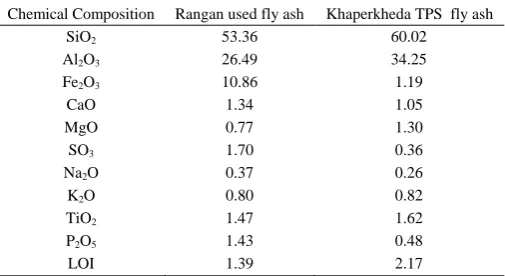
Fly ash used in the present work is procured from Khaperkheda Thermal Power Station (KTPS) Nagpur in Vidharbha region (Maharashtra/India) and is classified as the Low Calcium, Siliceous Fly ash. Table 1 provides the comparison of chemical composition of the fly ash used in the present study and that reported in the literature.
TABLE I: COMPARISON OF CHEMICAL COMPOSITION OF FLY ASH
Chemical Composition Rangan used fly ash Khaperkheda TPS fly ash
SiO2 53.36 60.02
Al2O3 26.49 34.25
Fe2O3 10.86 1.19
CaO 1.34 1.05
MgO 0.77 1.30
SO3 1.70 0.36
Na2O 0.37 0.26
K2O 0.80 0.82
TiO2 1.47 1.62
P2O5 1.43 0.48
LOI 1.39 2.17
Table I shows that for the fly ash used in the present study, the content of Fe2O3is less; and that of SiO2& Al2O3is very
high as compared to the fly ash used by Rangan [11]. The CaO content is less than 5%.
B. Computation of Materials
Table II (A) and (B) shows the material quantities for 1 cum of geopolymer concrete for various combination of parameters.
TABLEII:DETERMINATION OF QUANTITIES OF INGREDIENTS OF
GEO-POLYMER CONCRETE FOR 1CUM
(A)MASS RATIO OF ALKALINE LIQUID TO FLY ASH (FOR RATIO 2.50) Ratio of
alkaline liquid to fly ash
Mass of Alkalin e liquid
in Kg
Mass of NaOH Liquid in kg
Mass of Sodium silicate liquid in
kg.
Mass of Flyash
in kg. Fine aggregat
e in kg.
Coarse Aggregat
e in kg.
0.25 110.40 31.54 78.86 441.60 646.80 1201.20 0.30 127.38 36.38 91.00 424.60 646.80 1201.20 0.35 143.11 40.89 102.22 408.90 646.80 1201.20 0.40 157.71 45.06 112.65 394.30 646.80 1201.20
(B)MASS RATIO OF SODIUM SILICATE TO SODIUM HYDROXIDE
(FOR RATIO 0.35) Ratio Mass of alkaline
liquid in kg
Mass of NaOH liquid in kg
Mass of Sodium silicate liquid in kg
1.75 143.11 52.04 91.07
2.0 143.11 47.70 95.41
2.25 143.11 44.03 99.08
2.50 143.11 40.89 102.22
2.75 143.11 38.16 104.95
3.0 143.11 35.78 107.33
C. Casting and Testing of Cubes
Cylinders of size 100x200 mm have been prepared for various combinations of mix and tested for 28 days characteristic strength as per IS-516. The specimens are cured in ambient condition at room temperature and hot air oven curing condition at 60°, 75° and 90° temperature for 24 & 48 hours duration.
III. TEST RESULTS
Fig. 1 to figure 5 depicts the variation of compressive strength for various parameters and curing conditions.
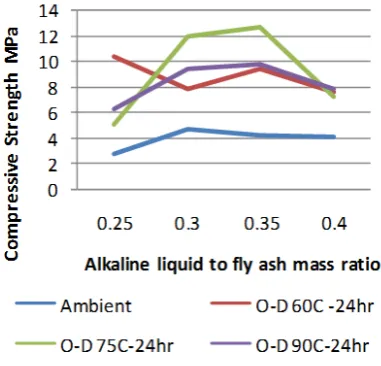
Fig. 1. Effect of mass ratio of alkaline liquid to fly ash for ambient and OD curing.
Fig 1 shows the effect of variation of parameter I, that is mass ratio of alkaline activator to fly ash on the compressive
strength for ambient and oven dry (OD) curing conditions under different temperatures. It is observed that optimum compressive strength is observed for oven dry curing at 750 C-24hr for the ratio 0.30 and 0.35, and 600c -24 hr for the ratio 0.25.
Fig. 2. Effect of mass ratio of alkaline liquid to fly ash for ambient and OD curing.
It is observed from Fig. 2 that optimum compressive strength corresponds to ratio of 0.30 and 0.35 under oven dry (OD) curing condition at 750 C for 48hr duration. There is marginal increase in compressive strength with increase in duration of curing from 24hrs to 48hrs.
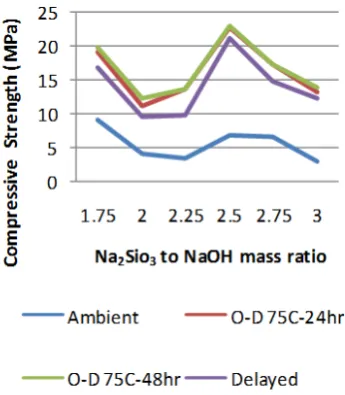
Fig. 3. Effect of mass ratio of sodium silicate to sodium hydroxide for ambient and OD curing
Fig. 3 shows the effect of variation of parameter II, that is mass ratio of sodium silicate to sodium hydroxide on the compressive strength for ambient and OD curing. The ratio of 2.5 provides optimum strength at all temperatures. Maximum compressive strength is observed in OD curing at 750 for24hr.
Fig. 4. Effect of mass ratio of sodium silicate to sodium hydroxide for ambient and OD curing
Fig. 5. Effect of molar concentration of sodium hydroxide for ambient and OD curing
Fig. 5 shows the effect of parameter III that is the molar concentration of NaOH solution in alkaline activator. As the molar concentration of sodium hydroxide liquid increases, compressive strength of concrete also increases. There is substantial increase in compressive strength observed for 12M-14M, whereas it is linearly increasing for 8M-12M. Compressive strength is substantially more in oven dried condition as compared to ambient curing condition.
IV. CONCLUSION
Locally available fly ash is found to be suitable for development of geo-polymer concrete. Since it is low Calcium fly ash as CaO content is 1.05%.
Mass density of geo-polymer concrete lies in the range of 2275 to 2350 Kg/cum. It is almost same as conventional concrete.
In view of role of alkaline activator, for parameter I, mass ratio of alkaline activator to fly ash for 0.25, 0.40, the optimum compressive strength of geo polymer concrete is
observed at 60°C; it is similar to previous studies. However, for ratio of 0.30, 0.35 the maximum strength is observed at 75°C.
For parameter II, mass ratio of sodium silicate to sodium hydroxide as 2.50, optimum compressive strength of geo polymer concrete is observed. It is same as previous studies.
For parameter III, molar concentration of sodium hydroxide solution, it is observed that compressive strength of geo-polymer concrete increases with increase in molar concentration. Substantial increase in 28 days average compressive strength is observed at 8M to10M & 12M to14M. The trend is similar to previous studies.
In oven dry curing condition at various temperatures for 24hr & 48hr duration, it is observed that compressive strength of geo polymer concrete did not increase substantially by increasing OD curing duration. Therefore, 24 hrs curing is considered sufficient and cost effective for all combinations of mix. This is similar to the recommendations of researchers.
The optimum combination of mix for development of geo polymer concrete is, mass ratio of alkaline liquid to fly ash as 0.35; and mass ratio of sodium silicate to sodium hydroxide as 2.50 in oven dry curing condition at 75°C for 24hrs. Similar ratios for these parameters are recommended in literature.
In oven dry curing, it is observed that even delayed oven dry curing by 8 days, also increase the compressive strength of concrete as compared to ambient curing; but it is less than regular oven dry curing.
While preparing workable mix in laboratory, it was observed that, higher water to geo-solids ratio is required to develop workable geo-polymer concrete. It is almost in the range of 0.24 to 0.28 for design mix, but researchers recommended water to geo solid ratio in the range of 0.16 to 0.24. It may be due to high percentage of SiO2 and Al2O3,
low percentage of Fe2O3 and CaO as compared to researchers
used fly ash.
V. DISCUSSION
Storage and disposal of huge quantity of fly ash, a waste material of coal fired thermal power station poses a great threat to pollution of air, water, and land. The utilization of this waste material for the production of cement-less concrete will certainly help in reducing the pollution impact to some extent.
In view of the studies on parameter I, that is mass ratio of alkaline activator to fly ash, all the ratios from 0.10 to 0.50 are studied, however, ratio of 0.25, 0.30, 0.35& 0.40 only are found to be workable. For the ratio of 0.10 to 0.20, mix cannot be prepared easily; more quantity of water is required and consequently very less compressive strength is observed.
For parameter II, that is mass ratio of sodium silicate to sodium hydroxide, the ratios from 1.0 to 3.0 are studied. It is observed that for ratios 1.0 to 1.50, alkaline liquid get solidified within 2-4 hrs for 12M concentration of NaOH and therefore, it could not be used to prepare mix. Similarly, 14M &16M solutions get solidified within an hour.
investigation it is observed that, 14M & 16M NaOH solution are more risky to handle than 12M solution. Also, the chances of solidification of alkaline activator are more with 14 &16 M solution than 12M. Hence 12 M NaOH solution is recommended for development of geo polymer concrete though its strength is slightly less than 14M & 16M solution. Ultimately the best combination of mix is with ratio 0.35, 2.50 and 12M NaOH solution.
In oven dry curing, 8 days delayed curing at 750 temperatures for 24 hr duration also increases the strength as compared to ambient curing. Delayed oven dry curing strength is less than the regular oven dry curing.
The study pertaining to various parameters of alkaline activator indicated that it plays a prominent role in the development of eco friendly and sustainable geo polymer concrete as an alternative to conventional concrete.
Subhash V. Joshi is a academician having twenty three years of teaching experience in Engineering and Technology field (Civil Engineering). Presently he is working as associate professor in civil engineering department of Shri Ramdeobaba college of Engineering and Management Nagpur India. He has completed his graduation in civil engineering in 1987 from Amravati university, Maharashtra state (India). He has earned post graduate degree MTech in Hydraulic engineering from VNIT Nagpur (India).
He is working as research scholar on the topic of geo-polymer concrete. He has recently published two papers in international journals and two papers in international conference on the topic of geo-polymer concrete, and many other papers in national conferences.
Mr. Joshi is closely associated with many professional bodies like Institution of Water Works Association, Institution of Engineers, Indian Society of Technical Education. He has guided many projects of undergraduate and post graduate students. He has worked in many organizing committees at the institute level.
Dr. Mahendra S. Kadu is an academician having twenty three years of teaching experience in engineering and technology field. Presently he is working as professor and head in civil engineering department of Shri Ramdeobaba college of Engineering and Management Nagpur India. He has completed his graduation in civil engineering in 1987 from Government college of Engineering Amravati university, Maharashtra state (India). He has earned post graduate degree M Tech in Hydraulic Engineering and Doctoral degree in Engineering and Technology from VNIT Nagpur (India). He has two ASCE publications in the field of Water Resources and Management. He has published five research papers in International journals, six research papers in international conferences and many others in national conferences. He has recently published six research papers in the area of Geo-polymer concrete in International and National conferences.
Dr. Kadu is closely associated with many professional bodies like Institution of Water Works Association, Institution of Engineers and Indian Society of Technical Education.
He has guided many projects of undergraduate and Post graduate students. He has worked in many organizing committees at the institute level. Presently he is working as chairman of board of studies (Civil Engineering) and member of Academic Council of faculty of Engineering and Technology; RTM university of Nagpur (India). He is guiding PhD scholars (8 no) in the area of Optimization of Engineering system and Geo-polymer concrete.
1 Faculty of Engineering Curtin University of Technology Perth, Australia, 2005.
[12] B. V. Rangan, “Mix design and production of fly ash based Geo polymer,”Indian concrete journalMay 2008, pp.7 – 14.
[13] S. V. Joshi and M. S. Kadu, “Effect of percentage of mass of combined aggregate on compressive strength of geo polymer concrete in oven dry curing condition,”International Journal of Advances in
Management, Technology and Engineering Sciences, vol. 1, no. 6,
March 2012, pp. 10-14.
REFERENCES
[1] D. M. Roy “Alkali-activated cements opportunities and challenges,”
Cement & Concrete Research, vol. 29, no.2 pp.249-254, 1999.
[2] V. M. Malhotra and P. K. Mehta, “High-performance, high-volume fly ash concrete: materials, mixture proportioning, properties,” Construction Practice, and Case Histories. Ottawa: Supplementary Cementing Materials for Sustainable Development Inc. 2002. [3] R. McCaffrey, “Climate change and the cement industry,” Global
Cement and Lime Magazine (Environmental Special Issue), pp. 15-19,
2002.
[4] A. Palomo, M. W. Grutzeck, and M. T. Blanco, “Alkali-activated fly ashes A cement for the future,”Cement and Concrete Research, vol. 29(8), pp. 1323-1329, 1999.
[5] H. Xu and J. S. J. V. Deventer, “The geo polymerisation of alumino-silicate minerals,” International Journal of Mineral
Processing, vol. 59, no. 3, pp. 247-266, 2000.
[6] J. Davidovits, “High-alkali cements for 21st century concretes,” Paper presented at the V. Mohan Malhotra Symposium on Concrete Technology: Past, Present And Future, University of California, Berkeley, 1994.
[7] Barbosa, “Synthesis and characterization of sodium polysialate inorganic polymer based on alumina and silica,” in Proc. Geopolymer
99 International Conference, France, 2000.
[8] J. T. Gourley, “Geo polymers; opportunities for environmentally friendly construction materials,” Paper presented at the Materials 2003
Conference on Adaptive Materials for a Modern Society, Sydney,
2003.
[9] Fernandez-Jiminez, A. and A. Palomo, “Characterization of fly ash: potential reactivity as alkaline cements,” vol 82, no.18, pp. 2259-2265. 2003.
[10] S. S. Bagchi and R.T. Jadhav, “Characterization of fly ash from koradi thermal power plant for its use as a pozzolona,”Journal IAEM, vol. 32, no.3, pp. 181–183, 2005.