This item was submitted to Loughborough’s Institutional Repository (https://dspace.lboro.ac.uk/) by the author and is made available under the
following Creative Commons Licence conditions.
For the full text of this licence, please go to: http://creativecommons.org/licenses/by-nc-nd/2.5/
Wireless Sensor Data Processing for
On-site Emergency Response
by
Yanning Yang
A Doctoral Thesis
Submitted in partial fulfilment of the requirements for the award of
Doctor of Philosophy of Loughborough University
(June 2011)
CERTIFICATE OF ORIGINALITY
This is to certify that I am responsible for the work submitted in this thesis, that the original work is my own except as specified in acknowledgments or in footnotes, and that neither the thesis nor the original work contained therein has been submitted to this or any other institution for a degree.
………. ( Signed )
ACKNOWLEDGEMENTS
There are numerous people who have provided support and guidance throughout the process of completing this thesis. Particular thanks are due to:
My supervisors Prof. Shuang-Hua Yang and Dr. Andrew May, who have both provided insightful suggestions and ongoing encouragement over many years. I am grateful that they were always available whenever I needed help. The technical support they offered helped me focus and stay on the right direction to achieve my goals. They helped me understand I was not doing the PhD alone.
My director of research Dr. Eran Edirisinghe, who provided useful guidance and support. The examiner of my end-of-year review meetings, Dr. Val Mitchell, who provided constructive feedback.
My father, Jianping Yang, and my mother, Suju Wang, who constantly supported me and encouraged me to continue. My uncle, Zhanhou Wang, who shared with me his valuable working experience in the area and clarified my confusion on a number of specific implementation issues. They have been a great strength to me. This thesis would not have been possible without their love and encouragement.
My friend Dace Rozenberga, who was with me during the most difficult times of my PhD and tried her best to help. My friend Yunqiu Li, who offered continuous friendship. My friend Raj Prasanna, who gave me lift to the interviews for data collection. All my friends in Holywell Park, especially Alexandra Alecu, Jatinder Gill, Khusvinder Gill, Hesham Abusaimeh, Yao Fang, HuanjiaYang, Xin Lu, Zaid Bin Ahmad, Ran Xu, and Carlos Insaurralde.
A number of members of staff from the Computer Science Department, who have provided assistance over the last three years. Particularly, Mr Gurbinder Singh Samra, Mrs Judith Poulton, Mrs Christine Bagley, and Dr. Roger Knott for doing their best to help. A member of staff in Holywell Park, especially Sharon Cook, Collette Nicole, and Jackie Cockburn.
ABSTRACT
This thesis is concerned with the problem of processing data from Wireless Sensor Networks (WSNs) to meet the requirements of emergency responders (e.g. Fire and Rescue Services). A WSN typically consists of spatially distributed sensor nodes to cooperatively monitor the physical or environmental conditions. Sensor data about the physical or environmental conditions can then be used as part of the input to predict, detect, and monitor emergencies. Although WSNs have demonstrated their great potential in facilitating Emergency Response, sensor data cannot be interpreted directly due to its large volume, noise, and redundancy. In addition, emergency responders are not interested in raw data, they are interested in the meaning it conveys. This thesis presents research on processing and combining data from multiple types of sensors, and combining sensor data with other relevant data, for the purpose of obtaining data of greater quality and information of greater relevance to emergency responders.
The current theory and practice in Emergency Response and the existing technology aids were reviewed to identify the requirements from both application and technology perspectives (Chapter 2). The detailed process of information extraction from sensor data and sensor data fusion techniques were reviewed to identify what constitutes suitable sensor data fusion techniques and challenges presented in sensor data processing (Chapter 3). A study of Incident Commanders’ requirements utilised a goal-driven task analysis method to identify gaps in current means of obtaining relevant information during response to fire emergencies and a list of opportunities for WSN technology to fill those gaps (Chapter 4). A high-level Emergency Information Management System Architecture was proposed, including the main components that are needed, the interaction between components, and system function specification at different incident stages (Chapter 5). A set of state-awareness rules was proposed, and integrated with Kalman Filter to improve the performance of filtering. The proposed data pre-processing approach achieved both improved outlier removal and quick detection of real events (Chapter 6). A data storage mechanism was proposed to support timely response to queries regardless of the increase in volume of data (Chapter 7). What can be considered as “meaning” (e.g. events) for emergency
responders were identified and a generic emergency event detection model was proposed to identify patterns presenting in sensor data and associate patterns with events (Chapter 8). In conclusion, the added benefits that the technical work can provide to the current Emergency Response is discussed and specific contributions and future work are highlighted (Chapter 9).
Keywords: sensor data processing, Data Fusion, Emergency Response, emergency
PUBLICATIONS
Journal Paper
Yang, Y., May, A. and Yang, S-H. (2010), Sensor data processing for emergency response, International Journal of Emergency Management, Vol. 7, Nos. 3/4, pp. 233-248.
Yang, Y., May, A. and Yang, S. H., A Generic State Model with Neighbourhood Support from Wireless Sensor Networks for Emergency Event Detection, International Journal of Emergency Management – Submitted
Conference Papers
Yang, Y., May, A. and Yang, S. H., Sensor Data Meaning Extraction for Emergency Response, In Proceedings of 18th TIEMS Annual Conference 2011, pp. 304-313.
Yang, Y., Prasanna, R., May, A. and Yang, L. (2010), Opportunities for WSN for Facilitating Fire Emergency Response, In Proceedings of IEEE International Conference on Information and Automation for Sustainability (ICIAfS) 2010, pp. 81-86.
Yang, Y., May, A. and Yang, S. H. (2009), Making Sensor Data Work for Emergency Response, In Proceedings of 16th TIEMS Annual Conference 2009, Istanbul, Turkey, June 9-11, 2009, pp. 231-240.
Yang, Y., May, A. and Yang, S. H. (2007), Emergency Information Management System Architecture, In Proceedings of 14th TIEMS Annual Conference 2007, Split, Croatia, June 5-8, 2007.
Abbreviations
ACTA : Applied Cognitive Task Analysis ART : Adaptive Resonance Theory
CADET : Critical Action and Decision Evaluation Technique CIM : Computation Independent Model
DEM : Department of Environmental Management DRA : Dynamic Risk Assessment
DSM : Data Storage Mechanism
EIMS : Emergency Information Management System EM : Emergency Management
EM : Expectation Maximization ER : Emergency Response
ERM : Emergency Response Management ERS : Emergency Response Systems
FEMA : Federal Emergency Management Agency GDCTA : Goal Directed Cognitive Task Analysis GDIA : Goal Directed Information Analysis GDTA : Goal-Driven Task Analysis
GIS : Geographical Information System GPS : Global Positioning System
HTA : Hierarchical Task Analysis IC : Incident Commander
ICS : Incident Command System
IESD : Information Extraction from Sensor Data IMAS : Influence Modelling and Assessment Systems ISIS : Incident-Site Information Space
JDL : Joint Directors of Laboratories
KDSD : Knowledge Discovery from Sensor Data LMS : Least-Mean-Square
MDA : Model Driven Architecture MDAS : Model-Driven Architecture Stack NAND : Negated AND
NMSE : Normalized Mean Square Error NS : Neighbourhood Support
NSSL : National Severe Storms Laboratory OAET : Operator Action Event Trees PIM : Platform Independent Model PSM : Platform Specific Model
RI : Rhode Island
RMSE : Root Mean Square Error RQ : research question TAM : Task Analysis Method VR : Virtual Reality
TABLE OF CONTENTS
Chapter 1. Introduction ... 1
1.1 Background to the Research ... 1
1.2 Research Challenges ... 4
1.3 Motivation ... 5
1.4 Research Questions and Objectives ... 5
1.5 Research Road Map ... 7
1.6 Contributions of the Research ... 10
1.7 Organization of the Thesis ... 11
1.8 Acknowledgements ... 13
Chapter 2. Literature Review: Emergency Response ... 15
2.1 Emergency Response: Theory and Practice ... 15
2.1.1 Emergency management and emergency response ... 15
2.1.2 Different roles and responsibilities in emergency response ... 17
2.1.3 Incident commander in the first responders group ... 20
2.2 Technology Aids in Emergency Response ... 28
2.2.1 Architecture proposals ... 28
2.2.2 Geographical information and mapping technologies ... 29
2.2.3 Modelling and simulation ... 30
2.2.4 Communication based messaging services ... 31
2.2.5 Wireless sensor networks for emergency response ... 31
2.2.6 Robots search and rescue ... 34
2.3 Lessons Learned ... 34
3.1 Information Extraction from Sensor Data ... 38
3.2 Sensor Data Pre-Processing ... 39
3.2.1 Sensor data cleaning ... 40
3.2.2 Missing values recovery from sensor data ... 42
3.2.3 Sensor data reduction ... 44
3.3 Sensor Data Mining ... 45
3.3.1 From traditional data mining to sensor data mining ... 45
3.3.2 What constitutes a suitable sensor data mining algorithm ... 48
3.3.3 Sensor data mining applications ... 50
3.4 Sensor Data Post-processing ... 50
3.4.1 Pattern evaluation ... 50
3.4.2 Data visualization ... 51
3.5 Sensor Data Fusion ... 51
3.6 Summary ... 52
Chapter 4. Study of Incident Commanders’ Requirements ... 58
4.1 Introduction ... 59
4.2 Aims and Objectives ... 60
4.3 Methods ... 60
4.4 Analysis and Results ... 62
4.4.1 Goals and priorities ... 62
4.4.2 Decisions required to achieve the goals ... 63
4.4.3 Summary of information needed ... 64
4.4.4 Summary of information not needed ... 65
4.4.5 Current means of information acquisition ... 66
4.4.6 Opportunities for technologies ... 68
Chapter 5. On-site Emergency Information Management System
Architecture ... 77
5.1 The Scope of On-site EIMS ... 78
5.2 Goal-Driven Architecture Design ... 79
5.3 The Enhanced Goal-Driven Architecture Design ... 81
5.3.1 Adaptive to different incident stages ... 81
5.3.2 Fusion of multiple data sources ... 85
5.4 EIMS Architecture ... 87
5.5 Function Specification of EIMS ... 89
5.5.1 Before incident - System diagnosis and early detection ... 89
5.5.2 During incident - Monitoring the incident ... 91
5.5.3 After incident – Update and upload knowledge base ... 92
5.6 Discussion and Conclusions ... 93
Chapter 6. Data storage Mechanism ... 96
6.1 The Need for a Different Data Storage Mechanism ... 97
6.2 Features of Sensor Data ... 98
6.3 Features of Emergency Response Applications ... 100
6.4 The Proposed Sensor Data Storage Mechanism ... 100
6.4.1 Database schema for building fire safety ... 101
6.4.2 Time-driven sensor data management ... 103
6.4.3 Adaptive support for different incident stages ... 105
6.5 Performance Evaluation of the Proposed Data Storage Mechanism ... 109
6.5.1 Experiment setup ... 109
6.5.2 Performance metrics ... 111
6.6 Conclusions ... 114
Chapter 7. Sensor Data Cleaning ... 116
7.1 The Need for a Suitable Sensor Data Cleaning Approach for on-site ER ... 117
7.2 The Proposed State-Aware Kalman Filter ... 118
7.2.1 Kalman Filter ... 118
7.2.2 The initial simulation of Kalman Filter ... 119
7.2.3 State-awareness rules ... 122
7.2.4 State-awareness rules integrated with the Kalman Filter ... 123
7.3 Performance Evaluation ... 124
7.3.1 Simulation implementation and results ... 124
7.3.2 Performance evaluation based on data collected from the field trial ... 129
7.4 Conclusions ... 134
Chapter 8. Meaning Extraction from Sensor Data ... 135
8.1 The Need for a Meaning Extraction Method for on-site ER ... 136
8.2 Ways of Conveying Meaning in the Context of ER ... 137
8.3 Event Detection ... 139
8.3.1 Threshold-based event detection ... 139
8.3.2 Tempo-spatial pattern based event detection ... 140
8.4 A Generic State Model for Emergency Event Detection ... 141
8.4.1 Sensor level state model ... 143
8.4.2 Neighbourhood support ... 144
8.4.3 Network level fusion ... 145
8.5 Application of State Model with NS to Threshold-based Event Detection ... 145
8.5.1 Single node system with multiple types of sensors ... 145
8.6 Application of state model with NS to tempo-spatial pattern based event detection ... 147 8.7 Performance Analysis ... 150 8.7.1 Performance metrics ... 150 8.7.2 Parameters considered ... 151 8.7.3 Simulation setup ... 151 8.7.4 Performance evaluation ... 153 8.8 Conclusions ... 157
Chapter 9. Conclusions and Future Work ... 160
9.1 Summary ... 160
9.2 Research Objectives Revisited ... 161
9.3 Contributions to Knowledge ... 165
9.4 Future work ... 171
References ... 174
Appendix ... 189
I. Interviews of Incident Commanders ... 189
II. Architecture Models for Each Captured System Action (in ArchiMate language)
List of Figures
Figure 1-1: Research road map ... 9
Figure 1-2: Structure of thesis ... 14
Figure 2-1: The process of emergency management ... 16
Figure 2-2: ICS structure as the scale and complexity of the incident increases ... 20
Figure 2-3: ICs’ tasks and decisions ... 23
Figure 3-1: The overall process of information extraction from data ... 39
Figure 3-2: Possible causes of data quality problems in sensor networks ... 39
Figure 3-3: An adaptive modular architecture of sensor data mining ... 46
Figure 3-4: Hierarchical cascades of ART neural-network classifiers implemented in units of a sensor network ... 47
Figure 3-5: The JDL data fusion framework ... 52
Figure 4-1: Framework of user requirement analysis ... 62
Figure 4-2: Using name tags at entry control ... 67
Figure 4-3: Mean of communicating information ... 67
Figure 4-4: Fire-fighters performing Left Hand Search ... 70
Figure 4-5: Fire-fighters using guideline ... 71
Figure 4-6: Projection of the future based on history of fire development ... 72
Figure 4-7: Fire-fighters carrying out the doorway procedure ... 75
Figure 5-1: Typical ERS framework ... 78
Figure 5-2: Goal-action diagram before an incident ... 83
Figure 5-4: Requirements breakdown after an incident ... 84
Figure 5-5: Diagram of emergency information system architecture ... 87
Figure 5-6: System diagnoses flowchart ... 90
Figure 5-7: Early detection of possible incidents flowchart ... 91
Figure 5-8: Real-time data monitoring flowchart ... 92
Figure 5-9: Update and upload knowledge base flowchart ... 92
Figure 6-1: Overall database schema ... 102
Figure 6-2: The real-time sensor data volume space ... 103
Figure 6-3: Different partitioning scheme on the real-time sensor data space ... 105
Figure 6-4: Adaptive data sampling ... 106
Figure 6-5: Database storage mechanism experiment design ... 110
Figure 7-1: The Kalman Filter cycle ... 118
Figure 7-2: An example plot of the simulated data ... 120
Figure 7-3: The result of the initial simulation of Kalman Filter ... 122
Figure 7-4: The iterative cycle of the state-aware Kalman Filter ... 124
Figure 7-5: The block diagram of the simulation system ... 125
Figure 7-6: An example plot of data simulation with multiple sensors ... 126
Figure 7-7: Performance evaluation of data cleaning approaches on temperature sensors ... 127
Figure 7-8: Performance evaluation of data cleaning approaches on smoke sensors . 128
Figure 7-9: Performance evaluation of data cleaning approaches on smoke sensors . 128
Figure 7-11: The block diagram of testing system based on field trial data ... 130
Figure 7-12: An example plot of raw sensor data (NodeID: 3) ... 130
Figure 7-13: Temperature sensor data cleaning ... 131
Figure 7-14: Flame sensor data cleaning ... 132
Figure 7-15: Smoke sensor data cleaning ... 132
Figure 7-16: CO sensor data cleaning ... 133
Figure 8-1: The intuition of spatial based event detection ... 141
Figure 8-2: Sensor level state model ... 143
Figure 8-3: The block diagram of the simulation system ... 152
Figure 8-4: An example simulated data for a sensor node in a 5×5 network for the duration of 300s ... 153
Figure 8-5: Performance comparison 1 ... 155
Figure 8-6: Performance comparison 2 ... 157
Figure AII-0-1: Architecture model for the system action: Prompt users to update the information and store the most up-to-date information ... 192
Figure AII-0-2: Architecture model for the system action: Run regular test and generate report on faulty parts ... 192
Figure AII-0-3: Architecture model for the system action: Generate warning of abnormal phenomenon detected ... 193
Figure AII-0-4: Architecture model for the system actions: Generate real-time monitoring of incident, integrate location map/floor plan with real-time incident development ... 193
Figure AII-0-5: Architecture model for the system action: Integrate dynamic risks with floor plan ... 194
Figure AII-0-6: Architecture model for the system action: Calculate historical trends and forward projection, and display them on request ... 194
Figure AII-0-7: Architecture model for the system action: Store resources information, integrate them with location map/floor plans ... 195
Figure AII-0-8: Architecture model for the system action: Store the statistical information of the incident ... 195
List of Tables
Table 2-1: A summary of task analysis methods ... 25
Table 2-2: Comparison of GDCTA, ACTA and GDIA ... 27
Table 3-1: The characteristics of the existing sensor data cleaning methods ... 42
Table 3-2: Example techniques in information extraction from sensor data ... 53
Table 3-3: Comparison of distributed and centralized sensor data mining ... 56
Table 6-1: Adaptive data sampling algorithm (Pseudo code) ... 107
Table 6-2. Adaptive data compression algorithm (Pseudo code) ... 108
Table 6-3: Summary ... 108
Table 6-4: Create Table Commands ... 110
Table 6-5: An example set of queries ... 111
List of Symbols
Symbols Meanings
a A value that is less than the pre-defined consecutive time T A The state transition model that applies to the previous state
T
A The transpose of A
B The control input model that applies to the control input vector
L
C The contour map extracted from the live sensor reading
E
C The pre-defined contour map event patterns
cf The confidence associated to the neighbourhood level alarm CF The level of severity of the abnormal state at the network level
( )
d t Neighbourhood level alarm ( , )j i
dis s s The distance from sensor node sj to si
D The set of measured data from sensor network ( )
D t The network level alarm
f The current sampling frequency
fA(t) The storage cost of the partitioned database at each minute t
fB(t) The storage cost of the database without partitioning at each minute t
fL The lowest acceptable sampling frequency
fU The highest acceptable sampling frequency
F Fire spread model
FN The number of actual (true) events that are not detected
FP The number of detected events which are not actual (true) events g: the pre-defined compression granularity
k
G Kalman Gain at the kth time instance
H The observation model which maps the state space into the observed space
HT The transpose of H I The identity matrix
s
l Level of support
m The number of sensor types
n The total number of warning levels
i s
N The neighbourhood of sensor node s
i
2
S
N The number of neighbours who are in suspicious state
n
N The total number of neighbours NS Neighbourhood Support
N Network size, which is the length of the square N N× grid
NE The estimation of the sensor reading under normal conditions o Outlier rate
O Outliers
Ol The lower bound of the pre-defined normal range for an incoming
observation
Ou The upper bound of the pre-defined normal range for an incoming
observation
1, 2, , r
1, 2, , l
p p L p l number of partitions by the range of location
1, , ,2 t
p p L p t number of partitions by the range of time Pc The compressed partition
Pw The working partition
ˆ
k
P The a posteriori error covariance matrix at the kth time instance
k
P The error covariance at the kth time instance
L
P The pattern extracted from live sensor data
N
P The pre-defined normal pattern of behaviour Q The process noise covariance
Qa The compressed data cell
Qb A data cell in the working partition
r The radius from sensor node si
R The measurement noise covariance
Rl The lower bound of the pre-defined normal range for the rising rate
Ru The upper bound of the pre-defined normal range for the rising rate
RRi The rising rate of sensor i
smoke
RR The rising rate of smoke sensor
CO
RR The rising rate of CO sensor
2
CO
RR The rising rate of CO
2 sensor
s The state of a sensor
i
s Sensor node
S2 Suspicious/checking state
S3 Abnormal state
S4 False alarm state
t The time when an event of interest occurs t Simulation time duration
T A pre-defined consecutive time
th The pre-defined threshold for the level of support THi The pre-defined threshold for the rising rate of sensor i
THsmoke The pre-defined threshold for the rising rate of smoke sensor
THCO The pre-defined threshold for the rising rate of CO sensor
2
CO
TH The pre-defined threshold for the rising rate of CO2 sensor TP The number of correctly detected events
1
k
u − The control input vector
k
v The measurement noise
v: (t,l,r) The data volume in the range of time, area of location and range of sensor readings
w A random noise
1
k
w − The process noise
W The level of warning (the Level of Severity)
x The state of a Kalman Filter system
k
x The current state of a Kalman Filter system at the kth time instance
1
k
ˆk
x The a posteriori state estimation at the kth time instance
k
z The measurement at the kth time instance
μ
The mean of normal readings according to the domain knowledgetemp
μ
Average room temperature under normal conditionssmoke
μ Average smoke level under normal conditions
CO
μ Average CO reading under normal conditions
Flame
μ Average Flame reading under normal conditions
~
= Pattern match
~
Chapter 1.
Introduction
1.1 Background to the Research
Emergency Response (ER) has always been important for minimizing the damage and the loss of life and property as natural and man-made disasters continue to occur. Nowadays, the importance of ER has received increasing recognition throughout the world. The demand for efficient ER has been highlighted by “the responses to the 9/11, terrorist attack on the World Trade Centre, Hurricane Katrina in the southern U.S., and the July 7 London bombings” (Yang, L. et al., 2009). In recent years, especially after 9/11, ER has become an area that has been receiving rapidly growing interest from researchers worldwide. Researchers from a diversity of backgrounds, including public administration, control engineering, and computing and communication technologies, have all put effort into developing means of improving the efficiency and effectiveness of ER.
The prevalent problems that may affect the efficiency and effectiveness of ER can be classified into three categories: sociological, organizational and technological, as summarized by Manoj and Baker (2007). Sociological issues consist of many aspects, including 1) the lack of understanding on human behaviour models and the impact of such models on emergency response technology system design, 2) the interoperability issue among different responding agencies, and 3) the issue of trust both in terms of establishing trust among different responding groups to share and communicate critical information and in terms of the lack of trust from emergency responders in terms of adoption of new technology, etc. Organizational issues occur as an organisation of people different from what the responding groups commonly practise emerges and must be adopted during emergency response and recovery.
A number of technological issues related to ER have been recognised and addressed by researchers over the recent decade, e.g. lack of communication systems within one responding agency and among different responding agencies, lack of decision support
systems, etc. Out of all the specific technological issues addressed by researchers, the most well recognised one is the lack of means of rapid gathering and communicating of critical information by the emergency responders during their responding to emergencies.
The importance of the availability of information and the means of communicating information has been recognised in the literature for over a decade. “In the absence of data and information, emergency response is simply well-intended guesswork that will most likely result in significant loss of human life” (Erickson, 1999).
In the modern world, successful emergency response not only demands effective management and command, coordination and cooperation from different responding crews, but also requires substantial support from technologies to provide the required information to the right person at the right time in the right format (Carver and Turoff, 2007; Manoj and Baker, 2007; Prasanna et al., 2007; Turoff, 2002; Yang, 2007). The people within an emergency responding agency can be classified into two categories: control centre staff and first responders.
Although different technology aids to ER have been proposed, most of the existing research focuses mainly on providing technology support to the control centre staff. Examples of technology support for control centre staff include: cascading web map services and Geographical Information System (GIS) web services (Vasardani and Flewelling, 2005), and remote sensing (Hutton and Melihen, 2006). The main advantage of such technology aids is that they enable better understanding of the whole picture of view within a region regarding incidents and available resources. As a result, better command and coordination of the available resources within the region can be achieved.
First responders are the teams offering immediate help to victims in case of an emergency. They are “the primary link in the chain of information exchanges that leads to making critical, perhaps lifesaving, decisions” (Sawyer et al., 2004).
However, there is a lack of technology support for first responders, who are usually deployed to the premises as soon as an incident occurs and act as the front-line soldiers in responding to incidents. Examples of first responders include fire-fighters, paramedics and police. Yang and Fredrick (2006) revealed that “during fire incidents,
when the first responders arrive on site, they have very limited information about the building, occupants and/or the location of the hazard”. Such lack of information could result in a delay in making decisions about whether or not to enter the building, whether it is safe to enter, whether the priority is to search and rescue occupants or other tasks and how to most efficiently deal with the hazard. The result of wrong decisions due to the lack of information could be fire-fighter deaths and casualties. For example, the death of up to four fire-fighters (BBC news, 2007) while tackling a warehouse blaze in Warwickshire highlighted the dangers of having limited information on the building. According to the latest published fire statistics in the UK (Fire Statistics, 2009), there were 6 fire-fighter deaths and 268 fire-fighter casualties in 2007, 2 fire-fighter deaths and 350 fire-fighter casualties in 2006. These numbers clearly demonstrate the requirement for better first responder support.
Researchers have identified that both “outside building information” and “inside building information” are required to provide a full picture of view in the event of an emergency (Hansen, 2007). Some of the latest Emergency Response Systems (ERS), which are technical systems that provide support to emergency responders, have integrated technologies such as Global Positioning System (GPS) to help emergency responders arrive on site as quickly as possible. However, little information from inside of the building is provided by current ERS. On arrival at an incident premise, Incident Commanders (ICs) have to assess the situation by observing from the outside, asking people who have been in the building or people who know, or checking the facilities provided by commercial buildings such as operation panels to identify which zone a fire incident is in. However, very limited information is typically available and these ways of obtaining information about the nature of an incident inside buildings are often time-consuming and inaccurate.
Wireless Sensor Network (WSN) is an emerging technology that has demonstrated its potential in providing the “inside building” information (Yang and Fredrick, 2006). They can provide increased situation awareness that is important for emergency responders (Yang, L. et al., 2009). WSNs typically consist of battery powered, low cost, resource limited sensor nodes that can be deployed across areas of varying sizes to autonomously form wireless networks (Tanenbaum, 2003). Sensor nodes can even be deployed in harsh environment where human access is difficult, and they can transfer real-time data about the occurrence and spread of an incident (such as a fire)
out of the network. The raw data collected from WSNs must be processed and converted into information, which is data that has meaning to an individual within a context of use. It is not until the raw data is converted into meaningful information about the environment being monitored that it can be interpreted by first responders and used by them to better plan their response to incidents.
This thesis focuses on first responders. It investigates the process and techniques of using data from WSNs to meet the information needs of first responders to facilitate the overall response to incidents.
1.2 Research Challenges
Using data from WSNs to satisfy the information needs of first responders presents a number of challenges which must be addressed if they are to be at practical use.
Although WSNs have promising and already successful applications in areas such as habitat monitoring, supply chain management, etc., they are known for having energy constraints and limited resources. Moreover, data from WSNs has different characteristics compared to those of traditional data. The constraints of WSNs and the special features of sensor data raise challenges in sensor data processing approaches, e.g. data storage, data cleaning and meaning extraction, because algorithms and approaches different from those designed for traditional data processing may be required.
The on-site ER environment presents a potential challenge as well. The nature of an incident is dynamic and highly demanding. Real-time or near real-time data retrieval, processing and management is required. However, the resources for computation and communication may be limited at an incident site. Therefore, meeting the demanding performance requirements under resource constraints could be a challenge.
In addition, this thesis aims to establish a link between technology and human factors perspectives, through an investigation of making sensor data ‘work’ for emergency response. Identifying technology capabilities of WSN that can ultimately impact on better situation awareness and other usability aspects of emergency responders
presents potential challenges and this is tackled by incorporating a user-centred design perspective within this thesis (Noyes and Baber, 1999).
1.3 Motivation
This research was driven by the motivation to make a contribution to knowledge in both human factors and sensor data processing. Although this research wanted to focus on technological development, it wanted to base this on a clear understanding of the relevant human factors issues, and particularly the user needs of the ICs.
Most of the existing research in the area of Emergency Management (EM) is either from a pure technology perspective or from a pure human factor perspective. Taking a more multidisciplinary approach and establishing a clear link between the two will provide benefit to researchers from both a technology perspective and a human factor perspective. In particular, identifying the real gaps existing in information gathering in current ER and opportunities for technology to fill in the gaps links users’ need with technology capabilities.
The motivation for this research was also driven by the potential benefits that sensor data processing technology can bring to ICs in facilitating the response to emergencies and reducing the risk of first responders being injured. As a result, a more effective ER may be accomplished, which can also bring benefits to the people who are under risk during an emergency, e.g. fire-fighters and building occupants.
The study of how a specific technology (sensor data processing) can bring benefit to users (first responders) prior to, during and after the design and implementation of the technology itself can provide considerable benefits to both researchers and users.
1.4 Research Questions and Objectives
This research aims to establish a link between what WSNs can provide and what first responders require. It focuses on the design and implementation of sensor data processing approaches that are suitable for facilitating first responders during their on-site ER.
The list of research questions (RQ) considered, and the specific research objectives associated with each research question to obtain the research aim, are described as follows:
RQ1: Out of all the potential user groups existing in the ER domain, which is the user
group that can benefit the most from the information provided by sensor data?
Objective associated with RQ1: Investigate the existing literature available on ER
from a human factors’ perspective to understand the generic theory and practice in ER as well as to choose a targeted user group in the first responders.
RQ2: What are the goals, tasks, information requirements of the targeted user group? RQ3: What are the opportunities for WSN technology to address the gaps related to
retrieving the required information?
Objective associated with RQ2 and RQ3: Understand the goals, tasks and
information requirements of the chosen user group through interviews and observations, with the purpose of identifying gaps in the current ER practice and analysing potential opportunities for the use of technology.
RQ4: How can the technology capabilities of WSN be implemented in an on-site ER
system?
Objective associated with RQ4:
• Research the existing literature available on information extraction from sensor data, and the associated process and techniques of information extraction from sensor data.
• Design a suitable system architecture for a WSN-based Emergency Information Management System (EIMS); specify the system functions and the associated system components.
RQ5: What constitutes a suitable sensor data storage mechanism for on-site ER? Objectives associated with RQ5:
• Evaluate and propose a suitable data storage mechanism for the WSN-based EIMS, with an emphasis on managing and maintaining the query efficiency regardless of the increase of data volume.
• Evaluate the efficiency of the proposed data storage mechanism and its cost-effectiveness.
RQ6: What constitutes a suitable sensor data cleaning approach for on-site ER? Objectives associated with RQ6:
• Analyse and propose a suitable data cleaning approach for the WSN-based EIMS, with the emphasis on separating outliers from real environmental changes and dealing with them separately.
• Evaluate the effectiveness of the proposed data cleaning approach in comparison to the existing data cleaning approaches.
RQ7: How to extract the defined “meaning” from sensor data? Objectives associated with RQ7:
• Analyse and specify what “meaning” can be in the context of WSN-based on-site EIMS, and propose a meaning extraction approach.
• Evaluate the performance of the proposed meaning extraction approach and discuss its application.
1.5 Research Road Map
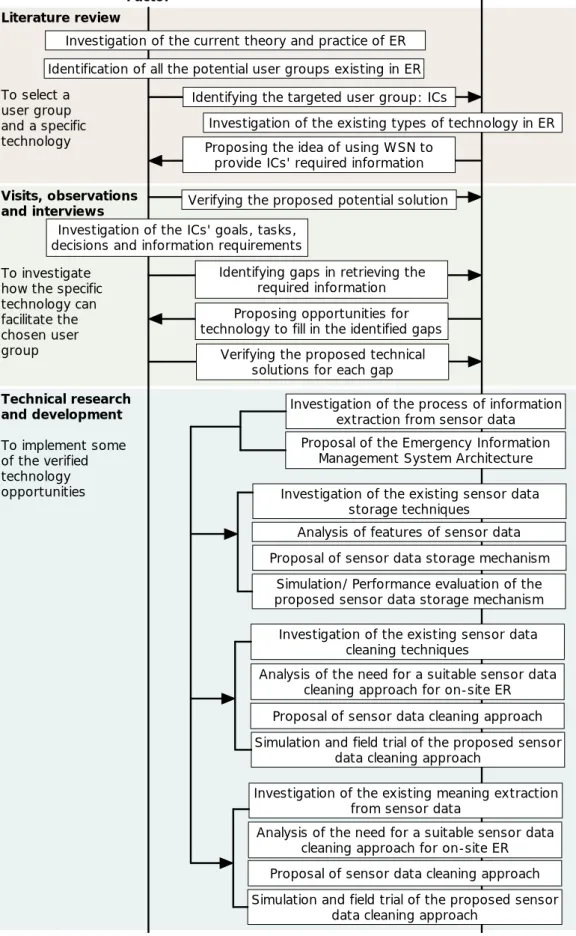
In order to establish the link between human factors and technology, an on-going cycle of identifying problems with a human factor or user-centred analysis, proposing technical solutions and verifying the solutions was undertaken.
The initial cycle was mainly based on a literature review. This phase focused on establishing the general link between human factors and technology (the selection of a user group and a specific technology). The initial human factors analysis identified the targeted user group, ICs, based on the literature review undertaken in order to
understand the current theory and practice in ER and to identify and analyse potential user groups. The literature review of existing types of technologies in ER suggested that WSN has great potential in providing the “inside” building information that may benefit the ICs. This initial proposal of using WSN to facilitate the ICs was positively received in interviews undertaken later.
The cycle was continued by undertaking visits to the Derbyshire fire and rescue service, observations and interviews with senior officers who can act as ICs in case of an incident. This phase further investigated the targeted user group and the specific technology. The aim during this phase was ultimately to answer the question “How can WSN be utilised to facilitate ICs?” The information requirements of ICs were identified through the analysis of their goals and tasks. Gaps in retrieving relevant information were identified and a list of opportunities for the use of technology was proposed. Each proposed opportunity targets an identified gap relating to the needs of the IC, and feedback on the proposed technical solutions was gathered from formal interviews and informal email contacts.
Further technical research was undertaken based on some of the verified technology opportunities. During this phase, the existing research on information extraction from sensor data was investigated, in order to understand the process and evaluate the available data fusion techniques. A system architecture was proposed and a detailed technique for each component of the system (sensor data storage, sensor data cleaning and meaning extraction) was proposed and evaluated in simulations and experiments. A road map of the research, which demonstrates the link between technology and human factors during these cycles, is shown in Figure 1-1.
Technical research and development To implement some of the verified technology opportunities Visits, observations and interviews To investigate how the specific technology can facilitate the chosen user group Literature review To select a user group and a specific technology Human Factor Technology
Investigation of the current theory and practice of ER Identification of all the potential user groups existing in ER
Identifying the targeted user group: ICs
Investigation of the existing types of technology in ER Proposing the idea of using WSN to
provide ICs' required information Verifying the proposed potential solution Investigation of the ICs' goals, tasks,
decisions and information requirements
Verifying the proposed technical solutions for each gap Proposing opportunities for technology to fill in the identified gaps
Proposal of the Emergency Information Management System Architecture
Proposal of sensor data storage mechanism Investigation of the existing sensor data
storage techniques
Simulation/ Performance evaluation of the proposed sensor data storage mechanism Identifying gaps in retrieving the
required information
Investigation of the process of information extraction from sensor data
Analysis of features of sensor data
Proposal of sensor data cleaning approach Investigation of the existing sensor data
cleaning techniques
Simulation and field trial of the proposed sensor data cleaning approach
Analysis of the need for a suitable sensor data cleaning approach for on-site ER
Proposal of sensor data cleaning approach Investigation of the existing meaning extraction
from sensor data
Simulation and field trial of the proposed sensor data cleaning approach
Analysis of the need for a suitable sensor data cleaning approach for on-site ER
1.6 Contributions of the Research
The contributions of the research detailed in this thesis are composed of five parts. They are summarized here as follows:
1. A comprehensive analysis of ICs’ goals, tasks/decisions, information needs, and their feedback on the proposed technology opportunities. This established a link between user requirements and technology capabilities, with the emphasis on the added benefits that the technology can provide to the users. 2. The proposal of an emergency information management system architecture
that addresses the dynamic nature of ER and can facilitate ER before, during and after incidents. The proposed architecture can also be flexibly applied to develop emergency detection systems, risk assessment systems, decision support systems, historical statistics or an integrated multi-purposes emergency response support system according to different contexts of use.
3. A proposed data storage mechanism that accommodates the challenges presented by the features of sensor data as well as maintaining efficiency for the entire ER process. Simulations demonstrated that the proposed data storage mechanism can provide the benefit of efficient querying with neither additional updating cost nor the introduction of unacceptable storage costs.
4. The proposal of a state-aware data cleaning approach for ER. This can fill in the gap relating to the fact that existing data cleaning approaches only produce a compromise between the observations and the system estimation regardless of the state. In comparison, the proposed data cleaning approach can not only reduce noise, but also remove outliers and quickly detect the real environmental changes.
5. A generic model for emergency event detection. This utilises the temporal-spatial correlations typically existed in WSNs in the form of Neighbourhood Support to improve the detection accuracy. The model can apply in both threshold-based event detection and tempo-spatial pattern-based event detection. Simulations demonstrated that applying this model can improve the
efficiency and accuracy of the existing event detection algorithms in both of the two categories of event detection.
All of the contributions aim to create suitable sensor data processing approaches to help satisfy the information requirements for ICs, and consequently facilitate ER.
1.7 Organization of the Thesis
The thesis was organized as follows:
Chapter 1 (this chapter) has introduced the background to the research and put the
focus of the thesis into context. It has also identified the potential challenges to and the motivation behind the undertaking of the research. The scope of the thesis has been outlined, and the aims and objectives of the research have been identified. In addition, the road map of the thesis demonstrating the link between technology and human factor has been described, and the contributions of the thesis have been summarized.
Chapter 2 was a literature review. The two main purposes of the literature review
were to understand the theory and practice of current ER, and to identify how the existing types of technologies can assist the information needs of users in ER. As a result of the review of the current theory and practice in ER, different user groups were identified and ICs were selected as the targeted user group. Then the existing types of technologies were reviewed with the emphasis of how they can assist the required information needs, resulting in the selection of WSN to be further investigated.
Chapter 3 investigated the existing literature on information extraction from sensor
data, as it was identified that it still remains a challenge to make sense of the large amount of data collected from WSN. The process and techniques of information extraction from sensor data were reviewed. Arguments on what constitute a suitable sensor data processing approach were summarized, and general recommendations of suitable sensor data processing approach were derived.
Chapter 4 presented the study of the ICs’ requirements, with the aim of identifying
opportunities for WSN for facilitating fire emergency response, and determining the focus of further technical work. A goal-driven task analysis method was adopted and
further extended to extract goals, tasks, information requirements and opportunities for technology to provide added benefits to ICs. A list of eight technology opportunities was identified and some of them were taken forward for further technical work.
Chapter 5 proposed an architecture for an on-site EIMS, for incorporating WSN
capabilities to provide Emergency Information. Its scope and characteristics were defined, the design requirements were summarized. The main components of the system and the interaction between components were discussed. In addition, system functions before, during, and after incidents were specified.
Chapter 6 proposed a data storage mechanism designed for storing and managing data
for on-site ER purposes. A comprehensive analysis of the features of sensor data was described, and the requirements of ER applications were evaluated. The detailed design of the data storage mechanism was discussed. Simulation results demonstrated that the proposed data storage mechanism can maintain the query efficiency as the real-time sensor data continues feeding into the database, and this was achieved with neither additional updating cost nor introduction of unacceptable storage costs.
Chapter 7 proposed a data cleaning approach. The feature of the typical existence of
‘noise’ in sensor data was addressed in the chapter. A set of state-awareness rules was proposed in order to address the issue that the existing data cleaning approaches do not take states into consideration and thus cannot separate outliers from real environment changes. The data cleaning experiments demonstrated that by integrating the state-awareness rules with a Kalman Filter, the resulting state-aware Kalman Filter can reduce noise and remove outliers, as well as quickly detect real changes in the environment.
Chapter 8 proposed an approach for meaning extraction from sensor data. One of the
examples of “meaning” in the context of on-site ER can be defined as the occurrence and development of a fire incident. Therefore the meaning extraction problem can be converted into an event detection problem. The sensor state model was further developed and applied to two categories of event detection: threshold-based event detection and tempo-spatial pattern based event detection. Simulation results demonstrated that the proposed event detection approach can improve the detection
efficiency and accuracy in both categories of event detection. False alarm rate can be reduced to 30%.
Chapter 9 concluded the thesis. This stated what are felt to be the most important
contributions of the thesis, and identified future research questions that have emerged from the research contained in this thesis.
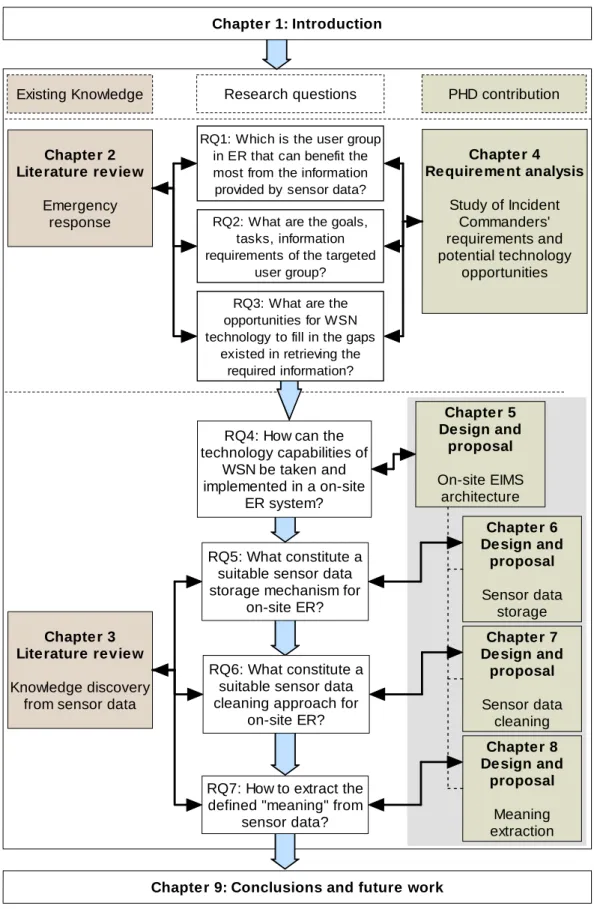
The structure of the thesis is shown in Figure 1-2. The figure demonstrates the relationships between the existing knowledge, the research questions posed and the studies undertaken in each chapter to address the research questions.
1.8 Acknowledgements
The work reported in this thesis was entirely undertaken by the author except Chapter 4.
The work contained in Chapter 4 is a study of the ICs’ requirements. The data analysis contained in the chapter was designed, managed and completed by the author. The analysis and findings in the chapter were partly based on the author’s data collection from the visits to Derbyshire and Leicestershire Fire and Rescue Services and 2 interviews with ICs. The analysis and discussion was also based on additional, interviews and data collection undertaken by Raj Prasanna in the Business School at Loughborough University. The pictures included in the chapter were produced by Raj Prasanna and are used with permission. The chapter was written in its entirety by the author.
All work within the rest of the chapters was undertaken and written solely by the author, and specifically for this thesis.
Chapter 1: Introduction
Chapter 9: Conclusions and future work Chapter 2 Literature revie w Emergency response Chapter 3 Literature revie w Knowledge discovery
from sensor data
Chapte r 4 Re quirement analysis Study of Incident Commanders' requirements and potential technology opportunities Chapter 5 Design and proposal On-site EIMS architecture Chapter 6 De sign and proposal Sensor data storage Chapter 7 De sign and proposal Sensor data cleaning Chapter 8 De sign and proposal Meaning extraction RQ1: Which is the user group
in ER that can benefit the most from the information provided by sensor data? RQ2: What are the goals,
tasks, information requirements of the targeted
user group? RQ3: What are the opportunities for WSN technology to fill in the gaps
existed in retrieving the required information?
RQ4: How can the technology capabilities of
WSN be taken and implemented in a on-site
ER system?
RQ5: What constitute a suitable sensor data storage mechanism for
on-site ER?
RQ6: What constitute a suitable sensor data cleaning approach for
on-site ER?
RQ7: How to extract the defined "meaning" from
sensor data?
Existing Knowledge Research questions PHD contribution
F ro m t h e hu m a n f a c to r's pe rs pe c ti v e F rom t he t e c hno logy 's p e rs p e c ti v e
Chapter 2.
Literature Review:
Emergency Response
Research questions addressed in this chapter:
1 What are the theoretical perspectives and real life practices in current Emergency Response?
2
Which is the user group that can benefit the most from sensor data, out of all the potential user groups existing in the domain of Emergency Response? What are their goals, tasks and information requirements? 3 What technology aids are available in existing Emergency Response Systems? 4 How is the existing technology meeting users’ information requirements? 5 What general recommendations can be made for Emergency Response Systems design?
This chapter provides a comprehensive review of Emergency Response (ER), with a special emphasis on how the existing types of technologies can assist the information needs of users in ER. The review of the current theory and practice in ER identifies different potential user groups existing in ER, which leads to the subsequent selection of the targeted user group, verification of their information requirements, and evaluation of the strengths and weaknesses of the existing types of technologies in providing the required information.
2.1 Emergency Response: Theory and Practice
2.1.1 Emergency management and emergency response
Throughout history, there have been natural and man-made hazardous events occurring and people putting effort in to reduce the risk they propose to human life and
safety. This effort laid the foundation for the discipline of Emergency Management (EM), which has become well known and respected in the recent 20 years. EM is defined as the profession and academic discipline of the management of disasters (prepare for, respond to, recover from disasters and mitigate their consequences to a certain degree) (Haddow et al., 2007). In other words, EM typically consists of four phases: mitigation, preparedness, response and recovery, as shown in Figure 2-1.
Response R e cover y Mitigation P repar edness Emergency Management
Figure 2-1: The process of emergency management
An appropriate starting place for EM is before the impact of incidents occurs. Mitigation refers to long-term minimising of the destructive effects of disasters, by the means of both structural (e.g. technologies) and non-structural measures (e.g. legislation, planning) (Christoplos et al., 2001). It is an important component of disaster risk management.
The other important component of disaster risk management is emergency preparedness. Its achievement takes place through a process of planning, training and exercising, and documenting response measures and protocols, which are generated by the planning process and rehearsed via training and exercises, in the written plan (Perry and Lindell, 2003).
Post-event response is an execution of the plans and operational responses to the incidents. There is often a theoretical debate over when the response function ends and the recovery function begins. Haddow et al. (2007) classified the response action as the “immediate actions to save lives, protect property, and meet basic human needs”, whereas the recovery function is concerned with issues and decisions that must be made after immediate needs are addressed.
In case of emergencies, service demands escalate tremendously, and survival mainly depends on the effectiveness of ER. Therefore, ER is a phase of particular importance to EM. Nowadays ER (especially response to catastrophic disasters) is characterised by shared authority, dispersed responsibility, scattered resources. Therefore, collaborative processes are essential (Waugh and Streib, 2006). These features of the ER present the requirement of collaboration and coordination between different agencies and between people playing varied roles.
2.1.2 Different roles and responsibilities in emergency response A review of literature identified four categories of people involved in ER: government/management based roles, first responders, volunteers and technical expertise. Each of them can be considered as a potential user group with unique characteristics.
Government/management based roles
“Inasmuch as disasters are geographically localized, county and municipal authorities are most often required to assume primary responsibility for emergency management” (Waugh and Hy, 1990). Citizens rely first on their local government for timely, coordinated, and comprehensive responses during an emergency. They expect that known potential hazards are included in the emergency management plans, and mitigation actions be taken whenever possible. McLoughlin (1985) concluded that every level of government in the USA is involved in emergency responses at different levels and different phases. Local governments’ main role is preparedness and response; state governments’ role is to lead, support, and coordinate; federal governments have extensive resource, they provide policy, guidance, technical and financial assistance. Handmer and Parker (1991) assessed the change of focus of British disaster planning and management from 1) planning for wartime emergencies to 2) civil emergencies prevention, planning and management. Emergency Management has become a central activity of public administration and an important function of worldwide government especially after 9/11.
First responders
First Responders are members of organisations and agencies such as emergency communications centres, emergency medical services, fire, rescue and hazardous
material response teams, law enforcement agencies, the Red Cross, and other disaster relief organisations (Sawyer et al., 2004). First responders routinely face dangerous environments and situations, ones ranging from fires to natural disasters to terrorist attacks (Betts et al., 2006). They are the teams offering immediate help to victims in case of an emergency, and maintaining an active link to policy makers. They are usually the “prime evaluators of threat and risk to homeland security”, and “the primary link in the chain of information exchanges that leads to making critical, perhaps lifesaving, decisions” (Sawyer et al., 2004).
First Responders are characterised by the division of specialised roles and a hierarchical structure. There are various roles in the first responders group, each of which represents different responsibilities. To fulfil these responsibilities, their goals will be different. For example, in the same fire fighting system, “the goal of the gas analyser is to detect the level of toxic gas in the environment, the goal of the fire fighter is to determine the level of risk present in the environment and the goal of the Incident Commander is to decide on the appropriate response for his/her crew” (Stanton et al., 2006). Different first responding agencies with different expertise (e.g. fire and rescue service, police, ambulance) are required to collaborate together when emergencies become serious enough. As a result, the concept of unified command has been used to meet the demand of improved overall management when multiple and diverse agencies are involved (Irwin, 1989). The common practice in ER is to implement an Incident Command System (ICS), defined as “the standardized on-scene incident management concept designed specifically to allow responders to adopt an integrated organisational structure equal to the complexity and demands of any single incident or multiple incidents without being hindered by jurisdictional boundaries” (U.S. National Response Team, 2000).
Volunteers
Stallings and Quarantelli (1985) named the groups of private citizens carrying out important emergency response tasks on a volunteer basis as “emergent citizen groups”. They perform damage assessment tasks (e.g. search and rescue immediately after the impact to assess damage, and report to public officials with first information about the actual extent and location of damage), operational tasks (such as distributing food, clothing, shelter or clearing the street), and coordination tasks. They are typically
characterised by informal organisation, flat hierarchy, fluid boundary, emergent inner relations, and emergent goals and tasks. Roberts (2004) summarised the past experiments in direct citizen participation in all aspects (e.g. forms, challenges, consequences) and concluded that there is a trend of greater direct citizen involvement as the societies become more decentralized and networked. However, there are still challenges in practise related to size, expertise, risk, time consumption of direct citizen participation.
Technical expertise
A diversity of simulation and modelling systems have been proposed to assist emergency response practise. However, apart from the issue of interoperability among different systems, “typical emergency response organizations usually do not have the technical expertise or the time for building simulation models” (Jain and McLean, 2003). Modern emergency response requires the involvement of technical experts, including developing technical systems to facilitate ER and assisting in the ER training process (Ford and Schmidt, 2000). In addition, during emergencies demanding high domain expertise, e.g. the emergencies in nuclear power industry (Crichton and Flin, 2004), biological terrorism attacks (Rotz et al., 2002), collaboration with domain technical experts is essential.
Summary
In summary, during the response phase, governments’ role is mainly a coordinator and supporter, although they have more responsibilities in policy making and command and control during the rest of EM process. First responders are trained to be “front-line soldiers” during the response phase. In case of emergencies, they have the primary responsibilities on-site and are presented with the most risks. Volunteers and technical expertise are also involved in ER activities. They can play a supporting role to first responders, for example by undertaking assigned tasks.
After reviewing different roles involved in emergency response, it can be stated that first responders have the most important role in on-site responses to emergencies. Therefore, the next section reviews further into the first responders group.
2.1.3 Incident commander in the first responders group
As described in section 2.1.2, specialized roles division and a hierarchical structure are the typical characteristics of the first responders group. The common practice of first responders across countries is to implement an ICS for on-site ER, under the concept of unified command.
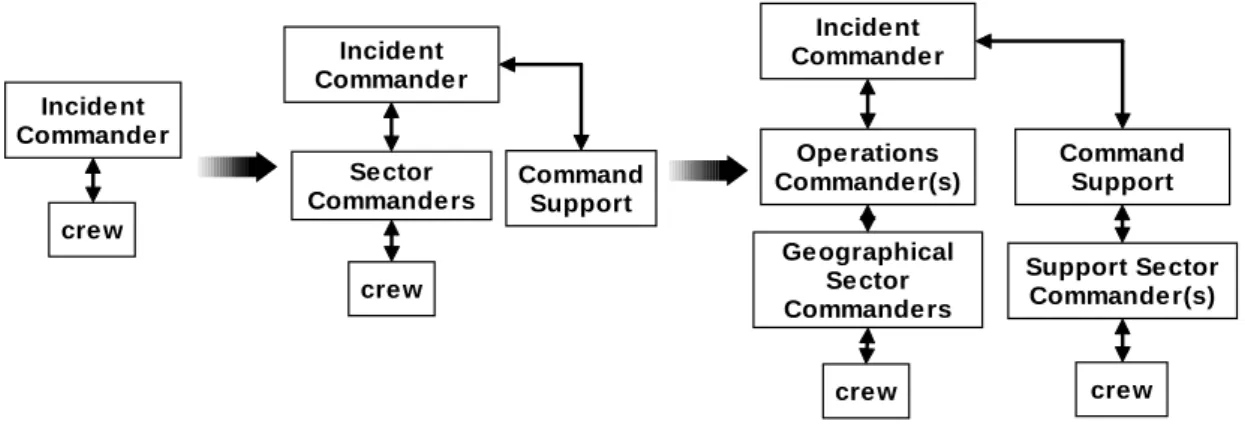
“Incident Commander is the highest-ranking position within the ICS and the one functional position always filled” in the first responders’ hierarchy (Bigley and Roberts, 2001). The initial person occupying this position is usually a senior officer in the first arriving crew. When the scale of the incident expands and becomes not manageable for the initial Incident Commander (IC), further resources will be deployed. The position of IC may be occupied by a later arriving more senior officer, and sectors can be introduced in the incident scene. In this case, the initial IC usually becomes a sector commander. No matter what the scale and complexity of the incident is, as shown in Figure 2.2, the IC remains at all times responsible for: the command and control, deployment of resources, tactical planning and co-ordination of the sector operations (Incident Command - 3rd edition, 2008).
Ge ographical Se ctor Commande rs crew Ope rations Commande r(s) Support Se ctor Commander(s) crew Command Support Incident Commander Incide nt Commande r cre w Sector Commanders crew Incide nt Commande r Command Support
Figure 2-2: ICS structure as the scale and complexity of the incident increases
“The IC is an information intensive position, which involves coordinating the overall response strategy to an emergency and managing available people and resources in real time” (Jiang et al., 2004a). Therefore, decisions made by ICs would have great impact on the overall efficiency of on-site ER. Technology support providing the required information to ICs would likely have benefits for the overall performance of on-site ER.
Goals and priorities
Although the terms used may be slightly different, the principles in ER are similar across countries. Turoff (2002) claimed that “past and future objectives remain the same in crises, providing relevant communities collaborative knowledge systems to exchange information”.
For different types of incident, the focus of goals could be different. The primary goals of incident command in the Fire Service are “to ensure that all is done that can be done to protect people – the civilians at risk and the fire-fighters – and that everything is done to preserve and protect property by confining the fire and extinguishing it as quickly as possible” (Carter and Rausch, 2008), whereas in public health incidents, the primary goal would be to prevent epidemic and ensure the health and safety of the general public (Qureshi et al., 2006).
Although different ER agencies have their individual responsibilities, they share common objectives: “save life; prevent escalation of the disaster; relieve suffering; safeguard the environment; protect property; facilitate investigation/inquiry; and restore normality as soon as possible” (Hill and Long, 2001). A similar set of ICs’ goals and priority were published by the U.S. Federal Emergency Management Agency (FEMA): “reducing the immediate hazard, saving lives and property, establishing situational control, and restoring normal operations. Lifesaving and responder safety will always be the highest priorities and the first objectives in the Incident Action Plan” (FEMA, 2008). Therefore, it can be summarized that ICs goals during emergencies (in a descending priority) are to save life, stabilize the incident, and protect property and environment.
In the emergency response plan of the Department of Environmental Management (DEM), State of Rhode Island (RI), the key goals of the IC are defined as: “Establish incident response objectives and strategies; Acquire and apply the most accurate, up-to-date assessments of the situation; Supervise an effective, safe, and efficient ICS organization; Deploy and monitor resources; Keep stakeholders and staff well-informed; Demobilize Incident Command” (DEM RI U.S., 2008). Compared to the sets of goals described above, this set of goals focuses on the role that ICs play in an emergency situation, instead of the ideas they are required to keep in mind when they
play their roles. This is most like a sequence of common tasks that ICs are required to carry out from the beginning to the end of an emergency.
Tasks/Decisions
Perry (2003) summarized the duties of the IC throughout an incident as follows:
• conduct initial situation evaluation and continual reassessments;
• initiate, maintain and control communications;
• identify incident management strategy, develop an action plan and assign resources;
• call for supplemental resources, including Emergency Operation Centre activation;
• develop an organizational command structure;
• continually review, evaluate and revise incident action plan;
• provide for continuing, transferring and terminating command.
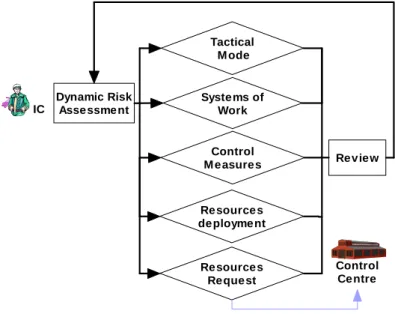
The initial situation evaluation and continual reassessments mentioned above are defined as Dynamic Risk Assessment (DRA) in the fire service guidance in the UK (Incident Command - 3rd edition, 2008). It is called a Dynamic Risk Assessment because the process of risk assessment is carried out in a changing environment, where what is being assessed is developing as the process itself is being undertaken.
It is a standard operational procedure of the local emergency responders (West Yorkshire Fire and Rescue Service, 2007) that the IC will carry out a DRA on arrival at an incident. The principal elements of the DRA are termed "the operational risk assessment process" and include the following areas:
• To look for and identify hazards (hazard spotting).
• To decide who might be harmed and how.
• To evaluate the risks (possibility and severity) arising from the hazards.