B uil di n g I nfo r m a ti o n M o d e lli n g
(BI M) v al u e r e a li s a tio n
fr a m e w o r k fo r a s s e t o w n e r s
M u n ir, MY, Kivi ni e mi, A a n d Jo n e s , S
h t t p :// dx. d oi.o r g / 1 0 . 1 2 0 1 / 9 7 8 0 4 2 9 5 0 6 2 1 5-3 9
T i t l e B uil di n g I nfo r m a t io n M o d elli n g (BI M) v al u e r e a li s a ti o n f r a m e w o r k fo r a s s e t o w n e r s
A u t h o r s M u n ir, MY, Kivi ni e mi, A a n d Jo n e s , S
Typ e C o nf e r e n c e o r Wo r k s h o p I t e m U RL T hi s v e r si o n is a v ail a bl e a t : h t t p :// u sir. s alfo r d . a c . u k /i d/ e p ri n t/ 5 7 0 1 9 / P u b l i s h e d D a t e 2 0 1 8 U S IR is a d i gi t al c oll e c ti o n of t h e r e s e a r c h o u t p u t of t h e U n iv e r si ty of S alfo r d . W h e r e c o p y ri g h t p e r m i t s , f ull t e x t m a t e r i al h el d i n t h e r e p o si t o r y is m a d e f r e ely a v ail a bl e o nli n e a n d c a n b e r e a d , d o w nl o a d e d a n d c o pi e d fo r n o
n-c o m m e r n-ci al p r iv a t e s t u d y o r r e s e a r n-c h p u r p o s e s . Pl e a s e n-c h e n-c k t h e m a n u s n-c ri p t fo r a n y f u r t h e r c o p y ri g h t r e s t r i c ti o n s .
F o r m o r e i nfo r m a t io n , in cl u di n g o u r p olicy a n d s u b m i s sio n p r o c e d u r e , p l e a s e c o n t a c t t h e R e p o si t o r y Te a m a t : u si r @ s alfo r d . a c. u k.
1 INTRODUCTION
Building Information Modelling (BIM) in Asset Management (AM) is an area that has not been given much attention by researchers. There has been more focus on BIM business value realisation in pre-con-struction and conpre-con-struction stages rather than the post construction stage, which has a longer life of the asset (Love et al., 2014). Although, BIM is claimed to pro-vide an efficient tool to asset managers in improving building performance and management of operations, there are very few case studies on the real use of BIM in the operations and use phase (Codinhoto & Kiviniemi, 2014).
BIM investments like other Information Technol-ogy (IT) based business initiatives are continuously questioned on the level of impact they have on organ-isational business value. Many clients worry that the value that BIM delivers may not be as high as ex-pected. Similarly, like other IT-based investments, BIM suffers from the ‘productivity paradox’ (Brynjolfsson 1993, Willcocks & Lester 1996). Some asset owners find themselves adopting BIM but can-not find sufficient economic justification. The invest-ment in BIM in the Architectural, Engineering and Construction (AEC) industry is increasing and there are still doubts that the benefits may not be as high as expected. The difficulty in the realisation of BIM ben-efits can be related to weaknesses in measurement techniques and business value realisation practices of the AEC industry. These factors make it difficult to
evaluate the benefits of IT-based tools or methodolo-gies such as BIM (Vass & Karrbom Gustavsson, 2014).
As a result, asset managers constantly have to jus-tify IT-based investments such as BIM because of the huge capital outlays and are compelled to appraise value at the strategic and operational levels (Irani, 2010). Many owner-operator organisations tend to approach the lifecycle management of BIM in an ad-hoc or unstructured manner. Investment evaluation should be conducted by asset owners in the same way projects are managed (Irani, 2010). One of the pre-dominant issues is that managers tend to measure those activities that are easily identifiable, thereby, creating a tendency of ignoring and undervaluing those that are not (Dawes, 2010). There should be a parallel activity, where investment decisions are re-viewed in relation to cost, risks and benefits. The con-duct of this activity will help asset owners evaluate the success of BIM and the business value it delivers. Benefits realisation management is a significant business process for asset owners to derive value from BIM. Defining requirements, measuring, ana-lysing and monitoring the entire process is important for asset owners to be able to identify BIM business value (Lin et al. 2007, Love et al. 2014). A number of studies have attempted to measure the benefits of BIM (Giel et al. 2010, Kreider et al. 2010, Barlish & Sullivan 2012, McGraw-Hill 2012, Love et al. 2013, Love et al. 2014, Walasek & Barszcz 2017), but more research is needed to clarify the difficulty in measure-ment of BIM benefits in the operations and use phase.
Building Information Modelling (BIM) Value Realisation Framework for
Asset Owners
M. Munir & A. Kiviniemi & S. Jones
ABSTRACT: The paper is presenting a value realisation framework for asset owners based on an exploratory study. The study is descriptive in nature and adopting a qualitative approach towards data collection. The paper adopts the viewpoint of BIM business value measurement considering that; (i) if the process is better as a result of BIM-based processes, then it is different in some relevant way; (ii) if it is different in some relevant way as a result of certain BIM properties or characteristics, then the change is observable; (iii) if the change is observ-able because of certain direct BIM benefits, then it is countobserv-able; (iv) if it is countobserv-able using defined measurement metrics, then it is measurable; (v) if it is measurable using established measurement techniques, an organisation can value each unit and therefore, realise the benefits of BIM. The specific contribution of paper is to improve asset owners’ understanding of BIM-business value measurement techniques and approaches.
2 METHODOLOGY
2.1 Research Question
This study presents a framework on how an asset owner can realise BIM business value in the opera-tions and use phase of built assets. It also seeks to demonstrate how owner-operator organisations can link intangible to tangible value for easy measure-ment. The study will address the following research questions:
What are the techniques and strategies of meas-uring the business value of BIM in AM pro-cesses?
How can intangible value be linked to tangible value?
2.2 Research methods
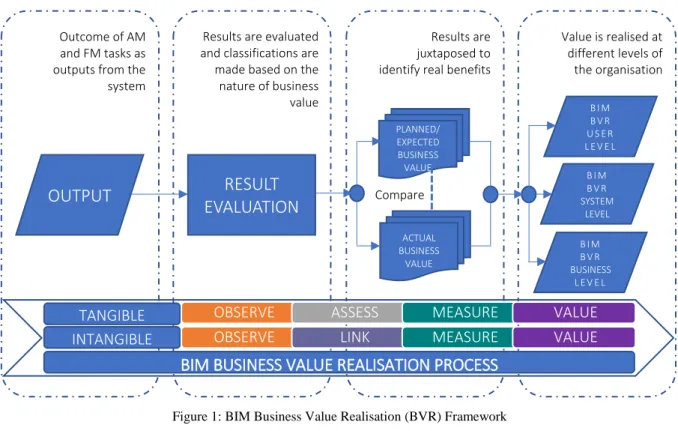
This study adopts exploratory and descriptive meth-ods of research. The study isdivided into two phases. The first phase is the literature review, where the study explores existing research on techniques of measuring business value for BIM and other IT-based initiatives. The reviewed literature was used to iden-tify elements of the framework for measuring BIM business value. The second phase comprises of devel-opment of the BIM business value realisation frame-work (Figure 1) and intangible business value linkage map (Figure 2).
2.3 Data Collection
The study adopts a qualitative approach towards data collection. The review of literature was conducted to identify relevant existing studies on the business value of BIM, IT value realisation frameworks and techniques for measuring business value of IT-based methodologies. The elements of the proposed busi-ness value realisation framework were also identified through this exercise.
In developing the framework, the main factors were drawn from three main theoretical foundations, those are: the AM-FM business processes; the value realisation concepts of Gliderman (2000) (tangible); and the theoretical concepts of Carayannis (2004) and Nogeste & Walker (2005) (intangible). Each of the aspects contribute to the framework with specific types of information.
This review of secondary data sources led to the development of a BIM business value realisation framework (Figure 1). The framework provides a pro-cedural model for approaching BIM business value realisation for asset owners. The framework organ-ised concepts such as outputs, result evaluation and business value realisation dimensions that the study explored directly during data collection.
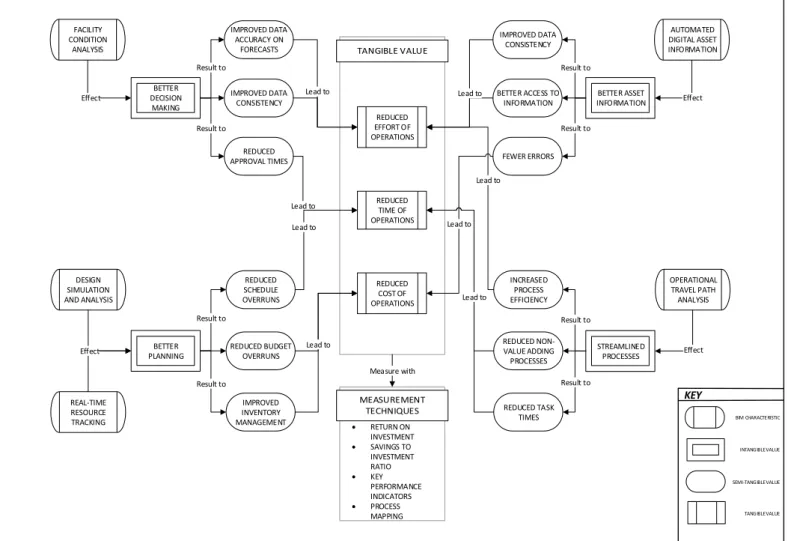
Finally, the concept map for linking intangible value to tangible for BIM-based processes (Figure 2) was drawn from the theoretical proposition of Bakis et al. (2006).
3 LITERATURE REVIEW
3.1 Building Information Modelling (BIM) in Asset
Management (AM)
BIM is a technology-based process that enhances per-formance and information delivery in the lifecycle of a built asset. BIM as defined by Succar et al. (2007)
is ‘a set of interacting policies, processes and
tech-nologies producing a methodology to manage the es-sential building design and project data in digital
for-mat throughout the building’s life-cycle’. On the
other hand, ISO 55000 (2014), defines AM as a ‘ co-ordinated activity of an organisation to realise value
from assets’. Certainly, AM facilitates a holistic
methodology that manages an asset from inception to disposal. The implementation of BIM in AM is an op-portunity for asset owners to attain value propositions in their organisations through effective management of business processes (Love et al., 2014). With hand-over standards such as COBie that deliver structured information of the facility to the client, asset manag-ers have the ability to leverage asset data through BIM. It is however worthy to mention that these tools and techniques do not fully support the asset owner in realising all the benefits that BIM generates in AM processes (Love et al., 2014).
BIM implementation in the operations and use phase will require changes in business processes and development of new roles for asset owners to achieve desired benefits (Ayyaz et al., 2012). These business modifications and resultant benefits continuously change throughout a facility’s lifecycle. Some of the challenges asset owners face are cultural and opera-tional in nature. That is, managing the change process and putting in appropriate measures for smooth im-plementation of BIM in AM. Without addressing these issues an organisation may not be able to track the business value BIM generates. Similarly, Cod-inhoto & Kiviniemi (2014) suggest that asset owners need to be aware of their organisational inefficiencies in the first place before they can address technology related challenges associated with BIM implementa-tion.
3.2 Value Realisation Management
IT business value is the sustainable benefit realised by an organisation through IT-based systems, either by collective or individual systems, assessed from an or-ganisational perspective (Cronk & Fitzgerald, 1999). Consequently, value realisation is the process of eval-uating these benefits. Value realisation management is defined as ‘the process that realises the benefits
that are achieved and manages the unexpected ones’
(Farbey et al., 1999). It is however the strategy adopted by an organisation to determine how benefits are realised, at what level and when. The main pur-pose of value realisation is not to forecast benefits but to make them come true (Ward et al., 1996).
Many studies on value realisation management have tried to address the issue of realising the benefits of IT-based investments, but the problem is a dy-namic one. Andersen, et al., (2000) present a proce-dural benefits measurement framework for IT-related investments in the AEC industry. Also, in a bid to ad-dress the complex issues of value realisation, Sa-pountzis et al. (2007) review four value realisation management approaches that may support organisa-tions in the optimisation of benefits from investment programmes. Ashurst & Doherty (2003) suggest best practice for value realisation through the develop-ment of a conceptual framework. Similarly, Ward et al. (1996) adopt a procedural approach and explains the steps within the value management process. On the other hand, Leyton (1995) propose a model which approached value realisation from the perspective of business change. Sapountzis et al. (2007), then pro-pose a value realisation framework integrated with business and investment processes.
The main challenge of realising BIM business value is that asset owners do not plan to realise bene-fits in the first place. Value realisation has to be done deliberately and consciously. Some asset owners har-bour the ‘silver bullet thinking’ on BIM investments (Thorp, 1998). That is, if they invest in BIM, the ben-efits will come automatically. Lin & Pervan (2003), suggests the need for asset owners to change their strategy of value realisation management from a pas-sive approach to a more proactive one. Love et al. (2014) further assert that BIM alone cannot deliver business outcomes and that the process of its imple-mentation has to be proactively managed to ensure that the organisation realises the business value it ex-pects. Irrespective of the primary strategic objective for adopting BIM, an organisation will have to under-stand its capability and maturity before it can realise any value from the whole process.
3.3 BIM Business Value
In identifying BIM business value, the main issue of contention for asset owners is how to identify the ben-efits and the methods with which to measure them. A number of studies have attempted to identify the ben-efits if BIM in the operations and use phase. Ding et al. (2009) find that BIM enabled facilities manage-ment yields a 98% reduction in time used to update asset databases. Similarly, Codinhoto & Kiviniemi (2014) identify thirteen (13) metrics of BIM benefits in the operations and use phase.
In a bid to evaluate the business value of IT-based investments, Willcocks & Lester (1996) propose a balance score card (BSC) approach to examine the contributions of the IT-based investment from the fi-nancial, internal business, innovation and learning, and customer perspectives. However, this method does not provide for an aggregate system for these factors, as the decision of worthiness of an investment still remains with the asset manager. On the other
hand, Construct IT (1998) identify different IT busi-ness value and classified each benefit against three factors; (i) efficiency assigned with a financial value, (ii) effectiveness defined with a subjective value, and (iii) performance qualified with qualitative accounts, however, with no quantification. The benefits were also classified according to the business processes they support. Also, Gartner (2003) present a five-pil-lar benefit realisation framework; strategic alignment, business process impact, architecture, direct payback, and risk. The framework determines the overall busi-ness value expected to be created by an IT-enabled business initiative. It uses a standard set of concepts for quantitative and qualitative value methods. The Gartner framework provides an aggregate score card for IT-based investments. Melville et al. (2004) pro-pose an IT business value model that uses a resource-based view (RBV) to focus on the impact of IT-resource-based investments such as BIM on organisational resources and business processes. Similarly, Love et al. (2014) present a framework that asset owners can utilise to realise value from investing in BIM. The framework adopts governance, change management, perfor-mance measurement, and stakeholder management as factors that enable the strategic alignment of the asset owners’ business strategy. However, the framework does not provide a scoresheet for aggregating the key factors. Furthermore, Sanchez et al. (2016) present an eight-step BIM value realisation framework that in-troduces a methodology together with a benefits, met-rics and enablers dictionary to aid measurement. However, the framework focuses mostly on tangible and semi-tangible benefits.
Deriving business value from an IT-based system can be difficult and depends largely on many different complex factors that cannot be controlled or isolated for formal experiments (Bakis et al., 2006). This is because the workings of an organisation are a collec-tion of various integrated systems to perform tasks and deliver outputs. It is not possible to isolate BIM from other closely interconnected processes, in order to assess it, or one independently of the other. An-other reason why it is difficult to objectively prove business benefits of a BIM-based investment is be-cause an IT system only has the potential to create value, and not direct value in its own right (Mooney et al. 1995, Farbey et al. 1999, Remenyi 2000, Love et al. 2014). Another argument is that an IT-based in-vestment may not yield the desired benefits simply because it is not well implemented (Brynjolfsson & Hitt, 1998).
3.4 BIM Value Measurement Techniques
There are many value measurement techniques that can be used by asset owners to identify the value that BIM affects. Some techniques are generic and some may be unique to certain organisations. The study will focus on four techniques; Return on Investment
(ROI), Savings to Investment Ratio (SIR), Key Per-formance Indicators (KPI) and Process Mapping. It is worth mentioning that an organisation may utilise multiple methods to measure BIM benefits. Also, Love et al. (2013), argues that if financial techniques such as ROI are only used to justify investment in BIM, then the entire process is limited to financial management.
3.4.1 Return on Investment (ROI)
ROI is defined as the ratio of resources gained or lost in a process or investment, as against the total amount of resources provided (White, 2007). When applied to BIM, it is suggested that positive ROI means business value to clients, contractors, consultants and other stakeholders and measurement to be calculated as a ratio of benefit to cost (Giel et al., 2010). ROI is cal-culated as:
𝑅𝑂𝐼 =𝐺𝑎𝑖𝑛 𝑓𝑟𝑜𝑚 𝐼𝑛𝑣𝑒𝑠𝑡𝑚𝑒𝑛𝑡 − 𝐶𝑜𝑠𝑡 𝑜𝑓 𝐼𝑛𝑣𝑒𝑠𝑡𝑚𝑒𝑛𝑡
𝐶𝑜𝑠𝑡 𝑜𝑓 𝐼𝑛𝑣𝑒𝑠𝑡𝑚𝑒𝑛𝑡 x 100
One of the challenges of using this method to meas-ure business value, is the lack of industry-wide ac-cepted benchmark for measuring BIM ROI (Giel et al., 2010). Another problem is the inapplicability to generalise or compare ROI data because it is hardly ever possible to find two organisations using the same business processes and accounting policies.
3.4.2 Savings to Investment Ratio (SIR)
SIR represents the ratio of savings in relation to in-vestment. The important factors when using SIR are investment cost and functional asset effectiveness (Ağra, 2011). When applied to BIM, an asset owner can determine whether the proposed savings in a BIM business case justifies the cost of the total investment. SIR involves the following processes; Determining the cost of the project; Determining the useful life of the asset; Determining the savings associated with the project; and Calculating the ratio. SIR is calculated as:
𝑆𝐼𝑅 =𝑃𝑉(𝐼𝑛𝑡𝑒𝑟𝑛𝑎𝑙 𝑃𝑟𝑜𝑗𝑒𝑐𝑡 𝐶𝑜𝑠𝑡 𝑆𝑎𝑣𝑖𝑛𝑔𝑠) + 𝑃𝑉(𝑃𝑟𝑜𝑔𝑟𝑎𝑚𝑚𝑒 𝐶𝑜𝑠𝑡 𝑆𝑎𝑣𝑖𝑛𝑔𝑠)
𝑃𝑉(𝐼𝑛𝑖𝑡𝑖𝑎𝑙 𝐼𝑛𝑣𝑒𝑠𝑡𝑚𝑒𝑛𝑡)
One of the challenges of adopting this method to measure business value is the meticulous nature of identifying savings in relation to the total investment and comparing it with alternative options. This task requires a great deal of skill to execute but can be very beneficial if done correctly.
3.4.3 Key Performance Indicators (KPI)
KPIs are a set of data measures used to evaluate the performance of a system, task or operation (Cox et al., 2003). Evaluations using KPIs usually compare ac-tual performance against estimated with reference to efficiency, effectiveness and quality of outcome and workmanship. KPIs can be used to assess both tangi-ble and intangitangi-ble value through quantitative and qualitative performance indicators.
One of the challenges of applying this method for measuring business value is the amount of resources required to develop performance benchmarks in owner-operator organisations. The benchmarking data for comparison has to be available for the asset manager to be able to evaluate whether targets have been met. Another weakness of using KPIs is that the models fail to identify actual parameters that repre-sent change in performance (Cox et al., 2003). 3.4.4 Process Mapping
Process mapping is a technique that involves identi-fying, documenting, analysing and developing an im-proved process (Anjard, 1996). It can be used to iden-tify where improvements can be made or to compare where improvements have been made. Process map-ping is a useful tool for identifying business process problems such as errors, repetitive processes, delays and inefficiencies. A process map is a visual aid that helps show how inputs, outputs and tasks are inter-linked (Anjard, 1996).
One of the challenges of implementing this method for measuring value is achieving the required level of detail and accuracy in process mapping. In some cases, mapped processes are not representative of the actual task. Another issue is the sourcing of skilled labour to draft process maps (Anjard, 1996). Simi-larly, patience to draft a process maps poses another drawback because the task of producing process maps organisation-wide can be overwhelming.
4 BIM BUSINESS VALUE REALISATION (BVR) FRAMEWORK
This section presents a framework for measuring business value of BIM-related outcomes for asset and facility managers (Figure 1). It suggests the process in a sequence and describes various aspects to be taken care of while observing outcomes, evaluating results, comparing planned and actual benefits, and finally, realising business value at the user, system or business dimension. The model is based on the meth-odology of BIM business value measurement consid-ering that; (i) if the process is better as a result of BIM-based processes, then it is different in some rel-evant way; (ii) if it is different in some relrel-evant way as a result of certain BIM properties or characteristics, then the change is observable; (iii) if the change is observable because of certain direct BIM benefits, then it is countable; (iv) if it is countable using de-fined measurement metrics, then it is measurable; (v) if it is measurable using established measurement techniques, an organisation can value each unit and, therefore, realise the benefits of BIM (Glideman, 2000). Furthermore, Cronk & Fitzgerald (1999), pro-pose three dimensions to IT business value, they are: user, system and business levels.
4.1 Measuring Tangible Value
The framework proposes a four-step process in measuring tangible value (Glideman, 2000).
OBSERVE: The change to the system is to be ob-served closely and properly documented. This step should assess the value realisation plan produced at the beginning of the investment lifecycle and re-view the targeted benchmarks. It is important that benefit identification is closely connected to the value realisation plan and business case so that the benefits that BIM could deliver are aligned with the organisational business strategy.
ASSESS: The next step is to assess the nature of the change, whether it is positive or negative. This can only be determined if the outcomes are properly classified to be measured against organi-sational performance benchmarks.
MEASURE: At this stage, a drawdown list of ex-pected benefits from the value realisation plan and business case should be compared with the out-comes that may materialise from the system. After identification, a suitable measurement technique is selected. Value is then measured using the identi-fied technique.
VALUE: The benefits or dis-benefits are realised at the end of the process. The nature of the BIM business value and its dimension is determined at the user, system or business level. The organisa-tion will have to document the value realised for learning and continuous improvement.
4.2 Measuring Intangible Value
This is a procedural technique of measuring intan-gible value of BIM business value in the operations
and use stage. A four-step process of measuring in-tangible benefits are observe, link, measure and value was adopted for this model (Carayannis, 2004, Nogeste & Walker 2005, Bakis et al. 2006).
OBSERVE: The change to the system is to be ob-served closely and documented properly. Identify-ing intangible outputs is challengIdentify-ing and compli-cated, hence, managers will have to cast a wide net over many outcomes from the system. The value realisation plan and business cases should be re-viewed so that performance benchmarks are iden-tified.
LINK: The next step will involve linking the ob-served phenomenon to measurable organisational metrics. This process is further explained in Sec-tion 4.2.1 (Figure 2). Intangible outcomes are to be linked to tangible outcomes for measurement. This process is exploratory as organisations have to de-velop appropriate pairing techniques.
MEASURE: The next step is to compare the new observed phenomenon with already existing or-ganisational standards or results. This is the stage where benefits planned for are monitored for real-isation. The appropriate measurement technique is adopted and value is identified.
VALUE: The benefits or dis-benefits are realised at the end of the process. The nature of the BIM business value and its dimension is determined at the user, system or business level. Finally, the pro-cess is properly documented.
4.2.1 Linking Intangible Value to Tangible Value
One of the difficult tasks of measuring intangible value is identifying a metric with which to measure
PLANNED/ EXPECTED BUSINESS VALUE RESULT EVALUATION OUTPUT B I M B V R U S E R L E V E L B I M B V R SYSTEM LEVEL Value is realised at different levels of the organisation Results are juxtaposed to identify real benefits Results are evaluated
and classifications are made based on the nature of business value Outcome of AM
and FM tasks as outputs from the system ACTUAL BUSINESS VALUE B I M B V R BUSINESS L E V E L Compare
BIM BUSINESS VALUE REALISATION PROCESS INTANGIBLE
TANGIBLE
OBSERVE LINK MEASURE VALUE
OBSERVE ASSESS MEASURE VALUE
it. Also, measuring intangibles is very difficult be-cause it is not always possible to quantify those val-ues in absolute terms without any degree of subjec-tivity. Whether intangibles are assigned with value or not, these benefits still remain significant to achieving organisational objectives (Remenyi, 2000). Bakis et al. (2006) evaluate the inherent problems of quantifying business value and the dif-ficulties associated with intangible value and demonstrated a business value linkage diagram for the benefits of IT-based investments.
In order to measure or quantify intangible busi-ness value of BIM, intangible value will have to be linked with tangible outcomes. Business value link-age is a technique which assists asset manlink-agers can utilise in identifying value and understanding the process through which value is created.
This study proposes a concept map used to link intangible to tangible value through a concept map. The BIM capability of the system is observed in or-der to identify the processes it affects and the value it delivers. Subsequently, the intangible benefits are identified. The possible semi-tangible benefits de-rived as a result of the intangible benefits are also acknowledged. The linking of semi-tangible bene-fits to the tangible benebene-fits is done for ease of meas-urement. Finally, intangible value linked to tangible derived from the BIM-based process may be evalu-ated using any value measurement technique. The concept map proposes a simple four step process but, in some cases, it can be shorter or longer. Whilst using this process, asset owners need to es-tablish benchmarks so as to improve linkage and measurement metrics over time.
BETTER DECISION MAKING BETTER ASSET INFORMATION BETTER PLANNING REDUCED TIME OF OPERATIONS REDUCED COST OF OPERATIONS REDUCED EFFORT OF OPERATIONS STREAMLINED PROCESSES FACILITY CONDITION ANALYSIS OPERATIONAL TRAVEL PATH ANALYSIS DESIGN SIMULATION AND ANALYSIS REAL-TIME RESOURCE TRACKING AUTOMATED DIGITAL ASSET INFORMATION IMPROVED DATA CONSISTENCY BETTER ACCESS TO INFORMATION IMPROVED INVENTORY MANAGEMENT REDUCED BUDGET OVERRUNS REDUCED SCHEDULE OVERRUNS REDUCED TASK TIMES INCREASED PROCESS EFFICIENCY REDUCED NON-VALUE ADDING PROCESSES REDUCED APPROVAL TIMES IMPROVED DATA CONSISTENCY IMPROVED DATA ACCURACY ON FORECASTS FEWER ERRORS Effect Result to Result to Effect Result to Result to Result to Effect Effect Result to Result to Lead to Lead to Lead to Lead to Lead to Lead to Lead to Lead to Measure with RETURN ON INVESTMENT SAVINGS TO INVESTMENT RATIO KEY PERFORMANCE INDICATORS PROCESS MAPPING Result to BIM CHARACTERISTIC INTANGIBLE VALUE SEMI-TANGIBLE VALUE TANGIBLE VALUE KEY 5 CONCLUSION
The measurement of the BIM business value has been the subject of considerable debate within the normative literature. The difficulties in measuring benefits and costs are often the cause of uncertainty about expected benefits, particularly in AM. Thus, how then can an asset owner obtain business ‘value’ from investing in BIM?
In addressing this issue, a framework for meas-uring business value from an investment in BIM is proposed. Furthermore, the study proposes the use of concept maps in identifying intangible value and linking it to tangible based on BIM capability that an organisation may attain from its implementation. The proposed model is conceptual in nature but pro-vides the underlying foundation for developing a strategy for asset owners to consider how BIM can Figure 2: Concept map for linking intangible value to tangible value for BIM-based processes
create value in their organisations. Whilst using this process, asset owners need to establish benchmarks so as to improve linkage and measurement metrics over time.
Tangible and intangible value have significant impact on the attainment of organisational business objectives. However, the measurement of intangible value is not a straightforward one. No matter how unclear the measurement is, it is still of value if the organisation learns and understands its processes more than they did prior to the process. It is worth repeating that asset owners need to plan for these benefits to be able to properly realise them. Having a value realisation plan is significant for asset own-ers to be able to track the benefits that BIM brings.
6 FUTURE WORK
Research focusing on business value of BIM has not been forthcoming. Therefore, the proposed frame-work in this study provides impetus for future re-search in this area.
7 REFERENCES
Ağra, Ö., 2011. Sizing and selection of heat exchanger at defined saving-investment ratio.
Applied Thermal Engineering, 31(5), pp.727-34.
Andersen, J., Baldwin, A., Betts, M., Carter, C., Hamilton, A., Stokes, E. and Thorpe, T., 2000. A framework for measuring IT innovation benefits.
Electronic Journal of Information Technology in
Construction, 5(1), pp.57-72.
Anjard, R.P., 1996. Process mapping: one of three, new, special quality tools for management, quality and all other professionals.
Microelectronics Reliability, 36(2), pp.223-25.
Ashurst, C. & Doherty, N.F., 2003. Towards the formulation of ‘a best practice' framework for benefits realisation in IT projects. Electronic
Journal of Information Systems Evaluation, 6(2),
pp.1-10.
Ayyaz, M., Emmitt, S. & Ruikar, K., 2012. Towards understanding BPR needs for BIM implementation. International Journal of 3-D
Information Modeling archive, 1(4), pp.18-28.
Bakis, N., Kagioglou, M. & Aouad, G., 2006. Evaluating the business benefits of information systems. In In Proceeding of 3rd International SCRI Symposium, Salford Centre for Research and Innovation, University of Salford, Salford, U.K. Salford, 2006.
Barlish, K. & Sullivan, K., 2012. How to measure the benefits of BIM — a case study approach.
Automation in Construction, 24, pp.149-59.
Brynjolfsson, E., 1993. The Productivity Paradox of Information Technology: Review and Assessment. Communications of the ACM, 36(12), pp.66-77.
Brynjolfsson, E. & Hitt, L.M., 1998. Beyond the productivity paradox: computers are the catalyst for bigger changes. Communication of the ACM, 41(8), pp.49-55.
Carayannis, E., 2004. Measuring intangibles: Managing intangibles for tangible outcomes in research and innovation. International Joumal of
Nuclear Knowledge Management, 1(1),
pp.333-38.
Codinhoto, R. & Kiviniemi, A., 2014. BIM for FM: a case support for business life cycle. In IFIP International Conference on Product Lifecycle Management. Advances in Information and
Communication Technology. July 2014.
Yokohama, 2014.
Construct IT, 1998. Measuring the Benefits of IT Innovation. Construct IT Centre of Excellence. Cox, R.F., Issa, R.R.A. & Ahrens, D., 2003.
Management’s perception of key performance indicators for construction. Journal of
Construction Engineering and Management,
129(2), pp.142-51.
Cronk, M.C. & Fitzgerald, E., 1999. Understanding 'IS Business value': derivation. Logistics
Information Management, 12(1), pp.44-49.
Dawes, S.S., 2010. Stewardship and Usefulness: Policy Principles for Information-Based Transparency. Government Information
Quarterly, 27(4), pp.377-83.
Ding, L., Drogemuller, R., Akhurst, P., Hough, R., Bull, S. and Linning, C., 2009. Towards Sustainable Facilities Management. In
Technology, Design and Process Innovation in
the Built Environment. London: Taylor and
Francis. pp.373-92.
Farbey, B., Land, F. & Targett, D., 1999. The moving staircase – problems of appraisal and evaluation in a turbulent environment.
Information Technology and People Journal,
12(3), pp.238-52.
Gartner, 2003. TVO methodology: valuing IT investments via the gartner business performance framework. [Accessed 09 November 2017].
Giel, B., Issa, R.R. & Olbina, S., 2010. Return on investment analysis of building information modeling in construction. In Proceedings of the International Conference on Computing in Civil
and Building Engineering. Nottingham, United
Kingdom, 2010. Proceedings of the International Conference on Computing in Civil and Building Engineering, Nottingham University Press, 30 June-2 July.
Glideman, C., 2000. Total economic impact workbook: performing a TEI study to evaluate technology initiatives.
Irani, Z., 2010. Investment evaluation within project management; an information systems
perspective. The Journal of the Operational
Research Society, 61(1), pp.917-28.
ISO, 2014. Asset management — Overview, principles and terminology — ISO 55000.
International standard ISO 55000, Available at:
http://www.irantpm.ir/wp-content/uploads/2014/03/ISO-55000-2014.pdf [Accessed 08 February 2017].
Kreider, R., Messner, J. & Dubler, C., 2010. Determining the frequency and impact of applying BIM for different purposes on projects.
In Innovation in AEC Conference. The
Pennsylvania State University, University Park, PA. Pennsylvania, 2010.
Leyton, R., 1995. Investment appraisal: the key for IT? In B. Farbey, F.F. Land & D. Target, eds.
Hard Money, Soft Outcome. Alfred Waller Ltd,
in association with Unicom, Henley on Thames. Lin, S., Gao, J., Koronios, A. & Chanana, V., 2007.
Developing a data quality framework for asset management in engineering organisations.
International Journal of Information Quality,
1(1), pp.100-25.
Lin, C. & Pervan, G., 2003. The practice of IS/IT benefits management in large Australian organizations. Journal of Information
Management, 41(1), pp.13-24.
Love, P.E.D., Matthews, J., Simpson, I., Hill, A. and Olatunji, O.A., 2014. A benefits realization management building information modeling framework for asset owners. Automation in
Construction, 37(1), pp.1-10.
Love, P.E.D., Simpson, I., Hill, A. & Standing, C., 2013. From justification to evaluation: Building information modeling for asset owners.
Automation in Construction Volume, 35(1),
pp.208-16.
McGraw-Hill, 2012. SmartMarket Report. pp.1-72. Available at: https://www.icn-solutions.nl/pdf/bim_construction.pdf
[Accessed 2017 November 08].
Melville, N., Kraemer, K. & Gurbaxani, V., 2004. Review: Information technology and organizational performance: an integrative model of IT business value. MIS Quarterly, 28(2), pp.283-322.
Mooney, G.J., Gurbaxani, V. & Kraemer, K.L., 1995. A process oriented framework for assessing the business value of Information Technology. In The Sixteenth International Conference on Information Systems, Amsterdam,
ICIS 1995. Amsterdam, 1995.
Nogeste, K. & Walker, D.H.T., 2005. Project outcomes and outputs: making the intangible tangible. Emerald Publishing Limited, 9(4), pp.55-68.
Remenyi, D., 2000. The elusive nature of delivering benefits from IT investment. The Electronic
Journal of Information Systems Evaluation, 3(1).
Sanchez, X.A., Mohamed, S. & Hampson, D.K., 2016. BIM Benefits Realisation Management. In X.A. Sanchez, D.K. Hampson & S. Vaux, eds.
Delivering value with BIM: A whole-of-life
approach. 1st ed. London: Routledge.
Sapountzis, S., Harris, K. & Kagioglou, M., 2007. Benefits realisation process for healthcare. In 4th International Research Symposium (SCRI),
March 26-27, 2007. Salford, 2007.
Succar, B., Sher, W. & Aranda-Mena, G., 2007. A proposed framework to investigate Building Information Modelling through knowledge elicitation and visual models. In Proceedings of
the Australasian Universities Building
Education Association, 4-5 July. Melbourne,
Australia, 2007.
Thorp, J., 1998. The Information Paradox — Realizing the Business Benefits of Information
Technology. Toronto, Canada: McGraw-Hill,
Inc.
Vass, S. & Karrbom Gustavsson, T., 2014. The perceived business value of BIM. In Scherer, M.a., ed. Proceedings at the 10th European Conference on Product and Process Modelling, ECPPM 2014, 17 September 2014 through 19
September 2014. Vienna, 2014.
Walasek, D. & Barszcz, A., 2017. Analysis of the adoption rate of Building Information Modeling (BIM) and its Return on Investment (ROI).
Procedia Engineering, 172, pp.1227-34.
Ward, J., Taylor, P. & Bond, P., 1996. Evaluation and realization of IS/IT benefits: an empirical study of current practice. European Journal of
Information System, 4(1), pp.214-25.
White, L.N., 2007. An old tool with potential new uses: return on investment. The Bottom Line, 20(1), pp.5-9.
Willcocks, L. & Lester, S., 1996. Beyond the IT productivity paradox. European Management