Financial Sustainability of Nonprofit Organizations: Determinants of
Donation Behavior in relation to TV Fundraising Campaign
By
PARK, Hayoung
THESIS
Submitted to
KDI School of Public Policy and Management In Partial Fulfillment of the Requirements
For the Degree of
MASTER OF DEVELOPMENT POLICY
Financial Sustainability of Nonprofit Organizations: Determinants of
Donation Behavior in relation to TV Fundraising Campaign
By
PARK, Hayoung
THESIS
Submitted to
KDI School of Public Policy and Management In Partial Fulfillment of the Requirements
For the Degree of
MASTER OF DEVELOPMENT POLICY
2019
Financial Sustainability of Nonprofit Organizations: Determinants of
Donation Behavior in relation to TV Fundraising Campaign
By
PARK, Hayoung
THESIS
Submitted to
KDI School of Public Policy and Management In Partial Fulfillment of the Requirements
For the Degree of
MASTER OF DEVELOPMENT POLICY Committee in charge:
Professor Cho, Yoon Cheong, Supervisor Professor Lee, Junesoo
i
Table of Contents
Abstractꞏꞏꞏꞏꞏꞏꞏꞏꞏꞏꞏꞏꞏꞏꞏꞏꞏꞏꞏꞏꞏꞏꞏꞏꞏꞏꞏꞏꞏꞏꞏꞏꞏꞏꞏꞏꞏꞏꞏꞏꞏꞏꞏꞏꞏꞏꞏꞏꞏꞏꞏꞏꞏꞏꞏꞏꞏꞏꞏꞏꞏꞏꞏꞏꞏꞏꞏꞏꞏꞏꞏꞏꞏꞏꞏꞏꞏꞏꞏꞏꞏꞏꞏꞏꞏꞏꞏꞏꞏꞏꞏꞏꞏꞏꞏꞏꞏ (1) I. Introductionꞏꞏꞏꞏꞏꞏꞏꞏꞏꞏꞏꞏꞏꞏꞏꞏꞏꞏꞏꞏꞏꞏꞏꞏꞏꞏꞏꞏꞏꞏꞏꞏꞏꞏꞏꞏꞏꞏꞏꞏꞏꞏꞏꞏꞏꞏꞏꞏꞏꞏꞏꞏꞏꞏꞏꞏꞏꞏꞏꞏꞏꞏꞏꞏꞏꞏꞏꞏꞏꞏꞏꞏꞏꞏꞏꞏꞏꞏꞏꞏꞏꞏꞏꞏꞏꞏꞏꞏꞏ (2) 1. 1. Background of the Study
1. 2. Objective of the Study
1. 3. Development of Research Questions
II. Literature Reviewꞏꞏꞏꞏꞏꞏꞏꞏꞏꞏꞏꞏꞏꞏꞏꞏꞏꞏꞏꞏꞏꞏꞏꞏꞏꞏꞏꞏꞏꞏꞏꞏꞏꞏꞏꞏꞏꞏꞏꞏꞏꞏꞏꞏꞏꞏꞏꞏꞏꞏꞏꞏꞏꞏꞏꞏꞏꞏꞏꞏꞏꞏꞏꞏꞏꞏꞏꞏꞏꞏꞏꞏꞏꞏꞏꞏꞏꞏꞏꞏꞏ (6) 2. 1. Nonprofit Organization
2. 1. 1. Applying Marketing Concepts in Nonprofit Organizations 2. 2. Donation Behavior
2. 3. Financial Sustainability
III. Theoretical Backgroundꞏꞏꞏꞏꞏꞏꞏꞏꞏꞏꞏꞏꞏꞏꞏꞏꞏꞏꞏꞏꞏꞏꞏꞏꞏꞏꞏꞏꞏꞏꞏꞏꞏꞏꞏꞏꞏꞏꞏꞏꞏꞏꞏꞏꞏꞏꞏꞏꞏꞏꞏꞏꞏꞏꞏꞏꞏꞏꞏꞏꞏꞏꞏꞏꞏꞏꞏꞏꞏꞏꞏ (13) 3.1. Communication Theory
3.2. Satisfaction and Loyalty Theory 3.3. Agency Theory
IV. Hypothesis Developmentꞏꞏꞏꞏꞏꞏꞏꞏꞏꞏꞏꞏꞏꞏꞏꞏꞏꞏꞏꞏꞏꞏꞏꞏꞏꞏꞏꞏꞏꞏꞏꞏꞏꞏꞏꞏꞏꞏꞏꞏꞏꞏꞏꞏꞏꞏꞏꞏꞏꞏꞏꞏꞏꞏꞏꞏꞏꞏꞏꞏꞏꞏꞏꞏꞏꞏꞏꞏꞏꞏꞏ (16) 4. 1. Emotional Sympathy Factor
4. 2. Economic Value Factor 4. 3. Relevance Factor 4. 4. Accountability Factor 4. 5. Sustainability Factor 4. 6. Social Innovation Factor
V. Methodologyꞏꞏꞏꞏꞏꞏꞏꞏꞏꞏꞏꞏꞏꞏꞏꞏꞏꞏꞏꞏꞏꞏꞏꞏꞏꞏꞏꞏꞏꞏꞏꞏꞏꞏꞏꞏꞏꞏꞏꞏꞏꞏꞏꞏꞏꞏꞏꞏꞏꞏꞏꞏꞏꞏꞏꞏꞏꞏꞏꞏꞏꞏꞏꞏꞏꞏꞏꞏꞏꞏꞏꞏꞏꞏꞏꞏꞏꞏꞏꞏꞏꞏꞏꞏꞏꞏꞏ (25) VI. Data Analysisꞏꞏꞏꞏꞏꞏꞏꞏꞏꞏꞏꞏꞏꞏꞏꞏꞏꞏꞏꞏꞏꞏꞏꞏꞏꞏꞏꞏꞏꞏꞏꞏꞏꞏꞏꞏꞏꞏꞏꞏꞏꞏꞏꞏꞏꞏꞏꞏꞏꞏꞏꞏꞏꞏꞏꞏꞏꞏꞏꞏꞏꞏꞏꞏꞏꞏꞏꞏꞏꞏꞏꞏꞏꞏꞏꞏꞏꞏꞏꞏꞏꞏꞏꞏꞏ (27) VII. Conclusionsꞏꞏꞏꞏꞏꞏꞏꞏꞏꞏꞏꞏꞏꞏꞏꞏꞏꞏꞏꞏꞏꞏꞏꞏꞏꞏꞏꞏꞏꞏꞏꞏꞏꞏꞏꞏꞏꞏꞏꞏꞏꞏꞏꞏꞏꞏꞏꞏꞏꞏꞏꞏꞏꞏꞏꞏꞏꞏꞏꞏꞏꞏꞏꞏꞏꞏꞏꞏꞏꞏꞏꞏꞏꞏꞏꞏꞏꞏꞏꞏꞏꞏꞏꞏꞏꞏ (31)
7. 1. Findings
7. 2. Additional Findings 7. 2. Managerial Implications 7. 3. Policy Implications
ii
List of Figures
iii
List of Tables
Table 1. Definition of Nonprofit Organization ꞏꞏꞏꞏꞏꞏꞏꞏꞏꞏꞏꞏꞏꞏꞏꞏꞏꞏꞏꞏꞏꞏꞏꞏꞏꞏꞏꞏꞏꞏꞏꞏꞏꞏꞏꞏꞏꞏꞏꞏꞏꞏꞏꞏꞏꞏꞏꞏꞏꞏꞏ (7) Table 2. Construct Scales of the Factors of Donation Behaviorꞏꞏꞏꞏꞏꞏꞏꞏꞏꞏꞏꞏꞏꞏꞏꞏꞏꞏꞏꞏꞏꞏꞏꞏꞏꞏꞏꞏꞏꞏꞏꞏ (25) Table 3. Sample Demographicsꞏꞏꞏꞏꞏꞏꞏꞏꞏꞏꞏꞏꞏꞏꞏꞏꞏꞏꞏꞏꞏꞏꞏꞏꞏꞏꞏꞏꞏꞏꞏꞏꞏꞏꞏꞏꞏꞏꞏꞏꞏꞏꞏꞏꞏꞏꞏꞏꞏꞏꞏꞏꞏꞏꞏꞏꞏꞏꞏꞏꞏꞏꞏꞏꞏꞏꞏꞏꞏ (26) Table 4. Component Matrix: Determinants of Donation Behavior (Emotional Sympathy,
Economic Value, Accountability, Relevance, Sustainability) ꞏꞏꞏꞏꞏꞏꞏꞏꞏꞏꞏꞏꞏꞏꞏꞏꞏꞏꞏꞏꞏꞏꞏꞏ (27) Table 5. Component Matrix: Types of TV Fundraising Campaign (Natural Disaster, Hunger,
Disease, Lack of Education, Sanitation) ꞏꞏꞏꞏꞏꞏꞏꞏꞏꞏꞏꞏꞏꞏꞏꞏꞏꞏꞏꞏꞏꞏꞏꞏꞏꞏꞏꞏꞏꞏꞏꞏꞏꞏꞏꞏꞏꞏꞏꞏꞏꞏꞏꞏꞏꞏꞏꞏ (28) Table 6. Effects of Determinants of Donation Behaviorꞏꞏꞏꞏꞏꞏꞏꞏꞏꞏꞏꞏꞏꞏꞏꞏꞏꞏꞏꞏꞏꞏꞏꞏꞏꞏꞏꞏꞏꞏꞏꞏꞏꞏꞏꞏꞏꞏꞏꞏ (28) Table 7. Effects of Donation Behavior on Donor Satisfactionꞏꞏꞏꞏꞏꞏꞏꞏꞏꞏꞏꞏꞏꞏꞏꞏꞏꞏꞏꞏꞏꞏꞏꞏꞏꞏꞏꞏꞏꞏꞏꞏꞏ (29) Table 8. Effects of Donor Satisfaction on Donor Loyaltyꞏꞏꞏꞏꞏꞏꞏꞏꞏꞏꞏꞏꞏꞏꞏꞏꞏꞏꞏꞏꞏꞏꞏꞏꞏꞏꞏꞏꞏꞏꞏꞏꞏꞏꞏꞏꞏꞏ (29) Table 9. Summary of Determinants of Donation Behavior Hypotheses Testingꞏꞏꞏꞏꞏꞏꞏꞏꞏꞏꞏꞏ (29) Table 10. Summary of Effects of Donor Satisfaction and Loyalty Hypotheses Testingꞏꞏꞏꞏ (29) Table 11. Effects of Types of TV Fundraising Campaign on Donation Behaviorꞏꞏꞏꞏꞏꞏꞏꞏꞏꞏꞏ (30)
iv
Appendix
1
Abstract
As nonprofit organizations have made strides in the field of international development, ensuring the financial resources has become a key issue to continue what nonprofits strive for and how they perform with the budget which are generated without efforts for profit-making. In terms of financial sustainability, this research aims to figure out the determinants of constructing donation behavior which are affected by fundraising campaigns. The factors to measure in this study are mainly divided into two parts: factors affected by donors’ attitudes such as emotional sympathy and economic value and by organizations’ performances such as accountability, relevance, and sustainability. By analyzing quantitative data collected by survey, the regression results reveal that fundraising campaigns should consider both donors’ behavioral and institutional performance factors when soliciting donors’ giving behavior. By select fundraising campaigns corresponding to the purposes of the Sustainable Development Goals (SDGs), the results of this paper present that it is important to ensure the financial sustainability of nonprofit organizations and thereby to enhance the public awareness for more successful implementation of SDGs.
Keyword: Nonprofit organization, financial sustainability, donation behavior, fundraising TV campaign, Sustainable Development Goals
2
I. Introduction
1.1. Background of the Study
In the field of international development, nonprofit organizations are becoming significant actors. For the rationale of the organizations, it takes the representativeness from voluntary participation by donors, which delivers a significant amount of financial resources. For the roles of the nonprofit sector, it shows a major presence in humanitarian assistance and development cooperation by determining a progressive impact on policy processes in the global governance. Beyond the political relations between states and the authorities of decision making from intergovernmental organizations, nonprofit organizations have made major strides in the field of international development. This is because nonprofit organizations are capable of dealing with both market and non-market functions, such as contributing to economic development, delivering social services, and promoting human rights (Keith & Roger, 1993; Wolch, 1990). In the context of international development, many organizations in developing countries are currently fighting against poverty by addressing the issues of extreme hunger, malnutrition, lack of medical services, discrimination in education, and unequal access to resources. As a result, nonprofit organizations have reached the point where they can provide their own services that go beyond the limits of public institutions and government.
To perform its organizational purposes, ensuring financial resource has become an important issue not only for nonprofits itself but also for the aspects of international
development sector around the world. In order to build up financial competence, nonprofits strive to increase donation behavior from individual donors who are voluntarily willing to join in, whichprovides the basis of organizational budget (Casey, 2016). In this study, donors indicate those who are currently participate in donations and will potentially participate in the future. Thus, setting strategic approaches to promote donation behavior decides sustainable
3
competences of fundraising as one of prioritized activities for the nonprofit sector.
Adequate fundraising strategies have a significant impact on the financial sustainability of nonprofits. In addition to covering administrative costs and securing budgets to conduct operations in the short term, it enables organizations to meet its own mission in an efficient and sustainable way in the long term. Regarding the features of fundraising, earlier stage of fundraising activities applied many theories and strategies from an aspect of marketing, which need to be analyzed again considered the characteristics of nonprofit organizations (Lindahl & Conley, 2002). After the fundraising strategies were developed, it is required to be analyzed how fundraising strategies can be interpreted in the view of donors. Regarding this issue, the importance of this research is on the effects of TV fundraising campaign in the context of the donor perspective.
Fundraising strategies have not only affected the amount of donations but also the way public perceive global poverty (Brooker et al., 2015). It is particularly controversial that some of organizations misuse their fundraising strategies by depicting poor people with
fragmentally exaggerated living environments in developing countries; which in reality may not be all true. It undermines the negative effects to encourage distorted perceptions of the reality of poverty so that to participate in donations relied on emotional motivation. According to Brooker et al. (2015), if people could not understand the necessity of what nonprofit organizations try to achieve, it would ultimately cause the lack of the level of participation from the public.
4
1.2. Objectives of the Study
The purpose of this study is to find out the factors of donation behavior in relation to TV fundraising campaign of nonprofit organizations. In particular, by applying the UN Sustainable Development Goals (SDGs), it is to measure donor intention for different types of fundraising campaigns in line with the goals. Therefore, this study focuses on analyzing the determinants of donation behavior in order to promote financial capacity of nonprofit organizations. In order to reach potential donors and facilitate philanthropic givings in the nonprofit sector, it is important to utilize the media, especially this paper will focus on TV fundraising campaigns. In relation to non-profit fundraising, the media such as TV campaign have been shown as important intermediary channels in the process of individual donors primarily enter as the funder of the nonprofit organization (Yörük, 2010). Since TV stations often provide airtime for fundraising campaigns without charge in the favor of corresponding to public interest through activities of nonprofit organizations, there were voices of concern, suggesting that nonprofit organizations are obliged to adhere appropriate guidelines for designing contents of TV fundraising campaign in order to achieve the public good.
The result of the study will analytically suggest that nonprofit organizations could consider and develop more effective strategies for financial sustainability by designing donor-focused fundraising. Moreover, TV fundraising campaigns, which are well organized not only to bring financial resources for organizations but also to provide a better understanding of the poverty, will ultimately enable the public to recognize that the universal goal is to pursue a sustainable world for everyone. In the long term, this will build up the common discourse that everyone is aware of the common responsibility to involve in the way of international
5
1.3. Development of Research Questions
From the variables identified, the following research questions have been specified to identify the determinants on donation behavior in relation to TV fundraising campaign of nonprofit organizations.
1. How do donors intend to participate in a donation in relation to TV fundraising campaign of nonprofit organizations?
1-1. How likely do individual donors intend to decide their donation behavior if they perceive emotional sympathy from TV fundraising campaign?
1-2. How likely do individual donors intend to participate in donation if they perceive the economic value from TV fundraising campaign?
1-3. How likely do individual donors intend to participate in donation if they perceive the accountability of nonprofit considering TV fundraising campaign?
1-4. How likely do individual donors intend to participate in donation if they perceive the performance of nonprofit is relevant for beneficiaries considering TV fundraising campaign?
1-5. How likely do individual donors intend to participate in donation if they perceive the performance of nonprofit is sustainable for beneficiaries considering TV fundraising campaign?
2. How does donation behavior affect donor satisfaction?
6
II. Literature review 2.1. Nonprofit organizations
As the interest in the welfare state grew in the 1950s, the nonprofit sector was emerged as “associational revolution,” which represented societal changes and technological advances, from various pressures such as general citizens, the public sector, and governments (Salamon, 1994a). Demonstrating this flow of social movement, Salamon (1994b) asserts that the global stream of economic growth in the 1960s and the early 1970s was one of significant driving forces for the growth of nonprofit organizations. By bringing material improvement for individuals, it empowered a number of middle-class citizens, who could lead the rise of private nonprofit organizations. In addition, in terms of how nonprofit sector has historically evolved, it linked with the worldwide trends in the decentralization of governments and the privatization of services for social welfare (Hodgkinson, 1999). The concept of decentralized government means the transfer of responsibility for public services from the central government to public and private sector.
Regarding the growth of nonprofit organizations from the developed to the developing countries, the role and objectives of nonprofit organizations are mainly on how to distribute humanitarian services, develop economic growth, sustain from environmental degradation, promote civil rights, and pursue a number of other objectives that governments have not been able to reach out (Salamon & Anheier, 1992). As an example of developed countries, in America, nonprofit organizations took a decisive role to develop the ways of delivering public services as an expanded substitute of national welfare system (Hammack, 2002). Accordingly, the third sector in America was encouraged to make project contracts or receive funding to meet the increasing needs of the public sector and to fill the gaps in government policies, such as vocational training for unemployment and child nutrition program (Kirsten, 2001). In case
7
of developing societies, nonprofit organizations mainly seek their objectives in the area of social services to protect human rights due to the lack of industrialized economic wealth led by governments (Casey, 2016). Moreover, beyond different levels of economic development, the role of advocacy of nonprofit organizations has become important in recent years. This allows to have the voices of various social opinions, helps develop a healthier society, and realizes economic and social justice based on democracy and equality (Almog-Bar & Schmid, 2014).
In terms of the definition of nonprofit organizations, there have been various approaches to assess the objectives, and structure of the third sector. However, considering its diversity of the missions and roles of nonprofit organizations, it makes difficult to create a commonly fixed consensus on defining terminology related to the sector (Bryson, 2018). In fact, the direction of research is further augmented by empirical studies presenting diverse views in unified ways on the definition of nonprofit organizations. Statements to define the nonprofit organizations described in empirical literature are summarized in Table 1.
Table 1. Definition of Nonprofit Organization
Literature Definition
McCarthy, Hodgkinson,
and Sumariwalla (1992) They are organizations formed to serve the public good, and income (or profit) from these organizations are not distributed to members or owners Salamon (1994a) A massive array of self-governing private organizations, not dedicated to
distributing profits to shareholders or directors, pursuing public purposes outside the formal apparatus of the state
Putnam (1995) Features of social organization such as networks, norms, and social trust that facilitate coordination and cooperation for mutual benefit
Salamon and Anheier
(1997) It is organized (possessing some institutional reality), private (institutionally separate from government), non-profit distributing (not returning any profits generated to their owners or directors), self-governing (equipped to control their own activities), and voluntary (involving some meaningful degree of voluntary participation, either in the agencies activities or management).
Morris (2000) A set of organizations which are collectively considered to possess characteristics that set them apart from states, markets or households
Gonzalez, Vijande, and Casielles (2002)
Organization without a financial objective, under private control, which aims to generate a social benefit for a specific sector or society
United Nations (2006) A not-for-profit, voluntary citizens’ group, which is organized on a local, national or international level to address issues in support of the public good
Werker and Ahmed
(2007) One group of players who are active in the efforts of international development and increasing the welfare of poor people in poor countries. It works both independently and alongside bilateral aid agencies from developed countries,
8
private-sector infrastructure operators, self-help associations, and local governments
Lewis (2009) Recognized as the third sector on the landscapes of development, human rights, humanitarian action, environment, and many other areas of public action Aboramadan (2018) Non-profit sector occupies the role of transforming the economy, as it provides
services that cannot be offered by the government, and it is also a powerful proxy in civil society and opinion leading
Derived from the description from Salamon and Anheier (1997), five characteristics of nonprofit organizations can be specified: organized, private, non-profit distributing, self-governing, and voluntary. The third sector is formally organized along with the legitimate basis for establishing organizations. The characteristics of private and self-governing factors clearly represent how nonprofits perform organizational activities within the intended scope without being constrained by governments’ polity boundaries or budget limitations. The characteristic of non-profit distributing indicates the purpose of nonprofit organizations that it is not to follow the interest of stakeholders but to achieve the organizational goals to the extent that it promotes the public common interest. The voluntary nature of nonprofit organizations influences how they conduct their organizational activities and how they raise the budget from those who voluntarily participated in.
9
2.1.1. Applying Marketing Concepts in Nonprofit Organizations
Moving away from a traditional view that marketing is an exclusively unique activity to the for-profit sector, Kotler and Levy (1969) regard the marketing techniques as a critical factor in the growth and maturity of the nonprofit sector. However, in the early process of applying the marketing concept, nonprofit organizations tended to be misled in an "organization-centered" direction rather than "customer-centered" (Andreasen, Kotler, & Parker, 2003). The customer-centered marketing process is to recognize what customers need and how customer perceive the products or services by aiming to understand and to meet the demands of its customer. Therefore, over the trials and errors in adapting a market-oriented approach considering the natures of nonprofit organizations, which are not directly related to market demand, many literatures build empirical studies on the importance of marketing tools for nonprofit organizations (Gonzalez et al., 2002; Kara, Spillan, & DeShields, 2004; Macedo & Pinho, 2006).
As Kotler (1979) defined that the purpose of marketing in the third sectors is to “survive, grow, and strengthen their contribution to the general welfare,” it requires more considerations on the representativeness of organizational identity rather than just a cost-efficient way. Dolnicar and Lazarevski (2009) suggest that marketing strategies can be fit to the characteristics of nonprofits such as market segmentation (to figure out the target customers with their mission), product positioning (to secure the attractive concept for the customers), and advertising (to develop communication channels for delivering their message). Especially, fundraising was considered as one of the key activities among the marketing strategies (Akchin, 2001).
In terms of nonprofit organizations, fundraising can no longer be regarded as a request for monetary assistance, but the exchange of values and expectation, which meets the donors’
10
needs (Andreasen, Kotler, & Parker 2008), as long as fundraising has rooted in various range of background such as in marketing, economics, social psychology, anthropology, biology, and evolutionary psychology (René & Wiepking, 2011). Concerning the objectives of nonprofits, it is often hard to be described in commercial ways, even though the goal of fundraising marketing seems like “making a profit” (Teri, 2001). This means that there are a number of factors to consider when setting up a fundraising strategy in nonprofit sectors, bringing a different approach compared to for-profit organizations, which simply aims at the economic gain. Therefore, on the side of nonprofit organizations, fundraising is a process of ensuring validity by not only raising funds to carry out organizational missions but also convincing the necessity of their activities (Čačija, 2013).
2.2. Donation Behavior
Given the voluntary nature of nonprofits, it is also important to inform the public of the organizational goals and activities by addressing the weights of drawing participation from the public (Leighann, Francois, & Anahit, 2012). In recent years, individual donations collected through fundraising activities have been as one of the main sources of the budget for nonprofit organizations (Smka, Grohs, & Eckler, 2003). This relates to the key characteristic of nonprofit sector, “voluntary,” for the financial capacity of organizations depends on the donation behavior from voluntary citizen. Accordingly, it is important to consider ways to increase donation behavior in order to build up the organizational capability in financial resources. Therefore, the competition for donations has highly increased so that the fundraising technique developed further to promote donation behavior based on the basic marketing concepts (Éva, 2010).
11
to make sure that the amount donated for a particular purpose to be only used to accomplish that purpose (Waters, 2011). This explains that abandoning this belief in the relationship with donors and finding new donors is a less efficient strategy than enhancing the relationship. In addition, Waters (2011) argues that sharing and reporting on the development of work that required donations is used as a way to build a trusting relationship and to improve institutional accountability.
2.3. Financial Sustainability
To define financial sustainability of nonprofit organization, Kingma (1993) improves the definition with "revenue diversification and financial stability" applying modern portfolio theory. Originally Markowitz (1952) articulates the modern portfolio theory to explain
revenue diversification as the stage at which investors construct an investment portfolio while narrowing the gap between actual revenue and estimated revenue. As diversification aims to lower portfolio volatility in the long run (Wilson, 1997) over revenue generation strategies (Frumkin & Keating 2002; Jegers 1997), it is crucial to ensure better organizational effectiveness and longevity on the basis of financial surplus and further to fulfill the
organizational mission (Tuckman & Chang 1992). Therefore, financial sustainability based on diversification helps to improve independency of nonprofit organizations against the financial instability resulting from resource dependency (Froelich, 1999; Tinkelman, 1999) even though the voluntary nature of organizations can be shown as relying on donative contributions (Carroll & Stater, 2008). Furthermore, considering the time frame of financial capability, it to be resilient to economic volatility in the short term, and to carry out the mission of the nonprofit in a sustainable manner in the long term (Bowman, 2011).
12
profit, and planet, sustainability of nonprofit organization means the capability to cover the administrative costs and perform what are prioritized to achieve in the way of ensuring its independent authorities of decision-making process (León, 2001). Letts, Ryan and Grossman (1999) proposed “program expansion capacity” as the ability to raise financial resources among the scopes of organizational capacity. In the context of maintaining organizational constituency, it primarily focuses on ‘balancing money and mission’ by securing sufficient financial resources from individual donations, government subsidies, or corporate philanthropy activities (McDonald, 2007). Ultimately it aims to achieve organizational purposes while maintaining the organization’s existence and taking care of the clients (Weerawardena, McDonald, & Mort, 2010).
Empirical literature has researched how to achieve financial sustainability of nonprofit organizations. From an organization management perspective, it is to increase the organizational efficiency and effectiveness in conducting business (Chetkovich & Frumkin, 2003) and to satisfy the expectations of funders (LeRoux, 2009). In terms of internal control, it is necessary to successfully achieve the organizational objectives and to effectively communicate financial results and performance to both internal and external stakeholders (Maclndoe & Sullivan, 2014). Strategically, nonprofit organizations can apply marketing tools of for-profit organizations or relationship marketing for managing donors.
13
III. Theoretical Background 3.1. Communication Theory
Hon and Grunig (1999) offer interpersonal communication theory that trust, commitment, satisfaction, and power of the relationship can be used to measure the relationship between nonprofit organizations and donors. Trust can be demonstrated by organizations from “doing what an organization say will do” (Ledingham & Bruning, 1998) and allows to predict what donors will behave in the future relationship (Mayer, Davis, & Schoorman, 1995). Commitment can be defined based on the belief that "the relationship is worth spending energy to maintain and promote" (Hon & Grunig, 1999) as it can be seen at the highest level of a relationship (Dwyer, Schurr, & Oh, 1987). Satisfaction indicates whether parties in a relationship have positive feelings to the partner, which commits to maintaining the relationship by determining that the benefits of the relationship are much greater than the costs (Dwyer, Schurr, & Oh, 1987).
As a result, following the dimensions of the interpersonal communication theory, nonprofit organizations must focus more on investing in the formation of the relationship based on trust, commitment, and satisfaction to assure donors, which can bring long-term benefits to the organization (Rosso, 1991). Applying this theory, Waters (2011) argues that trust and satisfaction are the strongest indicators and can be a hint to predict which donors will maintain their relationships according to the degree of the indicators. This suggests how important it is to focus on strategies that build strong trust and satisfaction through fundraising marketing. As statistical data have shown that donors are no longer contributing blindly (Light, 2003), it is important to effectively assure what donors may be concerned about donations (Waters, 2011).
14
3.2. Satisfaction and Loyalty Theory
Studies related to marketing strategies indicate that customer satisfaction must be achieved first in order to increase customer loyalty (Bowen, 2001; Gronholdt, Martensen, & Kristensen, 2000; Hallowell, 1996; Oliver, 1999). According to Giese and Cote (2000), customer satisfaction is referred to as a continuous assessment between the pre-purchase expectations and the perceived satisfaction after purchase with respect to products and services. Customer loyalty is a measure of repetitive purchases that results from a willingness to maintain a relationship (Mascarenhas & Kesavan, 2006; Ndubisi, 2007).
Reflecting marketing theories of the for-profit market, Hon and Grunig (1999) suggest that the relationship between nonprofit organizations and donors can be measured according to the level of satisfaction as “a satisfying relationship … outweighs the costs.” Waters (2009) asserts that satisfaction is an important factor in determining donors' commitments to nonprofits. Accordingly, nonprofit organizations should develop strategies to satisfy donors in relationship marketing, which can be an effective investment for long-term benefits (Waters, 2008). Also, it is recommended to consider donor satisfaction when designing communication channels for donors (O’neil, 2009).
According to Kelley and Davis (1994) customer loyalty is further increased when donors are satisfied with their giving behavior. In terms of fundraising, Sargeant and Jay (2004) found the impact of donor loyalty that a 10% increase in loyalty could increase ROI of an organization by 150%. The loyalty of donors enables nonprofit organizations to efficiently manage administrative and fundraising costs and ensure sustainable performance (Devine et al., 2007). In predicting the donor's loyalty, O’Reilly et al. (2012) argue that constant participation in donations is more critical than the amount of donations. By encouraging to join in fundraising events or volunteer activities, it can also enable donors to increase their loyalty to the organization (Pressgrove & McKeever, 2016).
15
3.3. Agency Theory
According to Jensen and Meckling (1976), a principal-agent relationship is based on “a contract under which one or more persons [principal] engage another person [agent] to perform some service on their behalf which involves delegating some decision-making authority to the agent.” There are “agency costs” in the principal-agent relationship defined by Jensen and Meckling (1976), which is the sum of “monitoring costs”, “bonding costs”, and “residual loss.” Monitoring costs are incurred by the principal to identify and restrain the agent's activity. Bonding costs arise when the agent has to prove the performance of its work to the principal. Residual loss is the difference compared to the utility that is available when the interests of the principal and the agent are in perfect aligned.
Applying this relationship to the nonprofit sector, agency problems often happen in dealing with financial resources since the budgets are collected from external participation of voluntary donors and used for the organization’s mission (Fama & Jensen, 1983).
Considering the natures of nonprofit organizations, various stakeholders are involved in the structure of an organization, so that it is difficult to distinguish who is the principal and who is the agent (Anheier, 2005; Stone, 2006). In particular, when several principals have different purposes and participate in an organization's business, it may hamper to achieve the mission of the organization (Steinberg, 2010). Therefore, the utility of both the principal and agent can be maximized when the conflicts are minimized and goals of the principal and the agent is coordinated harmoniously (Davis et al., 1997; Sundramurthy & Lewis, 2003).
16
IV. Hypothesis Development
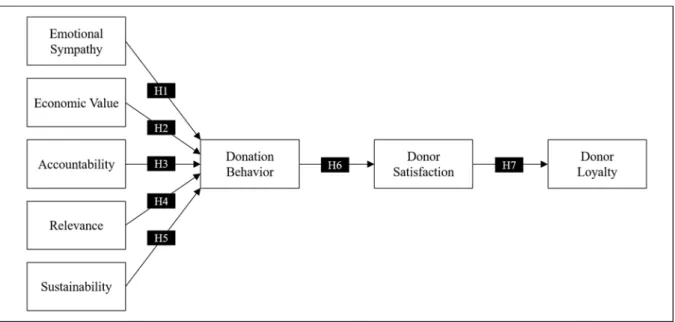
Hypotheses based on literature review indicate that the determinants of donation behavior are multivariate. To analyze what determines donation behavior in relation to TV fundraising campaigns, five distinctive factors are identified namely the emotional sympathy, economic value, accountability, relevance, and sustainability. While donor perceive the fundraising TV campaigns, the factors to measure in this study are mainly divided into two parts: factors affected by donors’ attitudes such as emotional sympathy and economic value and by organizations’ performances such as accountability, relevance, and sustainability. Dealing with who to be regarded as donors, this study assumes that everyone can potentially be a donor regardless of their prior or current experiences in donation. On the other hand, in order to measure the satisfaction and loyalty of donors, the correlation is analyzed based on any previous donation behaviors. Figure 1 shows a schematic diagram of a conceptual model to verify the five hypotheses regarding donation behavior. Each of the factor is briefly
described below.
17
Adopted by the 2015 United Nations General Assembly, the Sustainable Development Goals (SDGs) is to promote the global partnership beyond sectoral boundaries between governments, corporations and nonprofits to reach successful achievements of the goals (United Nations, 2015). As nonprofit organizations are already prominent players in the areas that overlap with the SDGs, such as social welfare, environmental conservation, health, education, and human rights, successful achievements of the goals can be depend on the role of nonprofits leveraging its capacities (Salamon & Haddock, 2015). In many cases, nonprofit organizations provide relevant products or services as sole providers at where the reach of governments and businesses are away. Accordingly, field research and fundraising campaigns have been systematically developed corresponding to the targeted performances.
Therefore, this research is focused to select fundraising campaigns corresponding to the purposes of the SDGs (United Nations, 2015), particularly SDG 1 (no poverty), SDG 2 (zero hunger), SDG 3 (good health and well-being), SDG 4 (quality education), and SDG 6 (clean water and sanitation). As a result, it is to analyze the factors that determine donation behavior for each goal of the SDGs. In this study, each goal is identified as an item with the following criteria: natural disaster, hunger, disease, lack of education, and sanitation. How each item is affected by the factors will be measured, which will be set into subclaims from H1 to H5.
4.1. Emotional Sympathy Factor
Empirical studies have shown that sympathy based on emotional stimulus such as guilt or empathy may influence as a factor that determines the giving behavior of donors (Fultz et al., 1986; Clary & Snyder, 1991; Amos, 1982). Traditional fundraisers have focused on inspiring potential donors to be willing to give through images that can trigger emotional responses (Babin & Darden, 1998). Emotions have significant impacts on intention and
18
decision on donation, and it has shown that it is rather difficult for donors to determine about their donation when emotional factors are entirely excluded (Faseur & Geuens, 2012; Polonsky & Sargeant, 2007). In addition, Andreoni (2006) argues that donors, who are encouraged to donate by their sympathy, perceive the emotional utility as a benefit of donation which can stimulate further decisions on charity.
When donors encounter fundraising campaigns, which bring emotional sympathy and show distressing realities, they try to counteract through their giving behavior (Merchant, Ford, & Sargeant, 2010) based on their expectations of social justice (Lerner, 1975). As a result, showing tragic images can be effective on encouraging donation behavior by arousing negative emotions of donors (Chang & Lee, 2010). According to the research of measuring whether emotions act as a factor regarding the effectiveness of charity fundraising campaigns, Bennett (2015) notes that donors show a positive behavior of giving in regard to emotional fundraising campaigns. It is, therefore, hypothesized that:
H1a. Emotional sympathy affects the intention to donation behavior for TV fundraising campaign regarding natural disaster.
H1b. Emotional sympathy affects the intention to donation behavior for TV fundraising campaign regarding hunger.
H1c. Emotional sympathy affects the intention to donation behavior for TV fundraising campaign regarding diseases.
H1d. Emotional sympathy affects the intention to donation behavior for TV fundraising campaign regarding lack of education.
H1e. Emotional sympathy affects the intention to donation behavior for TV fundraising campaign regarding sanitation.
19
4.2. Economic Value Factor
In terms of economic value of donation, “the price of giving” was defined by Weisbrod and Dominguez (1986) as the amount a donor contributes of the output generated from an organization. It is empirically clear that the smaller the costs for donor, the greater the participation in the donation (Karlan & List, 2007) as price elasticity is significantly involved for donors in the process of decision making on donations (Meer, 2014). However, considering economic efficiency from the perspective of donors, the absolute amount doesn’t matter since the most economical choice for donors would be not to donate at all (Sargeant & Jay, 2004). For this reason, what matters is how donors perceive that the price of giving to be economically valuable (Wiepking & Breeze, 2009).
Counting economic values of the performances conducted by nonprofit organizations, Tunkelman (1999) suggests that organizations which established greater financial efficiency in their program operations were able to attract more donations. Accordingly, the ratios of overhead costs, such as fundraising or administrative expenses, turn out to have negative impacts on donation behavior (Frumkin & Kim, 2001; Bowman, 2006). It indicates that donors care about where their donations are actually spent based on the purpose of the giving.
Furthermore, for donors, the transaction with nonprofit organizations is the result of their decision to spend their money on charitable giving, but no products or services are given to them in return (Andreasen, 2012). In terms of social marketing for the nonprofit sector, “price” is the cost to achieve what organizations set as their program goal and the amount of donation which encourages donors to pay (Aboramadan, 2018). The problem to be solved in the fundraising campaign is the “product” that organizations promise to offer. Therefore, donors will determine their giving behavior based on how much reasonable or acceptable the price for the product offered by nonprofits. For this reason, this research analyzes the effect of economic
20
value of donation in order to motivate the intention to donation behavior.
H2a. Economic value affects the intention to donation behavior for TV fundraising campaign regarding natural disaster.
H2b. Economic value affects the intention to donation behavior for TV fundraising campaign regarding hunger.
H2c. Economic value affects the intention to donation behavior for TV fundraising campaign regarding diseases.
H2d. Economic value affects the intention to donation behavior for TV fundraising campaign regarding lack of education.
H2e. Economic value affects the intention to donation behavior for TV fundraising campaign regarding sanitation.
4.3. Accountability Factor
Considering unique organizational characteristics of the nonprofit sector, organizational accountability is based on the performance measurement (O’Neill & Young, 1988; Poole, Nelson, Carnahan, Chepenik, & Tubiak, 2000). Since the nonprofit sector offers intangible products or services (Coleman, 1994), it is important for donors to confirm a trustworthy relationship with the organization (Sargeant, Ford, & West, 2006). Regarding how trustworthy and reliable a nonprofit organization is, donors determine their participation based on the belief that their donations will be used properly (Tonkiss & Passey, 1999). Accordingly, when a nonprofit requests a donation, donors expect the organization to demonstrate how reliable they are to manage the financial resources and to administrate for the purposes of soliciting the funds
21
(Glaser, 1994; Sargeant & Lee, 2004).
As nonprofit organizations are required to prove its organizational accountability, Carman and Fredericks (2008) try to define the evaluation criteria in terms of verifying transparency in accounting operations and informing donors. In addition, Sloan (2009) states that accountability of the nonprofit sector can be based on how well an organization performs its business while meeting fiscal and ethical code of conducts. This indicates that the accountability of nonprofit organizations can be largely defined in terms of financial enforcement and organizational management.
The goal of constructing nonprofit accountability is to promote better donation behavior and ultimately build public trust on organizational consistency of financial operations and governance (Carman & Fredericks, 2008). Therefore, this research investigates the hypothesis that accountability determine the intention to donation behavior:
H3a. Accountability affects the intention to donation behavior for TV fundraising campaign regarding natural disaster.
H3b. Accountability affects the intention to donation behavior for TV fundraising campaign regarding hunger.
H3c. Accountability affects the intention to donation behavior for TV fundraising campaign regarding diseases.
H3d. Accountability affects the intention to donation behavior for TV fundraising campaign regarding lack of education.
H3e. Accountability affects the intention to donation behavior for TV fundraising campaign regarding sanitation.
22
4.4. Relevance Factor
Empirical studies suggested that donors are more opened to be engaged with nonprofit organizations which can contribute to what donors care about and where donors perceive as their communities (Kelly, 1991; Philipp, 1999). In connection with this study, considering that donors put their donations for nonprofit fundraising to address the issues of global poverty, donors want to make sure that their donations can be contributed to changing the realities (Worth, 2002). For example, donors decide to make their giving behavior based on a “giving to cause” principle in case of fundraising campaigns due to natural disasters (Klein, 2009). In the case of Asian Tsunami occurred in December 2004, nonprofit organizations clearly addressed the reality of disaster and the ways to solve the crisis, which in turn helped successfully raise funds (Brown & Minty, 2008).
Literature asserted that the stronger the need for help, the more people would want to provide it (Staub & Baer, 1974; Wagner & Wheeler, 1969). In terms of “awareness of need,” how donors perceive the need for help also plays a critical role in determining donation behavior (Lee & Farrell, 2003; Bekkers & Wiepking, 2011). By showing how funds will be relevantly used for the cause of poverty, nonprofit organizations provide the rationale that allows donors to evaluate how much their donations are needed (Johnston, 2002). Accordingly, clarifying the impact of donations is one of important strategies of fundraising to increase donation behavior (Waters & Tindall, 2011). Therefore, this study will test that donation behavior can be encouraged if fundraising campaigns can address the reality of poverty and its solutions.
H4a. Relevance affects the intention to donation behavior for TV fundraising campaign regarding natural disaster.
23
regarding hunger.
H4c. Relevance affects the intention to donation behavior for TV fundraising campaign regarding diseases.
H4d. Relevance affects the intention to donation behavior for TV fundraising campaign regarding lack of education.
H4e. Relevance affects the intention to donation behavior for TV fundraising campaign regarding sanitation.
4.5. Sustainability Factor
According to Weerawardena, McDonald, and Mort (2010), sustainability in nonprofit organizations will be determined how efficient and effective they are, rather than just the fact that they continue to bring its budget sources. What matters is the effectiveness of problem solving with beneficiary-centered performance, beyond the possibility of whether the organization can be maintaining its existence. With regard to the performance of nonprofits contributing to improve the poverty in long-term perspective, when it comes to operating their field works, nonprofit organizations put their attention to beneficiaries, who are their main clients, but when communicating with donors, sharing information about beneficiary-centered outcomes is insufficient (Keystone, 2006). In particular, in designing a fundraising campaign, nonprofits may put more emphasis on inspiring donors to their giving decisions, overlooking whether the campaign is enough to illustrate the sustainable impact of its performance on beneficiaries (Chetkovich & Frumkin, 2003; McDonald, 2007). Therefore, to measure if donors lay their concerns whether it can achieve sustainable effects in terms of institutional performance, it is hypothesized that:
24
H5a. Sustainability affects the intention to donation behavior for TV fundraising campaign regarding natural disaster.
H5b. Sustainability affects the intention to donation behavior for TV fundraising campaign regarding hunger.
H5c. Sustainability affects the intention to donation behavior for TV fundraising campaign regarding diseases.
H5d. Sustainability affects the intention to donation behavior for TV fundraising campaign regarding lack of education.
H5e. Sustainability affects the intention to donation behavior for TV fundraising campaign regarding sanitation.
25
V. Methodology
As this study aims to explore the determinants of donation behavior in relation to TV fundraising campaigns of nonprofit organizations, a survey was conducted of the general public randomly sampled who can potentially participate in donations over the age of 20 regardless of nationality. Considering the population of the study, donation behavior was largely measured by the intention of those who have participated in the donation, and never participated before since everyone can be a potential donor regardless of their current donation or prior experiences. The questionnaire was written in two versions, Korean and English, allowing participants to select and respond according to their convenience. The validity of the questionnaire between the two versions of the languages was verified by back translation. By sending an anonymous link, participants were asked to conduct an online survey. The purpose of the study was explained to the participants and anonymity of the data and personal information were guaranteed. The survey was distributed to 271 people and a total of 205 responses were collected, with a response rate of 75.6%.
First, to validate the factors that influence donation behavior, Cronbach’s alpha of each factor is indicated in Table 2.
Table 2. Construct Scales of the Factors of Donation Behavior
Factors Statements Data items
Emotional
Sympathy 1.2. I am sympathized by the sorrow of the poor in miserable realities I don’t feel good about tragic situations of poverty. Reliability (Cronbach’s Alpha Coefficient)
Statement 1 Statement 2 0.900 Economic
Value 1.2. My donation will be a valuable economic assistance. My donation is more than the value of the money. Reliability (Cronbach’s Alpha Coefficient)
Statement 3 Statement 4 0.855 Accountability 1. The organization is reliable with honesty and ethical behaviors.
2. The organization is trusted for its financial transparency. Reliability (Cronbach’s Alpha Coefficient)
Statement 5 Statement 6 0.913 Relevance 1. My donation will be spent for what is needed for the poor.
2. My donation will directly improve the poverty. Reliability (Cronbach’s Alpha Coefficient)
Statement 7 Statement 8 0.820 Sustainability 1. My donation can make sustainable improvement for poverty.
2. My donation can provide long-term solution for the poor. Reliability (Cronbach’s Alpha Coefficient)
Statement 9 Statement 10 0.868
26
Of the 205 respondents, 55% were female. The mean average age of the respondents was 41 years. For more details on gender, age, education, and employment of the
respondents, the demographics of the sample are listed in Table 2.
Table 3. Sample Demographics
Total (N = 205) % N Gender Male Female 44.4% 55.6% (114) (91) Age 21-25 years old 26-30 years old 31-35 years old 36-40 years old 41-45 years old 46-50 years old 51-55 years old 56-60 years old 61-65 years old 66-70 years old 71 years or older 12.2% 17.7% 6.3% 5.9% 7.8% 9.8% 13.2% 12.2% 13.2% 1.5% 1% (25) (35) (13) (12) (16) (20) (27) (25) (27) (3) (2) Education High school
College degree (2 years) Bachelor degree (4 years) Master degree Ph.D. 22% 9.8% 45.9% 20% 2.4% (45) (20) (94) (41) (5) Employment Student Full-time employed Part-time employed
Working without pay (e.g. volunteer) Unemployed Home duties Retired Others 19.5% 36.6% 8.3% 1.5% 1% 14.1% 3.9% 15.1% (40) (75) (17) (3) (2) (29) (8) (31)
27
VI. Data Analysis
To check internal reliability, this study applied factor analysis for the data of
determinants items and SDGs criteria, using principal components as the extraction method and with a varimax rotation of Kaiser Normalization. This procedure was repeated for survey item of five types of TV fundraising campaigns and five determinants of donation behaviorto filter out significant factors. The overall items used in the survey came out with values above 0.6. Thus, the items with the high loadings are relevant to represent the constructs of each variable.
Table 4 summarized the result of factor analysis for factors that determine donation behavior: emotional sympathy, economic value, accountability, relevance, and sustainability.
Table 4. Component Matrix: Determinants of Donation Behavior (Emotional Sympathy, Economic Value, Accountability, Relevance, Sustainability)
Items Components
Factors Scale Items 1 2 3 4 5
ES 2 I don’t feel good about tragic situations of poverty. 0.814 ES 1 I am sympathized by the sorrow of the poor in miserable realities 0.811
EV 1 My donation will be a valuable economic assistance. 0.729
EV 2 My donation is more than the value of the money. 0.596
A 2 The organization is trusted for its financial transparency. 0.757
A 1 The organization is reliable with honesty and ethical behaviors. 0.729
R 2 My donation will directly improve the poverty. 0.733
R 1 My donation will be spent for what is needed for the poor. 0.708
S 1 My donation can make sustainable improvement for poverty. 0.751
S 2 My donation can provide long-term solution for the poor. 0.737
Table 5 summarized the result of factor analysis for types of TV fundraising campaign: natural disaster, hunger, diseases, lack of education, and sanitation.
28
Table 5. Component Matrix: Types of TV Fundraising Campaign (Natural Disaster, Hunger, Disease, Lack of Education, Sanitation)
Items Components
Factors Scale Items 1 2 3 4 5
ND 1 How likely are you willing to donate on the fundraising campaign for natural disaster? 0.607 ND 2 Do you have intention to donate for solving the problems of natural disaster? 0.574
H 2 Do you have intention to donate for solving the problems of hunger? 0.829 H 1 How likely are you willing to donate on the fundraising campaign for hunger? 0.808 D 1 How likely are you willing to donate on the fundraising campaign for disease? 0.776 D 2 Do you have intention to donate for solving the problems of disease? 0.760 E 1 How likely are you willing to donate on the fundraising campaign for lack of education? 0.849 E 2 Do you have intention to donate for solving the problems of lack of education? 0.799 Sa 1 How likely are you willing to donate on the fundraising campaign for sanitation? 0.800
Sa 2 Do you have intention to donate for solving the problems of sanitation? 0.796
To test how significant the factors affecting the five donation behaviors, regression analysis was applied to test the hypotheses using factor scores. Table 6 represents the results of multiple regression analysis for factors that determine donation behavior. Overall, the ANOVA analysis showed that the models was significant at 0.000 level with F=59.684 (r-square = .600). Given the Table 6, the findings indicate that hypothesis 1 and 5 are accepted, but not the hypothesis 2, 3, and 4. In other words, emotional sympathy and sustainability affect donation behavior as independent variables.
Table 6. Effects of Determinants of Donation Behavior
Variable (Independent → dependent) Standardized Coefficient (t-value-Sig)
Emotional Sympathy → Donation Behavior (H1) 0.687 (12.199***)
Economic Value → Donation Behavior (H2) -0.042 (-0.663)
Accountability → Donation Behavior (H3) -0.039 (-0.572)
Relevance → Donation Behavior (H4) 0.030 (0.345)
Sustainability → Donation Behavior (H5) 0.247 (3.082**)
*** p < 0.01, ** p <0.05, * p < 0.1 denotes statistical significance
Table 7 represent the results of regression analysis based on factor analysis for each item of the variables to test the effect of donation behavior on donor satisfaction. According
29
to the ANOVA, it finds the model is significant at 0.01 level with F = 47.317 (r-square = 0.255). Based on the finding, hypothesis 6 is accepted.
Table 7. Effects of Donation Behavior on Donor Satisfaction
Variable (Independent → dependent) Standardized Coefficient (t-value-Sig)
Donation Behavior → Donor Satisfaction (H6) 0.476 (6.879***)
*** p < 0.01, ** p <0.05, * p < 0.1 denotes statistical significance
To test the effect of donor satisfaction on donor loyalty, the ANOVA shows the model is significant at 0.01 level with F = 121.171 (r-square = 0.468). In general, the findings indicate that hypothesis 7 is accepted according to the result summarized in Table 8.
Table 8. Effects of Donor Satisfaction on Donor Loyalty
Variable (Independent → dependent) Standardized Coefficient (t-value-Sig)
Donor Satisfaction → Donor Loyalty (H7) 0.684 (11.008***)
*** p < 0.01, ** p <0.05, * p < 0.1 denotes statistical significance
In conclusion, the result of hypotheses testing of determinants of donation behavior is summarized in Table 9.
Table 9. Summary of Determinants of Donation Behavior Hypotheses Testing
Determinant Hypothesis Testing Result
Emotional Sympathy Emotional Sympathy → Donation Behavior (H1) Accepted
Economic Value Economic Value → Donation Behavior (H2) Rejected
Accountability Accountability → Donation Behavior (H3) Rejected
Relevance Relevance → Donation Behavior (H4) Rejected
Sustainability Sustainability → Donation Behavior (H5) Accepted
Lastly, the result of hypothesis testing from the impact of donation behavior toward donor satisfaction, and the impact of donor satisfaction on donor loyalty are summarized in Table 10.
Table 10. Summary of Effects of Donor Satisfaction and Loyalty Hypotheses Testing
Group Hypothesis Testing Result
Donor Satisfaction Donation Behavior → Donor Satisfaction (H6) Accepted
30
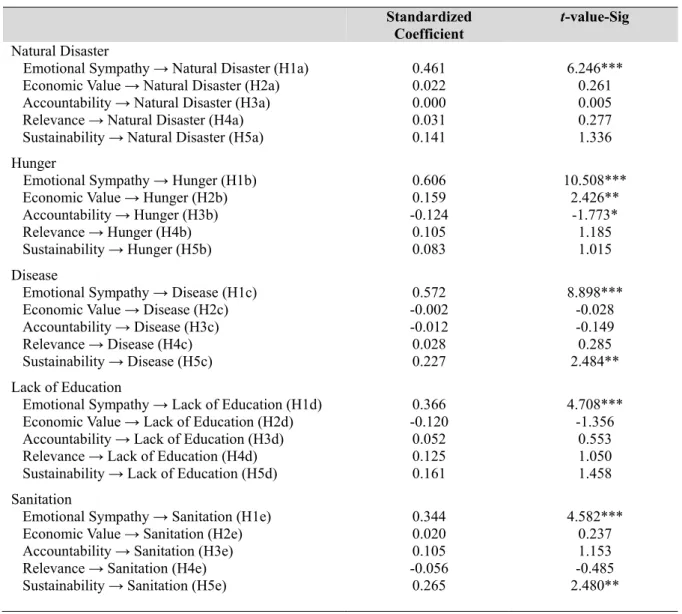
Furthermore, to analyze which factors have a significant impact when surveying participants' willingness to donate by type of five fundraising campaigns, regression analysis was applied to test the hypotheses using factor scores of the items. In this study, each type of fundraising campaign represents a donation solicit to solve a specific problem: natural disaster, hunger, disease, lack of education, and sanitation which are aligned with the criteria of the SDGs. As participants showed their donation intention by perceiving images of each fundraising campaign as examples, the results indicate that different factors affect donation intention according to types of campaigns. The results are summarized in Table 11.
Table 11. Effects of Types of TV Fundraising Campaign on Donation Behavior Standardized
Coefficient t-value-Sig
Natural Disaster
Emotional Sympathy → Natural Disaster (H1a) Economic Value → Natural Disaster (H2a) Accountability → Natural Disaster (H3a) Relevance → Natural Disaster (H4a) Sustainability → Natural Disaster (H5a)
0.461 0.022 0.000 0.031 0.141 6.246*** 0.261 0.005 0.277 1.336 Hunger
Emotional Sympathy → Hunger (H1b) Economic Value → Hunger (H2b) Accountability → Hunger (H3b) Relevance → Hunger (H4b) Sustainability → Hunger (H5b) 0.606 0.159 -0.124 0.105 0.083 10.508*** 2.426** -1.773* 1.185 1.015 Disease
Emotional Sympathy → Disease (H1c) Economic Value → Disease (H2c) Accountability → Disease (H3c) Relevance → Disease (H4c) Sustainability → Disease (H5c) 0.572 -0.002 -0.012 0.028 0.227 8.898*** -0.028 -0.149 0.285 2.484** Lack of Education
Emotional Sympathy → Lack of Education (H1d) Economic Value → Lack of Education (H2d) Accountability → Lack of Education (H3d) Relevance → Lack of Education (H4d) Sustainability → Lack of Education (H5d)
0.366 -0.120 0.052 0.125 0.161 4.708*** -1.356 0.553 1.050 1.458 Sanitation
Emotional Sympathy → Sanitation (H1e) Economic Value → Sanitation (H2e) Accountability → Sanitation (H3e) Relevance → Sanitation (H4e) Sustainability → Sanitation (H5e)
0.344 0.020 0.105 -0.056 0.265 4.582*** 0.237 1.153 -0.485 2.480** *** p < 0.01, ** p <0.05, * p < 0.1 denotes statistical significance
31
Regarding the TV fundraising campaign to improve natural disaster, H1a is accepted with the ANOVA analysis that is significant at 0.000 level with F =17.995 (r-square = 0.031). It indicates that emotional sympathy is a factor that influences donation behavior in
fundraising campaigns to address natural disasters.
In terms of the campaign to improve the problems of hunger, H1b, H2b, and H3 are accepted with the ANOVA analysis that is significant at 0.000 level with F = 54.995 (r-square = 0.580). It demonstrates that emotional sympathy and economic value, and accountability are significant factors that affect donation behavior in order to improve hunger.
For the campaign to solve disease, H1c and H5c are accepted with the ANOVA analysis that is significant at 0.000 level with F = 36.451 (r-square = 0.478). In other words, emotional sympathy and sustainability affect donation behavior for the campaign to deal with issues of disease.
With regards to the campaign to enhance lack of education, H1d is accepted with the ANOVA analysis that is significant at 0.000 level with F = 12.397 (r-square = 0.238). It means that emotional sympathy is a factor that determines donation behavior to advance the lack of education.
Concerning the campaign to promote sanitation, H1e and H5e are accepted with the ANOVA analysis that is significant at 0.000 level with F = 16.074 (r-square = 0.288). It describes that emotional sympathy and sustainability are factors that affect donation behavior to advance the issues of sanitation.
32
VII. Conclusion 7.1. Findings
This study aimed to analyze the determinants of donation behavior in relation to TV fundraising campaign of nonprofit organizations. The determinants are selected based on literature review that donors can be motivated for their giving behaviors by various reasons when a nonprofit organization solicit the contribution. Especially, while donor perceive the fundraising TV campaigns, the factors to measure in this study are mainly divided into two parts: factors affected by donors’ attitudes and by organizations’ performances.
As a result of this study, H1 and H5 were accepted that emotional sympathy and sustainability affect donation behavior, and H2, H3, H4 were rejected that economic value, accountability, and relevance don’t affect donation behavior. It was meaningful result that donors perceive both the emotional impression and organizational performance towards sustainability to decide their donation behavior. It was found that fundraising campaigns should focus not only on the donor's personal perception but also on the way to present organizational effectiveness.
The unique aspect of this study is that by selecting the types of fundraising campaigns in line with the criteria of the SDGs, it tries to figure out what factors significantly influence donation behavior according to the differences of each campaign. In all types of five
fundraising campaigns, emotional sympathy appeared to encourage giving behavior that H1a, H1b, H1c, H1d, and H1e are all accepted. At the same time, there were distinctive differences in factors that affect donation behavior according to each type of the fundraising campaign. For natural disaster and education related fundraising campaigns, emotional sympathy was the most effective determinant of donation behavior. Regarding the campaigns related to disease and sanitation, sustainability was a significant factor as well as emotional factors.
33
Interestingly, in terms of fundraising campaigns to improve hunger, it demonstrates that emotional sympathy, economic value, and accountability significantly affect donation behavior. This is likely due to the fact that participants are most concerned and well known about the issues associated with hunger.
In addition, about hypotheses that have not been accepted, further research is needed on why the perceived economic value of donations in fundraising, the accountability of
nonprofits, and the relevance of beneficiary-centered projects have no significant impacts on donation behavior.
This study explains one of the results of the study that economic value doesn’t affect donation behavior. In terms of economic factors, the actual price parity in the area where poverty-solving projects are carried out is very different from the economic level at which donors live, so it may be difficult to determine the value of this without existing background knowledge. Moreover, while the income level of donors may have a significant impact on making certain value judgments, no information related to income levels was collected.
Regarding accountability, the examples of fundraising campaign presented in the survey may not have effectively demonstrated organizational accountability within the contents. Fundraising campaigns focus primarily on which organizations will do what to solve or improve, while donors can't easily get information about accountability. Particularly in the fundraising campaign presented as examples, participants responded to the survey without seeing the logo or name of organizations. For further research, the question of
whether donors perceive the accountability considering nonprofit organizations’ brand can be specified.
In terms of the factor of relevance, it may be necessary for the donors to have
34
the problem of poverty. For example, to solve a health problem in a village suffering from malaria, donors may need more than the information available from fundraising campaigns to determine which method is more appropriate to solve the problem: whether a mosquito net will be given out, a malaria diagnostic kit will be distributed, a new health center will be established, or organizational cooperation will be required to investigate the local environment regarding outbreaks of malaria mosquitoes.
7.2. Additional Findings
In the survey question, a screening question classified those who have previously donated and have not donated. To find out whether intention for donation behavior varies based on prior experiences of donation, this study conducted independent samples t-test. With the significance level at 0.034, it shows that depending on existing donation experiences, there is a difference in determining donation behavior with fundraising campaigns.
In particular, for participants who answered that they have never made a donation before, the survey asked what the biggest hinderance was such as lack of emotional motivation, economic burden, mistrust of organizational accountability, and doubt about sustainability. As the study applied the analysis of the ANOVA which is significant at 0.003 level with F = 4.534, it indicates that based on what kinds of prior hinderance regarding donation experience, donation behavior varies.
For those who responded that they have donated before, the survey asked how many times they have donated with the criteria categorized with 1-2 times, 3-4 times, 5-6 times, or more than 6 times. The analysis of the ANOVA shows that the significance level is 0.800 with F = 0.335. It indicates that there is no difference between groups of respondents regarding the number of donation experiences.
35
The ANOVA analysis on participants' demographics showed that there is no difference in donation behavior by gender that is significant at 0.126 level with F = 2.365. Donation behavior differs by age groups with the ANOVA analysis that is significant at 0.001 level with F = 3.236. The donation behavior changed according to the level of education with the ANOVA analysis that is significant at 0.019 level with F = 3.027. The difference in donation behavior by job was not large with the ANOVA analysis that is significant at 0.152 level with F = 1.552.
7.3. Managerial Implications
Nonprofit fundraising campaigns are often used as a communication channel to represent the reality of poverty (Gourville & Rangan, 2004). It can be used to effectively inform the role of nonprofit organizations in society and to actively encourage the
participation of ordinary citizens (Brown, 2002). The communication methods used by these nonprofit organizations are not only effective for fundraising, but they also play a large role in creating and improving citizens' awareness of the nonprofit sector which are devoted to promote social issues free and not limited to domestic and foreign. Consequently, how well organized the nonprofit sector communicate with the general public will in turn provides a foundation for institutional sustainability (Iwu, Kapondoro, Darko, & Tengeh, 2015). If nonprofit organizations disregard the function of their fundraising campaigns for information transfer and blindly focus on raising funds based on methods such as the "shock effect", it will not be helpful for the development of the organizations in the long term (Ong, 2015). In particular, if the campaign induces the viewers' emotional motivation by showing the most vulnerable moments of beneficiaries without any filtration, it can harm the person involved in