Open Research Online
The Open University’s repository of research publications
and other research outputs
The perceptions of STEM Tutors on the role of
tutorials in distance learning
Journal Item
How to cite:Campbell, Anne; Gallen, Anne-Marie; Jones, Mark H. and Walshe, Ann (2019). The perceptions of STEM Tutors on the role of tutorials in distance learning. Open Learning: The Journal of Open, Distance and e-learning, 34(1) pp. 89–102.
For guidance on citations see FAQs.
c
2018 The Open University Version: Accepted Manuscript
Link(s) to article on publisher’s website:
http://dx.doi.org/doi:10.1080/02680513.2018.1544488
Copyright and Moral Rights for the articles on this site are retained by the individual authors and/or other copyright owners. For more information on Open Research Online’s data policy on reuse of materials please consult the policies page.
The perceptions of STEM Tutors on the role of tutorials in distance
learning
Authors
Anne Campbell, Anne-Marie Gallen, Mark H. Jones, Ann Walshe
The Open University, Walton Hall, Milton Keynes, MK7 6AA
Anne Campbell [email protected]
Anne-Marie Gallen [email protected]
Mark H.Jones [email protected]
Ann Walshe 0161 956 6858 [email protected]
Corresponding author: Ann Walshe
Anne Campbell is an Educational Developer and Senior Manager in Academic Services at The Open University, as well as being an Associate Lecturer in the School of Physical Sciences. Anne’s main focus is creating professional development opportunities for teaching staff to encourage facilitation of student learning, particularly in the online environment. She has a particular research interest in how students study and learn using electronic and online tools. @_AnneCampbell
Anne-Marie Gallen is a Lecturer and Staff Tutor in the School of Engineering and Innovation at the Open University. She is the author of a level 1 engineering and maths module , and has a particular interest in the pedagogy of group tuition. ORCID 0000-0002-2575-1105
Mark H. Jones is Senior Lecturer and Staff Tutor in the School of Physical Sciences at the Open University. He has led developments in teaching astronomy and space science, and has a particular interest in the pedagogy of online tuition. ORCID 0000-0001-6217-8574
Ann Walshe is a Lecturer and Staff Tutor in the School of Computing and Communications at the Open University and was an Associate Lecturer for 20 years. She has extensive teaching experience and has a particular interest in the pedagogy of group tuition.
The perceptions of STEM Tutors on the role of tutorials in distance
learning
Abstract
As part of a wider study into perceptions that different university stakeholders have of tutorials, we investigated the UK Open University model for tuition through a process of semi-structured interviews with a self-selecting set of STEM tutors. The aim of the study was to elucidate perceptions that tutors have of the role and purpose of tutorials, and their perceptions of student expectations of group tuition. Thematic analysis of interview transcripts using a grounded theory approach identified several key themes. These include perceptions of the tutor role in group tuition: facilitating academic learning and skills; and supporting the building of confidence, motivation, social interaction and collaborative group-work skills. Difficulties were identified in
encouraging student interaction in online synchronous tuition. In addition, mismatches became apparent between tutors’ perceptions of student expectations of tuition and their own preferred approaches, with suggestions that students expect a didactic rather than interactive experience.
Keywords
Distance learning; Group tuition; Tutor perceptions; Student expectations; Online tuition
Introduction
Within the past few years, changes in the UK Higher Education (HE) environment have led
to an increased focus on enhancing the student experience in order to maximise student
success. In England, the Teaching Excellence Framework
(https://www.gov.uk/government/collections/teaching-excellence-framework) is a strong
driver to promoting excellent teaching and increasing student-facing accountability within
English universities, an effect which ripples out to the other UK nations (e.g. see Universities
skills’ that employers consistently say they need. These include capacity for critical thinking, analysis and teamwork, along with the vital development of a student’s ability to learn” (Department for Business Innovation & Skills, 2016). One of the ways that universities,
whether campus-based or distance institutions, have traditionally addressed this aspect of
education is by providing tuition in groups. Tutorials for groups of students can address the
demand for critical soft skills to be developed and can enrich the learning experience, whilst
also allowing needs of individual students to be addressed (Roodt, 2013; Wilson, 1996).
Understanding perceptions of these tutorials from the point of view of tutors and students,
and indeed other stakeholders within our institutions, can give us insights into mismatches
between expectations and practice. Addressing such mismatches could then allow staff to
develop more effective forms of support.
Another change over recent years in many HE institutions, in the UK, but also the US
and elsewhere, has been a move to the provision of more online tuition, either in online-only
universities (e.g. Badia, Garcia, & Meneses, 2016), or as part of a blended learning strategy
(e.g. see Seaman, Allen & Seaman, 2018, for a report on the increase in numbers of students
studying online in the US). This change may affect how staff design and run their tutorials,
including content and style.
In this study, we discuss the results of an early part of a wide-ranging study at this
time of change, in which we intend to explore the perceptions of group tuition within the UK
Open University (OU) from various stakeholder viewpoints (tutors, students, academic
managers). In this initial paper we look at current perceptions of OU tutors working in
STEM disciplines about the role and purpose of tutorials, and also tutor understanding and
perceptions of student expectations. The issues that emerge have relevance across disciplines
and cross-sector, and are particularly relevant to institutions which have a distance or online
Educational context
The OU is the largest provider of HE distance education in the UK, with its model of open
distance learning. Teams of academic authors and support staff working in module teams
produce comprehensive self-study materials, while for most modules, students are assigned to
asmall group (typically containing 20 students), the tutor group, supported academically and,
to some degree pastorally, by a single tutor. The role of the tutor is to support self-study
through detailed feedback on assignments (correspondence tuition), one-to-one interaction
with students, and by delivering group tutorials, the subject of this study. These tutorials can
be either face-to-face or synchronous online, or a mixture of both. In most disciplines, tutors
use their judgement to choose the content and teaching style adopted in their tutorial sessions,
so as to best support students at given points in a module. Although attempts have been made
post-hoc (e.g. Tait, 2000) to analyse at a high-level the purposes of tutorials, we would
contend that it is the practice and perceptions of experienced front-line STEM teaching staff
that defines the purposes, content and style of tutorial provision for individual groups of
students. Since such views are the product of experience and environment, they are likely to
change over time, as indeed are student expectations of tuition (as noted by Stevenson and
Sander, 1998).
The OU is making increasing use of synchronous communication technologies, such
as Blackboard Collaborate (operated in the OU as ‘OU Live’), which allow real-time audio
and text communication whilst sharing a virtual whiteboard. These technologies can emulate
some of the features of a face-to-face tutorial session, whilst offering other features which are
unique to the online synchronous environment. An analysis of the OU experience of
introducing such systems (Kear, Chetwynd, Williams, & Donelan, 2012) identified a key
deficiency of synchronous conferencing in the areas of student interaction and participation,
and Campbell (2012) who went on to discuss how they might be addressed through a
programme of discipline-specific professional development for teaching staff. It might be
hoped then that tutors working through this medium will have responded to deal with the
issues of social presence, although the evidence to date (e.g. Lowe, Mestel, & Williams,
2016) shows that progress in this area is slow. The study reported here involved tutors who
all provide both face-to-face and online synchronous tuition.
A distinguishing feature of the OU tuition model is that student attendance is, by and
large, optional. Anecdotally, tutors have reported that participation rates in tutorials are often
low, which may indicate that many students are deciding not to attend tutorials. We believe
therefore that it is important to understand student perceptions of group tuition. Although
this study does not address this question directly, we can gain some useful insights from what
tutors report as student expectations.
Rather than investigating the specific changes discussed above, we wanted to be
sensitive to other changes that might shape tutors’ views of tuition. Consequently, we adopted a more holistic approach, described below, that aims to capture broader factors that
may have influenced tutor perceptions of the purpose of tutorials within the OU system.
Our aim in this study was to understand, in general, OU STEM tutor perceptions of
group tuition and also to investigate how tutors perceive student expectations of group
tuition.
Method
A qualitative approach was taken to data collection, consisting of semi-structured recorded
interviews with 19 OU STEM tutors who had volunteered to participate. Interviews were
conducted either by telephone or using the online synchronous software in use at the OU at
points for a conversation which could then evolve flexibly. Each interview followed a
similar pattern. Background and experience of tuition within and outside the OU were
probed, followed by a focus on perceptions of the purposes of group tuition in the OU
context. Tutors were then asked about their perceptions of other viewpoints, those of
students in particular, and whether this influenced their approach to tutorial design and
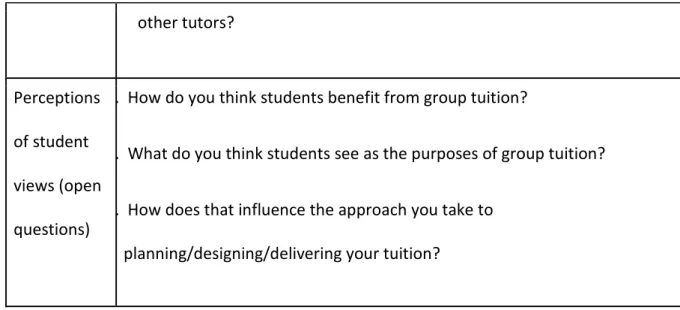
delivery. Table 1 shows the full set of questions used. All interviewees were provided with
the initial questions in advance, which allowed time for reflection and preparation.
Research exists that frames specific tasks and roles of distance tutors (e.g. Jelfs,
Richardson, & Price, 2009). However, in the present naturalistic study, it was appropriate to
allow themes to emerge in an inductive, open-ended manner, rather than constraining the
analysis to fit within previously existing theoretical frameworks. Therefore a grounded
theory interpretive approach (Glaser & Strauss, 1967) was taken to analyse the data, as this
provides a useful framework when the aim of a study is to learn about participant perceptions,
and where the data collected is primarily qualitative and descriptive (Cohen, Manion, &
Morrison, 2001).
Recordings of each interview were transcribed and then analysed by a team of
researchers (the four authors of this paper). Initial independent thematic analysis by each
researcher involved iterative reading of the scripts with occasional revisiting of the
recordings. Further analysis, based on the principle of constant comparison, was carried out
by all four authors at a face-to-face workshop in order to review and agree on coding, and to
draw out key emergent themes. Note that the researchers’ initial codings were found to be
closely aligned.
Tutor
background
1. What modules have you tutored on?
(closed
questions)
3. What experience do you have of tuition outside the OU?
Purposes of
tuition
(open
questions)
4. What do you think group tuition in the OU is for?
5. How have you come to this understanding of the purpose of group tuition?
6. Have your expectations of the purposes of group tuition changed or
developed since you started with the OU?
Mode of
delivery
(closed
questions)
7. Can you tell us the mode of delivery for your group tuition?
8. How is group tuition delivered on your module/s?
Objectives
(open
questions)
9. What are your objectives of your group tuition?
10.To what extent are you given guidance on the objectives of group tuition by your module team/s?
11. How do you decide what to include in your tutorials?
12. How do you decide when to offer tutorials, if you are able to do so?
Other views
(open
questions)
13. How do you think that your views of group tuition align with those of
· the module team?
· other tutors?
Perceptions
of student
views (open
questions)
14. How do you think students benefit from group tuition?
15. What do you think students see as the purposes of group tuition?
16. How does that influence the approach you take to
planning/designing/delivering your tuition?
Table 1. Semi-structured interview questions.
Study Participants
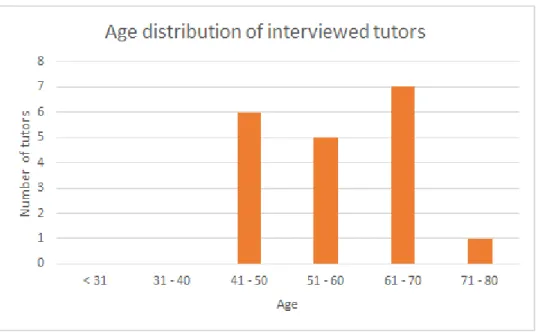
Interviewee ages ranged from 43 to 72 (Figure 1). All interviewees were first-level tutors
from science (10), engineering and technology (6) and mathematics (4) modules, some of
whom worked in more than one STEM discipline. Most also had extensive tutoring
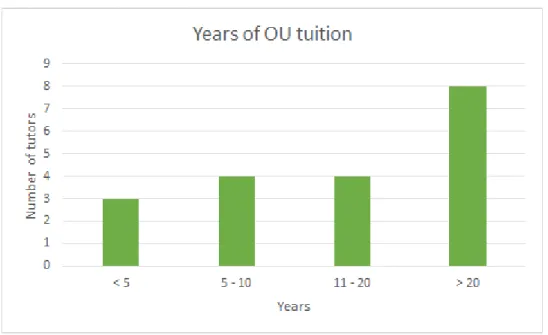
experience at higher levels, had experience across disciplines and faculties (Figure 2), and
almost all had extensive teaching experience external to the OU. Thirteen had taught or still
teach in colleges and/or schools. Seven had taught or still teach in other HE institutions.
Five work in teaching and learning in other areas such as professional development,
vocational training, basic literacy and prison teaching. The tutors were based in locations
across England, Scotland and Wales, from large towns to remote areas.
We recognise that by asking for volunteers, our interviewees may have had a strong
prior interest in tutorials and their purposes, which may have led to some bias: the views
expressed here may be more representative of tutors who have a deeper interest in tuition
In order to try to reduce the possibility of insider bias caused by any power
relationship brought about by interviewing colleagues in our immediate area, the researchers
first interviewed four of the tutors, each of whom was outside the individual researcher’s immediate field. These four tutors went on to conduct interviews with fifteen other tutors,
chosen to be outside their immediate work areas. Even so, in some cases, the interviewer and
interviewee were colleagues who had previously worked together, so it is possible that
familiarity and understanding of each other’s background and beliefs about tutoring may have had an influence on our findings. However, in reviewing the recordings and transcripts of
each interview, we found no evidence of influencing of interviewees: in fact, there were
probably advantages in having a common language and understanding of the tutoring
process, as this allowed interviewees to talk freely about their views (Robson, 1993).
Figure 2. The distribution of the number of years of work experience as a tutor of the sample of interviewed tutors.
Results
We present our results under two headings: Emergent Themes, which looks at tutor
perceptions; and Identified Issues in Tutorial Provision, which discusses specific issues
arising from the data.
Emergent Themes
A number of themes emerged from the analysis of interviews with tutors. These include
tutors’ perceptions of their tuition role, including facilitation of learning and supporting students through threshold concepts; their perceptions of tutorials and their purpose,
including motivation, collaboration and social interaction; and their perceptions of what
students want from tutorials, which focusses on assessment and how these expectations have
Tutors’ Perceptions of their Roles
Tutors as facilitators. In the context of the OU, where all the study materials are provided by
the academic authors, it is not surprising that tutors see themselves as facilitators of student
learning. Using the framework of Kember (1997) we suggest that these tutors have a
student-centred, learning-oriented conception, rather than a teacher-student-centred, content-oriented
conception. These findings chime to some extent with the findings of Jelfs et al. (2009).
They found that Science tutors largely had a student-oriented conception of teaching, while,
in contrast, Technology tutors had an impersonal concept of tutoring. In the present study,
every STEM interviewee, including the Technology tutors, in some way expressed their view
of themselves as facilitators of student learning. We should note again that because the tutors
in this study were self-selecting, they may have a deeper interest in, and perhaps a more
reflective view of, tuition than a typical tutor. One described the purpose of the role to be
… to guide a student through the material rather than to teach them,
essentially acting as the ‘guide on the side’ not the ‘sage on the stage’ (King, 1993). This role extends beyond engagement with the delivered material, with tutors also reporting that
facilitation was to 'enable students to participate themselves', as well as 'allowing students to
share ideas and knowledge' and 'getting students to do stuff for themselves'.
Addressing Threshold Concepts and Skills. Sixteen of the interviewees stated that a key
purpose of tuition is to address threshold concepts (Meyer & Land, 2006), challenging
material and pinch points. These tutors agreed that through tuition they are able to help
students ‘…with the concepts they are having difficulty with or skills they are having difficulty with', and that they are 'helping [students] to engage with the more challenging
...[students] benefit from the reinforcement of concepts through guided practice.
Experience allows tutors to predict student difficulties and misunderstandings, thereby
allowing design of appropriate tuition:
Once I am used to the module, I might have more idea of what I think are the sticking points and difficulties.
Further, two-thirds of these interviewees saw challenging their students intellectually as
important in order to enrich learning experiences:
...it is about extending learning from what they have got in their distance learning model, it is about adding another dimension.
Tuition is also seen as an opportunity for developing key transferable skills that students will
need in further studies and future employment. These tutors help with
…concepts, scientific concepts the students have difficulty with, skills, particularly maths skills.
and
Part of the tuition helps to develop this type of skill...basically professional skills they can apply that employers value a lot.
Tutors’ Perceptions of Tutorials
Motivation and building confidence. Two-thirds of interviewees identified encouraging
student motivation as an important part of the tutorial context:
...where you are geeing up the whole group, preparing them for what is coming and giving them some advice and guidance on how to tackle it.
can motivate students to study.
Within this, building student confidence was seen as a key outcome of group tuition,
something that is perhaps particularly needed in a distance learning context. Tutors want
their students to feel free to seek guidance and 'not be frightened of asking questions, not be
frightened of being wrong'. Over half of the tutors mentioned the importance of developing
self-confidence in students, and were aware of instances where their support had been
instrumental in this process:
...a student will sort of say that they didn’t think they could do it. So that is a benefit, that is a self-confidence thing with students isn’t it?
Enabling social interaction. Seventeen interviewees noted that they perceived social
interaction as an important purpose of group tuition for the students. This observation is in
line with the findings of Stevenson and Sander (1998), who surveyed OU psychology
students about their expectations of face-to-face tuition. Distance-learning students may feel
isolated, and tutorials are their main opportunity to experience social learning.
We are trying to get them to have an opportunity to socialise with each other, gain some friends, share ideas and expertise and mutually resolve issues.
Tutorials give students '...a sense of inclusiveness and belonging, otherwise they would feel
very much out on a limb…'. One tutor observed that 'for me learning is a group activity and without that social element to the learning people don’t learn as perceptively'. Tutorials are
'…really good for the students socially…when they meet other students it can really enliven them and invigorate them'.
Enabling collaboration. The ability to collaborate in group work is essential in most
mention tutorials as 'providing opportunities for [students] to collaborate as a group'.
Collaboration and group work help students develop their learning through peer interaction:
... particularly in face-to-face there is a huge opportunity for students to learn from one another… actually if you as a student are explaining it to another student, then that helps you get it clear in your mind in order to be able to explain it, as much as it helps the student who it is being explained to.
and
The students can help each other: learning is pretty much a group process.
Tutors’ Perceptions of Students’ Tutorial Needs
Through their interaction with students, every tutor interviewed had developed their own
view of the student perspective, although this may not be a full picture:
... it’s good to have students’ feedback and see what they are interested in … [but] it’s a lot harder than it seems trying to get students to tell you [what they want] …I normally sit down and I normally think, if I was a student on this module, what would I expect?
Tutors may also reach their understanding of the value of tutorials based on their own
background and experiences in HE:
I still remember how useful some of the tutorials that I attended were, so I think I try and model some of my tutorial aspects around the things that were useful to me when I was a student.
Passive or active? There was a shared belief amongst half the interviewees that their
students expected a didactic experience instead of a facilitative one:
...at level 1 a lot of them arrive thinking that it is a lecture or lesson and they will sit there in rows, preferably on the back row, and keep quiet while you write things on the board, so ...it is a bit of a shock that you are actually asking them to do things.
Despite this, OU tutors are clearly capable of managing student expectations and providing a
fruitful experience:
Quite a number of students have come up to me and said they really like doing the hands-on stuff and they find that are learning a lot by doing it.
One tutor recalled,
The expression on somebody’s face when I challenged them once was quite interesting. He came up to me afterwards and he said ‘I enjoyed that so much’ … It wasn’t what he was expecting.
Assessment focussed. One strong perception, shared by sixteen of the tutors, isthat students
expect tutorials to concentrate on and prepare them for their assessment tasks. A typical
response was:
I spend a majority of time in tutorials on support for assignments because I think that is what the students want.
This is a clear source of tension for tutors: they would like to expand the student learning
experience yet they feel constrained to meeting perceived student expectations of assessment
preparation:
It would be a wonderful opportunity to give them a very rounded-off introduction to studying and to learning, to the module and to the pathway but they don’t take this on. They want to have that [assignment] preparation and then they want to go home.
Changing expectations? Almost half the interviewees believe that students and their
expectations have changed:
the [OU] student population has changed and become significantly younger, and I think in many ways more demanding.
that students will now use the internet to support their studies: '…they tend to ask their questions on the internet or forums'. Tutors also believe that students have busier lives and
less time to devote to their studies:
I think over the years students used to be on schedule and they used to be prepared to spend more time studying in order to be on schedule. I think that life for, maybe for all of us, but for a typical student has got much busier now. They are trying to cram more things into life. … you used to know that pretty much all your students would be on schedule … Now you have to accept that most of them will be madly trying to catch up.
Eighteen of the nineteen participants mention such constraints on student time in relation to
falling tutorial attendance.
Identified issues in tutorial provision
The interviews set out to elucidate tutor perceptions of the purpose of group tuition as
described in the previous section. However the interviews also highlighted two areas that
tutors perceive to be important factors in determining how well tutorials actually meet these
stated purposes: the move to online delivery, and possible mismatches between student and
tutor expectations of the purpose of tutorials.
Online Delivery of Tutorials.
Although the tutors were not specifically asked about the effect that online delivery has had
on tutorials, this emerged as a theme that fifteen of the tutors referred to, either directly or
indirectly. Problematic issues of online delivery have long been anticipated, especially with
regard to the interaction that tutors see as a key strategy in facilitating learning or helping
students with threshold concepts. On the basis of analysis of student questionnaire data from
OU modules taught with face-to-face and purely online methods (albeit through
recommended training tutors and students in online communication to help alleviate issues
arising from a lack of paralinguistic cues in the online environment. In a study of the
perceptions of tutors on an online OU module taught using synchronous methods, Kear et al.
(2012) highlighted issues of interaction and participation, which they attributed to lack of
social presence.
From our study, it is evident that barriers to interactivity remain, and are seen as
problematic by the majority of tutors. Interviewees reported that they do attempt to develop
interactivity in online sessions. A typical response echoes the frustrations of many tutors in
facilitating interactive sessions,
I am still struggling if I am honest, with OU Live [online synchronous] sessions to make them more interactive. I can set up quizzes and polls and things like that but to actually get students to speak I find quite difficult, to get them to write on the whiteboard is even more difficult...
So, while tutors have taken steps to develop online teaching materials which require student
input, student engagement in more direct interaction is still very limited. There is a sense that
while some engagement that helps students to test their understanding is possible, the lack of
feedback from learners is preventing tutors from feeling that they are engaging with students
at an individual level.
Interaction in tutorials is also seen by tutors as important in helping develop
self-confidence in students. The effect of the move to online delivery on this aspect of tutorials
did not receive much comment, but where it was mentioned, there was an implication that
online tutorials are not as effective as the face-to-face,
I think a lot of the face-to-face stuff is confidence building, OU Live as well but I think face-to-face it is about encouraging and letting them know that they are doing well and letting them meet each other and find out that they are in the same boat, that sort of thing…
One tutor made an observation that the ability to watch recordings of online sessions could be
beneficial: 'I think in a way that is one of the good things about OU Live because if you are
really that lacking in confidence you could then listen to the recording'. This then highlights
a view that a student who is so lacking in confidence that they would not attend a live online
session could however benefit from viewing a recording of a session. Further work would be
required to establish whether students do benefit in this way.
While online tuition was widely recognised as presenting challenges to interactivity,
nine tutors perceived a benefit to this mode of delivery arising from increased attendance at
tutorial events,
...lots of people would agree the fact that face-to-face tutorials is a good way of facilitating the independent learning of students but the downside is that you very often don’t get a very good attendance, you get a better attendance on the OU Live type things…
The ease of student access to online events is reflected in the tutor experience of seeing
greater attendance as compared to face-to-face tutorials. Overall then, tutors do seem to
balance this advantage of online tuition against the difficulties of interacting effectively in the
online environment.
Differences between Tutor and Student Expectations of Tutorials
Another area of interest relates to differences between tutor perceptions of tutorials and their
(i.e. the tutors’) perceptions of student expectations of those tutorials. The issue of
mismatched expectations would be of concern in any organisation offering a service, and has
been highlighted in a HE context by Borghi, Mainardes, and Silva (2016). While we should
not take tutors’ views of student expectations as offering definitive information of the student view, they should act as indicators to potential tensions inherent within the OU tutorial
With regard to the tutors’ approach of running tutorials as facilitative sessions, the tutors’ perception, shared by twelve of the interviewees, is that students come to tutorials with an expectation that their tutor will ‘teach’ rather than ‘facilitate learning’. The
implication here is that students expect a presentation in the mode of a lecture, whereas tutors
would prefer a more interactive approach. The preference for the tutor to deliver a lecture
agrees with the findings of Stevenson, Sander and Naylor (1996) who investigated the
expectations of third-level OU psychology students in face-to-face tutorials. Despite the
differences in subject area, level and mode of delivery, it seems that many students in the OU
expect tutorials to be akin to lectures.
Tutors on the other hand, view interactivity as being key to helping students address
threshold concepts (Meyer & Land, 2006) since it provides a way of checking understanding
and prompting improvisation to meet student needs. The fact that a majority of tutors report
that students are reluctant to engage actively in tutorials, especially given the difficulties of
online interaction mentioned above, presents a major challenge to the tutorial model.
Furthermore, skills seen by tutors as important in the workplace, such as collaboration and
group working, which could be developed during tutorials, may be awkward to incorporate
and unsuccessful if students are reluctant to engage. It is not clear if the lack of engagement
arises from a student preference for lecture-style delivery (as noted above) or from inhibitions
to social presence arising from the online environment (Kear et al., 2012). Although, as
noted above, Stevenson et al. (1996) reported a preference for lecture-style delivery, focussed
group working and well-mediated discussion were also valued by students in face-to-face
settings. It may well be that given appropriate activities, students would engage with, and
value, online group working.
Another mismatch appears in the focus on assessment. Almost all tutors see students
pass their module. It is not uncommon for tutors to report that students seem to be learning
just enough to gain a qualification and have a task-oriented concept of tuition. As subject
experts, tutors recognise the need to challenge students intellectually and broaden their
learning experience beyond the study materials. Students do value the expert status of tutors
(Jelfs et al., 2009), but it is possible that they do not recognise that expertise as extending to a
set of behaviours that the tutor aims to develop.
The changing nature of student circumstances is also mentioned by all but two tutors
as a factor leading to changes in student expectations. In particular, whether tutorials
represent a valued use of time from the student perspective seems to be increasingly
questioned. Tutor perceptions of busier student lifestyles, stronger and deeper interactions
with ‘off-module’ online media and the internet, and the trend towards a younger mean student age were all identified as acting to reduce tutorial attendance.
These mismatches are not lost on tutors, and it raises the issue of the management of
student expectations of tuition; especially when students are new to HE and distance
education. One approach, advocated by Stevenson, MacKeogh and Sander (2006), is to
assess student expectations by questionnaire at the start of a module. While this seems to
have advantages in terms of ensuring that tutors have a better appreciation of what students
value in terms of tutor support, it is not clear that it provides any useful insight into teaching
practices or student engagement in tutorials.
Conclusions
The aim of this study was to explore current practices and expectations of STEM tutors about
the tuition of groups within a distance learning model. By adopting a qualitative approach
using semi-structured interviews, we believe that we have been able not only to capture tutor
delivering tuition.
On the whole, STEM tutors viewed tutorials as interactive spaces that facilitate
student development in knowledge and skills, including valued soft skills such as
team-working and communication. Tutors exercise their judgement in deciding on the content (i.e.
the concepts or skills worthy of attention) and in choosing appropriate learning activities.
The picture that emerges from these interviews reveals two major difficulties that tutors face.
Firstly, the move to online tuition using synchronous systems presents a challenge in creating
effective interaction: this can create a barrier to communication between tutor and student
and between students in a group. Secondly, we identified mismatches between the tutors’
aspirations for tutorials and their perceptions of student expectations.
These two challenges need to be further explored and addressed. It may well be that
the concept of the online tutorial is one that cannot be realised by direct analogy with its
face-to-face counterpart, and that alternative approaches to teaching should be further developed
that are better suited to the medium and more engaging for students. Furthermore, we
suggest that institutional strategies should be developed such that students could gain a better
appreciation of how they could benefit from taking a more active role in tutorials. This may
help students to better appreciate the role that interaction with a group (peers and tutor) can
play in their own development, and lead to a better realisation of the expected outcomes of
group tuition.
Acknowledgements
Our heartfelt thanks go to all of the tutors who participated in this research. We wish to dedicate this article to the memory of our tutor colleague, Dave Edwards, who worked closely with us on this project and many others.
Funding
We are very grateful to The Open University and The OU Centre for STEM Pedagogy (eSTEeM) who funded this work.
Disclosure
No potential conflict of interest was reported by the authors.
References
Badia, A., Garcia, C., & Meneses, J. (2016). Approaches to teaching online: Exploring factors influencing teachers in a fully online university. British Journal of Educational Technology. 48(6), 1193-1207.
Borghi, S., Mainardes, E., & Silva, E. (2016). Expectations of higher education students: a comparison between the perception of student and teachers. Tertiary Education and Management,22(2), 171-188.
Cohen, L., Manion, L., & Morrison, K. (2001). Research Methods in Education (5th ed.). London: Routledge.
Department for Business, Innovation & Skills (2016). Success as a Knowledge Economy: Teaching Excellence, Social Mobility & Student Choice. London: HMSO.
Glaser, B., & Strauss, A. (1967). The discovery of grounded theory: strategies for qualitative research. Chicago, IL: Aldine.
Jelfs, A., Richardson, J.T.E., & Price, L. (2009) Student and tutor perceptions of effective tutoring in distance education, Distance Education, 30(3), 419-441.
Kear, K., Chetwynd, F., Williams, J., & Donelan, H. (2012). Web conferencing for
synchronous online tutorials: Perspectives of tutors using a new medium. Computers & Education, 58, 953-963.
Kember, D. (1997). A reconceptualisation of the research into university academics’ conceptions of teaching. Learning and Instruction, 7(3), 255–275.
King, A. (1993). From Sage on the Stage to Guide on the Side. College Teaching, 41(1), 30-35.
Lowe, T., Mestel, B., & Williams, G. (2016). Perceptions of Online Tutorials for Distance Learning in Mathematics and Computing. Research in Learning Technology, 24(1), 30630.
Macdonald, J., & Campbell, A. (2012). Demonstrating online teaching in the disciplines. A systematic approach to activity design for online synchronous tuition. British Journal of Educational Technology, 43(6), 883-891.
Meyer, J. H. F., & Land, R. (2006). Threshold concepts and troublesome knowledge: an introduction. In J. H. F. Meyer & R. Land (Eds.), Overcoming barriers to student understanding: threshold concepts and troublesome knowledge (pp. 3-18). London: Routledge.
Ogina, T.A., & Mampane, S.T. (2013). Experiences of tutorial sessions as learning support for distance education students. Progressio, 35(1), 104-118.
Price, L., Richardson, J.T.E., & Jelfs, A. (2007). Face-to-face versus online tutoring support in distance education. Studies in Higher Education, 32(1), 1-20.
Robson, C. (1993). Real World Research: A Resource for Social Scientists and Practitioner-Researchers. Blackwell: Oxford.
Roodt, J. (2013). The role of a tutoring programme in a first-year English course: student and tutor perceptions (Master’s thesis). Retrieved from
http://scholar.sun.ac.za/handle/10019.1/85815
Seaman, J. E., Allen, I.E., & Seaman, J. (2018), Grade Increase: Tracking Distance Education in the United States. Retrieved from
https://onlinelearningconsortium.org/read/grade-increase-tracking-distance-education-united-states/
Stevenson, K., MacKeogh, K., & Sander, P. (2006) Working with student expectations of tutor support in distance education: testing an expectations-led quality assurance model. Open Learning, 21(2), 139-152.
Stevenson, K., & Sander, P. (1998). How do Open University Students Expect to be Taught at Tutorials? Open Learning, 13(2), 42-46.
Stevenson, K., Sander, P. & Naylor, P. (1996). Student perceptions of the tutor's role in distance learning. Open Learning, 11(1), 22-30.
Tait, A. (2000). Planning student support for open and distance learning. Open Learning,
15(3), 287-299.
Universities Scotland (2017). Strong Performance from Scotland’s Universities in the TEF. Retrieved from
https://www.universities-scotland.ac.uk/strong-performance-scotlands-universities-tef/
Wilson, T (1996), Levels of helping: a framework to assist tutors in providing tutorial support at the level students want and need. Nurse Education, 16, 270-273.