U N I V E R S I T A T P O L I T È C N I C A D E C A T A L U N Y A
UniversitatPolitecnica de` Catalunya Teoria delSenyal iComunicacions
This thesis is submitted in partial fulfillment of the requirements for the degree of Doctor of Philosophy (PhD)
E
fficient
, E
nd
-
to
-E
nd and
S
elf
-S
upervised
M
ethods for
S
peech
P
rocessing and
G
eneration
by S
antiago
P
ascual de la
P
uente
Advisor: Antonio Bonafonte C´avez Co-advisor: Joan Serr`a Juli`a
iii
“Out of the night that covers me, Black as the pit from pole to pole, I thank whatever gods may be For my unconquerable soul. In the fell clutch of circumstance I have not winced nor cried aloud. Under the bludgeonings of chance My head is bloody, but unbowed. Beyond this place of wrath and tears Looms but the Horror of the shade, And yet the menace of the years Finds and shall find me unafraid. It matters not how strait the gate,
How charged with punishments the scroll, I am the master of my fate,
I am the captain of my soul. ”
v
Abstract
Deep learning has affected the speech processing and speech generation fields in many directions. First, with end-to-end architectures that allow for injection and synthesis of waveform samples directly. Secondly, with the exploration of ef-ficient solutions that allow for deep learning to be applied, with its effectiveness, to computationally restricted environments like mobile devices. And finally, with latest trends that explore speech and audio data to learn novel representations with the least amount of supervision. In this work we explore these three directions in both speech generation and speech analysis systems. First, we make use of the latest pseudo-recurrent structures, such as self-attention models and quasi recur-rent neural networks, to build text-to-speech acoustic models. The resulting quality and efficiency of the proposed systems is then studied in comparison to the recur-rent baseline. Our study shows that, with the proposed pseudo-recurrecur-rent acoustic model based on quasi recurrent neural networks, named QLAD, we achieve a 11.2 times synthesis speedup on CPU and 3.3 times on GPU with respect to the purely recurrent baseline model. Moreover, such model is able to preserve the synthetic speech quality to the same level as in the original recurrent model, both competitive with state of the art in vocoder-based statistical parametric speech synthesis models. Secondly, we propose a speech enhancement generative adversarial network, the SEGAN. This is able to perform speech-to-speech mappings in one single inference as a fully convolutional structure, which also involves an efficiency increase with re-spect to existing end-to-end auto-regressive generative models. We show prominent results in noise removal with respect to other classic and deep regression baselines. This is first reflected in objective results, where the best performing model we pro-pose reaches the highest quotas of segmental signal-to-noise-ratio and intelligibility scores. In subjective terms, the model also shows advantage over all other selected baselines in terms of noise removal and, also importantly, least distortion injection in the speech regeneration. The proposed model also proves to be efficient in its transferability to new languages and noises. Departing from an English pre-trained model, the system achieves comparable objective performance to the English model itself on Catalan and Korean with only 24 s of adaptation data, with unseen speak-ers and noise. This would specially fit the requirements of having a model for low resource environments. Finally, we unveil the generalization capability of SEGAN towards other noises and distortions, hence truly taking advantage of the genera-tive capacity of the model with the so called generalized speech enhancement. The first task tackled under this shift towards palliating distortions on the speech sig-nals is a whisper-to-voiced conversion. This part of the work aims to improve an existing regression based approach with recurrent networks that, for clinical pur-poses, tries to recover natural speech from aphonia. Results show that our model can indeed enhance the naturalness of the resulting speech in terms of intonation, as well as proving the need for the adversarial training component upon the failure of
a regression-based method in time domain. Then, to finish our proposal on the use of SEGAN for generalized speech enhancement, a new paradigm shift is proposed where several distortions are combined and have to be palliated. This involves a new trend where deep generative models are to be used for general purpose speech enhancement, where reconstructed naturally sounding utterances have to emerge out of damaged ones even if it involves a change of prosody and low level features with respect to the original signal. To make our SEGAN effective on the first ap-proach we take for this task, we propose the insertion of perceptually related losses to build a multi-task setup in the GAN discriminator, as well as a two-stage training strategy. Acoustic features are then predicted in the deepest part of the classifier, which enriches the features learned in the adversarial training, which in turn makes the generator yields better quality for the regenerated speech. And secondly, the two-stage training is proposed to keep the equilibrium in the synergy between both GAN networks. With these two additions objective and subjective results show a substantial increase of quality of our proposed GAN compared to its vanilla ver-sion. Finally, we propose a problem-agnostic speech encoder, named PASE, as well as a training framework for it that makes it work unsupervisedly. PASE is a fully convolutional structure that yields compact embeddings, which contain highly ab-stract features such as speaker identity, prosodic traits and spoken contents. We also propose a novel self-supervised multi-task learning approach in order to train the encoder. Training without requiring manual labeling makes it specially attrac-tive for exportability purposes to whichever dataset and to leverage large amounts of data. Once PASE is trained during the self-supervised phase, it is exported into other tasks and datasets to assess its transferability and the quality of its learned rep-resentation. The encoder proves to be effective to do speaker, emotion and speech recognition. Specifically, if we are able to fine-tune it with the end-task classifier in the target dataset, the representation quality increases and systematically surpasses well tuned classic features such as MFCCs and FBANKs, which are extensively used in current state of the art speaker recognition and speech recognition systems, as well as itself without fine-tuning. Interestingly, we also show that this holds for noisy acoustic conditions to do speech recognition, even if the encoder was trained only on clean data as it is the case. Moreover, the self-supervised multi-task components importance is evaluated in an ablation study, which shows that all the proposed tasks matter across the three evaluated problems. Finally, we provide preliminary results on the effectiveness of the learned embeddings for text-to-speech. In this case the encoder is used as an acoustic feature descriptor for speaker identities, where the yielded frames for an utterance are averaged to obtain the global representation. Objective results show faster convergence and higher speech quality when using our embeddings than with typical trainable one-hot discrete codes. Additionally, using an acoustic feature extractor as descriptor allows for out-of-corpus speech identities to be synthesized, hence doing speaker adaptation without the need for retraining. We also show our first objective results that support that we can indeed perform this speaker adaptation, specially when we have enough samples of the target speaker.
vii
Acknowledgements
En aquesta tesi hi ha recopilades moltes pàgines de propostes, dissenys i resul-tats. Però a part d’això, i de manera no palpable ni fàcilment apreciable a la vista d’aquests fulls, hi ha un creixement personal important per part meva. Ha estat un camí llarg, dut endavant per il·lusions alimentades de curiositat. I dins la frus-tració que genera no obtenir el que un espera més sovint del necessari, aqui esta el resultat de la perseverança i la paciència per aconseguir quelcom del que quedar sat-isfet. Nogensmenys, un no sol suportar les frustracions sense companyia en la que recolzar-se i amb qui sentir que les coses milloraràn. Tampoc fora possible obtenir un treball de qualitat amb diversitat de propostes i resultats sense col·laboracions més que enriquidores. Així doncs, hi ha un gran col·lectiu de gent a qui agraïr el suport i la feina feta.
Primer de tot, tirar endavant la feina esmentada no seria possible sense una men-toria adeqüada. Així doncs, vull agraïr enormement als meus dos directors de tesi, l’Antonio Bonafonte i el Joan Serrà, la dedicació que han tingut envers a mi i la meva formació. El seu recolzament constant a les meves propostes m’ha ajudat envers el desenvolupament de noves idees. Els agraeixo també els esforços que han fet per aconseguir-me els recursos necessaris per dur a terme recerca cada cop més exigent, especialment en termes computacionals. És important remarcar que si em sento més científic, tant en saber proposar innovacions, com en el desenvolupament experi-mental i l’escriptura, és gràcies als seus consells i la seva incansable guia.
También agradezco la dedicación de mi tutora, Asunción Moreno, para escuchar y darme consejos de escritura, y por brindarme su inestimable ayuda con los sorti-legios burocráticos.
Agradezco a mi família primero de todo su cariño, y que me hayan apoyado en los momentos difíciles. También les agradezco enormemente que siempre me hayan empujado a estudiar y construirme un futuro donde la educación fuera un pilar fundamental. Es para mi una gran satisfacción alimentar su orgullo con el hecho de culminar mi educación superior como doctor. Además, debo agradecer de manera especial a mi madre, Maria Angeles, su eterno esfuerzo en trabajar sin reparo para que sus hijos tuvieramos oportunidades y buen ejemplo. Als meus germans, Toni i Jordi, els transmeto un especial agraïment per fer-me seguir els bons passos que m’obligàven a formar-me i no abandonar. També agraeixo al pare, l’Antonio, el fet que des de petit m’aportés reflexió i afecció pel coneixement.
Vull agraïr a la Cristina el suport que m’ha donat en tot moment per calmar els ànims quan els resultats eren adversos i els processos de la recerca generàven ansietat. També per alegrar-se de cada petita o gran victòria que pogués publicar i celebrar, i per fer-me sentir que esta orgullosa del que faig mentres avanço per aquest camí trontollós que es diu recerca. També agraïr a la seva familia el resguard de les escapades al poble amb les que alliberar els pensaments i respirar aire fresc.
També vull agraïr als meus companys i professors els moments d’entreteniment que m’han brindat, així com els coneixements que haguem pogut compartir al llarg del desenvolupament de la recerca que es presenta aqui. Gràcies a l’Amaia Salvador,
el Xavi Giró, el Miquel India, l’Enric Monte, el Jose Adrián Rodríguez Fonollosa, el Jordi Luque, el Carlos Segura, el Ferran Diego Andilla i el Jordi Pons.
També agraeixo els bons moments que els meus amics m’han brindat, per totes les vegades que em puc escapar per veure’ls, que no són tantes com esperaria, i lliurar-me delmare magnum de divagacions científiques que tant absorbeixen. Grà-cies especialment al Carles Valencia, el Nacho Ripoll, la Carla Hortigüela, el Pedro Yuste, el Maties Pons, la Carmen Quintana i el Rafa Valencia.
I also want to acknowledge the efforts and work by my close collaborators, which participated in certain parts of this extense work. I want to thank Maruchan Park and Prof. Kang-Hun Ahn for their work on SEGAN adaptation to Korean, and for the excellent time I had getting to know Korea. A piece of the "Pali pali" culture remains in me. I also thank José A. González for his work on whispered-to-voice conversion with SEGAN, and for facilitating us the data. I also thank Mirco Ra-vanelli and Yoshua Bengio for their work and collaboration to make PASE, their fan-tastic ideas to improve it and its current development. Also in this line of research, I want to thank Pawel Swietojanski for our insightful conversations on many topics related to speech processing and generation in the end of my PhD, in addition to his prominent work with PASE for ASR. I also want to thank Jianyuan Zhong and Joao Monteiro for their work on improving PASE and working so hard on refactoring the open source framework. I also thank Maurizio Omologo and the JSALT 2019 orag-nizers for gathering such great team with which I could learn so much about a broad set of concepts related to speech recognition, deep architectures and learning strate-gies. I also thank David Álvarez for his experimentation on merging PASE features with the SampleRNN acoustic model.
I want to deeply thank all those people that took the several subjective evalua-tions with patience. The satisfaction of successful results coming out of this work would not have happened without their willingness to help. Also, special thanks to all the reviewers, both for the publications that are part of the development of this thesis and for the thesis itself. They really helped me to substantially improve the quality of my manuscripts.
I acknowledge that this thesis would not have been possible without the financial assistance of the VEU group at UPC and the Spanish Government through the FPI grant and the project TEC2015-69266-P (MINECO/FEDER, UE).
ix
Contents
Abstract v Acknowledgements vii 1 Introduction 1 1.1 Motivation . . . 11.1.1 Sub-optimal Feature Selection . . . 3
1.1.2 Cumulative Errors in Cascaded Systems . . . 4
1.1.3 Processing Pipeline Complexity . . . 5
1.1.4 The Deep Paradigm Shift in Speech Processing . . . 6
1.2 Deep Speech Representation and Generation . . . 6
1.2.1 Speech Representations . . . 7
1.2.2 Speech Generation . . . 8
1.3 Objectives and Outline of the Thesis . . . 9
2 Literature Review 13 2.1 Speech Generation . . . 13
2.1.1 Unit Selection Concatenative Speech Synthesis . . . 13
2.1.2 Statistical Parametric Speech Synthesis . . . 14
2.1.2.1 Hidden Markov Model Based Statistical Parametric Speech Synthesis . . . 15
2.1.2.2 Deep Learning Based Statistical Parametric Speech Synthesis . . . 17
2.1.2.3 Towards End-to-End Speech Generation . . . 18
2.2 Speech Enhancement . . . 21
2.3 Unsupervised Speech Representation Learning . . . 23
3 Deep Learning Review 25 3.1 Stacking in Depth: Fundamental Neural Blocks . . . 25
3.1.1 Fully Connected Layer . . . 25
3.1.2 Convolutional Layer . . . 26
3.1.3 Transposed Convolutional Layer . . . 30
3.1.4 Recurrent Layer . . . 30
3.1.5 Quasi Recurrent Neural Layer . . . 31
3.1.6 Sequence to Sequence Model . . . 32
3.1.7 Attention Layer . . . 33
3.2 Deep Generative Models . . . 36
3.2.1 Explicit Density Models . . . 36
3.2.1.1 Autoregressive models . . . 37
3.2.1.2 Flow-based models . . . 37
3.2.2 Implicit Density Models . . . 39
4 Efficient Neural Acoustic Modeling in Text-to-Speech 43
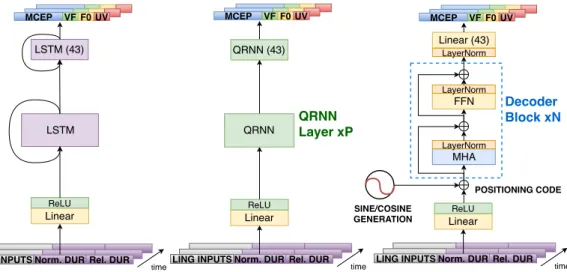
4.1 Recurrent Linguistic–Acoustic Decoder . . . 44
4.2 QRNN Linguistic–Acoustic Decoder . . . 45
4.3 Self-Attention Linguistic–Acoustic Decoder . . . 46
4.4 Experimental Setup . . . 47
4.4.1 Dataset . . . 47
4.4.2 Linguistic and Acoustic Features . . . 47
4.4.3 Model Details and Training Setup . . . 50
4.4.4 Evaluation Metrics . . . 51
4.4.4.1 Objective Evaluation . . . 51
4.4.4.2 Subjective Evaluation . . . 52
4.4.4.3 Efficiency Evaluation . . . 52
4.4.5 Results . . . 52
4.5 Discussion and Conclusion . . . 55
5 Speech Enhancement Generative Adversarial Network 57 5.1 Speech Enhancement GAN . . . 58
5.1.1 Model . . . 58 5.1.2 Training . . . 61 5.1.3 Generation . . . 61 5.2 Experimental Configuration . . . 62 5.2.1 Data . . . 62 5.2.2 Baselines . . . 63 5.2.3 Objective Metrics . . . 64 5.3 Results . . . 65 5.3.1 Model Variations . . . 65
5.3.1.1 Encoder/decoder stride and kernel sizes . . . 67
5.3.1.2 Normalization schemes . . . 67 5.3.1.3 Optimizer . . . 68 5.3.1.4 Skip connections . . . 68 5.3.1.5 Latent z . . . 69 5.3.1.6 Biases . . . 69 5.3.1.7 Transposed Convolutions . . . 70 5.3.2 Comparative Results . . . 70 5.3.2.1 Objective Performance . . . 70 5.3.2.2 Subjective Performance . . . 71
5.4 Language and Noise Transfer in SEGAN . . . 73
5.4.1 Language and Noise Transfer Results . . . 74
5.5 Whispered SEGAN . . . 75 5.5.1 Experimental Setup . . . 76 5.5.2 Results . . . 78 5.6 Generalized SEGAN . . . 80 5.6.1 Acoustic Losses . . . 80 5.6.2 Adversarial Pre-Training . . . 82 5.6.3 Dataset . . . 82 5.6.4 Experiments . . . 83 5.6.5 Evaluation . . . 84 5.6.6 Results . . . 84
xi
6 Learning Problem-Agnostic Speech Representations from Multiple
Self-supervised Tasks 87
6.1 Problem-agnostic Speech Encoder . . . 88
6.1.1 Encoder . . . 88
6.1.2 Workers . . . 89
6.1.3 Self-supervised Training . . . 91
6.1.4 Usage in Supervised Classification Problems . . . 92
6.2 Corpora and Tasks . . . 92
6.3 Results . . . 93
6.3.1 Worker Ablation . . . 93
6.3.2 Comparison with Standard Features . . . 93
6.3.3 Transferability . . . 95
6.4 PASE Embeddings for Text-to-Speech . . . 95
6.4.1 Multi-Speaker SampleRNN Acoustic Model . . . 95
6.4.2 Acoustic Seed . . . 96
6.4.3 Experimental Setup . . . 97
6.4.4 Results . . . 98
6.5 Conclusion . . . 101
7 Summary and Future Perspectives 103 7.1 Summary of Contributions . . . 103
7.2 Some Future Perspectives . . . 105
A Demo Pages: Audio Samples 107 B Publications by the Author 109 B.1 Chapter 4 . . . 109
B.2 Chapter 5 . . . 109
B.3 Chapter 6 . . . 109
B.4 Byproducts . . . 110
B.5 Open Source Projects . . . 110
B.5.0.1 Chapter 4 . . . 110
B.5.0.2 Chapter 5 . . . 111
B.5.0.3 Chapter 6 . . . 111
B.6 Blog post Tutorials on Convolutional Neural Networks . . . 111
xiii
List of Figures
1.1 Example communication between a person and a smart speaker. . . 2 1.2 Example end-to-end replacements for text-to-speech and speech
en-hancement applications. . . 4 1.3 MUSHRA results from different speech synthesis models from
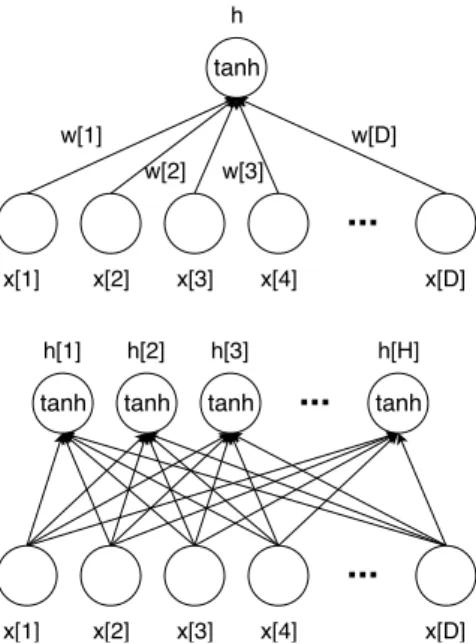
Pas-cual (2016) Fig. 4.21. SPSS: HMM-based Statistical-Parametric Speech Synthesis (see section 2.1.2). US: Unit Selection Concatenative Speech Synthesis (see section 2.1.1). LSTM-pf and LSTM-raw: SPSS models based on recurrent neural networks with and without post-filtering respectively. Ahocoded: vocoded speech. Natural: raw recordings. . . 5 2.1 SPSS framework schematic (from Zen et al. (2009) Fig. 3). . . 16 3.1 Top: fully connected neuron. Bottom: fully connected layer. . . 26 3.2 Example of a convolutional neural filter of size 3 sliding over the input
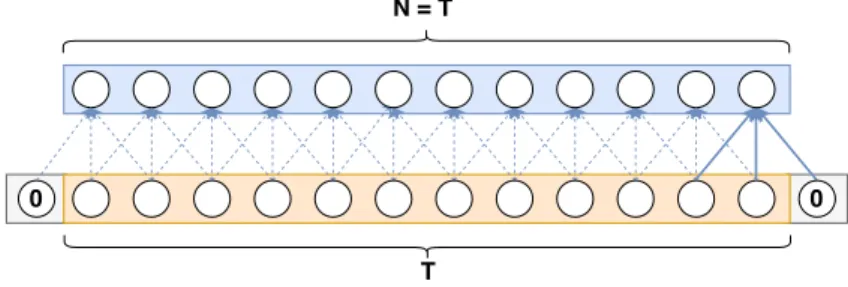
signal. . . 27 3.3 Example of a convolutional neural layer withK=4 feature maps and
L = 3 kernel width. The input signal hasT = 12 samples, and each feature mapN=10 activations. . . 27 3.4 Padding the input signal so that the output feature map has the same
lengthNas the input signalT. . . 28 3.5 Example of a convolutional kernel striding by a factor S = 2, hence
obtaining a feature map with decimated time resolution, fromT=12 toN=6. . . 28 3.6 Comparison between input-to-output channel connectivity patterns
in a normal convolution (left) and a grouped convolution (right). C
is the number of input channels,Kis the number of output channels,
G = 2 is the group size and Kg is the number of output channels connected to its group of inputs. The representation is a slice across the kernel length, so time axis is not represented. . . 29 3.7 Dilated convolutional kernel withD = 2. In each time-step, the
con-volutional parameters have a time-span of 5 samples, although only theL=3 weights are applied to the signal. . . 29 3.8 Recetive fields of a regular stack of a two convolutional neural
lay-ers (left) and a stack with a strided convolution with S = 2 (right). Crossed out units in the right-side indicate decimated samples ig-nored because of the doubled striding. . . 30 3.9 Transition from a convolution operation (top) to a transposed
convo-lution (bottom). Thewvalues denote the convolution weights, while theuvalues denote the transposed convolution weights. . . 31 3.10 Schematic of a QRNN layer, following the operations of equations 3.9
for the convolutional projections and 3.10 for the recurrent pooling. This corresponds to thefo-pooling type from the original QRNN pro-posal (Bradbury et al.,2017). . . 33
3.11 RNN based encoder-decoder model (from Cho et al. (2014)). . . 34 3.12 Example attention map that relates two sentences for machine
trans-lation, with an input English sentence "Are you still home?" and an output Spanish sentence "¿Todavía estan en casa?" (from TensorFlow neural machine translation with attention tutorial1). . . 35 3.13 Left: Scaled dot-product attention function diagram. Right:
multi-head attention consisting ofhparallel attention functions (from Vaswani et al. (2017) Fig. 2). . . 36 3.14 Schematic of the deep causal convolutional stack that forms the core
of WaveNet (from van den Oord et al. (2016b) Fig. 3). . . 37 3.15 Schema of the GAN training process. First, D back-props a batch of
real examples (left). Then,Dback-props a batch of synthetic examples that come fromG and classifies them as synthetic (middle). Finally, theDparameters are frozen, andGback-props to makeDmisclassify the examples (right). . . 40 4.1 Comparison of architectures for: (a) RNN/LSTM acoustic model (RNN
baseline); (b) QLAD; and (c) SALAD. The embedding projections are the same. The QRNN layer is stackedPtimes in the hidden structure. In SALAD, the positioning encoding introduces sequential informa-tion. The SALAD decoder block is stackedNtimes to form the hidden structure. FFN, Feed-forward Network; MHA, Multi-Head Attention; CConv1D, Causal 1D convolution. . . 45 4.2 Evolution of test distortions depending on the available amount of
training data (in percentage), for both male (left) and female (right) big models. . . 54 4.3 Inference time for the three different studied models: (Left) CPU speed
curves; and (Right) GPU speed curves. . . 55 5.1 Autoencoder architecture for speech enhancement (Gnetwork).
Fea-ture maps are depicted in blue and green. The decimation/interpolation factorsd depends on the strides and layer depth indexd. The input waveform length is designatedL, and the number of kernels/channels at each layer is kd. The right-side arrows denote skip connections, which have a multiplicative scalar factorad. . . 59 5.2 SEGAN training process. First,D backpropagates with the real pair
(x, ˜x) classifying it as real. Then, Dbackpropagates a fake pair (ˆx, ˜x). Finally, D parameters are frozen and G backpropagates to make D
miss-classify the pair (ˆx, ˜x) as real. Gtruth: ground-truth clean signal. Genc: Generator encoder structure. Gdec: Generator decoder struc-ture. . . 62 5.3 (a) LPS-DNN: Deep neural network baseline mapping of a context
window ofClog-power spectral frames to the central clean frame. (b) LPS-BLSTM: Bidirectional long-short term memory recurrent neural network that maps the full input noisy sequence to the clean one. The output of the BLSTM (forward and backward extracted features) is fed to an additional multi-layer perceptron to fullfil a final transformation and dimension adaptation sharing weights through time. . . 64
xv 5.4 One-dimensional transposed convolution (‘deconvolution’) with both
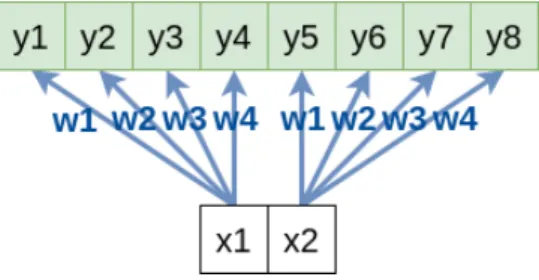
kernel width and stride equal to 4. The same kernel with weights wi ∈ Rwithi ∈ [1, 4](in a one-channel input case) does not overlap itself with neighboring samples. . . 70 5.5 Objective metrics for Catalan (top row) and Korean (bottom row).
Blue line (preeng): Pre-trained with English. Orange line (scratch): trained from scratch. Green dashed line: SEGAN level without fine tunning. Black dash-dotted line: Noisy level. . . 74 5.6 Noise experiment results for Catalan (top row) and Korean (bottom
row). Blue lines (preeng): Pre-trained with English. Orange lines (scratch): trained from scratch. Each line shows the resulting objec-tive evaluation of a certain metric depending on the amount of train-ing noises used to test the curve. The amount of noises ranges from 1 to 10, thus the total 10 available in the training set. Qualitatively similar plots were obtained for the PESQ, CSIG, and CBAK metrics. . . 76 5.7 Performance on different test noise types. From top to bottom (first
solid, then dashed lines), noise types correspond to: office (red), bus (blue), street (purple), living room (orange), and cafe (green) noises. Qualitatively similar plots were obtained for the PESQ, CSIG, and CBAK metrics. . . 77 5.8 Natural pitch contour in blue and three example reconstructions.
Or-ange is the RNN baseline contour, with a relatively flat behavior. Green and red are two different voiced versions from WSEGAN, produced with different latent codesz1andz2(i.e., different random seeds). . . . 79
5.9 Subjective test preference results on naturalness rating between RNN regression baseline and WSEGAN. Blue denotes WSEGAN prefer-ence, orange denotes RNN preference and gray denotes that both are equally preferred. . . 79 5.10 Setup of new multi-task framework with acoustic loss, power loss,
and adversarial outcomes (F and R). . . 82 6.1 The PASE architecture, with the considered workers. . . 89 6.2 Original SampleRNN architecture with 2 frame-level layers and
up-sampling ratios {4, 20} . . . 96 6.3 Combination of speaker and linguistic features along with other
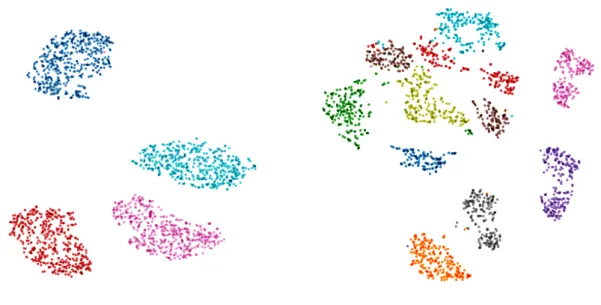
Sam-pleRNN model-specific conditioning inputs . . . 97 6.4 t-SNE projections of 4 CMU test speakers (left) and 10 VCTK test
speakers (right) in clean conditions. . . 98 6.5 Validation negative log-likelihood loss. Lower loss indicates higher
likelihood of the generated waveforms to be like the ground-truth ones, hence more similar to the actual speech. . . 99 6.6 Top: RMSE ofF0 for new speakers with respect to the length of speech
used for the embedding generation. Bottom: MCD for new speakers with respect to the length of speech used for the embedding generation.100 6.7 MCD and RMSE ofF0 for new speakers with respect to the length of
xvii
List of Tables
4.1 Linguistic and prosodic features of the context-dependent label format. 48 4.2 Different layer sizes of the different models and total number of model
parameters. Emb/H: linear embedding layer size and SALAD hidden size (in all layers but FFN ones); RNN/QRNN: recurrent or quasi-recurrent layer size in the hidden layers; dff: dimension of the feed-forward hidden layer inside the FFN in SALAD models. . . 50 4.3 Male (top) and female (bottom) objective results. Err, unvoiced–voiced
classification error. Lower values are better. . . 53 4.4 Subjective mean opinion scores, for both speakers, male and female.
Higher values are better. . . 54 4.5 Maximum inference latency with linear fit for RNN and QLAD
mod-els, and quadratic fit for SALAD. All measurements are taken at 45 s utterances. . . 55 5.1 Objective performance for different architecture variations. SEGAN is
the first approach we developed in Pascual et al. (2017) but is evalu-ated over the new dataset (V1). SEGAN+ is the new best-performing model out of the different variations (V1.2.8). For both COVL and SSNR metrics, higher is better. Letters ηand ω denote the learning
rate and kernel width, respectively. . . 66 5.2 Objective evaluation results with the considered baselines. TheL1/L2
prefix of DNNs and LSTMs describes the regression loss used, and theCvalue describes the amount of context frames. For all metrics, higher is better. . . 71 5.3 Subjective evaluation results comparing the considered systems. BCK
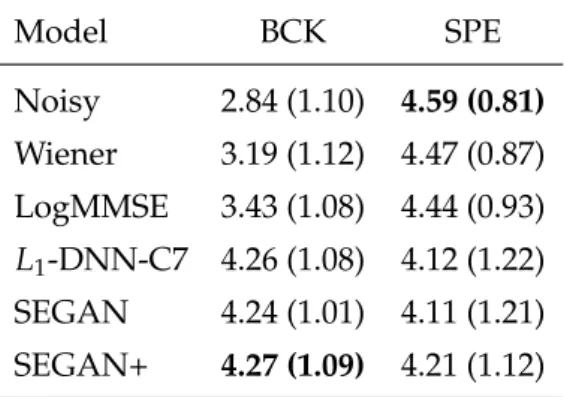
stands for background noise removal and SPE for speech distortion introduced by the system (see section 5.3.2.2). For both values, higher is better. Each cell shows the mean of each system (standard deviation in parentheses). . . 72 5.4 Mel cepstral distortion results for the three considered systems: RNN
baseline, SEAE+ (L1 auto-encoder), and WSEGAN. . . 78 5.5 Frequency of number of training active transformations usingp=0.4. 83 5.6 Objective metrics for the different systems (standard deviation into
parenthesis). For each metric, lower is better. . . 85 5.7 Subjective mean ranking score (lower is better). . . 85 6.1 Accuracies using PASE and an MLP as classifier. Rows below the “all
workers” model report absolute accuracy loss when discarding each worker for self-supervised training. . . 94 6.2 Accuracy comparison on the considered classification tasks using MLPs
and RNNs as classifiers. . . 94 6.3 Word error rate (WER) obtained on the DIRHA corpus. . . 95
xix
List of Abbreviations
ASR AutomaticSpeechRecognition DNN DeepNeuralNetwork
GAN GenerativeAdversarialNetwork GRU GatedRecurrentUnit
HMM HiddenMarkovModel HNM Harmonics plusNoiseModel IoT InternetofThings
IPA IntelligentPersonalAssistant LPS LogPowerSpectrum
LSTM LongShortTermMemory MCD MelCepstralDistortion MDN MixtureDensityNetwork
MFCC MelFrequencyCepstralCoefficients MCEP MelCepstralCoefficients
MHA MultiHeadAttention MLP MultiLayerPerceptron NLP NaturalLanguageProcessing PASE ProblemAgnosticSpeechEncoder PDF ProbabilityDensityFunction PReLU ParametricRectifiedLinearUnit QRNN QuasiRecurrentNeuralNetwork RMSE RootMeanSquaredError
RNADE Real-valuedNeuralAutoregressiveDensityEstimator RNN RecurrentNeuralNetwork
SEGAN SpeechEnhancementGenerativeAdversarialNetwork SPSS StatisticalParametricSpeechSynthesis
STS SpeechToSpeech TTS TextToSpeech US UnitSelection
1
Chapter 1
Introduction
1.1
Motivation
Speech is the most prominent way of exchanging messages between human beings. It allows us to be expressive as well as communicative, thus transmitting a mes-sage and, at the same time, conveying other information alongside linguistics that enrich the message. This is related to para-linguistics, which can be understood as everything that can be found in the speech signal that cannot be described only in strictly phonetic and/or linguistic terms (Schuller et al.,2013). Examples of acoustic phenomena embedded in speech, which are non related or loosely related to lin-guistics could be coughs, laughter or filled pauses. They can denote (health) state, emotion/mood, speaker idiosyncrasies, and the like. Moreover, high pitch can be an indication of anxiety and breathy voice can indicate attractivity, and they are also modulated onto the verbal message (Schuller et al.,2013).
Such richness makes speech signals to be present in a myriad of situations related to communications (e.g. phone, television, etc., and consequently in multimedia sys-tems too). As an inheritance of human to human interaction, it has become a natural way of communication with an automated system like an intelligent personal as-sistant (IPA), either in the form of a software application in the mobile phone or a hardware appliance like a smart speaker. We refer to human-to-human communi-cation as the process happening when a message is transmitted/received between human beings, regardless of the medium. It can hence happen through a telephonic channel or in a meeting room. In contrast, we refer to machine-to-human communi-cation as the process happening when a message is transmitted/received between a human being and a machine. Current smart speakers feature voice-activated digital assistants and often operate as home automation hubs. These devices are usually part of a company’s existing product stack1. Precisely, the introduction of these as-sistants, like Amazon Alexa, Google Home or Apple Siri, is a perfect match with the internet of thinsg (IoT) concept. We can play music, order products or interact with other home appliances thanks to the massive interconnection of IPAs with other de-vices. Actually projections stipulate that the smart speaker market is in the middle of a major growth cycle, and that the introduction of 5G mobile connectivity, with a massive data transfer capacity, will allow the IPAs market to grow even faster than now2 3.
Both scenarios, one where humans communicate amongst themselves and an-other with human-machine interactions, demand algorithms that process these sig-nals to extract information from them, enhance them or even mimic their generation process to make machines produce speech. These processing techniques allow us
1https://whatis.techtarget.com/definition/smart-speaker 2https://www.alliedmarketresearch.com/smart-speaker-market 3https://www.visualcapitalist.com/smart-speaker-market-share-fight/
FIGURE1.1: Example communication between a person and a smart speaker.
to communicate in any condition with other people or machines, even if such con-dition is adverse. This means we might be contacting someone through a phone call from a noisy environment or we may ask commands to an IPA in a real home environment, hence doing distant automatic speech recognition (ASR; Barker et al.,
2018). But not only distant recordings can be troublesome to recognize the linguistic contents. Motor impairments may provoke a loss of intelligibility and naturalness in some people’s speech too, so recomposing a signal with better quality with the aid of some device might be helpful in that situation.
An important component of modern technologies is the constant connectivity of the communication devices with processing machines, which is a concept aligned with the aforementioned IoT. These machines can in turn do data crunching on por-tions of conversapor-tions. For instance, in the case of IPAs, this process often aims to improve even further the future response of these devices, due to the fact that there is a feedback loop between the processing algorithms and the new incoming data to improve the algorithm itself. However, in order for the algorithm to properly take advantage of the massive data generated, we need to leverage the potential of algorithms that learn automatically from data.
Deep learning is a framework of algorithms and tools to learn automatic pat-terns from data, hence it forms a subset within machine learning techniques (Good-fellow et al.,2016). The deep learning popularity has grown exponentially during the latest years, as it offers complex statistical models that usually outperform pre-viously existing shallower and less computationally demanding ones. The termdeep
describes the fact that these models are built as multiple levels of a hierarchy that breaks down an abstract problem (e.g. classification of audio events) into sub-levels of features and transformations. And usually the performance of our models raise with the increase of hierarchy levels. This implies that not only the input-output mapping is learned in the hierarchy of concepts, but also the feature extraction pro-cesses. In order for these models to work effectively though, massive amounts of data are necessary, specially in end-to-end scenarios, which means that signals are directly injected as raw data. This is contrary to previous (and normally shallower) machine learning solutions, where a key factor was the so called feature engineering or feature design (Huang et al.,2001; Goodfellow et al.,2016). The end-to-end strat-egy has been successful in fields like computer vision, where current visual models work with raw pixel data to solve several tasks; including classification, semantic segmentation, object recognition, and image generation among others (Krizhevsky et al.,2012; He et al.,2016; Garcia-Garcia et al.,2017; Zhao et al.,2019; Radford et al.,
1.1. Motivation 3
2016; Brock et al., 2019). Natural language processing (NLP) is another field that currently tackles its most challenging tasks by directly processing words, characters or byte-pair encodings (Sennrich et al.,2016). These raw textual tokens are encoded with simple discrete identifiers and fed to deep models to get state of the art in lan-guage modeling, machine translation, and natural lanlan-guage understanding among others (Yang et al.,2019; Devlin et al.,2019; Vaswani et al.,2017; Young et al.,2018).
Regardless of the application field, in order to work effectively with deep models, massive amounts of data are necessary. And this need specially grows with the depth and complexity of the model. Precisely, the first great advantage nowadays to improve the speech processing pipelines is the availability of massive amounts of data to exploit with these automatized learning algorithms. Secondly, the spread of the GPU component and the democratization of its usage for high-end computations with open source platforms like PyTorch (Paszke et al.,2017) simplifies the building process of these complex models for everyone4.
With the advent of deep learning, speech technologies are suffering a drift into the end-to-end paradigm, similarly to the aforementioned computer vision and NLP cases. This implies that the deep model is exposed to large amounts of raw speech data, with the least possible signal pre-processing or prior knowledge about the structure of speech. The model is then trained to solve a certain task by consum-ing the data in a state as raw as possible, such that the model itself can learn the best intermediate features that lead to the optimum response. This trend is gaining popularity across the different disciplines of speech technologies, and end-to-end modelling usually satisfies to raise state-of-the-art results across many tasks. Ex-amples of these tasks are automatic speech recognition (ASR) (Graves and Jaitly,
2014), speech synthesis (van den Oord et al.,2016b), speech enhancement (Pascual et al.,2019b), spoken emotion recognition (Trigeorgis et al.,2016) or speaker recog-nition (Snyder et al.,2018). Nonetheless, these breakthroughs usually happen when the amount of computation time and data have been enough to fulfil the search of the optimum parameters for our algorithms.
As mentioned, this end-to-end scheme contrasts with shallower solutions that rely on feature engineering. Fig. 1.2 depicts simplified schematics of substitution of classic pipelines for end-to-end ones for text-to-speech (TTS) and speech enhance-ment tasks. Classic pipelines usually require important notions and prior knowl-edge about signal processing, as well as a clear conception of what features from the input signal are important to derive a proper response at the model output. We can exemplify the importance of feature selection by contrasting the classic feature se-lection used in speech recognition and emotion recognition. The former one works effectively upon mel frequency cepstral coefficients or filter banks (Hinton et al.,
2012), whereas emotion recognition typically relies on additional prosodic features like pitch contours, energy, or voicing factors, among others (El Ayadi et al.,2011). Hence models based on feature engineering may pose three main possible draw-backs in the resulting performance: sub-optimal feature selection, cumulative errors in cascaded systems, and more complex processing pipelines.
1.1.1 Sub-optimal Feature Selection
The feature engineering process may lead to representation limitations for the algo-rithms. This means that we might be imposing an initial bias in the outcomes by discarding input information. So there might be still exploitable features hidden in
TEXT Text and phonetic analysis Prosody generation Acoustic Model Waveform Generator
TEXT DEEP MODEL
STFT Enhancing Algorithm DEEP MODEL TEXT TO SPEECH SPEECH ENHANCEMENT ISTFT PHASE
FIGURE1.2: Example end-to-end replacements for text-to-speech and speech enhancement applications.
the raw data that we do not consider as important, perhaps because they were never studied within our field of interest. This can lead to sub-optimal results in the end. A clear example of this happens in TTS. The vocoding process, widely used in old statistical systems, discards information of the original speech waveform, hence bi-asing the resulting quality to a worse level even in the real data, where the model does not take effect yet. Fig. 1.3 depicts the results of subjective evaluations taken un-der MUSHRA tests for different TTS systems from Pascual (2016). There it is shown that the vocoder system, labelled as Ahocoder, has a degraded quality with respect to the natural speech, with an average score of approximately 82.7 with respect to the 97.7 achieved by natural speech.
1.1.2 Cumulative Errors in Cascaded Systems
The traditional pipelines are built with different specialized blocks that are trained separately, and cascaded afterwards. For instance we may have four main blocks in a TTS pipeline: (1) Text processing and linguistic feature extraction, (2) Prosodic fea-ture prediction, (3) acoustic feafea-ture prediction, and finally (3) Waveform generation. Each block can be deterministic or learned with a statistical model, but these blocks are trained independently, which can make it unaware of possible mistakes made at the beginning of the whole process. Developing an end-to-end approach tunes every block for the final task jointly, hence it is less prone to cumulative errors that may be present in classic pipelines. Following the TTS example, the advances of the latest years shifted from separated blocks cascaded after training (Arik et al.,2017; Sotelo et al.,2017), until almost end-to-end models like Tacotron where only the fi-nal acoustic mapping is decoupled for computatiofi-nal limitations (Wang et al.,2017). Even when Tacotron is not fully end-to-end (it does not produce waveforms, which are the end goal of speech synthesis) it is still considered to be an end-to-end system, due to the fact that it achieves a direct mapping between raw textual features and an acoustic representation without any break down of sub-blocks that connect the
1.1. Motivation 5
FIGURE1.3: MUSHRA results from different speech synthesis models from Pascual (2016) Fig. 4.21. SPSS: HMM-based Statistical-Parametric Speech Synthesis (see section 2.1.2). US: Unit Selection Concatenative Speech Synthesis (see section 2.1.1). LSTM-pf and LSTM-raw: SPSS models based on recurrent neural networks with and without post-filtering
respec-tively. Ahocoded: vocoded speech. Natural: raw recordings.
two domains. Hence in the end-to-end case the intermediate linguistic representa-tions, the alignment between linguistic and acoustic features, the required prosodic traits and the final acoustic features are learned altogether without intermediate la-beling per sub-task. The Tacotron 2 demo page5 shows several examples of a TTS
that captures a broad generalization of vocabulary, connected to appropriate pro-nunciations and prosodic traits that can be intuitively extracted from raw text, like intonation stress with capital letters, or the change from a statement into a question after a question mark.
1.1.3 Processing Pipeline Complexity
An end-to-end scheme can simplify the construction of models that solve complex tasks, as they do not require breaking down the big problem to be solved into smaller ones that are cascaded. It can even imply, as mentioned earlier, less need for prior knowledge in the design of the modeling pipeline. Hence, it can be a better fit for application/production purposes, as a single model is deployed to perform all the intermediate tasks, from the raw input until the expected output. This may also simplify the documentation and usability of our deployed system, due to the reduc-tion of blocks to be used and interacreduc-tions among them. However, this comes at a cost too, which is a loss in the interpretability of the model and the controllability
of its outcomes. Evidently this happens because the model is more opaque and the optimization process drives its decisions, which cannot be interpreted as responses to sub-tasks that we would usually solve after breaking down the problem. Again, the TTS research field has quickly tackled the end-to-end transition during the last 3 years, as in the aforementioned Tacotron case (Wang et al.,2017). However, after the success of end-to-end TTS, the pursue of a better controllability on the final result still remains, with recent studies on prosodic and expressiveness transfer that can be injected into Tacotron-like systems for instance (Wang et al.,2018; Kenter et al.,
2019).
1.1.4 The Deep Paradigm Shift in Speech Processing
We are in the middle of a paradigm shift in many fields related to signal processing, and one of them is speech processing. Going end-to-end can be advantageous in terms of performance and simplicity, as long as we have enough data and computa-tional resources to train them. It is evident that end-to-end systems, as they have to integrate many different stages within one structure, have to be deep and complex although monolithic. Nonetheless, leveraging our prior knowledge on the structure of speech can also be an effective strategy, as it still maintains the controllability over our model outcomes. We pragmatically use the term "prior knowledge" to refer to classic speech feature extraction procedures, like the mel-frequency cepstral coeffi-cients (MFCCs).
Deep generative speech models are those that mimic the real generation process that composes speech signals. They have been often used in the speech synthesis and TTS field for years (Taylor, 2009). The end-to-end shift is particularly signif-icant in this field, as deep models like the WaveNet (van den Oord et al., 2016b) proved to suffice to directly generate waveform samples. This pushed the natural-ness boundary beyond existing feature-based approaches by far. Moreover, other than text-conditioned generative models as in TTS, speech-conditioned generative models are gaining momentum too, specially thanks to this end-to-end paradigm shift. These models are applied to speech enhancement (Pascual et al.,2019b) and voice conversion (Serrà et al.,2019; van den Oord and Vinyals,2017) with different types of generative models applied directly on the raw waveform too.
1.2
Deep Speech Representation and Generation
Speech signals are present in many types of scenarios related to human-to-human and machine-to-human communications. Evidently the machine must convey some form of speech interfacing such that it can "listen" the human enquiries, and then "speak" in order to transmit the responses. Similarly, if the human-to-human com-munication has to be interpreted by a machine to enhance the signal quality or tran-scribe the conversation as well as recognizing who speaks, some acoustic represen-tation has to allow it.
In any type of communication, the flow of speech is either categorized (linguistic contents, speaker identity, emotion, etc.), or generated. A particular case of gen-eration is regengen-eration, in case of enhancing some qualities of corrupted captured speech. Regeneration can be inserted as a post-processing stage of either receiv-ing or emittreceiv-ing side. Hence in general terms for both communication devices and humans, we first have the recognition interface as the receiver, and the synthesis interface as an emitting process. In the middle of both interfaces there are other
1.2. Deep Speech Representation and Generation 7 components related to language understanding and intent recognition. In the case of humans, this language understanding is naturally available if the receiver under-stands the emitter language. In the case of machines, this obviously requires systems that map the captured linguistic spoken units from an ASR system into some con-ceptual categories that involve actions and responses. This process is called spoken language understanding (Tur and De Mori,2011). But aside from the intrinsics of the language understanding core, and regardless of whether communication hap-pens between human beings or a machine also interacts, the speech interfaces are critical components to establish proper interactions whenever some communication tool is used to carry the messages (e.g. phone, capturing device, etc.). In the follow-ing the speech representations concept will be described, as well as the importance of building compact and high-level speech descriptors to solve many tasks where speech is the input signal. Then, a brief description of speech generation is given, and its applicability to different applications where speech is synthesized out of dif-ferent source conditioning types.
1.2.1 Speech Representations
Firstly, if we communicate a message and we build an automatized and abstract representation of the speech, it can be used to recognize patterns or even reconstruct damaged parts of the acoustics if it is rich enough. The patterns can comprise the uttered content, the speaker identity, and the emotion embedded in the speech. Im-portantly, these characteristics should be extracted also in adverse conditions. So the representation should be robust either in the presence of background noise, rever-beration or pathologically damaged speech. Hence it is our interest to have a repre-sentation versatile enough to cover a broad spectrum of qualities about the speech as the described ones, as we can then couple in a single model different systems that are usually built and trained separately. We could think that the waveform already contains all these qualities, however a more abstract representation would ideally disentangle them, yielding frames that contain the different aforementioned factors encoded in different dimensions with a reduced intersection amongst them.
The advantage of merging representations and tasks has been already discussed previously to avoid high levels of complexity in the processing pipeline, includ-ing the avoidance of cumulative errors in the cascade of separate blocks. In fact, speech recognition systems can improve their performance by conditioning infor-mation about the acoustic environment or the speaker identity (Karafiát et al.,2011; Saon et al., 2013) by means of i-vector representations (Dehak et al., 2010). Simi-larly, phonetic and speaker variabilities affect the performance of speech emotion recognition systems, although the latter seem to be more critical (Sethu et al.,2008). As such, conditioning on speaker identity cues helps improving the performance of emotion recognition systems, to filter out the large acoustic variabilities among speakers (Kim et al.,2011; Ding et al.,2012).
Robust speech representations can even go beyond detecting those signal quali-ties explicitly, and use the mixture of the aforementioned signal qualiquali-ties implicitly in an end-to-end fashion to regenerate other versions of the utterance. For instance enhanced versions of the speech can be generated (Pascual et al.,2017; Pascual et al.,2019b), or the voice identity can be converted between two speakers by learning to factorize the signal qualities and recomposing at inference with changed identi-ties (van den Oord and Vinyals,2017; Serrà et al.,2019). Besides all the applications
to speech tasks themselves, current deep representations can even drive the gener-ation of face images that match the voices in the supplied utterances (Duarte et al.,
2019; Oh et al.,2019).
1.2.2 Speech Generation
Speech generation, also known as speech synthesis, refers to the computerized gen-eration of speech. This may happen after conditioning the gengen-eration on some ad-ditional source of information. TTS, for instance, is the method that generates the speech out of textual information (Taylor,2009). Hence when a user types text, the computer interprets the linguistic contents and generates a speech waveform match-ing them. Another possible source of information could be a speech signal itself. We could name this approach as speech-to-speech (STS). Speech enhancement is the task where a corrupted signal, either by additive noise or reverberation, is cleaned up and restored to be more natural and intelligible (Loizou,2013). This application then fol-lows the STS paradigm, where an input signal is modified and reconstructed in the output with different components. The TTS research field has been rapidly moving after the first applications of deep models in acoustic models (Zen and Senior,2014). Nevertheless, with the introduction of the WaveNet, as mentioned earlier, and also thanks to the sequence-to-sequence structures (Sutskever et al.,2014), the end-to-end model pursue accelerated exponentially in this field. As such, many very deep mod-els have recently been proposed with the availability of large amounts of speech and text data, as well as powerful computational resources to train them. Examples of these models are the different Tacotron versions (Wang et al.,2017; Wang et al.,2018; Shen et al.,2018), the different DeepVoice versions (Arik et al.,2017; Gibiansky et al.,
2017; Ping et al.,2018), the Char2Wav (Sotelo et al.,2017), the Transformer TTS (Li et al.,2019) or the ClariNet (Ping et al.,2019). These models are expensive to train, and as such their construction is often carried by the current big companies leading the deep learning research. On the other hand, however, there is hesitation on making speech generation models efficient too. The WaveNet was the proof that the wave-form sampling process can be learned with current technologies and achieves the best quotas of synthetic speech quality (comparable to real speech), but it is known that it is an expensive model to sample from (Kalchbrenner et al.,2018). To that end, several models pursue improving the waveform generation efficiency, either work-ing with a simple autoregressive parameterization than that of the WaveNet (Valin and Skoglund, 2019; Jin et al., 2018; Mehri et al., 2016; Kalchbrenner et al., 2018), or with other parallel approaches (van den Oord et al.,2017; Donahue et al.,2019). Hence, efficiency is an important matter in speech generation applications, pursued specially due to the need to embed these systems within the user devices for rapid and personalized responses (like IPAs).
Regarding speech enhancement, its main applications are usually related to im-proving the quality of communications in noisy environments. However, we also find applications related to hearing aids and cochlear implants, where enhancing the signal before amplification can significantly reduce discomfort and increase intelli-gibility (Yang and Fu,2005). Furthermore, speech enhancement is also applied as a pre-processing stage in speech recognition and speaker identification systems, usu-ally to denoise or dereverberate the recorded signals (Ortega-Garcia and Gonzalez-Rodriguez, 1996; Yu et al.,2008; Maas et al., 2012; Donahue et al., 2018). Beyond removing noisy conditions, speech enhancement may also refer to the recovery of missing signal components, which in turn aims to improve the signal naturalness
1.3. Objectives and Outline of the Thesis 9 and expressiveness. For instance, whispered speech refers to a form of spoken com-munication in which the vocal folds do not vibrate and, therefore, there is no pe-riodic glottal excitation. This can be intentional (e.g., speaking in whispers), or as a result of disease or trauma (e.g., patients suffering from aphonia after a total la-ryngectomy). The lack of pitch reduces the expressiveness and naturalness of the voice. Moreover, it can be a serious impediment for speech intelligibility in tonal languages (Chen et al.,2018) or in the presence of other interfering sources (i.e., cock-tail party problem (Popham et al.,2018)). The conversion from whispered to voiced speech (we refer to it as dewhispering), either by reconstructing partially existent pitch contours or by generating completely new ones, is an area of research that not only has relevant practical and real-world applications, but also fosters the de-velopment of advanced speech conversion systems (Pascual et al.,2018b). Speech dewhispering turns out to be an example of the need of speech enhancement in a distortion agnostic framework, which may be plausible to achieve with the current deep learning techniques and with enough data. So generalizing the speech en-hancement concept to palliate with any speech distortion provoked at any point of any speech processing pipeline is an interesting matter. To exemplify possible dis-tortions, we may have low-rate speech coding losses, signal amplitude clippings or even sample loss (unexpected zeroed out values in the signal).
1.3
Objectives and Outline of the Thesis
This thesis has 3 goals related to the application of deep architectures in different facets of speech generation and speech processing: (1) improving efficiency of recur-rent speech generation models, (2) exploring the applicability of generative adver-sarial networks (GANs) to make a non-autoregressive end-to-end STS system, and (3) investigate the use of self-supervision to do a generalizable speech encoder that can be applied to a myriad of speech processing tasks. Throughout the develop-ment of the end-to-end speech generation GAN and the self-supervised modules, efficiency is never abandoned to restrict the design of the proposed models.
Therefore, we begin working on the modeling efficiency concept in terms of syn-thesis efficiency of state of the art pseudo recurrent structures in TTS. Owing to the recent trend of end-to-end TTS, where computationally expensive models are built, this is aligned with the aforementioned recent advances in efficient designs in neural vocoders (Kalchbrenner et al.,2018; Valin and Skoglund,2019; Jin et al.,2018; Mehri et al.,2016). We explore the use of pseudo-recurrent structures such as self-attention and quasi RNNs (see chapter 3), that leverage the sequential dependencies of the signals similarly to RNNs, hence obtaining similar synthetic speech quality while increasing parallelization.
Secondly, we tackle a speech-to-speech problem with the first deep generative end-to-end design of its kind, working at the waveform level and built as a genera-tive adversarial network. The proposed system is applied to speech enhancement. With this design, our study makes a shift towards end-to-end deep generative mod-eling for speech generation. We focus on STS to apply our model, and we design it with little prior knowledge apart from its convolutional structure. Then, its lim-its are explored by augmenting the number of transformations to be carried or by adapting to new languages and domains. Nonetheless, we show that even when the plain model is designed with the least prior knowledge in terms of signal descrip-tion, using some speech processing enhances the model design to guide its learning strategy and perceptually weight it, specially when several distortions have to be
palliated. Interestingly, this shows that end-to-end models for STS, where an input waveform is processed to output the resulting waveform, benefit from using extra signals driven by prior knowledge, like the acoustic losses we attach to our model’s discriminator. This indicates that we can potentially obtain a rich set of features from the waveform through deep models, specially if we provide learning signals indicat-ing that the well known speech features like mel-frequency cepstral coefficients are present in our signal. This is connected to the last exploration we do in this thesis, as the use of auxiliary signals with which the model predicts transformed versions of the input signal is denominated self-supervised learning, a frorm of unsupervised learning.
Therefore, in the third part of this thesis we face the challenges of applying un-supervised learning to discover speech representations that can be useful for many end-tasks that require speech as input. As introduced, speech processing prior knowl-edge is leveraged from the beginning, but still allowing the model to do a full ex-ploration of the raw data (hence injecting waveforms in the input). An important characteristic of such representation is that it must keep information of different high-level features of speech (i.e. linguistic contents, speaker identity and prosody), but without the need for any label. The main objective of building such a system is its potential exportability to any task where novel speech feature extraction models might be helpful to begin the development. To achieve this, we focus on simple yet powerful approaches to learn such a versatile representation without the need of any hand-labeling.
In chapter 2 we proceed with a comprehensive literature review for speech eration, speech enhancement and speech unsupervised learning. The speech gen-eration part, developed in section 2.1, comprises a study of speech synthesis as a paradigm where textual and spoken inputs lead to a synthetic speech signal. First, concatenative speech synthesis is reviewed in section 2.1.1. After briefly review-ing its strengths and weaknesses, the statistical parametric approach is described in section 2.1.2. This review begins with the need to overcome the limitations of con-catenative synthesis in terms of adaptability and scalability. Then a thorough study is made to follow the path that leads to the current deep models, which successfully generate the highest level of synthetic speech quality with the greatest degree of adaptability to new speaker conditions and content conditionings. Eventually, the latest deep generative model trends applied to speech generation of either kind are reviewed and detailed.
In chapter 3 we introduce the different blocks that are used to compose deep learning models. Concretely, we focus in the description of the basic blocks that can be composed to build the structures used throughout this thesis, like convolutional neural networks with their design patterns, recurrent neural networks and attention models. Finally, in section 3.2 we describe deep generative models and their current taxonomy. In sections 3.2.1 and 3.2.2.1 we describe likelihood-based models and generative adversarial networks with detail owing to their impact with respect to the work developed in this thesis.
In chapter 4 we develop the first part of the thesis, where we pursue the devel-opment of pseudo-recurrent structures to make TTS systems efficient without loss of quality. To that end, we leverage the sequential processing capabilities of quasi re-current neural networks and self-attention models, presented in sections 4.2 and 4.3 respectively.
1.3. Objectives and Outline of the Thesis 11 Then, we work on the development of an end-to-end speech enhancement gen-erative adversarial network (SEGAN) in chapter 5. A thorough exploration of ar-chitecture variations of this model are performed through ablation studies in sec-tion 5.3.1. Moreover, in secsec-tion 5.4 we study the transferability of this proposed model towards new languages and noises unseen during training, and what is the least amount of adaptation data required to work well in those new conditions de-parting from an English model. Another dimension of study is the use of SEGAN to make whispered-to-voiced conversions in a pursuit of a generalized enhancement systems thanks to the potential of deep generative models. This is partly motivated by the application of reconstructing natural speech from whispering data synthe-sized from an articulator motion capture device (Fagan et al.,2008) used to aid peo-ple that suffered a total laryngectomy. Finally, after showing the capabilities of this model to both denoise and reconstruct missing speech components, a more gener-alized speech enhancement approach is proposed in section 5.6. The introduction of this mixture of severe adverse conditions on the signal, discussed in section 5.6, requires an upgrade of the model to palliate audible distortions that are perceptu-ally unpleasant. This brings the acoustic losses, described in section 5.6.1, which are attached in the end of the discriminator to establish a multi-task that weights per-ceptually the quality of the generated signals. Finally, a summary of the proposed contributions in this part of the thesis is detailed in section 5.7.
Chapter 6 is devoted to two main proposals: a problem-agnostic speech encoder and the self-supervised framework to train it. We begin proving that this encoder conveys high level abstractions from the speech waveforms, such as speaker identi-ties, emotional cues and spoken content classification. We also prove which parts of the self-supervised learning are effective with an ablation study. Then, we return to the speech generation problems by first applying this encoder to work as a speaker and content identifier. Concretely, in section 6.4 we provide an example of usage of PASE as a speaker identifier for acoustic models in TTS. Moreover, we also apply it to do speaker adaptation without any model training thanks to the generalization of PASE to out-of-corpus identities.
Finally, chapter 7 presents a summary of the research presented in this thesis, as well as a detailed list of the key contributions. There is also a set of future perspec-tives on where could the presented research lead to in section 7.2.
13
Chapter 2
Literature Review
We use the term speech processing to refer to all those techniques that extract and encode information from the speech signals at different levels (e.g. emotion, content, etc.), as well as those that generate speech signals. This chapter comprises a review of techniques to perform different facets of speech processing. Owing to the fact that this work comprises an exploration of deep generative models and unsupervised learning techniques for speech processing tasks, as stated in chapter 1, the follow-ing review rapidly moves into the latest techniques framed within the usage of deep neural models. In the following, three main topics are reviewed for the proper con-textualization of the different facets of this work; these are speech generation, speech enhancement and speech representation learning. The first two will be related under the speech-to-speech paradigm introduced in chapter 1. Nonetheless, a separate re-view of speech enhancement techniques is done, specially focused on deep learning applications, due to its importance in the development of the speech enhancement system proposed in chapter 5.
2.1
Speech Generation
Over time there have been several proposals of techniques to perform speech gen-eration, both for text-to-speech (TTS) and speech-to-speech (STS) approaches. Spe-cially TTS and voice conversion research brought the most innovative techniques to obtain flexible and scalable models, together with new levels of naturalness in the generated voice, until current systems that practically sound indistinguishable from natural speech in some cases. What follows is an overview of classic and recent techniques to generate speech. This overview mixes concepts from TTS and STS sys-tems, as we abstract the conditioning factor and pay attention to the speech signal generation techniques themselves.
2.1.1 Unit Selection Concatenative Speech Synthesis
The classic option we find in speech generation techniques is the so called unit se-lection concatenative speech synthesis (US). It is based on the concatenation of small speech units selected from a large database (Hunt and Black,1996), basically pasting pieces of real voice, which can already sound natural if their connection is continu-ous and smooth. However, if the concatenation is not effectively performed it yields glitches and audible discontinuities, this technique loses naturalness. The units can be phones as they serve as an elemental spoken unit. Nonetheless, a typical choice are diphones, which are constructed as the transition between two phonemes (i.e. from half of the left-side phone till half of the right-side phone). The reason for this is to find a structure which is least affected by co-articulation, which is the influ-ence of a phone context to itself (Hardcastle and Hewlett,2006). As such, they are
preferable even in scenarios with scarcity in the number of units (Hunt and Black,
1996).
During the construction of the waveform, two dimensions of decision have to be considered for the unit selection: the appropriate units depending on the target content, and the concatenation cost. As mentioned earlier, the content may come from a textual input as in TTS (Hunt and Black,1996), or from a spoken input as in STS (Sundermann et al.,2006; Jin et al.,2016).
A US system is comprised of a training part, where the datasets of speech units and their contexts are built out of aligned transcriptions. During synthesis, the pho-netic cues to compose the utterance are inferred out of text. Then these are used to select the proper units, which in turn depend on their contextualized units. After units are selected, some signal processing is applied to smooth the signal transitions. As mentioned, US allows us to construct the most natural speech in terms of signal quality, but the global naturalness of the full utterance might be broken by bad con-catenation decisions. This means that selecting the proper continuity matching units and even post-processing the signal adequately is of essential importance. But se-lecting the proper units first means having enough spoken contexts represented to select units from, which cannot happen unless we have a large database. It is known that US systems require big datasets of units to achieve a human level of naturalness, both in terms of waveform low level features but also in fluency and prosody (Hin-terleitner et al., 2016; Clark et al., 2007). For instance, works experimenting with varying corpus sizes, as in Clark et al. (2018), state that a corpus of around 36,000 phones (1.4 h of speech) provides an intelligible voice, but the system performs much better with much bigger corpora, and the authors still experiment quality improve-ments when using a corpus of 7 h. The signal processing block can also transform the signal to express certain emotional acoustic cues (e.g., sound happy, sound sad, etc.). Nevertheless, the main way to achieve this expressiveness is via expressive databases. This is called expressive speech synthesis (Cahn,1989; Bulut et al.,2002). We may even like to transform the acoustic units to change the speaker identity if we could. A proper adaptation with some simplistic processing would make this speech synthesis system scalable to any desired condition. Nonetheless, US systems are not flexible enough in terms of ease of adaptation to different spoken conditions; This is because for each condition change, either new recordings are needed to properly pick contextualized units, or specialized signal processing techniques are required to transform the existing units. These transformations, however, have a limit in the trade off between adapting the speech and distorting it. Another potential issue for US systems is the fact that the speech data has to be carried around with the synthe-sis system, as units themselves are the key component needed to build streams of speech (Black et al.,2007).
2.1.2 Statistical Parametric Speech Synthesis
The second methodology used to do speech generation is the so called statistical parametric speech synthesis (SPSS). This is grounded under the concept of building statistical models that generate speech signals, instead of retrieving them from a dataset. If we happen to have a statistical model that learns the structure of speech and we can generate new signals from it, then we can palliate the big drawbacks of US that limit the system’s flexibility (Black et al.,2007). Formally, we can express that a speech signal is a stream of acoustic framesX = [x1,x2, ...,xt, ...,xT], where X ∈ RT×A, being T the number of frames, and x
t ∈ RA, being Athe number of acoustic features per frame. Depending on the type of acoustic features for which
2.1. Speech Generation 15 our model learns the distribution, we have a trade-off betweenTandAparameters. If we happen to model the waveform samples directly, thenA=1 andTis the total number of samples we are modeling. Considering these variables, we can build the statistical modelΦexpressed as
Φ(X)≈ p(X) = p(x1,x2, ...,xT), (2.1) thus resembling as close as possible the true underlying distribution p(x)that gen-erated the composition of framesxtthat lead to the full signalX. Importantly, if our modelΦ actually resembles the generation process that builds speech signals, the sampling process can be conditio