Best practices of establishing a national
migration information management system
Consultancy Report Georgia
PREPARED BY Damiano Beltrame August 2011
FOR THE INTERNATIONAL ORGANIZATION FOR MIGRATION
AS PART OF THE PROJECT
“STEMMING ILLEGAL MIGRATION IN ARMENIA AND GEORGIA AND
ENHANCING POSITIVE EFFECTS FROM LEGAL MIGRATION”
INDEX
1.
Introduction ... 4
2.
Issues discussed during the August 2011 workshop ... 5
3.
Strategies for developing a National Migration Information Management System ... 7
3.1.
Introduction ... 7
3.2.
The global strategy of data identification ... 7
3.2.1.
Functional organization ... 7
3.2.2.
Data collection ... 13
4.
Concluding observations ... 18
5.
Annex ... 20
ACKNOWLEDGEMENTS
The Consultant would like to express appreciation to the Georgian government officials for their cooperation and assistance in conducting the assessment and for their responses and useful observations.
The assessment would not have been possible without the support of the International Organization for Migration (IOM). The Consultancy is grateful to the IOM staff members in Georgia for their advice and assistance.
The opinions and views expressed in this report are those of the author and do not necessarily correspond to the opinions of IOM.
1. Introduction
This assignment was conducted on behalf of IOM to extend its involvement with the Government of Georgia in the development of policies and measures aimed at establishing a national, inter-ministerial migration information management system.
The objective of the consultancy was to contribute to the efforts of the Government of Georgia and its State Migration Commission to establish an intra-ministerial migration information system, in compliance with national legislation and according to best international practices.
During the assignment meetings took place with officials from the following key state bodies:
Civil Registry Agency of the Ministry of Justice;
Ministry of Internal Affairs;
Ministry of Foreign Affairs;
Ministry of Internally Displaced Persons from Occupied Territories, Refugees and Accommodation;These meetings were dedicated to collect comprehensive information on the current state of affairs and to prepare the second part of the assignment, a two-day workshop with all stakeholders in the Georgian government.
The workshop was delivered in Tbilisi on 4 and 5 August 2011 to a core group of 15 officials from all relevant government ministries and agencies, which were:
Civil Registry Agency (CRA) of the Ministry of Justice;
Ministry of Internal Affairs (MIA);
Ministry of Foreign Affairs (MFA);
Ministry of Internally Displaced Persons from Occupied Territories, Accommodation and Refugees;
Ministry of Economy and Sustainable Development;
Office of the State Minister on Diaspora Issues;
Office of the State Minister on European and Euro-Atlantic Integration Issues.
National Statistics Office of Georgia - GeoStat;The aim of the workshop was to share the knowledge and practical skills required to further develop policies aimed at the establishment of a national migration information management system in Georgia.
2. Issues discussed during the August 2011 workshop
During the two-day workshop held on 4 and 5 August 2011, the general conclusion was that the Georgian Administration needs to coordinate the data that it gathers in the area of migration.
Based on the 2010 consultancy report drafted by the Canadian experts1 and according to the initial meetings held with the four key ministries prior to the 5-6 August 2011 workshop, it was established that considerable information is already existing and collected in different ways by the following state bodies:
- Civil Registry Agency: information related to identity, civil status, Georgian citizenship, residence permits, among other issues;
- Ministry of Internal Affairs: related to the general topic of internal security, including border control, issuing visas at the border, management of readmission, among other issues;
- Ministry of Foreign Affairs: related to Georgians living abroad and visa management. - Ministry of Internally Displaced Persons from Occupied Territories, Accommodation
and Refugees: related to internal migration, asylum seekers/refugees and repatriation;
All those institutions operate partitioned or stand-alone databases, which means that per each typology of information and within each government structure one or more completely independent databases are being operated.
The results of this approach are scattered and partitioned sets of information, which presents problems to aggregate information in a systematic manner. The risks of this approach of information management on the basis of local (ministerial) rather than integrated (inter-ministerial) processes are the following:
- Differences exist in between data because of the varying update schedule applied for different sets of data (for example, the number of travelers entering via airports or via land border may be updated daily; some data are collected on a permanent basis, but with a monthly update schedule, etc.;
- Specifics of the data collection campaign in terms of who organizes the data entry and how the data analysis is conducted based on the entered data;
- Specification of data collection and category definitions (for example, age tranches for persons). This generates a possible risk of distortion during the data analysis because data may have been collected in an incomplete way and/or entered in different formats.
1 The report “Assessment of the Migration Data System of Georgia” was produced by Canadian experts from
The information is:
- Scattered, because it is owned by different ministries and sometimes even stored in different databases used within the same ministry;
- Partitioned, because each data owner keeps the information disconnected to other related information that might be essential for establishing a full understanding of migration trends and processes.
For example
The topic of migration of seasonal workers should ideally be approached from a multi-disciplinary angle, as follows:
- Ministry of Internal Affairs (border management and admission into the country);
- Civil Registry Agency (issuance of residence permits);
- Ministry of Foreign Affairs (visa issuance abroad);
- Ministry of Sustainable Economic Development (relations to investors, development of the economy);
- Ministry of Finance (taxation);
- Ministry of Labour, Health and Social Affairs (regulation of the labour market and social services).
If data on the phenomenon of seasonal work is collected by all these entities and shared amongst each other, then one arrives at a comprehensive view of this type of migration and, hence, full understanding of how to regulate this type of migration to gain maximum benefits.
There are difficulties to have aggregate information because each authority manages its own sets of information, generating partial views. In such a setting, disseminating information generated by this infrastructure bears the high risk of:
- Data duplication, loss of data and/or incomplete data;
- Impossibility to generate comprehensive indicators that could serve as support tools for decision-making processes.
3. Strategies for developing a National Migration
Information Management System
3.1 Introduction
The main point that came out of the workshop facilitated by the Consultant on 4 and 5 August 2011 was to agree on and define a process leading towards the establishment of a unified migration information management system. In order to reach this target it is needed to put in place:
- a technical solution able to identify the selected and necessary information;
- a functional and organizational infrastructure able to identify, manage, and deliver the requested and appropriate information.
A possible approach is to elaborate a global strategy of data management for migration building on an appropriate centralized information system with the support of the adequate organizational infrastructure.
Before Georgia embarks on the organizational reforms to develop migration data management, there must be political support from the highest levels. In most countries, that means a mandate from the Prime Minister or a similar official with authority over the relevant agencies.
It also requires a legal review of domestic statutes and regulations to determine any additional authority that may be necessary to implement the system. A lead agency is then nominated to direct the process.
An effective and successful system usually begins with domestic interagency cooperation. For this circumstance, one the main points raised during the August 2011 workshop was to highlight the fact that all agencies involved needed to share relevant immigration information amongst each other.
3.2 The global strategy how to identify data
A global strategy is the implementation in a coordinated way of, from one side, the technical needs and from the other side, of the functional and organizational needs: a technological solution supporting an institutional environment.
Concerning immigration data management in Georgia there is a need to share data more than is currently happening. Considerable efforts have been dedicated to the technological side, but now an effort should be undertaken to find ways to “put together” all the necessary information.
3.2.1 Functional Organization
Most domestic integration first occurs within an agency when it turns its individual mission requirements into a single set of procedures, processes and data elements that are applied
uniformly: the so-called common data perimeter setting. This means that data need to be defined in terms of their scope and the type of data that need to be collected.
Regarding Georgia, the State Migration Commission has set to work out a common migration information system and the Civil Registry Agency is in charge of this process. Some elements highlighted during the workshop should be taken into consideration when defining the agency that will be in charge. By all means, it should ideally be an agency that already has in-house know-how and is equipped with the appropriate technology and expertise to operate this coordinating function.
Some countries have enlarged the competences of their immigration agencies by allocating them the function of managing migration-related data. Another model, as for example pursued by countries in Central America, is to cooperate on the regional (cross-border) level to determine strategies of migration data collection and hosting of an information system platform at the regional level to share information2.
In fact, because of the existence of multiple databases it is difficult and risky to merge all information in one main recipient, for the following reasons:
- Risk of loss of data: migration data generated by different agencies need appropriate solution, according to which each data base technology needs to check if the data have been transferred correctly from the initial database to the new environment and if redundant information has been correctly filtered. These processes can often cause the loss of valuable data;
- High level management for accessibility: one centralized system needs a strong organization to take charge of data collection, analysis, management, security, and functional organization. This last point is in fact the most important: the coordinating body needs to be acknowledged by all players as the undisputed leader and trusted to take the responsibility of properly managing the data of each individual ministry; - Complexity of the system: a unique system capable to manage all aspects of
migration management that satisfy all agencies of the Georgian administration is very complex. Expression of needs must be very well thought through and comprehensive. A specific gap analysis is required in order to detect redundancies, after which an approach shall be developed for the collection of data as issued by different sources (such as Ministry of Internal Affairs, Ministry of Foreign Affairs, Civil Registry, Ministry of IDPS, Ministry of Economy, Ministry of Finance, and others);
- Dissatisfaction of users: international experience has shown that it is extremely complicated to achieve completeness of required information. However broad a needs analysis may be, it can never be truly exhaustive because of the evolution of the phenomenon of migration and because it is extremely difficult to anticipate extraordinary events, such as natural disasters causing flows of forced migration.
2
As effected in the framework of the Central American Integration System (SICA; go to
Centralization has to be interpretated not in all inclusive points of view, because of the risks described above. The proposed ways of dealing with centralization of migration data management a strategy based on set of data to be extracted and monitored, as highlighted in the two examples below:
Practical Example of Centralized Data Management – the European Central Schengen Authority3
The Schengen Information System (SIS) was established as an intergovernmental initiative under the Schengen Convention, now integrated into the EU framework. It is used by border guards as well as by police, customs, visa and judicial authorities throughout the Schengen Area. It holds information on persons who may have been involved in a serious crime or may not have the right to enter or stay in the EU. Information is entered into the SIS by national authorities and forwarded via the Central System to all Schengen States. The SIRENE Manual lays down the procedures for EU States' exchanges of supplementary information on alerts stored in SIS.
Practical Example of Centralized Data Management – the Australian approach
The Australian Department of Immigration and Citizenship (DIAC)4 is entitled to collect all data for each foreigner who expresses the wish to travel to Australia. The relevant personal data are collected on the basis of the application procedures applicable for each type of visa: visits, business, migrants, work, work holidays for students, family reunification, study and other types. All the ongoing information collection processes are managed by the entitled ministries that bear the responsibility for issuing the decision on the issuance of the visa.
To develop an appropriate solution it is important to establish an organization based on negotiated parameters of strategic data. In fact, from the point of view of the information system it is necessary to elaborate a solution capable of collecting and analyzing data related to:
- Permanent phenomena, such as the number of persons entering/leaving the country and their nationality;
- Specific phenomena, for example the number of temporary workers, their duration of stay, and the status of their family members;
- Extraordinary phenomena, such as forced migration induced by a natural disaster or.
3
For more information go to: http://ec.europa.eu/home-affairs/policies/borders/borders_sis_en.htm
4
To obtain such target it is necessary to implement a solution that is sufficiently capable to receive data already collected by the responsible agencies.
The result of the negotiation should be a document called “data sharing protocol” that defines the following issues:
- The main topic of data: civil status, nationality, reason of travel, refugees, work, permanent residence, etc.;
- The data perimeter: this defines the level of detail in each set of data requested. For example, processing a permanent residence permit will probably require the collection and sharing of more detailed data than the processing of an ordinary entry visa;
- The period of update for each data category: except for data related to civil status and nationality (which are considered permanent), all other data need to be updated within a commonly agreed period, for example every quarter;
- The procedure of modification or enlargement of the perimeter: considering the Schengen example above, in 1985 the Schengen Member States exchanged data concerning five categories of data, whereas in the system that is currently being developed (the Schengen Information System II) the data categories are largely extended to include for example data on stolen work of arts, alerts on kidnapped persons, etc.;
- The procedure for installing specific data collections: sometimes, especially in the case of natural or man-made disasters, it is required to monitor data that are specific to the phenomenon, for example temporarily displaced persons.
The data sharing protocol usually consists of three main parts:
- Targets and objectives: this part describes the objectives of data sharing, the agencies involved and the responsibilities they have;
- Organizational issues: describing how the data exchange works, including a detailed description of the data that each agency has to share, procedures for data sharing, the process of data collection, and other procedures identified during the phase of functional description. It is necessary to describe the profile for the strategic position in the agencies and in the central organization. At the current time it is complicated to propose something already shaped for Georgia, but usually it depends on the size of the central organization. Commonly, there is a central body in charge of the migration policy management and an operational team in charge of coping with technical issues, such as data management, scheduling of data collection campaign and elaboration of the data collection;
- Responsibilities: this part is dedicated to define the responsibility of the agency in charge of the central system and data collected, managed and elaborated by the system, and the responsibility of all the other agencies involved in this process. Preferably, this data sharing protocol should have an official status as approved by governmental or ministerial decree, and where required should be supported by bylaws that
stipulate the details of the implementation modalities for each involved organization. The graph below depicts a macro-functional organization that could be followed in Georgia:
Migration data Management Centre
Operational Migration data management Team Ministry of Internal Affairs Database Indicators Communication layer Database Ministry of Foreign Affairs Database Ministry of Internal Desplace Persons Database Civil Registry Database Ministry… Database
Figure 1: General scheme for multi-database interface
This scheme proposes a communication layer that, after having identified the selected data needed per database, collates the various data and creates a unique recipient for all those data.
In Georgia each agency has its own database under its specific technological solution, and under its internal management procedures. In order to reach a harmonized data collection it is important to elaborate a communication layer that provides communication specifications at various levels:
- Per agency;
- Per relevant database as applied within each agency;
- Per set of data recorded into the database by the relevant agency.
The Schengen Information System (SIS) has implemented such solution in order to avoid the development of a complete new system. In fact, the SIS is based on the data collected by Member States and transmitted under specific regulations to the central system in order to be communicated to all Schengen Member states. The general scheme of SIS looks as follows:
Na
tio
nal
Le
v
el
Re
gi
on
al L
e
v
e
l
(EU)
Social Services Gendarmerie Custom Police C-SIS C-SIS-BackUp N-SIS SIS Replication N-SIRENE C-SIRENE National Infrastructure National Com LayerNa
tio
nal
Le
v
el
Re
gi
on
al L
e
v
e
l
(EU)
Social Services Gendarmerie Custom Police C-SIS C-SIS-BackUp N-SIS SIS Replication N-SIRENE C-SIRENE National Infrastructure National Com LayerFigure 2: General Scheme of the Schengen Information System
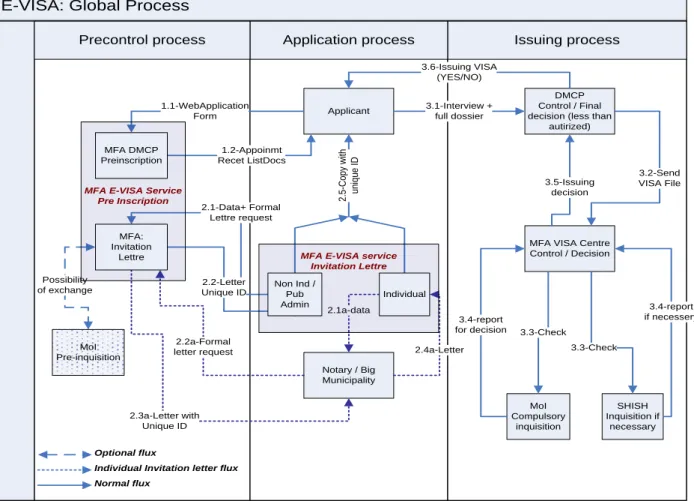
Another example of how migration data management systems can be organized is demonstrated by the system in place in Albania. In that country, there are three different agencies involved in the process of collection, exchange and analysis of migration-related data: the Ministry of Foreign Affairs, the Ministry of Interior and the Intelligence Service. According to the fact that in Albania the Ministry of Foreign Affairs is fully entitled to issue visa, it needs the collaboration of other agencies to check or collect data to issue the document. The data sharing is organized by by-laws under the “Law on Foreigners”.
E-VISA: Global Process Issuing process Application process Precontrol process Applicant Notary / Big Municipality 2.1-Data+ Formal Lettre request 2.2a-Formal letter request 2.2-Letter Unique ID 2.4a-Letter 1.2-Appoinmt Recet ListDocs 2.3a-Letter with Unique ID DMCP Control / Final decision (less than
autirized)
MFA VISA Centre Control / Decision MoI Compulsory inquisition SHISH Inquisition if necessary 1.1-WebApplication Form 3.1-Interview + full dossier 3.2-Send VISA File 3.3-Check 3.3-Check 3.4-report for decision 3.4-report if necessery 3.5-Issuing decision 3.6-Issuing VISA (YES/NO) Possibility of exchange
MFA E-VISA Service Pre Inscription MFA DMCP Preinscription MFA: Invitation Lettre MoI Pre-inquisition 2 .5 -C o p y w ith u n iq u e I D 2.1a-data Optional flux
Individual Invitation letter flux Normal flux
MFA E-VISA service Invitation Lettre
Non Ind / Pub Admin
Individual
Figure 3: General Scheme of Albanian visa issuance process5
3.2.2 Data collection
As concerns the collection of data, it is crucial to define the ultimate target. This entails providing an answer to the questions “Why” to share and “What” to share. As explained above, it is not important to share everything, but to address the following issues:
- The question “Why”: as an example we could use the following topic that is relevant for Georgia. If the Georgian position is to privilege foreign investors when it comes to the recruitment of foreign workers, it is important to have a vision of the growth of the international business generated by foreign investors and then to anticipate appropriate policies in the field of migration (e.g. policies related to visa regimes and admission into and stay in the country). In this context, one should monitor the nationality of the workers deployed by foreign investors, which will allow to determine if there is any linkage with the country’s policy on foreign investors (usually both phenomena are linked and generate migration flows to the country);
5
- Another relevant example concerns the monitoring of flows of foreign students coming to Georgia. Available information on these students is dispatched in different agencies: the Ministry of Foreign Affairs for visa application (when needed), the Ministry of Internal Affairs for visa issuance and passport registration at the border, and the Ministry of Education for student registration. In order to have a complete overview and understanding of the ongoing trends of flows of foreign students it is practically compulsory that involved agencies share the relevant information with each other;
- The question “What”: the most obvious targets to choose as fundamental pillars for the monitoring of migration are travel documents and visas. The border management systems of all highly developed countries take these documents as a starting point to build their migration data management systems.
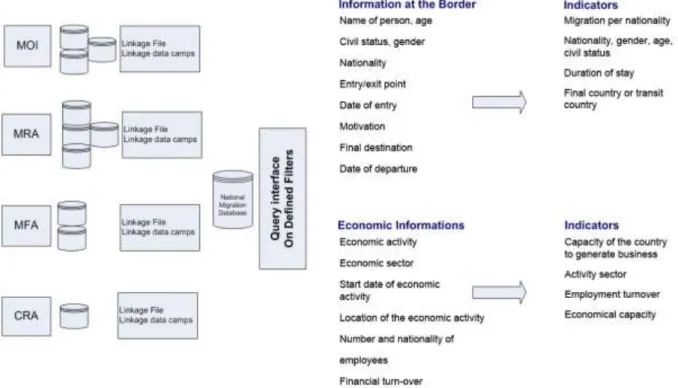
In accordance with the Georgian institutional environment the following scheme for data management strategy as part of a national migration management information system could be considered:
Figure 4: Possible scheme of data management for Georgia to produce indicators
This scheme shows in detail the process to extract data from the database of the entitled agency to the targeted new database, and then it shows a sample of data and indicators in order to monitor trends.
Via a linkage file, selected data are stored in a centralized database. Subsequently, through the interface of query it is possible to receive the analyzed information per each indicator.
A linkage file is a recipient in which all the data identified as pertinent are initially tagged. A data tagged is called a linkage data. All that information goes into the recipient file in a specific format capable to be inserted into the centralized database.
Prior to taking these steps it is necessary to have a technological gap analysis per agency that monitors the applicable:
- Database solution; - Data model scheme; - Maintenance procedures.
The result of this gap analysis gives information on:
- Which is the best central solution for the database system and decision-making solution;
- The required technical parameters (for example, if the file linkage should have a XML interface, JAVA applets, flat files or open source solutions, or other options, such as Oracle environment, Microsoft .Net with and MYSQL database, etc.).
SOURCE: KEY TASK: Issuance of temporary residence permit Requirements: SOURCE: Requirements: SOURCE: Requirements: SOURCE (5): Patrol Police (border) Requirements: Putting passport
data into the system, comparing with control data SOURCE (4): Public Registry Agency Requirements: Checking the legal status of employer organization and employer person (authority) SOURCE (3): Ministry of Internal Affairs (Informational Analytical Service) Requirements: Not wanted, not criminally prosecuted, not undesirable person SOURCE (2): Ministry of Internal Affairs (Counter-intelligence) Requirements: No obstacles in terms of security SOURCE (1): Foreigner Requirements: Passport data, document verifying legal stay in Georgia, legal grounds for residing in Georgia, legal source(s) of income SOURCE: KEY TASK: Issuance of temporary residence permit Requirements: SOURCE: Requirements: SOURCE: Requirements: SOURCE (5): Patrol Police (border) Requirements: Putting passport
data into the system, comparing with control data SOURCE (4): Public Registry Agency Requirements: Checking the legal status of employer organization and employer person (authority) SOURCE (3): Ministry of Internal Affairs (Informational Analytical Service) Requirements: Not wanted, not criminally prosecuted, not undesirable person SOURCE (2): Ministry of Internal Affairs (Counter-intelligence) Requirements: No obstacles in terms of security SOURCE (1): Foreigner Requirements: Passport data, document verifying legal stay in Georgia, legal grounds for residing in Georgia, legal source(s) of income
A sample regarding Georgian environment is the “Issuance of a temporary resident permit”. The above scheme describes the agencies involved in the process. This scheme shows all information sources that need to be consulted before the issuance of the document.
The question “what” can be answered simply: the issuance of a temporary residence permit. The question “why” is more complicated to answer and probably starts with the answer: to monitor persons that are residing for more than the duration of visa- or permit-free stay. Sharing all current information collected provides as an initial step the following set of information:
- Demographic data: gender, age;
- Nationality: passport of current nationality, initial nationality (nationality at birth if different), double nationality, statelessness;
- Family reunification: request of family reunification if the family is still in the country of origin;
- Criminal record: any record of criminal past and pending legal procedures;
- Motivation of the stay: establish an understanding if the applicant is an investor or an employee, in which case it is important to obtain information on his employer;
- Repercussions for the income tax regime.
Finally, this approach proposes to collect data identified as pertinent for migration control. Then after the relations installed in between data, it is possible to obtain an analysis of migration trends and processes as affecting the country.
The way to select pertinent data for migration is to extract first which are the national legal requirements that define concrete persons, such as travelers, migrants, asylum seekers, for example as follows: - Identity - Gender - Civil status - Nationality - ID document - Travel document - Country of origin - Place of destination - Residence permits - Asylum seekers - Return agreements - Economic regulation - Taxation regulation
In general, international practices to collect migration data are based on:
- Visa issuance and control processes: this is the first step towards the collection of information on migration flows with the analysis of: visa per nationality issued and refused;
- Border control.
The table below contains a set of indicators and information that needs to be monitored.
Set of data Indicator Type of Information Monitored
- Identity, gender, age - Civil status - Nationality - ID document control - Nationality (entering per nationality) - Gender - Civil status - Nationality of migrant - Gender - Civil Status
- Entry control: accepted/refused - Fake ID documents - Type of visa - Duration of stay - Point of entry - Reason of stay - Final destination - Motivation of stay - Length of stay - Transit migrants
- VISA control: issued / refused - Flux of migrant per entry point - Distribution of migrant in the country / transit
- Monitoring illegal migrant - Fake travel documents
- Returnees - Number of
returnees
- Country of origin
- Efficiency of the repatriation policy
- Asylum seekers - Temporary
residence document - Motivation of asylum
- Number of asylum claims - Country of origin
- Legislation for asylum - Local labour market
capacity - Education
- Type of working contract (long/short term)
- Type of residence permit - Location of employment
- Professional sectors where migrants are engaged
- Length of employment
- Temporary vs. long-term workers
- Compliance with labour and welfare legislation
- Combating illegal work
- Family members (spouse, children, other)
- Family reunification - Social services and healthcare services
- Long-term migrant
- Financial impact on social policy - Access to social services to migrant
- Irregular migration - Trafficking in persons
4. Concluding observations
The Georgian public administration already operates a large range of sets of information. The key challenge is to connect all those information sources with each other in order to conduct a migration analysis in accordance with established indicators.
That information has to be shared among all agencies involved, especially the sources of the key information for the analysis of migration flows and determination of the national migration policy. This is an important process, because if data are not appropriately shared, but instead compartmentalized within single agencies, this would mean a serious impediment for taking efficient action on migration management.
The current data exchange or relations in between the Civil Registry, the Ministry of Internal Affair and Consular Department of Ministry of Foreign Affairs is based on an operational need: the registration of Georgian citizens residing abroad, naturalization, civil status, entry into the country of foreigners, etc.
Statistical data for monitoring and managing migration need to be supported by a decision-making tool administered by a central body. It is important to agree on the organization for the centralized data base: to create a new structure or host the technical infrastructure in an existing administration.
In the case of Georgia the main steps that can be taken to make further progress in the field of migration data management could be the following:
- the identification of the pertinent database regarding the following topics: visa issued at the border and by the Diplomatic Mission, border control, residence permit, refugees, motivation of stay;
- the decision who is hosting the data base, and elaboration of the “data exchange protocol”;
- the selection of the first level set of pertinent data: nature of the travel document, nationality, gender, age, type of visa, type of residence permit. This step is the initial stage of a migration monitoring system;
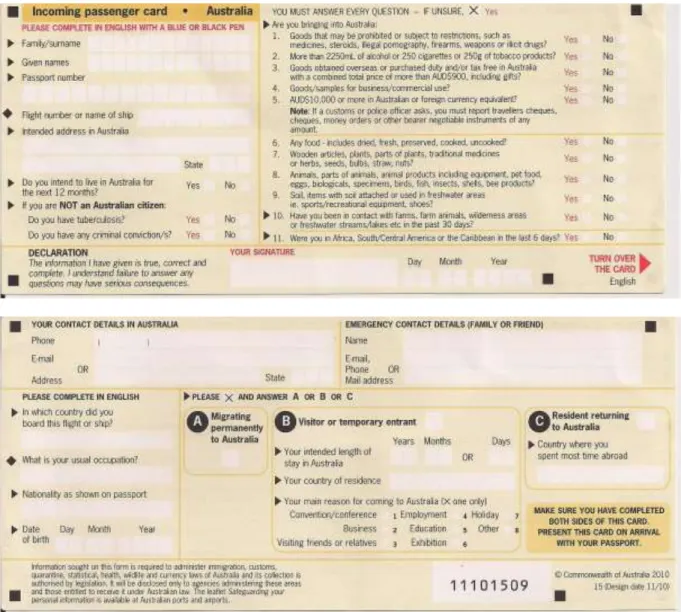
- As an additional tool, the introduction of a migration card could be a useful instrument to get information on migrants and their motivations. Many countries implement this system, which is usually not construed as an impediment for possible investors or for the development of the international commercial position of the country. In fact, by introducing a migration card it is possible to get initial essential inputs on:
The number of persons entering and exiting per nationality, gender and age; Reason of stay;
Length of stay.
The main added value of an immigration card administered at the border is that data are processed immediately. There are some easy solutions to be applied for reading
completed paper forms, which are based on high definition and speed scanner with OCR (Optical Character Recognition) software parameters. A clear example is the Australian immigration card illustrated below. All fields need a very basic answer or to tic the box, or to write in capital letter one letter per box (Identification data: name, family name, etc.) This document is inserted into a scanner, read, sent into the data base and finally analyzed to produce information for migration policy decision-makers.
Figure 5: Australian Immigration card
- The identification of the secondary level of data: resident or in transit, location of residence in the country, sector of employment, family reunification, revenue or economic means. That information is considered as additional and allows creating a better view on the activities that migrants undertake and their economical impact.
5. Annexes
5.1. Seminar Agenda
“The Development of a Migration Information Management System
in Georgia”
Workshop, 4 and 5 August 2011
Tbilisi, Courtyard Marriott
Order of proceedings
Day 1 – Thursday 4 August
10.00 Opening of the workshop
Welcome word by Ms. Mary Sheehan, Chief of Mission, IOM Georgia
Welcome word by Mr. Franco Impala, First Secretary of the Embassy of Italy to Georgia10.15 Keynote speech by Giorgi Gabrielashvili, Deputy Chairman of the Civil Registry Agency of the Ministry of Justice of Georgia
10.30 Introduction of participants General expectations
10.45 From Step I to Step II: from initial consultancy in June 2010 by Canadian experts towards concrete development of an inter-ministerial migration information system:
Basic overview of June 2010 consultancy, by representative of the IOM Mission to Georgia
Insights of expert Damiano Beltrame: basic elements of migration information system development. Experiences of other countries. General models of migration information systems.
11.45 Advantages and disadvantages of centralized vs. decentralized systems of migration data collection systems. Key cornerstones for effective data sharing between ministries. Overview of effective international practices, by expert
Damiano Beltrame.
Discussion / Questions and answers
13.00 Lunch
13.45 Overview of main indicators for data collection and analysis as part of migration information system development. Which indicators should Georgia focus on to develop an appropriate national system of data collection and analysis, given:
Georgia’s priorities in terms of overall strategic development and place of migration policy in country’s development strategy;
The country’s obligations in the field of migration management (national laws, international conventions);
Georgia’s growing partnership with the EU (readmission agreement, visa facilitation, etc.);
Georgia’s geopolitical situation and migration policies of immediate neighbours: impact on indicators for data collection;
Possible risks and challenges to Georgia’s migration management as posed by internal and external factors;
Future national and regional developments and possible impact on Georgia’s migration management: developing forecasting capacity using currently available migration data.Introduction by expert Damiano Beltrame
Discussion / Questions and answers 15.15 Coffee/tea break
15.30 Good practice of indicators to be collected for determining:
Legal migration trends;
Irregular migration trends;
Transit migration through Georgia;
Migration to Georgia (destination country);
Migration from Georgia (country of origin). Introduction by expert Damiano BeltrameDiscussion
17.00 End of proceedings of Day 1 / Overview of programme of Day 2
Day 2 – Friday 5 August
10.15 Overview of the various options available for migration information system development: basic pillars for software architecture development. General overview of effective international practice, by expert Damiano Beltrame
Discussion
11.00 Options available for Georgia for the development of software to support the migration information system. Advantages and disadvantages of various options available. Introduction, by expert Damiano Beltrame
Discussion
11.30 Coffee break
11.45 Continuation of considerations on most appropriate migration information system for Georgia and software system that needs to be developed to support that system
13.00 Lunch