How Does Knowledge Sharing Affect
Employee Engagement?
Sui Hai Juana, Irene Wei Kiong Tingb, Qian Long Kwehc, Liu Yaod Abstract: Employee engagement has emerged as a hot topic among academics and scholars over the last decade since organisations worldwide have adopted that lingo. However, little is known about how knowledge sharing, one of the main resources for organisations to maintain their competitive advantages, would affect employee engagement. Therefore, the objective of this study is to assess the impact of knowledge sharing on employee engagement based on the social capital theory. Data was obtained via questionnaires distributed to 180 randomly selected academics of public and private universities in Malaysia. This study applies multiple regression models to examine how three dimensions of knowledge sharing, namely structural, relational and cognitive, affect employee engagement. The results show all three aspects of knowledge sharing significantly and positively affect employee engagement. Specifically, work environment, leadership, organisational policies, communication, training and career development, compensation and team and co-workers in the knowledge sharing context improve employee engagement. This study is among the first to examine how organisations can better utilise knowledge sharing to engage their employees at work, which in turn help the organisation attain and sustain competitive advantages. Therefore, the addresses of knowledge sharing and employee engagement in this study are important and deserve further enrichments by including other knowledge management practices in the models.
Keywords: knowledge sharing, employee engagement, social capital theory, knowledge management practices
JEL classification: M12, M5
Article received: 21 January 2018; Article accepted: 20 August 2018
1. Introduction
The topic of employee engagement has received much scholarly attention as it helps organisations retain intellectual capital (Robinson, Perryman &
a Corresponding Author. Faculty of Industrial Management, Universiti Malaysia Pahang, 26300
Gambang, Pahang, Malaysia. Email: [email protected]
b Faculty of Industrial Management, Universiti Malaysia Pahang, 26300 Gambang, Pahang,
Malaysia. Email: [email protected]
c Benchmarking Research Group, Faculty of Accounting, Ton Duc Thang University, Ho Chi
Minh City, Vietnam. Email: [email protected]
d Faculty of Industrial Management, Universiti Malaysia Pahang, 26300 Gambang, Pahang, Malaysia. Email:[email protected]
Hayday, 2004), achieve higher productivity and increase profits (Wellins, Bernthal & Phelps, 2005). In other words, employee engagement enables organisations to gain competitive advantage (Song & Chermack, 2008) because employees are focused on improving their performance. To this end, knowledge sharing is fundamental and an important domain in retaining competitive advantage (Teng & Song, 2011), particularly in terms of employee engagement. It is worth noting that shared knowledge constitutes potential assets, which would improve organisational performance. Knowledge, defined as expertise, habit, skills, experience and understanding derived from trainings or learning processes, is a key source of competitive advantage for organisations in the 21st century (Maldonado-Guzmán, Lopez-Torres, Garza-Reyes, Kumar & Martinez-Covarrubias, 2016; Shabrina & Silvianita, 2015). However, little is known about the relationship between knowledge sharing and employee engagement. In other words, how does knowledge sharing affect employee engagement?
Since researchers have rarely bridged knowledge sharing with employee engagement, this study attempts to examine the effects of three dimensions of knowledge sharing (i.e. structural, relational and cognitive) on employee engagement. In order to achieve this objective, the study adopted a survey method whereby questionnaires were distributed to 180 academics working at two Malaysian universities. Higher education is undergoing transformation due to stiff competition and it is time universities play their own role and function especially on sharing knowledge efficiently and effectively (Kruger & Snyman, 2005) to avoid losing their own competitive advantages. Therefore, this study was undertaken to better gauge the effect of knowledge sharing on employee engagement.
The remainder of this paper is organised as follows: Section 2 contains theoretical discussions, research conceptual model and research hypothesis of this study. Section 3 focuses on data collection while Section 4 presents research findings, statistical tools, the discussion of key findings and implications. Finally, section 5 concludes this study with future recommendation.
2. Literature Review
Abu Bakar (2013) stated that Malaysia is a multi-ethnic society with a mixture of Islamic, Eastern and Western values. However, as Muslims are the majority in the country, most work values here are influenced by Islamic teachings (Abu Bakar, 2013). Therefore, employees working in Malaysia may have different responses to knowledge sharing and employee engagement compared with those working in the West. However, studies
on the effect of knowledge sharing on employee engagement, particularly among Malaysian employees, are limited.
2.1 Knowledge sharing
Knowledge, especially know-hows, experience, best practices, contextual information, is regarded as the most valuable asset in any organisation (Snyman & Kruger, 2004). Knowledge is an insight that generates a framework for identifying and combining new knowledge (Davenport & Prusak, 1998). It consists of data and information that has been organised and processed to convey understanding and lessons learnt (Wetherbe, Turban & Mclean, 1999). It covers intangible or tangible experience, which flows throughout the organisation (Lai, 2013). Classified as explicit knowledge and tacit knowledge (Nonaka, 1994), the former is tangible knowledge, such as procedures, rules, regulations and electronic database, which can be easily accessed. Tacit knowledge on the other hand is the knowledge hidden in an individual’s mind in the form of experience and expertise (Leonard & Sensiper, 1998), which is usually hard to communicate and it needs to be obtained through frequent interaction with others (Brown & Duguid, 2000). In an organisational context, employees have both tacit and explicit knowledge (Li et al., 2009).
In this regard, knowledge sharing has become increasingly significant to modern organisations in the knowledge-based economy (Obembe, 2010); it helps to explore whether the knowledge that exists before within the organisation can be discovered and utilised by employees who needs it (Obeidat, Al-Suradi, Masa’deh & Tarhini, 2016). Many social theorists have debated on the importance of social action in knowledge transfer processes (Obembe, 2010). Social capital theory argues that organisations have the potential for creating and sharing knowledge through networks, interaction and learning to improve their innovative capabilities (Landry, Amara & Lamari, 2002). This study adopts the social capital theory to explain knowledge sharing in organisations by viewing knowledge sharing from three dimensions, namely structural, relational and cognitive.
Mu, Peng and Love (2008) agree that knowledge sharing is a social process where employees are willing to share their valuable information and knowledge with others. It relates to sharing resources that are non-substitutable, inimitable, rare and valuable opening up new opportunities to individuals and organisations alike (Pinho, 2016). Specifically, knowledge sharing refers to the provision of task information and knowledge and skills
to help others and to collaborate with others to deal with problems, create original ideas, or carry out policies or procedures (Cummings, 2004).
2.1.1 Structural knowledge sharing
The structural dimension of knowledge sharing is the network ties (Nahapiet & Sumantra, 1998) and communication between members of a social network (Bolino, Turnley & Bloodgood, 2002). It acts as a medium for information flow and resource exchanges (Aslam, Shahzad, Syed & Ramish, 2013). Personal interactions through meetings, teamwork, emails or online discussion forums facilitate access to various knowledge sources among employees and such practices will develop the capabilities of the group through building and exchanging knowledge (Song & Chermack, 2008). Wang and Noe (2010) propose that such communities contribute to learning and transferring essential information. Since knowledge resides in employees’ mind and sharing is based on the relationship they have, structures or networks are important considerations in knowledge sharing. Similarly, Hansen (1999) opine that as employees are sources of information, their ability to share and the level of sharing depends on the strength of their relationships. (Chiu, Hsu & Wang, 2006) further categorised social interaction ties into: (i) the relationships, (ii) time spent and (iii) frequency of interaction among employees.
2.1.2 Relational knowledge sharing
Nahapiet and Sumantra (1998) define the relational dimension of knowledge sharing as “trust, norms and commitment within the organization,” which is based on relationships that the employees possess. Social needs (e.g. sociability, approval and prestige) require these relationships that can change employee values and their behaviour in terms of respect and friendship (Nahapiet & Sumantra, 1998), growth in trust (Chow & Chan, 2008) and promote identification among each other (Bolino et al., 2002). Thus, along with the network of relationships, the key elements of this dimension are: (i) trust, which is a promoter for social interaction and cooperation and it opens up avenues for knowledge sharing. Members of the organisation who trust one another are willing to share their knowledge since they have no fear of being exploited by the other members (Aslam et al., 2013). (ii) norm of reciprocity, which means knowledge sharing that is reciprocal (Chiu et al., 2006). It is assumed that knowledge sharing by a member is induced by the expectation that others
would reciprocate the act when required (Aslam et al., 2013). (iii) identification process, which causes people to perceive they belong to a team. It plays an important resource role that affects the sense of benefit from knowledge sharing (Nahapiet & Sumantra, 1998) through a member’s sense of belonging towards an organisation (Aslam et al., 2013).
2.1.3 Cognitive knowledge sharing
Cognitive dimension of knowledge sharing refers to resources that allow common interpretations and meanings within an organisation (Chow & Chan, 2008). Employees can tap easily into others’ tacit knowledge by accessing these resources (Abou-Zeid, 2007). Common language or vision support a mutual understanding of unified goals and norms of action in social situations. In organisations, shared vision and values enhance cognitive dimension of knowledge sharing (Tsai & Ghoshal, 1998). At the individual level, cognitive knowledge sharing is the result of frequent interactions and sharing the same way of conducting employee affairs which lead the individuals to learn skills and know-hows (Wasko & Faraj, 2005). Shared vision, shared language and shared goals were built by bringing employees together to create the foundation for trust, which plays an important role for cementing organisational relationships and thus enhances capabilities of knowledge sharing (Levin, Cross, Abrams & Lesser, 2002). Thus, along with the network of relationships, the key elements of this dimension are: (i) shared language, which aids individuals in understanding one another better. It encourages employees to enjoy in knowledge sharing activities and improves the quality of shared knowledge in the organization (Chiu et al., 2006). (ii) shared vision, which includes common goals and aspirations of organisational members. Common understanding enhances resource sharing while minimising misunderstandings (Aslam et al., 2013). The common goals aid the members in perceiving and enjoying these benefits (Aslam et al., 2013).
2.2 Employee engagement
Since it has been identified as a crucial factor for organisations to attain competitive advantage, employee engagement has been extensively discussed. According to Sanford (2002), higher employee engagement helps in reducing accidents, decrease rates of absenteeism and turnover while increasing performance (Juan & Yao, 2017). Kahn (1990) proposes employee engagement as the harnessing of members’ talent to match their
roles and whereby employees express themselves physically, cognitively and emotionally during role performances. Three psychological states determine whether employees are engaged or disengaged at work, namely psychological meaningfulness, psychological safety and psychological availability (Bailey, Madden, Alfes & Fletcher, 2017; Kahn, 1990).
Furthermore, Peters (2007) highlights employee engagement relates to employee commitment, which means the workers are pride of their organisation and the degree to which they intend to stay, desire to perform with their best and align their goals with organisational goals. He further emphasises that engagement creates job satisfaction and employee happiness. Fleming and Asplund (2007) conclude employee engagement as the ability to capture employees’ soul, hearts and minds to strive for excellence. Juan, Yao, Tamyez and Ayodele (2016) suggest employee engagement as an opportunity for employee connection and motivation to be a part of the organisation. Hewitt (2004) further explain that employee engagement is where individuals are emotionally and intellectually committed to the organisation; for example, employees have intense desires to be a member of the organisation despite opportunities to work elsewhere and employees spend extra time, effort and initiative to contribute to the success of the business (Baumruk, 2006). Newman and Harrison (2008) point out that engagement is the simultaneous presence of three behaviours in employees: job performance, citizenship behaviour and involvement. Cook (2008) reveals employee engagement as “how employees positively think and feel about their organisation and is proactive in relation to achieving organizational goals.” Definitions of employee engagement indicate workers could be engaged not only in their feeling but also in their thinking and behaviour.
2.3 Linkage between knowledge sharing and employee engagement
The process of those determinants affecting employee engagement through its three dimensions (i.e. affective, behavioural and cognitive) are intertwined with the processes of knowledge sharing via its three dimensions (i.e., structural, relational and cognitive). Hence, the inherently latent linkages between knowledge sharing and employee engagement are discovered and such linkages are contributions from knowledge sharing towards employee engagement. As discussed above, the dimensions of structural knowledge sharing (KSS), relational knowledge sharing (KSR) and cognitive knowledge sharing (KSC) are considered as independent variables while EE is dependent variable. Therefore, this study attempts to
close the gap by simultaneously linking the three dimensions of knowledge sharing with EE.
Accordingly, research hypotheses are proposed based on the review of different studies (Gupta & Singh, 2017; Kim & Park, 2017). According to Bolino et al. (2002) and Knox-Davies (2013), the KSS dimension involves interaction between members of the organisation by physical or electronic means, such as meeting, teamwork, emails, or online discussion forums, enhance relationships between them, thereby improve employee engagement. Thus, hypothesis 1 is developed as follows:
H1. The structural dimension of knowledge sharing positively affects employee engagement.
Second, trust is a key determinant of employee engagement (Abrams, Cross, Lesser & Levin, 2003). Wenbin, Fengjun and Hui (2012) find that norm of reciprocity is positively related to employee engagement. Saks (2006) reveals identification is significantly influencing employee engagement. Hence, in terms of the KSR dimension, hypothesis 2 is proposed as follows:
H2. The relational dimension of knowledge sharing positively affects employee engagement.
Third, the KSC dimension includes shared vision and shared language Nahapiet and Sumantra (1998); by accessing to these resources, employees are able to tap into each other’s tacit knowledge base (Abou-Zeid, 2007) and easily understand each other, thereby facilitate employee engagement. Hence, hypothesis 3 is developed as follows:
H3. The cognitive dimension of knowledge sharing positively affects employee engagement.
3. Data Collection and Variable Measurements
Salleh, Ahmad and Syed-Ikhsan (2008) point out knowledge sharing is a crucial element in higher education institutions. However, knowledge sharing among academics working at universities in Malaysia are lacking in factors that foster sharing of knowledge within organisations (Shabrina & Silvianita, 2015). This is evident in the number of academics working at
universities, which declined from 32,992 in 2010 to 24,476 in 2013 as the academics in Malaysian universities are disengaged (DOSM, 2015). Universities (both public and private) play important roles in enhancing national development and developing knowledgeable individuals. In addition, academics in public and private universities are crucial for effective administration and in generating profits for country (Ali & Panatik, 2015). Thus, it is important for policy makers of Malaysian universities to understand how knowledge sharing could affect employee engagement.
In order to attain the objective, survey questionnaire was adopted to seek responses from academics at two Malaysian universities (one public university and one private university). The respondents were chosen on a simple random sampling basis. Specifically, 180 academics participated in this study, 90 each from the public university and the private university. The survey instruments adapted questions from previous studies (Aslam et al., 2013; Naicker, 2013). A five-point Likert Scale (1 = Strongly Disagree, 2 = Disagree, 3 = Neutral, 4 = Agree, 5 = Strongly Agree) was used for each question (see Tables 2 and 3).
Table 1 contains the results of reliability test of the sample; each variable shows Cronbach’s Alpha coefficient value of higher than 0.7, indicating they are reliable for the other tests.
Table 1: Statistics Pertaining to Reliability of Variables
Variables Number of items Items deleted Cronbach’s Alpha
KSS 3 - 0.822
KSR 7 - 0.857
KSC 3 - 0.778
EE 12 - 0.909
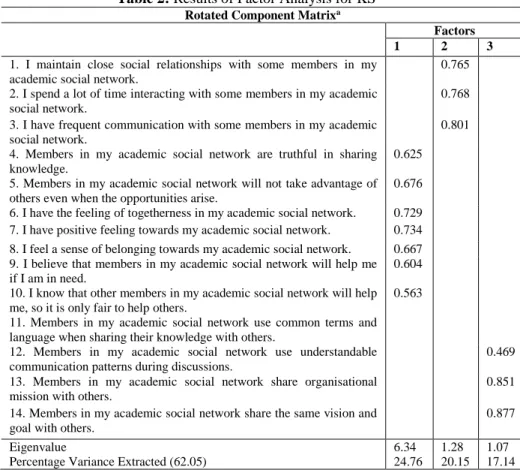
Next, a confirmatory factor analysis is performed. Table 2 shows three different factors were extracted for knowledge sharing and the total variance explained is 62.05%. Factor 1 (including items 4, 5, 6, 7, 8, 9, 10) with its eigenvalue of 6.34 is the relational dimension (KSR) while Factor 2 (including item 1, 2, 3) with its eigenvalue of 1.28 is called the structural dimension (KSS). Factor 3 (including item 12, 13, 14) with its eigenvalue of 1.07 is referred to as the cognitive dimension (KSC). Additionally, item 11 was deleted from this analysis as its Varimax value is less than 0.45. The KMO measure of sampling adequacy is 0.872, indicating sufficient inter-correlations while the Bartlett’s Test of Sphericity is significant at 99% confidence level (Chi square = 1,264.086). These results confirm all items used to measure a construct loaded on a single factor as each item has a Varimax value of 0.45 and above (Hair anderson, Tatham & Black, 1998).
Table 2: Results of Factor Analysis for KS Rotated Component Matrixa
Factors
1 2 3
1. I maintain close social relationships with some members in my academic social network.
0.765 2. I spend a lot of time interacting with some members in my academic
social network.
0.768 3. I have frequent communication with some members in my academic
social network.
0.801 4. Members in my academic social network are truthful in sharing
knowledge.
0.625 5. Members in my academic social network will not take advantage of others even when the opportunities arise.
0.676 6. I have the feeling of togetherness in my academic social network. 0.729 7. I have positive feeling towards my academic social network. 0.734 8. I feel a sense of belonging towards my academic social network. 0.667 9. I believe that members in my academic social network will help me if I am in need.
0.604 10. I know that other members in my academic social network will help me, so it is only fair to help others.
0.563 11. Members in my academic social network use common terms and language when sharing their knowledge with others.
12. Members in my academic social network use understandable communication patterns during discussions.
0.469 13. Members in my academic social network share organisational
mission with others.
0.851 14. Members in my academic social network share the same vision and
goal with others.
0.877 Eigenvalue
Percentage Variance Extracted (62.05)
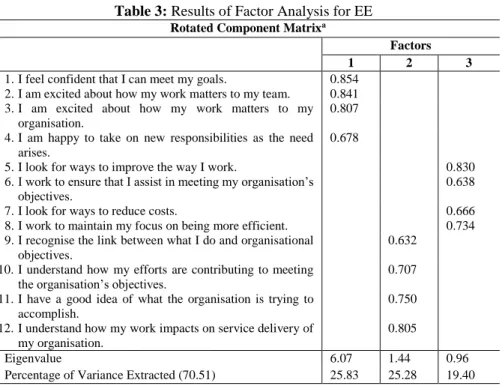
6.34 24.76 1.28 20.15 1.07 17.14 Three distinct factors with eigenvalue at 1.0 were extracted for employee engagement (EE) where those of Factor 1 (affective dimension) and Factor 2 (cognitive dimension) are 6.07 and 1.44 respectively, while that of Factor 3 (behaviour dimension) is 0.96 (see Table 3). The total variance explained by these three factors is 71.51%. The KMO measure of sampling adequacy is 0.865 indicating sufficient inter-correlations, while the Bartlett’s Test of Sphericity is significant (Chi square = 1,305.766, p < 0.01). These results confirm each of these constructs is unidimensional and factorially distinct and that all items used to measure a construct loaded on a single factor as their Varimax values are greater than 0.45 (Hair et al., 1998).
Table 3: Results of Factor Analysis for EE Rotated Component Matrixa
Factors
1 2 3
1.I feel confident that I can meet my goals. 0.854 2.I am excited about how my work matters to my team. 0.841 3.I am excited about how my work matters to my
organisation.
0.807 4.I am happy to take on new responsibilities as the need
arises.
0.678
5.I look for ways to improve the way I work. 0.830 6.I work to ensure that I assist in meeting my organisation’s
objectives.
0.638
7.I look for ways to reduce costs. 0.666
8.I work to maintain my focus on being more efficient. 0.734 9.I recognise the link between what I do and organisational
objectives.
0.632 10.I understand how my efforts are contributing to meeting
the organisation’s objectives. 0.707
11.I have a good idea of what the organisation is trying to accomplish.
0.750 12.I understand how my work impacts on service delivery of
my organisation.
0.805
Eigenvalue 6.07 1.44 0.96
Percentage of Variance Extracted (70.51) 25.83 25.28 19.40
4. Findings and Discussion
4.1 Findings
This section discusses respondents’ demographics, the difference between the public and private universities and the correlation matrix. This is followed by the results of the regression analysis. Table 4 shows the respondents’ demographic details, where it can be seen the number of male respondents (105 or 58.3%) are greater. Majority of the respondents are between 25 and 44 years old. Most of them are senior lecturers with PhD holders from the Faculty of Chemical and Natural Resources Engineering (15.6%) and the Faculty of Industrial Science and Technology (13.9%). Majority of the respondents have more than 10 years of academic experience. Almost all participating academics have worked for more than 2 years in their currently attached universities.
Table 4: Demographic Profile of Respondents Variables Frequency % Gender Male 105 58.3 Female 75 41.7 Age 25-34 years 66 36.7 35-44 years 64 35.6 45-54 years 30 16.7 55-64 years 20 11.1 Faculty
Faculty of Chemical & Natural Resources aa Engineering
28 15.6
Faculty of Civil & Earth Resources Engineering 15 8.3 Faculty of Electrical & Electronic Engineering 2 1.1 Faculty of Industrial Science & Technology 25 13.9 Faculty of Manufacturing Engineering 3 1.7 Faculty of Mechanical Engineering 2 1.1 Faculty of Technology Engineering 3 1.7 Faculty of Industrial Management 2 1.1 Faculty of Modern Language & Human Sciences 10 5.6 Faculty of Chemical Engineering 8 4.4 Faculty of Civil Engineering 10 5.6 Faculty of Mechanical Engineering 14 7.8 Faculty of Electrical & Electronic Engineering 10 5.6 Faculty of Petroleum Engineering 13 7.2 Faculty of Geosciences Engineering 9 5.0 Faculty of Fundamental & Applied Science 9 5.0 Faculty of Management & Humanities 11 6.1 Faculty of Computer & Information Science 6 3.3
Designation Lecturer 53 29.4 Senior Lecturer 86 47.8 Associate Professor 31 17.2 Others 10 5.6 Level of Education Bachelor Degree 8 4.4 Master Degree 52 28.9 PhD 120 66.7
Years of Academic Experience
1 - < 5 years 56 31.1
5 - < 10 years 52 28.9
≥ 10 years 72 40.0
Years of Working in the Current University
< 2 years 23 12.8
2 - < 5 years 52 28.9
5 - < 10 years 52 28.9
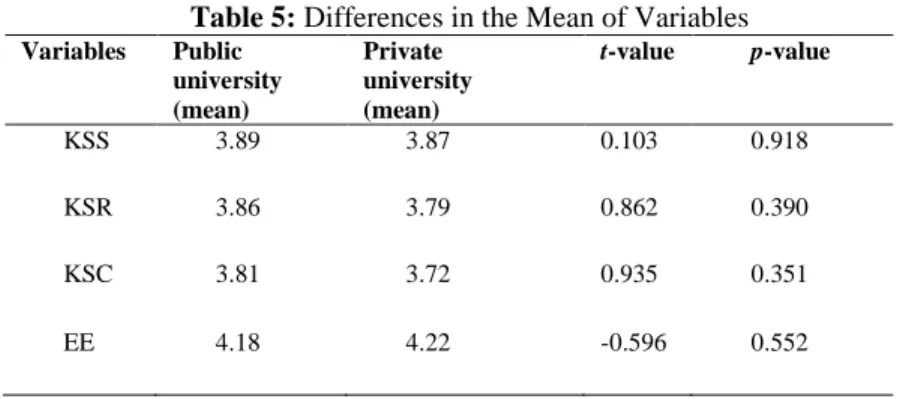
Inspecting Q-Q plots reveal the sample data of knowledge sharing and employee engagement is normally distributed for both universities and there is homogeneity of variance as assessed by Levene’s Test for Equality of Variance. Therefore, an independent samples t-test is conducted to compare the mean level of each variable between the responses from public university and those from the private university. Table 5 shows the differences in mean test of the variables; despite different points of time for the data collection from two different types of universities, the result indicates no significant differences exist in the scores of each variable between the public university and the private university. Due to the weakness of the univariate test, running a multivariate regression analysis is necessary as it would provide more reliable results.
Table 5: Differences in the Mean of Variables Variables Public university (mean) Private university (mean) t-value p-value KSS 3.89 3.87 0.103 0.918 KSR 3.86 3.79 0.862 0.390 KSC 3.81 3.72 0.935 0.351 EE 4.18 4.22 -0.596 0.552
Pearson correlation test is applied to test the correlation between the independent variables and the dependent variable. The results of the correlation analysis, which examines the magnitude of correlations, are shown in Table 6. The results showed there is a strong correlation between knowledge sharing and employee engagement (rKSS=0.559/0.276, p<0.01; rKSR=0.551/0.407, p<0.01; rKSC=0.401/0.272, p<0.01).
Table 6: Correlations Matrix
Public university Private university
EE KSS 0.559**
KSS 0.276**
KSR 0.551** KSR 0.407**
KSC 0.401**
KSC 0.272** Note: ** denotes the coefficients are significant at 1 per cent (two-tailed) test levels.
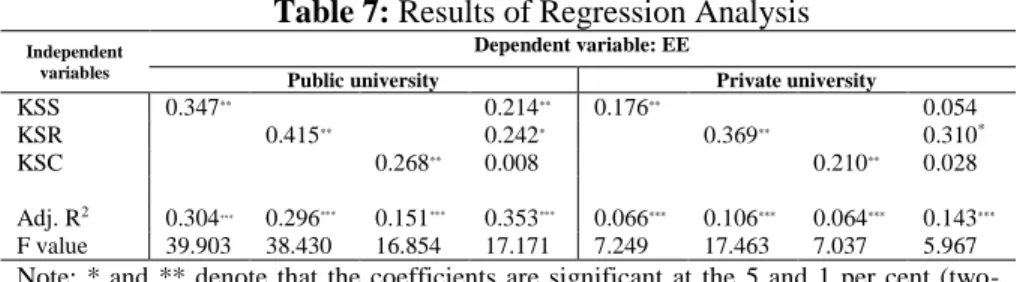
Table 7: Results of Regression Analysis
Independent variables
Dependent variable: EE
Public university Private university
KSS 0.347** 0.214** 0.176** 0.054
KSR 0.415** 0.242* 0.369** 0.310*
KSC 0.268** 0.008 0.210** 0.028
Adj. R2 0.304*** 0.296*** 0.151*** 0.353*** 0.066*** 0.106*** 0.064*** 0.143***
F value 39.903 38.430 16.854 17.171 7.249 17.463 7.037 5.967
Note: * and ** denote that the coefficients are significant at the 5 and 1 per cent (two-tailed) test levels respectively. The VIF values of the public-university coefficients are 1.813 (KSS), 2.096 (KSR) and 1.740 (KSC), while those of the private-university coefficients are 1.389 (KSS), 1.801 (KSR) and 1.566 (KSC).
Table 7 presents the regression results of this study. It is important to note that all of the variance inflation factors (VIF) values obtained are less than 2.5, suggesting no multicollinearity problem (Kennedy, 1998). Based on the statistical results, it can be concluded that all dimensions of knowledge sharing (i.e. KSS, KSR and KSC) have positive and significant effects on employee engagement. The determination values (adjusted R-squared) of 0.353 for the public university and 0.143 for the private university suggest that about 35 percent and 14 percent of the employee engagement is affected by its knowledge sharing among public university and private university respectively. Moreover, it is found that knowledge sharing in the public university has a greater positive impact on employee engagement. Specifically, when the three dimensions are included simultaneously in the regression analysis, KSS (β = 0.214, t = 3.001) and KSR (β = 0.242, t = 2.603) are the significant determinants of EE in the public university. However, KSR (β = 0.310, t = 2.595) is the only significant determinant of EE in the private university. The study also found KSR has the highest regression coefficient value in public and private universities.
4.2 Discussion and implication
Based on the regression results above, the study provides a few interesting insights. First, the result implies that the relational dimension of knowledge sharing positively and significantly affects employee engagement. First, greater trust among academic staff would ensure they feel they are a part of the organisational social network. When every academic fulfils the norms of reciprocity, they are more likely to stay and they may do more than what is normally expected of them (Kahn, 1990). Thus, the culture of trust, identification and norms of reciprocity should be cultivated in the organisation to help improve employee engagement.
Second, findings suggest structural knowledge sharing positively affects employee engagement. This indicates good relationships among academics in an academic social network could boost employee satisfaction and commitment in the organisation (Nahapiet & Sumantra, 1998). Additionally, employees who have spent more time interacting with others and who have frequent communications with their colleagues enjoy their work more (Chiu et al., 2006). Therefore, organisations that are interested in engaging their employees should provide opportunities for employees to interact and communicate with others in the organisation.
Third, as anticipated, cognitive knowledge sharing positively affects employee engagement. Using common terms and language are important for employee engagement to achieve high academic performance in universities (Abou-Zeid, 2007). Furthermore, shared vision or mission is an important factor of employee engagement. This allows academics to align their personal goals with organisational objectives and further improve the business outcomes (Lieberman & Dhawan, 2005). Abou-Zeid (2007) point out employees are able to tap into each other’s tacit knowledge through accessing shared vision or mission, which facilitates employee engagement.
5. Conclusion
This study investigated whether knowledge sharing contributes towards employee engagement to attain ultimate business objectives. In particular, this study examined the effects of three dimensions of knowledge sharing (i.e. structural, relational and cognitive) on employee engagement. The results showed all the three dimensions of knowledge sharing significantly and positively affect employee engagement, suggesting that trust, identification and norms of reciprocity are among the significant determinants of employee engagement. Besides, opportunities for employees to interact and communicate with their colleagues throughout the organisation could improve the level of employee engagement. It is was also evident shared language and share vision would lead to higher levels of employee engagement. Future research can enlarge the scope of the study to further convince policy makers that employee engagement is a key approach to achieve competitive advantage through sharing knowledge. Additionally, it can include interviews to get an in-depth view of the questions posed because survey questionnaire may have captured the surface of the real issues. Interviews could also attract a higher number of respondents.
Reference
Abou-Zeid, E. S. (2007). A theory-based approach to the relationship between social capital and communities of practice. The Electronic Journal of Knowledge Management, 5(3), 257-264.
Abrams, L. C., Cross, R., Lesser, E., & Levin, D. Z. (2003). Nurturing interpersonal trust in knowledge-sharing networks. Academy of Management Perspectives, 17(4), 64-77.
Abu Bakar, R. (2013). Understanding factors influencing employee engagement: a study of the financial sector in Malaysia. Ph.D. Thesis. Universiti of Malaya, Malaysia.
Ali, N. A. T. M., & Panatik, S. A. (2015). Work values and job satisfaction among academician in public and private university.
Jurnal Kemanusiaan, 24(2), 43 – 58.
Aslam, M. M. H., Shahzad, K., Syed, A. R., & Ramish, A. (2013). Social capital and knowledge sharing as determinants of academic performance. Journal of Behavioral and Applied Management, 15(1), 25 – 41.
Bailey, C., Madden, A., Alfes, K., & Fletcher, L. (2017). The meaning, antecedents and outcomes of employee engagement: a narrative synthesis. International Journal of Management Reviews, 19(1), 31- 53.
Baumruk, R. (2006). Why managers are crucial to increasing engagement: identifying steps managers can take to engage their workforce.
Strategic HR Review, 5(2), 24-27.
Bolino, M. C., Turnley, W. H., & Bloodgood, J. M. (2002). Citizenship behavior and the creation of social capital in organizations. Academy of management review, 27(4), 505-522.
Brown, J. S., & Duguid, P. (2000). The social life of information. Harvard Business School Press, Boston.
Chiu, C. M., Hsu, M. H., & Wang, E. T. (2006). Understanding knowledge sharing in virtual communities: an integration of social capital and social cognitive theories. Decision support systems, 42(3), 1872-1888. Chow, W. S., & Chan, L. S. (2008). Social network, social trust and shared
goals in organizational knowledge sharing. Information & management, 45(7), 458-465.
Cook, S. (2008). The essential guide to employee engagement: better business performance through staff satisfaction. USA: Kogan Publication.
Cummings, J. N. (2004). Work groups, structural diversity, and knowledge sharing in a global organization. Management science, 50(3), 352-364.
Davenport, T. H., & Prusak, L. (1998). Working knowledge: how organizations manage what they know. Harvard Business School Press.
DOSM. (2015). Number of private higher education institutions in Malaysia. Retrieved on 20 July 2016, from www.dosm.gov.my Fleming, J. H., & Asplund, J. (2007). Where employee engagement
happens. The Gallup Management Journal. New York: Gallup Press. Gupta, B., & Singh, A. (2017). Predicting employee engagement,
knowledge sharing & ocb. Indian Journal of Industrial Relations, 52(4), 675 – 688.
Hair, J. F., Anderson, R. E., Tatham, R. L., & Black, W. C. (1998).
Multivariate data analysis. 5th ed. New Jersey: Prentice Hall
International Inc.
Hansen, M. T. (1999). The search-transfer problem: the role of weak ties in sharing knowledge across organization subunits. Administrative science quarterly, 44(1), 82-111.
Hewitt, A. (2004). Employee engagement higher at double digit growth companies. Research Brief. Hewitt associates LLC.
Kahn, W. A. (1990). Psychological conditions of personal engagement and disengagement at work. Academy of Management Journal, 33(4), 692- 724.
Kennedy, P. (1998). A guide to econometrics. 4th ed. Cambridge, Mass:
MIT Press.
Kim, W., & Park, J. (2017). Examining structural relationships between work engagement, organizational procedural justice, knowledge sharing, and innovative work behaviour for sustainable organizations.
Sustainability, 9(2), 205-220.
Knox-Davies, B. (2013). The extent to which a learning organisation culture influences employee engagement in two service based organisations in the property sector of South Africa. Ph.D. Thesis. University of Pretoria, South Africa.
Kruger, C. J., & Snyman, M. M. M. (2005). Principles and strategies for the effective management of knowledge. Mousaion, 23(1), 62-81.
Lai, W. H. (2013). Interoperability of implicit and explicit firm-level knowledge accumulation. Journal of Strategy and Management, 6(3), 229-241.
Landry, R., Amara, N., & Lamari, M. (2002). Does social capital determine innovation? to what extent? Technological forecasting and social change, 69(7), 681-701.
Leonard, D., & Sensiper, S. (1998). The role of tacit knowledge in group innovation. California management review, 40(3), 112-132.
Levin, D. Z., Cross, R., Abrams, L. C., & Lesser, E. L. (2002). Trust and knowledge sharing: a critical combination. IBM Institute for Knowledge-Based Organizations, 19, 1-9.
Li, J., Brake, G., Champion, A., Fuller, T., Gabel, S., & Hatcher-Busch, L. (2009). Workplace learning: the roles of knowledge accessibility and management. Journal of Workplace Learning, 21(4), 347-364.
Lieberman, M. B., & Dhawan, R. (2005). Assessing the resource base of Japanese and US auto producers: a stochastic frontier production function approach. Management science, 51(7), 1060-1075.
Maldonado-Guzmán, G., Lopez-Torres, G. C., Garza-Reyes, J. A., Kumar, V., & Martinez-Covarrubias, J. L. (2016). Knowledge management as intellectual property: evidence from Mexican manufacturing SMEs.
Management Research Review, 39(7), 830-850.
Mu, J., Peng, G., & Love, E. (2008). Interfirm networks, social capital, and knowledge flow. Journal of Knowledge Management, 12(4), 86-100. Nahapiet, J., & Sumantra, G. (1998). Social capital, intellectual capital, and
the organizational advantage. Academy of Management Review, 23(2), 242-266.
Naicker, T. (2013). The effect of knowledge sharing on employee engagement. Ph.D. Thesis. University of Johannesburg, South Africa. Newman, D. A., & Harrison, D. A. (2008). Been there, bottled that: are
state and behavioural work engagement new and useful construct “wines”? Industrial and Organizational Psychology, 1(1), 31-35. Nonaka, I. (1994). A dynamic theory of organizational knowledge creation.
Organization science, 5(1), 14-37.
Obeidat, B. Y., Al-Suradi, M. M., Masa’deh, R. E., & Tarhini, A. (2016). The impact of knowledge management on innovation: an empirical study on Jordanian consultancy firms. Management Research Review, 39(10), 1214-1238.
Obembe, D. (2010). Understanding individual action: when employees contravene management directives to foster knowledge sharing.
Management Research Review, 33(6), 656-666.
Peters, M. (2007). Employee engagement: a research snapshot. (pp.1-2)
Cross Government Research Policy and Practice
Branch, Office of the Chief Information Officer, Ministry of Labour and Citizens' Services, Government of British Columbia, Canada Retrieved from http://www.cio.gov.bc.ca/local/cio/kis/pdfs/employee _engagement. pdf
Pinho, J. C. (2016). Social capital and export performance within exporter-intermediary relationships: the mediated effect of cooperation and commitment. Management Research Review, 39(4), 425-448.
Robinson, D., Perryman, S., & Hayday, S. (2004). The drivers of employee engagement Report 408. Institute for Employment Studies, UK.
Saks, A. M. (2006). Antecedents and consequences of employee engagement. Journal of managerial psychology, 21(7), 600-619. Salleh, K., Ahmad, S. N. S., & Syed-Ikhsan, S. (2008). Knowledge
management in public sector organisations: A suitable platform for e-government. Proceedings of The 4th International Conference on
e-Government (ICEG 2008), pp. 379 - 388.
Sanford, B. (2002). The high cost of disengaged employees. Gallup Management Journal. Retrieved on 20 July 2016, from http://businessjournal.gallup.com/content/247/the-high-cost-of-diseng g ed-employees.aspx
Shabrina, V., & Silvianita, A. (2015). Factors analysis on knowledge sharing at telkom economic and business school (tebs) telkom university bandung. Procedia-social and behavioral sciences, 169, 198-206.
Snyman, R., & Kruger, C. J. (2004). The interdependency between strategic management and strategic knowledge management. Journal of Knowledge Management, 8(1), 5-19.
Song, J. H., & Chermack, T. J. (2008). A theoretical approach to the organizational knowledge formation process: integrating the concepts of individual learning and learning organization culture. Human Resource Development Review, 7(4), 424 – 442.
Sui, H. J., & Liu, Y., (2017). Considering university governance: a preliminary investigation of employee engagement in higher educational institutions in Malaysia. Proceedings of The FGIC 1st Conference on Governance & Integrity, 3 – 4 April 2017,
Yayasan Pahang, Kuantan,Malaysia, pp. 224-232.
Sui, H. J., Liu, Y., Tamyez, P. F. B. M., & Ayodele, F. O. (2016). Review on knowledge management and employee engagement. Proceedings
of The National Conference for Postgraduate Research 2016, pp. 127-134.
Teng, J. T., & Song, S. (2011). An exploratory examination of knowledge sharing behaviours: solicited and voluntary. Journal of Knowledge Management, 15(1), 104-117.
Tsai, W., & Ghoshal, S. (1998). Social capital and value creation: the role of intrafirm networks. Academy of management Journal, 41(4), 464- 476.
Wang, S., & Noe, R. A. (2010). Knowledge sharing: a review and directions for future research. Human resource management review, 20(2), 115-131.
Wasko, M. M., & Faraj, S. (2005). Why should I share? examining social capital and knowledge contribution in electronic networks of practice.
Wellins, R. S., Bernthal, P., & Phelps, M. (2005). Employee engagement: The key to realizing competitive advantage. Development Dimensions International, 5, 1-31.
Wenbin, W., Fengjun, L., & Hui, L. (2012). Effect of corporate social responsibility on organizational citizenship behavior from the perspective of the reciprocity theory. Contemporary Economy & Management, 34(11), 25 - 33.
Wetherbe, J., Turban, E., & Mclean, E. (1999). Information technology for management: making connections for strategic advantages. 2nd ed.