Proceedings of the 27th International Conference on Computational Linguistics, pages 2551–2561 2551
Learning to Generate Word Representations using Subword Information
Yeachan Kim, Kang-Min Kim, Ji-Min Lee and SangKeun Lee
Korea University, Seoul, Republic of Korea
{yeachan,kangmin89,jm94318,yalphy}@korea.ac.kr
Abstract
Distributed representations of words play a major role in the field of natural language process-ing by encodprocess-ing semantic and syntactic information of words. However, most existprocess-ing works on learning word representations typically regard words as individual atomic units and thus are blind to subword information in words. This further gives rise to a difficulty in representing out-of-vocabulary (OOV) words. In this paper, we present a character-based word representation approach to deal with these limitations. The proposed model learns to generate word representa-tions from characters. In our model, we employ a convolutional neural network and a highway network over characters to extract salient features effectively. Unlike previous models that learn word representations from a large corpus, we take a set of pre-trained word embeddings and generalize it to word entries, including OOV words. To demonstrate the efficacy of the proposed model, we perform both an intrinsic and an extrinsic task which are word similarity and language modeling, respectively. Experimental results show clearly that the proposed model significantly outperforms strong baseline models that regard words or their subwords as atomic units. For ex-ample, we achieve as much as 18.5% improvement on average in perplexity for morphologically rich languages compared to strong baselines in the language modeling task.
1 Introduction
Recently, distributed representations of words have become an inevitable component in systems of nat-ural language processing (NLP),e.g.,chunking and named entity recognition (Turian et al., 2010), text classification (Kim, 2014), and question answering (Kumar et al., 2016). In such systems, word represen-tations play a vital role by capturing useful information of words, leading to the improved performance of the systems. Most existing approaches to learning word representations are learned in an unsuper-vised learning manner from a large corpus and, for simplicity and effectiveness, they regard words as individual atomic units in a learning phase (Bengio et al., 2003; Collobert and Weston, 2008; Mikolov et al., 2013; Pennington et al., 2014).
However, word-based approaches typically ignore subword information in words. It prevents the ap-proaches from taking into account the characteristic of words, “words are lexically related when they share some morphemes or semantic elements”(Williams, 1981). This constraint further makes repre-senting out-of-vocabulary (OOV) words difficult. Even if lexically related words have been observed, word-based approaches fail to represent such words that are not included in a pre-defined vocabulary.
Perhaps the simplest way to sidestep this problem is to use one or more pseudo-words (e.g.,<unk>) to represent OOV words. However, this is not a fundamental remedy, as OOV words have their own meanings in many cases, such as variants, compounds, and misspellings. This problem is more evident when the domain of a text in which the word is learned differs from the domains to be applied to an NLP task. For example, the word “talking”and“touchdown”in the domain with generic text can be represented as“tlking”and“touchdooown”in the domain of social media. In this case, although these words share a similar sequence, representing words in other domain is difficult.
In this paper, we present a character-based approach to generate word representations. Unlike pre-vious works that adopt unsupervised learning from a corpus, the proposed model learns to generate word representations based on the supervised learning of pre-trained word embeddings. We use a con-volutional neural network (CNN) (LeCun et al., 1998) to extract subword features over characters and utilize a highway network (Srivastava et al., 2015) to relate salient subword features to pre-trained word embeddings.
The proposed model has several benefits. As we regard characters as our atomic units for learning word representations, we have an ability to generate representations for all kinds of words, including OOV words. Moreover, we take a set of pre-trained word embeddings and generalize it to represent all words. This enables the proposed model to learn word representations efficiently without having to train with a large corpus.
To evaluate the proposed model, we perform an intrinsic and an extrinsic task which are word sim-ilarity and language modeling, respectively. We specifically conduct these tasks in various languages, as subword information is a characteristic of many languages such as French and Spanish (which have more than 40 different inflected forms for verbs). Experimental results show that the proposed model outperforms strong baselines that regard words or their subwords as atomic units, while representing OOV words quite well. In summary, we make the following contributions:
• We propose a character-based approach to generate word representations utilizing a convolutional neural network and a highway network.
• We leverage a set of pre-trained word embeddings and generalize it to all word entries. It allows us to efficiently learn word representations in a learning phase without training in a large corpus.
• We verify the efficacy of the proposed model in both an intrinsic and an extrinsic task with various languages. Our experimental results reveal that the word representations derived from our model considerably improve the performance on both of tasks in most languages.
The remainder of this paper is organized as follows. In Section 2, we discuss related works. In Section 3, we describe the proposed model. We report our performance evaluation results and analyze our methodology in detail in Sections 4 and 5, respectively. Finally, we conclude this paper in Section 6.
2 Related Works
Recently, many works have been proposed to improve the quality of word representations using subword1 information. Some works used word and subword representations concurrently to produce better word representations. For example, (Qiu et al., 2014) proposed a model that jointly learns word and subword representations for word embeddings. They found that this joint model is useful in producing better representations for rare words. Similarly, (Mousa et al., 2013) proposed a deep neural network for language modeling, where the inputs to the network are a mixture of words and morphemes as well as their respective features. This work showed that utilizing morphemes could enhance lexical coverage and mitigate the problem of data sparseness for a n-gram language model.
In a similar manner, many works have proposed utilizing only subword information to produce word representations. For example, (Wieting et al., 2016) proposed embedding models for words and sen-tences using character n-gram count vectors. Although they require specific paragraph pairs for training, these models showed promising results in representing words while considering subword information. Recently, (Bojanowski et al., 2017) proposed FastText, which is an extension of the continuous skip-gram model (Mikolov et al., 2013). In this model, a word representation is replaced with the sum of character n-gram representations. This work showed that utilizing subword information allows the model to be trained efficiently by sharing the n-gram parameters between words. (Luong et al., 2013) utilized re-cursive neural networks in which inputs are morphemes of words. The proposed model showed better estimations of rare and complex words.
Some of the above-mentioned works (Luong et al., 2013; Mousa et al., 2013; Qiu et al., 2014), which used morphemes and normalized words, require segmentation tools for morphological segmentation. By contrast, we do not have to use segmentation tools as we use only characters to produce word represen-tations. In addition, most works learn word representations from a large corpus using an unsupervised learning manner. However, we do not require training from a large corpus because we employ a set of pre-trained word embeddings.
Some works employed subword information, especially by using characters, to represent words in NLP tasks. For example, (Santos and Zadrozny, 2014) and (Ling et al., 2015) used a CNN and a re-current neural network (RNN), respectively, over character representations for part-of-speech tagging. For a language modeling, (Kim et al., 2016) used a CNN and a highway network which achieved better performance than word-based models. That network shares a similar architecture with ours. However, our architecture is different from the early network (Kim et al., 2016) in that ours is designed with a simpler network architecture and a different output layer based on the pre-trained word embeddings. For neural machine translation, (Ruiz Costa-Juss`a and Rodr´ıguez Fonollosa, 2016) and (Luong and Man-ning, 2016) incorporated character representations to produce OOV word representations and achieved improved performance over models that used unknown tokens to represent OOV words.
Most closely related to our work is Mimick (Pinter et al., 2017), which is a bidirectional long short-term memory (LSTM)-based word representation model. It learns a function from characters to word embeddings to represent OOV words. In terms of the quality of OOV word representations, Mimick has shown promising results in syntactical properties. By contrast, we explore a CNN-based architecture to learn features from pre-trained word embeddings. As words consist of locally salient features such as prefixes, roots, and suffixes, a CNN architecture is expected to be effective at extracting these features.
3 Proposed Model
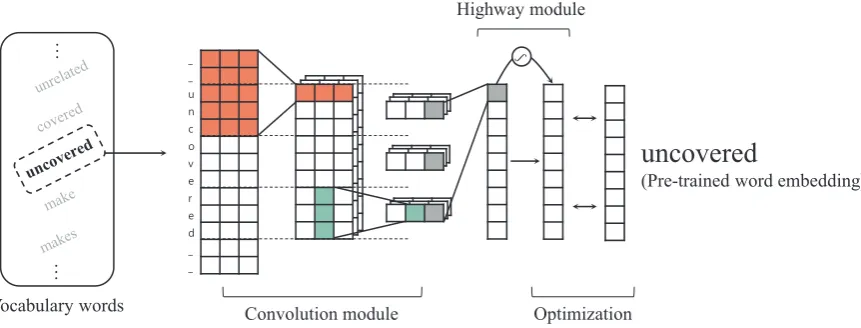
Figure 1 provides an overview of the proposed model. Our learning strategy is toreconstructpre-trained word embeddings from character representations. To this end, we first extract subword features using a character-based convolution module. We then utilize a highway network to adaptively combine the subword features derived from the convolution module. In the optimization step, we make this resultant representation similar to its pre-trained word embedding.
3.1 Character-based Convolution Module
A CNN is designed to capture the most informative local aspects of a particular task (LeCun et al., 1998). CNNs have been widely used in not only computer vision but also recently in NLP (Kim, 2014; Cao and Lu, 2017) because of its ability to extract local context features such as n-grams. Accordingly, we apply this network on a character sequence to extract its subword features.
We first use a one-hot encoding to quantize the character inputs, which has a value of 1 at the index of the corresponding character, otherwise it has a value of 0. We concatenate these character representations to constitute a word, which is represented asr∈R|Vc|×nwhereVcis a vocabulary of characters andnis the length of a word. Thus, the input representation for convolution has the following shape:
r=c1⊕c2⊕ · · · ⊕cn=
| | · · · |
c1 c2 · · · cn | | · · · |
whereci is a one-hot encoding for representing thei-th character in a word and⊕is a concatenation operator. We then insert zero-paddings to the side of these character representationsrin order to perform the same number of convolutions for all characters. The number of zero-paddings on each side is h−12 , where h is the width of convolution filter F. We perform the convolution operation on the padded representationrusing the following equation:
si=tanh(F·ri:i+h−1+b) (1)
where filterF is represented asF ∈R|Vc|×handri
B B X Q F R Y H U H G B B
…
…
Vocabulary words Convolution module
Highway module
Optimization
uncovered
[image:4.595.85.516.78.242.2](Pre-trained word embedding)
Figure 1: Overview of the learning phase in the proposed model. In this example, we process as input the word “uncovered” that is included in pre-trained word embeddings. In the convolution module, we use three filters with 5-width (thus, we add two zero-paddings) and other width filters, and we set the width of the stride to 3 for pooling. In the highway module, we use a single highway network. We then make this resultant representation similar to the pre-trained word embedding of “uncovered”. After training converges, we can represent words that are lexically related to the input word but that are not included in pre-trained word embeddings, like “uncovering”, as these words share similar character sequences.
The resultant vectorshas the same length as the input word because of the zero-paddings. To extract salient features, we apply a max-pooling operation on the vectors. Specifically, we use max pooling with stride to derive locally salient features that can contain suffixes, roots, and prefixes. As a result, each feature derived from stride pooling has a summary of subword information in a character sequence. The equation for stride pooling is as follows:
ei = max [sk·i:k·(i+1)−1] (2)
wherekis the length of a stride andsk·i:k·(i+1)−1 is a sequence representation with one stride ins. As stride pooling results in features that vary in length according to the length of words, we therefore simply sum the elements of the vectoreto produce fixed-sized features.
Thus far, we have described the procedure for a single filter. In our experiment, we use multiple filters with different widths to extract various subword features. We simply concatenate the results of each filter to merge the various features.
3.2 Highway Network Module
A highway network is an architecture that allows a model to train a very deep network efficiently (Sri-vastava et al., 2015). This network learns to route information using a gating mechanism. Recently, (Kim et al., 2016) utilized a highway network on a CNN for language modeling. It turned out that a highway network is helpful to a CNN, as it adaptively combines local features from individual filters. By following this line of work, we apply this network to adaptively combine subword features derived from a convolution module. It allows the proposed model to relate salient subword features with pre-trained word embeddings in a learning phase. The basic equation of a highway network is as follows:
y=TH+Ce (3)
whereHis a non-linear transformation on its inpute,Tis thetransform gateandCis thecarry gate. In our work, we useCas a(1-T)for simplicity. For the functionHandT, we use the following equations:
T =σ(Wt·e+bt)
H = tanh(Wh·e+bh)
whereWt, Whandbt, bhare square matrices and biases2, respectively. Finally, we set the size of resultant
vectoryas the pre-trained word embedding using a linear transformation for an optimization as follows:
w=W ·y+b (5)
wherewis a final word representation resulting from the proposed model, andW andbare parameters of linear transformation. Through the aforementioned procedures, we generate word representations while considering subword information.
3.3 Optimization with Pre-trained Word Embeddings
The proposed model reconstructs pre-trained word embeddings from characters. To make the word representation derived from our model learn the features of pre-trained word embeddings, we use the
squared Euclidean distanceas our objective function as follows:
E= X
v∈Vw
kwv−wˆvk2 (6)
wherewv is a word representation from our model andwvˆ is a pre-trained word embedding for a word
vin the vocabulary. After training converges, we discard pre-trained word embeddingswˆand usewas our word representations for NLP tasks.
4 Experiments
To evaluate the proposed model, we perform both an intrinsic and an extrinsic task which are word similarity and language modeling, respectively. The word similarity evaluates the ability to capture the semantic similarity of words. The language modeling evaluates the usefulness of the proposed word rep-resentations in an NLP task. We specifically conduct both of tasks in various languages, as the subword information is a language-dependent feature.
4.1 Experimental Settings
We train the proposed model using trained word embeddings. To simulate the settings having pre-trained word embeddings for various languages, we use word2vec (Mikolov et al., 2013), which is pre-trained in Wikipedia3 that was released on December 1, 2017 for seven languages: Arabic, Czech, German, English, Spanish, French, and Russian. The preprocessing for a corpus of each language is done using Natural Language Toolkit (NLTK) Tweet Tokenizer4. Based on (Lai et al., 2016), we assign to word vectors a 100 dimension, which has shown relatively better performance in both an intrinsic and an extrinsic task. In our experiments, we examine the following models:
• word2vec(Mikolov et al., 2013): This is a model that regards words as individual atomic units and adopts a window-based learning technique. Since this method is a word-based approach, it is incapable of representing OOV words. As a default for OOV words, we use null vectors for the word similarity task, and we randomly initialize and fine-tune them for the language modeling task. Of the two models of word2vec, CBOW and skip-gram, we use a skip-gram architecture for learning word representations, as it generally shows better performance than does CBOW (Lai et al., 2016).
• FastText (Bojanowski et al., 2017): This is an extension of word2vec and regards character n-grams as atomic units. The learning technique is similar to that of word2vec. We set the dimension of words to 100 that is same with other models and, for other settings, we follow the best settings described in the paper (Bojanowski et al., 2017).
2
According to the suggestion of (Srivastava et al., 2015), we initializebtas -3 for making the networks initially biased
towardscarrybehavior.
3
https://www.wikipedia.org/
• Mimick(Pinter et al., 2017): This is a character-based model that learns a function from charac-ters to word embeddings for representing words. For pre-trained word embeddings for this model, we use the previously mentioned skip-gram version of word2vec. In our experiments, we compare the best Mimick model, which uses pre-trained word embeddings for vocabulary words and gen-erated embeddings for OOV words. We set the hidden dimension of an LSTM to 256 for better convergence, and other parameters are same as those of the paper (Pinter et al., 2017).
• GWR(proposed model): This is our proposed model, denoted as the generated word representation (GWR), and we use the word2vec for pre-trained word embeddings. We generate all words that are observed and use them for overall tasks.
We implemented the proposed architecture using TensorFlow frameworks (Abadi et al., 2016) and trained our model in a single machine equipped with Intel Core i5, 16GB of RAM, and an NVIDIA GeForce GTX 1080 with 8GB of RAM. The details of the training parameters are shown in Table 1. We chose these listed parameters by validating the word similarity task.
Type value
optimizer Adam (Kingma and Ba, 2014)
learning rate 0.001
batch size 50
the width of filter [1,2,3,4,5,6,7]
the width of stride 3
# of filters max(200, 50*width)
# of highway networks 2
Table 1: Experimental settings of the proposed model
4.2 Word Similarity
We first perform word similarity task to evaluate the ability of models to capture the semantic similarity among words. The performance of word similarity is measured by computing the Spearman’s correlation coefficient between human judgment and the cosine similarity between word pairs.
4.2.1 Datasets
We collect word similarity datasets for six languages: Arabic (Ar), German (De), English (En), Spanish (Es), French (Fr), and Russian (Ru). For English, we compare the models on the WS353 (Finkelstein et al., 2001) and SL999 (Hill et al., 2014) datasets. For German, we conduct experiments on the GUR350 and ZG222 (Zesch and Gurevych, 2006) datasets, and we evaluate the models on the MC30 and WS353 datasets for Arabic and Spanish that are translated by (Hassan and Mihalcea, 2009). We evaluate French word vectors on the translated dataset RG65 (Joubarne and Inkpen, 2011), and for Russian, we evaluate the vectors on the HJ dataset introduced by (Panchenko et al., 2016).
4.2.2 Results
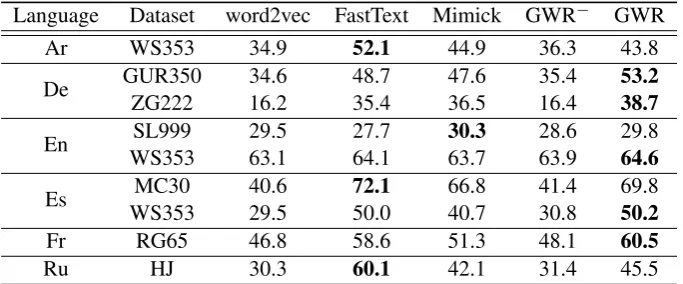
Language Dataset word2vec FastText Mimick GWR− GWR
Ar WS353 34.9 52.1 44.9 36.3 43.8
De GUR350 34.6 48.7 47.6 35.4 53.2
ZG222 16.2 35.4 36.5 16.4 38.7
En SL999 29.5 27.7 30.3 28.6 29.8
WS353 63.1 64.1 63.7 63.9 64.6
Es MC30 40.6 72.1 66.8 41.4 69.8
WS353 29.5 50.0 40.7 30.8 50.2
Fr RG65 46.8 58.6 51.3 48.1 60.5
[image:7.595.129.471.62.204.2]Ru HJ 30.3 60.1 42.1 31.4 45.5
Table 2: Word similarity results on entire datasets (Spearman’sρ×100). GWR−implies a model using null vectors for OOV words. Best results are in bold.
To confirm that OOV word representations derived from GWR indeed improve the performance, we assess the performance of our model when used with null vectors for OOV words (GWR−). The re-sults show that the model generating OOV words (GWR) considerably outperforms the model that does not generate them (GWR−). This improved performance indicates that the proposed model effectively expands the lexical coverage and generates representations of OOV words quite well. In addition, the GWR− model shows slightly better performance than that of the word2vec. It also shows its effec-tiveness at considering subword information in representing words. The differences between these two representations for vocabulary words are described in Section 5.2.
4.3 Language Modeling
As a second experiment, we perform language modeling as an extrinsic task to verify the usefulness of the proposed model when performing an NLP task. To evaluate the performance of word embeddings, we use an LSTM network with dropout regularization, which is used in (Bojanowski et al., 2017). Through the development set in (Botha and Blunsom, 2014), we set the hidden dimension of an LSTM to 256 and the probability of dropout to 0.5. In our experiments, we replace only the component of word embeddings to solely evaluate word embedding performance. The performance of language modeling is computed based on perplexity, which is a widely used metric in evaluating the usefulness of language modeling. Lower perplexity means a better model.
4.3.1 Datasets
We perform language modeling task using the datasets introduced by (Botha and Blunsom, 2014) on six languages: Czech (Cs), German (De), English (En), Spanish (Es), French (Fr), and Russian (Ru). Each dataset contains roughly one million tokens for training, and we follow the same pre-processing and data splits as reported in (Botha and Blunsom, 2014).
Language |Vw| word2vec FastText Mimick GWR
Cs 46k 412.7 397.9 401.7 352.1
De 36k 263.8 248.2 258.6 233.2
En 17k 259.8 256.3 257.2 240.7
Es 27k 190.7 186.9 189.2 174.7
Fr 25k 205.2 207.7 202.4 185.6
Ru 62k 311.5 282.7 293.1 243.1
4.3.2 Results
Table 3 shows the results. We observe a similar trend as with the performance of the word similarity task. The subword-based methods show better performance than the word-based method with most languages. Furthermore, the proposed GWR shows superior performances over these subword-based methods by a large margin. Based on the performance of the word2vec used in training GWR, we achieve notably improved performance in morphologically rich languages. For example, the performance on Slavic languages (Cs, Ru), which are morphologically rich, shows better perplexity reduction (15 and 22% for Czech and Russian, respectively) than other languages that are less significant languages in terms of morphology. This suggests that GWR is more useful and effective in morphologically rich languages.
5 Analysis
5.1 Effect of Highway Networks
0 0.1 0.2 0.3 0.4 0.5
0 10 20 30 40
T
rain
in
g
lo
ss
Epoch
1-MLP 2-MLP 1-Highway 2-Highway No layers
(a) Training loss
0 0.1 0.2 0.3 0.4 0.5 0.6
0 10 20 30 40
S
p
ea
rma
n
’s
ρ
Epoch
1-MLP 2-MLP 1-Highway
2-Highway No layers
[image:8.595.95.501.278.429.2](b) Word similarity performance (Spearman’sρ)
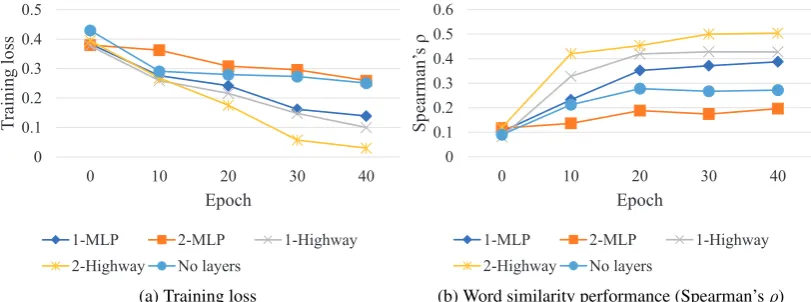
Figure 2: Training loss and word similarity performance with different architectures. The term ofk-MLP indicates thatk-layered MLP are stacked to the proposed model, and it is a same manner with a highway network.
As a component of the proposed model, we use a highway network rather than a multi-layer perceptron (MLP) that is widely used in CNNs (Kim, 2014; Cao and Lu, 2017). To show the effectiveness of a high-way network in our architecture, we assess the training loss and performance of word similarity during training step when each network (highway network, MLP) is stacked to the proposed model. As a rep-resentative language in this analysis, we use the WS353 dataset in Spanish, which is a morphologically rich language. The results are shown in Figure 2.
In Figure 2a, we can observe that a highway network basically shows faster convergence than does MLP with respect to training loss. The interesting results occur when the model is deeper with each network (2-highway, 2-MLP). While 2-MLP shows slower convergence than 1-MLP, 2-Highway shows faster convergence than 1-Highway. These results are related to the property of a highway network, which allows the model to train more deeply.
Figure 2b shows the performance of word similarity task. We observe a similar trend with the results of the training loss. The highway network shows superior performance compared to MLP. Furthermore, when 2-Highway is stacked to the proposed model, it shows better performance than that of 1-Highway. In contrast, 2-MLP performs worse than 1-MLP, even when the proposed model does not have a layer (No layers).
In-Vocabulay Out-of-Vocabulary
connect teach taxicab computes bluejacket vehicals globalise computerization
word2vec connect connecting communicate interact linking teach learn instruct enroll educate taxicab taxi minibus motorbike truck computes calculates logarithmic satisfies generates - - - -GWR connect connecting connects connected linking teach instruct learn teaching understand taxicab taxi limousine minibus motorbike computes compute calculates logarithmic computable jacket trouser sleeve t-shirt pants vehicles bicycles cars automobiles trailers global worldwide globally globalisation globalization computational computation computerized visualization computations
Table 4: Nearest neighbors of word representations for vocabulary and OOV words. Nearest words are sorted in descending order of similarity that computed by cosine similarity.
5.2 Nearest Neighbor of Words
To explore the quality of GWR, we perform a qualitative analysis by finding the nearest neighbors of word representations. Table 4 shows the nearest neighbors of word representations learned from the word2vec and GWR in English.
From nearest neighbors of OOV words, we discover the following: (i) GWR represents word-variants and compound words well (computerization, bluejacket); (ii) GWR captures different word styles ( glob-alise) and syntactically related words (global-globally-globalization); (iii) GWR shows robustness on misspellings (vehicals); (iv) GWR captures semantically related words in most OOV words ( bluejacket-pants, vehicals-bicycles).
We also derive some interesting results for nearest neighbors of vocabulary words. We observe that semantically or syntactically related words are located in nearest neighbors (taxicab-minibus, teach-teaching). Moreover, the proposed model renders lexically related word representation more similar. For example, the neighbors of “connect” show that the word-variants (connects-connected-connecting) are more closely located than are pre-trained word embeddings in vector space. This rendering satisfies the characteristic of words aboutlexical relatedness(Williams, 1981). Other words also show a similar trend (teach-teaching, computes-compute-computable). This is probably because the lexically related words share many parts of character sequences.
5.3 Training time
We measure the training time for GWR and corpus-based models. For a fair comparison, we use the same hardware resources, and record the training time when each model achieves the best performance on English data. Word2vec and FastText, which are corpus-based models, take approximately 10 and 14 hours, respectively. In contrast, GWR takes 52 minutes for learning 100,000 words in pre-trained word embeddings (i.e., 16x faster than FastText). This result demonstrates that GWR produces word representations efficiently.
6 Conclusion
In this paper, we have proposed a character-based approach, denoted as GWR, to generate word repre-sentations. To this end, we have used a CNN and a highway network to extract salient subword features, and then learned features from pre-trained word embeddings. Notably, the proposed model allows us to produce high quality representations of OOV words by considering subword information. Experimental results demonstrate the efficacy of our methodology and clearly show that the proposed model works well for NLP tasks. We plan to apply the proposed model to different domains such as text classification and named entity recognition.
Acknowledgements
References
Mart´ın Abadi, Paul Barham, Jianmin Chen, Zhifeng Chen, Andy Davis, Jeffrey Dean, Matthieu Devin, Sanjay Ghemawat, Geoffrey Irving, Michael Isard, et al. 2016. Tensorflow: A system for large-scale machine learning. InProceedings of the USENIX Symposium on Operating Systems Design and Implementation, pages 265–283.
Yoshua Bengio, R´ejean Ducharme, Pascal Vincent, and Christian Jauvin. 2003. A neural probabilistic language
model. Journal of Machine Learning Research, pages 1137–1155.
Piotr Bojanowski, Edouard Grave, Armand Joulin, and Tomas Mikolov. 2017. Enriching word vectors with
subword information. Transactions of the Association for Computational Linguistics, pages 135–146.
Jan Botha and Phil Blunsom. 2014. Compositional morphology for word representations and language modelling. InProceedings of the International Conference on Machine Learning, pages 1899–1907.
Shaosheng Cao and Wei Lu. 2017. Improving word embeddings with convolutional feature learning and subword
information. InProceedings of the Association for the Advancement of Artificial Intelligence, pages 3144–3151.
Ronan Collobert and Jason Weston. 2008. A unified architecture for natural language processing: Deep neural
networks with multitask learning. InProceedings of the International Conference on Machine Learning, pages
160–167.
Lev Finkelstein, Evgeniy Gabrilovich, Yossi Matias, Ehud Rivlin, Zach Solan, Gadi Wolfman, and Eytan Ruppin.
2001. Placing search in context: The concept revisited. InProceedings of the International Conference on
World Wide Web, pages 406–414.
Samer Hassan and Rada Mihalcea. 2009. Cross-lingual semantic relatedness using encyclopedic knowledge. In
Proceedings of the Conference on Empirical Methods in Natural Language Processing, pages 1192–1201.
Felix Hill, Kyunghyun Cho, S´ebastien Jean, Coline Devin, and Yoshua Bengio. 2014. Embedding word similarity
with neural machine translation.CoRR, abs/1412.6448.
Colette Joubarne and Diana Inkpen. 2011. Comparison of semantic similarity for different languages using the
google n-gram corpus and second-order co-occurrence measures. InProceedings of the Canadian Conference
on Artificial Intelligence, pages 216–221.
Yoon Kim, Yacine Jernite, David Sontag, and Alexander M Rush. 2016. Character-aware neural language models. InProceedings of the Association for the Advancement of Artificial Intelligence, pages 2741–2749.
Yoon Kim. 2014. Convolutional neural networks for sentence classification. InProceedings of the Conference on
Empirical Methods in Natural Language Processing, pages 1746–1781.
Diederik P. Kingma and Jimmy Ba. 2014. Adam: A method for stochastic optimization.CoRR, abs/1412.6980.
Ankit Kumar, Ozan Irsoy, Peter Ondruska, Mohit Iyyer, James Bradbury, Ishaan Gulrajani, Victor Zhong, Ro-main Paulus, and Richard Socher. 2016. Ask me anything: Dynamic memory networks for natural language
processing. InProceedings of the International Conference on Machine Learning, pages 1378–1387.
Siwei Lai, Kang Liu, Shizhu He, and Jun Zhao. 2016. How to generate a good word embedding.IEEE Intelligent
Systems, 31(6):5–14.
Yann LeCun, L´eon Bottou, Yoshua Bengio, and Patrick Haffner. 1998. Gradient-based learning applied to
docu-ment recognition. Proceedings of the IEEE, pages 2278–2324.
Wang Ling, Chris Dyer, Alan W Black, Isabel Trancoso, Ramon Fermandez, Silvio Amir, Luis Marujo, and Tiago Luis. 2015. Finding function in form: Compositional character models for open vocabulary word
rep-resentation. InProceedings of the Conference on Empirical Methods in Natural Language Processing, pages
1520–1530.
Minh-Thang Luong and Christopher D Manning. 2016. Achieving open vocabulary neural machine translation
with hybrid word-character models. InProceedings of the Annual Meeting of the Association for Computational
Linguistics, pages 1054–1063.
Minh-Thang Luong, Richard Socher, and Christopher D Manning. 2013. Better word representations with
recur-sive neural networks for morphology. Proceedings of the Annual Conference on Natural Language Learning,
Tomas Mikolov, Ilya Sutskever, Kai Chen, Greg S Corrado, and Jeff Dean. 2013. Distributed representations
of words and phrases and their compositionality. InProceedings of the International Conference on Neural
Information Processing Systems, pages 3111–3119.
Amr El-Desoky Mousa, Hong-Kwang Jeff Kuo, Lidia Mangu, and Hagen Soltau. 2013. Morpheme-based
feature-rich language models using deep neural networks for lvcsr of egyptian arabic. InProceedings of the
Interna-tional Conference on Acoustics, Speech, and Signal Processing, pages 8435–8439.
Alexander Panchenko, Dmitry Ustalov, Nikolay Arefyev, Denis Paperno, Natalia Konstantinova, Natalia Loukachevitch, and Chris Biemann. 2016. Human and machine judgements for russian semantic
related-ness. InProceedings of the International Conference on Analysis of Images, Social Networks and Texts, pages
221–235.
Jeffrey Pennington, Richard Socher, and Christopher Manning. 2014. Glove: Global vectors for word
repre-sentation. InProceedings of the Conference on Empirical Methods in Natural Language Processing, pages
1532–1543.
Yuval Pinter, Robert Guthrie, and Jacob Eisenstein. 2017. Mimicking word embeddings using subword rnns. In
Proceedings of the Conference on Empirical Methods in Natural Language Processing, pages 102–112.
Siyu Qiu, Qing Cui, Jiang Bian, Bin Gao, and Tie-Yan Liu. 2014. Co-learning of word representations and
morpheme representations. InProceedings of the International Conference on Computational Linguistics, pages
141–150.
Marta Ruiz Costa-Juss`a and Jos´e Adri´an Rodr´ıguez Fonollosa. 2016. Character-based neural machine translation. InProceedings of the Annual Meeting of the Association for Computational Linguistics, pages 357–361.
Cicero D Santos and Bianca Zadrozny. 2014. Learning character-level representations for part-of-speech tagging. InProceedings of the International Conference on Machine Learning, pages 1818–1826.
Rupesh K Srivastava, Klaus Greff, and J¨urgen Schmidhuber. 2015. Training very deep networks. InProceedings
of the International Conference on Neural Information Processing Systems, pages 2377–2385.
Joseph P Turian, Lev-Arie Ratinov, and Yoshua Bengio. 2010. Word representations: A simple and general
method for semi-supervised learning. InProceedings of the Annual Meeting of the Association for
Computa-tional Linguistics, pages 384–394.
John Wieting, Mohit Bansal, Kevin Gimpel, and Karen Livescu. 2016. Charagram: Embedding words and
sen-tences via character n-grams. InProceedings of the Conference on Empirical Methods in Natural Language
Processing, pages 1504–1515.
Edwin Williams. 1981. On the notions ”lexically related” and” head of a word”. Linguistic Inquiry, pages 245–
274.