
Financial Self-Efficacy Scale: Development and Validation of a Measurement Tool
A DISSERTATION
SUBMITTED TO THE FACULTY OF THE GRADUATE SCHOOL OF THE UNIVERSITY OF MINNESOTA
BY Hoa Thi Nguyen
IN PARTIAL FULFILLMENT OF THE REQUIREMENT FOR THE DEGREE OF
DOCTOR OF PHILOSOPHY IN SOCIAL WORK
Dr. C. David Hollister, Advisor
Copyright
©
By Hoa Thi Nguyeni
Acknowledgments
The journey to complete my dissertation has been longer than I planned and I could not have completed it without the tremendous support of my advisor, my committee members, my colleagues, and the encouragement and motivation from my family and friends. First or foremost, I would like to deeply express my gratitude to my advisor C. David Hollister who has been my mentor for both the Master and Ph.D. programs. Dr. Hollister guided me step by step through both programs, and fostered my love for social work research. Without him, I likely would not have applied to the doctoral program, let alone completed it. There have had so many times that I wanted to stop but it was Dave who encouraged me to continue, patiently getting me back on the right track when I got lost or encountered a “dissertation crisis”. He always encouraged me to do my best but also advised me to do what is the best for myself. I am so grateful to have him as my advisor.
I would also like to thank Dr. Jeffrey Edleson who was my Professor of the Research Method class where I started the idea for my dissertation and supported me to apply for the Interdisciplinary Dissertation Fellowship and then hosted me at his center (MINCAVA) during my pre-dissertation fellowship. This one year of pre-dissertation fellowship was so precious, and allowed me to concentrate on preparing and sharpening the skills I needed to do my dissertation. And of course this dissertation would not have been possible without the mentorship from my committee members - Dr. Elizabeth Lightfoot, Dr. Hee Yun Lee, and Dr. Catherine Solheim from the department of Family Social Science - who have given me invaluable input for my dissertation. They have also
ii
been so kind and flexibly accommodated my changing circumstances: meeting with me at a conference in Uganda for my dissertation proposal defense and then again at a
conference in Singapore to discuss my dissertation. I would have not been able to complete my dissertation while working and living in Vietnam without their flexibility and support.
I was fortunate to have a chance to work alongside with some experienced
researchers - Dr. Laurie Drabble and Dr. Meekyung Han - who were so kind in giving me some comments for my dissertation and also helped me in disseminating my surveys in their networks. I am also grateful to have the support of my husband Luke Coldham-Fussell who has always been there, supporting me in whatever decision that I chose. Thank you for listening to my complaints, putting up with my stress and being patient with me during those years. Thank you my little son Benjamin Hieu Coldham-Fussell who was born in the middle of my writing, who was a source of distraction but also a great source of motivation for me to keep going. I love you both and could not have done this without you two!
iii Abstract
Given the fact that many Americans are struggling with their daily financial management, many financial management training programs have been implemented with the aim of helping people increase their financial capability, to then lift them out of poverty. However, there is little empirical evidence about what works, what does not, and what the most effective strategy in improving individuals’ financial capability is. One of the main reasons for this is the lack of standardized measurement to design rigorous studies. This dissertation aims to develop and validate a Financial Self-Efficacy Scale (FSES) to contribute to the pool of standardized measurements. The FSES was tested on 299
women who were over 18 years old living in the United States. The split-half method and internal consistency method were used to check the reliability of the scale. Content-related validity was checked by consulting an expert panel. Construct-Content-related validity and criterion-related validity of the scale were examined by correlating the FSES with a New General Self-Efficacy Scale (NGSES). Factor analysis was also run to assess the
dimensionality of the scale and provide further evidence for the reliability and validity of the scale. Results showed that the FSES had an excellent reliability coefficient alpha (.93). The scale covered all key domains in financial management. The FSES was positively correlated with the NGSES. Factor analysis showed four factors which were consistent with the common categories in financial management curricula. The FSES will serve as a reliable and valid instrument for researchers to use in program evaluation. It will be a useful tool for practitioners to assess clients’ capability, facilitating the tailoring of programs to fit the needs of participants.
iv
TABLE OF CONTENTS
List of Tables ... vi
List of Figures ... vii
INTRODUCTION ... 1
CHAPTER 1: LITERATURE REVIEW ... 5
Effects of Financial Literacy Programs ... 9
Self-efficacy theory ... 15
Existing measurements about self-efficacy ... 22
CHAPTER 2: RESEARCH METHODS ... 31
Pre-dissertation study ... 31 1. Scale development: ... 31 2. Scale testing: ... 36 Dissertation ... 37 1. Scale development ... 39 2. Scale Testing ... 40 Sampling ... 44 Subject Recruitment ... 44 Data Collection ... 45 Data analysis ... 46 1. Item analysis ... 46 2. Split-half analysis: ... 48 3. Reliability analysis ... 49 4. Correlation analysis ... 49 5. Factor analyses ... 50 Sample of Participants: ... 50 CHAPTER 3: RESULTS ... 53 Reliability evidence ... 53
1. Item analysis results ... 53
2. Person-item map ... 54
3. Split-half analysis ... 55
4. Reliability analysis ... 55
Validity evidence ... 55
v
b. Response related validity ... 56
c. Construct-related validity and criterion-related validity ... 56
d. Factor Analysis ... 56
CHAPTER 4: DISCUSSION ... 60
CONCLUSION ... 71
REFERENCES ... 72
Appendix A: List of reviewed self-efficacy scales ... 83
Appendix B: Questions used by the expert panel to review the scale ... 85
Appendix C: Questions for the focus group ... 86
Appendix D: Recruitment Email ... 87
Appendix E: Consent Form ... 88
vi List of Tables
Table 1. Definition of each category of financial management………...32
Table 2. Hyphothesized factors and items ... 38
Table 3. Demographic Characteristics of the sample ... 93
Table 4. Item difficulty and item total-correlation for each item ... 101
Table 5. Total variance explained by the four extracted factors of FSES ... 102
Table 6. Factor loadings from the rotated factor structure matrix for the FSES ... 103
Table 7. Rotated factor pattern matrix for the 21 items FSES: principal axis factoring with promax rotation ... 104
Table 8. Four factors and items based on the EFA compared with he hypothesized factors ... 105
Table 9. Confimatory Factor Analysis for four extracted factors ... 107
vii List of Figures
Figure 1. Financial self-efficacy construct map ... 32
Figure 2. Distribution of Sumscore ... 95
Figure 3. Test Characteristic Curve ... 100
1 Introduction
Lack of basic financial management knowledge and skills is one the main factors that lead to poverty among Americans, but overall financial literacy in America is low. A recent national survey concerning financial literacy found that a majority of Americans did not understand basic financial concepts, more than 50% did not plan ahead for retirement or unexpected circumstances, and more than 25% participated in high-risk financial behaviors (Lusardi, 2011). To address this, financial literacy education has been receiving increased attention as a sustainable way to lift people out of poverty and also as a means to empower people, especially women and certain vulnerable groups. In the United States, many financial literacy training curricula have been developed and tailored for different groups such as youth, college students, women, battered women, the elderly, and others. Despite this increase in the number of financial management programs, there are few rigorous studies that provide empirical evidence regarding the most effective strategies in the enhancement of financial capability (CFPB, 2014). One of the main reasons for this dearth of empirical studies is the lack of standardized measurement.
Most previous evaluations of financial management training programs have tended to focus on the changes in financial knowledge, savings rate, financial confidence, and changes in some financial behaviors and attitudes, and so on (Bernheim, Garrett, & Maki, 2001; Zhan, Anderson, & Scott, 2006; Weaver, Sanders, Campbell, & Schnabel, 2008; Postmus, Plummer, & Murshid, 2010). As financial self-efficacy has been found to be one of the major factors influencing the development of financial knowledge and changes in financial behaviors, several scholars have attempted to develop instruments to measure financial self-efficacy. Examples are a computer self-efficacy scale (Compeau
2
and Higgins, 1995); a career decision-making self-efficacy scale (Betz, Klein, & Taylor, 1996); an eating efficacy scale (Glynn and Ruderman, 1986); an internet
efficacy scale (Eastin and LaRose, 2000), among others. However, measurements of self-efficacy in financial management still lack a standardized scale able to provide a precise estimation of an individual’s level of financial self-efficacy.
The purpose of this dissertation is to develop and validate a self-administered online scale that measures financial self-efficacy for women over 18 years old. It aims to examine the following hypotheses: (1) the developed Financial Self-Efficacy scale
(FSES) will exhibit robust psychometric properties, including a replicable factor structure and strong internal consistency reliability; (2) the FSES will positively correlate with the new General Self-efficacy scale (NGSES); (3) the FSES will have five factors which correlate positively with each other.
This dissertation relies on existing definitions of efficacy. In general, self-efficacy relates to people’s perceived capability. According to Bandura (1997),
“perceived self-efficacy refers to beliefs in one's capabilities to organize and execute the courses of action required to produce given attainments" (p.3). Self-efficacy is different from self-esteem since it measures the individual’s perception of their ability, whereas self-esteem measures one’s self-worth (Bandura, 1997). Self-efficacy relates to “people's sense of being able to take control over their actions and outcomes” (Baldwin, Baldwin, & Ewald, 2006, p.1).
Terminology in this area is not yet settled. For financial literacy, there is no standard definition of this term, but most agree that the notion includes both understanding and applying financial knowledge to undertake basic financial
3
management (Jump$tart Coalition, 2007; Servon & Kaestner, 2008; Vitt, Anderson, Kent, Lyter, Siegenthaler, & Ward, 2000). However, developments in the field of financial training suggest that financial capability is a more inclusive term that not only focuses on knowledge and skills but also takes into account other external factors such as access to capital, financial services, and financial policies. For instance, people who have the same financial knowledge and skills might have different financial outcomes due to racial/gender discrimination or cultural barriers. Accordingly, Johnson and Sherraden (2007) recommend financial programs focus on financial capability which includes both internal capacities and external conditions that gave people opportunities to become financially self-sufficient. The U.S. Department of the Treasury (2010) also defines financial capability as “the capacity, based on knowledge, skills, and access, to manage financial resources effectively” (p.1). Finally, there does not seem to be a standard definition of financial self-efficacy. In this study, financial self-efficacy refers to beliefs in one’s capabilities in managing their personal finances. It mainly measures people’s confidence that they can do the indicated actions and it does not measure people’s experiences.
This dissertation is organized into two main sections: (a) scale development and (b) scale testing. The scale testing section details a variety of methods to examine the reliability and validity of the scale. The scale was tested on a sample of 299 women who were above 18 years old and had lived in the United States for at least three years. The split-half method and internal consistency method were used to check the reliability of the scale. In terms of validity, the content-related validity was checked by an expert panel. The criterion-related validity and construct-related validity were checked by
4
correlating the results from the self-efficacy scale with the results from the New General Self-Efficacy scale (NGSE). In addition, factor analysis was run to assess the
dimensionality of the scale and provide further evidence for the reliability and validity of the scale.
The results showed that the developed FSES had robust psychometric properties, including a good validity and reliability when used with women who were more than 18 years old in the United States. Its reliability analysis yielded an excellent coefficient alpha. The expert panel agreed that the scale covered all main domains of financial literacy, which is good evidence for content related validity. Correlation analysis showed that the scale was positively correlated with the NGSE scale, which was good evidence for criterion-related validity and construct related validity. Factor analysis showed a four factors scale instead of five factors as hypothesized. However, these four factors were consistent with the hypothesized five domains of financial literacy and could be used as sub-scales to measure self-efficacy in different aspects of financial literacy. All factors showed a strong reliability coefficient.
The development and testing of the FSES provides researchers, educators, and practitioners a standardized tool to measure the changes in financial self-efficacy of their clients or trainees. Researchers could use the FSES to design experimental or quasi-experimental studies which would provide empirical evidence regarding what optimally effective strategies in financial management training are. In addition it could help evaluators compare different programs and develop evidence based programs, and help practitioners choose and tailor programs to fit with the needs of participants. As the scale has been found to be valid and reliable in measuring women and battered women, it will
5
be an effective tool for programs that focus on enhancing women’s financial capability, potentially contributing to poverty reduction among disadvantaged women.
Chapter 1: Literature Review
This study aims to develop and test a standard measurement of financial self-efficacy for women. This literature review will outline what is currently known about financial self-efficacy, especially among women, and describe some of the current measurements that are often used to measure financial self-efficacy. First, a summary of financial management programs will be provided to describe the main components of personal financial management. Second, research about impacts of these programs will be reviewed. Existing self-efficacy measures in general and financial self-efficacy measures in particular will also be discussed. Finally, Bandura’s self-efficacy theory will be introduced as a theoretical framework for this study.
Financial management education has been widely implemented in the United States with the main purpose of increasing participants’ financial knowledge and skills and financial self-efficacy. Many financial curricula have been developed and tailored for different populations, such as youth, middle-aged, immigrants, low-income families, and so forth. Financial management programs often provide participants with a range of knowledge and skills from basic financial management such as credit and savings to advanced financial planning such as debt management and investment. The programs can last from one week to several weeks depending on the depth of knowledge and skills. Methods of training include in-class lectures, online training modules, seminars, and workshops covering a wide range of knowledge and skills such as identifying assets and
6
liabilities, understanding banking options, reviewing and improving credit scores, purchasing a house or a car, budgeting, saving, and investing.
The National Endowment for Financial Education (NEFE) (n.d.) developed a set of financial education workshop kits tailored for different populations such as youth, the elderly, low income people, people with disabilities or health problems, and people in special circumstances (domestic violence, addiction). They also have a college series providing money management topics such as dealing with debt, budgeting after graduation, preventing identity theft, managing spending, saving, and financial risks, ways to control money and avoid money traps for college students.
The Federal Deposit Insurance Corporation (FDIC) (2013) developed the Money Smart curriculum for four target groups including adults, youth, older adults, and small business. The curriculum for adults consists of 11 modules covering topics relating to bank services, consumer rights, credit and credit history, checking account management, credit card management, saving, borrowing, home ownership, and financial recovery. The curriculum for youth aged 12-20 includes eight modules covering similar topics: bank services, credit and credit card management, checking account management, and savings. In addition, it includes specific topics for youth such as paying for college and cars, choosing apartments, and mortgages. The curriculum for older adults focuses on raising awareness about financial exploitation of the elderly and planning for unexpected events. It covers seven specific topics about common types of elder financial exploitation, common types of scams that target veterans and homeowners, different types of identity theft and medical identity theft, preparation for unexpected life events, and disasters. The curriculum for small businesses provides new entrepreneurs with basic information on
7
how to organize and manage their business. It has 10 training modules about common types of business, available banking services for small business, time management, financial management, risk management, record keeping, and tax preparation.
The Partnership for After School Education (PASE) (2007) developed a financial management curriculum “Dollars and Sense: Building Financial Dreams” for young adults age 18 to 24. The curriculum provides young adults with basic financial
knowledge and skills about saving, preparing for retirement, and future financial planning for themselves and their families. It focuses on teaching young adults about savings and budgeting for daily life, how to increase their savings with different investment types, and how to critically choose the best investment options for their retirement.
Since women often have lower financial knowledge, financial confidence, and less access to financial resources than men, they have unique and specific financial education needs (OECD, 2013). In response, the Women’s Institute for Financial Education (WIFE) has developed training materials to teach women about savings and investing, budgeting, and preparing for retirement. Besides basic financial management topics, WIFE prepares women for life after divorce or widowhood (WIFE, n.d.).
Several financial management training curricula specifically targeted for battered women have also been developed: Hope and Power for Your Personal Finances
(National Endowment for Financial Education & National Coalition against Domestic Violence, 2000); Personal Economic Planning (PEP) (VonDeLinde & Correia, 2005);
Redevelopment Opportunities for Women’s Economic Action Program (REAP) (Sanders,
Weaver & Schnabel, 2007); and Moving Ahead through Financial Management
8
knowledge about economic abuse, strategies to deal with financial and safety challenges after divorce, and strategies to address challenges after financial records have been misused by the abusers (Allstate Foundation, 2009).
Johnson and Sherraden (2007) argued that financial management programs which only focused on knowledge and skills failed to take into account other external factors such as access to capital, financial services, and financial policies. For instance, people who have the same financial knowledge and skills might have different financial
outcomes due to racial/gender discrimination or cultural barriers. Low income people are also less likely to have savings accounts. Therefore, Johnson and Sherraden (2007) suggested financial programs should focus on financial capability which includes both internal capacities and external conditions that give people opportunities to become financially self-sufficient.
Several financial education programs have adopted the latter approach and have added savings accounts, matched savings accounts, or investment clubs to their financial education programs. For example, the Save for America program offers no-fee savings accounts for youth who participate in a financial education program at school (Save for America, 2012). Juma Ventures, a non-profit organization focusing on youth, also offers matched saving accounts with youth’s savings are matched 1:1 or 3:1, depending on the saving goals, such as education, homeownership, computer purchases, etc. (Juma Ventures, 2011).
There are many factors suggesting a need for an enhanced financial capability. In general, Americans often have limited financial capability. A recent national survey with 1,488 American adults found more than 50% of the respondents did not plan ahead for
9
retirement and children’s college education. Only 49% of respondents said they set aside some money for an emergency fund which could cover three months of expenses.
Regarding financial product usage, about 12% of the population were unbanked (do not have checking, savings, or any type of banking accounts). More than 25% of respondents reported using high-cost borrowing methods such as payday loans, advances on tax refunds, and pawn shops. It is also alarming that more than 10% of the people who had a mortgage did not even know what their down payment was or the mortgage interest rate. A majority of respondents had limited knowledge of basic economic principles such as inflation, risk management, or interest compounding (Lusardi, 2011).
The situation regarding youth financial literacy is not much brighter. Graduates are facing increasing student loans (58% increase from 1997 to 2007) (Reed, 2008) and credit card debt (a 74% increase in 2009 compared to 2004) (Sallie Mae, 2009). A recent report on youth financial literacy also found that more than 50% of respondents aged 12-17 did not understand basic financial concepts (Lusardi, Mitchell, and Curto, 2010). Lusardi and colleagues (2010) also found that financial literacy was highly correlated with socio-demographic factors such as gender, education level, and family background. For instance, college males who grew up in families that have savings and investments are 45% more likely to know about risk diversification than females who have a high school diploma and who grew up in poor families with no savings.
Effects of Financial Literacy Programs
The effects of financial literacy programs have been examined in several studies. For example, Bernheim, Garrett, and Maki (2001) conducted a cross-sectional household survey with a national sample of adults aged 30 to 49 regarding the long term effects of
10
the financial education mandate in high school. They collected information about the subjects’ current incomes, savings, assets, liabilities, and demographic data, and then cross-referenced this information with the years of high school attendance to compare students who were exposed to financial education during their education and those who were not. The study found that the savings rate of the group that had financial education was 4.15% higher than the group which did not have financial education (Bernheim, Garrett, & Maki, 2001).
The effects of financial education vary depending on participants’ characteristics. Zhan, Anderson, and Scott (2006) conducted a pre-test, post-test study to measure the impacts of the Financial Links for Low Income People (FLLIP) program on 163
participants and found that while the training improved the knowledge of participants in all key financial areas, the levels of impacts were associated with the level of English proficiency, race/ethnicity, marital status, and level of education. For example, Hispanic participants averaged higher scores than other racial groups; married people had lower scores on average than singles; and participants who held at least a high school diploma averaged higher scores than people who did not. The study used 48 true-false and multiple choice questions that covered five areas of financial management such as
“predatory lending practices, public and work-related benefits, banking practices; savings and investing strategies; credit use and interest rates” (Zhan, Anderson, & Scott, 2006, p.58).
In another evaluation of financial programs for adolescents and high school (NEFE High School Financial Planning program), Danes and Brewton (2009) used a 17 question survey which included 9 questions about financial behavior, 7 questions about
11
financial knowledge, and 1 question about financial confidence. They used the post- then pre-test method to measure the changes. Students were surveyed right after the training, then they were asked about what they knew before the training using the same set of questions; finally, they were asked again three months after the training using the same measurement. The study found that students’ financial knowledge, behavior and confidence increased right after taking the training. These changes were sustained by applying this knowledge into practice during the three months following the training (Danes & Brewton, 2009).
The outcome evaluation study of the Redevelopment Opportunities for Women’s Economic Action Program (REAP) with battered women conducted by Sanders, Weaver, and Schnabel (2007) was one of the early studies examining the impacts of financial literacy programs specifically for battered women. It utilized a quasi-experimental design in which two domestic violence shelters were selected to implement the training and two other similar shelters were selected for comparison purposes. Data were collected
simultaneously for both groups following the class schedules. The REAP program included four class sessions, each lasting three hours, covering four topics: money and power; budgeting; building and repairing credit; and banking and investing. It focused on helping the women build a good credit history and become financially independent from the abusers.
This study measured the training impacts in terms of financial literacy and financial self-efficacy among REAP participants compared to non-participants.
Measurement to assess financial literacy was developed based on the main components of the curriculum. It included 35 items covering factual knowledge about financial
12
management. The participants rated themselves on a 4-point Likert scale, ranging from 1 (strongly disagree) to 4 (strongly agree). The higher the participants’ scores, the higher their level of financial literacy. Cronbach’s alpha for this measure was .81 (Sanders, Weaver, & Schnabel, 2007).
To measure financial self-efficacy, the REAP study used a sub-scale of the Domestic Violence-Related Financial Issues scale (DV-FI) which included 5 items asking about financial self-efficacy. The DV-FI scale is a multidimensional scale that includes 23 items and has five sub-scales, namely “financial self-efficacy, financial security and future safety, perceived financial role in partner abuse, economic abuse, and financial distress and relationship decisions) (Weaver, Sanders, Campbell, & Schnabel, 2009, p.581). Cronbach’s alpha for each factor is .86, .80, .75, .78, and .78 respectively (Weaver et al., 2009).
More recently, Postmus et al. (2010) completed a process evaluation of the Moving Ahead through Financial Management program for battered women. The program provides training for DV advocates and volunteers in working with DV victims as they work on their independent financial management. The curriculum covers
strategies in locating financial resources, managing financial issues including financial problems during and after divorce, safety issues for DV victims, and strategies in building personal finances. The research team conducted interviews (either in person or by phone) with more than 100 participants who have at least attended either the
individual or group session from domestic violence agencies and shelters in 10 states. Each had three rounds of interviews. Researchers also conducted interviews with 18 key stakeholders. Each had two rounds of interviews. The study measured the following
13
variables: economic, psychological, and physical abuse experiences, financial literacy, economic empowerment, economic self-sufficiency, economic self-efficacy, quality of life, and depression. They used the definition of economic self-sufficiency from Gowdy and Pearlmutter (1993) in which economic self-sufficiency is defined as “the
manifestation of a wide range of behaviors related to financial management.” Their definition of economic self-efficacy, cited from Weaver, Sanders, Campbell, and Schnable (2009) is one’s belief in having enough resources and confidence to complete financial tasks. Economic efficacy was measured by the five-item financial self-efficacy sub-scale of the DV-FI scale. The findings showed a significant improvement in financial literacy, economic self-sufficiency, and economic self-efficacy. Other outcomes such as economic, psychological, and physical abuse, depression, and quality of life were not significant.
The frameworks used to evaluate the outcomes of financial education programs vary, depending on the purposes of the study, its research questions, and available resources. It also depends on what are considered reasonable outcomes in the evaluation time frame (Sebstad, Cohen, & Stack, 2006). For example, Kirpatrick (1994) introduced a four- level framework to evaluate both short term and long term outcomes of training in general. The first level is evaluating participants’ reactions to the training, which is similar to doing a satisfaction survey. In this level, the evaluators mainly explore whetherthe participants like the training, which part of the training they like, and how they rate the training, and it also secures feedback to improve the training. This is often the first and simplest step in most training evaluations; however, it provides evidence about the favorability of the program. The second level is evaluating learning, in which
14
the evaluators attempt to measure changes in the knowledge, skills, and attitudes of the participants. This is an essential part of every training evaluation, providing evidence regarding the short term outcomes of the training. The third level is evaluating behavior. This level is more difficult, since it takes time to change behavior, and participants also need opportunities to show the changed behavior. The fourth level is evaluating training results. This is the final and most difficult level, in which the evaluators try to measure the distal outcomes and final results of the training.
Sebstad, Cohen, and Stack (2006) also proposed a framework to evaluate the outcomes and impacts of financial education. They proposed that the input variables should not be just the training itself, but should also include participants’ financial learning experiences (e.g., social networks and exposure to good financial practices) as learning outcomes are affected by social factors. In their evaluation framework, the first level of financial literacy outcomes includes financial knowledge, skills, and attitudes. The second level of outcomes includes financial behaviors and practices. The long-term impacts can be increased assets, savings rate, and so forth.
Recently, in an effort to help evaluate financial management programs, the Consumer Financial Protection Bureau (CFPB) developed a working definition of financial well-being based on open-ended interviews with 59 adult consumers, 30 financial practitioners, and consultation with experts (CFPB, 2015). The definition was comprised of four main elements, including “having control over day-to-day, month-to-month finances; having the capacity to absorb a financial shock; being on track to meet your financial goals; and having the financial freedom to make the choices that allow you
15
to enjoy life” (CFBP, 2015, p.19). Among these, the first and fourth elements apply to the present and the second and third elements concern individual’s future well-being.
Most evaluation studies focused on measuring the changes in knowledge, skills, and financial self-efficacy. However, findings of these studies are limited due to lack of rigorous design. One of the barrier and challenges in designing rigorous evaluation studies is the lack of standardized measurements.
Self-efficacy theory
This section presents self-efficacy theory as a theoretical framework on which this dissertation is based. The construct of self-efficacy was first introduced in the 1970s by Bandura – a psychologist and professor at Stanford University. During his life time, he once served as President of the APA and received several awards for his contribution to psychology development, including the Distinguished Scientific Contribution Award of the American Psychology Association, and the Distinguished Scientist Award. Bandura is the father of social learning theory and social cognitive theory and has contributed
tremendously to the development of psychology (Pajares, 2004).
Since its inception, self-efficacy has been studied from different perspectives which could be grouped into two main approaches (a) motivational theories which perceive self-efficacy in regard to motivation, and (b) cognitive theories which perceive self-efficacy in regard to “expectancies” and “perception of control” (Gecas, 1989, p.292). The main difference among these approaches is the emphasis on control. The motivational theories focus on the “motivation of control”, whereas the cognitive theories focus on the “experience of control” (Gecas, 1989, p.292). This dissertation considered
16
self-efficacy from a cognitive theoretical perspective, and Bandura’s social cognitive theory was reviewed to understand the construct of self-efficacy.
Bandura’s social cognitive theory originated from his social learning theory. In 1963, Bandura published the book “Social learning and personality development” which explained the process of learning as a cognitive process that happened via observation of the behavior itself and observation of the reward or punishments for that behavior, which was known as vicarious experience. However, in 1970s, Bandura started recognizing that his social learning theory was missing one key element, which was self-beliefs. He published the article “self-efficacy: toward a unifying theory of behavior change” in 1977 and proposed an integrative theoretical framework to behavior changes and how self-efficacy influenced these changes. He developed this theory further and called it 'social cognitive theory' in his book “Social Foundations of Thoughts and Actions: A Social Cognitive Theory” published in 1986 (Pajares, 2002).
The foundation of Bandura's (1986) social cognitive theory is “triadic reciprocality”,which illustrates the interaction among three factors, behavior, environmental, and personal factors (p.77). Behavior refers to skills and actions. Environmental factors refer to aspects such as social context and situation. Personal factors are cognition, self-efficacy, or self-confidence (Bandura, 1986). For example, in order to improve the trainees’ financial literacy, if using a social cognitive theory
framework, the trainer would have to improve their financial related knowledge and skills (behavior), their access to capital or environment that allows them to have more chances to practice their skills (environment), and their confidence in their ability to realize the skills (personal).
17
However, as suggested by Bandura, these factors are not equal. Among these three, personal factors play a key role in initiating and maintaining the behavior, and among all the cognition that affects human functioning, self-efficacy plays a central part in social cognitive theory. The main idea in self-efficacy theory is that people’s lives are guided by their perceived beliefs in their capabilities. People with high self-efficacy tend to view challenges as something to overcome and master. Conversely, people with low self-efficacy tend to believe that they could not overcome these challenges, and therefore they often avoid challenges and choose easier tasks to do.
In his self-efficacy theory, Bandura (1977) also distinguished between “efficacy expectations” and “outcome expectations.” “Efficacy expectations” are “the conviction that one can successfully execute the behavior required to produce the outcomes” (Bandura, 1977, p.193). This is the judgment about one’s capabilities in performing a certain behavior. “Outcome expectations” is defined as “a person’s estimate that a given behavior will lead to certain outcomes” (Bandura, 1977, p.193). This is a judgment about the individual’s environment. According to Bandura (1977), the “efficacy expectation” determines the initiation as well as the maintenance of action. An individual might believe that a certain behavior will result in a certain outcome; however, if they doubt their ability to perform that behavior, then that belief does not affect their action. For instance, if an individual does not believe that he/she could save regularly, then even if they believe that regular saving leads to financial stability, they might not start saving or will barely be able to maintain their saving habit. This is the main development in Bandura’s social cognitive theory in which he believes that self-efficacy plays a determinant role in behavioral change.
18
In his most recent book Self-efficacy: The exercise of control (1997), Bandura developed the concept of self-efficacy further and put it within the context of human agency. In this development, Bandura (1997) stated that self-efficacy is the key
component in human agency, in which he defined “agency” as “acts done intentionally” (p.3). In this case, self-efficacy is considered the main source of power to make changes. If people do not believe that they are able to implement the actions, then they will do little to initiate the actions. In addition to “triadic reciprocality”in social cognitive theory, Bandura in this book emphasized that “human agency” operates within its social
structural system and “people are both producers and products of social systems” (Bandura, 1997, p.6). People are impacted by sociostructural factors but also change these factors. People with a high level of self-efficacy tend to be able to make use of the advantageous situations or figure out ways to overcome disadvantageous situations, whereas people with a low level of self-efficacy are less able to take advantage of opportunities and quickly feel discouraged by difficulties (Bandura, 1997).
To test his hypothesis that one’s self-efficacy determine whether he/she starts a new behavior, the effort that he/she will put into the change, and the sustainability of the change, Bandura then conducted some experimental studies with people with severe phobias and another experiment in treatment to reduce emotional arousal in order to test the relationship between efficacy and behavioral change. Results showed that self-efficacy is positively correlated with initiation and maintenance of the behavior change. The higher the self-efficacy, the more effort people will put into the change, and the longer that they will maintain the change (Bandura, 1977).
19
According to Bandura (1977, 1997), the level of self-efficacy is based on the four following factors: “enactive mastery experience, vicarious experience, verbal persuasion, physiological and affective states.” “Performance accomplishment” refers to the personal experiences with successful performance in the past. Repeated successes help strengthen self-efficacy. Once a certain level of self-efficacy is established, occasional failures will not have much negative impact on one’s self-efficacy. Enhanced self-efficacy in one area of functioning will greatly help with other similar functioning and support to some extent with other different areas. For example, an increased level of self-efficacy in dealing with a certain animal phobia will also help reduce fear of other animals and can also help reducing social anxiety in some circumstances.
“Vicarious experience” refers to the experience of observing other people succeed in overcoming certain challenges without negative consequences (Bandura, 1977, 1997). Observing other people succeed can help increase one’s belief that they could also do similar things if they put in enough effort. In addition, modeled behaviors may help increase self-efficacy better if the modeling has specific outcomes. For instance, seeing others successfully manage their finance with clear outcomes of debt reduction and increased savings would help one have more confidence and motivation in finding ways to better manage their own finances. Observing a wide variety of people with different characteristics and circumstances also helps increase self-efficacy better, giving observers no reasons to excuse themselves from believing that they can perform similar activities.
“Verbal persuasion” refers to the idea that people can be talked into believing that they can perform a certain activity (Bandura 1977, 1997). Verbal persuasion has limited effect in enhancing self-efficacy compared to the personal experiences of success or
20
directly witnessing how others succeed. However, verbal persuasion combined with provision of necessary support to succeed can have a good effect in strengthening
efficacy. Verbal persuasion without any support to facilitate successful action can lead to failure, which will negatively affect one’s self-efficacy.
“Emotional arousal” is another factor that can affect self-efficacy. According to Bandura (1977, 1997), people’s fear and anxiety are partly influenced by their emotions. Negative emotions can increase anxiety, which will impede successes. Successful experiences in the past can help reduce negative emotions and fears. “Vicarious
experience” can also help reduce anxiety. Controlling “emotional arousal” is important in reducing ‘’avoidance behavior” and keep people on task (Bandura 1977, p.199).
Pajares (2002) also stressed self-efficacy was not always consistent with
outcomes. In general, high self-efficacy leads to high performance and good results. For example, students who have high self-efficacy in math are more likely to have better performance in math and better results than students with low self-efficacy in math. However, this is not always true. Jernigan (2004) conducted a mixed method study to explore students’ beliefs about learning and their motivation. She surveyed 101 students who were taking Portuguese classes and four student advisors at University of Texas, Austin and conducted phone interviews with seven students who dropped out before completing the course, six auditing students and five students whose surveys need further information. She found that self-efficacy did not always transfer to better education outcomes. Students with too much self-efficacy might be less motivated to work hard on studying a language. Students with less self-efficacy might try harder since they think
21
that they are naturally bad at language and they need to work harder to master the language.
Self-efficacy is different from other self-related concepts such as self-esteem. These terms are sometimes used interchangeably as they fall into the same category; however, they measure completely different things. Self-esteem is an evaluation of self-worth (Bandura, 1997). Smith and Mackie (2007) also defined self-esteem as an overall judgment of the self, which was subjective and emotional. The main distinction among the two concepts is that efficacy measures one’s perceived capability, whereas, self-esteem measures one’s perceived self-worth. Self-efficacy tends to be task-specific, whereas self-esteem is often at the domain level (Pajares, 1997).
Other scholars distinguish the difference between these two concepts based on the sources of development. Marsh, Walker, and Debus (1991) made the distinction that a person's self-esteem comes from their comparisons of their own performance with others or with their own performance in other similar activities such as “I am stronger than my brothers” or “I am better at math than history”. By making these comparisons, one develops their judgment of self-worth. In contrast, the judgment of one’s self-efficacy comes from their experience in successful performance in a given task in the past or their observation of others’ success.
According to Bandura (1997), there is no direct relationship between
self-efficacy and self-esteem. A person having a high level of self-self-efficacy does not mean that person also has high self-esteem, and vice versa, a person with high level of self-esteem does not necessarily have high self-efficacy. For example, individuals who consider themselves as incapable of managing their finances do not necessarily evaluate
22
themselves poorly if they do not put much value in financial management. On the other hand, it takes more than self-esteem to perform well in a given task. Some people might have low expectations of their performances, and thus enjoy high self-esteem resulting from successful performances; however, their self-efficacy in these performances remains low.
Existing measurements about self-efficacy
There have been quite a few self-efficacy scales developed since the inception of the self-efficacy concept. In general, self-efficacy scales usually use three approaches: (a) general measures (Gecas, 1989; Sherer et al., 1982); (b) domain – specific measures (e.g. Health Locus of Control Scale (Wallston, Wallston, Kaplan, & Maides, 1976); college academic self-efficacy (Owen & Froman, 1988); occupational self-efficacy scale (Schyns & Collani, 2002); physical self-efficacy scale (McAuley & Gill, 1983); and the most common approach is (c) task-specific measures (e.g. Entrepreneurial Self-efficacy Scale (McGee, Peterson, Mueller, & Sequeira, 2009); Interpersonal Skills Efficacy Scale (Munson, Zoerink, & Stadulis, 1986); Counseling Self-Estimate Inventory (Larson et al., 1992); Career Counseling Self-Efficacy Scale (O’Brien, Heppner, Flores, & Bikos, 1997); a computer self-efficacy scale (Compeau & Higgins, 1995); a career decision-making efficacy scale (Betz, Klein, & Taylor, 1996); an alcohol abstinence self-efficacy scale (DiClemente, Carbonari, Montgomery, & Hughes, 1994); a breastfeeding self-efficacy scale (Dennis & Faux, 1999)); an eating self-efficacy scale (Glynn & Ruderman, 1986); a coping self-efficacy scale (Chesney, Neilands, Chambers, Taylor, & Folkman, 2006); an exercise self-efficacy scale (Shin, Jang, & Pender, 2001).
23
All of these measurements structure their scales around the level of confidence in implementing the desired tasks. All of them use a Likert scale, except one which used Yes/No questions (i.e. Physical self-efficacy scale, (McAuley & Gill, 1983)). The Likert scales ranged from 4 to 10 point Likert scales. All of the aforementioned studies reported some evidence of validity and reliability. The reliability evidence is mainly based on the coefficient alpha. Ten out of the 14 scales reviewed have a coefficient alpha over .85, with the lowest coefficient alpha being .72. Validity evidence included construct validity, content validity, concurrent validity, and predictive validity. Ten out of the 14 scales reviewed used factor analysis. Factor analysis, reliability analysis, and construct validity were the most common types of analyses used in these studies. In most studies, the authors provided evidence for construct validity by correlating their scales with other scales; however, some studies demonstrated construct validity through factor analysis. Please see Appendix A for more information about all reviewed self-efficacy scales.
The development of self-efficacy scales started in the late 1970s and early 1980s. Sherer, Maddux, Mercandante, Prentice-Dunn, Jacobs, and Rogers (1982) developed the first general self-efficacy scale comprised of two sub-scales: a general self-efficacy subscale (17 items) and a social self-efficacy subscale (6 items). The items were
developed in three main areas, including “willingness to initiate behavior;” “willingness to expend effort in completing the behavior;” “persistence in the face of adversity.” Sherer et al. (1982) tested the scale on a sample of 376 students in introductory
psychology classes. The construct validity of the scale was examined by correlating it to six other personal characteristics measures, including the Internal-External Control Scale (I-E) (Rotter, 1966); the Personal Control Subscale of the I-E Scale (Gurin, Gurin, Lao, &
24
Beattie, 1969); the Marlowe-Crowne Social Desirability Scale (Crowne & Marlowe, 1964); the Ego Strength Scale (Barron, 1953); the Interpersonal Competency Scale (Holland & Baird, 1968); and the Self-esteem Scale (Rosenberg, 1965). The General self-efficacy factor has a moderate correlation with the six scales ranging from -.287, -.355 to .431 or .451 and went in the expected directions. The social self-efficacy showed a weak correlation with five scales, except a moderate positive correlation with the Interpersonal Competency (.432). In addition, the authors checked the criterion validity by analyzing its correlation with past successes in jobs, education, and military experiences. The results showed a weak correlation, mostly under .3 except the correlation with number of times fired being -.304. The alpha coefficient for the general self-efficacy sub-scale was .86, and for the social self-efficacy sub-scales, .71 (Sherer et al., 1982).
Chen, Gully, and Eden (2001) critiqued Sherer’s general self-efficacy scale (SGSE) for its low content validity. Chen and colleagues then developed a new General Self-efficacy Scale (NGSES) and compared it to the SGSE scale. The NGSE included the seven items in Sherer’s SGSE and seven additional new items. The items were scored on a Likert scale from strongly disagree (1) to strongly agree (5). It was tested with 316 undergraduate students in psychology classes. Based on the items’ face validity, factor loading, and correlations, the authors removed six items and left the NGSES to have eight items only.
The content validity of the scale was checked by two student panels, one comprised of 8 students in industrial and organizational psychology and 14
undergraduate students in a psychology class. They gave students a list of 35 mixed items from three scales (8 items from NGSES, 17 items from SGSE, and 10 items from the
25
Rosenberg’s self-esteem scale and asked students to rate whether the items were similar to the provided definition of GSE and self-esteem. The results showed that the NGSES was more related to the definition of general self-efficacy than the SGSE. They also asked the students to answer the Rosenberg (1965) Self-Esteem 10 item scale to examine the discriminant validity. Results showed that these two scales were distinct but also highly related with a high correlation of .87. The test-retest analysis also yielded that the scale was stable (r=.67). The scale had a coefficient alpha of .85 (Chen et al., 2001).
However, one’s self-efficacy often varies depending on the specific task that person needs to achieve (Bandura, 2006). An individual with high level of general efficacy might not have high level of financial efficacy. Therefore, general self-efficacy measurements have limited prediction when measuring specific tasks. That is why researchers desiring to measure a specific task-related self-efficacy need to develop a separate self-efficacy measure for that particular task. For instance, McGee, Peterson, Mueller, and Sequeira (2009) developed an entrepreneurial self-efficacy scale to measure the confidence of individuals in four areas of entrepreneurial tasks, including: (a)
searching (identifying entrepreneurial opportunities); (b) planning (transforming ideas into activities); (c) marshaling (gathering necessary resources to do the plan); and (d) implementing (carrying out and managing the plan). The scale was tested on a large pool (N=303) of “nascent entrepreneurs” (people who are starting their own businesses) (McGee, Peterson, Mueller, & Sequeira, 2009, p. 973). The authors reduced the number of total items from 26 to 19 after the factor analysis and found that the scale has five factors including searching, planning, marshalling, implementing-people and
26
results also showed that each item had a good discrimination index which meant each item measured a distinct construct but all measured a similar concept. The Confirmatory Factor Analysis showed a good result with CFI = .96, TLI = .95, and RMSEA = .06. This study contributes to the field with an ESE measurement based on specific tasks. It also creates a good model for an entrepreneurial education program, suggesting these
programs should consider the multi-dimensional and sequential aspects of entrepreneurial tasks (McGee, Peterson, Mueller, & Sequeira, 2009).
The domain specific self-efficacy scales which focus on measuring several similar tasks that could be grouped together under one domain are not very common. As listed in the Appendix A, there are four scales of this type so far. For example, Wallston and his colleagues developed two Health Locus of Control scales: one was an 11 item
unidimensional scale in 1976 and another was an 81 item multidimensional scale in 1978. The multidimensional scale is comprised of three subscales reflecting three dimensions of belief on health locus of control: internality (IHLC); powerful others (PHLC); and chance (CHLC) externality. The unidimensional scale was provided with some initial
psychometric values with a coefficient alpha of .72 and evidence for the concurrent validity (Wallston et al., 1976). The multidimensional scale was not fully tested until 1982. Windfield (1982) tested this scale on more than 150 medical and dental students and examined the validity and reliability of the scale. Results showed that the test-retest reliability was good for IHLC and PHLC, but not for CHLC. The CHLC also had low internal consistency with coefficient alpha of .49. The predictive validity of these subscales was low and they are not good predictors for other health relevant behaviors (Windfield, 1982).
27
In terms of the financial management area, there are several non-standardized measurements to measure financial knowledge, behaviors, and attitudes that were developed mainly for particular studies. In their recent book, Grable, Archuleta, and Nazarinia (2011) compiled a list of financial planning and counseling scales. Although the book had more than 300 pages listing all the measurements related to financial knowledge and management, financial related attitudes and behaviors, there were only three sets of financial self-efficacy items with one having two items and two having one item each. Danes, Huddleston-Casas, and Boyce (1999) developed a financial self-efficacy change scale with two items “I believed the way I managed my money would affect my future; I feel confident about making decisions that dealt with money” with a five-point Likert scale from 1 (almost never) to 5 (almost always). Then, in another study, Danes and Haberman (2007) developed two other financial self-efficacy scales, each of which had one item. One was “I believe the way I manage my money will affect my future” with scoring from 1 (strongly disagree) to 5 (strongly agree). The other was “I feel confident about making decisions that deal with money” with scoring from 1 (almost never) to 5 (almost always). These scales were developed to use in evaluation studies and the reliability and validity of these scales were not reported.
Dietz, Carrozza, and Ritchey (2003) developed a financial self-efficacy scale to examine whether financial self-efficacy explains gender differences in retirement saving strategies. The scale included three items which were adapted from the Pearlin global mastery scale (Pearlin & Schooler, 1978), which are “I have little control over financial things that happen to me; I often feel helpless in dealing with the money problems of life; There is little I can do to change many of the important money issues in my life”. The
28
reliability coefficient alpha reported was low at .69 and there is no validity evidence for this scale. Although the author mentioned that they ran a Confirmatory Factor Analysis (CFA) and all three items have item loadings more than .7, there was neither a report about the dimensionality of the scale nor the construct validity of the scale. The content validity of this scale was weak as the items do not cover all aspects of financial self-efficacy.
Weaver, Sanders, Campbell, and Schnabel (2009) developed a financial self-efficacy scale as a sub-scale in the DV-FI measure. The DV-FI scale includes 24 items with five factors. There are financial self-efficacy, financial security and future safety, perceived financial role in partner violence, economic abuse, and financial distress and relationship decisions. The scale was tested on a sample of domestic violence victims at a shelter, with N=113.
Financial self-efficacy in this study was a five item sub-scale in the DV-FI measurement, covering an individual’s confidence in selected financial management tasks such as credit card debt, credit rating, employment, and education opportunities. The items were worded in terms of confidence such as “I am confident that I can meet my goals for becoming financially secure; I am confident that I can meet my goals for eliminating credit card debt; I am confident that I can meet my goals for improving my credit rating; I am confident that I can meet my goals for obtaining adequate
employment; I am confident that I can meet my goals for accessing educational opportunities” (Weaver et al., p. 577).
The coefficient alpha was .86 for the sub-scale of financial self-efficacy.
DV-29
FI scale with the Family Resource Scale (Dunst & Leet, 1987), Conflict Tactics Scale (Straus, Hamby, Boney-McCoy, & Sugarman, 1996), and Psychological Maltreatment of Women Inventory (Tolman, 1999). The Financial self-efficacy sub-scale was found to be positively correlated with the Family Resource Scale; however, the correlation with other scales was not significant (Weaver et al., 2009). The test-retest reliability was examined by the stability coefficient of the test scores two weeks apart for the comparison group (n=35). The financial self-efficacy sub-scale showed a moderate stability over 2 weeks (r =.62).
Despite some evidence about reliability and validity, the Financial Self-Efficacy sub-scale (Weaver et al., 2009) has a number of limitations. First, this sub-scale includes only five items, which do not cover all major domains of financial management. Second, the authors tested the construct validity by examining the correlation with the Family Resource Scale which is not relevant to self-efficacy. Third, as the authors of this study also agree, results of this study only apply to women living in shelters. Further study needs to examine its validity and reliability with DV victims who do not seek shelter help.
Recently, Lown (2011) developed and tested a 6 item financial self-efficacy scale for researchers, educators, counselors, and advisors. The financial self-efficacy scale was developed based on Schwarzer and Jerusalem’s (1995) General Self-Efficacy Scale (GSES). The author used four items from the original GSES scale and added six more items about financial management related tasksand used a four point Likert scale from 1 (not true at all) to 4 (exactly true). The scale was distributed online to university
30
Results showed that the scale had a modest coefficient alpha of .76. Criterion related validity was checked through correlation with the Retirement Personality type (RPT) scale. Although the correlation was positive and significant, the question was about the suitability of using the RPT as a criterion. The RPT scale was used to identify different types of people in terms of retirement savings attitude and had limited validity in measuring people’s confidence in saving for retirement.
Although the author adapted the General Self-efficacy items to create a measure of financial self-efficacy, factor analysis results showed that the scale contained two distinct factors: general self-efficacy and financial self-efficacy (Lown, 2011). Therefore, the goal of developing a robust financial self-efficacy was not realized.
Clearly there is a need for a better measure of financial self-efficacy to use in program evaluation and practice. This dissertation attempts to develop and test a standard financial self-efficacy scale for use by evaluators, researchers, social workers, and
trainers. In the financial management area, women tend to have less knowledge about financial literacy, are more intimidated in financial decision making, and are less confident in investing money (Anthes & Most, 2000). A recent study also found that women had lower financial self-efficacy than men, which influenced their investment behavior. The lower financial self-efficacy made women choose less risky investment options (Montford & Goldsmith, 2015). Therefore, this dissertation focuses on
31
Chapter 2: Research Methods
This dissertation was built on an earlier study (here called the pre-dissertation study) which was conducted to provide the basis for the current study. The pre-dissertation study focused on developing a financial self-efficacy scale for battered women. The scale development and scale testing in the pre-dissertation study included the following steps:
Pre-dissertation study 1. Scale development: a. Literature review
The literature discussing self-efficacy concepts, financial self-efficacy and previous
studies using any kind of financial self-efficacy measures to evaluate the impacts of financial literacy programs on participants’ financial self-efficacy, financial literacy programs and studies evaluating financial literacy programs was reviewed. In addition, literature concerning domestic violence, empowerment for women in domestic violence situation, financial literacy training for battered women was also included.
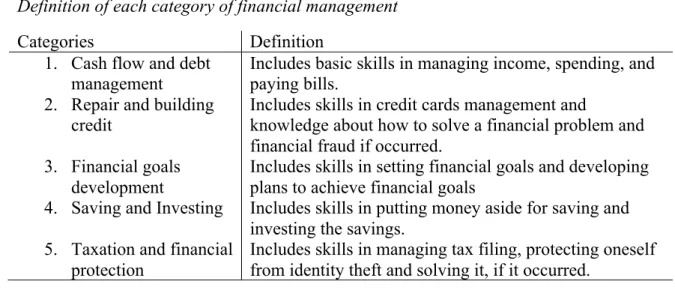
The financial self-efficacy construct was operationalized based on different financial literacy curricula. From reviewing literature and curricula of financial literacy programs, five main categories of financial management were identified, including: (1) cash flow and debt management, (2) repair and building credit, (3) financial goals development, (4) saving and investing, and (5) taxation and financial protection (See Table 1).
32 Table 1
Definition of each category of financial management
Categories Definition
1. Cash flow and debt management
2. Repair and building credit
3. Financial goals development
4. Saving and Investing 5. Taxation and financial
protection
Includes basic skills in managing income, spending, and paying bills.
Includes skills in credit cards management and
knowledge about how to solve a financial problem and financial fraud if occurred.
Includes skills in setting financial goals and developing plans to achieve financial goals
Includes skills in putting money aside for saving and investing the savings.
Includes skills in managing tax filing, protecting oneself from identity theft and solving it, if it occurred.
The basic knowledge and skills in personal financial management were used to develop the construct map. A construct map here mainly means an operationalized definition of the construct and a map detailing what each level of the concept means (Wilson, 2005). The financial self-efficacy construct map included a working definition of financial self-efficacy and a map illustrating what a high level of financial self-efficacy meant and what a low level of financial self-efficacy meant. Items to measure financial self-efficacy were developed based on this construct map (see Figure 1). Following the guide for constructing self-efficacy scales of Bandura (2006), items were worded in way that expressed the capability of respondents “I can…,” and the rating scale showed levels of confidence from one to five with one is “not confident at all” and five is “highly confident.”
Figure 1. Financial self-efficacy construct map
33 b. Consultation with experts
The items and the construct map were refined throughout the process of the instrument development. An expert panel including three people was formed, which had one expert in program evaluation, one expert in financial literacy training; and one expert in domestic violence. The expert panel was consulted regularly, especially during the item development step. In addition, an outside expert from Rutgers University who had been doing extensive research about financial literacy research for battered women was consulted. The expert panel reviewed both the construct map and the items and provided comments about the fit of the items to the construct map and the definition of the
concept; the clarity of the wording, the scale structure, and other features. An expert panel review meeting with the three above-mentioned experts was convened after the first
Moderately
confident
Moderately believe that they can achieve some main areas in financial management such as cash flow management, savings, debt management, and credit building.
Low
confident
Not very confident in their abilities in higher domain of financial management, but low to moderately confident in the basic domain such as debt management and cash flow management.
Highly
confident
Highly believe that they can do all of the easier aspects of financial management, including debt management, cash flow management; AND most of the harder domains such as credit building, financial goals development, savings, and tax.
34
draft of the scale was developed to review the scale with a set of already prepared questions (please see Appendix B for the set of the questions).
Overall, the panel thought that the measurement had face validity, the items measured what they were intended to measure and that they were appropriate to the definition of financial efficacy, and covered the main domains of financial self-efficacy. The comments were mainly about (a) simplifying the language and targeting the core activities under each domain; (b) focusing on short term financial management, since some of the investment activities could take a long time to start and people often thought about investment only after they have paid off their debt and were a little bit more solvent; and (c) revising the scale to 5 levels instead of 7 levels. After the meeting, email consultations and individual meetings were arranged to revise the scale. Many drafts of the items were sent back and forth to get comments and feedback from the experts. In total, the items were revised more than twenty times before the final version were ready for a pilot test.
c. Think-aloud interviews
After the items were reviewed by the expert panel, they were tested with five women via think-aloud interviews. Two of them were graduate students and one was undergraduate student at the University of Minnesota, and two were from the community. All of them were between 18-40 years old. According to Wilson (2005), a think-aloud interview is a technique of investigation in which interviewees are asked to say out loud their thoughts while responding to the questions. During this process, the interviewees were observed carefully to see if there were any questions that were difficult to
35
understand, which questions might make participants feel uncomfortable, which
questions the participants misunderstood, which questions might offend respondents, etc. The think-aloud interviews did not spot any questions that might offend or make the interviewees feel uncomfortable. Only one question in the demographic information about immigration status was a little bit confusing because participants have different ideas about what “immigrant” means. So, the question was reworded into “Were you born in the United States?” The think-aloud interviews also helped the researcher recognize that people often weigh their abilities based on past experience. Therefore, a note was put into the scale, “You do NOT need to be actually doing the actions now to rate yourself high. Instead, this is about the extent of your confidence in thinking that you can do the actions” to remind people think about their “perceived ability” rather than “experience.”
d. Focus group discussion
In addition to the think-aloud interviews, a focus group discussion was conducted to get feedback and comments about the items, scale structure, demographic questions, and wording of the letter of invitation. The focus group was conducted with a group of 12 graduate students enrolled in the program evaluation course at the School of Social Work, University of Minnesota. They were asked to take the scale and then provide comments about the instrument, questions that they thought might be offensive or irrelevant, questions that might have double meanings, the attractiveness of the letter of invitation, etc. (Please see Appendix C for the focus group questions).
The focus group was helpful in identifying some redundant questions and complicated, high level reading words such as “expenses,” “credit abuse.” A brief
![arxiv: v1 [astro-ph.he] 19 Apr 2016](data:image/gif;base64,R0lGODlhAQABAIAAAP///wAAACH5BAEAAAAALAAAAAABAAEAAAICRAEAOw==)