econ
stor
www.econstor.eu
Der Open-Access-Publikationsserver der ZBW – Leibniz-Informationszentrum Wirtschaft
The Open Access Publication Server of the ZBW – Leibniz Information Centre for Economics
Nutzungsbedingungen:
Die ZBW räumt Ihnen als Nutzerin/Nutzer das unentgeltliche, räumlich unbeschränkte und zeitlich auf die Dauer des Schutzrechts beschränkte einfache Recht ein, das ausgewählte Werk im Rahmen der unter
→ http://www.econstor.eu/dspace/Nutzungsbedingungen nachzulesenden vollständigen Nutzungsbedingungen zu vervielfältigen, mit denen die Nutzerin/der Nutzer sich durch die erste Nutzung einverstanden erklärt.
Terms of use:
The ZBW grants you, the user, the non-exclusive right to use the selected work free of charge, territorially unrestricted and within the time limit of the term of the property rights according to the terms specified at
→ http://www.econstor.eu/dspace/Nutzungsbedingungen By the first use of the selected work the user agrees and declares to comply with these terms of use.
Tinkl, Fabian; Reichert, Katja
Working Paper
Dynamic copula-based Markov chains at work:
Theory, testing and performance in modeling daily
stock returns
IWQW discussion paper series, No. 09/2011
Provided in cooperation with:
Friedrich-Alexander-Universität Erlangen-Nürnberg (FAU)
Suggested citation: Tinkl, Fabian; Reichert, Katja (2011) : Dynamic copula-based Markov chains at work: Theory, testing and performance in modeling daily stock returns, IWQW discussion paper series, No. 09/2011, http://hdl.handle.net/10419/48666
_____________________________________________________________________
Friedrich-Alexander-Universität
IWQW
Institut für Wirtschaftspolitik und Quantitative
Wirtschaftsforschung
Diskussionspapier
Discussion Papers
No. 09/2011
Dynamic copula-based Markov chains at work: Theory, testing
and performance in modeling daily stock returns
Fabian Tinkl
University of Erlangen-Nuremberg
Katja Reichert
University of Erlangen-Nuremberg
Dynamic copula-based Markov chains at work: Theory, testing and performance in modeling daily stock returns
Working Paper, 21.7.2011 Fabian Tinkl1 University of Erlangen-Nuremberg [email protected] Katja Reichert [email protected]
Keywords and phrases: Dynamic copula models, Markov chains, score test, GARCH models
Abstract
We generalize the score test for time-varying copula parameters proposed by [Abegaz & Naik-Nimbalkar, 2008] to a setting where more than one-parametric copulas can be tested for time variation in at least one parameter. In a next step we model the daily log returns of the Commerzbank stock using copula-based Markov chain models. We found evidence that compared to usual GARCH models the copula-based Markov chain models perform worse when daily stock returns are estimated. Thus we do not see any advantage of this model type when daily returns from nancial data are modeled.
1Correspondence author: Fabian Tinkl, Department of Statistics and Econometrics, University of
1 Introduction
Since the works of [Embrechts et al., 2002], [McNeil et al., 2005], [Patton, 2002] and [Patton, 2006] among others, copulas are now common tools in investigating con-temporal dependency
between assets like in portfolio or in quantitative risk management. [Joe, 1997] proposed to model the inter-temporal dependency of Markov time series models using copulas. As economic theory often does not tell us which kind of dependency to expect, the two ques-tions naturally arising are: rst, which copula to choose and second, how to model the parameter(s) of the copula. For instance, there is some empirical evidence that corre-lation between dierent assets varies over time, see [McNeil et al., 2005] p.123. Another stylized fact is that especially nancial times series tend to so-called volatility cluster-ing meancluster-ing that the conditional volatility, often measured by the conditional standard deviation, varies over time. Thus having answered question one in a way such we do not have evidence against the copula model chosen, the questions arises whether time variation of certain conditional moments of our observed time series lead to time varying param-eters in our copula. [Abegaz & Naik-Nimbalkar, 2008] suggested a score test under the Null that there is no time variation in an one-parametric copula. They proved the stan-dard χ2 asymptotic under the Null and mixing conditions on the process. The test has
reasonable power but has the shortfall of being applicable only to one parametric copula families. This leaves out several interesting interesting copula families like the student-t or Joe-Clayton copula. Thus, we focus on the question how to generalize the score test of [Abegaz & Naik-Nimbalkar, 2008] to copulas with more than just one parameter. We propose a transformation for the Joe-Clayton copula, as a bivariate extension of the uni-variate transformation for the Clayton copula used by [Abegaz & Naik-Nimbalkar, 2008]. The paper is organized as follows: section 2 reviews the idea of copula-based Markov chains, section 3 generalize the score test of [Abegaz & Naik-Nimbalkar, 2008], section 4 investigates the power of our test in nite samples by Monte-Carlo simulation. Section 5 shows the potentials of dynamic copula-based Markov chains for modeling log returns. We compare the models with a broadly used GARCH(1,1)-model. It will be seen that after some residual analysis, the standard GARCH(1,1)-model outperforms the dynamic copula-based Markov chain models and Section 6 concludes. The proofs can be found in the appendix.
2 Copula-based Markov chain models
Throughout the rest of the paper we write ∇δδ =∇0δ(∇δ),∇θδ =∇θ0(∇δ),∇θθ =∇0θ(∇θ),
where∇denotes the partial derivative of function with respect to the parameter(-vector) δ or θ. Moreover, vectors or matrices are shown in bold typeface.
This section will briey review copula-based Markov models. For a deeper understand-ing of copula models we refer to the textbooks of [Nelsen, 2006], [McNeil et al., 2005] and [Joe, 1997]. A nice overview article of [Härdle & Okhrin, 2010] gives some possible appli-cations of copula models for risk management. First, we give some denitions and restrict ourselves to the two dimensional case. The general case is straightforward.
Denition 1 A copula is a function C : [0,1]×[0,1]→[0,1], such that:
1. for every u, v∈[0,1]
C(u,0) = 0 =C(0, v)
and
C(u,1) =u, andC(1, v) =v.
2. for every u1, u2, v1, v2∈[0,1]with u1≤u2, v1 ≤v2 there is
C(u2, v2)−C(u2, v1)−C(u1, v2) +C(u1, v1)≥0.
The second property will be often called the two-increasing property. To sum it up, a copula is a distribution function with uniformly distributed margins. By Sklar's theorem we are able to separate the distribution function into its copula and the marginal distributions. Theorem 1 Let FX andFY be the marginal distributions of some real valued, continuous
random variables X and Y and G the joint distribution function of (X, Y). Then there
exists a copula C such that, for all (x, y)∈R2:
G(x, y) =C(FX(x), FY(y)). (1)
Moreover, if FX andFY are continuous, then C is unique.
Conversely, if FX and FY are the distributions of X and Y, respectively, the function G
dened by (1) is a joint distribution function with marginal distributions FX and FY.
Especially part two of the theorem is interesting for simulation or generating new dis-tribution functions by simply combining some univariate disdis-tribution functions through copulas. To establish the main result of this section we need the concept of conditional copula functions.
Denition 2 The conditional copula of V givenU =u is dened as: C2|1(v|u) =P(V ≤v|U =u) =
∂C(u, v)
∂u . (2)
A stationary rst order Markov chain can be constructed as proposed by [Joe, 1997] p.245. We summarize his explanation in the following theorem.
Theorem 2 Let (Xt)t∈N be a stochastic process with absolutely continuous distribution
function (cdf from now on)F, i.e. F has density functionf. ThenF(x, y) =C(F(x), F(y)).
Let C2|1(v, u) the conditional Copula dened as in (2). Then the conditional cdf is given
by:
F(xt|xt−1) =C2|1(F(xt)|F(xt−1)). (3)
We now give some examples for constructing rst order Markov chains from a given copula and a given marginal distribution.
2.1 Examples of copula-based Markov models
2.1.1 Clayton copula
The cdf of the bivariate Clayton copula is given for 0≤δ <∞ by C(u, v;δ) = (u−δ+v−δ−1)−1/δ
and the conditional copula by
C2|1(u|v;δ) = (1 +uδ(v−δ−1))−1−1/δ.
Kendall's τ can be derived by τ = δ+2δ and the lower tail dependence coecient by λL=
2−1δ, which is increasing in δ. The upper tail coecient is zero.
2.1.2 Gumbel copula
The bivariate Gumbel copula is dened by
C(u, v;δ) = exp(−[(−lnu)−δ+ (−lnv)−δ]1/δ),
and the conditional copula by
C2|1(u|v;δ) =u−1exp{[(−lnu)δ+ (−lnv)δ]1/δ} 1 + lnu lnv δ!−1+1/δ .
Kendall'sτ is given byτ = 1−1/δ and contrary to the Clayton copula, the Gumbel copula
2.1.3 Joe-Clayton copula
For asymmetric modeling of both lower and upper tail dependence one may use the Joe-Clayton copula, which is dened by:
C(u, v;δ1, δ2) = 1−(1−((1−u¯δ1)−δ2+ (1−v¯δ1)−δ2 −1)−1/δ2)1/δ1,
for δ1 ≥0, δ2 >0 andu¯= 1−u, ¯v= 1−v. The conditional copula is given by C2|1(v|u;δ1, δ2) = (1−w−1/δ2)1/δ1−1w−1/δ2−1(1−u¯δ1)−δ2−1u¯δ1−1
and w = ((1−u¯δ1)−δ2 + (1−v¯δ1)−δ2 −1).The tail dependence coecients are given by
λU = 2−21/δ1 and λL = 2−1/δ1. Therefore, λU 6= λL in general and in contrast to the
above mentioned copulas, the Joe-Clayton copula is able to model the asymmetric tail behavior of nancial data that is often observed.
2.2 Estimation of copula-based Markov models
We focuss on the IFM method proposed by [Joe, 1997] p.299 . for estimating the unknown parameters when we observe an iid sample. Given a parametric, copula-based model for
thed-dimensional random variableX with absolutely continuous distribution functionF,
such that:
F(x;θ,δ) =C(F1(x1, θ1), ..., Fd(xd, θd);δ).
The parameters of interest are θ = (θ1, ..., θd) ⊂ Ωd1, a d1-dimensional parameter space.
Note thatθ1, θ2, ...need not to have the same dimension nor needF1, ...Fd be distribution
functions of the same type. Let cdenote the pdf corresponding to C, then the density of X can be written as:
f(x;θ,δ) =c(F1(x1, θ1), ..., Fd(xd, θd);δ) d Y j=1 fj(xj;θj). Denote Ln= n Y t=1 ft(x;θ,δ) = n Y t=1 ct(F1(x1, θ1), ..., Fd(xd, θd);δ) d Y j=1 fj(xj;θj).
Taking logarithm on both sides, we have
LLn= n X t=1 logct(F1(x1, θ1), ..., Fd(xd, θd);δ) | {z } =:L2n + n X t=1 n X j=1 logfj(xt,j;θj) | {z } =:L1n
or in a short hand notation:
LLn=L1n+L2n.
The two-stage maximum likelihood estimator can be found the following way: Let θˆ be
solution of the maximization problem
max
θ∈Ωd1L1n(Xt,θ). (4)
Then denote ˆδ the solution of the second step max
δ∈Ωd2L2n(Xt, ˆ
θ,δ). (5)
For consistency see [White, 1994] theorem 3.10 and theorem 6.11 for the asymptotic dis-tribution of this two-stage estimator. In the context of conditional copula models we refer to [Patton, 2002] p.77 .
3 The general score-test for time varying parameters
The score test for testing for time varying parameters in our copula model is based on the score test in [Rao, 1973] p.415 . which is actually a LM-Test. We restrict us for reasons of clarity to the case where the copula is specied by two-parameters. An extension to the
n-variate parameter vector is straightforward.
Consider the following model for the copula parameterδ ∈R2 :
δt=δ+t= δ1 δ2 ! + t,1 t,2 ! , (6) where t iid
∼ G(0,Σ), where G is some distribution function, with EG[t] = 0 and Σ = σ1 0
0 σ2 !
. We test under H0 whether σ1,1 = σ2,1 = 0 against the alternative that
at least one σ is greater than zero. The test statistic of the score-test is based on the
score-function: Z0 = 1 √ nS(θ,δ) H0 , (7) where S(θ,δ) = ∇σ21LL(θ,δ) ∇σ2 2LL(θ,δ) ! .
We may derive the test statistics using the standard LM-testing approach, like in [White, 2001] p.77 . Under validity of the null hypothesis, Z0 should be near zero. Using the
argu-ments given in [White, 2001] and the assumptions listed in appendix A, we get the following result:
Theorem 3 Under the null hypothesis and the assumptions A1-A6 listed in appendix A, the following result holds:
n−1/2S(ˆθ,δˆ)→d N(0,Σ), (8) and n−1S(ˆθ,δˆ)0Σ1/2Σ1/2 −1 S(ˆθ,ˆδ)→d χ2(2), (9) where S(ˆθ,δˆ) =∇σ2 1LL(θ,δ)|θ,ˆˆδ and Σ= 1 4σ 2−σ δI−δδ1σ0δ+ (σθ+σδIδθI−δδ1)Σ−θ1(σθ+σδIδθI−δδ1)0. In addition we set: σ2 =E[Wt(θ,δ)Wt(θ,δ)0], Σ−θ1 = (D−1)V(D−1)0, with D =E[∇θθlogf(xt;θ)] and V =E∇θlogf(xt;θ)∇0θlogf(xt;θ) + 2 ∞ X k=1 E∇θlogf(x1;θ)∇0θlogf(x1+k;θ) , Iδδ =−E[∇δδc(F(xt−1,θ), F(xt;θ);δ)] Iδθ =E[∇δθlogc(Ft−1(xt−1;θ), Ft(xt;θ);θ)] σθ =E 1 2Wt(θ,δ)∇ 0 θlogc(F(xt−1;θ), F(xt;θ);δ) σδ =E 1 2Wt(θ,δ)∇ 0 δlogc(F(xt−1;θ), F(xt;θ);δ) .
Even though the formulas in theorem 3 are quite oblongly and may be confusing, one should have a detailed look at the dierent parts of Σ. Like in the common LM-test setting, we
actually test whether the constraints σ1 = σ2 = 0 are binding or not by testing if the
Lagrange multiplier λ from the constrained estimation of the model is large enough to
reject the null hypothesis of no time variation in the copula-parameter. Thus the rst part is just the variance ofˆλ, the estimated Langrangian. Assuming that the parameter vector
of interestΘ = (θ,δ) is separable, the information matrix has a block form say
I(Θ) = I11 I12
I21 I22
!
Thus the variance of ˆλ that corresponds to the restriction σ
1 = σ2 = 0 is given by
invertingI:
V ar(ˆλ) =I22(δ)−I21(δ)I11−1(δ)I12(δ).
Therefore, 1 4σ
2−σ
δI−δδ1σ 0
δcorresponds to the variance ofλˆ. The second part is due to the
two-stage estimation procedure employed and can be derived using arguments of theorem 6.11 in [White, 1994]. Thus the test proposed by [Abegaz & Naik-Nimbalkar, 2008] and its test statistics can be treated as in the LM-test context, we just have to be more careful about the assumptions and restrictions we impose, as we are not dealing with the usual
iid sample setting, but with Markov processes. Based on the assumptions proposed in
appendix A the standardχ2 asymptotic will hold.
To prove theorem 3, we will proceed in several dierent steps by making a rst order taylor series expansion of S(θˆ,δˆ) around the true vector (θ0,δ0):
n−1/2S(θ,ˆδˆ) = n−1/2S(θ0,δ0) +n−1/2∇0θS(θ0,δ0)(ˆθ−θ0) +n−1/2∇0δS(θ0,δ0)(ˆδ−δ0) +oP(1) ∼ = n−1/2S(θ,δ) | {z } Lemma 1 +n−1∇0θS(θ0,δ0) | {z } Lemma 4 n1/2(ˆθ−θ0) | {z } Lemma 2 +n−1∇0δS(θ0,δ0) | {z } Lemma 4 n1/2(ˆδ−δ0). | {z } Lemma 3 ∼
=means asymptotic equivalent, see for instance lemma 4.7. in [White, 2001]. The proof
of theorem 3 will be split up into the following four lemmas following standard arguments: rst we show that n−1∇0
θS(θ0,δ0) converges in probability to its expectation (which is
a constant) using some suitable law of large numbers, then we prove that the two-stage maximum likelihood estimatorn−1/2(ˆθ−θ0)will converge in distribution to a normal limit.
Combining these results we make use of Slutzky's theorem to establish the asymptotic normality of the score testS(ˆθ,ˆδ)
Lemma 1 Under the assumptions A1, A3 and A5 in appendix A we have:
n−1/2S(θ,δ)→d N(0,1/4σ2), (10)
with σ as in theorem 3.
The proof can be found in appendix B. Note that lemma 1 provides the convergence law and the asymptotic variance of the actual score function. Whereas the convergence of the next two parts is due to the two-stage maximum likelihood estimation used to calibrate the model.
Lemma 2 Under the assumptions A1-A4 in appendix A we have:
√
n(ˆθ−θ0)→d N(0,Σ−θ1), (11)
Next we establish the asymptotic distribution of the two-stage maximum likelihood esti-mator for δ:
Lemma 3 Under the assumptions A1-A4 in appendix A we have:
√ n(ˆδ−δ0)→d N(0,Σ−δ1), (12) where Σ−δ1 =I−δδ1+I−δδ1IδθΣ−1 0 θ IδθI −10 δδ .
The last lemma provides that n−1∇θS(θ,δ) and n−1∇δS(θ,δ) will converge a.s. to the
expectation of the hessian evaluated at the true parameter vector(θ0,δ0):
Lemma 4 Under the assumptions A1 and A3 in appendix A we have: 1. n−1∇θS(θ,δ)
a.s.
→ −σθ
2. n−1∇δS(θ,δ)a.s.→ −σδ
Combining these results yields the proof of theorem 3.
4 Simulation study
To investigate the asymptotic power of the proposed test we carried out a simulation study with dierent copulas and parameter constellations. In this paper we focus on the two-parametric Joe-Clayton copula. For conclusions on the score-test with a one-parametric copula we refer to [Abegaz & Naik-Nimbalkar, 2008]. To generate observations
{xt:t= 1, . . . , n} following a rst order Markov chain with a given copula C(ut−1, ut;δ)
and marginsF(xt;θ) we used the algorithm in [Abegaz & Naik-Nimbalkar, 2008].
After estimating the parameters θˆ and δˆfrom the obtained observations, the test
statis-tic can be computed. We estimated each component of the variance-covariance ma-trix Σ in theorem 3 consistently. For the estimation of the component V we follow
[Abegaz & Naik-Nimbalkar, 2008] by taking the following window estimator:
V = 1 n " n X t=1 ∇θlogf(xt;θˆ)∇0θlogf(xt;θˆ) + bn X t=k+1 dn(k) n X t=k+1 ∇θlogf(xt;θˆ)∇0θlogf(xt−k;θˆ) !# .
dn is a weight function with the Bartlett kernel dn(k) = 1−(k/bn+ 1), k = 1,2, . . . , bn.
Wherebnis a sequence of real, positive numbers, withbn→ ∞andbn/n1/4 →0ifn→ ∞.
We generated 500, 1000 and 1500 observations from the Joe-Clayton copula with
test, especially the test power, i.e. 1-β, whereβ is frequency how often the null hypothesis
of no dynamic is not rejected given the alternative is true. θ = (µ, σ) = (−3,0.5)and(1,2)
are chosen for the parameter of the normal distribution. The copula parameter δ follows
(6) and t is bivariate log-normal distributed with mean0 and variance-covariance matrix
Σ. We chose δ = (δ1, δ2) = (1,0.5) and (1.5,1). To include the strength of variation in
δt we increasedσ step by step, that isσ1 ∈(0,2) and σ2 ∈ (0,1). Note that this type
of variation is much smaller than in the article of [Abegaz & Naik-Nimbalkar, 2008] where
σ = (0,25). A variation that is that big may be seen with pure looks, so we follow the
question whether the test is also able to detect very small deviation from the constancy hy-pothesis. Forσ1 = 0and σ2 = 0theαerror (type I error) is obtained, because thenδt is
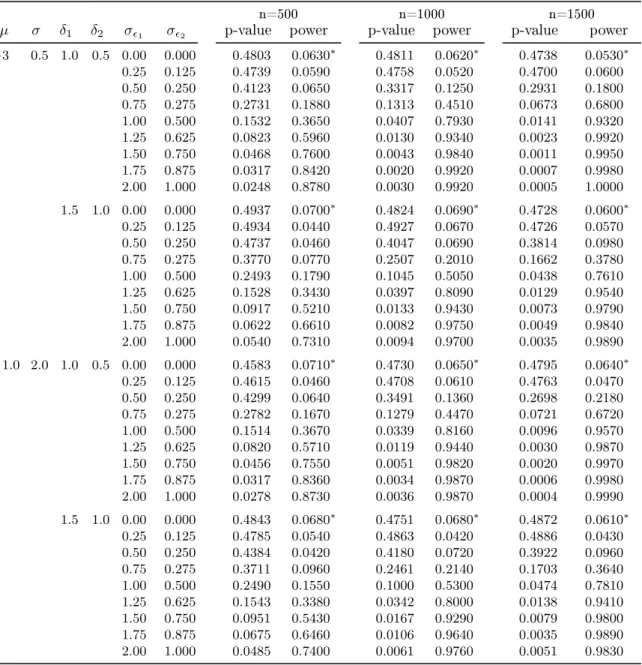
constant. The results are presented in table 4 and for one parameter constellation in gure 1. As can be seen the asymptotic power is aected by the number of observations and the variation ofδt. Theαerror lies between5%and 7%. We see, that the signicance level is
achieved even in small samples (n=500). The test power increases with more observations and higher variation in the dynamic model. For small sample size (n=500) the selectivity of the test is only acceptable for σ1 = 2 and σ2 = 1 with a β error of 13% to 26%. For
n = 1000 instead, the asymptotic distribution of the test seems to hold, even when the
σs are smaller. When variations are small, e.g. σ1 = 0.25 and σ2 = 0.125then the test
doesn't detect this deviation from constancy of the copula parameter. We conclude, that the test holds the signicance level and has reasonable power at least when sample size is large (n=1000) and the variation is not too small (σ1 ≈1.25and σ2 ≈0.5).
5 Empirical analysis
In this section we investigate the potential of the dynamic copula-based Markov model for nancial data compared to a usual GARCH(1,1) model.
5.1 Preliminary analysis
We chose daily log returns of Commerzbank from 18th April 2001 to 31th March 2010. To get an overview of the data we did some descriptive statistics and the KPSS test on stationarity and Jarque-Bera test for normality. As can be seen in table 1 the observations are skewed, leptokurtic, stationary and not normally distributed.
Table 1: Descriptive statistics of Commerzbank daily log returns
n mean std.dev. skewness kurtosis p-value of KPSS p-value of JB
Since we are modeling dependence structures we computed some common dependence measures: the linear correlation ρ, Spearman's Rho ρS and Kendall's Tau τ. Following
[Cont, 2001] we use ρ[α] = ρ[|Xt−1|α,|Xt|α] as a measure of nonlinear dependence. For α = 2volatility clustering, already mentioned in the introduction, can be measured. The
results are presented in table 2.
Table 2: Intertemporal dependence in Commerzbank daily log returns
ρ ρS τ ρ[1] ρ[2]
0.0791 0.0216 0.0134 0.3936 0.2475
The log returns show a slight slight positive correlation regarding rho ρS and τ. The
nonlinear measures show a higher amount and especially forα= 2we can assume volatility
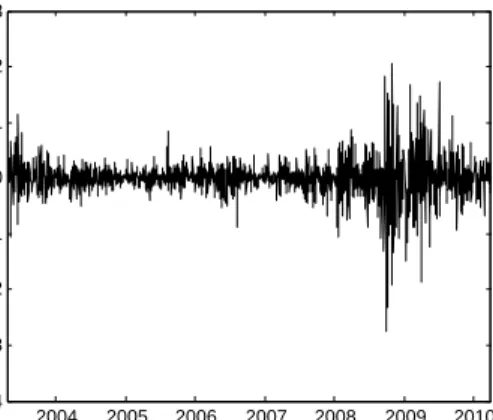
clustering. This is not surprising because gure 2 pictures this phenomenon. Because GARCH models take the volatility clustering into account, our approach to compare the copula-based Markov model with a GARCH(1,1) model is supported.
5.2 Parameter estimation
We assumed the IFM method, thus the parameters are estimated in two steps. First, we t the marginal distribution and follow two approaches:
Parametric and empirical distribution We t a hyperbolic distribution f(x) = ψ 2−η2 2ψσK1(σ p ψ2−η2)exp −ψpσ2+ (x−µ)2+η(x−µ)
with ψ >0 , 0 ≤ |η|< ψ , µ∈ R ,σ ≥0 and K1 is the modied bessel function of 2nd
order. As benchmark we use the gaussian distribution. The reason for choosing the hyper-bolic distribution is due its ability in modeling skewness as well as heavy tails, which is a well-known so-called stylized fact of nancial returns. The hyperbolic distribution has been investigated in nancial market models as by [Jaschke, 2000],[Eberlein & Keller, 1995] or [Reimann, 2005] among others. Moreover, [Eberlein & Keller, 1995] found evidence for stock returns to follow a hyperbolic distribution. In addition to the full parametric ap-proach, a semi-parametric is chosen, where the marginal distributions are estimated using the empirical distribution Fn(x) = 1nPnt=11(−∞,x](Xt) can be applied. This encompasses
the approach of [Genest et al., 1995]. GARCH
and [Bollerslev, 1986] suggested ARCH resp. GARCH models to capture this phenom-ena. Therefore, we adapt a standard GARCH(1,1) with gaussian innovations to the data and compare its performance with the copula-based Markov approach. Note that a GARCH(1,1) is clearly not Markovian, but a martingale dierence. So we compare en passant two dierent types of stochastic processes, namely Markov chains and martingale dierences.
The GARCH(1,1) process can be dened by xt|Ft−1 ∼ N(0, σ2t) with σt2 = ω+αx2t−1+ βσt2−1 and ω >0, α, β ≥0.
The residuals ut=σt−1xt withut∼ N(0,1)are then GARCH-ltered log returns.
We proceed with the estimation of the copula parameters. For the hyperbolic margins and the margins estimated with the empirical distribution function the score test for dy-namic copula parameters is performed. For the GARCH ltered innovations we also t our copula-based Markov model and we test whether there is still some dynamics in the dependence structure. If this were the case, we would have evidence that there is time-variation not only in the conditional variances but also in other moments. If instead the null cannot be rejected, we can conclude that all sort of time variation is already captured by the GARCH(1,1)-model. The only way a copula may now help in modeling the ltered GARCH(1,1)-residuals is just due to the fact, that we have assumed gaussian innovations, which is usually not convenient. Instead other distributions like skewed t-distributions as proposed in [Hansen, 1994] or [Chen, 2007] would be preferable. But the focus lies not on modeling the conditional distribution as exact as possible, but to elaborate the benet of dynamic copula-based Markov models over the standard GARCH(1,1) models.
If the null hypothesis of constant copula parameters is rejected, we model a dynamic copula parameter. For the score-test we assumed the variation in 6. The aim was to expose any kind of variation. In a next step we modelδtas a modied ARMA(1,k) process, as proposed
in [Abegaz & Naik-Nimbalkar, 2008]:
δt= exp ω+αlog(δt−1) +β 1 k k X i=1 |ut−1−ut−i−1| ! .
This approach includes an autoregressive termδt−1and an error term for the mean absolute
dierence betweenutandut−1, which captures variation in the dependence structure. The uts are estimated byuˆt=F(xt;θˆ). δ1 is assumed to be constant.
5.3 Results
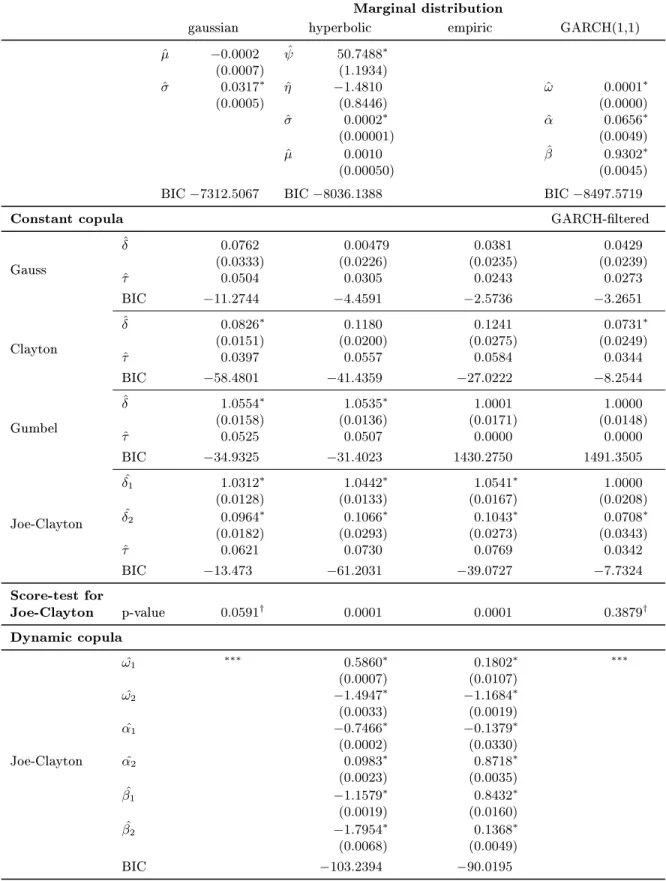
The results for Commerzbank daily stock returns are summarized in table 5. Regarding to the Bayesian Information Criterion (BIC) for the marginal distributions it can be seen that the hyperbolic distribution performs better than the gaussian one. The GARCH(1,1)
model achieves the best t due to BIC.
For the GARCH residuals we did some further investigation and tested them for autocorre-lation with a Ljung-Box test and for normality with a Jarque-Bera test (see table 3). If we had signicance against the Null of no serial correlation, we would still have some relevant information in our model, and thus we just re-identify our GARCH-model, by taking higher orders or an AR(p)-process for the conditional mean. But this would contradict economic theory, where the ecient market and the rational expectations hypothesis of the nancial actors contains that the conditional return of an asset should be zero, i.e. E[Rt|Ft−1] = 0,
because otherwise there is a systematic information about the behavior of the stock return and everyone will buy (if we had positive trend) or sell the asset. The null hypothesis of no correlation can be rejected for assuming dierent lags. As our times series includes 2363 observations we report the results of the Ljung-Box test of order 20 in table 3. Also the residuals are not normal distributed, the main focuss lies on the non-presence of auto-correlation in the residuals, the absolute values of the residuals and the squared residuals. Thus we can assume that the ltered residuals are not following a gaussian white noise process, but they are white noise and that the conditional distribution of the GARCH(1,1) model is misspeced. The t could have been improved by assuming student-t distributed residuals or a higher order GARCH process. To simplify matters we will not follow this.
Table 3: Tests of the GARCH residuals
p-value of Ljung-Box test p-value of Jarque-Bera test
ut |ut| u2t ut
0.3353 0.392 0.7927 0.0001
Next, we estimated the parameters of the copulas, proposed in section 2.1. For the gaus-sian and the ltered GARCH innovations the clayton and for the hyperbolic and empirical distribution the Joe-Clayton copula performs best, regarding BIC. So our generalization of the score-test to two-parametric copulas seems to be helpful. The Gumbel copula per-forms worst and is inappropriate for our data set. We also computed Kendall's Tau from the estimated copula parametersδ. Next we applied the generalized score-test for the
Joe-Clayton copula and the Joe-Clayton copula. The null hypothesis of constant copula parameters is rejected for all marginal distributions except the gaussian and the ltered GARCH in-novations. Modeling dynamic copulas improves the t in both other cases. To sum up we compare the dynamic Joe-Clayton copula with hyperbolic margins and 10 parameters, with an added up BIC of−8,139.4, to a simple GARCH(1,1) model with three parameters and
a BIC of−8,497.6. It gets clear that there is no advantage of the (dynamic) copula-based
Markov chain model for the log returns. Our approach to improve the usual GARCH(1,1) model by applying the copula-based Markov model on the residuals, brings few improve-ment of the t. Note that the choice of the Clayton copula corresponds to the stylized fact,
that (extreme) negative returns are more likely then positives. As the Clayton copula cov-ers negative tail dependence, it can be concluded that the ltered GARCH residuals still exhibits signicant lower tail dependence which encompasses the aforementioned stylized fact. Note that this phenomena could have been captured by taking a skewed conditional distribution in our GARCH model.
6 Conclusion
In our paper we gave a short review on dynamic copula-based Markov models and general-ized the score-test proposed by [Abegaz & Naik-Nimbalkar, 2008]. The null hypothesis of no time variation in the parameters of our copula models is extended to variation in at least one of the possible multidimensional parameter sets. The signicance level is maintained when a Joe-Clayton copula, which has two parameters, is investigated. The test power increases with more observations, but it is general lower than in one-dimensional parameter case. This result is not astonishing as we would reject the null, when there is time varia-tion in at least one parameter. To show that the generalizavaria-tion is useful, we modeled the daily returns of the Commerzbank stock using dierent copulas. We found evidence that the very exible Joe-Clayton copula outperforms the other one parametric copula models. After estimating the margins with hyperbolic distribution as well as the gaussian and the empirical distribution, the possible dynamics in the parameter is investigated. We see that the null is rejected for all copulas except for the gaussian and the. In a next step we set up as a benchmark model a standard GARCH(1,1) model with gaussian innovations. An-alyzing the residuals, we found no evidence against white noise, but the distribution still exhibits skewness. This may be captured by adapting a more realistic distribution like a skewed-t or hyperbolic. The main advantage of the standard GARCH(1,1) lies in the fact that it is numerical preferable as it is fast and quite easy to estimate, has less parame-ters compared with dynamic copula-based Markov models. Moreover, it is able to capture volatility clusters and its easy applicability to VaR calculations, portfolio optimization and option-pricing. Therefore, the question may arise, whether Markov chains are suitable models for stock returns at all or that martingale dierence equation like GARCH(1,1) are more able to capture stylized facts that stock returns exhibit.
Mathematical appendix
A: Assumptions
Following [Abegaz & Naik-Nimbalkar, 2008] and [White, 1994], resp. [Patton, 2002] p.112 . we post the following assumptions:
A1. The process (Xt)t∈N is stationary andα-mixing, with mixing coecient α(n), such
thatP∞
n=1α(n)
β
2(2+β) <∞, for β >0.
A2. (ˆθ,δˆ) is the two-stage maximum likelihood estimator and thus solution of the
maxi-mization problem (4) resp. (5).
A3. (a) f(xt|xt−1; Θ)>0P-a.s. independent ofΘ, and twice continuously dierentiable
on Ω.
(b) The copula densities are twice continuously dierentiable onΩd2.
(c) There exists neighborhoodsUθ and Uδ such that we have for all θ∈Uθ ⊂Ωd1
and δ∈UδΩd2: i. E sup θ |∇θf(xt;θ)| <∞,E sup δ |∇δc(ut, ut−1;δ)| <∞ ii. E sup θ |∇θθf(xt;θ)| <∞,E sup δ |∇δδc(ut, ut−1;δ)| <∞ iii. E sup θ |∇θθlogf(xt;θ)| <∞,E sup δ |∇δδlogc(ut, ut−1;δ)| <∞
A4. For all θ ∈ Uθ ⊂ Ωd1 and δ ∈ Uδ ⊂ Ωd2 we have, that −E[∇θθlogf(xt;θ)], V ar(∇θlogf(xt;θ)), −E[∇δδlogc(ut, ut−1;δ)], V ar(∇δlogc(ut, ut−1;δ)) are O(1)
and uniformly positive denite.
A5. E[|Wt,j(θ,δ)|2+β]<∞for β >0,j = 1,2 and allt≥1 and
lim n→∞ 1 n n X t=1 E[Wt,j2 (θ,δ)|Ft−1] =σ2j >0, a.s.
Note the minor modication compared to [Abegaz & Naik-Nimbalkar, 2008], especially the assumptions in A3 that are needed to ensure consistency of the the two-stage maximum-likelihood estimator are less strong than in for instance [Joe, 1997] p.318. To obtain locally asymptotic normally distributed estimators the twice continuously dierentiability assump-tion on the densities is sucient, see [Ferguson, 1996] p.119 . The uniformly integrability for the score functions and the densities are needed, on the one hand side to make use of the weak law of large numbers forα- mixing processes, see for instance [White, 1984], and
to interchange dierentiation and integration, see [Ferguson, 1996] p.124.
B: Proofs
Proof of lemma 1 First note that S(θ,δ) is a martingale under A1 and A3 and that
S(θ,δ) = 12Pn
martingales in [Basawa & Rao, 1980] p.388 to conclude, that n−1/2 n X t=2 Wt(θ,δ) d →N(0,σ2),
whereσ2=E[Wt(θ,δ)Wt(θ,δ)0]. Finally we have:
S(θ,δ) = 1 2 n X t=2 Wt(θ,δ) d →N(0,1/4σ2).
Proof of lemma 2 Denote the maximum likelihood estimator by θˆ obtained in a rst
step by maximizing (4) as the solution of the corresponding score equation Sθ(θ) = 0.
Then we have under the conditions A3, that 1 nSθ(ˆθ)
a.s.
→ E[Sθ(ˆθ)] = 0d1×1, where 0d1×1
is a vector of zeros with length d1. Making a rst order Taylor series expansion of S(ˆθ)
around the true parameter vectorS(θ0) we get:
Sθ(ˆθ) = Sθ(θ0) +∇θSθ(θ0)(ˆθ−θ0) +oP(1) 1 nSθ(ˆθ) ∼ = 1 nSθ(θ0) + 1 n∇θSθ(θ0)(ˆθ−θ0)
Rearranging leads to:
n1/2(ˆθ−θ0) = −1 n∇θSθ(θ0) −1 n−1/2Sθ(θ0).
For the rst equation we have
−1 n∇θSθ(θ0) −1 a.s. → E[∇θSθ(θ0)]−1 =D−1,
which is just the inverse of hessian of the the log-likelihood problem (4). Due to assumption A4 the matrix D is invertible at least in Uθ. The second term n−1/2Sθ(θ0) is just a
continuous function of anα-mixing process and thus is itselfα-mixing, see [Davidson, 1994]
theorem 14.1. For completeness we present a result due to [Denker, 1986]:
Theorem 4 Let (Xn)n∈N be strictly stationary α-mixing sequence, i.e. E[X1] = 0 and E[|X1|2+δ]<∞with mixing coecient α(n), s.t.
P∞ n=1α(n) δ 2(2+δ) <∞andlim n→∞σn2 = ∞. Set Sn=Pni=1Xi, then n1/2Sn/σn→d N(0, σ2), where σ2 = E[X12] + 2P∞
n=1E[X1X1+n], i the sequence {S2n/σ2n, n ≥ 1} is uniformly
Under the assumptions imposed on the process (Xt)t∈Nwe have that Sθ(θ0) = n X t=1 ∇θlogf(xt;θ0)
fullls the the assumptions of theorem 4, withE[X12] =E[∇θlogf(x1;θ0)∇0θlogf(x1;θ0)]
and P∞
n=1E[X1X1+n] =
P∞
k=1E[∇θlogf(x1;θ0)∇0θlogf(x1+k;θ0)]. Summarizing we
have n−1/2Sθ(θ0)→d N(0, V), where V =E[∇θlogf(x1;θ0)∇0θlogf(x1;θ0)] + 2 ∞ X k=1 E[∇θlogf(x1;θ0)∇0θlogf(x1+k;θ0)].
We nally get the result of lemma 2 by applying Slutzky's theorem.
Proof of lemma 3 Lemma 3 can be proven in exactly the same way as lemma 2 or seen as a direct consequence of theorem 6.11 in [White, 1994], therefore, it is omitted here. For a detailed proof see [Reichert, 2010] p.46 . If the model is correctly specied, the result for the asymptotic variance of the two-stage estimator simplies to the form given in lemma 3. Also note that our parameter-vector Θ = (θ,δ) is separable in the sense, that there is
no dependency betweenθ and δ, therefore, E[SθSδ] = 0.
Proof of lemma 4 First we have for i= 1, ..., d1 and j= 1...d2:
1 n ∂S(θ,δ)j ∂θi = 1 n n X t=2 ∂2 ∂θi∂21,j log c(ut−1, ut;δ) + 1 2 d2 X j=1 ∂2c(ut−1, ut;δ) ∂δ2 j σ1,j | {z } :=Nt(ut−1, ut;δ) σ2 1=0 . We have E " −∂ 2N t(ut−1, ut;δ) ∂δi∂σ21,j # σ2 1=0 =E " ∂Nt(ut−1, ut;δ) ∂θi ∂Nt(ut−1, ut;δ) ∂σ2 1,j # σ2 1=0 .
Some calculation yields:
∂Nt(ut−1, ut;δ) ∂σ2 1,j = 1 2Wt,j(θ,δ) ∂Nt(ut−1, ut;δ) ∂θi = ∇θilogct(θ).
Using the ergodic theorem we can nally conclude that: lim n→∞ 1 n ∂S(θ,δ)j ∂θi = E " ∂Nt(ut−1, ut;δ) ∂θi ∂Nt(ut−1, ut;δ) ∂σ2 1,j # σ2 1=0 = E −1 2Wt,j(θ,δ)∇ 0 θilogct(θ) σ2 1=0 := σθ,ij And thus lim n→∞ 1 n ∂S(θ,δ) ∂θ =σθ,
whereσθ is just as in theorem 3.
The second assertion of lemma 4 can be proven in exactly the same manner.
Proof of theorem 3 We have forn→ ∞:
n−1/2S(ˆθ,δˆ) =n−1/2S(θ0,δ0) + 1 n∇θS(θ0,δ0)n 1/2(ˆθ−θ 0) + 1 n∇δS(θ0,δ0)n 1/2(ˆδ−δ 0).
With the results from lemma 2-4 we have:
= n−1/2S(θ0,δ0)−σθD−1n−1/2Sθ(θ0)−σδI−δδ1n
−1/2S
δ(θ0,δ0)−σδI−δδ1IδθD−1n−1/2Sθ(θ0)
= n−1/2S(θ0,δ0)−σδI−δδ1n−1/2Sδ(θ0,δ0)−(σθ+σδI−δδ1Iδθ)D−1n−1/2Sθ(θ0).
Now we have to calculate the covariances betweenS(θ0,δ0),Sθ(θ) and Sδ(θ0,δ0). First,
as there is no dependency between δandθ we haveCov(Sθ,Sδ) = 0. Moreover, we have: Cov[S(θ0,δ0),Sθ(θ0)] = E[S(θ0,δ0)Sθ(θ0)0]−E[S(θ0,δ0)]E[Sθ0(θ0) 0] = n X t=2 E 1 2Wt(θ0,δ0)∇θlogf(xt;θ0) 0 − n X t=2 E 1 2Wt(θ0,δ0) n X t=2 E∇θlogf(xt;θ0)0 = 0.
Note that E[Wt(θ0,δ0)∇0θlogf(xt;θ)] = 0, because for every combination of {r, s, t ∈ 0,1, ...}of E[Wr,s(θ0,δ0)∇0θlogf(xt;θ)] = 0we have: R R R R R R 1 c(F(xr;θ),F(xs;θ);δ) ∂2c(F(x r;θ),F(xs;θ);δ) ∂δ2 ∂logf(xt,θ) ∂θ f(xr, xs, xt;θ,δ)dxrdxsdxt =R R R R R R 1 c(F(xr;θ),F(xs;θ);δ) ∂2c(F(x r;θ),F(xs;θ);δ) ∂δ2 1 f(xt;θ) ∂f(xt;θ) ∂θ ×f(xr;θ)f(xs;θ)f(xt;θ)c(F(xr;θ), F(xs;θ);δ)c(F(xs;θ), F(xt;θ);δ)dxrdxsdxt =R R R R R R ∂2c(F(x r;θ),F(xs;θ);δ) ∂δ2 ∂f(xt,θ) ∂θ f(xr;θ)f(xs;θ)c(F(xs;θ), F(xt;θ);δ)dxrdxsdxt =RRRRRR∂f(xt;θ) ∂θ c(F(xs;θ), F(xt;θ);δ)f(xs;θ) n ∂2c(F(xr;θ),F(xs;θ);δ)f(xr;θ) ∂δ2 o dxrdxsdxt =R R R R ∂f(xt;θ) ∂θ c(F(xs;θ), F(xt;θ);δ)f(xs;θ) n R R ∂2c(F(x r;θ),F(xs;θ);δ)f(xr;θ) ∂δ2 dxr o dxsdxt =R R R R ∂f(xt;θ) ∂θ c(F(xs;θ), F(xt;θ);δ)f(xs;θ) n ∂2 ∂δ2 R Rf(xr|xs;θ,δ)dxr o | {z } =0 dxsdxt =0.
Finally we can conclude that
Cov(S(θ,δ),Sδ(θ,δ)) = n X t=2 E 1 2Wt(θ0,δ0)∇ 0 δlogc(ut, ut−1,θ) = (n−1)σδ.
Putting the results together we get:
n−1/2S(θ0,δ0) n−1/2Sδ(θ0,δ0) n−1/2S θ(θ0,δ0) d →N 0 0 0 , σ/4 σδ/n 0 σδ/n Iδδ 0 0 0 V .
Thus we nally get:
n−1/2S(ˆθ,δˆ)→d N(0,Σ),
withΣjust as in theorem 3.
Tables and Figures
0 0.5 1 1.5 2 0 0.2 0.4 0.6 0.8 1 σε,1 Power Joe−Clayton−Copula n = 500 n = 1000 n = 1500 0 0.2 0.4 0.6 0.8 1 0 0.2 0.4 0.6 0.8 1 σε,2 Power Joe−Clayton−Copula n = 500 n = 1000 n = 1500Figure 1: Power of the general score-test
2004 2005 2006 2007 2008 2009 2010 −0.4 −0.3 −0.2 −0.1 0 0.1 0.2 0.3 Zeit Rendite Commerzbank
Table 4: Power of the score-test with Joe-Clayton copula and normal margins
n=500 n=1000 n=1500
µ σ δ1 δ2 σ1 σ2 p-value power p-value power p-value power
−3 0.5 1.0 0.5 0.00 0.000 0.4803 0.0630∗ 0.4811 0.0620∗ 0.4738 0.0530∗ 0.25 0.125 0.4739 0.0590 0.4758 0.0520 0.4700 0.0600 0.50 0.250 0.4123 0.0650 0.3317 0.1250 0.2931 0.1800 0.75 0.275 0.2731 0.1880 0.1313 0.4510 0.0673 0.6800 1.00 0.500 0.1532 0.3650 0.0407 0.7930 0.0141 0.9320 1.25 0.625 0.0823 0.5960 0.0130 0.9340 0.0023 0.9920 1.50 0.750 0.0468 0.7600 0.0043 0.9840 0.0011 0.9950 1.75 0.875 0.0317 0.8420 0.0020 0.9920 0.0007 0.9980 2.00 1.000 0.0248 0.8780 0.0030 0.9920 0.0005 1.0000 1.5 1.0 0.00 0.000 0.4937 0.0700∗ 0.4824 0.0690∗ 0.4728 0.0600∗ 0.25 0.125 0.4934 0.0440 0.4927 0.0670 0.4726 0.0570 0.50 0.250 0.4737 0.0460 0.4047 0.0690 0.3814 0.0980 0.75 0.275 0.3770 0.0770 0.2507 0.2010 0.1662 0.3780 1.00 0.500 0.2493 0.1790 0.1045 0.5050 0.0438 0.7610 1.25 0.625 0.1528 0.3430 0.0397 0.8090 0.0129 0.9540 1.50 0.750 0.0917 0.5210 0.0133 0.9430 0.0073 0.9790 1.75 0.875 0.0622 0.6610 0.0082 0.9750 0.0049 0.9840 2.00 1.000 0.0540 0.7310 0.0094 0.9700 0.0035 0.9890 1.0 2.0 1.0 0.5 0.00 0.000 0.4583 0.0710∗ 0.4730 0.0650∗ 0.4795 0.0640∗ 0.25 0.125 0.4615 0.0460 0.4708 0.0610 0.4763 0.0470 0.50 0.250 0.4299 0.0640 0.3491 0.1360 0.2698 0.2180 0.75 0.275 0.2782 0.1670 0.1279 0.4470 0.0721 0.6720 1.00 0.500 0.1514 0.3670 0.0339 0.8160 0.0096 0.9570 1.25 0.625 0.0820 0.5710 0.0119 0.9440 0.0030 0.9870 1.50 0.750 0.0456 0.7550 0.0051 0.9820 0.0020 0.9970 1.75 0.875 0.0317 0.8360 0.0034 0.9870 0.0006 0.9980 2.00 1.000 0.0278 0.8730 0.0036 0.9870 0.0004 0.9990 1.5 1.0 0.00 0.000 0.4843 0.0680∗ 0.4751 0.0680∗ 0.4872 0.0610∗ 0.25 0.125 0.4785 0.0540 0.4863 0.0420 0.4886 0.0430 0.50 0.250 0.4384 0.0420 0.4180 0.0720 0.3922 0.0960 0.75 0.275 0.3711 0.0960 0.2461 0.2140 0.1703 0.3640 1.00 0.500 0.2490 0.1550 0.1000 0.5300 0.0474 0.7810 1.25 0.625 0.1543 0.3380 0.0342 0.8000 0.0138 0.9410 1.50 0.750 0.0951 0.5430 0.0167 0.9290 0.0079 0.9800 1.75 0.875 0.0675 0.6460 0.0106 0.9640 0.0035 0.9890 2.00 1.000 0.0485 0.7400 0.0061 0.9760 0.0051 0.9830
REMARK: The means of 1000 replications of the p-values of the genaral score-test and the power are displayed for dierent parameter constellations. Theαerrors are marked with∗and describe how often the null hypothesis is
Table 5: Estimates for the daily log returns of Commerzbank
Marginal distribution
gaussian hyperbolic empiric GARCH(1,1)
ˆ µ −0.0002 ψˆ 50.7488∗ (0.0007) (1.1934) ˆ σ 0.0317∗ ηˆ −1.4810 ωˆ 0.0001∗ (0.0005) (0.8446) (0.0000) ˆ σ 0.0002∗ αˆ 0.0656∗ (0.00001) (0.0049) ˆ µ 0.0010 βˆ 0.9302∗ (0.00050) (0.0045)
BIC−7312.5067 BIC−8036.1388 BIC−8497.5719
Constant copula GARCH-ltered
Gauss ˆ δ 0.0762 0.00479 0.0381 0.0429 (0.0333) (0.0226) (0.0235) (0.0239) ˆ τ 0.0504 0.0305 0.0243 0.0273 BIC −11.2744 −4.4591 −2.5736 −3.2651 Clayton ˆ δ 0.0826∗ 0.1180 0.1241 0.0731∗ (0.0151) (0.0200) (0.0275) (0.0249) ˆ τ 0.0397 0.0557 0.0584 0.0344 BIC −58.4801 −41.4359 −27.0222 −8.2544 Gumbel ˆ δ 1.0554∗ 1.0535∗ 1.0001 1.0000 (0.0158) (0.0136) (0.0171) (0.0148) ˆ τ 0.0525 0.0507 0.0000 0.0000 BIC −34.9325 −31.4023 1430.2750 1491.3505 Joe-Clayton ˆ δ1 1.0312∗ 1.0442∗ 1.0541∗ 1.0000 (0.0128) (0.0133) (0.0167) (0.0208) ˆ δ2 0.0964∗ 0.1066∗ 0.1043∗ 0.0708∗ (0.0182) (0.0293) (0.0273) (0.0343) ˆ τ 0.0621 0.0730 0.0769 0.0342 BIC −13.473 −61.2031 −39.0727 −7.7324 Score-test for Joe-Clayton p-value 0.0591† 0.0001 0.0001 0.3879† Dynamic copula Joe-Clayton ˆ ω1 ∗∗∗ 0.5860∗ 0.1802∗ ∗∗∗ (0.0007) (0.0107) ˆ ω2 −1.4947∗ −1.1684∗ (0.0033) (0.0019) ˆ α1 −0.7466∗ −0.1379∗ (0.0002) (0.0330) ˆ α2 0.0983∗ 0.8718∗ (0.0023) (0.0035) ˆ β1 −1.1579∗ 0.8432∗ (0.0019) (0.0160) ˆ β2 −1.7954∗ 0.1368∗ (0.0068) (0.0049) BIC −103.2394 −90.0195
REMARK: Standard errors are embraced. The parameter estimates marked with∗are signicant at 5%-level. The
References
[Abegaz & Naik-Nimbalkar, 2008] Abegaz, F. & Naik-Nimbalkar, U. (2008). Dynamic copula-based markow time series. Communications in Statistics - Theory and Meth-ods, 37, 24472460.
[Basawa & Rao, 1980] Basawa, I. & Rao, B. (1980). Statistical inference for stochastic processes. London: Academic Press.
[Bollerslev, 1986] Bollerslev, T. (1986). Generalized autoregressive conditional het-eroskedasticity. Journal of Econometrics, 31, 307327.
[Chen, 2007] Chen, Y.-T. (2007). Moment-based copula tests for nancial returns. Journal of Business and Economic Statistics, 24, 377397.
[Cont, 2001] Cont, R. (2001). Empirical properties of asset returns: Stylized facts and statistical issues. Quantitative Finance, 1, 223236.
[Davidson, 1994] Davidson, J. (1994). Stochastic limit theory: An introduction for econo-metricians. Oxford: Oxford University Press.
[Denker, 1986] Denker, M. (1986). Uniform integrability and the central limit theorem for strongly mixing processes. In Dependence in probability and statistics, volume 11 (pp. 269289). Boston: Birkhäuser Boston.
[Eberlein & Keller, 1995] Eberlein, E. & Keller, U. (1995). Hyperbolic distributions in nance. Bernoulli, 1, 281299.
[Embrechts et al., 2002] Embrechts, P., McNeil, A., & Strautmann, D. (2002). Correlation and dependence properties in risk management: Properties and pitfalls. Risk Manage-ment: Value-at-risk and beyond. Cambridge: Cambridge University Press.
[Engle, 1982] Engle, R. (1982). Autoregressive conditional heteroscedasticity with esti-mates of variance of united kingdom ination. Econometrica, 50, 9871008.
[Ferguson, 1996] Ferguson, T. (1996). A course in large sample theory. London: Chapman & Hall.
[Genest et al., 1995] Genest, C., Ghoudi, K., & Rivest, L.-P. (1995). A semiparametric estimation procedure of dependence parameters in multivariate families of distributions. Biometrika, 82, 543552.
[Hansen, 1994] Hansen, B. (1994). Autoregressive conditional density estimation. Inter-national Economic Review, 35, 705730.
[Härdle & Okhrin, 2010] Härdle, W. & Okhrin, O. (2010). De copulis non est disputan-dum. Advances in Statistical Analysis, 94, 132.
[Jaschke, 2000] Jaschke, S. (2000). A note on stochastic volatility, GARCH models, and hyperbolic distributions. Working Paper.
[Joe, 1997] Joe, H. (1997). Multivariate models and dependence concepts. New York: Chapman & Hall.
[McNeil et al., 2005] McNeil, A., Frey, R., & Embrechts, P. (2005). Quantitative risk management. Princton: Princton University Press.
[Nelsen, 2006] Nelsen, R. (2006). An introduction to copula. New York: Springer.
[Patton, 2002] Patton, A. (2002). Applications of copula theory in nancial econometrics. PhD thesis, University of California, San Diego.
[Patton, 2006] Patton, A. (2006). Modelling asymmetric exchange rate dependence. In-ternational Economic Review, 47, 527556.
[Rao, 1973] Rao, C. (1973). Linear statistical inference and its application. New York: John Wiley & Sons.
[Reichert, 2010] Reichert, K. (2010). Copulabasierte Modellierung intertemporärer Ab-hängigkeiten. Diploma thesis, Departement of Mathematics, Erlangen.
[Reimann, 2005] Reimann, S. (2005). Evidence for a hyperbolic-like distribution of asset returns drawn from a simple economical nancial markets model. FINRISK Working paper, 212.
[White, 1984] White, H. (1984). Maximum likelihood estimation of misspecied dynamic models. In T. Dijkstra (Ed.), Misspecication analysis. New York: Springer.
[White, 1994] White, H. (1994). Estimation, inference and specication analysis. New York: Cambridge University Press.
[White, 2001] White, H. (2001). Asymptotic theory for econometricians. San Diego: Aca-demic Press.
_____________________________________________________________________
Friedrich-Alexander-Universität
Diskussionspapiere 2011
Discussion Papers 2011
01/2011
Klein, Ingo, Fischer, Matthias, Pleier, Thomas: Weighted Power Mean
Copulas: Theory and Application
02/2011
Kiss, David: The Impact of Peer Ability and Heterogeneity on Student
Achievement: Evidence from a Natural Experiment
03/2011
Zibrowius, Michael: Convergence or divergence? Immigrant wage
assi-milation patterns in Germany
04/2011
Klein, Ingo, Christa, Florian: Families of Copulas closed under the
Con-struction of Generalized Linear Means
05/2011
Schnitzlein, Daniel: How important is the family? Evidence from sibling
correlations in permanent earnings in the US, Germany and Denmark
06/2011
Schnitzlein, Daniel: How important is cultural background for the level
of intergenerational mobility?
07/2011
Steffen Mueller: Teacher Experience and the Class Size Effect -
Experi-mental Evidence
08/2011
Klein, Ingo: Van Zwet Ordering for Fechner Asymmetry
Diskussionspapiere 2010
Discussion Papers 2010
01/2010
Mosthaf, Alexander, Schnabel, Claus and Stephani, Jens: Low-wage
ca-reers: Are there dead-end firms and dead-end jobs?
02/2010
Schlüter, Stephan and Matt Davison: Pricing an European Gas Storage
Facility using a Continuous-Time Spot Price Model with GARCH
Diffu-sion
03/2010
Fischer, Matthias, Gao, Yang and Herrmann, Klaus:
Volatility Models
with Innovations from New Maximum Entropy Densities at Work
04/2010
Schlüter, Stephan, Deuschle, Carola: Using Wavelets for Time Series
Forecasting – Does it Pay Off?
05/2010
Feicht, Robert, Stummer, Wolfgang: Complete closed-form solution to
a stochastic growth model and corresponding speed of economic
re-covery.
_____________________________________________________________________
Friedrich-Alexander-Universität
06/2010
Hirsch, Boris, Schnabel, Claus: Women Move Differently: Job
Separa-tions and Gender.
07/2010
Gartner, Hermann, Schank, Thorsten, Schnabel, Claus: Wage cyclicality
under different regimes of industrial relations.
08/2010
Tinkl, Fabian: A note on Hadamard differentiability and differentiability
in quadratic mean.
09/2010
Tinkl, Fabian: Asymptotic theory for M estimators for martingale
differ-ences with applications to GARCH models.
Diskussionspapiere 2009
Discussion Papers 2009
01/2009
Addison, John T. and Claus Schnabel: Worker Directors: A German
Product that Didn’t Export?
02/2009
Uhde, André and Ulrich Heimeshoff: Consolidation in banking and
fi-nancial stability in Europe: Empirical evidence
03/2009
Gu, Yiquan and Tobias Wenzel: Product Variety, Price Elasticity of
De-mand and Fixed Cost in Spatial Models
04/2009
Schlüter, Stephan: A Two-Factor Model for Electricity Prices with
Dy-namic Volatility
05/2009
Schlüter, Stephan and Fischer, Matthias: A Tail Quantile Approximation
Formula for the Student t and the Symmetric Generalized Hyperbolic
Distribution
06/2009
Ardelean, Vlad: The impacts of outliers on different estimators for
GARCH processes: an empirical study
07/2009
Herrmann, Klaus: Non-Extensitivity versus Informative Moments for
Fi-nancial Models - A Unifying Framework and Empirical Results
08/2009
Herr, Annika: Product differentiation and welfare in a mixed duopoly
with regulated prices: The case of a public and a private hospital
09/2009
Dewenter, Ralf, Haucap, Justus and Wenzel, Tobias: Indirect Network
Effects with Two Salop Circles: The Example of the Music Industry
10/2009
Stuehmeier, Torben and Wenzel, Tobias: Getting Beer During
Commer-cials: Adverse Effects of Ad-Avoidance
11/2009
Klein, Ingo, Köck, Christian and Tinkl, Fabian: Spatial-serial dependency
in multivariate GARCH models and dynamic copulas: A simulation study
_____________________________________________________________________
Friedrich-Alexander-Universität
12/2009
Schlüter, Stephan: Constructing a Quasilinear Moving Average Using
the Scaling Function
13/2009
Blien, Uwe, Dauth, Wolfgang, Schank, Thorsten and Schnabel, Claus:
The institutional context of an “empirical law”: The wage curve under
different regimes of collective bargaining
14/2009
Mosthaf, Alexander, Schank, Thorsten and Schnabel, Claus: Low-wage
employment versus unemployment: Which one provides better
pros-pects for women?
Diskussionspapiere 2008
Discussion Papers 2008
01/2008
Grimm, Veronika and Gregor Zoettl: Strategic Capacity Choice under
Uncertainty: The Impact of Market Structure on Investment and
Wel-fare
02/2008
Grimm, Veronika and Gregor Zoettl: Production under Uncertainty: A
Characterization of Welfare Enhancing and Optimal Price Caps
03/2008
Engelmann, Dirk and Veronika Grimm: Mechanisms for Efficient Voting
with Private Information about Preferences
04/2008
Schnabel, Claus and Joachim Wagner: The Aging of the Unions in West
Germany, 1980-2006
05/2008
Wenzel, Tobias: On the Incentives to Form Strategic Coalitions in ATM
Markets
06/2008
Herrmann, Klaus: Models for Time-varying Moments Using Maximum
Entropy Applied to a Generalized Measure of Volatility
07/2008
Klein, Ingo and Michael Grottke: On J.M. Keynes' “The Principal
Aver-ages and the Laws of Error which Lead to Them” - Refinement and