NBER WORKING PAPER SERIES
CROSS-BORDER BANKING
Jonathan Eaton
Working Paper No. 4686
NATIONAL BUREAU OF ECONOMIC RESEARCH 1050 Massachusetts Avenue
Cambridge, MA 02138 March 1994
This paper was prepared for presentation at the conference "FinancialAspects of the
Transition from Stabilization to Growth" at the David Horowitz Institute for the Research of Developing Countries, Tel Aviv University, June 6-7th, 1993. I thank the conference participants, especially Benjamin Bental, Horst Bockelmann, and Mark Gertler, for many helpful comments. Akiko Tamura provided excellent research assistance. This paper is part of NBER's research program in International Trade and Investment. Any opinions expressed are those of the author and not thosc of the National Bureau of Economic Research.
NBER Working Paper #4686 March 1994 CROSS-BORDER BANKING
ABSTRACT
The banking systems of some countries export intermediation services to the rest of the world, while many other countries are net exporters of deposits to banks abroad and net importers of loans from banks abroad. Banking center countries typically have lower inflation,deeper financial systems, earn less government revenue from seigniorage, and have lowerreserve money relative to bank assets than nonbanking-center countries. This paper develops a stylized model of regulated bank intermediation to examine the role of national monetary policy in determining the international competitiveness of a national banking system. Monetary policy takes the form of controlling the supply of reserve money and imposing restrictions on banks thatgenerate a demand for reserve money (reserve requirements). The international competitiveness of a banking system is enhanced by having a monetary authority who places greater weight on the interests of existing creditors relative to debtors in its constituency, and who has less needto raise revenue from seigniorage. With complete integration of deposit and loan markets the location of intermediation can be indeterminate. Countries that receive more deposits can generate a given amount of seigniorage with less inflation. Monetary authorities in countries that experience deposit outflows may be tempted to impose capital controls in order to maintain their seigniorage base. One implication of the analysis is that integration of monetary policies can facilitate financial integration by reducing the incentive to relocate deposits to avoid the inflation tax.
Jonathan Eaton
Department of Economics Boston University
270 Bay State Road Boston, MA 02215 and NBER
Cross-Border Banking
Jonathan Eaton
1. Introduction
A number of multilateral, bilateral, and unilateral initiatives are seeking to increase international financial integration: Liberalization of trade in fi-nancial services was a large item in the Uruguay Round; fifi-nancial integration is a major component of such regional integration arrangements as the Eu-ropean Community and NAFTA; a number of countries, such as Australia and Indonesia, have taken steps to open their domestic financial markets to foreign banks.
The prospect of increased international competition in banking services raises fundamental questions about sources of comparative advantage and the potential gains from trade in banking services. Since trade in banking services can take several fundamental forms, the issues are complex and multifaceted.
At least three forms of international competition in banking services are worth distinguishing: (i) competition between banks in different countries, (ii) competition between the currencies of different countries as the unit of account for loans and deposits, and (iii) competition between the financial regulatory environment of different 'ountries.
Firm Competition
One type of international competition is the entry of foreign banks into domestic banking. In its pure form such competition is between foreign banks and domestic banks in accepting domestic deposits and making loans domestically on the domestic banks' home turf. Foreign-owned banks are subject to the same reserve requirements and other regulatory constraints as domestically-owned banks, with deposits and loans denominated in local currency (so that banks are not engaged in any "currency transformation" between deposits and loans). At issue here, then, is the relative productivity of individual banks, all operating in the same regulatory environment with
the same currencies, in providing banking services to a domestic clientele.' Hence international competition of this type does not involve direct compe-tition between different regulatory systems, since customers continue to be served by banks that are subject to the same regulations. Nor is there any competition among different currencies. Competition of this form doesnot require significant flows of capital between the home and host countries of the banks in question.
Currency Competition
A second form competition is between alternative currencies of denomi-nation. Banks may offer loans or accept deposits denominated in foreign cur-rencies. Examples are the dollar-denominateddeposits introduced at various points in Mexico and Peru, and the array of deposit and loan denominations provided by banks in the Eurodollar market. The banks offering these de-posits and loans may be foreign or domestically-owned, andactivity might be subject to the same regulations regardless of the currency of denomination. If the banks subject to the same regulations may offer loans and deposits in different currencies, the relative efficiencies of individual banks or of al-ternative regulatory systems is not at issue. What is at issue is the relative attractiveness of different currencies as units of denomination, which might derive, for example, from their stability of valueor their use as currencies of denomination in international trade.
Unless individual banks exactly balance the composition of their assets and liabilities by denomination, currency competition, unlike foreign entry, does put banks in the role of "currency transformers." It does not, however,
necessarily imply any cross-country capital flows, or"country transformation."2
'Several countries, such as Australia and Indonesia, have undertaken financial liberal-izations with the hope of attracting entry by foreign banks. Market penetration by foreign banks has remained small, and largely limitedto serving the financial needs of multima-tional clients based in the home countries of the banks in question. See, for example, the discussions in Lewis and Davis (1987) and Garber and Weisbrod (1993).
2Lewis and Davis (1987) distinguishamong three types of "transformation" that
in-ternational banks can engage in. One, which is the usual focus of the domestic banking
literature, is "maturity transformation," since bank assets and liabilitiescan be of different
maturities. A second is "currency transformation," since the composition of the curren-cies of denomination of a bank's assets may differ from that of its liabilities. A third is
Cross-Border Competition
A third form of international competition in banking is between banks operating in different regulatory environments: Banks subject to different regulations might compete to attract deposits, to make loans, or both. Since regulatory environments typically correspond to geographical regions, com-petition of this form is likely to create significant cross-border flows of bank deposits and liabilities. Moreover, competition of this sort can give rise coun-tries that are "banking centers," that act as net intermediaries for the rest of the world. To the extent that banks subject to different national regulatory systems have distinct ownership, an element of competition of this type also concerns the competitiveness of individual banks. For example, a reason why Switzerland might be a banking center is that Swiss banksare, by their very nature, efficient intermediaries. Another source of comparative advantage, however, is the regulatory environment itself. Cross-border flows of deposits and loans have involved banks that have branches in the client's home coun-try, suggesting that at least an element of competition derives from the bank regulations of the country where the banking activity occurs.
These conceptual distinctions among different pure forms of international bank competition help clarify the various determinants of comparative ad-vantage in banking. But increased banking competition is likely to occur in hybrid forms. For example, the establishment of U.S. branch banks abroad (foreign entry) probably increased interbank loan activity (cross-border bank-ing). Foreign entry may also occur precisely in order to provide loans and deposits in different currencies (in Aliber's (1984) terms, to service a local
"currency clientele").
Moreover, even though foreign entry in principle subjects foreign and domestic banks to the same regulations, a foreign bank's ability to compete may derive from its regulatory environment at home. A foreign bank may benefit, for example, from an enhanced ability to raise funds abroad, or from the lender-of-last resort function of the central bank in its homecountry.
Recognizing that international bank competition can take various forms, several of which may operate in any actual situation, in this paper I focus more narrowly on competition of the second and third types. Banks located
in different countries compete worldwide for deposits and loans, but denomi-nate deposits and loans in domestic currency and are subject to local banking regulations. Since I treat all banks as identical, and the banking sector as perfectly competitive, the issue of international competition at the firmlevel does not come up. The nationality of the ownership of a bank is irrelevant
In the next section I discuss some basic data on cross-border bank posi-tions, which I use to identify countries that serve as international banking centers. I then examine some key features of these countries that seem to distinguish them from non-banking centers.
In section 3 1 develop a simple model ofa national banking system to identify factors that might be associated with a nation's
ability to attract
deposits or to make foreign loans. The model focuseson two instruments of monetary policy, money growth and reserve requirements. A keyassumption is that bank claims and liabilities are nominally' denominated in domestic currency. Monetary authorities undertake policy with multiple goals. One is to earn seigniorage. Another is to serve the competing interests of existing creditors and debtors, as well as those ofnew lenders and new borrowers, in its constituency.In section 4 I apply the model to examine some implications of cross-border banking, which can take the form of international integration of de-posit markets, loan markets, or both.
Section 5 provides some concludingobservations, discusses the limitations
of the analysis, and suggests some extensions.
2. Cross-Border Banking and International Banking Centers
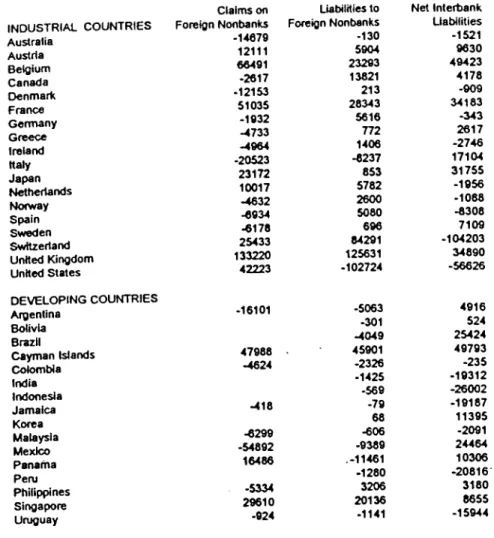
The ability of a national banking system to attract foreign deposits, and to make foreign loans, reflects its international competitiveness as an inter-mediary. Appendix Tables 1 and 2, based on data from the International Monetary Fund's International Financial Statistics, report net cross-border deposits of nonbanks and net cross-border credit to nonbanks, by residence of the bank, for a sample of European, Asian and Western Hemisphere coun-tries. Countries were selected on the basis of the availability of data. Data are averages of the available annual data for 1981-1985 and 1986-1990. Col-umn 3 reports net interbank liabilities. Data are in millions of current US dollars. I distinguish between countries identifiedby the IMF as "industrial" and "developing."
Positions Net Deposit Inflow
Net Deposit Outflow
Net
Loan OutflowBanking Centers
Austria Belgium France Netherlands Switzerland United Kingdom Japan I Cayman Islands SingaporeOutward Transformers
United States I Panama I Germany II Japan IINet
Loan InflowInward Transformers
Denmark Norway Sweden Canada Greece Ireland Spain Germany I Australia II Philippines IThe Disintermediated
Italy Australia I United States II Argentina Colombia Jamaica Malaysia Mexico Philippines II Uruguay Table 1: Banking TransformationBased on their net cross-border deposits from nonbanks and their net -cross-border claims on nonbanks, countries fall into four categories. Table 1
below assigns the countries for which I have data to the four categories. 1. Banking Centers
Banking centers provide net intermediation services to the rest of the world. These countries' banks are both net recipients of deposits from for-eign nonbanks and net lenders to nonbanks abroad. Among industrial coun-tries this group contains, for example, the Netherlands, Switzerland, and the United Kingdom (in both periods), and Japan (in the earlier period, indi-cated by "Japan I"). Among the developing countries this group includes the
Cayman Islands and Singapore both periods.
2. The Di.sinterinedjated
Opposite to this group are countries that are on net disintermediated. Nonbank residents of this group are net depositors in banksabroad and are net borrowers from foreign banks. Among industrial countries, membership in this group is more select and more unstable. Only Italy was disinterme-diated in both periods. Australia was disintermedisinterme-diated in the earlier period as was the United States in the later period.
Among developing countries, however, thisgroup includes all the South American countries for which data are available (in bothperiods), along with Mexico, Malaysia, and Jamaica (each in both periods) and Panama and the Philippines (each in the later period).
3. Inward Transformers
A third category of banking system receives net deposits from foreign nonbanks, yet fails to supply all of the domestic demand for bank loans. For countries in this group, the banking system transforms all (net) foreign deposits into (net) domestic loans.
Among the industrial countries, Denmark, Norway, Sweden, Canada, Greece, Ireland, and Spain fall into this category both periods, as does Ger-many for the first period and Australia for the second. Among the developing countries in the sample only Philippines, in the earlierperiod, belongs in this group.
j. Outward Transformers
Opposite to this group are countries whose nationalsdeposit more abroad than their banks receive in deposits from abroad, and whose banks are net suppliers of loans abroad. For thisgroup of countries, banks transform (net) domestic deposits into (net) foreign loans. This group includes the United States and Panama in the earlier period and Germany and Japan in the later one.
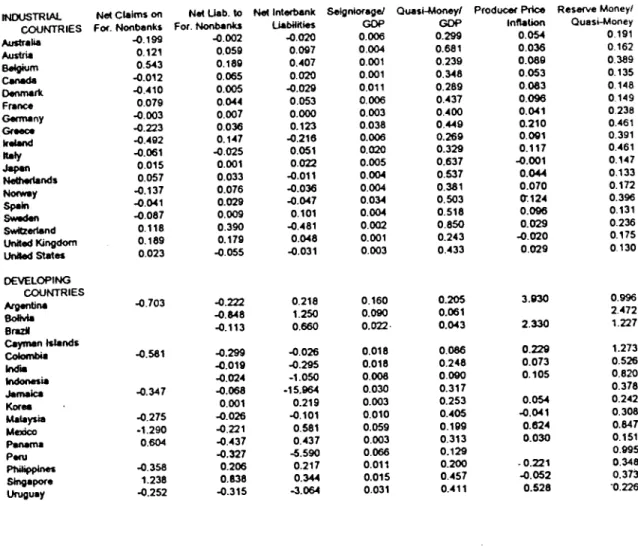
To examine the importance of cross-border positions relative to the do-mestic banking sector, in Appendix Tables 3 and 4 1 report net cross-border deposits from nonbanks, net cross-border claims on nonbanks, and net inter-bank claims as a share of domestic inter-bank assets. Among the inter-banking centers cross-border banking is especially significant for Singapore, Belgium, and Switzerland. For these countries net foreign deposits represent at least 30 per cent of domestic assets. Among disintermediated countries net cross-border loans are especially large for Argentina and Panama. At the other extreme, net cross-border positions for Germany and Japan are small. Banks and Nonbanks: What are the Distinguishing Features?
Among the four categories of countries, membership in the group of bank-ing centers appears to be more stable than membership in other groups. Are there financial characteristics of these countries that differ systematically from noncenters? To address this question, columns 4 through 7 of Ap-pendix Tables 3 and 4 report additional data on the financial systems of these countries. Column 4 reports annual average seigniorage as a share of GDP, defined as the increase in reserve money between consecutive years relative to the GDP of the earlier year.3 Column 5 gives the average annual ratio of quasi-money to gross domestic product. Column 6 indicates the av-erage annual rate of inflation of the producer price index during the period.
Column 7 provides the ratio of the monetary base to quasi-money.
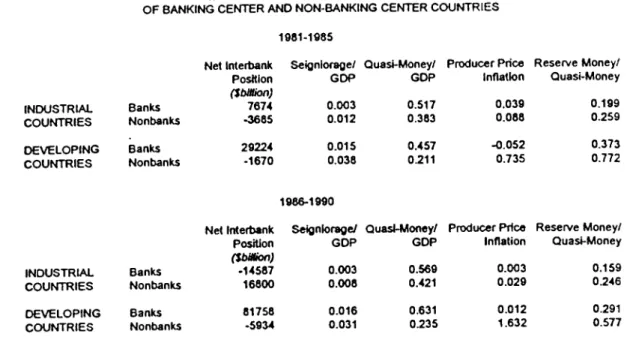
Appendix Table 5 reports averages of relevant statistics broken down be-tween industrial and developing countries and bebe-tween banking center coun-tries and other councoun-tries. (Unfortunately, Singapore is the only nonindustrial banking center for which I have data.) The table indicates the following re-lationships:
1. Inflation rates are much lower in banking centers than elsewhere. (Inflation also tends to be lower in industrial countries than in developed countries.)
2. Quasi-money as a fraction of GNP is much larger in banking centers 31take this definition from Fischer's (1982) classic paper on seigniorage.
than in noncenters. (This ratio also tends to be larger in industrial countries than in developing countries.)
3. Banking centers generate less revenue from seigniorage (relative to GDP) than noncenters (as do industrial countries compared with developing countries).
4. The ratio of reserve money to quasi-money is lower in banking centers than in noncenters (and is lower in industrial countries than in developing countries).
5. There does not seem to be a stable relationship between a country's role as a banking center and net interbank deposits, at least among the industrial countries.
What determines why some countries become banking centers while oth-ers experience international disintermediation? Section 3 develops a simple model of a regulated intermediation system to identify some factors that might be important, and to explain why banking centers have the features that they do.4
3. A Model of Regulated Intermediation
I adopt a variant of the Samuelson (1958) overlapping generations model. The analysis is complicated. At the expense of realism I have tried to make the simplest set of assumptions that allow an analysis of the issues at hand. Endowments and Preferences
I consider a national economy in which individuals live for two periods. Some of these individuals (called lenders) receive an endowment whilethey are young, while others (called borrowers) receive their incomes when they
4Alworth and Andresen (1992) provide a systematic regression analysis of the determi-nant.s of deposit inflows and outflows using a much more comprehensive data set propri-etary to the Bank of International Settlements, which was not available to this author. One
result supportive of the argument here is that countries with higher reserve requirements
are old. I assume that there are equal numbers of each type, and normalize their populations to one each. (To facilitate exposition I refer to lenders as feminine and to borrowers as masculine.) I normalize a lender's (early) endowment at two and set the borrower's (late) endowment at 2y.
Both lenders and borrowers want to smooth their consumption across the two periods of their lives. A simple way of introducing this motive is to assign each of them a lifetime utility given by:
U=lnC+lnC°
(1)where C is what the individual consumes in youth and C° is his or her consumption in old age.
This specification has two convenient implications for what follows: (1) Regardless of the interest rate, a lender will want to invest exactly half her income, or one, in her youth. (2) At any (finite) interest rate, a borrower will want to borrow whatever will require a repayment of half of his endowment, or y, in old age.
Naturally, a motive arises for lenders to make loans to borrowers in youth in exchange for repayment in old age. If contracts were automatically enforce-able and intermediation costless, in competitive equilibrium lenders would lend half their endowment to borrowers in their youth in exchange for half the borrower's endowment in old age. The real interest rate in the economy would be y. (It's convenient to specify interest rates in terms of repayment of principal plus interest, or one plus the interest rate as conventionally defined.)
Financial Intermediation
I assume, however, that these individuals are unable to enforce direct loan contracts among themselves. Instead, they must lend and borrow through a banking system. To invest lenders must make deposits in banks and borrow-ers canonly borrow from banks. Banks can enforce loan contracts and will honor deposit commitments.
Intermediation would be inconsequential if banking were (1) perfectly competitive, (2) costless, (3) not subject to reserve requirements or other taxes, and (4) specified loan and deposit contracts in real terms. Competition among banks would then push the interest rate to y and resources would be allocated just as if lenders could deal directly with depositors.
The focus here is on banking policy, rather than on the competitiveness of individual banks or on market structure. Hence I treat intermediation as intrinsically costless and the banking system within each country as perfectly competitive. But I assume that banks (1) must hold a fraction A of deposits as reserves, which take the form of reserve money issued by the local gov-ernment, and (2) specify loan and deposit contracts in terms of the currency of denomination of that money. Each period t the government specifies a reserve requirement Ag and the nominal supply of reserves Mg.
In making both assumptions together I combine issues of "currency com-petition" with "cross-border" competition. In principle, I could allow banks to denominate loans or deposits in foreign currency, as they often do, even while they hold reserves in local currency. It would be interesting to inves-tigate the consequences, but the analysis would be much more complicated. Banking systems do, however, tend to denominate loans and deposits in local currency, and are sometimes required to. (The fact that the government is usually the ultimate enforcer of loan contracts gives it a great deal of power in determining what form contracts can take.)
Under these assumptions, a lender in her youth at time 2 will invest half of her endowment in bank deposits, which offer a nominal return R?. The bank can lend a fraction (1 —A1) to borrowers, whom it will charge a nominal interest rate Rf'. The remaining deposits must be held as reserves, which I assume pay zero nominal interest. Denoting the ratio of the price level in a previous period to that in the current period (one over one plus the conventional inflation rate from last period to this) as H1, competition among banks will drive the real return on a period 2 deposit to:
Rf =
[(1 —A1)R + A1]fl1 = (2)where fl7 is the period 2 expectation of llt.
Whatever the interest rate, a borrower demands a loan amount that
re-quires a repayment of yin his old age. Since 1—A1 is the available loan amount
then equilibrium in the loan market implies that the nominal interest rate on loans must satisfy:
(1 —
A1)RH7
=
y. (3)The demand for reserves in period 1 is just A1, the reserve requirement times the deposit level. The government sets the nominal supply each period
at Mg. Hence the price level in period t is:
P =
M1/A, (4) so that: Mg_i/Mt Hg— . (5) Ag_If AgThe government's choice of the reserve requirement and money supply each period affects four important magnitudes: (1) Since deposits and loans made in the previous period were denominated in nominal terms, current monetary policy, by affecting the inflation rate, determines the cx post real return on bank loans and deposits due that period. (2) Since reserves pay zero nominal interest, monetary policy, through the inflation rate, determines the real return on reserves held over from the previous period.5 (3) The current reserve requirement determines how much will be available for new loans that period. (4) Money growth and the reserve requirement determine how much revenue the government earns from seigniorage that period, gg, which will be:
Ag_1Hg. (6)
Monetary Policy
I take the government's need for seigniorage as exogenous and constant at a level g. Taking into account its need for seigniorage revenue, the government must set M and A each period to satisfy (6). Hence inflation in period t
will be:
Hg =
Ag9
(7)Given the government's need for seigniorage, monetary policy each period. can be summarized by the reserve requirement A.
5Together (1) and (2) determine bank revenues. Competition among banks for deposits
means that nominal deposit rates will leave banks zero anticipated profits. I assume that lenders are also the owners of bank equity. Hence, cx post, lenders earn the total return on bank loans either as interest on deposits or as bank profits (although in equilibrium
Two factors constrain the government's choice of . First, since bank reserves cannot exceed deposits, cannot exceed one. Second, since the price level cannot be negative, from (6), the reserve requirement must exceed the need for seigniorage. At the lower bound =ginflation must be infinite to finance the government's seigniorage requirement.
As of period t, the nominal return on loans due is given, but the nominal return on new loans will take into account expected inflation as implied by (3), where the expectation will be consistent with anticipated future policy through (7).
Substituting these relationships into the expression for utility, the lifetime welfare of lenders and borrowers in each living generation at time t, as a function of monetary policy and predetermined variables, is:
UYB =ln(1 —g)+1ny
UYL = ln(y
+ )i —
g)=
ln[2,—(1 —
= ln[(l —
+ )] + ln(i)
where U is the utility of individual of type i, where i =YB,YL, OB, OL for young borrowers, young lenders, old borrowers, and old lenders, respectively. Setting a higher reserve requirement allows the government to achieve its seigniorage objective with less monetary growth and hence less inflation. Given the nominal interest rate set the previous period and the government's current need for seigniorage, a higher reserve requirement, since it means lower inflation, is good for old lenders but bad for old borrowers. Setting a higher reserve requirement also harms young borrowers by restricting what is lent them. Since the nominal interest rate satisfies (3), young lenders are unaffected by current monetary policy, but they, of course, benefit from a higher reserve requirement in the future, since it implies less inflation and a higher real return on reserves.
I assume that the government chooses the reserve requirement Xg each period to maximize a weighted average of the utilities of each type of liv-ing individual, takliv-ing the previous reserve requirement and nominal inter-est rate as given, but anticipating how its current choice of monetary pol-icy might influence the nominal interest rate and future monetary polpol-icy. I denote the weight it places on individuals of type i as 6', where again
and old lenders, respectively. Formally, then, each period t the government chooses A to maximize:
i =
YB,YL,OB,OL. (8)The first-order condition for a maximum, assuming that the interest rate set the previous period correctly anticipated subsequent monetary policy, is:
YB YL e OL OB
+
C+
=0.
l—A
y—A1—g dA
(A1—g)Notethat monetary policy in period 1—1 does not affect the optimal choice in t.6 Hence I can treat dA+1/dA =0. If exogenous parameters remain constant over time then the government will choose the same reserve requirement and inflation rate each period, so that individuals can reasonably expect that
— —
In characterizing the policy outcome one must consider two cases:
If 50L < EOB then, to convey the maximum benefit to borrowers at the expense of lenders, the government will simply set A at its lower bound of g and impose an infinite inflation tax. In this case the deposit rate is y and
the loan rate y/(1-g).
Alternatively, if 60L > then the government will choose an interior solution. Solving (9), the reserve requirement is then:
(50L —SOB) + 5YB9 5OL....5OB+t5YB
and the consequent (simple) inflation rate is: (5OL_öOB+5YB)g
=
(60L—6oB)(1 —
Expressionsfor the real return on deposits and loans are respectively:
RD_
—y(SOL5OB)(l_g)
60L_.50B+SYB
50L 50B 5YB
=
SYB(l —g)
Three factors determine monetary policy: (1) the seigniorage requirement g, (2) the welfare weight placed on old lenders relative to that on old borrow-ers —80B, and (3) the welfare weight placed on young borrowers 5YB•
In addition, both interest rates are higher the larger the endowments of bor-rowers relative to lenders. The following table shows how monetary policy and the consequent interest rates respond to these variables:
80L_60B 5YB
+
+
0inflation
+
+
0RD
+
+
RL
+
+
+
(The sign in each element of the matrix indicates how the first item in that row responds to an increase in the top item in that column.)
The categorization of individuals into these four groups is of course very stylized, as is the characterization of monetary policy as an attempt to serve their respective interests and to raise revenue. This description does, how-ever, capture some essential impacts of monetary policy: First, monetary policy can raise revenue for the government, and in some countries seignior-age revenue is significant. Second, to the extent that preexisting nominal contracts link individuals in the economy, inflation helps debtors at the ex-pense of lenders. Third, more restrictive reserve requirements divert loanable funds away from new borrowers toward government liabilities.
An implication of the analysis is that governments with little need for seigniorage and that place great weight on protecting the valueof outstand-ing loan contracts (relative to the weight they place on debtors and new bor-rowers) will tend to have low inflation and restrictive reserve requirements. Countries with large seigniorage needs and that place great weight on the interests of old and new borrowers will have higher inflation and less restric-tive reserve requirements. Given its seigniorage needs, a country that places more weight on maintaining the real value of existing loan contracts will use monetary restrictions relatively more than inflation (monetary growth) to raise seigniorage revenue. Even though lenders and borrowers establish nominal interest rates that perfectly anticipate the inflation that actually occurs, since some deposits are held in the form of reserves that pay a zero
nominal return, inflation is not neutral in its distributional effects: Higher inflation puts more of the burden of raising seigniorage revenue on lenders.
Implications for Cross-Border Banking Flows
So far I have considered a single economy in isolation. In the next sec-tion I extend the analysis to consider the implicasec-tions of various forms of integration. But the model of the closed economy foreshadows much of what happens.
Imagine a variety of countries that differ in terms of the four features
described at the top of the matrix above. A country is likely to attract
deposits from abroad if its deposit rate is higher than elsewhere, and to borrow from abroad if its loan rate is higher than elsewhere.
inward vs. outward transformation
Not surprisingly, (as in a purely real model) countries where borrowers (those with late endowments) have high endowments relative to lenders (with early endowments), i.e., countries where y is relatively high, will attract
cap-ital from abroad, both in deposits and in loans (the case of inward transfor-mation). These countries have good investment opportunities relative to the domestic supply of loanable funds. Moreover, countries whose governments weight the interests of (existing) lenders heavily relative to those of (existing and new) borrowers are, other things equal, more likely to attract both de-posits and loans. These countries impose higher reserve requirements both to reduce the need for inflation to finance seigniorage and to raise the interest rate on loans.7 Since more of domestic lenders' savings is diverted toward holding reserves, less is available for borrowers. Conversely, countries where lenders have high endowments relative to borrowers or whose governments place greater weight on the interests of borrowers than of lenders are likely to have lower interest rates on both deposits and loans, and to experience• both deposit and loan outflows.
7Under the assumptions here, a higher reserve requirement benefits depositors by im-proving their terms of trade vis-a-vis borrowers. This result does not generalize to bor-rowers' preferences that exhibit much more intertemporal substitutability, or, as shown below, to situations where the loan market is internationally competitive.
banking centers vs. disintermediation
Why do some countries become banking centers while others are disinter-mediated? The analysis points to the government's need for seigniorage as the determining factor. Countries whose governments seek to extract more resources out of their financial systems will, other things equal, have lower real deposit rates and higher real rates on loans. Deposits will tend to flow out of these countries toward countries with lower seigniorage needs, and bor-rowers will seek to borrow from these countries to take advantage of lower loan rates. This result is consistent with the observation that banking cen-ters in the sample of countries examined above earn much less seigniorage, relative to their GDP's, than other countries, and have lower reserves relative to deposits.
3. Market Integration
Say that monetary policy remains a national concern, but that financial markets become integrated internationally. Financial integration could mean that deposits, bank claims, or both, become traded internationally.
Deposit Trade
Say that banks compete internationally for deposits, but that banks con-tinue to lend only at home. This might be the outcome, for example, with no legal restrictions at all on capital flows, if banks maintain a unique ability to monitor the creditworthiness of local borrowers.8
Opening a national economy to trade in deposits would mean that banks and lenders in that economy would face a given world real deposit rate,
8Comments by some observers suggest that this is the likely outcome of financial in-tegration. Garber and Weisbrod (1993), for example, argue that financial integration
between the United States and Mexico will have little effect on U.S. bank lending to Mexi-can nonbanks since U.S. banks lack familiarity with MexiMexi-can loan customers. Stiglitz and Weiss (1981) formally model the role of informational advantages in lending. Equivalent arguments with respect to deposit activity are less prevalent. In fact, cross-currency bank
claims and bank deposits are of roughly comparable magnitudes. This similarity may, however, simply reflect artificial barriers to financial integration rather than the intrinsic
which I will denote RSD. I ignore possible inflation, exchange and default risk and treat this rate as constant. In order to attract deposits, domestic banks must offer a deposit rate competitive with the world rate. Competition among domestic banks for deposits implies the zero profit condition:
RD = [(1 —
))R
+ )tJH÷1 = R*D;that is, the anticipated real return on domestic loans and reserves, appropri-ately weighted by the reserve requirement, must equal the world rate.
To the extent that a country attracts or loses deposits, its seigniorage base rises or falls. I use w to denote the ratio of period t deposits invested locally to the total deposits of lenders that period. Hence a value of w1 above one means that the country has attracted net deposits from the world that period, and a value below one means that it has lost deposits to the world. I also make the assumption, which turns out to have consequence, that net and gross deposits positions coincide, i.e., that deposits flow only one way. I discuss the significance of this assumption below.
Taking into account potential deposit trade, the expression for the price change needed to finance a given level of seigniorage revenue becomes:
(10)
Wg
i
Sinceyoung lenders can earn the world deposit rate by investing abroad, their welfare is unaffected by domestic monetary policy. That is, if investors make local deposits, they must expect the domestic return to match the foreign return. The utility levels of the other factions in the economy now become:
U =
ln(1 —A)+lnwt
+lny
UOB = ln[2y —
(1 — )_1)R_1 Ag'g—1 —1 U0"
=
ln[(1 —)_1)R_1
+ )_] +ln(t,,)
Investors will choose to invest an amount wg that satisfies:R.D
(11)where the right-hand side of the inequality denotes the domestic return as a function of current deposit investment Wt, y,g, and the reserve requirement
)7 and
deposit investment w÷iexpected in the future. This expression must hold with equality if Wj > 0. Note that current monetary policy does not affect current portfolio investment. Note also that, at an interior equilib-rium, investment rises with borrower's income, the expected future reserve requirement, and future deposit investment, and falls with the seigniorage requirement?I assume that monetary authorities set Ag each period before depositors decide where to place their funds. Since monetary policy does not affect current investment, however, I assume that monetary authorities correctly anticipate the subsequent portfolio decisions. In order to satisfy the seignior-age requirement authorities must set Ag at least at g/wg (at which point generating the needed seigniorage requires infinite inflation).
The first-order condition for the reserve requirement becomes:
LYE - LOL LOB
—o —u
0.
(12)where .
= max(wg_i, 1). The expression holds with equality if theconse-quent A > g/wg.1°
If the solution is interior, having more domesticdeposits raises the optimal reserve requirement, and thereby lowers the inflation needed to meet the seigniorage requirement.
A steady-state equilibrium comprises a portfolio position w and a reserve
requirement A that jointly satisfy expressions (11) and (12), with Wg
=
w,Ag = A =
Since the analytic expressions for the equilibrium values of A and w are complicated to the point of intractability, I rely on some numerical solutions to illustrate the results. This model is too stylized for any of the parameter values and solutions to be considered indicative o. any actual economy. The only purpose is to suggest the direction of the effect of a change in circum-stances and in government preferences on monetary policy and on deposit
flows.
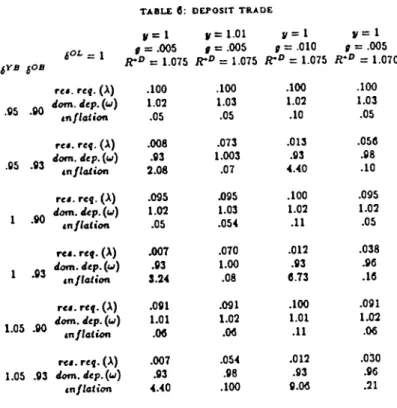
Appendix Table 6 presents steady-state values of A (the reserve require-ment), w the share of domestic deposits held domestically, and the consequent
9An interior investment allocation is locally stable, since, given expectations about the
future, the domestic real return decreases in the amount invested locally.
inflation rate for the values of 6YB and 50B indicated on the first and second columns, (with 50L normalized at one) and for the values of y, g, and R' indicated on the top row. I consider values of 8YB of .95, 1, and 1.05 and of 60B of .90 and .93.
the base case
As a base case I set y = 1 (meaning that borrowers and lenders have the
same endowment), a seigniorage requirement of .005 (or .25 per cent of the aggregate endowment), and a world deposit rate of 7.5 per cent. Note that the inflation rate is very sensitive to the weight placed on old borrowers. For each value of 5YB, the inflation rate is between 5 and 6 per cent when 50B is at its lower value and several hundred per cent when it is at its higher value. Accompanying higher inflation is a lower reserve requirement. The low inflation regime is associated with deposit inflow (w > 1) and the high inflation regime with deposit outflow (w < 1).
The simulations suggest, then, that countries that place relatively more weight on maintaining the real value of loan contracts will attract more deposits. Since the base of the inflation tax is higher, a given amount of seigniorage revenue can then be raised with a lower inflation rate.
Increasing the social weight on the interests of new borrowers affects these magnitudes in the same direction as increasing the weight on existing debtors, but the magnitudes involved are much smaller.
future endowments
Say that the endowment of borrowers is instead 1.01, meaning that bor-rowers have higher endowments relative to lenders. For all the welfare weights considered, the implication is more deposit inflow and lower inflation. Infla-tion is negligibly lower in cases where existing creditors have a higher welfare weight (when the country initially imports deposits) but dramatically lower in cases where existing debtors have a heavier weight (and the country ini-tially exports deposits). In two of these three cases raising the value of y converts the country from a deposit exporter to a deposit importer.
Doubling the seigniorage demands of the government approximately dou-bles the consequent inflation rate. This change also increases the reserve requirement. These two changes have offsetting effects on the net deposit position, which is virtually unchanged.
the world deposit rate
Lowering the world deposit rate from 7.5 to 7 per cent acts like an increase in y. Either change makes this country a more attractive place to invest relative to the rest of the world, so the country attracts more deposits from abroad. Hence., a lower world interest rate means more foreign deposits, lower inflation and a lower reserve requirement. Again the effects are negligible when existing debtors have a lower welfare weight (so that inflation is already low in the base case), but they become significant when existing debtors have more clout.
Simulations in which higher weights were placed on the interests of bor-rowérs lacked interior solutions. In these cases either the inflation rate was infinite or else the country was unable to attract any demand deposits at all.
net and gross deposit positions
I have assumed that net and gross deposit positions coincide. In this case the net deposit position determines how much national depositors suffer from inflation. To the extent that deposits flow in two directions, national deposits in local banks fall short of what the net position would imply. There is consequently greater incentive for the government to use the inflation tax as a source of revenue, since national lenders are less adversely affected. If gross and net positions can differ, the model makes no prediction about the magnitude of two-way flows. But what they turn out to be affects the equilibrium net position: As more domestic depositors invest abroad, the government has greater incentive to raise the inflation rate. Anticipating higher inflation, fewer net deposits flow in.11
'1This result suggests a reason why capital flight might be associated with high inflation.
The standard explanation is that capital flees to avoid the inflation tax. Another one
suggested here is that capital flight, by reducing the tax base, forces the government to inflate at a higher rate to achieve its seigniorage objective.
Loan Trade
A mirror exercise allows international trade in bank loans, but treats deposits as nontraded. I do not undertake it here. A difference is that, since new borrowers can tap loans from the world market, monetary policy has no effect on their welfare. Lenders rather than borrowers thus bear the full incidence of the reserve requirement and the inflation tax.
Full Financial Integration
Consider now a country that faces open competition in world markets both for deposits and for loans. I continue to call (one plus) the world real deposit rate R*D and call the world real loan rate (plus one) R*L. In order to compete in international loan markets, the national banking system cannot charge interest on loans that borrowers expect to exceed R*L in real terms and must offer depositors interest rates that they expect to yield at least
R.D in real terms. Hence, to maintain an internationally competitive bank-ing system, given public expectations about future inflation, the monetary authority must impose a reserve requirement that satisfies:
R*D =
R'
=
)ttH7
+ (1 — A)R*L.The change in the price level as a function of the reserve requirement A, seigniorage g, and the share of national deposits invested locally continues
to be given by expression (10). Hence ) must satisfy:
R*D RD =
A7+1wL+1 —g+(1_A)R*L.
(13)Note that, given anticipated future magnitudes, the return on domestic de-posits falls with the current amount of demand dede-posits invested locally and with the current reserve requirement.'2
Consider a steady-state situation in which the government expects to receive the same in bank deposits in the future as now, so that wj = = w. In this case it will expect to pursue the same monetary policy in the future as now, so that '7.H = A
=
A. The government will then have to set:(R*L — R*D) —g/w R*L —
I
in order to remain competitive in deposit and loan markets (which it must be in order to attract deposits to earn any seigniorage whatsoever). In order
to earn an amount g in seigniorage the price change must be:
=
w(R'
— R*D)— p.L9I continue to assume that the government chooses its current reserve requirement each period before depositors decide where to invest,
but that
the government anticipates the subsequent deposit allocation correctly.Depending on w, there are two cases to consider:
1. If w
—R*D) then the government can collect its entire
seigniorage requirement and continue to offer competitive interest rates. Given g, the inflation rate will be lower (and the reserve requirement higher) the larger the deposit base w. As g rises, so does the inflation rate.
2. If u.' < Rg/(R*f R*D) then the government cannot, even with
infinite inflation, collect its entire seigniorage requirement and still
offer competitive terms. The best that the government can do is
to set X (R —
R*D)/R*L, in which case it can collect at most(RSL —
R*))w/R*
in seigniorage. (In this case the reserve requirementis equivalent to an outright tax on deposits at rate )%.)13
The value of w is itself not determined. Wherever depositors invest they earn the same rate of return. If a country happens to receive a large amount of deposits, then it can meet its seigniorage needs with a low inflation rate. '31f, instead, the government establishes the reserve requirement after depositors choose where to put their funds, then the government would be able to offer a competitive return
and finance its seigrtiorage needs only if existing deposits met or surpassed the critical minimum. Otherwise, any small number of depositors in the country would see that there were not enough of them to allow the government to achieve its revenue objectives and leave them with a competitive return. Presumably they would also then seek to invest elsewhere. Hence there are two types of equilibrium for each country, one with deposits above the threshold, and another with no deposits.
Since it has more deposits it will have more funds available to lend, so is more likely to become a net lender internationally. Countries that receive fewer deposits will have to impose higher inflation in order to raise a given amount of seigniorage and to impose a lower reserve requirement in order to remain internationally competitive. If the level of deposits falls below
—R*D) then the government cannot earn the seigniorage that it wants even with infinite inflation.
This result suggests a fundamental indeterminacy about what countries emerge as banking centers. There maybe myriad equilibria depending upon where lenders decide to put their funds. Nevertheless, a country that is trying to generate a lot of seigniorage revenue is going to need a larger level of deposits in order to remain internationally competitive. This result suggests why banking center countries as a group rely less on seigniorage revenue to finance government expenditure than other countries do.
The analysis of the closed economy case suggested the direction in which deposits and loans would flow between countries whose financial systems are initially closed if some trade were then allowed. However, once finan-cial markets become totally open the allocation of deposits and loans may be arbitrary. But monetary authorities concerned with maintaining their seigniorage base may not be indifferent among alternative outcomes. This result suggests why international financial markets might be as subject to re-strictions on capital flows as they are: Countries experiencing large deposit outflows might, for example, seek to prohibit them in order to maintain their seigniorage base.
5. Conclusion
Certain countries export the intermediation services of the banks subject to their jurisdiction, receiving deposits from abroad and making loans abroad. These countries typically have lower inflation, collect less seigniorage, and have lower reserves relative to bank assets than other countries, particularly those that are disintermediated internationally.
This paper has developed a simple model of bank intermediation that attempts to identify factors that might be important in determiningwhat countries become banking centers. The analysis points to the following fac-tors as mattering:
1. A country is more likely to become a banking center if its political system is responsive to the interests of existing creditors relative to those of existing debtors. Such a country has less incentive to impose a high rate of inflation in order to transfer resources from creditors to debtors.
2. Since seigniorage is a tax on financial intermediation, a country that is less reliant on revenue from seigniorage is more likely to become a financial center.
3. An element of indeterminacy may be involved in that countries hap-pening to have more deposits can earn more in seigniorage with less
inflation.
The analysis is meant to suggest some fundamental relationships rather than to identify all factors that are likely to be relevant Some particularly critical omissions are the following:
1. 1 have identified cross-border competition with currency competition, ignoring the fact that banking systems can and do issue deposits and make loans that are denominated in foreign currencies. In principle the analysis could be extended to allow for foreign currency loans and deposits.
2. I have treated monetary policy as the outcome of the day-to-day in-centives of the monetary authority. The outcome may suffer from the well-known problem of time-inconsistency. For example, everyone in a country might benefit from a commitment to low inflation rate in the future even though the government might benefit from a high current level of inflation. I assume that the government responds only to its current incentives. Monetary institutions might exist, however, that make commitment to the long-run optimal policy credible.
3. While it simplified the analysis enormously, the assumption of Cobb-Douglas preferences is special. A number of specific results would not generalize to arbitrary sets of preferences.
4. I have ignored several other factors that play an important role in international competition for banking services.
(a) In assuming that banking services do not require resources I ig-nore the possibility that comparative advantage in intermediation, or factor abundance in resources used intensively in banking, is a reason for trade. Comparative advantage in my model is "artifi-cial," that is, determined by government policy, rather than the "natural" consequence of relative productivities and factor
endow-men ts.
(b) By assuming that banking is perfectly competitive I ignore the role of oligopolistic and monopolistic competition as a reason for international trade in banking services. Recent developments in international trade suggest how imperfect competition by itself can lead to cross-border trade)4
(c) In considering a situation of perfect certainty I ignore international diversification as a reason for cross-border intermediation.
(d) I have not considered the role of the central bank as a provider of deposit insurance and lender of last resort. Recent development in the theory of domestic banking have suggested the contribution of insurance mechanisms to banking efficiency.'5
Some extensions to the analysis might prove fruitful. For example, one extension would no longer treat countries as price takers in international markets for deposits and bank loans, allowing for market power and strate-gic interaction among the monetary authorities in different countries. The framework might usefully address the effects of harmonization of monetary policies or the integration of national monetary systems, as opposed simply to international trade in bank assets and liabilities.
The indeterminacy of the location of intermediation with fully-integrated financial markets suggests how international trade in bank deposits and loans
might be harmful as long as the framing of monetary policy remains a na-tional concern. The services that banks provide are inherently connected to the policies of the monetary authorities who manage the currencies in which bank assets and liabilities are denominated. Exploiting the potential gains from international trade in financial services may require not only greater
'4Helpman and Krugman (1985) survey this literature.
integration of financial markets, but greater integration of monetary policies as well.
References
1. Aliber, R.Z. (1984), "International Banking: A Survey,"
Journal of
Money, Credit, and Banking, 16: 661-678.2. Alworth, J.S. and S. Andresen (1992), "The Determinants of Cross-Border Non-Bank Deposits and the Competitiveness of Financial Mar-ket Centres," Money Affairs.
3. Diamond, D. and P. E. Dybvig (1983), "Bank Runs, Deposit Insurance, and Liquidity," Journal of Political Economy, 91: 401-409.
4. Fischer, S. (1982), "Seigniorage and the Case for a National Money," Journal of Political Economy, 90: 295-3 13.
5. Garber, P.M. and S. Weisbrod (1993), "Opening the Financial Services Market." in The Mexico-U.S. Free Trade Agreement, edited by P.M. Garber. Forthcoming. (Cambridge, MA: MIT Press).
6. Helpman, E. and P.R. Krugman (1985), Market Structure and Foreign Trade (Cambridge, MA: MIT Press).
7. Lewis, M.K. and K.T. Davis (1987), Domestic and International Bank-ing. (Cambridge, MA: MIT Press).
8. Samuelson, P.A. (1958), "An Exact Consumption-Loan Modelwith or without the Social Contrivance of Money," Journal of Political
Econ-omy, 66: 467-482.
9. Stiglitz, J.E. and A. Weiss (1981), "Credit Rationing in Markets with Imperfect Information," American Economic Review, 71: 393-411.
TABLE 1: NET BANK CROSS-BORDER POSITIONS, 1981-1985
Claims on Liabilities to Net inlerbank
INDUSTRIAL COUNTRIES Foreign Nonbanks Foreign Nonbenks Liabilities
Australia -14679 -130 -1521 Austria 12111 5904 9630 Belgium 66491 23293 49423 Canada -2617 13821 4178 Denmark -12153 213 -909 France 51035 28343 34183 Germany -1932 5616 -343 Greece -4733 772 2617 Ireland -4964 1406 -2746 Italy -20523 -8237 17104 Japan 23172 853 31755 NetherlandS 10017 5782 -1956 Norway -4632 2600 -1068 Spain -6934 5080 -8308 Sweden 4178 696 7109 SwItzerland 25433 84291 -104203 United Kingdom 133220 125631 34890 United States 42223 -102724 -56626 DEVELOPING COUNTRIES Argentina .16101 .5063 4916 BolivIa -301 524 Brazil -4049 25424 Cayman Islands 47988 45901 49793 Colombia -4624 -2326 -235 India .1425 -19312 IndonesIa .569 -26002 JamaIca -416 -79 -19187 Korea 68 11395 MalaysIa -6299 -606 .2091 MexIco -54892 -9389 24464 Panama 16486 .-11461 10306 Peru -1280 -20816 PhilippInes -5334 3206 3180 Singapore 29610 20136 6655 Uruguay -924 .1141 -15944
TABLE 2: NET BANK CROSS-OORDER POSITIONS. 1986-1990
Claims on UabBitles to Net Intecbank INDUSTRIAL COUNTRIES Foreign Nonbanks Foreign Nonbanks Uabilities
Australia -24059 459 15581 Aust*ia 23269 14831 15667 Belgium 127990 93376 29929 Canada -12024 17497 662 Denmark -24288 299 -3267 France 92396 65344 48057 Germany 12483 -27001 -79532 Greece -6957 2319 6372 Ireland -11036 623 -2135 Italy -37664 -6282 54650 Japan 58143 -4319 146141 Netheclarids 6588 4619 -19270 Norway -4755 6139 4395 SpaIn -3715 9556 -20062 Sweden -1906 4533 29782 Swltzertand 44678 147337 -204371 United Kingdom 182418 206052 42467 United States -64675 -155666 47015 DEVELOPING COUNTRIES Argentloa -21730 -9989 9895 BolivIa -386 78 BrazIl -12938 53339 Cayman Islands 111670 98638 147321 Colombia -5488 -3460 -628 India -2104 -42880 Indonesia -2099 -17069 Jamaica -383 -306 -15865 Korea -314 4468 Malaysia -6890 -957 -6020 MexIco -51628 -6774 16155 Panama -9144 -28943 -33489 Peru -2443 -17117 Philippines -4610 -296 969 Singapore 75119 46329 16195 Uruguay -609 -18-47 -34913
TABLE 3: CROSS-BORDER POSITIONS ANO FINANCIAL CHARACTERISTICS, 1961-1985
INDUSTRIAL Net Claims on Net Liab. to Net Interbank Selgn.oragel Ouasi-Moneyl Producec Price Reserve Money/
COUNTRIES for. Nonbanks For. Nonbanks Usbilitles GOP GOP IrrItation Quasi-Money
-0.199 .0.002 .0.020 0.006 0.299 0.054 0.191 .sjjstria 0.121 0.059 0.097 0.004 0.681 0.036 0162 Belgium 0.543 0.189 0.407 0.001 0.239 0.089 0.389 Canada -0.012 0.065 0.020 0.001 0.348 0.053 0.135 Denmait -0.410 0.005 -0.029 0.011 0.289 0.083 0.148 france 0.079 0.044 0.053 0.006 0.437 0.096 0149 G.mrany -0.003 0.007 0.000 0.003 0.400 0.041 0238 Graec. -0.223 0.036 0.123 0.038 0.449 0.210 0.461 -0.492 0.147 -0.216 0.006 0.269 0.091 0.391 Italy -0.061 -0.025 0.051 0.020 0.329 0.117 0.461 Japan 0.015 0.001 0.022 0.005 0.637 -0.001 0.147 Netherlands 0.057 0.033 -0.011 0.004 0.537 0.04.4 0.133 Norway -0.137 0.076 -0.036 0.004 0.381 0.070 0.172 spain -0.041 0.029 .0.047 0.034 0.503 0:124 0.396 Sw.den -0.087 0.009 0.101 0.004 0.518 0.096 0.131 SwItzerland 0.118 0.390 -0.481 0.002 0.850 0.029 0.236 United Kingdom 0.189 0.179 0.048 0.001 0.243 -0.020 0.175 United States 0.023 .0.055 .0.031 0.003 0.433 0.029 0 130 DEVELOPING COUNTRIES Argentina .0.703 -0.222 0.218 0.160 0.205 3.930 0.996 BolIvia .0.648 1.250 0.090 0.061 2.472 RrazlI -0.113 0.660 0.022 0.043 2.330 1.227 Ca)illanIslands Colombia -0.581 .0.299 -0.026 0.018 0.086 0.229 1.273 India .0.019 -0.295 0.018 0.248 0.073 0.526 Indonesia -0.024 -1.050 0.008 0.090 0.105 0.820 Jamaica .0.347 -0.068 -15.964 0.030 0.317 0.378 0.001 0.219 0.003 0.253 0.054 0.242 Malaysia -0.275 .0.026 -0.101 0.010 0.405 -0.041 0.308 Mex,co -1.290 -0.221 0.581 0.059 0.199 0.624 0.847 Panama 0.604 -0.437 0.437 0.003 0.313 0.030 0.151 Pew -0.327 -5.590 0.066 0.129 0.995 PhilIppines -0.358 0.206 0.217 0.011 0.200 .0.221 0.348 Singapore 1.238 0.838 0.344 0.015 0.457 -0.052 0.373 Uruguay -0.252 -0.315 4.064 0.031 0.411 0.526
TABLE 4: CROSS-BORDER POSITIONS AND FINANCIALCHARACTERISTICS.1986-1990
INDUSTRIAL Net Claims on Net Liab. to NetInterbank Seignlorag& Quasi-Money! ProducerPnce Reseive Money/
COUNTRIES For, Nonbanks For. Noribinks liabilities GOP GOP Inflation Quasi-Money Australia -0165 0.001 0.096 0.004 0.380 0.031 0.145 Austria 0.104 0.065 0.070 0.004 0.734 -0.006 0.135 BelgIum 0.474 0.332 0.127 0.001 0.278 -0.018 0 269 Canada .0.039 0.061 0.000 0.002 0.304 0.021 0 138 Denmark -0.241 0.005 -0.03.4 -0.001 0.320 0.008 0 160 France 0.068 0.047 0.035 0.001 0.417 0.022 0.149 Germany 0.007 -0.014 .0.043 0.008 0.421 0.002 0.245 Greece -0.180 0.058 0.168 0.027 0.503 0.131 0.370 Ireland -0.528 0.047 -0.094 0.006 0.294 0.011 0.329 italy -0.055 .0.012 0.080 0.008 0.421 0.002 0.490 Japan 0.015 .0.001 0.035 0.010 0.807 -0.019 0.131 Netherlands 0.022 0.014 .0.045 0.007 0.584 0.002 0.148 Nofway .0.057 0.096 0.051 0.001 0.338 0.464 0 168 Spain .0.009 0.023 .0.051 0.021 0.419 0.022 0.505 Sweden -0.017 0.024 0.167 0.008 0.511 0.035 0.139 Switzerland 0.097 0.315 -0.436 -0.003 0.932 0.004 0.159 United Kingdom 0.112 0.123 0.024 0.004 0.474 0.015 o.ogi United States 0.444 -0.056 0.016 0.004 0.442 0.025 0.133 DEVELOPING COUNTRIES Argentina -0.988 -0.448 0.455 0.064 0.192 10.080 0.710 BolivIa -0.472 0.083 0.019 0.108 0.629 BrazIl -0.111 0.511 0.057 0.075 5.820 1.039 Caymen Islands Colombia —0.703 .0.444 .0.105 0.026 0.085 0.260 1.115 India .0.019 .0.388 0.022 0.298 0.076 0.514 Indonesia .0.054 .0.366 0.008 0.211 0.090 0.346 JamaIca -0.212 .0.166 -7.538 0.034 0.330 0.563 Korea -0.002 0.064 0.015 0.290 0.015 0.253 Malaysia -0.225 .0.026 -0.166 0.017 0.486 0.039 0.295 Mexico -1.250 .0.174 0.391 0.021 0.146 0.743 0.493 Panama -1.001 -2.645 -1.818 .0.001 0.319 .0.019 0.090 Peru .0.704 -4.480 0.073 0.080 1.38.4 PhiliEpines -0.339 -0.024 0.087 0.018 0.218 0.108 0.430 Singapore 1.567 1.011 0.307 0.016 0.631 0.012 0.291 Uruguay -0.125 -0.351 -8.205 0.040 0.448 0.737 0.219
TABLE 5: FINANCIAL CHARACTERISTICS
OF BANKING CENTER AND NON-BANKING CENTER COUNTRIES 1981-1985
Net Interbank Seignloragel Quasl-Money/ Producer Puce Reserve Money!
Position GOP GOP Inflation Quasi-Money
($blllãon) INDUSTRIAL BankS 7874 0.003 0.517 0.039 0.199 COUNTRIES Nonbanks -3685 0.012 0.383 0.088 0.259 DEVELOPING Banks 29224 0.015 0.457 -0.052 0.373 COUNTRIES Nonbanks -1670 0.038 0.211 0.735 0.772 1966-1990
Net Interbank Seigniorage! Quasi-Money! Producer Puce Reserve Money! Position GDP GOP Inflation Quasi-Money INDUSTRIAL Banks .14587 0.003 0.569 0.003 0.159 COUNTRIES Nonbanks 16800 0.008 0.421 0.029 0.246 DEVELOPING Banks 81758 0.016 0.631 0.012 0.291 COUNTRIES Nonbanks -5934 0.031 0.235 1.632 0.577
TABLE 6: DEPOSIT TRADE
i,=l V=l.Ol 11=1 1/=1
= = .005= g = .005 g =.010 p = .005 1.075 J0 =1075 R°=1.075 ft.D =1.070
6YB
rca.req.(A) .100 .100 .100 .100
dam. Sep. (w) 1.02 1.03 1.02 1.03
.95 .90
nf1ahon .05 .05 .10 .05
rca.req. (A) .008 .073 .013 .056
Join. 4cp.(i) .93 1.003 .93 .98
.95 .93
nf1ai.on 2.08 .07 4.40 .10
rca.req. (A) .095 .095 .100 .095 dom.dcp.() 1.02 1.03 1.02 1.02
inflation .05 .054 .11 .05
rca.req.(A) .007 .070 .012 .038
93 Join. dip. () .93 1.00 .93 .96
anflaLion 3.24 .08 6.73 .16 rca. req. (A) .091 .091 .100 .091 Join. dep.(w) 1.01 1.02 1.01 1.02 1.05 .90
inflation .06 .06 .11 .06
ret.req.(A) .007 .054 .012 .030
1.05 .93 darn. dep.(w) .93 .98 .93 .96