Multi-Task Learning Using Uncertainty to Weigh Losses
for Scene Geometry and Semantics
Alex Kendall
University of Cambridge
[email protected]
Yarin Gal
University of Oxford
[email protected]
Roberto Cipolla
University of Cambridge
[email protected]
Abstract
Numerous deep learning applications benefit from multi-task learning with multiple regression and classification ob-jectives. In this paper we make the observation that the performance of such systems is strongly dependent on the relative weighting between each task’s loss. Tuning these weights by hand is a difficult and expensive process, mak-ing multi-task learnmak-ing prohibitive in practice. We pro-pose a principled approach to multi-task deep learning which weighs multiple loss functions by considering the ho-moscedastic uncertainty of each task. This allows us to si-multaneously learn various quantities with different units or scales in both classification and regression settings. We demonstrate our model learning per-pixel depth regression, semantic and instance segmentation from a monocular in-put image. Perhaps surprisingly, we show our model can learn multi-task weightings and outperform separate mod-els trained individually on each task.
1. Introduction
Multi-task learning aims to improve learning efficiency and prediction accuracy by learning multiple objectives from a shared representation [7]. Multi-task learning is prevalent in many applications of machine learning – from computer vision [27] to natural language processing [11] to speech recognition [23].
We explore multi-task learning within the setting of vi-sual scene understanding in computer vision. Scene under-standing algorithms must understand both the geometry and semantics of the scene at the same time. This forms an in-teresting multi-task learning problem because scene under-standing involves joint learning of various regression and classification tasks with different units and scales. Multi-task learning of visual scene understanding is of crucial importance in systems where long computation run-time is prohibitive, such as the ones used in robotics. Combining all tasks into a single model reduces computation and allows
these systems to run in real-time.
Prior approaches to simultaneously learning multiple tasks use a na¨ıve weighted sum of losses, where the loss weights are uniform, or manually tuned [38,27,15]. How-ever, we show that performance is highly dependent on an appropriate choice of weighting between each task’s loss. Searching for an optimal weighting is prohibitively expen-sive and difficult to resolve with manual tuning. We observe that the optimal weighting of each task is dependent on the measurement scale (e.g. meters, centimetres or millimetres) and ultimately the magnitude of the task’s noise.
In this work we propose a principled way of combining multiple loss functions to simultaneously learn multiple ob-jectives using homoscedastic uncertainty. We interpret ho-moscedastic uncertainty as task-dependent weighting and show how to derive a principled multi-task loss function which can learn to balance various regression and classifica-tion losses. Our method can learn to balance these weight-ings optimally, resulting in superior performance, compared with learning each task individually.
Specifically, we demonstrate our method in learning scene geometry and semantics with three tasks. Firstly, we learn to classify objects at a pixel level, also known as se-mantic segmentation [32,3,42,8,45]. Secondly, our model performs instance segmentation, which is the harder task of segmenting separate masks for each individual object in an image (for example, a separate, precise mask for each in-dividual car on the road) [37,18,14, 4]. This is a more difficult task than semantic segmentation, as it requires not only an estimate of each pixel’s class, but also which object that pixel belongs to. It is also more complicated than ob-ject detection, which often predicts obob-ject bounding boxes alone [17]. Finally, our model predicts pixel-wise metric depth. Depth by recognition has been demonstrated using dense prediction networks with supervised [15] and unsu-pervised [16] deep learning. However it is very hard to esti-mate depth in a way which generalises well. We show that we can improve our estimation of geometry and depth by using semantic labels and multi-task deep learning.
In existing literature, separate deep learning models
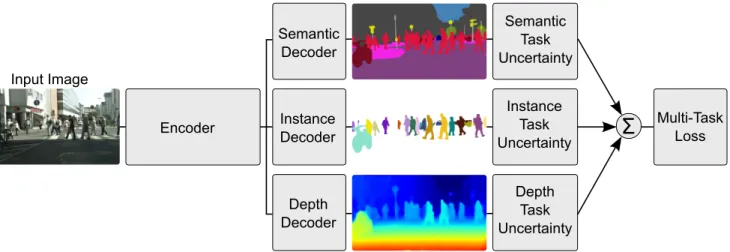
Encoder Semantic Decoder Input Image Multi-Task Loss Instance Decoder Depth Decoder Semantic Task Uncertainty Instance Task Uncertainty Depth Task Uncertainty
Σ
Figure 1: Multi-task deep learning. We derive a principled way of combining multiple regression and classification loss functions for multi-task learning. Our architecture takes a single monocular RGB image as input and produces a pixel-wise classification, an instance semantic segmentation and an estimate of per pixel depth. Multi-task learning can improve accuracy over separately trained models because cues from one task, such as depth, are used to regularize and improve the generalization of another domain, such as segmentation. would be used to learn depth regression, semantic
segmen-tation and instance segmensegmen-tation to create a complete scene understanding system. Given a single monocular input im-age, our system is the first to produce a semantic segmenta-tion, a dense estimate of metric depth and an instance level segmentation jointly (Figure1). While other vision mod-els have demonstrated multi-task learning, we show how to learn to combine semantics and geometry. Combining these tasks into a single model ensures that the model agrees be-tween the separate task outputs while reducing computa-tion. Finally, we show that using a shared representation with multi-task learning improves performance on various metrics, making the models more effective.
In summary, the key contributions of this paper are: 1. a novel and principled multi-task loss to
simultane-ously learn various classification and regression losses of varying quantities and units using homoscedastic task uncertainty,
2. a unified architecture for semantic segmentation, in-stance segmentation and depth regression,
3. demonstrating the importance of loss weighting in multi-task deep learning and how to obtain superior performance compared to equivalent separately trained models.
2. Related Work
Multi-task learning aims to improve learning efficiency and prediction accuracy for each task, when compared to training a separate model for each task [40,5]. It can be con-sidered an approach to inductive knowledge transfer which improves generalisation by sharing the domain information between complimentary tasks. It does this by using a shared representation to learn multiple tasks – what is learned from
one task can help learn other tasks [7].
Fine-tuning [1, 36] is a basic example of multi-task learning, where we can leverage different learning tasks by considering them as a pre-training step. Other models al-ternate learning between each training task, for example in natural language processing [11]. Multi-task learning can also be used in a data streaming setting [40], or to prevent forgetting previously learned tasks in reinforcement learn-ing [26]. It can also be used to learn unsupervised features from various data sources with an auto-encoder [35].
In computer vision there are many examples of methods for multi-task learning. Many focus on semantic tasks, such as classification and semantic segmentation [30] or classifi-cation and detection [38]. MultiNet [39] proposes an archi-tecture for detection, classification and semantic segmenta-tion. CrossStitch networks [34] explore methods to com-bine multi-task neural activations. Uhrig et al. [41] learn semantic and instance segmentations under a classification setting. Multi-task deep learning has also been used for ge-ometry and regression tasks. [15] show how to learn se-mantic segmentation, depth and surface normals. PoseNet [25] is a model which learns camera position and orienta-tion. UberNet [27] learns a number of different regression and classification tasks under a single architecture. In this work we are the first to propose a method for jointly learn-ing depth regression, semantic and instance segmentation. Like the model of [15], our model learns both semantic and geometry representations, which is important for scene un-derstanding. However, our model learns the much harder task of instance segmentation which requires knowledge of both semantics and geometry. This is because our model must determine the class and spatial relationship for each pixel in each object for instance segmentation.
0 0.1 0.2 0.3 0.4 0.5 0.6 0.7 0.8 0.9 1 45 50 55 60 Classification Weight IoU Classification ( % ) Classification 0 0.1 0.2 0.3 0.4 0.5 0.6 0.7 0.8 0.9 1 0.58 0.6 0.62 0.64 Depth Weight RMS In v erse Depth Error ( m − 1) Classification Depth Regression
Task Weights Class Depth Class Depth IoU [%] Err. [px]
1.0 0.0 59.4 -0.975 0.025 59.5 0.664 0.95 0.05 59.9 0.603 0.9 0.1 60.1 0.586 0.85 0.15 60.4 0.582 0.8 0.2 59.6 0.577 0.7 0.3 59.0 0.573 0.5 0.5 56.3 0.602 0.2 0.8 47.2 0.625 0.1 0.9 42.7 0.628 0.0 1.0 - 0.640 Learned weights 62.7 0.533
with task uncertainty
(this work, Section3.2)
(a) Comparing loss weightings when learningsemantic classification and depth regression
0 0.1 0.2 0.3 0.4 0.5 0.6 0.7 0.8 0.9 1 3.8 4 4.2 4.4 4.6 4.8 5 Instance Weight RMS Instance (px) Instance Regression 0 0.1 0.2 0.3 0.4 0.5 0.6 0.7 0.8 0.9 1 0.6 0.62 0.64 0.66 0.68 0.7 Depth Weight RMS In v erse Depth Error ( m − 1) Instance Regression Depth Regression
Task Weights Instance Depth Instance Depth Err. [px] Err. [px]
1.0 0.0 4.61 0.75 0.25 4.52 0.692 0.5 0.5 4.30 0.655 0.4 0.6 4.14 0.641 0.3 0.7 4.04 0.615 0.2 0.8 3.83 0.607 0.1 0.9 3.91 0.600 0.05 0.95 4.27 0.607 0.025 0.975 4.31 0.624 0.0 1.0 0.640 Learned weights 3.54 0.539
with task uncertainty
(this work, Section3.2)
(b) Comparing loss weightings when learninginstance regression and depth regression
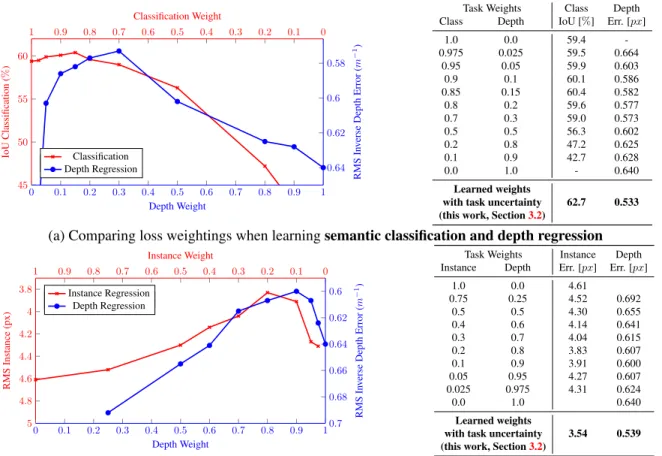
Figure 2:Learning multiple tasks improves the model’s representation and individual task performance. These figures and tables illustrate the advantages of multi-task learning for (a) semantic classification and depth regression and (b) instance and depth regression. Performance of the model in individual tasks is seen at both edges of the plot wherew= 0andw= 1. For some balance of weightings between each task, we observe improved performance for both tasks. All models were trained with a learning rate of 0.01with the respective weightings applied to the losses using the loss function in (1). Results are shown using the Tiny CityScapes validation dataset using a down-sampled resolution of128×256.
More importantly, all previous methods which learn mul-tiple tasks simultaneously use a na¨ıve weighted sum of losses, where the loss weights are uniform, or crudely and manually tuned. In this work we propose a principled way of combining multiple loss functions to simultaneously learn multiple objectives using homoscedastic task uncer-tainty. We illustrate the importance of appropriately weight-ing each task in deep learnweight-ing to achieve good performance and show that our method can learn to balance these weight-ings optimally.
3. Multi Task Learning with Homoscedastic
Uncertainty
Multi-task learning concerns the problem of optimising a model with respect to multiple objectives. It is prevalent in many deep learning problems. The naive approach to com-bining multi objective losses would be to simply perform a
weighted linear sum of the losses for each individual task:
Ltotal=
X
i
wiLi. (1)
This is the dominant approach used by prior work [39, 38, 30, 41], for example for dense prediction tasks [27], for scene understanding tasks [15] and for rotation (in quaternions) and translation (in meters) for camera pose [25]. However, there are a number of issues with this method. Namely, model performance is extremely sensitive to weight selection, wi, as illustrated in Figure 2. These weight hyper-parameters are expensive to tune, often taking many days for each trial. Therefore, it is desirable to find a more convenient approach which is able to learn the optimal weights.
More concretely, let us consider a network which learns to predict pixel-wise depth and semantic class from an in-put image. In Figure2the two boundaries of each plot show models trained on individual tasks, with the curves showing
performance for varying weightswi for each task. We ob-serve that at some optimal weighting, the joint network per-forms better than separate networks trained on each task in-dividually (performance of the model in individual tasks is seen at both edges of the plot:w= 0andw= 1). At near-by values to the optimal weight the network performs worse on one of the tasks. However, searching for these optimal weightings is expensive and increasingly difficult with large models with numerous tasks. Figure2also shows a similar result for two regression tasks; instance segmentation and depth regression. We next show how to learn optimal task weightings using ideas from probabilistic modelling.
3.1. Homoscedastic uncertainty as task-dependent
uncertainty
In Bayesian modelling, there are two main types of un-certainty one can model [24].
• Epistemic uncertainty is uncertainty in the model, which captures what our model does not know due to lack of training data. It can be explained away with increased training data.
• Aleatoric uncertaintycaptures our uncertainty with re-spect to information which our data cannot explain. Aleatoric uncertainty can be explained away with the ability to observe all explanatory variables with in-creasing precision.
Aleatoric uncertainty can again be divided into two sub-categories.
• Data-dependent or Heteroscedastic uncertainty is aleatoric uncertainty which depends on the input data and is predicted as a model output.
• Task-dependent or Homoscedastic uncertainty is aleatoric uncertainty which is not dependent on the in-put data. It is not a model outin-put, rather it is a quantity which stays constant for all input data and varies be-tween different tasks. It can therefore be described as task-dependent uncertainty.
In a multi-task setting, we show that the task uncertainty captures the relative confidence between tasks, reflecting the uncertainty inherent to the regression or classification task. It will also depend on the task’s representation or unit of measure. We propose that we can use homoscedastic uncertainty as a basis for weighting losses in a multi-task learning problem.
3.2. Multi-task likelihoods
In this section we derive a multi-task loss function based on maximising the Gaussian likelihood with homoscedastic uncertainty. LetfW(x)be the output of a neural network
with weightsWon inputx. We define the following proba-bilistic model. For regression tasks we define our likelihood as a Gaussian with mean given by the model output:
p(y|fW(x)) =N(fW(x), σ2) (2)
with an observation noise scalar σ. For classification we often squash the model output through a softmax function, and sample from the resulting probability vector:
p(y|fW(x)) =Softmax(fW(x)). (3) In the case of multiple model outputs, we often define the likelihood to factorise over the outputs, given some suffi-cient statistics. We definefW(x)as our sufficient statistics, and obtain the following multi-task likelihood:
p(y1, ...,yK|fW(x)) =p(y1|fW(x))...p(yK|fW(x))
(4) with model outputsy1, ...,yK(such as semantic segmenta-tion, depth regression, etc).
Inmaximum likelihood inference, we maximise the log likelihood of the model. In regression, for example, the log likelihood can be written as
logp(y|fW(x))∝ − 1
2σ2||y−f
W(x)||2−logσ
(5) for a Gaussian likelihood (or similarly for a Laplace like-lihood) withσ the model’s observation noise parameter – capturing how much noise we have in the outputs. We then maximise the log likelihood with respect to the model pa-rametersWand observation noise parameterσ.
Let us now assume that our model output is composed of two vectorsy1andy2, each following a Gaussian
distribu-tion:
p(y1,y2|fW(x)) =p(y1|fW(x))·p(y2|fW(x))
=N(y1;fW(x), σ12)· N(y2;fW(x), σ22).
(6) This leads to theminimisationobjective,L(W, σ1, σ2),
(our loss) for our multi-output model:
=−logp(y1,y2|fW(x)) ∝ 1 2σ2 1 ||y1−fW(x)||2+ 1 2σ2 2 ||y2−fW(x)||2+ logσ1σ2 = 1 2σ2 1 L1(W) + 1 2σ2 2 L2(W) + logσ1σ2 (7) Where we wroteL1(W) =||y1−fW(x)||2for the loss of
the first output variable, and similarly forL2(W).
We interpret minimising this last objective with respect toσ1 andσ2 as learning the relative weight of the losses
L1(W)andL2(W)adaptively, based on the data. Asσ1
– the noise parameter for the variable y1 – increases, we
have that the weight of L1(W) decreases. On the other
hand, as the noise decreases, we have that the weight of the respective objective increases. The noise is discouraged from increasing too much (effectively ignoring the data) by the last term in the objective, which acts as a regulariser for the noise terms.
This construction can be trivially extended to multiple regression outputs. However, the extension to classification likelihoods is more interesting. We adapt the classification likelihood to squash ascaled version of the model output through a softmax function:
p(y|fW(x), σ) =Softmax( 1
σ2f
W(x))
(8) with a positive scalarσ. This can be interpreted as a Boltz-mann distribution (also called Gibbs distribution) where the input is scaled byσ2(often referred to astemperature). This
scalar is either fixed or can be learnt, where the parameter’s magnitude determines how ‘uniform’ (flat) the discrete dis-tribution is. This relates to its uncertainty, as measured in entropy. The log likelihood for this output can then be writ-ten as logp(y=c|fW(x), σ) = 1 σ2f W c (x) −logX c0 exp 1 σ2f W c0 (x) (9) withfW
c (x)thec’th element of the vectorfW(x). Next, assume that a model’s multiple outputs are com-posed of a continuous output y1 and a discrete
out-put y2, modelled with a Gaussian likelihood and a
soft-max likelihood, respectively. Like before, the joint loss, L(W, σ1, σ2), is given as: =−logp(y1,y2=c|fW(x)) =−logN(y1;fW(x), σ21)·Softmax(y2=c;fW(x), σ2) = 1 2σ2 1 ||y1−fW(x)||2+ logσ1−logp(y2=c|fW(x), σ2) = 1 2σ2 1 L1(W) + 1 σ2 2 L2(W) + logσ1 + log P c0exp 1 σ2 2 fW c0 (x) P c0exp fW c0 (x) σ12 2 ≈ 1 2σ2 1 L1(W) + 1 σ2 2 L2(W) + logσ1+ logσ2, (10) where again we write L1(W) = ||y1 − fW(x)||2
for the Euclidean loss of y1, write L2(W) =
−logSoftmax(y2,fW(x))for the cross entropy loss ofy2
(withfW(x)not scaled), and optimise with respect toW as well asσ1,σ2. In the last transition we introduced the
ex-plicit simplifying assumption σ1
2 P c0exp 1 σ2 2 fW c0 (x) ≈ P c0exp fW c0 (x) σ12 2
which becomes an equality when σ2 → 1. This has the advantage of simplifying the
optimisation objective, as well as empirically improving re-sults.
This last objective can be seen as learning the relative weights of the losses for each output. Large scale values
σ2will decrease the contribution ofL2(W), whereas small
scaleσ2will increase its contribution. The scale is regulated
by the last term in the equation. The objective is penalised when settingσ2too large.
This construction can be trivially extended to arbitrary combinations of discrete and continuous loss functions, al-lowing us to learn the relative weights of each loss in a principled and well-founded way. This loss is smoothly dif-ferentiable, and is well formed such that the task weights will not converge to zero. In contrast, directly learning the weights using a simple linear sum of losses (1) would result in weights which quickly converge to zero. In the following sections we introduce our experimental model and present empirical results.
In practice, we train the network to predict the log vari-ance, s := logσ2. This is because it is more numerically
stable than regressing the variance, σ2, as the loss avoids
any division by zero. The exponential mapping also allows us to regress unconstrained scalar values, where exp(−s)
is resolved to the positive domain giving valid values for variance.
4. Scene Understanding Model
To understand semantics and geometry we first propose an architecture which can learn regression and classification outputs, at a pixel level. Our architecture is a deep con-volutional encoder decoder network [3]. Our model con-sists of a number of convolutional encoders which produce a shared representation, followed by a corresponding num-ber of task-specific convolutional decoders. A high level summary is shown in Figure1.
The purpose of the encoder is to learn a deep mapping to produce rich, contextual features, using domain knowledge from a number of related tasks. Our encoder is based on DeepLabV3 [10], which is a state of the art semantic seg-mentation framework. We use ResNet101 [20] as the base feature encoder, followed by an Atrous Spatial Pyramid Pooling (ASPP) module [10] to increase contextual aware-ness. We apply dilated convolutions in this encoder, such that the resulting feature map is sub-sampled by a factor of
(a) Input Image (b) Semantic Segmentation
(c) Instance vector regression (d) Instance Segmentation
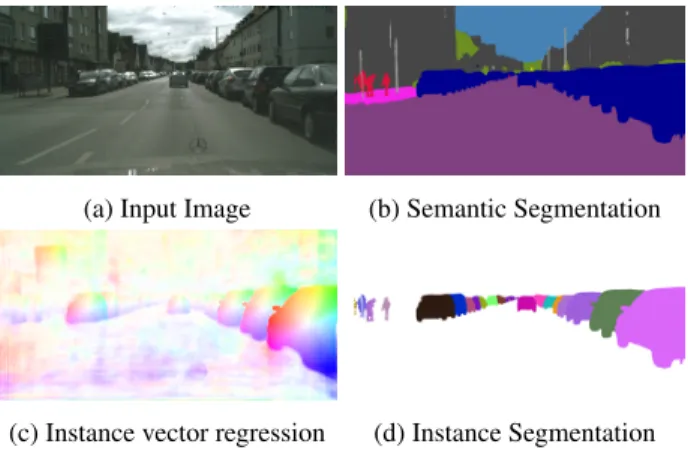
Figure 3: Instance centroid regression method. For each pixel, we regress a vector pointing to the instance’s centroid. The loss is only computed over pixels which are from instances. We visualise (c) by representing colour as the orientation of the instance vector, and intensity as the magnitude of the vector.
8 compared to the input image dimensions.
We then split the network into separate decoders (with separate weights) for each task. The purpose of the decoder is to learn a mapping from the shared features to an output. Each decoder consists of a3×3convolutional layer with output feature size 256, followed by a1×1layer regressing the task’s output. Further architectural details are described in AppendixA.
Semantic Segmentation.We use the cross-entropy loss to learn pixel-wise class probabilities, averaging the loss over the pixels with semantic labels in each mini-batch.
Instance Segmentation. An intuitive method for defin-ing which instance a pixel belongs to is an association to the instance’s centroid. We use a regression approach for in-stance segmentation [29]. This approach is inspired by [28] which identifies instances using Hough votes from object parts. In this work we extend this idea by using votes from individual pixels using deep learning. We learn an instance vector,xˆn, for each pixel coordinate,cn, which points to the centroid of the pixel’s instance,in, such thatin= ˆxn+cn. We train this regression with anL1loss using ground truth
labelsxn, averaged over all labelled pixels,NI, in a mini-batch:LInstance= |N1I|
P
NIkxn−xˆnk1.
Figure 3 details the representation we use for instance segmentation. Figure 3(a) shows the input image and a mask of the pixels which are of an instance class (at test time inferred from the predicted semantic segmentation). Figure3(b) and Figure3(c) show the ground truth and pre-dicted instance vectors for bothxandy coordinates. We then cluster these votes using OPTICS [2], resulting in the predicted instance segmentation output in Figure3(d).
One of the most difficult cases for instance segmentation algorithms to handle is when the instance mask is split due
(a) Input Image (b) Instance Segmentation
Figure 4: This example shows two cars which are occluded by trees and lampposts, making the instance segmentation challeng-ing. Our instance segmentation method can handle occlusions ef-fectively. We can correctly handle segmentation masks which are split by occlusion, yet part of the same instance, by incorporating semantics and geometry.
to occlusion. Figure4 shows that our method can handle these situations, by allowing pixels to vote for their instance centroid with geometry. Methods which rely on watershed approaches [4], or instance edge identification approaches fail in these scenarios.
To obtain segmentations for each instance, we now need to estimate the instance centres,ˆin. We propose to con-sider the estimated instance vectors,xˆn, as votes in a Hough parameter space and use a clustering algorithm to identify these instance centres. OPTICS [2], is an efficient density based clustering algorithm. It is able to identify an unknown number of multi-scale clusters with varying density from a given set of samples. We chose OPICS for two reasons. Crucially, it does not assume knowledge of the number of clusters like algorithms such as k-means [33]. Secondly, it does not assume a canonical instance size or density like discretised binning approaches [12]. Using OPTICS, we cluster the pointscn+ ˆxn into a number of estimated in-stances,ˆi. We can then assign each pixel,pnto the instance closest to its estimated instance vector,cn+ ˆxn.
Depth Regression. We train with supervised labels us-ing pixel-wise metric inverse depth usus-ing aL1loss function:
LDepth = |N1 D| P ND dn− ˆ dn
1. Our architecture esti-mates inverse depth, dˆn, because it can represent points at infinite distance (such as sky). We can obtain inverse depth labels,dn, from a RGBD sensor or stereo imagery. Pixels which do not have an inverse depth label are ignored in the loss.
5. Experiments
We demonstrate the efficacy of our method on CityScapes [13], a large dataset for road scene understand-ing. It comprises of stereo imagery, from automotive grade stereo cameras with a22cmbaseline, labelled with instance and semantic segmentations from 20 classes. Depth images are also provided, labelled using SGM [22], which we treat as pseudo ground truth. Additionally, we assign zero in-verse depth to pixels labelled as sky. The dataset was
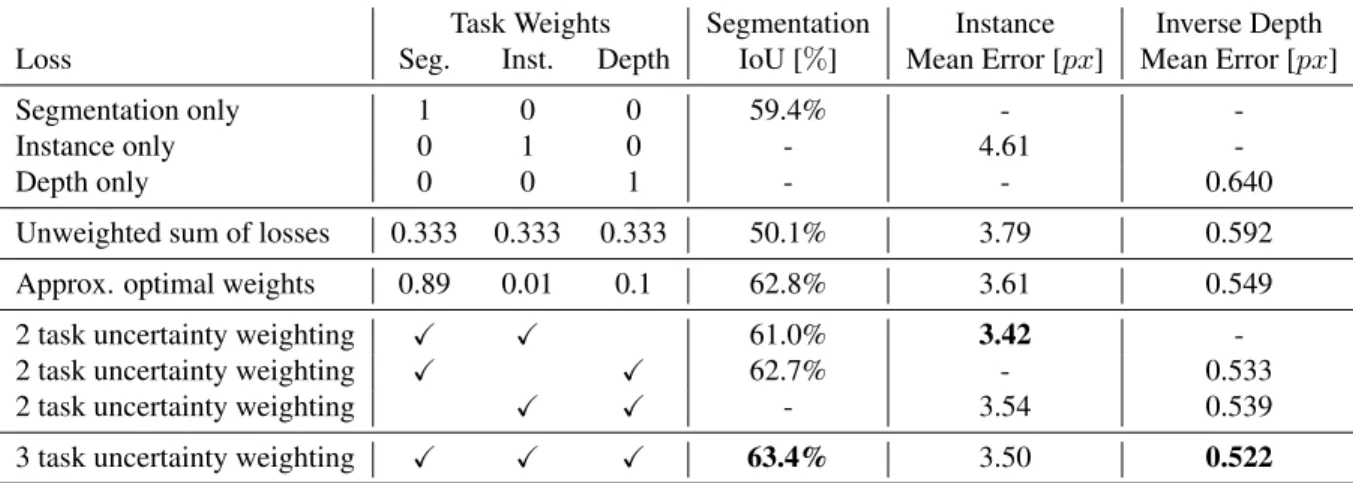
col-Task Weights Segmentation Instance Inverse Depth
Loss Seg. Inst. Depth IoU [%] Mean Error [px] Mean Error [px]
Segmentation only 1 0 0 59.4% -
-Instance only 0 1 0 - 4.61
-Depth only 0 0 1 - - 0.640
Unweighted sum of losses 0.333 0.333 0.333 50.1% 3.79 0.592
Approx. optimal weights 0.89 0.01 0.1 62.8% 3.61 0.549
2 task uncertainty weighting X X 61.0% 3.42
-2 task uncertainty weighting X X 62.7% - 0.533
2 task uncertainty weighting X X - 3.54 0.539
3 task uncertainty weighting X X X 63.4% 3.50 0.522
Table 1: Quantitative improvement when learning semantic segmentation, instance segmentation and depth with our multi-task loss. Experiments were conducted on the Tiny CityScapes dataset (sub-sampled to a resolution of128×256). Results are shown from the validation set. We observe an improvement in performance when training with our multi-task loss, over both single-task models and weighted losses. Additionally, we observe an improvement when training on all three tasks (3×X) using our multi-task loss, compared with all pairs of tasks alone (denoted by2×X). This shows that our loss function can automatically learn a better performing weighting between the tasks than the baselines.
lected from a number of cities in fine weather and consists of 2,975 training and 500 validation images at2048×1024
resolution. 1,525 images are withheld for testing on an on-line evaluation server.
Further training details, and optimisation hyperparame-ters, are provided in AppendixA.
5.1. Model Analysis
In Table1 we compare individual models to multi-task learning models using a na¨ıve weighted loss or the task un-certainty weighting we propose in this paper. To reduce the computational burden, we train each model at a reduced res-olution of128×256pixels, over50,000iterations. When we downsample the data by a factor of four, we also need to scale the disparity labels accordingly. Table1clearly il-lustrates the benefit of multi-task learning, which obtains significantly better performing results than individual task models. For example, using our method we improve classi-fication results from59.4%to63.4%.
We also compare to a number of na¨ıve multi-task losses. We compare weighting each task equally and using approx-imately optimal weights. Using a uniform weighting results in poor performance, in some cases not even improving on the results from the single task model. Obtaining approxi-mately optimal weights is difficult with increasing number of tasks as it requires an expensive grid search over param-eters. However, even these weights perform worse com-pared with our proposed method. Figure2shows that using task uncertainty weights can even perform better compared to optimal weights found through fine-grained grid search. We believe that this is due to two reasons. First, grid search is restricted in accuracy by the resolution of the search.
Second, optimising the task weights using a homoscedas-tic noise term allows for the weights to be dynamic during training. In general, we observe that the uncertainty term decreases during training which improves the optimisation process.
In AppendixBwe find that our task-uncertainty loss is robust to the initialisation chosen for the parameters. These quickly converge to a similar optima in a few hundred train-ing iterations. We also find the resulttrain-ing task weighttrain-ings varies throughout the course of training. For our final model (in Table2), at the end of training, the losses are weighted with the ratio 43 : 1 : 0.16 for semantic segmentation, depth regression and instance segmentation, respectively.
Finally, we benchmark our model using the full-size CityScapes dataset. In Table2we compare to a number of other state of the art methods in all three tasks. Our method is the first model which completes all three tasks with a sin-gle model. We compare favourably with other approaches, outperforming many which use comparable training data and inference tools. Figure5 shows some qualitative ex-amples of our model.
6. Conclusions
We have shown that correctly weighting loss terms is of paramount importance for multi-task learning problems. We demonstrated that homoscedastic (task) uncertainty is an effective way to weight losses. We derived a principled loss function which can learn a relative weighting automati-cally from the data and is robust to the weight initialization. We showed that this can improve performance for scene understanding tasks with a unified architecture for
seman-Semantic Segmentation Instance Segmentation Monocular Disparity Estimation Method IoU class iIoU class IoU cat iIoU cat AP AP 50% AP 100m AP 50m Mean Error [px] RMS Error [px]
Semantic segmentation, instance segmentation and depth regression methods (this work)
Multi-Task Learning 78.5 57.4 89.9 77.7 21.6 39.0 35.0 37.0 2.92 5.88
Semantic segmentation and instance segmentation methods
Uhrig et al. [41] 64.3 41.6 85.9 73.9 8.9 21.1 15.3 16.7 -
-Instance segmentation only methods
Mask R-CNN [19] - - - - 26.2 49.9 37.6 40.1 -
-Deep Watershed [4] - - - - 19.4 35.3 31.4 36.8 -
-R-CNN + MCG [13] - - - - 4.6 12.9 7.7 10.3 -
-Semantic segmentation only methods
DeepLab V3 [10] 81.3 60.9 91.6 81.7 - - -
-PSPNet [44] 81.2 59.6 91.2 79.2 - - -
-Adelaide [31] 71.6 51.7 87.3 74.1 - - -
-Table 2: CityScapes Benchmark [13]. We show results from the test dataset using the full resolution of1024×2048pixels. For the full leaderboard, please seewww.cityscapes-dataset.com/benchmarks. The disparity (inverse depth) metrics were computed against the CityScapes depth maps, which are sparse and computed using SGM stereo [21]. Note, these comparisons are not entirely fair, as many methods use ensembles of different training datasets. Our method is the first to address all three tasks with a single model.
(a) Input image (b) Segmentation output (c) Instance output (d) Depth output
Figure 5: Qualitative results for multi-task learning of geometry and semantics for road scene understanding. Results are shown on test images from the CityScapes dataset using our multi-task approach with a single network trained on all tasks. We observe that multi-task learning improves the smoothness and accuracy for depth perception because it learns a representation that uses cues from other tasks, such as segmentation (and vice versa).
tic segmentation, instance segmentation and per-pixel depth regression. We demonstrated modelling task-dependent ho-moscedastic uncertainty improves the model’s representa-tion and each task’s performance when compared to sepa-rate models trained on each task individually.
There are many interesting questions left unanswered. Firstly, our results show that there is usually not a single op-timal weighting for all tasks. Therefore, what is the opop-timal weighting? Is multitask learning is an ill-posed optimisa-tion problem without a single higher-level goal?
A second interesting question is where the optimal
loca-tion is for splitting the shared encoder network into separate decoders for each task? And, what network depth is best for the shared multi-task representation?
Finally, why do the semantics and depth tasks out-perform the semantics and instance tasks results in Table1? Clearly the three tasks explored in this paper are compli-mentary and useful for learning a rich representation about the scene. It would be beneficial to be able to quantify the relationship between tasks and how useful they would be for multitask representation learning.
References
[1] P. Agrawal, J. Carreira, and J. Malik. Learning to see by moving. InProceedings of the IEEE International Confer-ence on Computer Vision, pages 37–45, 2015. 2
[2] M. Ankerst, M. M. Breunig, H.-P. Kriegel, and J. Sander. Optics: ordering points to identify the clustering structure. In ACM Sigmod Record, volume 28, pages 49–60. ACM, 1999.
6
[3] V. Badrinarayanan, A. Kendall, and R. Cipolla. Segnet: A deep convolutional encoder-decoder architecture for scene segmentation. IEEE Transactions on Pattern Analysis and Machine Intelligence, 2017.1,5
[4] M. Bai and R. Urtasun. Deep watershed transform for instance segmentation. arXiv preprint arXiv:1611.08303, 2016.1,6,8
[5] J. Baxter et al. A model of inductive bias learning. J. Artif. Intell. Res.(JAIR), 12(149-198):3, 2000. 2
[6] S. R. Bul`o, L. Porzi, and P. Kontschieder. In-place activated batchnorm for memory-optimized training of dnns. arXiv preprint arXiv:1712.02616, 2017.
[7] R. Caruana. Multitask learning. InLearning to learn, pages 95–133. Springer, 1998.1,2
[8] L.-C. Chen, G. Papandreou, I. Kokkinos, K. Murphy, and A. L. Yuille. Semantic image segmentation with deep con-volutional nets and fully connected crfs. InICLR, 2015.1
[9] L.-C. Chen, G. Papandreou, I. Kokkinos, K. Murphy, and A. L. Yuille. Deeplab: Semantic image segmentation with deep convolutional nets, atrous convolution, and fully con-nected crfs.arXiv preprint arXiv:1606.00915, 2016. [10] L.-C. Chen, G. Papandreou, F. Schroff, and H. Adam.
Re-thinking atrous convolution for semantic image segmenta-tion.arXiv preprint arXiv:1706.05587, 2017.5,8,11
[11] R. Collobert and J. Weston. A unified architecture for natural language processing: Deep neural networks with multitask learning. InProceedings of the 25th international conference on Machine learning, pages 160–167. ACM, 2008.1,2
[12] D. Comaniciu and P. Meer. Mean shift: A robust approach toward feature space analysis.IEEE Transactions on pattern analysis and machine intelligence, 24(5):603–619, 2002.6
[13] M. Cordts, M. Omran, S. Ramos, T. Rehfeld, M. Enzweiler, R. Benenson, U. Franke, S. Roth, and B. Schiele. The cityscapes dataset for semantic urban scene understanding. In In Proc. IEEE Conf. on Computer Vision and Pattern Recognition, 2016.6,8
[14] J. Dai, K. He, and J. Sun. Instance-aware semantic segmenta-tion via multi-task network cascades. InIn Proc. IEEE Conf. on Computer Vision and Pattern Recognition, 2016.1
[15] D. Eigen and R. Fergus. Predicting depth, surface normals and semantic labels with a common multi-scale convolu-tional architecture. InProceedings of the IEEE International Conference on Computer Vision, pages 2650–2658, 2015.1,
2,3
[16] R. Garg and I. Reid. Unsupervised cnn for single view depth estimation: Geometry to the rescue.Computer Vision–ECCV 2016, pages 740–756, 2016.1
[17] R. Girshick, J. Donahue, T. Darrell, and J. Malik. Rich fea-ture hierarchies for accurate object detection and semantic
segmentation. InIn Proc. IEEE Conf. on Computer Vision and Pattern Recognition, pages 580–587, 2014.1
[18] B. Hariharan, P. Arbel´aez, R. Girshick, and J. Malik. Hyper-columns for object segmentation and fine-grained localiza-tion. InIn Proc. IEEE Conf. on Computer Vision and Pattern Recognition, pages 447–456. IEEE, 2014.1
[19] K. He, G. Gkioxari, P. Doll´ar, and R. Girshick. Mask r-cnn. arXiv preprint arXiv:1703.06870, 2017.8
[20] K. He, X. Zhang, S. Ren, and J. Sun. Deep residual learning for image recognition. InIn Proc. IEEE Conf. on Computer Vision and Pattern Recognition, 2016.5,11
[21] H. Hirschmuller. Accurate and efficient stereo processing by semi-global matching and mutual information. InIn Proc. IEEE Conf. on Computer Vision and Pattern Recognition, volume 2, pages 807–814. IEEE, 2005.8
[22] H. Hirschmuller. Stereo processing by semiglobal matching and mutual information.IEEE Transactions on pattern anal-ysis and machine intelligence, 30(2):328–341, 2008.6
[23] J.-T. Huang, J. Li, D. Yu, L. Deng, and Y. Gong. Cross-language knowledge transfer using multilingual deep neural network with shared hidden layers. InAcoustics, Speech and Signal Processing (ICASSP), 2013 IEEE International Con-ference on, pages 7304–7308. IEEE, 2013.1
[24] A. Kendall and Y. Gal. What uncertainties do we need in bayesian deep learning for computer vision? arXiv preprint arXiv:1703.04977, 2017.4
[25] A. Kendall, M. Grimes, and R. Cipolla. Convolutional net-works for real-time 6-dof camera relocalization. In Pro-ceedings of the International Conference on Computer Vi-sion (ICCV), 2015.2,3
[26] J. Kirkpatrick, R. Pascanu, N. Rabinowitz, J. Veness, G. Des-jardins, A. A. Rusu, K. Milan, J. Quan, T. Ramalho, A. Grabska-Barwinska, et al. Overcoming catastrophic for-getting in neural networks. Proceedings of the National Academy of Sciences, page 201611835, 2017.2
[27] I. Kokkinos. Ubernet: Training auniversal’convolutional neural network for low-, mid-, and high-level vision us-ing diverse datasets and limited memory. arXiv preprint arXiv:1609.02132, 2016.1,2,3
[28] B. Leibe, A. Leonardis, and B. Schiele. Robust object detec-tion with interleaved categorizadetec-tion and segmentadetec-tion. Inter-national Journal of Computer Vision (IJCV), 77(1-3):259– 289, 2008.6
[29] X. Liang, Y. Wei, X. Shen, J. Yang, L. Lin, and S. Yan. Proposal-free network for instance-level object segmenta-tion.arXiv preprint arXiv:1509.02636, 2015.6
[30] Y. Liao, S. Kodagoda, Y. Wang, L. Shi, and Y. Liu. Un-derstand scene categories by objects: A semantic regularized scene classifier using convolutional neural networks. In2016 IEEE International Conference on Robotics and Automation (ICRA), pages 2318–2325. IEEE, 2016.2,3
[31] G. Lin, C. Shen, I. Reid, et al. Efficient piecewise training of deep structured models for semantic segmentation. arXiv preprint arXiv:1504.01013, 2015.8
[32] J. Long, E. Shelhamer, and T. Darrell. Fully convolutional networks for semantic segmentation.In Proc. IEEE Conf. on Computer Vision and Pattern Recognition, 2015.1
[33] J. MacQueen et al. Some methods for classification and anal-ysis of multivariate observations. InProceedings of the fifth Berkeley symposium on mathematical statistics and proba-bility, volume 1, pages 281–297. Oakland, CA, USA., 1967.
6
[34] I. Misra, A. Shrivastava, A. Gupta, and M. Hebert. Cross-stitch networks for multi-task learning. InProceedings of the IEEE Conference on Computer Vision and Pattern Recogni-tion, pages 3994–4003, 2016.2
[35] J. Ngiam, A. Khosla, M. Kim, J. Nam, H. Lee, and A. Y. Ng. Multimodal deep learning. InProceedings of the 28th inter-national conference on machine learning (ICML-11), pages 689–696, 2011.2
[36] M. Oquab, L. Bottou, I. Laptev, and J. Sivic. Learning and transferring mid-level image representations using convolu-tional neural networks. InIn Proc. IEEE Conf. on Computer Vision and Pattern Recognition, pages 1717–1724. IEEE, 2014.2
[37] P. O. Pinheiro, R. Collobert, and P. Dollar. Learning to seg-ment object candidates. InAdvances in Neural Information Processing Systems, pages 1990–1998, 2015.1
[38] P. Sermanet, D. Eigen, X. Zhang, M. Mathieu, R. Fergus, and Y. LeCun. Overfeat: Integrated recognition, localization and detection using convolutional networks. International Conference on Learning Representations (ICLR), 2014.1,2,
3
[39] M. Teichmann, M. Weber, M. Zoellner, R. Cipolla, and R. Urtasun. Multinet: Real-time joint semantic reasoning for autonomous driving. arXiv preprint arXiv:1612.07695, 2016.2,3
[40] S. Thrun. Is learning the n-th thing any easier than learning the first? InAdvances in neural information processing sys-tems, pages 640–646. MORGAN KAUFMANN PUBLISH-ERS, 1996.2
[41] J. Uhrig, M. Cordts, U. Franke, and T. Brox. Pixel-level encoding and depth layering for instance-level semantic la-beling.arXiv preprint arXiv:1604.05096, 2016.2,3,8
[42] F. Yu and V. Koltun. Multi-scale context aggregation by di-lated convolutions. InICLR, 2016.1
[43] S. Zagoruyko and N. Komodakis. Wide residual networks. In E. R. H. Richard C. Wilson and W. A. P. Smith, editors, Pro-ceedings of the British Machine Vision Conference (BMVC), pages 87.1–87.12. BMVA Press, September 2016.
[44] H. Zhao, J. Shi, X. Qi, X. Wang, and J. Jia. Pyramid scene parsing network.arXiv preprint arXiv:1612.01105, 2016.8
[45] S. Zheng, S. Jayasumana, B. Romera-Paredes, V. Vineet, Z. Su, D. Du, C. Huang, and P. Torr. Conditional random fields as recurrent neural networks. InInternational Confer-ence on Computer Vision (ICCV), 2015.1
A. Model Architecture Details
We base our model on the recently introduced DeepLabV3 [10] segmentation architecture. We use ResNet101 [20] as our base feature encoder, with dilated convolutions, resulting in a feature map which is downsam-pled by a factor of 8 compared with the original input im-age. We then append dilated (atrous) convolutional ASPP module [10]. This module is designed to improve the con-textual reasoning of the network. We use an ASPP module comprised of four parallel convolutional layers, with 256 output channels and dilation rates (1, 12, 24, 36), with ker-nel sizes (12,32,32,32). Additionally, we also apply global
average pooling to the encoded features, and convolve them to 256 dimensions with a 1 ×1 kernel. We apply batch normalisation to each of these layers and concatenate the resulting 1280 features together. This produces the shared representation between each task.
We then split the network, to decode this representation to a given task output. For each task, we construct a decoder consisting of two layers. First, we apply a1×1convolution, outputting 256 features, followed by batch normalisation and a non-linear activation. Finally, we convolve this output to the required dimensions for a given task. For classifica-tion, this will be equal to the number of semantic classes, otherwise the output will be 1 or 2 channels for depth or in-stance segmentation respectively. Finally, we apply bilinear upsampling to scale the output to the same resolution as the input.
The majority of the model’s parameters and depth is in the feature encoding, with very little flexibility in each task decoder. This illustrates the attraction of multitask learning; most of the compute can be shared between each task to learn a better shared representation.
A.1. Optimisation
For all experiments, we use an initial learning rate of 2.5×10⁻³ and polynomial learning rate decay (1 −
iter max iter)
0.9. We train using stochastic gradient descent,
with Nesterov updates and momentum0.9 and weight de-cay104. We conduct all experiments in this paper using
PyTorch.
For the experiments on the Tiny CityScapes validation dataset (using a down-sampled resolution of128×256) we train over 50,000 iterations, using256×256 crops with batch size of 8 on a single NVIDIA 1080Ti GPU. We apply random horizontal flipping to the data.
For the full-scale CityScapes benchmark experiment, we train over100,000iterations with a batch size of 16. We apply random horizontal flipping (with probability 0.5) and random scaling (selected from 0.7 - 2.0) to the data dur-ing traindur-ing, before makdur-ing a512×512crop. The training data is sampled uniformly, and is randomly shuffled for each
epoch. Training takes five days on a single computer with four NVIDIA 1080Ti GPUs.
B. Further Analysis
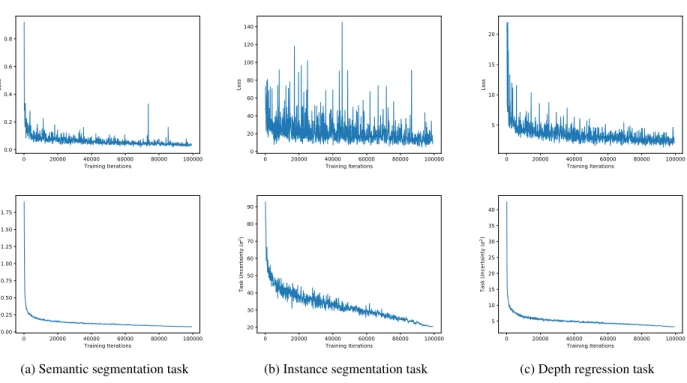
This task uncertainty loss is also robust to the value we use to initialise the task uncertainty values. One of the at-tractive properties of our approach to weighting multi-task losses is that it is robust to the initialisation choice for the homoscedastic noise parameters. Figure6shows that for an array of initial choices oflogσ2 from−2.0to5.0 the
ho-moscedastic noise and task loss is able to converge to the same minima. Additionally, the homoscedastic noise terms converges after only 100 iterations, while the network re-quires30,000+iterations to train. Therefore our model is robust to the choice of initial value for the weighting terms. Figure7shows losses and uncertainty estimates for each task during training of the final model on the full-size CityScapes dataset. At a point 500 iterations into training, the model estimates task variance of 0.60, 62.5 and 13.5 for semantic segmentation, instance segmentation and depth re-gression, respectively. Becuase the losses are weighted by the inverse of the uncertainty estimates, this results in a task weighting ratio of approximately 23 : 0.22 : 1 between se-mantics, instance and depth, respectively. At the conclu-sion of training, the three tasks have uncertainty estimates of 0.075, 3.25 and 20.4, which results in effective weighting between the tasks of 43: 0.16 : 1. This shows how the task uncertainty estimates evolve over time, and the approximate final weightings the network learns. We observe they are far from uniform, as is often assumed in previous literature.
Interestingly, we observe that this loss allows the net-work to dynamically tune the weighting. Typically, the ho-moscedastic noise terms decrease in magnitude as training progresses. This makes sense, as during training the model becomes more effective at a task. Therefore the error, and uncertainty, will decrease. This has a side-effect of increas-ing the effective learnincreas-ing rate – because the overall uncer-tainty decreases, the weight for each task’s loss increases. In our experiments we compensate for this by annealing the learning rate with a power law.
Finally, a comment on the model’s failure modes. The model exhibits similar failure modes to state-of-the-art single-task models. For example, failure with objects out of the training distribution, occlusion or visually challenging situations. However, we also observe our multi-task model tends to fail with similar effect in all three modalities. Ie. an erroneous pixel’s prediction in one task will often be highly correlated with error in another modality. Some examples can be seen in Figure8.
0 50 100 150 200 250 Training Iterations −1 0 1 2 3 4 5 Ta sk U nc er ta in ty
(a) Semantic segmentation task
0 50 100 150 200 250 Training Iterations 1 2 3 4 5 6 7 8 Ta sk U nc er ta in ty
(b) Instance segmentation task
0 50 100 150 200 250 Training Iterations −1 0 1 2 3 4 5 Ta sk U nc er ta in ty
(c) Depth regression task
Figure 6: Training plots showing convergence of homoscedastic noise and task lossfor an array of initialisation choices for the ho-moscedastic uncertainty terms for all three tasks. Each plot shows the the hoho-moscedastic noise value optimises to the same solution from a variety of initialisations. Despite the network taking10,000+iterations for the training loss to converge, the task uncertainty converges very rapidly after only 100iterations.
0 20000 40000 60000 80000 100000 Training Iterations 0.0 0.2 0.4 0.6 0.8 Lo ss 0 20000 40000 60000 80000 100000 Training Iterations 0 20 40 60 80 100 120 140 Lo ss 0 20000 40000 60000 80000 100000 Training Iterations 5 10 15 20 Lo ss 0 20000 40000 60000 80000 100000 Training Iterations 0.00 0.25 0.50 0.75 1.00 1.25 1.50 1.75 Ta sk Un ce rt ai nt y (σ 2)
(a) Semantic segmentation task
0 20000 40000 60000 80000 100000 Training Iterations 20 30 40 50 60 70 80 90 Ta sk Un ce rt ai nt y (σ 2)
(b) Instance segmentation task
0 20000 40000 60000 80000 100000 Training Iterations 5 10 15 20 25 30 35 40 Ta sk Un ce rt ai nt y (σ 2)
(c) Depth regression task
Figure 7:Learning task uncertainty. These training plots show the losses and task uncertainty estimates for each task during training. Results are shown for the final model, trained on the fullsize CityScapes dataset.
C. Further Qualitative Results
(a) Input image (b) Semantic segmentation (c) Instance segmentation (d) Depth regression Figure 8:More qualitative results on test images from the CityScapes dataset.
![Table 2: CityScapes Benchmark [13]. We show results from the test dataset using the full resolution of 1024 × 2048 pixels](https://thumb-us.123doks.com/thumbv2/123dok_us/418428.2547973/8.918.72.821.115.367/table-cityscapes-benchmark-results-dataset-using-resolution-pixels.webp)