91
Chapter 4
Aligning IT to
Organizational Strategy
Seven deadly sins of the IT scorecard:1. An IT-centric view of IT performance 2. Measures that don’t matter
3. Lack of standard metrics definitions 4. Over-reliance on tools
5. Lack of drill-down capability hindering interpretation 6. Too many metrics
7. No individual impact
—Working Council for Chief Information Officers (2003)
In the late 1980s, the deficiency in measuring IT using purely financial measures was addressed by Parker, Benson, and Trainor (1988) in their book on information economics.
Information economics assigns numerical scores to value and risk categories by a joint committee of end users and IT staff. For example, a value category of “0” would signify “no positive contribution” while a “5” would indicate a “large positive contribution.” In the same vein, in the risk category, a “0” would mean no risk and a “5” would indicate a “large risk.” Each of the categories is assigned a weight. By summing the weighted scores of the value categories and subtracting the weighted
92 Implementing the IT Balanced Scorecard
scores of the risk categories, one can calculate the total score of each
project. Value linking incorporates the benefits and cost in other functional
areas, while value restructuring refers to the efficiency and effectiveness
of employees (e.g., does the new system free up employee time so that they can do their own jobs more effectively?). The balanced scorecard (BSC) extends the information economics theory into a set of constructs understandable and immediately usable throughout the organization.
This chapter discusses how the balanced scorecard can be used within the IT department to assess its own performance as well as to integrate itself to the organization as a whole. One quickly discovers that there are a variety of approaches to implementing an IT scorecard.
The IT Balanced Scorecard
Over the past decade, many CIOs have realized that it is not sufficient to manage merely the IT end of the business. The integration of IT strategy to business strategy must be managed as well. The tool chosen for this task is the balanced scorecard.
The Working Council for Chief Information Officers (2003) did an extensive review of IT scorecards and found that the most advanced scorecards shared the following six structural attributes:
1. Simplicity of presentation. The very best scorecards are limited to a single page of from 10 to 20 metrics written in nontechnical language.
2. Explicit links to IT strategy. The scorecard should be tightly coupled to the IT strategic planning process and assist in tracking progress against IT’s key goals and objectives.
3. Broad executive commitment. Both senior IT as well as senior business managers should be involved in the scorecard process — both creation and ongoing.
4. Enterprise-standard metrics definitions. Consensus should be quickly achieved on metrics definitions. The review meetings should focus on decisions rather than debate over metrics. 5. Drill-down capability and available context. The high-level IT
scorecard should allow for detailed review of trends or variance by providing more granularity on component elements.
6. Individual manager compensation should be linked to scorecard performance.
Progressive scorecard practitioners track metrics in five key categories:
Aligning IT to Organizational Strategy 93
1. Financial performance. IT spending in the content of service levels, project progress, etc. Sample metrics include cost of data commu-nications per seat and relative spending per portfolio category. 2. Project performance. Sample metrics include percentage of new
development investment resulting in new revenue streams and per-centage of IT R&D investment leading to IT service improvements. 3. Operational performance. Instead of concentrating measurement efforts on day-to-day measures, best-in-class practitioners seek to provide an aggregate, customer-focused view of IT operations. Sample metrics include peak time availability and critical process uptime.
4. Talent management. This category of metrics seeks to manage IT human capital. Measures include staff satisfaction and retention as well as attractiveness of the IT department to external job seekers. Metrics include retention of high-potential staff and external cita-tions of IT achievement.
5. User satisfaction. Sample metrics include focused executive feed-back and user perspective.
The Working Council also found that best-of-br eed practitioners included two additional metric categories:
1. Information security. These metrics monitor remediation efforts for known vulnerabilities and track proactive policy and certification efforts. (Also see Appendix K for a discussion of E-business audit-ing.) Sample metrics include percentage of staff receiving security training and percentage of external partners in compliance with security standards.
2. Enterprise initiatives. Best-of-breed practitioners also use the score-card to highlight IT’s contributions to initiatives of corporate stra-tegic importance. Sample metrics include percentage of acquired company systems integrated in the Merger and Acquisition category and the number of business process steps enabled by technology in the Process Reengineering category.
Bowne & Co. (www.bowne.com), a New York City-based documents
management company, initiated an IT balanced scorecard in 1997. Their process consisted of seven steps:
1. Kick-off training for IT staff.
2. Ongoing strategy mapping. The annual IT strategy, like most com-panies, is derived from the corporate strategy.
94 Implementing the IT Balanced Scorecard
3. Metrics selection. A team, including the chief technology officer, created a list of metrics. The list was refined using analysis of each potential metric’s strengths and weaknesses. The CIO approved the final list.
4. Metrics definition. A set of standard definitions is created for each metric. It defines the measurement technique as well as the data collection process. It outlines initiatives that must be completed to allow tracking of the metrics.
5. Assigning metric ownership. Owners are assigned to each metric. This person is responsible for scorecard completion. Their bonuses are related to their scorecard-related duties.
6. Data collection and quality assurance. Data frequency varies by metric, based on cost of collection, the corporate financial reporting cycle, and the volatility of the business climate.
7. CIO, CTO, and corporate officers review scorecard every six months; metrics are revisited annually.
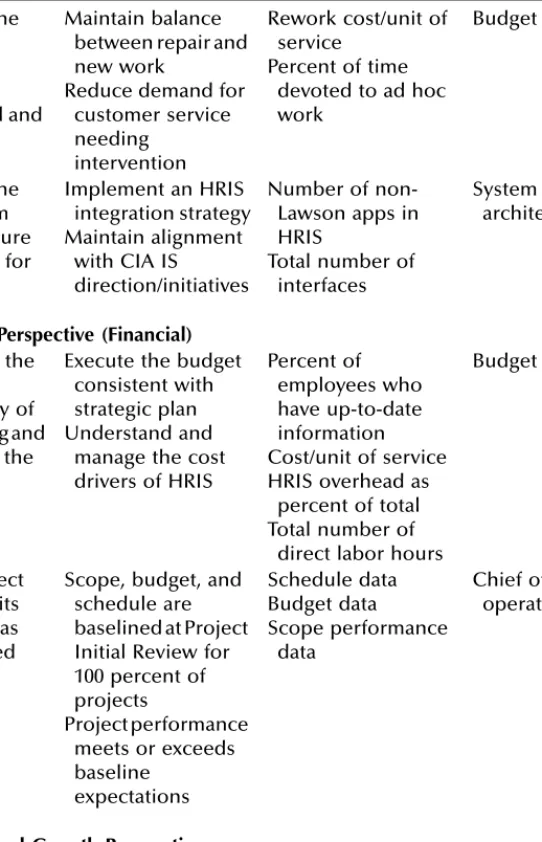
Bowne & Co. is a good example of a departmentwide IT scorecard but this process can also be used to develop a scorecard for a particular system. The Central Intelligence Agency (Hagood and Friedman, 2002) did just this for a human resource information system (HRIS). The program director developed six criteria for success that would drive the balanced scorecard development effort:
1. Deliver each new program segment on time and within budget 2. Deliver each functionality as promised
3. Maintain high system performance standards 4. Reduce reliance on legacy systems
5. Increase customer satisfaction 6. Employee satisfaction
The resulting scorecard can be seen in Table 4.1.
Altering the Balanced Scorecard for IT
Martinsons, Davison, and Tse (1999) suggest that the four balanced score-card perspectives might require some modification to be effective as an IT scorecard. Their reasoning is that the IT department is typically an internal rather than external service supplier, and projects are commonly carried out for the benefit of both the end users and the organization as a whole — rather than individual customers within a large market.
Aligning IT to Organizational Strategy 95
TABLE 4.1 The CIA’s HRIS Balanced Scorecard
Goals Objectives Measures Sources
Customer Perspective Provide HR information systems that meet agency needs Incorporate stakeholder feedback into strategic planning Provide timely and
accurate responses to customer service requests
Component HR officer survey HRIS help desk
performance Level of participation in CIA IT forums percent with collaboration HR front office Help desk personnel Deliver all projects for customers in conformance with an acceptable plan
All projects have plans negotiated with customers and are baselined
Percent of baselined projects with a plan
Chief of operations Manage HRIS work in conformity with published strategic and tactical plans Maintain HR roadmap as basis for resource allocation Communicate HRIS strategic direction to stakeholders Roadmap reviewed every two weeks and updated Number of projects performed for direct customers Level of participation in CIA IT forums with collaborations Personnel Chief of operations
Internal Process Perspective
HRIS data is available for users to conduct their business Improve accuracy of data entry Maintain data accurately within the HRIS
Make HRIS available to users for input 97 percent of the time
Ensure retrievable data is no older than 24 hours
Data entry error rates HRIS hourly availability data Payroll processing time Age of data Compensation group System engineer
96 Implementing the IT Balanced Scorecard
TABLE 4.1 (continued) The CIA’s HRIS Balanced Scorecard
Goals Objectives Measures Sources
Achieve the optimal balance between technical and strategic activities Maintain balance between repair and new work
Reduce demand for customer service needing intervention Rework cost/unit of service Percent of time devoted to ad hoc work Budget officer Achieve the minimum architecture effective for HRIS Implement an HRIS integration strategy Maintain alignment with CIA IS direction/initiatives Number of non-Lawson apps in HRIS Total number of interfaces System architect
Resource Perspective (Financial)
Maximize the cost efficiency of operating and evolving the HRIS
Execute the budget consistent with strategic plan Understand and
manage the cost drivers of HRIS Percent of employees who have up-to-date information Cost/unit of service HRIS overhead as percent of total Total number of
direct labor hours
Budget officer
Each project delivers its product as advertised
Scope, budget, and schedule are baselined at Project Initial Review for 100 percent of projects Project performance meets or exceeds baseline expectations Schedule data Budget data Scope performance data Chief of operations
Learning and Growth Perspective
Maintain a skilled and productive workforce to operate and evolve the HRIS Implement an effective strategic workforce plan Recruit skilled
workers who have initiative, innovation, and flexibility Number of employees with COTR certification Project management training levels Percent of technical
training goals met
Personnel
Aligning IT to Organizational Strategy 97
Martinsons et al. (1999) suggested four perspectives: 1. User orientation (end-user view):
Mission: deliver value-adding products and services to end users
Objectives: establish and maintain a good image and reputation
with end users; exploit IT opportunities, establish good relation-ships with the user community, satisfy end-user requirements, and be perceived as the preferred supplier of IT products and services 2. Business value (management’s view):
Mission: contribute to the value of the business
Objectives: establish and maintain a good image and reputation
with management, ensure that IT projects provide business value, control IT costs, and sell appropriate IT products and services to third party
3. Internal processes (operations-based view):
Mission: deliver IT products and services in an efficient and
effective manner
Objectives: anticipate and influence requests from end users
and management, be efficient in planning and developing IT
TABLE 4.1 (continued) The CIA’s HRIS Balanced Scorecard
Goals Objectives Measures Sources
Retain employees by giving opportunities and incentives Enhance employees’ knowledge and skills Maintain a high degree of HRIS employee satisfaction Enhance employees’ knowledge and skills Provide opportunities for individual career growth Project management training levels Percent of technical
training goals met Job Description
Index (JDI) scores Percent of voluntary
separations
Personnel
Ensure that HRIS learns from the past for better future performance
Record, analyze, and use lessons learned Develop best
practices for HRIS
Percent of leaders’ time devoted to mentoring Percent of projects with lessons learned in database Personnel
98 Implementing the IT Balanced Scorecard
applications, be efficient in operating and maintaining IT appli-cations, be efficient in acquiring and testing new hardware and software, and provide cost-effective training that satisfies end users
4. Future readiness (innovation and learning view):
Mission: deliver continuous improvement and prepare for future
challenges
Objectives: anticipate and prepare for IT problems that could
arise, continuously upgrade IT skills through training and devel-opment, regularly upgrade IT applications portfolio, regularly upgrade hardware and software, conduct cost-effective research into emerging technologies and their suitability for the business Martinsons et al. then drill down to provide IT-specific measures for each of these four perspectives. Most of the metrics have been derived
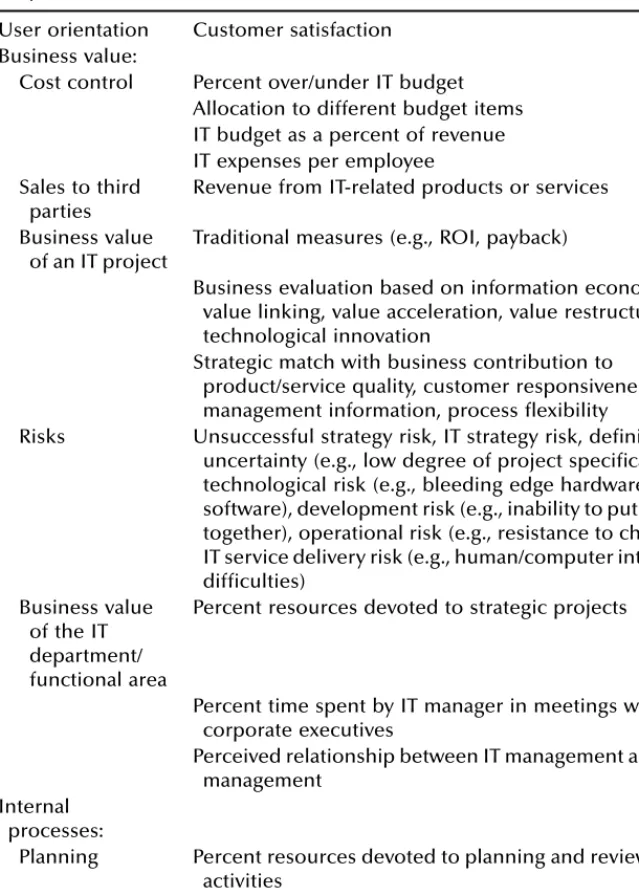
from mainstream literature and include those presented in Table 4.2.
Martinsons et al. also explain that the three key balanced scorecard principles of:
1. Cause-and-effect relationships 2. Sufficient performance drivers 3. Linkage to financial measures
are built into their IT scorecard. They explain that cause-and-effect rela-tionships can involve one or more of the four perspectives. For example, better staff skills (future readiness perspective) will reduce the frequency of bugs in an application (internal operations perspective).
Great-West Life Case Study
Van Grembergen, Saull, and De Haes (2003) performed an intensive study of the methodology used by Canada-based Great-West Life to develop their IT balanced scorecard. Great-West Life is the result of a merger between three financial services companies, each with its own IT services department. Stakeholders were quite concerned that they would lose control of their IT groups after the merger, so the merged IT department decided to utilize the balanced scorecard approach to formalize the controls and measures required to ensure IT success.
The merged IT department consisted of seven units: career centers, management services, account management, application delivery, technol-ogy services, corporate technoltechnol-ogy, and the E-business solutions center.
Aligning IT to Organizational Strategy 99
TABLE 4.2 IT Scorecard Metrics
Perspective Metric
User orientation Customer satisfaction Business value:
Cost control Percent over/under IT budget Allocation to different budget items IT budget as a percent of revenue IT expenses per employee
Sales to third parties
Revenue from IT-related products or services Business value
of an IT project
Traditional measures (e.g., ROI, payback)
Business evaluation based on information economics: value linking, value acceleration, value restructuring, technological innovation
Strategic match with business contribution to product/service quality, customer responsiveness, management information, process flexibility
Risks Unsuccessful strategy risk, IT strategy risk, definitional uncertainty (e.g., low degree of project specification), technological risk (e.g., bleeding edge hardware or software), development risk (e.g., inability to put things together), operational risk (e.g., resistance to change), IT service delivery risk (e.g., human/computer interface difficulties)
Business value of the IT department/ functional area
Percent resources devoted to strategic projects
Percent time spent by IT manager in meetings with corporate executives
Perceived relationship between IT management and top management
Internal processes:
Planning Percent resources devoted to planning and review of IT activities
Development Percent resources devoted to applications development Time required to develop a standard-sized new
application
Percent of applications programming with reused code Time spent to repair bugs and fine-tune new
applications
100 Implementing the IT Balanced Scorecard
At the time of the study, the IT department employed 812 full-time and part-time employees.
The organizational structure of the IT department is quite interesting. Application delivery was created as a stand-alone unit to focus on con-tinuous improvement of delivery performance. Account management was created to ensure effective communications with the company’s end users. This department takes great pains to educate end users on IT corporate agendas and translate business needs into IT processes. As its name implies, the career center focuses on the professional development of IT staff. The corporate technology group utilizes a centralized approach to the development of a common enterprise architecture and technology policies. Finally, the management services group focuses on running IT as a business and provides for effective financial reporting and adherence to the IT scorecard.
TABLE 4.2 (continued) IT Scorecard Metrics
Perspective Metric
Operations Number of end-user queries handled
Average time required to address an end-user problem Future readiness:
IT specialist capabilities
IT training and development budget as a percent of overall IT budget
Expertise with specific technologies Expertise with emerging technologies Age distribution of IT staff
Satisfaction of IT staff Turnover/retention of IT employees Productivity of IT employees Applications portfolio Age distribution Platform distribution
Technical performance of applications portfolio User satisfaction with applications portfolio Research into
emerging technologies
IT research budget as percentage of IT budget
Perceived satisfaction of top management with reporting on how specific emerging technologies may or may not be applicable to the company
Aligning IT to Organizational Strategy 101
As one can see, the organizational structure of the IT department roughly parallels that of the four perspectives of the balanced scorecard:
1. Financial perspective — management services 2. Customer perspective — account management
3. Internal perspective — application delivery, technology services, corporate technology, E-business solutions
4. Learning and growth perspective — career centers
Senior management of the three companies questioned the benefits of large investments in IT and wanted IT to be better aligned with corporate strategy. Some of the concerns of the different stakeholder groups included:
Senior management:
– Does IT support the achievement of business objectives? – What value does the expenditure on IT deliver?
– Are IT costs being managed effectively? – Are IT risks being identified and managed?
– Are targeted inter-company IT synergies being achieved?
Business unit executives:
– Are IT services delivered at a competitive cost? – Does IT deliver on its service level commitments
– Do IT investments positively affect business productivity or the customer experience?
– Does IT contribute to the achievement of our business strate-gies?
Corporate compliance internal audit:
– Are the organization’s assets and operations protected? – Are the key business and technology risks being managed? – Are proper processes, practices, and controls in place?
IT organization:
– Are we developing the professional competencies needed for successful service delivery?
– Are we creating a positive workplace environment?
– Do we effectively measure and reward individual and team performances?
– Do we capture organizational knowledge to continuously improve performance?
– Can we attract and retain the talent we need to support the business?
102 Implementing the IT Balanced Scorecard
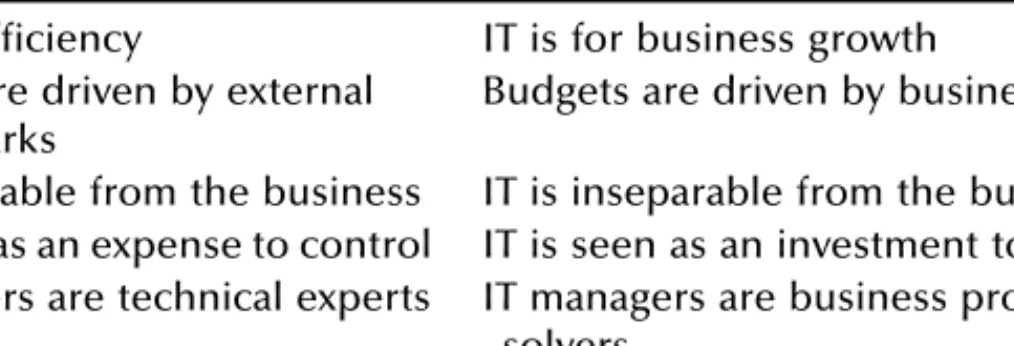
One of the most important initiatives the new CIO undertook was to migrate the new information services group to a strategic partner, as opposed to an IT services provider. As articulated by Venkatraman (1999) and summarized in Table 4.3, there are some important differences.
Great-West Life’s IT scorecard, as described by Van Grembergen, Saull, and De Haes (2003), encompasses the following four quadrants:
1. Customer orientation: to be the supplier of choice for all information services, either directly or indirectly through supplier relationships. 2. Corporate contribution: to enable and contribute to the achievement of business objectives through effective delivery of value-added information services.
3. Operational excellence: to deliver timely and effective services at targeted service levels and costs.
4. Future orientation: to develop the internal capabilities to continu-ously improve performance through innovation, learning, and per-sonal organization growth.
Van der Zee (1999) and Van Grembergen (2000) proposed that the relationship between IT and business can be more explicitly expressed
through a cascade of balanced scorecards, as shown in Figure 4.1.
Cascading was used effectively at Great-West Life, similar to the example in Figure 4.1, with the addition of “governance services” scorecards. Notice the use of the term “scorecards” — plural. Each set of scorecards is actually composed of one or more unit scorecards. For example, the IT Operations scorecard also includes a scorecard for IT Service Desk. Great-West Life’s four-quadrant IT scorecard consists of the following objectives, measures,
and benchmarks, as shown in Tables 4.4, 4.5, 4.6, and 4.7.
The measures of each of these unit scorecards are aggregated into the IT balanced scorecard. This, in turn, is fed into and evaluated against the business balanced scorecard.
TABLE 4.3 Moving IT from Service Provider to Strategic Partner
Service Provider Strategic Partner
IT is for efficiency IT is for business growth Budgets are driven by external
benchmarks
Budgets are driven by business strategy IT is separable from the business IT is inseparable from the business IT is seen as an expense to control IT is seen as an investment to manage IT managers are technical experts IT managers are business problem
solvers
Aligning IT to Organizational Strategy 103
Representative IT Balanced Scorecard Value Metrics
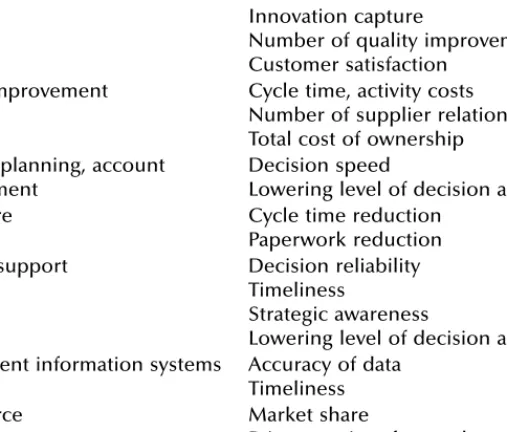
There are a wide variety of metrics that an organization can utilize. Arveson (1998), writing for the Balanced Scorecard Institute, recommends the
met-rics outlined in Table 4.8. Readers should also review Appendix C, which
contains a list of standard IT metrics, and Appendix B, which provides the metrics capability evaluation guide employed by the U.S. Air Force.
Drilling Down to the Specific System
Hopefully by now one understands the importance of developing cascad-ing sets of interlinked balanced scorecards. From a departmental perspec-tive, one will need to review, understand, and adhere to the organizational balanced scorecard from a macro perspective. However, one will need to review the departmental- and system-level scorecards from a micro level. The beginning of this chapter discussed an example of a balanced scorecard used by the CIA to assess the performance of a human resource information system. Another example of a micro-level scorecard is one that can be built for the implementation of a customer r elationship management (CRM) system. Brewton (2003) provides an illustration of a
balanced CRM scorecard in Table 4.9.
FIGURE 4.1 Cascade of balanced scorecards. Business balanced scorecard IT balanced scorecard IT development balanced scorecards IT Operations balanced scorecards AU2621_book.fm Page 103 Wednesday, January 12, 2005 2:44 PM
104 Implementing the IT Balanced Scorecard
Like Brewton (2003), Rosemann and Wiese (1999) demonstrate that the balanced scorecard can be used at the system level. Enterprise resource planning (ERP) is one of the most sophisticated and complex of all software systems. It is a customizable software package that includes integrated business solutions for core business processes such as produc-tion planning and control and warehouse management. The major ERP vendors (SAP, Baan, Oracle, and PeopleSoft) have seen their profitability soar in recent years.
Rosemann and Wiese (1999) use a modified balanced scorecard approach to:
Evaluate the implementation of ERP software
Evaluate the continuous operation of the ERP installation
Along with the four balanced scorecard perspectives of financial, customer, internal processes, and innovation and learning, they have
TABLE 4.4 Corporate Contribution Scorecard Evaluates IT from the Perspective of Senior Management
Objective Measures Benchmarks
Business/ IT alignment
1. Operational plan/budget approval
1. Not applicable Value delivery 2. Measured in business unit
performance
2. Not applicable Cost
management
3. Attainment of expense and recovery targets
3. Industry expenditure comparisons
4. Attainment of unit cost targets 4. Compass operational “top performance” levels Risk management
5. Results of internal audits 5. Defined sound business practices 6. Execution of security initiative 6. Not applicable 7. Delivery of disaster recovery assessment 7. Not applicable Inter-company synergy achievement
8. Single system solutions 8. Merger and
acquisition guidelines 9. Target state architecture
approval
9. Not applicable 10. Attainment of targeted
integrated cost reductions
10. Not applicable 11. IT organization integration 11. Not applicable
Aligning IT to Organizational Strategy 105
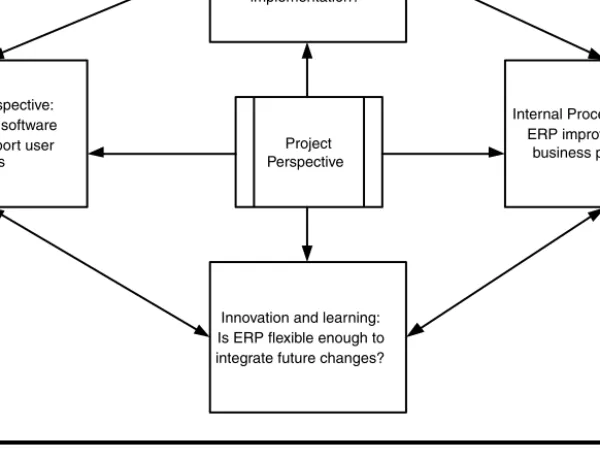
added a fifth for the purposes of ERP installation — the project perspective. The individual project requirements, such as identification of critical path, milestones, etc., are covered by this fifth perspective, which represents
all the project management tasks. Figure 4.2 represents the
Rosemann-Wiese approach.
Rosemann and Wiese contend that most ERP implementers concentrate on the financial and business processes aspects of ERP implementation. Using the ERP balanced scorecard would enable them to also focus on customer and innovation and learning perspectives. The latter is particu-larly important because it enables the development of alternative values for the many conceivable development paths that support a flexible system implementation.
Implementation measures might include:
Financial: total cost of ownership, which would enable identifica-tion of modules where over-customizaidentifica-tion took place
Project: processing time along the critical path, remaining time to the next milestone, time delays that would affect financial perspective
TABLE 4.5 Customer Orientation Scorecard Evaluated the Performance of IT from the Perspective of Internal Business Users
Objective Measures Benchmarks
Customer satisfaction
1. Business unit survey ratings 1. Not applicable a. Cost transparency and levels
b. Service quality and responsiveness
c. Value of IT advice and support d. Contribution to business
objectives Competitive
costs
2. Attainment of unit cost targets 2. Compass operational “Top-Level” performing levels 3. Blended labor rates 3. Market
comparisons Development
services performance
4. Major project success scores 4. Not applicable a. Recorded goal attainment
b. Sponsor satisfaction ratings c. Project governance rating Operational
services performance
5. Attainment of targeted service levels
5. Competitor comparisons
106 Implementing the IT Balanced Scorecard
Internal processes: processing time before and after ERP implemen-tation, coverage of individual requirements for a process
Customer: linkage of customers to particular business processes automated, resource allocation per customer
Innovation and learning: number of alternative process paths to support a flexible system implementation, number of parameters representing unused customizing potential, number of documents describing customizing decisions
As in all well-designed balanced scorecards, this one demonstrates a very high degree of linkage in terms of cause-and-effect relationships. For example, “customer satisfaction” within the Customer perspective might affect “total cost of ownership” in the Financial perspective, “total project time” in the Project perspective, “Fit with ERP solution” in the Internal
TABLE 4.6 Operational Excellence Scorecard Views IT from the Perspective of IT Managers and Audit and Regulatory Bodies
Objective Measures Benchmarks
Development process performance
1. Function point measures of: 1. To be determined a. Productivity b. Quality c. Delivery rate Operational process performance
2. Benchmark based measures of: 2. Selected compass benchmark studies a. Productivity b. Responsiveness c. Change management effectiveness
d. Incident occurrence levels Process
maturity
3. Assessed level of maturity and compliance in priority processes within:
3. To be defined a. Planning and organization
b. Acquisition and implementation c. Delivery and support
d. Monitoring Enterprise
architecture management
4. Major project architecture approval 4. OSFI sound business practices 5. Product acquisition compliance
with technology standards
5. Not applicable 6. “State of the infrastructure”
assessment
Aligning IT to Organizational Strategy 107
Process perspective, and “User suggestions” in the Innovation and Learning perspective.
Rosemann and Wiese do not require the Project perspective in the balanced scorecard for evaluating the continuous operation of the ERP installation. Here, the implementation follows a straightforward balanced scorecard approach. Measures include:
Financial:
– Compliance with budget for hardware, software, consulting
Customer:
– Coverage of business processes: percent of covered process types, percent of covered business transactions, percent of covered transactions valued good or fair
– Reduction of bottlenecks: percent of transactions not finished on schedule, percent of cancelled telephone order processes due to noncompetitive system response time
Internal process:
– Reduction of operational problems: number of problems with customer order processing system, percent of problems with
TABLE 4.7 Future Orientation Perspective Shows IT Performance from the Perspective of the IT Department Itself: Process Owners, Practitioners, and Support Professionals
Objective Measures Benchmarks
Human resource management
1. Results against targets: a. Staff complement by skill
type
a. Not applicable b. Staff turnover b. Market comparison c. Staff “billable” ratio c. Industry standard d. Professional development
days per staff member
d. Industry standard Employee
satisfaction
2. Employee satisfaction survey scores in: 2. North American technology dependent companies a. Compensation b. Work climate c. Feedback d. Personal growth e. Vision and purpose Knowledge
management
3. Delivery of internal process improvements to library
3. Not applicable 4. Implementation of “lessons
learned” sharing process
4. Not applicable
108 Implementing the IT Balanced Scorecard
customer order processing system, number of problems with warehouse processes, number of problems with standard reports, number of problems with reports on demand
– Availability of the ERP system: average system availability, aver-age downtime, maximum downtime
– Avoidance of operational bottlenecks: average response time in order processing, average response time in order processing at peak time, average number of OLTP transactions, maximum number of OLTP transactions
– Actuality of the system: average time to upgrade the system, release levels behind the actual level
– Improvement in system development: punctuality index of sys-tem delivery, quality index
– Avoidance of developer bottlenecks: average workload per developer, rate of sick leave per developer, percent of modules covered by more than two developers
TABLE 4.8 Recommended Metrics
System/Service/Function Possible Metric(s)
R&D Innovation capture
Number of quality improvements Customer satisfaction
Process improvement Cycle time, activity costs
Number of supplier relationships Total cost of ownership
Resource planning, account management
Decision speed
Lowering level of decision authority Groupware Cycle time reduction
Paperwork reduction Decision support Decision reliability
Timeliness
Strategic awareness
Lowering level of decision authority Management information systems Accuracy of data
Timeliness E-commerce Market share
Price premium for products or services Information-based products and
services
Operating margins New business revenues Cash flow
Aligning IT to Organizational Strategy 109
Innovation and learning:
– Qualification: number of training hours per user, number of training hours per developer, qualification index of developer (i.e., how qualified is this developer to do what he or she is doing)
– Independence of consultants: number of consultant days per module in use for more than two years, number of consultant days per module in use for less than two years
– Reliability of software vendor: number of releases per year, number of functional additions, number of new customers
Keeping Track of What Is Going On
Operational awareness is the continuous attention to those activities that enable an organization to determine how well it is meeting predetermined
TABLE 4.9 CRM Scorecard
Perspective Success Factor Metric
Financial Maximize customer lifetime value
Maximize share of wallet
Customer lifetime value ($) Share of wallet (%)
Customer Increase retention Increase penetration Increase win-backs Increase new business Increase satisfaction
Retention percent (%) Penetration ratio (number) Win-back percent (%)
Customer acquisitions (number) Customers highly satisfied (%) Process Maximize sales productivity
Maximize marketing effectiveness
Maximize service quality
Conversion rate per sales channel (%)
Revenue per conversion rate per sales channel ($)
Cost of sales per sales channel ($) Number of leads per marketing
channel (number)
Service level per channel (%) Cost per service encounter ($) Staff Increase employee
satisfaction
Maintain high employee retention
Increase core CRM competencies
CRM employees highly satisfied, by CRM function (%)
CRM employee retention (%) Strategic CRM core competency
coverage, by CRM function (%)
Implement
ing the IT Balanc
ed Sc
orecard
FIGURE 4.2 The ERP balanced scorecard.
Financial Perspective: What are the detailed costs of the ERP implementation?
Customer Perspective: Does the ERP software efficiently support user
needs
Innovation and learning: Is ERP flexible enough to integrate future changes?
Internal Processes: Does ERP improve internal
business processes Project
Perspective
Aligning IT to Organizational Strategy 111
performance objectives. It is a necessary component of scorecard-type endeavors.
Factors influencing the level of operational awareness include the nature of the work, the type of organization, and past performance. Accordingly, oversight organizations should maintain a relationship with the overseen organization and its management staff that affords ongoing awareness of that organization’s strengths and weaknesses, if any. This monitoring or surveillance is a fundamental part of operational awareness.
Surveillance
Surveillance includes both formal and informal activities. Formal surveil-lance activities, based on specific criteria, are typically established in writing and provided to the organization. Surveillance, general in nature and usually conducted and reported orally, is an effective approach when circumstances require flexibility to accommodate changing emphasis, shift-ing priorities, or establishshift-ing rapport. There should be scheduled activities that provide for sufficient levels of operational awareness, a sampling of which follows:
1. Hold periodic meetings between management staff with agenda items designed to fully communicate subjects such as curr ent initiatives, status of problem areas and actions taken to date, scheduled and planned training, and policy and procedure revision status of organizational or contract change implementation, as appropriate.
2. Review status reports and trend analyses of performance measures. Perform limited on-site review (if applicable) of selected areas of significant risk as appropriate.
3. Maintain awareness and involvement at a level such that a “for cause” issue is not a surprise.
When a “for cause” condition exists, certain surveillance activities may be assigned to other disciplines or functional areas. In these instances, supporting documentation resulting from the findings should be provided to the organization. Reports generated as a result of internal audits should be considered valuable diagnostic tools.
Selected significant risk areas typically refer to those actions or activities that require compliance with laws, regulations, and contract terms and conditions. There should be various control systems employed as neces-sary to ensure compliance and to test the currency and adequacy of the business system.
112 Implementing the IT Balanced Scorecard
Validation and Verification
Validation is the process of determining the degree of accuracy and completeness of the measurement techniques and the resulting data. Assessment practices and results should be periodically validated. The success of the self-assessment will depend largely on the mutually agreed-upon and understood performance objectives, measures, and expectations; the scope, depth, and effectiveness of the self-assessment; and the integrity of the self-assessment.
Verification is the process of substantiating a set of data results by means such as checking stated facts, citations, measurements, or attendant circumstances.
Verification of data resulting, for example, from the self-assessment and other operational awareness activities will, in part, formulate the basis of the approval of the business system. The data should be analyzed to determine its accuracy and that comparisons or benchmarks are valid.
Verification of narrative or statistical data should be tailored by data type. For example, reports and documentation could substantiate the self-assessment results of measures designed to demonstrate efficiency. Like-wise, interviews with selected internal and external customers and the organization’s employees may also verify reported survey results. Trend analysis of the self-assessment results should reflect the factual information provided by the interviews with staff.
The following suggestions can assist in the validation and verification of the self-assessment process and results:
Mutually understand what and how the organization will measure
performance.
Become familiar with the data sources and methods that will be
used in the calculations.
Confirm that the collection methodology is accurate, complete, and
timely.
Confirm that the data is properly controlled.
Become familiar with the trend analysis techniques to be used and
gain assurances that the organization’s personnel are qualified in this area.
On to
Chapter 5
This chapter discussed the unique concept of the IT scor ecard and
discovered that some researchers and many organizations have fine-tuned
the idea of the balanced scorecard to suit their own particular purposes. This chapter also discussed a variety of IT-specific scorecard examples,
Aligning IT to Organizational Strategy 113
along with their associated metrics. Hopefully, one is now becoming a lot more comfortable with the topic — as well as the process — and is getting ready to embark on a balanced scorecard project of one’s own.
Chapters 5 through 8 embark on very specific discussions of each scorecard perspective. Chapter 5 specifically delves into the financial perspective of the balanced scorecard.
References
Arveson, P. (1998). The Value of Corporate IT Initiatives.
http://www.balanced-scorecard.org/bscit/value_add.html.
Brewton, J. (2003, December 15). How Can We Use a Scorecard to Maximize Our
CRM Performance. CRM Magazine. http://www.destinationcrm.com/articles/
default.asp?ArticleID=3689&KeyWords=balanced.
Hagood, W. and L. Friedman. (2002, Winter). Using the Balanced Scorecard to
Measure the Performance of Your HR Information System. Public Personnel
Management, Vol. 31, No. 4.
Martinsons, M., R. Davison, and D. Tse. (1999, February). The Balanced Scorecard:
A Foundation for the Strategic Management of Information Systems.
Deci-sion Support Systems, 25(1), 71–88.
Parker, M., R. Benson, and H. Trainor. (1988). Information Economics: Linking
Business Performance to Information Technology. Englewood Cliffs, NJ:
Prentice Hall.
Rosemann, M. and J. Wiese. (1999). Measuring the Performance of ERP Software —
A Balanced Scorecard Approach. Proceedings of the 10th Australasian
Conference on Information Systems. http://www2.vuw.ac.nz/acis99/Papers/
PaperRosemannWiese-089.pdf.
Van der Zee, J. (1999, March). Alignment Is Not Enough: Integrating Business and
IT Management with the Balanced Scorecard. Proceedings of the 1st
Con-ference on the IT Balanced Scorecard, pp. 1–21.
Van Grembergen, W., R. Saull, and S. De Haes. (2003). Linking the IT Balanced Scorecard to the Business Objectives at a Major Canadian Financial Group.
Journal of Information Technology Cases and Application, Vol. 5, No. 1.
Van Grembergen, W. (2000). The balanced scorecard and IT governance.
Infor-mation Systems Control Journal, 2, 40–43.
Venkatraman, N. (1999). Valuing the IS contribution to the business. Computer
Sciences Corporation Report.
Working Council for Chief Information Officers. (2003). IT Balanced Scorecards.
http://www.cio.executiveboard.com/Images/CIO/PDF/CIO73748.pdf. AU2621_book.fm Page 113 Wednesday, January 12, 2005 2:44 PM