AUTOMATIC REFINEMENT OF
LARGE-SCALE CROSS-DOMAIN
KNOWLEDGE GRAPHS
Inauguraldissertation
zur Erlangung des akademischen Grades
eines Doktors der Naturwissenschaften
der Universität Mannheim
vorgelegt von
André de Oliveira Melo
aus Santiago, Brasilien
Dekan:
Professor Dr. Heinz Jürgen Müller, Universität Mannheim
Referent:
Professor Dr. Heiko Paulheim, Universität Mannheim
Korreferent*:
Professor Dr. Heiner Stuckenschmidt, Universität Mannheim
Tag der mündlichen Prüfung: 24. August 2018
*Anmerkung: Der Korreferent wird aus dem lateinischen "con" und "referre" abgeleitet und damit ist der "zweite Gutachter" der Korreferent - mir zwei "r".
Abstract
Knowledge graphs are a way to represent complex structured and unstructured in-formation integrated into an ontology, with which one can reason about the existing information to deduce new information or highlight inconsistencies. Knowledge graphs are divided into the terminology box (TBox), also known as ontology, and the assertions box (ABox). The former consists of a set of schema axioms defining classes and properties which describe the data domain. Whereas the ABox consists of a set of facts describing instances in terms of the TBox vocabulary.
In the recent years, there have been several initiatives for creating large-scale cross-domain knowledge graphs, both free and commercial, with DBpedia, YAGO, and Wikidata being amongst the most successful free datasets. Those graphs are often constructed with the extraction of information from semi-structured knowl-edge, such as Wikipedia, or unstructured text from the web using NLP methods. It is unlikely, in particular when heuristic methods are applied and unreliable sources are used, that the knowledge graph is fully correct or complete. There is a trade-off between completeness and correctness, which is addressed differently in each knowledge graph’s construction approach.
There is a wide variety of applications for knowledge graphs, e.g. semantic search and discovery, question answering, recommender systems, expert systems and personal assistants. The quality of a knowledge graph is crucial for its applica-tions. In order to further increase the quality of such large-scale knowledge graphs, various automatic refinement methods have been proposed. Those methods try to infer and add missing knowledge to the graph, or detect erroneous pieces of infor-mation. In this thesis, we investigate the problem of automatic knowledge graph refinement and propose methods that address the problem from two directions, au-tomatic refinement of the TBox and of the ABox.
In Part I we address the ABox refinement problem. We propose a method for predicting missing type assertions using hierarchical multilabel classifiers and in-going/outgoing links as features. We also present an approach to detection of rela-tion asserrela-tion errors which exploits type and path patterns in the graph. Moreover, we propose an approach to correction of relation errors originating from confusions between entities. Also in the ABox refinement direction, we propose a knowledge graph model and process for synthesizing knowledge graphs for benchmarking ABox completion methods.
In Part II we address the TBox refinement problem. We propose methods for iii
iv
inducing flexible relation constraints from the ABox, which are expressed using SHACL. We introduce an ILP refinement step which exploits correlations between numerical attributes and relations in order to the efficiently learn Horn rules with numerical attributes. Finally, we investigate the introduction of lexical information from textual corpora into the ILP algorithm in order to improve quality of induced class expressions.
In Appendix A we present an empirical comparison of local and global feature selection for transformation based multilabel classification. This work consolidates the advantage of using local feature selection, which is exploited in our approaches for type prediction and detection of relation assertion errors.
Zusammenfassung
Wissensbasen stellen eine Möglichkeit dar, komplexe strukturierte und unstrukturi-erte Informationen als Ontologie und Instanzen darzustellen. Mit diesen Informa-tionen können Schlussfolgerungen, Regeln und andere Formen von Logik verwen-den werverwen-den, um neue Informationen abzuleiten oder Inkonsistenzen aufzudecken. Wissensbasen sind aufgeteilt in einen terminologischen Formalismus (Ontologie/T-Box) und in einen assertionalen Formalismus (A(Ontologie/T-Box). Ersteres besteht aus einer Reihe von Axiomen, die Klassen und Eigenschaften definieren und die Daten-domäne beschreiben. Wohingegen die ABox aus einer Menge von Fakten besteht, die die Instanzen in Bezug auf das TBox-Vokabular beschreiben.
In den letzten Jahren gab es mehrere Initiativen, um große domänenübergrei-fende Wissensbasen (sowohl freie als auch kommerzielle) zu erstellen, wobei DB-pedia, YAGO und Wikidata zu den erfolgreichsten freien Datansätzen gehören. Diese Graphen werden oft aus semistrukturiertem Wissen, wie Wikipedia, oder unstrukturierten Texten aus dem Internet unter Verwendung von NLP-Methoden konstruiert. Insbesondere wenn heuristische Methoden und unzuverlässige Daten-quellen verwendet werden, ist es unwahrscheinlich, dass die Wissensbasis völlig korrekt oder vollständig ist. Es gibt einen Kompromiss zwischen Vollständigkeit und Korrektheit, der in jedem Konstruktionsansatz der Wissensbasis unterschiedlich behandelt wird.
Es gibt eine große Vielfalt von Anwendungen für Wissensbasen, z.B. semantis-che Susemantis-che, Frage-Antwort Szenarios, Empfehlungssysteme, Expertensysteme und persönliche Assistenten. Die Qualität einer Wissensbasis ist entscheidend für ihre Anwendungen. Um die Qualität solcher umfangreichen Wissensbasen weiter zu er-höhen, wurden verschiedene automatische Verfeinerungsverfahren vorgeschlagen. Diese Methoden versuchen, fehlendes Wissen abzuleiten und hinzuzufügen, oder fehlerhafte Informationen zu erkennen. In dieser Arbeit untersuchen wir das Prob-lem der automatischen Verfeinerung von Wissensbasen und schlagen Methoden vor, die das Problem aus zwei Richtungen angehen: automatischen Verfeinerung von TBox sowie ABox.
In Abschnitt I befassen wir uns mit dem ABox-Verfeinerungsproblem. Wir schlagen eine Methode zur Vorhersage fehlender Typ-Informationen vor, die hi-erarchische Multilabel-Klassifikatoren und eingehende/ausgehende Verbindungen als Merkmale/Features verwenden. Wir präsentieren auch einen Ansatz zur Erken-nung von falschen Beziehungen zwischen zwei Entitäten, der die Typinformation
vi
und Pfadmuster im Graphen verwendet. Darüber hinaus schlagen wir einen Ansatz zur Korrektur dieser Fehler vor, die aus Verwechslungen zwischen Entitäten entste-hen. Im Rahmen der ABox-Verfeinerung, schlagen wir ein Modell und einen Prozess zur Synthese von Wissensbasen vor, die zum Benchmarking von Meth-oden zur ABox-Vervollständigung verwendet werden.
In Abschnitt II sprechen wir das TBox-Verfeinerungsproblem an. Wir schla-gen Methoden vor, um aus der ABox flexible Restrikionen von Beziehunschla-gen zu erzeugen, die mit SHACL ausgedrückt werden. Wir führen einen ILP-Verfei-nerungsschritt ein, der Korrelationen zwischen numerischen Attributen und Bezie-hungen ausnutzt, um Hornregeln mit numerischen Attributen effizienter zu lernen. Abschließend untersuchen wir die Einführung von lexikalischen Informationen aus Textkorpora, um die Qualität erzeugter Klassenausdrücke von ILP-Verfahren zu verbessern.
Im Anhang A präsentieren wir einen empirischen Vergleich der lokalen und globalen Merkmalselektion für transformationsbasierte Multilabel-Klassifikation. Diese Arbeit konsolidiert den Vorteil der Verwendung lokaler Merkmalselektion, die in unseren Ansätzen für die Typvorhersage und die Erkennung von falschen Beziehungen ausgenutzt wird.
Contents
1 Introduction 1 1.1 Research Questions . . . 4 1.2 Contributions . . . 5 1.3 Structure . . . 5 2 Fundamentals 8 2.1 Knowledge Graphs in the Semantic Web . . . 82.2 Linked Open Data . . . 9
2.3 Knowledge Graph Construction . . . 12
2.4 Incompleteness and Noise . . . 13
2.5 Knowledge Graph Lifecycle . . . 14
2.6 Ontology Learning . . . 16
2.7 Automatic ABox Refinement Approaches . . . 17
2.7.1 Error Detection vs. Graph Completion . . . 17
2.7.2 Internal vs. External Methods . . . 17
2.7.3 Latent vs. Graph Feature Models . . . 17
2.8 Evaluation of Knowledge Graph Refinement Methods . . . 18
3 Related Work 20 3.1 Synthesis of Knowledge Graphs for Benchmarking . . . 20
3.2 Type Prediction . . . 21
3.3 Relation Assertion Error Detection . . . 23
3.4 Correction of Confusions in Knowledge Graphs . . . 24
3.5 Relation Constraints Learning . . . 25
3.6 Inductive Lexical Learning of Class Expressions . . . 26
3.7 Learning Rules With Numerical Attributes . . . 27
3.8 Summary . . . 28
I ABox Refinement 30 4 Synthesizing Knowledge Graphs for Refinement Benchmarking 31 4.1 Introduction . . . 31
4.2 Knowledge Graph Model . . . 32 vii
viii CONTENTS
4.3 Synthesis Process . . . 35
4.4 Experiments . . . 37
4.5 Conclusion . . . 42
5 Type Prediction using Hierarchical Multilabel Classification 43 5.1 Introduction . . . 43
5.2 Preliminaries . . . 44
5.2.1 Multilabel Classification Approaches . . . 45
5.2.2 Hierarchical Multilabel Classification Approaches . . . . 45
5.2.3 Evaluation Measures . . . 47 5.3 Problem Definition . . . 48 5.4 Approach . . . 50 5.4.1 Algorithm . . . 50 5.4.2 Features . . . 53 5.5 Experiments . . . 56 5.5.1 Datasets . . . 56
5.5.2 SLCN Base Classifier and Parameter Settings . . . 59
5.5.3 Graph Features vs. Latent Features . . . 59
5.5.4 Scalability Experiments . . . 62
5.5.5 Large-Scale Experiments on SW Datasets . . . 63
5.6 Conclusion . . . 65
6 Detection of Relation Assertion Errors 66 6.1 Introduction . . . 66
6.2 Problem Definition . . . 67
6.3 Approach . . . 67
6.3.1 Extracted Features . . . 69
6.3.2 Learning the Model . . . 71
6.4 Experiments . . . 71 6.4.1 Datasets . . . 72 6.4.2 Evaluation Measures . . . 73 6.4.3 Parameter Settings . . . 74 6.4.4 Comparison . . . 75 6.4.5 Manual Evaluation . . . 77 6.5 Conclusion . . . 79
7 Correction of Confusions Between Entities 80 7.1 Introduction . . . 80
7.2 Proposed Approach . . . 81
7.2.1 Type Prediction . . . 81
7.2.2 Retrieving Candidates . . . 82
7.2.3 Correcting Wrong facts . . . 83
7.3 Experiments . . . 84
CONTENTS ix
II TBox Refinement 87
8 Generation of SHACL Relation Constraints 88
8.1 Introduction . . . 88
8.2 Generating SHACL constraints . . . 89
8.2.1 SHACL . . . 90
8.2.2 Generation Process . . . 90
8.3 Experiments . . . 94
8.4 Conclusion . . . 98
9 Inductive Lexical Learning of Class Expressions 99 9.1 Introduction . . . 99 9.2 Preliminaries . . . 100 9.3 Approach . . . 102 9.4 Evaluation . . . 104 9.4.1 Experimental Setup . . . 104 9.4.2 Results . . . 105 9.4.3 Discussion . . . 107 9.5 Conclusion . . . 108
10 Learning Rules With Numerical Attributes 109 10.1 Introduction . . . 109 10.2 Problem Definition . . . 111 10.3 Interestingness Measure . . . 112 10.4 Correlation Lattice . . . 113 10.4.1 Independence Test . . . 114 10.4.2 Scalability . . . 115 10.5 ILP Algorithm . . . 116 10.6 Experiments . . . 116 10.7 Conclusion . . . 120 11 Thesis Conclusion 121 11.1 Part I: ABox Refinement . . . 121
11.2 Part II: TBox Refinement . . . 122
11.3 Open Issues and Limitations . . . 123
11.4 Future Work . . . 124
11.4.1 General Perspective . . . 125
A Local vs. Global Feature Selection in Multilabel Classification 127 A.1 Introduction . . . 127
A.2 Background . . . 128
A.2.1 Multilabel Classification . . . 129
A.2.2 Hierarchical Multilabel Classification . . . 130
x CONTENTS
A.2.4 Feature Selection Methods . . . 134
A.3 Related Work . . . 134
A.4 Feature Selection on Transformed Multilabel Classification . . . . 135
A.4.1 Global Feature Selection . . . 135
A.4.2 Local Feature Selection . . . 136
A.4.3 Analysis of Local Feature Sets . . . 137
A.5 Experiments . . . 138
A.5.1 Datasets . . . 139
A.5.2 Scalability . . . 142
A.5.3 Results . . . 143
A.5.4 Statistical Analysis . . . 147
A.6 Conclusion and Future Work . . . 149
List of Publications
Parts of the work presented in this thesis have been previously published in interna-tional journals and proceedings of internainterna-tional conferences. For all publications the author of this thesis was a key contributor of the work presented in both the publications and this thesis.
• André Melo, Martin Theobald and Johanna Völker: Correlation-Based Re-finement of Rules with Numerical Attributes. In Proceedings of FLAIRS’14, pages 345–250 (125): Chapter 10
• André Melo and Heiko Paulheim. Detection of Relation Assertion Errors in
Knowledge Graphs. In Proceedings of K-CAP’17, pages 22:1–22:8 (121): Chapter 6.
• André Melo and Heiko Paulheim:Type Prediction in RDF Knowledge Bases
Using Hierarchical Multilabel Classification. In Proceedings of WIMS’16, pages 14:1–14:10 (124): Chapter 5
• André Melo and Heiko Paulheim:Synthesizing Knowledge Graphs for Link and Type Prediction Benchmarking. In Proceedings of ESWC’17, pages 136–151 (123): Chapter 4
• André Melo and Heiko Paulheim:Type Prediction in RDF Knowledge Bases Using Hierarchical Multilabel Classification With Graph and Latent Fea-tures. International Journal on Artificial Intelligence Tools, Volume 26, 2017 (126): Chapter 5
• André Melo and Heiko Paulheim:An Approach to Correction of Erroneous Links in Knowledge Graphs. In Proceedings of QEKGraph colocated with K-CAP’17 (120): Chapter 7
• André Melo and Heiko Paulheim: Learning SHACL Constraints for
Valida-tion of RelaValida-tion AsserValida-tions in Knowledge Graphs. Submitted to Semantic Web Journal (Tracking number: 1888-3101): Chapter 8
• Lorenz Bühmann, Daniel Fleischhacker, Jens Lehmann, André Melo and Johanna Völker: Inductive Lexical Learning of Class Expressions. In Pro-ceedings of EKAW’14, pages 42–53 (23): Chapter 9
xii CONTENTS
• André Melo and Heiko Paulheim: Local and Global Feature Selection for Multilabel Classification With Binary Relevance. Airtificial Intelligence Re-view, pages 1–28, 2017 (122): Appendix A
List of Figures
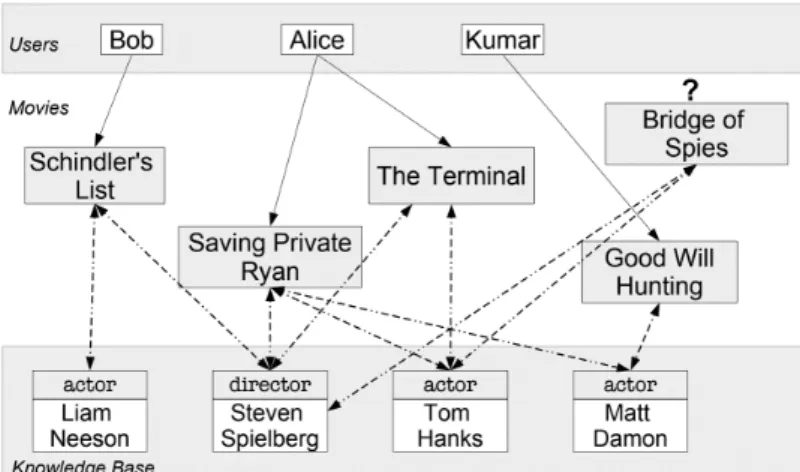
1.1 Example of movie recommendation using a knowledge base (28) . 2
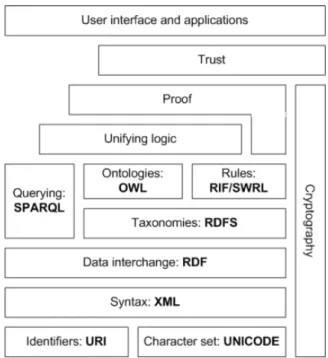
2.1 Semantic Web stack . . . 10
2.2 The Linking Open Data cloud diagram . . . 11
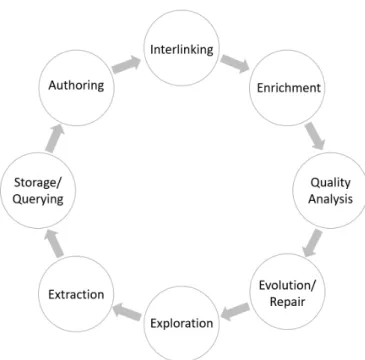
2.3 The Linked Data lifecycle . . . 15
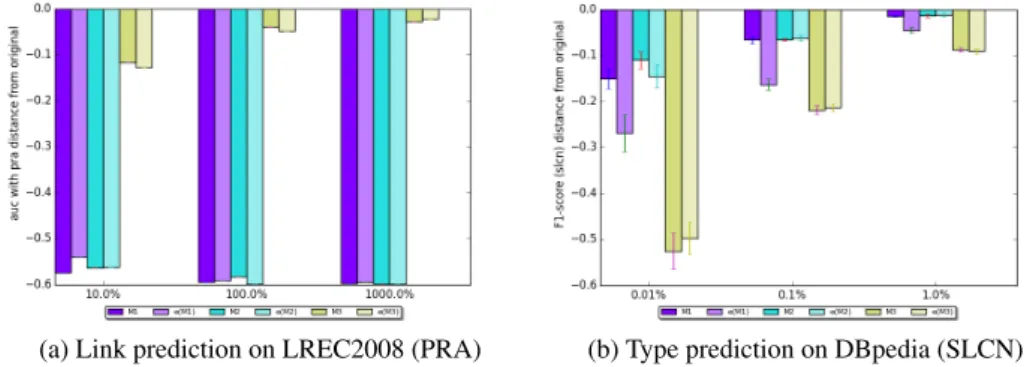
4.1 Distances of performance measures to original datasets . . . 39
4.2 Effect of scaling the replica sizes up and down . . . 39
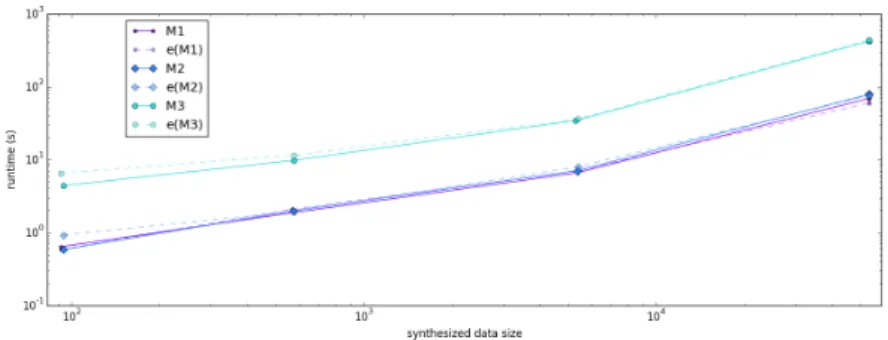
4.3 Nemenyi Critical distance diagrams for link and type prediction . 41 4.4 Synthesis process runtime over dataset size for the ESWC2015 model 42 5.1 A subset of the DBpedia type hierarchy . . . 45
5.2 Hierarchical multilabel classification local classifier approaches . 47 5.3 Evaluation of the impact of the parameters n and k on hF and runtime. . . 60
5.4 Type prediction results for different number of HolE embeddings dimensions . . . 61
5.5 Scalability in terms of number of instances, features and labels . . 63
6.1 Critical distance diagram comparing path selection heuristics . . . 75
6.2 Manual evaluation on DBpedia and NELL . . . 78
6.3 Runtime comparison of the evaluated methods . . . 79
7.1 Manual evaluation on DBpedia and NELL respectively . . . 85
8.1 Example of decision tree pruning . . . 91
8.2 Manual evaluation on DBpedia and YAGO . . . 96
8.3 Manual evaluation of the differences between SHACL and SSI on DBpedia and YAGO . . . 96
9.1 Outline of the general learning approach in ELTL: Class expres-sions taking the available background knowledge into account are generated and evaluated in a heuristic with respect to the target learning problem. Figure adapted from (77). . . 101
9.2 Illustration of a search tree in ELTL. . . 102 xiii
xiv LIST OF FIGURES
10.1 Confidence distribution over ageY . . . 110
10.2 Confidence distribution of rule r2 over the age attribute for the overall USA population (a) as well as refined by the states Florida (b) and South Dakota (c) . . . 111
10.3 Example of a body support distribution (10.3a) with different pos-itives distributions (10.3b) and (10.3d) . . . 112
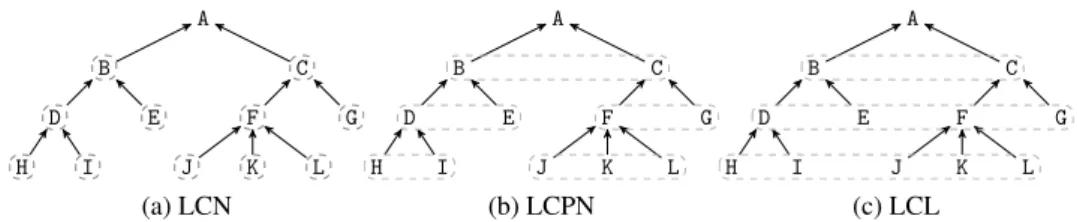
10.4 Example of correlation lattice for the numerical attributeage . . . 114
10.5 Example of a test for independence between the literals marital-Status(X,single)andemploymentStatus(X,unemployed) . . . 115
10.6 Evaluation of the correlation lattice construction . . . 118
10.7 Evaluation of the ILP extension . . . 119
A.2 Wilcoxon test on flat and hierarchical multilabel datasets . . . 148
A.1 Global vs local feature selection comparison with J48 and mea-suresD1andD2. . . 150
List of Tables
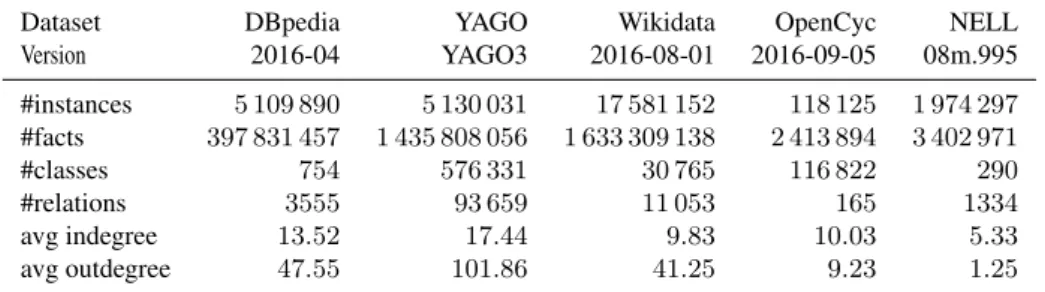
2.1 Profiling of major LOD datasets (166) . . . 13
4.1 Statistics about the datasets used in the experiments . . . 38
4.2 Summary of the link prediction results . . . 40
4.3 Summary of the type prediction results . . . 40
5.1 Statistics about the datasets used . . . 57
5.2 Comparison of different local classifiers on SLCN . . . 59
5.3 Comparison ofhF for type prediction on different feature sets . . 61
5.4 Evaluation of different classification methods on large cross-domain SW datasets . . . 64
5.5 Evaluation of different classification methods on smaller SW datasets 65 6.1 Comparison of local classifiers and number of selected features on generated errors of kind 1 . . . 74
6.2 Comparison of FMRR on generated errors of kind 1 . . . 75
6.3 Comparison of FMRR on generated errors of kind 2 . . . 76
6.4 Proportion of path and type features selected . . . 77
8.1 PaTyBRED features translation into SHACL . . . 93
9.1 Excerpt of the 50 class expressions that have been evaluated for the classAstronaut. The first column denotes the rank of the DL-Learner output without taking statistical measures into account. Only the class expressions have been shown in random order to the evaluators. . . 105
9.2 Results of relevance measure analysis. . . 106
10.1 Example of rules without numerical intervals . . . 109
10.2 Example of rules refined with numerical intervals . . . 110
A.1 Enron features ranked by information gain in descending order . . 137
A.2 Statistics about the flat datasets used . . . 140
A.3 Statistics about the hierarchical datasets used . . . 141 xv
xvi LIST OF TABLES
A.4 Comparison of local and global feature selection withmean aggre-gation on flat multilabel datasets . . . 144 A.5 Comparison of local and global feature selection withmean
aggre-gation on hierarchical multilabel datasets . . . 145 A.6 Comparison of local and global feature selection withmax
aggre-gation on flat multilabel datasets . . . 146 A.7 Comparison of local and global feature selection withmax
aggre-gation on. popular hierarchical multilabel datasets . . . 147 A.8 Correlations betweenD1 andD2 measures and the ratio between
global and local feature selection approaches for different evalua-tion measures . . . 148
List of Acronyms
AI Artificial IntelligenceIE Information Extraction IR Information Retrieval
IRI Internationalized Resource Identifier KB Knowledge Base
KG Knowledge Graph DAG Directed Acyclic Graph NLP Natural Language Processing SRL Statistical Relational Learning OIE Open Information Extraction POS Part-of-speech
RDF Resource Description Framework RDFS RDF Schema
OWL Web Ontology Language SHACL Shapes Constraint Language LOD Linked Open Data
SVM Support Vector Machine
HMC Hierarchical Multilabel Classification BR Binary Relevance
idf inverse document frequency
tf-idf term frequency–inverse document frequency
Chapter 1
Introduction
Semantic Web knowledge graphs are an important information source for many intelligent systems that require access to structured knowledge. Those knowledge graphs contain descriptions of the data as well as factual knowledge about real world entities and their relations and attributes in a fully machine-readable for-mat. Some of the most used Semantic Web knowledge bases are large-scale cross-domain datasets, such as DBpedia (106), YAGO (186), NELL (26), and Wiki-data (56).
Generating such datasets is an extremely challenging task, which often involves a trade-off between coverage and accuracy. That means it is difficult to generate large datasets with high quality. Guaranteeing that every fact is correct is com-plicated and often requires a manual evaluation, which is unfeasible on the scale of the aforementioned datasets with tens or hundreds of million facts. YAGO has been estimated to have 95% of correct data (186), while DBpedia’s correctness is estimated to be 88% (220) and NELL’s 74% (26).
On the other hand, while these datasets are some of the largest existing knowl-edge graphs, it is practically impossible to achieve full completeness in such cross-domain datasets. That means incompleteness cannot be solved. However, it is important to reduce it as much as possible without sacrificing the data’s correct-ness.
Both incompleteness and noise are common problems and solving, or at least reducing, them would be of great benefit for the applications which use such datasets. The process of reducing incompleteness and noise is calledrefinement. Developing automatic knowledge graph refinement methods which can do that on a large scale is a good way to reduce these problems therewith improving the quality of the data.
There is a wide variety of applications for knowledge graphs, e.g. semantic search and discovery, question answering, recommender systems, expert systems and personal assistants. For instance, knowledge graphs can play an important role addressing the cold-start problem, which is common in recommender systems and concerns the issue that the system cannot draw any inferences for users or items
2 CHAPTER 1. INTRODUCTION
Figure 1.1: Example of movie recommendation using a knowledge base (28) about which it has not yet gathered sufficient information.
Knowledge graphs are a great tool for leveraging external knowledge for im-proving content-based recommendations. Figure 1.1 illustrates how knowledge graphs can be exploited by recommender systems to reduce the cold-start prob-lem (28). With the information from knowledge graphs it is possible to extend the movies with information about actors and directors, including how they are related. In the example, Bob who has only watched Schindler’s List so far, can be recommended other popular movies directed by the Steven Spielberg, such as Saving Private Ryan and The Terminal.
If a knowledge graph has wrong or missing links, that can lead to worse rec-ommendations. By improving the quality and coverage of a knowledge graph, i.e. removing wrong facts and adding missing facts, this and many other applications which use knowledge graphs can indirectly profit from such improvement.
There is a wide variety of refinement methods in the literature. Some ap-proaches focus on refining the TBox, also known as schema or ontology, which describes a conceptualization, a set of concepts and properties for these concepts. Others approaches focus on refining the ABox, which consists of TBox-compliant statements about individuals belonging to those concepts. While there exist meth-ods which can use external resources, such as web data and information extracted from textual corpora, the focus of this thesis in on the methods which rely exclu-sively on information already present in the knowledge graph.
The refinement of TBox is also known in the literature as ontology learning. Since ABox statements need to comply with the TBox, the refinement of the TBox can lead to the indirect detection of ABox errors.
Designing a good TBox can be a difficult task, especially on large-scale cross-domain datasets, where it is complicated to have a deep understanding of the data. Moreover, in crowdsource datasets, such as Wikidata, it is important that users – who help populate the ABox – can clearly understand the TBox vocabulary and
3 use it adequately.
In many instances it can be interesting to consider a bottom-up approach, where the ABox information is used in order to learn patterns which can be integrated into the TBox. With that, unforeseen patterns can be induced from the data, and wrong patterns or often misused vocabulary can be identified and fixed.
Many ABox refinement methods do not use TBox information, relying exclu-sively on the relations between instances. However, since many knowledge graphs do have a schema, which provide valuable information about the data domain, it makes sense to exploit such information when available. The ABox refinement problem in the Semantic Web community has been traditionally divided into type prediction, i.e. prediction of missing instance types (concepts), and link prediction, i.e. prediction of relationships between instances.
Reasoning is one of the main premises of the semantic web, and it enables the deduction of new facts, thereby reducing incompleteness. Nevertheless, perform-ing deductive reasonperform-ing on incorrect data can be problematic, since chains of sev-eral wrong facts can be deduced from a single wrong fact, resulting in the increase of incorrectness. It has been shown that classical ontology reasoning can propagate errors and lead to nonsensical results when applied on real-world datasets (150). Therefore, it is necessary to develop more robust statistical methods which can work on noisy data in order to mitigate this problem.
Some of those aforementioned challenges from automatic knowledge graph re-finement are addressed in this thesis. In Part I we present ABox rere-finements meth-ods, which include a type prediction approach based on hierarchical multilabel classification, an approach to detection of relation assertion errors and an approach to correction of wrong links originated from confusions between instances. In ad-dition, we also propose a knowledge graph model and synthesis process for gener-ating artificial knowledge graphs for benchmarking of ABox completion methods. In Part II we present TBox refinement methods, which include the generation of relation constraints from the ABox. We also propose a method for induction of intuitive class expressions by incorporating lexical information into inductive logic programming (ILP), and an extension of the ILP algorithm to efficiently learn rules with numerical attributes, where correlations between numerical properties and literals are exploited by building a so-called correlation lattice.
In the Appendix we present a work about local feature selection in multilabel classification, which is one of the foundations of our type prediction and relation assertion error detection methods. There we perform an extensive empirical com-parison of local and global feature selection for transformation based multilabel classification methods, and show that the local approach consistently outperforms the global approach in terms of predictive performance without sacrificing runtime. In this thesis we study the automatic knowledge graph refinement problem from different perspectives and evaluate our proposed methods on a large set of popular publicly available knowledge graphs. It is important to notice that, as men-tioned earlier, external information is also worth considering and can potentially further improve the quality of a knowledge graph. However, we restrict ourselves
4 CHAPTER 1. INTRODUCTION
to the information already contained in the knowledge graph, such as the ontology axioms, type assertions, path patterns, textual and numerical information from data properties.
1.1
Research Questions
The general research question of this thesis isHow to automatically refine knowl-edge graphs using the information already contained in the graph?. In order to answer this question, we divide it into a number of more specific questions which are addressed in the later chapters of this thesis.
RQ1:How to automatically improve the quality of the ABox?
The problem of automatic refinement of knowledge graphs can be divided into two subproblems. One is the refinement of the ontology (TBox), addressed by RQ2, and the other is the refinement of the assertions box (ABox). The ABox refinement problem includes the detection and correction of erroneous facts, ad-dressed in Chapters 6 and 7, as well as the prediction of missing facts, adad-dressed in Chapter 5.
RQ2:How to automatically improve the quality of the TBox?
Automatic improvement of the TBox is an important part of the knowledge graph refinement problem. One of the main approaches to ontology learning is the in-duction of TBox axioms from the ABox. This can aid the construction and mainte-nance of the ontology and provide valuable insights about the data. This question is addressed in Chapters 8 and 9.
RQ3:How to efficiently apply refinement methods on large-scale data?
Enabling automatic knowledge graph refinement methods to be applied on large-scale graphs, as well as across multiple interlinked datasets is also an important problem. Scalable methods and efficient heuristics to explore large search spaces are good means to enable such methods to be applied on large amounts of data. This question is addressed in Chapter 10 and Appendix A.
RQ4: How to synthesize knowledge graphs for benchmarking knowledge graph
completion methods?
Artificially generated datasets are an important tool for comparing different al-gorithms for a given task. Being able to control characteristics of the data and analyzing how methods are affected by them are important to deeply understand the behavior of these methods. The challenge is to synthesize knowledge graphs from a given model, which should be able to convey characteristics important to the knowledge graph completion task. This question is addressed in Chapter 4.
1.2. CONTRIBUTIONS 5
1.2
Contributions
The contributions of this thesis are diverse and cover several different aspects of the automatic knowledge graph refinement, including methods for automatic TBox and ABox refinement. More specifically the contributions of this thesis are the following:
• A knowledge graph synthesis model for benchmarking of link and type pre-diction methods – Chapter 4.
• An approach to type prediction using hierarchical multilabel classification – Chapter 5.
• A machine learning approach to detection of relation assertion errors using path and type features – Chapter 6.
• An approach to correction of erroneous links originated from confusion be-tween entities – Chapter 7.
• An approach to learning expressive relation constraints based on our pro-posed relation assertion error detection method – Chapter 8
• An investigation of how to incorporate lexical information in order to learn more intuitive class expressions – Chapter 9.
• A correlation-based approach for refinement of clauses with numerical at-tributes – Chapter 10.
• An empirical study comparing local with global feature selection multilabel classification transformation methods – Appendix A.
1.3
Structure
The contents of the next chapters of this thesis are summarized as follows:
Chapter 2: Fundamentals- A brief motivation for the thesis and an overview of some of the basics of knowledge graphs, semantic web, linked open data, knowl-edge graph construction, knowlknowl-edge graph refinement methods and evaluation ap-proaches is presented.
Chapter 3: Related Work - A comprehensive overview of existing knowledge graph refinement approaches is given. The overview covers works related to all of the thesis contributions listed earlier.
Chapter 4: Synthesizing Knowledge Graphs for Refinement Benchmarking -A model for synthesizing knowledge graphs for benchmarking of knowledge graph completion methods, more specifically type and link prediction, is proposed. The model is able to replicate different characteristics of a knowledge graph related to the completion task. An evaluation is conducted to find out how well the proposed
6 CHAPTER 1. INTRODUCTION
model is able to replicate knowledge completion results of popular datasets and to find out which model elements are the most relevant for a good replication. Chapter 5: Type Prediction using Hierarchical Multilabel Classification- Hi-erarchical multilabel classification with local feature selection is applied for the prediction of missing types in knowledge graphs. It is shown that the structure of type hierarchies can be exploited to efficiently handle the cross-domain nature of large knowledge graphs and to improve scalability. Our evaluation show that the proposed approach outperforms previous state-of-the-art type prediction ap-proaches.
Chapter 6: Detection of Relation Assertion Errors- A supervised method for detection of relation assertion errors based on path and type features is proposed. The method consists of a binary classifier for each relation, which predicts whether a pair of subject-object entities belongs to the given relation. Moreover, an ap-proach for the exploration of the graph paths search space involving heuristic path relevance measures is presented. It is shown that the proposed method is able to outperform state-of-the-art error detection and link prediction approaches on the error detection task.
Chapter 7: Correction of Confusions Between Entities- An approach to cor-rection of confusions between entities is presented, where the focus is placed on detected relation assertion errors caused by such confusions. The proposed ap-proach is able to detect such cases and propose corrections, based on Wikipedia disambiguation links and approximate string matching. It is shown that the ap-proach is capable of correcting many of these cases, although the current accuracy achieved is not good enough to enable its application in a fully automated fashion. Chapter 8: Generation of SHACL Relation Constraints- An approach to gen-eration of relation constraints, based on the error detection method from Chapter 6, is proposed. The approach consists of learning a decision tree to detect error in each relation, which is then translated into a logical expression that represents the constraint. It is shown that the learned constraints can be more flexible and adapt better to incomplete data, being better at detecting errors than other state-of-the-art ontology learning approaches, such as statistical schema induction.
Chapter 9: Inductive Lexical Learning of Class Expressions- A method for generation of more intuitive class expressions based on lexical information is pre-sented. It extends the existing DL-Learner heuristics, which rely on scores based on examples coverage obtained via logical inference, by adding relatedness infor-mation about the target class and the entities in its class expression obtained from textual corpora. A manual evaluation shows that a combination of relatedness mea-sures is able to resemble the human perception of intuitiveness of a class expression best.
Chapter 10: Learning Rules With Numerical Attributes- A method for effi-cient refinement of rules with numerical attributes based on correlations between numerical attributes and categories is presented. The method exploits distributions of instances over numerical attributes on different subpopulations, and organize the information on a so-called correlation lattice. The lattice can be later used in
1.3. STRUCTURE 7
the ILP refinement step to efficiently explore the search space thereby improving scalability.
Appendix A: Local vs. Global Feature Selection in Multilabel Classification -An empirical comparison between local and global feature selection strategies for transformation based multilabel classification methods. It is shown that local fea-ture selection, where the selection is performed independently on each transformed datasets and local classifiers can work on specialized set of features, consistently outperforms the global approach.
Chapter 2
Fundamentals
In this chapter we present works which are fundamental to understanding of the thesis. It starts with the basics of knowledge graphs, semantic web and linked open data, then an overview of main knowldege graph ABox and TBox refinement methods are presented followed by evaluation approaches.
2.1
Knowledge Graphs in the Semantic Web
A knowledge graph1, or knowledge base, is a technology used to store complex structured and unstructured information used by a computer system. It is composed by ABox and TBox statements. TBox statements describe a conceptualization, a set of concepts and properties for these concepts. ABox are TBox-compliant statements about individuals belonging to those concepts. For instance, “every musician is a person” and “musicians play for bands” are TBox statements, while “Trent Reznor is a musician”, “Nine Inch Nails is a band” and “Trent Reznor plays for Nine Inch Nails” are ABox statements.
In the Semantic Web the Resource Description Framework (RDF)2is the lan-guage of choice for describing knowledge graphs. It is represents statements about resources in the form of triples <subject–predicate–object>, where the resources are represented by a uniform resource identifier (URI). The subject denotes the re-source, and the predicate expresses a relationship between the subject and the ob-ject or properties of the subob-ject. Moreover, resources may be divided into groups called classes, whose members of a class are known as instances of the given class. RDF standard representation uses standard XML notation, however, there are also more readable representations such as N-Triples, Turtle and Notation3. The ABox example mentioned earlier can be represented in RDF with Turtle notation as follows:
1The term Knowledge Graph was coined by Google in 2012 and has been recently also used to
refer to Semantic Web knowledge bases.
2https://www.w3.org/RDF/
2.2. LINKED OPEN DATA 9
@prefix ex: <http://example.org/> . ex:Nine_Inch_Nails a ex:Band . ex:Trent_Reznor a ex:Musician ;
ex:playsFor ex:Nine_Inch_Nails .
RDF is also used as base for ontology languages, such as OWL3 and RDFS4, which are used to define the TBox, often also referred to as ontology or schema. Both the Web Ontology Language (OWL) and RDF Schema (RDFS) provide a data-modelling vocabulary for RDF. OWL is intended to be compatible with and extend RDFS.
With RDFS one can, for example, define that the domain of theex:playsFor
relation isex:Musicianand the range is ex:Band. It can also organize classes
in a hierarchy determining subsumption relations between them. For instance, we can define a more general class ex:Agent which is the superclass of both
ex:Musicianandex:Band, and a more general relationex:memberOfwhich
sub-sumesex:playsForand has domain and rangeex:Agent.
Knowledge graphs represented in RDF can be accessed using the query lan-guage SPARQL5. The language has capabilities for querying across diverse RDF data sources. It is also capable of querying required and optional graph patterns, which can be combined with conjunctions and disjunctions. SPARQL also sup-ports constraining queries by source RDF graph as well as many of the features supported by SQL.
@prefix ex: <http://example.org/> . ex:Musician rdfs:subClassOf ex:Agent . ex:Band rdfs:subClassOf ex:Agent . ex:playsFor rdfs:domain ex:Musician ;
rdfs:range ex:Band .
ex:memberOf rdfs:domain ex:Agent ;
rdfs:range ex:Agent .
Figure 2.1 illustrates the architecture of the Semantic Web, showing how the different layers are stacked. Top of the stack (Trust, Proof and Unifying logic layers) is an essential part of the vision of the Semantic Web. However, at the moment there are still no implementation standards for those layers.
2.2
Linked Open Data
Linked Open Data is a method for publishing structured data so that it can be inter-linked and become more useful through semantic queries. It builds upon standard
3https://www.w3.org/OWL/
4https://www.w3.org/TR/rdf-schema/
10 CHAPTER 2. FUNDAMENTALS
Figure 2.1: Semantic Web stack
web technologies, extending them to share information in a way that can be read automatically by computers. The four principles of linked data outlined by Tim Berners-Lee are the following:
1. Use URIs to name (identify) things.
2. Use HTTP URIs so that these things can be looked up (interpreted, "derefer-enced").
3. Provide useful information about what a name identifies when it’s looked up, using open standards such as RDF, SPARQL, etc.
4. Refer to other things using their HTTP URI-based names when publishing data on the Web.
The number of linked open datasets available has quickly grown in the last few years, going from a few dozen of datasets in 2007 to more than a thousand nowadays. Figure 2.26 shows the Linked Open Data cloud diagram (2018-05-30) featuring1168datasets.
This gives an idea of the rapid adoption of the LOD principles. However, it is also worth noting that there are still several challenges to be addressed. What Figure 2.2 does not show is the fact that many of those datasets do not adequately
6"Linking Open Data cloud diagram 2018, by Andrejs Abele, John P. McCrae, Paul Buitelaar,
2.2. LINKED OPEN DATA 11
12 CHAPTER 2. FUNDAMENTALS
apply the linked data best practices (76). These best practices can be grouped into three areas:
• Linking: By setting RDF links, data providers connect their datasets into a single global data graph which can be navigated by applications and enables the discovery of additional data by following links.
• Vocabulary Usage: Publishers should use terms from widely-used vocabu-laries in order to ease the interpretation of their data. If data providers use their own vocabularies, the terms of such proprietary vocabularies should be dereferencable, and their definitions should contain RDF links pointing to widely-used vocabularies.
• Metadata Provision: Linked Data should be as self-descriptive as possible, and therefore include metadata. For instance, information about licensing, provenance and accessibility should be provided. With that, users and ap-plications can easily know whether they are licensed to use the data, assess its quality and access the data via alternative methods such as SPARQL end-points or data dumps.
An evaluation of the adoption of linking, vocabulary, metadata best practices (176), shows that most datasets fail to fully apply these practices. Provenance information is provided for roughly a third of all datasets. Only 10% of all datasets provide machine-readable licensing information and only 14.69% provide VoID7 metadata. This results there is still a long way for the vision of linked data
2.3
Knowledge Graph Construction
Most of the popular large-scale knowledge graphs, because of their magnitude, cannot be fully manually created and maintained. They rely, at least partially, on automatic methods for knowledge extraction which transform unstructured or semi-structured data, such as natural language text and web tables, into RDF triples. In this section we provide a brief overview of how some of the most popular pub-licly available large-scale cross-domain knowledge graphs are constructed.
DBpedia: DBpedia is extracted from Wikipedia’s structured data. The in-foboxes of articles are the main source of information, with types of inin-foboxes mapped into classes, and keys into properties in the DBpedia ontology.
YAGO - Yet Another Great Ontology: YAGO’s extraction is also based on Wikipedia. However, its classes are derived from the Wikipedia’s category system instead of infobox type, and infobox keys are manually mapped into a smaller set of properties. YAGO extracts and fuses knowledge extracted from various Wikipedia language definitions, while DBpedia creates different KGs for each language.
NELL - Never Ending Learning Language: Instead of just using Wikipedia, NELL extracts information from a large scale corpus of diverse websites. It is a
2.4. INCOMPLETENESS AND NOISE 13
Dataset DBpedia YAGO Wikidata OpenCyc NELL
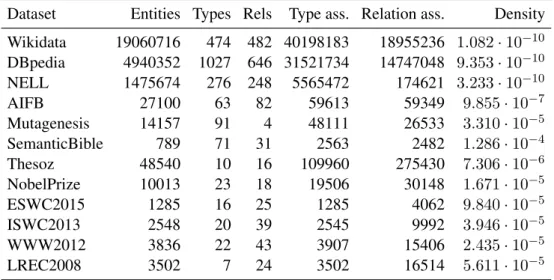
Version 2016-04 YAGO3 2016-08-01 2016-09-05 08m.995 #instances 5 109 890 5 130 031 17 581 152 118 125 1 974 297 #facts 397 831 457 1 435 808 056 1 633 309 138 2 413 894 3 402 971 #classes 754 576 331 30 765 116 822 290 #relations 3555 93 659 11 053 165 1334 avg indegree 13.52 17.44 9.83 10.03 5.33 avg outdegree 47.55 101.86 41.25 9.23 1.25
Table 2.1: Profiling of major LOD datasets (166)
research project that attempts to create a computer system that learns over time to read the web. Since it uses unstructured text as source, it relies on more complex information extraction approaches which learn text patterns that correspond to type and relation assertions.
Wikidata: Wikidata is a collaboratively edited knowledge graph, operated by the Wikimedia foundation that also hosts Wikipedia. Data is entered and main-tained by crowdsourced editors as well as automated bots. After the shutdown of Freebase, the data contained in Freebase was subsequently moved to Wikidata. A particularity of Wikidata is that for each axiom, provenance metadata can be included
OpenCyc: OpenCyc is a publicly available and reduced version of Cyc, which is one of the oldest knowledge graphs developed and curated by CyCorp.
There also exist other important private knowledge graphs such as Google’s Knowledge Vault, Yahoo’s Knowlege Graph, Facebook’s Entities Graph and Mi-crosoft’s Satori. However, since these datasets are not publicly available and there-fore cannot be used in our experiments, we do not get into more details.
Table 2.1 (166) shows some statistics about the aforementioned datasets, in-cluding the number of instances, facts, classes, relations, and average in-degree and out-degree. The latter two values indicate the average number of ingoing links per instance, i.e. relation assertions where the instance is the object, and the av-erage number of outgoing links, i.e. relation assertions where the instance is the subject.
Given the quality of the sources, scale of the datasets, and complexity of the extraction process it is common that these datasets have several missing facts as well as erroneous data. In the next sections we discuss these problems in more details.
2.4
Incompleteness and Noise
All of the knowledge graphs mentioned in Section 2.3 have two problems in com-mon: incompleteness and noise. Incompleteness refers to the absence of true facts in the data, while noise refers to the existence of false facts.
14 CHAPTER 2. FUNDAMENTALS
There are two main possible sources of noise: extraction errors and source data errors. The former refers to erroneous facts generated from correct input which was corrupted by problems in the information extraction process. The latter refers to errors which were already existent in the source data, e.g., a wrong entry in Wikipedia infobox, or a typo in textual data.
It has been estimated that Wikipedia, which is the source from DBpedia and YAGO, has 2.8% of wrong statements (209). YAGO’s and DBpedia’s correctness have been estimated to be 95% and 88% respectively (186; 220), while NELL’s is estimated to be only 74% correct (26). These figures have been calculated based on manual evaluation of data samples.
Estimating incompleteness is a much more complicated task. The high level of incompleteness of most graphs can be illustrated with the fact that in Wikidata only 2% of all people have a father, in YAGO the average number of children per person is 0.02 (65), and in Freebase 71% of people have no known place of birth and 75% no nationality (51). In general, between 69% and 99% of instances in popular KGs lack at least one property that other entities in the same class have (185).
Refining knowledge graphs, i.e. reducing both incompleteness and noise, is an extremely relevant task in such datasets. Given the large size of the cross-domain datasets, which often contain several millions of triples, automatic methods are essential to enable the refinement of datasets on such scale. In the next sections we give an overview of automatic knowledge graph refinement methods, starting with ontology learning, i.e. the refinement of the TBox, and then with automatic ABox refinement approaches.
2.5
Knowledge Graph Lifecycle
Once a knowledge graph is created and deployed as linked data, it needs to be adequately maintained. Additionally, the issues previously discussed should be addressed in order to progressively improve the quality of the knowledge graph. The lifecycle of linked data on the web (7), which comprises of eight stages shown in Figure 2.3, provides a framework for maintaining the data and continuously improving it.
The eight stages of the linked data lifecycle are defined as follows:
• Extraction: Information represented in unstructured form or adhering to other structured or semi-structured representations must be extracted and converted into RDF.
• Storage/Querying: Mechanisms have to be in place to store, index and query this RDF data efficiently.
• Authoring: Users must have the opportunity to create new structured infor-mation or to correct and extend existing ones.
2.5. KNOWLEDGE GRAPH LIFECYCLE 15
Figure 2.3: The Linked Data lifecycle
• Interlinking: Information about the or related entities in different datasets needs to be linked.
• Enrichment: Since Linked Data primarily comprises instance data, we ob-serve a lack of classification, structure and schema information. This de-ficiency can be tackled by approaches for enriching data with higher-level structures in order to be able to aggregate and query the data more efficiently. • Quality Analysis: Datasets contain a variety of information of different qual-ity. The quality of the information provided by different sources should be adequately assessed.
• Evolution/Repair: Knowledge and information are dynamic in various do-mains. Changes and modifications to knowledge graphs should be consid-ered and methods should be able to spot problems and to automatically sug-gest repairs.
• Exploration: Applications and users have to be empowered to browse, search and explore the information available in a fast, reliable and user friendly manner.
This thesis addresses mainly the enrichment and evolution stages. The ABox refinement methods proposed in the thesis can be used to detecting and correcting errors as well as predict missing facts. The TBox refinement methods, on the other hand, can induce TBox axioms from the ABox, thereby spotting problems and
16 CHAPTER 2. FUNDAMENTALS
indirectly improving the quality of the ABox. The combination of the two kinds of approaches enables the TBox and ABox to evolve together in a virtuous cycle.
2.6
Ontology Learning
Automatic ontology learning methods can be extremely helpful on the process of creation, maintenance and extension of ontologies. While the quality of the learned ontologies might not be perfect, especially when learning on noisy and incomplete data, in general the set of learned axioms is small and can be manually evalu-ated and improved by specialists. It can also be used to spot differences between intended and actual uses of ontologies, which are difficult to be predicted by ontol-ogy designers and laborious to be manually detected.
The impact of learned axioms can be significant, potentially allowing the detec-tion of several errors or predicdetec-tion of several new facts in the ABox with a single axiom. Moreover, when compared with ABox refinement approaches, ontology learning approaches have a clear decision process, which can be analyzed and im-proved by humans.
Ontology learning approaches can be substantially different, going into various research directions. Lehmann et al. (107) roughly classify such approaches into four main areas: ontology learning from text, linked data mining, concept learning, and crowdsourcing.
Ontology Learning from text mostly focuses on the generation of ontologies with text mining and information extraction methods. A prominent example is NELL project, which reads the web to add statements to its knowledge base and improves its performance over time, by taking user input about the quality of the extracted facts.
Linked Data Mining refers to the process of learning meaningful patterns in RDF graphs. Being able to detect the structure within the knowledge graphs can support the later creation of schemata and enable the detection of interesting as-sociations between elements in the graph. Statistical schema induction (203) or statistical relational learning methods are examples of methods in this area.
Concept Learning is a direction of research that aims at learning schema ax-ioms, such as class expressions, from existing ontologies and instance data. Most methods in this area are based on Inductive Logic Programming (113). While many algorithms, such as DL-FOIL (100) and OCEL (105) are generic supervised ma-chine learning approaches for description logics, there are also specific adaptations to ontology learning (102), e.g., in terms of performance and usability.
An interesting alternative to purely automatic approaches is crowdsourcing on-tologies. Formulating the task to be completed and providing incentives for peo-ple to contribute are additional challenges of this kind of approach. Exampeo-ples of crowdsourcing in the field of ontology learning include taxonomy construction via Amazon mechanical turk, and games with a purpose for ontology population (35; 83).
2.7. AUTOMATIC ABOX REFINEMENT APPROACHES 17
2.7
Automatic ABox Refinement Approaches
In this section we give a brief overview of knowledge graph refinement approaches that focus on directly improving the ABox. We present some of the state-of-the-art methods and categorize them according to (137; 149).
2.7.1 Error Detection vs. Graph Completion
There are two main goals of knowledge graph refinement: adding missing knowl-edge to the graph, i.e., completion, and identifying wrong information in the graph, i.e., error detection. The former addresses the incompleteness problem, while the latter addresses the noise problem.
Both completion and error detection approaches can be further distinguished by the targeted kind of information in the knowledge graph. For example, some ap-proaches are targeted towards completing/correcting entity type information, while others are targeted to (either specific or any) relations between entities, interlinks between different knowledge graphs, or literal values, such as numbers. The prob-lem of completing a graph with relations between entities is often referred to in the literature as link prediction, while the problem of completing a graph with entity type information is often referred to as type prediction.
2.7.2 Internal vs. External Methods
Internal methods use only the knowledge contained in the knowledge graph itself to predict missing information. External methods use sources of knowledge – such as text corpora, other knowledge graphs or crowdsourcing – which are not part of the knowledge graph itself. Those external sources can be linked from the knowledge graph, such as knowledge graph interlinks or links to web pages (e.g., Wikipedia pages describing an entity), or exist without any relation to the knowledge graph at hand, such as large text corpora.
Some popular external methods focus on type prediction. E.g., Giovanni et al. (71) exploit Wikipedia links to predict new types, Aprosio et al. (5) use type information from DBpedia in different languages, while Gangemi et al. (67) and Kliegr (88) use textual information from DBpedia abstracts. In link predic-tion, some methods predict new relation assertions with learned text patterns from Wikipedia text (97; 214). Other approaches using question answering based on web search engines (210) as well as HTML web tables (170) have also been pro-posed.
Amongst the internal methods, there are mainly two kinds: latent and graph feature models, which will be discussed in more details next.
2.7.3 Latent vs. Graph Feature Models
Graph feature models rely on features which can be directly observed in a graph. The intuition behind these methods is that similar entities are likely to be related
18 CHAPTER 2. FUNDAMENTALS
and that the similarity of entities can be derived from the neighborhood of nodes or from the existence of paths between nodes.
Latent features are those features which are not directly observed in the data. The main task of all latent feature models is to infer these features automatically from the data, while maximizing a triple score function over the whole dataset. In these models entities and relations are represented in lower-dimensional spaces. The intuition behind the learned representations is that the relationships between entities can be derived from interactions of their latent features.
Recently graph feature models have received a lot of attention and have become some of the best performing models on the link prediction task. There are different approaches to learning graph embeddings. There are tensor factorization mod-els (e.g., RESCAL (139), TRESCAL (31)), translation modmod-els (e.g., TransE (15), TransH (208), TransR (111)), multilayer perceptrons (e.g., E-MLP (181), ER-MLP (51)) and neural tensor networks (NTN) (181). Other methods are based on word embedding methods which are trained on random walks of a knowled-graph (169; 38), however they are not conceived for the link prediction task and cannot score triples.
Graph feature models have also been used for link prediction, e.g. path ranking algorithm (PRA) (98) and subgraph feature extraction (SFE) (69), as well as for er-ror detection, e.g. SDValidate (151). On the type prediction problem SDType (150) is an example of a graph feature model.
2.8
Evaluation of Knowledge Graph Refinement Methods
There are three main kinds of evaluation approaches for ABox automatic refine-ment (149): partial gold standard, silver standard and retrospective evaluation.
Partial Gold Standard: In this evaluation methodology a subset of graph enti-ties or relations are selected and labeled manually. Other evaluations use external data as partial gold standards. For completion tasks, this means that facts that should exist in the knowledge graph are collected, whereas for correction tasks, a set of facts in the graph is manually labeled as correct or incorrect. Crafting a gold standard can be extremely costly, and the fact that the gold standard is created for a relatively small sample can significantly affect the quality of the evaluation.
Silver Standard: Another evaluation strategy is to use the given knowledge graph itself as a test dataset. For completion, that means a subset of the knowledge graph is removed from the training dataset and used as test. For error detection, wrong facts can be generated and added to the knowledge graph, then later be used for reference in the evaluation. Since the knowledge graph is not perfect, it cannot be considered as a gold standard, therefore we call it a silver standard. How-ever, assuming that the given knowledge graph is already of reasonable quality, the evaluation results should be a good approximation of the actual results, with the advantage of being fully automatable.
2.8. EVALUATION OF KNOWLEDGE GRAPH REFINEMENT METHODS19
approach is given to human judges for annotation, who then label suggested com-pletions or identified errors as correct and incorrect. The quality metric is usually accuracy or precision, along with a statement about the total number of comple-tions or errors found with the approach, and ideally also with a statement about the agreement of the human judges. Recall and other measures which rely on it cannot be calculated since the number of false positives cannot be calculated. One advantage of retrospective evaluations is that they allow a very detailed analysis of an approach’s results. However the annotations are specific for a given method and cannot be reused.
For the evaluation of ontology learning approaches there are mainly gold stan-dard and manual evaluation approaches. Given that the TBox is generally orders of magnitude smaller than the ABox, in many cases the manual evaluation is fea-sible. At the same time, the creation of a gold standard can be difficult since the definition of a good ontology is often debatable and application dependent.
Chapter 3
Related Work
In this section we present previous works related to the contents of this thesis. We cover related works in the area of knowledge graph synthesis (c.f. Section 3.1), ABox refinement – including type prediction, detection and correction of relation assertion errors (c.f. Sections 3.2, 3.3 and 3.4) – as well as TBox refinement – more specifically learning relation constraints, class expressions and rules with numerical attributes (c.f. Sections 3.5, 3.6. In the rest of this section we discuss more extensively and deeply the works related to those areas.
3.1
Synthesis of Knowledge Graphs for Benchmarking
There have been works which address the synthesis of knowledge graphs for bench-marking purposes. However, most efforts were focused on synthesizing A-box assertions for a specific T-box. Moreover, these works generate benchmarking datasets for various tasks in the Semantic Web, but none of them focus on the evaluation of link and type prediction methods.
Guo et al. (73) propose a method for benchmarking Semantic Web knowl-edge base systems on large OWL applications. They present the Lehigh University Benchmark (LUBM), which has an ontology for the university domain and in-cludes the Univ-Bench artificial data generator (UBA), as well as a set of queries and performance measures. The data generator synthesizes A-boxes of arbitrary size to evaluate scalability. The data contains information about universities, which are artificially created based on some predefined restrictions, e.g. minimum and maximum number of departments, student/faculty ratio, which are based on arbi-trarily defined ranges.
SP2Bench (177) is a SPARQL performance benchmark based on DBLP data. It features a data generator, which can create datasets of any given size. Similarly to UBA, the authors synthesize the A-box based on an existing T-box, in this case the DBLP ontology, and a dataset specific model used to generate the synthetic data. The model uses logistic curves and simple intervals to describe characteristics of the DBLP data, such as the number and types of publications, distribution of
3.2. TYPE PREDICTION 21
citations, and level of incompleteness over years.
Morsey et al. (130) created a SPARQL query benchmark based on DBpedia to evaluate knowledge base storage systems. They gather a set of real world queries extracted with query log mining, and run them on datasets of different sizes gener-ated from DBpedia. Their “data generation” process consists of sampling the orig-inal DBpedia dataset and changing the entities namespace. Two sampling methods are considered: rand, which basically randomly selects a fraction of the triples, andseed, which first sample a subset of the classes, then instances of these classes are also sampled and added to a queue, with this process repeated until the target dataset size is reached.
Linked Data Benchmark Council (LDBC) (4) developed the social network benchmark (SNB) and the semantic publishing benchmark (SPB). The SNB which includes a data generator that enables the creation of synthetic social network data representative of a real social network. The data generated includes properties occurring in real data, e.g. irregular structure, structure/value correlations and power-law distributions. The benchmark covers main aspects of social network data management, including interactive, business intelligence and graph analytics workload. The SPB is similar to the SNB, but it concerns the scenario of a media organization that maintains RDF descriptions of its catalogue of creative works.
3.2
Type Prediction
The problems of inference on noisy data in the Semantic Web has been identified by Ji et al. (81) and Polleres et at. (156). Reasoning on noisy data can result on the propagation of errors and further damage the quality of the data. There have been solutions proposed for the specific problem of type inference in (general or particular) RDF datasets in the recent past, using strategies such as machine learning, statistical methods, and exploitation of external knowledge such as links to other data sources or textual information. One of the first approaches to type classification in relational data is discussed by Neville et al. (136). The authors train a machine learning model on instances that already have a type, and apply it to the untyped instances in an iterative manner.
Some works address slightly different inference problems. Instead of predict-ing instance types, Oren et al. (143) predict possible predicates for resources based on co-occurrence of properties. The approach discussed by Pohl (155) addresses the problem of mapping DBpedia entities to the category system of OpenCyc. They use DBpedia specific information – infoboxes, textual descriptions, Wikipedia cat-egories and instance-level links to OpenCyc – and apply an a posteriori consistency check using Cyc’s own consistency checking mechanism.
HYENA (219) is a multi-label classifier for named entity types based on hi-erarchical taxonomies derived from YAGO. Textual features extracted from the mentions of the named entity Wikipedia articles are used by the classifier, which consists of the SCN approach with siblings negative examples selection. There
22 CHAPTER 3. RELATED WORK
are several works on type prediction which exploit specific aspects of DBpedia. Aprosio et al. (5) introduced an approach which first exploits cross-language links between DBpedia in different languages to increase coverage. They use nearest neighbor classification based on different features, such as templates, categories, and bag of words of the corresponding Wikipedia article.
TheTipalosystem (67) leverages the natural language descriptions of DBpedia entities to infer types, exploiting the fact that most abstracts in Wikipedia follow similar patterns. Those descriptions are parsed and mapped to the WordNet and DOLCE ontologies in order to find appropriate types. Giovanni et al. (71) exploit types of resources derived from linked resources, where links between Wikipedia pages are used to find linked resources (which are potentially more than the sources actually linked in DBpedia). For each resource, they use the classes of re-lated resources as features, and usek-nearest neighbors for predicting types based
on those features. However, none of those approaches can be trivially applied to datasets other than DBpedia.
SDType (150) uses links between resources as indicators for types, namely the ingoing and outgoing properties of instances. The method requires the prior distri-bution of types, as well as, for every property, a conditional probability distridistri-bution of object and subject types. Every property is assigned a weight, where maximum weight is given to properties that appear with a single type only, while the minimum weight is given to properties which are equally present in all types. Based on that, when predicting the types of an instance, SDType computes a confidence value for every type possible. Those types whose confidence value satisfies an arbitrarily defined minimum confidence threshold are assigned to the instance’s prediction.
SDType is a simple and highly scalable method, whose complexity grows lin-early with the number of statements in the knowledge base. According to the al-gorithm categorization by Silla Jr. et al. (179), SDType can be considered a global hierarchical multilabel classifier with multipath, non-mandatory leaf-nodes. SD-Type also generates predictions consistent with the type hierarchy. That is because the confidence of any non-root class will be always smaller or equal to that of its superclass if the model is learned on data with all subsumed type assertions.
LIFT (222) relies on the idea of class specific features for local classifiers on multilabel classification. The authors propose a method for generation of class spe-cific features based on the distance of instances to the centroid of clusters computed for the positive and negative examples. Since this approach requires a clustering algorithm to be executed twice for each class, scalability is major issue.
Amongst the approaches discussed above and in (150), SDType is reportedly the best performing type predictor (150; 151), also outperforming RDFS reason-ing. Therefore, in the experiments of Chapter 5 we have restricted ourselves to comparing hierarchical classification methods against SDType.
Statistical relational learning is an area which has a lot in common with type prediction. In fact, type prediction can be considered a special case of the link prediction problem, discussed earlier in this section, where instances are linked with types. However, there are no reported results for type prediction using link
3.3. RELATION ASSERTION ERROR DETECTION 23
prediction approaches in the literature, therefore we cannot directly compare the results presented in the respective papers with our method. Link prediction works are presented in details in Section 3.3.
3.3
Relation Assertion Error Detection
The problem of relation assertion error detection in knowledge graphs has been re-searched by the Semantic Web community. A few methods have been proposed for cleansing large-scale LOD knowledge graphs, such as DBpedia and NELL, which contain many relation assertion errors that cannot be detected by reasoning meth-ods (151). Absence of domain and range restrictions of relations or too general restrictions is one of the main causes of such problems.
SDValidate (151) exploits statistical distributions of types and relations, and (48) applies outlier detection on type-based entity similarity measures to detect erroneous relation assertions. These methods can effectively detect errors on DB-pedia, however they require the existence of informative type assertions. More-over, more complex errors containing wrong entities with correct types cannot be detected. A detailed survey including link prediction and error detection methods for knowledge graphs can be found in (149).
Link prediction, or knowledge graph completion (KGC), is a problem highly related to error detection. Despite being a different problem, KGC methods can also be used on the error detection problem. This kind of methods can be divided into graph-based, which relies on features which can be directly observed in the graph, and embedding methods, which learn embeddings that represent entities and relations in a latent feature space.
The Path Ranking Algorithm (PRA) (98) has shown that a logistic regres-sion classifier using path features generated with random walks can be used for learning and inference in KGs and outperforms N-FOIL horn-clause inference on NELL (98). The approach has been improved with Sub-graph Feature Extraction (SFE) (69), which also simplifies some aspects of PRA. For instance, while PRA uses real-value features which correspond to the probabilities to reach o froms
with a given path, SFE simply uses binary features which indicate if o can be
reached from sor not. SFE not only reduces runtime by an order of magnitude
when compared with PRA, but it also improves the qualitative performance. In the recent years, knowledge graph embedding models, i.e., representations of knowledge graphs into lower-dimensional dense vector spaces, have received a lot of attention (207). Several different models have been developed for the knowl-edge graph completion problem and have brought improvements in performance.
There is a plethora of different embeddings models for knowledge graphs. One of the earliest embedding models is RESCAL (139), which performs tensor factor-ization on the knowledge graph’s adjacency tensor, with the resulting eigenvectors corresponding to the entity embeddings and the core tensor the relations matrices. TRESCAL (31) extends RESCAL by exploiting entity types as well as domain and