EUROPEAN COMMISSION
DIRECTORATE-GENERAL FOR ECONOMIC AND FINANCIAL AFFAIRS
ECONOMIC PAPERS
http://europa.eu.int/comm/economy_finance
N° 174 - July 2002
Pension reforms : key issues illustrated with an actuarial model
by Heikki Oksanen,
Directorate General for Economic and Financial Affairs
Economic Papers
are written by the Staff of the Directorate-General for
Economic and Financial Affairs, or by experts working in association with
them. The "Papers" are intended to increase awareness of the technical work
being done by the staff and to seek comments and suggestions for further
analyses. Views expressed represent exclusively the positions of the author and
do not necessarily correspond to those of the European Commission.
Comments and inquiries should be addressed to the:
European Commission
Directorate-General for Economic and Financial Affairs
Publications
BU1 - -1/180
Pension Reforms:
key issues illustrated with an actuarial model
byHeikki Oksanen*
Abstract
The paper examines pension reforms under ageing. With stylised facts, ageing is traced to low fertility and increasing longevity. Given these persistent factors, pension systems must be reformed to avoid an unfair burden being left for future generations.
The main results for reform blueprints are:
(1) In a Defined Benefit (DB) system, partial pre-funding is needed to achieve intergenerational fairness unless benefits are sufficiently reduced; partial privatisation is an option for the management of the accumulating funds.
(2) Transition from a DB to a Notional Defined Contribution (NDC) system is another reform option; it reduces the replacement rates to levels which match prescribed contribution rates; an NDC public pillar can be accompanied by a second pillar, managed by the private sector. (3) An effective retirement age increase is necessary to moderate the increase in pension
expenditure and to preserve adequate pension levels.
(4) Pension reforms have important effects on public finance target setting.
The presentation is non-technical and does not require prior knowledge of pension reforms.
JEL classification: H1, H5, H6
Keywords: Pension reform, pre-funding, privatisation, defined benefits, notional defined contribution system
Acknowledgements
My special gratitude goes to Patrick Wiese of Actuarial Solutions LLC who put his S-PRISM (Stylized Pension Reform Illustration and Simulation Model) at my disposal. I used it to calculate the scenarios reported in this paper. I would like to thank Niels Kleis Frederiksen for careful reading of an earlier draft, and my colleagues who participated in an internal seminar on the paper. Their comments and questions helped me to further clarify some of the arguments presented. Cecilia Mulligan (text) and Karel Havik (tables and graphs) deserve my warmest thanks for their careful editing work. I am solely responsible for remaining errors and omissions.
Caveat
Views expressed in the paper are exclusively those of the author and do not necessarily correspond to those of the European Commission, for whose Directorate-General for Economic and Financial Affairs the author is working.
TABLE OF CONTENTS
Page
EXECUTIVE SUMMARY 3
1. INTRODUCTION 6
1.1 The purpose of this paper
1.2 Key properties of alternative pension systems
1.3 Agnosticism about arguments for funding in previous literature 1.4 The actuarial model
1.5 Outline
2. PENSION SYSTEMS, PRIVATISATION AND ACTUARIAL
FAIRNESS UNDER STATIONARY POPULATION 13
2.1 Base case assumptions
2.2 The Defined Benefit (DB) pension system
2.3 Fully Funded Defined Contribution(FF DC) system 2.4 Partial privatisation with a stationary population 2.5 Notional Defined Contribution (NDC) system
2.6 Effects of a retirement age increase and actuarial fairness
3. SYSTEMIC PENSION REFORMS FOR ADVERSE DEMOGRAPHICS 21 3.1 Fairness across generations under defined benefits
3.2 Transition to Notional Defined Contribution (NDC) system
4. FURTHER REFORMS TO THE PRE-FUNDED DB SYSTEM 35 4.1 Indexation to prices or decrease of accrual rate
4.2 Increasing retirement age
4.3 Partial privatisation of a pre-funded DB system
5. COMPARISON BETWEEN DB AND NDC REFORMS AND FULL
FUNDING 46
6. EFFECTS OF PENSIONS AND AGEING ON PUBLIC FINANCE
TARGETS 49
6.1 Effects of ageing on public expenditure and tax revenue 6.2 Targets for public finance
7. MACROECONOMIC ASPECTS RELATED TO THE PENSION
REFORM SCENARIOS 56
Box 1. Derivation of the fair contribution rate under ageing: retirement age 60 Box 2. Outcomes of the reforms with varying compensation for later retirement TABLES
Table 2.1: Actuarially correct compensation for a retirement age increase Table 3.1: A pre-funded Defined Benefit system: retirement age 60 Table 3.2: Transition to NDC
Table 4.1: Further reforms to the pre-funded Defined Benefit system Table 4.2: Partial privatisation of a pre-funded Defined Benefit system FIGURES
Figure 2.1: Partial privatisation of a stable DB system: DB accrual rate reduced pro rata
Figure 2.2: Partial privatisation of a stable DB system: DB accrual rate reduced to comply with total replacement rate at 60%
Figure 3.0: Old age dependency ratio in EU-15, 1995-2050, and the stylised model projection Figure 3.1: A pre-funded DB system: fair contributions, retirement age 60
Figure 3.2: Transition to NDC
Figure 4.1: Pre-funded DB system: standard accrual rate reduced and retirement increased Figure 4.2: Partial privatisation of the pre-funded DB system: retirement age 60
Figure 4.3: Partial privatisation of the pre-funded DB system: retirement age 63
Figure 6.1: Targets for government balance under alternative reforms of the DB system, % of GDP Figure 6.2: Surplus or deficit (-) in government finances other than pensions under alternative
transition paths to an NDC system, % of GDP
EXECUTIVE SUMMARY
This paper addresses the design of pension reforms under ageing populations caused by low fertility and increasing longevity. Reforms are assessed, in particular, with regard to
financial sustainability and intergenerational fairness. As a benchmark for the latter it is required that all generations with the same fertility and longevity should pay the same proportion of wage to pensions to earn the same replacement rate and retirement age. Correspondingly, if the demographic factors differ from one generation to another so also should the pension benefits and/or the replacement rate.
Defined Benefit system to be pre-funded
A pure PAYG Defined Benefit (DB) system is always sustainable by definition if contributions are increased to cover expenditure at every moment in time. Under ageing, however, this represents an unfair burden sharing across generations. A criterion introduced in this paper requires that the generation which reduces fertility and/or lives longer than its predecessors, should correspondingly pay more for the same replacement rate and retirement age. Thus, under ageing, contribution revenue should exceed pension expenditure, creating a fund. Based on stylised facts for EU-15, this implies that contribution rates should now be increased drastically, leading to pension fund accumulation of over 150% of GDP in the next 60 years.
The size of the projected fund corresponds to the order of magnitude of pension funds in some EU Member States, but the high contribution rates required make it unrealistic as a reform proposal. However, the message of this projection is important: people should be informed of what they should pay into a public pension system if they want to preserve current benefit levels and retirement age, and if they want to be fair to future generations. If they are not prepared to pay this price, then they should – individually and collectively - accept pension reforms which involve reducing the replacement rate and/or increasing the retirement age.
We show that under the projected ageing, a retirement age increase of about three years is required to moderate to any significant degree the required rise in contribution rates in the long run. The resulting partial funding is, however, not much affected by this as the induced reduction of pension expenditure and increased contribution revenue in the short run should not immediately lead to lower contribution rates. Rather, the induced surplus should be saved for covering future expenditure.
This leads to the result that a vast range of pension system options for a stylised EU-15 economy imply pension fund accumulation of 100-150% of GDP in the next 60 years, of which 2/3 in 30 years. Only if replacement rates were radically reduced would the need for partial funding be removed.
Once the case for partial funding is established, the question about management of the accumulating funds arises, except where the government initially has a large debt and uses the accumulating funds for debt amortisation. In other cases, special institutions could be established to place these funds. Depending on attitudes towards the role of the state, partial privatisation by diverting part of contribution payments to a second pillar might become attractive. A fully funded second pillar has desirable properties with respect to a firm link between contributions and benefits, is therefore actuarially fair and
reduces labour market distortions. It should be noted, however, that this is achieved at the expense of deterioration of the publicly managed first pillar in these same respects. The new approach presented in this paper for reforming a DB system under ageing to achieve intergenerational fairness through partial pre-funding is meant to be easily understandable and applicable in practise. Fortunately, it is not necessarily in contradiction to other arguments presented elsewhere. Rather, an argument that a combination of a PAYG and a funded pillar is advantageous as it helps to diversify various risks is an additional one and reinforces the case for implementing pre-funding. Furthermore, funding may ease labour market distortions, increase total saving and GDP, and also lead to higher returns on pension contributions. These are possible additional positive effects of funding, but as they might be controversial and depend on circumstances in each case, it should be seen as a merit that the argument pursued in the present paper does not depend on them. In addition, the method here leads to a time path for partial pre-funding and/or privatisation, which can be considered to be a proxy for fair burden sharing across generations during the transition period.
Transition to a Notional Defined Contribution system
Transition to a Notional Defined Contribution (NDC) system is an alternative way to achieve financial sustainability and intergenerational fairness in the public pension system. If the personal accounts to which the contribution payments are recorded are set to earn an interest equal to the rate of growth of contributions (i.e. wage bill growth if the coverage remains constant), replacement rate is automatically reduced so that pension expenditure adjusts to contribution revenue.
During a transition to an NDC system, however, a deviation from financial balance may occur, depending on how the rules are set to transform the accumulated DB rights to NDC accounts and also on the possible changes to retirement age. Sustainability of the system may therefore require a transfer from the general government budget or specific adjustments to pension fund parameters during the transition period.
As the projected ageing leads in an NDC system to a considerable reduction of the replacement rate, the introduction of an additional pension contribution, which is transferred to a newly established fully funded second pillar (or to a voluntary third pillar) becomes an option. This would lead to partial funding of the pension system as a whole, with a roughly similar level of contributions and replacement rates as in a partially privatised DB system. Thus, the two alternative reform blueprints may lead to similar outcomes in these respects, although they differ drastically with respect to rules for determining contributions and benefits, and also require quite different measures for managing the transition. They also cope in different ways with any further changes in demographic factors or in retirement age.
Implications for setting targets for public finance
As a public pension system falls within general government finances, any surplus or deficit has a direct effect on public finances as a whole. The effects of pension reforms on contribution payments, pension expenditure and funding are key indicators, but in addition, the choices of whether government gross debt is reduced, whether reserves are built within the public sector, or whether the pension system is partially privatised, all directly influence public finances. Consequently, any projected path for the financial balance of a pension system and any pension reform considered or implemented have
marked implications for public finance target setting, notably for the overall balance of the general government. A method is presented which leads to a translation of the pension reform results to a target path for public sector balance in each particular case. As an example, in the case of a mono-pillar DB system, in which the retirement age increases by three years and accrual rates are adjusted so that replacement rates settle at around 60%, the target for government surplus is 1½-3½% of GDP. A partial privatisation would reduce this target, and possibly even justify a deficit, depending on the pace of ageing and size and timing of privatisation.
In the case of an NDC system, the long-run target for government deficit is not affected by ageing, provided that the system is well-designed so that pension expenditure adjusts to contribution revenue. However, the possible deficit during the transition needs to be financed by drawing from other government revenues. Correspondingly, if a surplus appears - which would happen for example if the retirement age increases - it can be used for financing any public expenditure.
Robustness of the results
The results here are based on an actuarial model, which means that it covers only the pension system. This does not, however, hamper much the applicability of the results. The rest of the economy is represented by various assumptions and it would be easy to show the effect of a change in any given assumption. Furthermore, most of the results are very robust, if it is assumed that pensions are indexed to wages or to the wage bill, which may be a good approximation of reality in the long term. Also, the general conclusions do not depend imperatively on the interest rate assumption, which reiterates the conventional view that the interest rate exceeds by a given margin the growth of the wage bill.
The paper presents a method to analyse pension reform options, and illustrates results based on simple stylised projections on ageing. The results may be sufficiently close estimates for the orders of magnitude of a variety of effects and therefore usefully serve the on-going debate on pension reforms. It is noteworthy, however, that although the simple demographic projection broadly mimics the current demographic projections for EU-15, it rather underestimates it in the next 30 years. As our calculations relate only to pension expenditure, omitting other age-related public expenditures, the real world problems may well be even more serious than those illustrated in this paper. This should be kept in mind if any alleviating factors are brought into the discussion.
Institutionally, the approach is sufficiently general to render results which can be applied in many countries. To tailor reforms to any individual country, more accurate modelling details and real demographic data could be introduced in order to derive more precise results.
1.
Introduction
1.1. The purpose of this paper
The threat to the financial sustainability of the pension systems in most European Union Member States, Candidate Countries and elsewhere has become a major economic policy issue. Briefly, the problem stems from the fact that the pension systems established in many countries after WWII have now matured, bringing a full pension prescribed in the said systems to most people covered, while at the same time demographic developments have turned adverse so that the ratio of pensioners to contributors is increasing rapidly. Twenty years ago, it was still believed that the problem of adverse demographic development would only be temporary, caused by the post-WWII 'baby boom' generation retiring. Gradually however, a consensus projection has emerged that low fertility and increasing longevity will lead to a rise in the old age dependency ratio until around 2040, and that the new high level will persist beyond that date. In Western Europe these two principal demographic factors are: (1) fertility declined in the 1970s - to about 1.7 children per woman, well below the 2.1 required for reproduction - and has remained persistently at that level, and (2) longevity has increased considerably, and is still expected to increase by nearly five years from 2000-2050. Of course, the latter factor would not represent a problem were the retirement age to increase correspondingly. As it has in fact decreased in the past and aggravated the problem, one of the most important policy challenges now is whether or not this trend can be reversed.
The consequences of ageing for public finances and for economies as a whole are now well recognised, but being clear about the seriousness of the problems encountered and about the required measures is not easy as such explanations require a time horizon that extends over many decades. Furthermore, discussion on pension reforms is often complicated by the many intended purposes and unintended side effects of pension systems, which makes it difficult to draw a line between the major issues and details.1 In the present paper we emphasise the two major demographic factors, fertility and longevity, and their consequences under alternative pension systems and, most importantly, under alternative transition paths from one system to the other. Our chain of arguments goes as follows:
(1) We note that in an ageing society, if the current pension replacement rates are maintained, fairness across generations requires that the currently working generation should not only finance the pensions of the current retirees but also pay in contributions exceeding the current expenditure, in order to pre-finance part of their own pensions. This means that the systems should move to partial pre-funding.
(2) Partial funding can take place within the public sector or be a result of partial privatisation. Privatisation could be designed so that the outcome is identical for the key pension system indicators, but it will always have significant effects on public sector finances. Thus, this interaction between the public and private
1 A survey of people’s opinions on pensions in four major EU countries reveals awareness of the looming
crisis, but knowledge about the current facts, not to mention reasoned strategies, is fairly low, see Boeri, Börsch-Supan and Tabellini (2001 and 2002).
sectors may confuse the discussion on pension reforms and considerably affect political choices.
(3) Our first argument for partial funding rests on the assumption of maintaining the current replacement rates. The other extreme option is that these rates be decreased so that the current contribution rates provide the required financing. To arrive at this outcome in the long run, one solution is a transition to a Notional Defined Contribution system.
From these elements we arrive at two basic blueprints for a pension reform, a transition either to a pre-funded and possibly partially privatised Defined Benefit (DB) system, or to a Notional Defined Contribution (NDC) system possibly accompanied by a fully funded second pillar. In both these reforms the level and/or the ratio between contributions and benefits change under ageing, and a change in the retirement age will affect the outcome significantly.
1.2. Key properties of alternative pension systems
We confine the treatment to mandatory pension systems, while voluntary individual pensions are merely touched upon. For most results it makes no difference whether the system, or some part of it, is mandatory by law or quasi-mandatory under a collective agreement.
Among mandatory schemes, three basic dimensions are relevant:
(1) Does the system provide Defined Benefits (DB); or does it require Defined Contributions (DC);
(2) what is the degree of funding; and (3) what is the degree of actuarial fairness?
Except for one extreme case, namely a Fully Funded DC system - which is by definition also fully actuarially fair - these three dimensions are distinct from each other, and may therefore form many combinations. We can find any degree of funding and actuarial fairness in a DB system as the system may accumulate assets and the link between contributions may or may not be close. A DC system may operate without reserves, in which case it is said to be a pure Pay-As-You-Go (PAYG) system, based on notional accounts operated under an administratively set notional interest rate - i.e. an NDC PAYG system). Alternatively, a public DC system can be funded to any degree. The degree of actuarial fairness is always rather marked in a DC system, but it always depends on various administrative rules, e.g. on the notional rate of interest, and the treatment of genders (on this taxonomy see Lindbeck, 2001, and Lindbeck and Persson, 2002).
We shall comment on the reform scenarios with regard to all three dimensions. However, in the present paper we also highlight two other properties of pension systems and their reforms. The first is financial sustainability. To define this, it must be noted that any scenario in which debt accumulates without limit is financially unsustainable. Such a case should always be judged as unfeasible as the system breaks down sooner or later. Sustainability allows accumulation of debt (or assets), but it is required that the debt (or
asset) converges to some constant percentage of a scale of the economy, which in the framework of the present study is the wage bill. In some cases we specifically look into the transfer from another branch of public budgets, which is required to make the pension system financially sustainable (or to make a transfer from the pension system in order to prevent infinite accumulation of assets).
Financial sustainability is a necessary condition for a scenario to be relevant, but this requirement can be met by an infinite number of financing modes. For instance, a DB pure PAYG system is financially sustainable by definition: contributions are adjusted to cover expenditure at each point in time. Subsequently, there are an infinite number of time paths for revenue, which may match the given expenditure in a sustainable manner. To make a distinction between alternative financing paths, a second criterion of
intergenerational fairness enters the picture. It looks into actuarial fairness specifically across successive generations. Under the specific rules determining the pension benefits in each system, we can identify only a limited number of financing modes which meet a certain benchmark for intergenerational fairness, which we shall define below. Under most cases there is only one such revenue mode, but we shall in practise accept a range of outcomes as there is a certain degree of arbitrariness in judging what is fair.
Secondly, alternative options, all of which can be regarded as fair across successive generations, are then constructed by varying the determinants of both benefits and the financing modes. The aim of the present paper is to be as explicit as possible on the underlying rules of the system and to analyse how they operate under an ageing population. Intergenerational fairness is a key factor which drives the results for the degree of funding in each case.
1.3. Agnosticism about arguments for funding in previous literature
In this introductory chapter we want to be clear about the position of the present paper in the more general controversy over transition to pension funding and privatisation. Without attempting to give an extensive assessment of this controversy2, we first explain how the competing schools see two key themes, and show that it is not necessary for us to take a fixed position on those issues.
Rate of return in alternative pension arrangements
Most arguments in favour of transition from pure PAYG systems to funding and privatisation of pension financing in previous literature rest on the difference in return on contributions paid in the two systems. For funding, the rate of return is taken to be the rate of interest in the financial market, either on government bonds or on a portfolio composed of bonds and equity. This is normally higher than the rate of growth of the wage bill (or more precisely, of the contribution base), which is the internal rate of return in a pure PAYG system which is on a steady path.
2 There is a somewhat more systematic review in Oksanen (2001a), and more extensive ones can be found
in the references therein, in particular, Holzmann (1999), Sinn (2000), Orzag and Stiglitz (2001), UN Economic Commission of Europe (1999) and The World Bank (1994).
Under these assumptions, it may initially appear that the funded system is more efficient, and therefore, a shift to funding will after a while give returns which outweigh the extra burden to be suffered by the generation which has to save for its own pension and at the same time honour the rights already accrued in the PAYG system.
There is, however, a flaw in the above reasoning. A counter-argument that a shift to funding does not give a net welfare gain was clearly formulated by Breyer (1989, also 2001): a consistent analysis requires that the returns to funds and the discount rate to compare income streams at different points in time has to be the same, thus a shift to funding does not increase total welfare, but rather, distributes it differently across generations.
The same broad conclusion was neatly derived by Sinn (2000): the difference between the market interest rate and the internal rate of return in the PAYG system does not indicate any inefficiency in the latter. Rather, it is the implicit interest paid by the current and future generations on the implicit pension debt accumulated because some past generations received benefits while not having (fully) contributed to anybody’s pensions themselves. Under certain assumptions, continuation of the PAYG system is a fair arrangement to distribute this past burden between the current and all future generations. A recent reaction and precision from the proponents of funding is presented by Feldstein and Liebman (2001, p. 63-64): as our economies are still growing, it is proven that the marginal product of capital exceeds the social discount rate of future consumption. Thus, increased national saving induced by a shift to funding of pensions increases total welfare. It is therefore socially optimal to take this gain and share it between the current and future generations.
Again, the response from those sceptical towards funding is that the additional saving could be achieved in many other ways, and there is no valid reason why the pension system should be used for this more general purpose. Feldstein and Liebman (2001) admit this, but maintain their view that it is advisable to reform the pension system to achieve this positive effect, regardless of the possibility that some other means could, in principle, lead to similar results.
A parallel chain of arguments and counter-arguments can be followed as to the question of whether pension funds increase welfare by allocating capital towards investments with higher return. The first argument is that in the long run, equity investment has a higher return than bonds, and that the privately managed pension funds may take advantage of this difference. The counter-arguments to this are again two-fold: (1) if it is assumed that markets are efficient, then risk-adjusted returns are equal and there is no gain from pension funding, or (2) if it is assumed that the markets are not efficient, there are many ways to change the allocation of capital, including the government borrowing from the market and investing in risky assets, and there is no compelling reason why the pension system should be used for this purpose (e.g. Orzag and Stiglitz, 2001).
The conclusion from this review of arguments is that a transition to pension funding can not be undisputedly argued only on the basis of differences in rates of return or interest rates. One needs to go further, to political economy arguments referring to political suitability of pension funding for acquiring welfare gains, as compared to other means. To judge this, one has to look into the initial institutional structure and evaluate the
prospects of finding the political will to make the required, in most cases major, changes to the pension system.
In the present paper we do not need to take a position on this controversy. We do not build the argument for partial funding or privatisation on the difference in the rate of return on pension fund investment over government bonds or social discount factor, but in the first place simply assume a uniform interest rate. Instead, our argument is built on fairness of redistribution, accepting that gain to one is loss to another. Despite this, we can also show how a possible difference in the rates of return affects the results.
Labour Market Distortion
In many treatments of pension reforms one pertinent issue is the distortion in the labour market caused by pension contributions, which are perceived as a tax on wages, while the contributions to a fund with individual accounts, even if mandatory, are supposed to be perceived by employees as saving for their future pension. For this reason, it is argued, a transition to funding improves welfare by eliminating this wasteful labour market distortion. There certainly is a point in here as pension contributions are perceived more as a tax the more intragenerational redistribution takes place, and it is normal that this is more often the case in public DB PAYG systems. But to treat the contributions to a public system as a tax and those to a privately managed funded pillar as individual savings gives a grossly exaggerated picture in favour of funding. In many PAYG systems there is a link between contributions and future benefits at the individual level, and if not, this link could be strengthened by various modifications to the rules, even without introducing funding. A transition to an NDC is a case in point and proves that the link between contributions and benefits and the degree of funding are two separate issues, not to be confused with each other.
Thus, we are not building the argument for partial funding on avoiding labour market distortion, though this does not mean that we want to dismiss this argument. It is certainly relevant in most cases, and serves to strengthen our argument, based on other factors.
1.4. The actuarial model
Our results are derived from an actuarial model into which we feed stylised facts about the demography, the parameters of alternative pension arrangements, and transitions from one system to another. Most conclusions are illustrated with simulation results.3
In our actuarial model, successive yearly cohorts are followed through their lives. They start as children, work and give birth to the next generation, and then retire. The model covers only the pension system, leaving the economy outside the model unspecified. This has two major advantages: (1) the model remains relatively simple, and (2) the relevant variables which are exogenous to the pension system are transparently fixed by assumption. The key exogenous variables are the premium of the interest rate over the wage bill growth, real wage growth, and inflation. As for the interest rate, our assumption
3 The scenarios are derived using a model, S-PRISM for Stylized Pension Reform Illustration and
Simulation Model, created by Patrick Wiese and copyrighted by Actuarial Solutions (email: [email protected]).
means that it moves with the wage bill, reflecting in a simple and conveniently assumed manner the reduction of the number of workers caused by low fertility. As for the real wage (reflecting change in labour productivity) and inflation, it is comforting that most results below will not depend on these variables as we additionally assume that pensions are indexed to wages (or to the wage bill). This may be a good approximation of reality in the long term, thus making most of our results applicable very generally. The model would allow for any other assumptions with regard to indexing rules and consequently to wage rate and inflation assumptions, but as illustrating such cases leads to a very rapid increase in possible combinations, it is left for further studies.
There are a number of issues relevant for the comparison of the alternative pensions systems which are left completely outside the present paper. While intergenerational fairness is in the forefront of our analysis, the parallel question of intragenerational distribution of income, i.e. redistribution between different socio-economic groups, is not treated here (we simply assume homogenous labour). Yet, intragenerational distribution is most often one of the objectives of public pension systems. This should not, however, reduce the relevance of our results based on intergenerational redistribution, as they would also hold in situations where intragenerational redistribution takes place.
Most results are reported as a percentage of the wage bill (after pension contributions). To give a rough key to relate the figures to GDP, it is sufficient to point out that the wage bill was roughly 40% of GDP in 2000 in EU-15. Thus, assuming simply that the pension system covers all employees, multiplying the figures related to the wage bill by 0.4 gives them as percentages of GDP. This serves as a rough estimate throughout the period.4 In EU Candidate Countries, the ratio of the wage bill covered by the pension system to GDP is lower – perhaps one third - as the share of the wage bill and the coverage of the pension systems are lower.
1.5. Outline
In Chapter 2 we introduce the key concepts for typical pension systems in a very simple setting, including an assumption of a stationary population. Our simple and counter-factual presentation serves to illustrate the elementary effects of a partial privatisation of a pure PAYG system, and to discuss actuarial fairness in the context of an increase in retirement age.
Chapter 3 presents the challenge of ageing, firstly, for a Defined Benefit (DB) system, where, in order to achieve intergenerational fairness, partial pre-funding is required. Secondly, we present a transition to a Notional Defined Contribution (NDC) system, with the main result that replacement rates adjust downwards to match the contribution revenue fixed under this system.
Chapter 4 introduces further parametric reforms to the DB system and an increase in retirement age, and discuss a partial privatisation of a pre-funded system.
4 This ratio may decrease slightly to give space for the increasing pension contributions without hitting
return on capital only. Other factors related to distribution of income between capital and labour affect this percentage as well, but for the present purposes a rough figure is sufficient.
Chapter 5 gives a comparison of a reformed DB system and a transition to an NDC system, with some comment on full funding.
Chapter 6 analyses and illustrates the long-term effects of ageing and pension reform on public finances more generally. Government balance targets should noticeably depend on pension the system in each case and on the reforms to be undertaken.
Chapter 7 discusses a few macroeconomic aspects related to pension reforms, notably total saving in the economy and labour market effects.
2.
Pension systems, privatisation and actuarial fairness under
stationary population
2.1. Base case assumptions
We assume that all people live 20 years as children, work for 40 years until the age of 60, and enjoy retirement for 18 years. The retirement age and life expectancy of 78 years correspond to the current EU averages. Working for 40 years is on the high side, but is assumed here for simplicity and does not effect our overall results.
In this chapter we assume a stationary population, i.e. equal births and deaths per annum. Most results discussed here would also hold (with slightly modified figures) were we to assume that the population grows or declines at any constant rate.
The increase in real wage rate (w) and labour productivity are assumed to be 1.75% per annum. Wage is defined as 'gross wage after payment of pension contributions' (which are often formally paid by the employer; if paid by the employee, then the definition would change to 'the wage after pension contributions but before taxes'). Under a stationary population and a mature pension system the share of the wage bill of GDP is constant.
Inflation is assumed at 1.5% per annum (p.a.).
Interest rate (r) is assumed, in the base case, to be uniform at 1.5 percentage points (p.p.) above the rate of change of the wage bill (wb). This order of magnitude is conventionally assumed in long-term analysis. Note that zero for this difference gives the floor for the interest rate in a dynamically efficient economy.
2.2. The Defined Benefit (DB) pension system
It is assumed that in the past a public DB pension system was established so that workers would earn an annual pension right equal to 1.5 percentage points of their salary, thus working for 40 years gives a 60% replacement rate (pension to wage ratio).5 After establishing the system, contribution rates are assumed to have increased only to cover current expenditure so that no reserves were accumulated. We then start to monitor the system at a point in time when it is mature, i.e. all pensioners having worked for the full 40 years, and having gained the full 60% pension. An assumption that the pensions in payment are indexed to the wage rate keeps the replacement rate at 60% through time. In a pure PAYG system the contribution rate is, by definition, at every point in time equal to the replacement rate times the ratio of pensioners to workers, even given a
5 Alternatively, instead of an annual accrual of pension rights, we could assume for most of our results
that the replacement rate is globally fixed at 60% of the wage. While the first system, in which accrual rates determine the replacement rate, can be fully actuarially correct across individuals (or their groups) at each point in time, the degree of actuarial fairness in the fixed replacement rate system is zero. Fairness across generations can still hold in both cases as it depends on the aggregate contribution payments and benefits received by each successive generation.
stationary population, and for any increase in wages, either nominal or real. The assumption of the interest rate is equally immaterial, as no reserves ever appear.
From the assumption of a stationary population, i.e. equal number of people in each yearly age cohort, it follows that the contribution rate required to cover the expenditure is equal to the replacement rate times the ratio of years in retirement to years at work, thus 27% ( = 60*18/40).
The assumptions of the 60% replacement rate and 27% contribution rate are not far from reality in the European welfare states, if we consider occupational pensions, survivors benefits, disability benefits and non-occupational pensions, with all financing coming from contributions and from public budgets. Thus, our orders of magnitude roughly correspond to reality, even if we refer to a grossly simplified institutional structure of occupational pensions financed from wage contributions.
2.3. Fully Funded Defined Contribution (FF DC) system
In a Fully Funded Defined Contribution (FF DC) system, benefits are acquired by contributing to an individual account, and the pension is determined by the contributions, the proceeds of the fund and – normally – by buying an annuity at the moment of retirement. If we assume that the annuity is indexed to the wage rate, we can calculate that with the assumptions above, including r = wb+1.5, a contribution rate of 17.3% leads to a replacement rate of 60%. Thus, 9.7 percentage points of the 27% contribution rate in the corresponding matured DB PAYG system is needed to continuously serve the implicit interest on the implicit debt accumulated when previous generations acquired pension rights without contributing fully to anybody’s pensions.
2.4. Partial privatisation with a stationary population
Partial privatisation means that part of the contributions previously paid to the DB public pillar are diverted to a privately managed fully funded second pillar. The previously accrued rights in the public first pillar are assumed to be honoured. The second pillar accumulates funds and provides pensions determined by contributions paid and interest accrued.
We start with the matured DB system described above and assume that in year 2001 one quarter of contributions, i.e. 6.75% of the wage bill, is transferred to the second pillar, leaving 20.25% to go to the first.
In the first illustration we assume that from 2001 onwards the accrual rate in the first pillar is decreased in the same proportion as the contributions, or from 1.5% to 1.125% per year.
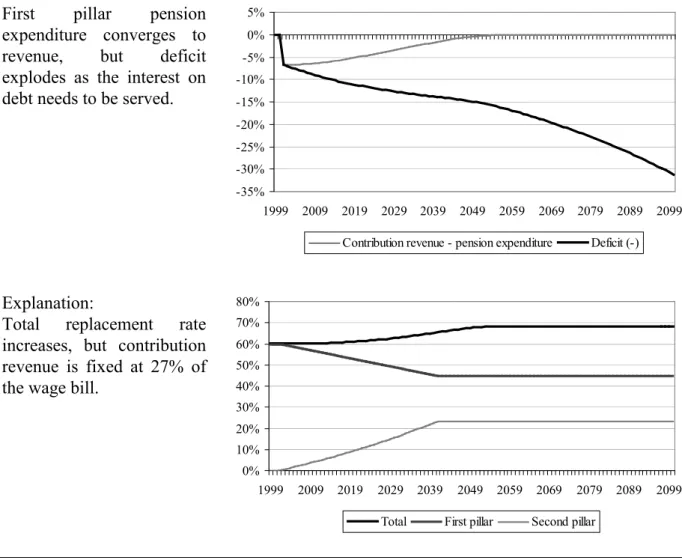
An immediate effect is a deficit in the public pillar of 6.75% of the wage bill: expenditure is given, but less money in received. Over time, expenditure decreases as the rights accrued before 2001 cease and the new lower rights enter into force. By the end of the transition period in 2060, contributions and pension expenditure are equal in the public pillar.
Figure 2.1. Partial privatisation of a stable DB system: DB accrual rate reduced pro rata
First pillar pension expenditure converges to revenue, but deficit explodes as the interest on debt needs to be served.
-35% -30% -25% -20% -15% -10% -5% 0% 5% 1999 2009 2019 2029 2039 2049 2059 2069 2079 2089 2099 Contribution revenue - pension expenditure Deficit (-)
Explanation:
Total replacement rate increases, but contribution revenue is fixed at 27% of the wage bill.
0% 10% 20% 30% 40% 50% 60% 70% 80% 1999 2009 2019 2029 2039 2049 2059 2069 2079 2089 2099 Total First pillar Second pillar
There are other features, however, illustrated in Figure 2.1, which crucially depend on the assumption that the interest rate exceeds wage bill growth by 1.5%, i.e. r = wb+1.5%. Contribution payments cover pension expenditure in the long run, but the debt incurred during the first 60 years leads to an exploding government debt and deficit, an unsustainable path.
One way to comprehend what makes this scenario unsustainable is that the total replacement rate increases from the initial 60% to 68%. The replacement rate from the public pillar reduces to ¾ of the initial 60%, or to 45%, but the second pillar gives 23% instead of 15%, as the 1.5% premium in the rate of return to funded assets adds to the accumulating rights. However, no extra resources are made available as the total contribution rate is maintained at 27%. The 20.25% allocated to the public pillar is not sufficient to cover both the pension expenditure and the interest on the debt which arises during the transitional period when pension expenditure exceeds contributions.
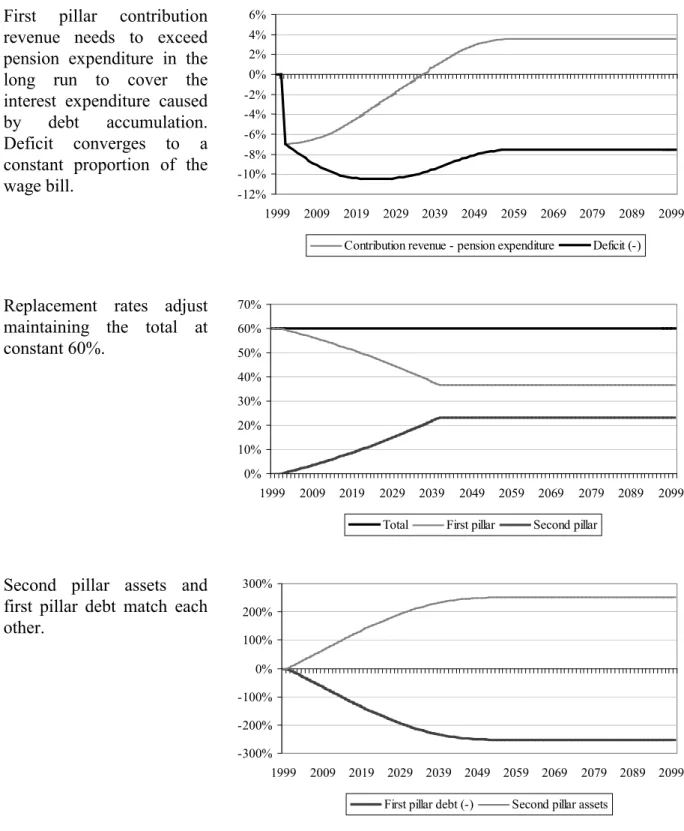
Thus, designing privatisation so that the first pillar remains financially sustainable requires changes to the ratio between the contributions paid to and benefits derived from the public pillar. There are an infinite number of options for a sustainable combination, one of them being that the contribution rate is maintained at 20.25% and accrual rates are adjusted so that the total replacement rate is maintained at 60%, which means that the first pillar replacement rate converges to 36.6%.
This case is illustrated in Figure 2.2. Government deficit and debt converge to certain figures, the replacement rates adjusting in parallel, and the permanent funds accumulated in the second pillar exactly matching the permanent debt in the first pillar.
One way to express what happens under privatisation is to say that part of the Implicit Pension Debt (IPD) of the PAYG system, defined as the present value at each point in time of the accrued rights of both workers and retirees, becomes explicit government debt. Before privatisation the IPD is 645% of the wage bill, and it will decline to 394% at the end of the transition period. The explicit debt correspondingly increases to 251%, maintaining the sum of implicit and explicit debt at 645%. The permanent level of funds in the second, privately managed pillar, converges to 251%, exactly matching the increase in government debt.
The main message from this exercise is that privatisation requires that the actuarial fairness in the first pillar be reduced. In other words, as the second pillar produces a return on its contributions which exceeds wage bill growth, the internal rate of return in the first pillar has to decrease so that the average rate of return matches the equilibrium conditions, which remain unaffected by the privatisation. Thus, the second pillar is more attractive for the individual and the attractiveness of the first pillar is correspondingly reduced.
Only under the extreme assumption that the difference between the interest rate and wage bill growth is zero (r = wb) is the outcome sustainable without a reduction in the actuarial fairness in the first pillar.
Note furthermore that the stocks of assets and debts mentioned above do not depend on real or nominal wage growth or inflation. However, government deficit is measured as nominal expenditure, including interest payments, minus revenue, and depends therefore on nominal growth even if the real rate of interest, and the stocks of assets and debts as a percentage of the wage bill are given. If, for example, inflation remains permanently at 3% and the nominal interest rate is correspondingly 1.5 percentage points higher, the peak of the deficit would be 14.4% of the wage bill, and would converge to 12.2% on the new permanent path, instead of 10.5% and 7.5% if inflation is 1.5%, as assumed above (Figure 2.2).
This leaves us puzzled about the advisability of privatisation. Something must be missing from the picture above as privatisation is still pursued as a serious option. The explanation is not that the private second pillar may earn a higher rate of return than government bonds. Although it would make the new total replacement rate higher than in the example above, the problem with the public pillar would remain.
The crucial element above is that we considered a stationary population (though the same results would hold also for a steadily growing population). In such a case continuation of a pure PAYG system can be viable, and arguments for systemic changes seem weak.
Figure 2.2. Partial privatisation of a stable DB system: DB accrual rate reduced to comply with total replacement rate at 60%
First pillar contribution revenue needs to exceed pension expenditure in the long run to cover the interest expenditure caused by debt accumulation. Deficit converges to a constant proportion of the
wage bill. -12%-10% -8% -6% -4% -2% 0% 2% 4% 6% 1999 2009 2019 2029 2039 2049 2059 2069 2079 2089 2099 Contribution revenue - pension expenditure Deficit (-)
Replacement rates adjust maintaining the total at constant 60%. 0% 10% 20% 30% 40% 50% 60% 70% 1999 2009 2019 2029 2039 2049 2059 2069 2079 2089 2099 Total First pillar Second pillar
Second pillar assets and first pillar debt match each other. -300% -200% -100% 0% 100% 200% 300% 1999 2009 2019 2029 2039 2049 2059 2069 2079 2089 2099 First pillar debt (-) Second pillar assets
It was important to demonstrate this to understand that the debate on privatisation is triggered by population ageing, and that the arguments are not captured/valid if population is assumed to be stationary. When the pensions burden increases, sharing it between successive generations becomes a serious issue, leading to a possible accumulation of funds, in which case privatisation enters the picture as a way to shift the management of these funds to the private sector. This will be illustrated in Chapter 3.
2.5. Notional Defined Contribution (NDC) system
A Notional Defined Contribution (NDC) system is one more set of rules for a pension system. It is more recent than the other two main systems described above, but it has already been implemented in Sweden, Latvia and Poland and in some non-European countries as a result of pension reforms in 1990s. The reforms in Italy in the 1990s also contain some NDC features. (Williamson, 2001).
In an NDC system contributions are fixed, registered in notional individual accounts which are remunerated by a administratively fixed rate of interest, and the capitalised value at retirement is transformed to an annuity paid out as a pension. Applications may differ in practise, but if the notional rate of interest is set as the rate of growth of the contribution base (which is the wage bill if complete coverage is assumed), and if projections of life expectancy at retirement are continuously updated, the system has the valuable property that pension expenditure equals contributions in the long-run (though not necessarily in the short run).
An NDC system is not supposed to possess reserves, or, should they exist, they have no relationship to individual accounts. This is exactly what makes the system notional. This also means that an NDC system is never developed so that a new system with these rules starts from scratch. Were it so, the system would have accumulated funds like a FF DC system, the only difference being that the rate of return would be determined administratively (and hence contain a rule for handling the surplus or deficit stemming from the difference between the factual and the notional returns on the funds). Thus, while DB PAYG and FF FC can exist and mature on the basis of their respective rules from the beginning, NDC represents a transformation of a DB PAYG system. This has been the case also in practise.
NDC systems normally only cover old age pensions, while disability pensions are financed from the state budget, though perhaps administratively integrated to the old age NDC system. Also, in an NDC system, non-contributory periods like maternity leave are often covered by a contribution from the government budget so that personal accounts continue to accumulate.6
The elementary case of a stationary population highlights the similarities between the DB PAYG and NDC for old age pensions. Assume the DB PAYG above, and assume that it is transformed to an NDC at a certain moment so that contributions remain at 27% of wages, but go to individual accounts, and that previously accrued pension rights are honoured. New pensions are then partly determined by the old DB rights and partly by the NDC annuities, so that the proportion of the former declines to zero after 40 years. Of course, the total replacement rate remains at 60%, and the system maintains constant financial balance.
Nothing real changes in this transformation. But again, this equality of the DB PAYG and NDC only holds if the population is stationary (or steadily changing).
6 DB PAYG systems can more easily support disability pensions, non-contributory periods etc. as
2.6. Effects of a retirement age increase and actuarial fairness
The simple setting of a stationary population gives us some elementary results concerning the effects of a retirement age increase on pension expenditure in the long run and on the actuarially fair compensation for postponing retirement.
Consider the identity
(1) contribution rate / replacement rate = years in retirement / years at work.
Taking the figures above, i.e. 27%, 60%, and 18 and 40 years, for these four variables, we assume an increase in the retirement age of one year. Maintaining the assumption on the replacement rate, we get a contribution rate of 24.9%. This is also a measure for pension expenditure as a percentage of the wage bill in the new steady state. Thus, expenditure decreases by 2.1% of the wage bill (or 0.8% of GDP assuming that the wage bill is 40% of GDP).
Workers may not agree to work longer if they are not compensated by receiving a higher pension. In a DB system as assumed above, one benchmark could be that the accrual rate of 1.5% holds for the additional year at work, making the new replacement rate 61.5%. In the new steady state, contributions and expenditure are 25.5% of the wage bill, i.e. 1.5% of the wage bill (or 0.6% of GDP) lower than with a retirement age of 60.
In these two examples, pension expenditure decreases because workers do not get fully compensated for their additional year at work. An actuarially fair compensation is by definition an increase in the replacement rate such that the capitalised value of the pension - taking one additional year of contribution payments into account - is the same before and after the increase in retirement age.
The result will naturally depend on the assumption of the interest rate (or discount rate). A simple benchmark is the case where the interest rate is equal to wage rate change. Under this assumption we can simply use the above identity, set 41 and 17 for the years at work and in retirement and 27% for the contribution rate, and conclude that the new replacement rate is 65.1%. This not only holds for the new steady state if everybody shifts to higher retirement age, but it is also gives 5.1% as the actuarially correct accrual rate for the additional year at work for any individual.
If the interest rate is higher than the increase in the wage rate, the actuarially correct accrual rate is correspondingly higher. Table 2.1 gives the results for interest rates 5%, 3%, 0%, and –0.7% above the wage rate change. The last case anticipates the case below, where the rate of interest is equal to the wage bill growth and the number of employees decreases by 0.7% p.a. due to low fertility.
Any deviation from the actuarially correct compensation for additional work can be treated as an implicit tax imposed on pension benefits. If the replacement rate does not increase at all, then the implicit tax rate is 100%. If the standard 1.5% accrual rate is applied on the additional year, then the system reaps 70-80% of the additional revenue (last column in Table 2.1).
Table 2.1. Actuarially correct compensation for a one-year retirement age increase Assumptions:
– initially, people are at work from age 20 to 59 and in retirement from 60 to 78 – standard accrual rate 1.5% (leading to replacement rate 60% after 40 years at work)
– contribution rate 27% (balancing a pure PAYG, assuming stationary population and pensions indexed to wages) D acar itr 5 7.8 80.9 3 6.7 77.5 1.5 5.9 74.4 0 5.1 70.7 -0.7 4.8 68.7
d = interest rate premium over wage rate growth,
acar = actuarially correct accrual rate for an additional year at work,
itr = implicit tax rate if accrual rate is 1.5% instead of the actuarially correct one for the additional year. Note: The calculation for implicit tax rate (itr) does not include the excess of the wage over the would-be pension during the extra year worked. Were it included, the results for the case of d=0, for example would be 48.4% instead of 70.7%. However, the direct costs related to working rather than retiring, and the additional utility due to leisure when retired, may match the difference between the wage and pension during this one year. Thus, the simple figures for itr above may give a good approximation of the relevant factors.
Obviously, the figures derived above differ slightly for the second and further additional years at work, and also if the life expectancy increases and therefore the number of years in retirement increases (assuming a fixed retirement age). The main difference, however, is between the small compensation derived from the standard accrual rate (or no compensation at all) and the actuarially fair compensation. The order of magnitude of this difference does not depend greatly on the other factors if we stay within a range of realistic assumptions.
These simple results give a tool to tackle questions related to the attempts to increase the retirement age. If workers have a choice on their retirement age, the incentives to retire may matter significantly. In addition, employers may not have the incentives to train and recruit older workers as this investment is at risk due to possible retirement. These factors may go together: the employer may expect the older worker to stay longer only if the pension system clearly encourages late retirement.
Note that above we only derived the results for long-run effects on pension expenditure or revenue, while an increase in retirement age always has an additional transitory downward effect on pension expenditure too. Depending on the rules of the system, this may have a permanent effect on the balance of the pension system on top of the difference between contribution revenue and pension expenditure. This topic will be discussed further below when illustrating the effects of retirement age changes under alternative pension systems assuming an ageing population.
3.
Systemic pension reforms for adverse demographics
As already stated in the introduction, the EU Member States and Candidate Countries are now experiencing unprecedented ageing as fertility is low and life expectancy is increasing. In the 1970s fertility declined to roughly 1.7 children per woman. In 2000 it was as low as 1.5, though partly affected by the increase in the average age of women giving birth. Correcting for this, the temporary underlying fertility rate is now 1.7.
We now enter into our stylised model an assumption that fertility was constantly at 2.1 until 1980, then declined to 1.7 in 1981 and remains at that level. The purpose of this simplified assumption is to show clearly the consequences of one single change in fertility in each pension system, and then to suggest reforms to cope with the adverse effects. In reality, changes in fertility happen gradually as a series of successive changes, and our results would apply to each of them.
Secondly, we also include into the analysis an increase in longevity. Its effects are straightforward if we assume that the retirement age remains at 60: an increase in longevity from 78 to 83 from 2000 to 2050 increases the time spent in retirement from 18 to 23 years.
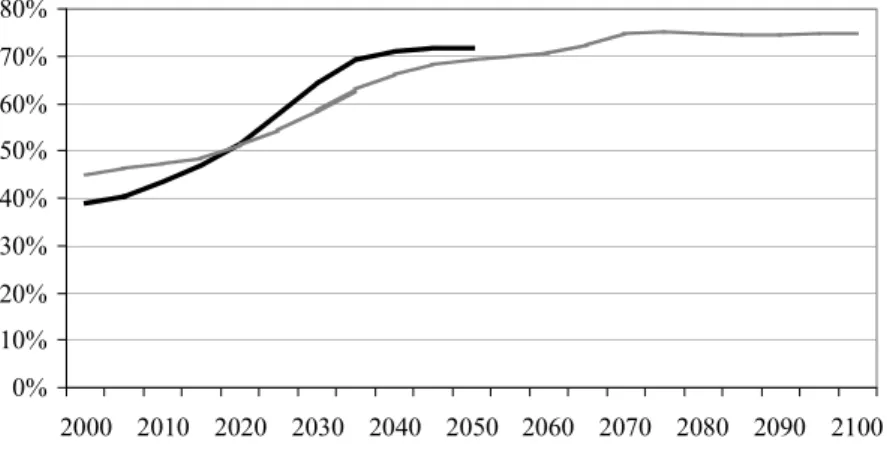
These two simple demographic assumptions produce an old age dependency ratio, or the ratio between population over 60 years of age to 20-59 years old, which roughly resembles the actual population projections for EU-15. The projected figure starts at a lower level than our simplified one, but then increases faster, as the big post-WWII 'baby boom' cohorts reach the age of 60 and over, so that the change by 2040 is even more dramatic than with our stylised facts (Figure 3.0). The graph also shows that given the assumptions on fertility and longevity, inherent also in Eurostat projections, a further increase in the dependency ratio after 2050 is implied. Thus, without claiming that our results are directly applicable, they may, despite their simplicity, give useful approximations, not forgetting that the real world situation is probably even more worrying.7
3.1. Fairness across generations under defined benefits
Apart from fully funded personal pension accounts, pension systems redistribute income from workers (or tax payers) to pensioners. However, the redistribution across generations in an accounting sense is not decisive. This can be demonstrated by a simple example: in a mature DB pure PAYG system under a stationary (or steadily changing) population, all successive generations pay an equal percentage of wages to pensions and also receive a pension fixed as an equal percentage of the wage rate. Thus, there is no redistribution of income across generations in a real sense.
Our current topic is to look into distribution across generations in a real sense. We note a permanent decline in fertility, and we assume that the replacement rate is determined as in the example in the previous chapter. Then, the rules of the pure PAYG system mean that the contribution rates have to be increased to cover the expenditure, according to the
7 For population and pension expenditure projections for EU-15, see Economic Policy Committee (2001), “Budgetary challenges posed by ageing populations”.
Figure 3.0. Old age dependency ratio* in EU-15, 1995-2050, and the stylised model projection
A simple assumption of permanent fertility decline from 2.1 to 1.7 in 1981 and an increase in longevity from 78 to 83 years from 2000 to 2050 produce an old age dependency ratio, which roughly resembles the actual population
projections for EU-15. 0% 10% 20% 30% 40% 50% 60% 70% 80% 2000 2010 2020 2030 2040 2050 2060 2070 2080 2090 2100 Eurostat projection Stylised model proj.
* Old age dependency ratio: ratio of population aged over 60 years to those aged 20-59 years.
increase in the ratio of pensioners to employees. While this is one possibility to keep the system in financial balance, the question of fairness in this scenario must be raised. If the age of women giving birth is 30 years, it takes 30 years until everybody in the labour force belongs to the group who’s fertility was at the new lower level, and 60 years before everybody in the labour force belongs to a cohort born after fertility declined. During this long transitional period, the adults who first invented the low fertility behaviour would, in a pure PAYG system, pay lower pension contributions than any generation coming after. Since every generation is enjoying the same replacement rate, fairness calls for a change in the regime: the first generation with the lower fertility should pay the same percentage of wages in pension contributions as any succeeding generation. Revenue would thus exceed expenditure, creating a fund which would remain constant as a percentage of the wage bill all other things being equal. Thanks to the proceeds from the fund, the contributions paid by all future generations are lower than in a pure PAYG system. This principle, leading to partial funding, was outlined by Sinn (2000) and further developed by Oksanen (2001a and 2001b).
A parallel argument applies for increasing longevity, if the replacement rate and the retirement age are given. In a pure PAYG system contributions are determined by the longevity of current pensioners only. If longevity increases, fairness for the future labour force is not maintained. The currently working generation, which will enjoy retirement for longer than current pensioners, should pay part of their future pensions themselves. Thus, contribution revenue should exceed current expenditure to create a fund. Were the increase in longevity to stop, the fund in relation to the wage bill would stabilise. Of course, if the replacement rate is decreased or retirement age increased, pension contributions and funding should change.8
8 A reference to a criterion called ‘fixed relative position’ (FRP) developed and discussed by Musgrave
Taking these two demographic factors into account, fairness across generations may require departing from a pure PAYG system and obliging the currently working generation to save for part of their own pensions. Note that this argument for partial funding is not built on foreseeable welfare gains for everybody, but purely on distribution of income between generations. If funding then ultimately leads to overall gains to be shared between the successive generations in one way or another, an additional advantage has been gained, though our argument here does not depend on it.
The benchmark for fairness across generations applied here concentrates on distribution of income across generations, and thus does not, for example, depend on real growth in the economy. This can be seen as an advantage of the approach. However, let’s look into a possible objection. It could be argued that it is fair that future generations, with a higher per capita income, should pay higher contributions for given pension benefits. This could indeed be the case. However, it is important to note that this does not justify a pure PAYG system. Under ageing, a pure PAYG system determines the ratio between contributions and benefits independently of real economic growth. There is probably no argument for rendering the outcome fair under all possible real growth rates.
Having said this, the benchmark for fairness could be modified to take the growth in welfare into account by adding a parameter determining a acceptable change in the ratio of contributions to benefits as a function of real growth. The illustrations below could be modified to this effect, though the results would then depend on the expected rate of real growth, and rules should be specified for coping with deviations from expectations. Thus, we would enter into complicated arguments, while the additional value of the results would be debatable.
Defined Benefit system to be pre-funded
We now maintain the previous assumptions of work, retirement and pension rights accrual rate, but drop that of the stationary population, to derive the fair contribution rate and the consequent degree of funding under ageing. In our search for a fair time path for pension contributions we make one important restriction: at each point in time the pension contribution rate is the same for everyone, as it normally is in DB PAYG system. Thus, when any change takes place, we do not set a different pension contribution rate for the cohorts responsible for the change, but at each point in time all workers pay the same new contribution rate. This means that complete fairness across cohorts is not achieved, but once again, the outcomes always compare favourably with those of a pure PAYG system.9
clarifying here. ‘FRP’ simply means indexation of pensions to wages after pension contributions. This is or has been the case in most European occupational pension systems. We also make this assumption in most scenarios illustrated here. This rule means that, for instance, that as soon as gains from an increase in productivity are reflected in the wage rate, they are automatically shared between current workers and pensioners. However, if demographics change, as it currently does, this rule is not sufficient for intergenerational fairness in a pure PAYG system as it does not bring justice across cohorts with different fertility and/or longevity. The aim of the present section is precisely to explain that under the FRP rule (equivalent to wage indexation) a departure from pure PAYG is required for intergenerational fairness (unless replacement rates are sufficiently reduced).
9 Here we deviate from Kifmann and Schindler (2001), who derive useful results for smoothing the
implicit tax rate implied by pension contributions and benefits under ageing. One of their results is to show that cohort-specific contribution and/or replacement rates are necessary for smoothing. In our
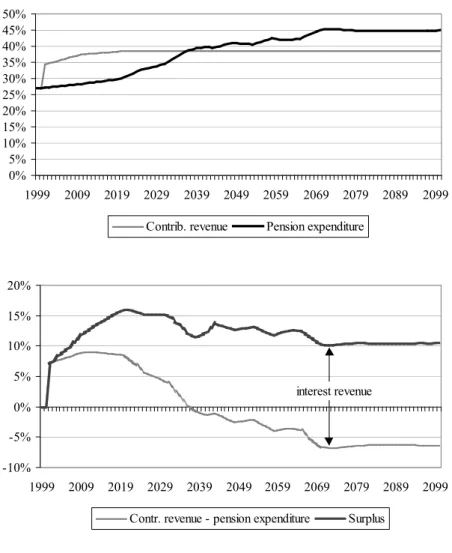
Figure 3.1. A pre-funded DB system: fair contributions, retirement age 60
Fertility declines to 1.7 in 1981; longevity increases gradually from 78 in 2000 to 83 in 2050; contributions increased in 2001 and gradually further to 2020 to correspond to the fertility decline and longevity increase (Scenario 4 in Table 3.1).
Contributions are gradually increased to 38% for intergenerational fairness. Otherwise, in a pure PAYG, the contributions to be paid by future generations would increase to 45%. 0% 5% 10% 15% 20% 25% 30% 35% 40% 45% 50% 1999 2009 2019 2029 2039 2049 2059 2069 2079 2089 2099 Contrib. revenue Pension expenditure
The initial increase in contribution rates produces an asset accumulation which provides interest revenue to support pension financing. -10% -5% 0% 5% 10% 15% 20% 1999 2009 2019 2029 2039 2049 2059 2069 2079 2089 2099 Contr. revenue - pension expenditure Surplus
interest revenue
The assets converge to more than 400% of the wage bill, or 175% of GDP. 0% 50% 100% 150% 200% 250% 300% 350% 400% 450% 500% 1999 2009 2019 2029 2039 2049 2059 2069 2079 2089 2099 Fund assets
terminology they are necessary for complete fairness, but we accept that for other pension system purposes and for practical reasons, the contribution rates are the same for everybody at each moment in time. Hence, complete fairness across cohorts is not achieved, while solutions which are as close as possible approximations are striven for.
Figure 3.1 illustrates the application of the principle of fairness in the case of fertility decrease and longevity increase. Expenditure increases to 45% of the wage bill. The contribution rate is increased to 38% by 2020, with an initial immediate jump in 2001, followed by a gradual increase. The details of the derivation of this path are given in Box 1, and Table 3.1.
The surplus peaks at 15% of the wage bill in 2019, converges to 10.5%, and results in a permanent fund of 427% of the wage bill.10
In Table 3.1 we also report IPD and the difference between IPD and the fund, which, under pre-funding is a measure of the burden to be carried over from one generation to the other in each scenario. Also the latter is larger than the original IPD of 645% of the wage bill before ageing started. The degree of funding, i.e. the ratio between the fund and IPD, is 40% in Scenario 4.
10 The above results are based on a number of simple, easily understandable assumptions. They can,
however, be generalised to a few more complicated situations. One is the assumption that in 2000 the DB system has an initial zero balance. In some systems, though, reserves may have been accumulated, and in others a deficit may have occurred, covered by borrowing directly from the market or by a deficit financed government subsidy. The treatment of these funds in setting future contribution rates and funding rules should depend on whether the funds were accumulated by cohorts before or after the decline in fertility, and on the longevity change in the past. In addition, they depend on the reactions of interest rates to ageing, as this determines the proceeds acquired from funds, whether accumulated previously or in future. We leave this theme to a further study.
Box 1. Derivation of the fair contribution rate under ageing: retirement age 60 To show separately the effects of changes in fertility and longevity, the first two scenarios in Table 3.1 assume a decline in fertility in 1981 but no longevity increase. Scenario 3 presents the pure effect of an increase in longevity by assuming counterfactually that fertility remains at the reproduction level of 2.1. Scenario 4 then combines the two demographic changes.
In Scenarios 1 and 2 a decline in fertility to 1.7 in year 1981 leads to a gradual increase in pension expenditure as a percentage of the wage bill to 34.3% as the ratio between pensioners and workers increases.
In Scenario 1 the contribution rate is increased gradually from 1981. As women give birth between the ages of 15 and 45, the average age is 30. The cohort aged 30 in 1981 will retire in 2010. Thus, the contribution rate should be increased to its new permanent level by 2010.
The new permanent contribution rate is 32%. This produces a sustainable time path
which can continue forever under the assumed demography and pension system.
The surplus of the system peaks at 7.7% of the wage bill and then converges to 3.6%, producing a permanent fund of 154% of the wage bill. A rough approximation for these figures as a percentage of GDP is obtained by multiplying the above figures by 0.4.
Scenario 2 moves towards reality by noting that the new principle of fairness is invented only for year 2001. It also assumes that those at work in 1981-2000 are not punished retroactively. The contribution rate is set to reach its permanent level in 2010, but now it jumps in 2001 by two thirds of its total increase. The required new permanent contribution level is 32.8%, which is higher than in Scenario 1 as the adjustment was made later. Correspondingly, the surplus and the fund are lower than above.
In Scenario 3 longevity increases from 78 in 2000 to 83 in 2050 without a decline in fertility in 1981. This leads to a level of expenditure in 2050 of 34.5% of the wage bill. Thus the assumed two demographic factors have roughly the same effect on expenditure in the long run.
For longevity increase, the time path for fair contributions is derived as follows: the contribution rate has to correspond to the longevity at the time when the current average worker will enjoy pension rights. The midpoint of employment is at 40 years of age and the midpoint of retirement at around 70 years, thus the lead in timing has to be 30 years. The contribution rate increase must therefore be completed by 2020. Assuming that the new rule is implemented only in 2001, the contribution rate should immediately jump by 3/5 of the total increase in that year. Scenario 3 shows that the surplus and fund accumulation required for a fair preparation for the longevity increase is bigger than that for the fertility decline.
Scenario 4 in Table 3.1. shows the result for the combined effects, also illustrated in Figure 3.1.