Interval Certitude Rule Base Inference Method using the
Evidential Reasoning
L.Q. Jin, X. Fang
Liqian Jin
School of Economics and Management,
Chongqing University of Posts and Telecommunications, P. R. China
[email protected] Xin Fang*
1. Chongqing Engineering Research Center for Processing Storage and Transportation of Characterized Agro-Products, P. R. China 2. School of Business Planning,
Chongqing Technology and Business University, P. R. China *Corresponding author: [email protected]
Abstract: Development of rule-based systems is an important research area for arti-ficial intelligence and decision making, as rule base is one of the most general purpose forms for expressing human knowledge. In this paper, a new rule-based representation and its inference method based on evidential reasoning are presented based on oper-ational research and fuzzy set theory. In this rule base, the uncertainties of human knowledge and human judgment are designed with interval certitude degrees which are embedded in the antecedent terms and consequent terms. The knowledge repre-sentation and inference framework offer an improvement of the recently developed rule base inference method, and the evidential reasoning approach is still applied to the rule fusion. It is noteworthy that the uncertainties will be defined and modeled using interval certitude degrees. In the end, an illustrative example is provided to illustrate the proposed knowledge representation and inference method as well as demonstrate its effectiveness by comparing with some existing approaches.
Keywords: interval certitude rule, knowledge representation, uncertainty inference, evidential reasoning.
1
Introduction
There are several types of uncertainties of knowledge such as incompleteness, randomness, fuzziness, inexactness and ignorance. The inference method which is based on uncertain knowl-edge is the uncertainty inference method. Because of the uncertainty is ubiquitous, the uncer-tainty knowledge representation and unceruncer-tainty inference method have become the most visible and fastest growing branch of artificial intelligence [38].
In the existed methods of knowledge representation, rule base seems to be the most common form for expressing various types of knowledge [27]. The rule bases can be used to support decision making with both quantitative and qualitative knowledge under various types of uncer-tainties. Specifically, different types of data such as exact number, fuzzy number, interval value, even subjective judgment can be represented by rule.
In the last four decades, the development of uncertainty methods have received extensive attention. Many methods have been proposed for showing uncertain knowledge and informa-tion. Such as the certainty factor based inference method [36], inference method using the Dempster-Shafer theory [12], Belief Rule Base Inference Methodology using the Evidential Rea-soning (RIMER) [31, 38–40], subjective Bays method [36], fuzzy inference method [29], et al.
In these methods, inference method using the Dempster-Shafer theory has a shortcoming in the aspect of dealing with conflict evidence, the subjective Bayes method is mainly used in the randomness but does not apply to other uncertainties, fuzzy inference method is used in the vagueness.
With the Dempster-Shafer theory, fuzzy set theory and If-then rule, Yang et al [38] have researched and given RIMER. The uncertain knowledge is described byBelief Rule Base (BRB), and it is able to handle many types of information. Evidential Reasoning (ER) approach is an uncertainty inference method which make up for the deficiencies of the inference method using the Dempster-Shafer theory. However, there are still some defects [17].
Liu et al. [5, 21] proposed the Extended Belief Rule Base (EBRB) based on BRB and the Extended Belief Rule Base Inference Methodology using the Evidential Reasoning (RIMER+). And the uncertainty of antecedent is described with belief structure and different evaluation grade set, but there is only one consequent attribute and knowledge should be converted to belief structure.
The fuzzy set has been widely researched and applied in various fields [20, 30, 34]. Interval number is an important fuzzy number, and it has been widely used in a lot of fields such as decision making science [2, 32, 37, 41], operational research [6, 9, 19], [8, 33]. The main reasons are as follows:
• In the theoretical research, interval numbers are closely linked with other forms of
uncer-tainty.
• In the practical application, in order to evaluate the things, people are mainly inclined to
give the upper and the lower bounds of information, and the interval number’s expression is nearly accord with this uncertainty characteristics of human thought.
According to the above analysis, the certitude rule base is not accord with actual situation. Because of the limitations of human cognition and the complexity of the objective things, decision maker can not always be confident enough to provide subjective judgment with exact certitude degrees. But at times, a range of the certitude degree can be assessed, such range is referred to as interval certitude degree. In order to apply the interval uncertainty, the knowledge representation which is based on the interval certitude rule and its inference method should be proposed. [16]
This paper is organized as follows. In Section 2, the Interval Certitude Rule Base Inference Method using the Evidential Reasoning (ICRIMER) is given. First, the structure and repre-sentation of Interval Certitude Rule Base (ICRB) is presented. Then a new generic knowledge base inference method ICRIMER is proposed. In Section 3, the performances of ICRIMER is demonstrated by comparing with some existing approaches using a case study of classifications with eight data sets of UCI Machine Learning Repository. The paper is concluded in Section 4.
2
Interval certitude rule base inference method
In this section, the basic knowledge of interval value fuzzy number is introduced, include concept, ranking method and similarity measure. Then the interval certitude rule is proposed as knowledge representation method. In the end of this section, the interval certitude rule base inference method using the evidential reasoning with nonlinear programming is presented. 2.1 Interval value fuzzy number
Notea=
aL, aU
be a bounded closed interval, and satisfies aL≤aU,aLis the lower bound
of a, aU is the upper bound of a. If aL, aU ∈ R, then a =
aL, aU
aL, aU ∈[0,1], thena=
aL, aU
is an interval value fuzzy number (for short, interval number). Specially, if aL=aU, thena=
aL, aU
is an exact number, note a=aL.
A ranking method based on the technique for order preference by similarity to ideal solution (TOPSIS) and distance is given in order to rank the interval number.
According to TOPSIS [22], for interval number, the positive ideal solution is[1,1], the negative ideal solution is [0,0]. The relative similarity degree η of interval number a =
aL, aU is as follows: η(a) = d−(a) d+(a) +d−(a) where d−(a) = aL +aU 2 −0 = aL +aU
2 is the distance [23] between a = aL, aU and negative ideal solution[0,0],d+(a) = aL +aU 2 −1 = 1− aL +aU
2 is the distance [23] between a=
aL, aU
and positive ideal solution[1,1].
The relative similarity degree η satisfies that the larger the relative similarity degree is the larger the interval number will be. So the ranking of interval number can be given based on the relative similarity degree:
• If η(a) > η(b) thena≻ b , ’≻’ denotes the fuzzified version of ’>’ and has the linguistic
interpretation ‘greater than’.
• Ifη(a) =η(b) thena=b, means that the ranking orders of a=aL, aU andb=bL, bU
are identical,a=
aL, aU
is equal to b=
bL, bU
, but aL =bL and aU =bU may be not always realized.
The similarity measure of interval numbers is also an important content of interval type data processing. According to the Lukasiewicz implication algebra on[0,1], supposea=
aL, aU
and
b=
bL, bU
are interval numbers, the similarity measure S[] is as follows:
S[](a, b) = h S[]L(a, b), S[]U(a, b)i S[]L(a, b) = min min 1−aL+bL,1−bL+aL , min 1−aU +bU,1−bU+aU S[]U(a, b) = max min 1−aL+bL,1−bL+aL , min 1−aU+bU,1−bU+aU
2.2 Interval certitude rule
An interval certitude rule base (ICRB) withK rules can be represented as follows:
R =
(X, A),(Y, C), ICD[],Θ, W, F
whereX ={Xi|i= 1,2,· · · , I} is the set of antecedent attributes, the relationship among the
antecedent attributes is taken as ‘∧’, ‘∧’ is the logical connective; Ai=
Ai,Ii
Ii= 1,2,· · ·, LAi
is the set of attribute values for antecedent attributeXi(i= 1,2,· · · , I), noteA={Ai|i= 1,2,
· · ·, I} be the set of antecedent attribute value sets; Y = {Yj|j = 1,2,· · ·, J} is the set
of consequent attributes, the relationship among the consequent attributes is taken as ‘∧’;
Cj= n Cj,J j Jj = 1,2,· · ·, L C j o
is the set of attribute values for consequent attributeYj(j= 1,2,
· · ·, J), noteC={Cj|j= 1,2,· · · , J}be the set of consequent attribute value sets;Θ=θk|0≤
thekth rule;W = wi 0≤wi ≤1, i= 1,· · ·, I, and I P i=1 wi = 1
is the set of the antecedent at-tribute weights,wi is the weight ofXi ;ICD[]={Icd(∆)|Icd(∆)⊆[0,1]}is interval certitude
degree set,Icd(∆)is the interval certitude degree of event∆,Icd(∆) is called interval certitude degree. Icd(∆) satisfies the more higher the degree of certainty is, the more large Icd(∆) will be. Icd(∆) = [0,0]means completely uncertainty, Icd(∆) = [1,1] means completely certainty,
Icd(∆) = [0,1] means that we know nothing about the uncertainty of event ∆. F is a logical function.
More specifically, the kth rule in the ICRB R can be written as Rk(k= 1,2,· · ·, K):
If X1=Ak1, Icdk X1 =Ak1 ∧ · · · ∧ XI =AkI, Icdk XI =AkI then Y1 =C1k, Icdk Y1=C1k ∧ · · · ∧ YJ =CJk, Icdk YJ =CJk
with rule interval certitude degreeIcdk Rk
, rule weightθk and antecedent attribute weights
(w1, w2,· · ·, wI)
where ‘=’ means ‘is’;θk is the weight of thekth ruleRk;(w
1, w2,· · ·, wI)are the weights of the
antecedent attributes. Fori= 1,2,· · · , I ,Ak
i is the referential value of theith antecedent attributeXi that is used
in the kth rule Rk , Ak
i ∈ Ai or Aki =φ, ( φ is default, means that the ith attribute Ai of the
kth rule. Rk has no effect on the consequent); Icdk Xi =Aki
⊆[0,1] is the interval certitude degree of that Ak
i is the referential value of Xi inRk , means the degree of Aki influence on the
consequent; ifAk
i =φthenIcdk Xi =Aki
= 0 and this antecedent attribute can be left out. For j = 1,2,· · ·, J, Ck
j is the referential value of the jth consequent attribute Yj that is
used in Rk , Ck
j ∈ Cj or Cjk = φ (means that the kth rule Rk and its antecedent have no
effect on the jth consequent Cj ), Icdk
Yj =Cjk
⊆ [0,1] is the interval certitude degree of that Ck
j is the referential value of Yj in Rk, means the degree of that Yj is Cjk , if Cjk = φ
thenIcdkY j =Cjk
= 0and this consequent attribute can be left out; Icdk Rk
⊆[0,1]is the interval certitude degree ofRk, means the degree of thatRk is true.
For shortly, thekth rule Rk can be written as:
If Ak 1, Icdk Ak1 ∧ · · · ∧ Ak I, Icdk AkI then Ck 1, Icdk C1k ∧ · · · ∧ Ck J, Icdk CJk
with rule certitude degree Icdk Rk
, rule weight θk and antecedent attribute weights
(w1, w2,· · ·, wI) Note: αki =IcdkAki= αkiL,αikU , βjk =IcdkCjk= βjkL,βjkU γk=IcdkRk= γkL,γkU where0 ≤ αk i L ≤ αk i U ≤1,0≤βk j L ≤βk j U ≤1,0≤ γkL ≤ γkU ≤1; and the kth ruleRk can be given as:
If Ak 1, αk1 ∧ · · · ∧ Ak I, αkI , then Ck 1, βk1 ∧ · · · ∧ Ck J, βkJ . with rule certitude degree h γkL
, γkUi
, rule weightθk and antecedent attribute weights
Note: Ak=nAki A k i ∈AiorAki =φ, i= 1,2,· · ·, I o Ck=nCjk C k j ∈CjorCjk=φ, j= 1,2,· · ·, J o ∧Ak=Ak1∧Ak2∧ · · · ∧AkI ∧Ck =C1k∧C2k∧ · · · ∧CJk
where Ak is the set of antecedent attribute values of the kth rule Rk; ∧Ak is the antecedent
of thekth rule Rk; Ck is the set of consequent attribute values of the kth rule Rk; ∧Ck is the consequent of the kth ruleRk.
The kth ruleRk can be given as:
If ∧Ak, αk
then ∧Ck, βk
with rule certitude degree γk, rule weightθk and antecedent attribute weights (w
1, w2,· · · , wI)
whereαk =h αkL
, αkUi
⊆[0,1]is the interval certitude degree of∧Ak,βk=h βkL
, βkUi
⊆
[0,1]is the interval certitude degree of∧Ck,γk=h γkL
, γkUi
⊆[0,1]is the interval certitude degree of the kth rule Rk,θk is the weight of the kth rule Rk,(w
1, w2,· · · , wI) are the weights
of the antecedent attributes. 2.3 Inference method
The interval certitude rule base inference method using the evidential reasoning is given as follows.
The input actual vector can be noted as
Input() ={(a1, α1),(a2, α2),· · ·,(aI, αI)}
whereai ∈Aiorai =φ(i= 1,2,· · · , I)is one-to-one correspondence with theith antecedent
at-tributeXi;αi = h (αi)L,(αi)U i 0≤(αi)L≤(αi)U ≤1, i= 1,2,· · · , I
is the interval certitude degree ofai. Ifai =φthenαi = 0.
Suppose that the input fact Input() and the kth rule Rk match successfully, for all i =
1,2,· · ·, I, ai is equal to Aki without Aki =φ. But the interval certitude degrees of input fact
value and antecedent attribute value may be different; so according to the similarity measure, there is a similarity degree should be given as activation certitude factors.
The activation certitude degree of Ak
i (i= 1,2,· · · , I) under the input fact is given with
similarity measure S[] as follows:
˜ αik= S Ak i, ai Ak i ∈Ai 1 Ak i =φ where S Ak i, ai = S[] αk i, αi , αk
i is the interval certitude degree of Aki, αi is the interval
certitude degree of ai, S Aki, ai
is the similarity degree of Ak
i and ai. Aki=φ is a specific case,
if Ak
i=φ then the value of will not influence the matched conclusions, whether ai is default or
some other values, the ith antecedent attribute in thekth rule always can be satisfied. Note
˜
Ak =nα˜ki |i= 1,2,· · ·, Io
˜
The activation weight set of the kth ruleRk is given as follows: Wk =nwik|i= 1,2,· · · , Io where wik= wi Aki ∈Ai 0 Ak i =φ
after normalization, the activation weight set is given as ˜ Wk =nw˜ik|i= 1,2,· · · , Io where ˜ wki = wik I P t=1 wk t .
Because that the ‘∧’ connective is used in rules, so the aggregation function of antecedent is referred to as the T-norm operator. The interval certitude degree of antecedent ∧Ak can be
obtained as follows: ˜ αk= ˜ αkL,α˜kU = " I Y i=1 I r h ˜ αk i Liw¯ k i , I Y i=1 I r h ˜ αk i Uiw¯ k i # where ¯ wki = w˜ k i max l=1,···,I ˜ wk l ¯ wk
i means that the smaller the weight is, the less the impact on certitude degree ( α˜ki
w¯ki
is approaches the limit of 1), ifw˜k
i = 0 then I r h ˜ αk i Liw¯ k i = I r h ˜ αk i Uiw¯ k i = 1 [23]. According to ER approach,
∧Ck is the set of the consequent of the kth rule Rk as the
frame of discernment, letΩk =
∅,
∧Ck ,Rk and∧Akare evidences, the weights of them should be confirmed, the new weight is called credibility degree. By the definition of ICRB,
γk = h γkL
, γkUi
is the degree of that the rule Rk is true, it can be seem as the degree of
Rk influence on ∧Ck when Rk is true; α˜k =h α˜kL
, α˜kUi
is the degree of ∧Ak influence on
∧Ck when ∧Ak is true. Based on the above analysis, the credibility degree wk
R of Rk and the
credibility degreewk
A of∧Ak can be obtained as follows:
wRk = wkRL,wkRU = " γkL (˜αk)U + (γk)L, γkU (˜αk)L+ (γk)U # wkA= wkAL,wkAU = " ˜ αkL (˜αk)L+ (γk)U, ˜ αkU (˜αk)U+ (γk)L #
The basic probability masses are:
mR ∧Ck=wkRγk =hmRL∧Ck, mUR∧Cki= wRkLγkL,wkRUγkU
mR Ωk= 1−mR ∧Ck=hmLR Ωk, mUR Ωki= 1−wRk U γkU,1−wRk L γkL ¯ mR Ωk= 1−wkR= h ¯ mLR Ωk,m¯UR Ωki= 1−wkR U ,1−wRk L wheremR ∧Ck
is the basic probability mass ofRk;m R Ωk
is the remaining probability mass that is unassigned toCk which is caused by Rk; m¯
R Ωk
is amount of remaining support left uncommitted by the weight ofRk.
mA ∧Ck=wkAα˜k=hmAL∧Ck, mUA∧Cki= wkALα˜kL,wAkUα˜kU mA Ωk= 1−mA ∧Ck=hmLA Ωk, mUA Ωki= 1−wkA U ˜ αkU,1−wkA L ˜ αkL ¯ mA Ωk= 1−wkA=hm¯LAΩk,m¯UAΩki= 1−wkAU,1−wAkL wheremA ∧Ck
is the basic probability mass of∧Ak,m A Ωk
is the remaining probability mass that is unassigned to∧Ckwhich is caused by∧Ak;m¯A Ωk
is amount of remaining support left uncommitted by the weight of∧Ak.
With the Dempster combination method [12], the upper boundβ˜kU and the lower bound
˜
βkL of the activation degree β˜k of consequent ∧Ck are given as follows:
M ax/M inβ˜k S.t.β˜k= m ∗ R ∧Ck m∗ A ∧Ck +m∗ R ∧Ck m∗ A Ωk +m∗ R Ωk m∗ A ∧Ck +m∗ R Ωk m∗ A ∧Ck 1−m¯∗ R(Ωk) ¯m∗A(Ωk) m∗ R ∧Ck+m∗ R Ωk= 1 m∗ A ∧Ck+m∗ A Ωk= 1 ¯ m∗ R Ωk+ ¯m∗ A Ωk= 1
the solutions of the optimization problem are the upper bound β˜kU and lower bound β˜kL
of the activation degreeβ˜k.
˜ βk= ˜ βkL,β˜kU ˜ βkL= M in β˜k ˜ βkU = M ax β˜k
Then the interval certitude degree of consequent attribute value Ck
j (j= 1,2, · · ·, J) is
ob-tained based on the similarity measureS[]: ˜ βjk= ˜ βjkL,β˜jkU
˜ βjkL= min 1−βk j L +β˜kL,1−βk j U +β˜kU βk j L ˜ αk= 1 min ˜ βkLβk j L ,1 ˜ αk<1 ˜ βjkU = max 1−βk j L +β˜kL,1−βk j U +β˜kU βk j U ˜ αk= 1 min ˜ βkUβk j U ,1 ˜ αk<1
If there areT rules which are matching successfully with the input fact and having the same consequent attribute value C′, then the combination method should be given. First of all, the
tth rules can be given asRt:
If ∧At,α˜t thenC′,β˜t n ∧ · · · ∧Ct n−1,β˜ t n−1 ∧Ct n+1,β˜nt+1 ∧ · · · ∧Ct J,β˜Jt
with rule certitude degree γt, rule weightθt and antecedent attribute weights w1, w2,· · ·, wI
where = 1,2,· · · , T, n∈ {1,2,· · · , J} and n is determinate; ∧At is the antecedent of rule R t,
˜
αt=h α˜tL
, α˜tUi
⊆[0,1]is the interval certitude degree of ∧At;C′and Ct
j(j= 1,· · ·, n−1,
n+ 1,· · ·, J) are the consequent attribute values of rule Rt, β˜nt =
˜ βtn L ,β˜nt U ⊆ [0,1] is the interval certitude degree of C′ under the input fact, β˜t
j = ˜ βt j L ,β˜t j U ⊆ [0,1] (j= 1,· · · , n−1, n+ 1,· · · , J) is the interval certitude degree ofCjt under the input fact; γt=
h
γtL
, γtUi
⊆ [0,1] is the rule certitude degree of rule Rt, θt ∈ [0,1] is the rule weight of
rule Rt, the activation weights of rules are under the influence of Θ = {θt|t= 1,2,· · ·, T},
w1, w2,· · ·, wI are antecedent attribute weights.
The rule weights are the relative weights (preference weights), according to the preference weight method [25], the credibility degrees of rules are given as ̟={̟t|t= 1,2,· · ·, T}, and
̟t is the credibility degree of the tth rule Rt.
According to the evidential reasoning approach, {C′} is frame of discernment, let Ω′ =
∅, {C′} , the basic probability masses are given as follows:
mt(C′) =̟tβ˜nt = mLt (C′), mUt (C′) = ̟t ˜ βntL̟t ˜ βntU mt(Ω′) = 1−mt(C′) = 1−̟tβ˜nt = mLt (Ω′), mUt (Ω′) = 1−̟t ˜ βntU,1−̟t ˜ βntL ¯ mt(Ω′) = 1−̟t
where mt(C′) is the basic probability mass of Rt, mt(Ω′) is the remaining probability mass
that is unassigned toC′which is caused by the incompleteness of ruleRt;m¯t(Ω′) is amount of
remaining support left uncommitted by the weight of Rt.
Suppose mΛ(t)(C′) is the combined basic probability mass of C′ by aggregating the first
t(t= 1,2,· · · , T) rules(R1,· · ·, Rt), and mΛ(t)(Ω′) is unassigned toC′which is caused by the
incomplete-ness of the firstt rules(R1,· · · , Rt); m¯Λ(t)(Ω′) is amount of remaining support left
uncommitted by the weight of the firstt rules(R1,· · ·, Rt).
Obviously, for the firstt= 1,
mΛ(1)(C′) =m1(C′) =̟1β˜j1= h mLΛ(1)(C′), mUΛ(1)(C′)i= ̟1 ˜ βn1L, ̟1 ˜ β1nU
mΛ(1)(Ω′) =m1(Ω′) = h mLΛ(1)(Ω′), mUΛ(1)(Ω′)i= 1−̟1 ˜ βn1U,1−̟1 ˜ βn1L ¯ mΛ(1)(Ω′) = 1−̟1
The combined masses of the first trules are given as follows:
• mΛ(t+1)(C′) M ax/M in mΛ(t+1)(C′) = m∗Λ(t)(C′)m∗t+1(C′) +m∗ Λ(t)(C′)m∗t+1(Ω′) +m∗Λ(t)(Ω′)m∗t+1(C′) S.t. m∗ Λ(t)(C′)m∗t+1(C′) +m∗Λ(t)(Ω′)m∗t+1(Ω′) +m∗ Λ(t)(C′)m∗t+1(Ω′) +m∗Λ(t)(Ω′)m∗t+1(C′) = 1 m∗ t+1(C′) +m∗t+1(Ω′) = 1
The result of solving the optimization model is
mΛ(t+1)(C′) = h mLΛ(t+1)(C′), mUΛ(t+1)(C′)i mLΛ(t+1)(C′) = M in mΛ(t+1) (C′) mUΛ(t+1)(C′) = M ax mΛ(t+1) (C′) • mΛ(t+1)(Ω′) M ax/M in mΛ(t+1)(Ω′) = m∗Λ(t)(Ω′)m∗t+1(Ω′) S.t. m∗ Λ(t)(C′)m∗t+1(C′) +m∗Λ(t)(Ω′)m∗t+1(Ω′) +m∗ Λ(t)(C′)m∗t+1(Ω′) +m∗Λ(t)(Ω′)m∗t+1(C′) = 1 m∗ t+1(C′) +m∗t+1(Ω′) = 1
The result of solving the optimization model is
mI(t+1)(Ω′) = h mLI(t+1)(Ω′), mUI(t+1)(Ω′)i mLI(t+1)(Ω′) = M in mI(t+1) (Ω′) mUI(t+1)(Ω′) = M ax mI(t+1) (Ω′) • m¯Λ(t+1)(Ω′) ¯ mΛ(t+1)(Ω′) = ¯mΛ(t)(Ω′) ¯mt+1(Ω′)
The composition certitude degree of the consequent attribute valueC′is given as follows:
β′=h(β′)L,(β′)Ui,(β′)L= m L Λ(T)(C′) 1−m¯Λ(T)(Ω′) ,(β′)U = m U Λ(T)(C′) 1−m¯Λ(T)(Ω′) .
Obviously, interval certitude degree satisfies that the interval certitude degree is more greater the consequent attribute value is more certain. If there are more than one matches and values of each consequent attribute, then the consequent attribute value with the greater interval certitude degree is the final consequent attribute value under the actual input vector.
3
Illustrative examples
In this section, a case study of classification with UCI data sets is provided. This example is used to illustrate the effectiveness of ICRIMER by comparing with some existing approaches.
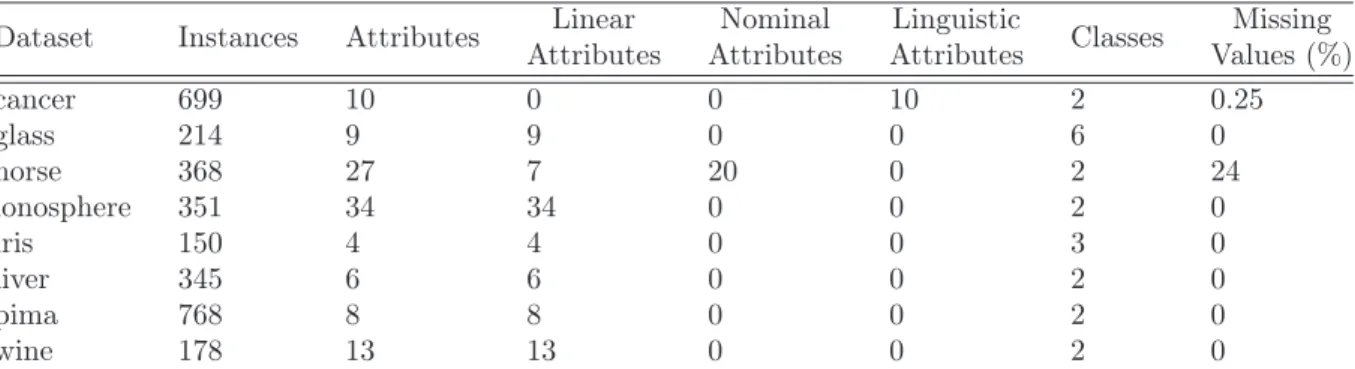
In order to compare ICRIMER inference method with other methods which are based on different data types as well as missing values, eight data sets from the UCI Machine Learning Repository are used. Table 1 shows for each data set its name, the numbers of instances,
attributes, linear attributes, nominal attributes, linguistic attributes, classes, and the percentage of the missing values.
Table 1: Properties of eight data sets from UCI Dataset Instances Attributes Linear
Attributes Nominal Attributes Linguistic Attributes Classes Missing Values (%) cancer 699 10 0 0 10 2 0.25 glass 214 9 9 0 0 6 0 horse 368 27 7 20 0 2 24 ionosphere 351 34 34 0 0 2 0 iris 150 4 4 0 0 3 0 liver 345 6 6 0 0 2 0 pima 768 8 8 0 0 2 0 wine 178 13 13 0 0 2 0
These data sets are used to compare the performances of Interval Certitude Rule Base Infer-ence Method using Evidential Reasoning approach (ICRIMER), Rule Based InferInfer-ence Method using Dempster-Shafer theory (RIMDS) [15], Feature Interval Learning algorithm (FIL) [11], k -Nearest Neighbor algorithm (k-NN) [4] Logistic Regression (LoR) [3,26], Naive Bayesian classifier (NB) [7], Pruning Decision Tree (PDT) [13].
ICRIMER and RIMDS are interval feature projection based logical inference algorithms. FIL is an interval feature projection based algorithm. LoR and NB are probability based algorithm. PDT is a structure based algorithm and decision tree can be used to describe If-then rules. k-NN is a famous machine learning method and give excellent results on many real-world examples [24]. To illustrate the significance of the accuracy of the rule base, a comparison rule base is given, and the interval certitude degrees and weights of rules are given based on some artificial restric-tions. For example, if two rules which have the same antecedent and the different consequent, then these two rules will be given the smaller interval certitude degrees and weights; the weights of attribute are given using the feature selection method based on Relief [18]. The learning method based on ICRIMER and the comparison rule base is recorded as ICRIMER-c.
In the eight data sets, there are different data types: linear values, nominal values, linguistic values (evaluation grade) and missing values. So the instances should be transformed into interval certitude rules firstly.
Table 2 and Figure 1 report the correctly classified accuracy rate of the FIL,k-NN, LoR, NB, PDT, RIMDS and ICRIMER which are obtained by averaging the correctly classified accuracy rates over five repetitions of 5-folder cross validations. In this paper,k=5 fork-NN which exactly consistent with the case study in Ref. 29 as 5-NN gives the best correctly classified accuracy rate.
From Table 2 and Figure 1, we can find some phenomena as follows.
(i) ICRIMER may not always be the best classification method except data sets cancer and iris, but ICRIMER outperforms the interval classification methods RIMDS and FIL on five data sets, cancer, glass, horse, iris and liver. It means that ICRIMER has a higher classification capability on interval data sets.
Table 2: Correctly classified accuracy rates of the FIL, k-NN, LoR, NB, PDT, RIMDS, ICRIMER and ICRIMER-c
Learning Method cancer glass horse ionosphere iris liver pima wine
FIL 0.9688 0.5502 0.7718 0.9253 0.9426 0.6185 0.7054 0.9663 k-NN 0.9691 0.6455 0.8157 0.8501 0.9640 0.6110 0.7353 0.9540 LoR 0.9342 0.6355 0.8300 0.8775 0.8533 0.6870 0.6355 0.9607 NB 0.9740 0.5392 0.8027 0.8842 0.9293 0.6151 0.7262 0.9348 PDT 0.9299 0.6822 0.8033 0.8974 0.9600 0.6870 0.6822 0.9157 RIMDS 0.9629 0.5844 0.7700 0.8643 0.9739 0.6232 0.5195 0.9444 ICRIMER 0.9759 0.6047 0.7733 0.8942 0.9800 0.6318 0.6987 0.9055 ICRIMER-c 0.9900 0.6512 0.8132 0.8971 0.9899 0.6957 0.7532 0.9722
cancer glass horse ionosphere iris liver pima wine 0 0.2 0.4 0.6 0.8 1 1.2 DATA SETS ACCURACY RATE FIL k−NN LoR NB PDT RIMDS ICRMIER ICRMIER−c
Figure 1: Correctly classified accuracy rates of the FIL, k-NN, LoR, NB, RIMDS, ICRIMER and ICRIMER-c
(ii) With regard to If-then rules, ICRIMER outperforms or a bit underperforms PDT on five data sets, cancer, ionosphere, iris, pima and wine. It means that ICRIMER has advantages in this respect.
(iii) ICRIMER-c is the best classification method on five data sets cancer, iris, liver, pima and wine, on the other three data sets the accuracy rate of ICRIMER-c is higher than the accuracy rate of ICRIMER and ICRIMER-c is the second best method in the eight methods. It means that, with a relatively accurately rule base, ICRIMER has general applicability and high classification capability.
(iv) Compare the classified accuracy rates of ICRIMER and ICRIMER-c, the classified accu-racy rate of ICRIMER-c is higher than the classified accuaccu-racy rates of ICRIMER. It means that a relatively accurately rule base is an important influencing factors of ICRIMER and the rule base can be more accurately by adjusting the interval certitude degrees and weights of rules, the knowledge representation method ICRB is effective.
In general, ICRIMER is the better algorithm on this eight UCI data sets, with the relatively accurate rule bases, the results of classification would be better. And the interval certitude structure can be used to describe the uncertainties of knowledge; the ICRB can better reflect the uncertainty, correctness and importance of instance or knowledge. Moreover, if the weights and interval certitude degrees are given by domain expert or gained through training, then the results will be more rational and better.
4
Conclusions
In this paper, a new knowledge representation, interval certitude rule base (ICRB), was proposed to capture uncertainty and nonlinear causal relationships based on the If-then rule and fuzzy set theory. The inference process of interval certitude rule base was characterized by all interval certitude rules expression and was reasoning using the evidential reasoning. And an illustrative example with UCI data sets was used to illustrate the application of the proposed method.
There are several features of the interval certitude rule base inference method (ICRIMER). First, due to the use of interval certitude rule, the ICRIMER method gives a description frame-work of relationships between inputs and outputs which may be complete or incomplete, linear or nonlinear, discrete or continuous, or their mixture, which are based on both numerical data and human judgments. Second, the uncertainty of human judgment is characterized with inter-val certitude structure, and ICRIMER is a multi-output uncertainty inference method with one or more than one consequent attributes. These features are more close to the experience and perception of human.
Acknowledgements
This work is supported by Doctor Project of Chongqing Social Sciences (Grant No. 2016BS082, 2016BS032), Project of Chongqing Municipal Education Commission (Grant No. KJ2016008391 44), Chongqing Commission of Science and Technology Research Projects (Grant No. KJ170616 5), Chongqing Engineering Research Center for Processing, Storage and Transportation of Char-acterized Agro-Products (Grant No. KFJJ2016026), Fundamental Science and Frontier Technol-ogy Research Project in Chongqing (cstc2017jcyjAX01301), National Natural Science Foundation of China (No.71702015).
Bibliography
[1] Aczel J., Saaty T.L. (1983); Procedures for synthesizing ratio judgments, Journal of Math-ematical Psychology, 27(2), 93–102, 1983.
[2] Barrenechea E., Fernandez J., Pagola M. et al (2014); Construction of interval-valued fuzzy preference relations from ignorance functions and fuzzy preference relations. Application to decision making, Knowledge-Based Systems, 58, 33–44, 2014.
[3] Bielza C., Robles V., Larranaga P. (2011); Regularized logistic regression without a penalty term: an application to cancer classification with microarray data, Expert Systems with Applications, 38(5), 5110–5118, 2011.
[4] Cataron A., Andonie R., Chueh Y. (2013); Asymptotically unbiased estimator of the infor-mational energy with kNN,International Journal of Computers Communications&Control, 8(5), 689–698, 2013.
[5] Calzada A., Liu J., Wang H.,Kashyap A. (2013); A GIS-based spatial decision support tool based on extended belief rule-based inference methodology, Eureka–2013 Fourth Interna-tional Workshop Proceedings, 388–395, 2013.
[6] Chao X.R., Peng Y., Kou G. (2017); A similarity measure-based optimization model for group decision making with multiplicative and fuzzy preference relations,International Jour-nal of Computers Communications &Control, 12(1), 26–40, 2017.
[7] Chen J.N., Huang H.K., Tian F.Z. et al. (2008); A selective bayes classifier for classifying incomplete data based on gain ratio, Knowledge-Based Systems, 21(7), 530–534, 2008. [8] Chin K.S., Yang J.B., Guo M. et al. (2009); An evidential-reasoning-interval-based method
for new product design assessment,IEEE Transactions on Engineering Management, 56(1), 142–156, 2009.
[9] Conde E., de la Paz Rivera Perez M. (2010); A linear optimization problem to derive relative weights using an interval judgement matrix, European Journal of Operational Research, 201(2), 537–544, 2010.
[10] Couso I., Garrido L., Sanchez L. (2013); Similarity and dissimilarity measures between fuzzy sets: A formal relational study,Information Sciences, 229, 122–141, 2013.
[11] Dayanik A. (2010); Feature interval learning algorithms for classification,Knowledge-Based Systems, 23(5), 402–417, 2010.
[12] Dempster A.P. (1967); Upper and lower probabilities induced by a multivalued mapping, Annals of Mathematical Statistics, 38(2), 325–339, 1967.
[13] Esposito F., Malerba D., Semeraro G. (1997); A comparative analysis of methods for pruning decision trees,IEEE Transactions on Pattern Analysis and Machine Intelligence, 19(5), 476– 491, 1997.
[14] Hu B.Q. (2010); Fuzzy theory, Wuhan University Press, 2010.
[15] Jin L.Q., Xu Y. (2014); A rule-based inference method using Dempster-Shafer theory, Knowledge Engineering and Management Proceedings of the Eighth International Conference on Intelligent Systems and Knowledge Engineering (ISKE 2013), 61–72, 2014.
[16] Jin L. Q., Xu Y., Fang X. (2016); A novel interval certitude rule base inference method with evidential reasoning, Proceedings of the 12th International FLINS Conference (FLINS 2016), 50–55, 2016.
[17] Jin L.Q., Liu J., Xu Y., Fang X. (2015); A novel rule base representation and its inference method using the evidential reasoning approach,Knowledge-Based Systems, 87, 80–91, 2015. [18] Kononenko I. (1994); Estimating attributes: analysis and extension of relief,Proceedings of
the Seventh European Conference in Machine Learning, Springer-Verlag, 171–182, 1994. [19] Li D.F. (2011); Linear programming approach to solve interval-valued matrix games,Omega,
39, 655–666, 2011.
[20] Li M., Wu C., Zhang L. et al. (2015); An intuitionistic Fuzzy-TODIM method to solve distributor evaluation and selection problem,International Journal of Simulation Modelling, 14(3), 511–524, 2015.
[21] Liu J., Martinez L., Calzada A. et al (2013); A novel belief rule base representation, gener-ation and its inference methodology,Knowledge-Based Systems, 53, 129–141, 2013.
[22] Nadaban S., Dzitac S., Dzitac I. (2016); Fuzzy TOPSIS: A General View,Procedia Computer Science, 91, 823-831, 2016.
[23] Park J.H., Park I.Y, Kwun Y.C. et al (2011); Extension of the TOPSIS method for decision making problems under interval-valued intuitionistic fuzzy environment,Applied Mathemat-ical Modelling, 35, 2544–2556, 2011.
[24] Saez J.A., Derrac J., Luengo J. et al (2014); Statistical computation of feature weight-ing schemes through data estimation for nearest neighbor classifiers, Pattern Recognition, 47(12), 3941–3948, 2014.
[25] Saaty T.L. (1980);The Analytic Hierarchy Process, McGraw-Hill Press, 1980.
[26] Soman K.P., Diwakar S., Ajay V. (2011);Insight into data mining theory and practice, China Machine Press, 2011.
[27] Sun R. (1995); Robust reasoning: integrating rule based and similarity based reasoning, Artificial Intelligence, 75(2), 241–295, 1995.
[28] Wang Y.M. (2009); Reply to the note on article "The evidential reasoning approach for multiple attribute decision analysis using interval belief degrees", European Journal of Op-erational Research, 197, 813–817, 2009.
[29] Wang Z.D., Wang H.Q., Lv H.W. et al (2014); Spectrum migration approach based on Pre-decision Aid and interval mamdani fuzzy inference in cognitive radio networks,International Journal of Computers Communications &Control, 9(1), 85–92, 2014.
[30] Wang J.Q., Wu J.T., Wang J. et al. (2014); Interval-valued hesitant fuzzy linguistic sets and their applications in multi-criteria decision-making problems,Information Sciences, 288, 55–72, 2014.
[31] Wang Y.M., Yang J.B., Xu D.L. et al (2006); The evidential reasoning approach for multiple attribute decision analysis using interval belief degrees, European Journal of Operational Research, 175, 35–66, 2006.
[32] Wang Y.M., Yang J.B., Xu D.L. et al. (2006); The evidential reasoning approach for multiple attribute decision analysis using interval belief degrees, European Journal of Operational Research, 175, 35–66, 2006.
[33] Wang Y.M., Yang J.B., Xu D.L. et al. (2007); On the combination and normalization of interval-valued belief structures, Information Sciences, 177, 1230–1247, 2007.
[34] Wang T., Zhang G.X., Perez-Jimenez, M.J. (2015); Fuzzy membrane computing: Theory and applications, International Journal of Computers Communications & Control, 10(6), 144–175, 2015.
[35] Xu D.L., Yang J.B., Wang Y.M. (2006); The evidential reasoning approach for multi-attribute decision analysis under interval uncertainty,European Journal of Operational Re-search, 174, 1914–1943, 2006.
[36] Xu Y., Qiao Q.X., Chen C.P. et al. (1994); Uncertainty inference, Southwest Jiaotong University Press, 1994.
[37] Xu Z.S. (2013); Group decision making model and approach based on interval preference orderings,Computers &Industrial Engineering, 64, 797–803, 2013.
[38] Yang J.B., Liu J., Wang J. (2006); Belief rule-base inference methodology using the eviden-tial reasoning approach—-RIMER, IEEE Transactions on Systems, Man, and Cybernetics - Part A: Systems and Humans, 36(2), 266–285, 2006.
[39] Yang J.B., Singh M.G. (1994); An evidential reasoning approach for multiple-attribute decision making with uncertainty, IEEE Transactions on Systems, Man, and Cybernetics, 24(1), 1–18, 1994.
[40] Yang J.B., Xu D.L. (2013); Evidential reasoning rule for evidence combination, Artificial Intelligence, 205, 1–29, 2013.
[41] Yue Z.L. (2013); Group decision making with multi-attribute interval data, Information Fusion, 14, 551–561, 2013.