TISP6NTP2C High Voltage Ringing SLIC Protector
QUAD FORWARD-CONDUCTING P-GATE THYRISTORS
PROGRAMMABLE OVERVOLTAGE PROTECTORS
Description
Independent Tracking Overvoltage Protection for Two SLICs: - Dual Voltage-Programmable Protectors
- Supports Battery Voltages Down to -155 V - Low 5 mA max. Gate Triggering Current - High 150 mA min. (70 °C) Holding Current - Specified 2/10 Limiting Voltage
- Small Outline Surface Mount Package - Full 0 °C to 70 °C Temperature Range Rated for Common Impulse Waveforms
How to Order
Device Symbol D Package (Top View)
Voltage Impulse Wave Shape Current Impulse Wave Shape IPPSM A 10/1000 10/1000 25 10/700 5/310 40 2/10 2/10 90
Typical TISP6NTP2C Router Application
PROCESSOR SLIC 1 SLIC 2 TRANSCEIVER TRANSCEIVER TISP6-NTP2C POTS 2 POTS 1 TERMINAL ADAPTOR LINE LAN AI6NTP2C
The TISP6NTP2C has been designed for short loop systems such as:
– WILL (Wireless In the Local Loop) – SOHO (Small Office Home Office)
– FITL (Fibre In The Loop) – ISDN-TA (Integrated Services Digital Network - Terminal Adaptors) – DAML (Digital Added Main Line, Pair Gain)
MDRXAN 1 2 3 4 5 6 7 8 K2 A A K4 G1,G2 K1 K3 G3,G4 SDRXAIA K1 K3 K4 K2 G3,G4 A A G1,G2 ... UL Recognized Components
*RoHS Directive 2002/95/EC Jan 27 2003 including Annex
*RoH
Device Package Carrier
TI SP6NTP2C D ( 8 -pin Sma ll- Outl ine) R (Embossed Tape Reeled) TISP6NTP2CDR-S
Description (Continued)
Recommended Operating Conditions
Absolute Maximum Ratings, 0
°
C≤
TJ≤
70°
C (Unless Otherwise Noted)The systems described often have the need to source two POTS (Plain Old Telephone Service) lines, one for a telephone and the other for a facsimile machine. In a single surface mount package, the TISP6NTP2C protects the two POTS line SLICs (Subscriber Line Interface Circuits) against overvoltages caused by lightning, a.c. power contact and induction.
The TISP6NTP2C has an array of four buffered P-gate forward conducting thyristors with twin commoned gates and a common anode connection. Each thyristor cathode has a separate terminal connection. An antiparallel anode-cathode diode is connected across each thyristor. The buffer transistors reduce the gate supply current.
In use, the cathodes of an TISP6NTP2C thyristors are connected to the four conductors of two POTS lines (see applications information). Each gate is connected to the appropriate negative voltage battery feed of the SLIC driving that line pair. By having separate gates, each SLIC can be protected at a voltage level related to the negative supply voltage of that individual SLIC. The anode of the TISP6NTP2C is connected to the SLIC common. The TISP6NTP2C voltage and current ratings also make it suitable for the protection of ISDN d.c. feeds of down to -115 V (ETSI Technical Report ETR 080:1993, ranges 1 to 5).
Positive overvoltages are clipped to common by forward conduction of the TISP6NTP2C antiparallel diode. Negative overvoltages are initially clipped close to the SLIC negative supply by emitter follower action of the TISP6NTP2C buffer transistor. If sufficient clipping current flows, the TISP6NTP2C thyristor will regenerate and switch into a low voltage on-state condition. As the overvoltage subsides, the high holding current of the TISP6NTP2C helps prevent d.c. latchup.
Component Min Typ Max Unit
CG Gate decoupling capacitor 100 220 nF
RS Series resistor for GR-1089-CORE intra-building surge survival, section 4.5.9, tests 1 and 2 5 50 Ω Series resistor for K.20, K.21 and K.45 coordination with a 400 V primary protector 10 50 Ω
Rating Symbol Value Unit
Repetitive peak off-state voltage, VGK= 0 VDRM -170 V
Repetitive peak gate-cathode voltage, VKA= 0 VGKRM -167 V
Non-repetitive peak on-state pulse current (see Notes 1 and 2)
IPPSM A
10/1000 (Telcordia (Bellcore) GR-1089-CORE, Issue 2, February 1999, Section 4) 5/320 (ITU-T K.20, K.21& K.45, K.44 open-circuit voltage wave shape 10/700) 2/10 (Telcordia (Bellcore) GR-1089-CORE, Issue 2, February 1999, Section 4)
25 40 90 Non-repetitive peak on-state current, 50 Hz/60 Hz (see Notes 1 and 2)
ITSM A 0.1 s 7 1 s 5 s 300 s 900 s 2.7 1.5 0.45 0.43
Non-repetitive peak gate current, 1/2µs pulse, cathodes commoned (see Note 1) IGSM +25 A
Operating free-air temperature range TA -40 to +85 °C
Junction temperature TJ -40 to +150 °C
Storage temperature range Tstg -40 to +150 °C
NOTES: 1. Initially, the protector must be in thermal equilibrium. The surge may be repeated after the device returns to its initial conditions. Gate voltage range is -20 V to -155 V.
2. These non-repetitive rated currents are peak values for either polarity. The rated current values may be applied to any cathode-anode terminal pair. Additionally, all cathode-cathode-anode terminal pairs may have their rated current values applied simultaneously (in this case the anode terminal current will be four times the rated current value of an individual terminal pair).
Electrical Characteristics, 0
°
C≤
TJ≤
70°
C (Unless Otherwise Noted)Thermal Characteristics
Parameter Test Conditions Min Typ Max Unit
ID Off-state current VD= VDRM, VGK= 0 TJ= 25°C -5 µA
-50 µA
V(BO) Ramp breakover voltage
UL 497B, dv/dt≤±100 V/µs, di/dt =±10 A/µs,
VGG= -100 V, Maximum ramp value =±10 A TJ= 25°C -112 V V(BO) Impulse breakover
voltage
2/10µs, ITM= -27 A, di/dt = -27 A/µs, RS= 50Ω, VGG= -100 V,
(see Note 3) -115 V
VGK(BO) Gate-cathode impulse breakover voltage
2/10µs, ITM= -27 A, di/dt = -27 A/µs, RS= 50Ω, VGG= -100 V,
(see Note 3) 15 V
VF Forward voltage IF= 5 A, tw= 200µs 3 V
VFRM
Ramp peak forward recovery voltage
UL 497B, dv/dt≤±100 V/µs, di/dt =±10 A/µs,
Maximum ramp value =±10 A TJ= 25°C 5 V
VFRM Impulse peak forward recovery voltage
2/10µs, ITM= -27 A, di/dt = -27 A/µs, RS= 50Ω,
(see Note 3) 12 V
IH Holding current IT= -1 A, di/dt = 1A/ms, VGG= -100 V -150 mA
IGKS Gate reverse current VGG= VGK= VGKRM, VKA= 0
TJ= 25 °C -5 µA
-50 µA
IGT Gate trigger current IT= -3 A, tp(g)≥20µs, VGG= -100 V TJ= 25°C 5 mA
6 mA
VGT
Gate-cathode trigger
voltage IT= -3 A, tp(g)≥20µs, VGG= -100 V 2.5 V
CKA Cathode-anode
off-state capacitance f = 1 MHz, Vd= 1 V, IG= 0, (see Note 4)
VD= -3 V 100 pF
VD= -48 V 50 pF
NOTES: 3. GR-1089-CORE intra-building 2/10, 1.5 kV conditions with 20 MHz bandwidth. The diode forward recovery and the thyristor gate impulse breakover (overshoot) are not strongly dependent of the SLIC supply voltage value (VGG).
4. These capacitance measurements employ a three terminal capacitance bridge incorporating a guard circuit. The unmeasured device terminals are a.c. connected to the guard terminal of the bridge.
Parameter Test Conditions Min Typ Max Unit
RθJA Junction to free air thermal resistance TA = 70°C, EIA/JESD51-3 PCB,
Parameter Measurement Information
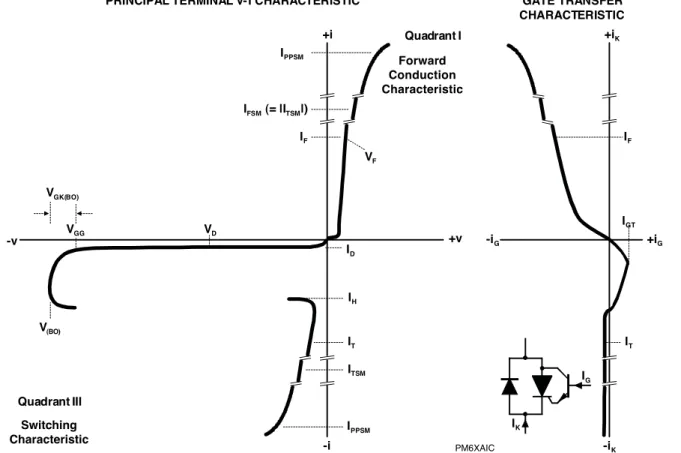
Figure 1. Principal Terminal and Gate Transfer Characteristics
PM6XAIC -v VGG VD IH IT ITSM IPPSM V(BO) ID Quadrant I Forward Conduction Characteristic +v +i IF VF IFSM (= |ITSM|) IPPSM -i Quadrant III Switching Characteristic VGK(BO)
PRINCIPAL TERMINAL V- I CHARACTERISTIC
IGT IF +iK -iK IT -iG +iG GATE TRANSFER CHARACTERISTIC IK IG
Voltage Stress Levels
APPLICATIONS INFORMATION
SLIC Protection
ISDN Protection
For voltage feed protection, the cathodes of an TISP6NTP2C thyristors are connected to the four conductors to be protected (see Figure 3). Each gate is connected to the appropriate negative voltage feed. The anode of the TISP6NTP2C is connected to the system common. Positive overvoltages are clipped to common by forward conduction of the TISP6NTP2C antiparallel diode. Negative overvoltages are initially clipped close to the negative supply by emitter follower action of the TISP6NTP2C buffer transistor. If sufficient clipping current flows, the TISP6NTP2C thyristor will regenerate and switch into a low voltage on-state condition. As the negative overvoltage subsides, the high holding current of the TISP6NTP2C prevents d.c. latchup.
Figure 4 shows the protector electrodes. The package terminal designated gate, G, is the transistor base, B, electrode connection and so is marked as B (G). The following junctions are subject to voltage stress: Transistor EB and CB, SCR AK (off state) and the antiparallel diode (reverse blocking). This clause covers the necessary testing to ensure the junctions are good.
Testing transistor CB and EB: The maximum voltage stress level for the TISP6NTP2C is VBATH with the addition of the short term antiparallel
diode voltage overshoot, VFRM. The current flowing out of the G terminal is measured at VBATH plus VFRM. The SCR K terminal is shorted to the
common (0 V) for this test (see Figure 4). The measured current, IGKS, is the sum of the junction currents ICB and IEB.
Testing transistor CB, SCR AK off state and diode reverse blocking: The highest AK voltage occurs during the overshoot period of the protector. To make sure that the SCR and diode blocking junctions do not break down during this period, a d.c. test for off-state current, ID,
can be applied at the overshoot voltage value. To avoid transistor CB current amplification by the transistor gain, the transistor base-emitter is shorted during this test (see Figure 5).
Summary: Two tests are need to verify the protector junctions. Maximum current values for IGKS and ID are required at the specified applied
voltage conditions.
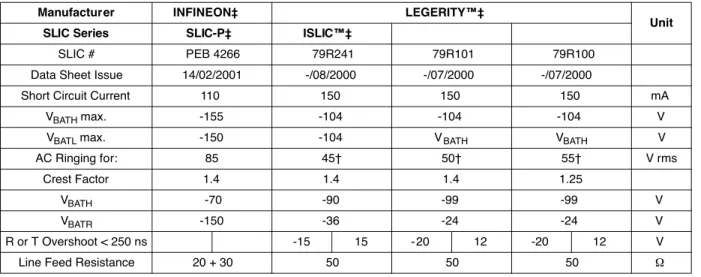
The generation of POTS lines at the customer premise normally uses a ringing SLIC. Although the lines are short, a central office ringing voltage level is often required for fax machine operation. High voltage SLICs are now available that can produce adequate ringing voltage (see table). The TISP6NTP2C has been designed to work with these SLICs which use battery voltages, VBATH, down to -150 V. Figure 2 shows a
typical example with one TISP6NTP2C protecting two SLICs.
The table below shows some details of HV SLICs using multiple negative supply rails.
Manufacturer INFINEON‡ LEGERITY™‡
Unit
SLIC Series SLIC-P‡ ISLIC™‡
SLIC # PEB 4266 79R241 79R101 79R100
Data Sheet Issue 14/02/2001 -/08/2000 -/07/2000 -/07/2000
Short Circuit Current 110 150 150 150 mA
VBATH max. -155 -104 -104 -104 V
VBATL max. -150 -104 VBATH VBATH V
AC Ringing for: 85 45† 50† 55† V rms
Crest Factor 1.4 1.4 1.4 1.25
VBATH -70 -90 -99 -99 V
VBATR -150 -36 -24 -24 V
R or T Overshoot < 250 ns -15 15 - 20 12 -20 12 V
Line Feed Resistance 20 + 30 50 50 50 Ω
† Assumes -20 V battery voltage during ringing.
‡ Legerity, the Legerity logo and ISLIC are the trademarks of Legerity, Inc.
Other product names used in this publication are for identification purposes only and may be trademarks of their respective companies .
APPLICATIONS INFORMATION
Figure 2. SLIC Protection Figure 3. Protection of Four ISDN Power Feeds
Figure 4. Transistor CB and EB Verification Figure 5. Off-State Current Verification CG 100 nF SLIC 2 TISP6NTP2C IK AI6XBNB SLIC 1 SLIC PROTECTOR 0 V 0 V RS1 VBATH RS2 RS3 RS4 ISDN POWER SUPPLY 0 -ve NEGATIVE SUPPLY TISP6NTP2C +t° +t° +t° +t° +t° +t° +t° +t° 0 -ve 0 -ve 0 -ve R R R R AI6XDJA CURRENT SINK CURRENT SINK CURRENT SINK CURRENT SINK
Resistor "R" may be needed if sink has internal clamp diode
VBATH + VFRM T 1/4 1/4 ISP 6NTP2C AI6XCEB 0 V K B (G) IEB ICB IGKS 0 V AI6XCFB 0 V K B (G) ICB V(BO) TISP 6NTP2C ID(I) ID A
ID(I) is the internal SCR value of ID
MECHANICAL DATA
Device Symbolization Code
Devices will be coded as below.
Device Symbolization Code
TISP6NTP2CDR-S 6NTP2C
“TISP” is a trademark of Bourns, Ltd., a Bourns Company, and is Registered in U.S. Patent and Trademark Office. “Bourns” is a registered trademark of Bourns, Inc. in the U.S. and other countries.