How does sub-national autonomy affect the effectiveness of
Structural Funds?
by Cornelius Bähr* RWTH Aachen University Paper draft please do not quoteAbstract
This paper investigates the effectiveness of the European Union’s regional policy with a focus on the federal structure of its member states. An empirical model is employed to estimate the effect varying decentralization among the member states has on the conditional effectiveness of Structural Funds expenditure. The results suggest that Structural Funds are more effective in promoting growth when the states exhibit a higher degree of decentralization.
Acknowledgement
The author would like to acknowledge a grant from the German Science Foundation (DFG SPP 1142). The usual disclaimer applies.
Keywords: Fiscal federalism, regional policy, sub-national autonomy JEL-Classification: H5, H7, R11
*
Department of Economics, RWTH Aachen University, D-52056 Aachen, Germany, e-Mail: [email protected]
1. Introduction
The European Union uses a system of conditional grants known as the Structural Funds with the objective to promote economic and social cohesion among its member states. Whether the objective is appropriate in itself and whether it can be reached with this instrument is subject to an ongoing debate.
While the empirical evidence on the effectiveness of Structural Funds in general is rather mixed (e.g. Boldrin and Canova 2001; Beugelsdijk and Eijfinger 2005), considerations drawing on the diversity of countries suggest, that the effectiveness of regional policy crucially depends on the institutional environment in which it is implemented (e.g. De La Fuente 2002). Ederveen, de Groot, and Nahuis (2006) observe that Structural Funds expenditure is conditionally effective, when institutional quality is controlled for. Similarly, Esposti and Bussoletti (2004) point to the fact, that interacting policies also affect the impact of regional measures.
So far the federal structure of the EU Member States did not attract much attention when the effectiveness of the Structural Funds is considered. Although the EU Commission requires the inclusion of regional authorities and stakeholders in the planning and implementation procedure of programs funded by Structural Funds, one should expect that the performance is better, where the sub-national authorities are more accustomed to pursuing economic policy and implementing programs. This should be the case in states with a higher degree of sub-national autonomy. Using panel-data for a sample of 13 EU Member States from 1960-1995 the effects of Structural Funds on growth are analysed. When a decentralization index by Stegarescu (2004) as a measure of sub-national autonomy is introduced as an interacting variable, it turns out that increasing sub-national autonomy has a significantly positive impact on the effectiveness of the Union’s Structural Funds expenditure.
In the following section the European regional policy is sketched in its basic aspects and some theoretical considerations for the connection between decentralization and the effectiveness of Structural funds are given. Section 3 introduces the empirical model. In section 4 the data are presented. The results of the regression are depicted and discussed in section 5. Section 6 concludes.
2. The Theoretical Framework
The main objective of European regional policy is economic and social cohesion among the member states of the European Union. To reduce differences in economic development between the regions and the lag of the most disadvantaged regions, Structural Funds are
employed to allocate support to those regions. The Structural Funds are subdivided into four different funds, each with a specific thematic area: the European Regional Development Fund (ERDF) is aimed at financing infrastructure, job-creating investment, local development projects and aid to small firms; the European Social Fund (ESF) supports the employment goals of the European Union; the European Agricultural Guidance and Guarantee Fund (EAGGF) is used for the adaptation of agricultural structures and measures to promote rural development; the Financial Instrument for Fisheries Guidance (FIFG) contributes to the reform of the Fisheries sector. Additional to these Funds there is the Cohesion Fund, which was created to assist the four cohesion countries (i.e. Ireland, Greece, Portugal, and Spain) in reaching the criteria for joining the single currency and is now devoted to the least prosperous states of the European Union (i.e. the ten new member states Greece, Portugal and Spain). In 1975 the ERDF constituted the first effort to conduct specific measures to reduce regional disparities across the Community. Since the Single European Act in 1986, economic and social cohesion is among the explicitly formulated objectives of the European Union, laying a foundation for a genuine regional policy. Two technical features of the Structural Funds were introduced with the Single European Act: the operational periods over which spending is scheduled; and the specific objectives expenditures are attributed to (Vanhove 1999: 480ff.). During the first two operational periods 1988-1993 and 1994-1999 there were six objectives to which expenditures were assigned. Objective 1, being the most important, covered the least prosperous regions (having a per capita GDP of less than 75% of the EU average). The other objectives related to mitigating industrial decline (objective 2), reducing long-term unemployment (objective 3), adaptation to industrial change (objective 5), support for agricultural sectors and rural areas (objective 5a and 5b), and assistance to sparsely populated areas (objective 6).
At the beginning of the third planning period (2000-2006) the objectives were consolidated, reducing them to three. The first remained largely unchanged and focuses on regions where economic development is lagging behind. Objective 2 deals with revitalizing areas facing structural difficulties in regions that have an above-average economic development (viz. are not objective 1-regions). Objective 3 is to promote the development of human resources and support the employment perspectives of the long-term unemployed. In geographical terms, objective 3 covers the entire EU territory besides objective 1-regions. Additionally to these objectives, there are the four Community Initiatives (Interreg, URBAN, EQUAL, Leader), which are designed to finance projects on specific policy areas. For the planning period beginning in 2007, again, a reformulation of the objectives is proposed.
From the different Structural Funds the various objectives are financed to differing degrees. During the operational period 2000-2006 more than 2/3 of the total Structural Funds spending is going to objective 1. Also the four Community initiatives are covered from the Structural Funds.1 94.65% of the Structural Funds expenditure goes to objective 1-3 and 5.35% to the Community Initiatives. From 2000-2006 195 billion EUR are made available for the Structural Funds for the EU-15. Additionally there is 18 billion EUR provided for the Cohesion Fund. Together with 22 billion EUR for pre-accession measures and 22 billion EUR for structural measures in the accession countries in 2004-2006 this amounts roughly 37% of EU total expenditure.2
From perspective of fiscal federalism expenditures from the Structural Funds take the form of conditional grants from the European level to the member states. There are two forms of intergovernmental grants that are theoretically linked to specific purposes. While unconditional grants should be used for fiscal equalization across jurisdictions primarily based on equity grounds3, conditional grants (mostly in form of matching grants) are supposed to internalize spill-over benefits that accrue in vertical or horizontal direction from one jurisdiction to the federal level or other jurisdictions. While the size of the unconditional grants then is determined by the preferences for equity within the federation, the conditional grant should equal the size of the external effect related to the activity pursuant to a Pigouvian subsidy (Oates 1990: 1126f.).
Based on this distinction the objective of economic and social cohesion alone is not sufficient for an engagement of the EU in co-financing expenditures for regional policy measures. Only when the implemented policies create spill-over effects to the Union level co-financing at the rate of the external effect is warranted. While some authors dismiss the existence of such spill over effects and call for a pure compensation mechanism (e.g. Heinemann 1999), Fenge and Wrede (2004) argue that there are in fact positive vertical externalities, although they are small compared to the co-financing rates of up to 85% in the Structural Funds.
The major share of the Structural Funds expenditure then has to be explained as a means of redistribution or compensation between the member states. Although deeper integration between the member states creates welfare gains through enhancing the efficiency of markets, those welfare gains are not evenly distributed among the member states. Then spending by the EU can be seen as a system of side-payments to ensure the consent of all participants in the 1 http://www.europa.eu.int/comm/regional_policy/funds/prord/sf_en.htm 2 http://www.europa.eu.int/comm/regional_policy/intro/working4_en.htm 3
There exists also the argument that unconditional grants should be used to create a level playing-field as a basis for interjurisdictional competition.
collective decision-making process at the EU level. The reason for the implementation of regional policies then is cohesion in the first place, but to back up ongoing integration. If fiscal equalization is the primary function of Structural Funds, then – according to the theory of fiscal federalism – unconditional grants should be used. However, on grounds of political acceptability, the use of conditional grants may still be warranted (Folkers 1995).
The effectiveness of Structural Funds is affected by these considerations through the fact that the Funds have to be invested in a growth stimulating way to bring about the convergence process they are designed for. Although Structural Funds have to be invested there are reasons to cast doubt, whether they are used in a way that really promotes growth. First, the Funds have often to be invested in pre-specified projects that are not always growth promoting, such as environmental projects. Second, while the co-funding requirement ensures that resources actually are invested, it may cause crowding out public funds from otherwise implemented projects. It is not a priori clear that projects that qualify for EU-funding have a higher growth promoting capability than other public projects.
In the literature several attempts to evaluate the effectiveness of Structural Funds in achieving cohesion between the member states or the regions have been made. In general, Structural Funds are assumed to be effective, if they foster a trend to convergence across regions or countries. Theoretically two concepts of convergence can be distinguished. While the unconditional version of β-convergence implies a trend to common steady state across the considered units, conditional β-convergence allows for different steady-states income levels but expects countries with a lower income grow faster. In contrast σ-convergence relates to the dispersion of income levels or growth rates. For sigma-convergence to take place the gaps between income levels or growth rates across countries or regions must narrow (see e.g. Islam 2003: 314f.).
The evidence for the effectiveness of Structural Funds in the literature is mixed. Boldrin and Canova (2001) analyze a set of 185 NUTS 2 regions during 1980-1996. They apply tests for different convergence and divergence concepts to GDP and labor productivity. Their results are not supportive of unconditional beta-convergence for regional per capita income. If allowed for different steady states they still do not find beta-convergence in terms of per capita income, but a small amount of convergence in labor productivity. Boldrin and Canova (2001) also analyze directly various measures of dispersion for different groups of regions. When looking at regions benefiting from SF they do not find signs of accelerating growth rates. Accordingly they reject the hypothesis of a beneficial effect of the EU’s regional policy.
A contrasting view is presented by Ederveen et al. (2002). Using cross-country regression analysis for the period from 1977 to 1996 for twelve EU-countries they find evidence for beta-convergence among EU-countries. Also for a sample of 160 European regions at NUTS II-level between 1984 and 1996 they find beta-convergence. For both samples they also detect sigma-convergence. Exploring the issue from a within country perspective they observe beta- and sigma convergence in the majority of countries. In an additional analysis Ederveen et al. (2002) include the expenditure on Structural Funds in their regressions. They observe convergence among European countries and regions. On the country-level, the impact of the Structural Funds is positive when interacted with the countries openness. On the regional level, Structural Funds only have a positive impact on economic growth when region specific steady states are allowed for. Finally, Ederveen et al. (2002) survey a number of convergence studies that take account of Structural Funds expenditure. The reported results are also very mixed. Generally simulation studies point to a more positive effect of the expenditure than regression results. The authors take that as evidence for crowding out of national aid to poorer regions. In a more recent study Beugelsdijk and Eijffinger (2005) observe beta-convergence among 15 EU member states covering the period from 1995-2001. They also find a positive relationship between (lagged) Structural Funds expenditure and GDP growth at the national level.
In line with these observations De La Fuente (2002) points to the fact that Structural Funds expenditure takes place in a country-specific environment. Therefore he argues that the inclusion of control variables might play a crucial role for the results. Ederveen, de Groot and Nahuis (2006) argue that Structural funds are conditionally effective. They estimate a dynamic panel specification using data on 13 EU-countries 1960-1995 in order to determine the effect of Structural Funds expenditure on growth on a national level. As conditioning variables they introduce a range of measures that all capture some sort of institutional quality. Among those variables are the degree of trade openness, inflation, trust, corruption and a direct measure of institutional quality. The impact of the Structural Funds themselves turns out to be negative. However, when measures of institutional quality are taken into account as interacting variables, the interaction terms become significantly positive. Similarly, Esposti and Bussoletti (2004) show that additional policy measures, in his case spending on Common Agricultural Policy, can have significant counter-effects on the effectiveness of Structural Funds expenditure.
While the mentioned studies explore the effectiveness of Structural Funds expenditure in various ways, the institutional set-up or the federal structure of the member states did not
attract much attention in this context. There is a branch of literature that explicitly explores whether the degree of decentralization has an independent impact on the growth of an economy. While there is no formal theory of fiscal decentralization and growth, there are a number of arguments concerning the connection between economic performance and federalism.
Besides the famous Decentralization Theorem that states that a federal system is able to provide public goods more efficiently as it can differentiate the provision according to the differing preferences of its citizens, arguments related to interjurisdictional competition strengthen the case for better economic outcomes in federal systems. Federal states are expected to exhibit higher innovative capacity, while constraining the governments’ power to extort excessive taxes from their citizens (see e.g. Oates 1999). On the other hand there are concerns that decentralized governments are more exposed to the demands of local interest groups for protectionist policies. Also, interjurisdictional competition may actually increase incentives to imitate and free-ride on innovations of other units, thus reducing the extent of policy innovation in a federation. Reviewing arguments for the federalism-growth connection Feld, Zimmermann and Döring (2004) point to the multi-dimensionality of this connection. They also provide a survey of empirical studies on the link between economic growth and federalism in various settings. However, the evidence remains inconclusive.
The implementation of the Structural Funds is conducted in collaboration between the different levels of government within the European Union. The European Council decides upon the Commission’s proposal on the budget and the general rules for the Structural Funds’ execution. Then, the member states and the affected regions draft operational programs that specify strategies and priorities for action, as well as the funding schemes. After the Commission’s approval, these operational programs are implemented by the authorized bodies. Additionally, the rather general operational programs are worked out in greater detail by national and regional bodies.4
So, while the conceptual design of the Structural Funds is decided at the European level, their execution strongly depends on the activity of national and regional authorities. The degree to which regional authorities have an actual impact on the specific design and implementation of Structural Funds programs is expected to differ between the member states according to their institutional setup. If the policies that are financed through Structural Funds are sensitive to specific regional needs, then member states with a higher degree of decentralization should be able to implement more effective programs. On the one hand regional authorities are expected
4
for an overview on the mechanisms of European regional policy: http://www.europa.eu.int/scadplus/leg/en/s24000.htm
to have better information on specific growth inducing projects. On the other hand there should be a more effective regional implementation of the programs in traditionally decentralized countries with regional authorities that have a higher administrative capacity. In this paper we try to establish some evidence for the connection between a higher degree of decentralization and a higher effectiveness of Structural Funds expenditure. Therefore, we will estimate an initial level-growth regression taking into account Structural Funds expenditure and a measure of decentralization. While the employed empirics are closely related to Ederveen, de Groot and Nahuis (2006), who assess the conditional effectiveness of Structural Funds, this paper emphasizes the impact of decentralization on the policy outcome. 3. The Model
In order to verify the impact, the federal structure of a Member State has on the effectiveness of Structural Funds expenditure we estimate a pooled cross-sectional regression
it it it it A it it h it k it it
y
s
s
n
g
SF
SF
TD
g
=
β
1ln(
)
+
β
2ln
,+
β
3ln
,+
β
4ln(
+
+
δ
)
+
β
5+
β
6+
ε
where the included variables denote growth of per capita GDP (git) as the dependent variable, and as independent variables the initial per capita GDP in period t (yit), the domestic savings rate (sk,it), the rate of human capital accumulation (sh,it), the rate of population growth (nit), the exogenous rate of technological progress (gA), and the rate of depreciation (δ). In order to test the hypothesis that Structural Funds expenditure is more effective for growth when countries exhibit a higher degree of decentralization, we include a measure for the Structural Funds expenditure (SFit) and a term that interacts the degree of decentralization (TDit) with the Structural Funds expenditure. Setting β5 and β6 to zero the model relates to the standard empirical growth model as suggested by Mankiw, Romer and Weill (1992). We will report results on this specification as a point of reference.
The panel we use for estimating the model includes 13 EU countries5 and covers seven five-year periods from 1960-1965 to 1990-1995 as in Ederveen, de Groot, and Nahuis (2006). Accordingly, each observation represents a five-year average of the respective variable. Discussing the merits of the panel data approach Islam (2003) emphasizes the alleviation of the omitted variable problem. While choosing five-year periods may give rise to a short frequency problem, it is defended by Islam (2003: 332).
5
The sample includes Austria, Belgium, Denmark, Finland, France, Greece, Italy, Ireland, the Netherlands, Portugal, Spain, Sweden and the UK. Germany is missing due to the structural break in 1990, for Luxembourg the human capital variable is missing.
We estimate the model as a pooled OLS regression using panel corrected standard errors that are robust to heteroscedasticity and allow for possible contemporaneous correlation across panels. As data on the decentralization variable are not available for all countries for the first and the second five-year period there arises the issue of a possible selection bias. It can be shown, that in the given data this does not pose a real problem (see e.g. Wooldridge 2002: 580ff.).
4. The Data
In our analysis we use data on GDP, savings, human capital, population growth, and decentralization. The dataset used is largely the same as in Ederveen, de Groot, and Nahuis (2006).6 The Data on GDP, population, and savings are taken from the World Bank’s World Development Indicators 2000. Data on GDP is given in constant 1995 $. The growth rates of GDP and population are calculated as gy = (yT/y0)1/T – 1. Savings are measured by gross domestic capital formation as a percentage of GDP. The variable on human capital is taken from Domenech and De LaFuente (2006). They derive it from various international sources on educational attainment levels as a measure of average years of schooling.7 The variable covering Structural Funds expenditure from 1975-1986 is constructed using information given in Vanhove (1999). For the period from 1986-1998 Domenech, Maudes and Varela (2000) provide data on a wide range of financial flows related to the EU’s regional policy8. Receipts from the ERDF as percentage of GDP are used as a proxy for the Structural Funds, as it is the most important single fund within the system of Structural Funds.9 For the rates of technological progress and depreciation we set gA+ δ = 0.05 for all countries and time periods as it is standard in the growth literature (e.g. Mankiw, Romer and Weill 1992; Islam 1995). The indicator for decentralization was established by Stegarescu (2004). It measures the share of sub-national tax revenue. The distinguishing property of this measure is that it takes account of the degree of decision-making power the sub-national authority has on the tax. In doing so, it does not just distinguish between federal and unitary states, but includes the actual discretion sub-national authorities have on their own tax-policy. Stegarescu (2004) develops three different measures of tax decentralization that he labels TDec1, TDec2, and TDec3 respectively. For this purpose, he builds on a classification for tax autonomy first developed in OECD (1999) ordering taxes according to the degree of control sub-national governments
6
It is published by H. de Groot at: http://www.henridegroot.net/pdf/database_sf.xls 7
It is available at: http://iei.uv.es/~rdomenec/human/human.html 8
This dataset can be downloaded from: http://iei.uv.es/~rdomenec/EUbudget/EUbudget.html 9
have on the tax base, the tax rate, or both of them. The measures of tax decentralization relate the amount of tax revenue the sub-central governments control to the tax revenue of consolidated general government. As TDec3 relates the total tax revenue a sub-central government receives to the tax revenue of general government, TDec1 considers only the revenues from those taxes, on which the sub-national authorities alone decide on either tax base or tax rate or both of them. TDec2 then additionally considers revenue from shared taxes (Stegarescu, 2004: 7).
Stegarescu (2005) shows that the consideration of different indicators of tax decentralization leads to different results regarding centralization or decentralization when subnational authorities participate in central government decision making. For our purpose we would actually need a measure for the discretion sub-national authorities have on co-financing structural funds expenditures. As there is no such measure, we consider Stegarescu’s measure as an appropriate proxy. The implicit assumption is then, that greater autonomy in deciding on spending on projects where structural funds are involved goes hand in hand with greater sub-national tax-autonomy.
Both, the decentralization indicator and the measure of Structural Funds can take the value of zero. To avoid problems when taking the natural logarithm of those measures we add 1 to the values before taking the logarithm.
5. The Results
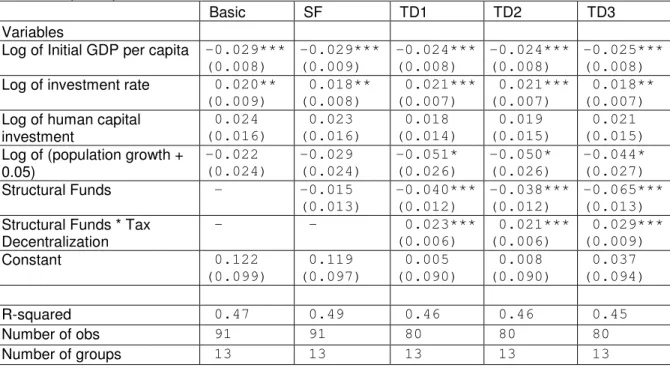
In table 1 we present the first results from the regression. It presents the results for the basic regression, the inclusion of Structural Funds as an explanatory variable and the inclusion of the variable interacting Structural Funds and with the three measure of decentralization. In the basic regression the relationship between the initial per capita income and growth of per capita GDP is negative and highly significant. This represents convergence across the EU-Member States in the sample during the period 1960-1995. The implied speed of convergence is 0.029.10 The coefficients on the other variables also show the expected signs. Average domestic capital investment and investment in human capital prove to be growth promoting; the coefficient on the variable that captures population growth and depreciation is negative, although the coefficients on the latter two variables are not significant.
When entering the Structural Funds variable into the regression, the general results do not change. The convergence hypothesis still holds and the signs on the coefficients remain unchanged. The coefficient on the investment variable drops from 0.020 to 0.018, the
10
coefficient on human capital from 0.024 to 0.023, while the coefficient on the population drops from -0.022 to -0.029, the latter two still not being significantly different from zero. The receipt of Structural Funds as such has a negative effect on per capita growth. However, this effect is not significantly different from zero neither at the 5%- or 10%-levels.
Table 1: Impact of Decentralization on the Effectiveness of Structural Funds. Dependent Variable: Growth of per capita GDP
Basic SF TD1 TD2 TD3
Variables
Log of Initial GDP per capita -0.029*** (0.008) -0.029*** (0.009) -0.024*** (0.008) -0.024*** (0.008) -0.025*** (0.008) Log of investment rate 0.020**
(0.009) 0.018** (0.008) 0.021*** (0.007) 0.021*** (0.007) 0.018** (0.007) Log of human capital
investment 0.024 (0.016) 0.023 (0.016) 0.018 (0.014) 0.019 (0.015) 0.021 (0.015) Log of (population growth +
0.05) -0.022 (0.024) -0.029 (0.024) -0.051* (0.026) -0.050* (0.026) -0.044* (0.027) Structural Funds - -0.015 (0.013) -0.040*** (0.012) -0.038*** (0.012) -0.065*** (0.013) Structural Funds * Tax
Decentralization - - 0.023*** (0.006) 0.021*** (0.006) 0.029*** (0.009) Constant 0.122 (0.099) 0.119 (0.097) 0.005 (0.090) 0.008 (0.090) 0.037 (0.094) R-squared 0.47 0.49 0.46 0.46 0.45 Number of obs 91 91 80 80 80 Number of groups 13 13 13 13 13
Notes: Panel corrected standard errors are reported in parentheses. ***, **, and * denote significance at the 1%-, 5%-, and 10%-levels, respectively.
When the different measures of decentralization are entered into the equation as an interactive term with the Structural Funds, the coefficient on the Structural Funds turns out to be significantly negative. Also, the coefficient increases in size to -0.040. For the initial per capita income the coefficient increases by 0.005 but is still highly significant. A remarkable result is that the coefficient on the population variable increases in size and significance, when the measures of decentralization are entered into the equation.
While the receipt of Structural Funds as such appears to have a negative impact on per capita income growth, receipts of Structural Funds do have a positive effect, when they are interacted with decentralization. On all of the three measures of decentralization, the coefficients are positive and significant at the 1%-level. This can be taken as a evidence that the effect of Structural Funds spending is more beneficial in countries that have a more decentralized structure. The differences in size between the coefficients on the different measures of decentralization are not very huge. So the differing degrees of tax decentralization across countries and time can be assumed to have a stronger impact than the
differences in the form tax decentralization. While the coefficients on the TD1 and TD2 measures are very close, the TD3 measure differs slightly more.
Due to data availability (cf. section 3) the panel becomes unbalanced when introducing the measures of tax decentralization. As stated above in the example at hand the consistency of the estimators is not negatively affected. One can also show, that restricting the sample to a shorter period, for which it is balanced, does not change the general results which are available on request.
In order to assess the validity of the results we present in the following some robustness analyses that were performed on the data. In presenting the results we focus on the TD1 indicator as it has the closest relation to our notion of decentralization. The results for the other two indicators are very close to those presented and available on request.
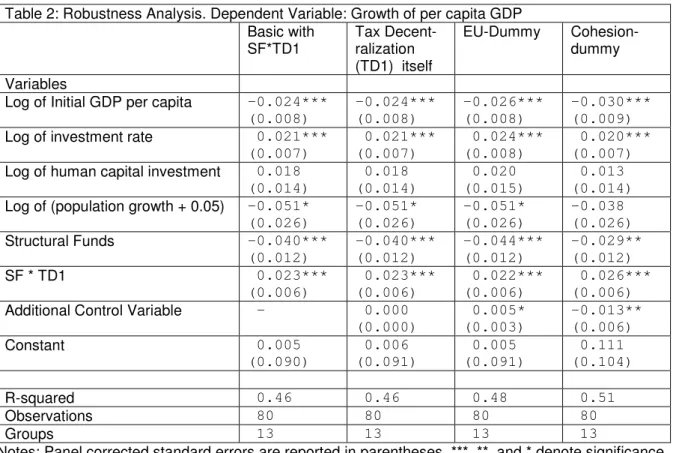
In table 2 we recapitulate the result of the regression using the TD1 indicator as an interacting variable with the receipts of Structural Funds. When introducing the tax decentralization variable itself into the regression its value is practically zero. Also, all the other coefficients are almost unaffected by the introduction of this variable. This means that an independent growth-effect of a country’s decentralized structure cannot be established within this panel. All of the positive impact of the decentralized structure has to be attributed to the interaction with the Structural Funds.
Table 2: Robustness Analysis. Dependent Variable: Growth of per capita GDP Basic with SF*TD1 Tax Decent-ralization (TD1) itself EU-Dummy Cohesion-dummy Variables
Log of Initial GDP per capita -0.024*** (0.008) -0.024*** (0.008) -0.026*** (0.008) -0.030*** (0.009) Log of investment rate 0.021***
(0.007) 0.021*** (0.007) 0.024*** (0.008) 0.020*** (0.007) Log of human capital investment 0.018
(0.014) 0.018 (0.014) 0.020 (0.015) 0.013 (0.014) Log of (population growth + 0.05) -0.051*
(0.026) -0.051* (0.026) -0.051* (0.026) -0.038 (0.026) Structural Funds -0.040*** (0.012) -0.040*** (0.012) -0.044*** (0.012) -0.029** (0.012) SF * TD1 0.023*** (0.006) 0.023*** (0.006) 0.022*** (0.006) 0.026*** (0.006) Additional Control Variable - 0.000
(0.000) 0.005* (0.003) -0.013** (0.006) Constant 0.005 (0.090) 0.006 (0.091) 0.005 (0.091) 0.111 (0.104) R-squared 0.46 0.46 0.48 0.51 Observations 80 80 80 80 Groups 13 13 13 13
Notes: Panel corrected standard errors are reported in parentheses. ***, **, and * denote significance at the 1%-, 5%-, and 10%-levels, respectively.
The introduction of a dummy variable measuring the time of EU-membership leaves the results of the basic specification largely unaffected. The negative impact of initial per capita income and receipts of Structural Funds and the positive impact of average investment in physical and human capital are slightly increased, whereas the coefficient on the interaction term is somewhat decreasing. The coefficient on the EU-dummy variable is small and significant only at the 10%-level. We can therefore conclude that, while being an EU-member has a small positive impact on growth, the impact of the Structural Funds on growth is not affected by the duration of the EU-membership. Also, the positive impact of a decentralized internal fabric of a country on the conditional effectiveness of Structural Funds is not affected. As the cohesion countries received particularly large amounts of support via the Structural Funds one might suspect that the effect of these expenditures is especially strong in those countries. We entered a dummy-variable for the cohesion countries to control for the possible effects. Judging from the variable on initial income, the trend to convergence becomes slightly more pronounced, with the variable included. The coefficient on the dummy-variable indicates a somewhat lower growth for the cohesion countries. Besides this, Structural Funds itself have a less negative effect on growth. Our variable of concern, the interaction term comprising Structural Funds and decentralization remains increases slightly, fostering the result of a positive effect of decentralization on the conditional effectiveness of Structural Funds.
6. Conclusion
This paper tried to show that the effectiveness of regional policy in the European Union depends among others on the internal fabric of the Union’s member states. One distinguishing feature of the member states is their differing degree of decentralization. In order to display the connection between sub-national autonomy and the effectiveness of Structural Funds expenditure an empirical model was estimated. An interaction variable comprising Structural Funds expenditure and a decentralization measure was introduced to the model to take account of this effect.
While Structural Funds expenditure cannot be said to be unambiguously growth promoting in itself, a significantly positive effect of Structural Funds on growth was found when they are interacted with a decentralized structure of a country. The effect holds also for the applied robustness checks.
As these are encouraging first results, further research on the concrete mechanisms in which sub-national autonomy affects the effectiveness of regional policy is needed to explore the issue in more detail.
Literature
Beugelsdijk, M. and S.C.W. Eijfinger (2005). The Effectiveness of Structural Policy in the European Union: An Empirical Analysis for the EU-15 in 1995-2001. Journal of Common Market Studies, 43 (1), 37-51.
Boldrin, M. and F. Canova (2001). Inequality and Convergence in Europe’s Regions: reconsidering European Regional Policies. Economic Policy, 32, 205-245. De La Fuente, A. (2002). Does cohesion policy work? Some general considerations and
evidence from Spain. UFAE and IAE Working Papers 563.03.
Domenech, R., A. Maudes, and J. Varela (2000). Fiscal Flows in Europe: The Redistributive Effects of the EU Budget. Review of World Economics, 136( 4).
Domenech, R., and A. de La Fuente (2006). Human Capital in Growth Regressions: How Much Difference Does Data Quality Make? Journal of the European Economic Association, 4(1), 1-36.
Ederveen, S., J. Gorter, R. de Mooij, and R. Nahuis (2002). Funds and Games. The Economics of European Cohesion Policy. CPB Special Publication No. 41.
Ederveen, S., H. de Groot, and R. Nahuis (2006). Fertile Soil for Structural Funds? A Panel Data Analysis of the Conditional Effectiveness of European Cohesion Policy. Kyklos, 59 (1), 17-42.
Esposti, R. and S. Bussoletti (2004). Regional Convergence, Structural Funds and the Role of Agriculture in the EU. A Panel-Data Approach. Quaderno di Ricerca n. 220.
Dipartimento di Economia, Universita Politecnica delle Marche.
Feld, L.P., H. Zimmermann, T. Döring (2004). Federalism, Decentralization and Economic Growth. Philipps-University Marburg, Public Finance Group Discussion Papers Series “Fiscal Federalism and National Growth“, No. 1.
Fenge, R., and M. Wrede (2004). EU Regional Policy. Vertical Fiscal Externalities and Matching Grants. CESifo Working Paper No. 1146.
Folkers, C. (1995). Welches Finanzausgleichssystem braucht Europa? In: Karl, H. and W. Heinrichsmeyer (Eds.). Regionalentwicklung im Prozess der europäischen Integration. Bonner Schriften zur Integration Europas, Bd. 4. Europa Union Verlag, Bonn. 87-108. Heinemann, F. (1999). Der Kompensationsfonds: Eine neue Finanzverfassung für die EU der
21+. Wirtschaftsdienst, 79, V, 293-299.
Islam, N. (1995). Growth Empirics: A Panel Data Approach. Quaterly Journal of Economics, 110, 1127-1170.
Islam, N. (2003). What Have We Learnt From The Convergence Debate? Journal of Economic Surveys, 17, 309-362.
Mankiw, N.G., P. Romer, and D.N. Weill (1992). A Contribution to the Empirics of Economic Growth. Quarterly Journal of Economics, 107, 407-437.
Oates, W. E. (1999). An Essay on Fiscal Federalism. Journal of Economic Literature, 27, 1120-1149.
OECD (1999). Taxing Powers of State and Local Government. OECD Tax Policy Studies No. 1. Paris.
Stegarescu, D. (2004). Public Sector Decentralization. Measurement Concepts and Recent International Trends. ZEW Discussion Paper No. 04-74.
Stegarescu, D. (2005). Costs, Preferences, and Institutions: An Empirical Analysis of the Determinants of Government Decentralization. ZEW Discussion Paper No. 05-39. Vanhove, N. (1999). Regional Policy: A European Approach. Ashgate, Aldershot.
Wooldridge, J.M. (2002). Econometric Analysis of Cross Section and Panel Data. MIT Press, Cambridge (MA).