VTT PUBLICATIONS 526
Requirements implementation in embedded software development
Juho Jäälinoja
Tätä julkaisua myy Denna publikation säljs av This publication is available from VTT TIETOPALVELU VTT INFORMATIONSTJÄNST VTT INFORMATION SERVICE
PL 2000 PB 2000 P.O.Box 2000
02044 VTT 02044 VTT FIN–02044 VTT, Finland Puh. (09) 456 4404 Tel. (09) 456 4404 Phone internat. +358 9 456 4404 Faksi (09) 456 4374 Fax (09) 456 4374 Fax +358 9 456 4374
ISBN 951–38–6370–0 (URL: http://www.vtt.fi/inf/pdf/) ISSN 1455–0849 (URL: http://www.vtt.fi/inf/pdf/)
ESPOO 2004 ESPOO 2004 ESPOO 2004 ESPOO 2004 ESPOO 2004
VTT PUBLICATIONS 526
Juho Jäälinoja
Requirements implementation in embedded
software development
VTT PUBLICATIONS
509 Sallinen, Mikko. Modelling and estimation of spatial relationships in sensor-based robot workcells. 2003. 218 p.
510 Kauppi, Ilkka. Intermediate Language for Mobile Robots. A link between the high-level planner and low-level services in robots. 2003. 143 p.
511 Mäntyjärvi, Jani. Sensor-based context recognition for mobile applications. 2003. 118 p. + app. 60 p.
512 Kauppi, Tarja. Performance analysis at the software architectural level. 2003. 78 p.
513 Uosukainen, Seppo. Turbulences as sound sources. 2003. 42 p.
514 Koskela, Juha. Software configuration management in agile methods. 2003. 54 p.
516 Määttä, Timo. Virtual environments in machinery safety analysis. 2003. 170 p. + app. 16 p.
515 Palviainen, Marko & Laakko, Timo. mPlaton - Browsing and development platform of mobile applications. 2003. 98 p.
517 Forsén, Holger & Tarvainen, Veikko. Sahatavaran jatkojalostuksen asettamat vaatimukset kuivauslaadulle ja eri tuotteille sopivat kuivausmenetelmät. 2003. 69 s. + liitt. 9 s.
518 Lappalainen, Jari T. J. Paperin- ja kartonginvalmistusprosessien mallinnus ja dynaaminen reaaliaikainen simulointi. 2004. 144 s.
519 Pakkala, Daniel. Lightweight distributed service platform for adaptive mobile services. 2004. 145 p. + app. 13 p.
520 Palonen, Hetti. Role of lignin in the enzymatic hydrolysis of lignocellulose. 2004. 80 p. + app. 62 p.
521 Mangs, Johan. On the fire dynamics of vehicles and electrical equipment. 2004. 62 p. + app. 101 p.
522 Jokinen, Tommi. Novel ways of using Nd:YAG laser for welding thick section austenitic stainless steel. 2004. 120 p. + app. 12 p.
523 Soininen, Juha-Pekka. Architecture design methods for application domain-specific integrated computer systems. 2004. 118 p. + app. 51 p.
525 Mäntyniemi, Annukka, Pikkarainen, Minna & Taulavuori, Anne. A Frame-work for Off-The-Shelf Software Component Development and Maintenance Processes. 2004. 127 p.
526 Jäälinoja, Juho. Requirements implementation in embedded software devel-opment. 2004. 82 p. + app. 7 p.
VTT PUBLICATIONS 526
Requirements implementation in
embedded software development
Juho Jäälinoja
ISBN 951–38–6370–0 (URL: http://www.vtt.fi/inf/pdf/) ISSN 1455–0849 (URL: http://www.vtt.fi/inf/pdf/)
Copyright © VTT Technical Research Centre of Finland 2004 JULKAISIJA – UTGIVARE – PUBLISHER
VTT, Vuorimiehentie 5, PL 2000, 02044 VTT puh. vaihde (09) 4561, faksi (09) 456 4374 VTT, Bergsmansvägen 5, PB 2000, 02044 VTT tel. växel (09) 4561, fax (09) 456 4374
VTT Technical Research Centre of Finland, Vuorimiehentie 5, P.O.Box 2000, FIN–02044 VTT, Finland phone internat. + 358 9 4561, fax + 358 9 456 4374
VTT Elektroniikka, Kaitoväylä 1, PL 1100, 90571 OULU puh. vaihde (08) 551 2111, faksi (08) 551 2320
VTT Elektronik, Kaitoväylä 1, PB 1100, 90571 ULEÅBORG tel. växel (08) 551 2111, fax (08) 551 2320
VTT Electronics, Kaitoväylä 1, P.O.Box 1100, FIN–90571 OULU, Finland phone internat. + 358 8 551 2111, fax + 358 8 551 2320
Jäälinoja, Juho. Requirements implementation in embedded software development. Espoo 2004. VTT Publications 526. 82 p. + app. 7 p.
Keywords software process improvement, software requirements analysis, embedded systems
Abstract
Development of correct requirements at the beginning of a software project is considered an important precondition for successful software development. Moreover, implementing these requirements correctly during the software development is arguably just as important. Rigorous implementation of requirements in embedded software development is especially critical, since requirements affect both software and hardware. The goal of this research is to identify elements for effective requirements implementation in embedded software development.
A conceptual-theoretical research approach is applied to analyse previous research on requirements implementation and to construct a new theory which integrates requirements implementation related elements into a holistic framework. These elements include requirements implementation processes, methods, and roles. The developed framework describes relations among these elements and furthermore their relation to software development activities. The framework can be used as a basis for improving software development areas that are related to requirements implementation.
To validate the feasibility of the developed framework, two case studies were carried out within embedded software development organisations. The validation was conducted by making a current state analysis and by suggesting improvements based on the developed requirements implementation framework. The results from the case studies indicated that the framework was a useful foundation for improving the organisations' requirements implementation practices.
Preface
This research was conducted at VTT Electronics in the MOOSE (software engineering MethodOlOgieS for Embedded systems) project. The project's goal was to improve the integration of available tools, techniques, methods, and processes involved in embedded software development. The project started at the beginning of 2002 and I joined the project a year later. In the project I had an opportunity to study and write my graduate thesis on requirements and embedded software development. This publication is based on that thesis. I must sincerely thank VTT Electronics and other partners in the project for allowing me to write the thesis as part of the project.
I wish to thank all the people at VTT Electronics for their support. Especially, I would like to thank Ms. Päivi Parviainen for competent guidance throughout the study. Furthermore, I want to thank Prof. Markku Oivo from the University of Oulu for his support. I am also grateful for the co-operative people in the two anonymous organisations I had the opportunity to study.
Contents
Abstract... 3 Preface ... 4 Abbreviations... 7 1. Introduction... 9 1.1 Background... 91.2 The research problem and methods ... 10
1.3 Scope ... 12
1.4 Structure ... 12
2. Embedded systems and requirements ... 14
2.1 Embedded systems ... 14
2.2 Embedded systems development... 15
2.3 Embedded software development... 16
2.4 Requirements... 18
2.5 Requirements engineering ... 21
3. Requirements in software development activities ... 24
3.1 Software requirements analysis... 24
3.2 Requirements and software architecture design ... 26
3.3 Requirements and detailed software design ... 29
3.4 Requirements and software coding... 30
3.5 Requirements and software testing... 31
4. Requirements implementation-supporting elements... 34
4.1 Requirements change management ... 34
4.1.1 Impact analysis... 36
4.1.2 Change management tools ... 37
4.2 Requirements tracing... 38
4.3 Consistency management ... 41
5. Requirements implementation framework... 45
5.1.1 Requirements implementation in software requirements
analysis... 46
5.1.2 Requirements implementation in software designing ... 50
5.1.3 Requirements implementation in software coding... 52
5.1.4 Requirements implementation in software testing ... 54
5.1.5 Requirements implementation throughout the development... 56
5.2 Adaptation of the framework... 59
6. Validation of the requirements implementation framework ... 62
6.1 Research approach for validation ... 62
6.2 Case one - large organisation... 63
6.2.1 Current state analysis ... 64
6.2.2 Improvement proposal ... 65
6.3 Case two - small organisation... 67
6.3.1 Current state analysis ... 67
6.3.2 Improvement proposal ... 68
6.4 Applicability of the requirements implementation framework... 69
7. Conclusions... 71
7.1 Answers to the research questions... 71
7.2 Significance of the results ... 72
7.3 Further research possibilities ... 74
References... 75 Appendices
Appendix 1: Questionnaire on current state requirements implementation practices
Abbreviations
AQA Architecture Quality Analysis ASIC Application-Specific Integrated Circuit ATAM Architecture Tradeoff Analysis Method CBSP Component-Bus-System-Property CCB Change Control Board
CMM Capability Maturity Model
CMMI Capability Maturity Model Integration
DOORS Dynamic Object-Oriented Requirements System DSP Digital Signal Processing
GRL Goal-oriented Requirement Language
MOOSE software engineering MethodOlOgieS for Embedded systems PDL Program Design Language
QFD Quality Function Deployment
RTM Requirements Traceability Management SBAR Scenario-Based Architecture Reengineering SCM Software Configuration Management SCR Software Cost Reduction
SDL Specification and Description Language SRS Software Requirements Specification TCM Test Case Management
UCM Use Case Maps
UML Unified Modeling Language
VTT Technical Research Centre of Finland (Valtion teknillinen tutkimuskeskus)
1. Introduction
Modern embedded systems are more complex than before, and much of this complexity is realised in these systems' software. Organisations that neglect to manage software development efficiently are doomed to fail in these complex development projects. Developing correct requirements and implementing them correctly are considered key elements in successful software development. In this research, the latter condition is studied and related means for improving requirements implementation are provided. The term requirements implementation refers in this research not only to realising requirements in code, but also to their elaboration into software requirements, designs, and test cases. This chapter presents the background for the study, defines the research problem and scope, and outlines the structure of the study.
1.1 Background
This study was carried out at VTT Electronics within the MOOSE (software engineering MethodOlOgieS for Embedded systems) project, which aimed to improve the integration of available tools, techniques, methods, and processes involved in embedded software development. System and software requirements engineering are among the research areas in the project. The industrial partners of the project expressed several problems related to requirements. The following list contains some examples (MOOSE 2002b):
• requirements are hard to specify and difficult to know up-front
• software expertise is absent from system requirements allocation
• change of requirements creates inconsistency amongst work products
• tracing of requirements throughout the development is difficult
One of the main problems of requirements implementation is the inevitable change of original requirements. Requirements may be removed, modified, or added to during the development. Software development is very rarely a linear front-end process, where requirements can be agreed upon at the beginning and the rest of the development will be based on them. Instead, software typically
iterates towards greater maturity. During the iterations original requirements very often change, which can cause problems for design, implementation, and testing activities. Problems typically arise when a change of one requirement affects many different components in the system.
Correct implementation of requirements in embedded software development is a critical success factor for the whole system development since it affects both software and hardware. For instance, an inconsistency between requirements and software designs leads to incorrect implementation of the software and furthermore might trigger unexpected behaviour in the system's hardware. The later a defect is found in the system development, the more it will cost to repair. This research explores solutions to these problems from the point of view of requirements implementation. Although there has been made a significant number of research on development, implementation, management, and consistency management of requirements, these studies unfortunately present only insular solutions. A holistic view of these elements is needed in order to locate essential improvement areas in software development. Furthermore, current research lacks an embedded software viewpoint regarding these issues. It is obvious that concurrent development of hardware and software creates specific problems for requirements implementation. In this study, the previously stated deficiencies in current research are addressed.
1.2 The research problem and methods
The purpose of this research is to study effective implementation of requirements in embedded software development. The research problem is stated as the following research question and sub-questions:
1. How can requirements be effectively implemented in embedded software development?
1.1. What is the relationship between requirements and development activities?
1.2. How should requirements be implemented during development?
1.3. What kind of framework would help to analyse and improve requirements implementation practices?
The research problem is solved with conceptual-theoretical and theory-testing research approaches. Conceptual-theoretical research approach usually includes an analysis phase, which is sometimes followed by a synthesis phase. The objective of the analysis phase is to study how previous research has structured the subject of research. (Järvinen & Järvinen 2000.) The first research sub-question is answered here in the analysis phase by studying the relationship between requirements and development activities based on current literature. Literature is also used as a source for answering the second sub-question. Elements for effective requirements implementation are assembled from software engineering standards, books and research papers.
The synthesis phase of conceptual-theoretical research approach allows us to construct a new model or a theory, which describes the subject of the research more accurately (Järvinen & Järvinen 2000). In the synthesis phase, the third research sub-question is answered by integrating requirements implementation related elements found in the analysis phase into a holistic framework. The developed framework describes relations among requirements implementation elements and furthermore their relation to software development activities. The utilisation of the framework should not oblige us to use any specific methods or techniques; instead, it suggests what kinds of techniques can be used in rigorous implementation of requirements and how these techniques can be integrated. The framework can be used as a basis for improving software development areas that are related to requirements implementation.
A theory-testing research approach is applied to validate the usability of the developed framework in an industrial environment. The validation includes two case studies within embedded software development organisations. First, a current state analysis of an organisation's requirements implementation practices in software development process is carried out with an historical experimentation research approach according to Zelkowitz and Wallace (1998). After the analysis, an improvement proposal is composed based on a comparison between the current state and the developed framework. Finally, the proposal is evaluated by the case organisation to get feedback on the applicability of the framework.
1.3 Scope
This research concerns both requirements engineering and software implementation. Requirements engineering gives input to software implementation and pervades its management elements over the whole software development life cycle. On the other hand, there is a significant flow of information from software implementation to requirements development activities. For example, requirements are very hard to know up-front, and therefore they tend to refine as the software matures. In this research, related areas of requirements engineering and software implementation are covered and their interrelations are studied.
The research is not merely concerned about methods that elaborate requirements into software analysis models, designs, source code and test cases. Neither does the research concentrate purely on the requirements management issues. Instead, the scope of the research is to study rigorous implementation of requirements, consistency management between requirements and software work products, and how requirements and change management can be integrated into software development activities.
The research is restricted to study requirements implementation in embedded software development context. Many of this research's concepts, however, are applicable for any kind of software development. The requirements implementation framework's usefulness is validated in embedded software environment with industrial case studies by making a current state analysis and suggesting improvement proposals. However, implementing the proposed improvements and then evaluating the possible improvement of the software process is not within the scope of this research.
1.4 Structure
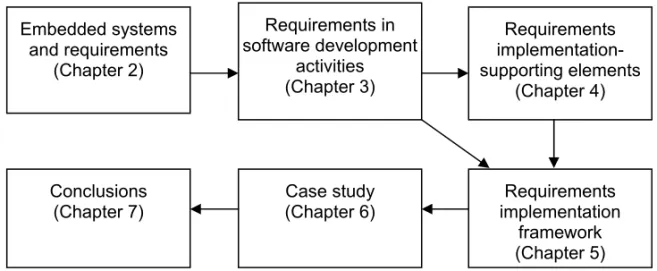
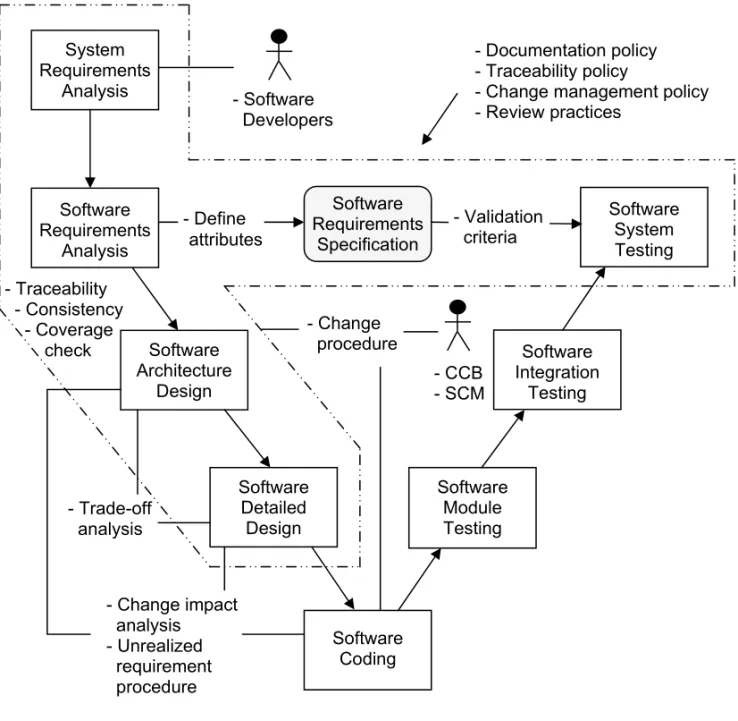
The structure of this research is illustrated in Figure 1. Chapter 2 introduces the basic concepts of the study. Special characteristics of embedded systems and embedded software development are discussed. Furthermore, definitions for requirements and requirements engineering are given.
Chapter 3 examines the relationship between requirements software development activities such as requirements analysis, design, coding, and testing. Also elements needed for effective implementation of requirements in the development activities are presented.
Figure 1. Structure of the research
Chapter 4 presents requirements implementation-supporting elements which are used throughout the software development. These elements include change management, traceability of requirements, and consistency management between requirements and different software work products. The first and second research sub-questions are answered in Chapters 3 and 4.
Chapter 5 answers the third research sub-question by presenting a framework that integrates elements of effective requirements implementation discussed previously in Chapters 3 and 4. The sub-question is further handled in Chapter 6, where the validation of the framework is discussed. Two case studies that validate the framework are presented and the most important findings are discussed.
The last chapter concludes the research and discusses the results. Further study opportunities based on this research are also given. Appendix 1 contains a questionnaire that can be used to clarify an organisation's current state of requirements implementation practices. A summary of requirements implementation practices and methods referenced to in this study is given in Appendix 2. Embedded systems and requirements (Chapter 2) Requirements in software development activities (Chapter 3) Requirements implementation-supporting elements (Chapter 4) Case study
(Chapter 6) implementation Requirements framework (Chapter 5) Conclusions
2. Embedded systems and requirements
This chapter introduces the basic concepts of the research. Because the focus of this research is requirements implementation in embedded software domain, special characteristics of embedded systems, embedded systems development, and embedded software development have to be taken into account. Furthermore, definitions for requirements and requirements engineering are given.
2.1 Embedded systems
Embedded systems are electro-mechanical products which relate mechanics, hardware and software. Examples of embedded systems are mobile phones, medical instruments and petrol dispensers. (Taramaa et al. 1998.) An embedded system contains a computer which is part of a larger system that provides non-computing features to the user (Douglass 2000). The size of an embedded system might vary from a small thermometer to a chemical plant's process controller.
Generally, an embedded system is composed of components implementing different hardware and software functions. Hardware functions may be implemented by off-the-shelf components, programmable logic and Application-Specific Integrated Circuits (ASICs). Software functions may be implemented by off-the-shelf processors such as Digital Signal Processors (DSPs) and other specific processors. (López et al. 1998.) Embedded systems typically contain a small microcontroller and limited software. However, with the development of such systems more sophisticated microcontrollers, DSP chips, off-the-shelf real-time operating systems, and software are being used. (Stankovic 1996; López et al. 1998.)
Embedded systems that have timing constraints are called real-time systems, which not only have to produce correct output, but also should produce it at the right time. Embedded real-time systems often operate in tight timing constraints, where missing an important deadline can lead to severe consequences. (Stankovic 1996.) Some real-time embedded systems operate in a safety-critical domain, where functionality and reliability are critically important features. Examples of safety-critical real-time embedded systems are avionics, traffic control systems, and medical devices.
2.2 Embedded systems development
The development of embedded systems is difficult, because these systems are part of a physical environment whose complex dynamics and timing requirements they must pursue. Taramaa et al. (1998, p. 907) define other key characteristics of embedded systems development:
• embedded systems design is often constrained by the implementation technology
• different technologies used in the same system can be developed simultaneously
• the system can possess both low-level and high-level software implementation
• maintainability and extendibility of embedded systems is achieved with new functions, technologies, and interfaces
• short development time
Although development of embedded systems has been a common practice since the first microprocessors, traditional development approaches are no longer valid to ensure high quality under strict time-to-market and design cost constraints. One of the reasons for this is the increasing complexity of today's microprocessors and associated real time software. Also the complexity of hardware and software interface communication mechanisms increases the need for more suitable development approaches. (López et al. 1998.)
As a solution, more sophisticated development approaches for such complex embedded systems are being developed. These methodologies are called hardware/software co-design methodologies. (López et al. 1998.) The traditional sequential development approach has been replaced by concurrent development of hardware and software in the co-design approach. Hardware and software design activities may begin with immature system specifications and architectural designs. Concurrent development with incomplete specifications requires close collaboration from all participants. For example, interfaces between software and hardware must be designed in co-operation by both hardware and software designers. Also testing processes for hardware and
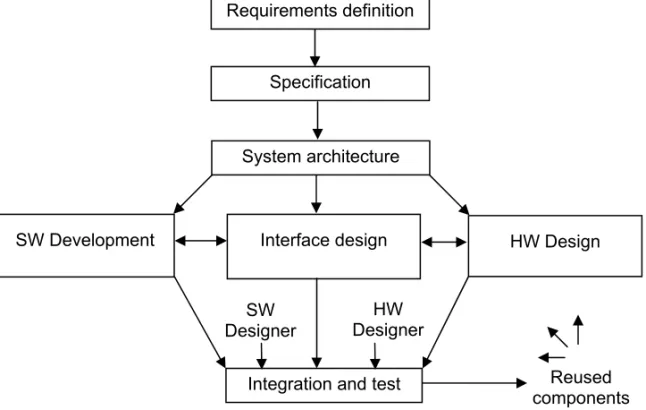
software have to be integrated. Reusing components from previous designs or outside the design group is considered as the main design goal. (Ernst 1998.) Embedded systems co-design process is shown in Figure 2.
Figure 2. Embedded systems design process (adapted from Ernst 1998, 46).
The functionality of an embedded system is usually fixed and is mainly determined by its interaction with the system's environment. An embedded system often has numerous operation modes, capability to respond to exceptions, and features that demand concurrent execution of different operations. (Gajski & Vahid 1995.) These functions are handled by the embedded system's built-in software, which is closely connected to the hardware. The close connection between software and hardware means that the software development is often steered and restricted by the hardware. (Lee 2000.)
2.3 Embedded software development
Software development is one component of the whole embedded systems development process. Embedded systems development from the viewpoint of
HW Designer SW Designer Requirements definition Specification System architecture
SW Development Interface design HW Design
Integration and test Reused components
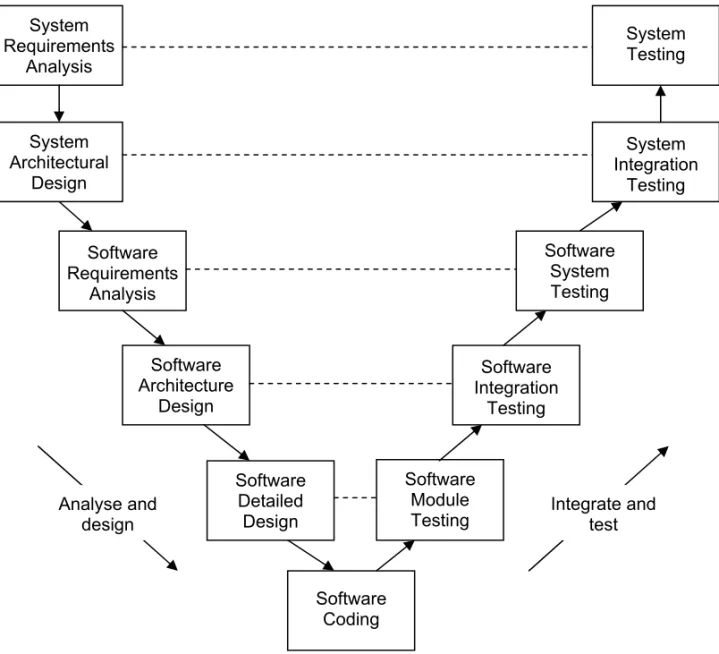
software is presented as the classical V-model according to Easterbrook (2001) and the terminology of ISO/IEC 12207 in Figure 3. This model's concepts are used throughout this research. However, system level analysis, design, and testing activities are not in the scope of the research.
Figure 3. Software development V-model (based on Easterbrook 2001 and ISO/IEC 12207).
The V-model basically states that the system requirements on the left side of the V are gradually refined in the analysis and design activities until they are implemented as software code. The activities on the right side of the V then integrate and test the software until it is ready to be integrated with other
Software Integration Testing Software Module Testing Software System Testing Software Architecture Design Software Detailed Design Software Requirements Analysis Software Coding System Architectural Design System Integration Testing Analyse and
design Integrate and test
System Requirements
Analysis
System Testing
possible systems and hardware. The dotted lines between the development activities indicate that the testing activities are based on the analysis and design activities. Although verification and validation of the product is closely related to testing, all the work products from the development activities must be verified and validated throughout the development. Verification means checking that an activity's work products fulfil the requirements or conditions imposed on them in the previous activities. Validation ensures that the requirements and the final product fulfil the product's specific intended use. (ISO/IEC 12207.)
It should be understood that the V-model is a simplified representation of software development. There is a constant information flow from lower-level development activities such as coding and design to higher-level requirements analysis and design activities. The development activities are not separate entities performed by different people; on the contrary, there is a lot of overlap and collaboration among these activities and system and hardware development activities. Furthermore, the software development activities interrelations and performance order may vary.
Programmers write today's embedded software using low-level programming languages, such as C or even assembly language, to cope with constraints on performance and cost. Object-oriented languages such as C++ are not as popular. (MOOSE 2002b.) Implementation and debugging tools for embedded software are basically the same as those for traditional software, such as compilers, assemblers, and debuggers. However, most tools for embedded software development are immature compared to traditional software development tools. (Sangiovanni-Vincentelli & Martin 2001.)
2.4 Requirements
A requirement is something that the system must exhibit or a quality that the system must have. Requirements are defined at the beginning of the development as a specification of what should be developed. Requirements for a system are typically a combination of demands from different people at different levels of the developing organisation and from the environment where the system must operate (Sawyer & Kotonya 2001, 2). In addition to the description of what the system should do, requirements often involuntarily describe how the
system should be done. Therefore, requirements are a mixture of problem information, statement of behaviour, and design and manufacturing constraints. (Sommerville & Sawyer 1997.)
Requirements used in the development of embedded systems are generally classified as system, hardware, and software requirements. This research concerns itself mostly with system and software requirements. System requirements are derived from various high-level requirements stated by different stakeholders. These stakeholders are for example acquirers, end-users, sales and marketing people, regulators, system developers, and other existing systems. System requirements are expressed in the terms of the stakeholders' domain and are usually documented in a system requirements specification (Sawyer & Kotonya 2001).
Software requirements are detailed requirements for software derived from the system requirements. Software requirements fall into two general categories: functional and non-functional requirements. Functional requirements define capability and behaviour of the system. A sample functional requirement would be a system's capability to format some text or modulate a signal. (Sawyer & Kotonya 2001.) Non-functional requirements refer to performance, interface, quality, and design constraints of the software. For example, a non-functional requirement could define a recovery time for the software or specify the programming language used in the implementation of the software. Software requirements categorisation based on IEEE 830-1998 standard with explanatory questions is listed in Table 1.
Table 1. Categorisation of software requirements.
Functional
requirements What is the software supposed to do?
Performance requirements
What are availability, response time, and recovery time of software functions?
External interface
requirements How does the software interact with external entities, such as hardware?
Quality attributes What are the quality considerations of software such as
reliability, usability, maintainability, and portability?
Design constraints Are there any required standards in effect, implementation
languages, operating environments, etc.?
In order to achieve quality in the developed product, it is not enough only to fulfil the functional requirements. When a non-functional requirement such as usability is neglected, the resulting system might work correctly but it may be difficult to use. Unfortunately, non-functional requirements are often not as easily verifiable as functional requirements during the development. (Ebert 1997.)
Functional and non-functional requirements for software are typically documented in a software requirements specification (SRS). The readers of an SRS are expected to have knowledge of software engineering concepts, which can reflect on the language and notation used in the specification. (Sawyer & Kotonya 2001.) In addition to the software requirements that are stated in natural language, graphical representations are often needed to depict a full picture of the intended system. These representations as analysis models also help developers to detect inconsistencies, errors, and omissions in the requirements. Furthermore, graphical descriptions improve developers understanding of the requirements. (Wiegers 1999.) The SRS and its graphical representations are discussed further in the next chapter.
Requirements for embedded software have a different emphasis than requirements for conventional desktop software. In conventional software development, non-functional requirements such as timing, reliability, robustness, and power consumption are secondary to the logical correctness of computations. In embedded software development, non-functional requirements
Functional requirements Non-functional requirements
are equally important as functional requirements. (Karsai et al. 2003.) Non-functional requirements are especially recognised as an important success factor in market-driven embedded software development (Punter et al. 2002). A product with outstanding functionality is not enough; instead, both functionality and quality characteristics are needed for a successful product.
In addition, system and hardware requirements are more important in embedded software development than in development of conventional software. During the system design, an agreement based on system requirements is made about the system's components and their purposes. Then, software and hardware requirements are elaborated for each of these components separately. (Davis 1990.) Therefore, development of embedded software is dependent on system and hardware requirements. Developers of conventional software hardly need to worry about system level requirements (except for large software systems) and even less so about hardware requirements.
2.5 Requirements engineering
The term requirements engineering has various definitions. Robinson and Pawlowski (1999) characterise requirements engineering as an iterative process of discovery and analysis of agreed set of clear, complete, and consistent system requirements. This research shares a broader perspective on requirements engineering, including the management viewpoint, as stated by Dorfman (1997, p. 12): "...requirements engineering consists of elicitation, analysis, specification, validation/verification, and management [of requirements]."
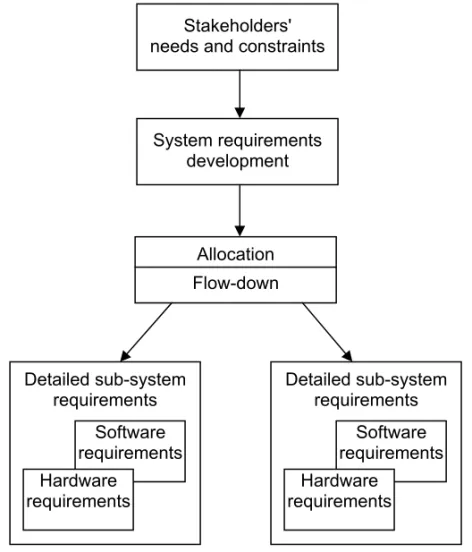
Requirements engineering can be further classified into system and software requirements engineering. System requirements engineering is concerned with analysing and documenting system requirements. Requirements engineering from systems engineering viewpoint is shown in Figure 4. In system requirements engineering, stakeholders' needs are transformed into system description, system performance parameters, and system configuration. System-level requirements engineering is also concerned with the partitioning of the system. This is achieved by identifying which requirements should be allocated to which components (e.g. software, hardware, or subsystem). (Sawyer & Kotonya 2001.) The allocation is based on different criteria such as cost of
implementation, cost of replication, implementation time, ease of change, and error rates during operation (Stevens et al. 1998).
Figure 4. Requirements engineering in systems engineering context (adapted from Parviainen et al. 2003, 13).
After the allocation, a flow-down process will take place, where requirements for the lower-level elements are specified in response to the allocation. The lower-level elements must have at least one requirement that responds to the allocation, but often many requirements are written for one allocation. (Dorfman 1997.) Finally, requirements are implemented in sub-systems either in hardware or software disciplines.
Software requirements engineering is concerned with establishing and documenting software requirements. Allocated system requirements are transformed into software requirements through the use of analysis, design,
Stakeholders' needs and constraints
System requirements development Allocation Flow-down Detailed sub-system requirements Software requirements Hardware requirements Detailed sub-system requirements Software requirements Hardware requirements
trade-off studies, and prototyping. The major difference between system and software requirements engineering is that the origins of system requirements are stakeholders' needs, while the origins of software requirements are system requirements. (Thayer & Dorfman 1997.) However, in small scale development, software requirements may come directly from stakeholders.
Sawyer and Kotonya (2001) have defined requirements engineering activities, which are broadly compatible with the ISO/IEC 12207 (1995) software life cycle processes standard. Requirements engineering consists of activities such as elicitation, analysis, specification, validation, management of requirements. These activities, except for requirements management, should comprise an iterative process where activities are repeated until an acceptable requirements document is produced. This process is not a separate front-end activity in the software life cycle, but rather an activity that is initiated at the beginning of the life cycle and continues to be refined through the life cycle. Requirements management is an activity that spans the entire software development. It consists of requirements identification, tracing, and change management. (Sawyer and Kotonya 2001.)
3. Requirements in software development
activities
After the agreed system requirements have been specified and further allocated to software, the work begins on evolving these requirements into a software requirements specification, designs, code, and test cases. This chapter discusses the relationships between requirements and software development activities of the V-model presented in the previous chapter. In addition, elements needed for effective implementation of requirements in the development activities are presented. These elements were gathered from current literature, which includes software engineering standards, research papers, and books. The presented elements are later used in Chapter 5 to construct the requirements implementation framework.
3.1 Software requirements analysis
Software requirements analysis is a software engineering activity that brings system requirements closer to software designs. In this activity, system requirements are elaborated into software requirements. The elaboration is done by refining, analysing, modelling, and specifying allocated system requirements into software requirements. To increase knowledge about what is required from the software, the problem is partitioned and representations that describe requirements for software are constructed. Thus, requirements analysis is a technical step, where broad expressions of the software are refined into a more detailed specification that serves as a foundation for all other software engineering activities that follow. (Pressman 2000.)
Two distinct activities are performed during the specification of software requirements: problem analysis and product description. Problem analysis is an activity where analysts brainstorm ideas, interview people, and identify all possible constraints on the problem's solution. Product description activity is concerned with the external behaviour of the product. The purpose of the product description activity is to solve the problem that is understood after the problem analysis. (Davis 1990.) Possible approaches for these activities are structured analysis, object-oriented analysis, and formal methods. Sample
techniques include data flow diagrams, state-transition diagrams, and use cases. (Parviainen et al. 2003.)
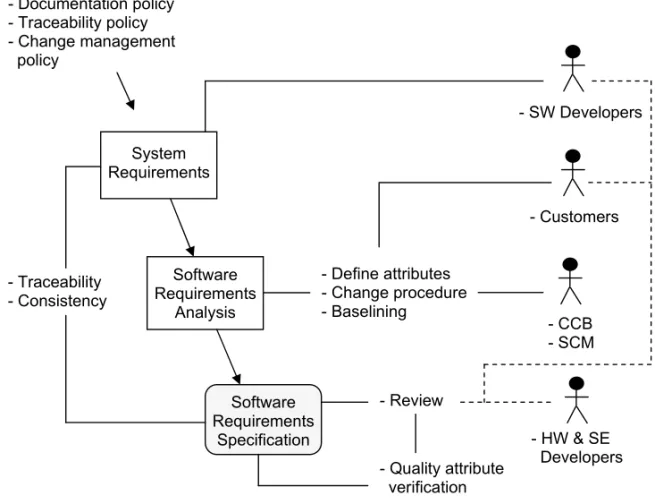
A software requirements specification (SRS) is developed as a result of the requirements analysis. If necessary, it may be jointly prepared with customers, because software engineers usually do not understand customers' problems and domain area well enough to produce correct requirements (IEEE Std 830-1998). On the other hand, software developers who will later implement and test these requirements should be also included in the software requirements analysis activity. For example, software architects could prevent the acceptance of unachievable requirements. Benchmarking and prototyping the architecture before the requirements are nailed down may reveal problems with the suggested requirements. (Mead 1994.) Software testers should be included in requirements reviews to make sure that the requirements can be eventually verified. All the requirements included in the SRS should have a proper verification criterion. (Wiegers 1999.)
Requirements in an SRS should be documented with related attributes so that they are identified and prioritised. Identification is needed for requirements management. Priorities for requirements should be assigned to define implementation order and allow resolution of conflicts in later development activities. Customers naturally demand high priorities for requirements that are important for users. In contrast, developers desire high priorities for requirements that are important for software development and maintenance. The cost of a certain requirement plays also major role in deciding what is essential to implement. Reconciliation of these different viewpoints can be supported, for example, with Quality Function Deployment (QFD) and Wiegers' method. (Wiegers 1999.)
A requirement's stability may be also be stated as an attribute. For some requirements it is possible to define the probability of their change in the future. The stability attribute enables software developers to construct designs that are more tolerant of change. Other possible attributes for requirements include source and scope of the requirement. (Sawer & Kotonya 2001.)
An SRS must be in line with system requirements. To achieve this, traceability between system and software requirements must be established. Furthermore,
software requirements consistency with system requirements must be ensured. (ISO/IEC 12207:1995, IEEE 830-1998.) The SRS should be comprehensive and should not include any design, implementation, testing, or project management details other than applicable design and implementation constraints. An undocumented requirement is not part of the agreement and no one should expect it to be in the product. Although all the needed requirements should be contained in the SRS, software design and construction can begin before the entire SRS is written. This requires that the development project has baselined agreement for a set of requirements. Baselined requirements are approved and reviewed requirements from the SRS under development. Changes to the baselined requirements should be made through a defined change control process. (Wiegers 1999.)
After the software requirements have been analysed and specified, they need to be verified. Verification ensures that requirements (1) correctly describe behaviour and characteristics of the system, (2) are internally consistent, (3) are complete and high-quality, and (4) provide an adequate basis to proceed with design, implementation, and testing. Verification is not a solitary activity performed after all of the requirements have been documented. Instead, as the requirements tend to develop during the requirements gathering and analysis, they need to be verified incrementally. (Wiegers 1999.)
One possible approach for verification of software requirements is a formal inspection of the SRS. This is especially useful when requirements are being baselined for further development of software. Reading techniques such as perspective-based reading (Shull et al. 2000) can be used in requirements inspections. In addition to inspections, some quality attributes, such as safety, might require their own specific verification procedures (Rodríguez-Dapena et al. 2001).
3.2 Requirements and software architecture design
Software's architectural design depicts a holistic view of the software to be built. It represents the structure and organisation of software components, their properties, and the connections between them. The architecture enables software engineers to analyse the effectiveness of the design in meeting its requirements.
Furthermore, risks associated with the construction of the software are reduced by comparing alternative architectural solutions. (Pressman 2000.) Having a good software architecture does not ensure that the developed product will meet its requirements. On the other hand, having a badly designed architecture makes it almost impossible to meet the product's requirements. (Hofmeister et al. 2000.) Requirements are a key input to the design of software architecture. Elaborating requirements into valid software architecture that satisfies those requirements is a difficult task and is mainly based on intuition. Little is known about the impact of architectural choices on the requirements. (Grünbacher et al. 2001.) The architectural design must meet both functional and non-functional requirements. For example, performance requirements and timing constraints for embedded software influence architectural design. Sample constraints include data throughput rates, function call latencies, and interrupt congestion (Ronkainen et al. 2002).
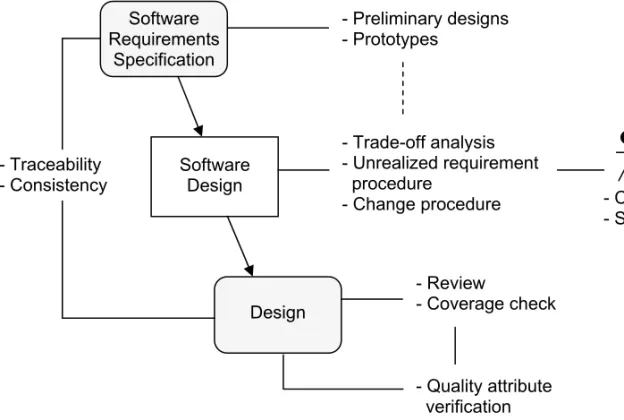
Other quality attributes such as testability, understandability, and modifiability can be also implemented in the architectural design. This is achieved, for example, by specifying required levels of cohesion and coupling for the design (Davis 1990). Some of these quality attributes, such as safety, may need specific verification processes to ensure that these characteristics are included in the design (Rodríguez-Dapena et al 2001). Ebert (1997) suggests to use checklists-based inspections for measuring the success of quality attributes absorption into the architectural design.
An important purpose of the software architecture is to abstract the software design so that architects can analyse trade-offs between different solutions. Trade-off analysis means exploring the impact of certain decisions in terms of all the criteria and constraints (Ruhe et al. 2003). Based on a trade-off analysis, the architect must decide which requirements gets higher priority, and design a solution that adequately satisfies the requirements. A requirement might be sacrificed or compromised as a result of the trade-off analysis. (Hofmeister et al. 2000.) Sample approaches for analysing architectural designs against requirements include Architecture Trade-off Analysis Method (ATAM), Scenario-Based Architecture Reengineering (SBAR), and Architecture Quality Analysis (AQA) (MOOSE 2002a). In addition to trade-off analyses, these
methods can be used for evaluating absorption of quality attributes into the design.
As architects examine the requirements and develop possible architectural solutions, they might need to consult stakeholders to negotiate on changes to the requirements (Hofmeister et al. 2000). Ideally, software architects are involved in the early activities of the development. This way development of unachievable requirements is more likely to be prevented. Software's architecture must be considered during the development of requirements to make certain that the requirements are valid, consistent, and feasible. Architecture modelling and trade-off analysis are important activities and should already take place during requirements engineering. (Mead 1994.)
Software projects often consider requirements analysis and candidate architectural solutions concurrently. However, the relationship between requirements and software architecture is not obvious. Requirements describe aspects of the problem to be solved and constraints on the solution. In contrast, architecture describes a solution to the problem stated in the requirements. Requirements deal with such concepts as goals, options, agreements, issues, conditions, and system features and properties. They may be simple or complex, precise or ambiguous, stated in natural language or precise formalism. In contrast, the concepts used in architectural design differ from those used for requirements. Architecture deals with components, connectors, topologies, and the software's desired properties. These differences between requirements and architectures make it difficult to build a bridge that spans the two. (Grünbacher et al. 2001.)
Because of the different concepts used in requirements and software architectures, consistency and traceability maintenance between them is complicated. A single requirement may concern multiple architectural solutions and a single architectural element may have numerous relations to different requirements (Grünbacher et al. 2001). Nevertheless, software development standards require that traceability between an architectural design and requirements is established. Furthermore, the architecture's consistency with the requirements must be ensured. (ISO/IEC 12207; ISO/IEC TR 15504-5.)
3.3 Requirements and detailed software design
Detailed software design represents the software at a level of abstraction that is very close to code. The design must describe data structures, interfaces, and algorithms in sufficient detail to guide developers in construction of the software code. These descriptions are represented using design notations such as flowcharts, N-S charts, decision tables, program design languages (PDL), dataflow diagrams, entity-relationship diagrams and UML. (Pressman 2000.) Object-oriented design of embedded real-time software considers detailed design as definition of data structures, associations, operations, algorithms and exceptions (Douglass 2000).
Software designers should be included in the development of requirements (e.g. in requirements inspections) to make sure that requirements can serve as a basis for detailed designs. Several different software designs will usually satisfy the given requirements. These designs may vary in performance, efficiency, and robustness characteristics. The most efficient way to fulfil the requirements should be explored. (Wiegers 1999.)
Both functional and non-functional requirements affect the detailed design activity. While functional requirements steer the design's operations and algorithms, non-functional requirements set constraints on these solutions. For example, performance requirements oblige designers to develop algorithmic solutions that meet the given timing constraints (Davis 1990). Also hardware constraints, such as available memory, affect designers' work by restricting the solution space. Design constraints stated in software requirements affect the detailed design activity explicitly. These constraints may define the notations and techniques used in the detailed design.
Quality attributes appear in design trade-offs when designers need to choose between particular structural and behavioural aspects of the system. For example, quality attributes can be used to guide the selection and application of design patterns during design. Characterising and using patterns according to quality attributes allows designers to meet system-wide non-functional requirements. (Gross & Yu 2001.) As in architectural design, some quality attributes may need specific verification processes to ensure that these characteristics are reflected in the detailed design (Rodríguez-Dapena et al 2001).
Software development standards require that a software component's detailed design is traceable to software requirements and consistent with them (ISO/IEC 12207:1995; ISO/IEC TR 15504-5:1998). The design should be also verified so that all of the functional requirements are accommodated and unnecessary functionality is not included (Wiegers 1999).
3.4 Requirements and software coding
The purpose of the software coding activity is to produce software units that reflect software designs and requirements. In coding activity, the developers begin to write modules that compile in the programming language (Mazza et al. 1996). If designs are specified detailed enough, they may be used directly as the basis for coding. Otherwise, developers need to use software requirements stated in the SRS and detailed designs together.
Implementation of functional requirements in code is more straightforward than is the case with non-functional requirements. Software engineers have to consider various aspects while implementing non-functional requirements. Performance requirements might oblige software engineers to use a low-level programming language (Ronkainen et al. 2002). Efficiency requirements, such as memory constraints, require programmers to use available hardware resources narrowly (Davis 1990).
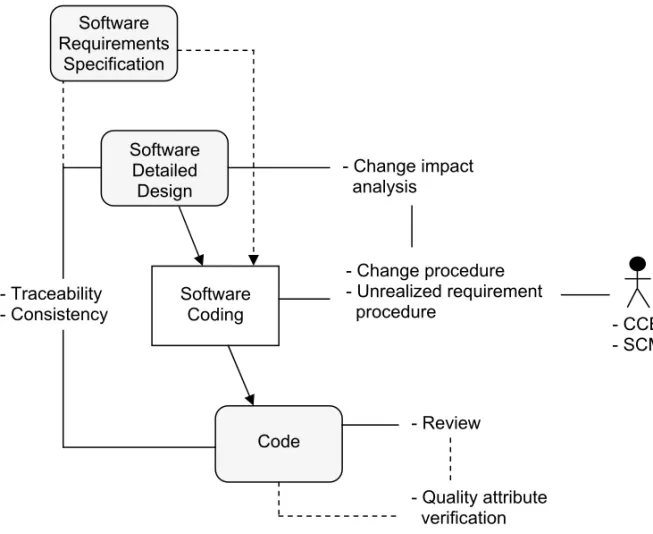
Maintainability and portability requirements are also clearly present in the coding activity. The source code's maintainability is achieved by following the organisation's coding standards. Static code analysis tools such as QAC/++ (2003) or Logiscope (2003) can be used to identify a source code that is not conformant to the specified quality attributes. These tools typically identify problem areas in the code's structure, maintenance, and portability issues. Programming language selection, for example between a standardised high-level and a processor specific low-level language, also has considerable influence on portability requirements.
Certain quality attributes, for example predictability, should become crucial for developers at the coding activity. Definition of these characteristics cannot be made precisely at the beginning of the development because of their dependency
on the software architecture and implementation technology. (Rodríguez-Dapena et al. 2001.) On the other hand, trade-off analyses between some quality attributes have to be made before coding. For example, fulfilling an efficiency requirement may require that a code is implemented using a specific compiler and operating system. As a result, the system may work fast, but at the same time it will be hard to maintain, enhance, and port to another environment. (Wiegers 1999.) Some of these quality attributes may need specific verification procedures to ensure that the desired quality is elaborated into software code (Rodríguez-Dapena et al. 2001).
In some phase of the construction process, developers will encounter ambiguity and confusion while translating software requirements into code. To solve these problems, the obscure requirements should be traced back to their sources and a solution would be negotiated. Procedures should be defined for a situation where problems can't be resolved immediately. (Wiegers 1999.) Management of the confusion and ambiguity is improved when requirements are traced into code and their consistency is checked. Maintaining a code's traceability and consistency with requirements is also required by software development standards (ISO/IEC 12207:1995; ISO/IEC 15504:1998).
3.5 Requirements and software testing
The purpose of the software testing activity is to ensure that the produced software will satisfy the software requirements. Software testing includes three basic testing stages: module, integration, and system testing. Module testing verifies that a software module's source code is doing what it is supposed to do. Testing of software modules is followed by integration testing, where the focus is on software designs and the structure of the software architecture. Finally, system testing is performed to ensure that the software as an entity fulfils all software requirements. (Mazza et al. 1996; Davis 1988; Pressman 2000.)
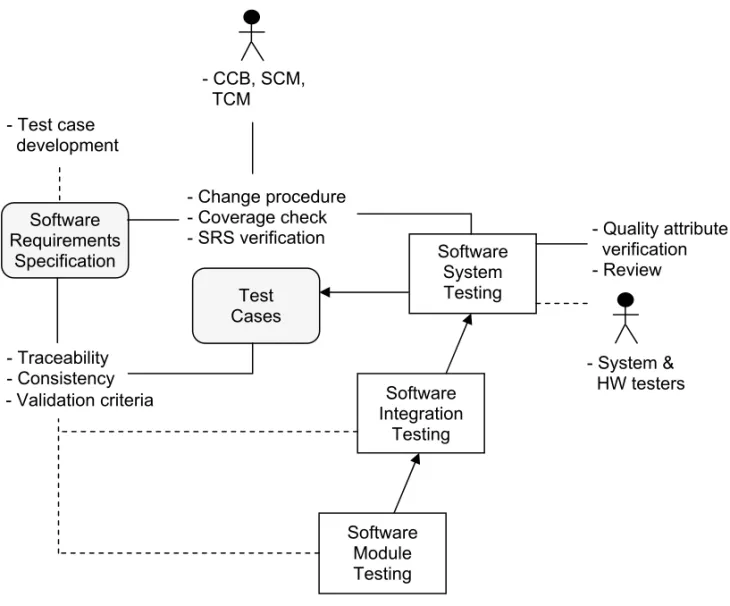
System testing is the most significant testing activity from software requirements viewpoint. Davis (1988) emphasises that system testing should ensure that the entire software embedded in its actual hardware environment behaves according to the SRS. System test plans and test cases should be designed to ensure that all the software's desired characteristics are achieved. The purpose of test planning
is to assess how the software will be tested for conformity with the SRS. Another purpose of the planning is to ensure that the SRS is verifiable. An SRS is verifiable only when all of the stated requirements are verifiable. However, some of the requirements cannot always be rigorously verified. For example, usability requirements have multiple interpretations and are hard to measure quantitatively. (Davis 1990.)
Software testing has a major role in embedded system development due to the system's reliability and other non-functional requirements. For example, a system's quality attributes such as safety and reliability often require high code coverage percentages. Usability aspects could be tested by gathering suitable information during usability tests in an environment as close to the operational environment as possible (Ebert 1997). Other sample techniques for non-functional requirements testing include recovery testing, security testing, stress testing, and performance testing (Pressman 2000). However, the realisation of quality attributes is often difficult to verify. Various possible scenarios and different input combinations force developers to limit the set of test cases. In reality, quality attributes are often the first ones to bypass systematic verification. (Rodríguez-Dapena et al. 2001.)
The software testing activity's test cases are based on software requirements. The relation between requirements and test cases is considered so essential that the link between them should be always established (Weber & Weisbrod 2002). Every requirement should be traced to at least one test case, so that all expected system behaviour is verified (Wiegers 1999). Composing test cases as soon as requirements stabilise enables developers to find and correct flaws in requirements inexpensively. Writing test cases for requirements crystallises the developers' vision of how the system should behave. Ambiguous and conflicting requirements should be revealed when the developer cannot describe the system's expected response to a test case. (Wiegers 1999.)
In actual practice, software developers often fail to manage requirements, validation criteria, and test cases. Although it is agreed that requirements specifications should go hand in hand with validation criteria and test cases, the actual specification documents do not really fulfil these agreements. One reason for this is the fact that it is very difficult to specify validation criteria and suitable test cases for some functional requirements. With non-functional requirements the
case is even harder. Providing concrete requirements validation criteria examples for developers and having developers exploit and re-use these samples may improve these problems. The validation of non-functional requirements is also improved if these requirements are stepwise refined until they are implemented by a set of functional requirements. (Weber & Weisbrod 2002.)
4. Requirements
implementation-supporting elements
The previous chapter discussed the role of requirements in software development activities and overviewed elements needed for effective requirements implementation in these activities. The importance of maintaining consistency and traceability between requirements and software work products was emphasised in all discussed activities. In addition, requirements change management is needed for controlling the inevitable change.
This chapter discusses these requirements implementation-supporting elements, which manifest themselves throughout the software development. First, requirements change management and its effect on software development is discussed. Then, traceability of requirements, which is also an important part of the change management, is covered in more detail. Finally, approaches for ensuring consistency between requirements and different software work products are presented. The presented requirements implementation-supporting elements are later used in Chapter 5 to develop the requirements implementation framework.
4.1 Requirements change management
Changing requirements are the reality in system development rather than stable ones. Designers are faced with unpredicted and disruptive changes in requirements that the system has to satisfy. (Harker et al. 1993.) Requirements sometimes change because of an error in requirements analysis, but more often it is consequence of a change in the system's environment (Sawyer & Kotonya 2001). In addition to the change in the system's operating environment, the hardware where the software is embedded may change. Therefore, concurrent development of the embedded system's hardware and software is a possible source for change. (Mäkäräinen 2000.) Sometimes, unfeasibility of requirements is only revealed once the actual software designs and code are implemented and tested; therefore, original requirements may need to be changed because of a change request from software development activities.
Whatever the reason for a change, it is important to manage the change by ensuring that the proposed changes go through appropriate review and approval procedures (Sawyer & Kotonya 2001). Effective system development requires organisational change management policies, which define the processes used for change management and the related information that is associated with change requests (Kotonya & Sommerville 1998). The need for requirements change management is also stated in the Software Engineering Institute's process improvement framework Capability Maturity Model Integration (CMMI). The requirements management process area in the CMMI framework requires that changes to the requirements are managed during the project (CMMI-SW 2002). The need for a formal requirements change process arises when many changes to requirements are proposed. A requirements change management process consists of activities for documenting, reporting, analysing, costing, and implementing changes to requirements. Change management process can be thought of as a three-stage process. First, the problematic requirement is identified and analysed using the problem information and change for the requirement is proposed. Then, the proposed change is analysed to see how many other requirements are affected and what is the cost of the change. Finally, the change is implemented and relevant documents are updated. (Kotonya & Sommerville 1998.)
Procedures for requirement problem analysis and change implementation are dependent on the type of the change, the requirement, and requirements documentation. Cost and change impact analysis, however, are more general processes. These processes ensure that unnecessary changes are not made and that affected requirements are discovered. (Kotonya & Sommerville 1998.) A requirements change management process may be included in a process that is intended for general change management in the system development. Examples of change management models include Olsen's change management model, the spiral-like change management model, and the generic change management process model (Parviainen et al. 2003).
A recent survey in embedded software industry revealed that there are problems implementing requirements change management process. Although change management procedures are defined, they are in many cases rejected. The main reason for this is that these procedures take too much time. Time is consumed
for example in re-reviewing all the relevant documents after every change. As a result of inappropriate change management, requirements and design documents may easily lose their consistency. (MOOSE 2002b.)
Change management process is also complicated by communication problems specific to embedded systems development. Concurrent development of an embedded system is often carried out in separate technology groups. Therefore, detailing the changes to all concerned parties becomes crucial when developers share the same software components. However, the development groups usually operate independently and their working practices, tools, and vocabularies are not always similar. (Mäkäräinen 2000.)
To overcome the problems in implementing a change, a change control board or (CCB) may be needed for controlling the change process. Such board is a body of people (possibly one individual or a group of people) that makes decisions about approving proposed requirement changes. Generally, a CCB reviews and approves changes to any baselined work product on the project. Large projects often have many levels of control boards. For example, some control boards are responsible for business decisions while others deal with technical issues. Smaller projects may have only one or two people that make all the change decisions. However, a CCB should have representatives from all groups that are affected by a change. Sample representatives include people from product management, project management, configuration management, software development, and quality assurance. (Wiegers 1999.)
4.1.1 Impact analysis
The impact of the change must be analysed before a requirement change is approved. Not only must the change's impact on the requirement specification be analysed; its impact on lower level work products has to be examined as well. For example, if a change is made to a single requirement that affects few details in high-level designs, it may affect many other lower-level designs, implementations and test cases. This kind of phenomenon is know as the ripple effect. The purpose of impact analysis is to tackle problems such as the ripple effect by identifying potential consequences of a change. Impact analysis can
also be used to determine what to modify in order to accomplish a change. (Arnold & Bohner 1993.)
Research on impact analysis has concentrated mainly on determining source code level changes or using traceability to predict changes to different work products created during the development. Techniques for impact analysis on implementation level include control and data dependency, and program slicing. Various traceability approaches enable impact analysis throughout the software development. (O'Neal & Carver 2001.) Wiegers (1999) suggests that developers use checklists and defined procedures for discovering possible implications of a change. As a result of impact analysis, a developer reports to the CCB the needed effort for a requirement change. A standard reporting template will make it easier for the CCB to find information needed to make decisions.
Quality impact analysis methods such as Quality Factor Deployment can be utilised to assess the impact that a requirement change is likely to have on quality aspects such as performance, safety, and reliability. Also requirements inspections, viewpoint analysis and trade-off analysis can used to identify potential conflicts and trade-offs within the set of changing requirements. (Lam & Shankararaman 1999.)
In actual practice, impact analysis is mostly performed manually, because tool support is weak. Also absence of traceability information between requirements and other software work products complicates impact analysis. (MOOSE 2002b.) Wiegers (1999) states that the organisation's ability to succeed in impact analysis depends on the quality and completeness of the maintained traceability data.
4.1.2 Change management tools
When many requirements changes are introduced, the need to use a change management tool grows. Requirements change management may be supported by specialised requirements management and software configuration management tools. Some of these tools enable the use of database supported electronic change request forms. Furthermore, they may provide automatic notification to responsible persons with electronic forms. (Kotonya & Sommerville 1998.) Sample commercial requirements management tools that
also support requirements change management include Rational RequisitePro (2003) and DOORS (2003).
The general problem with change management tools is their own implicit model of change process, which organisations must adopt. In addition, special-purpose change support tools are fairly expensive and difficult to integrate. Therefore, these tools are mostly used by very large organisations in very large projects. Because requirements management also involves release management and configuration management, a tool support that integrates these features is actually demanded by industry. Some of the requirements management tools provide only some of the demanded features, while integration of configuration management, change management, and test case management is needed. (MOOSE 2002b.)
Requirements change management and software configuration management (SCM) have similar objectives. SCM is used as a means of controlling change throughout the software development process. It consists of activities that identify unstable work products, establish relations among them, define mechanisms for managing versions of these work products, control changes that are imposed, and audit and report about the changes that are made. Specifically, change control activity of SCM is responsible for ensuring quality and consistency as changes are made to configuration items. (Pressman 2000.) Requirements can be regarded as software configuration items and therefore controlled under SCM. The same SCM processes and tools that are used for design, implementation, and testing activities can be also used for versioning and managing changes in the requirements. (Crnkovic et al. 1999.) However, Kandt (2002) states that most configuration management tools are file based and therefore do not manage documents at a level of granularity that is truly useful - individual requirements, design concepts, classes, functions, test cases, and so on.
4.2 Requirements tracing
Requirements, designs, and implementations that are correct, consistent, and error-free ensure that the developed system meets its stakeholders needs. One of the key factors in achieving these features is understanding and tracing the relationships amongst these work products. (Palmer 1997.) The development of
embedded systems also requires that traceability between a system's different technology components is handled (Mäkäräinen 2000). Requirements traceability is defined as "...the ability to describe and follow the life of a requirement, in both a forwards and backwards direction (i.e., from its origins, through its development and specification, to its subsequent deployment and use, and through all periods of on-going refinement and iteration in any of these phases)." (Gotel & Finkelstein 1994, p. 97)
Requirements traceability has various benefits in software development when used appropriately. As discussed earlier, it provides a means of managing change in requirements. Traceability can be also used for showing a system's compliance with requirements, maintaining a system's design rationale, proofing when a system is complete, and establishing maintenance mechanisms (Ramesh et al. 1995). Traceability is considered a key issue in transforming requirements into architecture and further work products (Grünbacher 2001). Design decisions are consistent with decisions made earlier in system development when lower level work products are traced to higher-level work products. Requirements tracing enables conflict detection by discovering linkage between selected entities and by providing visibility into the entire system. It also supports assessment of high-level behaviour and non-functional requirements' impact on design specifications. Also test cases coverage in relation to requirements is provided. (Palmer 1997.) Tracing requirements to designs, software units and all levels of testing has been also stated to be the best way to monitor progress (Lindström 1993).
A defined traceability policy is needed as the number of requirements grows. All decisions about which elements are to be traced and how to do so should be defined in the project's inspection phase (Weber & Weisbrod 2002). Factors that influence such decision-making are the number of requirements, the system lifetime, organisational maturity, the development team size, type of the developed system, and specific customer requirements. Small teams can handle changing requirements without structured traceability information, but larger teams have to establish a formal traceability policy. Certainly, the development of critical systems needs a more comprehensive traceability policy than the development of non-critical systems. (Kotonya & Sommerville 1998.)