A CTL-Based Logic for Program Abstractions
Martin Lange1 and Markus Latte2
1 Dept. of Computer Science, University of Kassel, Germany
2 Dept. of Computer Science, Ludwig-Maximilians-University Munich, Germany
Abstract. We define an action-based extension of the branching-time temporal logic CTL which allows path quantifiers to be restricted by formal languages. The main purpose of this logic is its use in abstract interpretation. A reduction from a concrete system to an abstract one may contain spurious traces which can render the verification of the ab-stract system useless with respect to the concrete one. We pick up the suggestion to verify a modified property on the abstract system instead of the one that the concrete system is supposed to have. The logic in-troduced here enables a systematic modification of such properties. We present some ways of such a modification which aim at implicitly exclud-ing spurious traces in the verification of abstracted systems.
1
Introduction
Model checking is one of the most successful automatic verification techniques for all kinds of programs: hardware, protocols, reactive software, etc. In model checking, the program to be verified is given as a transition systems representing the operational semantics of a program with states and transitions between the states, and the property specifying correctness of the program is formalised in a temporal logic.
Various temporal logics have been introduced for model checking. The most prominent ones are the linear-time temporal logic LTL [14] and the branching-time temporal logic CTL [7]. These are not only incomparable in terms of their expressive power but also — and partly thus — incomparable in terms of their pragmatics. CTL model checking is easier than LTL model checking (P- vs. PSPACE-complete [5, 15]) whereas LTL satisfiability checking is easier than CTL satisfiability checking (PSPACE- vs. EXPTIME-complete [15, 7]).
These results, in particular the model checking complexities, hold w.r.t. fi-nite models. However, many programs, in particular software, occupy an infifi-nite state space. Clearly, model checking infinite-state programs is undecidable in general but it remains decidable for certain classes of infinite-state programs, e.g. pushdown processes, and weak temporal logics like CTL and LTL. It is still just PSPACE-complete for LTL but EXPTIME-complete for CTL [3, 19].
This does not immediately enable automatic program verification for infinite-state programs because of several reasons. Programs may not fall into these classes, in particular if the cause for infinity is the use of variables over un-bounded domains etc., or the relatively high worst-case complexities may not
allow efficient implementations in practice. In such cases, it may be necessary to employ a technique that generally reduces the complexity of the underlying verification problem at the expense of total correctness: abstraction [6]. It is also applicable in cases of finite systems where state-space explosion renders the verification problem inefficient in practice.
Abstraction is the process of transforming a transition systemT into a (typ-ically) smaller transition systemTabs which contains at least some of the infor-mation that is present in T. Verification of the smaller system is then easier or even possible. However, the abstraction must be chosen such that the verification of the abstract system allows to make assertions about the underlying property and the original system.
Consider, for instance, one of the most well-known abstraction schemes, called
∃∃-abstraction. There, states of the abstract transition systemTabs result from collapsing sets of states of the original transition systemT, and there is a tran-sition between collapsed states S and T iff there are s ∈ S and t ∈ T with a transition fromstot in the original system. It is not hard to see that the runs or paths ofTabsform a superset of the paths ofT. Every path inT can be found in Tabs but the latter also contains spurious traces which are paths that only arise as artefacts of the abstraction but do not exist in the original system T. Now consider a class of simple properties ϕ to be checked onT, namely tem-poral properties which quantify over paths in a universal manner only. It is the case that Tabs|=ϕimpliesT |=ϕfor suchϕbut not vice-versa because of the relationship between paths in Tabs and in T. Thus, if the abstracted system is correct w.r.t.ϕthen so is the original one. If the abstracted system is faulty then nothing is known about the original one because the reason for the error may be a spurious trace. Still, abstraction can thus enable the verification of systems which cannot be model checked under normal circumstances at the expense of completeness for instance.
It turns out that this is all very well in theory but in practice it happens very often that the abstracted system fails the desired property, i.e. spurious traces interfere with the verification task too much. Now note that there is no reason for considering theoriginal propertyon the abstracted system. This observation has led to suggestions regarding the weakening of universally path quantified properties, for instance by consideringfair traces in the abstract system only [2]. This does work in certain cases. However, there is no general relationship between the abstraction scheme and fairness which would guarantee it to work in many cases. A more precise weakening would relativise the path quantification in the property to be checked on the abstract system to paths occurring in the original system. Note that, if this was possible, then it would not only be restricted to
∃∃-abstractions and universally path quantified properties. The same could be done with existentially path quantified properties and all kinds of abstractions. For this purpose, we suggest a logic which is based on the commonly used branching-time temporal logic CTL and which allows relativised path quantifiers. While there are logics around with very high expressive power, even temporal ones, these typically extend the modal µ-calculus by incorporating all kinds
of expressive operators. Such logics are more or less useless in the setting of abstraction. We propose to base such a logic on a commonly used logic Lsuch that the problem of determiningT |=ϕfor someϕ∈ Lcan be transformed into the problem of determining Tabs |= ϕabs for an abstracted system Tabs and a propertyϕabswhich incorporates information that gets lost betweenT andTabs into ϕ. Maybe this could even be automised such that to the outside, only T
andϕwould be visible which underpins the need forϕto belong to a commonly used specificaton logic and thereforeϕabs to be something based upon that.
In Sect. 2 we introducePath Relativised Computation Tree Logic(CTLrel). It is a simple branching-time temporal logic which is interpreted – like action-based CTL [13] – over transition systems with labeled edges. It extends CTL by allow-ing path quantifiers to be restricted. The restriction is realised by languages of
ω-words aiming at maximal flexibility for the abstraction process. Hence, CTLrel is in fact a family of branching-time temporal logics parametrised by a class of formal languages of ω-words. Sect. 3 then exemplifies the possible use of this logic in the framework of abstraction.
CTLrelis closely related toPropositional Dynamic Logic with the Delta
opera-tor (∆PDL) [17, 12]. This relationship is, for instance, exploited in Sect. 4 where we first analyse the complexity of model checking and satisfiability problems depending on the class of languages used for quantifier relativisation. From the discussion above it should be clear that model checking is an important problem for such a logic in such a framework. Satisfiability checking is, too. Note that a satisfiable formula CTL formula could easily become unsatisfiable when path quantifiers are arbitrarily relativised. A decidable logic then allows such formulas to be automatically checked before they are being used in verification.
In Sect. 5 we consider the use of CTLrelin the framework of abstract interpre-tation. We suggest a generic use of the path quantifier relativisation in CTLrel formulas whcih forms the basis for two heuristics that aim at implicitly excluding spurious traces in the verification of abstracted systems. Finally, Sect. 6 contains remarks about future work.
2
CTL with Path Relativisation
Models of CTL with path relativisation are transition systems which — as op-posed to ordinary CTL models and like models of action-based CTL — also have labeled edges and need not be total. Let Σbe a finite alphabet and P be a countably infinite set of atomic propositions. A transition system is a tuple
T = (S,−→, λ) whereSis a set ofstates,−→ ⊆ S ×Σ×Sis thetransition relation, and λ:S →2P labels each state with a finite set of propositions that are true
in this state. We writes−→a tinstead of (s, a, t)∈ −→.
LetT = (S,−→, λ) be a transition system. An α:S → S is an abstraction function for T if it satisfies the following consistency condition for all s, t ∈ S: ifα(s) =α(t) thenλ(s) =λ(t). The function introduces an equivalence relation
∼α onS where s∼α s0 iff α(s) =α(s0) . Equivalence classes and the quotient set are written as [ ]α andS/α, respectively. An equivalence class is called an
abstract state. We may omit the index αwheneverαis clear from the context. Theabstraction ofT w.r.t.αis the transition systemTα= (S/α,−→
α, λα) such that for alla∈Σ:
– t−→a αt0 iff there ares∈tands0 ∈t0 such thats−→a s0, and
– λα([t]α) =λ(t).
Note that the consistency condition above ensures well-definedness of the label-ing function λα.
In order to simplify technical details, we assume thatΣ always contains a special characterdand that each transition system has a distinct stateendwith
s−→d endfor everysincludingenditself. Furthermore,endhas no other incoming or outgoing transitions than these. This means that transition systems are total in the sense that in any state at least ad-action is possible. However, afterwards nothing else is possible any more. Thus, taking ad-transition somehow indicates being in a deadlock state.
Apath inT is an infinite sequenceπ=s0, a0, s1, a1, . . ., alternating between states and edge labels, s.t. si−−→ai si+1 for all i≥ 1. Note that the assumption above ensures that no maximal paths other than infinite ones exist. We write
ΠT(s) for the set of all paths through T that start in s. An initial path is a
prefix of a path which ends at a state.
A pathπ=s0, a0, s1, a1, . . .determines in a unique way theω-worda0a1a2. . . over Σ. Abusing notation we will identify a path with its determined word of edge labels and sometimes simply write π ∈L for a path πand a language L. As usual,Σω denotes the set of all infinite words over Σ.
Formulas of CTLwith path relativisation, CTLrel, are built like CTL formulas with the difference that path quantifiers are syntactically indexed by languages of
ω-words. We present the logic in positive normal form which simplifies statements about fragments later on.
ϕ ::= q| ¬q|ϕ∨ϕ|ϕ∧ϕ|EXaϕ|AXaϕ|EL(ϕUϕ)|EL(ϕRϕ)| AL(ϕUϕ)|AL(ϕRϕ)
whereq∈ P,a∈Σ, andL⊆Σω.
A formula is purely existential if does not contain any subformula of the form AXaψ, AL(ψ1Uψ2) or AL(ψ1Rψ2). Similarly, it is purely universal if it does not contain any subformula of the formEXaψ,EL(ψ1Uψ2) orEL(ψ1Rψ2).
Clearly, languagesL in the index of a path quantifier are infinite sets of in-finite words in general, and the question of syntactic representation of such lan-guages arises. Here we consider automata as such representations, in particular
nondeterministic B¨uchi automata (NBA) forω-regular languages [4], nondeter-ministic B¨uchi visibly-pushdown automata (NBVPA) [1] forω-visibly-pushdown languages, and nondeterministic B¨uchi pushdown automata (NBPDA) [16] for
ω-context-free languages. By CTLrel[ωREG], CTLrel[ωVPL] and CTLrel[ωCFL] we denote the sets of formulas in which annotated languages are regular, visibly pushdown or context-free, respectively.
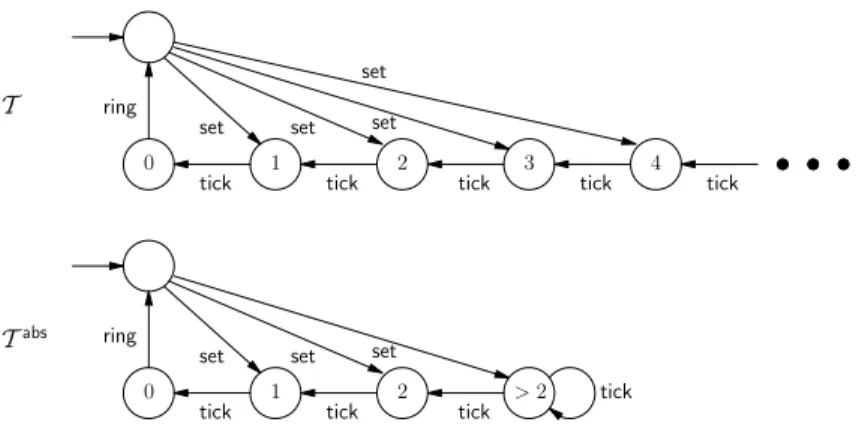
set set tick tick tick tick set set tick ring set tick tick tick set set ring tick 0 1 2 3 4 2 1 0 >2 Tabs T
Fig. 1.Transition system of an alarm clock and an abstraction.
We allow more propositional and temporal operators as abbreviations:tt:=
q∨ ¬qandff:=q∧ ¬qfor someq∈ P, as well asQLFϕ:=QL(ttUϕ),QLGϕ:=
QL(ffRϕ), andQ(ϕ◦ψ) :=QΣω(ϕ◦ψ) forQ∈ {E,A} and◦ ∈ {U,R}.
The semantics of CTLrelis given as follows. LetT = (S,−→, λ) be a transition system as above. In particular, all paths in it are infinite. For anys∈ S we have:
T, s|=q iff q∈λ(s)
T, s|=¬q iff q6∈λ(s)
T, s|=ϕ∨ψ iff T, s|=ϕorT, s|=ψ
T, s|=ϕ∧ψ iff T, s|=ϕandT, s|=ψ
T, s|=EXaϕ iff there ist∈ S s.t.s−→a tandT, t|=ϕ
T, s|=AXaϕ iff for allt∈ S : ifs−→a t thenT, t|=ϕ
T, s|=EL(ϕUψ) iff ∃π=s0, a0, s1, a1, . . .∈ΠT(s) s.t.a0a1a2. . .∈Land ∃i∈NwithT, si|=ψand∀j < i:T, sj|=ϕ T, s|=EL(ϕRψ) iff ∃π=s0, a0, s1, a1, . . .∈ΠT(s) s.t.a0a1a2. . .∈Land ∀i∈N:T, si|=ψ or∃j < is.t.T, sj|=ϕ T, s|=AL(ϕUψ) iff ∀π=s0, a0, s1, a1, . . .∈ΠT(s) : ifa0a1a2. . .∈Lthen ∃i∈NwithT, si|=ψand∀j < i:T, sj|=ϕ T, s|=AL(ϕRψ) iff ∀π=s0, a0, s1, a1, . . .∈ΠT(s) ifa0a1a2. . .∈Lthen ∀i∈N:T, si|=ψ or∃j < is.t.T, sj|=ϕ
3
Examples
As a first example, consider an alarm clockT which can be set to count down an arbitrary number of steps and then ring. Its transition system is depicted in
the top of Fig. 1. Clearly, an alarm clock should ring eventually once it is set to a certain time, therefore, the alarm clock should not have a state from which an infinitetick-path exists. This property is specifiable in action-based CTL as AG¬EGticktt.
Now consider an abstraction which identifies all counter values that are greater than 2. This introduces a tick-loop in the state representing all such values. The abstracted systemTabs is depicted at the bottom of Fig. 1.
It should be clear thatT |=AG¬EGticktt since every sequence oftick-actions must eventually lead to the state with counter value 0 and that has no outgoing
tick-action. On the other hand,Tabs6|=AG¬EG
tickttsince state “>2” is reachable and has an infinite tick-trace. Note that this trace is spurious. It is possible to mend this fault though by introducing fairness and excluding this spurious trace. Take, for instance the fairness predicate Φ:=GFtick⇒GFring, i.e. if infinitely many ticks are being done then also infinitely many rings are being done. Now it is the case that Tabs|=
fair AG¬EGtickttunder this fairness predicate, meaning that the CTL path quantifiers in this formula now only range over fair paths, i.e. those that satisfy the fairness predicateΦ. Note that the spurious trace does not, hence, the property holds under this assumption.
While this does work in this particular case, the introduction of a fairness predicate seems rather arbitrary as well as its choice. Furthermore, the chosen fairness predicate almost contradicts the correctness property at hand. Hence, this is almost like only considering that part of the abstracted system which does satisfy the correctness property and then showing that it does indeed. In other words, finding the right fairness predicate may be as hard as showing correctness of the original system.
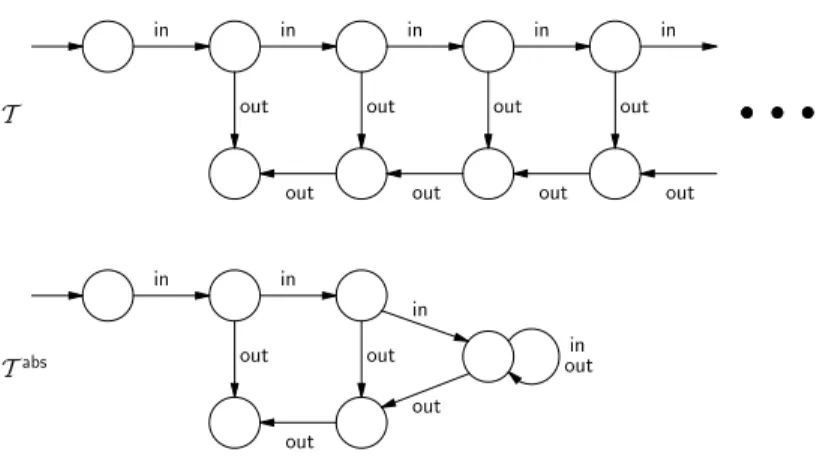
CTLrel offers a more fine-tuned and more systematic way of amending the correctness properties. We will consider another example in which the introduc-tion of fairness is not able to exclude spurious traces that easily. Consider a system containing a buffer into which items can be placed and from which items can be taken. It works such that once something is taken out, it can only be emp-tied and nothing more can be put into it. The transition system T is depicted on top in Fig. 2. An abstractionTabs which collapses all states containing more than 2 buffer items is depicted below that.
Now consider the correctness property stating that at no point is it possible to execute an out-action followed by an in-action. In action-based CTL it can be written as AG¬EXoutEXintt. Clearly, it is satisfied by the original system T and not satisfied by the abstractionTabs because of the spurious trace through the self-loop in the state representing all large buffer contents. The important observation about this is, though, that no fairness predicate can exclude all the spurious traces which cause the violation of the correctness property. This is simply because fairness is concerned with the infinite occurrence of states / actions, etc. or the absence thereof. The characteristics of the spurious traces in this case, however, is the single occurrence of anin-action after a singleout -action. It is therefore sensible to restrict the path quantification to traces of the
in in in in in
out out out out
out out out out
T in in out out out in out outin Tabs
Fig. 2.Transition system of a buffer system and an abstraction.
forminω∪in∗out∗dωwhere actiondindicates, as introduced above, a transition into an imaginary deadlock state.
The issue about the right choice of path relativisation still persists, though. As in the first example, the trace predicate inω∪in∗out∗dω is somehow found miraculously. However, CTLrel allows for a more automatic approach. Note that
T is indeed a visibly pushdown system with push-actionin and pop-actionout. The language of its traces is a visibly pushdown language (ωVPL), characterised by the property that no out-action occurs after in in-action and on any prefix, the number of out-actions is at most as high as the number of in-actions. Let
L be that language. Using CTLrel it is then possible to replace the correctness property above by AG¬EL∩Σ∗out inΣωFtt for instance and test that on the
ab-stracted system. Note how this restricts path quantification to traces which are present in the original system only. This is of course the essence of excluding spurious traces.
4
Results on CTL
relWe are particularly interested in the complexity of the model checking and satisfi-ability checking problem for CTLrelrelative to the class of formal languages used for the quantifier restrictions. Upper bounds can easily be obtained by relating it to∆PDL?—Propositional Dynamic Logic with Tests and the Delta operator — over the corresponding class. We therefore first analyse the relationship between CTLrel and well-known logics like that one.
4.1 Expressivity
CTLrelis situated between two cornerstones: CTL [7] and∆PDL?[11] i. e. recur-sive PDL together with delta operators. The former is well-known. The latter
is modal logic over a Kleene algebra of accessibility relations with tests. The delta operator then takes a specification formalisms for infinite words and turns it into an existential quantification over paths labeled with a word in this lan-guage. This is of course very similar to the mechanism used in purely existential formulas in CTLrel. For a comparison to CTL we simply interpret the usual CTL models as CTLrel models with a single edge label only.
Theorem 1. CTL ≤lin CTLrel[A] for Σω ∈ A, and CTL lin CTLrel[A] for
A)ωREG.
Proof. The embedding of CTL is trivial usingΣωas a quantifier restriction, and writingEXψasEXaψfor the unique actionathe occurs in the underlying models.
For the strictness, considerϕ:=ELGttfor a languageL6∈REG. If this formula had an equivalent CTL-formula then there would be also a B¨uchi tree automaton which recognizes exactly the models ofϕin a certain representation [18]. Hence, there would also be a B¨uchi word automaton which accepts precisely the words
in Lwhich contradictsL6∈ωREG. ut
We remark that CTLrel does not seem to be an extension of action-based CTL. For instance, the formula EFaqin action-based CTL expresses that there is a path of the forma∗Σω such thatqholds in thefirst state after thea∗ prefix.
Clearly, CTLreldoes not provide a mechanism which can transform information between moments on a path and the inner structure of words in the language restricting those paths.
Theorem 2. CTLrel[A]
lin∆PDL?[A].
Proof. The embedding is proved by induction on the structure of formulas in CTLrel[A]. We detail only the case of θ := E
AϕUψ for an automaton A with
statesQ, initial state q0, and final statesF. Letϕ0 and ψ0 be the translations ofϕandψ, respectively. The translation ofθ ishBitt whereBis an automaton of the same kind asAwith states containingQ× {0,1}, initial state (q0,0) and final states F× {1}. Let p acta //q denote a transition in A leading from state
pby reading a∈Σ to stateq while performing operation acton the stack—if applicable. ThenBcontains the following three transitions.
(q,0) ?ϕ 0 nop // a act //(q 0,0) (q,0) ?ψ0 nop // a act //(q 0,1) (q,1) a act //(q 0,1)
For the strictness, we consider the property “there is a path on whichp holds infinitely often”. Obviously, this property is expressible by a delta operator in
∆PDL?[ωREG]. For the sake of contradiction, assume that there is CTLrel[A ]-formulaϕexpressing this property. Hence,ϕalso characterizes this property over transition systems over a singleton alphabetΣ. For such systems the quantifiers are relativized either to ∅ or to Σω . Hence, ϕ can be understood as a CTL-formula. But fairness is not expressible as a CTL-formula [8]. ut
4.2 Model Checking
Theorem 3 (Upper and lower bounds). The model checking problem for
CTLrel[A] over a finite transition system is
– inPTIME ifAisω-context-free, and – hard forPTIME ifΣω∈A.
Proof. Given a formula ϕ∈ CTLrel[A] and a transition systemT = (S,−→, λ), we compute inductively the set of states in T which satisfy a subformula of ϕ. Thereto, we extendλwith those formulas. The cases are similar to that of pure CTL. We detail the case of a formulaEL(ϕUψ) forL∈A. For presentation assume thatLis given as a B¨uchi automatonA= (Q, q0, δ, F) whereQis the set of states,
q0∈Q, the transition relationδ∈Q×Σ×Q, andF ⊆Qare the final states. We construct for every states∈ San automatonB:= (Q×S×{0,1},(q0, s,0), δ0, F0) recognizing witnessing paths forEL(ϕUψ) starting ats. The last component of the state is 1 iff the eventuality is satisfied. So,δ0 consists of
((q, s,0), a,(q0, s0,0)) ifϕ∈λ(s)
((q, s, i), a,(q0, s0,1)) ifψ∈λ(s) ori= 1
where each line requiresq0 ∈δ(q, a) ands a
−→s0 for somea∈Σ. Finally, F0 :=
F× S × {1}. A similiar construction is available for PDAs. The emptiness check for this ω-PDA can be done in PTIME [3]. Finally, CTL is hard for PTIME.
Hence, so is CTLrel[A]. ut
4.3 Satisfiability
Theorem 4. The satisfiability problem forCTLrel[ωCFL] is undecidable.
Proof. Remember that the universality problem (is L = Σ∗?) for context-free
languages (of finite words) is undecidable. Now let L∈ CFL over someΣ and consider the formulaϕL:=EΣ∗dωF¬q ∧ ALdωGq.
Remember the assumption about paths in CTLrel models being of the form
Σω∪Σ∗dω. The first conjunct then says that one of them is of the formΣ∗dω and satisfies ¬qat some point. The second conjunct says that all paths inLdω satisfyq everywhere. Hence, ifL=Σ∗ thenϕ
L is clearly unsatisfiable. On the other hand, if there is aw∈Σ∗\Lthenϕ
L is for example satisfied in the model which has a single pathwdωsuch that¬q holds somewhere on this path. ut Therefore, we consider smaller classes of languages. Those with particular nice algorithmic and algebraic properties areωREG andωVPL for instance.
Theorem 5. The satisfiability problem forCTLrel[ωREG]isEXPTIME-complete,
Proof. The membership follows from Thm. 2 using that ∆PDL?[ωREG] is in EXPTIME [9] and that ∆PDL?[ωVPL] is in 2-EXPTIME [12]. Moreover, the logic CTLrel[ωREG] is EXPTIME-hard as CTL is [10] so. For the hardness of CTLrel[ωVPL] one can extend the proof [12] of L¨oding et al. that PDL plus a certain visibly pushdown language is 2-EXPTIME hard. Besides a standard embedding, one ∆PDL?[ωVPL]-expression needs to be rephrased as it uses an alternating between test operators and labels which is not directly expressible in CTLrel[ωVPL]. An another modification takes account of total transition system.
u t
5
CTL with Path Relativisation in Abstraction
For the subsequent discussion, we fix a transition systemT = (S,−→, λ) and an abstraction function α:S → S. Since the transition relation of the abstraction
Tαis defined by existential quantification, a simple induction yields the following statement.
Proposition 6. Fors∈ S we have
– Ifϕis purely existential then T, s|=ϕ impliesTα,[s] α|=ϕ.
– Ifϕis purely universal then Tα,[s]
α|=ϕimpliesT, s|=ϕ.
Hence, it suffices to verify universally quantified formulas on the abstract system, and a positive answer carries over to the concrete system. In general, complete-ness, i.e. the converse direction, does not hold since the abstraction might admit spurious traces. A negative model checking result on the abstract system there-fore need not reflect an error in the concrete system but it could. In order not to stall the design cycle of a system in the verification phase by having negative model checking results too often, one would like to “get as close to completeness as possible”. This clearly requires purely existential formulas to be strengthened and purely universal formulas to be weakened. We therefore propose a general mechanism which uses the path quantifier relativisation in CTLrel and realises this strengthening and weaking at the same time. Hence, it is applicable to arbitrary formulas, not just those that are purely existential or universal.
Definition 7. Let L⊆Σω be a language. The restrictionof a CTLrel-formula
ϕw.r.t. Lis defined as the homomorphic extension over ¡ QL0(ψ1◦ψ2) ¢ ¹L:=QL0∩L ¡ (ψ1¹L)◦(ψ2¹L) ¢ whereQ∈ {E,A},◦ ∈ {U,R}.
Note thatωREG andωVPL are closed under intersections, hence, CTLrel[ωREG] and CTLrel[ωVPL] are closed under restrictions with languages of these respec-tive classes.
A nice property to have would be the following. For all transition systems
T, for all abstraction functionsαforT there exists a languageL6=∅such that for all purely existential formulasϕwe have:Tα,[s]
α|=ϕ¹LimpliesT, s|=ϕ. This is not possible however. Assume it was true. Then, it would also apply to
transition systems over a singleton alphabetΣ. But thenL=Σωand therefore
ϕ¹L≡ϕ. Hence, this property would imply the missing converse directions in Prop. 6 which are easy to refute by counterexample.
In the following we therefore present two heuristics which aim at exluding spurious traces through quantifier relativisation. The first one is rather simple and mainly meant to explain the problems involved in this approach. The second one is more sophisticated and aims at closing down on completeness by making certain requirements on the abstraction.
5.1 A Suffix Heuristic
Suppose T is a transition system with some initial state s, and Tα is its ab-straction w.r.t. some α. Take the CTL formula ϕ =AGEFq expressing liveness with respect to some proposition q. A natural candidate for the restriction of the path quantifiers in ϕ would be L := ΠT(s), i.e. the language of all paths
in L. Note that not even then does the result of Tα,[s]
α |= ϕ ¹ L transfer in any way to T, s |= ϕ. The reason for this is the fact that ΠT(s) describes all
pathsstarting in s. However, note that the AG-operator intuitively requires the subformulaEFqto be interpreted inarbitrary states ofT, not justs. Hence,EFq
should be restricted to paths which start in those states that the formula itself is interpreted in. This would require the subformula to “know” which state it is interpreted in. In other words, the existential quantifier should be restricted to certain suffixes of words inΠT(s).
This could even mean thatELFqis interpreted in the starting state of a path which eventually satisfiesqbut the restriction toLis too rigid and excludes this path. Hence, while one aims at excluding as many spurious traces as possible, one would also exclude good traces. This calls for an overapproximation in order to fix this problem.
Definition 8. Let L⊆Σω. The suffix-closure ofL is
Suff(L) := {w∈Σω| ∃v∈Σ∗ s.t.vw∈L}.
The heuristics presented here proposes to reduce the verification task of
T, s |= ϕ on the concrete side to Tα,[s]
α |= ϕ ¹ Suff(ΠT) on the abstract
side. Note that the existential quantifier in the definition of Suff(L) realises an overapproximation in the sense that – coming back to the example above – the subformulaEFqwould of course still be interpreted in an arbitrary but reachable statetof the system, but the quantifier relativisation would restrict the existen-tial path quantifier to suffixes of paths froms. Since some of these pass through
t, we have ΠT(t)⊆ Suff(ΠT(s)), and the restricted formula does not exclude
good traces. It remains to see how well this does at excluding spurious traces. Clearly, this heuristic would be worthless if the considered classes of formal languages were not closed under suffixes. However, this is not the case.
Proposition 9. For all C ∈ {ωREG, ωVPL, ωCFL} and for all L∈ C we have Suff(L)∈ C.
5.2 A Local Heuristic
Note that the approach suggested in the previous section is global in a sense. Here we propose a local approach which focus on the abstract states, their connections, and the spurious traces that are created within those states
Definition 10. For a concrete states inT we define its abstraction language
as a subset ofΣ∗∪Σω by
Ls := {a0. . . an | there is an initial paths0a0. . . an−1sn inT s. th.
si∈[s] for all0≤i < nandsn∈/[s]}
∪ {a0a1. . .| there is a path s0a0s1a1. . . inT s. th.
si∈[s]for alli∈N}
The abstract languageof the abstractionTαisL α:=
¡S
s∈SLs
¢ω
.
In other words, the abstract language of a state describes all traces within its class. In particular, fragments of spurious traces are excluded. The languageLα is an over-approximation of the transition system. Indeed, it also admits words in LsLtLα when [s] and [t] are not connected. But, therefore,Lα might have a more condensed description thanT itself.
Prop. 6 can be strengthened by a restriction which is compatible with the induced equivalence classes.
Lemma 11 (Soundness). For any purely existential formula ϕ we have that
T, s|=ϕimplies Tα,[s]
α|=ϕ¹L, for anyL⊇LsLα ands∈ S.
Proof. Induction on ϕ. We sketch the case ϕ = EL0(ψ0Uψ1) only. Consider a witnessing path π := s0, a0, s1, a1, . . .. Then πα := [s0]α, a0,[s1]α, a1, . . . is a path inTα. By induction hypothesis we haveTα,[s]
α|=EL0((ψ0¹L)U(ψ1¹L)). A subsequence ofπα might loop in just one equivalence class. This observation gives rise to a factorization along whichπα∈L
sLαcan be shown. ut For the converse implication we synchronize traces in the abstract system with those in the concrete one.
Definition 12. The abstractionTαissyntactically traceableiff[s]−→a
α[s0]and [s]−→a α[s1] implys0=s1 for alls, s0, s1∈ S anda∈Σ with[s0]6= [s]6= [s1].
Syntactical traceablity is a rather strong and artificial property as it requires that a label determines the targeted state. None of our introductive examples enjoy this property. However in our examples, not the label but the course of the considered trace uniquely specifies the next equivalence class. This observation motivates the following definition.
Definition 13. The abstractionTα is semantically traceableiff for all pathsπˆ
in Tα and for all states s
0, s1 ∈ S it holds thatπ∈L(Ls0Lα∩Ls1Lα)implies
s0=s1 whereL=Σ∗∩(
S
In the alarm clock example, assume that the sequence set tick leads to the class “> 2”. Then the label tick either keeps the trace in this class or brings it to the class “1”. Hence, the abstracted system is not syntactically traceable. However, it is semantically traceable as the number ofticks before the clock rings determines the next state.
Proposition 14. If Tα is syntactically traceable then it is also semantically
traceable.
Theorem 15 (Conditional Completeness). LetT be semantically traceable.
Suppose that for the formulas ψ0,ψˆ0,ψ1 andψˆ1
Tα,[s]α|= ˆψi implies T, s|=ψi (1)
holds fors∈ S andi∈ {0,1}. Then for◦ ∈ {U,R},s∈ S andL0 ⊆Σω we have
Tα,[s]
α|=EL∩L0( ˆψ0◦ψˆ1) implies T, s|=EL(ψ0◦ψ1) (2)
whereL0:=L
sLα.
Proof. Let ˆπ:= ˆs0a0ˆs1a1. . .be a path witnessing the premise of the equation (2). It remains to show that there exists a pathπ—and not just a sequence of states— inT which follows ˆπ. Given that, the property (1) completes the proof. The path ˆ
π can be factorized usingL0 such that the (finite or infinite) word determined
by a factor is inLtfort ∈ S. The first factor is in Ls. Along this factorization we constructπas follows. Assume a factor and a path ending at a concrete state such that its abstraction is the first state in the considered factor. For the first factor this path consists of the statesonly. Now, the word of the factor is inLt for somet∈ S. Therefore, the definition of this language admits two possibilities. Either, there is an infinite path in [t]α, then we are done. Or there is a finite pathπ0 in [t]
α and a label a∈Σ leading π0 to a state outside of [t]α. Then we extendπbyπ0 and the said label. By the definition of “semantically traceable”,
the following node is uniquely determined. ut
Although the restriction on the formulas seems to be rather artificial it avoids the suffix problem. However, the consistency condition for abstraction functions ensures that any formula withoutEandAmeets the property (1). Together with Lem. 11, we have completeness of our method with respect to a certain class of formulas.
Corollary 16 (Conditional Faithfulness). Let T be semantically traceable
and letϕbe a formula withoutEX,AX, and nested quantifiers. We have Tα,[s]
α|=ϕ¹L0 iff T, s|=ϕ (3)
forL0 :=L
The languageL0 used by the previous theorem and corollary is subsumed by
Lα. Hence, modelcheckingϕ¹Lα on the abstract system is almost as good as checkingϕ¹L0.
Note that Cor. 16 is only formulated for formulas without the next-time operators. The fragment for which Cor. 16 states completeness and thus full elimination of spurious traces is therefore in some sense the stutter-invariant part of CTLrel only.
6
Conclusion and Further Work
We have presented a framework for the transformation of correctness properties which should go hand in hand with the transformation of a concrete system into an abstract one. The goal of this transformation is to minimise the significance of spurious traces in the abstract model. We have then suggested two heuristics for certain transformations within this framework.
The work contained herein is obviously not completed. It remains to be seen how these heuristics perform in practice, i.e. how often they can confirm absence of errors in a concrete system (w.r.t. purely universal properties for instance) by confirming that the abstract system is error-free. A dealbreaker may also be the computation of the involved languages which are being factorised into the property. It remains to be seen whether efficient algorithms for these computation problems exist.
On the theoretical side, it is of course possible to consider extensions of CTLrel. It is not too difficult to see that one could introduce test predicates into the formal languages without losing any of the complexity results. Another obvious extension would be CTL∗
rel, i.e. CTL∗ with path relativisation in the same style. This would have a significantly higher complexity in both model checking and satisfiability checking though.
References
1. R. Alur and P. Madhusudan. Visibly pushdown languages. In Proc. 36th Ann. ACM Symp. on Theory of Computing, STOC’04, pages 202–211, 2004.
2. D. Bosnacki, N. Ioustinova, and N. Sidorova. Using fairness to make abstractions work. InProc. 11th Int. Workshop on Model Checking Software, SPIN’04, volume 2989 ofLNCS, pages 198–215. Springer, 2004.
3. A. Bouajjani, J. Esparza, and O. Maler. Reachability analysis of pushdown au-tomata: Application to model-checking. In Proc. 8th Int. Conf. on Concurrency Theory, CONCUR’97, volume 1243 ofLNCS, pages 135–150. Springer, 1997. 4. J. R. B¨uchi. On a decision method in restricted second order arithmetic. InProc.
Congress on Logic, Method, and Philosophy of Science, pages 1–12, Stanford, CA, USA, 1962. Stanford University Press.
5. E. M. Clarke and E. A. Emerson. Synthesis of synchronization skeletons for branch-ing time temporal logic. In Logics of Programs: Workshop, volume 131 ofLNCS, pages 52–71, Yorktown Heights, New York, 1981. Springer.
6. E. M. Clarke, O. Grumberg, S. Jha, Y. Lu, and H. Veith. Counterexample-guided abstraction refinement for symbolic model checking. Journal of the ACM, 50(5):752–794, 2003.
7. E. A. Emerson and J. Y. Halpern. Decision procedures and expressiveness in the temporal logic of branching time. Journal of Computer and System Sciences, 30:1–24, 1985.
8. E. Allen Emerson and Joseph Y. Halpern. “sometimes” and “not never” revisited: on branching versus linear time temporal logic. J. ACM, 33(1):151–178, 1986. 9. E.A. Emerson and C.S. Jutla. The complexity of tree automata and logics of
programs. In Foundations of Computer Science, Annual IEEE Symposium on, pages 328–337, 1988.
10. M. J. Fischer and R. E. Ladner. Propositional dynamic logic of regular programs.
Journal of Computer and System Sciences, 18(2):194–211, 1979.
11. C. L¨oding, C. Lutz, and O. Serre. Propositional dynamic logic with recursive programs. J. Log. Algebr. Program., 73(1-2):51–69, 2007.
12. C. L¨oding and O. Serre. Propositional dynamic logic with recursive programs. In
Proc. 9th Int. Conf. on Foundations of Software Science and Computation Struc-tures, FOSSACS’06, volume 3921 ofLNCS, pages 292–306. Springer, 2006. 13. R. De Nicola and F. Vaandrager. Action versus state based logics for transition
systems. InProc. Int. Spring School on Theoretical Computer Science: Semantics of Systems of Concurrent Processes, volume 469 ofLNCS, pages 407–419. Springer, 1990.
14. A. Pnueli. The temporal logic of programs. InProc. 18th Symp. on Foundations of Computer Science, FOCS’77, pages 46–57, Providence, RI, USA, 1977. IEEE. 15. A. P. Sistla and E. M. Clarke. The complexity of propositional linear temporal
logics. Journal of the Association for Computing Machinery, 32(3):733–749, 1985. 16. Ludwig Staiger. Handbook of formal languages, vol. 3: beyond words, chapter ω-languages, pages 339–387. Springer-Verlag New York, Inc., New York, NY, USA, 1997.
17. R. S. Streett. Propositional dynamic logic of looping and converse is elementarily decidable. Information and Control, 54(1/2):121–141, 1982.
18. M. Y. Vardi and P. Wolper. Automata-theoretic techniques for modal logics of programs. J. Comput. Syst. Sci., 32(2):183–221, 1986.
19. I. Walukiewicz. Pushdown processes: Games and model-checking.Information and Computation, 164(2):234–263, 2001.