TIPS Small Grant Scheme Research Paper Series 2011
The Impact of ISO 9000 Certification on Sales:
A Case Study of Mauritius
Moolna Kawthar & Sannassee Raja Vinesh
November 2011
Abstract
ISO 9000 is a set of international standards that provide management requirements for creating and maintaining company quality systems. However, existing literature is divided over whether ISO 9000 is good or bad for companies. Several papers have analysed the effects of ISO 9000 certification and have reported different findings. Using an empirical approach, this research seeks to ascertain whether the mean sales of ISO certified companies is significantly greater than those of their non-certified counterparts and assesses the impact of ISO 9000 certification on sales of companies in Mauritius. The methodologies employed are an independent T-test and static and dynamic panel regression analysis. Based on a sample of 39 ISO certified companies and 39 non-ISO certified ones in 2000-2009, the findings report a significant difference between the mean sales of the two groups (in favour of the certified companies) and a positive and significant relationship between ISO 9000 certification and sales. Also, the dynamic panel analysis confirms this positive relationship. Thus, it can be said that ISO certified companies in Mauritius, experience the benefits of certification through increased sales which also implies increased customer loyalty and confidence and a larger customer base. This paper will help the non-ISO certified firms to consider investing in a suitable quality management system, possibly leading to ISO 9000 certification.
2
1.0 INTRODUCTION
In this era of globalization, there is increasing pressure on firms – by consumers and competitors alike – to continually innovate in new products and to upgrade the quality of existing goods and services. There is a need for greater investment in infrastructure, process standardization for business success and to reduce technical barriers to trade. In this respect, the International Organization of Standardization (ISO) seeks to promote standardization and facilitate the international exchange of goods and services, and cooperation in fields such as intellectual, scientific, technological and economic activities. Quality management theory has been influenced by the contributions by quality leaders (Crosby, 1979; Deming, 1982; Juran 1986, 1988). Quality management allows companies to obtain a degree of differentiation and to reduce costs. The ISO 9000 standards series is a set of quality system standards that prescribes good quality practices, without directing how a company should achieve them. Today, many countries have either adopted ISO 9000 or used it as the basis of their national quality certification systems. In Mauritius also, this standard has gained momentum.
The willingness to implement ISO 9000 certification may be related to expectations about improved quality and to those factors perceived as important to competitive success and competitive advantage (Escanciano et al., 2001; Withers and Ebrahimpour, 2000). Organisations are striving to achieve customer satisfaction through an emphasis on quality products and services. This is because competitiveness is dependent on providing superior quality products and services to customers. As a result, organisations have pursued a number of quality initiatives, such as Total Quality Management (TQM), Just-In-Time (JIT), the Shing Prize, the Deming Prize and ISO 9000. Nevertheless, the most popular quality philosophies are ISO 9000 and TQM.
The ISO 9000 series outline the requirements to be met by a producer illustrating his competence to design, produce and deliver products or services with a consistent and coherent level of quality. There are various definitions of “quality”. ISO 8402 defines quality as “the totality of features and characteristics of a product or service that bears on its ability to meet a stated or implied need”. Crosby defines quality as “conformance to requirement”. Juran (1988) define quality as “fitness for use”. Japanese companies find that the old definition, “the degree of conformance to a standard”, is too narrow and have come up a new definition in terms of “user satisfaction”.
ISO 9000 certification has been applied around the world and in all sectors of industry. Nowadays for a company, receiving ISO 9000 certification is not only a fashion or trend, but also a general requirement for running a good business (Yann, 1998). According to ISO (1998), “The ISO 9000 international standards are a set of written guidelines that make up a non-specific quality management system that can be applied to any organization regardless of the product or service being provided”. ISO has developed more than 18,000 International Standards and some 1,100 new ISO standards are published every year. “The ISO Survey of Certifications 2009” reveals that there are more than 1,200,000 ISO 9001 certificates in the world in more than 176 countries. Approximately 50% of businesses are certified, or in process to upgrade to the new ISO 9001:2008 standard. The top 10 countries for ISO 9001 certificates as at 2009 are China, Italy, Japan, Spain, Russian Federation, Germany, U.K., India, U.S.A and Korea.
3
A number of researches have analysed the association between ISO 9000 and performance. Recent literature describes and evaluates ISO 9000 as a potential source of competitive advantage. However, the results obtained are mixed. Also, case studies do not prove that ISO 9000 will lead to improved performance, only that it is possible. On the other side, descriptive statistics cannot demonstrate causal links and so provide weak evidence. And, most of these studies were based on self-rated performance measures, which is not an objective way of assessing the impact of ISO 9000 on performance. Because of these concerns, statistical data analysis is used in this research to analyse the association between ISO 9000 and sales.
Previous studies have reported a number of benefits which ensue from the implementation of ISO 9000 certification like, for instance, internal efficiency, less faulty products, access to international markets, cost savings and an increase in sales. However, although ISO 9000 is widely disseminated, certification is not an easy process for firms. Implementation can be time consuming and costly; collecting the documentation and completing the application very often takes more than one year, and the required third-party audit may take several days to complete. Companies incur costs for training and because of the substantial investment required, implementing ISO 9000 for many firms is not a decision to be taken lightly.
2.0 LITERATURE REVIEW 2.1 Introduction
Studies have been conducted both worldwide and in Mauritius to investigate how ISO 9000 certification pays off. Some of them concluded that it leads to improved internal processes, which boost up productivity and lower costs. Others found that as customers increasingly require quality products, ISO 9000 would help maintain or increase a firm’s market share. However, others claim that certification does not lead to any improvements.
Each of the aforementioned study type considers different aspects of success. For instance, some have looked at financial impacts while others have looked at the non-financial impacts. Also, their methodologies have differed. While most of the studies have used questionnaires or interviews, very few have used econometric modeling. The former methods, however, are not the best ones to use. This is because they involve self-reporting bias. For example, it can be found that many managers who are interviewed will be reluctant to disclose that ISO 9000 implementation has not had any positive impact on the company. As such, the latter method i.e. econometric modeling, is deemed to be more accurate and objective. This research gives a more objective view of the impact of ISO 9000 certification on sales.
However, before coming to the methodology part, there is a need to review the existing literature on the impact of ISO 9000 certification on performance so as to be able to address any shortcomings with existing studies. It can be found that in spite of growing interest on the topic analysed in this paper, the literature reveals that total quality remains an ambiguous concept; although it is the most important concept, it is the least understood subject for managers (Seddon, 1998). As such, managers consider quality management as one of the most critical and challenging issues confronting them.
4
A wide range of disciplines in management, business and economics have provided explanations concerning the reasons driving an enterprise to adopt the ISO 9000. Indeed, the impact of ISO 9000 on a business also depends upon what motivates the firm to seek certification. For instance, Jones et al. (1997) talked about ‘developmental’, ‘non-developmental’ and ‘mixed’ motives. They studied Australian companies and those which fell in the “developmental” category were motivated by the internal benefits, like improvement of the “company’s internal processes” or “business performances”. On the other hand, companies belonging to the “non-developmental” category were pushed towards certification by market forces. The “mixed” category regrouped companies having both internal (e.g. developmental reasons) and external reasons (e.g. non-developmental reasons). Out of the 272 responses, only one in every seven company had developmental reasons.
Some authors believe that internal motives are more important than external ones. A survey by Gotzamani and Tsiotras (2002) found that Greek companies seek ISO 9000 certification mainly to improve internal operations. Arauz and Suzuki (2004), in a study in Japan, revealed that internal motivation was the significant factor in terms of cost and quality. On the other hand, Raynor and Porter (1991) have found that the key reason for certification in the U.K. was the perception of the customer. In a study in U.K., Blackham (1992) and Tennant (1993) found that tender eligibility, customer satisfaction and marketing advantages were more important than the internal forces.
Nowadays, however, the first reason for the adoption of the ISO 9000 certification may lie in a reactive approach to doing business, lacking any strategic consideration and planning, usually on request by customers (Leung et al., 1999). Evidence from Hong Kong shows that this is especially true for SMEs in the service and construction sectors (Lee, 1998). Marketing provides the second major explanation for the adoption of ISO 9000 quality schemes and Juran (1995) has posited that the major reason for seeking certification is maintenance or expansion of markets. Sonny Nwankwo (2000) found that one of the factors which motivate a company to adopt ISO 9000 certification was its image. Already professional and proactive organisational strategists are most likely to be the ones who would want to implement quality schemes. Thus image-motivated reasons become the driving force to seek certification. However, this type of motivation may undermine a long term internal value system.
Although companies seek ISO 9000 certification for external reasons, this leads to internal improvement (Casadesu´s et al., 2000). This is because external motivations stimulate quality awareness among employees. It is claimed that when companies become certified based on internal reasons, they derive benefits on a more global dimension. Firms with internal motivations encounter fewer difficulties in implementing ISO 9000. On the other hand, when companies implement ISO 9000 for external motivations, improvements obtained are mainly of an external nature. Gotzamani and Tsiotras (2002) stated that companies seeking ISO 9000 certification mainly based on external motivations will achieve mostly external benefits, while those that seek certification based on true quality improvement will get benefits mainly in terms of internal operations improvement.
5
Zaramdini (2006), selected 19 common reasons that could motivate United Arab Emirates (UAE) companies in seeking ISO 9001:2000 certification. The internal motives could be either associated with operational performances or with managerial performances, whereas the external motives relate to those elements outside an organization that may affect all or part of it (like customers, competitors, government and suppliers). The 19 reasons were Top management decision; Improving product and/or service quality; Improving processes and procedures; Improving productivity and/or efficiency; Reducing incidents, rejections and complaints; A step towards total quality management; Use it as a basis for internal costs reduction; Improving communication within the organization; Improving relationships between employees and management; Use it as a promotional and/or marketing tool; Maintaining and/or increasing market share; Demand and/or pressure from customers; Competitive advantage; Requisite to compete in the sector; Our competitors are ISO 9001 certified; Direct entry to new market; Be role model to suppliers; Improving the organization’s public image; and Requested by the government.
ISO 9000 is the most widely-sought quality assurance scheme in the UK. It is a “first level” formal system for the improvement of quality control. Juran (1995) has posited that the major reason for seeking certification is maintenance or expansion of markets. Evidence shows that anticipated marketing advantage, specifically increasing market share and access to new markets, have been critical factors that encourage the pursuit of the ISO 9000 certificate (Buttle, 1997).
2.2 Impact of ISO 9000 certification on certified firms
Quality gurus such as Crosby (1979), Deming (1986) and Juran (1982) have promoted quality concepts around the world and thus many firms have gradually embraced quality management practices. The implementation of ISO 9000 may have a positive or negative impact on registered firms. These can be in terms of the benefits and drawbacks conferred by certification. Also the nature of the benefits can be classified in terms of internal, external and financial benefits (Casadesus and Gimenez, 2001). External benefits are those which are reflected in the market, like for instance, an increase in market share, access to new markets, being able to export to some markets which were previously closed due to the existence of technical barriers to trade and most important of all, customer satisfaction. These were discussed by Tari (2003). On the other hand, the internal benefits can be productivity, competitive advantage improvement, reduction in cost and personnel motivation: different authors have found different benefits. According to Lloyd’s Register Quality Assurance Ltd (1994), certification eliminates redundancy or reduces unnecessary work. The implementation of ISO 9000 reduces faulty goods, and improves the performance of workers. It also enables easy accessible, traceable and auditable work procedure.
Some studies investigated the state of ISO 9001: 2000 certification in the Arab world. A total of 32 Saudi manufacturing firms were surveyed by Mezher and Ramadan (1999). They analyzed the costs and benefits linked with the certification process. The main benefits perceived by Saudi firms were associated with the improvement of customer service and firm’s efficiency. Tsiotras and Gotzamani (1996) found that certification led to better documentation procedures and clearer working instructions. Buttle (1997) found that “improving efficiency”, “improving awareness of
6
procedural problems” and “better management control” were the top three benefits perceived by the firms studied, followed by “using standard as a promotional tool” and “increasing customer satisfaction”.
Despite the benefits reported, there are numerous barriers including high cost of implementation, lack of full commitment of top management, lack of human and financial resources, employee resistance, no perceived advantage in certification of the service industry, and that suitable training and education of employees could not be ensured (Quazi and Padibjo, 1998). Thus, benefits need to be weighed against the cost of designing, implementing and maintaining the system (Nwankwo, 2005).
2.2.1 Impact of ISO 9000 certification on non-financial performance
There is a variety of literature on the impact of ISO 9000 certification on non-financial performance indicators. A survey of 300 ISO companies was carried out for the Malaysian Manufacturing companies to study the motives for ISO 9000 certification (Abdalsalam Mohamed A. Gader, 2004). The study revealed that companies adopt ISO certification due to external pressure by customers and thus gain fewer benefits. Therefore, the companies were not too committed to follow the guidelines of ISO certification. It should be noted that the motive for seeking certification is an important predictor of performance.
A study by Ahire and Gohlar (1996) found that the introduction of TQM in SMEs had helped to increase SMEs’ market focus, to become more efficient, to exploit their human resources better, and to improve their competitiveness. In the same line, Shea and Gobeli (1995) found two major benefits of TQM to SMEs: improved customer satisfaction and a high level of employee satisfaction. Boon and Monder (1998) also stated that quality is applicable to all firms irrespective of size and context.
Empirical research posits that better quality has a positive relationship with business performance. This also applies for the service sector; Capon et al. (1990) identifies 20 service studies that find a positive relationship between quality and business performance. Rust et al. (1994) found that a link exists between quality and financial returns. Caruana and Pitt's (1997) study of 131 UK service firms suggests that better quality does have a positive effect on the overall performance of the firm, relative to its competitors.
A telephone interview by the Management System Standards (2001) on 1005 Canadian certified firms, revealed that 99.5% of the certified firms intend to maintain their certification because of the internal benefits gained such as greatly qualify awareness, self discipline, improved management practice and better quality products or services and externally improved relationships with customers and advantages over competition.
Ragothaman and Korte (1999) found that smaller firms which are ISO certified experienced cost reduction and export potential increase better than did large firms. A study by the Australian Manufacturing Council (1994) found that certified companies, particularly those exporting, reported that customer perception of product quality increases following certification. Furthermore, this perception is important in attracting new customers, retaining customer confidence, and penetrating international markets. The study concluded that certification is
7
expected to lead to both actual and perceived quality improvements, as well as to overall improvements in organizational performance.
Particular studies while reporting very interesting results have certain limitations. For instance, Heras, Casadesus and Ochoa (2001) analysed the consequences of compliance with ISO 9000 standards on the companies’ economic performance by means of an empirical survey conducted from 1994 to 1999 of 400 certified and 400 non-certified Spanish companies in Catalonia and the Basque Country. It was found that certified companies outperformed the non-certified companies in terms of economic profitability. However, the problem is that it does not prove any cause-effect relationship between ISO 9000 certification and better economic performance.
A survey was conducted in Taiwan by Jang and Lin (2007) and its purpose was, amongst others, to examine whether businesses can benefit from ISO 9000. The results show a positive relationship between ISO 9000 implementation and firm performance. ISO 9000 has a direct and positive effect on operational performance and an indirect effect on market performance. This, in turn, has a positive impact on business performance. A limitation of this paper, however, is that it uses perceptual measures of the degree of operational, market and business performance rather than objective measures. Calisir (2007) investigated the factors affecting service companies' satisfaction with ISO 9000. A survey methodology was again used and the results suggest that service companies should lay greater emphasis on educating and receiving support from top management. Personnel must be trained particularly in communication and quality skills. However, this paper concentrates on service companies and ignores other industries. Caro and García (2009) studied whether ISO 9000 certification affects consumer perceptions of the business. They used a survey methodology to gather data on 204 Spanish consumers of insurance services. They investigated whether differences exist in consumer perceptions of the services provided by certified firms and non-certified ones in terms of satisfaction, quality and corporate image. The paper finds that certification improves consumers' perceptions with regard to all three variables.
There remain studies which did not report favourable results. Batchelor's (1992) study of over 600 registered UK firms, found that only 15 per cent of firms achieved gains from quality certification. These benefits were largely internal (such as reductions in error rates and procedural efficiency), rather than external dimensions (such as market share). This is in line with the study of Terziovski et al. (1997) of 1,000 firms in Australia and New Zealand that found that Quality Certification had no significant, positive relationship with business performance. Similarly, Hua et al. (2000) found from a survey of 100 companies in Shanghai that there were no significant differences in quality-related performance measures between companies with ISO 9000 certification and those without.
2.2.2 Impact of ISO 9000 certification on financial performance
There is, to date, insufficient evidence on whether ISO 9000 certification has really led to improved financial performance. This remains a debatable issue since there are limited researches that address the performance of companies after certification. The association between ISO 9000 certification and financial performance is mainly concerned with impact on sales and profitability. Most companies have witnessed an increase in the overall sales after
8
certification (Kantner, 1997). Supporting this, Haversjo (2000) reported that ISO 9000 certified companies have better rates of return than non-certified ones, largely due to increased sales. Chua, Goh and Wan (2002) examined the issue of ISO 9000 certification and its benefits for Singapore based companies. Using a survey of 146 firms, they seek to ascertain if certification has improved the performance for listed and non-listed companies. The results suggest that certification leads to better overall financial performance. Like Skrabec et al. (1997), this study also suggests that ISO 9000 certification is beneficial to both listed and non-listed firms. However, listed firms that are certified financially out-performed those that are not.
Sharma (2005) studied a sample of 70 companies listed on the Singapore Stock Exchange over a 6-year period. They provided evidence that ISO 9000 certification is associated with improvements in financial performance. The study suggests that ISO 9000 certification benefits both the firm and its stakeholders. Significant improvements in profit margin, growth in sales and earnings per share were noted.1
Sears-Keating and LeBrasseur (2000) examined 34 small and SMEs in northern Ontario (Canada) and derived three categories of company, labeled technical, managerial and market organizations. Each type differed in terms of age, size, Canadian customer base, management knowledge and beliefs, and export sales. It was concluded that ISO 9000 played an insignificant role, if any, in the overall strategy of the companies surveyed. Costa and Lorente (2007) considered 713 companies and two methodologies: the comparison of certified and non-certified companies and a longitudinal study of the results of certification. The results suggest that, instead of improving the results of companies, certification actually worsened it. ISO 9000 actually reduces benefits and profitability, no differences in sales were noted and costs remained unchanged. In fact, certified companies were the group with the worse performance. These results support the findings of Singels et al. (2001) that certified companies had worse average cost savings and rate of sales, market share and net benefit growth as compared to non-certified ones.
Lo, Yeung and Cheng (2007) undertook a study of 695 publicly listed manufacturing firms and they found that ISO 9000 certified companies shortened their operating cycle time by 5.28 days one year after implementation. Certified firms showed continuous improvement in time-based efficiency in the long run, and experienced a shorter operating cycle time of 11 days. ISO certified firms gained an average of 6.5% improvement in operating cycle time and thus both inventory days and account receivable days improved similarly. They also found that the abnormal performance of shortened account receivable days also means that the certified firms could offer better customer service and product quality.
A survey instrument was used by Feng, Terziovski and Samson (2008) and the authors find a positive and significant relationship between certification and operational performance. However, operational and business performance would improve if certification is well planned and implemented coupled with corrective action, periodic audits, employee training and commitment. A limitation of this research is that it is purely of a cross-sectional nature. The
1 Profit margin is used in the study as a measure of internal financial efficiency, growth in sales to measure the external effects on financial performance and earnings per share, the overall improvement of financial performance of firms.
9
authors were unable to account for the lags between the existence of practices and performance changes.
Capistrano (2008) considered three years pre and post certification, using operating efficiency, asset use efficiency, and financial leverage. He conducted an exploratory study to determine whether ISO 9000 certification has a significant effect on financial performance in Philippine. Generally, certified organizations would experience a significant improvement in operating efficiency and asset use efficiency, and a significant fall in reliance on external financing. The results indicated improvements in some performance measures, although not statistically significant, some showed declining performance and the majority witnessed a fall in the variance of their performance measures. However, it can only be said that ISO 9000 certification is not fully implemented in Philippine as much as the literature suggests.
Another study based on stock market performance for publicly-traded companies and focused on the financial perspectives of registration benefits by Aarts and Vos (2001) found that New Zealand market does not react to ISO 9000 registration announcements. The real value of the companies is unaltered before and after registration. It is difficult to determine whether the change in the stock value is because of the quality or other external factors. At the same time, it is assumed that all the benefits of ISO 9000 are reflected in the value of the company when it is probably not true. The research is restricted only to large businesses since small firms cannot trade on the stock market.
Some studies reveal that company size is one of the factors responsible for deriving benefits from ISO 9000 certification. Chittenden et al. (1998) reported that U.K. firms that adopted ISO 9000 were mainly large, multi-product and manufacturing based. They concluded that large firms that implemented ISO 9000 were mainly motivated by the desire to improve internal processes, while small firms were motivated by marketing and competitive advantages. Tsekauras et al. (2002) found that in the Greek manufacturing sector, the adopters of ISO 9000 standards were mainly large companies. On the contrary, McAdam and McKeown (1999) found that in Northern Ireland, ISO 9000 certification was beneficial for the small businesses. The specific benefits were: better control of business, higher sales, lower costs, increased productivity and fewer customer complaints. These organizations also had high levels of employee participation and training.
The studies referred to above show contradictory results; some support key assertions made by proponents of ISO 9000, while others do not. A clear association between ISO 9000 registration and an increase in sales is yet to be demonstrated. Some aspects of performance are enhanced in registered companies (reject rates, customer complaints), whereas others (market share and profitability) are not reported or yield at best neutral results.
10
3.0 OVERVIEW
3.1 Global Overview of International Organization for Standardization (ISO)
The International Organisation for Standardisation was created in 1946 to "facilitate the international coordination and unification of industrial standards". “The ISO 9000 family is about ‘Quality management’". ISO 9000 embodies a series of standards and guidance documents that help companies to establish a management system that focuses on quality improvement. The management system addresses three stages in the quality process: setting goals and targets, evaluating performance, and determining how best to close any observed shortfalls. Standards ensure good quality, environmental friendliness, safety, reliability, and interchangeability of products and services. ISO standards facilitate trade between countries and make it fairer while providing governments with a technical base for health, safety and environmental legislation, and conformity assessment. ISO also shares technological advances and safeguards consumers. The ISO 9000 series is designed to apprise customers of the basic level of quality assurance that the supplier has achieved by formalization and documentation of its QMS (Beattie and Sohal, 1999). The ISO 9000 standards have resulted since 1987 in a significant worldwide phenomenon, given the quite impressive growth and diffusion of registrations according to the ISO 9001 standard in so many countries and different kinds of organisations. Certification can be regarded as an indication of commitment to quality. Some quality and productivity-related benefits include an improvement in on-time delivery and reduction in the cycle time, error rates and test/inspection procedures (Taormina, 1996). ISO does not itself certify organizations but countries have formed accreditation bodies authorising certification bodies to audit organizations applying for certification. ISO 9001 is applicable in contractual situations whereby the supplier shows its ability in design, development, production, installation and servicing. ISO 9002 is for contractual usage, and product conformance can be achieved through production and installation. ISO 9003 relates to final inspections and tests for detecting and controlling any product nonconformity. ISO 9004 serves as a guideline in developing and implementing a QMS. ISO 9001:2000 regroups the three standards 9001, 9002, and 9003 into one, called 9001.
ISO 9001:2008 system focuses on prevention, on quality of product realization and on improvement of customer satisfaction. It provides the framework and the audit requirements for the quality management system. ISO 9004:2009, on the other hand, is guidance for the continual improvement of overall performance, efficiency and effectiveness based on a process-based approach and broader perspective for performance improvement. Its purpose is managing for sustained success and meeting the expectations of customers and other relevant parties.
3.2 Overview of ISO 9000 standard institutions and agencies in Mauritius
The Mauritian standards ‘MS ISO 9000’ are identical to the ‘ISO 9000’ core series of standards. Agencies, like the national accreditation body, work to facilitate trade through the removal of Technical Barriers to Trade (TBT). Mauritian enterprises that trade in global markets need to show conformity of export products with international standards in a manner that is recognized
11
regionally and internationally. This approach induced Mauritian firms to adopt ISO certification. The MPSQA (Mauritius Public Sector Quality Association) is an organization which promotes and institutionalizes a quality culture for modern and efficiency services especially in the public sector.
MAURITAS defines accreditation as “the procedure by which an authoritative body gives formal recognition that a body or person is competent to carry out specific tasks”. In Mauritius, MAURITAS is the sole national accreditation body. It was launched in the late 1990s and is engaged in conformity assessment.2 In order to grant accreditation to conformity assessment bodies, MAURITAS must itself comply with the international standard ISO/IEC 17011. By working with international standards, it ensures that the conformity assessment bodies are assessed against criteria that are used world-wide.
The Mauritius Standard Bureau (MSB) is authorised to develop standards and provide conformity assessment services such as testing, calibration and certification. It is a member of the ISO and represents Mauritius in the Africa Regional Organization for Standardization (ARSO). MSB operates the National Management Systems Certification Scheme. The objective of this QMS certification scheme is to recognise companies which meet the requirements of MS ISO 9001:2008 and have properly designed, planned, established, maintained and implemented QMSs. These Mauritian Standards on QMS are identical to the ISO 9000 core series of standards which have been published by the ISO.
SGS is set up in Mauritius for more than 15 years. Initially, it was providing services to the Export Processing Zone and the textile industry. SGS has always been in line with new international standards and has been expanding its services in accordance with local needs. Today, SGS is active in many sectors including textile, food and environment and it has contributed to the development and implementation of QMSs for many Mauritian firms and organizations. Since 2004, SGS has been providing facilities for testing petroleum products through its modern and competent laboratories accredited ISO 17025. SGS is an independent and reliable partner in international trade and its aim is to become a reference in terms of quality in Mauritius and in the region.
4.0 METHODOLOGY
The methodology describes how the research is conducted in order to fulfill its objectives. Previous researches have used structured interviews, questionnaires and case studies.3 This research uses statistical data analysis to investigate the association between ISO 9000 implementation and sales. Firstly, an Independent T-test will be performed to determine whether ISO certified companies have higher sales than their Non-ISO certified counterparts. Then the econometric model will be regressed to investigate associations between Sales, Age of firm, Size of firm, Profit margin and Distribution and Selling Expenses. The regression will also show
2 The vision of MAURITAS is the achievement of international recognition and its mission is to “provide a national, impartial and transparent mechanism for the accreditation of laboratories, certification and inspection bodies”.
3 Gotzamani and Tsiotras (2002) did a factor analysis, Casadesus and Gimenez (2000), a cluster analysis and Beattie and Sohal (1999) performed a content analysis on secondary sources.
12
whether there is a significant relationship between ISO 9000 and Sales and whether ISO 9000 certification has a positive or negative impact on Sales. A dynamic panel regression will entail which will include sales of the previous year as an independent variable.
In order to formulate the hypotheses, two basic theories/concepts are considered. For instance, according to Sharma (2005), the main focus of a company should be the customer and it should consider their needs and demands so as to maintain a competitive edge and survive in the market. Thus a company with a quality logo has an advantage since it can better attract customers who demand quality products and services. In fact, according to Dale (1994) and Yamada (2001), certification boosts up customer confidence. This explains how ISO 9000 certified firms are expected to increase their customer base and market share and, ultimately, sales. As such, an important hypothesis is to test whether companies which are ISO 9000 certified have higher sales than those which are not certified.
Secondly, we consider the balanced-scorecard framework. This is a management system that translates an organisation’s strategic objectives into performance metrics in four aspects: financial, internal processes, customers, and learning and growth. These indicate how well the strategic plan is executing so that adjustments can be brought about. The balanced-scorecard framework would suggest that improvements to internal processes4 could lead to improved financial performance. It also postulates that sales revenue is linked with customer satisfaction and this triggers the adoption of ISO 9000. The framework states that internal improvements lead to greater customer satisfaction and hence higher sales. In fact, as seen earlier in the literature review, the theories underlying ISO 9000 certification and the balanced-scorecard framework suggest that the forces driving ISO 9000 certification could be either internal or external or both. It also adds that if customers’ expectations are not met at one company, they will eventually find another company that will meet their needs or demands.
Hence, on the basis of the external improvement theory and the balanced-scorecard framework, the main hypotheses are formulated as follows:
H1. The Sales of ISO 9000 certified firms are greater than those of firms without ISO 9000 certification.
H2. There is a significant relationship between ISO 9000 certification and Sales. H3. There is a positive relationship between ISO 9000 and Sales.
H4. There is a positive relationship between sales and all the other independent variables.
4.1 Research design
The data gathered for this study referred to a representative number of both ISO 9000 certified and non-certified companies in Mauritius. ISO-certified companies were considered from those certified by the MSB and SGS. Companies which were not certified as a whole were excluded as well as companies where only a specific department was certified.
The companies’ data was obtained from the Registrar of Companies which possesses information for all companies registered in Mauritius. The MSB’s and SGS’s websites were consulted to
13
establish the year of certification,. For the Non-ISO certified companies, a random sample was drawn from the Top 100 companies (Ranking by Turnover). The research includes companies from different industries since ISO 9000 certification is not meant only for one type of industry. For this research, we used two samples: one sample of 39 certified companies and another sample of 39 non-certified companies. Data was collected for the years 2000-2009 (10 years) and included, amongst others, the sales revenue of each accounting year.
As Heras et al. (2001) have stated, one must consider that there is a multitude of variables that could influence a company’s financial performance, and therefore it is important to define a group of variables which must reflect the impact of quality management system implementation over company financial performance. This will enable us to properly analyse this issue, to reduce the influence of company activity sectors, sizes, age or other factors, because these may influence the conclusions regarding the real impact of ISO 9000 certification over sales.
An econometric model is constructed and the variables to be included in this research are described as follows. Sales are measured by Log Sales and is to be denoted by logsalesit, Age is measured by Log of number of years since incorporation and is denoted by logageit, Size is proxied by Log Total Assets and is denoted by sizeit, Profit Margin is calculated as (Profit before tax/Sales)*100 and denoted by pmit, Distribution and Selling Expenses is measured by Log Distribution and Selling Expenses and denoted by dsit. The ISO Status of the companies will be represented by a dummy variable with value 1 if they are ISO 9000 certified and 0 otherwise. Finally, an error term will be included in the econometric modeling and will be denoted by εit. In the model, the regressand is Sales and one of the objectives of this research is to find the direction and significance of the relationship between ISO 9000 certification and sales. The external improvement theory postulates that ISO 9000 will increase customer base, market share and consequently, sales. Therefore, based on this theory, a test will be performed to assess empirically whether ISO 9000 certification really increases sales. As Juran (1995) stated, the major reason for seeking certification is maintenance or expansion of markets that will increase sales. Also the relationship between Sales and Size of the firm, Profit Margin, Age of the firm, ISO certification and Distribution and Selling Expenses is to be assessed. For the purpose of constructing the regression model, Log Sales is calculated. And it is expected that the relationship between sales and ISO 9000 is a significant and positive one.
Age is included since Finley and Buntzman (1994) argued that the performance of a company is affected by its age. This is because companies that are incorporated since long have already created an image in the market and already have a large customer base if they have a sound goodwill, while newly incorporated firms have to strive to create a reputation and attract customers and gain customer loyalty. However, the relationship between age and sales is not always a positive one. For example, in Sharma (2005), the relationship between Sales and Age is a negative one. Sears-Keating and LeBrasseur (2000) also included age in their research because they believe that it is an important factor to be considered. Age, in the present research, refers to the number of years since incorporation of the company. For this research, a positive relationship is expected.
Company size is included to control the size effects on performance. Many studies have found that the size of the company is a critical factor. Tsekauras et al. (2002) found that adopters of ISO 9000 standards in the Greek manufacturing sector were mainly large companies. Chittenden
14
et al. (1998)’s U.K. study found that firms that adopted ISO 9000 tended to be large, multi-product and manufacturing based. McAdam and McKeown (1999) found that in Northern Ireland, ISO 9000 certification was beneficial for the small businesses. The specific benefits were: better control of business, increased sales, reduced costs and fewer customer complaints. In a same line, Ahire and Gohlar (1996) found that the introduction of TQM in SMEs had helped to increase SMEs’ market focus. In this study also, Size is included and the proxy used is Log Total Assets, as in Sharma (2005).
Profit margin is calculated by taking profit before tax as a percentage of sales. This also represents financial performance of the firm. Its relationship with sales may be positive or negative depending on the types of products (i.e. basic necessities or luxuries).
The variable ISO Status is included as a dummy variable. Where a company is ISO 9000 certified, it is coded 1 and where it is not, it is coded 0. For the purpose of this research, a positive and significant relationship is expected.
“Distribution” describes the whole process of getting goods into the hands of the customer. Distribution costs are incurred with the objective of meeting two functions, namely, sales promotion and delivery. It includes packing, dispatch and making the reconditioned returned empty package available for re-uses. On the other hand, selling expenses are those incurred in promoting sales and retaining customers. These are directly related to sales and examples would include advertising and salespersons’ commissions. In this research, we use distribution and selling expenses since they are believed to have an impact on sales. And it is to be noted that, in this research, these include also marketing expenses. The relationship between “distribution and selling expenses” and sales is expected to be a positive one. This is because as more is being spent on advertising and other marketing and distribution facilities, customer satisfaction - and hence sales – is boosted.
The implied theoretical model is as follows:
Sales = ƒ (Age, Size, Profit Margin, ISO, Distribution and Selling Expenses)
4.2 Method of Analysis
Hypothesis 1 of this research is to investigate whether the sales of ISO 9000 certified firms is greater than firms without ISO 9000 certification i.e. whether certified firms outperform non-certified ones. This will be done by the Independent Samples T-Test. The latter compares the mean scores of two groups on a given variable. Here, the hypotheses to be tested are as follows: H0: The means of the two groups are not significantly different.
Ha: The means of the two groups are significantly different.
If the Significance Level is less than 0.05, the Null Hypothesis is rejected and this implies that the means of the two groups are significantly different.
For Hypothesis 2 (significant relationship) and 3 (positive relationship), the panel approach will be adopted for the tests. Panel Data consists of a time series for each cross-sectional member in
15
the data set i.e. it involves both a spatial and temporal dimension. The combination of time series with cross-sections can enhance the quality and quantity of data in ways that would be impossible using only one of these two dimensions. There are many types of panel data models among which are the fixed effects models and random effects models. And lastly, for Hypothesis 4, the panel regression itself will shed light on the relationship between the dependent and the independent variables.
To know whether to use the fixed or random effects model, the Hausman specification test is performed. If there is significant correlation between the unobserved person-specific random effects and the regressors, the fixed effects model is preferred. To know whether there is such a correlation or not, there is a need to compare the covariance matrix of the independent variables in the LSDV model with those in the random effects model. The null hypothesis is such that there is no correlation. If the difference between the covariance matrices of the two models is not statistically significant, then the correlations of the random effects with the explanatory variables are statistically insignificant.
H0: Random Effects Model Ha: Fixed Effects Model
In this research, use is also made of a dynamic panel-data model whereby lagged value of the dependent variable is included as regressor. Here a simple model with one lag of the dependent variable Y as a regressor and a vector of strictly exogenous regressors, x’it is considered:
yit = α yi,t-1 + x’it β + ui + eit
ui can be either a fixed- or a random-effect term, in the sense xit need not be independent of it. 5.0 ANALYSIS
The analysis part consists of performing the various tests (e.g. the pooled panel regression and dynamic panel regression) and then interpreting the results obtained so as to determine the relationship between Sales, Age of the company, Size of the company, Profit Margin, Distribution and Selling expenses and more specifically ISO status. Hence, both static and dynamic (GMM) panel data techniques are employed to analyse the impact of ISO 9000 certification on Sales of the sample of companies, consisting of 39 ISO certified companies and 39 Non-ISO certified companies over a period of 10 years. An econometric model is thus constructed and is as follows:
Logsalesit = α t+ β1logageit + β2sizeit + β3pmit + β4isoit + β5 dsit + εit i is used to index companies and t to index time
5.1 Independent Samples T-Test
One of the hypotheses is that mean sales of ISO certified companies is greater than that of those which are not certified. To test this hypothesis, an independent T-test is performed to find out whether there are significant differences between the means of ISO certified companies and those which are not.
16
H0: There is no difference between the means Ha: There is difference between the means
Table 5.1.1: Independent Samples T-Test
Variables
Mean for ISO certified Companies
Mean for Non-ISO
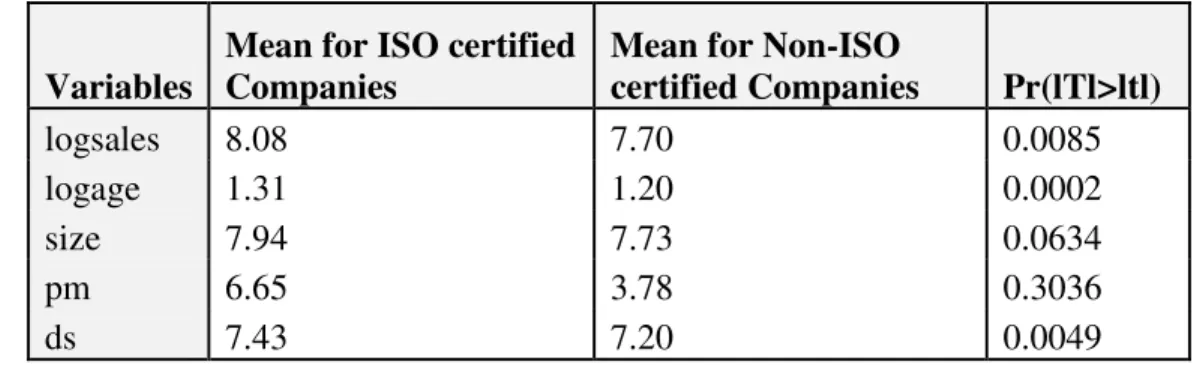
certified Companies Pr(lTl>ltl) logsales 8.08 7.70 0.0085 logage 1.31 1.20 0.0002 size 7.94 7.73 0.0634 pm 6.65 3.78 0.3036 ds 7.43 7.20 0.0049 Level of significance= 1%
The above table shows the results obtained and it can be seen that the mean sales of ISO certified companies is significantly different from the Non-ISO certified ones. Also the certified companies have a higher mean sales than their Non-certified counterparts. Some previous researches also have reached the same conclusion. For instance, Corbett et al. (2002) found that firms that failed to seek certification experienced substantial deteriorations in sales while firms that did seek certification generally managed to avoid such declines. As such it can be said that ISO certified companies tend to outperform Non-ISO certified ones. Similarly, Casadesus, Gimenez and Heras (2001) conducted a study in Spain and they analysed one group of 400 certified companies and another group of 400 non-certified companies. In their tests, they included the sales revenue as well as the profitability ratio. They concluded that the economic profitability of the ISO 9000 certified companies is greater than that of the non-certified companies. Their results show that there are statistically significant differences between the ISO certified companies and the non-certified ones, except for the year 1996. Again, it could be said that the ISO 9000 certified companies outperformed the non-certified ones.
On the other hand, however, when Costa and Lorente (2007) used the t-test to compare the average sales of certified and non-certified firms, they concluded that in 1996, there were no significant differences between the sales of the two groups. They reported a mean sales of 16.71 for certified firms as compared to a mean sales of 17.04 for non-certified ones, with a p-value of 0.929. As such, the results in the present research are inconsistent with the study by Costa and Lorente (2007) who found that non-certified firms slightly outperformed the certified ones: the present research concludes that the mean sales of ISO certified companies are significantly higher than their non-certified counterparts.
Noting the above, it should be noted that the companies in the sample are from different sectors. While in some sectors, the sales value is likely to be high, it is low due to the different nature of the businesses.5 As the Independent T-Test is only a classical test of hypotheses, in
17
order to avoid bias, there is a need to compare sizes as well. It can be found that the mean size of ISO certified companies (7.94) is greater than that of non-certified companies (7.73). However, this difference in mean size is insignificant (0.0634). Hence, it can be said that there is no bias since comparison is made between companies which are of nearly same sizes. Similarly, profit margin is not significantly different for the two samples. This is consistent with Beattie and Sohal (1999) who found that there was no significant difference in profitability of certified firms as compared to non-certified ones. Also, it can be seen that there is a significant difference between the mean age of companies from the two samples. There is also a significant difference between the distribution and selling expenses of ISO and non-ISO certified firms (p-value = 0.0049), with the mean distribution and selling expenses of the ISO certified ones being greater than that of the non-certified ones. This is in line with theory as ISO certified companies have to incur more expenses in order to abide by the criteria set by the standard.
5.2 Correlation Matrix
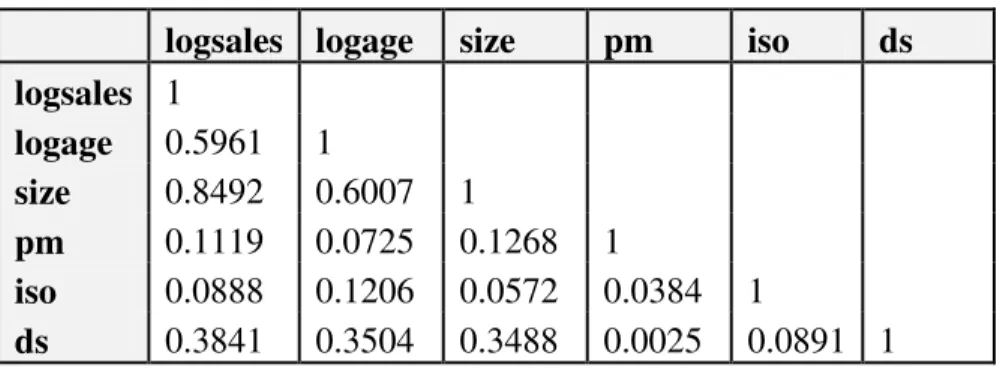
One of the research objectives is to investigate relationships between Sales, Age of firm, Size of firm, Profit margin, Distribution and Selling Expenses and ISO status. To know which variables are positively related and which ones are negatively related, a correlation matrix can be analysed. From the table below, it can be seen that a positive relationship is expected between each of the six variables. And it is to be emphasized that sales and ISO status are positively related.
Table 5.2.1: Correlation Matrix
logsales logage size pm iso ds
logsales 1 logage 0.5961 1 size 0.8492 0.6007 1 pm 0.1119 0.0725 0.1268 1 iso 0.0888 0.1206 0.0572 0.0384 1 ds 0.3841 0.3504 0.3488 0.0025 0.0891 1
5.3 Random or Fixed Effects: The Hausman Specification Test
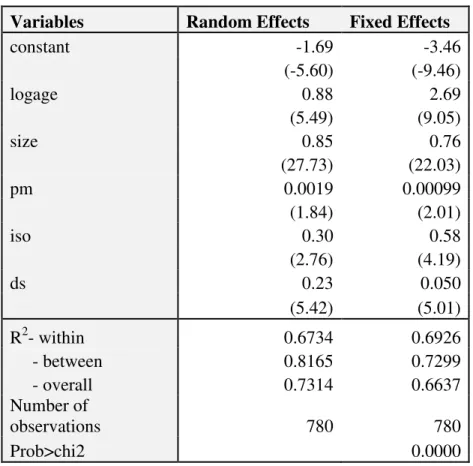
The fixed effects and random effects tests generate the following results as shown in Table 5.3.1. For instance, it can be found that under the random effects model, sales of a company and its ISO status are positively and significantly related with a z-value of 2.76. On the other hand, under the fixed effects model, the sales of a company and its ISO status are also positively and significantly related, but with a t-value of 4.19. However, the Hausman test favours the fixed effect estimator as shown by Prob> chi2 = 0.0000. The positive and significant relationship between ISO status and logsales can be explained by the balanced-scorecard framework which suggests that the implementation of ISO 9000 leads to customer satisfaction through better
18
quality products and hence increased sales. Also companies with a quality badge leads to higher customer confidence that boosts up sales. Certification also leads to an increase in export sales since it reduces TBT. The other variables also are significantly related to logsales. For example, under the fixed effect estimator, it can be found that a 1 unit increase in age leads to a 2.69 units increase in sales and a 1% increase in size leads to a 0.76% increase in sales. The fixed effects test reports a R-square (within) of 69.26 %. This is a measure of goodness of fit, showing that 69.26 % of the variation in sales is explained by the independent variables.
Table 5.3.1: Random and Fixed Estimation Methods
Variables Random Effects Fixed Effects
constant -1.69 -3.46 (-5.60) (-9.46) logage 0.88 2.69 (5.49) (9.05) size 0.85 0.76 (27.73) (22.03) pm 0.0019 0.00099 (1.84) (2.01) iso 0.30 0.58 (2.76) (4.19) ds 0.23 0.050 (5.42) (5.01) R2- within 0.6734 0.6926 - between 0.8165 0.7299 - overall 0.7314 0.6637 Number of observations 780 780 Prob>chi2 0.0000 Level of significance= 5%
The variables show the coefficients and z/t values are in parentheses.
5.4 Empirical Analysis
5.4.1 Generalized Estimating Equations
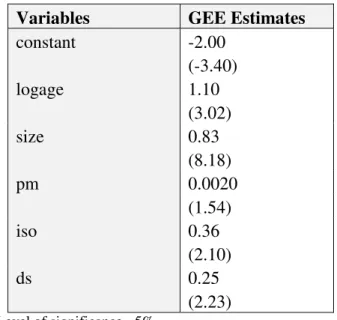
After ascertaining that the Hausman test favours the fixed effects model, a GEE test can be performed. Generalized Estimating Equations fits population-averaged panel-data models. It fits generalized linear models and allows the specification of within-group correlation structure. A robust test specifies that the Huber/White estimator of variance is to be used in place of the default GLS variance estimator. This causes GEE to produce valid standard errors which are not biased. Under Generalized Estimating Equations also, it can be found that ISO has a positive
19
significant relationship with sales, implying that certification will boost up the sales of a company.
Table 5.4.1.1: Generalized Estimating Equations
Variables GEE Estimates
constant -2.00 (-3.40) logage 1.10 (3.02) size 0.83 (8.18) pm 0.0020 (1.54) iso 0.36 (2.10) ds 0.25 (2.23) Level of significance= 5%
The variables show the coefficients and the quantities in brackets are the heteroskedastic robust z-values.
5.4.2 The Model
Logsalesit = α t+ β1logageit + β2sizeit + β3pmit + β4isoit + β5 dsit + εit
Logsalesit = -2.00 + 1.10 logageit + 0.83 sizeit + 0. 0020 pmit + 0.36 isoit + 0.25 dsit + εit
The equation above incorporates the coefficients of each variable and same will be explained in further details below. Starting by age, it can be seen that as age increases by one unit, sales also will increase by 1.10 units. The relationship between age and sales is significant (z-value=3.02) and positive. This is in line with Finley and Buntzman (1994) who argued that the age of a company influences its performance. This may be explained by the fact that older companies have already achieved customer confidence and loyalty. In contrast, newly incorporated companies have to strive to attract clients and achieve customer loyalty. When a company has existed for many years, it usually establishes itself at a high position in the industry and has a good reputation. In addition, if it is ISO 9000 certified, customers become loyal, it becomes easy to attract new customers and penetrate new markets. Hence long established companies are likely to have higher sales levels.
Size also is positively and significantly (z-value= 8.18) related to sales. As size increases by 1%, sales also increase by 0.83%. This may be because when a company is large, it can offer a wide range of products. Also large companies benefit from economies of scale and can thus offer a number of benefits, like bulk discounts and gift vouchers to their customers, and this boosts up sales. Another explanation is that large companies invest a lot in advertising and quality certification. Such advertising campaigns which show their variety of products and their quality
20
badge cannot be undertaken by small companies. As such, this boosts up customer confidence and sales. Customers also rest assured that they have value for money. This is in line with Tsekauras et al. (2002) who found that adopters of ISO 9000 standards in the Greek manufacturing sector were mainly large companies.
Profit margin, however, is insignificant and positive. A 1% rise in profit margin will lead to a 0.0020% rise in sales. This is in contrast with Sharma (2005) where profit margin was found to be significant. This positive relationship is often the case where it concerns basic necessities such that even when prices rise, the quantity sold will not fall by much and hence sales revenue will rise. However, in this research, a number of companies, from different industries and sectors, producing both basic necessities and luxuries are drawn. Thus, it can be said that though the model shows a positive relationship, yet it is an insignificant one.
This research concludes that there is a positive and significant (z-value = 2.10) relationship between ISO status and sales meaning that ISO certification boosts up sales. This is supported by the literature (Kantner, 1997; McAdam and McKeown, 1999). This is also consistent with the Balanced-scorecard framework which provides that better quality products will have a positive impact on sales level. This is because, as a company implements the requirements of ISO 9000 standards, it improves its internal operations, processes, and produces better quality products which lead to customer satisfaction. This, in turn, enlarges the customer base, breeds customer loyalty and confidence and increases sales. The external improvement theory also suggests that ISO 9000 implementation will increase market share and sales. This is also in line with Juran (1995) who posited that the major reason for seeking certification is maintenance or expansion of markets.
Distribution and Selling expenses is found to be significant (z-value = 2.23) and positive. A 1% increase in distribution and Selling expenses will lead to a 0.25% increase in sales. This shows that as more is spent on distribution and selling expenses, this lead to a significant increase in sales. In fact, this can be explained by the fact that if the company provides delivery service and proper after-sales services, this will attract customers and hence boosts up sales. Also this also includes the cost of advertising and marketing. Advertising, if successful, will either attract new customers or breed customer loyalty, hence leading to an increase in sales.
5.4.3 Dynamic Panel Data Estimation (First Step GMM estimator)
The Generalized Estimating Equation provides very interesting results as are interpreted above. However, it does not take into account the fact that sales of this year are likely to be affected by sales of the previous year. This is the case because of psychological reasons. Thus, lags need to be included because as a result of inertia, people do not change their consumption habits immediately following the adoption of ISO 9000 certificates. Another reason of using dynamic panel is that, at the level of the company itself, changes are not made as soon as certification is obtained. Companies need a period of time to adapt their operations to the requirements of the standard. The incorporation of dynamics into the model necessitates that the econometric equation be rewritten as an AR (1) model:
yit – yit-1 = αt + vyit-1 + βxit+ εit where,
21
the Left-hand side is the log difference in sales over a period; yit = the logsales;
xit= the vector of explanatory variables, that is x = [logage, size, pm, iso, ds] and
αt = the period specific intercept term to capture changes common to all companies; and εit= the time variant idiosyncratic error term.
Similarly, the equation can be written as: yit = αt + (v+1) yit-1 + βxit + εit
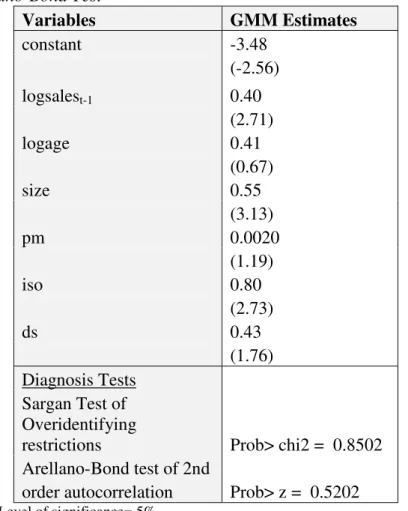
GMM estimators are used to overcome the problem of endogeneity. The first step GMM estimator will be used since it is more reliable. The asymptotic standards errors from the two step GMM estimator have been found to have a downward bias (Blundell and Bond 1998). The results obtained are as follows:
Table 5.4.3.1: Arellano-Bond Test
Variables GMM Estimates constant -3.48 (-2.56) logsalest-1 0.40 (2.71) logage 0.41 (0.67) size 0.55 (3.13) pm 0.0020 (1.19) iso 0.80 (2.73) ds 0.43 (1.76) Diagnosis Tests Sargan Test of Overidentifying
restrictions Prob> chi2 = 0.8502 Arellano-Bond test of 2nd
order autocorrelation Prob> z = 0.5202 Level of significance= 5%
The variables show the coefficients and the quantities in brackets are the heteroskedastic robust z-values.
22
Logsalesit = -3.48 + 0.40 logsalesi,t-1 + 0.41 logageit+ 0.55 sizeit + 0.0020 pmit + 0.80 isoit + 0.43 dsit + εit
Again, in the dynamic panel equation, the coefficients are incorporated and they represent the impact of a change in any of the independent variables on the dependent one. For instance, as shown above, as sales of previous year increases by 1%, the sales of this year increase by 0.40%. The positive and significant coefficient of lag sales suggests that lagged sales of the company contribute positively towards the current level of sales confirming the existence of dynamism and endogeneity in the model. The relationship between ISO and sales is positive and significant (z-value = 2.73). The results from the dynamic panel analysis show that ISO leads to an increase in sales in the sample of companies even in the short run. Also the coefficient of the lagged sales is 0.40 implying a coefficient of partial adjustment α of 0.60. This means that sales in one year are 60% of the difference between the optimal and the current level of sales. It can also be noticed that some of the variables are insignificant in the dynamic panel regression. Age, profit margin and distribution and selling expense are insignificantly related to sales. The estimated equation passes all diagnosis tests related to Sargan Test of overidentifying restrictions and the Arellano-Bond test of autocorrelation.
5.5 Discussion of Findings
We now discuss the areas where our findings have implications for companies. It can be seen that although ISO 9000 certification has been adopted by companies, yet its impact on sales is inconclusive. The benefits of ISO 9000 certification should be based on sound platforms relating to the systems, procedures and processes and not on mere judgment. However, there is little reported empirical evidence of this in practice. This paper has therefore attempted to furnish empirical evidence on the value of ISO 9000 to sales of companies.
This research concludes that there is a positive and significant relationship between ISO 9000 and sales in Mauritius. It thus confirms the studies of Casadesus, Gimenez and Heras (2001) on certified companies in Spain and Lima, Resende, and Hasenclaver (2000) on Brazilian firms. Jang and Lin (2007) conducted a study in Taiwan. For the methodology, they used the SEM techniques. SEM is a linear cross-sectional statistical modeling technique which includes covariance structure analysis, latent variable analysis, confirmatory factor analysis (CFA), path analysis (PA) and regression analysis (Botha et al., 1999). Their results show a positive relationship between ISO 9000 and firm performance. Additionally, ISO 9000 directly and positively influences operational performance and indirectly affects market performance, in turn positively impacting business performance. One of their research objectives was to test whether internal motivation is positively related to the depth of ISO 9000 implementation and they obtained a t-value of 5.50 which implies a significant relationship. Also Corbett et al. (2002) examined the effect of ISO 9000 certification on publicly traded firms in the U.S. and they found that certification leads to improved financial performance, including improved sales. McAdam and McKeown (1999) also found that, in Northern Ireland, the specific benefits were increased sales and fewer customer complaints. In addition, Quazi et al. (2002), Elmuti and Kathawala (1997) and Chua, Goh and Wan (2003) also reported that ISO 9000 certification leads to increased sales.