Research Article
Safety Considerations on MRI Systems for
Firefighters and Paramedics
© 2016 Schmidt G; licensee Iran University of Medical Sciences. This is an open access article distributed under a Creative
Background and Objectives
The use of magnetic resonance imaging (MRI) systems is on the rise all over the world. MRI systems appear to be useful for various applications and the number of patient examinations is increasing constantly. Especially Europe shows an increase of installed systems and the countries Switzerland, Austria and Germany display the highest numbers of installed systems in 2009.1,2 Moreover,
rele-vant reports from the Organisation for Economic Co-oper-ation and Development (OECD) confirms the rise of MRI systems in various countries.3
*Corresponding Author: Georg Schmidt, Rochusgasse 2, 3430 Tulln, Austria. Tell: +43 (0) 680 405 19 26; Email: [email protected]
Georg Schmidt
1*1 Alfred Nobel Open Business School, Austria.
The higher availability of MRI systems triggered an in-crease in the use to clarify medical-diagnoses.4 One of
the major MRI examinations constitutes the clarification of ischaemic insults and slipped disks. Additionally, MRI systems are increasingly used in scientific research and especially brain-research benefits form the ongoing de-velopment of MRI systems. Nowadays, MRI can be con-sidered as standard-examination in various countries, which can be conducted in hospitals and private clinics.
Magnetic Influence by MRI Systems
MRI systems can be understood as large magnets, oper-ating with high magnetic field. These magnets can pos-sess a weight of up to 100 tons.5,6 Magnets can either be
implemented as permanent magnets, resistance magnets
IJHR
Open Access
Abstract
Background and Objectives: Endometrial hyperplasia (EH) is an abnormal overgrowth of endometrium that may lead to endometrial cancer, especially when accompanied by atypia. The treatment of EH is challenging, and previous studies report conflicting results. Metformin (dimethyl biguanide) is an anti-diabetic and insulin sensitizer agent, which is supposed to have antiproliferative and anticancer effects and the potential to decrease cell growth in endometrium. While some studies have evaluated the anticancer effect of metformin, studies on its potential effect on endometrial hyperplasia are rare. To address this gap, in this comparative trial study, we evaluate the effect of additive metformin to progesterone in patients with EH.
Methods: In this clinical trial, 64 women with EH were randomized in two groups. The progesterone-alone group received progesterone 20 mg daily (14 days/month, from the 14th menstrual day) based on the type of hyperplasia, and the progesterone-metformin group received metformin 1000 mg/day for 3 months in addition to progesterone. Duration of bleeding, hyperplasia, body mass index (BMI), and blood sugar (BS) of the patients were then com-pared between the two groups.
Findings: NA mean age of 44.5 years, mean BMI of 29 kg/m2 and mean duration of bleeding of 8 days were calcu-lated for the study sample. There was no significant difference in age, BMI, gravidity, bleeding duration, and duration of disease at baseline between the two groups. While all patients in the progesterone-metformin group showed bleeding and hyperplasia improvement, only 69% of the progesterone-alone patients showed such an improvement, with the difference between the two groups being significant (P = 0.001). Although the difference between two groups in the post treatment endometrial thickness was not significant (P = 0.55), post treatment BMI in the progesterone-metformin group was significantly lower than in the progesterone-alone group (P = 0.01). In addition, the BS reduction in the progesterone-metformin group was significantly larger than that in the progesterone-alone group (P = 0.001). Conclusions: Our results indicated that administration of progesterone 20 mg/day plus metformin 1000 mg/day can significantly decrease bleeding duration, hyperplasia, BMI and BS in women with EH.
Keywords: Endometrial hyperplasia, Metformin, Progesterone
Background and Objectives
Endometrial hyperplasia (EH) is an abnormal over
-growth of endometrium that may lead to endometrial cancer, especially when accompanied by atypia [1].
Although the effect appears only in 5% of asymptom-atic patients, its prevalence in patients with PCOS
and oligomenorrhea is about 20% [2]. Body mass index (BMI) and nulliparity are two main risk factors for EH. Other risk factors include chronic
anovula-tion, early menarche, late onset of menopause and
diabetes [3], which are related to increased
circulat-ing estrogen [4]. The treatment of EH is challengcirculat-ing and previous studies report conflicting results [5]. Age, fertility, and severity of EH in histology are the most important factors determining the treatment op -tion [5]. Most studies have addressed hysterectomy
in patients with atypical EH [5], particularly those
with PCOS, and have led to conflicting results [5-11].
Evaluation of the Effect of Additive
Metformin to Progesterone on Patients
with Endometrial Hyperplasia
Afsaneh Tehranian 1, Nasim Zarifi 1*, Akram Sayfolahi 2, Sara Payami 2, Faezeh Aghajani 2
1 Department of Gynecology and Obstetrics, Arash Women's Hospital, Tehran University of Medical Sciences, Tehran, Iran 2 School of Medicine, Tehran
University of Medical Sciences, Tehran, Iran
*Corresponding author: Afsaneh Tehranian, Department of Gynecology and Ob-stetrics, Arash Women's Hospital, Tehran University of Medical Sciences, Tehran, Iran, P.O.Box: 1653915981, Tel: +98 21 77719922, Fax: +98 21 2177883196, E-mail: [email protected]
RESEARCH ARTICLE
© 2015 Tehranian A et al.; licensee Iran University of Medical Sciences. This is an Open Access article distributed under a
Cre-Background and Objectives: The use of magnetic resonance imaging (MRI) systems is on the rise and the number of installed systems is constantly increasing all over the world. This raises the possibility for emergency personnel to get in contact with these systems. However, the clothing and working material of paramedics and firefighters is not designed for the use on magnets. More research is needed to gain a deeper understanding of the risks for emergency personnel, working on MRI systems. Therefore, this study examined the effects of magnetic force on selected working materials and clothes of firefighters and paramedics.
Methods: This study was conducted as a field study, utilising a 1.5 T MRI system. Selected items were examined on their behavior in the magnetic field and the following parameters were measured: (i) the force of attraction and (ii) the distance to the magnet when a force of attraction is recognisable. Manual force meter and a wooden distance meter were used to measure the parameters.
Findings: The highest force of attraction can be researched in helmets (30 N), boots (90 N) and gloves (17 N). The measured force is high enough to pull these items into the magnet. Jackets and pants did not receive a high force of attraction. Working material can be influenced by eddy currents, according to the composition. The movement of the item can then be restricted.
Conclusions: Considering the results of this study, most of the clothing and working materials can be considered as MRI safe. However, the force of attraction of boots and helmets might be high enough to cause serious distraction for emergency personnel. There might be a high risk for emergency personnel to forget small items in their pockets which subsequently can act as dangerous projectiles. Additional tests might display the need for an independent MRI system. There is a high risk to damage the system (e.g. to break the cover by attracted objects) and hospitals might not be willing to take the risk in the future.
Keywords: Magnetic resonance imaging, Safety, Magnetic fields, Firefighters, Paramedics, Emergencies
Abstract
(electrical) or superconductive magnets.7 The high
mag-netic field is used to generate pictures by activating hydro-gen atoms in the body and can reach up to 3 T for patient examinations. MRI systems used in research are using much stronger magnetic fields and can reach up to 20 T or more. The magnetic field of a 1.5 T magnet can be under-stood as 30.000 times stronger compared to the earth’s magnetic field.8 The magnetic fields around the magnet
influence objects which are ferromagnetic, diamagnetic and paramagnetic.8 The influence reduces by distance but
can abruptly come into effect when getting closer to the magnet. Magnetic fields around the magnet can cover an area for about 30 m2 (323 square foot) but are only high in
force in close proximity to the magnet. The magnetic field declines fast to less than 0.5 mT (after approximately 1 to 2 m) and should be marked by an obvious line on the floor.9 The effect of the magnet field is minimal outside the
0.5 mT areas and can therefore be considered as safe for ferromagnetic and metallic objects.
Safety on MRI Systems
However, next to all the improvements and development of these systems it seems that safety-aspects do not receive enough attention. Accidents on MRI systems seem to hap-pen frequently and can be reported all over the world.10-12
It seems that a misjudgement of the force of the magnetic field and a lack of understanding of how to deactivate the magnet triggered most of the accidents.
Due to the force of attraction, ferromagnetic and metallic objects are not compatible for the use on MRI systems.13
This includes for example pacemakers and implants.14,15
The force of the magnet would be able to displace objects within the body and also daily items like glasses, pens or watches can become dangerous projectiles.9,16 Therefore,
it is a strict provision for patients to remove all objects and clothing which might be magnetic and therefore constitute a risk to get pulled towards the magnet.17
Emergency Personnel and MRI
The increase of MRI systems might also increase the possibility for emergency personnel to get in contact with these medical devices.18 Moreover, emergency personnel
might now be more often contacted to assist in MRI acci-dents (for example when large objects were attracted by the magnetic force and pulled into the magnet).
However, the clothing and working-materials of firefight-ers and paramedics are not designed for the usage on MRI systems and it remains unclear if emergency person-nel can operate in close proximity to the MRI.
A literature research on the safety of emergency per-sonnel on MRI systems did not deliver an adequate
re-sult and it seems that no studies on this subject are con-ducted so far. Only the security measures, provided by manufactures, can be taken into account. More research is needed to gain a deeper understanding of the risks for emergency personnel, working on MRI system. Therefore, this field study examines the effect of magnetic force on selected working materials and clothes of firefighters and paramedics.
Methods
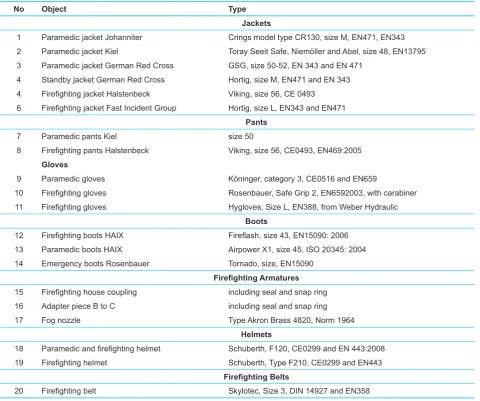
This study was conducted as a field study and aims to research the effect of a MRI’s magnetic field on working materials and clothes of firefighters and paramedics. This study was conducted at the emergency hospital Berge-dorf in Hamburg, Germany. The chosen MRI was a Philips Achieva with 1.5 T. This device is normally used for clinical examinations and no changes to the system have been conducted during the study. The hospital-management agreed to provide the system up to three hours to conduct this study. Within this time it was possible to examine 20 items: six different jackets, two different pants, three differ-ent gloves, three differdiffer-ent boots, three differdiffer-ent firefight-ing instruments, two different helmets and one firefightfirefight-ing belt. The test-objects are used by active firefighters and paramedics and no changes have been conducted to the items. Table 1 summarises the selected objects:
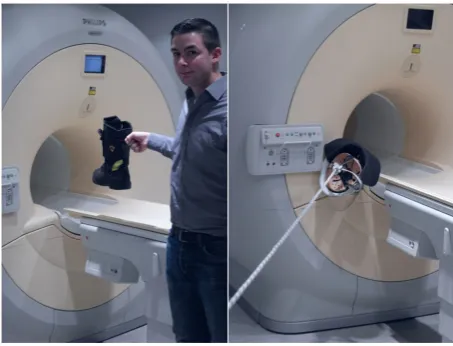
Each item was investigated in advance by a small hand magnet to determine the magnetic behaviour before en-tering the MRI room. The item was secured with ropes when the object appeared to be highly magnetic. In order to investigate the force of attraction, test persons wore the clothing and approached the magnet. If an influence by the magnetic force was recognisable, the item was inves-tigated more specific. The helmets and firefighting boots needed additional safeguard by rope because the force of attraction was high. Without the rope-safeguard these items would have been pulled in the magnet (Figure 1).
Measured parameters included the force of attraction and the distance to the magnet when a force of attraction is recognisable. The force of attraction was measured by manual force meters and the distance of attraction by a wooden distance meter. In order to investigate as much objects as possible, four persons were present to cover the amount of work.
Results
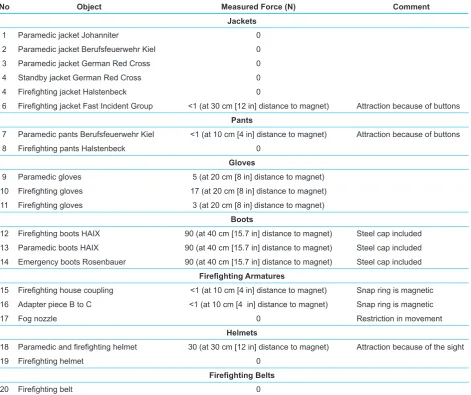
The investigation of the gloves displayed a force of at-traction for every different type. The measured forces of 3, 5 and 17 N are already high enough to pull the glove in the magnet. The influence by the magnetic field started within a distance of 20 cm (8 in) (Figure 2).
Measurement of the boots displayed the highest force of attraction and it was possible to measure 90 N for every pair of boots. In this case the force of attraction is already very high and the boots would have been pulled in the magnet with high speed. All values were measured with a distance of 40 cm (15.7 in) to the magnet.
The examination of the firefighting armatures displayed no attraction by the magnetic field. However, an attraction due to the snap ring of the firefighting house coupling and the firefighting adapter piece could be measured within a distance of 10 cm (4 in). Moreover, it was recognisable that all firefighting armatures receive an influence by the magnetic field due to eddy-currents. Eddy-currents restrict the movement of the devices as long as they are under the influence of magnetic fields and it appears difficult to Table 1. Selected Test-Objects
No Object Type
Jackets
1 Paramedic jacket Johanniter Crings model type CR130, size M, EN471, EN343
2 Paramedic jacket Kiel Toray Seeit Safe, Niemöller and Abel, size 48, EN13795
3 Paramedic jacket German Red Cross GSG, size 50-52, EN 343 and EN 471
4 Standby jacket German Red Cross Hortig, size M, EN471 and EN 343
4 Firefighting jacket Halstenbeck Viking, size 56, CE 0493
6 Firefighting jacket Fast Incident Group Hortig, size L, EN343 and EN471
Pants
7 Paramedic pants Kiel size 50
8 Firefighting pants Halstenbeck Viking, size 56, CE0493, EN469:2005
Gloves
9 Paramedic gloves Köninger, category 3, CE0516 and EN659
10 Firefighting gloves Rosenbauer, Safe Grip 2, EN6592003, with carabiner
11 Firefighting gloves Hygloves, Size L, EN388, from Weber Hydraulic
Boots
12 Firefighting boots HAIX Fireflash, size 43, EN15090: 2006
13 Paramedic boots HAIX Airpower X1, size 45, ISO 20345: 2004
14 Emergency boots Rosenbauer Tornado, size, EN15090
Firefighting Armatures
15 Firefighting house coupling including seal and snap ring
16 Adapter piece B to C including seal and snap ring
17 Fog nozzle Type Akron Brass 4820, Norm 1964
Helmets
18 Paramedic and firefighting helmet Schuberth, F120, CE0299 and EN 443:2008
19 Firefighting helmet Schuberth, Type F210, CE0299 and EN443
Firefighting Belts
20 Firefighting belt Skylotec, Size 3, DIN 14927 and EN358
D
C
B
A
Figure 1. Examples of Selected Test-Items; (A) Gloves, (B)
Firefighting house coupling and adapter piece B to C, (C) Fog nozzle and (D) Firefighting belt.
move the devices.
The measured force of attraction of the paramedic and firefighting helmet is attributable to the sight of the hel-met (see Table 2, No. 18). The measured force of attrac-tion was measured within a distance of 30 cm (12 in) to the magnet and values 30 N. This force is already high enough to pull the helmet in the magnet (Figure 3).
All results are summarised in Table 2.
Discussion
Results show that jackets and pants do not receive a high force of attraction. Slight attraction could be measured on two items and was caused by buttons on the clothes. It can be assumed that most of the clothing of firefighters and paramedics can be considered as MR safe. Even when there will be a slight attraction, it can be assumed that the force might not be strong enough to pull the clothes from the person.
However, boots received a high force of attraction and with a force of 90 N it was even difficult for the test-per-son to remove the boot from the magnet. This force of attraction was caused by the steel-caps within the boot and might lead to serious distraction during emergencies. However, the force was not high enough to pull the boot from the test person’s foot. One of the tested helmets also showed a higher force of attraction and might also cause distraction during emergencies. Without the security strap of the helmet the force would be high enough to pull the helmet in the magnet. Additional features of helmets (e.g. visor of helmet) might increase the force of attraction. Con-sidering these results, it might be advantageous to remove helmets before entering MRI rooms.
All the tested gloves display a force of attraction and must be handled with caution next to MRI systems. The force of attraction is high enough to pull the tested gloves in the magnet and additional attachments to the gloves
Figure 2. Testing of Gloves With the Manual Force Meter. Figure 3. Testing of Boots and Helmet. The boot is floating freely
due to the high force of attraction and the helmet needed to be secured by ropes.
(like carabiners) can increase the force of attraction con-siderably.
All the firefighting armatures and the firefighting belt did not display a force of attraction. All the tested materials are manufactured by non-ferromagnetic materials (aluminium and brass) and can therefore be considered as MR safe. The slight attraction of the house coupling and the adapter piece are attributable to the snap ring in these devices. However, these components still receive a major influence by eddy-currents and display a limitation in movement next to MRI systems. The difficulty to move these devices might lead to serious distraction during emergencies and should be considered in advance.
Additional training for firefighters and paramedics should be considered to highlight the danger of ferromagnetic ob-jects close to MRI systems. Emergency personnel might forget small items in their pockets which can subsequently become dangerous projectiles. MRI personnel are used to perform a check of their pockets before entering the examination room; introducing this check to firefighters and paramedics might be a first possibility to increase the safety of emergency personnel. Moreover, firefighters and paramedics might benefit to invest in MRI safe boots with-out a steel cap.19 Additionally, it is possible to invest in MRI
safe breathing protection systems (composite bottles) and non-magnetic fire extinguisher.20
Study Limitations
firefight-ers and paramedics. However, the spectrum of clothing and working-materials consists of more items and addi-tional research is needed to gain a deeper understanding of which items can be considered as MR safe. Additional tests might display the need for an independent MRI sys-tem. There is a high risk to damage the system (e.g. to break the cover by attracted objects) and hospitals might not be willing to take the risk in the future.
Conclusions
Considering the results of this study, most of the cloth-ing and workcloth-ing materials can be considered as MRI safe. However, the force of attraction of boots and hel-mets might be high enough to cause serious distraction for emergency personnel. There might be a high risk for emergency personnel to forget small items in their pock-ets which subsequently can act as dangerous projectiles. Additional tests might display the need for an independent MRI system. There is a high risk to damage the system (e.g. to break the cover by attracted objects) and hospitals might not be willing to take the risk in the future.
Abbreviations
(MRI): magnetic resonance imaging.
Competing Interests
The author declares no competing interests.
References
1. Schlenker RU, Schwartz FW, Grobe T, Behrens K. Barmer GEK Arzt Report. Berlin; 2011.
2. Nowotny S. Teure Check-ups in den Röhren: Untersuchungen nehmen zu. Neue Zürcher Zeitung; 2012.
3. OECD. Medizintechnik (Verfügbarkeit und Nutzen): Gesundheit auf einem Blick 2009. OECD-Publishing; 2010. 4. Gasperl M. Magnetresonanz-Tomographie. Salzburg:
Naturwissenschaftliche Universität Salzburg; 2009. 5. Schwarzmüller-Erber G, Silberstein E, Eder S. Angewandte
Magnetresonanztomographie: Grundlagen und Anwendun-gen. Wien: Facultas; 2013.
6. SIEMENS. Magnetom C: Technical Data. Erlangen; 2004. 7. SIEMENS. 25 Jahre
Innovationen-Magnetresonanztomog-raphie bei Siemens. Erlangen; 2003.
Table 2. Results of Tested Objects
No Object Measured Force (N) Comment
Jackets
1 Paramedic jacket Johanniter 0
2 Paramedic jacket Berufsfeuerwehr Kiel 0
3 Paramedic jacket German Red Cross 0
4 Standby jacket German Red Cross 0
4 Firefighting jacket Halstenbeck 0
6 Firefighting jacket Fast Incident Group <1 (at 30 cm [12 in] distance to magnet) Attraction because of buttons
Pants
7 Paramedic pants Berufsfeuerwehr Kiel <1 (at 10 cm [4 in] distance to magnet) Attraction because of buttons
8 Firefighting pants Halstenbeck 0
Gloves
9 Paramedic gloves 5 (at 20 cm [8 in] distance to magnet)
10 Firefighting gloves 17 (at 20 cm [8 in] distance to magnet)
11 Firefighting gloves 3 (at 20 cm [8 in] distance to magnet)
Boots
12 Firefighting boots HAIX 90 (at 40 cm [15.7 in] distance to magnet) Steel cap included
13 Paramedic boots HAIX 90 (at 40 cm [15.7 in] distance to magnet) Steel cap included
14 Emergency boots Rosenbauer 90 (at 40 cm [15.7 in] distance to magnet) Steel cap included
Firefighting Armatures
15 Firefighting house coupling <1 (at 10 cm [4 in] distance to magnet) Snap ring is magnetic
16 Adapter piece B to C <1 (at 10 cm [4 in] distance to magnet) Snap ring is magnetic
17 Fog nozzle 0 Restriction in movement
Helmets
18 Paramedic and firefighting helmet 30 (at 30 cm [12 in] distance to magnet) Attraction because of the sight
19 Firefighting helmet 0
Firefighting Belts
Please cite this article as:
Schmidt G. Safety considerations on MRI systems for firefighters and paramedics. Int J Hosp Res. 2016;5(1):7-12. doi:10.15171/ijhr.2016.02.
8. Peters P, Matthiass H, Reiser M. Magnetresonanztomogra-phie in der Orthopädie. Stuttgart: Ferdin and Enke Verlag; 1990.
9. SIEMENS. Magnetom Trio a Tim System: Operator Manual-MR System. Erlangen; 2009.
10. Boy, 6, Killed in Freak MRI Accident. ABC News. 2015. http:// abcnews.go.com/US/story?id=92745&page=1. Accessed December 30, 2015.
11. Mishra L. Two Stuck to MRI Machine for 4 hrs. http://www. mumbaimirror.com/mumbai/cover-story/Two-stuck-to-MRI-machine-for-4-hrs/articleshow/45103043.cms. Accessed December 30, 2015. Published 2014.
12. Lüssenheide B. Magnetische Ausrüstungsteile-Ein Problem in MRT. http://www.atemschutzunfaelle.de/download/ Ausbildung/MRT.doc. Accessed December 30, 2015. Published 2005.
13. Shellock FG. Metallic surgical instruments for interventional MRI procedures: Evaluation of MR safety. J Magn Reson Imaging. 2001;13(1):152-157.
14. Sawyer-Glover AM, Frank G. Shellock. Pre-MRT procedure screening: recommendations and safety considerations for biomedical implants and devices. J Magn Reson Imaging. 2000;12(1):92-106.
15. Roguin A, Zviman MM, Meinninger GR, et al.
Mod-ern pacemaker and implantable cardioverter/defibril-lator systems can be magnetic resonance imaging safe. Circulation. 2004;110:475-482. doi:10.1161/01. CIR.0000137121.28722.33.
16. Woods TO. Standards for medical devices in MRI: Present and future. J Magn Reson Imaging. 2007;26(5):1186-1189. 17. Capizzani R. Magnetic Resonance Imaging Hazards and
Safety Guidelines. 2009.
18. Kanal E, Borgstede JP, Barkovich AJ, et al. White paper on mr safety: 2004 update and revisions. AJR Am J Roentgenol. 2004;182(5):1111-1114.
19. America HN. Firefighting Boots. http://www.haixusa.com/ fire/. Accessed December 30, 2015. Published 2013. 20. ACE-TEC. Atemschutzflaschen. http://www.ace-tec-fire.