The impact of ensemble diversity on learning
big data in dynamic environments
Tinofirei Museba
University of Johannesburg
Department of Applied Information Systems Johannesburg, South Africa
Abstract
For many classification tasks, data is collected over an extended period of time and the predictive model learns over time, adapting to changes in the underlying distribution of the data if necessary. To optimize generalization performance, margin distribution is considered to be an important factor. A major concern posed by nonstationary learning for any algorithm is the rate of adaptation to new concepts and the volume of the data. Tackling the problem of learning in nonstationary environments associated with drifting concepts with ensembles of classifiers makes the concept of diversity to be of paramount significance in optimizing the rate of adaptation to new concepts for classification tasks. In this paper, we investigate the impact of ensemble diversity on the rate of adaptation to new concepts in nonstationary learning. The rate of adaptation is analyzed by exploiting the correspondence that exists between voting margins and the double fault measure, a popular diversity measure strongly linked to the margin. We utilize the Adaptive Classifier Ensemble Boost algorithm (AceBoost) to generate diverse base classifiers and optimize margin distribution to exploit different amounts of diversity to generate an optimal ensemble capable of handling different kinds of drift. The experimental results confirm that AceBoost outperforms other state of the art algorithms that exploit ensemble diversity to handle concept drift.
Keywords- ensemble, diversity, margin, support vector machine, concept drift
Volume 12, 2019, Pages 227–240
1
Introduction
The assumption with many machine-learning algorithms is that the classification landscape is static. However, this assumption is not valid for many real world problems. In the case of classification problems, the decision boundaries may change over time because of the changes in the underlying distribution of the data. This phenomenon is not as concept drift (A.Tsymbal, 2004).
Such nonstationary problems represent a considerable challenge for machine learning algorithms designed for classification tasks. In dynamic environments, a learning model receives a constant stream of data, where an example has to be classified and a true label has to be provided only after the classification process. At some point, the underlying data generation mechanism or the concept that we are trying to learn from data is constantly evolving (Haixun Wang, Wei Fan, 2003), indicating a change in concept that necessitates a change of the prediction model. Online learning involves learning from data that is viewed ony once and must then be discarded and adapting to the changes of concept.
Section 3.1 and section 3.2 provides a description of our proposed algorithm. Section 3.3 provides a description of the diversity measure used in the formulation of the algorithm. Section provides a description of the drift detection method and a description of the datasets used in the experiments is provided in section 3.5. Section 4 provides a description of the experiments conducted and the results obtained from the experiments are provided in section 5.
2
Background on ensemble diversity and Voting margins
Diversity and voting margins are two important aspects of ensemble methods that are theoretically connected. The voting margin can be defined as the confidence-weighted correctness of the prediction on a given example (Richard Stapenhurst, 2011). Voting margins are useful in determining generalization error. Large margins reduce an upper bound on generalization error. The sign of a margin indicates whether a training instance is correctly classified or not. The magnitude of the margin is an indication of the confidence of the prediction. Diversity is intuitively an important feature of an ensemble classifier as there has to be some differences between the predictions of the base learners .Kuncheva and Whitaker et al (2001) provided an analysis of several diversity measures. Tang et al (2006) proved that maximizing the diversity among the base classifiers is equivalent to optimizing the margin of an ensemble on the training samples if the average classification accuracy is constant and maximal diversity is achievable. As a result, increasing the diversity among base classifiers is an effective approach of improving the margin distribution of ensemble classifiers.
3
Related Work
3.1
Online Adaptive Classifier Ensemble Boost (AceBoost)
The Online Adaptive Classifier Ensemble Boost (AceBoost) exploits the correspondence between ensemble diversity and margins to manage diversity explicitly using a proxy parameter. The algorithm enables a principled study of the rate of ensemble diversity that is required for each concept in dynamic environments associated with concept drift for classification tasks. AceBoost learns in an online incremental fashion using techniques analogous to Online AdaBoost. The algorithm improves the margin distribution by minimizing the margin reduced classification loss making it capable of selecting the appropriate amount of diversity suitable for the currently occurring concept for adaptation regardless of the amount the magnitude of change or severity. AceBoost mimics the sampling with replacement of AdaBoost and uses a Poisson distribution instead of a weighted sampling to optimize computational time of normalizing example weights. Each training instance is presented to the training algorithm 𝑛 times where 𝑛 is drawn form a Poisson (𝜆) and 𝜆 is a weight derived from a previous performance on that sample. Since the margin of the training samples have an underlying relationship with the diversity of the base classifiers because of the margin loss function, the Poisson distribution 𝜆 is equated to the margin loss function 𝜇. Since the algorithm is analogous to Online Adaboost, the property of increasing the margin is inherent in the algorithm. If the margin or separating decision boundary is increased, the generalization performance is improved as well.
3.2
Adaptive Classifier Ensemble Algorithm
3.3
The Double Fault Measure
To control diversity through enlarging and decreasing margins through a proxy parameter, the algorithm uses the Double Fault measure. The diversity of an ensemble learning machine can only be appropriately increased if it is represented by a diversity measure that is strongly related to the average loss and hence the average margin since Tang et al (2006) proved that enlarging the margins can be equated to increasing diversity. Existing diversity measures are more related to the variance of the outputs and do not consider the performance of individual classifiers. The Double Fault Measure is closely related to the generalization error and tends to produce a stable behavior because if strong classifiers are available as it seeks to decrease the probability of identical errors. The Double Fault measure is symmetric and works well in linking it with enlarging margins. The connection between double fault diversity measure and exponential loss creates a good relationship between the double fault diversity measure and ensemble accuracy.
The Double Fault diversity measure is a quadratic function of the margin expressed as:
𝐷𝐷𝐹 = 1
𝐿(𝐿−1)∑ ∑ 𝑁𝑗,𝑘00
𝑁 𝐿 𝑘≠𝑗 𝐿
𝑗=1 and the margin is interpreted as: Algorithm : Adaptive AceBoost
Require: : Poisson distribution ∈ : margin loss
𝐻𝑙𝑜𝑤 ← AceBoost (low diversity) 𝐻ℎ𝑖𝑔ℎ ← AceBoost (high diversity) Let 𝜆 = 𝜇
For 𝑘 ∈ 1… 𝑁 do Train 𝐻𝑙𝑜𝑤 on (𝑥𝑡, 𝑦𝑡) If change is detected then
Quantify magnitude of change with DDM
Train (𝑥𝑡, 𝑦𝑡) with 𝐻ℎ𝑖𝑔ℎ Update 𝐻𝑙𝑜𝑤
𝐷𝐷𝐹 = 1
2 (1-𝑚̅) - 𝐿
4(𝐿−1) (1-𝑚 2 ̅̅̅̅)
The term (1-𝑚̅) tends to give preference to more accurate ensembles and gives the Double fault measure the impetus of asymmetry and the term (1- 𝑚̅̅̅̅2 ) stands for the notion of diversity. Above all, the double faulty measure takes into consideration the set of margins generated by the whole ensemble instead of just the behaviour of pairs of classifiers (Richard Stapenhurst, 2012)
3.4
Drift Detection Method
The AceBoost algorithm uses the Drift Detection Method (DDM) (J.Gama, 2004) as a change deection mechanism to properly investigate the role of diversity of an ensemble classifier when it encounters a new concept. The use of DDM enables us to see how quickly AceBoost adapts new concepts given perfect change detection information when concept drift is detected, the change detection algorithm quantifies its severity and the low level diversity ensemble is replaced by the high diversity ensemble. The severity of change is varied to avoid scenarios where AceBoost has an advantage. The use of DDM to explicitly handle concept drift allows the change detector to provide useful information about the occurrence, the severity and the width of the encountered new concepts. Ensemble classifiers with a drift detection mechanism combine the flexibility of the ensemble classifier to cope with different types of drifts and has the capacity to provide useful descriptions about location, width and severity or magnitude of the drift.
3.5
Datasets
world dataset used in this experiment is the Forest Covertype. The dataset is contains 581012 instances and 54 attributes. The dataset is composed of cartographical and geological data gathered from over 581012 forests and 30 by 30 meter square cells of undistributed forest cover from cartographical data.
4
Experiments
5
Results
We show results on both the Waveform dataset and the Covertype dataset. Overlapping features are varied in order to properly investigate how new concepts encountered affects the performance of the algorithm. We plot the performance of the algorithm and make comparisons with other existing state of the art algorithms that exploit the aspect of diversity to optimize generalisation performance when learning big streaming data associated with concept drift.
The following plots indicate the performance of AceBoost against other two state of the algorithms on the Waveform dataset
.
Figure 1: Average accuracy achieved by AceBoost on the Waveform dataset
Figure 2: Average accuracy achieved by DivBoost on the Waveform dataset
At each step of the learning process, DivBoost struggles to achieve stability. Adjusting the margins using the diversity measure limits its rate of adaptation to new concepts.
Figure 3: Average accuracy achieved by ADOB on the Waveform dataset
Figure 4: Average accuracy achieved by the AcBoost algorithm on the Forest Covertype dataset
Each time AceBoost encounters a new concept, it selects an ensemble that matches the current concept making adaptation to new concepts faster than anticipated. Regardless of the type of drift currently occurring, AceBoost varies the ensemble diversity to adapt accurately to the type of drift currently occurring.
Figure 5; Average accuracy achieved by DivBoost on the Forest Covertype dataset
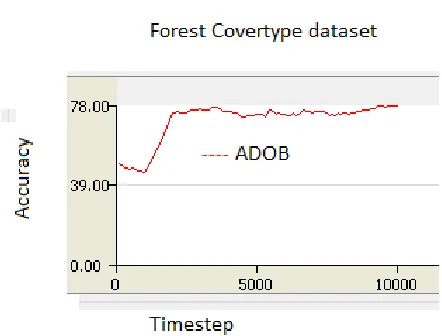
Figure 6: Average accuracy achieved by ADOB algorithm on the Forest Covetype dataset
The average accuracy of the ADOB algorithm on the Forest Covertype dataset reached 77.40%. The algorithm adapts to new concepts slowly and is unstable in situations where the severity of change is significant. The algorithm recovers slowly from a drift as the volume of the data increases, predictive accuracy of the algorithm decreases.
5.1
Tables
The table below provides a summary of the performances of the algorithms on both the synthetic and real world dataset.
Table 1: Accuracy of the algorithms on both synthetic and real world datasets
Benchmark dataset AceBoost DivBoost ADOB
Waveform 84.30 73.70 81.80
6
Conclusions
In this paper, we presented the Adaptive Classifier Ensemble Boost (AceBoost), a new ensemble algorithm that exploits diversity to learn big data in dynamic environments associated with drifting concepts. Since the algorithm is based on the premises of the equality that exists between maximizing the margin and increasing ensemble diversity, generalisation performance for classification is easily optimized by increasing or decreasing the voting margins. AceBoost uses the Double Fault measure as the diversity measure and the values are controlled through a proxy parameter. This makes the algorithm suitable to adapt to any type of drift encountered in huge streaming data. The results achieved by AceBoost indicate that we could benefit from an ensemble classifier designed to learn big data by varying the amounts of diversity. The performance of AceBoost on big streaming data wast compared with other two state of the algorithms. AceBoost performed comparably well against the two state of the algorithms. The problem of learning big data in nonstationary environments associated with concept drift can be solved using machine learning methods such as ensembles that can vary their diversity levels. In some scenarios, low diversity ensembles typically adapt accurately on new concepts and high diverse ensembles always adapt faster. For future work, various diversity measures can be tested their suitability and their link to voting margins.
References
L.I. Kuncheva, “Classifier ensembles for detecting concept drift in streaming data: An Overview and perspectives” , Supervised and Unsupervised Ensemble Methods and their Applications, Volume 2, pages 5-9, 2008
Michael J.Procopio, “ An experimental analysis of classifier ensembles for learning drifting concepts”, PhD, University of Florida, 2007.
Thomas G. Ditterich, “Machine Learning Research”, AI Magazine, 18(4), pages 97-136, 1997.
Richard Stapenhurst, Gavin Brown, “Theoretical and Empirical Analyis of Diversity in Non-Stationary Learning”, IEEE Symposium on Computational Intelligence in Dynamic and Uncertain Environments, Paris, France, April 2011.
L.Kuncheva, C.Whitaker, “Ten measures of diversity in classifier ensembles: Limits for two classifiers” In Proceedings of the IEE Workshop on Intelligent Sensor Processing, pages 1-10, 2001.
E.K Tang, P.N. Suganthan, X.Yao, “An analysis of diversity measures”, Machine Learning 65(2006), pages 247-271.
L.I Kuncheva, C.J Whitaker, “Measures of diversity in Classifier Ensembles and their relationship with the ensemble accuracy”, Machine Learning, Volume 51, pages 181-207, 2003.
Leandro Minku, X.Yao, “DDD: A New Ensemble Approach for dealing with concept drift” IEEE Transactions on Knowledge and Data Engineering, 24(4), pages 619-633, 2012.
Joao Gama, Pedro Medas, Gladys Castillo, Pedro Rodriguez, “Learning with Drift Detection”. Brazilian Symposium on Artificial Intelligence, pages 286-295, 2004. Haixum Wang, Wei Fan, Philip S.Yu, Jiawei Han, “Mining Concept-Drifting Data Streams using Ensemble Classifiers”, In KDD’03: Proceedings of the ninth ACM SIGKDD International Conference on Knowledge Discovery and Data Mining, New York, NY, USA, pages 226-235, 2003.