Research Paper:
Validity and Reliability of OARS
Multidimensional Functional Assessment Questionnaire in
Iranian Elderly
Ali Falahati1 , Robab Sahaf2* , Ahmad Ali Akbari Kamrani2 , Yadollah Abolfathi Momtaz3,4 , Mehdi Rassafiani5,6 , Gerda Fillenbaum7
1. Department of Aging, University of Social Welfare and Rehabilitation Sciences, Tehran, Iran.
2. Iranian Research Center on Aging, Department of Aging, University of Social Welfare and Rehabilitation Sciences, Tehran, Iran. 3. Department of Gerontology, University of Social Welfare and Rehabilitation Sciences, Tehran, Iran.
4. Malaysian Research Institute on Ageing (My Ageing), Universiti Putra Malaysia, Serdang, Selangor, Malaysia. 5. Department of Occupational Therapy, Faculty of Allied Health Sciences, Kuwait University, Kuwait City, Kuwait. 6. Pediatric Neurorehabilitation Research Center, University of Social Welfare and Rehabilitation Sciences, Tehran, Iran. 7. Center for the Study of Aging and Human Development, Durham, North Carolina, USA.
* Corresponding Author: Robab Sahaf, PhD
Address: Iranian Research Center on Aging, Department of Aging, University of Social Welfare and Rehabilitation Sciences, Tehran, Iran.
Tel: +98 (912) 8204187
E-mail: [email protected]
Objectives: The present study examined the psychometric properties of the Persian version of the OARS multidimensional functional assessment questionnaire (MFAQ/OARS) in Iranian elderly.
Methods: This non-experimental psychometric study utilized the Persian translated questionnaire based on the IQOLA protocol. The study cohort was selected from the comprehensive healthcare centers across Kashan, Iran in 2016, based on the interviews with 482 adults ≥60-year-old (269 men and 213 women). The face validity of the questionnaire was assessed according to the experts’ opinions, while the content validity was assessed using the Lawshe and Bausell–Waltz methods. The concurrent validity and inter-rater reliability were assessed for each of the five domains of functioning. Test-retest reliability was assessed using the Intraclass Correlation Coefficient (ICC).
Results: The questionnaire exhibited adequate face validity. The Lawshe and Bausell–Waltz methods revealed a 98% content validity estimation of the items, and those with lower values were maintained in the questionnaire after necessary modifications. The MFAQ/OARS was correlated with the WHODAS 2.0 and the GDS15 (P<0.0001), which indicated the acceptable concurrent validity of the questionnaire. All domains of the questionnaire showed satisfactory inter-rater reliability estimates, and the ICC was >0.89 for all domains except for the activities of daily living (ICC=0.78). The test-retest reliability for the five domains was 0.72–1. Discussion: According to the study results, the Persian version of MFAQ/OARS presented a satisfactory face, content, and concurrent validity, and reliability for functional assessment among Iranian elderly. Therefore, it can be used in clinical fields and research studies to assess the functioning of elderly in various life domains.
A B S T R A C T
Article info:
Received: 28 Nov 2017
Accepted: 10 Feb 2018
Keywords:
Psychometric, Geriatric assessment, Aging Iran, Translation
Citation: Falahati A, Sahaf R, Akbari Kamrani AA, Abolfathi Momtaz Y, Rassafiani M, Fillenbaum G. Validity and Reliabil-ity of OARS Multidimensional Functional Assessment Questionnaire in Iranian Elderly. Iranian Rehabilitation Journal. 2018; 16(2):169-176. http://dx.doi.org/10.32598/irj.16.2.169
:
: http://dx.doi.org/10.32598/irj.16.2.169
Use your device to scan
1. Introduction
he worldwide elderly population is grow-ing rapidly due to various factors such as improvement in sanitary and health con-ditions, improved medical care, reduced mortality rates, and increased birth rates. Thus, this population has increased from 200 million in 1950 to 600 million in 2012, and the figure is estimated to reach 2 billion by 2050 [1]. According to 2016 census in Iran, 9.2% of the Iranian population (about 7 million) were >60-year-old [2]. With increasing age, people tend to experience reduction in all their functioning abilities
[3]. The International Classification of Functioning, Dis-ability, and Health (ICF) is a widely used framework for classifying and describing the information regarding health, disability, and functioning. ICF is a conceptual basis and utilized standard language for describing and measuring the health and disability. According to this classification system, function refers to the body func-tions, activities, and participation, while disability refers to the impairments and limitations in the activity and participation [4].
The quality of life and general health may be influ-enced negatively by reduced functioning [5]. Therefore, the health and quality of life of aging individuals as well as their level of functioning should be assessed regularly in order to plan appropriate interventions for their im-provement [6]. Since different domains are involved in the functioning of older adults, instruments capable of concurrent assessment of all the different domains of functioning are essential. Some questionnaires that can be used to assess the functional ability include Katz in-dex [7], Barthel index [8], Lawton [9], World Health Or-ganization Disability Assessment Schedule (WHODAS) 2.0 [10], and care dependency scale [11] in the elderly. Although all these tools can assess the functioning in a specific domain based on the researcher’s objective, none of them can concurrently assess the functioning in different domains (except WHODAS 2.0 that does not assess the economic and physical health domains), thereby indicating the advantage of MFAQ/OARS (mul-tidimensional functional assessment questionnaire/older Americans resources and services).
It seems to be an appropriate assessment address-ing five domains of functionaddress-ing specifically designed for elderly, which includes social resources, economic resources, physical health resources, mental health re-sources, and selfcare capacity (activities of daily living) in part A, while part B evaluates the level of using the services [12]. Each domain of functioning receives a
score ranging from 1 (highest level of functioning) to 6 (total impairment in the functioning). The total function-ing score is calculated based on the performance in all domains, and ranges from 5 (highest level of function-ing) to 30 (total impairment in the functionfunction-ing) [12].
The MFAQ/OARS has been translated into at least to eight languages such as Dutch, Italian, Australian Eng-lish, EngEng-lish, Swedish, Spanish, Portuguese, and Bra-zilian. The social resources domain has been validated by a joint study in The Netherlands, Italy, Austria, Eng-land, and Sweden [13], and the mental health domain has been validated in Brazil [14]; all the five domains have been validated in Spain [15] and Portugal [16]. Overall, the main version and the other forms of the questionnaire in various languages have shown satisfac-tory validity and reliability [13-16]. Given that old age is a critical stage of life and that the elderly population is growing continuously in Iran, the limitations of us-ing non-validated tools due to lus-inguistic, cultural, and geographical differences led the present study to exam-ine the psychometric properties of the Persian version of MFAQ/OARS in Iranian elderly. To the best of our knowledge, the questionnaire is the only multidimen-sional tool that assesses the function among older indi-viduals. This study would develop an appropriate tool for the comprehensive evaluation of the elderly and provide the basic information that would the healthcare policy makers and clinicians to plan interventions.
2. Methods
The present study is a non-experimental, psychometric study, and prior permission was obtained from the author of the MFAQ/OARS. Then, according to the IQOLA protocol [17], two individuals proficient in the English language translated the questionnaire into Persian. After making the necessary revisions, the other two transla-tors back-translated the questionnaire into English. The items not compatible with the Iranian culture were re-placed. Next, the questionnaire was sent to the author, who approved the consistency between the two forms of the questionnaire. Subsequently, the validity and reli-ability of the Persian version of the MFAQ/OARS were examined. In order to assess the face validity, the ques-tionnaire was sent to 18 experts for their opinion on the quality of translation, comprehensibility, and appropri-ateness for the Iranian population. These highly expe-rienced professionals belonged to different disciplines, including gerontology [7], occupational therapy [7], psychology [3], and physiotherapy [1], and their average age was 44.5±7.11 years.
Two indices were used to assess the content validity quantitatively: Content Validity Ratio (CVR) and Con-tent Validity Index (CVI). According to the Lawshe table for determining the minimum CVR, items with CVRs ≥0.42 (based on the opinions of 18 experts) were maintained [18]. The CVI based on the Bausell–Waltz method was set as >79% [19]. In the next step, a total of 482 adults >60-year-old, attending the Comprehen-sive Healthcare Centers in Kashan, Iran, participated in this study. The inclusion criteria were as follows: age >60 years, the absence of cognitive disorders, and in-formed consent obtained for participation in the study. The study objectives were explained to the participants by the researchers, and the questionnaires completed by interviews. All statistical analyses were performed using SPSS version 23. In all the stages of completing the questionnaire, ethical considerations were addressed. Only those who were interested in participating in the study were recruited, the interviews did not hurt the par-ticipants or cost them anything, and the parpar-ticipants were allowed to leave the study at any time. This article was extracted from a Master’s thesis (Number: 941193014) by the first author and approved by the Ethics Commit-tee at the University of Social Welfare and Rehabilitation Sciences (Number: IR.USWR.REC.1395.235).
In order to assess the concurrent validity of MFAQ/ OARS, the WHODAS 2.0 validated in Iran by Abedza-deh et al. [20] and geriatric depression scale (GDS-15) validated in Iran by Malakuti et al. [21] were also completed by the participants. The original form of the WHODAS 2.0 was developed by the WHO in 1988 based on ICF to assess the respondents’ activities, limita-tions, and participation limitations [10]. It is a general tool for assessing the health and disability and can be used for both patients and the general population. The WHODAS 2.0 assesses the following domains: cog-nition (understanding and communicating), mobility, self-care, getting along (interacting with other people), life activities, and participation (joining in community activities); The complete form of this instrument com-prises of 36 items [10]. The original form of GDS-15 was developed by Yesavage et al., and the long form of this questionnaire consisted of 30 items. In the present study, the 15-item version of GDS-15 was utilized [22]. Then, the correlations between the scores on the MFAQ/ OARS and WHODAS 2.0 and GDS-15 were estimated using the Spearman’s rank correlation coefficient.
In addition, the inter-rater reliability was assessed. First, the raters were trained, and then, they independently pro-vided their ratings. The correlation coefficient between the ratings and the Intra-class Correlation Coefficient
(ICC) was used to assess the inter-rater reliability. In or-der to assess the test-retest reliability, the MFAQ/OARS was completed by 20 elderly from the sample on two occasions at an interval of 2 weeks, and the consistency was assessed using the ICC.
3. Results
A total of 482 adults, aged >60 (ranged 60–96, mean=71.74±9.82) years, participated in the present study. The participants’). The cohort comprised of 269 (55.8%) males and 213 (44.2%) females. 95.6% of the participants had an education level lower than that of high school diploma, 87.2% were Persian, and 34% lived alone. Table 1 summarized the demographic char-acteristics of the participants.
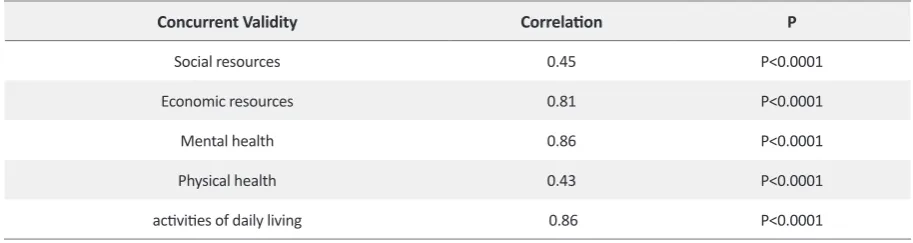
The average time of completing the questionnaire was 51.14±7.01 min. Regarding face validity, all the 10 ex-perts reported the quality of translation, comprehensi-bility, and appropriateness of the MFAQ/OARS for the Iranian population as acceptable. The examination of the content validity indicated that 2 items had a CVR<0.42 and 2 other items had a CVI<0.79; these items were maintained in the questionnaire after making minor modifications for compatibility with the Iranian culture. The concurrent validity of the MFAQ/OARS was as-sessed by concurrent administration of WHODAS 2.0 and GDS-12 and calculating the Spearman’s rank cor-relation coefficient for each domain of functioning. The results were presented in Table 2. The inter-rater reliabil-ity for each domain of functioning was also examined
(Table 3). According to the results, there was a signifi-cant relationship observed, which indicated satisfactory inter-rater reliability.
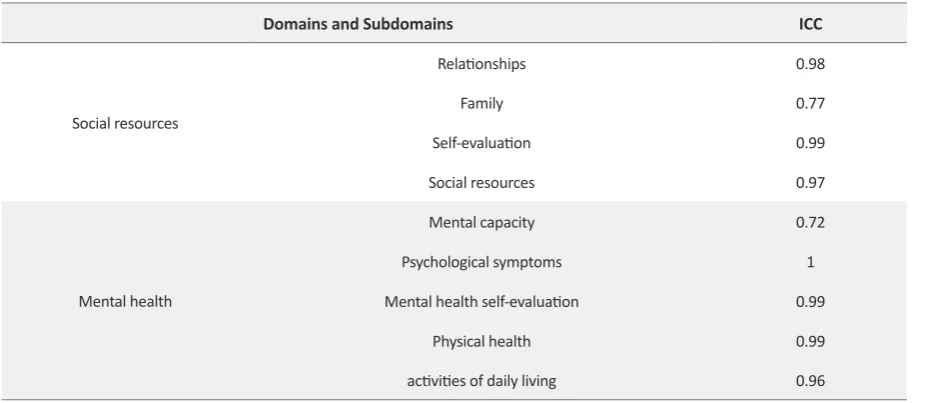
The ICC indicated a significant agreement between the first and second stage of the questionnaire (P<0.0001), thereby demonstrating the replicability of the scores on the domains and subdomains of the MFAQ/OARS and its total score. The ICC for each domain of functioning was also demonstrated in Table 4.
Table 1. Demographic characteristics of the study sample (n=482)
Variable Frequency Percentage
Gender Male 269 55.8
Female 213 44.2
Ethnicity
Persian 420 87.2
Turk 31 6.4
Kurd 20 4.1
Lur 11 2.3
Education
0-4 years 235 48.8
5-8 years 216 44.7
Unfinished high school 10 2.1
High school diploma 9 1.9
Bachelor’s degree 7 1.5
Master’s degree 5 1
Marital status
Single 25 5.2
Married 315 65.4
Widowed 110 22.8
Divorced 32 6.6
Living arrangement
Only with partner 195 40.5
Alone 164 34
With partner and children 117 24.3
With a friend 4 0.8
Only with children 2 0.4
Table 2. Correlations between MFAQ/OARS scores and those administered concurrently
Concurrent Validity Correlation P
Social resources 0.45 P<0.0001
Economic resources 0.81 P<0.0001
Mental health 0.86 P<0.0001
Physical health 0.43 P<0.0001
The face validity of the MFAQ/OARS indicated the simplicity and clarity of the statements from the Iranian population. In the examination of content validly, all the questionnaire items were maintained, thereby confirm-ing the content validity of the MFAQ/OARS.
The concurrent validity of the MFAQ/OARS in the el-derly was examined using Spearman’s rank correlation coefficient in each of the five domains. It was found to be moderate for social resources and physical health and high for economic resources, mental health, and activi-ties of daily living (>0.80).
4. Discussion
ICC was used to examine the inter-rater reliability for each of the five domains (0.78–0.97); the lowest and highest correlation coefficients indicated the activities of daily living and economic resources, respectively. However, regarding the inter-rater reliability of the
original version of the questionnaire, the lowest ICC was for physical health (0.66), and the highest for ev-eryday activities (0.86). Therefore, in both studies, the inter-rater reliability for all the five domains was re-ported as satisfactory [12]. The test-retest reliability of the questionnaire was also adequate for all the domains and subdomains. The test-retest reliability of the original questionnaire was reported as 90.7 [4]. According to the results obtained in this study, the validity and reliability were confirmed for Iranian elderly.
5. Conclusion
The MFAQ/OARS tool exhibits a satisfactory validity and reliability in assessing the functioning ability of Ira-nian elderly. It is a comprehensive instrument assessing different domains of functioning. On the other hand, it also compares between the overall score and different domain scores; therefore, researchers using this ques-tionnaire can compare the respondent’s scores on
dif-Table 3. Correlation between ratings
Domains ICC
Social resources 0.96
Economic resources 0.97
Mental health 0.95
Physical health 0.89
Activities of daily living 0.78
Table 4. Intraclass Correlation Coefficient (ICC)
Domains and Subdomains ICC
Social resources
Relationships 0.98
Family 0.77
Self-evaluation 0.99
Social resources 0.97
Mental health
Mental capacity 0.72
Psychological symptoms 1
Mental health self-evaluation 0.99
Physical health 0.99
ferent domains and take appropriate decisions about the care of the elderly based on the MFAQ/OARS scores.
The MFAQ/OARS tool can be used for hospitalized elderly, as well as, those residing in retirement homes. However, the present study was only focused on the el-derly living in the community. Therefore, future studies are essential to assess the psychometric properties of the questionnaire in the other populations of older individu-als. Nevertheless, the present study had some limitations considering the economic differences between Iran and the USA. Thus, future studies should encompass the opinions of economic experts. The validity in the eco-nomic domain could be improved by considering the level of inflation and poverty line and accurate catego-rization of income levels. Finally, we suggest that the MFAQ/OARS should be used in functional assessments of the elderly and determining the level of optimal care.
Ethical Considerations
Compliance with ethical guidelines
This article was approved by the Ethics Committee at the University of Social Welfare and Rehabilitation Sciences (Number: IR.USWR.REC.1395.235). The informed consent was obtained for participation in the study. The study objectives were explained to the partici-pants by the researchers.
Funding
This study was not supported by a specific grant from any funding agency, and hence, was funded by the first author. It was extracted from a Master’s thesis (Number: 941193014) by the first author in Department of Aging, University of Social Welfare and Rehabilitation Scienc-es, Tehran, Iran.
Conflict of interest
The authors declare no conflict of interest.
Acknowledgments
The authors sincerely thank Dr. Hosseinzadeh, the translators, and all those who helped in this project.
References
[1] Shirazi Khah M, Mousavi M, Sahaf R. [Study of health and
social indicators of elderly women in Iran (Persian)]. Iranian Journal of Ageing. 2012; 6(S1):66-78.
[2] Amini R ISR, Sahaf R. Aging in Iran: past, present and
fu-ture. Journal of Aging in Emerging Economies. 2013; 4(1):17-34.
[3] Arking R. Biology of aging: Observations and principles.
Oxford: Oxford University Press; 2006.
[4] World Health Organization. International classification
of functioning, disability and health (ICF). Geneva: World Health Organization; 2001.
[5] Halter J, Ouslander J, Tinetti M, Studenski S, High K,
Astha-na S. Hazzard’s geriatric medicine and gerontology. New York: McGraw-Hill; 2009.
[6] Üstün TB, Chatterji S, Kostansjek N, Bickenbach J. WHO’s
ICF and functional status information in health records.
Health Care Financing Review. 2003; 24(3):77. [PMID] [PMM
-CID]
[7] Katz S, Ford AB, Moskowitz RW, Jackson BA, Jaffe MW.
Studies of illness in the aged: the index of ADL: a standard-ized measure of biological and psychosocial function. JAMA.
1963; 185(12):914-9. [DOI:10.1001/jama.1963.03060120024016]
[PMID]
[8] Oveisgharan S, Shirani S, Ghorbani A, Soltanzade A, Baghaei
A, Hosseini S, et al. Barthel index in a Middle-East country: Tanslation, validity and reliability. Cerebrovascular Diseases.
2006; 22(5-6):350-4. [DOI:10.1159/000094850] [PMID]
[9] Graf C. The Lawton instrumental activities of daily living
(IADL) scale. Medsurg Nursing. 2009; 18(5):315-6. [PMID]
[10] Üstün TB, Chatterji S, Kostanjsek N, Rehm J, Kennedy C, Epping-Jordan J, et al. Developing the World Health Organization disability assessment schedule 2.0. Bulle-tin of the World Health Organization. 2010; 88(11):815-23.
[DOI:10.2471/BLT.09.067231] [PMID] [PMCID]
[11] Rajabi G, Namadmalan M, Ghasemzadeh R, Foroughan M, Zahednejad S, Dijkstra A. [Psychometric properties of the Per-sian version of care dependency scale in older people nursing home residents (Persian)]. Payesh. 2015; 14(2):193-204.
[12] Fillenbaum GG. Multidimensional functional assessment of older adults: The Duke Older Americans Resources and Services procedures. London: Psychology Press; 2013.
[13] Burholt V, Windle G, Ferring D, Balducci C, Fagerström C, Thissen F, et al. Reliability and validity of the Older Ameri-cans Resources and Services (OARS) social resources scale in six European countries. The Journals of Gerontology Series B: Psychological Sciences and Social Sciences. 2007;
62(6):S371-S9. [DOI:10.1093/geronb/62.6.S371] [PMID]
[14] Blay SL, Ramos LR, Mari JJ. Validity of a Brazilian ver-sion of the Older Americans Resources and Services (OARS) mental health screening questionnaire. Journal of the American Geriatrics Society. 1988; 36(8):687-92.
[DOI:10.1111/j.1532-5415.1988.tb07169.x]
Question-naire: Cross-cultural adaptation and validity measurement. Atención Primaria. 1996; 17(8):486-95.
[16] Rodrigues RMC. [Validation of the European Portuguese version of the Older Americans Resources and Services in-strument (Spanish)]. Pan American Journal of Public Health. 2008; 23(2):109-15.
[17] Bullinger M, Alonso J, Apolone G, Leplège A, Sullivan M, Wood-Dauphinee S, et al. Translating health status question-naires and evaluating their quality: the IQOLA project ap-proach. Journal of Clinical Epidemiology. 1998; 51(11):913-23.
[DOI:10.1016/S0895-4356(98)00082-1]
[18] Salavati M, Mazaheri M, Khosrozadeh F, Mousavi SME, Negahban H, Shojaei H. The Persian version of locomotor ca-pabilities index: translation, reliability and validity in individ-uals with lower limb amputation. Quality of Life Research.
2011; 20(1):1-7. [DOI:10.1007/s11136-010-9716-3] [PMID]
[19] Yaghmaei F. [Critical review of psychometric properties in research questionnaires (Persian)]. Faculty of Nursing of Mid-wifery Quarterly. 2006; 16(52): 66-75.
[20] Abedzadeh–kalahroudi M, Razi E, Sehat M, Asadi-Lari M. Psychometric properties of the world health organiza-tion disability assessment schedule II-12 Item (WHODAS II)
in trauma patients. Injury. 2016; 47(5):1104-8. [DOI:10.1016/j.
injury.2015.11.046] [PMID]
[21] Malakouti K FP, Mirabzadeh A, Salavati M, Kahani S. [Val-idation of Geriatric Depression Scale (GDS-15) in Iran (Per-sian)]. Research in Medicine. 2006; 30(4):361-9.
[22] Yesavage JA, Sheikh JI. 9/Geriatric Depression Scale (GDS) recent evidence and development of a shorter version.
Clinical Gerontologist. 1986; 5(1-2):165-73. [DOI:10.1300/