Vol. 8, No. 4, 2016 Article ID IJIM-00786, 10 pages Research Article
A new evaluation model for selecting a qualified manager by using
fuzzy Topsis approach
S. M. Hosseini ∗†
Received Date: 2015-11-13 Revised Date: 2016-01-04 Accepted Date: 2016-02-11
————————————————————————————————–
Abstract
Considering the contemporary business settings, managers role is more than essential to the viability and further development of an organization. Managers should possess such skills in order to effectively cope with the competition. Multiple attributes decision making (MADM) is an approach employed to solve problems involving selection from among a finite number of alternatives. The aim of this study is to develop a methodology to evaluate managers based on integrating fuzzy AHP and fuzzy TOPSIS approaches. In this paper, I have taken into consideration some important criteria which affect the process of managers selection. I have calculated the weights for each criterion based on Interval-valued fuzzy AHP and then inputted these weights to the fuzzy TOPSIS method to rank managers. The entire methodology is illustrated with the help of a numerical example and finally the rank of each managers is determined according to its results. The proposed method enables decision analysts to better understand the complete evaluation process and provide a more accurate, effective, and systematic decision support tool. Also, the proposed method provides a useful way for handling fuzzy TOPSIS based on fuzzy numbers.
Keywords: Fuzzy number; Fuzzy TOPSIS; Multiple criteria decision-making.
—————————————————————————————————–
1
Introduction
F
utroduced in [zzy numbers and fuzzy arithmetic were in-37, 14, 22]. The fuzzy function was introduced in [6]. Then, the authors [13] pre-sented an elementary calculus based on the [13]. Fuzzy numbers are study a variety of problems ranging from various spaces [7], to control chaotic systems [15, 17, 38], fuzzy differential equations [3], fuzzy integral equations [25, 28], fuzzy lin-ear and nonlinlin-ear systems [1,2] and fuzzy neural network [26,27,29].Methods of approximate inference based on fuzzy set theory allow formal representation to be
∗Corresponding author. [email protected] †Department of Manegment, Firoozkooh Branch, Is-lamic Azad University, Firoozkooh, Iran.
built for verbal decision-making procedures con-taining vague, fuzzy premises [16]. These pro-cedures, as a rule, are described by sets of ver-bal, conditional statements (verbal implications). Methods of approximate inference is based on the extension of the concept of a fuzzy set by an interval-valued fuzzy set (or more precisely: a fuzzy set with an interval-valued membership function, see Zadeh [37]).
It is a clear fact that every organizations man-agement system defines and directs its present and future, in particular under the aforemen-tioned present circumstances. Management poli-cies, processes, tools and structures play a critical role on how to exploit the opportunities and avoid the threats. Improved management skills can be achieved through training and development
grams inside an organization, as well as through-experienceinpractice.Nevertheless,the initial and decisive step is the selective selection of those managers that possess at a minimum extent a number of contemporary management skills. TOPSIS is a popular approach to multiple crite-ria decision making (MCDM) problems that was proposed by Hwang and Yoon [21, 36]. The ba-sic principle is that the chosen alternative should have the shortest distance from the positive ideal solution and the farthest distance from the neg-ative ideal solution. In the TOPSIS, the per-formance ratings and the weights of the criteria are given as crisp values. Chen [8] presented a method for fuzzy group decision making situa-tions based on the ranking of generalized trape-zoidal fuzzy numbers. The authors [33] develop a fuzzy version of TOPSIS method based on fuzzy arithmetic operations, which leads to a fuzzy rela-tive closeness for each alternarela-tive. Recently fuzzy TOPSIS successfully used for MCDM problems [12, 31, 32]. Ashtiani et al. in [4] used fuzzy TOPSIS method based on interval-valued fuzzy sets for solving MCDM problems, but applying it for some fuzzy MCDM problems leads to the in-correct solution and results. Therefore, Mokhtar-ian [27] tried to eliminate this problem.
Taking into account the above mentioned, the aim of this paper is to propose a new approach towards managers selection problem and fuzzy AHP is used to determine the preference weights of evaluation. Then, this research adopts the fuzzy TOPSIS to improve the gaps of alternatives between real performance values and pursuing as-pired levels in each dimension and criterion and find out the best alternatives.
2
The fuzzy AHP
Gorzalczany [16] proposed the concept of interval-valued fuzzy sets. Then, Yao and Lin [35] represented the interval-valued fuzzy set [ ¯AL,A¯U]
where ¯ALdenotes the lower interval-valued fuzzy set, ¯AU denotes the upper interval-valued fuzzy set, and ¯AL ⊂ A¯U. Thereby, the minimum and
maximum membership value of ¯AL are ¯AL and ¯
AU, respectively.
Assume that there are two interval-valued tri-angular fuzzy numbers ¯A and ¯B, where
¯
A= [(aL1, aL2, aL3;hLA¯),(aU1, aU2, aU3;hUA¯)]
and
¯
B= [(bL1, bL2, bL3;hLB¯),(bU1, bU2, bU3;hUB¯)],
aL1, aL2, aL3, aU1, aU2, aU3, bL1, bL2, bL3, b1U, bU2 andbU3 are real values, 0 ≤ hLA¯ ≤ hAU¯ ≤ 1 and 0 ≤ hLB¯ ≤ hUB¯ ≤ 1. The arithmetic operations between the triangular fuzzy numbers ¯A and ¯B are reviewed from [10].
We will briefly introduce that how to carry out the AHP in this section.
In first time, construct pairwise comparison matrices among all the elements/criteria in the dimensions of the hierarchy system. Assign lin-guistic terms to the pairwise comparisons by ask-ing which is the more important of each two di-mensions, as following matrix ¯C.
¯
C=
1 c¯12 . . . c¯1n
¯
c21 1 . . . c¯2n
..
. ... . .. ... ¯
cn1 c¯n2 . . . 1
=
1 ¯c12 . . . ¯c1n
1 ¯
c12 1 . . . ¯c2n
..
. ... . .. ... 1
¯
c1n
1 ¯
c2n . . . 1
(2.1)
where
¯
cij =
1 ¯ 7, . . . ,
1 ¯ 2,
1 ¯
1,¯1,¯2, . . . ,¯7, i̸=j,
1, i=j.
Then to use geometric mean technique to define the fuzzy geometric mean and fuzzy weights of each criterion by Hsieh et al. [18]
¯
ri = (¯ci1⊗ · · · ⊗¯cij ⊗ · · · ⊗c¯in)1/n,
¯
wi= ¯ri⊘(¯r1⊕ · · · ⊕r¯i⊕ · · · ⊕r¯n),
where cij is a IVF comparison value of
dimen-sion ito criterionj, thus, ¯ri is a geometric mean
of interval-valued fuzzy comparison value of cri-terion i to each criterion, ¯wi is the IVF weight
of the ith criterion, can be indicated by a IVF, ¯
wi = [(wL1, w2L, w3L;hLw¯),(wU1, wU2, wU3;hUw¯)]. The
wL1, wL2 and wL3 stand for the lower, middle, and upper values of the ¯wLi andw1U, w2U andw3U stand for the lower, middle, and upper values of the ¯wUi
weight of the ith dimension.
3
The fuzzy TOPSIS
TOPSIS method is easy to understand and to implement. These issues are of fundamental im-portance for a direct field implementation of the method by practitioners. Moreover, it allows the straight linguistic definition of importance and ratings under each criterion, without the need of cumbersome pairwise comparisons and the risk of inconsistencies.
Suppose a crisp MCDM problem has n al-ternatives (A1, . . . , Am) and n decision
cri-teria/attributes (C1, . . . , Cn). Each
alterna-tive is evaluated with respect to the n crite-ria/attributes. Due to the fact that, in some cases, determining the exact values for the ele-ments of decision matrix is difficult, so, their val-ues are considered as fuzzy numbers [24]. In other words, in fuzzy MCDM problems, the values of al-ternatives with respect to each criterion/attribute and the values of relative weights with respect to each criterion/attribute are usually character-ized by fuzzy numbers. By considering the fact that, the TOPSIS method can also be used to deal with MCDM problems as a popular, accu-rate, and easy to use method. The steps of the proposed method can be described as follows:
Step 1: Determine the weighting of evaluation criteria. This research employs fuzzy AHP to find the fuzzy preference weights.
Step 2: Construct the fuzzy perfor-mance/decision matrix and choose the ap-propriate linguistic variables for the alternatives with respect to criteria
¯
D=
C1 C2 · · · Cn A1
A2 .. .
Am
¯
x11 x¯12 · · · x¯1n
¯
x21 x¯22 · · · x¯2n
..
. ... . .. ... ¯
xm1 x¯m2 · · · x¯mn .
i= 1,2, . . . , m;j= 1,2, . . . , n
¯
xij = K1(¯x1ij ⊕ · · · ⊕x¯kij ⊕ · · · ⊕x¯Kij)
(3.2) where ¯xkij is the performance rating of alternative
Ai with respect to criterion Cj evaluated by kth
expert, and ¯
xkij = [((xkij)L1,(xkij)L2,(xkij)L3;hL¯xk ij
),
((xkij)U1,(xkij)2U,(xkij)U3;hUx¯k ij
)].
Step 3: Normalize the fuzzy-decision matrix. The normalized fuzzy-decision matrix denoted by
¯
R is shown as following formula:
¯
R= [¯rij]m×n, i= 1,2, . . . , m; j= 1,2, . . . , n.
(3.3) The normalization process can be performed by following formula:
¯
rij = [((xij) L
1
(x+j)U
3
,(xij)L2
(x+j)U
3
,(xij)L3
(x+j)U
3
;hLxij¯ ),
((xij)U1
(x+j)U
3
,(xij)U2
(x+j)U
3
,(xij)U3
(x+j)U
3
;hUxij¯ )],
(x+j )U3 =maxi{(xij)U3|j= 1,2, . . . , n},
i= 1,2, . . . , m; j= 1,2, . . . , n.
(3.4)
Also we can set the best aspired level (x+j )U3 and
j = 1,2, . . . , n is equal one; otherwise, the worst is zero. The weighted fuzzy normalized decision matrix is shown as following matrix ¯U:
¯
U = [¯uij]m×n, i= 1,2, . . . , m; j= 1,2, . . . , n,
(3.5) where ¯uij = ¯rij ⊗w¯j.
Step 4: Determine the IVF positive-ideal so-lution (FPIS) and IVF negative-ideal soso-lution (FNIS). According to the weighted normalized fuzzy-decision matrix, we know that the elements ¯
uij are normalized positive IVF and
0≤(uij)L1 ≤(uij)L2 ≤(uij)L3 ≤1,
0≤(uij)U1 ≤(uij)U2 ≤(uij)U3 ≤1,
0≤hL¯xij ≤hU¯xij ≤1.
Then, we can define the FPIS ¯A+(aspiration lev-els) and FNIS ¯A− (the worst levels) as following formula:
¯
A+= (¯u+1, . . . ,u¯+j , . . . ,u¯+n) (3.6)
¯
A−= (¯u−1, . . . ,u¯−j , . . . ,u¯−n) (3.7)
where ¯u+j = [(1,1,1; 1),(1,1,1; 1)]⊗w¯j and ¯u−j =
[(0,0,0; 1),(0,0,0; 1)]⊗w¯j, j = 1,2, . . . , n.
FPIS and FNIS is now presented as follows:
Si+=∑nj=1S(¯uij,u¯+j ) = ∑n
j=1
(1−
∑3
k=1|((uij)Uk−(uij) L k)−((u
+
j)Uk−(u
+
j)Lk)|
3 );
Si−=∑nj=1S(¯uij,u¯−j ) = ∑n
j=1
(1−
∑3
k=1|((uij)Uk−(uij) L
k)−((u−j)Uk−(u−j)Lk)|
3 );
i= 1,2, . . . , m.
(3.8)
Step 6: The relative closeness can be calculated as follows:
Ri = Si−
Si++Si−, i= 1,2, . . . , m. (3.9)
Then, rank alternatives in terms of their relative closeness’s.
4
Selecting a qualified manager
The purpose of the empirical application is to illustrate the use of the suggested method. Suppose that a company intends to choose a manager from four volunteers named A1, A2, A3 andA4. The decision making committee assesses the four concerned volunteers based on six criteria which follow:
a) Creative (C1),
b) proficiency in identifying research areas (C2), C) proficiency in administration (C3),
d) personality (C4), e) past experience (C5), f) self-confidence (C6).
The number of the committee members is three, labeled as DM¯ 1,DM¯ 2 and DM¯ 3 respec-tively. Each decision maker has presented his assessment based on linguistic variable for rat-ing performance and importance of each criterion by a linguistic variable as depicted in Appendix. The comparison of the importance or preference of one criterion, attribute or alternative over an-other can be done with the help of the question-naire. The method of calculating priority weights of the different decision alternatives is discussed below.
Step 1: The weights of evaluation dimensions. We adopt IVF-AHP method to evaluate the weights of different dimensions. Following the construction of IVF-AHP model, it is extremely
important that experts fill the judgment matrix. The following section demonstrates the compu-tational procedure of the weights of dimensions.
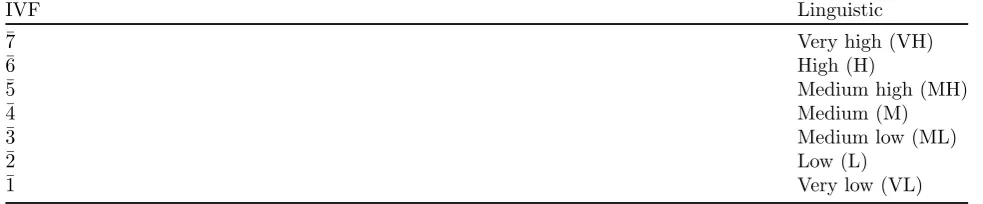
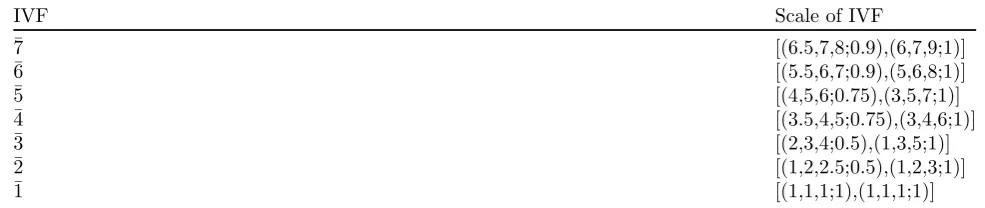
(1) According to the committee with three rep-resentatives about the relative important of di-mension, then the pairwise comparison matrices of dimensions will be obtained. We apply the IVFN defined in Table1and Table2. We transfer the linguistic scales to the corresponding IVFN.
(2) Computing the elements of synthetic pair-wise comparison matrix by using the geometric mean method suggested by Buckley [5] that is ¯
aij = (¯a1ij ⊗¯a2ij ⊗a¯3ij)1/3, for ¯dm12 as the exam-ple:
¯
c12= (M H ⊗M L⊗V H)1/3 =
[((4×2×6)1/3,(5×3×7)1/3,(6×4×8)1/3; 0.5),
((3×1×5)1/3,(7×5×3)1/3,(9×7×5)1/3; 1)] =
[(3.63,4.72,5.77; 0.5),(2.47,4.72,6.80; 1)]
It can be obtained the other matrix elements by the same computational procedure, therefore
¯
C=
C1 C2 · · · C6
C1
C2 .. .
C6
¯
c11 c¯12 · · · ¯c16 ¯
c21 c¯22 · · · ¯c26 ..
. ... . .. ... ¯
c61 c¯62 · · · ¯c66
Table 1: Definitions of linguistic variables for the importance of each criterion.
IVF Linguistic
¯
7 Very high (VH)
¯
6 High (H)
¯
5 Medium high (MH)
¯
4 Medium (M)
¯
3 Medium low (ML)
¯
2 Low (L)
¯
1 Very low (VL)
Table 2: Definitions of linguistic variables for the importance of each criterion.
IVF Scale of IVF
¯
7 [(6,7,8;0.9),(5,7,9;1)]
¯
6 [(5,6,7;0.9),(4,6,8;1)]
¯
5 [(4,5,6;0.75),(3,5,7;1)]
¯
4 [(3,4,5;0.75),(2,4,6;1)]
¯
3 [(2,3,4;0.5),(1,3,5;1)]
¯
2 [(1,2,3;0.5),(1,2,4;1)]
¯
1 [(1,1,1;1),(1,1,1;1)]
where
¯
c11= ¯c22= ¯c33= ¯c44= ¯c55= ¯c66= 1, ¯
c13= [(1.4,1.8,2.2; 0.75),(1.1,1.8,2.8; 1)], ¯
c14= [(2.8,3.9,4.9; 0.5),(1.8,3.9,5.9; 1)], ¯
c16= [(1,1.3,1.6; 0.5),(0.7,1.3,1.9; 1)], ¯
c21= [(0.2,0.2,0.3; 0.5),(0.2,0.2,0.4; 1)], ¯
c23= [(0.7,0.8,1; 0.5),(0.5,0.8,1.2; 1)], ¯
c24= [(1,1.6,2.1; 0.5),(1,1.6,2.5; 1)], ¯
c25= [(0.2,0.2,0.3; 0.5),(0.2,0.2,0.4; 1)], ¯
c26= [(1.8,2.2,2.6; 0.75),(1.5,2.2,3.3; 1)], ¯
c31= [(0.4,0.5,0.7; 0.75),(0.3,0.5,0.9; 1)], ¯
c32= [(1,1.2,1.4; 0.5),(0.8,1.2,1.9; 1)], ¯
c34= [(4.9,5.9,6.9; 0.75),(3.9,5.9,7.9; 1)], ¯
c35= [(0.9,1.1,1.2; 0.75),(0.8,1.1,1.4; 1)], ¯
c36= [(0.4,0.5,0.6; 0.75),(0,0.5,0.7; 1)], ¯
c41= [(0.2,0.2,0.3; 0.5),(0.1,0.2,0.5; 1)], ¯
c42= [(0.5,0.6,1; 0.5),(0.4,0.6,1; 1)], ¯
c43= [(0.1,0.2,0.2; 0.75),(0.1,0.2,0.3; 1)], ¯
c45= [(1.8,2.9,3.9; 0.5),(1.2,2.8,4.9; 1)], ¯
c46= [(0.1,0.2,0.2; 0.75),(0.1,0.2,0.3; 1)], ¯
c51= [(0.2,0.2,0.3; 0.5),(0.1,0.2,0.5; 1)], ¯
c52= [(3.6,4.7,5.8; 0.5),(2.5,4.7,6.8; 1)], ¯
c53= [(0.8,0.9,1; 0.75),(0.7,0.9,1.2; 1)],
¯
c54= [(0.2,0.3,0.5; 0.5),(0.2,0.3,0.7; 1)], ¯
c56= [(0.4,0.5,0.6; 0.9),(0.4,0.5,0.7; 1)], ¯
c61= [(0.6,0.7,1; 0.5),(0.5,0.7,1.4; 1)], ¯
c62= [(0.3,0.4,0.5; 0.5),(0.3,0.4,0.6; 1)], ¯
c63= [(1.6,2,2.5; 0.75),(1.3,2,3.1; 1)], ¯
c64= [(3.9,4.9,5.9; 0.75),(2.8,4.9,6.9; 1)], ¯
c65= [(1.6,1.9,2.2; 0.9),(1.4,1.9,2.5; 1)], ¯
c14= ¯c15.
(3) To calculate the fuzzy weights of dimensions, the computational procedures are displayed as following parts
¯
r1 = [(1.8,2.3,2.8; 0.5), (1.3,2.3,2.8; 1)],
¯
r2 = [(0.58,0.71,0.86; 0.5), (0.51,0.71,1.08; 1)],
¯
r3 = [(0.96,1.12,1.3; 0.5), (0.56,1.12,1.56; 1)],
¯
r4 = [(0.4,0.5,0.64; 0.5), (0.34,0.5,0.79; 1)],
¯
r5 = [(0.65,0.77,0.95; 0.5), (0.54,0.77,1.17; 1)],
¯
The weights of each dimension are:
¯
w1 = [(0.23,0.35,0.5; 0.5), (0.14,0.35,0.67; 1)],
¯
w2 = [(0.07,0.1,0.15; 0.5), (0.05,0.1,0.25; 1)],
¯
w3 = [(0.12,0.16,0.23; 0.5), (0.06,0.16,0.36; 1)],
¯
w4 = [(0.05,0.07,0.11; 0.5), (0.04,0.07,0.18; 1)],
¯
w5 = [(0.08,0.11,0.17; 0.5), (0.06,0.11,0.27; 1)],
¯
w6 = [(0.14,0.2,0.29; 0.5), (0.1,0.2,0.45; 1)].
Each decision maker has presented his assessment based on linguistic variable forA1, A2, A3andA4 as depicted in Table 3.
Now the proposed approach to develop the TOPSIS for fuzzy TOPSIS can be defined as fol-lows:
1) According to the committee with three rep-resentatives, the importance of the criteria and the rating of alternatives with respect to each cri-terion can be calculated as:
¯
xij = 13[¯x1ij ⊕x¯2ij ⊕x¯3ij],
i= 1, . . . ,4; j= 1, . . .6.
Therefore, we have:
¯
D=
C1 C2 · · · C6
A1
A2
A3
A4
¯
x11 x¯12 · · · x¯16 ¯
x21 x¯22 · · · x¯26 ¯
x31 x¯32 · · · x¯36 ¯
x41 x¯42 · · · x¯46
, (4.10)
where
¯
x11= [(5.83,6.33,7.33; 0.9), (5.33,6.33,8.33; 1)],
¯
x12= [(3.67,4.33,5.33; 0.75), (3,4.33,6.33; 1)],
¯
x13= [(6.5,7,8; 0.9), (6,7,9; 1)],
¯
x14= [(1,1.33,1.5; 0.5), (1,1.33,1.67; 1)],
¯
x15= [(1.67,2.67,3.5; 0.5), (1,2.67,4.33; 1)],
¯
x16= [(2.67,3.33,4.17; 0.5), (2.33,3.33,5; 1)],
¯
x21= [(6.176.67,7.67; 0.9), (5.67,6.67,8.67; 1)],
¯
x22= [(1.67,2.67,3.33; 0.5), (1,2.67,4.33; 1)],
¯
x23= [(4.83,5.33,6.33; 0.75), (4.33,5.33,7.33; 1)],
¯
x24= [(1.33,2.33,3; 0.5), (1,2.33,3.67; 1)],
¯
x25= [(2.5,3.33,4.33; 0.5), (1.67,3.33,5.33; 1)],
¯
x26= [(5.33,6,7; 0.75), (4.67,6,8; 1)],
¯
x31= [(6.17,6.67,7.67; 0.9), (5.67,6.67,8.67; 1)],
¯
x32= [(2.17,3,3.83; 0.5), (1.67,3,4.67; 1)],
¯
x33= [(4.33,5,6; 0.75), (3.67,5,7; 1)],
¯
x34= [(3.67,4.33,5.33; 0.5), (3,4.33,6.33; 1)],
¯
x35= [(3.67,4.33,5.33; 0.75), (3,4.33,6.33; 1)],
¯
x36= [(5.83,6.33,7.33; 0.9), (5.33,6.33,8.33; 1)],
¯
x41= [(5.83,6.33,7.33; 0.9), (5.33,6.33,8.33; 1)],
¯
x42= [(3.83,4.67,5.67; 0.75), (3,4.67,6.67; 1)],
¯
x43= [(5,5.67,6.67; 0.75), (4.33,5.67,7.67; 1)],
¯
x44= [(5,5.67,6.67; 0.75), (4.33,5.67,7.67; 1)],
¯
x45= [(6.5,7,8; 0.9), (6,7,9; 1)],
¯
x46= [(5.33,6,7; 0.75), (4.67,6,8; 1)].
2) The normalization process can be performed by Eq. (3.4):
¯
r11= [(0.67,0.73,0.85; 0.9), (0.61,0.73,0.96; 1)],
¯
r12= [(0.55,0.65,0.8; 0.75), (0.45,0.65,0.95; 1)],
¯
¯
r14= [(0.13,0.17,0.2; 0.5), (0.13,0.17,0.22; 1)],
¯
r15= [(0.19,0.3,0.39; 0.5), (0.11,0.3,0.48; 1)],
¯
r16= [(0.32,0.4,0.5; 0.5), (0.28,0.4,0.6; 1)],
¯
r21= [(0.71,0.77,0.88; 0.9), (0.65,0.77,1; 1)],
¯
r22= [(0.25,0.4,0.5; 0.5), (0.15,0.4,0.65; 1)],
¯
r23= [(0.54,0.6,0.7; 0.75), (0.48,0.6,0.81; 1)],
¯
r24= [(0.17,0.3,0.39; 0.5), (0.13,0.3,0.48; 1)],
¯
r25= [(0.28,0.37,0.48; 0.5), (0.19,0.37,0.59; 1)],
¯
r26= [(0.64,0.72,0.84; 0.75), (0.56,0.72,0.96; 1)],
¯
r31= [(0.71,0.77,0.88; 0.9), (0.66,0.77,1; 1)],
¯
r32= [(0.33,0.45,0.57; 0.5), (0.25,0.45,0.7; 1)],
¯
r33= [(0.48,0.56,0.67; 0.75), (0.41,0.56,0.78; 1)],
¯
r34= [(0.48,0.56,0.69; 0.5), (0.45,0.56,0.83; 1)],
¯
r35= [(0.4,0.48,0.59; 0.75), (0.33,0.48,0.7; 1)],
¯
r36= [(0.7,0.76,0.88; 0.9), (0.64,0.76,1; 1)],
¯
r41= [(0.67,0.73,0.85; 0.9), (0.61,0.73,0.96; 1)],
¯
r42= [(0.57,0.7,0.85; 0.75), (0.45,0.7,1; 1)],
¯
r43= [(0.56,0.63,0.74; 0.75), (0.48,0.63,0.85; 1)],
¯
r44= [(0.65,0.74,0.87; 0.75), (0.56,0.74,1; 1)],
¯
r45= [(0.72,0.78,0.89; 0.9), (0.67,0.78,1; 1)],
¯
r46= [(0.64,0.72,0.84; 0.75), (0.56,0.72,0.96; 1)].
3) The weighted fuzzy normalized decision ma-trix can be performed by Eq. (3.5):
¯
u11= [(0.16,0.26,0.42; 0.5), (0.09,0.26,0.64; 1)],
¯
u12= [(0.04,0.06,0.12; 0.5), (0.02,0.06,0.24; 1)],
¯
u13= [(0.09,0.12,0.2; 0.5), (0.04,0.12,0.36; 1)],
¯
u14= [(0.01,0.01,0.02; 0.5), (0.01,0.01,0.04; 1)],
¯
u15= [(0.02,0.03,0.07; 0.5), (0.01,0.03,0.13; 1)],
¯
u16= [(0.04,0.08,0.14; 0.5), (0.03,0.08,0.27; 1)],
¯
u21= [(0.16,0.27,0.44; 0.5), (0.09,0.27,0.67; 1)],
¯
u22= [(0.02,0.04,0.07; 0.5), (0.01,0.04,0.16; 1)],
¯
u23= [(0.06,0.1,0.16; 0.5), (0.03,0.1,0.29; 1)],
¯
u24= [(0.01,0.02,0.04; 0.5), (0.01,0.02,0.09; 1)],
¯
u25= [(0.02,0.04,0.08; 0.5), (0.01,0.04,0.16; 1)],
¯
u26= [(0.09,0.14,0.24; 0.5), (0.06,0.14,0.43; 1)],
¯
u31= [(0.16,0.27,0.44; 0.5), (0.09,0.27,0.67; 1)],
¯
u32= [(0.02,0.04,0.08; 0.5), (0.01,0.04,0.17; 1)],
¯
u33= [(0.06,0.09,0.15; 0.5), (0.02,0.09,0.28; 1)],
¯
u34= [(0.02,0.04,0.07; 0.5), (0.02,0.04,0.15; 1)],
¯
u35= [(0.03,0.05,0.1; 0.5), (0.02,0.05,0.19; 1)],
¯
u36= [(0.1,0.15,0.25; 0.5), (0.06,0.15,0.45; 1)],
¯
u41= [(0.15,0.25,0.42; 0.5), (0.08,0.25,0.64; 1)],
¯
u42= [(0.04,0.07,0.13; 0.5), (0.02,0.07,0.25; 1)],
¯
u43= [(0.07,0.1,0.17; 0.5), (0.03,0.1,0.31; 1)],
¯
u44= [(0.03,0.05,0.09; 0.5), (0.02,0.05,0.18; 1)],
¯
u45= [(0.06,0.08,0.15; 0.5), (0.04,0.08,0.27; 1)],
¯
u46= [(0.09,0.14,0.24; 0.5), (0.06,0.14,0.43; 1)].
4) We obtain define the FPIS ¯A+ and FNIS ¯A−
by means of Eq. (3.6) and Eq. (3.7).
5) Finally, we calculate the relative closeness by Eq. (3.8) and Eq. (3.9):
R1 = 0.491, R2= 0.492,
Table 3: Definitions of linguistic variables for the ratings.
IVF Scale of IVF
¯
7 [(6.5,7,8;0.9),(6,7,9;1)]
¯
6 [(5.5,6,7;0.9),(5,6,8;1)]
¯
5 [(4,5,6;0.75),(3,5,7;1)]
¯
4 [(3.5,4,5;0.75),(3,4,6;1)]
¯
3 [(2,3,4;0.5),(1,3,5;1)]
¯
2 [(1,2,2.5;0.5),(1,2,3;1)]
¯
1 [(1,1,1;1),(1,1,1;1)]
Therefore, the final ranking is A2 ≻A1 ≻ A3 ≻
A4.
5
Conclusion
In this paper, we have presented a new method for fuzzy AHP and fuzzy TOPSIS model to evaluate different alternatives based on the pro-posed similarity measure between inter val-ued fuzzy numbers and the proposed interval-valued fuzzy number arithmetic operators. The proposed fuzzy AHP and fuzzy TOPSIS method provides a useful way for handling fuzzy MCDM problems based on fuzzy numbers. Utilizing the proposed fuzzy AHP and fuzzy TOPSIS method, a manager selection problem was examined and the results are demonstrated.
References
[1] S. Abbasbandy, A. Jafarian and R. Ezzati,
Conjugate gradient method for fuzzy sym-metric positive definite system of linear equa-tions, Appllied Mathematics and Computa-tion 171 (2005) 1184-1191.
[2] S. Abbasbandy, R. Ezzati and A. Jafarian,
LU decomposition method for solving fuzzy system of linear equations, Appllied Mathe-matics and Computation 172 (2006) 633-643.
[3] S. Abbasbandy, J. J. Nieto and M. Alavi,
Tuning of reachable set in one dimensional fuzzy differential inclusions, Chaos, Solitons & Fractals 26 (2005) 1337-1341.
[4] B. Ashtiani, F. Haghighirad, A. Makui and G.A. Montazer,Extension of fuzzy TOPSIS method based on interval-valued fuzzy sets, Applied Soft Computing 9 (2009) 457461.
[5] J. J. Buckley, Fuzzy hierarchical analysis, Fuzzy Sets and Systems, 17 (1985) 233247.
[6] S. S. L. Chang, L. Zadeh, On fuzzy mapping and control, IEEE Trans. System Man Cy-bernet 2 (1972) 30-34.
[7] M. Caldas and S. Jafari, θ-Compact fuzzy topological spaces, Chaos Solitons & Fractals 25 (2005) 229-232.
[8] C. T. Chen, Extensions of the TOPSIS for group decision-making under fuzzy environ-ment, Fuzzy Sets and Systems 114 (2000) 19. [9] S. H. Chen, Ranking generalized fuzzy num-ber with graded mean integration, In Pro-ceedings of the eighth international fuzzy systems Republic of China (1999).
[10] S. H. Chen, Ranking fuzzy numbers with maximizing set and minimizing set, Fuzzy Sets and Systems 17 (1985) 113129.
[11] S. M. Chen, J. H. Chen, Fuzzy risk anal-ysis based on similarity measures between valued fuzzy numbers and interval-valued fuzzy number arithmetic operators, Expert Systems with Applications 36 (2009) 63096317.
[12] T. C. Chu, Y. C. Lin, A fuzzy TOPSIS method for robot selection, The International Journal of Advanced Manufacturing Tech-nology 21 (2003) 284290.
[13] D. Dubois, H. Prade, Towards fuzzy differ-ential calculus, Fuzzy Sets Systems 8 (1982) 1-7.
[15] G. Feng, G. Chen, Adaptive control of discrete-time chaotic systems: a fuzzy con-trol approach, Chaos Solitons & Fractals 23 (2005) 459-467.
[16] M. B. Gorzalczany, A method of inference in approximate reasoning based on interval-valued fuzzy sets, Fuzzy Sets and Systems 21 (1987) 1-17.
[17] W. Jiang, Q. Guo-Dong, D. Bin, H∞
Variable universe adaptive fuzzy control for chaotic system, Chaos Solitons & Fractals 24 (2005) 1075-1086.
[18] T.,Y. Hsieh, S.,T. Lu, G.H. Tzeng, Fuzzy MCDM approach for planning and design tenders selection in public office buildings, International Journal of Project Manage-ment 22 (2004) 573584.
[19] A.,T. Gumus,Evaluation of hazardous waste transportation firms by using a two step fuzzy-AHP and TOPSIS methodology, Ex-pert Systems with Applications 36 (2009) 40674074.
[20] C. C. Huang, P. Y. Chu, Y. H.Chiang,
A fuzzy AHP application in government-sponsored R&D project selection, Omega 36 (2008) 10381052.
[21] C. L. Hwang, K. Yoon, Multiple Attributes Decision Making Methods and Applications, Springer, Berlin Heidelberg (1981).
[22] A. Kaufmann, M. M. Gupta, Introduction Fuzzy Arithmetic, Van Nostrand Reinhold, New York, (1985).
[23] M. N. Mokhtarian, A note on Extension of fuzzy TOPSIS method based on interval-valued fuzzy sets, Applied Soft Computing 26 (2015) 513-514.
[24] M. N. Mokhtarian, A. Hadi-Vencheh, A new fuzzy TOPSIS method based on left and right scores: An application for determining an industrial zone for dairy products factory, Applied Soft Computing 12 (2012) 24962505.
[25] M. Mosleh, Numerical solution of fuzzy lin-ear Fredholm integro-differential equation of the second kind by fuzzy neural network, Ira-nian journal of fuzzy systems 11 (2014) 91-112.
[26] M. Mosleh, Fuzzy neural network for solving a system of fuzzy differential equations, Ap-plied Soft Computing 13 (2013) 3597-3607.
[27] M. Mosleh, M. Otadi,Simulation and evalu-ation of fuzzy differential equevalu-ations by fuzzy neural network, Applied Soft Computing 12 (2012) 2817-2827.
[28] M. Otadi, M. Mosleh, Numerical solutions of fuzzy nonlinear integral equations of the second kind, Iranian journal of fuzzy systems 11 (2014) 135-145.
[29] M. Otadi, Fully fuzzy polynomial regression with fuzzy neural networks, Neuro Comput-ing 142 (2014) 486-493.
[30] N. F. Pan,Fuzzy AHP approach for selecting the suitable bridge construction method, Au-tomation in Construction 17 (2008) 958965.
[31] Ch. Ch. Sun, A performance evaluation model by integrating fuzzy AHP and fuzzy TOPSIS methods, Expert Systems with Ap-plications 37 (2010) 77457754.
[32] S. H. Tsaur, T. Y. Chang, C. H. Yen, The evaluation of airline service quality by fuzzy MCDM, Tourism Management 23 (2002) 107115.
[33] E. Triantphyllou, C. T. Lin, Develop-ment and evaluation of five fuzzy multi at-tribute decision making methods, Interna-tional Journal of Approximate Reasoning 14 (1996) 281310.
[34] Sh. H. Wei, Sh.M. Chen, Fuzzy risk analy-sis based on interval-valued fuzzy numbers, Expert Systems with Applications 36 (2009) 22852299.
[35] J. S. Yao, F. T. Lin, Constructing a fuzzy flow-shop sequencing model based on statis-tical data, International Journal of Approxi-mate Reasoning 29 (2002) 215234.
[36] K. Yoon, System selection by multiple at-tribute decision making, Ph.D. disserta-tions, Kansas State University, Manhattan, Kansas, (1980).
[38] Y. Zheng, G. Chen, Fuzzy impulsive control of chaotic systems based on TS fuzzy model, Chaos, Solitons & Fractals 39 (2009) 2002-2011.